Usual Suspects

0

New info on Tim Smith’s spending sprees

By Greg Cahill

RECENTLY OBTAINED state documents reveal new details about numerous “questionable” campaign contributions in connection to a 1998 probe of Sonoma County Supervisor Tim Smith. The documents paint the picture of a career politician who frequently has sought campaign contributions and charged expenses to his campaign committee, even during non-election years and sometimes while performing official duties for which the county or other jurisdictions provide reimbursement.

“He is always campaigning,” the report noted, “as evidenced by the fact that he ran unopposed in 1992.”

This year, Smith, the three-term incumbent in the 3rd Supervisorial District race, has set a new record for campaign fundraising in his effort to fend off challenger Noreen Evans, a Santa Rosa city councilwoman. As of Dec. 31, Smith had amassed a $65,655 war chest and spent only about a third of it; Evans had raised $66,615 and spent four fifths of the money.

According to the 1998 report filed by the Fair Political Practices Commission, Smith once claimed a $37.63 purchase at Victoria’s Secret as a campaign expense, and billed the campaign committee for a raincoat that he said was needed for inclement weather while “walking the streets” during a campaign.

During a 13-week period between March and June of 1993, Smith visited a Safeway market 13 times (including three times in four days) and claimed $584.94 in groceries as campaign expenses for fundraising events during a non-election year.

“There is a fine line [between personal and political matters], and he considers political events to include times he has entertained persons whose support he covets or whose names were [solicited] for placement on a fundraising list for future reference,” the report noted.

Some of Smith’s other questionable past expenses included food, wine, and spirits used at a 1993 Crescent City camping trip held as a “thank you” for contributors, campaign workers, and supporters. “These were unadvertised events and anywhere from 20 to 50 people would stop by for barbecues and such during the two weeks he would be there,” the report stated. “He would bring his children on the trips, but attendees were mostly people other than family members.”

Among the charges on the past campaign expense receipts he provided the FPPC were $984 for a plane trip to New Orleans to attend a Federal Emergency Management Agency meeting (he charged the campaign committee through a credit card and then paid a FEMA reimbursement to the committee, reporting it as a contribution); $354.73 for a computer desk; $50.29 for a meal at Julio’s Rooftop Pizzeria in Washington, D.C. (which even Smith conceded might be “stretching it” in terms of a legitimate expense); and $23.45 for cigarettes and photo processing.

Smith admitted to being “quite blasé” in the past about the way he recording his expenses. He told investigators that he often didn’t keep track of smaller events–which he called “coffees”–because he “is always fundraising.”

The report noted that he has used campaign funds for memberships to the NAACP, the Hispanic Chamber of Commerce, Sonoma County Alliance, Social Advocates for Youth, and the Heart Association. He also has charged to his campaign committee activities related to appearances at local events, as when KRCB-TV has solicited him to be “auctioned off” and to buy someone lunch.

“He views his participation in such events as being political . . . ,” the report noted.

TWO YEARS AGO, the FPPC fined Smith $18,000 for failing to fully disclose how he spent campaign funds between 1993 and 1996. The new information details numerous other expenses deemed questionable by state investigators, but not included in the original 12 counts.

Smith has denied misusing any of the $13,300 in previously disputed campaign funds, saying he spent the money on “legal purposes.” He has argued that the fine–the largest ever levied against a Sonoma County politician–was the result of sloppy record keeping. But Daryl East, chief of enforcement for the FPPC, has said that the commission had reason to suspect that Smith used campaign funds for personal use.

At the time, Smith told investigators that he had no explanation for failing to keep accurate records other than that he was “lazy” and believed that credit-card statements were sufficient for complying with stringent state record-keeping requirements.

The law requires that the FPPC bear the burden of proof in such cases. The lack of sufficient records prevented investigators from filing additional charges in connection to all the questionable expenses uncovered during the probe.

“The FPPC maintained that I did not keep accurate enough records under their regulations,” Smith commented this week. “All funds used by my campaign are for campaigning and fundraising purposes. We paid the fine, and we learned from our mistakes, and it won’t happen again. That’s the end of it.”

From the January 20-26, 2000 issue of the Sonoma County Independent.

© Metro Publishing Inc.

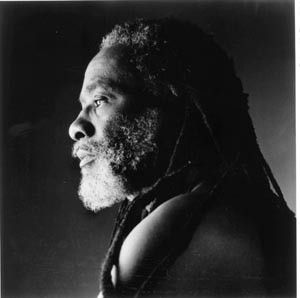
Walter “Wolfman” Washington

0

Howlin’ Wolf

“Wolfman” Washington comes knockin’

By Alan Sculley

WALTER “WOLFMAN” Washington spent most of the ’90s with his music career in limbo in the United States. In the early ’90s, singer, songwriter, and guitarist Washington, 57, had stepped up to a major label, signing with Point Blank, a label owned by Virgin Records. But the bluesman’s lone CD for the label, Sada, came and went with little notice, and he was not retained by the label.

Instead, Washington found himself struggling through much of the decade to keep his career afloat while he tried to find a new record deal.

Blue Moon Rising, a CD Washington had recorded in the early ’90’s was finally picked up for release in 1995 by a small European record label. But the CD was never issued in America. It wasn’t until 1997, when Washington re-signed with Rounder Records–the label that had originally signed him in the mid-’80s–and released the CD, Funk Is in the House, that his stateside fans finally got a new batch of music.

Washington certainly didn’t intend to have such a long gap between studio records. But at least when he did get to release a CD in America he felt he returned in peak form.

“Just within the last two or three years, say, the music really started changing to the point where you can hear the tightness,” Washington says. Much of the reason for the musical cohesion is because of the development of Washington’s six-man backing group, the Roadmasters. Unlike many solo artists whose bands seem like easy-to-replace hired guns, Washington clearly views the Roadmasters as an integral part of his musical team. The involvement of the band members is obvious just by looking at the songwriting credits on Funk Is in the House.

“If they’re going to be playing the music, they’ve got to be [involved],” Washington says. “Some cats, they just tell the band you play that and you play this. But I give them a chance to express themselves. Of course, it kind of helps me, too, to understand who I’m working with and the type of people, the potential that they have. If the cats feel all they do is just play music and not be involved, you feel like left out, in a sense.”

Further evidence of the Roadmasters’ impact on Washington’s sound can be heard in the performances on the Funk Is in the House CD. Washington and the Roadmasters show off their blues and soul chops on a cover of Ray Charles’ “Mary Ann,” while on “Wolf Funk” Washington’s guitar playing adds a strong jazz accent to the funky foundation provided by the other musicians.

MEANWHILE, on bluesy soul ballads like the Washington-penned “When the Answer Is Clear” and Jerry Butler’s “I Stand Accused” the Roadmasters give Washington a sympathetic backdrop to showcase his rich vocals. Washington understands the importance of his band, in part because he spent a large part of his career as a sideman himself. And his mentor, singer Johnny Adams, wasn’t shy about sharing his knowledge with Washington and giving the guitarist a strong voice in the music Adams recorded. Washington had met the singer early in his career.

Adams, in fact, helped Washington, who had just quit the 12th grade, to get his first steady gig as a guitarist in the house band at the Dew Drop Inn in New Orleans. The house band backed a number of national acts that were booked to play at the club. One of those stars, Lee Dorsey (who was on a roll behind the hit singles “Ride Your Pony” and “Working in a Coal Mine”), gave Washington his first taste of life as a touring musician when in the early ’60s Dorsey hired the guitarist for his touring band.

For two and a half years, Washington backed Dorsey at theater and festival shows around the world.

After leaving Dorsey’s band, Washington did stints with R&B diva Irma Thomas and others. In the early 1970s, he also began working again with Adams, a partnership that lasted nearly 20 years. Washington served as a featured player on such critically acclaimed Adams albums as From the Heart (1984), Room with a View of the Blues (1987), and Walking on a Tightrope (1989). During this period, he also began fronting bands as a solo artist in his own right.

ON TOUR, Washington and his band would play an opening set and then back the acclaimed singer during Adams’ headlining sets. “Johnny helped me out a lot,” Washington recalls. “When I was out with Lee, all I did was play music. And so when I came back, Johnny asked me if I could sing. He heard me singing. He said, ‘Man, why don’t you come by the house sometime and I’ll show you how to utilize your voice?’–you know, like in ranges and hearing what you can do with your voice and how you can make different notes and sounds and hear yourself how you want to sing things.

“It took a while for me to find that, but after a while it just came natural.”

In the mid ’80s, Washington decided it was time for him to step up his career as a solo artist and bandleader in earnest. He continued to record with Adams, but having signed with Rounder Records (the label for which Adams recorded), Washington shifted his focus toward his own career. Three albums released on Rounder–Wolf Tracks (1986), Out of the Dark (1988), and Wolf at the Door (1991)–earned Washington praise for his unique blend of New Orleans funk, soul, and blues, and his talents as an expressive guitarist and singer established him as a promising force on the blues scene.

“This time I’m staying with Rounder,” Washington explains. “I’m not going to be venturing all over. It seems to be working pretty good for me.”

Walter “Wolfman” Washington performs Tuesday, Jan. 25, at 8 p.m. Dominic’s Ristorante, 3600 Stony Point Road, Santa Rosa. Tickets are $8 in advance, $10 at the door. 584-8803.

From the January 20-26, 2000 issue of the Sonoma County Independent.

© Metro Publishing Inc.
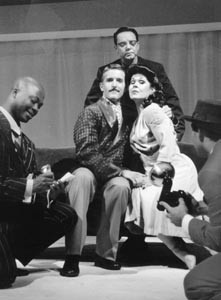
‘Private Eyes’

0

Private Eyes.

Undercover

‘Private Eyes’ offers intriguing puzzles

By Daedalus Howell

PLAYWRIGHT Steven Dietz’s romantic comedy qua detective play Private Eyes marches to the beat of a different conundrum. Marking an estimable debut for director Dodds Delzell, Actors’ Theatre’s production is canny, sexy proof that a love triangle can have more than three sides.

Nebbish actor Matthew (Peter Downey) suspects his mercurial actress wife, Lisa (Danielle Cain), is having an affair with their British director, Adrian (Steven Abbott). To complicate matters, the three are in the midst of rehearsing a play penned by Adrian depicting an affair not dissimilar to the one possibly at hand.

Matthew’s jealous probing of the situation is aided and abetted by Cory (Beverly Bartels), who might be a private eye, a jilted wife posing as a private eye, or even a jilted wife posing as a private eye who is working undercover as a waitress at a restaurant that might just be a rehearsal set within the characters’ own play. Whew.

Peeling back the onion, skin of Private Eyes’ various potential realities is Matthew’s psychiatrist Frank (Kristina Poe), whose analysis of the play’s events also begins to feel uncomfortably deceptive.

Dietz’s work is a play within a play to the nth degree. Its dramatic pauses are more pregnant than a Russian nesting doll. Imagine Borges with gags. Fantastic leaps of theatrical logic abound, and nary a scene passes without some order of revelation spawning yet another meta-reality. Here, the space-time continuum is compressed into either a seamless Möbius strip or an entangled Gordian knot, depending on one’s attitude.

Director Delzell excels, however, at navigating Dietz’s labyrinthine turns and succeeds at staging an evocative and challenging work that’s hilarious to boot.

Downey is superb as the suspicious husband who can no longer discern if his convictions are real, rehearsed, or simply idle patter to pass the time on the therapist’s couch. Cain, too, turns in a compelling portrayal as his wayward wife with a high-energy performance that is devilishly crisp.

Likewise, Abbott does a fine turn as Adrian, the starchy auteur gone adulterer, delivering a number of the show’s best lines, including “Honesty shouldn’t be an afterthought, it should be a last resort.”

Poe does well with her portrayal of the sober shrink and is a welcome ballast to the general insanity that begins to cloud the plot. But it’s Bartels’ scene-stealing sleuth Cory who accounts for much of the play’s laugh-out-loud moments. Replete with an impenetrable poker-faced air and Lauren Bacall-esque purr, Bartels lays it on deliciously thick with her sledgehammer delivery of lines like “I prefer dick” when discussing her professional title or when she downs a stolen single-serve bottle of airplane brandy in one sultry swig.

Ron Bartels’ set design, composed of slanted walls adorned in mahogany wainscoting, is reminiscent of an M.C. Escher print–the perfect model for this production. Astute listeners will note that sound designer Amy Curley culls her soundtrack from a laundry list of detective flicks.

Less of a whodunit and more of a “who’s-doing-who?,” Actor’s Theatre’s production of Private Eyes is both a delightful, highbrow romp through a dressing-room looking glass and an entertaining evening of theater.

Private Eyes plays through Feb. 19 at 8 p.m. on Thursdays, Fridays, and Saturdays and at 2 p.m. on Sundays, at Actors’ Theatre, Luther Burbank Center, 50 Mark West Springs Road, Santa Rosa. $10-$15. 523-4185.

From the January 20-26, 2000 issue of the Sonoma County Independent.

© Metro Publishing Inc.
Chai

0

High on Chai

Indian drink adapts to U.S. market

By Marina Wolf

I CALLED DIRECTORY assistance the other day to get the phone number of a chai company in Santa Cruz. We were doing OK until we hit the second part of the name. “Chai. Is that C-H-I…?” No, ma’am. It’s not “chia” (watch it sprout!) or chi (good energy, though) or chi-chi (all right, maybe a little bit of that). It’s just chai, the spicy, milky hot drink that hit the cafe scene in the mid-’90s and hasn’t let up.

In recent years, sales have steadily increased, growing 30 percent a year to reach a projected $22 million in 1999. And there are more than a hundred American chai companies, offering not only “traditional” masala, or spiced chai, but also brews with a decidedly American twist: decaf chai, green-tea chai (get those anti-oxidants), ginseng chai, herbal chai, chocolate chai. It comes in bulk blends, tea bags, or in concentrate to froth, nuke, or otherwise heat with whole milk, or soy milk, or skim milk, or water.

Spiced chai has come a long way from the boiled beverage that is poured out in countless households, street stands, and train stations throughout northern India. The chaiwallahs, or chai purveyors, keep it low-tech: coarsely crushed black tea leaves, a dose of ground spices, milk, and water, boiled until thick and murky and served in cups that could be Styrofoam or cheaply fired clay, but that always are disposable.

THIS SIMPLE preparation captured the senses of visiting Americans, who came to India in the Peace Corps or as visitors to ashrams or just as subcontinental tourists. Back home in the states, so the legend goes, chai flowed through the underground, riding on the wave of all things Indian. Take Masala Chai, the company I was looking up in Santa Cruz. Founder Raphael Reuben acquired the taste for chai at an ashram in upstate New York in the early ’70s and began selling a packaged chai blend in 1980.

Masala Chai and other early chai pioneers may have started a trend in more ways than one. “[Raphael] Americanized the recipe,” says co-owner Susan Beardsley. “Eastern versions never have all these spices. Usually they only have one or two. And they’re a lot sweeter.” The Masala Chai mix is sold largely to the health-food market, says Beardsley, so the mix is even less sweet than other American commercial brands.

On this point opinions vary; some say the American chai is much sweeter and creamier than its Indian ancestor. But for sure it’s less savory. Fresh Cup, a trade publication for specialty coffee and tea purveyors, reports that many versions produced for U.S. markets have reduced or eliminated the measure of savory spices–fennel, aniseed, and the peppercorns that are key to a really biting blend. It’s just one small step away from chai’s ayurvedic origins, in which a balance of spices is meant to support the body’s own inner balance, and one giant step toward making complex Indian spicing more accessible to an American audience. What’s left is very American: sweet spices, like cinnamon, cardamom, cloves, and ginger, and warm milkiness that many of us never seem to outgrow.

Deaf Dog Coffee in Petaluma has been serving chai since it opened more than three years ago; in two years its use has almost doubled. “It’s still only 2 or 3 percent of our sales, but we go through an awful lot of containers,” says Deaf Dog co-owner Liz Salisbury. Manager Gail Finne reports that she still gets some people asking about the drink, but others seem quite comfortable with it: “We’re getting more people asking for straight chai.”

Ugh.

Normally, chai mix is blended half and half with milk or a milk analog such as soy milk. But Americans have been quick to make chai their own. In Chai: The Spice Tea of India (Storey Books, 1999), author Diana Rosen and her contributors propose chai cocoa, mocha chai, and such cocktails as toddies; and just about every cafe has its own specialties. A’Roma Roasters in Santa Rosa, for example, offers chai milkshakes and what they call a ‘chai spritzer”: chai mixed with fresh-squeezed lemonade.

Owner Dayna Irvine says they had been making their own chai up until a year ago, when they switched to a concentrate from Oregon Chai, a Portland-based company whose mixes are among the most popular for cafe owners. “In order to prepare chai from scratch properly, you need to boil it over the stove,” says Irvine. “We just couldn’t keep up with the demand.”

Then there are those who will always make chai from scratch. The manager at Sizzling Tandoor confirmed that they make their own chai (and sounded bemused, if not somewhat offended, at even being asked). Their recipe was more a process than a recipe. “Black tea, cardamom, cloves, cinnamon stick, ground up,” he listed carefully. “Boil it, put in sugar and whole milk, boil again.” How long does the whole thing take? “About 15 or 20 minutes.”

OK, EVEN A SLACKER cafe can steam up a chai from a mix faster than that. And though chai, in its native country, is meant as a relaxing drink with friends and family, we could only expect that Americans would want their chai hot and fast. But, as with all things in a convenience pack, one has to wonder how far chai has moved from its original state. I don’t know the answer; I’ve never been to India.

But I am inclined to doubt the translation between a soot-covered station and a sanitized espresso counter.

There are more than just miles between the two.

Chai Try

IN THE INTEREST of experimentation, I thought I’d do a taste test on homemade chai and chai mix from a container. I mixed the home brew from a recipe in Chai: The Spiced Tea of India (“Diana’s Favorite Chai,” on page 33, if you want to look it up) and had my lovely and capable assistant mix and nuke the chai concentrate, Mountain Chai from Celestial Seasonings. Here was the process for both:

From Scratch

Locate cardamom–10 minutes.

Locate moldy ginger, scrape until acceptable–5 minutes.

Place cardamom and other whole spices in pan with water and bring to boil, then lower heat and simmer–7 minutes.

Rip open tea bags to measure (the recipe called for Assam, but I’m sure the chaiwallahs would love the convenience of Lipton. Oh, and each tea bag holds a teaspoon)–3 minutes.

Sweep up spilled tea–2 minutes.

Add milk and sugar to spice blend and heat to almost boiling–1 minute.

Turn off heat, add loose tea, stir, and let sit for 3 minutes.

Strain tea and wipe cup–1 minute.

Total: 32 minutes.

Mix

Fill cup halfway with concentrate, fill rest of way with milk, nuke until hot.

Total: 3 minutes.

Results of blind taste: The chai mix had great aroma, but not as much flavor in the mouth, certainly not as much as some of the blends I’ve had in cafes. They must be adding something extra. It also was not nearly as sweet as the home brew, which I found quite satisfying, maybe not 29 extra minutes’ worth, but certainly enough to really wrap up that home-cooked Indian meal right. My assistant called the homemade chai “curiously stronger” and said she would be more likely to choose a chai mix for an evening’s worth of drinking.

From the January 20-26, 2000 issue of the Sonoma County Independent.

© Metro Publishing Inc.
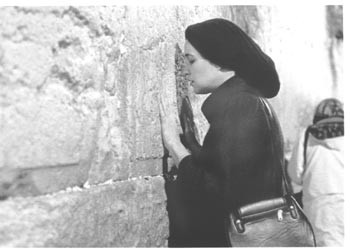
Small

Livin’ Large

In a global era, why we hunger to be small

By Richard Rodriguez

IN THE LAST DAYS OF 1999, Americans had many reasons to feel big. We were in outer space, repairing a telescope to peer into infinity. On Earth we were the world’s superpower. On Wall Street, money piled on money. And we were masters of a technology that promised the world: anything you might want, any time of the day.

But even while Americans were feeling very big, there were signs that an alternate mood was abroad in the land–call it a hunger for small.

The darkest side of that yearning has been most obvious among the white loners who are united in the forest against the complicated idea of America. More routinely, at American high schools, as we learned from Columbine High, the cafeteria is separated into camps, even while the student body grows spectacularly varied.

Is it possible that the more global, the larger our lives become, the more we will yearn for the small? Will there be more Quebecs, as there are more North America Free Trade Agreements? More chapters of the Crips and the Bloods, as that abstraction we call Southern California extends into the desert?

Parents purchase their son a computer for Christmas. They tell themselves they are giving their child the world; in real time, they are giving him solitude. The child ends up alone in his room, entering chat rooms where he meets people just like himself.

The loudest advertisers of bigness, of course, have been the cyber-rich. They are rich, out of all proportion to the rest of us. In the age of big, they are gigantic.

Last month, Jeff Bezos, founder of Amazon.com, Time magazine’s Man of the Year, was telling us he envisions a retail operation that can offer nearly anything we might ever want. The fawning media never asked Mr. Bezos about the loneliness computers make some people feel–and why it is that the primary business of e-retailing has been pornography.

No matter. In the age of bigness, hype replaces insight. Gossip replaces news. The people who matter are celebrities, people of no matter. And the wisest in the land are billionaires.

Indeed, a recent survey found that a majority of American teenagers expect to be millionaires in their lives. No economics teacher, apparently, has gotten around to teaching them about inflation: What happens to your million dollars when everyone else is a millionaire?

In San Francisco, studio apartments currently go at $2,500 a month in my neighborhood. The “utility vehicles” get larger and larger, look like tanks. But there’s no place to park.

I know a 20-year-old who has maybe $30 million. Trouble is, he can’t find an apartment. He wants Pacific Heights and a view of the Golden Gate Bridge. He has $2.1 million to spend on the place. There is nothing available at that price.

Suddenly, there are signs of a counter-mood, call it a New Bohemianism, in favor of small. A few weeks ago, you could see it, albeit masked, on the streets of Seattle, during the World Trade Organization meeting. Inside the hotels, business executives and government ministers talked global trade. Outside, self-styled “anarchists” took aim at Starbucks. Those masked strangers in Seattle were, in some cases, communards, but they were, I suspect, also children of the American suburb.

They are the ragged edge of a broader middle-class discontent with the large–with sprawl, and the loss of the intimate scale.

Tom Wolfe, the novelist, observes that, driving along a freeway, the way one knows one has left one town and entered another is by the repetition of store signs: Gap; Ross; Costco.

I SPEAK HERE not as a neutral. In 1999, the small bookstore in San Francisco in which I was a partner closed its doors. The usual reasons–the superstores and e-retailing. The odd thing, the interesting thing, was that at the party we gave for our customers, several hundred people came and not a few of them wept, wept openly, at the loss of a place downtown where their faces were recognized and their idiosyncratic tastes were remembered, by human beings.

Real estate developers are not oblivious to the hunger for intimate scale. Recently they have been building malls that resemble faux main streets. Politicians, meanwhile, are speaking of “open spaces,” trying to placate an impatience as the traffic slows to three miles an hour.

Who would have guessed that, at the end of a century given to bigness, a daughter of California, Butterfly, would perch in the upper branches of a redwood tree for two years to protect it from being cut down? When she finally relinquished her vigil she was weeping and she knelt to kiss the tree’s ancient roots.

In October, I was at an environmentalist meeting in Denver where the entire day was spent talking about the necessity for claiming vast parts of the West as “wilderness.” What struck me was that the participants were clearly the winners in today’s global economy: The women wore Chanel; the men wore handmade cowboy boots.

There is in the environmental movement, at its very heart, some desire to reverse our relationship with nature. There is a desire to protect nature, so that nature in another way might loom over us.

BESTSELLING BOOKS are written these days about great storms at sea. It’s as though, at a time when we have trained Moby Dick to jump for our amusement at Sea World, we yearn to fear the sea. We want to feel small, at sea.

The very rich are spending many thousands of dollars to climb Mt. Everest. Not-so-rich teenagers, devotees of “extreme sports,” take their boards and their ropes to the snow or to the water or cliff’s edge. They talk about the exhilaration of falling.

We are left with this paradox: Never have Americans had so many reasons to feel themselves gigantic upon the earth; never have so many Americans wanted to feel themselves dwarfed on the earth.

All during the New Year, I kept thinking of Jonathan Swift’s 18th-century satire Gulliver’s Travels. In one chapter, Gulliver wakes up to find himself a giant in the world. In another, he finds himself tiny.

Thus did 1999 come to an end with a strange mixture of mood. With all the talk of the stock market and technology, there was also the knowledge that a lone hacker could penetrate big business, big government, and our own home computer. With all the talk of globalism, there was also the knowledge that we live in a borderless world, defenseless against a lone terrorist.

In the end, big and small are ratios, each in relationship to the other. California, for example, has more gated communities than any other state, at the same time that California is melting into a global society with the highest rate of miscegenation of any state in the mainland United States. Small creates big and vice versa.

We are going to have to learn how to balance the two. We are going to have to learn how to balance globalism with the need for an address.

If we continue living in an America that’s publicly given only to the big, we may end up alone, while our children sit in their rooms at computers, in a country owned by three corporations, and threatened always by a hacker who may be our daughter.

This article originated with the Pacific News Service. PNS editor Richard Rodriguez, author of Hunger of Memory, writes on culture for Harper’s, the Los Angeles Times, and the News Hour with Jim Lehrer.

From the January 20-26, 2000 issue of the Sonoma County Independent.

© Metro Publishing Inc.

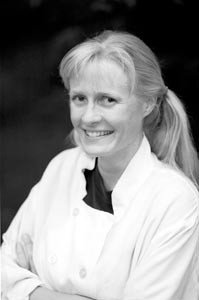
Sue Murphy

0


Murphy’s Law

Comic Sue Murphy savors the spotlight

By Paula Harris

FUNNYWOMAN Sue Murphy is ticked. She’s waging her own personal battle with cyberspace–and so far the Web is winning. Case in point: Just try looking up this stand-up celebrity and television comedian (she just appeared on Late Night with David Letterman) on an Internet search engine and what do you get?

Sure, there are scads of websites–but most are related to Sue Murphy, a real estate agent in New England. Other sites refer to another female comic named Sue Costello who played the TV role of a waitress/stand-up comedian named (what else?) “Sue Murphy” in the short-lived sitcom Costello.

It’s all rather confusing.

Finally, there are the sites about our Sue Murphy, the observational comic who grew up in Menlo Park in the South Bay and now lives in Los Angeles. But Murphy laments these are filled with none-too-useful snippets of misinformation and ancient jokes.

The quip that crops up most online goes: “You know when you walk into a room and can’t remember what you walked in for? Do you realize this is how dogs spend their lives?”

Murphy doesn’t care to have it repeated to her. “That’s so old,” she groans over the telephone. “It’s the oldest joke I’ve ever written, and for some reason that keeps getting quoted. You know how the Internet just has a tendency to repeat itself and things get cycled through and cycled through and become extremely irrelevant? It’s very interesting to me.”

Murphy, 40-ish and single, with a kicky short haircut and large, expressive eyes, is talking from her Los Angeles pad. Lauryn Hill croons in the background while Murphy chats and fiddles with her computer.

This is just a short break in the popular comedian’s hectic schedule. The following day she will head to Sacramento for stand-up gig at Punchline. Then, on Friday, Jan. 28, Murphy hosts the “Battle of the Comedy Titans”–a comedy show at the Luther Burbank Center–which will feature past San Francisco Comedy Competition winners Vinnie Favorito and Don Friesen.

Murphy, a former actor, never intended to be a comic herself. She transitioned into stand-up via the world of theater. During the golden years of San Francisco comedy, she worked as a team with Dan St. Paul, whom she met when both acted in a play.

In 1989, when Murphy had just started branching out in stand-up solo, she placed sixth in the fabled San Francisco Comedy Competition, which has helped launch several heavy-hitting comedic careers, including those of Marsha Warfield and Robin Williams.

Murphy’s live shows are now in high demand. She has also appeared in a multitude of stand-up comedy shows and sitcoms on TV, and currently has her own half-hour special airing on Comedy Central. In addition, she’s a regular on the Tonight Show and is the voice of the wisecracking Latara in the ABC Saturday morning cartoon Ewoks.

Murphy says she cannot describe her comedic style. “I just be myself, like any good comedian. I believe you have to be true to yourself,” she says.

So where does she get the inspiration for her act? “I probably will talk about this [interview],” she says with a sudden, explosive chuckle. “Actually I’m inspired by everything–anything that happens. I can be getting my gift with purchase at the Clinique counter. I have about 10 minutes on Cinnabons right now because of a particular event at the Cinnabon stand in Chicago O’Hare Airport.”

Like fellow female comedian Paula Poundstone, Murphy does not think of herself in terms of being a woman comic. “If you’re funny, you’re funny,” she explains. “Obviously, I’m female and I have a certain point of view that must be affected by that in some degree. I agree with Paula completely in that I think she and I are similar in the way that we don’t necessarily only talk about our experiences from a female point of view–it’s just about living your life.”

Right this second, Murphy is living her life by pounding on the computer and announcing her latest project in the battle with cyberspace–the creation of her own website. “It’s not going to be a fancy website but just a vehicle for getting the right information over,” she says. There’s nothing that makes me more angry than misinformation.”

DESPITE her complaints about cyberspace, Murphy can’t be all that mad at technology since she offers to e-mail over a few new jokes, which appear almost instantly: “Las Vegas is promoting itself as a family vacation spot. Because you know what kids like . . . hookers and pawn shops,” says one.

“How did I end up owning so much crap? I know at one point on my life I owned a futon and a bong and I was happy,” says another.

This second quip must kind of ring true for Murphy, who describes herself as “an organizational fool.”

“You have to be when you’re living in a million different places at one time. I’m feeling a little overwhelmed because as I look around I realize I’ve got a lot to organize,” she sighs. “The last three weeks have just been so enormously busy–my house has turned into my purse.”

Still, Murphy thrives on all the activity. “What’s great about doing stand-up is that it’s always an ongoing, growing, changing, interesting thing and always current for me,” she explains. “It’s always about where you are now, and for me, what I did five years ago is so irrelevant to what I’m doing now, so it’s always changing and always interesting.”

The sound of computer keys are evident once again as Murphy muses about her future website, which is currently under construction. “I can’t use ‘suemurphy.com’ because of the woman who’s a real estate agent in New England–and I don’t think she’s going to sell me her address,” she says.

“But my site is coming to a computer near you soon,” she adds excitedly.

Suddenly Murphy checks the time and has to go. Meet people. Write material. Design a website. Get organized.

Any final comedic comments to leave us with? “Actually, I’m not a comedian–I’m a real estate agent in New England,” she deadpans. “I just like to fly into Santa Rosa and fake comedy in between four-bedroom-two-bath sales. . . . It’s a shoddy ruse, but I’m trying to pull it off.”

Sue Murphy hosts “The Best of the San Francisco Comedy Competition” on Friday, Jan. 28, at 8 p.m. at the Luther Burbank Center, 50 Mark West Springs Road, Santa Rosa. Tickets are $21.50-$24.50. For details, call 546-3600.

From the January 20-26, 2000 issue of the Sonoma County Independent.

© Metro Publishing Inc.
‘Fantasia 2000’

0

Nose to Nose

Humor expert Allen Klein on life, death, happy endings, and ‘Fantasia 2000’

Writer David Templeton takes interesting people to interesting movies in his ongoing quest for the ultimate post-film conversation. This is not a movie review; rather, it’s a freewheeling, tangential discussion of life, alternative ideas, and popular culture.

I’M LATE–and that’s just the beginning of it. Having sprinted several blocks along the streets of San Francisco after playing “Where’s Waldo?” with local parking spaces, I’m nearly hit by a speeding bike messenger as I cross the street to enter Metreon, the cavernous new high-tech entertainment complex. Pulling my daughter’s jingling, multicolored jester’s cap from my backpack, I reluctantly slip the thing onto my head and start searching for a tall, bearded fellow wearing a clown nose.

That will be Allen Klein. A best-selling author (The Courage to Laugh, The Healing Power of Humor, and others) and public speaker, Klein is known in certain circles as a “jolly-tologist.” Having never met before, however, we’ve settled on this whimsical hat-and-nose recognition system by which Klein–who is no stranger to either whimsy or clown noses–and I will be able to find each other.

The system works, although by the time I get there Klein is merely holding his nose in his hand.

“I was wearing it for a while,” he says, laughing, as we snap up our tickets and scamper, bells jangling, toward the immense Imax theater, where Fantasia 2000–recently released in 75 Imax theaters around the world–has just begun.

An update of Walt Disney’s classic 1940 animated spectacle, this new version features all-new segments of animation set to rousing classical music: a pod of whales cavort amid Antarctic icebergs, then take unexpected flight among the rolling clouds, set to Ottorino Respighi’s soaring Pines of Rome. Donald Duck helps Noah fill the ark as Edward Elgar’s Pomp and Circumstance thunders by, and Hans Christian Andersen’s classic story “The Steadfast Tin Soldier” springs to Disney-fied life with the Allegro from Dmitri Shostakovich’s Piano Concerto No. 2. Finally, as Igor Stravinsky’s manic-depressive Firebird Suite plays on, the sprite-ish spirit of spring rises from her winter sleep and awakens the earth, is chased and destroyed by the lava-spewing spirit of fire, and finally rises from death to bring life once more to the world.

“What an incredible experience,” sighs Klein, as we make our way from the theater. “I admit I was feeling a bit rushed and tense there, but the moment I sat down and saw those whales and the little funny baby whale–it all just melted away.”

KLEIN, WHO SPENDS his weekends at his “other home” in Sebastopol, knows a thing or two about the influence of art and humor on the human mind and emotions. A sought-after expert on the healing powers of laughter, Klein has handed out thousands of clown noses at his seminars. A former art director for the Captain Kangaroo Show, in the ’60s, Klein says his knack for whimsy changed his life after the death of his wife in the early ’70s. It was his wife’s ability to laugh at tragedy, even during her illness, that inspired Klein to return to college for a degree in human development, with an emphasis on humor. He was soon asked to write and speak on the subject.

“Suddenly,” he explains, “I was a jolly-tologist.”

As we discuss Fantasia 2000 over lunch, I mention my one quibble with the film: the ending of “The Steadfast Tin Soldier” segment, significantly altered from Hans Christian Andersen’s bittersweet original. In this one, the tin soldier wins the heart of the ballerina doll and defeats the evil jack-in-the-box; in the original, both the soldier and the doll perish in the fireplace–leaving only a small tin heart in the next morning’s ashes.

“Well, happy endings are important,” Klein says. “Granted, I never read the original story, but I was satisfied with the ending of this one.”

Klein even believes that fiction’s happy endings can be healing.

“Happy endings have an incredible power,” he says, “a power that can help get people through difficult times. We can look at a movie think, ‘Hey, my life is kind of terrible, but maybe there’s a reason to hope, maybe a happy ending is around the corner, maybe if I keep going, things will turn around for me–like they did for the person in the movie.’ ”

“Yet there are those who would argue that happy endings give us a false expectation that everything will turn out wonderfully,” I reply. “Beyond movies and books, is there really any such thing as a happy ending?”

“Well, when my wife died she was 34,” Klein says. “Until then I’d always thought, ‘Here’s the woman I’m going to spend my life with.’ My daughter was 10, and suddenly we’re dealing with a terminal illness, and then we’re dealing with someone’s death at an early age, and suddenly I feel that I’m alone in the world with a 10-year-old daughter to raise.

“I couldn’t see any happy ending to that story.

“But I had to force myself to say, ‘There’s got to be something else to this story,’ ” Klein recalls. “So what am I supposed to do with my life now?’ I know it’s cliché-ish, but good things often come out of bad.

“You know, the real truth is,” says Klein, reaching into his pocket to present me with my very own clown nose, “that there are no endings–happy or otherwise. Life is not a movie or a short story or a novel, with a final reel or a final page. I may die, but the story continues without me.

“We saw that today in the movie, in the last sequence,” he reminds me. “The big fire, total destruction, and yet there was a rebirth of life. Life, death, and birth, and life–our story keeps on going.

“I don’t know about you, but I’m pretty happy about that.”

From the January 20-26, 2000 issue of the Sonoma County Independent.

© Metro Publishing Inc.

Housing Crunch

0

Labor of love: Susan Ohlson, pictured with her dog Caspian, helped transform a couple of acres of bare ground in Santa Rosa into a neighborhood for low-income families, with supervision by the Burbank Housing Development Corp.

Time but No Money

Sweating for the American Dream –sweat equity builds a local following

By Yosha Bourgea

WHEN SUSAN OHLSON started building her house, she had no experience in carpentry and knew nothing about construction. But she didn’t let that stop her. “I had no clue how to do this,” Ohlson says. “But my attitude was, OK, well, I’m going to learn.”

In May of 1998, the Santa Rosa neighborhood of De Turk Commons was nothing but a couple of acres of bare soil and 32 low-income families, most of whom, like Ohlson, were new to the construction business. But they shared the dream of owning their own homes, and the willingness to help one another build them from the ground up. Under the supervision of the Burbank Housing Development Corp. in Santa Rosa, they began to make their dream a reality.

“The first couple of weeks, we didn’t have any idea what we were doing. There was a lot of shoveling of dirt,” Ohlson recalls. Soon, the family crews began laying the foundations, tying rebar, and driving stakes. Everyone learned to move quickly when the cement trucks arrived. Even on days when rain threatened to dampen enthusiasm, the work continued.

Ohlson discovered that she had a knack for framing the structure of the houses. As she placed two-by-fours and installed floor joists for the second story, the process of building her home became a labor of love.

“I was able early on in the project to submit changes,” Ohlson says. “I changed a hallway closet into a kitchen pantry. Instead of a sliding glass door off the kitchen, I put in French doors.”

It would have been nearly impossible for Ohlson, a secretary and single mother, to work the required minimum of 30 hours a week on her own. Fortunately, she had assistance from her 19-year-old son, Holland, and from what she calls her “church family,” fellow members of City Life Fellowship who volunteered their time on weekends.

At the end of last May, crews completed construction on the houses of De Turk Commons, and the residents finally moved in. A grateful Ohlson hosted a dinner of thanks for the 20 or so volunteers who had perspired on her behalf. After a year of hard work, she had what so many people struggle for: a house of her own.

“SWEAT EQUITY” is the somewhat undignified term for an arrangement whereby prospective homeowners can work off part of the cost of a house by helping to build it. John Lowry, executive director of Burbank Housing, prefers the term “mutual self-help housing,” although he acknowledges that it’s less catchy.

“We emphasize the mutual aspect of the program,” Lowry says. “It seems important to me that people have some investment in the house that makes them feel attached to it. If people are just handed a house, they may not behave like homeowners. This program provides an experience for them, an emotional equity. It also tends to weed out the people who are not willing to do the work.”

Since 1986, Burbank Housing has supervised the completion of 11 self-help projects throughout Sonoma County, with a total of 287 housing units. Three more projects in Santa Rosa, Windsor, and Cloverdale are slated to begin within the next two years. Quarry Ridge, a Healdsburg project, has halted construction until further notice because of a delay in funding.

Lower-income, first-time home buyers who qualify for the self-help program are required to put in at least 30 hours of construction labor per week per family, although many families choose to do more. A down payment is not required. Included in the package is a deferred payment second loan that does not need to be paid off unless the home is sold again. Most participating families have insufficient income to qualify for even a 5 percent loan in the conventional housing market.

De Turk home buyers wound up with reduced first mortgages averaging $115,000, which, at a 5 percent rate offered through the California Housing Financing Agency, translates to monthly mortgage payments of about $600. In contrast, the same houses in the conventional market would have had a first mortgage of about $140,000, a higher rate–about 7 percent–and a monthly mortgage payment of some $900.

In a red-hot housing market that is quickly moving out of the reach of low- and moderate-income families, these subsidies often can make all the difference for families with limited financial resources–if they are willing to commit to as much as a year of manual labor. Under the technical supervision of Burbank Housing employees, families work together pouring foundations, putting in siding, roofing, installing windowsills and baseboards, hanging doors and cabinets. Roxanne Trujillo, Ohlson’s friend and next-door neighbor at De Turk Commons, says she learned to use a powersaw while building her house.

“They don’t need to have construction skills, although, of course, we’re delighted when we find anyone who does,” Lowry says.

What participating families do need to have is a good credit rating and low debt obligations. In many cases, particularly in rural developments, that means Mexican-American immigrants–farmworkers who are much less likely to have bad credit than whites in the same income range. Mexican-Americans also are more likely to have two-parent families, making it easier for them to meet the labor requirements.

“Most [white families] we work with don’t seem to have trouble living near minorities,” Lowry says, “but quite a few of them are uncomfortable with becoming a minority–that is, being the only white family on their block.”

THE RELATIVELY RECENT history of self-help housing in America actually begins with minorities. In 1964, a group of Quakers in the San Joaquin Valley sat down with local Mexican-American farmworkers and asked them what it was that they wanted most. The workers’ most frequent response came as a surprise: not higher wages, not improved working conditions, but a place they could call their own. In response, the Quakers began searching for ways to make home ownership affordable to low-income families. The following year, they incorporated Self Help Enterprises, the first self-help housing organization in the country.

Today there are 10 groups in the state of California that offer sweat equity programs. Burbank Housing is the only such group in Sonoma County.

One reason that self-help housing is not more widespread is that it isn’t a moneymaking concept. Burbank Housing, a non-profit corporation, covers most of its costs through other projects, including conventional rental housing. The costs of development for self-help housing programs are so high in relation to values that the market remains far from lucrative.

“It’s the same dilemma that private builders face [when they’re] trying to do low-end first-time home buying,” Lowry says. “If you were very efficient, you could do nothing but sweat equity and cover your costs. But it would be tough.”

A more subtle obstacle is the cultural standard by which Americans judge their houses, particularly houses they own. Renting a house in a crowded urban neighborhood is one thing, but who wants to spend 30 years making mortgage payments on one?

“We have a much greater expectation of what homes should be than other cultures,” Lowry says. “[In America] the expectation is that you need to have a garage and you need to have individual road access.”

Burbank Housing has what is probably the highest-density self-help program in the country. Although many prospective home buyers feel the need for privacy and plenty of space, that ideal is becoming more and more difficult to achieve. In the rapidly escalating local housing market, finding an affordable house–any house–is a challenge.

“A single family lot is a luxury in Sonoma County,” Lowry says.

TODAY, THE HOUSES of De Turk Commons are still noticeably newer than the ones across the street. The new paint gleams in the winter sunlight; in each front yard, a young tree is tied to a wooden stake. “The neighborhood is much quieter than I thought it would be,” says Ohlson, scooping up her shih tzu, Caspian, from the front lawn. “There are lots of small kids, but they’re very well behaved. The neighbors are just wonderful.”

Inside, the house is surprisingly spacious. At the top of the carpeted staircase are three bedrooms, including a guest room that Ohlson will convert into a sewing room next year. Warm sun streams through the south-facing windows.

Although the tree out front has just begun to sink its roots, Ohlson plans to watch it grow for a long time. The house is her son’s inheritance, something she hopes will remain in the family for generations. In a way, it’s also a gift to herself.

“I don’t know if I could just walk in and buy a house after having had this experience,” Ohlson says. “I know how this house was put together. I’ve always been a renter, and whenever I had a problem I had to call the landlord.

“I’ve got the education now, where I know how to do the stuff myself.”

To be placed on the Burbank Housing mailing list for upcoming sweat equity projects, call Mariella Zapata at 573-5902.

From the January 20-26, 2000 issue of the Sonoma County Independent.

© Metro Publishing Inc.

Slamfest 2000

By Natalie Sibert Freitas

SINCE THE DAYS when Alice Cooper started playing with snakes on stage, metal and all its mutations have held tight to a dedicated following. Now, metal madness seems to be on the upsurge again in Sonoma County.

On Thursday, Jan. 27, Rumors nightclub will host its first metal mania event with Slamfest 2000, a show featuring eight Northern California bands.

Patrick Warner of Aurora Sound is teaming up with Hedge-hog Productions to co-present the event, which he hopes will pump new energy into Sonoma County’s metal scene. “There has always been a steady interest in metal shows,” Warner says. “My hope is to renew the scene as it was back in the days of Magnolia’s and the Cotati Cabaret, when bands like Ice and Parallax played.”

Among the bands that will take the Slamfest stage are Spitkiss; Ripstoke, which plays a Black Sabbath-style of music; Sonoma County’s longest running metal masters, Skitzo; and the Heat Creeps, who offer a fast mix of punk, rockabilly, and metal.

“All of the bands have a very good stage presence, which was a huge motivation for selecting them,” Warner says.

From the January 20-26, 2000 issue of the Sonoma County Independent.

© Metro Publishing Inc.

‘Mating Cries’

0

Mating Cries.

True Beauty

‘Mating Cries’ merits love at first sight

By Daedalus Howell

LADIES AND GENTLEMEN, a dynamic duo of thespians has descended upon local stages–award-winning theater veterans Conrad Bishop and Elizabeth Fuller are making a new home in Sebastopol. As a respite from a national tour, the lifelong collaborators are bringing Mating Cries, their suite of six original micro-plays exploring the slings and eros of amour, to their new home for a single weekend.

Judging from a mid-January performance in San Francisco, Mating Cries is a splendid brew of art and love, delivering a hearty serving of wit, insight, and stagecraft sure to arouse even the most curmudgeonly paramour.

From the get-go, Bishop and Fuller’s sparkling onstage chemistry is awesomely apparent–imagine an Elaine May and Mike Nichols for the west county set. Opening the production is the charming playlet “Dreamers,” in which the couple trade punchy epigrams about love, loaded with such suggestive gems as Fuller’s line “I want a bouquet of lovers–but they wilt.”

Later, “The Dreamers” finds Bishop and Fuller parsing the personal ads of a mismatched couple, whose sheer loneliness hastens compromise of their ideals. Though this is well-trodden territory for parody, Bishop and Fuller offer new and satisfying gags and provide insight into how far a heart will bend before it breaks.

The weak link in Bishop and Fuller’s otherwise brawny theatrical chain is their first-act closer, “Freeway,” which gets caught on the rough shoulder of an overwrought “highway-of-life” metaphor. It’s the tale of garrulous newlyweds represented by grotesque puppets who ride through a series of pap platitudes until, mercifully, they wreck and die.

Though the first act dead-ends in “Freeway,” Bishop and Fuller come roaring back full throttle in the second act with “At the Prom with Kali,” which finds an Omaha teenager going stag at his senior prom until he cuts the rug with the Hindu goddess of destruction. The deadpan setup is worth a chuckle, but the story take a fulfilling tack as the young lover becomes mired in his harrowing erotic tryst.

The equally satisfying “Transcripts” finds a pair of typists in the midst of their labors while Fuller’s lovesick character realizes her internal musings about her colleague are somehow bleeding into their shoptalk.

Bishop and Fuller are versatile performers, but they’re also crackerjack playwrights, as indicated by their deft retelling of the Greek myth of “Baucis and Philemon.” The story–in which an aged couple show hospitality to a couple of gods disguised as mortals who reward them by turning them into intertwining trees–is a bittersweet exploration of lifelong love.

The production values in Mating Cries are a study in economy–the sets and props are minimal, the music is spare, and the costumes are merely suggestive. In lieu of spectacle, however, Bishop and Fuller offer the eloquence of their performances and the comic profundity of their text.

As they suggest in their program, “Erotic bonding is often difficult in this world we’ve created, but nevertheless, it’s a really good idea.” That sentiment applies equally to Mating Cries.

Mating Cries plays on Friday and Saturday, Jan. 21 and 22, at 8 p.m. at the Subud Center, 234 Hutchins St., Sebastopol. $10-$15. 824-4307.

From the January 20-26, 2000 issue of the Sonoma County Independent.

© Metro Publishing Inc.

Usual Suspects

New info on Tim Smith's spending sprees By Greg Cahill RECENTLY OBTAINED state documents reveal new details about numerous "questionable" campaign contributions in connection to a 1998 probe of Sonoma County Supervisor Tim Smith. The documents paint the picture of a career politician who frequently has sought campaign contributions and charged expenses to his campaign committee,...

Walter “Wolfman” Washington

Howlin' Wolf "Wolfman" Washington comes knockin' By Alan Sculley WALTER "WOLFMAN" Washington spent most of the '90s with his music career in limbo in the United States. In the early '90s, singer, songwriter, and guitarist Washington, 57, had stepped up to a major label, signing with Point Blank, a label owned...

‘Private Eyes’

Private Eyes. Undercover 'Private Eyes' offers intriguing puzzles By Daedalus Howell PLAYWRIGHT Steven Dietz's romantic comedy qua detective play Private Eyes marches to the beat of a different conundrum. Marking an estimable debut for director Dodds Delzell, Actors' Theatre's production is canny, sexy proof that a love triangle can have...

Chai

High on Chai Indian drink adapts to U.S. market By Marina Wolf I CALLED DIRECTORY assistance the other day to get the phone number of a chai company in Santa Cruz. We were doing OK until we hit the second part of the name. "Chai. Is that C-H-I...?" No, ma'am. It's...

Small

Livin' Large In a global era, why we hunger to be small By Richard Rodriguez IN THE LAST DAYS OF 1999, Americans had many reasons to feel big. We were in outer space, repairing a telescope to peer into infinity. On Earth we were the world's superpower. On Wall Street, money...

Sue Murphy

Murphy's Law Comic Sue Murphy savors the spotlight By Paula Harris FUNNYWOMAN Sue Murphy is ticked. She's waging her own personal battle with cyberspace--and so far the Web is winning. Case in point: Just try looking up this stand-up celebrity and television comedian (she just appeared on Late Night with...

‘Fantasia 2000’

Nose to Nose Humor expert Allen Klein on life, death, happy endings, and 'Fantasia 2000' Writer David Templeton takes interesting people to interesting movies in his ongoing quest for the ultimate post-film conversation. This is not a movie review; rather, it's a freewheeling, tangential discussion of life, alternative ideas, and...

Housing Crunch

Labor of love: Susan Ohlson, pictured with her dog Caspian, helped transform a couple of acres of bare ground in Santa Rosa into a neighborhood for low-income families, with supervision by the Burbank Housing Development Corp. Time but No Money Sweating for the American Dream --sweat equity builds a local...

Slamfest 2000

By Natalie Sibert Freitas SINCE THE DAYS when Alice Cooper started playing with snakes on stage, metal and all its mutations have held tight to a dedicated following. Now, metal madness seems to be on the upsurge again in Sonoma County. On Thursday, Jan. 27, Rumors nightclub will host its first metal mania event...

‘Mating Cries’

Mating Cries. True Beauty 'Mating Cries' merits love at first sight By Daedalus Howell LADIES AND GENTLEMEN, a dynamic duo of thespians has descended upon local stages--award-winning theater veterans Conrad Bishop and Elizabeth Fuller are making a new home in Sebastopol. As a respite from a national tour, the...
11,084FansLike
4,446FollowersFollow
6,928FollowersFollow
