Chairman Sarris

0

Depending on present company, Graton Rancheria chairman Greg Sarris might be seen as one of Sonoma County’s few public intellectuals, as a champion of American Indian rights or as the big bad wolf behind one of California’s largest casino projects. Originally, Sarris said that “casinos are not in the picture” for the tribe’s plans, but with groundbreaking almost complete for a planned casino in Rohnert Park, his stance has obviously changed.

Sarris refuses to talk with media about the deal’s plans and potential impact, but it’s clear that the casino has the potential to alter the landscape of Sonoma County—some say for good, some say for worse. Yearly revenues are projected to be around $300 million with 15,000 cars entering and exiting the parking lots each day. The tribe will give some of that money back through the Community Benefit Fund, and Sonoma County is said to receive up to $38 million per year for the county’s parks and open spaces and other environmental purposes.

Sarris first received renown as a writer. His short story collection Grand Avenue, which takes Santa Rosa as setting, received acclaim when it was published in 1995. In addition to chairman and casino responsibilities, Sarris holds an endowed chair in Native American studies at SSU, and teaches classes in creative writing, American literature and American Indian literature. Greg Sarris speaks on Wednesday, Nov. 7, at Santa Rosa Junior College in the Bertolini Student Activities Center, Room 4608. 1501 Mendocino Ave., Santa Rosa. 2pm. Free; $4 parking fee. 707.527.4647.

Share Alike

Last month, my son Jordan and I went to a birthday party for my retired friend who, in lieu of gifts, asked guests to bring some cool object they didn’t need anymore. These treasures were then arranged on a table, and we were instructed to write our names on sticky notes and attach them to any item that thrilled us. If you brought two things, you could take two things, and so forth.

I scored a set of 40-year-old kitchen bowls in their original box; I knew they were authentic because they were made in the U.S.A.—wow, an American flashback! The eclectic array of things inspired a lot of laughing and talking around the table (“Does this wig make me look fat?”) among mostly strangers. The most fun I had was seeing a woman claim the necklace I’d brought; her eyes got so wide you’d think she’d just found the Holy Grail of accessories. At that moment, I felt really happy. I’d made someone’s day, just by parting with one piece of stuff.

My excitement about sharing is universally human, though the so-called consumer culture denies it. People do not naturally fit in the “consumer” box that we have been shoved into. As we leave that box, we can now join a fun movement that takes us beyond the message in Annie Leonard’s 2008 video The Story of Stuff. Leonard’s to-the-point cartoon spelled out the mess that consumerism has created, and now she and her anti-waste team have partnered with two groups—the Center for the New American Dream (aka New Dream) and Yerdle—to spell out where we need to go: toward giving rather than consuming.

One expression of this value is the Giving Spree pledge for Nov. 23, otherwise known as Black Friday, considered by many the most socially isolating, stuff-consuming day of the retail year. The emerging project Yerdle is starting to mobilize people around the San Francisco Bay Area in friendly events including house parties known as Sharing Shindigs, held with friends and family.

There is also this pledge: “I pledge to join the largest ever Black Friday giving spree, Nov. 23. I will give things away via Yerdle to my friends and family. I will ask my friends and family to join me. Together we will share instead of shop this Black Friday.”

For those shy of parties, shared stuff is also being aggregated for online viewing. Doesn’t it sound better than a claustrophobic trip to the big-box store or the impersonality of Amazon?

For more, see www.yerdle.com and www.newdream.org.

Sneak Attack

0

Astonishing. Remarkable. Sinister. Those are words that come up again and again when confronting the wave of voter identification laws that has swept through more than 30 Republican-dominated state legislatures in recent years. The measures sound innocuous enough: when a voter shows up to the polls on Election Day, he or she must present valid photo ID in order to cast a ballot.

The goal, proponents say, is to combat in-person voter fraud—claiming to be someone you’re not and entering a vote in that person’s name. But study after study, including an exhaustive investigation by the Arizona State University’s Walter Cronkite School of Journalism and Mass Communication, has found almost no evidence that in-person voter fraud occurs. Culling through 5,000 documents over 10 weeks, the News21 project found only 10 cases of in-person voter fraud since 2000: about one case for every 15 million eligible voters.

What’s more, requiring state or federally issued ID at the polls has been repeatedly shown by independent analyses to impose a disproportionate burden on very specific demographics: the poor, the elderly, students and people of color.

“We’ve heard it time and time again—it really is a solution in search of a problem,” says Stephen Spaulding, Washington D.C.–based staff counsel for the nonprofit citizens’ lobby group Common Cause.

“We do have election administration problems in the country—with machines breaking down, assuring that votes are counted accurately—and we need to focus our attention there,” he says. “This threatens everyone’s right to a free and fair election.”

Barred at the Box

A symbol of what’s wrong with voter ID laws is Viviette Applewhite. At 93 years old, Applewhite is an African-American Pennsylvanian who marched with Martin Luther King Jr. and has cast her ballot in almost every election since the 1960s.

Her purse was stolen years ago, and with it her Social Security card. What’s more, since she was adopted as a child, the name on her birth certificate differs from that used on other official documents. Her adoption itself lacks any kind of record.

Under Pennsylvania’s voter ID law, which was passed in March 2012 and has since become a legal lighting rod in the battle over voting rights, Applewhite could not obtain the required identification to participate at the polls.

Her case, and the case of others similarly affected by the law, was taken up by the American Civil Liberties Union of Pennsylvania, the Advancement Project, the Public Interest Law Center of Philadelphia and the D.C.–based law firm Arnold & Porter. The lawsuit was granted a preliminary injunction, and as the case was being appealed in August, Applewhite received an ID using her 20-year-old Medicare card, proof of address and a state document affirming her name and Social Security number. (According to media reports, the process also required her to take two buses to the licensing office.)

That’s a lot of hassle to exercise a right Applewhite has enjoyed for 60 years, but she’s not alone. According to best estimates, strict voter ID laws could effectively disenfranchise millions of voters if adopted nationwide.

[page]

According to figures from the Brennan Center for Justice at New York University, as many as 11 percent of adult U.S. citizens do not have any form of government-issued photo identification, accounting for more than 21 million people. Among that group, 18 percent of citizens 65 years of age or older don’t have a government-issued photo ID (more than 6 million seniors) and, based on 2000 U.S. Census figures, more than 5.5 million African-American adults lack photo ID—a full 25 percent of eligible black voters. Meanwhile, U.S. citizens, regardless of ethnicity, age or gender, who make less than $35,000 “are more than twice as likely to lack current government-issued photo identification as those earning more than $35,000 a year,” the Brennan Center reported, adding that it means at least 15 percent of voting-age Americans in the low-income bracket lack valid ID.

On top of that, the Brennan Center found in its survey that as many as 7 percent of voting-age citizens (more than 13 million adults) don’t have ready access to documents proving their citizenship, making the process of getting valid ID all the more complicated.

“These ID laws—and this notion that they don’t impose a cost on citizens—are farcical,” said Spaulding. “We know that in some states it costs money to get documents and get an ID. There are a number of voters who are in a catch-22; they’re 90 years old, they were born at home with a midwife and they don’t have a birth certificate. There’s the expense of getting those documents, there’s the expense—especially in rural areas—of making the trip to get the ID. This notion that these IDs are ‘free’ does not pass the smell test.”

But it’s on that notion that voter ID laws have been ruled constitutional.

Indiana’s restrictive voter ID law, which is seen as the test case for similar laws nationwide, was upheld by the United States Supreme Court in 2008 because it was not found to be burdensome to voters.

“Clearly, that’s not the case,” Spaulding said.

No Coincidence

It doesn’t take much analysis to figure out the upshot of proliferating voter ID requirements: fewer seniors, students, people of color and low-wage earners at the polls. And it doesn’t take much to see which party would most benefit from a whiter, more middle-age, affluent electorate.

“I don’t think it’s a coincidence that the legislators carrying these bills are not Democrats,” said Lisa Graves, executive director of the nonprofit watchdog group Center for Media and Democracy.

According to Graves, whose organization has made voting rights a priority issue, this newest push to limit the franchise traces its roots to the 1990s and the enactment of the National Voter Registration Act, or “Motor Voter Act,” under President Bill Clinton. The measure did exactly what its name implies: made it easier for voters to register. African Americans, particularly, registered in high numbers, Graves says, prompting backlash among conservative states.

“In response to that law, Southern states started proposing changes to the laws to make it harder to register. Those bills went nowhere; they were perceived as racist and sort of languished for a number of years,” she says.

Then came the election of President George W. Bush, “and the right wing started pushing this theme of voter fraud,” Graves says. The Bush administration even tried to redirect the voting-rights section of the civil rights division to push this idea of voter fraud, she adds.

“U.S. attorneys were fired because they didn’t do enough to assert nonexistent voter fraud,” Graves says.

Despite pressure from the new Bush administration, strict voter ID laws remained few and far between, with only Indiana and Georgia enacting restrictive ID measures in 2005. But, Graves says, “these things were bubbling.”

[page]

When Barack Obama won the 2008 presidential election, it was in large part due to huge voter turnout in cities and among students and African Americans. Republicans, having lost the White House, also found their party losing ground in state legislatures. According to data compiled by News21, 62 voter ID bills have been introduced in 37 state legislatures since 2009, with the bulk of the measures introduced or adopted in 2011 and 2012. According to the Brennan Center and News21, a handful of states have active, strict photo ID laws for voters and more than a dozen others are pending, either hung up in court, awaiting pre-clearance from the Department of Justice, or too recently enacted to be in effect.

“It’s remarkable,” says Jennie Bowser, Denver-based senior fellow with the National Conference of State Legislatures. “I’ve tracked election legislation since late 2000 and everything that happened in Florida, and I’ve never seen so many states take up a single issue in the absence of a federal mandate.”

Graves, meanwhile, fingers the culprit.

“Suddenly, the Indiana law was dusted off the shelf and put out there as a national model that every state should be pushing,” she says, “and ALEC is behind it.”

The Bill Mill

ALEC stands for the American Legislative Exchange Council, and according to some, it is nothing less than a shadow lawmaking body that draws its strength from an ocean of corporate money. If the Supreme Court ruling in Citizens United can be said to have opened the gates to corporate cash in American politics, then ALEC is trying to turn on the flood.

“ALEC isn’t simply a think tank or a gathering of lawmakers; it is a corporate-funded operation that pushes a corporate message and a conservative message,” says Graves, whose Center for Media and Democracy in July 2011 made public 800 internal documents on its website ALECExposed.org, proving ALEC’s cloaked hand in crafting “model legislation” meant for introduction in statehouses around the country.

“At its core, it is a way to take some of these ideas that a think tank might fancy and operationalize them,” she says. “And I use ‘operationalize’ very purposefully.”

A call to ALEC’s media relations representative for this story went unanswered, but the organization’s ideological bent is clear. On its website, ALEC says it “works to advance the fundamental principles of free-market enterprise, limited government, and federalism at the state level through a nonpartisan public-private partnership of America’s state legislators, members of the private sector and the general public.”

Registered with the Internal Revenue Service as a 501c3 nonprofit, ALEC boasts around 2,000 member legislators—the vast majority being Republicans—who pay a nominal fee for membership, and upwards of 300 corporate and other private-sector members who pony up between $7,000 and $25,000 for the privilege of getting together with sympathetic lawmakers at lavish retreats.

Broken up into task forces focused on various aspects of public policy—from education to civil justice and the environment—ALEC members, both from the public and private sectors, get together and write model bills which are then voted on and, if ratified, carried home by ALEC legislators for introduction in their respective states.

The strategy has been successful. ALEC brags on its website that each year about a thousand pieces of ALEC-written or ALEC-inspired model legislation ends up getting introduced in the states, with an average 20 percent becoming law.

Despite this, and even though the organization has been active for nearly 40 years—it was established in 1973 by arch-conservative Paul Weyrich, who also cofounded the Heritage Foundation—ALEC has remained largely under the radar. Nonetheless, its impact on policy in the states reads like a greatest hits compilation of the most controversial bills in recent history, from changes to U.S. gun laws like Florida’s “stand your ground” legislation made infamous by the Trayvon Martin shooting, to state-based efforts at overturning or circumventing the Affordable Care Act, to recent measures limiting the powers of teachers’ unions and handing portions of student instruction over to for-profit education companies. Even Arizona’s hotly contested immigration law, SB 1070, started life as an ALEC-approved “model” bill.

“There’s a whole set of bills that are advancing that corporate agenda to privatize prisons, privatize education, and by privatize I mean profitize,” said Graves.

[page]

Profit Above All

According to figures from ALEC’s own IRS filings from 2007 to 2009, made public by CMD, the organization raked in more than $21.6 million from corporations (with members including Exxon Mobil, Altria, GlaxoSmithKline and Pfizer); institutions like the Charles G. Koch Charitable Foundation; and nonprofits including the NRA, the Goldwater Institute and the Family Research Council. In all, private-sector contributions account for nearly 98 percent of ALEC’s funding, while the dues paid by member lawmakers, pegged at about $50, came to just more than $250,000, or about 1 percent of its haul during the same time period.

In exchange for these hefty—though tax-deductible donations—ALEC’s private-sector members get to ensure that individual pieces of ALEC legislation, by and large, serve a narrow band of very specific corporate interests: education measures benefit for-profit education firms and harm unions; healthcare measures benefit insurance companies and drug manufacturers; tort reforms benefit corporations in general by limiting their liability to consumers.

More “insidious,” as Graves put it, is ALEC’s drive against voting rights.

“It’s deeply cynical and quite sinister—an outlandish effort by ALEC and others to make it harder for Americans to vote,” she says. “At the end of the day, depending on which analysis you’re looking at, it’s possible that these measures remove maybe 1 percent from the pool of votes that would be part of the election. You still have an election, but you’ve shaved off this percentage; you have the appearance that you have an election.”

If voting rights get in the way, well, as notorious mob accountant Otto Berman once said, “Nothing personal. It’s just business.”

“I think it is a little more class-oriented,” says Alexander Keyssar, professor of history and social policy at the Harvard Kennedy School and a frequent speaker and writer on voting-rights issues.

“The core interest in the suppression that’s going on is partisan, it’s not racial,” he says. “If African Americans voted predominately Republican, or 50–50 Republican, I don’t think their neighborhoods would be targeted for suppressive efforts. I think that it’s a community that now votes 95 percent Democrat, and if you want to knock out Democrat interests, that’s a good place to start.”

Live Review: The One Island Tour at Hopmonk, Sebastopol

Despite the rain, crowds filled Hopmonk’s Abbey last week for Monday Night Edutainment’s first big show of the fall season. For more than a decade, the weekly dance party has been introducing Sonoma County to reggae’s freshest bands and MCs. But it is loyalty to the genre’s biggest international stars that consistently fills the house.

One Island Tour 2012
Photo by Christopher Harris

Edutainment’s WBLK production crew resumed their tradition of booking excellent talent with a three-band lineup. What’s more, Hopmonk had their first opportunity to debut a giant translucent tent covering the entire back patio. With the rain falling lightly outside, it was just another NorCal summer night inside the glowing dome.

Headlining was Caribbean band Bambú Station from the Virgin Island of St. Croix. They are currently touring as one half of The One Island Tour, a 16-city West Coast run with Maui’s InnaVision. The two linked up with the opener Ancestree, a reggae festival favorite based in Santa Cruz.

What Music is Like at the World Series

0


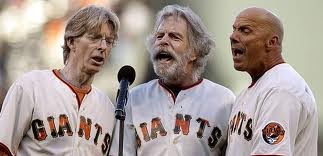
The first thing we notice walking into the ballpark for Game One of the World Series? The music, of course. “Friend of the Devil” is playing over the PA, which isn’t surprising, considering the Grateful Dead are still revered in San Francisco and Giants third-base coach Tim Flannery is a huge deadhead. Here he is singing the national anthem with Bob Weir and Phil Lesh in the NLCS—you gotta love that fist-pump by Lesh—but even in the offseason, Flannery plays with his band, the Lunatic Fringe, sometimes in benefit appearances for Bryan Stow and sometimes just for the hell of it. Flannery’s been a musician since a young age. “When I was young,” he says, “I thought I was John Denver.” I love Flannery for his gutsiness and smarts when it comes to, say, sending Buster Posey home against all apparent odds, but you gotta love him for his laid-back life off the field too.
Pomp and regalia are in full bloom at the ballpark, with bunting draped over every level’s banister and, after batting practice, old-time organ music: “Good Day Sunshine,” “Wait ‘Til the Sun Shines, Nellie,” and others played in that inimitable ballpark style. We thought it might be Dave “Baby” Cortez and his Happy Organ, who made a comeback last year, but nope—here’s a shout out Steve Hogan, the Giants organist who sits up there near the huge Coke bottle in left field and waits for instructions from the sound manager over whether to play “Charge” or “Jaws.” Watch this dry little video about his day-to-day task of tickling the Hammond, and try to tell me it isn’t the best job in baseball.
In the lead-up to the game, the PA represents both teams: “Sing a Simple Song” by Sly and the Family Stone, from San Francisco, and “White Trash Party” by Eminem, from Detroit. (Neutral parties are given “Intro” by the xx, among the best manifestations of bland neutrality since the “chillout” craze.) The way that Sly Stone has crashed and burned in recent years decades, this might not be the best talisman of hope for the Giants, but not exactly to the Tigers’ benefit, either, since the Eminem song celebrates, uh, tramp stamps.

Oct. 27 and Oct. 28: Zombie Walk at Copperfield’s Books

0

mitt-romney-zombies.jpg

The cool thing about zombies is you can get totally creative with them. For example, last year my Halloween costume was Zombie Laura Ingalls. The costuming possibilities abound! Zombie Buster Posey! Zombie Mitt Romney! Zombie Beyoncé! In honor of Halloween, Copperfield’s Books hosts two Zombie Walks through Petaluma and Sebastopol, where people have permission to terrorize humans in the farmers market and lumber through town moaning, “Brains! Brains!” Make sure to stay for the party afterwards and get some treats and maybe an award or two. The zombies walk on Saturday, Oct. 27, at Copperfield’s Petaluma (140 Kentucky St., Petaluma; 2pm. 707.762.0563) and Sunday, Oct. 28, at Copperfield’s Sebastopol (176 N. Main St., Sebastopol; 11am; 707.823.2618).

Oct. 26: John Mayall at the Uptown Theatre

0

John_Mayall.jpg

The music scene in 1965 London must have been a mind-blowing thing to witness. That’s when Peter Green, Eric Clapton, Keith Richards and Steve Winwood began to discover the blues of American greats like John Lee Hooker, Sonny Boy Williamson, Buddy Guy and the like. John Mayall, with his vicious multi-instrumentalist talents and ear for the blues, was at the head of the pack. Just listen to the classic album John Mayall’s Bluesbreakers with Eric Clapton and be transported back to a bloody good musical epoch. At almost 80 years of age, Mayall continues to rock the stage, backed up by decades of experience. He plays Friday, Oct. 26, at the Uptown Theatre. 1350 Third St., Napa. $30—$35. 8pm. 707.259.0123.

Oct. 25: Glenn Matlock at 19 Broadway

0

glen-matlock1_2217734b.jpg

There’s no argument against the fact that in the realms of punk-rock history, the Sex Pistols were super-important. Glenn Matlock was the bass player until he was kicked out in 1977, replaced by Sid Vicious. More than 30 years later, he continues to tour as “Glenn Matlock of the Sex Pistols.” Interestingly, PiL, Johnny Rotten’s “other band,” plays the same night in San Francisco. Perfect opportunity for a clandestine, midnight Pistols reunion at the midway point of the Golden Gate Bridge! Glenn Matlock shows off punk rock’s ancient history on Thursday, Oct. 25, at 19 Broadway. 17 Broadway Blvd., Fairfax. $10—$12. 9pm. 415.459.1091.

Oct. 25: Daniel Coshnear at the River Reader

0

051.jpg

Learning about the closing of another independent bookstore is one of the most heartbreaking things to hear as a book lover. So it’s with heavy heart that we watch the River Reader, Guerneville’s only independent bookstore, shut its doors at the end of October. “Despite my best efforts and your support, I am going to have to close,” says Susan Ryan, the store’s proprietor. Fortunately, October events will go as planned, including a reading by Daniel Coshnear, award-winning Guerneville writer whose latest collection, Occupy and Other Stories, is out this month on Kelly’s Cove Press. Coshnear reads Thursday, Oct. 25, at the River Reader. 16355 Main St., Guerneville. 7pm. Free. 707.869.2240.

Kernel of Wisdom

As the Obama administration improves school-lunch guidelines, replacing frozen pizzas with vegetables, the predictable response from the right is something akin to “Wah! Gimme back my Cheetos!”

Absurdly, conservative politicians are defending students’ right to eat junk in school cafeterias, an organized tantrum that Mother Jones dubs the “Tater Tot rebellion.” But aside from the predictable preference that kids (and politicians funded by processed-food purveyors) seem to have for junk over good food, children and adults alike may unknowingly be fighting for the right to fuel an addiction triggered by wheat.

The dark side of wheat is explored by physician William Davis in Wheat Belly: Lose the Wheat, Lose the Weight, and Find Your Path Back to Health. In the wake of so many low-carb diet books, the title made me suspect that the book would be no more revolutionary than the USDA’s recently (and slightly) improved plate symbol replacing the nutritionally incorrect, industry-derived food pyramid. But I was wrong.

Davis does not advise simply reducing our intake of carbs. Instead, his message amounts to an absolute avoidance of wheat products, doctor’s orders. When wheat is eliminated, weight loss is merely a happy outcome of a much more critical achievement: conquered addiction and reduced threat of disease, ranging from diabetes and heart disease to arthritis and irritable bowel syndrome.

Many are susceptible to the demon in wheat, says Davis, not only those with gluten sensitivity. Davis himself was once among the victims of wheat’s dark agent, gliadin. A protein component of gluten, gliadin is like bread lover’s heroin; it breaks down during digestion into polypeptides that hook up with opiate receptors in the brain. The result is addiction and a triggered desire for carbohydrates.

Davis claims that what many consider a sweet tooth is actually a wheat tooth (and, due to cross-breeding, a rye tooth as well); it’s the gliadin in the wheat (and now rye) that leads the compulsive charge back to the doughnut box. Succumbing to addictive cravings for more carbs leads to obesity and to spikes in blood sugar that can ultimately result in diabetes and a host of related health problems.

In present political food fights over cafeteria lunches in a nation where child obesity is epidemic, I’d like to see Davis’ research placed squarely on the table.

Chairman Sarris

Depending on present company, Graton Rancheria chairman Greg Sarris might be seen as one of Sonoma County's few public intellectuals, as a champion of American Indian rights or as the big bad wolf behind one of California's largest casino projects. Originally, Sarris said that "casinos are not in the picture" for the tribe's plans, but with groundbreaking almost complete...

Share Alike

Giving sprees pledged for Nov. 23

Sneak Attack

How big business wants to shrink the electorate

Live Review: The One Island Tour at Hopmonk, Sebastopol

Despite the rain, crowds filled Hopmonk’s Abbey last week for Monday Night Edutainment’s first big show of the fall season. For more than a decade, the weekly dance party has been introducing Sonoma County to reggae’s freshest bands and MCs. But it is loyalty to the genre’s biggest international stars that consistently fills the house. Photo by Christopher...

What Music is Like at the World Series

The first thing we notice walking into the ballpark for Game One of the World Series? The music, of course. "Friend of the Devil" is playing over the PA, which isn't surprising, considering the Grateful Dead are still revered in San Francisco and Giants third-base coach Tim Flannery is a huge deadhead. Here he is singing the national anthem...

Oct. 27 and Oct. 28: Zombie Walk at Copperfield’s Books

The cool thing about zombies is you can get totally creative with them. For example, last year my Halloween costume was Zombie Laura Ingalls. The costuming possibilities abound! Zombie Buster Posey! Zombie Mitt Romney! Zombie Beyoncé! In honor of Halloween, Copperfield’s Books hosts two Zombie Walks through Petaluma and Sebastopol, where people have permission to terrorize humans in the...

Oct. 26: John Mayall at the Uptown Theatre

The music scene in 1965 London must have been a mind-blowing thing to witness. That’s when Peter Green, Eric Clapton, Keith Richards and Steve Winwood began to discover the blues of American greats like John Lee Hooker, Sonny Boy Williamson, Buddy Guy and the like. John Mayall, with his vicious multi-instrumentalist talents and ear for the blues, was at...

Oct. 25: Glenn Matlock at 19 Broadway

There’s no argument against the fact that in the realms of punk-rock history, the Sex Pistols were super-important. Glenn Matlock was the bass player until he was kicked out in 1977, replaced by Sid Vicious. More than 30 years later, he continues to tour as “Glenn Matlock of the Sex Pistols.” Interestingly, PiL, Johnny Rotten’s “other band,” plays the...

Oct. 25: Daniel Coshnear at the River Reader

Learning about the closing of another independent bookstore is one of the most heartbreaking things to hear as a book lover. So it’s with heavy heart that we watch the River Reader, Guerneville’s only independent bookstore, shut its doors at the end of October. “Despite my best efforts and your support, I am going to have to close,” says...

Kernel of Wisdom

Author William Davis stalks the demon in wheat
11,084FansLike
4,446FollowersFollow
6,928FollowersFollow