
Usual Suspects

Women’s Justice Center fires new salvo at SRPD

By Greg Cahill

DESPITE an official study of charges that the Santa Rosa Police Department mishandled seven cases last year involving violence against women and children, a local women’s advocate is charging that city hall has failed to address adequately an alleged cover-up and “police defensiveness” over the issue.

Those claims, raised by victims’ advocate Marie De Santis of the Women’s Justice Center, were first brought to the attention of the Santa Rosa City Council in an Aug. 24 letter that detailed seven cases, all involving Spanish-speaking victims.

“This is the kind of snowballing of critical life problems that overtakes victims when police deny services,” wrote De Santis in a Jan. 1 letter to Santa Rosa officials. “It is something we see on a daily basis, because police denial of protection and justice is so common, especially in the minority communities we serve.

“The regular denial of protection, combined with police’s incurable cover-ups of complaints, is a deadly mix for the women and children of Santa Rosa.”

De Santis wants an independent review of the Police Department’s handling of the cases. Santa Rosa–like most other North Bay communities, with the exception of Novato–has no civilian police review board. Dunbaugh and Santa Rosa City Council members oppose the formation of such a review board.

In one of the disputed cases, De Santis charges, the detective assigned to investigate a child molestation report “dumped” the case, failing to contact the mother of the 14-year-old victim and accepting the girl’s contention that there was no need to pursue the perpetrator because the multiple felony sex crimes had stopped. Further investigations, following complaints from advocates, led to a conviction in the case. In another, the actions of officers allegedly resulted in the suicide of an estranged spouse who was the subject of a court-invoked restraining order that De Santis says should have led to the victim’s arrest and safekeeping. In yet a third, a Santa Rosa woman claims to have been beaten by a police officer after the victim returned home to find her son in handcuffs. According to De Santis, the victim attempted to file a complaint with the District Attorney’s Office, which subsequently referred the case to the state Attorney General’s Office.

In her Aug. 24 letter, De Santis asked the City Council to instruct Santa Rosa Police Chief Michael Dunbaugh to refrain from contacting the state prosecutor assigned to the case so that Dunbaugh could not “in any way attempt to forestall, obstruct, or influence” the progress of the investigation.

Dunbaugh–who last fall dismissed allegations that the department has mishandled the cases–has said he welcomes such criticism. “We’re always open to evaluations about what we’re doing, right, wrong, or indifferent,” he said, during a phone interview when the charges first came to light. “We accept them and follow through.”

In response to the Aug. 24 letter, Dunbaugh has scheduled a March 14 meeting with community leaders to discuss complaints that the department has failed to provide adequate translation services to non-English-speaking victims of sexual assault. According to De Santis, the department routinely enlists bilingual family members, roommates, and neighbors to translate testimony from victims of rape and other sex crimes. That practice, she says, inhibits traumatized victims from filing a complaint.

“The more [the victim] holds back, the less work the officer has to do,” says De Santis. The police just haven’t taken this issue very seriously yet.

Police records obtained by the Women’s Justice Center through a public records disclosure found that, while police dispatcher frequently use an ATT subscription service that offers translations in 77 languages, officers in the field seldom utilize the service.

Meanwhile, De Santis adds, eight more Spanish-speaking women stepped forward between August and January to register their dissatisfaction with the way their cases were handled by the SRPD. Several more have contacted the Women’s Justice Center in the past few weeks.

THIS IS NOT the first time that social justice advocates have butted heads with the SRPD. In 1998, complaints about eight police-involved deaths–including several in Santa Rosa–led to public hearings on the matter by the U.S. Commission on Civil Rights.

The commission’s report, released last May, noted that panel members were “appalled” by the police-involved deaths of eight people over the 25-month period leading up to the commission’s packed public hearing. “The Advisory Committee agrees with community spokespersons who said that the number of events should be cause for alarm for all citizens of the county,” the report stated.

The civil rights panel recommended that the Sonoma County Board of Supervisors and the Santa Rosa and Rohnert Park city councils create independent civilian review boards with the power to, among other things, investigate police-involved shootings or alleged misconduct; promote improved procedures for filing a citizen complaint; encourage increased ethnic, gender, and language diversity in law enforcement ranks; and support better training in cultural diversity and handling of domestic violence cases and of suspects experiencing psychiatric and drug- or alcohol-induced episodes.

Santa Rosa Mayor Janet Condron was quick to denounce the report. At an April 21 press conference, Condron asked, “Is [independent civilian review] really what’s needed in this community? We don’t think so.”

Others disagree. “This report is important,” Judith Volkart, attorney and former chair of the Sonoma County chapter of the American Civil Liberties Union, said at the time. “It’s the first time an outside group not affiliated with local law enforcement has focused on the pattern of police behavior and the pattern of mistrust in the community, and listened to everyone.

“These are the recommendations, and we need to pay attention–it’s everyone’s responsibility.”

Usual Suspects loves tips. Email us at Su******@******an.com

From the February 22-28, 2001 issue of the Northern California Bohemian.

© Metro Publishing Inc.

World Social Forum

Going Global

Dispatches from the World Social Forum

By Kenny Bruno

“UM OUTRO mundo é possível.”–Another world is possible. That’s the slogan of the World Social Forum under way here in Porto Alegre, Brazil, in early February. Or, as they said in Seattle, “This is what democracy looks like.” While thousands chanted that slogan in Seattle, Washington, D.C., Chiang Mai, Melbourne, and Prague, they were being tear-gassed, pre-emptively arrested, harassed, and generally denied their rights by an enormous show of state force on behalf of undemocratic international institutions.

In Porto Alegre, this is what democracy looks like: During a march of thousands against neoliberalism I counted 10 police officers. When 200 Brazilian anarchists broke off from the march to throw white paint on a McDonald’s, about six police stood by.

The next day, an ex-cop explained it this way, “We police were instructed to form partnerships with the social movements.” By comparison, Davos, Switzerland, where the World Economic Forum is meeting this week, has become a fortress.

Porto Alegre is an appropriate setting for the World Social Forum, while authorities have shut down the roads to Davos, deported activists, and banned marches. In Porto Alegre, the governor of the state of Rio Grande do Sul, gave the opening speech. In fact, his government was a major funder of the forum.

In Porto Alegre, this is what democracy looks like: Hundreds of young people are camping nearby–apparently without ever sleeping–virtually without police presence.

This is what democracy looks like: Participatory budgeting. For 12 years, Porto Alegre’s budget has been decided by hundreds of well-organized community and worker groups.

This is what democracy looks like: There is no corporate sponsorship of the World Social Forum. No ads telling us how sustainable Shell is, or how clean Dow is, or how concerned for the poor Philip Morris is. No Nike swooshes. Just a few banners for the national bank of Brazil, saying “It’s better because it’s ours.” The most ubiquitous logo around is that of the Workers’ Party, on flags everywhere.

In Porto Alegre, this is what democracy looks like: Lots of meetings and lots of talking. The humid rooms, overpacked with people listening for the umpteenth hour to plans to stop new free-trade agreements and for models for local economic democracy.

This is what democracy looks like: There are lots of unionized workers present. The state of Rio Grande do Sul has twice as many union members as the national average.

This is what democracy looks like: The entire state of Rio Grande do Sul has been declared GMO-free, although some Roundup Ready soy has been smuggled in from Argentina, according to one knowledgeable government official from Brasilia. Two days ago activists traveled with French farmer/activist José Bové four hours out of Porto Alegre to tear up a few illegal acres of Monsanto’s Roundup Ready Franken-soy.

THE WORLD SOCIAL Forum is the first significant post-Seattle gathering where the goal is not to disrupt the meetings of undemocratic institutions, in what has become a series of traveling protests. Rather it is a space for activists to think, talk, and imagine another world–a more just, democratic world.

The anticorporate globalization movement has come to “an important stage in the counteroffensive that began in Seattle,” says Walden Bello, executive director of Thailand-based Focus on the Global South.

Naturally, the rhetoric of democracy in Porto Alegre cannot be transferred everywhere, especially not to the United States. In the opening ceremony, during introductions of the 120 countries represented by delegates, Cuba received the loudest ovation, while the United States and Israel got a smattering of boos. There is occasionally a flavor of old-style leftism that sounds irrelevant to most U.S. ears.

And, as one should expect in a gathering as large and diverse as this one, there are significant differences of opinion on policy and strategy. For example, some participants are working to incorporate social and environmental clauses into the WTO; others insist there must be no new round of the WTO.

Nevertheless, the overall feeling here is of fresh air coming into the debate over globalization, especially compared with the stale rhetoric in Davos. From Porto Alegre, the concept that a gathering of the rich and powerful is the answer for the poor and dispossessed, that the World Economic Forum has somehow transformed itself into a global poverty program, seems too absurd to bother debunking.

Yet neither is the Social Forum a poverty program. And that is one of the most refreshing aspects of the gathering. It is not about money. It’s not about growth, “sustainable” or otherwise. It’s not even really about development–a concept that has perhaps been hopelessly perverted by institutions like the World Economic Forum and the World Bank. Still, economic issues are prominent in the discussions here.

Rather the forum is about democracy. Not the democracy that comes from more money and therefore more choices of things to buy, but rather the democracy of participation in local and societywide economic decisions. This is the democracy that corporate globalization gazes so harshly on.

Even the most ardent supporters of the current form of globalization acknowledge that it is a web of powerful and unaccountable forces. They say the best we can do, as individuals and as nations, is to prepare ourselves to flourish in this lightning-fast, hyper-competitive world, grabbing what we can for ourselves–mobility, wealth, markets, computers.

THE FOLKS HERE would not be interested in this individualistic and competitive vision of society, even if the powerful institutions controlling globalization were to reduce the inequities and provide a safety net for those left out.

There are many challenges for the World Social Forum. Midway through the gathering, participants had not decided where, when, and if there will be another one (it seems likely). Nor had they settled on producing a statement or manifesto (it seems unlikely). Activists must stay alert to the co-optation of our language and ideas by the World Economic Forum, by the WTO, and by the World Bank. We must improve the democratic process within the Social Forum–to include more students, more non-Brazilians, more indigenous people, and others. We must make sure to keep the momentum that started with the explosion in Seattle.

Seattle was the pivotal moment in the first plank of this complex movement–protest and resistance. Porto Alegre will, I believe, come to be seen as an important step in moving forward the second part: innovation and alternatives.

It is important that many protesters have gone to Davos to continue to expose the injustice of the World Economic Forum. But I’m glad I came to Porto Alegre. As Walden Bello, a veteran of Davos meetings, says, “Davos is the past. Porto Alegre is the future.”

And the present is a collective dream of the thousands gathered here: Um outro mundo é possível.

Kenny Bruno is a research associate at ‘Corporate Watch,’ where this article first appeared.

From the February 22-28, 2001 issue of the Northern California Bohemian.

© Metro Publishing Inc.

Mose Allison

0

Sly Sage

Mose Allison slips into the Mystic

By Greg Cahill

“Y OU KNOW, I used to joke in interviews, whenever a reporter would ask me how long I’m going to keep playing music, that I’m going to get myself a Gray Panthers punk-rock band and retire in Arizona. So I wrote that into a song lyric once,” says 73-year-old jazz great Mose Allison, in a rich Southern drawl, during a phone call from his Long Island home. “Then I found out that there already is a Gray Panthers punk-rock band in Arizona. It’s called One Foot in the Grave.

“That’s the trouble when you write songs and hold them–the weird stuff comes true.”

And “the weird stuff” has come steadily over the years. Allison, an unflappable Mississippi native, is known for a laconic wit that fans revere for its hipster philosophy but that some critics confuse with cynicism. “It’s erroneous,” he says of that perception. “They don’t get it. My songs usually have a joke in them. To me, it’s a form of humor. A lot of them are ironic–the ironic couplet, that’s my staple weapon.

“But cynical is the last thing that I am.”

You need only listen to the newly released The Mose Chronicles: Live in London, Vol. 1 (Blue Note), his latest–recorded last year with bassist Roy Babbington and drummer Mark Taylor–to grasp his point. It’s an energetic showcase for Allison’s trademark laid-back phrasing and sly wit, with songs ranging from his own “If You Only Knew” and “Everybody’s Crying Mercy” to J. D. Loudermilk’s “You Call It Jogging” and Willie Dixon’s “I Love the Life I Live.”

His patented lyrical twists have earned Allison–who last year marked his 50th anniversary as a performer–a loyal cadre of fans, including some of the music industry’s biggest names. In 1970, the Who included his anthemic “Young Boy Blues” on their classic Live at Leeds (MCA)–one of just a few cover tunes the iconoclastic British rockers ever recorded. Indeed, the list of those who have tapped the Mose Allison songbook is impressive: Bonnie Raitt (“Everybody’s Cryin’ Mercy”); John Mayall (“Parchman Farm”); Van Morrison (“If You Only Knew”); the Clash (“Look Here”); and the Yardbirds (“I’m Not Talking”), among others.

In 1994, a pair of retrospectives hit the racks: Allison Wonderland–The Mose Allison Anthology (Rhino) and High Jinks! The Mose Allison Trilogy (Columbia). In 1996, Tell Me Something: The Songs of Mose Allison (Verve)–an acclaimed tribute album featuring Mose acolytes Van Morrison, Georgie Fame, and Ben Sidran–took a scintillating romp through the master’s bluesy jazz catalog.

“My songwriting just sort of develops little by little,” Allison muses when asked about his gift. “I might write a song when I can’t sleep one night. Or I might finish another. It’s just a matter of accumulation and pulling them together.”

AS THE SON of a stride-jazz pianist, Allison took up piano lessons at age 6. In the backwater town of Tippo, Miss., he was immersed in jazz and country blues. While he’s lived on Long Island for nearly 40 years, he has retained a Southern state of mind–a condition that is evident in his breezy musical style.

“Oh, some of the things that come with [being raised in the South] are the ironic comment, the exaggeration, the understatement,” he says. “That’s just part of the way people think and speak down there, particularly in the rural areas.

“So I catch myself thinking in the idiom of my ancestors.”

He still credits the black country blues singers heard blaring on the jukebox at the small gas station near his home as among his major influences.

His first gig was playing six nights a week at a club in Lake Charles, La., in 1950. Drawn to the work of jazz pianists Nat Cole, Bud Powell, John Lewis, and Al Haig, Allison soon found himself playing with some of the fastest rising stars in the jazz world. In 1956, he moved to New York City and began playing piano with some of the emerging “cool” jazzmen, including sax players Al Cohn, Zoot Sims, Stan Getz, and Gerry Mulligan. “We used to call them ‘Lesterians,’ ” he says of those reedmen. “That was the swing thing and that was my primary motivation. I never wanted to know if a guy was a good technician or could play a lot of notes–I wanted to know if he could swing.”

It was a heady time–bohemian poets, modern artists, and even Beat writer Jack Kerouac dotted the audience at those gigs (Kerouac later recorded with Cohn and Sims), but Allison didn’t run with that crowd, preferring to stay close to his Southern roots when it came to songwriting.

The following year, Allison began singing and started his own combo. He quickly became known for his understated, idiosyncratic style that the Rough Guide to Jazz has called “a sophisticated and wry form of self-communion” and that remains his signature.

“The media like to make a big deal about me being there at the birth of the cool, but just about every good jazz player blows hot at one time and cool at another,” he laughingly says. “But I came up through the bebop era and trying to be as hip as possible and all of that. That was just part of the process of growing up as a jazz musician in America. The thing about me is that I really wanted to use the music I had heard while growing up in the South and mix it in with modern jazz.

“If I had any individuality, that’s what it was based on.”

And he has refined that blend in a manner that has earned him the title “King of Cool.” “I tell everybody that if I was in this for the money, I’d be in trouble,” says Allison, who still tours extensively and remains a legend in jazz circles. “I still get gratification out of a good performance. That’s one of my rules: a good performance is its own reward.”

Mose Allison performs, along with bassist Mel Graves and drummer George Marsh, Friday, March 2, at 8:30 p.m., at the Mystic Theater, 21 Petaluma Blvd. N., Petaluma. Tickets are $15. 707/765-2121.

From the February 22-28, 2001 issue of the Northern California Bohemian.

© Metro Publishing Inc.

Open Mic

0

Free Your Mind

By Greg Cahill

LAST WEEK, some of our newspaper racks in Guerneville and Petaluma were vandalized, the contents dumped in the trash, apparently by readers offended by the “Christianity at the Crossroads” cover story. That thought-provoking article, by longtime contributor David Templeton (who once studied for a ministerial career), related the latest work of the Santa Rosa-based Jesus Seminar, a group of scholars examining how mainstream Christianity might change over the course of the next thousand years.

(If you missed it, or if your neighborhood rack was emptied, the article can be found in our .)

This isn’t the first time our racks have been vandalized because of our coverage. And it’s not the first time we’ve upset people–from both ends of the spectrum–by tackling challenging topics. That often provokes a loud and emotionally charged response. For example, last month, we received scads of phone calls, letters, and e-mails from angry Republicans upset over Stephen Kessler’s satirical spin on George W. Bush’s inaugural speech. And we still get correspondence from North Bay progressives who disdained our opposition to Ralph Nader’s vanity campaign. And then there are those folks who just think that it is the duty of an alternative newsweekly to preach to the choir.

Not enough for some folks, too much for others.

The incident last week reminded me of a bit of wisdom that comedian Howard Hessemen passed along a few years back when I interviewed him in connection with a benefit concert for the Mill Valley-based Bread & Roses. Hessemen, best known as the burned-out radio deejay Dr. Johnny Fever on WKRP in Cincinnati, was preparing to reunite with other former members of the ’60s radical political improv comedy troupe the Committee, which also included such well-known North Bay figures as actor Peter Coyote and folksinger Mimi Farina (who had since formed Bread & Roses to bring musicians into prisons, hospitals, and other institutions).

When asked to describe his motivation for shaking things up, Hessemen simply stated his motto: Challenge your credulity. In other words, never get comfortable with your own beliefs. Stay open to new ideas. Embrace change.

The Bohemian will continue to challenge readers with its news, opinion, ideas, and arts coverage. And, hopefully, readers will hold us to that task and continue to challenge themselves as well.

‘Bohemian’ editor Greg Cahill used to make ice cream runs for the nuns at a neighboring convent.

From the February 22-28, 2001 issue of the Northern California Bohemian.

© Metro Publishing Inc.

Grocery Shopping

0

Basket Case

Of grocery carts and guessing games

By Marina Wolf

IT ONLY HAPPENED once that I can remember, and that was five or six years ago, but the details of my supermarket encounter remain as vivid as a National Enquirer point-of-sale display: I reached to pick out my usual container of cottage cheese (fortunately, I have no dieting trauma associated with it, and enjoy it with pineapple). I wanted to keep moving because I left my coat in the car and it was chilly in the dairy aisle. But the sharp-nosed older woman in a tan coat, reaching to get a box of margarine, wanted to make a point. She looked at the container in my hand and said cheerily, “You really ought to try the 1-percent cottage cheese.”

I was initially unable to fathom why this stranger was taking me to task for my choice in dairy products, but she soon made her point clear: “It tastes just fine, and, you know, it’s lower in fat.

Being new to fat liberation and the art of fat-friendly comebacks, I mumbled something like, well, this is my favorite brand, and we moved apart, a blushing large woman and a busybody who probably felt great about spreading the low-fat gospel to someone who “obviously” needed it.

Nowhere are our eating habits more exposed to public scrutiny than in grocery stores. The gleaming cages of the carts provide the illusion of containment and privacy, but the reality is that everything is hanging out for public assessment. People who wouldn’t even think about peeking in our cupboards or rummaging through our refrigerators without an invitation are free to mentally weigh out the calories, grams of fat, and menu of every product in our baskets.

“YOU ARE what you eat.” We play the game every time we look at the cart of the person in front of us and imagine to ourselves where they are going, what their plans are, what kind of person they might be. Heck, I do it, too. Five kinds of flavored potato chips, along with red-eyed laughter: duuude, don’t bogart that joint. One steak and a six-pack of Bud: lonely guy on Monday night. Turkey breast, diet cola, magazine with a half-naked anorectic on the cover: woman on a diet. It’s not such a great step from this to some buttinsky looking at my cottage cheese, looking at me, and imagining that I must be–I should be–interested in finding a low-fat alternative to my small-curd indulgence. Of course, there’s a difference between playing mental guessing games with someone else’s 10-items-or-less and offering them diet tips in the aisles. It’s the difference of intent, and of some presumption of personal involvement, and then actually saying the words.

The last time I felt people’s eyes so sharply upon my eating habits was in college, the year when I was getting food stamps. They made my penniless existence easier–and I didn’t faint anymore at work for lack of eating–but standing in line at the grocery store was a whole new experience in hostility. As I hurriedly tore out the food stamps, the food moved along the excruciatingly slow conveyor belt, getting scanned twice: once by the cashier and once by the eyes of the people behind me. It didn’t matter whether I was buying my steak (with expiring-today, 50-percent-off tags) because I was having my period and seriously craving iron, or that I just wanted some Ovaltine to sit with while I studied in my damp cellar apartment. There was no explaining.

At a deeper level, I resented then, as I do now, the idea that I need an explanation. Why does it matter how I pay? Why does it matter what my weight is? We all have to eat, and we have the right to determine what and how much we want to put into our mouths.

Of course, the grocery store has become a treacherous, confusing place for everyone, a battlefield of ads and information from food manufacturers, whose best interest is to have people feel insecure about what they eat. That way there’s always demand for products that play to those insecurities. Read the packages and you can track the dietary worry of the day. Salt raises blood pressure? Let’s offer low-sodium soups (that need more than a few grains of salt to taste good). Fiber! It’s good for what ails ya! Next thing you know, those dish-scrubbing pads will get labels saying that they’re naturally high in fiber. Of course, fat is the biggie, has been for years. I saw a “low in fat” sticker on an apple recently and immediately grew depressed that people don’t know this already.

The point here is that grocery stores are only partly in the business of selling you food and essential feminine hygiene products (ooh, don’t get me started). Grocery stores also serve as showcases for the food industry’s best marketing games. That interfering old biddy with her 1 percent cottage cheese wasn’t being mean; she was just parroting the slogan from the side of the carton.

Which doesn’t mean I feel compassion for those unwitting pawns of the diet-food industry. It just puts me on the lookout for better, sharper ways to snap them out of it. Next time I’ll do what I’ve started to do when faced with a choice between fat-free and regular baked goods at a coffee counter. “Does this have fat in it?” I say, pointing at the ones that I know are “fat enriched.” When I get a confused nod or a nervous giggle, I say, “Oh, good! I’ll take it.”

From the February 22-28, 2001 issue of the Northern California Bohemian.
© Metro Publishing Inc.

‘Hannibal’

0

Hannibal.

Losing Lecter’s Lunch

Horrified brain expert dissects America’s favorite cannibal

Writer David Templeton takes interesting people to interesting movies in his ongoing quest for the ultimate post-film conversation. This is not a review; rather, it’s a freewheeling, tangential discussion of art, alternative ideas, and popular culture.

ATTENTION, class. Please take notes. Three things Dr. John J. Ratey and Dr. Hannibal Lecter have in common:

1. They are both brilliant doctors with a keen understanding of the human psyche.

2. They are both eloquent speakers, able to take complex scientific issues and restate them in elegant, understandable English.

3. They both have a thing for brains.

Unlike the fictional Dr. Lecter, however, Dr. Ratey’s interest in that spongy, three-pound organ is not the least bit culinary–a fact his patients will undoubtedly be relieved to hear.

Until he was invited by me to sit through Hannibal–the hit sequel to 1990’s Oscar-winning Silence of the Lambs–Ratey had never even considered using the human brain as a side dish, with or without onions.

“I loved Silence of the Lambs,” gasps the Massachussetts-based Ratey. “I loved it! But this one was . . . oh my god! It was horrible! It was just horrible! It ran from dull to grotesque and right back to dull. I mean . . . Oh . . . my . . . god!”

Exactly.

But everything is a matter of taste. With a box-office take of 100 million and counting, audiences are clearly eating Hannibal up, taking special delight in the much-discussed scene (one that gives new meaning to the word headwaiter) in which Lecter (Anthony Hopkins) dresses up in his Sunday best to serve up the frontal lobes of one unfortunate fellow’s brain, sliced off and sautéed with shallots and a dash of white wine, while the poor, anesthetized slob sits there babbling and slurring.

“The one good thing about that scene,” says Ratey, “is that people are leaving the theater asking serious questions about the human brain. Which part does what? How much of the brain do we need? Very good questions.”

An associate clinical professor of psychiatry at Harvard Medical School, Ratey is the author of several books on psychology and human behavior, the most recent of which is the appealingly titled A User’s Guide to the Brain .

The book is an exciting read that makes brain science seem like an action adventure, and Ratey is just as accessible and entertaining in person. He’s the kind of person who, discussing a film like Hannibal, will toss off such comfortably down-to-earth remarks as, “It’s kind of stupid to take someone’s brain apart like that” or “The brain is full of cross-fibers going all over the goddamn place.”

THREE FACTS the brain-eating scene got right, according to Dr. Ratey:

1. The brain has no nerve cells, so carving it up like turkey would technically not hurt.

“Assuming the person didn’t go into shock,” Ratey allows. “I suppose it’s possible to scoop out a few spoonfuls of brain while the guy makes wisecracks, and maybe he wouldn’t go into shock because you don’t lose that much blood when you do that sort of thing–but, oh my god!”

2. The removal of some prefrontal lobe tissue would cause some slurred speech, but the subject would maintain his basic language skills.

“Hannibal was going into the guy’s right frontal area,” the doctor explains. “And for men especially, that part of the brain does not contain much language function. They have language function in their left hemisphere only. For women, who tend to be more bilateral–having language function in both hemispheres of the brain–it would have been worse.”

3. While brain damage can cause changes in people’s personalities, since the guy in question was kind of a sleazebag, the procedure would probably make him no worse a person.

“What Lecter tells him is very true,” Ratey affirms. “He says, ‘You don’t really need this part of your brain,’ then something about ‘social graces’ and his being fairly rude to begin with. That’s accurate, because the part of the brain that Lecter was cutting has a major role in controlling our social interactions, our level of politeness, our empathy and sympathy to other people’s feelings. That guy was a sleazebag, so he wasn’t using much of that anyway.”

Just how much of our brains can we do without?

“Well, there are people who have hemispherectomies,” Ratey says, “in which one entire half of their brain–a whole hemisphere–is surgically removed. There are problems with motor skills on the opposite side, obviously–you’d be severely impaired–but most of their language function can be gradually picked up by the other half of the brain. So, can you live with half of your brain missing? Yes. Will you still function? Not very well.”

Not surprisingly, Ratey is much more interested in what went wrong with Hannibal Lecter’s brain than in how Lecter would go about making a meal of someone else’s. Especially interesting to Ratey is the common-sense method Hannibal uses to try and escape justice at the climax of the film.

“Hannibal would try that,” Ratey reveals, “because–and this is kind of interesting–people like Hannibal don’t feel very much. Their brains are such that normal levels of sensation can’t register a spark. They have to press for the bizarre, the weird, the extreme. There’s a whole list of things they often don’t feel any other way.”

Five things that people like Lecter don’t easily feel:

1. A sense of thrill. 2. Pleasure. 3. Fear. 4. A sense of threat. 5. Pain.

According to Ratey, it’s like this: Though fairly rare, such individuals are hard-wired, so to speak, to be impervious to normal levels of stimulus. In scary or life-threatening situations that would give the rest of us a coronary these medical marvels maintain completely normal levels of blood pressure and pulse.

“In psychobabble language,” he says, “these people are not connected to their own lives; they’re sort of ‘not into it’ as much as the normal people. This is how we get people like Jeffrey Dahmer, people devoid of human feelings of pain, sadness, and attachment.

“It so happens,” Ratey concludes, “that all the Lecter types are missing that.”

From the February 22-28, 2001 issue of the Northern California Bohemian.

© Metro Publishing Inc.

Odeon Pope

0

The Seeker

Saxman Odean Pope strives for the sacred

By Greg Cahill

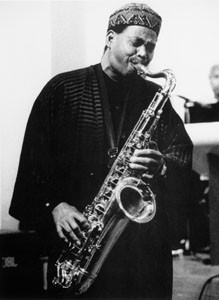
ODEAN POPE spends his time in the relentless pursuit of truth as codified in the fiery scales of a searing free-jazz sax solo. Indeed, 10 minutes into a phone interview with this obscure Philadelphia-based tenor sax player, it becomes clear that this is a man who is not a mere musician in the traditional sense of the word, but a committed spiritual seeker thirsting for sacred knowledge inside a swirl of polytonality. “To me, music is a universal thing,” says Pope.

This is a notion that permeates Pope’s conversation and one that has been a guiding light throughout his long, fruitful career as a performer, recording artist, and educator.

How deep is that vision? At age 8, as a member of a Baptist church in the unusually named town of Ninety Six, N.C., Pope would sit in the straight-backed, wooden pews, listening to the gospel choir and pondering what it would sound like to play that same sacred music on nine saxophones.

He got his chance. As the leader of the avant-garde Saxophone Choir, Pope has recorded several adventurous (and hard-to-find) albums, establishing himself as a cult figure. He has mastered the art of multiphonics, using a cluster of simultaneous overtones, an extremely difficult technique. And he’s performed for nearly 30 years as a sideman with legendary jazz drummer Max Roach and jammed with many of the giants of jazz, including John Coltrane and Dizzy Gillespie.

He returns to Sonoma State University on Saturday, Feb. 24, in a rare North Bay appearance.

“It’s important to channel information down to the young people in order to keep this music alive,” says Pope, 63, who teaches everyone from poor Philly kids to privileged suburban students. “My philosophy is that even if you successfully pass that information down to one out of 10 students, then that one will pass it down to others,” he adds. “You’ve got to keep that fire burning.”

FOR POPE, that fire has burned hotly since his youth. “When I first came to Philadelphia I was 10 years old,” he says. “There was a place called the Earl Theater, and they used to have Lionel Hampton, Count Basie, Illinois Jacquet, and Buddy Rich’s big bands–a whole lotta big bands used to come through town. I was exposed to a lot of different kinds of music.”

At 18, he joined the pit band at the rival Uptown Theater, playing behind such R&B and soul heavyweights as Stevie Wonder and Aretha Franklin. “About 10 days out of each month they’d feature a touring stage show–Smokey Robinson, the Supremes,” recalls Pope, who already had sat in with jazz greats Chet Baker and Elvin Jones. “I learned a lot from that.”

It was during one of his frequent visits to a local nightclub that an underage Pope met Roach. “I wasn’t old enough to go inside the clubs, but I used to stand right near the door and listen to all the music.” During the breaks, the musicians would come outside to catch a breath of fresh air.

One of them later arranged for Pope to sit with Roach. “Max kicked ‘Cherokee’ so fast that it was one of the most intense learning experiences I ever had,” Pope says of the drummer’s mastery of legendary saxman Charlie Parker’s complicated jazz piece. “It made me go back to the woodshed to get more and more involved with the music.”

Among his closest contacts in those early years were such jazz notables as Coltrane, Rahsaan Roland Kirk, Pharaoh Sanders, Benny Golson, and Jimmy Heath–all part of the bustling Philly music scene. He remembers Coltrane as a humble man who would sit in his living room with his tenor sax perched on his lap, surrounded by a half-dozen books on African and American literature and the arts, alternately reading and playing his horn.

“‘Trane gave me my first major job, with [jazz organist] Jimmy Smith,” Pope says. “When [Coltrane] went to work with Miles Davis [in 1958], he had two weeks left on a job at a club here in Philly. He’d been listening to me at some of the local jazz workshops, and, for whatever reason, he called and asked me take over that spot for him. Of course, I was scared to death, but he convinced me that I could do it.”

At 21, Pope landed a spot in Roach’s landmark band. It was a heady experience for the novice jazz player, who stayed on board for a year before returning to Philly. “It really showed me the kinds of things I needed to do and convinced me that music was going to be my livelihood,” he says. “I came back and enrolled in school and got deeply involved with it.”

He returned with a vengeance, performing with pianist Ray Bryant and Art Blakey and the Jazz Messengers before resuming his long, continuous association with Roach. In the ’70s, he led an experimental jazz-funk fusion band called Catalyst, a contemporary of Miles Davis’ early electric bands. “It was a period of adjustment during which all musicians were standing back and taking a very good look at themselves and saying, ‘Let’s dabble in this and see if there’s anything there.’ ”

He formed his own trio, a format that gave him the freedom to explore a more adventurous free-jazz sound, and joined the ranks of jazz players reaching out into unexplored musical terrain.

Over the years, he has embraced the spirit of musical discovery. “Right now, I’m working on the whole spectrum of how you can expand, like cross rhythms. It gives me a chance to extend from where some of these jazz giants left off,” he explains. “I’m taking it to another level. The way I look at it is, music is evolution. Every time I pick that horn up there’s always something that I discover I can do differently if I really seek. If you were on planet Earth for, like, 2 billion years, I feel as though there’s always something new that you can find to do. There’s no end.

“When you feel satisfied with what you’re doing and feel as though you’ve got everything, then you’re dead.”

Odean Pope performs on Saturday, Feb. 24, at 8 p.m., at Warren Auditorium, Sonoma State University, 1801 E. Cotati Ave., Rohnert Park. Tickets are $12 general, $6/students and seniors. 707/664-2353.

From the February 22-28, 2001 issue of the Northern California Bohemian.
© Metro Publishing Inc.

‘Rebels with a Cause’

0

Rebels with a Cause.

Rebel Hearts

Helen Garvy offers forgotten stories of the ’60s

HELEN GARVY was a young rebel the last time she stood in this part of downtown Oakland. That was 31 years ago. She’s a bit older now, and perhaps a bit wiser, but Garvy is still a rebel. And sometimes–today, for instance, back in Oakland to revisit a painful, powerful memory–she still gets angry.

Dressed for warmth against the February wind, the filmmaker stands near the corner of Clay and 16th, attempting to summon a vision of these streets as they looked on Friday, Oct. 20, 1969.

That was the day a band of antiwar activists, Garvy among them, temporarily shut down the Oakland Army Induction Center with a loud protest against America’s seemingly unstoppable Vietnam War machine. Only a few days before, in the very same spot, a baton-wielding squad of sheriffs and police officers had attacked protesters during an antiwar peace march, beating demonstrators until they scattered.

“I was furious,” recalls Garvy, 58, her voice dropping to a whisper. “We were all so angry by what happened in Oakland. We’d seen police violence at protests in the South, but this was the first time we’d ever seen that kind of violence here.”

All these events are captured in Rebels with a Cause, Garvy’s documentary film about Students for a Democratic Society (screening Feb. 23 and 24 at the Sonoma Film Institute).

Back then, however, Garvy was working as a schoolteacher in San Francisco. She was also an activist and an early member of SDS, which organized the Oakland protest. That Friday, Garvy joined a second, even larger protest march, and this time the marchers were prepared, protected by motorcycle helmets and hard hats. The police attacked anyway, but anticipating the police tactics, the protesters used cars and flower planters to barricade the intersections. This time they succeeded, taking the streets of Oakland and shutting down the U.S. Army–for one day.

But what a day.

THIS MORNING, Garvy can find few signs that any of it happened. “Nothing is recognizable,” she murmurs, gazing up and down the street. “I don’t remember exactly where anything was. Of course, in a situation like that, you don’t really pay attention to landmarks.”

Now standing in the spot where Garvy guesses the Induction Center was–“The building was nothing much to look at, that’s all I remember,” she says–is the Elihu M. Harris State Building, an attractive, glass, stone, and steel structure that was opened about three years ago.

Ironically, just inside the building’s main lobby is a conspicuous sign directing police officers upstairs for “Use of Force Training.”

Back on the street, Garvy points to a nearby street light, allowing that it might be one she climbed up to get a better view of the area and to scout the scene for the presence of police. “There were so many people, you didn’t know what was happening even half a block ahead,” she recalls. “And if you were like me, you were terrified.”

Our history books offer few references to such significant events of the 1960s. In order to preserve those stories, Garvy, who lives in Santa Cruz, has spent the last five years making Rebels with a Cause, a remarkable oral-history documentary that chronicles the actions of SDS.

Among the most influential student groups of the 20th century, SDS at the height of its strength had more than 100,000 members on campuses from coast to coast, organizing to fight for civil rights, free speech, women’s rights, and the anti-apartheid movement, and to call for an end to the war in Vietnam.

The film features dozens of interviews with the group’s members, ranging from Tom Hayden to the late Carolyn Craven. Mingled with archival footage, newspaper clippings, and startling FBI documents that target SDS leaders, Rebels masterfully blends its individual storytellers, cutting from person to person–often in mid-sentence–in a way that suggests a group of people so closely connected they can finish one another’s thoughts.

“We would do that, back in the ’60s,” says Garvy, smiling. “We would finish each other’s sentences. In a lot of ways, the movement was one big long dialogue.”

In part, Garvy made the film to counter the widely held opinion that the ’60s were mainly about sex, drugs, and rock and roll, and that the idealistic social movements of the era were a failure. That’s a view, says Garvy, that breaks her heart–and can’t be supported by the facts.

“We did make a difference,” she says. “Yes, we had setback after setback, and frustration after frustration. It took years to end the war–and it was the Vietnamese who did that–and every little victory along the way took incredible effort.

“But look around,” she continues. “The world is a better place because of the people who put their lives on the line in the ’60s.”

Garvy’s film has already changed a few minds. After one screening, a young black woman approached Garvy and thanked her. “She thanked us for making things better for her,” Garvy says. “She said she’d always taken it for granted that people made sacrifices so she can be a little better off than she would have been.”

Garvy hopes the film also touches those who were a part of the movement.

“There are people who lost their hope back then,” she says, “people who’ve been hurt and disappointed and embarrassed to talk about what they did in the ’60s because everyone keeps saying we failed.

“I hope they see this film and finally get to say to themselves, ‘Oh my god. It wasn’t all for nothing,’ ” she says. “We really did make a difference. We really did help change the world.”

‘Rebels with a Cause’ screens at 7 p.m. Friday and Saturday, Feb. 23 and 24, at Sonoma State University’s Darwin Hall, 1801 E. Cotati Ave., Rohnert Park. Filmmaker Helen Garvy is tentatively scheduled to appear Friday night. Tickets are $4. 707/664-2606.

From the February 22-28, 2001 issue of the Northern California Bohemian.
© Metro Publishing Inc.

Russell Banks and Michael Ondaatje

Reel Deal

Novelists Russell Banks and Michael Ondaatje pair up to discuss fiction and film

By

FROM THE BURNING desert of The English Patient to the snow country in The Sweet Hereafter, the geographies in the books of Russell Banks and Michael Ondaatje are as diverse as their prose. Still, these two prolific literary lions are both most quickly identified by mentioning the movies that came from their words. Ondaatje is the author of The English Patient. Banks wrote the books that were the sources for the films Affliction and The Sweet Hereafter.

Such writers reading publicly always face the same questions–whether they were handled gently or roughly by Hollywood, what was included or left out, how it felt to see the omissions and additions. Yielding to these popular questions, the two authors have made the subject of novels transformed into movies the main part of their Feb. 28 appearance at the Marin Center Literary Arts Series.

If you ask me, Banks has had the better luck with his adapters. Paul Schrader’s solid film of Banks’ semi-autobiographical novel Affliction had a justly Oscar-winning turn by James Coburn as the lumbering, drunken father, and Nick Nolte was tragic and feral as the beaten, grievously damaged son. (Echoing other battered kids who were saved by art, Banks has said that if he hadn’t become a novelist, he probably would have become a murderer.)

Atom Egoyan’s film of Banks’ The Sweet Hereafter was maybe the best movie of the 1990s. In his novel, Banks spoke of the unspoken terror of North American families as they try to protect themselves against chance: the random act of violence, the bad influence, the loose piece of machinery that snaps and kills a child.

Meanwhile–and this is the bitterest irony in The Sweet Hereafter–these families are blind to the interior forces that scatter them. By never preaching Togetherness or Responsibility, Egoyan captured Banks’ great themes. How love and admiration is expressed in the worst possible way, as incest. How a father is placed, by a medical emergency, into the position of Abraham, with Isaac shivering in his arms.

Egoyan’s remoteness is as clean as the mountain snows and as eerie as the dirge “Courage” by the Tragically Hip, floating in the freezing air.

A DIFFERENT KIND of remoteness flickers through the work of Michael Ondaatje, whose prose style is elemental and mysterious, where Banks’ writing is clear and calm. Born in Sri Lanka, Ondaatje relocated to the antipodes of the world in Toronto. Still, the heat and spice remain into his novel writing, which seems an extension of his poetry.

The French title for The English Patient is L’Homme Flambé, “the burned man.” Ondaatje’s best-known book contains the epigram “the heart is an organ of fire.” He mentions “the antlered helmet of fire” the burning pilot wears when he is rescued. A burning heart also turns up as an image in a page of Ondaatje’s poetry in the collection Handwriting.

Rereading The English Patient, all alight with fire symbolism, is so much easier than rewatching the movie. The film seemed to lose its way, touching all the corners of a novel that’s simultaneously expansive and compact. It lost me with its emphasis on the romance of the stiff English–Kristin Scott Thomas and her double, Ralph Fiennes, thin already at his precooked weight.

Gorgeous as the movie could be, I had to cheer Seinfeld’s Elaine (Julie-Louise Dreyfus) when she broke up a screening of The English Patient by yelling “Wouldja hurry up and die, already?”

Statelessness is kind of a religion to Ondaatje, who writes about Hungarians in the Sahara and Sikhs prowling the Suffolk downs. When Ondaatje decided to write about America, he chose legendary figures of whom the historical facts are scant: the elusive jazz trumpeter Buddy Bolden (in his fictionalization of Bolden’s life, Coming through Slaughter) and Billy the Kid, in his 1970 The Collected Works of Billy the Kid. The book about William Bonney is woven out of scraps of poetry, news accounts, interviews: scraps gathered, as if they were pulled out of a fire.

Banks, by contrast, chose not a common outlaw for his American epic novel, but a titanic one. Banks’ novel Cloudsplitter is titled from the Iroquois name for an Adirondack mountain that overlooked John Brown’s farm in upstate New York. The honorific also applies to the towering figure of abolitionist John Brown, American history’s most celebrated terrorist, whose murder of pro-slavers and seizure of the federal arsenal at Harpers Ferry precipitated the Civil War.

There are at least two ways of looking at Brown. Thomas Hart Benton’s mad-heroic portrait of Brown in the Kansas statehouse illustrates the passionate view. In the mural, Brown stands twice the height of an ordinary man, holding an open Bible with Alpha and Omega written large on its pages. Maybe Banks was thinking of this painting when he described Brown’s visage as “the face of a man who had been gazing on fires, who had routed the attendants of fires . . . the man who dared to swing open the iron doors and peer inside.”

Contrast that strength with Edmund Wilson’s more cool summing up of Brown, in his brilliant book of essays on Civil War literature, Patriotic Gore. “This madman,” Wilson calls John Brown, reminding the reader of the insanity that ran in Brown’s family, root and branch. Wilson credits Brown’s cult to “the capacity of self-delusion of the Bible-drugged New England idealist.”

Either way, it’s hard to think of a more vivid contrast to the coolly remote personalities who inhabit The English Patient.

Something slithered away from Ondaatje’s pages when the novel was about to be captured for screening purposes. Or perhaps symbolism just looks screamingly literal in a movie. (Maybe Michael Powell, a British director who took English rectitude and ripened it into lush reveries, could have made The English Patient in his customary fiery stained-glass-window brightness–instead of the nostalgic cream and bone colors used by the admirable cinematographer John Seale.)

When Ondaatje writes about different levels of pain–burning alive, Nazi torture, the minor injuries a furious woman inflicts on her stubborn lover–he always describes the scars instead of the wounds. The pain is always elsewhere.

In Ondaatje’s most recent novel, Anil’s Ghost, his heroine Anil is a forensic examiner who re-creates injuries through the marks left on skeletons. Ondaatje seems to be in the same line of work as Anil. In Ondaatje, violence is abstract, touching down and moving on, impossible to perceive except through its aftermath.

Banks, who experienced plenty of violence growing up, writes of it with the sense of injustice that is still awake and pain that’s still vivid. It’s the American in Banks that thinks there is truth and justice somewhere.

From the February 22-28, 2001 issue of the Northern California Bohemian.

© Metro Publishing Inc.

‘Ratcatcher’

0

Ratcatcher.

No Kidding

Hell is for children in compelling ‘Ratcatcher’

By Nicole McEwan

“MY MUM says this place is a very-mental-health hazard,” says one child to another as he surveys the garbage-choked yard of the condemned housing project they call home. It’s ’70s-era Glasglow at the height of the famed garbage strike. In this sorry corner of the earth, the vermin outnumber the populace–and the rats probably eat better as well.

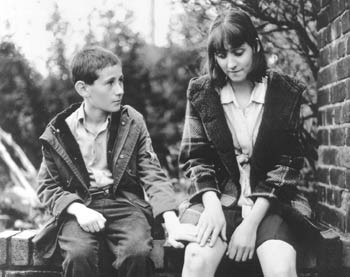
Ratcatcher, UK director Lynne Ramsay’s mesmerizing feature film debut, paints a devastating portrait of one boy’s impoverished life as it aimlessly drifts from bad to worse. Shot mainly in cool blues tones, the episodically structured film is saturated with a dank and bitter hopelessness that moves purposely toward a frank conclusion that would never see the light of day on a Hollywood film set.

Unlike the young hero of the highly overpraised, paint-by-numbers tearjerker Billy Elliot, 12-year-old James Gillespie (William Eadie) is leading a life that’s unlikely to take him much farther down the lane, let alone over the rainbow.

He lives one step above squalor in a tiny apartment with his drunk-and-on-the-dole dad, his long-suffering mum, and his two sisters. It’s a hand-to-mouth existence, but somehow there’s always enough money for liquor and cigarettes, even if that means hiding from the landlord and letting the children suffer in outgrown shoes.

School’s out for the summer, so James spends his days playing in and around the polluted, trash-strewn canal near his home. In these bleak surroundings, the mountains of rubbish and the murky water serve as both playground and swimming pool to a group of lice-ridden, grubby imps, and sadistic toughs so downtrodden that they might have sprung from Dickens’ inkwell.

One morning, some horseplay between James and his best friend, Ryan, ends in disaster, with the younger boy drowning. Terrified, James flees the scene. The secret weighs on him terribly, but his remote, erratic behavior goes unnoticed by a family consumed with simply surviving.

Distraction comes in the form of a masochistic and pitifully myopic neighborhood girl (Leanne Mullen), whose chief form of entertainment is to allow a group of neighborhood bullies to use her as sperm depository. Presumably it’s the only attention Margaret gets, as her parents are rarely at home. It’s a disturbing but utterly believable scenario made more poignant by the fact that the girl is quite pretty–only she doesn’t know it yet. In the same way that dogs smell fear, her tormentors sense her insecurity and recognize her loneliness and use those weaknesses against her.

James, a sexual innocent, finds solace and an almost maternal fascination in her naked form. Goaded by the others into laying atop her semi-clad body, he finds comfort, not arousal, in her Madonna-like embrace. Ramsey breaks up the desolation with several small magic moments like this.

Particularly memorable is one in which a pet mouse is carried skyward by a balloon. As James watches the slow ascent, his envy of the animal’s escape is palpable, despite his knowledge that the mouse will likely perish.

Eades’ angular face, alert eyes, and milk-pitcher ears serve him well in an often silent performance. Considering the dour tone of Ramsey’s film, it’s a good bet that the director cast him for his low cuteness quotient.

Ratcatcher is not without flaws. In her quest to avoid sentimentality, Ramsey has left a few too many questions unanswered. Of course, poverty is too complex a social ill to explain in 90 minutes, though Brit social realist filmmaker Ken Loach has made a career out of trying, with mostly strong results.

“What doesn’t kill you makes you stronger,” wrote Nietzsche. It’s a homily tailor-made for children like James–if only they all lived long enough to appreciate it.

‘Ratcatcher’ opens Friday, Feb. 16, at the Rafael Film Center, 1118 Fourth St., San Rafael. For details, see or call 415/454-1222.

From the February 15-21, 2001 issue of the Northern California Bohemian.

© Metro Publishing Inc.

Usual Suspects

Women's Justice Center fires new salvo at SRPD By Greg Cahill DESPITE an official study of charges that the Santa Rosa Police Department mishandled seven cases last year involving violence against women and children, a local women's advocate is charging that city hall has failed to address adequately an alleged cover-up and "police defensiveness" over...

World Social Forum

Going Global Dispatches from the World Social Forum By Kenny Bruno "UM OUTRO mundo é possível."--Another world is possible. That's the slogan of the World Social Forum under way here in Porto Alegre, Brazil, in early February. Or, as they said in Seattle, "This is what democracy looks like." While thousands...

Mose Allison

Sly Sage Mose Allison slips into the Mystic By Greg Cahill "Y OU KNOW, I used to joke in interviews, whenever a reporter would ask me how long I'm going to keep playing music, that I'm going to get myself a Gray Panthers punk-rock band and retire in Arizona. So I wrote...

Open Mic

Free Your Mind By Greg Cahill LAST WEEK, some of our newspaper racks in Guerneville and Petaluma were vandalized, the contents dumped in the trash, apparently by readers offended by the "Christianity at the Crossroads" cover story. That thought-provoking article, by longtime contributor David Templeton (who once studied for a ministerial career), related the latest...

Grocery Shopping

Basket Case Of grocery carts and guessing games By Marina Wolf IT ONLY HAPPENED once that I can remember, and that was five or six years ago, but the details of my supermarket encounter remain as vivid as a National Enquirer point-of-sale display: I reached to pick out my usual container...

‘Hannibal’

Hannibal. Losing Lecter's Lunch Horrified brain expert dissects America's favorite cannibal Writer David Templeton takes interesting people to interesting movies in his ongoing quest for the ultimate post-film conversation. This is not a review; rather, it's a freewheeling, tangential discussion of art, alternative ideas, and popular culture. ...

Odeon Pope

The Seeker Saxman Odean Pope strives for the sacred By Greg Cahill ODEAN POPE spends his time in the relentless pursuit of truth as codified in the fiery scales of a searing free-jazz sax solo. Indeed, 10 minutes into a phone interview with this obscure Philadelphia-based tenor sax player, it becomes clear...

‘Rebels with a Cause’

Rebels with a Cause. Rebel Hearts Helen Garvy offers forgotten stories of the '60s HELEN GARVY was a young rebel the last time she stood in this part of downtown Oakland. That was 31 years ago. She's a bit older now, and perhaps a bit wiser, but Garvy is...

Russell Banks and Michael Ondaatje

Reel Deal Novelists Russell Banks and Michael Ondaatje pair up to discuss fiction and film By FROM THE BURNING desert of The English Patient to the snow country in The Sweet Hereafter, the geographies in the books of Russell Banks and Michael Ondaatje are as diverse as their prose. Still, these...

‘Ratcatcher’

Ratcatcher. No Kidding Hell is for children in compelling 'Ratcatcher' By Nicole McEwan "MY MUM says this place is a very-mental-health hazard," says one child to another as he surveys the garbage-choked yard of the condemned housing project they call home. It's '70s-era Glasglow at the height of the...
11,084FansLike
4,606FollowersFollow
6,928FollowersFollow
