
SUV Driver’s Defense

Gimme a Brake

Why I drive a hate crime

By Steven Mikulan

AT A PARTY a while back, the talk, as it usually does these days, turned to the Internet. When I mentioned to some people that Earthlink was my server, a shocked friend exclaimed, “But that’s run by Scientologists!” She was referring to the Hubbardian bent of Sky Dayton, Earthlink’s founder, and continued ribbing me until I replied that I doubted my monthly fees went toward the upkeep of the Celebrity Center or any of the cult’s other enterprises. My friend nodded politely, and the conversation moved on to other matters. We both knew she didn’t really care about the Scientology connection, just as I wasn’t really defending my choice of a server.

The important thing is that she got to partake in the American pastime of Making Friends Feel Bad, and I had not taken offense.

My friend and I are both card-carrying “progressives,” and that morning stood sipping champagne in a room mostly filled with like-minded people. I knew the drill: You admit to a seemingly benign consumer preference; your chums shoot you down for it. Either someone’s read that your favorite marketer of merino-wool sweaters has a side business in the Sudan selling iron slave collars, or it’s pointed out that a cherished neighborhood hardware store peddles old-growth redwood.

Making your pals feel bad (but not so bad as to lose them) is a refined social skill highly regarded in my neck of the political woods. It has roots, ironically enough, in traditional class snobbery as well as in the consumer chauvinism that first spread from the pages of Playboy and Esquire into the popular consciousness of the early 1970s–a belief that the kind of stereo speakers we own or the wine we drink are not merely practical choices but statements of identity.

Evaluations of other people’s tastes tend to be political judgments issued from the bench of one’s own private Nuremberg. No longer content to merely dismiss a friend’s contrarian tastes as gauche, we detect in them nothing less than a threat to the planet–implying that the offender is a kind of consumer criminal. In today’s casual conversations, you run the constant risk of being made to feel guilty (as opposed to merely stupid) for wearing, eating, or driving the wrong product at the wrong time.

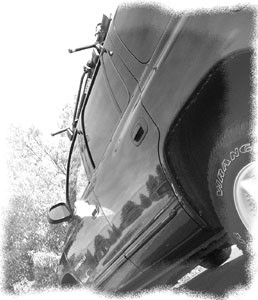
A few months ago, for example, a friend commented on the base villainy of sports-utility vehicles and their owners. I politely told him that I was an SUV owner. He looked at me as though I had just admitted to collecting human skulls. His response was not new. “That’s your car?” a horrified colleague had once asked me in my company’s parking lot. “I’m so disappointed–that’s the kind someone in advertising would buy.” I had my reasons for owning my Pathfinder, not the least of which has to do with the fact that I actually use it to go off-road camping. No matter–my choice of transportation was so heinous that, in the morality of the left, it amounted to a hate crime.

Automobiles, those expensive scourges of global climate, are high on the list of possessions that can be used to make us feel bad. Still, most of us nurse some guilty memory of a car or two that we treated as almost human. Mine is of my father’s ’55 Chevy Bel Air, a big gray block of steel that was old the day he drove it off the used-car lot. It wasn’t just a machine that took us from one place to another, it was the largest thing we owned; it had a radio in it, and during winter afternoons it became my own private solarium.

I have an album of mental snapshots of our Chevy that will never fade: my mother pushing the stuck car through snow while my father steered, or her making sandwiches in the back seat on one of our cross-country moves, rain hammering on the roof. And there was one golden afternoon when my father had driven a cousin and me from eastern Long Island into Manhattan to see the American Museum of Natural History and the Hayden Planetarium. We sailed down Fifth Avenue in a ticker-tape parade of my own imagining, everything in that late afternoon becoming lost in the blare of horns and the glint of summery light on the Empire State Building.

THE ONLY journey friends seem to let me take in my Pathfinder is a guilt trip. Guilt, of course, takes the fun out of owning anything and is the torture tool of choice used by people to make others feel bad. Usually this guilt accrues from the suffering of distant peoples or some ecological outrage–sometimes both. I remember the time I invited a man active in Latino cultural politics over to a balcony barbecue. At first he was enthusiastic about the idea, especially when we got to talking about how much we preferred mesquite over chemically soaked briquettes. Then his political conscience kicked in. “But we shouldn’t burn mesquite,” he said quietly, pausing to remember just why. “The environment, you know . . . and Mexico. It’s cutting down their mesquite forests.”

I laugh at all this because I graduated from Berkeley during the Age of Boycotts (the early 1970s), when I learned how to needle people about owning Krugerrands, drinking Gallo wine, or wearing Farrah jeans. But as the 1970s boogied along, the number of boycotts multiplied exponentially until people simply ignored them. (Today, a list for the venerable Nestlé embargo alone proscribes no fewer than 200 products and businesses, from Arrowhead Water to Friskies Cat Chow.) So a funny thing happened on the way to the Finland Station–the Age of Boycotts morphed into the materialistic and narcissistic Me Decade, followed by a kind of ongoing Me Century.

Apparently there was one eternal law of history Marx had forgotten to tell us about: Affluence eventually afflicts all but the most self-destructive radicals, something every generation discovers and that I only dimly perceived some 30 years ago as I sat in on a meeting of the Young Workers Liberation League, the bell-bottomed successor of the Young Communist League. At one point it came up that the CP boss for Northern California, Mickie Lima, would let the group use his Mendocino ranch for a weekend getaway. “He’s got a ranch?” someone sniffed. “Yeah, really! That’s kinda funny,” another remarked tartly.

Lima had been born in the small town of Usal, and got his baptism in radical politics during a 1935 strike of barrel makers in Arcata, in which three strikers were killed. He’d had a pretty tough life up there on the North Coast, and probably didn’t see anything wrong with owning a little piece of real estate during the vexingly prolonged “twilight of capitalism”; but to a group of college radicals still in their teens, the idea of a property-owning Communist was on par with that old gag about anarchists who wear watches.

“I HATED HAVING to visit your family’s place. You were so poor, and I’d think, ‘How can people live like this?’ My cousin–the one who had gone with me to the Museum of Natural History and the Hayden Planetarium–blurted this out some years back, as we reminisced about our childhoods one evening.

Looking back, I suppose I can see why he might’ve considered my brother and me “poor cousins.” We were the ones who ate spaghetti on Thanksgiving, whose mother washed our laundry in the bathtub, and whose family occasionally needed a handout from the Red Cross. Still, we lived like pharaohs compared to some of the kids I knew, with their ketchup sandwiches and homes built into the lofts of abandoned garages. At the time of my cousin’s confession, however, I was stunned. What could have made him think this way?

Of course, I realized–it was the Chevy. And our rented home’s dirt yard and perhaps the derelict graveyard that lay just beyond it. Or possibly, too, it had something to do with the neighborhood drunks who walked through our driveway on their way to sleep things off in that cemetery. But mostly, I figured, it was the ’55 Bel Air, for it had always stuck out when parked next to my aunts’ and uncles’ new Impalas. Forget the blare of horns and the glint of summery light–my cousin had probably cringed in embarrassment when we drove down Fifth Avenue in our old gray car. Not that anyone said anything then, of course, because 35 years ago making those close to you feel bad had not yet come into vogue.

Today, I tell myself that my reasons for driving an SUV are practical ones. With it, I can camp off-road and, on the admittedly rare occasions I need to, I can haul two-by-fours and sheet rock fairly easily. But I suspect part of me also likes owning an automobile that doesn’t get stuck in the snow or stick out next to new Impalas. I figure if Mickie Lima could own a ranch, why can’t I drive a big, shiny car? At least, like Lima, my SUV is red.

This article first appeared in the ‘L.A. Weekly.’

From the March 1-8, 2001 issue of the Northern California Bohemian.

© Metro Publishing Inc.

Open Mic

0

In the Doghouse

By Yosha Bourgea

“THERE’S A LEASH LAW, you know,” snarls the jogger. He speaks without breaking stride, so I don’t even try to respond. By the time my brain has formulated a snappy comeback –“Yeah, I know”–he’s far out of hearing range. Confrontation is not my strong suit. Yeah, I know there’s a leash law. I also know that on this quiet paved path just off Willowside Road, where I take my dogs for their daily walk, I have yet to see the leash law enforced. That’s why we come here, and why we have plenty of company from other canines and their companions.

But while most of the pedestrians, joggers, and bicyclists we pass are the friendly kind, there are some who just don’t want anything to do with dogs, especially ones they don’t know. The fate of Diane Whipple, who was mauled to death outside her San Francisco apartment last month, has added fuel to their fear. In Petaluma, angry complaints have prompted two public hearings by the Parks and Recreation Commission to determine whether city officials should continue to allow dogs without leashes at Oak Hill Park. No dog-related injuries have been reported in the park, but protesters argue that mixing loose dogs with children and elderly people is simply unsafe.

These fears are understandable. Some dogs are too aggressive to be unleashed, and some, like the 120-pound Presa Canario that killed Whipple, should not be allowed in public under any circumstances. But then there are cream puffs like Jennie and Isabella, my two border collie mixes, who either kowtow to strangers or avoid them altogether. They deserve to have a place where they can exercise freely, without the restrictions that justifiably apply to dangerous or untrained dogs.

Some public parks feature enclosed leash-free areas, but most of these are pathetic rectangles of dirt, not much larger than the average backyard. You might as well leave your dog at home–which plenty of folks do. That kind of neglect is unconscionable, but quite legal. On the other hand, you can be slapped with a fine for walking your dog without a leash in a public park–regardless of how much time you’ve invested in training her.

People who want to avoid dogs when they exercise can choose from plenty of locations where dogs are prohibited or restricted. Is it too much to ask that dogs and their friends be given the same consideration?

From the March 1-8, 2001 issue of the Northern California Bohemian.

© Metro Publishing Inc.

Jack London Scholar Susan Nuernberg

London Bridge

Famous writer finds a passionate champion

By Paula Harris

“THE PROPER function of man is to live, not to exist,” Jack London once wrote. “I shall not waste my days in trying to prolong them. I shall use my time.” Sonoma County’s most famous writer may not gain unanimous praise from literary critics, but these defiant words still sound just as vital today as they did in the early 1900s.

“And London did it–he used his time,” declares Jack London scholar Susan Nuernberg, striding through the Special Collections area of Sonoma State University’s Schulz Information Center, surrounded by paraphernalia relating to the controversial writer. “He crammed so much into those 40 years. It’s incredible.”

Nuernberg, an associate professor on a year’s sabbatical from the University of Wisconsin, is working at SSU to help organize the recently acquired Jack London materials–a coup of a donation made to the university library. While she’s in town, she’ll also teach a course on the author.

Nuernberg, 54, can be classed as a true Jack London expert. She was named “Jack London Woman of the Year” in 1995 by the Jack London Foundation. Hell, she’s even visited the original site of the author’s cabin in the Yukon, where he tried to strike it rich in the Klondike gold rush but ended up becoming a writer instead.

Ask Nuernberg anything about the adventurous writer or his wild cronies and the light flashes on in her red-brown eyes as some little-known anecdote springs forth from her vast knowledge.

Nuernberg is quick to defend London (who died in 1916 in Glen Ellen) against his notoriously debauched image. “It’s hard to get beyond the sensational gossipy stuff–that he committed suicide, that he was a womanizer and an alcoholic,” she says, shaking her head.

London’s works, especially such classic novels of wilderness adventure as The Call of the Wild and White Fang, were hugely popular with the mainstream public. But Nuernberg says scholars shunned the author.

“The critical establishment was put off,” she says. “Here was this illegitimate, working-class, socialist, and self-taught author who didn’t fit the Henry James mold. The critical establishment liked the idea of a self-destructive lifestyle–even though London sometimes fanned the flame of that image to sell his books. [But] it worked against critics taking him seriously.”

Nuernberg prefers to view London as an intellectual writer who was ahead of his time. She also subscribes to a new theory about London: a doctor who made a study of London’s medical records believes that the writer suffered for years from undiagnosed lupus.

“This would account for many of [London’s] ailments,” says Nuernberg. “It makes sense.” This theory also concludes that London accidentally overdosed on pain medication, rather than succumbed to kidney failure, according to the autopsy, or committed suicide, according to what Nuernberg dubs “the Myth.”

As she walks around the library racks, carefully pulling London items off the shelves for closer inspection, Nuernberg is clearly in her element. Right now, the new collection is still mostly stashed in cardboard boxes, some unopened, their contents waiting to be cataloged and displayed.

The London collection represents the core of a new Sonoma Writers Room that SSU is establishing in the Schulz Center. The treasure trove of London lore was originally amassed during the past 20 years by the late Philadelphia-based collector Carl Bernatovech. Bernatovech’s collection was then purchased from his family earlier this year by Waring Jones, a Minnesota journalist, writer, and longtime London fan.

Jones asked Sonoma State to provide a home for the material. “[Jones] loved the idea that the ranch was just on the other side of the hill, and wanted all materials to be accessible to the students,” Nuernberg says.

The 50-box collection includes first edition volumes, magazine articles, London’s personal letters and financial records, and movie memorabilia.

Today, several open cardboard boxes line the floor, all crammed with canisters containing reels of early-made films of London’s novels. “How the films got from Hollywood into the hands of a private collector no one knows,” Nuernberg says with a laugh.

The collection also includes some 350 original magazine articles, including many rare turn-of-the-century editions of The Saturday Evening Post, which serialized London’s novels, that are stashed in pristine leather portfolios, courtesy of collector Bernatovech.

In addition, several of London’s personal items (currently in storage) will join the collection, including a silk shirt made for the author in Polynesia and later discovered in one of the barns on the ranch.

The Sonoma Writers Room, located in one corner of the Special Collections area of the library, will feature a glass-walled area with smaller-scale replicas of chairs found at London’s ranch, fabric similar to the cloth London brought back from the South Seas, and lighted shelves with nonreflective glass to display a variety of items.

The room, slated to open in June, will also highlight other local writers, including Richard Henry Dana, M.F.K. Fisher, Alice Walker, Richard Brautigan, and Gary Snyder.

But London will be the main focus. And Nuernberg couldn’t be happier about that.

The scholar says her fascination with London began back in college. “I was curious as to why London wasn’t taught in my graduate courses in American literature, and when I asked the faculty, I was told he was a racist,” she explains.

This led Nuernberg to write her dissertation on the ideology of race and how London’s ideas reflected that. “Of course he was absolutely typical of the period,” she concluded. “It was the height of American expansion abroad.”

While London’s scientifically driven ideas of race, with an emphasis on Darwinism, may be criticized now, Nuernberg says her research of the author shows that his ideas developed and changed throughout the years.

“I would call him an intellectual writer,” she says. “His novels were about ideas, and he speaks directly to people. But in the end, my sense is that his time hadn’t yet come.”

From the March 1-8, 2001 issue of the Northern California Bohemian.

© Metro Publishing Inc.

‘George Washington’

0

Southern Gothic

‘George Washington’ offers haunting tale of small-town life

By Nicole McEwan

GEORGE Washington was the first president of the United States. This is the first fact David Gordon Green learned. Before he knew his ABCs, before he could tell time, the nascent director absorbed the legend of our nation’s founding father.

So it’s no wonder that George Washington serves as the title of the 25-year-old Green’s stunning feature film debut, a haunting picture whose naturalistic performances, astounding cinematography, and rejection of plot structure place it in the company of classics like Terence Malick’s Days of Heaven. Throw in a Cassavettes-like use of the face as a narrative tableau and you have a piece of art that alternately thrills and frustrates–a hallmark of independent film spirit.

“George always knew he’d be a hero,” says Nasia (played by Candace Evanofski), the film’s preternaturally wise narrator. George (Donald Holden) is her new boyfriend. He’s a dreamer–and in the decrepit North Carolina town these kids inhabit, that in itself is an act of bravery.

At 12, the tough-yet-tender Nasia doesn’t know much, but she knows two things for sure. She knows a good catch when she sees one–and she knows she wants to get pregnant. Why? Because no man will ever love her as much as a child will.

This blend of innocence and cynicism is typical of George Washington, which takes a fly-on-the-wall approach as it observes a group of dirt-poor kids stranded in a decaying town.

The film opens in the midst of a seemingly endless summer. Nasia has just dumped Buddy (Curtis Cotton III) for George. In this little group that’s big news. Without distractions like trips to the mall and summer camp, these kids find excitement where they can. Mostly that means just sitting around talking. Their often-improvised musings are the backbone of the film. One kid talks of escaping to another planet, while another wants to be president. Emotions are discussed in earnest because defense mechanisms are still undeveloped. Green’s documentary background and use of non-actors give these scenes true authenticity.

Then, without warning, a freak accident occurs. Everything changes. Suddenly what passes for childhood in this desolate backwater comes to an end. George, already rendered an outsider by the helmet he must wear to protect his underdeveloped cranium, is the most deeply affected. He rebels by taking extraordinary risks and becomes his own version of the TV superheroes every kid is weaned on.

If George Washington is about anything, it’s about growing up into an adolescence that has no discernible end. By the close of the film, these kids are not children, but they’re only one step along the path to adulthood. In the absence of parenting, it’s a self-guided journey–leaving us to wonder: How on earth will they get there?

‘George Washington’ opens Friday, March 2, at Rialto Cinemas Lakeside, 551 Summerfield Road, Santa Rosa. For details, see or call 707/525-4840.

From the March 1-8, 2001 issue of the Northern California Bohemian.
© Metro Publishing Inc.

Peter Carey

Rebel Hearts

‘True History of the Kelly Gang’ brings legend to life

By Patrick Sullivan

A MURDERING bandit to some, he was a folk hero to others. Driven to crime by an oppressive government, he robbed the obscenely rich and gave to the piteously poor. Hunted by hundreds of armed men, he made his brutal pursuers look laughably inept.

Robin Hood? Zorro? The Zapatista’s Subcommandante Marcos? Funny–isn’t it?–how this description seems to fit them all. Born from fact or fiction (or a fertile marriage of the two), the heroic outlaw may be the most potent, persistent figure in popular mythology.

But Peter Carey (Oscar and Lucinda) doesn’t seem interested in myth-making. True, the Booker Prize-winning author’s latest novel, True History of the Kelly Gang (Knopf; $25), tells the story of Australia’s most famous folk hero, a poor Irish farm boy who led a small gang of rebels against the might of Her Majesty’s Government. But the triumph of Carey’s book–narrated in the outlaw’s own unpolished words–is that Ned Kelly comes out looking like a human being instead of a legend.

“Let me read your history,” a prim schoolteacher turned hostage begs, after he realizes Kelly has written down the story of his life. “It is too rough,” the outlaw replies. “It is history, Mr. Kelly,” the teacher responds. “It should always be a little rough–that way we know it is the truth.”

Forget Zorro, forget Robin Hood: Carey’s Kelly has his feet firmly rooted in the clay. True History of the Kelly Gang may be a tale of heroism, but it’s a believable heroism, filled with rebels hooked on opium, bushrangers with bad bowels, and a fearless leader of men who is, at heart, a momma’s boy in the Oedipal sense of the phrase. The outlaw stumbles almost accidentally into his epic conflict with Australia’s ruling class in Carey’s version of events.

Or perhaps we should say Ned Kelly’s version, for this chronicle purports to be written in the outlaw’s own hand. Carey’s attempt to slip into Kelly’s 19th century skin could easily have gone badly wrong. And, at first, there is something precious and artificial about the narrator’s neglect of punctuation and constant use of the word “adjectival” in place of curse words.

But like other tricks of Carey’s craft, these quickly grow on the reader: Kelly’s voice feels so authentic precisely because of Carey’s care with such details.

Despite Kelly’s rough grasp of punctuation and grammar, he proves a skillful narrator, as in this passage about his gang’s failed attempt to bloodlessly capture a band of policemen sent to kill them all: “The 2nd policeman were Scanlon he spurred his horse forward firing at me as he done so. My gun responded and Scanlon lurched on to his horse’s neck and lay there motionless. The Spencer clattered to the ground then Scanlon’s body followed it were as lifeless as a bag of spuds. Events continued without relent Dear God Jesus it were a sorry day.”

Carey, of course, has an agenda–and it goes beyond his obvious sympathy for the outlaw. Carey’s Kelly, it’s clear, is at his most heroic when he attempts to write his own account of the events in which he is enmeshed.

Did Kelly really make such an attempt? Maybe not, but that’s irrelevant: Carey’s aim is to rescue the man behind the myth from both those who revile him as a murderer and those who worship him as a hero. And in that, True History of the Kelly Gang is profoundly successful.

Peter Carey reads from ‘True History of the Kelly Gang’ on Thursday, March 8, at noon at Ross School, Lagunitas Road, Ross. Tickets are $10. For details, call 707/939-1779.

From the March 1-8, 2001 issue of the Northern California Bohemian.
© Metro Publishing Inc.

Newsgrinder

Important events as reported by daily newspapers and summarized by Daedalus Howell

Tuesday 02.27.01

The first train in over two years pulled into the Petaluma depot in mid-February, reports the Argus-Courier, resulting in the first train story in over two years for the city’s flagship newspaper. In the coming months, the Northwestern Pacific Railway Co.’s 1,500-horsepower locomotive will be hauling beer, grain, and lumber to Petaluma from Schellville–offering fierce competition for the Napa Wine Train, which moves only middlebrow winos.

Monday 02.26.01

In 1994, Cotati bought land for a proposed 48-unit senior housing complex, but ran out of money before its completion. Though the original seniors interested in the low-income units have long since passed, a new crop will soon be calling the Charles Street Village home, at least for a little while, according to the Press Democrat. The complex, affectionately nicknamed the Mausoleum, is comprised of 13 buildings a few steps from the downtown hub. “They are not just left in their units; there are actually activities that they will be encouraged to participate in,” says regional manager Annie Derringer. Among the activities will be waiting and waiting and waiting for visitors, as well as pinning the scythe on the reaper.

Friday 02.23.01

Greedy Canucks no longer satisfied with laundering their useless coinage for ours via innocent vending machines have a new scheme, reports the Marin Independent Journal. The FBI is warning residents to beware of the “Canadian lottery scam” wherein a telemarketer calls and convinces suckers that they have hit the Canadian jackpot, but in order to collect they need to send a cashier’s check to process the paperwork or cover taxes. Not dissimilar to the “I have a girlfriend in Canada scam” perpetrated by virgin males to account for make-believe sexual conquests, the con often results in dozens of useless calls north of the border. For more information, e-mail your credit card numbers (with expiration dates) to da******@**am.com.

Thursday 02.22.01

Tomales High School is no longer home of the Braves, just land of a hundred dogmatic jocks, reports the Point Reyes Light. More than 100 Tomales High School students, a third of the student body, cut morning classes to protest Shoreline School District trustees’ vote asking the school council to pick a new mascot to replace the “Braves,” presumably because it is offensive to Native Americans. Demonstrators lined the road to the high school, waved signs, and chanted, “It’s our school!” to which the deposed spirits of thousands of coastal Miwok retorted, “It’s our land!” Principal Terry Hughey entreated the protesters to return to class, but was out-testosteroned. Varsity boys basketball captain Kevin Ballatore said that if his involvement in the protest meant forfeiting the last game of the season–so be it; he wasn’t interested in playing if he couldn’t be a Brave. Choose your battles, Kev. In an unrelated story, a Native American basketball team has elected to use “Angry White Boy” as their team mascot name.

From the March 1-8, 2001 issue of the Northern California Bohemian.

© Metro Publishing Inc.

Robert Johnson

0

Blue Mood

Robert Johnson tribute is a keeper

By Greg Cahill

ROBERT JOHNSON casts a long shadow, even 63 years after his untimely death. The enigmatic Mississippi delta bluesman wrote and recorded just 28 songs during his brief career, and only a handful of people alive today actually knew him or heard him perform, yet Johnson remains a wildly intriguing figure on the American music landscape.

Over the years, Johnson’s songs have been recorded by Eric Clapton, the Rolling Stones, Fleetwood Mac, Peter Green, and hundreds of others. The 1986 film Crossroads riffed off of Johnson’s elusive personal history and the myth that the bluesman once cut a deal with the devil. And a handful of documentaries, including one starring bluesman Keb ‘Mo in dramatized sequences, have sought to unveil the man behind the legend.

Easier said than done. Johnson, who died in 1938 at age 27, reportedly after being poisoned by a jealous husband, was virtually unknown in his day, but left an impressive–if diminutive–body of work. A new all-star tribute CD, Hellhounds on My Trail: Songs of Robert Johnson (Telarc), adds to that legacy 16 tracks about cheating women, cheating men, cheap booze, and hard luck. Together these songs, lovingly rendered and infused with passion, still touch the soul (just check out the chilling version of “Hellhound on My Trail” from Alvin “Youngblood” Hart and James Cotton) and retain much of the heat of the originals.

Far removed from the high-octane Stevie Ray Vaughan-inspired power blues contingent–Johnny Lang, Kenny Wayne Shepherd, Doyle Bramhall II, et al.–this is laid-back country blues, plain and simple.

And that’s most refreshing in its own way.

There are plenty of recognizable names here: The ubiquitous Taj Mahal–a living repository of American blues–leads off with a stripped-down version of “Crossroads,” delivering a propulsive solo on his National steel guitar; North Bay bluesman Joe Louis Walker dishes up a rare solo acoustic track on “Dust My Broom”; and Grammy-nominated guitarist Susan Tedeschi teams up with guitarist Derek Trucks (nephew of longtime Allman Brothers drummer Butch Trucks) for a sassy take on “Walking Blues.”

There also are lesser-known players as well. For instance, Memphis blues guitar phenom Eric Gales deconstructs “Me and the Devil Blues,” featuring a marvelously understated Hammond B-3 organ backing from Norris Johnson.

But it is the seasoned touch that gives this compilation its special flair–it just doesn’t get any better than 85-year-old guitarist and singer David “Honeyboy” Edwards, who apprenticed under Johnson and blues legend Charley Patton, strolling through “Traveling Riverside Blues.” Authentic? Believe it.

Indeed, Telarc–which in the past year has emerged as the nation’s premier blues label–draws here on a super-roster of veteran players that includes Robert Lockwood Jr., who learned his blues firsthand from Johnson and was so close to the itinerant bluesman that he considered himself Johnson’s stepson. Among others are Chicago blues harmonica giant Carey Bell, former Muddy Waters sideman Bob Margolin, Texas blues legend Clarence “Gatemouth” Brown, and Chicago blues pianist Pinetop Perkins, as well as relative newcomers Lucky Peterson and Chris Thomas King.

An strong lineup, to be sure, collaborating on a humble tribute to an unlikely musical giant. As blues writer Lawrence Cohn points out in his liner notes, “[P]erhaps no single individual has had more of an impact on blues in general and the artists of the past three and half decades in particular.”

Johnson couldn’t possibly have imagined that he would be such a larger-than-life figure after all these years–deal with the devil or not.

Spin du Jour

Honeyboy Edwards Mississippi Delta Bluesman Smithsonian Folkways

Probably best known for his oft-covered composition “Feel So Good Today,” David “Honeyboy” Edwards is one of the last living links to the great country blues players of the 1920s. This newly reissued 13-track CD (originally issued in 1979 on the Folkways label) is just Edwards, his slide-guitar playing, warm vocals, and heart of soul. From the opening track, “Big Fat Mama,” which served as a model of vocal phrasing for Taj Mahal, it becomes apparent that Edwards–who worked with all the founding fathers of the Delta blues–was a major influence on a whole generation of contemporary bluesmen, from Taj Mahal to Keb Mo and beyond. An essential recording for any serious blues hound.

From the March 1-8, 2001 issue of Metro, Silicon Valley’s Weekly Newspaper.

© 2000 Metro Publishing Inc. MetroActive is affiliated with the Boulevards Network.

For more information about the San Jose/Silicon Valley area, visit sanjose.com.

Eating Habits of the Manly Man

The Manly Man menu and other strange vittle viewings

By Marina Wolf

ONLY CATS and face-twitching sociopaths openly watch other people eat. I know this. But much as listening to someone else’s conversation is considered an etiquette violation only if you get caught, so is watching other people while they eat a problem only if the watching is noticed.

And it’s so much more fun than eavesdropping. The psychology of eating goes beyond etiquette, though etiquette is often the first observable quality about a person’s dining habits. Does he push the food carefully apart or mash it together? Does she stir the coffee incessantly or cut the lettuce in the salad? There are no right or wrong answers, no chart to match up manners with personality type. The most interesting part of the process is whether any of it matches up with what you might have guessed just from looking at the person, and that says more about the observer than the observee.

You see how amusing it can be to check out someone else chowing down. Nonetheless I usually avert my eyes. People in restaurants are already hypersensitive to the presence of others–like wild animals in the Serengeti, we are, eying each other around the watering hole–and I hate adding pressure. But sometimes I simply can’t help but watch.

The other day I was entranced by a fellow who sat across the aisle from me. He sat alone, turned slightly away from me, in perfect alignment for discreet observation: our eyes could never meet, yet I could see most of his profile, a rough face with broad cheekbones, deep outdoor tan. As I coupled his well-worn jacket with his scuffed work boots planted firmly on the floor, the signs in my head read: construction worker. Manly man. Meat and potatoes. Light beer.

Manly Man held the menu carefully in his sturdy calloused hands and read each page from top to bottom. He gave his order to the waiter with quiet firmness: New York steak, baked potato, salad with two containers of Thousand Island dressing, yes, bread, please. Anything to drink, sir? Strawberry daiquiri, with extra whipped cream.

I stifled a giggle, but resisted looking up until the waiter brought the drink out, a goblet full of rosy pink froth with a cloud of whipped cream on top. In the same matter-of-fact way, this diner licked off a bite of the cream. He then drenched his salad with dressing–more pink!–he just dumped it in, one cup after another. Even from inside his closed mouth, the bites of lettuce made brisk, crisp noises that cheered me up in a strange sort of visceral way. He ripped a roll with calloused fingers and spread margarine thickly on the pieces. He obviously did not know or care about dietary guidelines, not in that moment, at least.

When his skillet arrived, Manly Man slathered the potato with both margarine and sour cream and let it all melt in a puddle while he tore into his steak. The pieces of meat were savagely large chunks, but he speared them neatly on his fork and into his mouth, and managed to keep his mouth closed while chewing meditatively on the mouthfuls of meat. When the potato had been thoroughly soaked in dairy product, he shoveled it in, his fingers grasping the fork over the top.

Meanwhile the daiquiri had disappeared, and Manly Man sipped delicately at another one while he cleaned his plate with an intensity of focus that knocked the breath out of me. He had no newspaper or book or laptop to distract him, the way many solo diners do. It was just him and the dinner and his appetite at that table, with enough room for all three. And two daiquiris, besides.

From the March 1-8, 2001 issue of the Northern California Bohemian.

© Metro Publishing Inc.

‘The View from Spring to Autumn’

0

Dance Dreams

Choreographer Ann Woodhead stages final piece

By Paula Harris

ANN WOODHEAD can recall the exact moment she got hooked. It happened out of the blue one day when Woodhead, just a schoolgirl then, went to see a performance by renowned Spanish dancer José Greco.

“I can still remember what the weather was like that day and what I was wearing,” she remembers dreamily. “While other girls were infatuated with movie stars, I was in love with him!”

Woodhead realized then she was also in love with dance.

“Not with ballet–at the time I hated that,” she explains, “but with other forms like social dancing. I knew that when I danced I was really happy. It engaged me totally–my intellect, my spirit, and my body. It made me feel like a whole person. It made me feel beautiful.”

That love affair has spanned almost four decades. Woodhead began ballroom dancing in high school. For the past 39 years, she’s danced seriously, working as a dance instructor at Sonoma State University since 1975 and creating adventurous choreography that often melds classical and modern dance and music.

Now the acclaimed Sonoma County dancer and choreographer is winding down her teaching career at SSU by directing The View from Spring to Autumn, her last production before she retires next January.

Today, at age 61, the unconventional Sebastopol resident is as provocative as ever. She lounges in a Santa Rosa restaurant booth, dressed entirely in scarlet and black, a dramatic figure with a flowing scarf, chunky silver earrings, and gray hair cut short and spiky with the ends colored red.

Woodhead is not about to “act her age.” Right now she’s admiring a woman’s blood-red fake snakeskin ankle boots from afar. “I’d like a pair of those,” she remarks and settles back in her seat to order a thick sirloin steak and fizzy mineral water with lemon. During the conversation, Woodhead polishes off the meat with gusto but eschews the mashed potato. At one point, she rests her steak knife on the plate looks across the table intently and doesn’t mince words.

“What I love in dance and theater isn’t Hello, Dolly,” she announces. “And it doesn’t interest me to make steps. I’ve done a lot of steps. Now the thrust is improvisation.”

Described by Woodhead as postmodern dance, her new show combines material from two older pieces, Earth and Air (originally created for the Ann Woodhead Dance Company in the early ’80s) and Garden of the Heart (created for the Sonoma State University Dance Ensemble in the mid-’90s), with newer pieces, including Temporary Excuses, with original music by Tony D’Anna and Jason Sherbundy, which will contain some subtle nudity.

“Unlike some of the things I’ve done, this show is extremely accessible,” she promises.

“In my early years as a choreographer I was only interested in totally cutting edge and avant garde,” she says. “But I’ve softened. I still consider dance to be experimental, but I’ve seen so much, I’m not even sure what’s cutting edge anymore.”

Earth and Air will use seven dancers performing to a prerecorded version of Bach’s Third Brandenburg Concerto. In Garden of the Heart, SSU music professor Marilyn Thompson will play Chopin’s nocturnes to accompany seven female dancers.

Besides the Sonoma State University Dance Ensemble, Woodhead has invited guest dancers Elizabeth Boubion, Tom Truss, and Julie Kane. According to Woodhead, Kane will dance at eight months pregnant to enhance one choreography. “It calls for a very pregnant woman,” Woodhead explains. “But if she goes into labor beforehand, the piece can still function without her.”

Woodhead herself will perform an eight-minute solo called The Burden of Breath: An Autumn Tango. “Yeah, I’m definitely the oldest dancer in the show,” she adds. “Everyone else ranges from 18 to 40.”

She’s proud of the fact that age and shape play no role in her production. “Different body types humanize the dancing,” she says. “I have a lot of body types in my show–big-round, little-round, tall-skinny. I love that.”

Woodhead believes the Western art of dance should begin to embrace artists who fall outside the stereotype.

“There’s a whole generation of dancers in their 40s, 50s, and beyond, and there are going to be more of us,” she says, explaining that today’s dancers take better care of their bodies, make use of sports medicine, and are able to continue for longer despite breakdown of connective tissue and loss of resilience over time.

Some critics may disapprove of dancers who still perform at age 61, Woodhead says, but far more congratulate her positive example. However, she grudgingly admits, “Aging is a challenge.”

As far as the future of dance is concerned, Woodhead spots a trend toward a more athletic, almost circus-style showiness. She doesn’t like it.

“There’s a place for flashy, but it’s not my fundamental intention,” she explains. “I’m interested in the poetics of dancing in imagery and evoking feeling rather than demonstrating and telling people what they’re supposed to feel. I want audiences to find layers of experiences in what they’re seeing. I don’t like it to be too simple.”

Although her time as an educator with SSU is coming to a close, Woodhead says there are still lots of challenges on the horizon. She plans to pursue her second love, acting, move eventually to a home by the sea north of Fort Bragg–and, yes, keep on dancing.

“Yes, of course I’m going to continue to use dance as my exercise,” she says with a laugh. “Somehow walking just doesn’t make it.”

‘The View from Spring to Autumn’ hits the stage Feb. 23-25 and March 1-4 at Sonoma State University, Persons Theater, 1801 E. Cotati Ave., Rohnert Park. Tickets are $15. Call for times. 707/664-2353.

From the February 22-28, 2001 issue of the Northern California Bohemian.

© Metro Publishing Inc.

Newsgrinder

Important events as reported by daily newspapers and summarized by Daedalus Howell

Tuesday 02.20.01

The Marin County chapter of the American Red Cross and the National Disaster Operations Center will join in an extensive earthquake exercise on Friday, reports the Marin Independent Journal. Though critics believe the activities will prove moot after the coming earthquake plunges the state into the ocean, enthusiasts are boning up on preparedness tactics: Bolinas’ self-titled Tsunami Six plan to surf the towering waves generated by aftershocks, and the Looters Local 537 is gearing up for post-quake “anarchy shopping.” Tom Busk, disaster manager for the Marin County chapter of the American Red Cross, quotes a frustrated mime: “We’re pretending we’re having the big one.” The two-day exercise will consist of working out almost every possible scenario, including alien invasion and a Jermaine Jackson comeback tour. “There will be no business as usual,” says Hank Waschow, coordinator for the Marin Office of Emergency Services–no business except underwater tours of Marin County.

Tuesday 02.20.01

A stowaway aboard a US Airways flight failed to make his connection to the Land of the Living, reports the Napa Valley Register. The dead man was found in the wheel well of one of the airline’s 767-200 jets at San Francisco International Airport. The human popsicle boarded the jet at London’s Gatwick Airport before landing in San Francisco, where the skyrocketing rents may have killed him instantly. “At higher altitudes you can get to almost minus-60 degrees Fahrenheit with no oxygen. So the chances of surviving something like that are totally remote,” said SFO spokesman Ron Wilson, though he could not deny that being a stowaway is more socially responsible than purchasing tickets through Priceline and furthering the scourge of pitchman William Shatner.

Sunday 02.18.01

A recent settlement has one cracker slum lord eating Jim Crow. In 1997, Fred Rogers allegedly told Lynn Hudson that African-Americans were prohibited from moving into Novato’s Marin Valley Mobile Country Club, seeing as it was apparently a “white trash only” trailer park. “He told Mr. Hudson to look around and he would see that there were no black residents,” said Fair Housing Executive Director Nancy Kenyon. In an out-of-court settlement, Rogers has agreed to pay Hudson $3,000 in damages and perform 240 hours of community service in Marin City. “Mr. Rogers led me to understand that people of the African-American race and people of color are not welcome into his community because they would bring it down,” said Hudson in a written statement. “To the contrary, it is only people with ignorant, insensitive attitudes who . . . bear the responsibility for making a community unattractive to anyone.” Despite the housing crush, methinks no one wants to live in Mr. Rogers’ neighborhood.

From the February 22-28, 2001 issue of Metro, Silicon Valley’s Weekly Newspaper.

© 2000 Metro Publishing Inc. MetroActive is affiliated with the Boulevards Network.

For more information about the San Jose/Silicon Valley area, visit sanjose.com.

SUV Driver’s Defense

Gimme a Brake Why I drive a hate crime By Steven Mikulan AT A PARTY a while back, the talk, as it usually does these days, turned to the Internet. When I mentioned to some people that Earthlink was my server, a shocked friend exclaimed, "But that's run by Scientologists!" She...

Open Mic

In the Doghouse By Yosha Bourgea "THERE'S A LEASH LAW, you know," snarls the jogger. He speaks without breaking stride, so I don't even try to respond. By the time my brain has formulated a snappy comeback --"Yeah, I know"--he's far out of hearing range. Confrontation is not my strong suit. Yeah, I know there's...

Jack London Scholar Susan Nuernberg

London Bridge Famous writer finds a passionate champion By Paula Harris "THE PROPER function of man is to live, not to exist," Jack London once wrote. "I shall not waste my days in trying to prolong them. I shall use my time." Sonoma County's most famous writer may not gain unanimous...

‘George Washington’

Southern Gothic 'George Washington' offers haunting tale of small-town life By Nicole McEwan GEORGE Washington was the first president of the United States. This is the first fact David Gordon Green learned. Before he knew his ABCs, before he could tell time, the nascent director absorbed the legend of our nation's...

Peter Carey

Rebel Hearts 'True History of the Kelly Gang' brings legend to life By Patrick Sullivan A MURDERING bandit to some, he was a folk hero to others. Driven to crime by an oppressive government, he robbed the obscenely rich and gave to the piteously poor. Hunted by hundreds of armed men,...

Newsgrinder

Important events as reported by daily newspapers and summarized by Daedalus Howell Tuesday 02.27.01 The first train in over two years pulled into the Petaluma depot in mid-February, reports the Argus-Courier, resulting in the first train story in over two years for the city's flagship newspaper. In the coming months, the Northwestern Pacific Railway Co.'s...

Robert Johnson

Blue Mood Robert Johnson tribute is a keeper By Greg Cahill ROBERT JOHNSON casts a long shadow, even 63 years after his untimely death. The enigmatic Mississippi delta bluesman wrote and recorded just 28 songs during his brief career, and only a handful of people alive today actually knew him or heard...

Eating Habits of the Manly Man

The Manly Man menu and other strange vittle viewings By Marina Wolf ONLY CATS and face-twitching sociopaths openly watch other people eat. I know this. But much as listening to someone else's conversation is considered an etiquette violation only if you get caught, so is watching other people while they eat a problem only if...

‘The View from Spring to Autumn’

Dance Dreams Choreographer Ann Woodhead stages final piece By Paula Harris ANN WOODHEAD can recall the exact moment she got hooked. It happened out of the blue one day when Woodhead, just a schoolgirl then, went to see a performance by renowned Spanish dancer José Greco. "I can...

Newsgrinder

Important events as reported by daily newspapers and summarized by Daedalus Howell Tuesday 02.20.01 The Marin County chapter of the American Red Cross and the National Disaster Operations Center will join in an extensive earthquake exercise on Friday, reports the Marin Independent Journal. Though critics believe the activities will prove moot after the coming earthquake...
11,084FansLike
4,606FollowersFollow
6,928FollowersFollow