Open Mic

0

Drivers’ Ed

By Susan Bono

MY SON will be driving soon. Consider yourself warned. Come summer, it might not be a mom with 30 years of experience behind the wheel of that blue Sable wagon. Instead, you may be encountering someone with, shall we say, more youthful attitudes and responses.

I confess I’m a little worried. My son has so much to learn. He’s still under the impression that a car is a potentially dangerous weapon. He remains acutely aware of the laws of physics every time he buckles up. In spite of what he sees every day, he thinks tailgating is bad form, as is failure to yield right of way.

Unlike more experienced drivers, he believes in using turn signals. He’s naive enough to obey stop signs and thinks he’s supposed to look both ways before pulling into traffic. He’ll drive you crazy if you end up in line behind him, because he hasn’t figured out how to add at least seven miles to any posted speed limit. I can’t get him to listen to reason. He just keeps referring to the California Motor Vehicle Code.

I don’t know what they’re teaching our children in Drivers’ Ed these days, but it’s obviously pathetically antiquated. His dad and I have been doing our best to set a modern example, as have so many of you, but we’re having a tough time convincing him that only losers follow the rules.

Fortunately, my son is a smart one. He’ll catch on to the way things really work. He’ll start rolling through those stop signs and stop using his turn signals. He’ll learn to drive either half-asleep or staring into the rearview mirror and talking to himself (until he gets a cell phone). Before you know it, he’ll be out there speeding, hugging your blind spot, cutting you off, and communicating with his middle finger like a veteran.

In the meantime, I am hoping you can give him a little distance and remember what driving was like before you got the hang of it. It’s really true that you’re only young once. Your understanding could help keep my son alive until he learns to drive like the rest of us.

Susan Bono is the editor of Tiny Lights Publications.

From the March 8-14, 2001 issue of the Northern California Bohemian.

© Metro Publishing Inc.

Upstairs at the Annex

0

Artist Loft

New art gallery hides above the bookshelves

By Paula Harris

WALK DOWN Fourth Street in downtown Santa Rosa and you’ll only find one art gallery. Or maybe you won’t find it. The newly opened Upstairs at the Annex, well concealed on the upper floor of Copperfield’s Books on Fourth Street, is currently drawing only about 10 visitors per day. But that doesn’t seem to bother curator Clayton Kadleck.

“I didn’t want [the gallery] to be terribly obvious,” he says.

It’s not. In fact, it melts unobtrusively into the background of the bookstore. You have to climb a flight of stairs to get to there, all the time wondering whether you’re going to end up in the employee lunchroom.

But once you enter the gallery, you find something fairly rare on the Sonoma County scene: work by local 20- and 30-something artists. The gallery’s current exhibit, “Coming Attractions: Sonoma County Artists under 40,” features sculpture, photography, and paintings by emerging artists.

The exhibit includes an abstract hanging metal sculpture by Kenn Ferro of Sebastopol; paintings by Ellen Valentine, who grew up in Sonoma County; and a couple of abstract collage-paintings by Kadleck himself, who also pursues painting. “I wasn’t going to put any of my paintings in this show, but then I changed my mind,” he comments.

Kadleck, 35, who is also the bookstore’s assistant manager, is the brains behind the new gallery, which opened last month. “We had space up there that wasn’t being used, so I thought we could make an art gallery,” he explains.

Enter Kadleck, his buddies, and his mom and dad. They painted the walls and grabbed some cheap but highly effective subdued lighting from IKEA. “I like the way the bulbs cast their own colors on the walls,” Kadleck says.

His father (who works in the trucking biz) came up with the idea of hanging panels of pale-toned material to screen off the art gallery space from the bookstore below. And his mom sewed these eight panels, which are made of muslin.

The result is a small but airy hushed space with a comfortable feel in which to contemplate the work currently on display.

“I wanted [the new art gallery] to be a space of its own,” explains Kadleck, “so that it’s part of the bookstore, yet is an entity of its own as well.” The whole project was done on the cheap, costing less than $1,000 to put together.

Kadleck, who serves as the gallery’s curator, is already actively seeking submissions for the gallery’s second show, which will be open to artists of all ages. Titled “The Condition of Music,” the exhibit will explore the relationship of music and various visual art forms. “I had this quote floating about in my head by art historian Walter Pater,” he says. “It says that ‘All art aspires to the condition of music.’ ”

He is hoping to incorporate live music into the exhibit by featuring a harpist and maybe some piano and song and a small music installation.

The new showcase for local artists is drawing positive comments from some on the arts scene.

“It’s great that there’s another venue for artists and to have something downtown is even better,” says Elisa Baker, ARTrails program coordinator and exhibits curator of the Cultural Arts Council of Sonoma County. “The new space is calling in a public that may not normally get to go to an art gallery. ”

Kadleck does hope that word eventually will spread about his gallery. “It’s the perfect location,” he says. “A great atmosphere.”

From the March 8-14, 2001 issue of the Northern California Bohemian.

© Metro Publishing Inc.

‘Deadly Persuasion? Media’s Hidden Messages’

0

Kilbourne and others to speak at SSU lecture

Sure, our culture passively absorbs thousands of media messages that bombard us every day, as comfortably and unthinkingly as drawing breath, or slurping a diet soda. But the effects of the commercial barrage can be shocking, with impacts that shape both society-at-large and individual behavior. To draw attention to that situation, the Sonoma County Department of Health Services, Sonoma State University, and the Sonoma County Literacy Project are co-sponsoring “Deadly Persuasion? Media’s Hidden Messages.” Jean Kilbourne and fellow media literacy experts David Considine, Peter DeBenedittis, and Ann Simonton will unscramble some of the hidden signals to reveal how media and marketing messages are painstakingly strategized to create addictive behavior, promote gender stereotypes and violence, and even impact democratic processes by focusing on image over issues. The event will be held Thursday, March 29, at 7 p.m. Sonoma State University, Person Theatre, 1801 East Cotati Ave., Rohnert Park. Admission is $8/ general, $5/students. 707/664-2382

From the March 8-14, 2001 issue of the Northern California Bohemian.

© Metro Publishing Inc.

Merle Haggard

0

Outlaw Country

Merle Haggard’s unbridled honesty

By Felix Thursday

ANTI-CORPORATE, anti-Nashville, anti-studio musician, and now on the Anti-Epitaph label (the same music stable housing Rancid, NoFX, Tom Waits, and Tricky), 60-something Merle Haggard is back with another batch of songs and a recent autobiography detailing his many detours along life’s highway–from drugs to divorce to incarceration.

Haggard–who appears March 13 at the Luther Burbank Center in Santa Rosa–has been just about as beat up as an old Farmall tractor from traveling to practically every two-bit truck stop and backwoods honky-tonk in America over the past three decades or so. Yet he still has enough shit-kicking spirit to shame any of today’s so-called country music hat acts.

At the same time, however, he has mellowed and evolved from being merely a spokesperson for the high-crown hat and gun-rack contingent that embraced such Vietnam War-era my-country-right-or-wrong anthems as “Okie from Muskogee” and “The Fightin’ Side of Me” into an emotive, innovative, and introspective singer/songwriter.

“Watching while some old friends do a line/ Holding back the want to in my own addicted mind/ Wishing it was still the thing even I could do . . . ” he sings on “Wishing All These Old Things Were New,” the opening track on his latest CD If I Could Only Fly. It’s the best recent Hag composition since 1985’s “Kern River.”

“I knew someday you’d find out about San Quentin,” he laments to his children later on the album on “I’m Still Your Daddy.” “. . . But it’s time you knew the truth about your papa/ I’ve not always been the man I am today.”

It is the unbridled honesty and soul-searching of songs like “I’m Still Your Daddy” and “Wishing . . .” that have come to define Haggard’s career in country and beyond, and that portray, on the new album, a man (now a senior citizen) still struggling to provide insight to himself through song.

If I Could Only Fly is not all mired in melancholy, though. Along with his pleas for forgiveness and efforts to make peace with his past, Haggard expresses some lighter more optimistic hues, like on the paean to the Texas Playboys, “Bareback,” and the old Louisiana jazz styling of “Honky Tonky Mama,” backed by his rugged band of improvisational virtuosos the Strangers. A man who in the past has admitted to being “The Rugged Kind” and claimed matter-of-factly that “my hat don’t hang on the same nail too long” now concedes, on “Leavin’s Getting Harder,” that “old fishing pole looks better every day.” And where he used to boast that “I don’t let no woman tie me down,” he now swears to his new wife, “If you need someone to turn to, turn to me.”

On the new album, Haggard sounds happy for once and–like always–he sounds great.

HIS MEMOIR, My House of Memories (Cliff Street/Harper Collins; 1999)–with prominent Nashville journalist Tom Carter–exposes just how honest and autobiographical Haggard has been in the songs spanning his career, from his Okie roots to his troubled upbringing in Bakersfield battling the authorities and, later, his own inner struggles with money, monogamy, and addiction.

He candidly recalls his encounters with the IRS, LSD, and UFOs, his stint in San Quentin for attempting to burglarize a bustling restaurant (he thought was closed), interstate car chases, barroom brawls, and freight-train hopping (a feat he purports he still could pull off today). Haggard also explains the demise of four of his five marriages, recounts a near-death experience from a drug overdose, and exalts the love for his present wife and family.

With experiences like these, it’s no wonder Hag has remained the most prolific songwriter in country music for more than 30 years.

As he sings on If I Could Only Fly‘s “Honky Tonky Mama”: “I think I have paid my dues.”

Merle Haggard performs Tuesday, March 13, at 8 p.m. at the Luther Burbank Center, 50 Mark West Springs Road, Santa Rosa. Tickets are $30, $35, and $40. 707/546-3600.

From the March 8-14, 2001 issue of the Northern California Bohemian.

© Metro Publishing Inc.

Jean Kilbourne

Not for Sale

When ads remake women, we all lose

By Jennifer L. Pozner

“ADVERTISERS know what womanpower is,” explains a self-promotional pitch for the Ladies’ Home Journal. The ad shows a stylish woman wired to a mammoth computer that measures her whims with graphs, light bulbs, and ticker tape. The magazine insists that, like the machine, it has its finger on the pulse of women’s desires. Perk and breathlessness permeate its claim to be able to harness the many elements of “womanpower,” including “sales power” (“She spots a bright idea in her favorite magazine, and suddenly the whole town’s sold on it!”), “will power” (“Can you stick to a nine-day diet for more than four hours at a stretch?”), and, of course, “purchasing power” (“Isn’t it the power of her purse that’s been putting fresh smiles on the faces of America’s businessmen?”).

That was 1958. Today advertisers are generally more sophisticated in their execution, but their primary message to and about women has remained fundamentally unchanged. To tap into our power, offer us a new shade of lipstick, a fresh-scented floor wax, L’eggs pantyhose, Wonderbras, or Nike women’s sports gear. The difference is that today, both entertainment and news media outlets are up for grabs by the hawkers of hair spray and Hondas.

Take Disney’s news giant, ABC. In November, after ABC accepted a hefty fee from Campbell’s soup, journalist Barbara Walters and The View crew turned eight episodes of their talk show into paid infomercials for canned soup. Hosting a “soup-sipping contest” and singing the “M’m! M’m! Good!” jingle on-air, they made good on ABC’s promise that the “hosts would try to weave a soup message into their regular on-air banter.”

And in March, after Disney bought a stake in Pets.com, the company’s snarky sock puppet mascot began appearing as a “guest” on Good Morning America and Nightline. It was a sad day in news when Diane Sawyer addressed her questions to a sock on a stool with a guy’s hand up its butt, but that’s what passes for “synergy” in today’s megamerged media climate.

How does advertising’s increasing encroachment into every niche of mass media affect our culture in general, and women in particular? I asked pioneering advertising critic Jean Kilbourne, author of Can’t Buy My Love: How Advertising Changes the Way We Think and Feel.

A favorite on the college lecture circuit, Kilbourne has produced videos that are used as part of media literacy programs worldwide, in particular Killing Us Softly, first produced in 1979 and remade as Killing Us Softly III in 2000. She shares her thoughts here about advertising’s effects on women, children, media, and our cultural environment–and explains why salvation can’t be found in a Nike sports bra.

Media Manipulation: Kilbourne and others to speak at SSU lecture.

Pozner: In the recent film What Women Want, Mel Gibson and Helen Hunt produce a Nike commercial in which a woman runs in swooshed-up sportswear while a voice-over assures her that the road doesn’t care if she’s wearing makeup, and she doesn’t have to feel uncomfortable if she makes more money than the road–basically equating freedom and liberation with a pair of $150 running shoes. Is this typical of advertising to women?

Kilbourne: Absolutely. The commercial in the movie is saying that women who are unhappy with the quality of their relationships can ease their frustration by literally forming a more satisfying relationship with the road. There’s no hint that her human relationships are going to improve, but the road will love her anyway.

Advertising is always about moving away from anything that would help us find real change in our lives. The real solutions–to stop waxing or to challenge unnatural beauty standards or to demand that men grow up–are never offered. Instead, the message is that we must continue with these painful and humiliating rituals, but at least we can escape for a while by lacing on our expensive sneakers and going out for a run.

Advertisers were kind of slow to really focus on women. Initially they did it by co-opting feminism. Virginia Slims equated women’s liberation and enslavement to tobacco with the trivializing slogan “You’ve come a long way, baby” in the ’80s; a little while ago it ran a campaign with the slogan “Find your voice.”

Then there were endless ads that turned the women’s movement into the quest for a woman’s product. Was there ever such a thing as static cling before there were fabric softeners and sprays?

More recently, advertisers have discovered what they call “relationship marketing,” creating ads that exploit a human need for connection and relationships, which in our culture is often seen as a woman’s need.

Pozner: Advertising and the larger culture often imply that women are failures if we do not have perfect relationships. Of course, “perfect” relationships don’t exist in real life. Why are they so prominent in ads?

Kilbourne: This is part of the advertising mentality that doesn’t equate to real-world experience. Most men gain insight into women not through quick fixes but by having close relationships with them over time, sometimes painfully. In the world of advertising, relationships are instant and the best ones aren’t necessarily with people: Zest is a soap, Happy is a perfume, New Freedom is a maxipad, Wonder is a bread, Good Sense is a tea bag, and Serenity is a diaper. Advertising actually encourages us to have relationships with our products.

I’m looking at TV Guide right now and there’s a Winston cigarette ad on the back cover with a woman saying, “Until I find a real man, I’ll take a real smoke.” There’s another with four different pictures of one man with four different women, and the copy reads, “Who says guys are afraid of commitment? He’s had the same backpack for years.” In another ad, featuring a young woman wearing a pretty sweater, the copy says, “The ski instructor faded away after one session. Fortunately the sweater didn’t.”

One automobile spot implied that a Civic coupe would never tell you, “It’s not you, it’s me. I need more space. I’m not ready for a commitment.” Maybe our chances for lasting relationships are greater with our cars than with our partners, but surely the solution can’t be to fall in love with our cars or to depend on them rather than on each other.

Pozner: Basically, men can’t be trusted but Häagen-Dazs never disappoints? Love is fleeting but a diamond is forever? Sort of a recipe for lowered expectations, isn’t it?

Kilbourne: A central message of advertising is that relationships with human beings can’t be counted on, especially for women. The message is that men will make commitments only reluctantly and can’t be trusted to keep them. Straight women, and these are pretty much the women in ads, are told that it’s normal not to expect very much or get very much from the men in their lives. This normalizes really abnormal behavior–with male violence at the extreme and male callousness in general–by reinforcing men’s unwillingness to express their feelings. This harms men, of course, as well as women.

Pozner: Is it unusual for advertisers to imply that the essence of womanhood can be found in cosmetics and commercialism?

Kilbourne: Not at all. The central message of advertising has to be that we are what we buy. And perhaps what’s most insidious about this is that it takes very human, very real feelings and desires such as the need to love and be loved, the need for authentic connection, the need for meaningful work, for respect, and it yokes these feelings to products. It tells us that our ability to attain love depends upon our attractiveness.

Pozner: By now most of us know that these images are unrealistic and unhealthy, that implants leak, anorexia and bulimia can kill, and, in real life, model Heidi Klum has pores. So why do the images in ads still have such sway over us?

Kilbourne: Most people like to think advertising doesn’t affect them. But if that were really true, why would companies spend over $200 billion a year on advertising? Women don’t buy into this because we’re shallow or vain or stupid but because the stakes are high. Overweight women do tend to face biases–they’re less likely to get jobs; they’re poorer. Men do leave their wives for younger, more beautiful women as their wives age. There is manifest contempt and real-life consequences for women who don’t measure up. These images work to keep us in line.

Pozner: What do these images teach girls about what they can expect from themselves, from boys, from sex, from each other?

Kilbourne: Girls get terrible messages about sex from advertising and popular culture. An ad featuring a very young woman in tight jeans reads: “He says the first thing he noticed about you is your great personality. He lies.” Girls are told that boys are out for sex at all times, and girls should always look as if they are ready to give it. (But God help them if they do.) The emphasis for girls and women is always on being desirable, not being agents of their own desire. Girls are supposed to somehow be innocent and seductive, virginal and experienced, all at the same time.

Girls are particularly targeted by the diet industry. The obsession with thinness is about cutting girls down to size, making sure they’re not too powerful in any sense of the word. One fashion ad I use in my presentations shows an extremely thin, very young Asian woman next to the copy “The more you subtract, the more you add.”

Adolescent girls constantly get the message that they should diminish themselves, they should be less than what they are. Girls are told not to speak up too much, not to be too loud, not to have a hearty appetite for food or sex or anything else. Girls are literally shown being silenced in ads, often with their hands over their mouth or, as in one ad, with a turtleneck sweater pulled up over their mouth.

One ad sold lipstick with a drawing of a woman’s lips sucking on a pacifier. A girl in a particularly violent entertainment ad has her lips sewn shut. Sometimes girls are told to keep quiet in other ways, by slogans like “Let your fingers do the talking” (an ad for nail polish), “Watch your mouth, young lady” (for lipstick), “Make a statement without saying a word” (for perfume), “Score high on non-verbal skills” (for a clothing store).

Pozner: Let’s talk about violence against women in ads. A controversy broke out during the Olympics when NBC ran a Nike commercial parodying slasher films, in which Olympic runner Suzy Favor Hamilton is chased by a villain with a chain saw. Hamilton outruns him, leaving the would-be murderer wheezing in the woods. The punch line? “Why sport? You’ll live longer.” The ad shocked many people, but isn’t violence against women, real or implied, common in ads?

Kilbourne: People were outraged that Nike considered this type of thing a joke. A recent Perry Ellis sequence showed a woman apparently dead in a shower with a man standing over her; that one drew protests, too. But ads often feature images of women being threatened, attacked, or killed. Sexual assault and battery are normalized, even eroticized.

In one ad a woman lies dead on a bed with her breasts exposed and her hair sprawled out around her, and the copy reads, “Great hair never dies.” A perfume ad that ran in several teen magazines showed a very young woman with her eyes blackened, next to the text “Apply generously to your neck so he can smell the scent as you shake your head ‘no.’ ” In other words, he’ll understand that you don’t really mean it when you say no, and he can respond like any other animal.

An ad for a bar in Georgetown with a close-up of a cocktail had the headline “If your date won’t listen to reason, try a velvet hammer.” That’s really dangerous when you consider how many sexual assaults involve alcohol in some way. We believe we are not affected by these images, but most of us experience visceral shock when we pay conscious attention to them.

Pozner: Are there subtler forms of abuse in ads?

Kilbourne: There’s a lot of emotional violence in ads. For example, in one cologne ad a handsome man ignores two beautiful blonds. The copy reads, “Do you want to be the one she tells her deep, dark secrets to? Or do you want to be her deep, dark secret?” followed by a final instruction: “Don’t be such a good boy.” What’s the deep, dark secret here?

That he’s sleeping with both of them? On one level the message is that the way to get beautiful women is to ignore them, perhaps mistreat them. The message to men is that emotional intimacy is not a good thing. This does terrible things to men, and of course to women too.

There are also many, many ads in which women are pitted against each other for male attention. For example, there’s one ad with a topless woman on a bed and the copy “What the bitch who’s about to steal your man wears.” Other ads feature young women fighting or glaring at each other. This means that when girls hit adolescence, at a time when they most need support from each other, they’re encouraged to turn on each other in competition for men. It’s tragic, because the truth is that one of the most powerful antidotes to destructive cultural messages is close and supportive female friendships.

Pozner: Over the years we’ve grown more accustomed to product placements in movies, but how did we get to a point where the whole premise of a film–What Women Want–rests on product placements?

Kilbourne: I think this is the wave of the future. As more and more people use their VCR to skip the commercials when they watch television, the commercials will begin to become part of the program so they can’t be edited out. So while you’re watching Friends, Jennifer Aniston will say to Courteney Cox, “Your hair looks great,” and Courteney will say, “Yeah, I’m using this new gel!”

Pozner: A number of media critics have dubbed the encroachment of advertising in media, education, and public spaces “ad creep.” You’ve called it a “toxic cultural environment.” Can you explain that?

Kilbourne: As the mother of a 13-year-old girl, I feel I’m raising my daughter in a toxic cultural environment. I hate that advertisers cynically equate rebellion with smoking, drinking, and impulsive and impersonal sex. I want my daughter to be a rebel, to defy stereotypes of “femininity,” but I don’t want her to put herself in danger. I feel I have to fight the culture every step of the way in terms of messages she gets.

Just as it is difficult to raise kids safely in a physically toxic environment, where they’re breathing polluted air or drinking toxic water, it’s also difficult or even impossible to raise children in a culturally toxic environment, where they’re surrounded by unhealthy images about sex and relationships, and where their health is constantly sacrificed for the sake of profit.

Even our schools are toxic–when McDonald’s has a nutrition curriculum, Exxon has an environmental curriculum, and kindergartners are given a program called “Learning to Read through Recognizing Corporate Logos.” Education is tainted when a student can get suspended for wearing a Pepsi T-shirt on a school-sponsored Coke day, which happened in Georgia in 1998.

The United States is one of the few nations in the world that think children are legitimate targets for advertisers. We allow the tobacco and alcohol industries to use talking frogs and lizards to sell beer, and cartoon characters to sell cigarettes. The Budweiser commercials are in fact the most popular commercials with elementary school kids, and Joe Camel is now as recognizable to 6-year-olds as is Mickey Mouse.

Pozner: What advice do you have for parents, for any of us, who want to counteract this toxic cultural environment?

Kilbourne: Parents can talk to their children, make these messages conscious. We can educate ourselves and become media literate. But primarily we need to realize that this is not something we can fight purely on an individual basis.

Corporations are forever telling us that if we don’t like what’s on TV we should just turn it off, not let our kids watch tobacco ads or violent movies. We constantly hear that if parents would just talk to their kids there would be no problem. But that really is like saying, “If your children are breathing poisoned air, don’t let them breathe.”

We need to join together to change the toxic cultural environment. That includes things such as lobbying to teach noncorporate media literacy in our schools, fighting to abolish or restrict advertising aimed at children, organizing to get ads out of our schools, banning the promotion of alcohol and tobacco, and other community solutions.

There are great media literacy projects in Los Angeles, New Mexico, Massachusetts, and many places throughout the world. There’s no quick fix, but I have extensive resources about media criticism groups, social change organizations, educational material, media literacy programs, and more available on my website. If they want, people could start there.

Jennifer L. Pozner is women’s desk director at Fairness and Accuracy in Reporting, or FAIR, a national media watchdog group. This article first appeared on Salon.com.

From the March 8-14, 2001 issue of the Northern California Bohemian.

© Metro Publishing Inc.

Jaron Lanier

Artificial Stupidity

Virtual-reality pioneer Jaron Lanier says computers are too dumb to take over the world

By Damien Cave

JARON LANIER entered college at age 15. Before turning 25, he coined the term “virtual reality,” landed on the cover of Scientific American, and subsequently became a hot pop-culture commodity–a dreadlocked, blue-eyed visionary, media darling, and inspiration to geeks everywhere.

But now, in his 39th year, Lanier has turned sour on his own futuristic visions. Lanier, a longtime Sausalito resident, recently published “One-half a Manifesto” at Edge.org, an online intellectual forum. The 9,000-word treatise rebukes the “resplendent dogma” of today’s au courant visionaries: the irrational belief “that biology and physics will merge with computer science.” The essay also takes techno-titans such as the roboticist Hans Moravec to task for working to create thinking, self-replicating machines while ignoring the fact that such research will only “cause suffering for millions of people.”

Lanier’s turnaround is impressive. He is, after all, a man who spent much of the last 20 years telling us that the real world would merge with the virtual, creating new forms of community that would enhance the quality of our lives. The one-time evangelist has suddenly become a skeptic.

“My world has gone nuts for liking computers too much and not seeing them clearly for what they are,” he says in an interview about the essay.

What they are, Lanier argues, is far from the omnipotent engines of destruction envisioned by such other scientists-turned-cautionaries as Sun Microsystems’ Bill Joy. Nor are they saviors, declares Lanier. Neither the evil nanobots of Joy’s nightmare nor the poverty-curing “mind children” that Moravec envisions are possible, says Lanier. Simply put, software just won’t allow it. Code can’t keep up with processing power now, and it never will.

“Software is brittle,” he says. “If every little thing isn’t perfect, it breaks. We have to have an honest appreciation for how little progress we’ve made in this area.”

ON THE SURFACE, Lanier’s stance appears to resemble that of Joy, the influential programmer who used the pages of Wired magazine to condemn Moravec and others for desiring to build sentient machines without acknowledging the apocalyptic dangers. But Lanier ultimately takes quite a different tack. Joy condemned science for what it could do; Lanier condemns it for failing to recognize what it can’t. Lanier’s upstart argument yields a uniquely here-and-now version of computer science ethics and an entirely different, but equally frightening form of what Lanier calls “Bill’s version . . . of the Terror.”

Lanier didn’t always play the skeptic. He was once a believer–convinced that it was possible to create perfect computers and cure software of its tendency to break rather than bend.

“During my 20s, I definitely believed I could crack this problem,” he says. “I spent a lot of time on trying to make something that didn’t have the unwieldiness of software, the brittleness of software.”

He failed. The artificial-intelligence pioneer Marvin Minsky mentored Lanier, but the relationship never led to a breakthrough. Even Lanier’s brainchild–virtual-reality programming language, or VPL–often crashed. VPL may have been the heart and soul of virtual reality, the basis for gloves, masks, games, and more, but it still broke down. It was great code, but it was just code. It wasn’t perfect.

“I ultimately didn’t pull it off,” Lanier says.

The failure didn’t crush Lanier: it just made him wiser. He started to see that Moore’s Law (which dictates that processing power will double every 18 months) is not enough; that processing power without perfect software cannot create AI.

Still, he didn’t speak up. “All ambitious computer scientists in their 20s think they are going to crack it,” he says, relishing their exuberance with a raised voice. “And why shouldn’t they?”

So he watched with simple amusement as his contemporaries continued blindly to believe what Lanier knew to be false; he watched as these futurists–or “cybernetic totalists” as he calls them now–focused on extremes, on experiments in academic labs, or on books of boosterism like Eric Drexler’s Unbounding the Future: The Nanotechnology Revolution.

He remained silent. Even when Thomson-CSF, a French electronics company, stripped him of his virtual-reality patents and ousted him (with good reason, some contend) from the company in 1992, Lanier did not make a fuss. He just went back to work on the electronic music he loved and on other forms of computer science, figuring his contemporaries would eventually learn their lesson, too. Their dreams were harmless, he thought.

Besides, their wild visions “didn’t matter then because there was only this obscure group of people who believed it,” he says.

Then the Internet exploded. Suddenly the technologists Lanier had been indulgently dismissing–his “quirky, weird friends with strange beliefs”–became Zeitgeist heroes. Those wacky ideas suddenly exited the confines of Stanford and MIT and became seeds for attracting venture capital.

LANIER FIRST noticed the dangers inherent in the mass marketing of half-baked AI concepts while using Microsoft Word. All he wanted to do was abbreviate a name he had cooked up–“tele-immersion.” “It’s a cross between virtual reality and a transporter booth,” he says, a strategy for employing the Internet to bring people together in a computer-generated, 3-D space.

Lanier simply wanted to write the word tele-immersion as tele-i. And when Word wouldn’t let him do it, capitalizing the “i” repeatedly, Lanier found himself frustrated, even angry. Though he knows how to turn it off, he claims most users don’t. And he’s still none too pleased.

“This crazy artificial-intelligence philosophy, which I used to think of as a quirky eccentricity, has taken over the way people can use English,” he says. “We’ve lost something.”

And it’s not just Word that spun Lanier into a tizzy. It’s the sheer prevalence of these “thinking” features: the fact that PowerPoint shrinks the font when you add too many words, that browsers add complete URLs after the user puts in three letters, and that there’s little that most people can do about it.

“[Programmers] are sacrificing the user in order to have this fantasy that the computers are turning into creatures,” he says. “These features found their way in not because developers think people want them, but because this idea of making autonomous computers has gotten into their heads.”

Not only do people not want them, suggests Lanier, but they won’t work anyway. In the end, Joy may be saved by software’s failures. Nanobots will not make humans “an endangered species,” as the headline to Joy’s article states; the White Plague–a cloud of nanobot waste called “gray goo” in Eric Drexler’s book Engines of Creation–will not descend on our world and kill us all, as Joy fears.

But that’s not to say the future will be all hunky-dory. Lanier predicts a whole different set of dangers. We won’t be annihilated, we’ll just be further and further divided. It will be a Marxist class-warfare nightmare, a more extreme version of what Lanier considers two of the present time’s dominant characteristics: wild technological innovation and a widening gap between rich and poor.

BIOTECHNOLOGICAL advances, combined with the processing power increases demanded by Moore’s Law, will result in the mixing of genetics, superfast processors, and various levels of flawed software. The rich will get good code and immortality, suggests Lanier. The middle class will gain a few extra years, and the poor will simply remain horribly mortal.

“If Moore’s Law or something like it is running the show, the scale of separation could become astonishing,” he writes near the end of his essay. “This is where my Terror resides, in considering the ultimate outcome of the increasing divide between the ultrarich and the merely better off.”

“With the technologies that exist today, the wealthy and the rest aren’t all that different; both bleed when pricked,” writes Lanier “But with the technology of the next 20 or 30 years they might become quite different indeed. Will the ultrarich and the rest even be recognizable as the same species by the middle of the new century?”

Lanier’s pessimism might seem to contradict his earlier argument that software’s inherent flaws will come to humanity’s rescue. But Lanier says there is no contradiction: he’s simply taking one scenario to its final ending point, an end that acknowledges the weakness of software.

So should we just stop researching controversial technologies, as Joy suggests? Lanier’s critics say no. George Dyson, author of Darwin among the Machines, responded to Lanier’s essay on Edge.org by noting that the glitchy nature of software is just the “primordial soup” of technology “that proved so successful in molecular biology.” Instead of condemning the mess, he writes, “let us praise sloppy instructions, as we also praise the Lord.”

Rodney Brooks, director of the MIT Artificial Intelligence Laboratory, suggests that Lanier abandon the notion “that we are different from machines in some fundamental, ineffable way” and accept the fact that all matter is essentially mechanical. And Kevin Kelly–a founding editor of Wired magazine–wrote in his own response on the Edge Web site that, flawed or not, “right now almost anything we examine will yield up new insights by imagining it as computer code.”

Even Lanier admits that the doom-and-gloom scenario in his essay’s conclusion may not occur. “I’m an optimist,” he says. “I believe we can avoid it.” Indeed, the manifesto is only “one-half” because the other half of Lanier would have to include all the positive aspects of science–the “lovely global flowering of computer culture,” he writes–that can be seen all over the Web. It’s found in the community of Napster, he says, just as it’s visible in the open-source software movement. And it can be seen in his own work on tele-immersion, which he says “will be bigger than the telephone”–in about 10 to 20 years.

IT’S THE NOTION that the computer is inherently superior to humans that Lanier wants to combat. He’s lost his faith in computers, and, like a present-day Nietzsche, he’d like the rest of the world to recognize that this 21st-century God is dead.

“I’d like to address the intermediate people, the ones who are really designing the software that people will use,” he says. “And I would say, please repudiate this notion that the computer could have an opinion and can be your peer. Instead, put the person in charge. . . . [B]ecause if the tools people use to express themselves and do their work are written by people who have a certain ideology, then it is going to bleed through to everyone. When you have a generation who believes that a computer is an independent entity that’s on its way to becoming smarter and smarter, then your design aesthetic shifts so that you further its progress toward that goal. That’s a very different design criterion than just making something that’s best for the people.”

“There should be a sense of serving the user explicitly stated,” he says, his high-pitched voice rising. “There should be a Hippocratic oath. The reason the Hippocratic oath exists is to place the priority on helping individual people rather than medical science in the abstract. As a physician it would be wrong to choose furthering your agenda of future medicine at the expense of a patient. And yet computer science thinks it’s perfectly fine to further its agenda of trying to make computers autonomous, at the expense of everyday users.”

“It’s immoral,” he adds. “I want to see humanistic computer science. You have to be human-centric to be moral.”

This article was originally published on Salon.com. An remains in the Salon archives. Reprinted with permission.

From the March 1-8, 2001 issue of the Northern California Bohemian.

© Metro Publishing Inc.

‘A Good Baby’

0

Bad Attitude

‘A Good Baby’ has a man who needs killing

Writer David Templeton takes interesting people to interesting movies in his ongoing quest for the ultimate post-film conversation.

HERE I AM, sitting in the dark, all alone with Jill Conner Browne. I am a lucky man. Browne is the ringleader and founder of the infamous Sweet Potato Queens, Mississippi’s unofficial grand marshals of Jackson’s annual St. Patrick’s Day parade since 1982. They dress in anatomically augmented green gowns to dance and wave to the ever-increasing crowds. Under Browne’s guidance, they also act as role models for all “fallen Southern belles,” literal or metaphorical.

They have their own website: www.sweetpotatoqueens.com.

Now, the fact that I get to share an otherwise unoccupied movie theater with Jill Conner Browne–we’re here for a private screening of the moody Southern drama A Good Baby–will no doubt cause certain women to drool with unrestrained envy.

After all, ever since the release of Browne’s outrageous self-help guide The Sweet Potato Queens’ Book of Love, the Boss Queen has become an inspiration to thousands of females across the U.S. of A.

On the other hand, since I am a man, my close proximity to Jill Conner Browne may cause a few of my brothers-in-testosterone–those who’ve heard the rumors, anyway–to openly fear for my safety.

Well, fear not, my brothers.

Though SPQBOL does indeed contain a chapter titled “Men Who May Need Killing,” and though Browne is fond of saying things like, “I love men. They taste just like chicken,” the truth is, she’s a card-carrying sweetheart.

It’s a bright pink card with the words “Lick You All Over, 10¢.” Upon arrival, Browne handed them out to the theater operators, then showed off a copy of her new book, the hilarious sequel God Save the Sweet Potato Queens, before distributing Sweet Potato Queen bumper stickers all around, smiling and flirting all the while.

Honestly. There’s nothing the least bit murderous about this woman.

Until the movie starts.

A Good Baby is an eerie melodrama starring Henry Thomas (of E.T. fame) as Raymond Toker, a gentle hunter in rural North Carolina who stumbles upon an abandoned newborn and finds himself almost supernaturally attached to the child. David Straithairn (Passionfish; Dolores Claiborne) plays Truman Lester, a softly psychotic traveling salesman–he’s as crazy as a soup sandwich, and evil to boot–who is hell-bent on getting his good-for-nothing hands on that good little baby.

Lester is bad, bad, bad.

“I hate him,” Browne hisses, at one point. “I hate him. Let’s kill the sonofabitch.”

I agree. But how? Browne consults the screen, where Lester has been making a move on a defenseless country girl (who might have benefited from reading the Sweet Potato Queen books, by the way). Ooh, he’s bad.

“Bludgeoning,” Browne proposes. “One of us should hit him with something real hard.” A few minutes later, after Straithairn has intensified his seduction, I suggest drowning.

“Oh, drowning’s good,” she replies. “Let’s do that.”

Thankfully, we don’t need to. Something even better happens to bad old Lester.

“DAVID STRATHAIRN IS such a good bad guy,” Browne says over a cup of coffee, after the show. “I hated him in Dolores Claiborne, too. You take one look at his face, and you just want to see him dead.” Indeed.

Dolores Claiborne–the book was written by Stephen King–is one in a long line of stories about nasty Southern men who die or suffer at the hands of women who’ve taken a little too much crap. It’s a genre Browne is very fond of.

One true-life example is the story of Curtisene Lloyd, which Browne relates in the first book, taking the details from the audiotape of a court case in which Lloyd testified against the man who tried to rape her.

“Curtisene Lloyd,” says Brown, “is my hero.”

When Lloyd–a middle-aged, African-American Sunday school teacher–woke up one night to find a naked intruder in her bedroom, intent on rape, she took the matter in hand.

“First, she realized that he had no weapon,” drawls Browne, smiling slyly. “So she got his dick in one hand and his balls in the other and she twisted as hard as she could in opposite directions. It worked like a charm.”

It certainly sounds effective. The would-be rapist fought to get away, but Miss Lloyd had the better grip on the situation. Dragging the whimpering miscreant out of the room and down the hall–pulling him along by his ever-shriveling maleness–she yanked him all the way through the house and out to the porch.

“Then,” Browne tells, her expression growing ever fonder, “this itty-bitty woman says to the guy, ‘Now, I’m gon’ go back in the house and get my gun, and I’m gon’ blow your motherfucking head off, you slimy, stanking, lowdown piece of shit!’ ”

The rapist loped off into the bushes, buck naked and barely able to walk. Back on the floor of Miss Lloyd’s room were all his clothes, with his full name written inside every single piece. He ended up going to jail, and the tape of Miss Lloyd describing how she waxed a bad guy’s ass has now been distributed throughout the world.

Stories like this have motivated a large number of men to denounce the Queens as man haters, with Browne being named the worst offender of the Sweet Potato bunch.

“Whenever some interviewer–usually a man–gets in my face and wants to know, ‘What’s this about men who need killing?’ ” says Browne, “I always say, ‘You have any daughters? Do you have a mother? A sister?’ If you’ve ever been close to a woman who was brutalized in any way, you would be the first to want that guy dead.

“Look. I’ve been a victim of domestic abuse myself,” Browne reveals, growing quiet. “And I can tell you, I’m a strong woman. I lift weights. If somebody attacked me on the street, they might just wish they hadn’t. But when it’s in your home, and it’s somebody who’s supposed to love you and take care of you that suddenly attacks you, it’s so stunning that . . . I . . . I . . . just . . . I was . . . I had no . . . ”

Slightly rattled at the memory, Browne stops to compose herself. “Let’s just say it stunned me. And after the fact it stunned me all over again that I didn’t just murder him then and there.

“So women may joke about it,” she continues, smiling once again, “and in the book we do have some fun with the idea of killing some men who really need it, but it’s all done as an act of empowering.

“And listen,” the Boss Queen concludes, “I’ve known plenty of women I’d like to run over in my car, too.”

‘A Good Baby’ opens Friday, March 2, at the Rafael Film Center, 1118 Fourth St., San Rafael. For details, see or call 415/454-1222.

From the March 1-8, 2001 issue of the Northern California Bohemian.

© Metro Publishing Inc.

Usual Suspects

Petaluma water policy prompts a complaint

By Greg Cahill

A FORMER Petaluma City Council member and a group of local progressives have filed a complaint over Petaluma City Council’s decision on Jan. 23 to overturn a controversial water contract policy. David Keller, an environmentalist whose decision not to seek re-election in November helped lead to the defeat of the once-green council majority, is among 10 south county residents who have enlisted a San Francisco attorney to challenge the way in which the council reversed its opposition to a controversial 35-year public water contract. That agreement would control the supply and distribution of water between the Sonoma County Water Agency and several municipal water districts in Sonoma and Marin counties.

According to a Feb. 22 letter from attorney Andrew L. Packard, the group wants the Sonoma County Board of Supervisors, the board of directors of the SCWA, and the Sonoma County Counsel’s Office to “correct several significant violations” of the state’s open-meeting law known as the Brown Act, under the threat that the group will file a lawsuit to overturn the vote.

In September, after 18 months of public debate, the Petaluma City Council refused to sign on to the controversial agreement after charging that ratepayers weren’t being given the full story about the cost of the contract, the environmental impact of water diversions on the Eel and Russian rivers, or the need for more extensive water conservation measures.

At the time, Sonoma County and Santa Rosa officials threatened reprisals. But other participating communities soon began warming up to Petaluma’s position, and county officials announced that they were ready for a compromise.

After a pro-business majority regained control of the City Council in November, the issue was reopened. On Jan. 22, Petaluma Mayor Clark Thompson convened a special meeting to discuss the agreement, despite protests from three council members–Matt Maguire, Pam Torliatt, and Janet Cader-Thompson–that the meeting had not been properly announced to the public. The council then reversed its position and voted to sign on to the agreement.

In his Feb. 22 letter to county officials, Packard contends that “the ultimate resolution of these matters will touch upon the lives of hundreds of thousands of Sonoma County residents, as well as the residents of neighboring counties, for years to come. For these reasons, these matters warrant the strictest adherence to the letter and spirit of the Brown Act’s unambiguous mandate that public officials’ actions ‘be taken openly and that their deliberations be conducted openly.’ ”

Napa Police Officer Charged in Rape Case

EIGHT MONTHS after allegedly raping his former sister-in-law, a Napa police officer has surrendered his gun and badge and turned himself in to authorities. Alexander Edgar Mingus, 52, was arraigned Tuesday at Napa County Superior Court on one felony count of forcible rape. Bail was set at $50,000.

The victim, who was identified last Friday in the Napa Valley Register as the suspect’s sister-in-law, has known Mingus for 22 years. She is the estranged wife of Napa’s deputy police chief.

“The kind of relationship we had was . . . I saw [Mingus] like a friend . . . a big brother,” the woman told the Register. “It’s like being raped by your sister’s husband.”

If convicted, Mingus, a 27-year veteran Napa police officer, could be sentenced to eight years in state prison.

According to court documents, Mingus allegedly raped the woman on July 26 at her home. On Aug. 31, the woman filed a complaint with Napa Police Chief Dan Monez, accusing Mingus of sexually assaulting her. Because of potential conflict of interest, Napa law enforcement authorities asked the Santa Rosa Police Department to investigate the case. Mingus remained on duty until Oct. 17, when the SRPD’s Sex Crime and Family Violence Section interviewed the victim and conducted an investigation that resulted in a search warrant.

Mingus was then placed on administrative leave.

In November, the California State Office of the Attorney General was brought into the investigation. At that time, the Sonoma County District Attorney’s Office consented to the appointment of Sonoma County Deputy District Attorney Christine Cook as a special deputy attorney general responsible for case review and prosecution.

From the March 1-8, 2001 issue of the Northern California Bohemian.

© Metro Publishing Inc.

‘The Mexican’

The Mexican.

Wasted Trip

‘The Mexican’ squanders cast with cheap stereotypes

By

IN THE MOVIES, Mexico often serves as a testing ground, a place where the gringo can hazard his manhood in a dangerous country against wily, ruthless, unwashed, gibbering sadists–a land where even God’s good water can’t be trusted. The Mexican spares us not one of these stereotypes.

Directed by Gore Verbinski (auteur of Mouse Hunt) in the northern deserts, the film tells the story of a pistol called “The Mexican” that falls in and out of the hands of an inept petty hood named Jerry (Brad Pitt). Since he owes a favor to a crime boss (miscast Bob Balaban), Jerry must go to a small town south of the border to pick up the gun.

Unfortunately, he foolishly leaves the pistol in his car, which is promptly stolen, etc., etc. Meanwhile, Jerry’s angry girlfriend, Samantha (Julia Roberts), whose mind is a mulch of pop-psychology advice books about men who can’t love, has left him to go to live in Las Vegas. Since it’s thought that Jerry ran off with the pistol, the crime boss sends a thuggish kidnapper named Leroy (James Gandolfini, better known as crime boss Tony Soprano on HBO), after Samantha.

The script is by actor J. H. Wyman, who wrote and directed a previous movie titled Pale Saints, which has the same elements of people captive in car trunks, vague poetic dreams of relocating to someplace sunny and magical and small-time hoods with sunglasses. The point of this new potboiler is that lovers have to be put in peril to realize the importance of commitment. There’s something especially irritating about films that try to overcome their cheap-jack fatalism with equally cheap romance. Even Gandolfini can’t really sell a speech in which he says he’s learned the importance of love from the people he’s had to whack along the way. The way Verbinski lingers over the scenes, he thinks he’s found another dimension in Gandolfini. Not hardly–this major actor has been exploring the soulful side of a parasitic killer in one brilliant episode of The Sopranos after another.

Pitt and Roberts have never been able to transcend poor direction, and here they have Gore Verbinski. The impression The Mexican leaves is of one scene at the end where the two leads are sitting side by side on a couch in a hotel lobby, waiting for a phone call–oh, those undependable Mexican phones.

The question is whether Pitt and Roberts have reached the level of stardom where even watching them sitting doing nothing is fascinating. As in Hannibal, the stars don’t connect until the last half hour; and there’s too much connivance to keep them apart as Pitt negotiates the bad Mexican hombres, bad Mexican roads, bad Mexican junkyard dogs, and all the other bad jokes in one botch of a film.

From the March 1-8, 2001 issue of the Northern California Bohemian.

© Metro Publishing Inc.

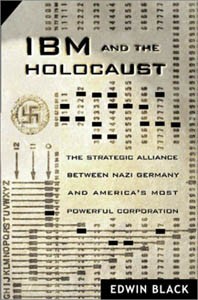
Edwin Black

An American company stands accused in ‘IBM and the Holocaust’

By Tom Sullivan

A friend of mine is fond of telling the story of a car trip he took as a boy with his friend’s grandparents, who were Holocaust survivors. As they passed a Ford on the road, the elderly man and woman began cursing the vehicle. When he asked why, he was told of Henry Ford’s anti-Semitism, Nazi sympathies, and alleged Nazi collaboration. Now, Edwin Black argues that another American business giant is deserving of similar infamy in his new book, IBM and the Holocaust (Crown Publishers, $27.50).

Black is the son of Polish Holocaust survivors. He is also the author of The Transfer Agreement, which examines a 1930s scheme between German Zionists and the Nazi regime under which the Zionists helped to lessen the impact of the international boycott of German goods in exchange for the Germans allowing some Jews to emigrate to Palestine.

According to Black’s new book, IBM supplied Hollerith punch-card readers and related technology to the German government, which used the technology to conduct censuses, organize their rail system, organize and bill for slave labor, and coordinate the rounding up of Jews and other victims for shipment to concentration camps.

Without this technology, Black argues, the Holocaust could not have proceeded on as grand a scale, and the roundup of victims could not have been accomplished as quickly or efficiently. And, he argues, without the cooperation of IBM and IBM’s chairman, Thomas J. Watson, the Germans would not have had the machines in sufficient quantities to make them effective.

IBM’s direct involvement with the German government was conducted mainly through its German subsidiary, Dehomag, and Watson had little or no control over the company once war broke out in Europe. However, in the years before the war Watson expanded Dehomag, authorized its managers to develop and expand production facilities in Germany, and positioned them to work closely with the virulently anti-Semitic German government.

None of this was illegal, and Watson had a wide following of international businessmen who also favored increased rather than decreased economic interaction with the Third Reich–a form of constructive engagement similar to President Reagan’s strategy with apartheid South Africa.

However, Black argues, Watson should have been aware and probably was aware that the work Dehomag was undertaking was being done for purpose of identifying Jews in Germany. He also points out that by 1933, when Dehomag first undertook a census for Germany, the extreme anti-Semitic nature of Hitler’s beliefs and programs was public knowledge.

IBM NY essentially lost control of Dehomag in 1940, when Watson was compelled to appoint a Nazi majority to the board of directors. But according to Black, Watson maintained careful surveillance of the company through IBM’s Geneva subsidiary, which continued economic relations with Dehomag throughout the war.

IBM NY did maintain a greater degree of involvement with and control over its subsidiaries in countries occupied by Germany. For instance, Watson personally approved the construction of manufacturing plants in Vichy France and Nazi-occupied France in 1941.

Black also claims that “Millions of punch cards were routinely shipped from IBM in America directly to Nazi-controlled sources in Poland, France, Bulgaria and Belgium.” This information was revealed in a Justice Department investigation of IBM for trading with the enemy. The investigation was eventually dropped, although Black maintains that this was in part because of Watson’s close ties to President Roosevelt and in part because the U.S. government was dependent on IBM equipment and technology for the prosecution of the war.

This book has its flaws. Black tends to overwrite and has included a fair amount of extraneous material. More importantly, it would have been helpful if the book had made some attempt to provide context for IBM’s decision to continue close relations with its subsidiaries. Were there other subsidiaries of American companies that were deemed vital to the German war effort? If so, how did their parent companies handle the situation? Were there similarly situated companies who refused to cooperate with the Nazis? If so, what were their rationales and the effects of their decisions?

It is also unclear what would have happened if the Germans had not had IBM technology and equipment at their disposal. In Rwanda not long ago, nearly a million people were massacred with hoes and similar tools, so probably some version of the Holocaust would have taken place regardless of the sophistication of available technology. It is clear, however, that the technology was deemed highly valuable by the Germans themselves, and was widely used by other countries to conduct censuses and organize information and resources.

Black does establish that IBM benefited tremendously from its subsidiaries’ relationships with the Nazis, both in terms of actual profits during the war years and in terms of the competitive advantage that it derived from being firmly entrenched in newly liberated Europe. Clearly, Watson and his aides acted in the best interests of their company. Black’s book, together with a recently filed lawsuit against IBM, will help clarify the effects of their actions on their species.

Web extra to the March 1-8, 2001 issue of the Northern California Bohemian.

© Metro Publishing Inc.

Open Mic

Drivers' Ed By Susan Bono MY SON will be driving soon. Consider yourself warned. Come summer, it might not be a mom with 30 years of experience behind the wheel of that blue Sable wagon. Instead, you may be encountering someone with, shall we say, more youthful attitudes and responses. I confess...

Upstairs at the Annex

Artist Loft New art gallery hides above the bookshelves By Paula Harris WALK DOWN Fourth Street in downtown Santa Rosa and you'll only find one art gallery. Or maybe you won't find it. The newly opened Upstairs at the Annex, well concealed on the upper floor of Copperfield's Books on Fourth...

‘Deadly Persuasion? Media’s Hidden Messages’

Kilbourne and others to speak at SSU lecture Sure, our culture passively absorbs thousands of media messages that bombard us every day, as comfortably and unthinkingly as drawing breath, or slurping a diet soda. But the effects of the commercial barrage can be shocking, with impacts that shape both society-at-large and individual behavior. To draw attention to...

Merle Haggard

Outlaw Country Merle Haggard's unbridled honesty By Felix Thursday ANTI-CORPORATE, anti-Nashville, anti-studio musician, and now on the Anti-Epitaph label (the same music stable housing Rancid, NoFX, Tom Waits, and Tricky), 60-something Merle Haggard is back with another batch of songs and a recent autobiography detailing his many detours along life's highway--from...

Jean Kilbourne

Not for Sale When ads remake women, we all lose By Jennifer L. Pozner "ADVERTISERS know what womanpower is," explains a self-promotional pitch for the Ladies' Home Journal. The ad shows a stylish woman wired to a mammoth computer that measures her whims with graphs, light bulbs, and ticker tape. The...

Jaron Lanier

Artificial StupidityVirtual-reality pioneer Jaron Lanier says computers are too dumb to take over the worldBy Damien CaveJARON LANIER entered college at age 15. Before turning 25, he coined the term "virtual reality," landed on the cover of Scientific American, and subsequently became a hot pop-culture commodity--a dreadlocked, blue-eyed visionary, media darling, and inspiration to geeks everywhere. But now, in...

‘A Good Baby’

Bad Attitude 'A Good Baby' has a man who needs killing Writer David Templeton takes interesting people to interesting movies in his ongoing quest for the ultimate post-film conversation. HERE I AM, sitting in the dark, all alone with Jill Conner Browne. I am a lucky...

Usual Suspects

Petaluma water policy prompts a complaint By Greg Cahill A FORMER Petaluma City Council member and a group of local progressives have filed a complaint over Petaluma City Council's decision on Jan. 23 to overturn a controversial water contract policy. David Keller, an environmentalist whose decision not to seek re-election in November helped lead to the...

‘The Mexican’

The Mexican. Wasted Trip 'The Mexican' squanders cast with cheap stereotypes By IN THE MOVIES, Mexico often serves as a testing ground, a place where the gringo can hazard his manhood in a dangerous country against wily, ruthless, unwashed, gibbering sadists--a land where even God's good water...

Edwin Black

An American company stands accused in 'IBM and the Holocaust' By Tom Sullivan A friend of mine is fond of telling the story of a car trip he took as a boy with his friend's grandparents, who were Holocaust survivors. As they passed a Ford on the road, the elderly man and woman...
11,084FansLike
4,606FollowersFollow
6,928FollowersFollow