Newsgrinder

Important events as reported by daily newspapers and summarized by Daedalus Howell

Tuesday 03.13.01

Sixteen years ago, convicted felon Jeffrey Campbell escaped from the Marin County Jail in a laundry cart, then mailed his jailors a postcard. Now “Wish you were here” ain’t so funny anymore–yep, he’s back in the pokey, reports the Marin Independent Journal. Defense attorney Kim Kruglick argued that Campbell (who changed his name to Leslie and became a registered nurse during his years on the lam) should be granted probation for being a “healer.” Says Kruglick, “He’s shown that he could be a better man.” At the time of his capture, Leslie, the “better man,” was wanted in Michigan for fleeing prosecution after allegedly stealing prescription painkillers from a local hospital. “If I could go back and change things, I would,” Campbell said. No word if this includes picking a cooler pseudonym.

Tuesday 03.13.01

A fifth-grade boy, with apparently no idea how tough it is to get into a good university, just shot his future full of holes. The 11-year-old was arrested and suspended from Sebastopol’s Pine Crest School for making death threats against three teachers and the principal during recess, reports the Press Democrat. The boy faces expulsion from school and a hearing in Sonoma County Juvenile Court, and will be required to write about a “formative educational experience” in his college application essays (forget about letters of recommendation, kid). Dawn Johnson-Huff, the wannabe assassin’s school principal says, “It was more or less an angry child blowing off.” Yeah, his future. Talk ain’t so cheap anymore, kids.

Sunday 03.11.01

Coming to a neighborhood near you: The IJ reports that hazardous-waste experts from the U.S. Army Corps of Engineers have discovered methane spreading underground from the defunct Hamilton Field military base. Besides the gas, volatile organic compounds (no relation to the punk band) and other suspected carcinogens are wafting from the ground like a gaseous specter of death toward the site of a proposed housing development. Possible solutions include breaking down the gas with oxygen, building a rock-filled trench around the landfill to disperse the gas, lighting a match, and running away very, very quickly. “Let them complete their report and let the experts tell us what the problem is and what they’re going to do about it,” bravely says nearby resident Kurt Hansler. “In the meantime, I’m not going to lose any sleep, and my hair isn’t going to get any grayer.” No, dude, it’s just going to fall out during chemotherapy.

Wednesday 03.07.01

Two thumbs down: The Argus-Courier reports that the curtain is going down on Pacific Theatres Petaluma because the last picture show cannot compete with its sibling, the larger Rohnert Park 16-screen stadium theater; both are owned by the Pacific Theatres Corp. (their marketing plan revealed!). In lieu of the vicarious cinematic experience, bored P-townie teens are expected to experiment with sex, drugs, violence, and cannibalism.

From the March 15-21, 2001 issue of the Northern California Bohemian.

© Metro Publishing Inc.

‘Frankie & Johnny’

0

Love Story

Older couple takes chance on romance in ‘Frankie & Johnny’

by Yosha Bourgea

THE RAMBUNCTIOUS opening night crowd at Sonoma County Rep was so ready for a play like Frankie & Johnny in the Clair de Lune that it began laughing the moment the house went dark and squeaking bedsprings and sounds of coital bliss started coming from the stage.

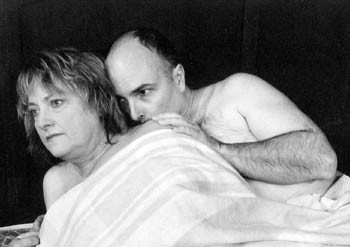
Frankie & Johnny, written by Terence (Lips Together, Teeth Apart) McNally, was once the basis for a movie starring Michelle Pfeiffer and Al Pacino. The two leads in SCR’s production are Diane Bailey and Steven David Martin, who look not a thing like their glamorous film counterparts and who are, for that reason among others, especially well suited to their roles.

Frankie & Johnny is a funny, poignant dialogue between a middle-aged man and a middle-aged woman just beginning to fall in love. He is the new short-order cook at a New York diner, she the veteran waitress. They notice each other at work, go out on a date, and end up in her apartment having sex. The sex is great, but afterward–in a reversal of the old gender cliché–Frankie wants to be left alone, and Johnny isn’t ready to go.

Bailey, the director of more than 20 plays at SCR, is entirely believable as the wary, pragmatic Frankie. She has a kind of tough resignation that seems to come from living alone in New York City and from having been around the proverbial block too many times. Like any experienced waitress, she has suffered a lot of fools–but not gladly.

Martin’s Johnny is not foolish, but he is sometimes a ham in the way that men can be when they’re trying to impress women. His earthy exuberance ranges between that of Zorba the Greek and Joe E. Brown in Some Like It Hot. Zowie! He’s effusively in love with Frankie, even though they’ve just met, and he has no problem expressing himself.

Frankie, on the other hand, regards his puckish behavior as first bewildering, then more and more annoying. Her complacency is seriously ruffled, and the distance to which she is accustomed has been breached by a strange, persistent man who won’t stop praising her beauty, no matter what insults she hurls at him. “You want too much,” she says defensively. “I’m a BLT sort of person, and I think you’re looking for someone a little more pheasant under glass.”

Johnny is undaunted by her resistance, unwilling to retreat from intimacy, determined to win her over. Martin plays him with relaxed self-confidence and a kind of virility that has nothing to do with machismo. Because he pitches most of the woo, Johnny gets most of the laughs, and in less skilled hands he could seriously upstage Frankie. Not this time. Martin and Bailey generate real chemistry, balancing each other attentively on the stage.

Director and set designer Jim DePriest has given his actors a rather drab apartment to be in, aside from four small posters of the Beatles that I didn’t really believe Frankie would hang right above her bed. But the sink works, and the whole audience can smell the Western omelet that Johnny cooks on the stove, further enhancing the intimacy of the small theater.

This is a play to see with someone you love. Playwright McNally says, “The story is a celebration of people who follow the yearning and are willing to enter the joust once more.”

‘Frankie & Johnny in the Clair de Lune’ runs through April 7 at the Sonoma County Repertory Theatre, 104 Main St., Sebastopol. Tickets are $15. For reservations, call 707/823-0177.

From the March 15-21, 2001 issue of the Northern California Bohemian.

© Metro Publishing Inc.

DEA Crackdown on Drug Paraphernalia

Bongs Away

Feds vs. bongs: Heads up for head shops

By Philip Smith

ADAM ENGLEBY thought everything was cool. Yes, his shop, Hemp Cat in Iowa City, sold, ahem, “smoking accessories,” or bongs, pipes, and rolling papers, but the Iowa City Police Department visited regularly, and they never had any problem with Hemp Cat’s back room. Heck, Engleby even had signs in his store advertising the accessories as being for use with tobacco, he wouldn’t allow any talk about drugs in the shop, and he certainly didn’t allow minors into the back room. And after all, Iowa City is a progressive, tolerant college town, and local police reflected the relaxed attitude.

The Iowa City Police Department’s Sgt. Brotherton has said as much. “We [didn’t] see [the Hemp Cat] as a major problem,” he said. “We weren’t paying much attention.”

But what was an acceptable arrangement for the community wasn’t good enough for the feds. On Feb. 11, Engleby’s home and business were raided by teams of civilian-dressed law officers, headed by the Drug Enforcement Administration.

“The DEA led the raids,” Engelby said. “The only badge I was shown was a DEA badge. They had warrants for ‘drug paraphernalia’ and any sort of records, and they took everything. They took our rolling papers, they took real tobacco pipes, and, of course, they seized all of our computers–four of them, two at the store and two at home. They even took my wife’s computer.

“The Iowa City PD never hassled us in six years of business,” groaned Engleby, “and no one ever came in and told us to stop, no one complained.”

No one was arrested, Engleby said, and no charges have been filed, but Engleby has now joined a growing number of “alternative store” (the industry cringes at the term “head shop”) owners and operators being rudely awakened to the reality of federal drug-paraphernalia laws.

UNLIKE MANY state and local paraphernalia statutes, which allow for a subjective, contextual interpretation of whether a given object is indeed drug paraphernalia–sometimes a spoon is only a spoon–federal law is black and white: Possession of a bong is a federal offense, and so, of course, is the sale or manufacturing of a bong, or conspiracy to do so. It can get you three years in federal prison. And it doesn’t matter if the bong has never been used or if it is a jewel-encrusted work of art; a bong is a crime. And to make things even rosier, since 1990 federal law has made drug-paraphernalia violators subject to Racketeer Influenced and Corrupt Organization (RICO) and money laundering charges, as well.

“It’s simple,” said head-shop defense attorney Robert Vaughan, the longtime publisher of an industry newsletter. “If you have a bong, you’re violating federal law. You can get a license to own a Tommy gun, but you can’t get one to own a bong.

“Stores that have bongs are screwed,” the Nashville-based lawyer said. “They can’t win. The Supreme Court upheld its so-called objective standard in U.S. vs. Pipes and Things in 1994, and now categories of items are per se illegal.”

That was news to Engleby and his customers. “The customers are really disappointed. They’re saying, ‘Can they do that?’ ” Engleby said. “Everyone is shocked that the DEA has that kind of power. One City Council member came in to express his support; he didn’t think it was right.”

Unfortunately for Jerry Clark and Kathy Fiedler of Des Moines, they were already well aware of federal paraphernalia laws. Their shop, Daydreams, was raided by the feds last year, and they are scarred by the experience.

“We were raided by U.S. Postal inspectors, the DEA, and local cops and sheriff’s deputies,” Clark said, “and we’re barely hanging on now. It’s hurt us financially; we’ve lost over $250,000 in inventory and paid out lots of money in legal fees.

“And they’re using the RICO act on us, so we’re facing 10 to 12 years,” he said bitterly. “They’ve seized my partner’s properties under the asset forfeiture laws. But all we can do is try to litigate our way out or come to a negotiated settlement. We’re trying to work out a better deal than going to court.”

“We weren’t aware of the federal law,” interjected Fiedler, “but let’s face it, we weren’t the only ones. We did everything to the letter of the law as we knew it, we did not sell to minors, we checked IDs; if they didn’t have IDs, tough luck.”

Clark and Fiedler remain in business, but they are angry. “This is a bullshit law,” snorted Clark, “and you have to get mad at the people who created this stupid law. But,” he hesitated, “looking at the penalties we face, we’re not going to do anything to rock the boat.”

“We don’t feel like felons,” added Fiedler, more hurt than angry. “These people don’t have any idea who’s smoking–they think it’s the kids, but our customers are lawyers, preachers, even people from the state Attorney General’s Office. They’re nice, average people, but instead of drinking a six-pack, they’d prefer to smoke things.

“Morally, I see nothing wrong with what we’re doing,” she insisted.

So who ordered the raids? Hard to say. Repeated calls to the DEA were referred to the U.S Attorney’s Office in Des Moines, and they didn’t return calls. The Iowa City Police Department’s laconic Lt. Wyss, who coordinates the Johnson County Multi-Agency Task Force, did confirm that his officers participated at the DEA’s request.

When asked why his officers were devoting their time to busting bongs, Wyss said: “Because they violated the law, I suppose. The DEA asked us, and we were happy to help.”

Attorney Vaughan, who is representing Clark and Fiedler, finds it all faintly ridiculous were it not for the serious consequences.

“With Operation Pipeline they managed to knock out all the big boys,” he said, “but all they’ve created is a whole multilevel cottage industry, and lots of these people don’t even know about the federal law, they don’t have any historical memory of Pipeline, and enforcement is sporadic. What a waste of time and resources and people’s lives.

“It’s as if the feds were out arresting the guy smoking a joint on the corner,” he said.

This article comes from the newsletter of the Drug Reform Coordination Network.

From the March 8-14, 2001 issue of the Northern California Bohemian.

© Metro Publishing Inc.

‘The Mexican’

0

Tough Talk

‘Wild at Heart’ author sneers at wimpy Pitt film

Writer David Templeton takes interesting people to interesting movies in his ongoing quest for the ultimate post-film conversation.

“W ELL, the dialogue stinks.” This six-syllable assertion has been uttered by author Barry Gifford, standing beside me in the mushy evening mist outside the theater where our threesome has just seen the new Brad Pitt-Julia Roberts flick The Mexican.

Gifford is an author, a screenwriter, a playwright, and a poet. He’s best known for the novel Wild at Heart, for the screenplay of David Lynch’s Lost Highway, and for the best-selling book of film criticism, Out of the Past: Adventures in Film Noir. He enjoys a worldwide reputation as a tough-talking, one-of-a-kind American writer with an unconventional body of work. He lives in Berkeley, not far from Vinnie Osorio, the other member of our little group.

Vinnie, a pal of Gifford’s since they were both 13, has earned a unique reputation of his own over the last few years, since Vinnie accompanies Gifford to most of his appearances and interviews. According to Gifford, a major magazine in Rome planned a piece on Gifford, but was so impressed with Vinnie–a self-described “Buddhist plumber”–that the resulting article was as much about Vinnie as it was about Gifford.

Gifford clearly enjoys this development.

“He gets half of all my interviews now,” Gifford says, smiling oh so slightly. He adjusts his jacket as the mist turns to rain, while Vinnie offers his own summation of the film.

“It was hilarious,” he says.

“The dialogue stinks,” repeats Gifford. And with that we go off in search of a drink.

THE MEXICAN is a strange hybrid. An action-adventure-comedy with mystical undertones, it follows the dual stories of a sad-sack thug (Pitt) sent to Mexico to fetch a legendary pistol named The Mexican, and the thug’s neurotic girlfriend (Roberts), who is taken hostage by a sentimental hit man (James Gandolfini) to ensure that Pitt returns with the goods.

At the heart of the film are the gooey “relationship” chats that Roberts shares with the surprisingly New Age hit man. The dialogue is strewn with the catch phrases of modern psychology: “You’re not validating me,” “I’m a giver, you’re a taker,” and “Let’s take a time out.”

Vinnie loved it. Gifford didn’t.

“All the men vs. women stuff was OK,” Gifford allows, sipping a vodka as we perch on a row of stools at a nearby bar. “But it was tiresome.”

“You don’t realize how much of that psychobabble shit really goes on,” Vinnie remarks. “I thought their relationship was the most realistic thing in the movie. All that carping and bitching, the constant postulating, the pop-psychology theories used to justify their own egocentricities. I’ve heard so much of that crap in my life you wouldn’t believe it.”

“Well, when I hear the word relationship–as the saying goes, I reach for my Luger,” jokes Gifford. “But seriously, I agree that the relationship talk was stuff we hear all the time, but it wasn’t funny. The script needed a rewrite.

“Let me ask you something, Vinnie,” Gifford continues. “Why is this couple together? Let’s see, she says that he’s a generous and kind lover, but we don’t get anything else.”

“Oh, I know exactly why she’s with him,” Vinnie replies. “She’s with him because he listens to her. He’s a lug and a criminal and he gets exasperated with her, but he listens, and obviously nobody’s been listening to her in a long, long time. Would you?”

Gifford wouldn’t.

Which brings this conversation to the big moral point of the movie, as symbolized by The Question–the simple test as to whether a relationship will last. Roughly paraphrased, the question is: If two people really love each other but just can’t get along, when do they say enough is enough?

The movie’s answer? Enough is never enough. If two people truly love each other, they’ll never give up.

Gifford’s answer isn’t so sweet.

“I think it comes to a point where, you know, the repetitiousness of it all finally wears you out,” he says. “You get tired. You just get so goddamn tired. That’s when it’s time to say, ‘Enough is enough.'”

Hardly the stuff of self-help books, but kind of catchy.

“Now, if the other person is capable of changing, really doesn’t want to lose the good parts, there’s still a chance,” Gifford adds. “I think people’s ability or inability to change, to want to change, is the key to the whole thing. You have to be able to recognize when the other person is just not going to ever be secure enough to satisfy you.”

Vinnie nods.

“Security,” Gifford says. “That’s the thing.”

“The first thing you have to do is be comfortable with yourself,” Gifford goes on. “It’s an old adage. It’s a cliché. But it’s nevertheless the main truth of the whole matter. Once you are comfortable with the way you are, then it’s really up to the other person to accept or not accept you. That is the answer to the question about when enough is enough.

“In this movie,” he says, “the answer is very shallow. The people are shallow. The whole movie is shallow. Better dialogue would have helped.”

“But, Barry, I’ve known so many people like that it’s frightening,” Vinnie insists. “I’ve known women like that.”

“Fine, so The Mexican was realistic in that one thing,” Barry Gifford gives in. “But the dialogue still stinks.”

From the March 8-14, 2001 issue of the Northern California Bohemian.

© Metro Publishing Inc.
Usual Suspects

Marin recall losing its luster

By Greg Cahill

ERIN BROCKOVICH will not be using her star power to save a floundering recall campaign against Marin County District Attorney Paula Kamena. Last week, a coalition of angry family law advocates and medical marijuana supporters announced incorrectly that Brockovich–the environmental law crusader portrayed by Julia Roberts in last year’s popular film by director Stephen Soderbergh–would be attending a press conference to lend her clout to a bid to unseat Kamena. Not so, said a spokeswoman for Brockovich.

Now the recall campaign itself is drawing fire for the latest in a string of apparent dirty tricks.

A letter from Edward Masry, a partner in the Southern California law firm that employs Brockovich, cited in the Marin Independent Journal, stated that someone has been masquerading as the celebrity legal eagle by using fake stationery to write letters to California State Supreme Court Chief Justice Ron George and another judge to complain about alleged abuses in family law matters. Masry went on to state that someone has been using Brockovich’s name “to further a cause that she has no association with or knowledge of.”

Lynette Shaw of the Marin Alliance for Medical Marijuans reportedly told the IJ she was surprised to hear about the Brockovich incident. Shaw, who helped plan the press conference, said that she is convinced Brockovich “was misrepresented.” In a statement to the paper, Kamena characterized the recall campaign as lacking in credibility, noting that the incident should call into question the viability of complaints against her. “This reminds me of the jury instruction about witnesses being willfully false,” she said. “It says a witness who is willfully false in one material part of his or her testimony is to be distrusted in others.”

Meanwhile, a classified ad appearing in the San Francisco Chronicle last week listed a job opening for a Marin County district attorney. Among the qualifications: “Integrity a must.”

Two separate groups–one angry over child-custody decisions and the other miffed about the county’s medical marijuana policies–joined forces last fall in an eleventh-hour bid to force a May 22 special recall election.

No one has stepped forward to run against Kamena.

Nation Wide

STATE ASSEMBLYMAN Joe Nation, who won a seat in the Legislature last year, isn’t wasting any time making a name for himself during the energy crisis. Nation has proposed a conservation-based program that would charge a higher rate for those using more than the amount of power allocated in previous years.

The program, for residential and commercial users, would require the installation of real-time meters to help users gauge the rate of consumption and the cost of that power at any given time. The proposed tiered-rate system probably would go into effect first for businesses. It is estimated that the state will face a 30 percent shortfall in electrical power this summer, despite the announcement this week that Gov. Gray Davis has signed long-term contracts with energy suppliers. California consumers, who were asked to curtail energy use this winter, have decreased consumption overall by just 8 percent.

Meanwhile, Nation–who sits on the Assembly’s Utilities and Commerce Committee–will discuss his proposal and other energy-related matters on March 28 at the monthly dinner meeting of the Santa Rosa Democratic Club. There will be an open-mic session for audience participation. Among the topics that Nation will discuss are public conservation measures; energy efficient homes; the feasibility of solar, wind, and nuclear power; and the possibility of state ownership of utility companies, power plants, and transmission lines.

The dinner meeting will be held at the Santa Rosa Memorial Veterans Building, 1351 Maple Ave., Santa Rosa. The meeting begins at 6 p.m. with a mix-and-mingle session, followed by dinner at 7 p.m. Admission to the event is free, though dinner costs $7 with reservations ($9 without). For details, call 575-0128.

On a side note, the conservative Bush administration has been very, very good for the local Democratic Club. SRDC President Liz Basile reports signing 24 new members, bringing membership up to 325. “In a way, Bush is doing us a favor because we’re beginning to see active Democrats up in arms over his policies,” she says. “It’s very scary what’s happening.”

Usual Suspects loves tips. Email us at Su******@******an.com

From the March 8-14, 2001 issue of the Northern California Bohemian.

© Metro Publishing Inc.

Newsgrinder

Important events as reported by daily newspapers and summarized by Daedalus Howell

Tuesday 03.06.01

A coyote killed a Mill Valley family dog in what the Marin Humane Society said was the first documented coyote attack on a pet in Marin County in at least 30 years, reports the IJ. The pet, a 12-pound bichon frisé curly lap dog named Cassie (Canis familiaris idioticus) was asking for it, according to supporters of the coyote (Canis killis pro forma). “This is really sort of a freak first-time incident that really reminds us to be careful when living close to wildlife,” said Marissa Miller, a Humane Society spokeswoman. An anvil, packaging from the Acme Co., and a copy of Darwin’s Origin of Species were found at the scene.

Tuesday 03.06.01

The Sonoma Index Tribune reports that a man was cited for unlawful possession of nunchakus after being pulled over by Sonoma City Police for not having a license plate. When the driver could not provide proof of registration, the officer caught “an unobstructed view of the nunchakus,” apparently sparing the use of his X-ray vision. The suspect, Robert Neal Jr., though some call him Bruce, was cited for felony possession of a weapon with a name that cannot be spelled with a fifth-grade education.

Monday 03.05.01

The DARE–Drug Abuse Resistance Education (sometimes known as Dude, Acquiring Ritalin is Easy)–program used in 30 Sonoma County schools is coming under increasing fire because recent academic studies and government reports show it has marginal, if any, long-term effects on drug use, according to the Press Democrat. “Just Say No hasn’t worked,” said Bill Alden, a retired Drug Enforcement Administration agent who serves as deputy director of DARE America Inc. “It’s too simplistic for kids today.” Indeed, today’s savvy children need more than an acronym or pithy aphorism to divert them from the Devil’s candy–they need whole sentences, perhaps, dare I say, even paragraphs. Many critics believe DARE is a “gateway program” that can lead to harder, 12-step style programs–or even jail.

Sunday 03.04.01

Boudoir pornographers the world over owe a debt to George W. Wheelwright III, co-founder of the company that became the Polaroid Corp., who died Thursday at the Marin Convalescent Center in Tiburon at the age of 97. Wheelwright founded Polaroid with Edwin H. Land, a scientist whose ideas for a lens that could polarize light formed the technological underpinnings of glare-free sunglasses and later of instant photography, according to the Marin Independent Journal. Wheelwright’s contribution rendered embarrassing trips to the Fotomat unnecessary and was the amateur smut-maker’s tool of choice before the advent of digital photography. Remember, it’s impolite to say “Cheese” with your mouth full.

From the March 8-14, 2001 issue of the Northern California Bohemian.

© Metro Publishing Inc.

Spins

0

Back to the Future

Jazz CDs spotlight 1950s avant-garde

By Harvey Pekar

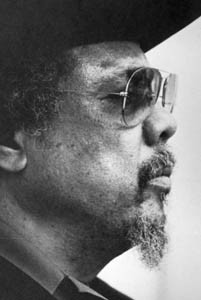
ALL OF THE classically influenced avant-garde jazz movements have produced fascinating music, but some have not caught on; they haven’t become immediately influential and seemed to have petered out. But a trio of new CD reissues–Charlie Mingus’ Jazz Composers Workshop (Savoy); the Sandole Brothers’ The Sandole Brothers and Guests (Fantasy); and Teddy Charles’ The Prestige Jazz Quartet (Prestige)–spotlight a period well worth re-examining.

And all received relatively short shrift in the sprawling Ken Burns PBS-TV documentary Jazz.

That the avant-garde was often ignored is evidenced in the impressionist-influenced music of Bix Beiderbecke, Frank Trumbauer, and Red Norvo in the late 1920s and early 1930s. Unique and attractive as it was, it received virtually no popular support. In the mid-1940s, the superb pianist Lennie Tristano, whose work was marked by Bach as well as 20th-century composers, created a genre of modern jazz that was an alternative to bop. He influenced a few brilliant musicians–Lee Konitz, Warne Marsh–but, again, his music was too far out for most mainstream jazz fans, and by 1960 only a handful of musicians were left performing his style, although his was the first group, as opposed to an unaccompanied soloist, to record free-jazz performances.

There were also big bands experimenting with classical influences during the 1940s, such as those of Stan Kenton and Boyd Raeburn, who made a recording called Boyd Meets Stravinsky.

The synthesizing of jazz and classical music continued into the 1950s, and some of the more important hybrid albums from that period by Charlie Mingus, who has received a lot of publicity, and others, have recently been reissued. While bassist/ composer Mingus’ most popular works have been funky, sometimes gospel-influenced selections such as “Better Git It in Your Soul,” his compositions dating back to the 1940s have always exhibited a classical influence. It was particularly obvious during the mid-1950s, as on the two great 10-inch LPs–currently available on both Fantasy and Bethlehem–the bassist cut for the Period label with trumpeter Thad Jones, alto saxman/clarinetist John La Porta, and tenor player Teo Macero.

Actually, the Period stuff and the Savoy material discussed here did not originally come out under Mingus’ name; they were by a co-op group called the Jazz Composers Workshop. On the just reissued Savoy CD, two groups are featured. One, put together in 1954, features Mingus, LaPorta, Macero, baritone player George Barrow, pianist Mal Waldron, and drummer Rudy Nichols. The charts here are credited to Mingus. He emphasizes contrapuntal writing, and there is improvised counterpoint on these selections, too. The soloists are highly distinctive. LaPorta and Macero, who later turned to record producing for a living because Mingus’ music was too advanced for the general public, both employ unusual interval skips. Macero sometimes screams, playing above the normal upper register of the tenor before John Coltrane and Albert Ayler popularized it. Teo’s soft, pretty tone is Stan Getz-like, and his relaxed articulation is reminiscent of Lester Young school players. LaPorta has a more biting timbre on alto, and his unpredictable solos contain abrupt starts and stops. Waldron combines a gentle touch with ideas that are harmonically and rhythmically daring.

The other group on the disc is a 1955 quartet with Mingus, Macero, pianist Wally Cirillo, and drummer Kenny Clarke. Cirillo provides exquisite, lyrical solo work, employing a style rooted in both bop and Tristano. His work’s quite graceful, and he’s got an even lighter touch than Waldron. Macero’s playing is also lovely, full of surprises yet gentle. Mingus, then technically the best of all jazz bassists, performs outstandingly as a soloist and accompanist on both sessions.

THE BROTHERS Sandole, guitarist/composer Dennis and pianist/composer Adolph, are among jazz’s many well-kept secrets. Dennis played with Ray McKinley, Tommy Dorsey, Boyd Raeburn, and Charlie Barnet from 1939 to 1946, then returned to his hometown, Philadelphia, to teach, and continued to do so until his death several months ago. Among his students were some very distinguished jazzmen, including John Coltrane, trumpeter Art Farmer, and composer/arranger Tom McIntosh. Here the Sandoles’ advanced compositions are performed by a band that includes Dennis, Farmer, LaPorta, Macero, trombonist Sonny Russo, and pianist Al Del Governatore. Often they use complex phrases, oddly contoured melodies, and frequently shifting harmonies. They employ a rich palette of tone colors and textures, including a grainy reed sound.

Also included on the CD are four 1956 selections by LaPorta on clarinet backed by pianist Jack Keller and drummer Clem DeRosa. LaPorta was a classically trained clarinetist, as his clean articulation and pure tone indicate, but these tracks, three of which are standards, are not as challenging as the material with Mingus and Sandole. In fact, there are times when the group is reminiscent of the Benny Goodman Trio.

THE PRESTIGE Jazz Quartet consists of vibist Teddy Charles, pianist Waldron, bassist Addison Farmer (Art’s brother), and drummer Jerry Segal. Charles was one of the major 1950s avant gardists. He experimented with extended forms, polytonality, fourth chords, modal music, and fluctuating tonal centers. This 1957 recording contains a suite by Charles, “Take Three Parts Jazz,” a version of Thelonious Monk’s “Friday the Thirteenth,” and two Waldron originals, including “Meta-Waltz.” Charles and Waldron take risks while improvising; nevertheless, their solos are lucidly constructed. Both play with a combination of daring and discipline.

During the late 1950s, jazz-classical hybrid music became categorized under the label Third Stream. It attracted some attention momentarily, but quickly lost out in popularity, even among experimental jazz fans, with the rise of free jazz, Coltrane’s modal music, and fusion.

Currently, avant-gardists are blending all sorts of genres, not only jazz and classical, but R&B, rock, Balkan, and various Asian forms, and 1950s Third Stream music can be seen as anticipating the efforts of such contemporary avant-garde musicians as John Zorn and Dave Douglas. Beyond this, however, a lot of Third Stream stuff remains as stimulating and fresh as ever. Listen to these artists. Because most jazz fans know so little about them, they’re in for a wonderful surprise.

From the March 8-14, 2001 issue of the Northern California Bohemian.

© Metro Publishing Inc.
Rubio’s Baja Grill

0

Baja Beyond

Cheap seafood hooks ’em at Rubio’s Baja Grill

By Paula Harris

THE STORY is a cute one. According to the corporate PR machine at Rubio’s Baja Grill chain, the fast-food taqueria was spawned like this: In the mid-’70s, San Diego State University student Ralph Rubio idled away his spring breaks at San Felipe, a Baja fishing village, where he discovered the local delicacy, fish tacos; he nabbed the recipe; and when his dad challenged him to get his suntan-lined butt off his surfboard and make something of his life, young Ralph opened a walk-up taco stand in San Diego. Since that day in 1983, so goes the legend, Rubio’s has sold more than 38 million fish tacos.

Now Rubio’s Baja Grill has opened in Santa Rosa at the Plaza Shopping Mall, between Fresh Choice and the giant grasping hand sculpture. You may have seen the bright neon signs and exotic palapa-style umbrellas with dried palm fronds outside.

Yes, it’s fast food and not fancy, yet Rubio’s has a laid-back charm–even for a walk-up taqueria. A cross between nearby Sonoma Taco Shop and the Cantina, it’s bright and festive with a coral-tiled floor, tables decorated with colorful suns, chilies, fish, maps of Baja, and little mottos like “Fish tacos and cerveza, the two best amigos a lime ever had.”

There are prints of tropical scenes, complete with palms and hammocks by the ocean, a small aquarium (no, the inhabitants won’t end up in your burrito), and happy music on the sound system. We line up and place our order with the cheerful kid behind the counter who dutifully raves about the fish tacos.

Rubio’s uses Alaskan pollack (a white fish in the cod family), which is then beer-batter fried until crispy and heaped into a warm soft corn tortilla with shredded cabbage, salsa, and a light tasting white sauce, and served with a wedge of fresh lime. The effect is a crunchy, mild fish-flavored treat that will reel you in at $1.89.

There’s also a marinated char-grilled fish taco, with the type of fish changing on a monthly basis. Today they’re serving a mahi-mahi taco for $2.65.

But best of all is the lobster taco ($2.99)–real lobster meat in a warm soft corn taco smeared with guacamole and a slightly zesty sauce, plus shredded cabbage and salsa made with tomato, green pepper, onion, and fresh lime. The slightly salty tender gobs of warm lobster meat enliven the taste buds and, indeed, cry out for a slug of cold beer to wash it all down.

There are bottles of beer on ice at the counter, domestic for $1.95 and Mexican for $2.95 a bottle. A glass of house chardonnay is $2.65. There are also plenty of choices in sodas and other soft drinks.

Other menu highlights include a grilled chicken burrito ($4.79)–fresh, colorful, and inviting with tomato, onion, cilantro, and good chicken, and not overblown with leaking cheeses and sauces; fresh (though a bit bland) guacamole ($1.65/small, $2.69/large); and pale-hued but peppery and tasty refried beans (99 cents). Thick, not too greasy, corn chips are 99 cents for a side order.

Kids’ meals offer a variety of choices (like the fish taco or chicken taquito) with chips or beans or rice, a churro, and a prize ($3.29).

A nice touch is the salsa bar, where you can load up on fresh salsas on ice (picante, verde, or regular). Whole chilies and lemon and lime wedges also come with your meal.

Desserts are limited to a chocolate ice cream-filled taco concoction ($1.89) or a hot crisp churro–a doughnutlike stick that encaramelizes the lips with cinnamon and powdered sugar (another deal at 99 cents).

For sheer value, this place is quite a catch.

Rubio’s Baja Grill Address: 1016 Santa Rosa Plaza, Santa Rosa; 707/546-3267 Hours: Monday-Saturday, 10:30 a.m. to 9 p.m.; Sunday, 10:30 a.m. to 8:30 p.m. Food: Fast-food taqueria, seafood tacos Service: Friendly counter folk Ambiance: Laid-back beach-type Price: Cheap Wine list: One house chardonnay; beer and sodas rule here Overall: 2 1/2 stars (out of 4)

From the March 8-14, 2001 issue of the Northern California Bohemian.

© Metro Publishing Inc.

Lori Andrews and Dorothy Nelkin

0

Creepy book says your body tissue is wanted, dead or alive

HOW MUCH would you guess a human body is worth? $100? $1,000? Back in the late 1960s, a number of folks–mostly high school science teachers–began gleefully spreading the deflating news that our bodies, when reduced to the base assortment of the chemicals, fluids, and fibers that we’re all made of, is worth less than 20 bucks, wholesale. That’s if you could even find anyone in the market for your vital fluids.

Well, heads up–the market has changed. Ask John Moore, a Seattle businessman who discovered that his UCLA doctor had been secretly harvesting Moore’s blood cells, patenting the unique chemicals in his blood and selling them to a Swiss pharmaceutical company. The price tag: $15 million.

That Moore felt appalled and violated by this revelation is to be expected. That he got over his shock and sued the doctor for a portion of the profits is no surprise. But that the California Supreme Court eventually ruled against Moore, claiming he had no legal or financial rights to his own tissues, is an eye-opener. According to the court, its ruling was necessary to encourage venture capital investment and protect scientific progress.

It’s hard to say what’s more shocking: that we may not have legal ownership and control of our own bodies; or that, properly marketed, our bodies have become gold mines of financial opportunity. Can we protect ourselves from those looking to cash in on this development? If not, how can we cash in ourselves?

These questions, and others even more mind-boggling, are explored in a fascinating new book about the brave new world of bio-commerce. Body Bazaar: The Market for Human Tissue in the Biotechnology Age (Crown; $24.00), by seasoned science-and-medicine writers Lori Andrews and Dorothy Nelkin, is a highly readable, heavily documented hybrid. The relatively slender book–180 pages of text with 57 pages of footnotes–blends meticulously researched facts with dozens of unsettling true stories. Fairly reported and solidly scientific, The Body Bazaar reads like a creepy horror novel that gives you bad dreams but won’t let you put it down.

According to Nelkin and Andrews, your tissue, blood, and bones are the $1s, $5s, and $10s of the biotechnology industry. The sack of cells we like to think of as our bodies has become the new currency in a $17 billion business. There are now over 1,300 biotechnology firms worldwide–companies that transform human tissue into products.

For example, the foreskins of newborn boys can now be used to grow new tissue for artificial skin. The unique antibodies in individual peoples’ blood have been used to manufacture vaccines against hepatitis and other diseases. A common clot-busting drug uses material from the kidneys of deceased infants.

If this all seems relentlessly ghoulish–well, it is. But it’s also entertaining. The book even offers a look at such colorful peripheral issues as body-snatching, biological performance art, and the bio-collectible market.

In one remarkable chapter, we learn the strange fate of Einstein’s brain. It seems that when the famed scientist died in 1955 his body was cremated–but his brain was kept from the fire by Dr. Thomas Stolz Harvey, who performed the autopsy. Over the years, Harvey has used pieces of the brain for study and given Tupperware-entombed portions to friends as Christmas presents.

The book concludes with some thoughts on how we might be able to keep our own tissues from being sold in the Body Bazaar of the 21st Century. How much is that worth to you?

From the March 8-14, 2001 issue of the Northern California Bohemian.

© Metro Publishing Inc.

’15 Minutes’

15 Minutes is no place for talented actors.

Red Menace

Russian baddies assault America in inane ’15 Minutes’

By

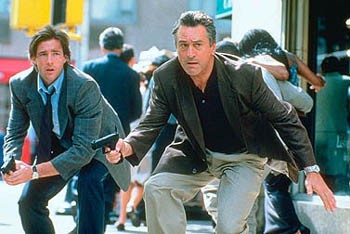
HERE’S an important message about violence in the media, brought to you by Time-Warner-AOL and its New Line Cinema division, creators of the Nightmare on Elm Street franchise.

15 Minutes, director and writer John Herzfeld’s follow-up to the equally shoddy 2 Days in the Valley, seems to be a re-creation of mid-1980s Golan-Globus grindhouse fare. It’s an uneasy mixture of titillating violence and New York Post editorial page-style denunciation of crime in the streets.

A previous example of this brand of kibble is Cannon Films’ 1987 Street Smart with Christopher Reeves. Here it is again: the “realistic” exposé of criminals pampered by the justice system, combined with wholly fictional adventures of supernaturally apt murderers, who are about as subject to the laws of physics as Superman.

Yes, Robert De Niro is in this movie, but his qualities as an actor can’t help a part meant for Charles Bronson. Fast and loose is the only way to play this kind of potboiler, which veers from splattery violence to lame social commentary. De Niro, trying to give the film weight, especially during a torture scene, just pulls the thing off its hinges.

At any rate, De Niro’s on-screen for about 30 minutes of this movie, playing a celebrity NYPD homicide detective named Edward Flemming. The well-known cop teams up with a wet-behind-the-ears arson investigator (Edward Burns, who’s getting worse).

Their quarry is a pair of Slavic killers: the Czech Oleg (Oleg Taktarov) and the Russian (Karel Roden, who makes his debut suffering from delusions of Gary Oldmanism). At first, the foreigners are just looking for their cut of a robbery; then they decide to become famous outlaws and get their “15 minutes” of fame. The movie-mad Oleg, who likes to pretend that his name is “Frank Capra,” steals a video camera and films the pair’s crime sprees.

In a bit of business none could have anticipated, the videos become evidence against the criminals. Yet thanks to their careful study of tabloid television, our villains try to escape prosecution with an insanity defense. “I love America!,” Roden chortles, outdoing Yakov Smirnoff. “No one is responsible for what they do!”

This deep thought is later underscored in case we miss the point: “You Americans are pussies!,” the ex-Soviet sneers under the Statue of Liberty on the horizon. Americans! Are you going to take this Russian insult lying down, or are you going to avenge it with a hail of bullets?

The despicable 15 Minutes doesn’t work either as social commentary (not enough brains) or as entertainment (not enough moviemaking skill). 15 Minutes is, however, notable as the first real cinematic expression of the Bush II era, in which alarmist rhetoric and foreigner hatred are played as simple common sense.

From the March 8-14, 2001 issue of the Northern California Bohemian.

© Metro Publishing Inc.

Newsgrinder

Important events as reported by daily newspapers and summarized by Daedalus Howell Tuesday 03.13.01 Sixteen years ago, convicted felon Jeffrey Campbell escaped from the Marin County Jail in a laundry cart, then mailed his jailors a postcard. Now "Wish you were here" ain't so funny anymore--yep, he's back in the pokey, reports the Marin Independent...

‘Frankie & Johnny’

Love Story Older couple takes chance on romance in 'Frankie & Johnny' by Yosha Bourgea THE RAMBUNCTIOUS opening night crowd at Sonoma County Rep was so ready for a play like Frankie & Johnny in the Clair de Lune that it began laughing the moment the house went dark and squeaking...

DEA Crackdown on Drug Paraphernalia

Bongs Away Feds vs. bongs: Heads up for head shops By Philip Smith ADAM ENGLEBY thought everything was cool. Yes, his shop, Hemp Cat in Iowa City, sold, ahem, "smoking accessories," or bongs, pipes, and rolling papers, but the Iowa City Police Department visited regularly, and they never had any problem...

‘The Mexican’

Tough Talk 'Wild at Heart' author sneers at wimpy Pitt film Writer David Templeton takes interesting people to interesting movies in his ongoing quest for the ultimate post-film conversation. "W ELL, the dialogue stinks." This six-syllable assertion has been uttered by author Barry Gifford, standing beside me...

Usual Suspects

Marin recall losing its luster By Greg Cahill ERIN BROCKOVICH will not be using her star power to save a floundering recall campaign against Marin County District Attorney Paula Kamena. Last week, a coalition of angry family law advocates and medical marijuana supporters announced incorrectly that Brockovich--the environmental law crusader portrayed by Julia Roberts in...

Newsgrinder

Important events as reported by daily newspapers and summarized by Daedalus Howell Tuesday 03.06.01 A coyote killed a Mill Valley family dog in what the Marin Humane Society said was the first documented coyote attack on a pet in Marin County in at least 30 years, reports the IJ. The pet, a 12-pound bichon frisé...

Spins

Back to the Future Jazz CDs spotlight 1950s avant-garde By Harvey Pekar ALL OF THE classically influenced avant-garde jazz movements have produced fascinating music, but some have not caught on; they haven't become immediately influential and seemed to have petered out. But a trio of new CD reissues--Charlie Mingus' Jazz Composers...

Rubio’s Baja Grill

Baja Beyond Cheap seafood hooks 'em at Rubio's Baja Grill By Paula Harris THE STORY is a cute one. According to the corporate PR machine at Rubio's Baja Grill chain, the fast-food taqueria was spawned like this: In the mid-'70s, San Diego State University student Ralph Rubio idled away his...

Lori Andrews and Dorothy Nelkin

Creepy book says your body tissue is wanted, dead or alive HOW MUCH would you guess a human body is worth? $100? $1,000? Back in the late 1960s, a number of folks--mostly high school science teachers--began gleefully spreading the deflating news that our bodies, when reduced to the base assortment of...

’15 Minutes’

15 Minutes is no place for talented actors. Red Menace Russian baddies assault America in inane '15 Minutes' By HERE'S an important message about violence in the media, brought to you by Time-Warner-AOL and its New Line Cinema division, creators of the Nightmare on Elm Street franchise. ...
11,084FansLike
4,606FollowersFollow
6,928FollowersFollow