
Handmade Holiday Gift Disasters

0

Handmade Hell

Holiday gift ideas to cross off your list

By Gretchen Giles

The limbs of my family tree bend to splintering under the weight of old tubes of half-used acrylics, dusty typewriters, barely scuffed dancing shoes, and neglected Mozart scores. We of my genetic wood all like to think of ourselves as artists, reputations self-built without regard to the hard facts of slim publication, egregious still lifes, left feet, and a few traumatized piano chords.

Therefore, when the rough circumstances of a poverty-stricken young motherhood slapped down upon me for several consecutive jolly winter seasons, I delusionally chose to make my own holiday gifts.

Since I have no proven talents that don’t include typing, this was dicey stuff. But I had learned to sew when I was eight and had knitted well into my 11th year. What, I reasonably considered, could be so hard about creating a few lovely handmade gifts to delight friends and family alike?

While “slap” and “dash” are two words that certainly married in the minds of my honored giftees, these labors were not quick, easy, or particularly inexpensive to craft.

I might maintain in court–and being family, we were able to settle out of court in several instances–that my intent was not to sicken or injure my best beloveds. It just kind of continued to turn out that way.

This being a community service of sorts, I offer several homemade gift ideas and tips on how not to do them.

Ouch, That Hurts

We all know that dried flowers are a thoughtful decorative touch. When considering the simple nosegay as a permanent present, however, do not make the ordinary mistake of composing it solely of thistles wrested from the roadside. I imagined them, glistening under a light spray of paint and tied with a ribbon, as the kind of touch that screams, “I Love You in a Tasteful Way” at all passersby. I was wrong. While my grandmother eventually healed, the scars in her palms remain a stigmata of testament to this misguided effort. I share this heavy lesson: At the very least, do not wrap your roadside nosegay–let your happy recipients know what’s coming before they firmly grasp it.

Wood I, Could I

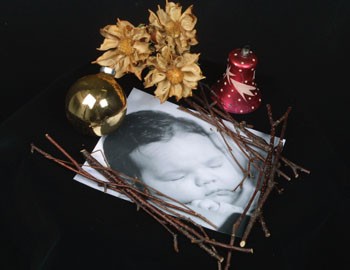
It’s a simple holiday fact: When whacked on eggnog, relatives have a tendency to clamor madly for baby photos. I determined to cut a clever two-birds-with-one-stone swathe by making my own picture frames, complete with infant mug shots. That I unfortunately tried to fashion these frames entirely out of twigs was not even original. I read about it in one of those crafty women’s magazines that litter the grocery checkout. “Easy Gifts You Can Make at Home!” taunted the headline. Below it read the evil instructions for simply gathering twigs from one’s own lawn and tying them together with decorative twine.

How difficult could that be, I shrugged.

Answer: Plenty. It was like being damned to a geometry lesson in the madhouse of the soul as I composed slippery, foldable diamonds of twigs, irregularly shaped triangles of twigs, twitching parallelograms of twigs, and, finally, a large symmetrical pile of twigs that flickered nicely in the fireplace.

Having failed logic and having never been any good at math, I had precut the children’s photos to fit the foldable diamonds. Those butchered prints appeared anonymously under the tree, tucked into a plain white envelope. One aunt still mentions that mystery in a wondering voice each year. She is my favorite aunt.

Squash It!

If you’re like Martha and me, you buy extra pumpkins at Halloween in order to gracefully decorate your Thanksgiving festivities. If you’re even more like Ms. Stewart and me, you think that spray-painting these glorious globes adds a certain sophisticated yet earthy splash to the traditional crèche. However, if you’re only like me, you go even further and imagine that others might wish to share in this three-month-old vegetable experiment.

And so it was that one chilly day I rolled my old pumpkins out into the driveway without fully examining them and spray-painted them silver and gold with a steely determination to give joy to others. Perhaps you are unaware of the smell of a seeping, rotting squash as it weeps through a layer of cheap, silver spray paint. Perhaps you should consider yourself very lucky not to have been my sister the Christmas of ’94.

‘B’ Is for Botulism

Everyone loves the groaning board at the holidays, but we’re all pretty well agreed that the groaning should remain strictly metaphorical. Unhappily, stomachy noises have sometimes been heard after receiving one of my thoughtful homemade kitchen gifts. Several instances spring merrily to mind.

There was the Kahlua distilled with cheap generic vodka that must have come from some grocery store’s bathtub. While no one was blinded, none of us order liqueur after dinner anymore or utter the word “Mexico” in family company.

There were the flavored olive oils that I steeped for months in garlic and rosemary from my very own garden. In retrospect, I might agree that first washing the rosemary would have been a sage notion. I additionally might concur that thoroughly sterilizing the bottles would have reserved some emergency room time for others in need.

Indeed, from the sorry wastes of my kitchen have issued many, many failed gifts: There were the cranberry breads that I was too impatient to fully cook, thus achieving an unusual holiday color composition as an uncanny green spread to join the red of the berries; the dough ornaments that received a similar baked impatience plus some slapped-on dashes of paint, only to sog off the tree Christmas morning in damp thuds; and the cookies in which dribs of imitation rum, lemon, and almond flavoring desperately replaced the vanilla, resulting in holiday treats tasting like crumby abstract paintings.

Modern Mistakes

I have now laboriously clambered back into the teeming circle of the middle class, which allows me to waste large amounts of money each December on perfect gifts made by others, presumably safe to both open and digest.

But I continue to flirt with creative danger, last year’s Christmas tree being a case in point. Hampered by the intimate confines of our teeny cottage, we had no place in which to place the fir.

Ill-advised artistry struck when we rescued the previous year’s tree–as yet unrecycled in an awful heap at the bottom of the garden–sawed off most of its limbs, spray-painted it gold, and hung it from the ceiling. There the hateful thing swayed, whacking us regularly on the heads while the kids moaned on about their unhappy childhoods.

All of this has led to a family tribunal decreeing that, like a paroled graffiti artist, I may never again come within 800 feet of a can of spray paint.

I am additionally barred from stepping foot in the kitchen for that dangerous period of time stretching from Thanksgiving to Boxing Day.

I think we can all live with that.

From the December 13-19, 2001 issue of the Northern California Bohemian.
© Metro Publishing Inc.

Terry Ehret

0

Photograph by Michael Amsler

Painting in Tongues

Poet Terry Ehret masters the art of words

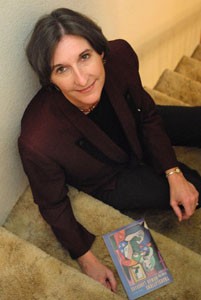
Terry Ehret talks in pictures. An award-winning poet and teacher, Ehret is a master at using words to create vivid images. Even in everyday conversation, delivering remarks in a tone of voice as subdued and noncommittal as a plain, white canvas, Ehret illustrates her speech with ideas that are achingly visual.

Ehret–author of the collections Suspensions and Lost Body, and a writing teacher at Sonoma State University and Santa Rosa Junior College–offers memories and insights so sharply sketched that they hang in one’s mind for hours afterward.

This crisp December morning, for example, in the midst of explaining how dangerous it can be for a poet–for any of us, really–to try to escape the behavioral models we create for ourselves, Ehret begins describing a large window that once looked out from the house of her childhood, a piece of plate glass so wide that from the outside it reflected only a vast expanse of sky.

“Birds would fly toward the window and would fly right into it,” she recalls, “because all they would see in it was more blue sky. Our backyard was full of the graves of broken-necked birds.”

What Ehret’s readers have known for years (and what her students quickly learn) is that after reading her words or listening to them, you begin to see the world differently. You start to notice things.

“And that,” she says with a nod, “is what poetry does to you.”

Today, Ehret is perched on the couch in the Petaluma home she shares with her husband and three daughters. She’s cradling a warm cup of Earl Grey tea–it’s an Earl Grey morning; the tea’s color perfectly matches the sky outside the window–and describing the experience of creating her newest book.

Titled Translations from the Human Language, this volume represents more than just her first solo work since the 1993 release of Lost Body. The new book also marks Ehret’s entrance into the world of publishing.

Released in August, Ehret’s Translations and a collection of poems by San Francisco poet Valerie Berry, Difficult News, are the first books to be published by Sixteen Rivers Press, the innovative not-for-profit publishing collective cofounded by Ehret.

Sixteen Rivers–named for the 16 rivers that flow into the Francisco Bay–is based on a model pioneered by Alice James Books, a feminist poetry cooperative started in Maine in the 1970s as an alternative publishing avenue for women writers.

Ehret first learned of collective publishing in June, 1996, while attending a writing workshop in Oregon. During a group discussion on the difficulties of getting poetry published, Ehret shared her own frustrations, revealing that each year she allowed herself $500 dollars to spend on contest fees, mailing costs, and the like. In spite of numerous awards and previous books published, she seldom saw any return on her investment.

Said Ehret, “If a group of writers pooled the money they would normally spend in a year to not get published, they could probably afford to publish one or two of their own books.”

Afterward, she was cornered by Ruth Gundle, founder and editor of Eighth Mountain Press, who told Ehret that what she had just described was called collective publishing. Gundle quickly put Ehret in touch with Patricia Cumming, one of the founding members of Alice James Books.

An excited Ehret brought the idea to her Sunday evening writers group. The theory was simple: Members would make an initial investment of cash and commit at least a few years to the collective. Each member would take turns performing all the tasks of a publishing company, from typesetting and designing to marketing and distribution.

Nobody took the bait.

Not until 1999, after years of letting the idea ferment in her mind, was Ehret able to assemble a group of poets willing to take on the challenge of forming a regional press. By that time, Ehret had won the support of Gundle and Cumming, along with established writers such as poets Dana Gioia and Carolyn Kizer and sci-fi legend Ursula K. Le Guin, who all agreed to act as advisors to the publishing collective.

With a total of eight members, an official name, and a sharp new logo, the group decided they would publish two books a year, starting with those members who had manuscripts ready to go–four of them did–and pairing one established poet (a writer who’d already been published) with one newcomer.

The decision about which authors would go first was made in charmingly egalitarian fashion: Collective members drew names from a hat. As it turned out, Ehret and Berry went first, to be followed the next year by Margaret Kaufman and Susan Sibbet.

For Ehret and Berry, whose starting position left them feeling alternately like pioneers or guinea pigs, the process of turning their manuscripts into books was harder than they had guessed. Still, these first two books from Sixteen Rivers made it to press and reaped immediate critical acclaim from such publications as Poets and Writers.

“It represents a quantum leap in our view of ourselves,” Ehret says. “Because now, all of a sudden, we’re thinking of ourselves as a publishing company, where previously we just thought of ourselves as writers who had some collective experience.”

Ultimately, of course, the success of Sixteen Rivers will depend on the quality of the books it publishes. While the 50-something poems that comprise Translations from the Human Language represent less than a quarter of the work Ehret has produced since publishing Lost Body, she feels they are among the best she’s ever written.

“My feeling is that these poems, together, make a statement that is larger than the statement they make alone,” Ehret says.

The poems in Translations have much in common with Ehret’s previously published work in that every piece in some way reflects the author’s obsession with the secret vernacular that lies behind language, those portions of our lives that are not verbal but are communicated through body language and tone of voice.

“What I mean when I talk about the human language,” she says, “is that which lies beneath spoken and written language. Because those silent rituals are as potent, as piercing as anything that is verbally expressed, and . . . . ”

With that, Ehret grows silent. She turns her head and gazes outside and up toward the sky, as if to wordlessly add, “And as powerful as a refection on a plate-glass window.”

From the December 13-19, 2001 issue of the Northern California Bohemian.
© Metro Publishing Inc.

‘The Business of Strangers’

Good Company

Channing shines in ‘The Business of Strangers’

By

The plot of Patrick Stettner’s debut film, The Business of Strangers, sounds brutal in the Neil LaBute mode. At the film festivals, the film was frequently compared to LaBute’s dire In the Company of Men.

Note, though, the opening shot under the titles: the tall median grasses lining an airport runway, combed by the exhaust of a descending jet. That soft brushing of the grass is one sign of offbeat sensuality to come, as is the way photographer Ted Maniaci gets a cold thrill out of the alien cleanliness of hotels and airports.

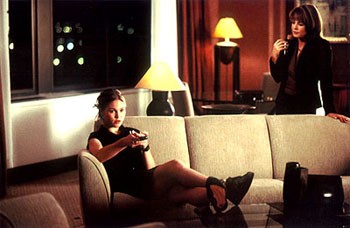
The Business of Strangers begins at this Edward Hopper International Airport, with executive Julie Styron (Stockard Channing) hitting the ground running. We don’t know what business Julie’s in, but it’s clear Stettner knows the drill. His workplace lingo isn’t overwritten or overprofane; Stettner is not just another Mamet’s boy.

Some skullduggery is going on at the home office, which Julie is monitoring desperately via cell phone. Against this distraction, her business presentation is screwed up by the late arrival of a visual-aids helper named Paula (Julia Stiles). The older woman fires her tardy assistant on the spot.

By chance, Julie encounters Paula later at the airport hotel. By then, the executive Julie has received some good news, and so she decides to be nice and buy Paula a drink.

And after we get to know Paula, we can see she’s an ambisexual, hard-partying girl who fancies herself a writer. She’s as arrogant as a racehorse, but good at telling people what they want to hear–a female version of Patricia Highsmith’s amoral Ripley. The drinking continues into the night, ending in a seductive tug of war between the two.

Channing’s Julie is bottled-up to the point of androgyny. Stettner teases us, in a civilized fashion, with what exactly the older woman’s love life is like. Soon the two women come together in choosing a target: a full-of-himself headhunter named Nick (Frederick Weller) with a derisive smile and porn-star sideburns.

If what happens later among the three of them seems improbable at times, blame the miscasting of Stiles. Yes, Stiles’ disdainful face has the sexy sourness of the actress that critic Manny Farber used to refer to as “Jeanne Morose.”

But unlike Jeanne Moreau, Stiles doesn’t yield in playing her character: You can’t get under Paula’s tattooed skin, because there wouldn’t be room in there for anyone else. (As a rule in the movies, any character with a tarantula tattoo is probably not going to turn out to be a misunderstood, vulnerable soul.) Because Channing isn’t matched by someone of her own caliber, The Business of Strangers isn’t a complete success.

It’s Stettner’s barbed, sparse dialogue–and Channing’s inflections of it–that make The Business of Strangers gripping. Thanks to Channing, we don’t see a bitch; we see what her character would want us to see: an unself-pitying business professional, working twice as hard because she’s aging and because she’s a woman.

While I’m not likening the looks of a handsome actress to a homely actor, Channing seems like Edward G. Robinson at his best: all tension and muscular power, which frays, in quiet moments, into neurotic frailty.

From the December 13-19, 2001 issue of the Northern California Bohemian.

© Metro Publishing Inc.

Miles Davis, John Coltrane, and Billie Holiday

0

Jazz Trio

CD reissues spotlight three legends

By Greg Cahill

It’s been a banner year for jazz reissues. In January, filmmaker Ken Burns unleashed his monumental, episodic jazz documentary accompanied by a hefty companion book and a celebrated CD reissue series. In the spring, Sony/Legacy and Fantasy Records marked the 75th anniversary of Miles Davis’ birth with a flurry of CD anthologies, previously unreleased recordings, and reissues. And, this summer, three essential Thelonious Monk multi-disc collections hit the stores.

Now, just in time for the holiday rush, three box sets salute a trio of jazz greats: Miles Davis, John Coltrane, and Billie Holiday.

Miles Davis: The Complete In a Silent Way Sessions (Sony/Legacy), a three-CD set, traces the evolution of the landmark 1968-69 recording sessions that spawned the seminal fusion jazz album In a Silent Way, a still rewarding atmospheric recording.

Packaged in a handy 4-by-5 inch hardbound portfolio, the set includes an exhaustive collection of essays and liner notes detailing the 17 tracks that gave birth to a new sub-genre of sometimes magnificent, often maligned imitators.

The tracks chronicle the push and pull of a rotating lineup that included Davis, saxophonist Wayne Shorter, keyboardists Joe Zawinul, Chick Corea, and Herbie Hancock, guitarist John McLaughlin, bassist Dave Holland, and drummers Tony Williams and Joe Chambers.

While we’re not privy to the behind-the-scenes musical directing of bandleader Davis, the sessions are a rare glimpse into a six-month period that saw phenomenal artistic growth and led to one of the most radical shifts in American popular music in the late 20th century.

Live Trane: The European Tours (Fantasy/ Pablo) offers a similar view of musical giant John Coltrane at a major artistic turning point in his career. The newly released seven-CD set, most of which is available for the first time on a domestic recording, captures saxophonist Coltrane during three pivotal European tours between 1961 and 1963.

At the time, Trane was still recording mostly blues-based ballads for the Pablo label under the guidance of producer and promoter Norman Granz (the visionary impresario who died last week at his home in Switzerland).

But these discs reveal the burgeoning artist who would later set the music world on its ear with a series of innovative improvisational recordings that would culminate a few years later in the astonishing A Love Supreme.

Coltrane’s version of the film hit “My Favorite Things” appears no less than five times here, each take presenting a fresh vehicle for Trane’s unswerving explorations.

While the recording quality is impeded by misplaced mics and other staging problems, the sheer musicality and excitement of these performances more than makes up for any sonic shortfall.

Lady Day: The Complete Billie Holiday on Columbia (1933-1944) (Sony/Legacy) suffers from a couple of shortcomings. First, the voluminous 10-CD set is big and clunky–a 12-by-12 inch hardcover portfolio that doesn’t fit easily into a CD library. And the massive 120-page booklet–which includes a lengthy essay by music critic Gary Giddins (of Ken Burns’ Jazz fame)–incorrectly lists the date of Holiday’s death in one instance.

Yet the music itself–from a swinging 1933 date with the Benny Goodman Orchestra to a rare 1944 V disc (issued exclusively to overseas military personnel) with pianist Art Tatum–is a completist’s dream.

Of course, people like to make a big deal out of the extreme change in Holiday’s vocal style after her heroin addiction kicked in and her subsequent arrest and incarceration for drugs in 1947. And it’s arguable that she was a singer in the early years and more of a boozy song interpreter in the later period. But these recordings–which include several master takes previously unreleased in the States–are filled with often sassy, always soulful flair.

Did Billie Holiday ever record a bad track? If she did, you won’t find it on these essential recordings.

From the December 13-19, 2001 issue of the Northern California Bohemian.

© Metro Publishing Inc.

Afghan Civilian Casualties

Collateral Damage: Eight-year-old Ismutula Taj was injured by a stray bomb.

Deadly Deception

Afghan civilians keep dying, the Pentagon keeps denying

By David Corn

My fantasy of the week: Donald Rumsfeld meets a young Afghan boy named Noor Muhammad. At the start of the daily Pentagon press briefing on Dec. 4, the defense secretary delivered a short lecture on the subject of civilian casualties in Afghanistan. “One of the unpleasant aspects of war is the reality that innocent bystanders are sometimes caught in the crossfire,” Rumsfeld said, “and we’re often asked to answer Taliban accusations about civilian casualties. Indeed one of today’s headlines is, ‘Pentagon Avoids Subject of Civilian Deaths.’

“The short answer,” Rumsfeld continued, “is that that’s simply not so.”

He then proceeded to prove, in a way, the offending headline’s point.

“With the disorder that reigns in Afghanistan, it is next to impossible to get factual information about civilian casualties,” Rumsfeld said. “First, the Taliban have lied repeatedly. They intentionally mislead the press for their own purposes. Second, we generally do not have access to sites of alleged civilian casualties on the ground. Third, in cases where someone does have access to a site, it is often impossible to know how many people were killed, how they died, and by whose hand they did die.”

Look at the World Trade Center, Rumsfeld declared. The number of dead there keeps shifting.

“If we cannot know for certain how many people were killed in Lower Manhattan, where we have full access to the site, thousands of reporters, investigators, rescue workers combing the wreckage, and no enemy propaganda to confuse the situation, one ought to be sensitive to how difficult it is to know with certainty, in real time, what may have happened in any given situation in Afghanistan,” Rumsfeld said.

“What we at the Pentagon try to do is to tell the press what we do know that’s accurate, and we try to say what we don’t know,” he continued “We lost thousands of innocent civilians on Sept. 11, and we understand what it means to lose a father, a mother, a brother, a sister, a son or a daughter, and we mourn every civilian death.”

Rumsfeld’s remarks, seemingly heartfelt, were actually an exercise in profound cynicism. If we can’t count the dead in New York, how can you expect us to know anything about civilian casualties in Afghanistan? The defense secretary portrayed it as an impossible task, and he suggested that claims of civilian casualties were only coming from Taliban scumbags. Of course you can’t believe them.

But as Rumsfeld was talking, Washington Post reporter Susan Glasser was filing a piece based on a visit to Jalalabad’s Public Hospital No. 1.

In the previous four days, the hospital had taken in 36 patients who said they were victims of the U.S. bombing strikes targeting villages southwest of Jalalabad, in an area where Osama bin Laden and al Qaida remnants are thought to be hiding in cave compounds. The hospital had also received 35 dead.

One of the injured was Noor Mohammed, who had lost both eyes and both arms.

Noor, who is somewhere between 10 and 12 years old, told his uncle he heard the sound of an airplane overhead, ran from his room, and did not know what happened next.

Asked how he felt, the boy whispered, “I feel cold and I cannot talk.” Glasser found other wounded children from families who claimed they had been struck by bombs while in their mud houses.

Two days earlier, the New York Times had run a dispatch (in a not-too prominent spot) from Tim Weiner, reporting that, according to witnesses and local officials, U.S. bombers flying over this area of Tora Bora had struck three villages, killing dozens of civilians. Weiner quoted the local law and order minister and the region’s defense minister, who each maintained such attacks had occurred. Survivors interviewed by Weiner spoke of horrific devastation in these areas.

“The village is no more,” said a man named Khalil. “All my family, 12 people, were killed. I am the only one left in this family. I have lost my children, my wife. They are no more.” Another survivor said she had lost 38 relatives; another estimated up to 200 were dead.

The Pentagon denied everything. Weiner quoted Rear Admiral Craig Quigley, chief spokesman for the Central Command, asserting that American bombers had hit their targets 20 miles away from these villages: “If we had hit a village causing widespread death that was unintended, we would have said so. We have been meticulous reporting whenever we have killed a single person.” (Interest declared: Weiner is a friend. He can be trusted to suss out a difficult situation.)

The day after Weiner’s account appeared, at the Pentagon briefing, Rear Adm. John Stufflebeem was questioned about the reports of civilian deaths around Tora Bora. He replied, “I have seen the press reports about alleged civilian casualties, and I would just ask us all to remember that this was orchestrated by the Taliban, and therefore it’s not clear to us in fact were there innocent civilians who in fact may have been injured.” (Note the double “in fact.”)

The Dickensian-named admiral added, “We know for a fact that these were legitimate military targets in that area that were struck. We know that there was terrific traditional, consistent planning to ensure that only these targets were struck. We know there were no off-target hits, so there were no collateral damage worries in this series of strikes. And therefore I can’t comment on the civilian casualties because I don’t know them to be true.”

A few moments later, he added, “I find it a little bit suspect to hear that villages are being flattened.”

Yet Richard Lloyd Parry, a reporter for the London-based Independent, visited the area and found homes replaced by craters, a cemetery containing 40 freshly dug graves (some, he was told, contained only body parts), and a fragment bearing the words “Surface Attack Guided Missile AGM 114.”

Truth is often difficult to ascertain in war. But it is clear that Stufflebeem and Rumsfeld were not speaking truthfully. The reports of these casualties were not “orchestrated by the Taliban.” In fact, as the admiral might say, the information was coming from officials of a government that replaced the Taliban.

What, then, to make of Noor Muhammad and his tale? And the others who tell of hearing airplanes and being bombed in their homes?

If Rumsfeld and Stufflebeem are to be believed, it must be that Noor and the rest were all participating in an elaborate and sophisticated propaganda campaign that entailed faking craters, persuading anti-Taliban officials who are working with American forces to lie to benefit the Taliban, enlisting dozens of persons with God-awful injuries for the con, and encouraging children to tell false stories about how they came to be harmed.

The reports filed by Weiner, Glasser, and Parry demonstrate that Rumsfeld was engaging in champion dissembling when he maintained the Pentagon cannot possibly keep track of civilian casualties in wild and wooly Afghanistan.

The U.S. military may not be able to discern figures with the same precision it claims for its bombing. Yet in many instances it can determine if civilian casualties have happened by doing what Weiner and the other reporters did: asking people on the ground.

Instead, in this latest episode, the Pentagon rushed out a denial that does not hold and then further insulted local Afghan officials and survivors by dismissing their reports as Taliban disinformation–and waited for that news cycle to whiz by.

I would like to watch Rumsfeld and Stufflebeem tell the eyeless and armless Noor Muhammad he’s lying.

It is not, as Rumsfeld asserted, “impossible to get factual information about civilian casualties.” His military just hasn’t bothered. It could start by sending someone to interview Noor and his fellow survivors.

David Corn is the Washington editor of The Nation.

From the December 13-19, 2001 issue of the Northern California Bohemian.
© Metro Publishing Inc.

Military Recruiters

Lesson Plan

Military recruiters go to school

By Tara Treasurefield

“Recruiters are basically bounty hunters,” says Shepherd Bliss, a Vietnam veteran and Sonoma County environmental activist. “They don’t warn young people about two big consequences of going into the military: chemical exposure and post traumatic stress.”

Bliss strongly objects to amendments to the pending federal education bill that will guarantee military recruiters access to all high schools in the nation and to all student directory information.

According to the U.S. Senate, as many as one in four high schools in the country now withhold student information from the military or bar military recruiters from campus. But that won’t be possible when the law changes. Since the education bill has already passed both houses of Congress and is in joint conference committee, the new rules will probably be approved by the end of the year.

“Giving military recruiters such access transforms the schools into breeding places for soldiers, rather than places for education about democracy, which is what they should be,” Bliss says.

But North Bay school administrators generally see military service as a viable career option. Scott Lane, principal of Laguna High in Sebastopol, says Laguna encourages recruiters to talk to interested students during non-class time, but doesn’t allow them to speak to classes, make formal presentations to the full student body, or initiate contact with students. Student information is confidential, unless parents ask the school to release it.

When the law changes, Laguna will release records for all students. “I’m interested in protecting privacy rights,” Lane says. “I hope the addresses are used to send information, and not to solicit or bother.”

Carl Wong is Superintendent of the Petaluma Joint Union High School District, where military recruiters visit campus career centers and participate in Career Day. Like schools in the West County, Petaluma treats student contact information as confidential. When the law changes, Wong says the district will assess its options. “We will refer to our legal counsel to render an advisory, and adopt board policy accordingly,” he explains.

Tamalpais High School District in Marin will also seek counsel. Chris Anderson, Assistant Superintendent of the Tamalpais district, says, “Sometimes these things get passed and there’s a conflict between different laws.”

Sonoma High School already provides military recruiters with a master list of student contact information. “If a parent objects, we remove their child’s name from the list,” says principal Bob Kruljac. Sonoma High will disregard parental objections when the law changes.

With a visitor’s pass at San Marin High, military recruiters can walk around campus and approach students during lunch. But San Marin doesn’t release student contact information, according to Principal Greg Duffy. “The parent community wants their privacy protected,” Duffy says. San Marin policy will change when the law changes.

Is there a place for peace advocates, as well as military recruiters, at the nation’s schools? Absolutely, says Gulf War veteran James Madison, founder of Veterans Teaching Peace in Schools. “For all the trampling of our civil rights that is going on right now, I still have a basic faith in America’s ability to adhere to the Constitution.” Madison says that VTPS presentations are well received by students.

North Bay schools are likely to welcome VTPS and similar groups. Doria Trombetta, co-principal of El Molino High in Forestville, says, “During the Gulf War, we had speakers from all sides at lunch.”

The Tamalpais district also allows campuses to be used as open forums, and teachers in the Tamalpais district and at San Marin High and other schools invite speakers to air controversial issues in class.

Trombetta is particularly sensitive to the value of respecting differing views. Her husband belongs to Veterans for Peace, and her son is at West Point. “I never want to see a generation demonized the way Vietnam veterans were,” Trombetta says. “Nor do I want to feel that there is necessarily one right decision for all students.

“I want students to see a wide range of opinions and come to their own decisions about what’s right and wrong.”

From the December 6-12, 2001 issue of the Northern California Bohemian.

© Metro Publishing Inc.

‘You Can’t Take It With You’

0

Modern Message

‘You Can’t Take It With You’ still offers relevant moral

By Julia Hawkins

You have to like the Pacific Alliance Stage Company’s You Can’t Take It with You for the sweet production the company makes of it. Written by Moss Hart and George S. Kaufman, the play is about a family and its friends who ignore the outside world’s pressures in order to enjoy life as it presents itself. You Can’t Take It with You still works because much of what it says is still true and because Pacific Alliance’s casting and directing are superb.

Today’s audience, baby boomers especially, hardly needs to be told to enjoy the present. But our enjoyment often turns out to be spurious, and this is a reason why the play remains relevant.

In contrast to the Sycamore family, we spend money instead of time and watch others live their lives on television instead of living our own. And though we don’t postpone indulging ourselves and our whims, we still don’t allow ourselves to follow our interests or to step off the track to do so. Perhaps we can no longer afford to do so, of course, and here lies the weakness of the play’s pertinence: The family’s grandfather (played by Robert Parnell) owns rental property and can support everyone modestly.

The family is meant to appear eccentric: They welcome all visitors, treat their black servants kindly, and each family member has a hobby he or she spend the days enjoying. All lack talent, but no one considers that an obstacle to enjoyment.

The conflict arises when one of the daughters, representing the real world (she works in a bank and has no hobby), becomes engaged to the banker’s son whose conventional parents disapprove of her family.

Contemporary audiences may not find the conflict as compelling today as it must have appeared in 1936, when You Can’t Take It with You was written (the play won the Pulitzer the next year) and when those with a job and even a little money stood out in stark contrast to those who had neither.

It was also a time when one’s appearance of respectability helped one find a job and social acceptance. But today, the Sycamore family’s eccentricities are neither shocking nor particularly interesting, although the ballet daughter’s wobbly dancing and the father’s fireworks explosions in the basement finally make us laugh.

And though class division certainly endures today, the division seems to matter less with the rise of the middle class and its compensatory material distractions.

The Pacific Alliance production works because director Michael Grice plays it straight, without sentimentality or flash, and with faith in the material. The cast, especially Parnell, with Meg Mackay as Penny Sycamore, an aspiring playwright, and Will Marchetti as fireworks maker Paul Sycamore, make the family as believable and genuine as the material allows. More importantly, they make the family likable champions of the play’s moral.

This production might be considered low-key, but that has more to do with our own speediness and high shock threshold. You Can’t Take It with You builds its own momentum through its consistency and revelations.

And–surprise, surprise–many of the buttons the play pushes function in us still. Who among us does not enjoy seeing the snooty humbled, having a Russian countess over for dinner, or seeing our daughter marry well?

At the end, the Sycamores all sit down to dinner round the table, that icon of family stability and security, which, when there is love and kindness, is still just about as good as life gets.

‘You Can’t Take It with You’ continues through December 9 at the Spreckels Performing Arts Center, 5409 Snyder Lane, Rohnert Park. For details, call 707/588-3400.

From the December 6-12, 2001 issue of the Northern California Bohemian.
© Metro Publishing Inc.

Locally Handmade Gifts

0

Made in the North Bay

Our annual guide to gifts made close to home

By Paula Harris and David Templeton

Santa’s workshop is a great place, and his elves work harder than a tech employee whose boss just walked by with a folder full of pink slips. But let’s be honest: Does anyone really believe that one small production facility (apparently using fairly old-fashioned techniques) can make all the toys and trinkets needed for Christmas morning in a world of six billion people?

Yes, Virginia, it’s true: We’re telling you that Santa has help. And some of his best auxiliaries are right here in the North Bay. In fact, creative crafts people and clever entrepreneurs offer more locally made holiday gifts than you can shake a reindeer at. And–here’s the best part–none of them require Santa to pilot his sleigh through the mall parking lot.

Robert Janover True Images

For eight years now, local photographer Robert Janover has been putting out vibrant calendars that illustrate the visual beauty of Sonoma County. The 2002 Sonoma County photo and events calendar is graced with 65 color photos and lists more than 300 upcoming local events of interest to tourists, day-trippers, and locals alike. Check out the glossy pages: The county’s redwood trees, apple orchards, vineyards, rivers, coasts, and mountains never looked this good–even in real life! The calendar retails for $12.95. Janover’s popular Sonoma County picture book is also available for $24.95. Buy them at Janover’s studio at 555 Fifth Street, suite 101, Santa Rosa. 707/566-0984. –P. H.

Torch Candles

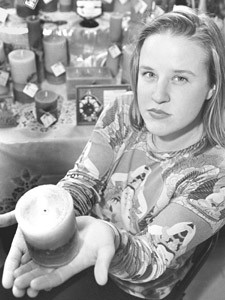
If you think Twiggy, Chunky, Brickhouse, Mama, and Fat Daddy are (respectively) a washed-up model, a candy bar, a bad disco song, the woman who gave you life, and a gansta rap singer, then you haven’t seen these colorful candles. These fun-shaped (and oddly named) little things are produced at Torch Candles, an innovative Forest Knolls business run by Collen Grimes. Conceived as an all-female endeavor–business cards read, “Torch Candles: Handmade by fiery women”–Grimes’ company has begun crafting a whole line of candles that frequently inspire people to mutter words like “lovely” and “breathtaking.” According to Grimes, she’s the only candle maker in the Bay Area who uses natural herbs and spices–like cayenne pepper and spirulina, which make a “lovely” red and a “breathtaking” green. This ingenious concept is sometimes more difficult to execute than you might think. “It took me a year and a half to find something that makes a natural blue,” Grimes says, describing her ultimate discovery of woad, a European herb of the mustard family. “It’s what Braveheart used to make his face blue,” she adds. Currently sold mainly at crafts fairs and farmers’ markets, Torch candles run from a few dollars up to $36. They make one-of-a-kind gifts that will be as fun to give as they are to name out loud. For locations where you’ll find Torch candles, call 415/488-4797. –D. T.

Judy’s Breadsticks

Listen up, ’cause this is a snackers delight! San Rafael-based Judy’s Breadsticks has recently introduced Twigs, a crunchy new addition to its line of organic goodies. Choose from savory flavors such as sunflower and garlic-fennel (encrusted with fennel seeds) or sweet flavors such as currants and cinnamon (studded with whole, sweet currants), and espresso bean-vanilla, which tastes chocolatey. “They’re sure to lift your spirits during the holiday season,” says Lynda Najarian, who owns this baking biz. Made with organic whole wheat flours and natural vegan ingredients, the texture of these rustic-looking, irregular twigs is dry, satisfyingly crunchy, and crammed with flavor. Indeed, samples brought by the office were so addictive we chomped them down in a jiffy. At around $3 for a pretty seven-ounce bag, these are perfect to pop in a Christmas stocking or gourmet gift basket. They are available at gourmet grocers such as Whole Foods, Fiesta Market, Andy’s Produce, and Petaluma Market. –P. H.

Napa Valley Beverage Company

Sure, you could guzzle sickly sweet, caffeinated, carbonated beverages during the holiday season, but why? Whether you’re a designated driver, a teetotaler, or simply searching for pure refreshment, Napa Valley Beverage Company has a flavorful alternative to alcohol when you have to bring a bottle to the party. The Napa-based company has launched a line of fruit-flavored sparkling beverages that are not only caffeine-free but sweetened with Splenda brand sucralose, a zero calorie sweetener derived from sugar. Choose from sweet strawberry, medium peach, or less sweet black cherry flavored sparkling beverages. The 20-ounce plastic bottles are sold nationwide and retail for 99 cents, as low as 69 cents in some markets. Available at most grocery stores. –P. H.

La Dolce V Fine Chocolates

“These aren’t hulking great truffles that you need a knife and fork to eat but petite, demure European chocolates,” says Veronica Bowers of her exquisite confections. The owner and artisan chocolatier at La Dolce V calls herself “a one-woman show,” and indeed she both creates and markets Harvest Fair double gold-medal winners such as hazelnut pralines and vanilla bean caramels. Bowers uses all natural flavorings and infusions that include many local ingredients. These holiday delights include dreamy dessert sauces and assorted gift boxes wrapped in sage green and gold with ivory ribbons. Prices range from $2.50 for a chocolate bar to $55 for a pound of sweet decadence. Up until now La Dolce V chocolates were available only through mail order, but Bowers has recently opened a chocolate boutique at 2661 Gravenstein Hwy. S. in Sebastopol. 707/829-2178. Or visit the website at www.ladolcev.com. –P. H.

R. S. Basso

We know you yearn to sink into a plumply inviting custom-made chair and forget the stressful holiday shopping, so treat yourself. At R. S. Basso you can order an overstuffed chair or sofa for yourself or a loved one for half of what you’d normally pay elsewhere in the Bay Area. Founded by the husband-and-wife team of Mary Li and Ron Basso, the showcase stores are filled with handsome, finished furniture in all styles. And Basso is packed with a lot more than just couches. They also carry fine art, floor and table lamps, figurines, magnificent mirrors, wrought-iron chandeliers, and framed sketches and photos from eras past. With stores in Sebastopol (186 N. Main St.) and Healdsburg (115 Plaza St.)–along with others in St. Helena, Corte Madera, and Palo Alto–Basso’s has come a long way from its simple beginnings as a reupholstering business. 707/829-1373.–P. H.

Full Circle Farm

To buy a bar of handmade herbal soap from Kathi Karr Province is to engage in an eye-opening experience that is light years beyond the apparently simple act of acquiring a beautiful and practical gift. The soaps made at Sonoma’s Full Circle Farm come with something extra: an informal education in the art of saponification (soap making), a ten-dollar word that Province may just insist you memorize, before or after she tells the story of the Roman washer women who discovered soap. (It was around 1,000 B.C., and the women noticed their clothes got cleaner if they washed them in the sudsy part of the river near the place where animal sacrifices were performed–and aren’t you glad you know that now?) Ranging in form from elegant, palm-sized bricks to wonderfully corpulent Goddess-shaped soaps, Province’s all-natural products are as beautiful to see as her stories are enlightening to hear. The soaps can be found at numerous crafts fairs and farmers’ markets throughout the North Bay. For a schedule or more information, call Full Circle Farm at 707/996-7897. –D. T.

Arrowsmith Farms

“Christmas, though frequently cheerful, can be very, very stressful,” says Shelly Arrowsmith, the earth-motherly proprietress of Arrowsmith Farms. While not an entirely new thought, Arrowsmith’s calm reaffirmation of the season’s mental stresses is made all the more comforting if you are massaging her beeswax-and-olive-oil skin balm into your weary hands as she says it. Made out of beeswax from the 10 thriving hives she manages on her farm in Sonoma, Arrowsmith’s skin balms are gently scented or unscented. At $9.00 a tin, they make excellent stocking stuffers. For that matter, she also makes cow-spotted eye pillows, aromatic dream pillows, and Magic Wishy Beans–what she calls, “My farmer’s version of the Pet Rock”–which are a bag full of glittery beans and an entertaining list of “instructions.” Arrowsmith’s wares can be found at most of the North Bay’s farmers’ markets. For other locations, call 707/935-3420. –D. T.

Valley of the Moon Gift Certificates

Carpool, cell phone, meetings, and junk mail can turn even the most Zen-minded individual into a bumbling, frazzled mess. Sometimes the gift of getting away is the most valued of all. If you’re short of ideas on how to give a loved one some time off, here’s a tip: The Sonoma Valley Visitors Bureau, which promotes the Valley of the Moon region, one of the most popular tourist areas in the county, has gift certificates that can be purchased in increments of $25 or as packages. Certificates are redeemable at a variety of bed and breakfast inns and guest cottages including Gaige House Inn, Bancroft House, and Valley of the Moon Retreat, as well as at several muscle-melting spas like Bella Luna and Day Spa de Sonoma. All gift certificates are delivered by mail within 72 hours of purchase. Sonoma Valley Visitors Bureau, 453 First Street East, Sonoma. 707-996-1090. Or log on to www.sonomavalley.com.–P. H.

Wild Oat

Find a myriad of locally made goodies at Wild Oat Gift Shop within the Sonoma County Museum. Select from such diverse treasures as pretty wooden boxes for $13.95, a collection of locally crafted silver jewelry, porcelain collectibles, and unique decorated eggs incorporating trees or angels from $11.95 to $60. The store also carries Smith and Reilly handmade mustards in curry, garlic, or original flavors. Plus, there’s a collection of books by local authors, such as the Santa Rosa Postcard Book and a book featuring aerial views of Sonoma County, in addition to a selection of regional historical maps. And if you’re really stuck for an original idea, Wild Oat has Clo the Cow dolls dressed up like characters from the famous local dairy billboards for $8. Hey, maybe next year they’ll do the Moodonna and Baby Cheeses. 425 Seventh Street, Santa Rosa. 707/579-1500. –P. H.

From the December 6-12, 2001 issue of the Northern California Bohemian.
© Metro Publishing Inc.

Stone Soup

0

Stone Soup

Fabled recipe gets a culinary correction

By Marina Wolf

I’ve never had stone soup, but I know about it from the story in which three hungry soldiers on their weary way home from the war seek shelter and sustenance in a suspicious village. Denied food by the villagers, who had hidden their own victuals, the travelers went about preparing soup from a stone and water.

As they hinted at how much better the soup would be with this ingredient or that, the villagers were stirred to pull their foodstuffs out of hiding and throw them in the pot–salt and pepper, carrots, cabbage, beef, potatoes–until a full and rich soup was bubbling away, and the residents were setting up tables for a feast in the town square.

Now, the story offers a good idea for a casual dinner party, and the process is emotionally and metaphorically correct. The stone is obviously neither flavoring nor food, but a magnet for bringing humble ingredients together and exciting the villagers’ imaginations.

But as a recipe, “Stone Soup” is procedurally flawed, and I’d like to set the record straight with a culinarily correct retelling of the tale. . . .

The soldiers looked at the gathering of peasants–who had put on their saddest, most hungry faces–and then talked among themselves. Finally, they turned to the townspeople and proclaimed, “If you are hungry too, then we must make what we can from what we have. We’ll make stone soup.”

The villagers’ eyes grew wide at this. Soup from a stone? That would be well worth the cooking lesson, and a good recipe for lean times ahead. They hurried to bring out the largest kettle in the village and built an enormous roaring fire over which to cook. As the kettle heated, the soldiers requested and received three small, round stones, which they then threw into the kettle with three loud clanks.

“These stones should make a pretty good soup,” said one soldier as he stirred the rattling stones. “But it would be even better if the stones could be cooked a little while with some onions in a bit of oil. And garlic–well, that would perhaps be too luxurious. . . .”

The villagers discovered that they might have a drop or two of olive oil and a few onions left in the back of their poor pantries, so they ran off to chop up an apronful of onions and a handful of garlic, and lugged back a liter of oil. The onions hit the hot oil with a hiss and a marvelous savory smell, and the peasants’ mouths began to water.

The soldiers continued to stir the contents of the kettle, making sure the onions didn’t burn. “Of course, this stone soup would be something special if we had a carrot or two to go in it, and perhaps some celery,” said one of the men. “Now would be the time, because those vegetables take a while to cook. But why ask for what you don’t have?” he concluded with a shrug.

“Well, now, I could probably round up some carrots,” said one of the watching women and hurried off. “And I can check my cellar to see if I have any little bunch of celery left,” said her neighbor. The two brought back armfuls of produce, which the soldiers accepted without comment and quickly sliced them into the kettle.

“Any stone soup needs some seasoning,” said the soldiers as they stirred the pot carefully. “Even a sprinkle of thyme, a dash of salt and pepper–” They had not even finished the sentence before a little girl ran off. She returned with the entire contents of her mother’s spice shelf bundled up in her apron.

The soldiers laughed and thanked the girl, and quickly picked through the jars for all the dried green herbs–thyme, marjoram, rosemary. “We add them here because the oils in these herbs come out better cooked in oil than in water,” commented one of the soldiers, throwing in pungent pinches of stuff and topping it off with enough bay leaves to make a wreath.

By now the aroma wafting out of the kettle was quite tantalizing, and even the soldiers admitted that they were almost ready to add the water. “But if we only had a little bit of beef and a few potatoes, this soup would be fit for a rich man’s table.” The villagers looked at each other, scurried off, and within minutes returned, each with a few potatoes or some modest chunk of beef, which they flung, bones and all, into the hissing pot.

By now the soldiers had to take turns stirring. In addition to the stones, there was a considerable amount of food in the pot, and it was important to get everything in contact with the hot kettle. When the beef looked a little brown on the sides, they yelled out to the villagers: “Water! Water! Quickly, now!” And the men formed a bucket brigade from the village well to the kettle, and quickly filled up the kettle with fine, fresh water.

In time the stone soup was bubbling away. Then the soldiers tasted it and added more salt and pepper, and then heaved an enormous lid on top of it. “In stone soup, as in all soup, the flavors need a chance to marry,” said one of the soldiers. “Or at least to get to know each other,” he added with a wink.

Without prompting, the villagers rushed to set up tables in the town square. As the scent of the delicious soup drifted out across the village, they thought: If this is a rich man’s soup, shouldn’t it be served with good bread, and a roast, and some of our good cider?

And so a banquet was laid forth, and the soup, when it was finally ladled out, was the best soup any of them had ever tasted. All from a stone!

From the December 6-12, 2001 issue of the Northern California Bohemian.

© Metro Publishing Inc.

‘Closer’

Secrets & Lies

Deception is the rule as lovers get ‘Closer’ at AT

By Patrick Sullivan

Looking for a holiday heart warmer about life, love, and the tender joys of emotional intimacy? Want something that will inspire you to pull your significant other under the mistletoe for a big, wet kiss?

Closer ain’t it.

“Kind is dull. Kind will kill you,” one character tells another, and then goes on to prove that cruelty can also be pretty lethal.

Now on stage in an Actors Theatre production directed by Argo Thompson, Patrick Marber’s Closer is a play about relationships that could put the most starry-eyed romantic off the sweet stuff for good.

With only four characters–two men, two women–you’d think there would be some limit to the amount of lying, cheating, and general bad behavior that could go on.

You’d be wrong.

And yet, this is not a simple sex comedy or a soap opera. We’re not at Melrose Place or on Temptation Island. In Closer, relationships do matter. They just don’t work. Ever.

“I know what men want,” explains Alice (the charmingly energetic Danielle Levin), a stripper with a big secret who, as another character says, possesses the “moronic beauty of youth.”

Turns out men want an impossible bundle of contradictions, a woman who doesn’t and can’t exist, an ideal–any ideal, almost–rather than quotidian reality. And women aren’t far behind in the delusion department.

The play opens with Alice artfully seducing the older Dan (J. Eric Cook) even as he describes his dead-end job as an obituary writer. Dan’s work consists of whitewashing the lives of his deceased subjects: “He valued his privacy” means the dead man was gay, “He enjoyed his privacy” means he was a flaming queen, and so on.

That theme continues: Gay or straight, deception seems to be an integral, inextricable part of romance and sex. “What’s so great about the truth?” Dan exclaims. “Try lying for a change. It’s the currency of the world.”

Not that any of these characters really need to be urged to deception as they couple, uncouple, and couple again in a new combination. And when honesty does rear its head, it wrecks relationships; as we learn from the play’s other couple.

A working-class bloke turned wealthy dermatologist named Larry (Dodds Delzell) discovers that his wife, an American photographer named Anna (Beverly Bartels), is having an affair. “Thank you for your honesty,” Larry says. “Now fuck off and die, you fucked-up slag.”

If your raunch alarm is going off, then be warned: Closer gets much rougher than that in both word and deed. Indeed, cruel jibes and some (pretty funny) sexual humor are the order of the day (“You’re a man,” Anna says. “You’d come if the tooth fairy winked at you”).

And yet, the audience has to care about these characters for their self-inflicted predicaments–packed with ironies and hypocrisies–to be poignant as well as humorous. It’s fortunate, then, that the excellent cast of this AT production manages to find the heart in Marber’s play.

Beverly Bartels is good at being bad at lying, and J. Eric Cook manages just the right combination of ferocity and plaintiveness as he moves from deceiver to deceived and back again. Dodds Delzell is especially good as the up-and-coming doctor with a taste for strippers and prostitutes. Delzell’s expressive face conveys more with a twitch of the eyebrow than some actors can communicate with their whole bodies.

Closer will appeal to anyone looking for some hard truths about romantic relationships. But leave the mistletoe at home–around this play, it’s a loaded weapon.

‘Closer’ continues through Dec. 22 at Actors Theatre, LBC, 50 Mark West Springs Road, Santa Rosa. For details, call 707/523-4185.

From the December 6-12, 2001 issue of the Northern California Bohemian.

© Metro Publishing Inc.

Handmade Holiday Gift Disasters

Handmade Hell Holiday gift ideas to cross off your list By Gretchen Giles The limbs of my family tree bend to splintering under the weight of old tubes of half-used acrylics, dusty typewriters, barely scuffed dancing shoes, and neglected Mozart scores. We of my genetic wood all like to think...

Terry Ehret

Photograph by Michael Amsler Painting in Tongues Poet Terry Ehret masters the art of words Terry Ehret talks in pictures. An award-winning poet and teacher, Ehret is a master at using words to create vivid images. Even in everyday conversation, delivering remarks in a tone of voice as...

‘The Business of Strangers’

Good Company Channing shines in 'The Business of Strangers' By The plot of Patrick Stettner's debut film, The Business of Strangers, sounds brutal in the Neil LaBute mode. At the film festivals, the film was frequently compared to LaBute's dire In the Company of Men. Note, though, the...

Miles Davis, John Coltrane, and Billie Holiday

Jazz Trio CD reissues spotlight three legends By Greg Cahill It's been a banner year for jazz reissues. In January, filmmaker Ken Burns unleashed his monumental, episodic jazz documentary accompanied by a hefty companion book and a celebrated CD reissue series. In the spring, Sony/Legacy and Fantasy Records marked the 75th...

Afghan Civilian Casualties

Collateral Damage: Eight-year-old Ismutula Taj was injured by a stray bomb. Deadly Deception Afghan civilians keep dying, the Pentagon keeps denying By David Corn My fantasy of the week: Donald Rumsfeld meets a young Afghan boy named Noor Muhammad. At the start of the daily Pentagon...

Military Recruiters

Lesson Plan Military recruiters go to school By Tara Treasurefield "Recruiters are basically bounty hunters," says Shepherd Bliss, a Vietnam veteran and Sonoma County environmental activist. "They don't warn young people about two big consequences of going into the military: chemical exposure and post traumatic stress." Bliss strongly objects...

‘You Can’t Take It With You’

Modern Message 'You Can't Take It With You' still offers relevant moral By Julia Hawkins You have to like the Pacific Alliance Stage Company's You Can't Take It with You for the sweet production the company makes of it. Written by Moss Hart and George S. Kaufman, the play is about...

Locally Handmade Gifts

Made in the North Bay Our annual guide to gifts made close to home By Paula Harris and David Templeton Santa's workshop is a great place, and his elves work harder than a tech employee whose boss just walked by with a folder full of pink slips. But let's be honest:...

Stone Soup

Stone Soup Fabled recipe gets a culinary correction By Marina Wolf I've never had stone soup, but I know about it from the story in which three hungry soldiers on their weary way home from the war seek shelter and sustenance in a suspicious village. Denied food by the villagers, who had hidden...

‘Closer’

Secrets & Lies Deception is the rule as lovers get 'Closer' at AT By Patrick Sullivan Looking for a holiday heart warmer about life, love, and the tender joys of emotional intimacy? Want something that will inspire you to pull your significant other under the mistletoe for a big, wet kiss?...
11,084FansLike
4,606FollowersFollow
6,928FollowersFollow
