Talking Pictures

0

Bombing Out

Get me out of here: Is that Denzel Washington fleeing the set of The Siege?

Two action novelists take on ‘The Siege’

By David Templeton

David Templeton takes interesting people to interesting movies in his ongoing quest for the ultimate post-film conversation. This time around, he journeys to Sacramento–the hometown of authors Richard Herman and William P. Wood–for an afternoon matinee of the big-budget action-thriller The Siege.

FUNNY, but somehow when I sat down in the theater with Richard Herman and William P. Wood, I never anticipated that they’d end up in recurring fits of boyish giggles. This from a former Air Force major (Herman), the best-selling author of numerous testosterone-fueled action novels, and a retired deputy district attorney (Wood), with his own string of white-knuckle crime thrillers.

Honestly, these guys don’t strike one as the giggling type. Then again, some movies are so dumb that a good giggle is the only logical response.

About halfway through The Siege–in which freedom-loving FBI agent Denzel Washington crosses swords with evil Army Gen. Bruce Willis in an attempt to squash a New York City bombing campaign perpetrated by Arab terrorists–enough dumb plot twists and make-believe nonsense have piled up that any intelligent viewer would be hard-pressed to resist a disbelieving snort or two.

Terrorist bombings, it is explained, always come in fours. Yeah, right.

When a bomb-carrying truck drives over the sidewalk and through the front window of a thoroughly unprotected Federal Building, Wood merrily mutters, “Hah!” as the screen ignites in a noisy kaboom of flames. “Oh come on, where’s the concrete barrier?” he’d like to know. Herman, during a silly sequence involving Washington’s improbable evasion of an army surveillance squad, just smiles and shakes his head. The giggle factor only gets worse by the film’s unlikely ending, at which point my two guests have been brought to the brink of hysterics.

In fairness, some of my guests’ mirth is generated by little things that the movie gets right. A remark about the CIA making mistakes all the time draws a bellow of appreciative laughter and a line about a U.S. “policy shift”–an event that leaves a group of Palestinian double agents in the lurch without protection–is received with ironic amusement. “Oh no!” gasps Herman. “Not the dreaded policy shift!” (More on that later.)

It is certain that others will not find The Siege quite so laughable. Its depiction of hate crimes against Arab-Americans, the imposition of martial law on NYC, and the subsequent internment of Arab-American citizens are certainly chilling. In fact, several anti-defamation groups have accused the film itself of being racist, making claims that the Arab characterizations are stereotypical and mean-spirited. Nothing to laugh about there.

“But you see, Bill and I have both seen how government operates close up,” explains Herman after the show. “So we’re in a position to see the humor that others might miss.”

Not to mention knowing their way around a good, believable plot: Each author–both residents of Sacramento, they’ve become friends and staunch supporters over the years–has been praised for the realism of their work. Wood is known as the author of The Bone Garden (based on the case of Dorothea Fuentes, whom Wood successfully prosecuted). His new book, Quicksand, is one of his best: a taut, intelligent thriller about husband and wife crime-fighters on opposite sides of their own terrorist conspiracy. Herman’s books–geopolitical potboilers of the highest order–include Warbirds, Power Curve, and the just-released Against All Enemies, in which two downed U.S. pilots are put on trial in Sudan after a failed bombing run on a chemical weapons plant. Ironically, the title Against All Enemies was once announced as the title of The Siege.

“I’m really glad they changed the name of the movie,” Herman says, as we all slide into a booth at a popular hamburger place. “I would have hated to have been linked to this thing by having the same name.”

“So, was there a point to this movie?” he asks. They both turn to me for an answer.

“Well, the posters all carry the phrase ‘Freedom is History,'” I tell them. “I assume they were trying to make a statement about the price of freedom and the possibility of those freedoms as the world becomes increasingly dangerous.”

HERMAN BURSTS out laughing. “Really? Did they accomplish that, do you think?”

“If you like science fiction, yeah, they did,” answers Wood.

“In the movie’s defense,” Herman says, shrugging, “it was fairly entertaining. It was a classic series of setups and payoffs. The backbone of fiction, right. Nice payoff to nice setups.”

“OK,” Wood considers this, “the setups were OK, but the payoffs were phony. And if the payoff is phony, then the picture is phony.”

“Oh, they did a few things right,” Herman says. “The laughable ‘dreaded policy shift,’ for instance. Unfortunately, they hit that one right on the head. That’s real. Honest to God, how many times have we asked our allies to carry the water for us and then left them high and dry?”

“So it hit a few nails on the head,” Wood amiably retorts. “It spent the rest of its time insulting my intelligence. What about the way the military was portrayed? Willis was a one-dimensional bad guy. Another stereotype. I’ve never known a military officer who was anything like that.” Willis, in fact, played the part like a monotone megalomaniac with a cold, soulless, zombie stare.

“I’ve known more than my share of military types,” Herman says. “And Bill’s right. The army guys were stereotypes as much as the evil terrorists and the driven FBI agents. In fact,” he points out, “what emotional impact the film has is had by playing on our prejudices–prejudices against the military as well as against the Arab nations.

“Yet I still go back to my point,” he continues, “that if you take an uncritical eye at this thing, the movie works.”

“Well, I don’t agree,” Wood says, grinning across the table at his old friend, “uncritical eye or not. Then again, I guess I’ve seen worse.”

From the November 19-24, 1998 issue of the Sonoma County Independent.

© Metro Publishing Inc.

Spins

0

Rare Air

Past life: The four-CD John Lennon Anthology cuts close to the bone.

New CDs focus on rarities from Lennon, Springsteen, Stereolab and the John Coltrane Quartet

John Lennon Anthology Capitol/EMI

DURING a decade-long solo career, John Lennon distanced himself from his Beatles past and left behind an intimate recorded legacy that chronicled his often turbulent personal life. His widow and longtime collaborator, Yoko Ono, has compiled and artfully designed this four-CD collection of rarities–including numerous personal recordings that have never been bootlegged, and a 60-page booklet written by Ono and Rolling Stone writer Anthony DeCurtis–thoughtfully capturing Lennon in many of his most private moments. There are demos and outtakes from his earliest solo work, including alternate takes from the raw, politically charged 1971 New York City concert, which served as Lennon’s coming-out party, and lots of revealing behind-the-scenes stuff taped during 1974’s infamous Lost Weekend that found a bedraggled and estranged Lennon on an extended bender and recording with the world’s fussiest producer, the legendary Phil Spector, who manages even to one-up Lennon’s outrageous behavior (the session includes an instructive cover of the Ronettes “Be My Baby,” complete with step-by-step layering of the patented Spector wall of sound). There’s a heart-tugging moment in which Lennon’s 3-year-old son Sean sings a lyric from “A Little Help from My Friends,” announcing that it’s his favorite song and catching his famous father (who co-wrote the lyric) unable to recall the title. And another in which Lennon, who at the time was supposed to have hung up his guitar and settled into domestic life at his New York City apartment, bangs out a biting and bawdy parody of Bob Dylan’s “Gotta Serve Somebody” (retitled “Serve Yourself”) for a chuckling audience that seems to have been comprised solely of Sean and Ono. Musically, there are many interesting moments here, and historically this document should appeal to any die-hard Beatles fan. The rest of you can sit this one out. GREG CAHILL

Bruce Springsteen Tracks Columbia

BRUCE SPRINGSTEEN’S Tracks, a four-disc set of 56 unreleased songs and 10 B-sides, sets the highest standard yet for what boxed sets can achieve. Superstar boxes have always held to a gratuitous pattern of offering a “best-of,” plus two or three new recordings. Springsteen instead takes his cue from the only other box by a major artist to break that wasteful pattern, Bob Dylan’s The Bootleg Series Vol. 1-3. But the Boss ups the ante: Where Dylan’s set featured many half-finished or lesser takes of well-known songs, the 56 unreleased songs on Tracks are fully realized works, not just studio leftovers. Springsteen has always created dozens of finished songs he couldn’t fit on his albums, and claims these tracks (many of which have been bootlegged, though a good third of the set has surprised even hardcore collectors) are among the standouts he elected to hold back owing to thematic or stylistic concerns. The result, more or less in chronological order, is a set that does much more than merely summarize a career or underline best-selling albums (though it does include Springsteen’s first recordings–his May 1972 audition tape for Columbia Records and a new track recorded just this past August). For the most part, Tracks is a new statement that highlights subtexts of those earlier albums without referring to them. Twenty-five years of hype may have overtold the story of his working-class realism and rock-romantic traditionalism, but Tracks seems to tell that story for the first time. KARL BYRN

Stereolab Aluminum Tunes Drag City

STEREOLABS’ third extras compilation is both a must-have rarities collection for die-hard Stereolab fans and a perfect introduction to the band for pop-music dilettantes. The set’s two CDs feature 25 songs culled from rare 7-inch B-sides, compilation tracks, and remixes of an entire album, Music for the Amorphous Body Study Center, which Stereolab composed to accompany a New York City art installation. Like all Stereolab releases, the cerebral ear candy on Aluminum Tunes combines sugary European lounge-pop with irreverent analog synth ectoplasm, orchestral flourishes, and long interludes of droning, enveloping, hypnotic washes of almost white noise. An intriguing, multifacted collage and a soothing, escapist sound bath. MICHELLE GOLDBERG

John Coltrane Quartet Ballads MCA Impulse!/Mobile Fidelity

Jazz legend and saxophonist John Coltrane is most revered for his exploratory free jazz that pushed the envelope of the genre before his untimely 1967 death. But two years before Coltrane recorded 1964’s epic tone poem A Love Supreme, achieving status as an existential saint, he laid down a set of melodic, blues-based ballads that rank among the most beautiful works ever committed to tape. This stunning set of standards, digitally remastered and reissued here on a 24k-gold CD, is warm, intimate, and irrepressibly lyrical. Close your eyes and let this reissue transport you to the front row of that timeless cabaret of the mind. As for the ice clinking in the glass, you’ll have to provide that yourself. G.C.

From the November 19-24, 1998 issue of the Sonoma County Independent.

© Metro Publishing Inc.
Medea, the Musical

0

Greek Grins

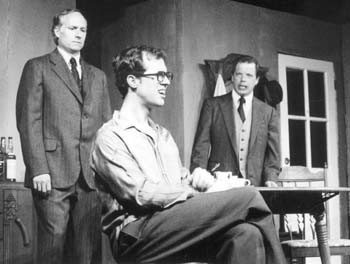
Triple threat: Coco Boylan, Sheila Groves, and Argo Thompson star in Medea.

Campy ‘Medea’ makes merry

By Daedalus Howell

BRAVISSIMO! The Actors’ Theatre production of Medea, the Musical gets in everything but the, er, kitsch-en sink. This Technicolor cabaret extravaganza, skillfully sutured from a talented sexy cast and playwright-director John Fisher’s hilariously campy script, will make you laugh so hard your face will ache and your seat will be wet (if only because water occasionally splashes from the onstage antics into the audience).

Set at a fictional “Euripides Festival” where a production of Medea is under way, Fisher’s musical is a bawdy, raucous burlesque of the original boy-meets-girl, boy-pisses-girl-off, girl-commits-infanticide story. This Medea successfully braids the threads of Greek mythology, popular culture, and gay camp into an NC-17 comic cat-o’-nine-tails, and then proceeds to whip your butt silly.

Actors’ Theater powerhouse Argo Thompson leads the cast through a cavalcade of backstage shenanigans portraying none other than “Argo”–a gay lampoon of himself struggling to play “Jason,” captain to (prepare for extreme synchronicity) “The Argonauts.” Convolutions abound as the actors portray versions of themselves as actors attempting to portray “characters” in this play within a play.

Also complicating matters are the intrusions of the metaplay’s auteur (played with wonderful panache by Robert Pickett) and his attempts to stage the tragedy as a homoerotic fantasia zealously touting gay empowerment. This does not bode well for the unlikely romantic pairing of Argo and Sheila (a superb Sheila Groves as “herself” playing Medea), who each conspire to bend the show to their own sociopolitical objectives.

Each of the 16 cast members shines brilliantly. Highlights include expert choreographer-performer Cabernet Lazarus’ high-kicking an Emma Peel-meets-Blaxploitation-flick “Afro-dite” dance sequence, macho rockers Matt Bartona and Robert Conard’s reckless driving sprees, and Anthony Martinez’s emotional breakdowns as Argo’s jilted ex.

Comic turns also come when Tim Earls’ pager goes on, Frankie Travis goes down, and Jason Breaw goes off as Aetees, queenly King of Colchis. CoCo Tanner Boylan’s steamy Phaedra, Queen of Athens (who lusts after her son, Hippolytus, played to the homo-hilt by David Costner), adds an extra sensual oomph to the show.

This is a stellar cast that sparkles under Fisher’s crisp direction and surely benefits from his obvious intimacy with the award-winning work (after the stopover at Actors’ Theatre, Fisher and his Medea head for Broadway–seriously).

Droll actor-pianist and musical director Lyle Fisher and percussionist Petra Sperling-Nordqvist escort the players through a spate of song-and-dance numbers culled from the far reaches of popular culture.

Medea, the Musical is a madcap, zippity-Dada, calisthenic marvel. With material of this caliber, it would seem impossible to do it wrong, but AT does it so right that it’s marvelous. Even the gods must be grinning.

Actors’ Theatre performs Medea, the Musical Nov. 13-Dec. 19 at the Luther Burbank Center, 50 Mark West Springs Road, Santa Rosa. $5-$15. 523-4185.

From the November 19-24, 1998 issue of the Sonoma County Independent.

© Metro Publishing Inc.
Thanksgiving Table Wines

0

Feast of Flavors

Michael Amsler


The search for that perfect Thanksgiving table wine

By Bob Johnson

IF THE ANNUAL Thanksgiving Day feast is a “formal” occasion around your house, heaven help you when the time comes to select the accompanying wines. I’ve been trying for years to uncover the “ultimate” Turkey Day vino … one elixir, when sipped between mouthfuls of turkey and candied yams, that melds all of the flavors into a rush of hedonistic gastronomic delight.

It has been a fruitless search. Each year I experiment, and 10 pounds later, I crash and burn in a puff of smoke.

I am the Coyote, and the “ultimate” Thanksgiving wine is the Roadrunner.

(Hmm, maybe if we substitute roadrunner meat for turkey meat, the flavors of the roadrunner would … Oh, sorry. Guess I’m obsessing again.)

So, to summarize, if your family stages a “formal” meal on Turkey Day, you may stop reading now. I can’t help you with the wine. You may as well continue perusing the Independent; maybe a group you like has a concert scheduled at the Luther Burbank Center or McNear’s.

However, if your holiday feast more closely resembles a king’s pig-out, interspersed with heady doses of mirth and merriment, you’ve come to the right place. By extending the theme of overindulgence to the wine, the “ultimate” answer becomes clear: uncork not one, not two, but a whole bunch of bottles … and hide Aunt Martha’s car keys until well into the evening, after the post-bash java has taken effect and she’s ready for the road.

The bottlings that follow (all are local except where otherwise indicated) would make wonderful additions to your holiday table. They are rated on a scale of one to four corks: one cork, no flaws; two corks, good; three corks, excellent; and four corks, add your friendly neighborhood wine critic to the guest list.

Prices are suggested retail or as seen in the marketplace:

Michael Amsler


Gundlach-Bundschu
1997 Gewürztraminer

A rose petal nose and a tart grapefruit flavor lead to a refreshing, slightly spicy finish. Gold medal winner at the San Diego National Wine Competition. $12. 2.5 corks.

Chateau St. Jean
1997 Fumé Blanc

Lush and peachy, with a broad feel on the palate that includes notes of grass, vanilla, and fig. One of the few fumés that would work well as a before-dinner sipper. $9. 3 corks.

De Loach
1997 Chardonnay

First came the winery’s multiple bottlings of zinfandel. Now De Loach is confusing … er, treating us to various designations of chardonnay. The “Sonoma” bottling is the original, however, and still this reporter’s favorite. The 1997 rendition features juicy and ripe flavors of apple and tropical fruit, making it a nice addition to the Turkey Day table or a refreshing and satisfying pre-meal quaff. $15. 3 corks.

Michel-Schlumberger
1997 Pinot Blanc

When does a pinot blanc not taste like a pinot blanc? When winemakers expose this relatively delicate grape to an overabundance of oak contact. M-S may have pushed the oak envelope a bit too far in the past, but not with this vintage. Now a nuance rather than a dominant flavor, the oak in this bottling complements rather than dominates the fruit flavors. $12. 3 corks.

Rosemount Estate
1997 Pinot Noir

No, we haven’t added a 51st state. But this Aussie winery has its U.S. headquarters in Sonoma, so deal with it. This exuberant wine is still a youngster, but its sweet strawberry-jam and bright cherry flavors make it hard to resist. The fruit components are nicely framed by a buttery quality and alluring spice notes. $9.99. 3 corks.

Benziger
1996 Reserve Chardonnay

Lactose intolerant? Stay away. But if you like buttery chardonnays, this one’s is for you. This full-bodied Carneros wine also exudes pear, honey, and spice aromas and flavors. $19.99. 3.5 corks.

David Coffaro
1997 Dry Creek Cuvée

Start with intense black fruit flavors, add a dash of black pepper, and toss in a hint of fennel, and you have this unique bottling from Dry Creek Valley that will stand up to virtually any flavors on the dinner plates. The wine is an unusual combination of cabernet sauvignon, zinfandel, carignane, and petite sirah–a true tribute to the value of blending. $22. 3.5 corks.

Gallo Sonoma
1994 Zinfandel

This Frei Ranch wine has a deeply extracted wild blackberry nose with hints of pepper and allspice. On the palate, a sweet cherry flavor appears and follows through to the finish. Lip-smacking from the moment it touches your mouth until it’s deep in your throat. This is not your father’s Gallo. $11. 3.5 corks.

Nalle
1996 Zinfandel

A highly perfumed, perfectly balanced vino from Dry Creek Valley with spiced berry fruit and powerful vapors of allspice. From one of the world’s leading zin makers, this wine is at once racy and elegant. A special bottling for a special occasion. $19.98. 4 corks.

From the November 19-24, 1998 issue of the Sonoma County Independent.

© Metro Publishing Inc.
The Scoop

Death Race 2000

By Bob Harris

SO ON NOV. 3 we good citizens all traipsed down to the ballot box and exercised our democratic muscles by voting for the millionaire of our choice. Yippee. News coverage across the land exalted the holy ritual, airing man-on-the-street interviews with exiting voters who decried their non-voting fellow citizens as slackers and layabouts who shirk their civic duty and so deserve neither complaint nor quarter. Yuh-hunh.

And so now once again the tide of 30-second televised deceptions that so rudely cake mud over our Dawson’s Creek reruns will recede for another term, and all of us who voted can finally and thankfully return to our slumber, content in the knowledge that once again democracy has worked its noble deed and the people have truly spoken. Yeah, right.

An Associated Press computer analysis has found that, of congressional candidates who entered the last two weeks of the race with the most financial resources–meaning money already spent and money still available, combined–96 percent won.

Ninety-six percent.

And it gets worse. In almost 60 percent of the House of Representative seats, winning candidates had a financial advantage of at least 10-1. No wonder pro wrestlers are getting into politics. It’s the only other major sport that’s so obviously fixed. Which isn’t to say there aren’t occasionally a few exceptions. This year’s voters rejected the highly partisan Sens. Lauch Faircloth and Al D’Amato, and the national Republican effort on behalf of House candidates, led by Newt Gingrich, now better known as the Kerry Collins of the GOP.

Lauch and Al both outspent their opponents and lost, and Newt frittered away a huge financial advantage on a spree of Monica Lewinsky ads. In the 30 races where the GOP bought airtime to show pictures of Monica, the Democrats won 18 seats.

So factionalism and Jenny McCarthyism are losing issues to a large chunk of the citizenry.

And Americans do tend to intuitively reject the Perots and Huffingtons who appear to be buying their way into office. The more the money comes from somebody else, the better we can maintain our illusions.

But it ought to tell us everything we need to know that the only significant victory by an independent, out of over 500 major political races nationwide, was by a professional wrestler. And if “The Body” can get elected, how long will it be before motocross, tractor pull, and drag-racing champions start jumping into public office?

Make no mistake–voting is the essence of democracy, absolutely indispensable and fundamental. But it means nothing without an informed and active electorate whose activities ensure a genuine choice at the ballot box. Real democracy doesn’t happen because we all vote for one guy over another. Real democracy is what we all do in the time between Novembers that gives trips to the voting booth their meaning.

Women didn’t get the vote in America because men changed the laws out of the goodness of their hearts. Women got the vote because they marched and protested and fought for the vote, literally for generations. Civil rights in the South didn’t happen because of a walk to a voting booth, but because of a March on Washington. And so on.

THE POLICY AUCTION we call the 2000 presidential election has already begun. It’ll take at least $20 million just to compete in the primaries. The only Democrat with access to those kind of dollars is Al Gore. End of story. The GOP won’t make the illegal fundraising allegations stick because both sides of the aisle have more dirty money than Papillon.

The rest of the mule team–Gephardt, Bradley, Kerrey, Kerry, Wellstone, etc.–have about as much chance at the nomination as Vinny Testaverde has at winning a Super Bowl. One of these five will probably be the VP.

I’m inclined to pick Bill Bradley, because he’s tall. Seriously. Tall candidates do really well in the TV era. Besides, he hasn’t done anything for the last few years, so he’s prepped for the job. But Bob Kerrey is raising a lot of cash on sheer early hustle, and platform shoes are back in style, so he looks like No. 2 for now.

No, I didn’t mean it that way.

MEANWHILE, the only GOP candidates with a financial prayer are Steve Forbes, George W. Bush, Lamar Alexander, and Newt Gingrich. Liddy Dole has an outside shot if she gloms the hubby’s Rolodex.

Quayle, Bauer, Ashcroft, Kasich, and a half-dozen GOP governors are just kidding themselves. Their poll numbers make the new $20 seem like a runaway hit. Cripes, if they’re gonna do something for vanity’s sake, they really ought to just mosey on down to GlamourShots and pose a few for the missus. Same impact on history, millions of dollars cheaper, and they throw in the frame for free. Bush fils is the current favorite, but his straw-poll performance will decline rapidly once he exists as more than a name outside of Texas. Besides, there’s a chance he won’t even run because of his reportedly, um, er, active, uh, personal life, which apparently only recently finally began to resemble that of a properly unsatisfied Republican.

Evidently Bushboy has more ass to cover than Dr. Laura.

NEWT GINGRICH can’t win, because he has a public approval rating only three points ahead of having a weasel running loose in your sinuses. Besides which, he owes Bob Dole bigtime for the tobacco-money rescue on last year’s ethics fine, which means if Liddy runs, Newt will probably have to support her campaign. Assuming he isn’t too busy feeding on carrion.

Lamar Alexander can’t win, because I sat behind him on a plane a while back and absolutely no one recognized him, even though we were flying into Tennessee, where he used to be the governor. The guy’s harder to remember than the last time “The Family Circus” was actually funny. Which leaves Steve Forbes.

And since most Republican partisans have no problem with paying retail for government office–the use of private wealth to attain public authority is seen as a First Amendment right–there’s no reason Steve Forbes can’t win the nomination, except for the fact that he strongly resembles one of the Budweiser lizards.

Forbes has unlimited wealth, a tax plan that appeals to the fiscal conservatives, and a newfound hard line on social issues that plays well with people who speak Tongues as a second language.

He’d be the perfect GOP candidate if his eyes weren’t on different sides of his head.

So …

The early guess for 2000 here is Gore/Kerrey defeating Forbes/Liddy Dole (or whomever) by a narrow margin, with Republican control of Congress expanding by five to 10 seats.

Not that any of this matters much, since the left and right in the American spectrum are defined merely as the extremes of acceptable dinner conversation among the moneyed class while waiting for Carlos to decant the Chianti.

Until you and I and the rest of the American public begin doing the real work of democracy, and take it on ourselves to force a change in the way campaigns are financed, the rest is largely a sideshow, a bait-and-switch carnival game creating the illusion of actual democracy while retaining little of its practical meaning.

Or at least 96 percent of it is.

From the November 19-24, 1998 issue of the Sonoma County Independent.

© Metro Publishing Inc.
Ruhama Veltfort

Paradise Lost

Donna Sproull


‘The Promised Land’ lacks luster

By Patrick Sullivan

SINCE 1492 (at least) they’ve been wading ashore, drawn across vast oceans to the new world by all kinds of glittering attractions, real or imagined. Whether they came seeking fortune, fleeing famine, or just eager to set up shop where they could do the religious persecution for a change, immigrants to America have at least one thing in common: If they’d known how often we’d be telling their stories in the future, they would have staggered back in wide-eyed astonishment. “Dang!” they might have said. “Nobody cared this much in the old country.” Naturally, they’d be too full of old-world courtesy to voice their next thought: Don’t you people have anything else to write about?

But there’s no denying the appeal of tales of immigration to a nation full of readers descended from immigrants. In the back of our minds, most of us still harbor misty visions of Ellis Island and the Statue of Liberty, a fact that still influences our politics to this day: “Give us your huddled masses,” we tearfully urge the world, at least as long as they’re all Ph.D. computer programmers with a physical allergy to food stamps.

We’re even more charitable when it comes to books about the immigration experience. Still, we have our limits, and even the most forgiving readers may find they’ve hit rough seas when they sail into The Promised Land (Milk Weed Press; $23.95). This new offering from San Francisco author Ruhama Veltfort bears all the signs of a first novel: The author clearly has a wonderful tale to tell, but hasn’t quite got a handle on how to tell it.

First, the story. Veltfort has placed two fascinating characters at the center of her book, which begins in mid-19th-century Poland. Yitzhak is the charismatic, rebellious son of a rabbi who cannot live with his father’s strict orthodox beliefs. Chana is a deeply sensitive but half-wild peasant girl whose family has been torn apart by tragedy. Brought together by a series of mishaps and a minor miracle, the two are pushed into marriage by Chana’s adopted family before they know much about each other. Suspicion turns into affection, which blossoms into true love.

But Yitzhak, troubled by disturbing dreams, cannot rest. His uncanny healing powers and unorthodox ecstatic spiritual practices attract a small group of followers, and soon the little group finds itself on the road, moving first across Europe and then over the ocean in search of sanctuary and a potent something that Yitzhak can’t quite name.

Moved along by divine guidance and religious persecution, the Jewish settlers land in New Orleans, roll up the mighty Mississippi, and then head out west, braving close encounters with inscrutable Indians, fanatical Mormons, the Donnor party, and even San Francisco’s Emperor Norton.

It’s a great story, but the trick lies in the telling, and that’s where the author stumbles badly. Her descriptions are packed with clichés, her pacing is agonizingly slow until it’s much too fast, and her shifting narrative churns up the same ground repeatedly, often adding nothing to our understanding. Moreover, many of the minor characters–Jewish, Mormon, or Indian–are as flatly one-dimensional as a sheet of paper. Surely the worst examples are the black slaves who talk in bad Southern dialogue, eat watermelon, and pray for Moses to lead them over the River Jordan.

The novel saves most of its truly evocative descriptions for the characters’ ecstatic spiritual experiences. The author’s account of a crowded Jewish prayer circle is powerfully vivid: “Yitzhak closed his eyes, faint with odor and devotion. He felt the circle turn like a great wheel, whirling upward into space as though his feet no longer rested on the ground.”

Indeed, perhaps the novel’s biggest attraction is its intriguing exploration of Jewish religious beliefs, although the narrative is encumbered by a few too many unexplained Yiddish and Hebrew phrases.

The book picks up the pace in the second half and manages an unexpected ending. Still, the reader will be left with the hollow feeling that this story–put to paper so many times before–could have been told better. Maybe next time.

Ruhama Veltfort reads from The Promised Land Wednesday, Nov. 18, at 7:30 p.m. at Readers’ Books, 130 E. Napa St., Sonoma. 939-1779.

From the November 12-18, 1998 issue of the Sonoma County Independent.

© Metro Publishing Inc.

Migrant Workers in Graton

0

Culture Clash

Michael Amsler


Spanish, spirit, and song grate some in Graton

By Stephanie Hiller

MARIO RAMOS is one of the lucky ones. Eldest son of 11 children in a poor Puerto Vallarta family, Ramos came to the small west county town of Graton as an exchange teacher in Oak Grove school’s bilingual program, and now owns Mexico Lindo, a nice little restaurant in town. He’s known as “profesor” among the Latinos here.

Nancy Kesserling, who knew Mario at Manzanita School, calls him “an angel in the community.”

She says he brought “Spanish, spirit, song–and soccer” to the school.

Now, Graton is in the midst of a major gentrification project that is putting local migrant workers at the heart of a heated public debate–and Ramos is stepping forward to help mediate the dispute.

A former school principal who oversaw the upgrade of his rural school with new classrooms and bathrooms with funds from the Rotary Club, Ramos is no stranger to community process.

And he’s not a man to forget his origins.

As long as anyone can remember, Mexican migrant workers have come here to work the orchards and the vineyards. For years, they’ve been lining up on summer mornings waiting for work, and lingering in the streets in the evenings before settling down to sleep under a local bridge.

They work hard, Ramos says. Whenever he has recommended workers to local people, “they have thanked me,” he adds.

THIS SUMMER Ramos went so far as to drive a van full of workers to help install a vineyard in Cazadero. Most of the money goes back to the workers’ families in Mexico. Sometimes they save the money to get a jump start on a business there.

One young man wanted to become a fisherman. “Down there, the government is so corrupt, he had no way to make money for the boat,” Ramos explains. The man earned that money here, and went home. Some say the number of workers has increased this year, but no one knows.

Certainly the gentrification of Graton has changed the scene’s backdrop.

The bars are gone, old buildings have been demolished, and new shops and restaurants have sprouted, one of them belonging to Ramos. Some of the new business owners have complained that the presence of migrant workers on the streets just doesn’t look good. Ramos, who has always been involved in the dialogue, was invited to address the problem at community meetings in 1993.

He began talking with the men about such unseemly behaviors as drinking on the streets.

“I talked to the guys–they understood,” Ramos says. “I said, ‘We don’t want the people to see us doing bad things.’ “

Since then, the men have learned to monitor themselves.

Beyond that, Mario says the community did not know what else it wanted to do, and the meetings stopped.

Still, many workers remain unhoused, and this year Graton environmentalists became concerned about garbage and pollution in the creek, produced by those workers who live under the bridge.

GASP, a group of citizens organized around the sewer issue, has proposed installation of two porta-potties in town for public use, under funding provided by bottling company AVG for creek restoration, after North Coast River Watch threatened to sue the company for inadequate disposal of waste.

At a meeting last week called by resident Ann Erikson, Graton residents met with Supervisor Mike Reilly, Sonoma County Sheriff’s Deputy Mike Raasch, and school principal Jim Waliszewski to discuss the situation.

The atmosphere was congenial. Residents appeared willing to work together to come up with solutions. The workers “are not committing violent crimes,” confirms Deputy Raasch.

Even then, “There’s a certain amount of race-based fear in the Anglo community,” says Craig Curley. A contractor, he works comfortably with many Latinos, but he knows women who are afraid to walk through town.

Merrilyn Joice, editor of the town’s Graton Gazette, has pointed out that most women she has queried speak not of fear but of “discomfort” about whether or not to say hello.

Principal Waliszewski told the meeting that he has “never seen anything inappropriate” when the men use the school basketball court, but he has recently received calls from concerned parents whose children are afraid to go there after school.

Proposed solutions include a park or community center, not only for the workers, but for youth, some of whom are now sporting gang colors.

“I’d rather have the workers than the Graton Boys,” says Curley, referring to alleged local gang activity.

Ramos would like to see some cooperative housing that could help get the workers off the streets. “The vision I have is some kind of place they can come to and pay for–a brasero program,” Ramos says.

“Let everyone do their part.”

Citizen participation and contributions are invited at the coming community meeting, Tuesday, Nov. 17, at 7 p.m., at the Oak Grove Elementary School, 8760 Bower St., in Graton.

From the November 12-18, 1998 issue of the Sonoma County Independent.

© Metro Publishing Inc.
Frank Black

0

Back in Black

Lisa Johnson


Ex-Pixies honcho Frank Black rocks on

By Greg Cahill

BECK SAID in an interview once that every song is like its own nation: “It has its own laws,” explains ex-Pixies kingpin Frank Black. “I really think that’s true–they come out the way they come out. I’m really just delivering the next batch of songs, whether people like that or not. I almost don’t have any control over it.”

Sounds mystical, but the latest batch of songs out of the blue has served this alt-rock innovator well. Frank Black and the Catholics (SpinArt) has garnered rave reviews for the singer, songwriter, and guitarist Rolling Stone once credited with fronting “the quintessential college rockers”–a major influence on Kurt Cobain and the alt-rock revolution that followed Nirvana’s 1991 pop chart ascendancy. It’s “the kind of weirdo rock that inspired 1,000 bands to call themselves ‘alternative,’ ” the Philadelphia City Paper recently opined about the rocker’s return to form. “Black invents and takes risks but stays true to his sound.”

And what a sound. Seductive pop melodies. Balls-to-the-wall surf riffs (“like the Beach Boys on acid,” a critic once noted). Otherworldly lyrics. Black’s deranged shrieks. Primal anarchy at its best.

“Even though I try not to read reviews,” admits the reclusive Black, during a phone call from his L.A. home, “it’s good to know there are some good ones out there.”

The thing that’s gotten those jaded rock crits so excited is that Black–who has been slammed in the past for overproducing otherwise sublime neo-psychedelic fare–opted this time for a raw, stripped-down approach that lends a spontaneous, vibrant spark to 11 originals and a raucous cover of Larry Norman’s honky-tonk classic “Six Sixty-Six.”

“We were feeling very proud of the demo [that became the new release], and believed that it should be a record in its own right,” says Black who fought to maintain the project’s initial integrity. “The producer thought it was the best demo he’d ever heard, and so he headed off for slicker, shinier records and we stayed with ours, captured at a moment before someone sucked all the heart out of it.

“All that tedious overdubbing and the latest fix-it-in-the-mix computer technology–we’re not interested in that. It’s rough and ready, a diamond in the rough.”

A LITTLE HISTORY. Frank Black started life 34 years ago as Charles Michael Kitteridge Thompson IV. His first taste of the rock life came while banging his guitar in the garage of the suburban L.A. home of his Pentecostal mother and stepfather. The family relocated to Boston. Rock ‘n’ roll took a back seat to other interests, namely astronomy. While living in Puerto Rico as a University of Massachusetts exchange student, Thompson decided either to travel to Australia in pursuit of Haley’s Comet or to form a band.

Rock ‘n’ roll won the toss. Back in Boston, the aspiring singer/songwriter teamed up with college roommate Joey Santiago, a rich Filipino kid with a knack for buzz-saw guitar licks. At the suggestion of his biker-bar owner biological dad, he changed his name to Black Francis, and adopted the moniker Pixies in Panoply for his band after hooking up with Ohio native Kim Deal, a novice bassist, and Deal’s drummer friend David Lovering.

In 1987, the Pixies released their explosive debut EP Come on Pilgrim on the artsy London-based 4AD label. It was followed the next year by the virulent full-length Surfer Rosa, capturing extensive college radio play and critical raves.

A major label deal followed. But by the time 1989’s breakthrough Doolittle (Elektra), which featured the college radio fave “Monkey Gone to Heaven,” hit the airwaves, the Pixies already were falling apart owing to tension between the band’s founder and Deal. The Pixies released two more albums–1990’s Bossanova (which featured some of Black’s best UFO-obsessed lyrics) and 1991’s Trompe le Monde–but by then Deal already had formed her own band, the Breeders, featuring Tanya Donelly of Throwing Muses.

“We carved out a nice little niche for ourselves,” reflects Black. “We had a good little run. But I don’t think that if we had stuck it out longer we would have been big and famous. I think that the music was far too quirky for that. The bands that sell millions and millions of records have some kind of mass appeal, a genuine pop cleverness or charisma.

“Sometimes it’s just because they’re lame and boring and that’s what people are looking for at a particular time.”

UNDER THE NEW pseudonym Frank Black, Thompson in 1993 recruited Santiago, members of Pere Ubu, and several session players and released his eponymous solo CD to mixed reviews. In subsequent years, Black fell out of favor with critics who once hailed him as an innovator but later turned against him for being too experimental. “I actually find that even my most quirky moments aren’t that quirky compared to [the avant-garde San Francisco group] the Residents or some band like that,” says Black. “I mean, compared to them I feel like I’m in the Bay City Rollers.

“But I guess it’s better to have people writing bad reviews about you than nothing at all. I’ve always been fortunate in that regard.”

These days, Black is living the good life–even the reviews are good. “I have a nice house, a beautiful girlfriend, lots of pets,” he says, sounding like the antithesis of the angst-ridden alt-rocker. “My home life is a pretty happy, warm, fuzzy experience in the California sunshine. It’s a nice thing to come home to after being in nightclubs and Holiday Inns for a few weeks.”

And as for the road, even that’s treating Black kindly. “You learn where the good cafes and truck stops are. You learn to love certain stretches of road just for the sheer beauty of it. And, of course, the big payoff at the end of most days is the gig. We get to play–that’s a great reward, getting to play at a rock show. I mean, that never gets boring. There’s always something exciting about it, whether it’s sold out or not. Whether it’s a big club or a tiny club. Whether it’s a great place or a shitty place. The bottom line is that you’re going to play music and there are going to be people there to hear you, so that always is there. There’s always a crowd. There’s always you. And there are always your instruments.

“It’s exciting to go out there and prove yourself, to go out there and say, “I have a great rock moment in me, so stick around for a while.’ “

Frank Black and the Catholics perform Friday, Nov. 20, at 8 p.m. at the Phoenix Theatre, 201 Washington St., Petaluma. Tickets are $10/$12. 415/974-0634.

From the November 12-18, 1998 issue of the Sonoma County Independent.

© Metro Publishing Inc.

Filmmaker Gustavo Mosquera

0

Vanished

By David Templeton


IN ARGENTINA, in the mid-1980s, whenever Gustavo Mosquera was stopped for “routine questioning” by the military police, he was asked the standard questions: his name, his address, and his occupation. If you were lucky, that was as far as it went.

“Every day the cops were putting us up against the wall, asking for our IDs,” Mosquera explains, “and asking for our ideas, too. Because ideas are what dictatorships are most afraid of.” Whenever questioned, the young Mosquera would reply, honestly, that he was a student, currently enrolled at the University of Buenos Aires.

“Then they would want to know what I was studying,” he continues. “So I would say, ‘electronic engineering,’ and they would let me go. ‘An electronic engineer? Those are not dangerous.’ ”

But what Mosquera, who is now a part-time resident of Santa Rosa, would always fail to mention was his other course of study, his passion, his first love: In addition to his engineering degree, he was also pursuing a degree in cinematic arts–with dreams of becoming a film director.

“The military dictatorship had no use for filmmakers,” he says of the since ousted cadre of military generals. “Artists of any kind–journalists, poets, writers, thinkers–had been disappearing. Thirty thousand people vanished during the military times. So my family begged me to have another occupation.”

That other occupation may have saved his life; it most certainly made him a better filmmaker.

“I’d gained so much knowledge about electronics and engineering,” says Mosquera, “and had come to appreciate mathematics and abstract ideas and the artistic works of people like M. C. Escher that it began to all come together in my films.”

Case in point: Moebius.

Made two years ago while Mosquera was teaching at the University in Buenos Aires, Moebius is a small-budget allegorical thriller about a missing subway train. Financed by the university, it was made with the assistance of a hand-picked “workshop” team of students. The film features a mathematician hero, numerous references to advanced mathematical concepts, striking visuals imbued with an Escher-like circuitousness, and special effects shot with a camera that Mosquera, employing his accidentally acquired engineering skills, designed himself.

“What I did was I found a very old 35-mm camera in an antique store,” he explains, reaching to pick up the case that holds the very same machine. “It was made in 1926. I basically took it apart and rebuilt it to do things it had never been intended to do.” Unveiling the camera–a rickety, smoky-black thingamajig–Mosquera lifts it from the case and holds it up proudly. “I changed the motor, added a few enhancements, a new belt. This is the camera that I held while hanging from the front of the subway train, riding back and forth for hours, filming the tunnel shots. I am now very fond of this camera.”

And audiences have become very fond of Moebius.

Michael Amsler


For the last two years, Mosquera has been globetrotting from film festival to film festival, with Moebius as his calling card. The film has picked up numerous awards and been enthusiastically received in Hong Kong, Singapore, China, and throughout Europe, and has also performed well at the Sundance and San Francisco film festivals. The movie will receive its local premiere this weekend at the Sonoma Film Institute, on the Sonoma State University campus.

ON THE SURFACE, it’s an eerie and compelling mystery story set in the labyrinthine tunnels under Buenos Aires, loaded with nifty surreal tinges and a sly, satisfyingly metaphysical payoff. Underneath that, however, there is a poetic, richly symbolic exploration of Argentina’s abiding national guilt over the vanishing of those 30,000 disappeared people, a subject on which the country’s current democratic government has remained staunchly silent. As with the missing subway train, it is ultimately easier for the bureaucrats to forget all about it than to pursue the mystery further into the unthinkable darkness.

“The festivals have been a very big help,” Mosquera allows. “They have increased the reputation of this film in ways that I could not have done on my own.” While staying in Northern California–his fiancée, Terra Miezwa, is a longtime local resident–Mosquera has been meeting with various Hollywood movers and shakers, hoping to turn Moebius’ indie glitter into a chance at mainstream gold.

But according to Mosquera, any such alchemy will have to be on his terms.

“I’ve been told by many producers,” he says, “that Hollywood is not in the business of making movies for intellectuals. It’s crazy. You’d think they would be so happy when someone brings them a well-written script, a script that tries for something deeper and better than all of the rest.”

He sighs. “Hollywood believes that the audiences are stupid, but they are not. I know that they deserve better than much of what they’ve been getting.”

While Moebius was made for only $250,000, his next film, he hopes, will be made, in English, for $3 million–still a pittance by Hollywood standards. Like Moebius, it will be a philosophical fable disguised as science fiction.

But first, there are a few more festivals to attend.

“I’ve been asked to take the film to Korea, to Calcutta,” Mosquera says. “But I believe it is nearing the time to stop all of that. As much as I love Moebius, I am ready to make a new one.

“All I need is for some producer to say, ‘Yes. Green light. Let’s go.’ “

The Sonoma Film Institute screens Moebius on Nov. 13 and 14 at 7 p.m. at the Darwin Theater, Sonoma State University, 1801 E. Cotati Ave., Rohnert Park. Admission is $2.50-$4.50. 664-2606.

From the November 12-18, 1998 issue of the Sonoma County Independent.

© Metro Publishing Inc.
Talking Pictures

0

Past Imperfect

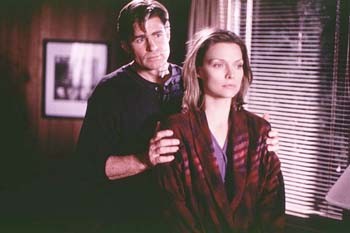
Glory days: William Macy and Joan Allen get ready for revolution in Pleasantville.

Author Clyde Edgerton on ‘Pleasantville’

By David Templeton

Writer David Templeton takes interesting people to interesting movies in his ongoing quest for the ultimate post-film conversation. This time out, he takes a stroll through Pleasantville with best-selling Southern author Clyde Edgerton.

IT’S A LONG WAY from North Carolina to San Francisco, and Clyde Edgerton–appearing now at the front door of a massive downtown cineplex–looks as if he’s walked the whole way on foot. His eyes are remarkably red, his unshaven, smiling face broadcasts the effort of every stifled yawn. He’s in California for a string of bookstore readings–his 1997 best-selling novel Where Trouble Sleeps has just been released in paperback–and he’s graciously agreed to go to the movies before his first appearance. Even so, I’m feeling more than a little guilty, fearing that Edgerton might be happier back at his hotel–you know, taking a nice long nap.

“Oh, I’m all right,” he says in a warm drawl, suppressing another yawn. “I may end up fallin’ asleep during the movie–but hell, if you don’t mind, I don’t mind.”

I don’t mind. And for the record, Edgerton doesn’t fall asleep.

In fact, Pleasantville proves to be a stimulating experience. You’ve seen the commercials: Two ’90s teenagers (Reese Witherspoon and Toby Maguire) are transported into the strictly black-and-white world of a ’50s television sitcom, infecting the townsfolk (including Joan Allen and William H. Macy) with a kind of Technicolor virus as the citizens’ private passions are gloriously, sometimes frighteningly, awakened.

By the end of the film, Edgerton has been temporarily energized.

“Though I wanted it to be funnier,” he points out. “It could have been one funny-ass movie.”

Pleasantville is a film about many things, but chiefly it’s a satire on modern conservative attitudes, poking holes in the right-wing’s insistence that America in the ’90s needs an infusion of ’50s values. Certainly, the colorful changes brought to the town of Pleasantville have a dark side–with shades of McCarthyism and racial segregation, erupting into book burning and ugly hate crimes. The filmmakers seem to be saying that, sure, changes can be difficult. But in the end, freedom is always worth the complications that come with it.

Edgerton’s own work explores similar territory. Walking across Egypt (soon to be made into a film itself), Killer Diller, and especially Where Trouble Sleeps, all show the conflict between old ways of thinking and new. In Trouble, a tiny ’50s Southern town–a rundown version of Pleasantville–is forever altered, for good and ill, when a mysterious stranger drives into town with larceny in his heart and a trunk full of dirty movies. The way the town ultimately deals with the stranger, and the mark he leaves behind, is unforgettable.

“We talk about the way the world was in the ’50s and the way it is now,” Edgerton says after the film, as we sit in a nearby diner. “But when we think of the ’50s, we can’t really remember what the ’50s were like. We remember the way the ’50s were in some movie or some TV show or in photographs. Politicians say that the ’50s were such a wonderful time, a time of family values and goodness. That’s true–but it’s also not true.

“In my life, when I was growing up in the ’50s, there was no discussion of sex, certainly, but there was no discussion of any new ways of thinking,” he continues. “Harmony had to prevail. Harmony had to be in the family and in the community. There was no such thing as an outspoken person–unless they were crazy.

“In my family, especially on my father’s side of the family, he always worshiped his parents. He and his sisters stayed at home, very close to their parents. In a sense, they gave up their lives; they didn’t look for options or even think about moving away. They just stayed there, almost in a kind of psychological, emotional incest.”

“Which was bad,” I interject.

“Well, it’s good and bad,” he replies. “I think–not only in the South, but in many rural areas, especially agricultural areas, where the family lived and worked in sight of each other, from dawn to dark, every day of the year, year after year–a certain level of harmony had to happen in order to survive.”

EVER READ Robert Bly?” I ask.”Not much,” Edgerton returns. I explain the controversial assertion by the poet/men’s movement leader that one of men’s biggest problems is that we no longer grow up in sight of our fathers, are no longer trained in our father’s trade. “Bly says that a kind of spiritual food was once passed from father to son,” I sum up, “and that isn’t done much today, to the spiritual detriment of all men.”

“Well, that’s fine as long as you don’t have an asshole for a father,” Edgerton tosses back, amiably. “As soon as you have an asshole father you learn asshole ways that you pass on to your asshole son. There were plenty of people living at home and who knew their fathers in the ’50s, and in a lot of cases, because they grew up with their father, and because of that militaristic emotional bonding, they didn’t ever do anything on their own–because of their father.”

He let out a yawn again–a great big one–as I mention a recent Time magazine article. Critical of Pleasantville, the writer argued that the ’50s were far less dark than what followed; we gained sexual and artistic freedom at the cost of drug addiction, AIDS, and teen pregnancy.

Time magazine can make the same argument about the Middle Ages,” Edgerton says. “They could say, ‘Well, you know, in the Middle Ages they didn’t have AIDS, so the Middle Ages weren’t all bad.’ Depends on who you were in the Middle Ages, where you fell in the class structure. The ’50s were nice for middle-class white men. OK. But if you were black? If you were a woman? In the ’50s? It was a hell of a lot worse for you.

“The thing is, when we talk about returning the ’50s–either literally, like in the movie, or figuratively, by regaining some sense of values–you can’t. You can’t do it. We can’t put the toothpaste back in the tube. The differences between today and the ’50s are too great. Like I said, we’ve forgotten what it was really like back then, but it wasn’t Ozzie and Harriet.

“What I’m tryin’ to say is,” he concludes, politely covering one last yawn, “we’ve covered so much ground since the ’50s–ground we don’t even remember covering–that we no longer even recognize how far we’ve come.”

“We’ve come a long way, baby?” I say with a laugh.

Edgerton nods, smiles, and shrugs all at once: “You bet we have.”

From the November 12-18, 1998 issue of the Sonoma County Independent.

© Metro Publishing Inc.
Talking Pictures

Bombing Out Get me out of here: Is that Denzel Washington fleeing the set of The Siege? Two action novelists take on 'The Siege' By David Templeton David Templeton takes interesting people to interesting movies in his ongoing quest for the ultimate post-film conversation. This time around, he journeys to Sacramento--the hometown of authors...

Spins

Rare Air Past life: The four-CD John Lennon Anthology cuts close to the bone. New CDs focus on rarities from Lennon, Springsteen, Stereolab and the John Coltrane Quartet John Lennon Anthology Capitol/EMI DURING a decade-long solo career, John Lennon distanced himself from his Beatles past and left behind an intimate recorded legacy that...

Medea, the Musical

Greek Grins Triple threat: Coco Boylan, Sheila Groves, and Argo Thompson star in Medea. Campy 'Medea' makes merry By Daedalus Howell BRAVISSIMO! The Actors' Theatre production of Medea, the Musical gets in everything but the, er, kitsch-en sink. This Technicolor cabaret extravaganza, skillfully sutured from a talented sexy cast and playwright-director John Fisher's hilariously...

Thanksgiving Table Wines

Feast of Flavors Michael Amsler The search for that perfect Thanksgiving table wine By Bob Johnson IF THE ANNUAL Thanksgiving Day feast is a "formal" occasion around your house, heaven help you when the time comes to select the accompanying wines. I've been trying for years to uncover the "ultimate" Turkey Day vino ......

The Scoop

Death Race 2000 By Bob Harris SO ON NOV. 3 we good citizens all traipsed down to the ballot box and exercised our democratic muscles by voting for the millionaire of our choice. Yippee. News coverage across the land exalted the holy ritual, airing man-on-the-street interviews with exiting voters who decried their non-voting fellow citizens as...

Ruhama Veltfort

Paradise Lost Donna Sproull 'The Promised Land' lacks luster By Patrick Sullivan SINCE 1492 (at least) they've been wading ashore, drawn across vast oceans to the new world by all kinds of glittering attractions, real or imagined. Whether they came seeking fortune, fleeing famine, or just eager to set up shop where they...

Migrant Workers in Graton

Culture Clash Michael Amsler Spanish, spirit, and song grate some in Graton By Stephanie Hiller MARIO RAMOS is one of the lucky ones. Eldest son of 11 children in a poor Puerto Vallarta family, Ramos came to the small west county town of Graton as an exchange teacher in Oak Grove school's bilingual...

Frank Black

Back in Black Lisa Johnson Ex-Pixies honcho Frank Black rocks on By Greg Cahill BECK SAID in an interview once that every song is like its own nation: "It has its own laws," explains ex-Pixies kingpin Frank Black. "I really think that's true--they come out the way they come out. I'm really just delivering...

Filmmaker Gustavo Mosquera

Vanished By David Templeton IN ARGENTINA, in the mid-1980s, whenever Gustavo Mosquera was stopped for "routine questioning" by the military police, he was asked the standard questions: his name, his address, and his occupation. If you were lucky, that was as far as it went. "Every day the cops were putting us up against...

Talking Pictures

Past Imperfect Glory days: William Macy and Joan Allen get ready for revolution in Pleasantville. Author Clyde Edgerton on 'Pleasantville' By David Templeton Writer David Templeton takes interesting people to interesting movies in his ongoing quest for the ultimate post-film conversation. This time out, he takes a stroll through Pleasantville with best-selling Southern author...
11,084FansLike
4,606FollowersFollow
6,928FollowersFollow


