
Bodega, Saturday Night

0

Sweet and Sour

Wild bunch: The cast of Bodega, Saturday Night goes all out for laughs.

Bodega, Saturday Night’ offers an uneven variety show

By Daedalus Howell

IF VARIETY is the spice of life, then Bodega Theatre Company’s variety show, Bodega, Saturday Night, an evening of original sketch comedy and music modeled after television’s Saturday Night Live, puts the nut in nutmeg and the pap in paprika.

Billed as “a comedy and music revue,” Bodega, Saturday Night is an uneven, oddball melange of corporate-bashing comedy, adolescent shtick, and middlebrow humor penned by Jedd Crow and Steve Hastings and directed by Lee Rhoads. It’s a light, ebullient diversion, which, in some ways, may herald the return of old-school vaudeville. The bits exist for their own sake, devoid of a unifying premise and packed into 90 minutes–with nearly 20 performances in all and many genuine laughs.

Apart from skits, the show features tap dancing, numerous musicians (some funny and some decidedly un-), and a man who can play John Philip Sousa’s Stars and Stripes Forever using his hands as an instrument. Or at least it looks that way–theatrical trickery may be, er, afoot. Indeed, this company is crafty. Watch for actors planted in the Casino’s conjoining dining space swilling Olympia beer and exhaling sputum all over neighboring diners. What at first appears as just cause to reinstate prohibition is actually an elaborate setup for later stage-borne antics.

Seventeen-year-old singer Rachel Bockover opens the show with a folksy rant featuring the line “We really freaked her out, we had our titties out, uh-huh,” and returns with a poignant ballad of love gone awry.

Writer-performer Crow’s “Rent-A-Granny,” a one-note premise that finds actress Susana Crofton interested in chartering matriarchal services from Vince Craft (who is also the show’s de facto host), typifies much of the show.

Characters such as Swami Satchabanana and Madame Pin-Shin Yao (ethnic caricatures featured in Crow’s sketch “The Overpopulation Conference”) are a refreshing smack of political incorrectness–and timely since India recently matched China’s 1 billion population mark.

Writer Hastings appears as an intentionally hapless stand-up act, performing a song about a dingo that he segues into with the old “what’s a bush doctor–an Australian gynecologist?” gag. Hastings can be endearing, however, as when he repeatedly loses his guitar pick in his instrument’s sound hole and frequently refers to crib notes taped to his guitar.

Singer-songwriter Ernie Noyes steals the show with both of his musical appearances: he describes his bad attitude in a song in which he sings that he’s a “godless, pervert commie” who “smokes mari-ju-wanni,” and he later closes out the night with a well-crafted transvestite cowboy ballad à la countrified Tom Lehrer.

The interactive portion of the bill comes with Craft’s solo interpretation of The Wizard of Oz at breakneck speed, replete with costumes, props, and “a little dog too.” Throughout, he encourages the audience to sing along with the musical bits.

Though often silly, discursive, and underdeveloped, Bodega, Saturday Night does achieve its share of belly laughs. The earnestness of the performers and the eerie notion that they’re having more fun than the audience is sufficient cause to let down one’s guard (and indeed, taste) and be merrily entertained.

Bodega, Saturday Night plays on Saturday, Aug. 28, at 7 and 9 p.m. at the Theatre in the Casino, 17050 Bodega Hwy. Tickets are $10. 876-1858.

From the August 19-26, 1999 issue of the Sonoma County Independent.

© Metro Publishing Inc.
Talking Pictures

0

Private Parts

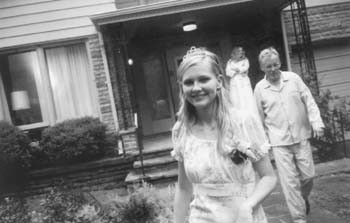
Political follies: Dave Foley and Dan Hedaya get Nixonian in Dick.

Comedian Debi Durst thinks some people don’t know ‘Dick’

By David Templeton

Writer David Templeton takes interesting people to interesting movies in his ongoing quest for the ultimate post-film conversation. This column is not a review; rather, it’s a freewheeling, tangential discussion of life, alternative ideas, and popular culture.

“WELL, that settles it,” barks Debi Durst, as the lights come on and we stand up to leave. “We can now safely say that Richard Nixon was the best Dick we’ve ever had in the White House.”

Well, he’s certainly the funniest, as portrayed by actor Dan Hedaya in the gleeful new Nixon-era White House satire Dick. The movie stars Kirsten Dunst and Michelle Williams as a pair of oh-so-sweet, but not-so-bright D.C. teens who change history after accidentally bumping into presidential henchman G. Gordon Liddy in mid-Watergate burglary.

Later, they bump into Liddy again, this time on a high school tour of the White House, and are soon being questioned by Dick–excuse me, President Nixon–himself. Thinking the girls might know something, he makes them his official dog-walkers. Before long, the well-meaning twosome have escalated the president’s increasing paranoia–they get him hooked on marijuana-laced cookies–and sabotaged his cover-up scheme: they record eight-and-a-half minutes of Olivia Newton John love songs on his secret Oval Office tape machine.

When Nixon begins to show his true colors–cursing, breaking laws, kicking the dog–the girls hatch a plan to ruin him. Remember Deep Throat, the mysterious informant to Washington Post whistle-blowers Bob Woodward and Carl Bernstein? Well, guess who she was?

“Just goes to show you,” Durst remarks, “it doesn’t take much to bring down a Dick.”

DEBI DURST–she’s married to political humorist Will Durst–is something of a San Francisco legend. A determinedly eccentric stand-up comic and sharp-tongued satirist with a great laugh that sounds like Woody Woodpecker on uppers, she’s been a major mover-and-shaker on the Bay Area comedy scene for years. I was charmed to learn that Durst was also the voice of the “Corpse Kid”–“There goes Christmas!”–in Tim Burton’s Nightmare before Christmas.

Wearing a vintage, handmade red-white-and-blue jacket–“I don’t know anyone who didn’t make something out of an American fag at one time or another,” she says–Durst leads the way from the theater and into a nearby bar. She’s clearly ready to talk.

“Unlike a lot of kids today, who don’t know Dick,” she says, grinning, “I know quite a lot about Dick. So ask me something.”

“Well,” I say, “let’s start by comparing Dicks.”

“Cool,” she says. We quickly make a list of actors who’ve portrayed Richard Nixon in various films: Anthony Hopkins in Oliver Stone’s Nixon. Rip Torn in Blind Ambition. Philip Baker Hall in Robert Altman’s Secret Honor.

“And now Dan Hedaya, who was born to be Dick,” Durst crows. “Dan Hedaya’s Dick was by far the best and greatest that I have ever seen. Anthony Hopkins’ Dick pales in comparison to Dan Hedaya’s Dick.

“John Belushi would have been great in this part,” she adds. “I’m really sorry we never got to see John Belushi’s Dick.”

“Hmmmm. Are the Dick jokes ever going to peter out here?” I want to know.

“Good one. And probably not,” Durst says, laughing. Later, at my inference that the film might have been a bit far-fetched, even for a satire, she says, “Not a bit. I didn’t think Dick was too hard to swallow at all.

“Prepare yourself,” she cautions. “This could go on for hours.”

“DID YOU SEE that couple in front of us, with the kids?” Durst says, a little later. “You could tell they were sitting there going, ‘Jesus, how do we explain this?’ They’re going to have to go home and have a history lesson now. God forbid.

“But seriously, if it wasn’t for Dick, we wouldn’t know dick. Think about it. Historically, presidential dirt was always covered up, ignored by the press–until Watergate came along and blew it wide open. White House cover-ups–cheating and lying and paying people to shut up–that goes way, way back.

“Nixon,” she observes, “was just the first Dick to get caught.”

Ouch.

“In the Kennedy days,” she continues, “the press kept its mouth shut about JFK’s little peccadilloes. But after Dick–let’s just call it A.D., shall we?–it’s been open season on presidents.

“It’s funny to think about it now,” she goes on, “but back then we really did have this sense of respect for the authority and office of the president. It was, as we were taught in school, ‘the highest office of the greatest country on the planet!’ God bless America! Now it’s kind of unthinkable that anyone would completely trust the president.”

I recount my memory of watching Nixon’s famous resignation on TV (followed, on one Los Angeles radio station, with a live rendition of Ding Dong the Witch Is Dead). Durst was in college at the time.

“We were rehearsing a play in the theater building,” she recalls, “and the teacher came running in shouting, ‘He’s quitting! He’s quitting!’ We all started shouting, and ran into the office where there was this little tiny television–and there he was, giving his speech, saying ‘You’re right. I’m wrong. I’m leaving. Now you won’t have Dick to kick around anymore.’

“After that, it was like a great big party. We ran outside to see if anyone else had been watching, and everybody was there, standing around laughing, shouting, mouths hanging open. We were kind of giddy. We kept saying, ‘It’s over. It’s over. Things are gonna be better now.’

“Ha,” she adds.

“So what I want now,” she goes on, “is more Dick. The movie, not the guy. I mean, who knows how much Dick they had to chop to make this a two-hour movie.

“Yep. That’s what America really needs a whole lot of uncut Dick.”

From the August 19-26, 1999 issue of the Sonoma County Independent.

© Metro Publishing Inc.

Five Artists

0

Fantastic Five

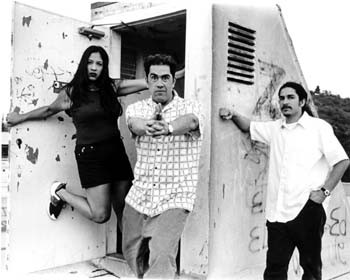
Head trip: Riding the crest of the Internet’s hot MP3 craze, Petaluma-based Headboard may be the county’s best unsigned band.

Five local artists to watch

By Patrick Sullivan

GO AHEAD–just try it. Try to nail down the five visual artists, actors, musicians, and other local creative types with the biggest potential to make a startling success out of their budding careers. You’d have better luck playing the lottery.

Creativity, after all, is everywhere in Sonoma County. There are those who strive for the big time, hoping to make it into the pages of Rolling Stone, or at least ARTNews. And there are others who aim for nothing more and nothing less than to simply enrich our community’s cultural life with their artistic efforts.

But all excuses and explanations aside, there are some folks on the crowded local scene who seem to exude potential, to sweat it from their pores, to pour it out onto the canvas and the stage. And while recognizing true talent is a treacherous task, leaving it unmarked is worse. Therefore, below you’ll find our list of five local artists to watch out for in the first five years of the next millennium. You’ve already met them in the pages of the Independent, but we think they deserve a fresh look. If you want our advice, don’t take your eyes off these folks, because they’re on the move.

Headboard Pop Band

ANYBODY WHO thinks the Unabomber had a point about computer technology will not find a receptive audience in the members of Headboard.

Founded in 1994, the Petaluma-based pop/rap/ska band–which counts everyone from the Beachboys to Public Enemy among its influences–has engaged in serious flirtations with major label success at least twice in its tumultuous history. But now, the five-member outfit is riding to national exposure on the cresting wave of MP3 online music technology, which permits Internet users to download music to their computer.

According to Headboard’s Glen Rubinstein, the band regularly places in MP3’s top 40 lists and has had over a million downloads of their music since they first went online last December. That kind of exposure allowed the band to take a summer break from its usual heavy-duty touring schedule (the musicians played 150 shows last year). Instead of driving across the country, Headboard has been at Grizzly Studios in Petaluma recording a single for a small European label.

But the MP3 exposure does more than sell music: it also puts Headboard’s name in the mouths of recording industry executives.

Headboard begins playing live shows again this fall, and the 23-year-old Rubenstein thinks a major label deal may again be in the works when they play a showcase gig next month at L.A.’s notorious Viper Room. Still, grim experience has taught Rubenstein not to pin his hopes on the mercurial music industry.

“That’s not my primary goal–to get a record deal,” he says. “If it happens, that’s a thrill. If not, we know what we’re doing.”

Mitch Altieri & Phil Flores Filmmakers

IT’S AN EASY mistake to make. After the incredible out-of-nowhere success of a dark horse indie film like The Blair Witch Project, you might have the notion that independent filmmaking is as easy as a walk in the park . . . or a hike in the woods. But it just ain’t so, as any number of enterprising dreamers with busted bank accounts and no distribution deal can tell you.

Welcome to the real world, where hard work doesn’t always pay off.

Place in the sun: Filmmakers Phil Flores and Mitch Altieri are aiming for Sundance.

So here’s the question: How do you tell the desperate dreamers from the next big thing? Sometimes you get a feeling, a vibe, an intuition–and Mitch Altieri tends to inspire that feeling more than most. Maybe it’s his easy confidence, or maybe it’s his track record. After all, he won the coveted Bay Area Cable Excellence Award for his first film, King’s River, which he wrote and produced for public television when he was just 19.

In any case, it’s hard to talk to the Petaluma filmmaker, now 26, without getting the distinct feeling that he’s on track to success. For more than a year now, Altieri and his partner, Phil Flores, 27, have run their own production company, American Whitehorse Pictures, while also working on their first feature film, Long Cut, which tells the story of a young girl and the gentle ex-convict who tends horses on her grandfather’s ranch.

Scrapping together even the relatively meager (by Hollywood standards) budget required to shoot the film wasn’t easy. The Whitehorse Pictures partnership had to rely on their own ingenuity and the proverbial kindness of strangers. Altieri is quick to give ample credit to community support: wardrobe items were provided by the Santa Rosa Saddlery, and Two Rock Ranch donated film locations.

Now, the end of the road is in sight. According to Altieri, Long Cut will soon be completed, just in time to submit it to the Sundance Film Festival, the traditional kingmaker in the world of independent film.

“We’re hoping to have a rough cut done somewhere in the next two or three months,” says Altieri, adding confidently, “The boys from American Whitehorse Pictures will be going to Utah.”

Chris Finley Visual artist

IN THE WORK of Chris Finley, the aesthetic of the video game collides with the world of contemporary art. Neither may ever be the same. Of course, the 28-year-old Penngrove painter and sculptor, who takes creative inspiration from the computer games of his youth, is hardly alone in having a unique vision. What sets him apart is that other people like what he sees.

This January the Independent reported that Finley was one of four Bay Area artists accepted into an exhibit at the prestigious San Francisco Museum of Modern Art. Museum-goers who attended the Society for the Encouragement of Contemporary Art exhibit were treated to Finley’s unusual installation piece. Titled Level Three: Buzz No Thank You MMM Pizza with Steamy Crotch Hippitty Hop Head-Butt Moo, the piece was especially notable for its interactive component, which allowed people to head-butt a “hippitty hop” and thus elicit a moo from a painting of two women sunk deep into a giant pizza. Sound weird? Sure, but museum-goers loved it.

Video vision: Artist Chris Finley has his eye on the future.

“I had to replace the hippitty hops several times because people kept hitting their heads on it so much,” Finley explains.

After the SECA exhibit, Finley’s career really took off. A commercial gallery in San Francisco that exhibited his work sold every piece. At the moment, you can’t see Finley’s art locally, but he does have shows coming up in both Los Angeles and New York.

Finley still maintains his studio in a renovated chicken barn in Sebastopol, but that could change if his plans for the future work out.

I think I want to just continue making the quality of work I’m making,” he says, and then laughs. “And, of course, I’d like to get a much bigger studio and hire some assistants.”

Mayra Carol Singer

SANTA ROSA singer Mayra Carol has all the usual marks of a rising musical talent. She works hard, taking her show on the road to venues across California. She constantly strives to improve both her musical ability and her stage presence. And she’s even been featured on national television.

About the only thing that separates Carol from your average 20-something poised on the brink of success is that she has one heck of a head start. She is, after all, only 13 years old.

But the young mariachi singer–who has performed everywhere from Santa Rosa’s Art in the Park summer concert series to Sabado Gigante, a Spanish-language variety show that attracts some 100 million viewers around the globe every week–demonstrates more maturity than a lot of musicians two or three times her age. She’s even pressed a CD, called Mensajera del Amor, Spanish for “Messenger of Love.” Take that discipline, add in an ample amount of natural talent and a supportive family, and combine it all with the music industry’s current red-hot interest in the Latin music trend, and it’s clear that Carol is in the right place at the right time.

Of course, the teenage singer probably has a few other things on her mind besides honing her already remarkable voice–like school and growing up. But her many local fans would hardly be surprised to see her move onto the national stage for good. They only hope she sticks around a while longer.

Brian Bryson Actor/Playwright

FOR ACTOR-playwright Bryan Bryson, the wood of the stage is proving to be a springboard to success. The 30-year-old Santa Rosa resident has long maintained a fruitful relationship with Actors’ Theater, playing lead roles in such plays as Arcadia. But last January saw his career reach a point of departure with the successful debut of his solo theaterwork, Romance: A One-Man Show, in AT’s Bare Stage Series.

A philosophical comedy, Romance details the exploits of the brass-balled Mr. Billman, president of a video dating service, who sends a zealous matchmaker to spark amour between a Zen-head drug addict and an ex-erotic dancer. Bryson not only wrote the play, but also played all the parts, integrating video monitors and a bit of cross-dressing to deliver an exciting performance that provoked rave reviews from audiences and critics alike.

Now the actor is taking his show on the road. He’ll be restaging Romance at next month’s San Francisco Fringe Festival.

So what’s the secret to his success?

“I think what gives me the edge is the fact that I’m allergic to lawn furniture. Since I was a kid I’d break out into a rash–I can’t be around the stuff,” quips the irreverent Bryson. “I’ve got a thumb on my right foot.”

But seriously, folks.

“Some people like to do crossword puzzles and go skiing–I like to do theater,” Bryson finally admits.

Romance premieres at the San Francisco Fringe Festival on Sept. 9 at 10 p.m. at Il Teatro 450, 449 Powell St. For details, call 415/433-1172.

Daedalus Howell contributed to this article.

From the August 19-26, 1999 issue of the Sonoma County Independent.

© Metro Publishing Inc.
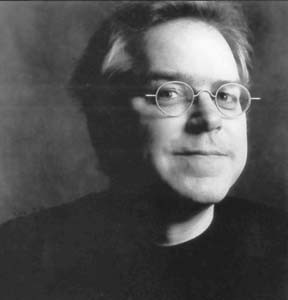
Richard Heinberg

0

Harvest of Fear

Seeds of doubt: Author Richard Heinberg thinks genetically engineered crops may yield a grim harvest.

Author Richard Heinberg takes a skeptical look at genetic engineering

By Patrick Sullivan

UNDER COVER of darkness, a small group of people enters the quiet cornfield and goes to work among the rows, using their hands and feet to pull up crops and stomp them flat. When the intruders finish their task and depart, they have ensured that the harvest isn’t going to match the expectations of the farmer–who is, as it happens, a plant biologist at the University of California at Berkeley.

The crop stompers also have fired the first shot in what may be a newly confrontational battle against genetic engineering in the United States.

For this is no ordinary cornfield. Before the crops were destroyed, the Berkeley location was the site of a university experiment in genetically altered corn, part of an attempt to learn which genes are responsible for corn’s nutritional traits so that researchers can eventually produce sweeter or more protein-rich plants.

The crop-stomping incident, which took place earlier this month, underscores the strong reactions provoked by genetic engineering, the controversial high-tech practice of manipulating DNA to, among other things, create new varieties of plants and animals. While supporters call it the best hope to end world hunger, opponents say genetic engineering poses an ominous threat to human health and the environment.

The group of crop-pulling protesters–which reportedly included activists from Sonoma County–was inspired by environmentalists in Europe, who have long employed such tactics to dramatize their opposition to what they call “Frankenfoods.” According to some observers, the Berkeley crop pull and two other recent actions targeting genetically modified commercial cornfields in the Central Valley may be the first time these tactics have been employed in the United States.

And it won’t be the last, according to Richard Heinberg. The 48-year-old Santa Rosa author, whose latest book, Cloning the Buddha: The Moral Impact of Biotechnology, a radical critique of genetic engineering due out in late August, was not involved in the Berkeley action. But Heinberg–who will read from his book on Aug. 26 at New College of California in Santa Rosa–supports such tactics because he fears that Americans are rapidly turning their farms and supermarkets over to genetically modified foods before anyone determines what dangers those products may pose.

While Heinberg’s book paints a grim picture of the power and momentum of the biotech industry, the author says the tide may now be turning. Americans, Heinberg says, are waking up to the dangers of genetic engineering. In part, that’s owing to new scientific evidence about the unexpected side effects of the technology, including a recent Cornell University study that found that pollen from a widely planted variety of genetically modified corn kills the larvae of the monarch butterfly, an important pollinator.

Still, despite growing public awareness, Heinberg–who is a faculty member at New College of California–argues that the urgency of the situation demands such radical actions as crop pulls–and such radical critiques as the one made in his book.

“This process [of implementing biotechnology] is moving very quickly, and I’m convinced that the likelihood of serious unintended consequences is very large,” Heinberg says. “I think in a situation like that, somebody does need to yell fire in a crowded theater, because there really is a fire.”

MANY AMERICANS don’t realize how deeply biotechnology already touches their lives. The United States now grows an estimated 75 million acres of genetically modified crops. Roughly 60 percent of the processed foods sold in America contain genetically engineered ingredients. But the average consumer doesn’t know that, in part because no labeling is required for such food–a fact that looms large in Heinberg’s book, which calls for legislation mandating the clear labeling of altered ingredients.

Of course, such measures have been proposed before, but so far both government regulators and the biotech industry have strenuously resisted. That’s partly because many polls show that a large percentage of Americans would refuse to consume food they knew to be genetically engineered, so putting such a label on a product could bankrupt a company.

Some defenders of biotech also argue that there’s no good reason for labeling because genetic engineering is, in one sense, nothing new. After all, humans have been breeding plants and animals to get desirable characteristics for thousands of years.

Genetic engineering, some supporters say, is simply a high-tech version of that traditional process.

But Heinberg and many others argue that such modern techniques as cloning and gene splicing allow scientists to tinker with organisms in fundamentally new ways to produce, as Heinberg puts it in Cloning the Buddha, “genetic changes that would never occur in the wild or through the most intensive breeding.”

The results of that process can be both impressive and terrifying. On the one hand, scientists are producing crops that grow quickly and resist pests. On the other, genetic engineering sometimes produces unexpected side effects that range from the inconvenient–like food allergies–to the potentially catastrophic.

In his book, Heinberg tells the alarming story of an attempt in the early 1990s to genetically redesign Klebsiella planticola, a common soil bacteria, to break down lumber companies’ wood waste into useful fertilizer.

The new organism was apparently on the fast track to EPA approval before an alert Oregon microbiologist determined that it was both lethal to plants and extremely competitive. If it had been introduced into the general environment, the new strain of Klebsiella might have spread quickly and wreaked ecological devastation, turning forests and fields into dead sludge.

HEINBERG USES such incidents to buttress his contention that Americans must work quickly to learn everything they can about genetic engineering in order to come to grips with the urgent practical and moral issues that surround it.

“This technology is poised to reshape our lives at very basic levels: the food we eat, how we reproduce, what our children look like,” Heinberg says. “These are pretty important issues, and we really can’t just leave them to the experts, because the experts tend to be very highly trained in very narrow fields of knowledge. They really aren’t equipped to make the kind of basic ethical judgments that affect all of society.”

Cloning the Buddha goes straight to what its author sees as the root of the problem–the mechanistic scientific worldview that spawned biotech in the first place. In an era where new technology presents us with difficult choices, Heinberg believes that we need a new ethic–and even a new spirituality–to sort out right from wrong.

For an example of these sticky dilemmas, Heinberg turns away from agriculture to offer his readers the difficult issue of genetic therapy, which may soon be used to alter the DNA of human gametes or fertilized eggs to prevent some diseases.

“Well, on a micro level, yes of course, anybody would have to agree with that,” Heinberg says. “But how do you define a disease? Tay-Sachs? Sickle cell anemia? Sure, everybody would agree that those are diseases. How about shortness? Or male-pattern baldness? Are these diseases that would require genetic intervention?

“Where do you stop?”

At a time when, according to Heinberg, a basic genetic engineering laboratory can be put together for as little as $20,000, gene therapy is just one of the difficult issues likely to confront Americans in the near future.

The author hopes we’ll be ready.

“It’s entirely possible that genetic engineering could have a wide range of ethically acceptable uses once we have put it under some kind of public control and scrutiny,” Heinberg says. “What I’m saying is that we haven’t had that conversation yet. We haven’t thought through the issues.”

A three-part series on biotechnology begins at New College of California on Thursday, Aug. 26, with Heinberg’s reading. The series continues on Sept. 28, with a lecture by Dr. Ignacio Chapela, chair of the Microbial Biology Department at UC Berkeley. Finally, on Oct. 26, Britt Bailey, co-author of Against the Grain: The Dangers of Genetic Engineering of Crops, lectures. All events begin at 7:30 p.m. at 99 Sixth St., Santa Rosa. A $5 donation is requested. For details, call 568-0112.

From the August 19-26, 1999 issue of the Sonoma County Independent.

© Metro Publishing Inc.
Runaway Bride

0

Wed Menace

not romantic.

By David Templeton

Writer David Templeton takes interesting people to interesting movies in his ongoing quest for the ultimate post-film conversation. This column is not a movie review; rather, it’s a free-wheeling, tangential discussion of life, alternative ideas, and popular culture.

Suzanne Finnamore holds up three fingers–one for each year of her still newlywed-ish marriage. As she does so, her multi-diamond wedding ring sparkles in the moody light of this people-packed San Francisco pub, Liverpool Lil’s.

Strangers from other tables turn their heads to look at the ring.

“Technically,” Finnamore shouts, folding her fingers away and straining to be heard above the post-Happy Hour tumult all around us, “we won’t be married three years until September 21–but I tend to round up.”

She takes a sip of white wine.

“It’s weird. As the product of a broken home, I always feel the specter of divorce hanging over my head,” she says, managing to sound confessional and intimate while still making herself heard. “But I read somewhere that the divorce rate goes down dramatically after the first 40 years. Isn’t that helpful? Hardly anyone gets divorced after being married for 40 years.

“So the way I look at it, I’ve got three years down and only 37 more to go–then I’m safe.”

“Are you checking the years off on the wall somewhere?” I suggest.

“Oh, sure,” she laughs. “Like a prisoner in a cell.”

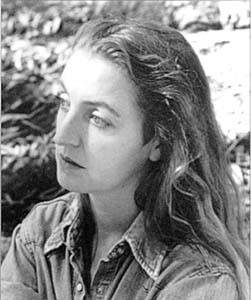
My guest is the author of Otherwise Engaged (Knopf; $22.00), a sharp-witted, very funny novel about marriage that plays like a series of clever one-liners disguised as an epic emotional journey. In the book, Eve–Finnamore’s hyper-determined heroine–walks an emotionally rocky road from the moment of her engagement to the day of her wedding.

“Michael leaves his socks on the floor when he takes off his shoes,” she writes. “This used to be fine. But now a sock on the floor isn’t just a sock on the floor. It’s a sock on the floor for the rest of my life.”

Picked from the slush pile at Knopf–Finnamore closed the deal on the day she gave birth to her son, Pablo–the novel has hit the literary funny bone of men as well as women, and seems poised to become a runaway hit.

And speaking of runaways.

We’ve just divorced ourselves from a screening of Runaway Bride, the remarkably un-cynical–dare I say “sweet?”–comedy starring Richard Gere and Julia Roberts. In the film, she’s a commitment-phobic charmer with a history of leaving men at the altar (literally; she’s done it three times), and he’s the newspaper columnist who’s career depends on her doing it a fourth time.

Finnamore liked it.

“Though Richard Gere was playing a straight man who owned a cat,” she says. “A straight man? With a cat? I’m sorry.

“Some things really did ring true, though,” she allows. “Remember when Richard Gere is watching those videos of Julia Roberts’ three ‘almost-marriages?’ You could see–especially in the second one–that she was visibly hyperventilating as she was walking down the aisle.

“That’s exactly how I felt when I got married. I was a wreck. I didn’t expect to be, but I was. The intensity of the moment overwhelmed me.”

“Hmmmmm. Aren’t weddings supposed to be romantic moments?” I ask. “Isn’t romance kind of integral to the “perfect wedding” that you read about in Modern Bride Magazine?” Or see in Julia Roberts movies.

“Oh no! No!” Finnamore shouts “There’s nothing romantic or intimate about a wedding. Once you have more than five or six people, it becomes a group event and you lose all hope of intimacy. To me a ‘romantic moment’ with my husband is just the two of us.

“It doesn’t include a whole lot of other people. It doesn’t include legally binding contracts, or caterers, or people in tight dresses and funny hats.”

“I said something to my husband, just the other day,” Finnamore relates, “and it really was, I felt, a landmark moment. Our son is now almost a year old, and we’d been having what we call ‘an interesting week,’ where everything that could go wrong did go wrong.

“So I said to my husband, at the end of this long, tumultuous day, just before we went to bed, ‘Well, I guess we’re really married now.'”

A temporary decrease in the bar’s volume allows Finnamore to lower her voice.

“It’s weird. Three years of marriage,” she murmurs, “and it wasn’t until that moment, that very moment, that I finally felt like we were actually married.”

“Is this ‘married’ in a good way?” I ask, carefully.

“Oh yeah, married in a good way,” she nods, solidly. “But also married in a real way.”

“I don’t think you really get married on the day of the wedding,” she expounds. “You have an opportunity to start working toward a marriage at that point, but I don’t think the marriage actually occurs until later.”

“In my opinion, weddings are one of the few public rituals that we have left in our society. I mean, what else have we got? There are no more public hangings. Weddings are about it, right?”

“Funerals,” I mention.

“Okay. Weddings and funerals,” Finnamore says. “But people mostly just get cremated now–then there’s a little wine and cheese thing afterwards, so even funerals are going the way of the dodo. Pretty soon, weddings will be all we have left.

“Well, weddings and divorces,” she says sitting up straight. “Divorces are now more common than funerals, aren’t they? What we need is some really fun ritual to accompany our divorces. There’s no divorce cake. There’s no divorce shower. There’s no divorce rehearsal or rehearsal dinner. It’s really a shame.”

“What about a public sock-burning,” I suggest.

“That could work,” she laughs. “God knows we need something, cause as long as people keep getting engaged, people will keep on getting divorced.”

From the date-date, 1999 issue of the Sonoma County Independent.

© Metro Publishing Inc.

School Gardens

0

Rich Harvest

MICHAEL AMSLER

School-garden projects are blossoming all over

By Paula Harris

IT’S AUGUST and La Tercera Elementary School in Petaluma is closed for summer vacation, but the campus garden is bustling with activity this mellow morning. Several students and parents scurry among the tall golden sunflowers in the butterfly and hummingbird habitat area, intent on their various tasks: deadheading plants, collecting seeds, watering the herbs, and amending the soil.

“I love it here,” says Becky Dunaway, an outgoing 8-year-old with long dark hair and a quick smile, as she digs in the dirt. “We plant seeds and watch the plants grow. If they’re vegetables, we get to eat them. If they’re flowers, we get to take the seeds and plant them and watch them grow all over again.”

These families are “baby-sitting” the school garden, which organizers say has in two years gone from a committee-based concept to an award-winning community project, which is the pride of students and parents alike.

This year, La Tercera was one of 300 schools nationally to win the National Gardening Association Youth Garden Grant. The project is funded by donations from county businesses.

“Our garden is in the lush and blooming shape it’s in right now because 20 families volunteer to come in and care for it during the summer vacation,” says Denise Ward, a parent volunteer who became school garden director when the project began in 1997.

Ward says all the school’s students, grades K-6, help care for the garden and learn valuable lessons from doing so, and she laments the lack of state dollars for such projects. “The state should supply more funding and understand that in nurturing and caring for things, children are less likely to hurt themselves or the world around them,” she says. “Your mind is in a different place when you’re gardening and growing something.”

TINA POLES, school-garden teacher trainer for the Occidental Arts and Ecology Center, which helps public and private schools in Sonoma County start and sustain organic gardens, agrees. “The school garden is a kind of a growing place that tends to lend itself to being very respectful of life and our processes, and I think children sense that,” Poles says. “In a well-done program, the garden is a place to just be. Sure, you can do lessons in it, but it’s also a place to just be and do work, move barrels of dirt, and make compost piles, and there’s an end product. It’s very concrete– you do this and things happen.

“Kids really love that–they don’t have a lot of that in their lives.”

Poles has seen transformations in students as they work on the garden projects. “It seems to calm children down who need to be calmed down, and it excites children who are passive,” she says.

In addition, Poles observes, the garden is a healing place for children who may live in a small apartment or who haven’t had much experience with nature and being outside. “[The garden] is an incredibly good antidote to too much television and too many video games,” she says. “You can’t do those things in the school garden, so in some ways you’re saved from all that stuff.”

For the past two years, the OAEC has offered a five-day residential training program for local schoolteachers and parents (of kids from preschool to high school) who are interested in creating and maintaining a school garden. A recent workshop was attended by teachers from a dozen local schools planning to add a school-garden project to their curricula.

To help nurture this growing trend, the OAEC has also established a Sonoma County School Garden Resource Network. “This links people who do horticultural work in Sonoma County with schools,” explains Poles.

The network offers technical assistance, donations of materials, and other support services. Among member organizations are the Sonoma County Farm Bureau, the Sonoma County Office of Education, the Luther Burbank Home and Gardens, and Sonoma County Jail Industries.

NEXT SUMMER, the network will host a national school-garden project symposium at Sonoma State University, which will include a variety of speakers on the topic. The OAEC teacher-training program, offered twice yearly, consists of hands-on organic gardening sessions; an examination of curriculum development to see how the garden can fulfill state-mandated curricula at all grade levels (the garden is an outdoor laboratory that can provide a natural setting for integrated curricula); a course in nutrition, including a garden harvest lunch; and a course in teaching art in the garden.

Speakers from Occidental’s Harmony Elementary School, which has maintained a very successful school garden for several years, share their knowledge and ideas with the OAEC trainees. The goal is that the students should be part of the entire design process and feel total ownership of their new garden.

Intertwined throughout the program is information about fundraising for gardens and networking with the community to keep the project alive. School must often rely on grants and donations to keep the garden going. “It’s a constant struggle, but people in community have been very generous,” says Poles.

One such community member is Joan Betts, who last year handed out more than $60,000 worth of plants to local schools. As part of her Master Gardener Project at SSU, Betts operates Cinderella Nursery, a non-commercial facility near Rohnert Park. She works with companies such as Home Depot to provide schools with much-needed greenery. “We get last week’s plants,” she says with a laugh. “The reps pull everything that’s not premium off the shelves because people insist on everything in perfect bloom–so we pick ’em up.”

Betts tends to peaked plants, restores their health, and donates them to school gardens and other youth-garden projects. “Gardening is a necessary tool for learning,” says Betts. “Children need to understand the environment, and they learn through growing things. If they can respect growing things, they can better respect the land and make better environmental decisions in the future.” *

From the August 12-18, 1999 issue of the Sonoma County Independent.

© Metro Publishing Inc.
‘California Shorts’

State of Mind

By Patrick Sullivan

WHEN YOU’RE stuck smack-dab in the middle of it with some 33 million-odd other people (and some of them are very odd indeed), it’s easy to forget what a strange place modern California really is. What census report, what demographic profile, what bar graph or pie chart could ever do justice to the momentous–and, for some, catastrophic–collision of cultures, people, and ideas that has produced this place we call home?

None can, of course. As Steven Gilbar, editor of California Shorts (Heyday Books; $15.95), puts it in his introduction, our sun-kissed land is more “a state of mind than a state of the union.” In the face of California’s diverse wonders and multitudinous nightmares, social science gets hopelessly lost, and human imagination must step in with a literary road map.

To that end, Gilbar has assembled this eclectic collection of short fiction, pulling together 22 previously published stories from some two decades of literary labor by some of the state’s finest contemporary authors, including such luminaries as T. Coraghessan Boyle, Sonoma County’s own Gerald Haslam, and the recently deceased Alice Adams.

These are stories with a firmly rooted sense of place, whether it’s the sun-blasted Sacramento River delta, the cottage-cheese-bland suburbs of Los Angeles, the forested slopes of the Trinity Mountains, or the familiar streets of Santa Rosa. The characters who prowl these environments are just as diverse: they range from skateboarding street kids to Indian immigrants to cougar-hunting cowboys.

In one of the collection’s best stories, “The Pacific,” the protagonist is a lonely young woman welding airplane parts in a World War II factory while waiting for her husband to return from battle overseas. Author Mark Helprin turns a description of the factory floor into pure poetry: “Through the dark glass of the face plate the flames in the distance were like a spectacular convocation of fireflies on a hot, moonless night. With the mask up, the plane of the work table looked like the floor of the universe, the smokey place where stars were born.”

Short-story aficionados will find much here that is familiar. For instance, many readers will have already encountered “The Magic Pony,” the searing story of two young girls growing up in deeply dysfunctional Indian families in Santa Rosa. But the story, taken from Greg Sarris’ award-winning 1994 collection Grand Avenue, has all the more devastating power coming, as it does here, after Ray Parvin’s “A Dream She Had,” a fairly lighthearted fable about infidelity testing a marriage in the mountains.

The wonders don’t stop there. Michelle Cliff’s “Apache Tears” takes an eerie look at a morbid museum in an L.A. suburb. In “Clothes,” Indian-American author Chitra Divakaruni offers a tragic tale of love and ambition set mostly in a 7-Eleven.

It’s deeply appropriate that the twin tensions of race and class figure prominently in California Shorts. Suburban homeowners try to recover their dog and their dignity from a Mexican-American gardener in “The Rake People.” A young Portuguese-American woman dispossessed by the parish priest plots a stunning revenge in Katherine Vaz’s “Original Sin.”

Of course, it’s only natural that a collection this eclectic offers a few disappointments. Indeed, early on, California Shorts presents a remarkably unremarkable story about the adventures of a lonely fire-spotter from the usually far-from-commonplace T. Coraghessan Boyle (author of Riven Rock ). Far worse is Laura Kalpakian’s cliché-ridden portrait of a deranged Vietnam vet in “Veteran’s Day.”

Then there’s the train wreck: If a mediocre grad student’s dissertation on evolutionary psychology had a head-on collision with a bodice-ripping romance novel, Catherine Ryan Hyde’s “Castration Humor” would be the mangled body pinned beneath the resulting wreckage.

The editor of California Shorts doesn’t claim to have assembled the very best of California’s fiction, and it’s probably a good thing. Although there are many fine stories included, some of the featured authors have written better work than is presented here. But the collection does have a special strength: Way out on the western edge of the continent sits a potent but peculiar land, and California Shorts offers brief but penetrating glances at its diverse wonders.

From the August 12-18, 1999 issue of the Sonoma County Independent.

© Metro Publishing Inc.

Tutoring

0

The Edge

Tutoring programs for college-bound teens are catching fire

By Janet Wells

KENT PINGREY didn’t want to spend six weeks of summer vacation and every Saturday hitting the books. What teenager would? But now that the 19-year-old Rohnert Park native is on his way to an engineering degree at San Diego State University, he’s glad he spent his leisure time dissecting pigs and calculating rocket-projectile vectors.

Pingrey is one of almost 1,000 local high school students each year who participate in programs through Sonoma State University that prepare them for an increasingly competitive college-admissions gauntlet.

When Pingrey was in middle school, he was recruited by Sonoma State’s Academic Talent Search, a federally funded program that offers workshops on everything from study habits to self-esteem, the Saturday Academy, tutoring, and field trips.

At Rancho Cotate High School, Pingrey chose to participate in 3-1-3, a joint program with SSU that identifies 30 at-risk ninth graders and enrolls them in rigorous college-preparatory classes. Senior year is a combination of classes at high school and at Sonoma State, which allows most participants to then complete their college degree in three years.

“The program made it so much easier here,” Pingrey says of his first full year at SSU. “I already had a couple of classes under my belt and knew my way around. Some students when they come in, they don’t really even know how to take notes.

“The real benefit is that they make sure you’re on track, that you’re fulfilling the requirements and your grades are good,” adds Pingrey, who has transferred to San Diego State for the fall.

In addition to intensive academic tracking, SSU’s pre-college academic development program has 50 tutors logging more than 12,000 hours helping students at public high schools around the county.

Pingrey, self-assured and motivated, didn’t bother with academic tutors until his senior year, when he was taking calculus at SSU.

“Then I was in there every day,” he says.

THESE DAYS, fulfilling the high school graduation requirements isn’t enough for students who want to go to college. Even good grades and decent SAT scores don’t guarantee admission. To help their chances, students now do summer internships, play sports, and perform community services to show leadership qualities. They take honors courses to boost their grade-point averages. And to show that they can stand up to academic challenge, they participate in pre-college programs like those at SSU.

“It used to be that college was for kids with a lot of brains who could get scholarships or those who could afford it. Historically, it was the rich person’s privilege,” says Gloria Miller, director of pre-college programs at Sonoma State University. “People have recognized that pretty much without a college degree you don’t get a chance at the better-earning jobs. Now people are better off as a whole economically, so college is a possibility for many more people.

“You wouldn’t think with us being in the backwater of Sonoma County we’d be competitive,” Miller adds. “We are.”

Sonoma State, with about 6,000 students, accepts 80 percent of its applicants. More than half of those have a grade-point average of 3.0 or better, according to the National College Board website. San Francisco State University accepts 69 percent of its applicants, and Cal Poly San Luis Obispo, the most competitive state university, takes only 38 percent of those applying. Then there are the really tough schools, like the University of California at Berkeley, which accepts just 31 percent of its applicants, most of whom have 4.0 grade-point averages or better.

By comparison, Stanford University accepts 15 percent of applicants, and Harvard just 13 percent.

KARLA MARROQUIN’S parents hoped that she would go to college, but as recent immigrants from El Salvador, they didn’t speak English and had no idea how to begin to maneuver their 8-year-old daughter through the system. Sonoma State’s academic-talent-search staffers found her in seventh grade and steered her into Upward Bound, a four-year program for low-income high school students who are the first in their family to pursue a college degree.

As part of Upward Bound, Marroquin went to summer school at SSU, enrolled in the Saturday Academy, and attended tutoring sessions every Wednesday after school.

“You grew up in the program. Every Saturday we’d talk, kind of like a support group,” she says. “There was more support than in high school. The [high school guidance] counselor put me in English as a Second Language classes automatically. The Upward Bound staff went around and put me in college prep classes instead.”

Two years ago, Marroquin graduated from Casa Grande High School in Petaluma with a 3.66 GPA, heading in a very different direction from her friends.

“They were going to go to work when out of high school,” says the 19-year-old SSU sophomore, who plans on majoring in economics and going into international relations.

“Most of my friends got pregnant, got married. They have different ambitions than I do now.”

For more information on Sonoma State University’s pre-college programs, call 664-2428.

From the August 12-18, 1999 issue of the Sonoma County Independent.

© Metro Publishing Inc.

Charter Schools

0

On Course

MICHAEL AMSLER

Sonoma County charter schools are a bold experiment in education

By David Templeton

WHEN THE UNASSUMING double doors of Sonoma Charter School first swung open, back in the fall of 1993, the event was viewed by local bureaucrats and education watchdogs as the start of a worthy, if controversial, experiment. As one of California’s first charter schools–created as an alternative to a public school system that, according to charter-school advocates, has become inefficient, outdated, and unbending–everyone involved knew that this ambitious K-8 school out on Sonoma Highway would be the focus of much public scrutiny.

To an extremely focused and determined core of parents and educators, however–most of whose students would be attending the brand-new school–that first day of classes was more than just Day One of some educational “experiment.”

To them, it was nothing short of a dream come true.

“I’m constantly blown away by the things these parents have accomplished,” enthuses Roger Frost, principal of Sonoma Charter School, now officially the oldest operating charter school in the county. Aside from all the pre-legislation letter-writing and petition signing, Frost mentions fundraising efforts, school-wide painting parties, rotating volunteers for lawn-cutting and landscaping, and daily food service.

Parents even sit in when new teachers are being interviewed.

Though it may have been the passage of the 1992 California Charter Schools Act that made charter schools legally possible, it is the parents and teachers that made it happen to begin with. And it’s those same parents and teachers that continue to make things happen, as California’s charter-school program enters its sixth year. “The big majority of charter schools are founded by families that are seriously seeking a different educational option,” Frost says, “a program they can have some control over. Charter-school parents tend to be very involved.”

Indeed. Seven years after the charter-school bill passed, with nearly 200 such schools now up-and-running in the state (including 10 in Sonoma County alone, with two new ones opening doors this fall), it is clear that a high level of parent-teacher involvement is pretty much typical of the ever-growing charter-school movement.

Not that there is any such thing as a “typical charter school.”

“The whole theory behind charter schools is to generate new and innovative techniques and models of learning,” explains Colin Miller of the California Department of Education. As examples, he cites “back-to-basics” charter schools, arts-based schools that combine academic studies with emphasis on performance and fine art, and bilingual immersion schools. There are charter schools that include religious teachings, schools that take place outdoors or in museums, schools that combine classroom learning with large amounts of homeschooling, and schools that aim to help at-risk children or those with various learning blocks or substance-abuse issues (Marin County’s Sobriety High School, for instance, offers a curriculum involving 12-step meetings and routine urine tests).

“To try and lump all these schools together,” says Miller, “and to say that they are all similar, or that they are all intended to accomplish the same thing, is just impossible.”

AT A CROWDED luncheon in June, Ray Carlson–head of the board of directors for the award-winning, non-profit Kid Street Theater, in Santa Rosa–stood up before a packed room of supporters to announce that the innovative arts-therapy program had won approval for charter-school status. After several years of operating as an after-school and summertime program for at-risk children, the highly successful program has become Sonoma County’s newest charter school.

According to Carlson, it’s not a moment too soon.

“So far, most charter schools have served an upper-middle-class segment of the population,” explains Rose Haynes, Kid Street’s charter-school administrator, pointing out that the new school, which officially opens Aug. 30, will serve a distinctly less advantaged group of children: homeless kids, those in shelters, children who’ve seen severe abuse. “Most of the kids who will be coming to us literally don’t know how to learn,” she says. “The circumstances of their lives have been focused purely on survival, not learning. Our goal at Kid Street Charter School is to create a loving and caring environment so that our students can become learners.”

On the other hand, a charter school can help save existing school programs threatened by changing social and political tides. Ginger Dale is the principal of Cali Calmecac, an award-winning bilingual immersion school, grades K-8, that was a Windsor district public school until last year, when it transformed into a charter school to avoid being shut down by the anti-bilingual Unz initiative. Now that Cali Calmecac has been chartered, Dale has seen a dramatic increase in interest from parents outside the Windsor school district.

“A lot of parents evidently want their kids to be bilingual,” she says. The change, she says, has been a positive one. “Now that we’re a charter school, there’s a sense among the parents and teachers that everyone has more say in school matters–and everyone’s excited by that. We haven’t made any big changes yet, but there’s a sense of great potential, as everyone is looking at what we want from our school in the future.”

But the future of the charter system is uncertain. While parents rave about this newfound sense of participation in their children’s education, politicians concerned with such issues know that there’s more to an effective education than having happy parents. At some point, academic standards have to come into play.

“Charter schools still need to prove themselves as an effective alternative to public schools,” insists Assemblywoman Virginia Strom-Martin, D-Duncans Mills, a former elementary school teacher. “For now, the jury is still out.”

She admits that charter schools are certainly popular–to accommodate this popularity, the state Assembly has just passed legislation that will allow up to 100 new charter schools per year. But she is far from convinced that they are any better, academically, than public schools.

A recent state report, while inconclusive, found no evidence that the charter schools are academically superior to their traditional counterparts. “I basically think charter schools are fine,” continues Strom-Martin. “But I’m concerned that charter schools might be seen as some magical educational panacea. People see charters as the only alternative to problems within the public school system, but we can still do a lot of creative things within the existing structure. Teachers in public schools are not as ‘hamstrung’ as charter-school advocates believe.”

UNFORTUNATELY, the very diversity and academic range of charter schools that make them so appealing also make them difficult to evaluate, and make their performance nearly impossible to compare to that of public schools. Academically, it’s an apples-and-oranges situation. As Miller points out, “Not all charter schools are going for academic excellence. If a school is designed to serve low-performing students, then their tests will show that they are performing below standard–but does that mean the school is unsuccessful? The students might, in fact, be improving. Those types of things are hard to gauge by test results.”

Assemblywoman Kerry Mazzoni, D-Novato, agrees that some would prefer the charter-school experiment to fail. “I think some charter schools are doing a good job, and some aren’t living up to the expectations their local communities had for them,” she says. “There are people who feel that charters are threatening the existence of public schools. But I’m not one of them. And the majority of the Legislature believes that charter schools are here to stay. What we want to have happen now is for those schools to work.”

Most charter-school fans, however, believe they already are working, and that what they need is to be left alone. The last thing they want is any well-meaning legislative tinkering. “After all,” says Roger Frost, “one small step can ruin something beautiful.”

From the August 12-18, 1999 issue of the Sonoma County Independent.

© Metro Publishing Inc.

Movie Memorabilia

Prop Culture

Cosmic collection: From Titantic driftwood to Star Wars props, movie memorabilia and related historical artifacts are the private passion and public spectacle of Tony Probst, owner of Sonoma Sound Masters in Santa Rosa.

Tony Probst fills his retail shop full of movie memorabilia–and you can see them for free

By Christian M. Chensvold

HOLDING A PIECE OF wreckage from the Titanic is a rare and indescribable thrill. Your imagination is stoked to a feverish pitch by this solemn connection to one of modern history’s greatest tragedies.

But finding out that the busted chair leg is worth a couple million dollars–now that’s really exciting.

When Tony Probst tells me that some guy bought a piece of Titanic wood about the size of a wallet and began selling splinters of it, along with a photo of the ship and an authentication certificate, for $400 each–and made a fortune doing it–I quickly start calculating. There’s gotta be a couple of million dollars worth of Titanic splinters in my hands right now.

But Probst, 40, who is owner of the Santa Rosa high-end electronics store Sonoma Sound Masters, has no intention of butchering his rare artifact for financial gain. Instead, it rests comfortably beside loads of other movie memorabilia and historical artifacts in his retail store-cum-museum, where any browser can take a free tour through 20th-century American pop culture.

Probst discovered how much memorabilia can enhance a business establishment while supping at San Francisco’s Hard Rock Cafe–a rather mediocre dining experience, he notes, were it not for the entertaining items on the wall. Since he had provided electronics equipment to several movie types, including the folks at George Lucas’ Marin outpost, he put the word out through his contacts that he was looking for movie stuff. Any stuff. That was three years ago, and in this short amount of time, this shopkeeper with the right connections has been able to amass a formidable collection.

So what’s he got? How about a piece of the Death Star from Return of the Jedi? How about film cells from classic Disney films such as Dumbo? Then there’s the pistol Harrison Ford used in Blade Runner, drawings penned by Walt Disney himself, and the bench in the film Titanic that DiCaprio and Winslet sit on after he’s persuaded her not to jump (Probst has been offered $28,000 for this one).

Plus there’s the Holy Grail from Indiana Jones and the Last Crusade, and from the same film, Dr. Henry Jones’ (Sean Connery) grail diary. It’s one of those magical tomes bibliophiles dream of discovering, consecrated with the dual powers of religion and cinema, humankind’s two most seductive inventions.

Probst has put very little cash into his collection. His connections find pieces for him cheap and sometimes even free. He was offered (and recently bought) Han Solo frozen in carbonite, a gigantic prop from The Empire Strikes Back, for only $1,500. From the recently released film The Mummy, Probst can get the charred map the treasure hunters used (too expensive at $3,000, he says). Then there’s Shirley Temple’s first contract, signed when she was 5 years old (wonder if she read the fine print). In fact, some of Probst’s sources are so deep inside that his pieces are the memorabilia equivalent of contraband.

“If Lucasfilm knew I had this,” he says, pointing to one prized piece, “the person I got it from would definitely not have a job anymore.”

Proof of authenticity is of immense importance in these matters, and Probst has papers on about 80 percent of the items in his collection. The other 20 percent he takes on faith from his trusted sources. When it comes to putting items up for auction, documentation is everything. Take the million-dollar Titanic driftwood: If you stole it, could you prove it was more than mere flotsam?

Of course, since the shop used to be a bank, the security system is strong enough for Probst to sleep soundly at night, and his collection is also insured.

PROBST, who has sold very few items despite offers at a 10-fold profit margin, displays his collection in his shop for the simple pleasure of sharing it with the public. He gets a great deal of satisfaction from the wide-eyed stares his collection provokes among his customers. He even allows girls to be photographed in the blue Coeur-de-Mer necklace from Titanic.

“It is very stupid to collect something and just hold it for your own gratification,” he says. “I get more enjoyment out of other people looking at it.”

Among the most valuable items in this collection is the original script and storyboards for the 1946 Disney film Song of the South (remember Tar-Baby, Brer Rabbit, and “Zippa-dee-do-da”?). According to Probst, this could go at auction for as much as $100,000. Even pricier still is a color test signed by Carl Barks–the animator who invented such characters as Tweety and Donald Duck–which might fetch $400,000.

As a sailor, Probst is particularly interested in the Titanic story. He has made friends with the operator of the Titanic Museum in Canada, who has brought him several additions to his collection, including such curiosities as overstock fabric and tiles from the White Star Lines company that never made it onto the ship, and one of the only two remaining copies of the last photograph ever taken of the ship, direct from the original negative.

“Looking at that photograph, which was one of the first items I got, you just felt some sort of vibes coming off of it,” Probst says, his eyes widening. “It’s a dark, ominous picture, and just about everybody you look at on the deck you know is going to be dead in three days.”

That connection to history provides Probst with the biggest thrill he gets from collecting. It’s as if the barriers of space and time that separate him from remote events and people have broken down.

Of course, he also has more tangible motives. Memorabilia are a very prudent investment: barring any major economic depression, the stuff will only go up in value.

Still, despite the presence of many props from such recent mega-movies as The Sphere and The Mummy, Probst’s movie collection offers more than just high-priced trinkets from Hollywood. There are many items–such as Billy Mummy’s laser gun from Lost in Space, a photo of Cassius Clay (later Mohammed Ali) with the Beatles, and John Lennon’s tour jacket from the year he was assassinated–that have more to offer than their surface significance.

Together, they form a chronicle of 20th-century Americana, a part of who we are–it’s as if Probst had the pillow that Washington died on. A stroll through his collection is a stroll down memory lane of Main Street America, complete with dollar values.

So it seems strangely ironic when Probst says that the one piece he most covets is the title prop used in the 1960 film The Time Machine.

Some might think he already has one.

From the August 12-18, 1999 issue of the Sonoma County Independent.

© Metro Publishing Inc.

Bodega, Saturday Night

Sweet and Sour Wild bunch: The cast of Bodega, Saturday Night goes all out for laughs. Bodega, Saturday Night' offers an uneven variety show By Daedalus Howell IF VARIETY is the spice of life, then Bodega Theatre Company's variety show, Bodega, Saturday Night, an evening of original sketch comedy and music...

Talking Pictures

Private Parts Political follies: Dave Foley and Dan Hedaya get Nixonian in Dick. Comedian Debi Durst thinks some people don't know 'Dick' By David Templeton Writer David Templeton takes interesting people to interesting movies in his ongoing quest for the ultimate post-film conversation. This column is not a review; rather,...

Five Artists

Fantastic Five Head trip: Riding the crest of the Internet's hot MP3 craze, Petaluma-based Headboard may be the county's best unsigned band. Five local artists to watch By Patrick Sullivan GO AHEAD--just try it. Try to nail down the five visual artists, actors, musicians, and other local creative types...

Richard Heinberg

Harvest of Fear Seeds of doubt: Author Richard Heinberg thinks genetically engineered crops may yield a grim harvest. Author Richard Heinberg takes a skeptical look at genetic engineering By Patrick Sullivan UNDER COVER of darkness, a small group of people enters the quiet cornfield and goes to work among...

Runaway Bride

Wed Menace not romantic. By David Templeton Writer David Templeton takes interesting people to interesting movies in his ongoing quest for the ultimate post-film conversation. This column is not a movie review; rather, it's a free-wheeling, tangential discussion of life, alternative ideas, and popular culture. Suzanne Finnamore holds up three...

School Gardens

Rich Harvest MICHAEL AMSLER School-garden projects are blossoming all over By Paula Harris IT'S AUGUST and La Tercera Elementary School in Petaluma is closed for summer vacation, but the campus garden is bustling with activity this mellow morning. Several students and parents scurry among the tall golden sunflowers in...

‘California Shorts’

State of Mind By Patrick Sullivan WHEN YOU'RE stuck smack-dab in the middle of it with some 33 million-odd other people (and some of them are very odd indeed), it's easy to forget what a strange place modern California really is. What census report, what demographic profile, what bar graph or pie chart could...

Tutoring

The Edge Tutoring programs for college-bound teens are catching fire By Janet Wells KENT PINGREY didn't want to spend six weeks of summer vacation and every Saturday hitting the books. What teenager would? But now that the 19-year-old Rohnert Park native is on his way to an engineering degree at San Diego...

Charter Schools

On Course MICHAEL AMSLER Sonoma County charter schools are a bold experiment in education By David Templeton WHEN THE UNASSUMING double doors of Sonoma Charter School first swung open, back in the fall of 1993, the event was viewed by local bureaucrats and education watchdogs as the start of...

Movie Memorabilia

Prop Culture Cosmic collection: From Titantic driftwood to Star Wars props, movie memorabilia and related historical artifacts are the private passion and public spectacle of Tony Probst, owner of Sonoma Sound Masters in Santa Rosa. Tony Probst fills his retail shop full of movie memorabilia--and you can see them for free...
11,084FansLike
4,446FollowersFollow
6,928FollowersFollow