Ravenous Cafe

0

Culinary joy: Chef Joyanne Pezzolo, along with husband, John, has created one of the North Bay’s most popular eateries.

Somethin’ to Crow About

Seasoned Ravenous continues to satisfy

By Paula Harris

ANTICIPATION is part of the pleasure of dining at tiny Ravenous Cafe in Healdsburg. Since there are only eight tables and the affable staff never pressures one to hurry, a short wait (even if you drift in with dinner reservations) isn’t unusual. But half the fun is in sitting outside on the rustic rough-hewn bench out front on a mellow autumn night and savoring the cooking smells wafting out to the street while you peruse the beautifully handwritten menu.

By day, Ravenous is a welcome retreat from the increasing bustle of the plaza. You can meet good friends for a lazy lunch, to chew the fat and feast on tasty smoked trout and warm potato salad, or a bowl of soup–like the Moroccan red-lentil broth–and maybe share a glass of sauvignon blanc.

By night, the cozy restaurant is a warm, shadowy hideaway. Oversize tortoiseshell-framed mirrors, faux tiger-skin banquettes, deep ochre walls, topaz-hued beaded candleholders, and Natalie Merchant’s lilting voice flowing from the sound system give the intimate feel of dining in a gourmet chef’s dusky bedroom.

While culinary new kids in town–organic-inspired Acre Cafe and Lounge and the flashy bistro Zin–may have grabbed all the attention of late, it bears mentioning that Ravenous (which is attached to the venerable Raven Theater) steadily has been turning out creative, high-quality fare for the past eight years. It’s a tribute to chef-owners John and Joyanne Pezzolo, who add thought and love to their food, and have never let their standards drop.

A recent dinner proved it.

The evening’s cream of tomato soup ($3.50) had an unusual but pleasing texture: a warm silky base bolstered with semi-crunchy vegetables and chunks of whole fresh tomato. It was topped with a dollop of sour cream and fresh basil leaves. Each tomato-y spoonful perked up our appetites.

We gasped at the sight of the smoked salmon appetizer ($8.50), equally impressed by the colorful ingredients in shades of green, orange, black, and yellow, and the super-generous portion. Having been charged $7 for an appetizer consisting of three miserable midsized shrimp (and little else) at a new restaurant in Sonoma recently, this was a glutton’s dream.

Luscious slices of the smoky rose-gold fish rested atop warm and fluffy corn cakes, which resembled old-fashioned popovers. Scoops of gleaming (though a bit bland-tasting) gold and black caviar, topped with crème fraîche. The dish was garnished with a wreath of large pungent salty caperberries (extra-large capers on stems), some peppery mesclun greens, and a thick wedge of fresh lemon for spritzing. Terrific!

Our vegetarian dining companion gave thumbs up to the roasted chili pepper entrée ($12.50). “It captures your interest,” he enthused, caressing the bountiful plateful with his fork. The dish, a roasted poblano-type chili pepper stuffed with potatoes, hominy, greens, and jack cheese with grilled corn salsa, black beans, yellow rice, and lightly fried house-made corn tortillas on the side, certainly was a rainbow of tastes and a visual delight.

The pork tenderloin scaloppini ($15)–delicate slices of melt-in-the-mouth pork in a wine, cremini mushroom, and sage sauce–was another winner. It was accompanied by airy, baked cheese-scented polenta as light as a feather-down comforter, and exceptionally moist roasted white turnips. Cauliflower, green beans, squash, and roasted Bermuda onion with a slight caramel flavor completed the dish.

The Asian pear and huckleberry cobbler with vanilla ice cream ($6) was light and sconelike with chunky pears, teeny purple huckleberries, and smooth ice cream. It had a delectable natural fruit flavor without extra added sugar.

And the chocolate crème pie with chocolate sauce ($5.75) featured a pale gold pastry shell with a milk chocolate pudding interior, set on a pool of dark chocolate, drizzled with more dark chocolate, and topped with a cloud of whipped cream.

Toe-curlin’ good.

The servers were friendly and efficient. Our one gripe was that they (at least the two we questioned) lacked the wine knowledge to make pairing suggestions. However, our server did let us taste some of the wines offered by the glass before we made our selections.

The Peterson 1997 pinot noir ($7.50 per glass) had a strawberry, balsamic, black pepper flavor that was a good match with the pork dish. And the Ledson 1997 chardonnay ($7.50 per glass) was full-bodied, buttery-rich, and heavy enough to drink with creamy seafood or pasta dishes–or all by itself.

Make those reservations and take your appetite along. We anticipate you won’t be disappointed.

Ravenous 117 North St., Healdsburg; 431-1770 Hours: Wednesday-Sunday, lunch, 11:30 a.m. to 2:30 p.m.; dinner, 5 to 9:30 p.m. Food: Eclectic American bistro-style; lovely desserts Service: Friendly, low-key Ambiance: Intimate Price: Moderate (no credit cards accepted) Wine list: Good selection, including several interesting wines offered by the glass Overall: 3 1/2 stars (out of 4)

From the October 21-27, 1999 issue of the Sonoma County Independent.

© Metro Publishing Inc.

Savage Jazz Dance Company

0

Pure Energy

The Savage Jazz Dance Company thrives on spontaneity and live music

By Marina Wolf

IT’S A SUNNY, sleepy Sunday afternoon in Berkeley, a time when most College Avenue denizens are still recovering from brunch. But upstairs at the Shawl-Anderson Dance Studio, the dancers of the Savage Jazz Dance Company are just launching a rehearsal that feels like a sweaty Saturday night.

The dancers swing, strut, pose in catty clusters, and explode in exuberant pas de deux and cross-the-floor chases, while along one wall, the musicians–who perform onstage with the dancers at their shows–let loose on some Ellington jam.

Meanwhile, choreographer Reginald Ray-Savage is sitting down for the first run-through of the day, but that doesn’t mean he’s sitting still. His hands clap, his legs bounce as he tracks the shifting groups of dancers from his seat at the edge of the dance floor. He’ll be getting up in a few minutes to demonstrate a jeté or to push someone’s hip into place, but for now he’s seated. From time to time he shouts, not commands but call-outs, the kind that erupt in a concert when the groove is on.

“Higher!” he hollers, jerking his chin toward the ceiling. “Move! Yeah! Now! Go!”

The dancers–who perform Oct. 23 and 24 at Spreckels–don’t need much more direction than that. After years of training with Savage, the company of young dancers moves with confidence, almost bravado, to the bold, sultry music of 40 or 50 years ago. It is this exposure to classical jazz that makes them a rarity in the jazz dance world, says the 41-year-old Savage.

“Every other jazz class, they get Ricky Martin, Backstreet Boys, whoever’s hot. They only use pop music,” he says, rolling his eyes. “Then people come in here and they hear Mingus and they go, ‘What? This ain’t jazz. The tempo’s too fast.’ And I say, ‘Naw, this is jazz music, baby. Watchoo been listening to?’ ”

Obviously they haven’t been listening to Savage’s musical collaborator, Marcus Shelby, a 31-year-old bass player and jazz composer whose original works and smooth classical covers of the jazz greats–Ellington, Monk, Parker, Mingus–snagged him and his orchestra the Best Local Jazz Group award from the readers of the San Francisco Bay Guardian.

During the rehearsal Shelby is impassive as he plucks his strings and watches the dancers respond, but get him in the chair and start him talking about the relationship that develops among the performers, and his face relaxes into a small but satisfied smile.

“It’s really jazz, all the same spontaneity, the improv, the energy,” says Shelby. “And it changes every time we play. Maybe my clarinet player woke up on the wrong side of the bed this morning, so he’s going to play a little angry, which is going to cause the dancers to dance a certain way, which is going to cause my piano player to look at them strange. Every night there’s a different dynamic. Every day is fresh.”

“The band keeps you so much more on your toes,” agrees dancer Susannah Blumenstock.

“We’re learning how to dance in musicians’ terms,” she says. “Musicians count differently, they signal changes differently. And when they’re onstage and really going, suddenly we go from 12 performers to 23.”

DANCING to live onstage music is just one of the ways Savage has parted from his more “classical” dance background. In his hometown of St. Louis, Savage started in modern dance at the Katherine Dunham Dance Company. During his performing career he danced in several civic and regional ballet companies, including the Ruth Page Ballet Chicago and the St. Louis Black Repertory Dance Company (a now-defunct arm of the St. Louis Black Repertory Company).

Savage still retains a healthy respect for the traditions he has stepped away from, and doesn’t hesitate to use the technique in training his dancers. He quotes George Balanchine frequently and displays some of the ballet master’s terse discipline to instill a sense of structure for his dancers. He even acknowledges the glitzed-out Broadway jazz as an important influence in his life, if only for offering its choreographers as role models.

“I love Bob Fosse. Please!” he exclaims. “When I saw All That Jazz, I knew it was all right to be straight, smoke, and dance. So please, Lordy, wherever Mr. Fosse is . . .” Here he presses his palms together and bows in respect. “But where’s the dance to Ellington or Mingus? Until you do that, you’re not really talking about jazz choreography.”

In a world that tends to give more credence to the musical traditions of another continent, Savage is almost, well, savage in his promotion of jazz music. To insist that there is something inherently better about classical music is possibly racist, says Savage, and definitely ridiculous.

“There are only 88 keys on that piano,” says Savage, jabbing his finger vigorously at the scratched-up upright pushed into an alcove. “Everybody who’s ever played the piano has played on 88 keys. . . . Duke Ellington and Peter Tchaikovsky played the same piano. It’s not a question of being better, it’s two people being totally different.”

On the side, Shelby is basking in the glow of Savage’s passionate defense. The two understand each other and appreciate what the other does for the art form, and so by extension the performers do, too.

“The band loves to play for this group,” Shelby says, flashing a grin at Savage. “I didn’t tell you this, but they’re always asking when we’re going to be playing with the Savage dancers again.” He turns his attention back to the guest. “It’s like playing a gig at a club or festival. It’s the same energy. We don’t have to tone things down so they can dance. . . .”

“It’s not background at all!” Savage interrupts to agree. “I need them to play, play, play!”

The Savage Jazz Dance Company performs Oct. 23 and 24; Saturday at 8 p.m. and Sunday at 2:30 p.m. Spreckels Performing Arts Center, 409 Snyder Lane, Rohnert Park. $18. 588-3400.

From the October 21-27, 1999 issue of the Sonoma County Independent.

© Metro Publishing Inc.

Jive 5 Winners

0

The five winners of the Jive 5 writing contest

The future has arrived. Our chrome-plated, double-barreled Brave New World is upon us, parked at the curb with its 12-cylinder engine rumbling like a rocket, so put down your pens and hold on to your double mochas, folks, ’cause it’s going to be a bumpy ride.

But wait: we’re getting ahead of ourselves. Two months ago, the Sonoma County Independent kicked off Jive Five–the latest installment of our annual coffeehouse writing contest–by asking local writers to give us a sneak peek at the 21st century. As we teeter on the brink of the new millennium, we wanted an idea of what to expect from our Brave New World. Give us the raw truth or the most half-baked lies, we urged, as long as you do it in 500 words or less.

And so they did, in all shades and hues, from rosy predictions of world peace to pitch-black tales of totalitarian horror to all the wonderful gradations of gray in between. Funny, shocking, sad, or profoundly hopeful–we got it all. Our sincere appreciation to everyone who entered; please accept our thanks for your imaginative efforts. Contest judges were editor Greg Cahill; arts editor Patrick Sullivan; Susan Bono, editor of the Tiny Lights journal of personal essays; SRJC writing instructor Guy Biederman; and J. J. Wilson, SSU English professor and co-founder of the Sitting Room in Cotati.

Below, you’ll find the five winning entries. But that’s not the end of the jive. On Wednesday, Oct. 27, at 6:30 p.m., you’ll get a chance to see the winning writers (and the judges) in person as they read their stories and receive their prizes. Free food and coffee round out the futuristic fun at A’Roma Roasters and Coffeehouse, 95 Fifth St., Railroad Square, Santa Rosa. All are invited. Admission is free. (For details, call 527-1200.) –Patrick Sullivan

First Place

Erotic Act By Leslie Cole

IN THE NEW millennium the writing of a complete sentence will be an erotic act. The sound of a pen scratching out a thought on rough paper will be a major turn-on. Photographs of hands holding writing instruments will be considered not just beautiful but the ultimate seduction, and the advertising industry will use such images to cause longing. A billboard showing a rough boxy hand with callused fingertips gripping a stubby-end pencil will rivet and arouse consumers. The motion of a pen as it moves across paper will be the new tango, and the curve and fall of a graceful script will be compared to water falling over stones, to the heat between her thighs, to a bright leaf slowly falling. It will be a map, a choreography of what is wished for.

Gifts of soy ink, liquid chocolate, a box of Bics, coal, yellow pollen carefully gathered, Crayolas coupled with rice paper, the peeled bark of a shivering aspen, a smooth box of fine white sand, brown paper sacks, the backs of menus, a spiral notebook will be a major proposal, an offering.

People will have their bare skin ruled and lined like a legal tablet. Hallmark stores and Office Depot will start stocking condoms, red wine, vibrators, silk gloves. Stone tablets and chisels will again be in vogue. The brave will turn to pissing out messages in white snow, to smearing out endearments on the backs of dusty cars.

But the complete sentence, a complete thought will be what matters. Fragments and run-ons will be reason for scorn and a cause for male and female impotency. Strunk and White’s Elements of Style will be a bestseller. Lovers will receive copies of it as gifts, will leave them lying around casually on coffee tables. English teachers will be revered as gods and goddesses. They will ride in sedan chairs lined with silk pillows. Their students will fall to their knees in reverence, and basic-skills classes will become jammed with ardent learners. The Eros of some instructors will be so overwhelming that they will need to lecture from behind a satin screen. Would-be writers will frame comments from their mentors in gilt-edged frames. Teachers’ wastebaskets will become sacred, and the sound of tearing paper will be painful. A note crumpled in the face of a lover, devastation.

In the new millennium a complete sentence seduces. A complete thought. A subject and a verb naked. I want you. You take me. We take us. We are taken. We have been taken. Take me now. Take me.

Second Place

The Dream of Undoing By Jennie Orvino

ON A WHITE balcony with louvered doors, overlooking town square in Novi Sad, 11:59 p.m. on the eve of the year 2000. A midnight sun outlines hills pitted black with steaming craters, pooled oil, and unexploded yellow bomblets with white fins, like toys.

A clock chimes and the landscape of rubble begins to rise; like time-lapse photography in reverse, crushed beams and blocks of stone form hospitals and churches once again, blasted buses get their wheels back, puffy as cartoons, rolling over roads empty of

armored personnel carriers. An undulating wave, from gray to Technicolor, moves across the line of sight, charred meadows turn verdant, fouled waters run clear, legs and arms blown off by shrapnel gather themselves to be once more Sanja Milenlovic, who carries her basket of turnips home from market.

Third Place

Twentyfirst-Something By Mrs. Klein

AS THE WORLD, bulging under its equatorial belt from the fried fat of the land, turns into the new Middle Ages, earthlings will be going bald at an exponential rate, their reflective pates creating a planetary aura glow that will deflect global warming into outer space where it will melt the Milky Way into a chocolate mess, but not on our hands!

The population bomb will be defused as scientists discover that wearing black causes sterility. Geneticists will clone the Dalai Lama with Saddam Hussein, birthing a yin/yang international leader who gives with one hand and takes away with the other, allowing a wholly/unholy alliance between the Mother of All Joy & the Father of All Pain.

The media will grow more snakes on itheir Medusa mainframe, slithering deeper into the orifices of all mankind and Roto-Rooting out the last stinking socialist tendencies, thereby saving humanity from itself.

Praise Allah Channels! Praise the Invisible Ones! Praise the Half-Time Baltimore Oracles! Praise Aldous Huxley Jr. III, CEO of BNW Inc., largest global temp personnel agency and singles matchmaking network, bringing together Need & Desire and satisfying millions of fantasies.

The high level of toxins in our fingertips will activate the holograms in U.S. paper money, and the money molecules will come alive and establish themselves as a separate and superior nation. “The Bills,” as they will call their sovereignty, will sequester themselves in gated palaces, ordering in pizza, pot stickers, exotic yen, snowmobiles, stiletto-heeled shoes, disposable diapers, SUVs, smart bombs, Neil Diamond collections, and angel pins, thereby creating a greater demand for these products, helping to fuel the economy and filling up the purse in the Pursuit of Happiness, as consumers establish consumption quota clubs, with an annual competition for the King and Queen of Consumption.

Peace on earth will prevail, as Gen Xers rally around the non sequiturs, while Gen Motors and Gen Foods merge to manufacture edible autos that move and feed the masses.

All non-human creatures will form a Union to raise their standards of living, and after a long and difficult strike that interrupts nature’s usual weather patterns, the air, land, and sea critters will have access to better housing, cleaner air, land, and seas, and the right to interspecies marriage, with benefits.

Thanks to the use of EMFs as Energy Cleansers, all co-dependents and their therapists will attain high degrees of awareness, spontaneously combusting into erotic particles of light, showering a widespread feeling of contentment and satisfaction over most of the Eastern Hemisphere, and ushering in an era of decline for whiners and control freaks.

The 13-moon calendar will replace the 12-month calendar and workers will enjoy the extra paycheck.

A Native American woman will be elected president of the United States, and all lands will be returned to their original owners. Real estate salespeople will live in their Mercedes and enjoy the experience of a simple lifestyle.

In short, the 21st century will come to be known as the Great Equalizer.

Honorable Mention

Beneath a Tree, Close to the Shore By Matthew Kramer

THE SLEEPING BAGS that have been your traveling companions for thousands of miles have just woken up crying. They dozed during the drive, were fine for the flight, tranquil on the train, and seemed happy to get in some hiking. Now the pair of them are voicing their differences–they will not zip together.

You’d never considered checking for that. Passports: months in advance. Hostel memberships: ditto. You exchanged currency at the bank, memorized a few foreign phrases, flipped through travel books, Let’s Go, Happy Planet. Hell, you even suffered through a Rick Steves video borrowed from the library. You were well prepared. There’s even a de-cored, squashed roll of toilet paper in a Ziploc in your backpack.

But taking a test-run on zippers? You remember pulling them brand-new from their stuff-sacks, saying, “Hocus Pocus! Alakazam!” as the mummy bags kept magically unfolding from their cocoons. There’s nothing to do but laugh.

It’s funny. After all the delight, delays, and discomfort, it does seem pretty damn funny. It’s as if you’ve covered a third of the world with your zippers down. Both of you. Yanks! Assuming everyone’s going to speak your language, that all sets of teeth will mesh seamlessly for a smooth communion. Well, it ain’t gonna happen.

The two-person tent is perfectly pitched–that, you practiced–beneath some sort of evergreen off the shore of a lake. Darkness is settling in, making itself at home, oblivious to your dilemma. The temperature is falling with each star that flickers on.

You’re weary, on the border of crankiness, but next to you, on a separate sleeping bag, sits the most important person in your life. There’s nothing between you but sweat-dampened clothing.

“Forget dinner.”

“I could go for something sweet.”

Your eyes have adjusted to the blue glow of the tent.

“Let’s just put one on top and one on bottom.”

“Yeah? Which one?”

Lips on your neck, softly. And fingertips. Buttons. Other zippers–these two functioning fine. Others have checked into hotels, packed into parties. What will they take home with them from this night? Here, within this glowing dome, it’s personal, and sober. It’s one-on-one. It’s one.

When you awaken to early-morning raindrops, you feel a familiar hand on your shoulder, see a sleep-puffy face not far from yours. Pulling your hand from the warmth, you reach into the cold new century, some say the new millennium, and smooth a strayed stand of hair back behind that freckled ear. While your favorite human being cuddles closer in sleep, these thoughts blossom abruptly in your mind, springing up from the drizzle that’s lulling you back to sleep: “This is it–we’ve arrived–the future.”

Honorable Mention

Prophet Tear-ing By Rick Escalante

IN THE FUTURE nobody will be famous. Andy Warhol is dead; besides, his art sucks. Campbell’s soup will be around. It will look the same, it will taste the same, it will be the same. It will suck. But it comes in a can. A tin can. Tin cans will become the most sought-after artifacts because they once contained the essence of what can no longer be contained. Except for Campbell’s soup cans. They will still suck. Sex as we know it will vanish; in fact, sex as I know it has vanished. Vanishing cream will vanish only to be replaced by varnish because it originally was varnish but then the “r” vanished and so the varnish was vanquished, but that’s going too far. In the future “r”s will disappea making the futue look vey bleak. In fact, it will look so bleak everyone will need glasses. Everyone will be driven insane looking at rows and rows of rose-colored glasses. Everybody will look the same because everyone will wear rose-colored glasses. Insanity will become the leading cause of death. Dog attacks will become the second leading cause of death because the Seeing Eye dogs will be made to wear rose-colored glasses. Dog food that comes in cans will be under suspicion of manslaughter, and a successful class-action lawsuit against the dog-food manufacturers will cause mass famine and kidney failure among the world’s population.

Fetching will replace girl watching as the world slowly goes to the dogs. A fetching woman will no longer be sought after. To call a woman a “dog” will no longer be politically incorrect. It will mean she will be fetching. Political correctness will no longer be political or correct. Neither will spelling bees.

Words will fragment, becoming “black holes” that under the weight of their own meaning will suck until they suck themselves into oblivion, leaving traces of their essence in tin cans. In the future, the past will be forgotten; history buffs will wander the streets, prompting confused cries of “. . . the Alamo . . . the Alamo.”

Sex will become bilingual, making it possible for the layman to cry out “OH GOD” in languages foreign to most tongues, in which case he can use his mother tongue, but that’s really disgusting. Pushing the envelope of bad taste will be replaced by a shocking, vile form of public expression–all those who witness INTEGRITY won’t know what hit them–and that will be half the problem.

In the future, the ghost of Martin Luther King will invade the psyche of the masses, prompting nocturnal cries of “I have a (wet) dream.” Bozo the Clown will run for president and win, but leaving office, his shoes will be hard to fill. And finally, life will be found on planet Earth, but not life as we know it. It will suck.

From the October 21-27, 1999 issue of the Sonoma County Independent.

© Metro Publishing Inc.
Latino Health Forum

0

Forum illuminates Latina-health issues

By Yosha Bourgea

EDIA URTEAGA had an advantage when she found out she had diabetes. As a patient-relations coordinator at Kaiser Permanente Medical Center in Santa Rosa, she already knew factual information about the disease and understood some of its sources. Still, when test results from a regular checkup showed that her blood sugar levels were dangerously high, she refused at first to believe it.

“I became really scared,” Urteaga says. “I just stopped eating. I was rejecting this, saying, ‘Why me?’ I knew about diabetes, but when it’s your own body it’s a different story.”

Because Latinos like her suffer a greater incidence of diabetes than other ethnic groups, Urteaga will be taking part in a panel discussion on nutrition and diabetes strategies next Thursday as part of the seventh annual Latino Health Forum conference. She will talk about nutrition, medication, and exercise, but also about how important it is that health-care providers acknowledge the emotional impact of being diagnosed with a disease like diabetes.

“It’s different for Latinos because of language barriers and cultural barriers,” Urteaga says. “It all depends on what stage of acculturation a person is at. At some stages, you’re basically isolated.”

In years past, the conference–which is organized by the Sonoma County Academic Foundation for Excellence in Medicine and held at the Sonoma County Office of Education in Santa Rosa–has tackled topics such as the health of Latino farmworkers and the problem of youth violence. This year, the focus is on women’s-health issues.

Conference coordinator Natalie Peck expects between 150 and 200 people–students, health-care workers, politicians, clergy members, social advocates, and others–to attend the daylong gathering. Workshops will touch on issues such as domestic violence, cultural attitudes toward women’s sexuality, and the problem of finding access to health care.

Bill Hughes, executive director of the Southwest Community Health Center, says that a majority of the patients at his facility are Latino–and most of them are at or below the poverty level. A study released by the Sonoma County Health Partnership this year shows that 35.8 percent of Latinos in the county are uninsured–far more than the general population. Hughes says that the few patients who have insurance through their employers generally don’t have enough.

“One of the things that people tend not to realize is that poor people are sicker than affluent people,” Hughes says. “It’s a combination of living conditions, diet, and frequently education. The people who are routinely the sickest are the people who don’t have insurance.”

While documented immigrants are eligible for Medi-Cal, many of them do not apply for it out of fear and uncertainty about its effect on immigration status. And undocumented immigrants, who have learned to be wary of the INS, often don’t seek out health care at all–even when it is desperately needed.

Although there are Latinos in every economic bracket, it is no stereotype to say that they are disproportionately represented among the poor. At the county, state, and national levels, Latinos have the lowest per capita income of any ethnic group.

“These are the folks who are picking our crops, minding our children, cooking, cleaning,” says Helen Rodriguez-Trias, co-director of the Pacific Institute for Women’s Health and one of the keynote speakers at the conference. “They are very poorly paid, and we now have a false economy. Ultimately, the only way a society can thrive is by caring about all its members.”

The other keynote speaker is America Bracho, executive director of Latino Health Access, who will address the challenges that Latinas face in reconciling their cultural traditions with the culture of the United States. “Sometimes [in traditional culture] you are taught that you don’t own your body,” Bracho says, “and then [in the United States] when you are 40, you’re asked to touch your breast to look for cancer, but we’re trained not to do that. We are not taught as a society to participate.

“We have to start by finding a way of feeling comfortable with our own bodies.”

Although traditional gender roles are changing, it is still difficult for many Latinas to gain equal footing with the men in their lives. Yolanda (not her real name), who will be speaking at a conference workshop on domestic violence, says that she endured physical abuse at the hands of her husband for 10 years before she was able to turn him in to the police.

“I accepted it, I thought it was part of being a wife,” she says. “I finally realized it didn’t have to be that way.”

IN SPEAKING to groups of Latino men, Yolanda has found that, like her, many of them came from violent homes and grew up thinking that physical abuse was acceptable. The cycle of violence isn’t easy to break, she says, but talking about it is a beginning.

Of course, domestic violence affects women of every background, but for Latinas who may not be fluent in English or aware of available resources, it can be especially difficult to ask for help. Yolanda, who has been a Sonoma County resident for 20 years, was aided in her legal struggle by activist Marie De Santis of the Women’s Justice Center, which offers bilingual assistance to women in need. “If it hadn’t been for her, I wouldn’t have made it through the court stuff,” Yolanda says. “Her presence in the courtroom was amazing.” De Santis will also speak at the conference workshop.

Empowering Latina girls and women is a community process, and the Latino Health Forum offers an opportunity for the community to come together in that spirit. “We need to teach our girls who they are as Latinas, not just at the physical level, [but also] at the political level,” Bracho says. “If you don’t know your power, you can’t make change.”

From the October 21-27, 1999 issue of the Sonoma County Independent.

© Metro Publishing Inc.
‘Body Shots’

Body Shots.

Disco Daze

Tragic singles mingle in L.A. nightspots in “Body Shots”

By

ISN’T IT TRAGIC being a glamorous single? Spending your nights at the most exclusive nightclubs, burning hundreds of dollars on fancy cocktails, having wordless trysts in the parking lot–and all this effort just to alleviate the loneliness that threatens to crush the soul like a sensitive little bug?

At last, there’s a movie to console you during those sad moments between the morning hangover and the hour when you must put on your war paint and carefully selected wardrobe and wade out into the sea of flesh again. And this film is called Body Shots.

It starts off with a brave little poem, which states (I was weeping too hard to get the exact wording), “You can have a ride on my jelly roll, but you can’t have a piece of my soul.” (So true! And yet, so cruel!) Sara (Tara Reid) opens the story with a vignette that could be titled “Courtney Love’s Night Out.” She’s swerving home in her car, clad in a slip, crying and drunk as a skunk. Crosscut to a pair of acquaintances (Amanda Peet, Sean Patrick Flanery), who wake up hung-over, fully dressed, and not really introduced to each other. Sara busts in on the scene, raving about being date-raped.

Flashback to how the mess all began: men showering at their gym, trash talking about all the pussy they’ll be rounding up that night. Flashback to women, putting on their makeup and talking about whether they mind giving head or not. Thence to the overproduced scene at the disco, a bacchanal of blue lights and throbbing music, during which I went crazy trying to figure out which of these actors was which. Apparently the evil Christopher Reeve guy is Michael (Jerry O’Connell), an Oakland Raider on the prowl; the Brad Pitt knockoff is Shawn (Brad Rowe), Michael’s buddy; and Ron Livingston is Trent, the hopeless horndog who crashes the scene and ends up getting lashed by a dominatrix.

But all the characters are subordinated to Reid. Sara’s near Rashomon experience with Michael takes over the movie. Her night of bad sex is an example to all of us clublanders, as is the film’s big knee-trembler scene in a parking lot up against a cyclone fence. Compulsive. Animalistic. Chilling. Brrr, just imagine the feel of that cold metal against your naked butt. All through the act, the couple talks in voice-over about how neutral and empty all of this tragic loveless sex is! Can’t you sympathize? I was crying like a baby! I was crying a river! I was crying 96 teardrops! I remember that director Michael Cristofer’s previous film, Gia, also had a lesbian scene through a chain-link fence. Does Cristofer harbor the only known case of a cyclone-fence fetish?

But, I mean, this isn’t about sex, it’s about love! As we learn from the scene of one of these kids–damn, which one was it?–giving the camera a 1,000-yard stare and repeating, “Sex without love is violence! Sex without love is violence!” So true, so sadly, terribly true. Harold Robbins tried telling us, Jackie Collins tried telling us. When will we learn? When will the world realize that beautiful dim-bulbs need love, too! Oh well, off to Club Vapid. See ya!

From the October 21-27, 1999 issue of the Sonoma County Independent.

© Metro Publishing Inc.
Walter Kirn

‘Thumbsucker’ mostly covers old ground

By Patrick Sullivan

“HERE WE GO again,” mutters the constant reader with a quiet sigh as he or she wades into the first chapter of Thumbsucker. “Here’s another author with another painful story about the agony of adolescence who thinks it’s his job to tell us about it and our duty to listen.”

Surely any reader, constant or intermittent, can be forgiven for approaching Walter Kirn’s latest novel with a jaded eye and a cynical heart. In Thumbsucker (Doubleday; $14), Kirn introduces us to Justin Cobb, a terminally anxious teenaged oral compulsive who moves from sucking his thumb to finding far worse things to stick in his mouth. Caught without shelter in the fierce storm of adolescence, our beleaguered narrator weathers sexual angst, family dysfunction, and drug experiments gone awry.

If any of this sounds familiar, it’s probably because there may be no period of life more closely examined in contemporary fiction than the troublesome years between Little League and our first trip to the bar or the ballot box. The coming-of-age novel has been transformed from a classic form to an industry standard, with all that implies–quick turn-around, shoddy workmanship, and relentlessly familiar contents.

To make such a work stand out, an author has to take his book off the assembly line and imprint it deeply with his own personality. To his credit, Kirn has done just that: the novel’s greatest strength is the author’s idiosyncratic sense of humor, sly yet somehow innocent, light as a kiss from a dying man and just as morbid.

In Thumbsucker, as in real life, part of growing up is making the disturbing but entertaining discovery that everyone around you is at least mildly insane. The book’s protagonist encounters events like the “Muscular Dystrophy Fun Fair” and watches driver’s ed films like Death Drives Ninety. Everyone Justin meets has bizarre advice to offer, from the light-fingered manager of the gas station where he works (“I like your honesty. Leaves twice as much for me”) to the Mormon missionaries who come knocking on his door.

The narrator’s oral compulsive nature becomes a metaphor: Not only does everyone want to tell Justin how to live; they all want to put something in his mouth–his dad’s raw deer meat, his dentist’s Ritalin, his quasi-girlfriend’s pot. Usually, he sucks the offered object down out of need and fear.

Chief among his tormentors (and easily the most vivid character in the book) is Justin’s father, Mike, a wounded jock with a taste for blood who manifests a repellent combination of brutality and vulnerability. Heading for a mental breakdown, he comes off as driven yet helpless, abusive yet deeply interested in bonding with his son. He cuts Justin’s hair with a Swiss Army knife. He tries to cure the titular thumbsucking with hot pepper on the offending digit. Above all, he tries to infect his boy with his own pathological competitiveness.

A friend of the family suggests to Justin that someone should tell his dad the news: “It’s the nineteen eighties. The West’s been won.”

“We’ve tried,” the teenager replies. “He disagrees.”

But dad is also the funniest person in this book–albeit unintentionally: “I try not to go by averages,” he sagely advises his son. “Averages, a wise man told me once, are usually an excuse for something.” Shoplifting, he explains another time, is driving up the price of milk. They shoplift milk? his son asks. “They shoplift everything,” Mike replies. “Milk is where they recapture the lost profits.”

But while Thumbsucker has a sense of humor and some compelling characters, there are some profound weaknesses here. Not only does the novel mostly cover well-trodden ground, but many of the author’s attempts to take us into new territory feel unduly contrived.

Obviously, Kirn isn’t aiming for strict realism, but it’s hard to take his narrative too seriously when it keeps veering deep into a Twilight Zone. His narrator has close encounters with celebrity actors, discovers that his boss has burned down the gas station to collect insurance money, and watches his middle-aged dentist change from an easygoing hippie into a patriotic National Guardsman. Often, the author’s uncontrolled taste for the absurd takes the edge off his story.

Still, there’s much to like about Thumbsucker, especially its main character, poised on the brink of adulthood but far from sure that he wants to jump over the edge. And maybe Justin’s dilemma explains why coming-of-age novels keep popping up on the shelves: Who among us hasn’t wanted a second shot at that particular leap of faith?

From the October 21-27, 1999 issue of the Sonoma County Independent.

© Metro Publishing Inc.

Bruce Springsteen

0

The Boss’s Back

On the other side of Bruce Springsteen

By David Templeton

I WASN’T EXPECTING to go see Bruce this time around. Though my heart rate admittedly quickened when I first learned that Springsteen would be touring this fall–together again with the E Street Band–I’d quickly decided that my time and money had better things to do.

Now, don’t get me wrong.

I still consider Springsteen to be the best, most dynamic rock-and-roller standing–an argument I’ve gotten better at making as the years have flipped by. But the day before Springsteen’s Oakland Coliseum concerts went on sale, I figured I would sit this one out.

See, my wife and I have been reading Suze Orman books. We’re consolidating our debts, cutting back on non-essentials. How could I justify something as, um, frivolous, as a Bruce Springsteen concert?

The sweet voice of anarchy piped up in the form of my 12-year-old daughter, Amber.

The night before tickets were to go on sale–for a two-night run (later extended to three nights) at the Oakland Coliseum–I discovered a little pile of dollar bills under my pillow, savings from Amber’s allowance, with a little note: “Go see Bruce.”

“You have to go,” she pleaded. “For goodness sakes, you’ve had the guy’s butt hanging on your wall my entire life.”

It’s true. She speaks of a framed, 4-by-4-foot poster of the Born in the U.S.A. album cover–the one featuring that famous close-up of Bruce’s well-worn blue jeans.

Bruce’s butt. I’ve had that poster since 1984. Over the years we’ve come to know every inch of it, from the missing rhinestone on his belt to the white, Brazil-shaped fade-mark on the left back pocket.

I bought the poster when I was 25, as an adornment to liven the bare walls of the apartment I was suddenly occupying all by myself–after a stinging breakup with my girlfriend. Bruce’s Butt became the focal point of my home, a symbol of wounded masculinity. Or something.

Not that Bruce needed such a bachelor-pad exhibition.

With Born in the U.S.A., Springsteen was, at that moment, very, very popular, selling out amphitheaters and making millions. With his surprisingly commercial new collection of three-minute musical snapshots, Springsteen–a strong word-of-mouth favorite since before his Born to Run album put him on the charts–had struck a major American nerve.

I remember a night in late 1984, in a downtown pub populated entirely by the kind of men inclined to be hanging out in a bar at 2 a.m. When the radio started playing “Dancing in the Dark,” a weird thing happened. Men started singing. “You can’t start a fire, You can’t start a fire without a spark,” they bellowed. “This gun’s for hire, even if we’re just dancing in the dark.” A bunch of guys, pumping their arms in the air, began to chant: “This gun’s for hire. This gun’s for hire.” It was sad, and desperate, and kind of thrilling.

Lonely men do stupid things. Springsteen gave us permission to do them.

The first time I heard Springsteen I was working on a factory bottling line, packing industrial strength mayonnaise in downtown Los Angeles. The song was “Born to Run.” I didn’t like it. “Wrap your legs round these velvet rims and strap your hands cross my engines.” Give me a break. It was an old high school compatriot who turned me around, forcing me to listen to the song again, headphones tight against my head, lyric-sheet open on my lap. “Baby this town rips the bones from your back, it’s a death trap, a suicide rap, Got to get out while we’re young . . .”

From then on, Springsteen’s anthems of desperation and longing were the soundtrack of my own unsteady move from adolescence to adulthood. When I left L.A. permanently, at the age of 21, I played “Thunder Road,” loud, on the car stereo, timing it so I crossed the county line just as Springsteen sang the words, “It’s a town full of losers and I’m pulling out of here to win.”

Over the years, Springsteen calmed down, got married, divorced, and remarried. He had kids. His music evolved to reflect his tentatively advancing maturity–and we all grew right along with him.

SO WITH Amber’s sweet insistence–and her money, which I swear I’ll pay back–I got up early the next morning and went to stand in the ticket line, with about a hundred other guys, all looking a little sheepish to be there.

I was surprised to see my friend Todd–who once owned every Springsteen bootleg there was–standing a few places a head of me.

Todd shrugged. “I thought I was past this whole concert-going thing,” he said, “but . . .” I understood. This was no mere concert anymore. It had become a Robert Bly thing, a brotherhood of men uniting to honor their own path to adulthood.

“Now all we have to do is get tickets, ” Todd added, as the doors swung open.

Ten minutes later, nearly every seat was sold out.

By the time we reached the counter, all that was available were seats back of the stage. Bruce wouldn’t even be facing us.

“I don’t know about you,” I said to Todd. “I think I just need to be there.” So that was that. Todd and I will be driving in together–and we’ll take our kids, the next generation of Bruce fans. I really don’t mind at all that I’ll be forced to watch the show from behind the stage–at least we’ll be there. And after all, it’s a view of Bruce I’m very familiar with.

From the October 21-27, 1999 issue of the Sonoma County Independent.

© Metro Publishing Inc.
‘The Source’

0

New documentary explores the ongoing influence of the Beats

By Nicole McEwan

The Source, Chuck Workman’s densely constructed odyssey through the best minds of the Beat Generation, opens with a mesmerizing image. The 1942 photo depicts three young men standing arm in arm on a cold winter’s day. On the left is Jack Kerouac, widely grinning and shamelessly staring straight into the camera. In the center is Allen Ginsberg, head tilted back, eyes averted, smug and shy simultaneously.

Beside him stands an impeccably clad William S. Burroughs, already staring down his nose at the world–a self-described “WASP washout” slumming around with restless vigor. The trio seem expert at living in the moment, caught in the midst of an impromptu party and ready to take on the world. Miraculously, they did–and then they wrote about it.

Before the Beats, America’s critical eye was pointed resolutely outward–enemies existed strictly beyond its borders and anyone who wasn’t blithely marching in step with the postwar machine was likely to be labeled a Communist. More than anything, the Beats’ writing held up a mirror forcing introspection on an unwilling nation.

“There was a schizophrenia between the subculture and popular culture,” explains Ginsberg in one scene, describing the vibrant black, gay, and jazz cultures that were flourishing in the ’40s and ’50s, far beneath the nation’s radar. Through a kaleidoscope of poetry, photographs, home movies, newsreels, TV kinescopes, and interviews, Workman credits the Beats’ philosophies as the kindling that set the counterculture on fire–eventually leading up to the civil rights and anti-war movements, the ERA, and even Stonewall.

Workman has made a career out of producing the divinely edited movie-clip sequences that are sometimes the unintentional highlight of the Academy Awards show. Here he puts those well-honed editing skills to fine use, fashioning a coherent portrait of his subjects from a multitude of sources. Using the creative arcs of Kerouac, Ginsberg, and Burroughs, the three most prominent Beats, as a framework, Workman weaves in bon mots, insights, and anecdotes from an impressive array of personalities, including writers Ken Kesey, Amiri Baraka, and Norman Mailer; lesser-known Beats like Gregory Corso and Gary Snyder; City Lights founder/publisher Lawrence Ferlinghetti, Bob Dylan, and even Jerry Garcia–who describes Beats muse Neal Cassady as the first person the musician had ever met “who he, himself, was the art.”

To his credit, Workman tempers this mostly rosy tribute with scenes of bitterness (Corso decrying his lesser status than that of the more famous Kerouac) and decline (a drunken, bloated Kerouac getting the freak-show treatment on a ’60s-era TV gabfest). Along the way, a sense of wry amusement informs ironically positioned clips of the pop culture commodification of Beat yearnings, from Beat quotes on coffee mugs to a Saturday Night Live skit with Steve Martin donning the requisite beret, black turtleneck, and stoned demeanor.

Less successful are the dramatized interludes featuring actors Johnny Depp, John Turturro, and Dennis Hopper as the Beat triumvirate reading portions of On the Road, Howl, and Naked Lunch. Workman’s previous (and equally accomplished) documentary Superstar celebrated the life and work of Andy Warhol–a painter who so well understood the potent allure of celebrity that he exploited it in his art. Here, Workman takes a page from Warhol’s book, using the three inarguably gifted actors as audience bait. Sadly, the trio often appears to be reading the words from a teleprompter–which seems oddly sacrilegious in this setting. Still the words work a certain magic–and Hopper, with his ferretlike countenance, is especially convincing as Burroughs.

A largely successful marriage of context and content, The Source‘s celebratory, elegiac tone captures the imagination like a great book–one that warrants a first and possibly a second perusal.

‘The Source’ screens Wednesday and Thursday, Oct. 20 and 21, at 7 and 9 p.m. at Washington Square Cinema, 219 S. McDowell Blvd., Petaluma. For details, call 762-0006.

From the October 14-20, 1999 issue of Metro, Silicon Valley’s Weekly Newspaper.

© 1999 Metro Publishing Inc. MetroActive is affiliated with the Boulevards Network.

For more information about the San Jose/Silicon Valley area, visit sanjose.com.

‘Random Hearts’

Random Hearts.

Cold Spell

No magic in chilly ‘Random Hearts’

By

THROUGHOUT the new melodrama Random Hearts, Harrison Ford’s character carries cuckoldry like a cross. In his scenes as a glib political consultant, Sydney Pollack (who also directed) shows us a pugnacious, humane, and world-weary face. Judging from his onscreen performance, Pollack is not exactly the man you’d expect to be so slow, so terminally restrained behind the camera. It wasn’t mentioned much at the time, but Pollack was certainly the best actor in Eyes Wide Shut, a much more tentative movie about adultery than Random Hearts. Pollack looks like a man who could understand how a woman could have sex with her husband in the morning and deceive him in the afternoon. But Pollack doesn’t pass on that understanding to his characters, and throughout Random Hearts, Ford displays an incomprehension that looks like dumbness.

Ford plays Sgt. “Dutch” Van Den Broeck, a Washington, D.C., Internal Affairs policeman who is apparently happily married. When a plane crashes, it is revealed that two of the dead were traveling under assumed names: Dutch’s wife and the husband of a Republican congresswoman, who were having an affair. When Dutch seeks out the congresswoman, Kay Chandler (Kristin Scott Thomas), looking for clues, he falls for the aristocratic woman. He deludes himself into thinking that what he’s actually doing is tracking down the truth about his wife’s secret life.

Warren Adler’s novel spent 15 years in development, and here’s why: the plot is a fine first act that seems doomed in the last two. Forgiven, as it were, by the deaths of their cheating spouses, what’s the logic in the two betrayed lovers staying apart? But it turns out that the congresswoman is facing a tough re-election campaign, and any impropriety can be used against her. There’s also a subplot about Dutch’s cowboylike investigation of a rogue cop. Wearing a discreet earring and a floppy haircut, Ford is meant to be the fiery counterpart to his patrician lover–who is not just a congresswoman, but the daughter of a congressman as well. But Scott Thomas, who hides under the shade of her Dietrich eyelids, is every bit as recessive an actor as Ford is, and the two seem lost in respective snits.

Pollack keeps the film morose and free of humor. Nothing lightens the mood. And the question of Chandler’s principles–her reason for avoiding happiness with Dutch–seems unbelievable. Why is she in Washington, anyway? She herself says she hasn’t got a political record to run on, and she apparently has no politics. And the importance of Dutch’s dirty job as a cop isn’t shown to us either. When you’re constructing an argument between love and duty, it’s best to make that duty clear and strong, instead of vague and distracting. Kay’s highhandedness with Dutch is irritating, even snobbish, and the one scene of a weekend they spend together in an autumn-leaf-covered cabin provides the only brief warmth in a stodgy film.

From the October 14-20, 1999 issue of the Sonoma County Independent.

© Metro Publishing Inc.
‘Watermelon Nights’

0

SRJC offers uneven production of ‘Watermelon Nights’

By Daedalus Howell

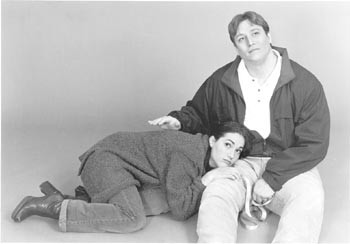
BRITISH DRAMATIST Robert Holman once remarked, “The novel is more of a whisper, whereas the stage is a shout.” But Santa Rosa Junior College theatrical director Leslie McCauley is out to prove that novels can shout (or at least chatter audibly) with her verbatim staging of the fifth chapter of author Greg Sarris’ novel Watermelon Nights.

Inspired by the work of the San Francisco-based theatrical troupe Word for Word (the company that pioneered word-for-word presentations of non-dramatic work), McCauley animates Sarris’ coming-of-age tale about a young Native American man named Johnny (played by Zachary A. Hummell) caught between the world of a Santa Rosa Indian community and his dreams of becoming a clothing retailer in San Francisco.

More significant, however, is the fact that Johnny is gay and living under the homophobic scrutiny of his peers as he ponderously considers the nature of love. To complicate matters, Johnny finds himself attracted to the tight-lipped Felix (Jack Kohler), the brawling but charming Cro-Magnon who lords it over his social circle.

Hummell turns in an earnest and vivid performance as the emotionally troubled Johnny, who must nimbly navigate a psychological obstacle course lest he get his ass kicked. Hummell never unfurls his brow and anxiously trots the stage without letting the character default into a portrait of victimhood.

Conversely, Kohler’s Felix prowls the scenery like some order of predatory jungle cat. Clad in a wife-beater undershirt and permanently pinching a cigarette (from which he awkwardly drags so as to flex his enormous biceps) between his thumb and forefinger, Kohler draws Felix as a valentine to sleaze. The cigarette effect, no matter how clumsily deployed (it is painfully obvious the actor is a non-smoker), does underscore the character’s trumped-up bravado and, eerily, works.

A half dozen supporting characters round out the cast, who may, at any given point, be mewing or mooing as ad hoc cats or cattle. Among those allowed to act standing up are such standout performers as rubber-faced Drew Hirshfield (he steals the show as Dollface, a decrepit feline enthusiast) and Jessica Larson, who takes on the roles of an officious McDonald’s clerk, a nurse and a bank teller.

Author Sarris’ stylistic decision to write much of this chapter in a vernacular that chucks out conventional grammar for the sake of down-home dialogue (“knowed” instead of “knew,” for example) may prove grating to some ears, though on paper it adds color to the text.

Indeed, the hazards of staging non-dramatic work are manifold, and though director McCauley successfully mitigates much of their impact, the fact is that the production often seems to default into a mere recitation of the work rather than an actorly interpretation of it.

Not every word of Sarris’ text plays well onstage, which is just as well because he wrote a novel, not a play. However, a more formal interpretation of Sarris’ often engaging work might have better served both the production and theatergoers.

That said, SRJC’s production of Watermelon Nights remains important theater, not least because it addresses issues germane to the local Native American experience that are seldom, if ever, explored on Sonoma County stages.

‘Watermelon Nights’ plays on Thursday and Friday, Oct. 14 and 15, at 8 p.m. and on Saturday, Oct. 16, at 2 and 8 p.m. at the Burbank Auditorium, SRJC, 1501 Mendocino Ave., Santa Rosa. $7. 527-4342.

From the October 14-20, 1999 issue of the Sonoma County Independent.

© Metro Publishing Inc.
Ravenous Cafe

Culinary joy: Chef Joyanne Pezzolo, along with husband, John, has created one of the North Bay's most popular eateries. Somethin' to Crow About Seasoned Ravenous continues to satisfy By Paula Harris ANTICIPATION is part of the pleasure of dining at tiny Ravenous Cafe in Healdsburg. Since there are...

Savage Jazz Dance Company

Pure Energy The Savage Jazz Dance Company thrives on spontaneity and live music By Marina Wolf IT'S A SUNNY, sleepy Sunday afternoon in Berkeley, a time when most College Avenue denizens are still recovering from brunch. But upstairs at the Shawl-Anderson Dance Studio, the dancers of the Savage Jazz Dance Company...

Jive 5 Winners

The five winners of the Jive 5 writing contest The future has arrived. Our chrome-plated, double-barreled Brave New World is upon us, parked at the curb with its 12-cylinder engine rumbling like a rocket, so put down your pens and hold on to your double mochas, folks, 'cause it's going to be a bumpy ride. ...

Latino Health Forum

Forum illuminates Latina-health issues By Yosha Bourgea EDIA URTEAGA had an advantage when she found out she had diabetes. As a patient-relations coordinator at Kaiser Permanente Medical Center in Santa Rosa, she already knew factual information about the disease and understood some of its sources. Still, when test results from a regular checkup showed that...

‘Body Shots’

Body Shots. Disco Daze Tragic singles mingle in L.A. nightspots in "Body Shots" By ISN'T IT TRAGIC being a glamorous single? Spending your nights at the most exclusive nightclubs, burning hundreds of dollars on fancy cocktails, having wordless trysts in the parking lot--and all this effort just to alleviate...

Walter Kirn

'Thumbsucker' mostly covers old ground By Patrick Sullivan "HERE WE GO again," mutters the constant reader with a quiet sigh as he or she wades into the first chapter of Thumbsucker. "Here's another author with another painful story about the agony of adolescence who thinks it's his job to tell us about it...

Bruce Springsteen

The Boss's Back On the other side of Bruce Springsteen By David Templeton I WASN'T EXPECTING to go see Bruce this time around. Though my heart rate admittedly quickened when I first learned that Springsteen would be touring this fall--together again with the E Street Band--I'd quickly decided that my time and...

‘The Source’

New documentary explores the ongoing influence of the Beats By Nicole McEwan The Source, Chuck Workman's densely constructed odyssey through the best minds of the Beat Generation, opens with a mesmerizing image. The 1942 photo depicts three young men standing arm in arm on a cold winter's day. On the left is Jack...

‘Random Hearts’

Random Hearts. Cold Spell No magic in chilly 'Random Hearts' By THROUGHOUT the new melodrama Random Hearts, Harrison Ford's character carries cuckoldry like a cross. In his scenes as a glib political consultant, Sydney Pollack (who also directed) shows us a pugnacious, humane, and world-weary face. Judging from his onscreen...

‘Watermelon Nights’

SRJC offers uneven production of 'Watermelon Nights' By Daedalus Howell BRITISH DRAMATIST Robert Holman once remarked, "The novel is more of a whisper, whereas the stage is a shout." But Santa Rosa Junior College theatrical director Leslie McCauley is out to prove that novels can shout (or at least chatter audibly) with her verbatim...
11,084FansLike
4,446FollowersFollow
6,928FollowersFollow


