Proposition 22 and the Mormon Faith

0

Conditional Love

In the face of the Knight Initiative, an ex-Mormon daughter struggles with faith and family

By Marina Wolf

MY OLDER BROTHER, Danny, and I have always respected each other. Through the storms of adolescence we frequently managed to be civil, and even as we grew into adulthood, our lives sharply diverging, the relationship bloomed.

It must be that respect and love that sends me to church with him and the family whenever we visit. It’s only twice a year, a small sacrifice to make at the altar of family feeling. No doubt it pleases them to think that, however sinful my life may be in their eyes, at least I’m still exposed to the saving principles of the Church of Jesus Christ of Latter-Day Saints.

Of course, there’s not a chance I’ll ever go back, not after 15 years, including eight and a half years spent with the woman I love. But still, at these church services that resonate in my reluctant soul, I wallow in a weird sort of nostalgia manqué, nostalgia for something that never was, but might have been. Watching the young Mormon women proudly herding their children down the aisle, I think: This could have been my life, too.

My family would love for that to be my life. Instead of struggling with what to tell the kids about “Aunt Lidia,” my brother could invite me and my husband to dinner with his friends. Instead of casting bewildered sideways glances at my longtime lover, my mother could occasionally mention me in the family newsletter. But they know enough of my tongue and temper not to argue with my “choices.”

In grateful exchange, I go with them to church once in a while.

This Sunday, I sit between my mother and my younger sister during the women’s meeting, which is being taught by the ward representative for Proposition 22, the California ballot measure that would prohibit the recognition of same-sex marriages performed in other states. The ward rep’s daughters take turns reading official church statements about the dire threat that same-sex marriage poses to the family and our country; then the floor is opened for comment.

It is unnerving to listen to these women talk about “perverts,” oblivious to my presence. I feel like an escapee, huddled in the bushes outside the prison while the searchlights sear the darkness around me. Surely they will find me out. But they don’t. The discussion swirls around me unabated, while I take discreet notes to steady my nerves and my mother flips aimlessly through her scriptures.

One woman relates reading in her psychology textbook about a woman who left her family for another woman. “That’s when I understood how serious this issue is,” she says, her eyes earnest and wide. “How could she choose someone else over her children?”

The teacher nods her head. “We can’t afford to be complacent about Prop. 22,” she says. “We want it to pass.”

“You can’t say that,” hisses one of her daughters from her seat; the church–which has encouraged members to donate to the Knight campaign–is being intently scrutinized, from within and without, for any overt political activity in church buildings. But the teacher barely pauses. “It’s going to be a knock-down, drag-out fight,” she continues, telling the story of the prophet in the Book of Mormon who scrawled slogans on a banner and marched through the streets for God. She’s good, she’s got a lot of charisma. She has the room in the palm of her hand.

Most of the room, at any rate.

At the end of the lesson, neither my mother nor my sister says “Amen.”

The Knight Initiative: The supporters and detractors of Proposition 22.

THEY PROBABLY weren’t the only ones present feeling a little uneasy, if we go on anecdotal evidence, acceptable assumptions, and basic math. With a worldwide membership approaching 11 million, and between 3 and 10 percent being gay, there could be anywhere from 333,000 to 1.1 million gay men and lesbians in the LDS church. In addition to their parents and grandparents, gay persons from Mormon backgrounds usually have siblings and a large extended family. (Besides my six brothers and sisters, I have, on my mom’s side alone, four sets of aunts and uncles, who produced a total of 22 cousins.)

As the numbers go up, the picture becomes clear: LDS policy on “the homosexuality issue” affects more than just gays in the church.

“The church leaders have a tendency to formulate policies, and . . . then they turn away and don’t want to talk about it anymore. They do not see the wreckage that’s going on,” said Kathryn Steffensen in a recent interview with KUED, a Utah public television station, for a documentary on gay and lesbian Mormons. Steffensen is a founding member of Family Fellowship, a support group for families with gay members. She gets to witness the damage firsthand, families who come to them traumatized and fearful for their children’s salvation.

Others who are in a unique position to see the “wreckage” are bishops and stake presidents (the local lay leaders in the Mormon church). These men don’t establish policy; they simply implement it according to their biases and abilities.

The local leaders are usually the deciding factor in a family’s experience with gay issues.

Some are sympathetic. One Central Valley bishop, who had a gay brother himself, was able to speak to my older brother heart to heart about the balancing act he needed to do. In Southern California, literally in the shadow of the Santa Monica temple, the stake president started a monthly meeting of fellowship for gays and lesbians and their families; it ran for seven years before being closed down by the church authorities.

Other local leaders can be much less supportive. Jake, a Central Coast gay man who remains a member after four years of church discipline, remembers his former stake president as a compassionate man: “He was doing what he thought was right.”

Among the right actions the stake president took when Jake came to him in torment in 1985 was to tell Jake’s parents about their son’s homosexuality, without his consent.

MARYANNE RECALLS what happened when she and her husband told one of their former bishops about their gay son: “He said that if he had a gay son he would ban him from our family, and that if he had a gay person move in on his block he would move.”

Though Maryanne and her husband knew that their feelings of acceptance were correct, they were still disheartened by the bishop’s response. In true Mormon fashion, Maryanne went to the temple and had a revelation. “I was off in the corner in very deep prayer when a voice and a presence came in front of me and said, ‘Love your children.’ I looked up and didn’t see anyone, so I bowed my head again in prayer, and the voice said, very firmly and louder, ‘Love your children.’ ”

And so she and her husband did, turning their energies to the local chapters of Affirmation and Family Fellowship, which began as a study group for six confused parents in 1993 and has since grown to include 1,300 households on a mailing list.

Many in Family Fellowship who have reached acceptance of their gay relatives view the challenges they’ve faced not as a tragedy, but as a journey leading them to greater understanding and togetherness as a family. The Watts family, for example, has suffered through two gay children leaving the church, one voluntarily and one through an especially harsh and rapid excommunication.

But their mother, Mildred Watts (or Millie, as her fans call her affectionately), says the suffering has only brought them together.

“I have just been stunned by how solid and united our family has been,” said Mildred in an interview for the KUED documentary. “We have friends in Family Fellowship who can’t even get their families together for Christmas. If the gay sibling’s going to be there, then the others don’t want to come. . . .

“I’m just grateful that all our kids have been so good.”

TRULY, sometimes our families can surprise us. When I sent my coming-out letter to the family newsletter, the first surprise was that the letter got in at all. Then one cousin wrote in and said not to assume that they would all have problems with my sexuality. My parents, who could barely look me in the eye in the months after I came out, now send Christmas packages addressed to both me and my lover.

My grandparents have demonstrated the strangest contrasts of all. The week before my commitment ceremony, I got a letter from my grandfather, who was blind and mostly paralyzed from a series of strokes, but still managed to dictate a denunciation to my grandmother. Meanwhile, my grandmother, a quietly devout woman, had photocopied the announcement of our ceremony and sent it out with the family newsletter, with an apology that the photocopy “wasn’t as nice as the original.”

A few years ago, I took my partner to visit them in southern Utah. While Grandpa dozed in the back bedroom, Grandma shyly showed us around the lodgelike house. “You could sleep upstairs, it’s quieter, but the beds are small and they aren’t that comfortable. Or you could sleep in here,” she continued as she led us to a room off the main room. “It’s a lot more comfortable. I’ll leave it up to you.”

Grandma trotted off to fix lunch as we stared at the king-sized bed.

None of this necessarily means that my family has really accepted me or my life. It’s just that they want to keep the family together. Mormon emphasis on family feeling makes the threat of its dissolution that much more disturbing. To make matters worse, those family ties are meant to carry on to the afterlife, which means that cutting them because of deliberate sin, as homosexuality is perceived in the church, often feels like a final farewell.

ADVICE FROM CHURCH authorities isn’t much help to families struggling with this situation. I don’t know what else my mother’s bishop told her when she went to him about me, but the thing that stuck out in her mind was the need to beg me to take my name off the records of the church. If I did not, she said, it would affect her standing in the afterlife, as a parent who had been remiss in raising me.

Other potential sources of support are equally confusing. One article in the September 1999 issue of the church magazine Ensign recommends moderating response to the news: “Keep in mind that this is the same person you have always known: a child of God. Be grateful that this individual is willing to share his or her burden with you.” But further down the page, the author highlights the real challenge of the situation: “While maintaining a loving concern for the person, reiterate the Lord’s position that homosexual relations are sinful, and don’t lose sight of this gospel truth.”

Love the sinner, hate the sin, in other words.

As in other conservative religions, estrangement and outright disownment over a family member’s homosexuality are not unheard of in Mormon circles. But mostly families just end up not talking about it. Lori, from the Bay Area, came out 10 years ago and hasn’t talked with her family much about it since. They live on the other side of the country, and when they do visit, the subject is more or less closed.

“They’re not angry. They’ve just put up some barriers; that’s how they function,” she says. “It’s not a close relationship, and it’s not an honest one.

“And that’s upsetting.”

IF FAMILIES often put up barriers between themselves and their gay members, the wall between the family and the larger community of the church can be nearly impenetrable. “I found it virtually impossible to attend church. I never knew when a song, or a word, or the sight of a loving friend would bring uncontrollable tears,” writes one woman in the Family Fellowship newsletter, Reunion. “Many times, I rushed from the church building engulfed in unspeakable sorrow and grief. I knew that once the tears started, they would never quit, and I knew at the time that I could not share the feelings of my heart with anyone.”

Another newsletter contributor wrote bitterly of her spiritual exile. “Unfortunately, my comfort has not come from my church associations. In fact, they have been a tremendous sorrow because I have always expected them to be my greatest support. Instead, I have felt abandoned.”

Those families who are “outed” as having a gay or lesbian relative, or who decide to reveal the fact of their own accord, can find themselves facing a social network that is damaged beyond repair.

At this point, a Mormon family can deal with the challenge in one of three ways: fight, flee, or flounder in the miserable status quo.

Many do choose to remain in the church and fight. The Wattses write letters to the church authorities several times a year. Maryanne and her husband regularly speak out in meetings. In politically charged times, this is a difficult decision. Church officials say that no one will be subject to discipline for opposing the church’s position on homosexuality and same-sex marriage, but a look at the chronology of church involvement in the Knight Initiative reveals that the pressure is on.

Dave Combe, a former Mormon who collects this information via online reports from members, believes that members are justified in their fear of retribution.

For instance, one member, not even in California, made a comment in a priesthood meeting and was released as the priesthood instructor. Another member was initially denied a temple recommend (a document from the local church leader attesting to her worthiness) because she “associated with apostates”–that is, she hung out with her gay brother. (The ruling was overturned by the stake president.)

Other families end up leaving the church because the conflict is simply too much. Gary and Mildred Watts write of this often in their letters to church authorities. “The continuing characterization by our ecclesiastical leaders of our gay children as ‘evil,’ as ‘being of the devil,’ and as ‘perpetrators of the unraveling of the fabric of human society’ is painful,” they wrote in one letter from 1995. “For some it severely tries their loyalty to our church, which heretofore has occupied a significant role in all our lives.”

Says Maryanne, “A lot of parents drift from the church when their children come out. We meet them all the time. They’ve drifted away from the church because they can’t deal with the church thinking they’re not going to be an eternal family.”

Lavina Fielding Anderson agrees: “This is the family church. We invented it, we have a monopoly on it. They have invested themselves and their marriage, in the hopes that their children will have the same kind of happiness, that they will replicate this family pattern, here in mortality and in the next life.”

Anderson collects anecdotes of spiritual abuse for the Mormon Alliance and has talked with many gays and their families in the course of her work. To her mind, the church’s actions in this and other political campaigns about gay issues definitely border on spiritual abuse, in that they can seriously damage members’ relationship with the church and with God.

“Some people are able to sort out the message that they’re getting from the church and say, ‘That’s not the message I’m getting from God,’ and still feel validated in their spiritual journey.

But many people can’t make that distinction, so to save themselves, they have to walk away from the church.

“But they end up walking away from God, too.”

EVEN IF MORMONS with gay relatives do manage to stay in the church, says Anderson, they can never go home again to the church that had formerly been the rock of their faith. “They may still look as though they’re in the mainstream, they may still be in the same row in church,” she says, “but they’re hearing the message with different ears.”

When the dissonance is too much to take, some members are choosing to have their names formally removed from the records of the church. Kathy Worthington, who left the LDS church 30 years ago over its refusal to grant black males priesthood privileges, now serves as an unofficial counselor for others wanting to leave the church.

Usually, says Worthington, she gets one or two requests a year; since the church came out with its announcements in May, she has received 116 photocopies of letters, from both gays and straights, that have requested removal of names.

USUALLY the distancing on both sides is more subtle. Mark has a brother who came out as gay, and while the whole family is completely comfortable with that, says Mark, they can never be themselves with the family of the church, especially with homosexuality being such a hot topic in church these days. “When we share our beliefs, it makes [the other members] uncomfortable to be around us, and it makes us uncomfortable to be around them as well, because we can’t really talk about that issue.”

This is the silent middle, the gray area where members don’t know exactly what to do, but can’t shake the feeling that what the church is asking them to do just isn’t right. It’s a difficult place to be in a church where things are either right or wrong, God or Satan. Those caught in between feel the pressure.

“I’m a strong member of the Mormon church, and I’m not trying to find fault with the church leaders,” says Mark. He then sighs nervously. “I’m not trying to make it a big issue. But with the whole Knight Initiative becoming very popular with the first presidency [the top leaders of the church], I definitely feel that they’re forcing me to choose between the church and my brother.”

I don’t understand how my own brother holds these two mutually opposing concepts and thought patterns–gay sister, gay-hating church–in his head without exploding, but he does. Of all the Wolf kids, we’ve always been closest–in age, geography, and feeling–and that hasn’t really changed. If we lived any closer, I’m sure he would probably have my lover and me baby-sit about twice a week.

But at the same time, he will be contributing to Prop. 22.

I ask him about it one Sunday evening, the day of that awkward women’s meeting in my brother’s ward. I shouldn’t ask if I’m not ready to hear the answer, but there it is. Might even do some precinct walking, he says. That hurts. He speaks so easily about this, about voting for it. What’s worse, he prays for me. Even though I have been with my lover as long as he has been married, he hopes that I will change.

I ask whether he gets sad thinking about me, and the silence is horrible, ringing and eternal. His eyes are red and watery as he gazes out the kitchen window into the black night. “A little,” he finally says. I stare at him, paralyzed by confusion. I want to shake him and hug him, cry and shout, beg him not to worry about me in the afterlife. “I’m a good person!” I want to say. “Your god will let me in!”

But he won’t believe me anyway, and I can’t bear to beg. So I just sit and look away from his tears and think about the choices we both have made in order to sit at the same table.

IT IS ONE THING to go to church out of family obligation. It is quite another to be drawn to it out of my own soul-felt need.

The desire to go back to church had been building in me for months, ever since I started writing this article. Mormons might call it the still small voice, the prompting of the Holy Spirit. I couldn’t call it that, but I also couldn’t shake the feeling that I needed to go. I wanted to put a face on the “homosexual menace,” maybe plant a seed of understanding.

But more than that, I wanted to finally speak my truth in front of a Mormon congregation.

Fast-and-testimony meetings are supposedly held for this exact purpose. On the first Sunday of every month, members fast all day and then have the opportunity at church to stand up and bear witness to their beliefs. This almost always has to do with the truth of the gospel as it was revealed to church founder Joseph Smith and all the Mormon prophets since. But every once in a while someone will get up at this spiritual open mike and say something unexpected.

That was my intention when I set out a couple Sundays ago to a local ward’s testimony meeting. I half-expected some burly guys in dark suits to drag me away from the podium, but the room was utterly still as I unfolded a slightly sweaty paper and read from it, my throat rough and dry in the oppressive air.

I talked briefly of my family and how they had a hard time matching me with the picture that is painted in church of deviants and destroyers of the family. I ended my statement with these words:

“I don’t know exactly what has been discussed in this chapel, or amongst yourselves in the lobby, but if it’s anything like in my family’s home wards, then some thoughtless and hurtful things have probably been said. Like many Mormons with gay relatives or friends, my family is afraid or embarrassed to speak up, which means they suffer in silence.

“On behalf of them and others like them, I beg you: do not cause further pain in a situation that is already hard enough. Be sensitive when you speak of homosexual issues. You do not know who among you has a gay friend or relative, or who is gay themselves.

“Harsh words on this subject, especially in a church environment, are cruel, and cruelty toward other human beings can never be Christian.

“If you are able to think before you speak, you can also think before you vote. If you don’t know any gay people, think of me and my family. There are many people whose lives and hearts are affected by your actions. I wouldn’t dream of arguing morality or politics with anyone here. I can’t dictate how others should act in matters of conscience or love.

“But I know one thing, and I came here today to testify to its truth: nothing is as simple as it seems.

“In a matter that is portrayed as ‘us vs. them,’ some of them can be us.”

I COULDN’T FIGURE out what to say at the end, so I just stared at my paper for a few seconds and then stepped down. Not being a religious person anymore, I didn’t want to say, “In the name of Jesus Christ,” and I sure didn’t want to say “amen” and have no one say it afterward.

The church member who stood up after me thanked me for reminding him to love unconditionally. And at the end of the meeting, I was thronged by people wanting to shake my hand and thank me for coming.

One older woman said, “I’m so glad you came today. I used to live next to two gay men, and they were the most wonderful people. They were the souls of charity. I think it’s wonderful that you came and spoke today.”

Several people invited me to come back, and I said thank you. What could I say? “Didn’t you hear me? I’ve been with my lover for eight and a half years. Why would I want to come to a church where so many people are against civil recognition for our relationship?”

No. I didn’t say that. But I wanted to.

From the February 17-23, 2000 issue of the Sonoma County Independent.

© Metro Publishing Inc.

Joe Diffie

0

Joe Diffie gets serious on latest CD

By Alan Sculley

One could say that when it came to his career, Joe Diffie quit joking around with his latest CD, “A Night To Remember.” It’s a statement that applies, first of all, to his music itself. In recent years, Diffie had enjoyed chart success with a string of light-hearted novelty-type tunes, such as “Honky Tonk Attitude,” “John Deere Green,” “Third Rock From the Sun,” and “Bigger than The Beatles.” He became well enough known for such material that he gained the nickname Joe Dittie.

But lately, the string of chart-topping hits has dried up and Diffie’s record sales had stalled. Diffie was getting indications that radio was ready for a new direction.

“With me there seems to be some sort of resisting force that all of a sudden for some reason decided they weren’t going to play songs of mine that were funny songs, and I was getting a lot of comments from radio people to my radio people saying ‘Joe’s got a great voice. We want to hear him sing songs that aren’t ditties and stuff,'” Diffie said. “I got a lot of that kind of information fed back to me.”

On a broader level, Diffie got more serious about his career–and his lifestyle–prior to making “A Night To Remember,” and made several significant changes.

He decided to begin managing his own career and he committed himself to a more healthy lifestyle by quitting smoking and adopting an exercise routine that has seen him shed some 40 pounds. He also switched producers, bringing in Don Cook and Lonnie Wilson to work on “A Night To Remember.”

All three decisions had specific benefits for Diffie.

In taking over his own management, Diffie feels he has improved his partnership with his record label, Epic, and others involved in his career–a situation he hopes will pay off with better record promotion and more sales.

“I just felt like it was time,” Diffie said of managing his career. “I just wanted a fresh everything, and it just seemed kind of crazy to me to pay out huge sums of money to somebody to do something I was perfectly capable of doing with a little more effort. So that was one of the main reasons, obviously. The other was I just wanted to be more involved in my career. I just felt like I was out of touch with folks, the folks at my label. I’d go over there and it was like I was the stepchild or something, almost. I don’t know how to explain that, I mean, they were all nice enough. I could just feel this little wall there.

“So it’s been nice to be the one that they call and talk to and get a direct answer from me and I get direct answers from them and it just, it’s a real connected kind of feeling.”

Putting aside cigarettes and following a regular exercise routine that includes daily time on a stationary bike or treadmill had a direct effect on Diffie’s ability to perform on stage and in the studio.

“I guess I was in denial that it was affecting me, that the smoking was affecting me,” he said. “Then when I quit, all of a sudden I’m able to do songs in my set list I had to drop out before because they had notes I couldn’t handle night after night. So what a thrill it’s been. I have a lot more stamina and I’ve got a lot more high end range back that I started to lose a little bit.”

As for the switch in producers, Diffie admits that Cook’s track record was a factor in his decision.

“Well Don Cook, of course, has been so successful with Brooks and Dunn, Alabama and a bunch of other people. And he just, he’s a real good song person,” Diffie said, praising Cook’s ability to recognize material that was ideally suited to the singer.

“I wanted Don mainly because of his reputation and his success. And the other reason, with Lonnie, Lonnie and I are dear friends. He’s played drums on all my records and we’ve written a bunch of songs together and done many, many demos, spent hours and hours singing and messing around at his home studio. He’s just a real dear friend of mine so we just ended up, the other side of that story is Don had been wanting Lonnie to become involved in production. Lonnie had played on most of the stuff he produced, so it was just a good opportunity all the way around.”

It’s a bit early to know if the changes will put Diffie’s career back on it’s early trajectory–Diffie’s first two CDs, A Thousand Winding Roads (1990) and Regular Joe (1992) spawned six straight number one hits (including the heartfelt ballads “Home” and “Ships That Don’t Come In”). But the Duncan, Oklahoma native’s album sales and radio play have slowed since then.

On a musical level, though, the verdict is in. Diffie’s efforts have produced one of the most musically satisfying albums of his career. “A Night To Remember” offers an engaging mix of mid-tempo and ballad material (such as the title track and “Better Off Gone”) and melodic rockers such as “You Can’t Go Home” and “It’s Always Something.”

Throughout the CD, the material leans toward traditional sounds, with ballads like “Don’t Our Love Look Natural” and “I’m The Only Thing I’ll Hold Against You” being particularly old school in their approach.

Every song on “A Night To Remember” centers on romance in some respect–and for the most part, the subject matter rises above the cliches that often inhabit love songs.

The title song, for instance, starts out sounding like the story of a newly unattached man’s declaration to live it up in the wake of his romantic freedom. Instead, as the full-bodied ballad unfolds, the character stays at home, pulls out photos of his ex-lover and spends the evening reliving the life he lost. Another lyrical gem is “Are We Even Yet,” which offers a pointed look at the competition between a bickering couple.

Such subjects did not find their way onto the new CD by accident. In trying to decide what direction to take his music, Diffie had an eye on the kind of material he felt gave him the best opportunity to reach fans old and new.

“We had a myriad of song meetings where we tried to solve all the issues facing country radio and our listenership, who’s listening to it and who’s buying the records and who’s playing the records and what demographics,” Diffie said. “You get into all those kinds of discussions and the conclusion we came up with was the majority of people who are actually physically buying records are probably young females. So we tried to find songs that were dealing with stuff that interests that kind of demographic, while I’m trying to be true to me and myself.

“The number one factor was we wanted to find songs that dealt with love,” Diffie, 40, revealed. “And even the songs that talked about a lost love situation, at least had the guy, or the character in the song, being remorseful that he messed up and he lost his love, or there was a light at the end of the tunnel. So that was kind of our driving force behind when we were selecting songs.”

The romantic fare is a bit ironic for Diffie, who recently became engaged to Theresa Crump, a 30-year-old who was working as a secretary in Orlando, Florida, when she met Diffie. It will be the third marriage for Diffie, who has four children from his previous marriages.

“There was a golf tournament one day and a little impromptu kind of jam concert the night before at this little club in Orlando,” said Diffie, explaining how he Crump. “She knew a bunch of folks, she’s a big country fan, so she had gotten to know a lot of people at the radio station there was there and I just met her and started talking to her. The next thing I know we exchanged numbers and the next thing I know, here we are.”

This positive turn in his romantic life, however, had nothing to do with the thematic direction Diffie’s music took on A Night To Remember.

“I met Theresa after I pretty much had all the songs together and had begun recording it,” Diffie said. “So that didn’t really factor into this particular project, but I’m sure it will in the future.”

Joe Diffie performs Wednesday, Feb. 16, at 8 p.m. at the Luther Burbank Center, 50 Mark West Springs Road, Santa Rosa. For ticket info, call 546-3600.

From the February 10-16, 2000 issue of the Sonoma County Independent.

© Metro Publishing Inc.

Planned Communities

1

One alternative: Michael Black, an architect by trade, helped initiate Two Acre Wood, an intentional housing development that opened last August in Sebastopol. The project, says Black, is based on sound humanistic principles.

A Different Path

Intentional communities gain a foothold

By Yosha Bourgea

MICHAEL BLACK is not a guru, but he looks like one. From the Taj Mahal gleam of his bare scalp to his attentive gaze and calm, well-considered speech, his appearance evokes a sense of harmony that is reflected everywhere in his self-designed home near downtown Sebastopol.

A wide arch above a counter defines the boundary between kitchen and living room without the presence of a wall. Around the perimeter of the main space, a row of small, square windows above eye level brings in daylight without sacrificing privacy.

Behind the house, a redwood deck leads out to a hot tub. And from the front door, a paved footpath leading down a slope connects to the other homes in the new intentional community of Two Acre Wood.

The only flaw in this otherwise serene picture is one that Black, an architect, did not design. Just a few yards up the hill, on the other side of a low fence that marks the edge of the lot, a row of identical beige houses rises like a wall above the oak trees. This is Stefenoni Court, a conventional housing subdivision that dominates the western horizon.

The tenants of Two Acre Wood began moving in last August, and already the community has seen the death of a dog and the birth of a child. Despite a storm of protest from neighbors concerned about the impact of traffic on their quiet road, Black, the initiator and designer of Two Acre Wood, succeeded in persuading the Sebastopol City Council to approve the zoning for the site.

Now the community of 25 adults and nine children is working to establish positive relationships, both internally and in the greater neighborhood. There also are plans, Black says, to plant vines along the western fence to block the view of the subdivision next door.

But there’s no concealing the fact that, like all intentional communities, Two Acre Wood is still an exception–an island in a sea of tract housing.

THE ORIGINS of the term “intentional community” can be traced to circa 1950, according to the website of the Fellowship for Intentional Community. Definitions are as abundant and diverse as the people who live in places like Two Acre Wood, or Monan’s Rill in eastern Santa Rosa, or the Sowing Circle west of Occidental.

While most agree that an intentional community consists of a group of people sharing land or housing in a cooperative spirit, there are myriad ways that such a group can be structured. From private would-be utopias and religious enclaves to public-service-oriented groups and co-housing developments, the movement toward intentional community is growing.

The FIC website lists almost 100 such communities in California alone–and those are only the ones that requested to be on the list.

The site estimates that there are several thousand others throughout the country.

For those unfamiliar with contemporary intentional communities, the image of a hippie-laden commune is often the first to come to mind. Communitarians do tend to be left of center politically, and some have roots in the counterculture of the ’60s and ’70s; Black’s wife, Alexandra Hart, was a founding member of the controversial Morningstar Ranch in Graton. But the raucous, laissez-faire ambiance of such places has proven difficult to sustain, particularly from a financial standpoint.

The rallying cry at the now-defunct Wheeler Ranch commune was “No Rules!” But today, few of the people who can afford to invest in home ownership in Sonoma County would be willing to chant that particular mantra.

ALTHOUGH A SHARED ethos is central to most intentional communities, another factor drawing many people to consider participation is the economic advantage of community living. “What you tend to see more of around this area is highly enlightened real estate deals,” says Mary DeDanan, one of a group of people working to establish a small intentional community near Jenner.

“If you look at what median housing goes for versus what we’re offering, it’s pretty affordable.”

Prospective members of Wild Iris Ranch, must pay a $1,000 nonrefundable “earnest money” fee to show the seriousness of their commitment to join. That fee is part of the down payment, which is $15,000 for a single member and $20,000 for a couple. At buy-in, the membership is $105,000 (including the down payment), with monthly mortgage payments expected to average $900.

Compare that to the conventional market, where the median resale price last year hovered around $255,000 for a house or $140,000 for a condominium, and intentional community starts looking like a pretty smart idea. Of course, not everyone would be comfortable with the cozy living situation at Wild Iris Ranch.

“We’re taking the housemate concept to the nth degree,” DeDanan says. “A lot of people don’t want that.”

To comply with rural zoning laws, which allow just one house plus a granny unit per 40 acres, DeDanan and fellow core-group members Marcin Whitman and Chris Carpenter are designing a community that is a hybrid of co-housing and shared housing.

In addition to a single-bedroom granny unit that is already finished, the group plans to build a large structure, incorporating three to four separate bedrooms, around a common living space. Because the building will have only one kitchen, it can be legally defined as a single house.

“People want their own little piece of property,” DeDanan says. “[But] the individualistic model, with 50 little houses each with their own washer and dryer . . . the planet can’t sustain this kind of stuff.”

Michael Black agrees. “We’re founded on humanistic and ecological principles,” he says. “We live closer, more modestly, to not use up the surface of the planet for housing.

“We should not live isolated lives.”

IRONICALLY, many intentional communities find it necessary to isolate themselves from mainstream society in some way, if only to preserve their sense of integrity. Some are cautious about revealing their location or welcoming visitors who are not familiar with the priorities of the group. Concern over the possible impact of this article on a precarious relationship with neighbors also led one community member to request “vague” descriptions.

Monan’s Rill, one of the most firmly established intentional communities in Sonoma County, has survived (and thrived) for a quarter of a century by protecting the privacy of its residents.

“When we first came here 25 years ago we were a little overwhelmed, and we tried not to have too much notice paid to us,” says Russ Jorgensen, one of the founding members.

“Now that we’re a mature group and more stable, we don’t mind having visitors when we can be helpful.”

Still, when an unknown reporter requests a visit, Jorgensen says he’ll need to talk it over with the other residents at a general meeting before he can give a definite answer. Like many intentional communities, Monan’s Rill governs by consensus, a process that is less impersonal but more time-consuming than majority rule.

The need of the community to deliberate openly is crucial, an outsider’s deadline notwithstanding.

“There’s a stance of using consensus that is inherent in co-housing,” says Black of Two-Acre Wood. “It’s not about the power of the majority.”

A common problem within intentional communities concerns the division between private and public space, and the balance between individual freedom and community standards. As a new community, Two Acre Wood is just beginning to address some of these issues. Some residents, Black says, consider their front porches private space and use them for storage. Others see this as a disruption of the neighborhood’s unified look. But as with any other conflict, a resolution will come when all the neighbors sit in a circle, speaking honestly to one another and listening with respect.

“Consensus is the glue that holds us together,” Black says.

New College of Santa Rosa (99 Sixth St.) will host “Finding and Financing an Intentional Community,” a forum introducing the skills needed to start a co-housing project, on Saturday, Feb. 12, from 9 a.m. to 5 p.m. The cost is $100. Call 568-0112. Meanwhile, a new co-housing group is enlisting participants for a planned community in downtown Cotati. For details, call Geof Syphers at 510/891-0446.

From the February 10-16, 2000 issue of the Sonoma County Independent.

© Metro Publishing Inc.

Botanica Erotica

Evangelists of eroticism: Dae Williams and Diana DeLuca.

Natural Urges

Founders of Botanica Erotica preach healing power of pleasure

DIANA DELUCA and Dae Williams are on a mission from God. Or Goddess. Or both, depending on one’s point of view. Their calling–and to hear the Sebastopol women talk, it’s clear that this is a calling–is to spread the simple but unexpected message that pleasure heals. “We’re telling people,” says Williams, “that pleasure is good, that when you are experiencing pleasure, it heals your body–and it also heals the planet.”

“A lot of people need to be given permission to enjoy their bodies,” says DeLuca, who adds a potent, practical piece of advice that she is glad to share with others.

“If your mouth waters,” she says, “or if your nipples get hard, know that it’s your body telling you, ‘This is good!’

“Of course,” she adds with a matter-of-fact smile, “this goes for men as well as women.”

DeLuca (a local teacher, writer, and herbalist) and Williams (a licensed aesthetician and co-owner, with her sister Gina Williams and Andrea Spanzo, of Sebastopol’s happily hedonistic Sensuality Shoppe boutique) are the brains and spirits behind Botanica Erotica, a one-of-a-kind line of all-natural, handcrafted, mostly edible, aphrodisiac balms and lotions intended to enhance the sensual experience of our own and others’ bodies.

These “erotic botanicals” bear enticingly playful names like Bawdy Budder (edible spreads that come in a choice of flavors, including dark chocolate, white chocolate-almond-orange, and chocolate-tangerine) and Love Balm (exotically flavored lovemaking “lubricants” made from natural coconut oil and other organic ingredients). Along with such intriguingly titled offerings as Lust Dust, Love Licks, and Aphrodisiac Love Elixirs, the Botanica Erotica products–based on recipes that DeLuca has been sharing for years now in her phenomenally popular herbal sensuality workshops–have officially been on the market since 1998, granting grateful consumers’ previously unanswered wish for healthful erotic delights.

“A lot of folks really care about what they put into their bodies, and they care about what they put on their bodies,” explains Williams, sitting with DeLuca in the resplendent surroundings of the Sensuality Shoppe, one of several Bay Area stores that now carry Botanica Erotica products. “Women would tell us, ‘You know, we grow our own vegetables. We buy all-organic foods. We only want good yummy things for all bodies–but there’s nothing out there with all-natural erotic products.’ And it was true. I wanted to create an alternative to that.”

At that point, Williams was already successfully blending and marketing a line of all-natural face- and body-care products under the name Rejuvenescence, later changed to Sensuous Beauty. A fortuitous crossing of paths occurred, and she joined forces with DeLuca, who, it turns out, taught a workshop in the early ’90s that was Williams’ first inspiration to go into the organic beauty-product business.

Working in a large, festively decorated space out in the country (“Imagine the most awesome restaurant kitchen you’ve ever seen,” suggests Williams), the dynamic duo manufacture and package all the products with their own hands–and those of a growing sisterhood of gleefully hedonistic helpers.

“Concocting is always fun,” says DeLuca. “To say that we enjoy our work is an understatement.”

As proof of the dynamic duo’s spiritual intentions, every jar and bottle of Botanica Erotica comes inscribed with the phrase “Pleasure Heals.”

Buy the Book: Botanica Erotica founder Diana DeLuca’s book, Botanica Erotica: Arousing Body, Mind, and Spirit.

WHILE MANY of the products arise from experimentation and “happy accidents,” and some are based on, as Williams puts it, “yummy things we started making for ourselves and our loved ones,” a number of Botanica Erotica products evolve from suggestions offered by customers. Among the most popular of these is the Nether Petal Pomade, a “sacred” moisturizer otherwise known as Yoni Lip Balm.

“It can serve as a lubricant, but we already had lubricants,” says Williams.

The Beautiful Breast Balm, one of Williams’ own creations, is another invention that seems to be flying off shelves, tapping further into that need for sensual anointments. “It’s not just some lotion to slap on your body before you throw on your clothes,” Williams says. “There’s intention there. You warm your hands and massage it into your breasts, and you have to be conscious about that. It’s about loving your body.”

“Then there’s our Pleasuring Cream for Men,” DeLuca offers.

“I can’t tell you what a big deal that product is,” Williams says with a grin. “It’s like giving permission to men to masturbate. Men pick this up and look at it and go, ‘Wow!’ They see it’s out in the open, it’s being honored. ‘I can have my own little jar of cream just for that purpose?’ It’s about giving permission to pleasure yourself.

“Let’s face it, it’s a pretty natural instinct.”

And natural instincts are what DeLuca and Williams are all about. As the proprietors of Botanica Erotica, they’ve become reigning evangelists of eroticism, the high priestesses of pleasure, the patron saints of sensuality–and they love it.

“What better way could you have for being in the world,” preaches DeLuca, “than to have a lot of pleasure and to create a lot of pleasure for other people, so it comes right back around to you and you get to have even more pleasure.”

Adds Williams, “It’s a really good business to be in.”

And business is good.

AFTER BUILDING a significant local base of clientele through word of mouth and a handful of product placements in natural-food and beauty stores, Williams and DeLuca recently floated a few high-profile test cruises into the turbulent waters of national advertising, taking out a display ad in Herb Companion magazine. The response, according to Williams, was overwhelming.

“We heard from women all over the country, including places like Texas and Alabama,” she says with a laugh. “Then, after sending out the orders, we began to get these amazing calls. Women from all over saying, ‘The most beautiful thing is happening. I’m falling in love with myself just by putting this stuff on.’ ”

“They’ll say, ‘My husband and I sat down and went through the whole catalog, and we’ve decided on these two. What do you think?’ ” relates DeLuca, happily. “And you know they spent an hour together just letting themselves become all tantalized.”

Says Williams, “Every time we send one of our little packages across the country, we say, ‘Well, the scale’s going to tip a little bit more in this direction. Here comes another person over to the pleasure side.’ ”

From the February 10-16, 2000 issue of the Sonoma County Independent.

© Metro Publishing Inc.

Sex Tips

Operating instructions for the sexually challenged

AS ANYONE who pays attention to the news–and to politics in particular–must surely be aware, there are certain nefarious forces afoot these days that claim, quite loudly and vociferously, that the institution of marriage, if not exactly being faced with imminent extinction, is surely being seriously threatened.

While one might agree that marriage–the spiritual union of any two loving and committed souls–is not always what it should be, one could strongly disagree with the solution proposed by these political troublemakers: namely, that the legal definition of marriage be confined to couples of separate genders (i.e., one man, one woman).

This solution will never save marriage. It will only limit it to the group of people who, all on their own, have managed to push divorce rates so high that modern marriages have a mere 50/50 chance of lasting. The real threats to marriage are such things as husbands who sleep with women other than their wives, and such things as prenuptial contracts and social pressures that force young people into unhappy shotgun liaisons merely because someone got too frisky to use a condom.

Then there’s the No. 1 threat to modern marriage: boring sex.

As the great philosopher/comic Phyllis Diller once said, “Marriages are pretty much like apples on a tree. They’ll go bad if someone’s not plucking the fruit now and then.”

With this in mind, here’s a short list of Valentine’s Day gifts, specially designed to add a little spice to any couple’s bedroom. For best results, however, it is suggested that these helpful books, games, and the like be employed regularly throughout the year, not just on Valentine’s Day or wedding anniversaries.

101 Great Quickies by Laura Corn is a novel twist on the standard sex guides that fill bookstore shelves. The pages of this book are actually sealed envelopes, 101 of them, each containing a separate suggestion for a short, spicy commingling. With such curiosity-provoking titles as “Delicious Torture” and “Lickity Splits,” the possibilities are obvious.

The Sensuality Shoppe, in Sebastopol, is a treasure trove of potential marriage-enhancers, from negligees and silk boxer shorts to Botanica Erotica organic massage oils, edible lotions (see “Natural Urges,” page 16) and, er, toys. Among the most ingenious and psychologically satisfying offerings are an array of bedroom board games, with titles like “ForePlay” and “Speak Love/Make Love,” specifically created to strengthen the bond between lovers as they get certain juices flowing. A good one is “Romantic Rendezvous,” a game of love, intimacy, and adventure, in which the two players toss their dice and move around a board, stopping on squares with pointed suggestions–from kisses to declarations of love to, well, you get the idea–that must be acted on immediately before play resumes. The nice thing about these games, of course, is that everyone wins.

For a more cerebral approach, may we suggest some good steamy poetry. The Love Poems of Rumi, translated by Deepak Chopra, offers some of the most tantalizing words of love ever crafted in any language. For a more modern touch, Diane Ackerman’s collection of poems The Jaguar of Sweet Laughter includes some of the most heart-rate-accelerating poems in recent memory.

InterCourses: An Aphrodisiac Cookbook, by Martha Hopkins and Randall Lockridge, is perfect for the couple that feels the urge to cook together. Beautifully illustrated, the book reveals such tantalizing treats as grapes rolled in almonds and ginger and Thai chicken with peanut sauce, recipes in which the preparation is as stimulating and the, um, consummation.

Who knows, with such relationship enhancers as these, even Newt Gingrich might have stayed married. May he have better luck with his next partner, whoever she–or he–might be.

From the February 10-16, 2000 issue of the Sonoma County Independent.

© Metro Publishing Inc.

‘Amadeus,’ ‘La Cage aux Folles’

0

Amadeus.

Music Makers

Two theatrical productions strike high notes

By Daedalus Howell

CURSE the ephemeral nature of live theater! Though it will be gone from the stage in just a few weeks, Sonoma County Repertory’s production of playwright Peter Shaffer’s Amadeus should be bottled and shared with the generations.

Expertly directed by Jim DePriest, Shaffer’s masterpiece is based on real-life speculation that 18th-century composer Antonio Salieri hastened the demise of his prodigiously talented rival Wolfgang Amadeus Mozart.

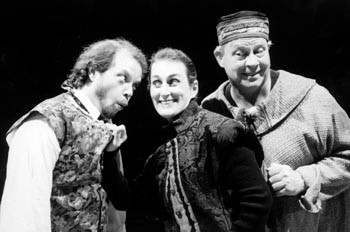
As a young man, Salieri (John Moran) wants nothing more than to be a composer and eventually finds patronage with Emperor Joseph II (played here by a comically superb Gerald Haston). But when the vainglorious Mozart (Ben Stowe) sashays into the Viennese court, the maestro’s perspective sours. As he recounts, “Was it so early that I began to have thoughts of murder?”

In a profound turn in his career on local stages, Moran offers a pitch- perfect portrayal of the court composer–a man whose artistic envy is so dark that he launches a one-man hate campaign against God.

To say Moran does his usual laudable best here would be an insult to this performance. For the duration of this show, the man simply is Salieri in all his wit, whimsy, and wretchedness. Moran’s performance of the famed “mediocrity” speech is both exquisite and harrowing as the character realizes that his work, unlike Mozart’s, was of its time, but not timeless.

Fans of the Academy Award-winning film version of Shaffer’s play may liken some of Stowe’s stage-borne antics to those originated by actor Tom Hulce (namely, the signature giggle), but the young actor is ultimately successful in finding his own voice for Shaffer’s text.

Though its length may have playgoers of lesser stamina hearing lullabies, in the end, SCR’s Amadeus is music to the ears.

THE SANTA ROSA PLAYERS’ production of the gender-bending chestnut La Cage aux Folles isn’t all a drag. Directed by Bob Rom, this saucy send-up of sugar and spice and all things vice is set at a French cabaret famed for its female impersonators.

Alpha-she-male Albin (Vance Smallwood), all mascara and moxie, turns in the performance of his life posing as the mother of his gay lover’s grown son when the young man brings home his conservative future father-in-law.

An avalanche of mini-disasters ensues (both in the plot and onstage), but the show makes up for its lack of polish with a handful of rousing song-and-dance numbers. Thank its gaggle of Gagelles (the faux broad-squad that works as sort of a Greek chorus throughout the show). The energy these boys muster is simply atomic.

Though their va-va-voom isn’t always the pinnacle of grace–some of the femmed-up fellas look like piano movers despite their clean-shaven bodies–they invariably land on their feet. At times one may wish this production was simply a revue of its estimable musical portion, since many of the acted segues are ham-handed or even inaudible. But the cast excels with the acrobatic dance routines cooked up by choreographer Anthony Gianchetta and can carry a tune when backed by the tight five-piece orchestra led by talented young keyboardist Paul Stroba.

Like La Cage‘s signature tune, “We Are What We Are,” this production is what it is–a light, frivolous spectacle.

‘Amadeus’ plays Thursdays-Saturdays at 8 p.m. and Sundays, Feb. 13 and 20, at 2 p.m. through March 4, at the Sonoma County Repertory Theatre, 415 Humboldt St., Santa Rosa. $10-$15. 544-7278.

‘La Cage aux Folles’ plays Fridays and Saturdays at 8 p.m. and Sundays at 2 p.m. through March 5 at the Lincoln Arts Center, 709 Davis St., Santa Rosa. $11-$13. 544-7827.

From the February 10-16, 2000 issue of the Sonoma County Independent.

© Metro Publishing Inc.

Murphy’s Irish Pub

0

Seasonal spirits: Larry Murphy keeps the ale–and the good times–flowing at Murphy’s Irish Pub in Sonoma.

Suds ‘n’ Grub

Murphy’s Irish Pub: a casual hangout with lots of lively atmosphere

By Paula Harris

IT’S A DRIZZLY DARK night in downtown Sonoma. For once, the historic plaza is quiet and seems almost empty. We amble down one of the narrow cobblestone alleyways. The cheery sound of singing and pulsating Cajun accordion music is emanating from one building. We find that the noise is flowing from the former dining room of Babette’s Restaurant, which closed last year. No signs of the upscale, ultra-expensive French eatery remain–Murphy’s Irish Pub, formerly located on the opposite side of the alley, has moved into the site lock, stock, and (beer) barrel.

Babette’s once swanky “red room” (a romantic dining room decorated with velvet, brocade, and white linen, where the well-heeled dined on such delicacies as foie gras with white nectarines) is now a basic wood-paneled area serving no-nonsense pub grub.

The pub itself (also with dining tables) is separated inside by a corridor and outside by a charming facade of a little Irish street with three false front doors, complete with brass knockers and little windows bedecked with lace curtains. The jaunty music and neon signs glowing warmly in the windows lure us inside. There, the Frères Chapeaux, two fun-loving fellas in checkered shirts and felt hats, are gyrating in one corner. They’re belting out Cajun, Creole, and zydeco songs and accompanying themselves with a squeezebox and a fiddle.

They’ve just finished loudly performing something called “C’est la Vie.” Grinning pub-goers are applauding and raising their pints in approval. “Bet Chuck Berry never thought that song could be done by an accordion player,” declares the frère with the squeezebox. “Or by you,” dryly quips the frère with the fiddle.

According to Murphy’s calendar of events, live music is an ongoing fixture at the alehouse four nights a week. Everything from traditional Irish and contemporary Celtic to folk and blues. There are also periodic team Trivia Quiz Nights and Literary Nights, when local actors read and perform selections from famous Irish playwrights like James Joyce and George Bernard Shaw.

There will likely be plenty of St. Paddy’s Day celebrations.

And, yes, families are welcome.

IN THIS COMFORTABLE, informal atmosphere we settle right in, sliding into old wooden bench seats at a particularly antique-looking table with a slightly scarred marble top. The decor consists mainly of family photos on the walls and ledges lined with empty beer bottles.

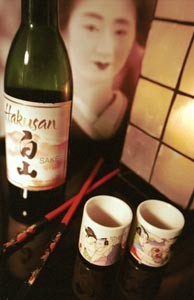
Of course the beer is the big draw. Murphy’s offers a variety of suds ($4 an imperial pint, $2.50 a glass), including Guinness Stout, Murphy’s Irish Stout, and Harp Lager from Ireland. Additionally, the bartenders pour Bass Ale, Bitburger Pilsner, Fuller’s E.S.B., Gordon Biersch Marzen, Red Tail Ale, Young’s Special London Ale, and Bellhaven Scottish Ale. Hard cider, a small selection of wines, and soft drinks are also available.

But don’t overlook the food. Many of the items are homemade and, though not fancy, make hearty accompaniments. For instance, garlic chips ($4) and popcorn chicken ($4), both served atop greaseproof paper on a plastic tray, make good beer buddies.

The chunky French fries are hot, slightly greasy, and golden-crisp with tender middles and are sprinkled with salty, garlicky flecks. The supergenerous portion of popcorn chicken is enough for four! The deep-fried pieces of chicken breast (served with ranch dressing) are hot and crunchy with an unexpected spicy afterbite.

A housemade soup ($4 a bowl, $2.75 a cup) this night is a wintry white bean and vegetable. Thick and hearty and served with housemade raisin-studded Irish soda bread, it warms and comforts.

We aren’t too impressed by two stew dishes: a vegetable mixture of broccoli, carrots, potatoes, cabbage, celery, and barley ($6.50); and a classic Irish lamb stew with cabbage, carrots and potatoes ($7.50). The veggie version has a very watery sauce. And the Irish stew (although boasting a few tasty tender pieces of lamb) lacks depth of flavor and would be improved with a less glutinous sauce.

The best entrée in our book is the piping-hot shepherd’s pie ($9.50), with its seasoned ground beef and vegetables baked with a delicious topping of smooth mashed potatoes and mild cheese, which is heated under the grill to crisp the potato topping and melt the cheese. Very satisfying, especially with a glass of Kenwood merlot ($5). Most items are served with a choice of side dishes, including mushy peas (to which you might add salt, pepper, and malt vinegar for extra ooomph).

Murphy’s offers one dessert: a sourdough bread pudding ($4). It’s a heavy plateful served with caramel and Jameson whisky sauce.

You’ll likely leave the establishment with a warm glow–not just from a bellyful of carbs, but from an enjoyable casual evening spent in the lively, hospitable environment of an authentic Irish pub.

Murphy’s Irish Pub Address: 464 First St. E., Sonoma; 935-0660 Hours: Sunday-Thursday, 11 a.m. to 11 p.m.; Friday and Saturday, 11 a.m. to 12 midnight Food: Pub grub includes many housemade items Service: Friendly, chatty Ambiance: Casual, frequently with live music; families welcome Price: Inexpensive to moderately inexpensive Wine list: Small selection since most patrons drink beer or cider Overall: 2 stars (out of 4) for the food; 3 stars for the atmosphere

From the February 10-16, 2000 issue of the Sonoma County Independent.

© Metro Publishing Inc.

Usual Suspects

0

Bench Press

Pat Gray candidacy stirs storm of protest

By Janet Wells

THE RACE for Sonoma County Superior Court Judge, Office No. 2, is heating to a roiling boil, with intimations that incumbent Patricia Gray is angling to deep-six, or at least cast doubt on, potentially unfavorable results from a Sonoma County Bar Association survey.

As is standard practice before every judicial election, the Sonoma County Bar Association distributed surveys to 1,348 attorneys just after the holidays, asking for their opinions on candidates’ abilities. By the Jan. 31 deadline, 166 responses had arrived, and local attorneys expected the results to be available this week. On Tuesday, the bar released the results for the five candidates running for a separate Superior Court seat being vacated by retiring Judge Lloyd von der Mehden. But results for the race between Gray and challenger Elliot Daum were conspicuously absent. A statement from the bar offered the provocative explanation that results were being withheld pending the outcome of a bar association board investigation into a complaint concerning the survey.

A handful of local attorneys and Daum supporters held a press conference Tuesday at Courthouse Square in downtown Santa Rosa, equating the bar association’s actions with censorship.

Apparently the bar association board will be looking into a complaint that an action by a bar staff member tainted the results of the survey. In a twist worthy of a Scott Turow plot, Sonoma County Bar Association Director Dan Schurman acknowledges that Gray is the source and that he is the subject of the complaint.

The trouble started because of his support for Daum, Schurman says. “I hosted an event where I invited my friends to come meet him,” he explains. “It wasn’t in my capacity with the Sonoma County Bar Association, but I sent [the invitation] from my Sonoma County Bar e-mail account. Pat Gray is claiming that was improper and voids the survey sent to 1,350 lawyers.”

Schurman says the bar distributed the survey a month before he sent the e-mail invitation to 12 lawyers. “[The invitation] was immediately followed by a second e-mail that this was not related to anything the bar association was doing, and that my support of Elliot does not reflect the Sonoma County Bar Association taking any position. It is a tempest in a teapot. It is absolutely ludicrous,” Schurman adds.

Gray’s complaint will be presented to the bar association board at its Feb. 14 meeting, but it is unclear when–or if–the survey results will be released.

“I trust that the Bar Association will conduct their investigation and report their findings in due course. There is no reason to speculate as to the reasons or the result of the delay,” Gray says in a statement released Tuesday through her campaign manager, David Williams. “To do otherwise is [to] speculate unfairly and cast a shadow on the Bar Association.”

SEVERAL ATTORNEYS, however, are willing to speculate that the survey will reflect a resounding lack of support for Gray. “There are a lot of people out there . . . that don’t feel that she should be a judge [because of] her temperament, her demeanor, her competency,” says Santa Rosa attorney L. Steve Turer.

Santa Rosa attorney Michael Fiumara says he was once a staunch fan of Gray’s. “I really believed in her. [But] she was very unpredictable,” he says, referring to Gray’s behavior during a case he tried in her courtroom. “One minute she was quite nice and cool, the next she was like a raging bull. She was so moody. I was terrified for my clients.”

Meanwhile, Gray’s candidacy has become a divisive issue among local Democratic Party officials and insiders, even though it’s a nonpartisan race. The Democratic Central Committee has endorsed Gray–an active party member–but Democratic Club of Santa Rosa members split on their support of Gray. One party activist reports that some club members recently asked the committee to rescind its endorsement, but were met with threats that the club’s charter might be revoked to penalize Daum supporters.

In Sonoma County’s other, mellower, judicial race, candidates received a rating of “exceptionally well qualified” from the following percentages of the bar survey’s respondents: Gregory Jilka, 37 percent; Cheryl Martinsen, 12 percent; Frank Briceno, 7 percent; James Bertoli, 2 percent; John LemMon, 1 percent.

Greg Cahill contributed to this article.

From the February 10-16, 2000 issue of the Sonoma County Independent.

© Metro Publishing Inc.

Douglas Coupland

Road rules: Gen X author Douglas Coupland may be tired of talking about his new book, Miss Wyoming, but the critics aren’t–the novel is being hailed by some as a signpost of maturity in Coupland’s unorthodox writing career.

The Ride Stuff

A short, strange trip with Gen X author and tired traveler Douglas Coupland

IT IS A DECIDEDLY low-energy Douglas Coupland who crouches at the curb in front of his San Francisco hotel. Bearing the weight of too many early mornings after too many long nights, he peers into the open doorway of an ultra-sleek black stretch limousine. As he contem-plates the vehicle’s cavernous interior, his face is a sloppy mix of sleep deprivation and mild embarrassment.

“Um, omigod,” he finally proclaims.

Generously arranged for by Coupland’s publisher, the imposing limo has been sent to transport the mild-mannered reluctant icon (author of Generation X, Shampoo Planet, and Microserfs) to the airport, where he’ll catch a flight to Seattle for another full day of interviews. With an audible sigh, Coupland clambers in and takes a seat, making room for me.

“Suddenly this feels really silly,” confesses my host, as the uniformed driver securely shuts the door behind us.

“I feel like we’re on our way to the senior prom or something,” says Coupland, peering through the tinted windows as we sail away from the sidewalk. “I feel like I should have brought you a corsage.”

Coupland, 38, a native of Vancouver, Canada, is currently finishing up a months-long book tour to promote his latest uncategorizable opus, Miss Wyoming (Pantheon Books; $23), the comic-tragic tale of two Hollywood players, one a seasoned producer of direct-to-airlines cinematic schlock and the other an emotionally wounded B-level starlet who was once a child beauty-pageant queen.

Taking advantage of strange twists of fate–he suffers a mystical near-death experience, while she is believed to have disintegrated in an airplane crash–they each drop out of their former lives, disappearing from the world’s cultural radar. The central story is about what happens after they reappear and accidentally merge into each other’s lives.

Short Cuts: An excerpt from ‘Miss Wyoming’ by Douglas Coupland.

Critics are divided over this latest offering, just as they have been since Coupland trampolined into the mainstream with 1991’s phenomenon-sparking, bestselling novel Generation X, the bible of the slacker generation. Yet the new book is widely recognized as the work of an increasingly confident (dare we say mature?) writer of idiosyncratic yet genuinely compelling fiction.

Which brings him to the West Coast, where he’s spent the last few days schlepping from bookstore to bookstore. He was hoping for a little free time to, you know, catch a movie or something, but no such luck for Coupland, who’s been receiving a surprising amount of media attention for a guy some critics wrote off years ago.

At the moment, though, Coupland wouldn’t mind a tiny bit less attention.

“I’m so tired of talking about my book,” he confesses, as our 35-minute ride begins. In demonstration of this point, he feigns snoring. “Promise me you won’t ask me anything about the book.”

“Well,” I think to myself, “although I understand how repetitious such book-hawking interviews can become, I nevertheless am a professional–as are you–and feel that I must ask you a number of precisely planned questions specifically focused on your latest novel.”

But what I say is “OK, I promise not to ask anything about the book.”

Fortunately, Douglas Coupland is the kind of author who has a lot on his mind and needs very little prompting to divulge it. In fact, the man who claims to have become an author only by accident–his book jacket lists his occupation as “designer and sculptor,” a reference to his art-school education and favorite hobby–seems to have something amusing to say on almost every subject.

He talks about movies–“1999 was just the best movie year. In the old days you would go to a movie and know everything that’s going to happen, but nowadays you go to a movie and you never know what’s going on.” And he talks about the mental habits of overly verbal people–“Even as I say these words to you, I’m seeing the words before me, like on a TelePrompter. The only time I don’t see them is when I’m sculpting”–and about the problem of Prince Charles’ face. But more on that later.

“‘Kssssshkk. This is your captain speaking,'” Coupland intones, skillfully rendering an echoey impression of airplane intercom blather. “‘Tonight’s in-flight movie will be . . . ksssshhkk . . . Sister Act 2.'”

Which brings up another of Coupland’s favorite subjects: airline flight.

“For this one-year-and-a-half window, Sister Act 2 was like this spawn from Hell that followed me on every flight I took anywhere in the world,” he complains. “The current spawn from hell is Kevin Costner and Kelly Preston in For Love of the Game. ‘Kssssshkk. Tonight’s in-flight movie will be For Love of the Game with Kevin Costner and Kelly kssssshkk Preston.’ I’ve seen it so many times I know it by heart.”

Coupland’s corner: The author wearily contemplates the next interview.

THERE IS, in fact, just such a reference in Miss Wyoming. When the movie producer character plunges into his near-death experience, the doctor who attempts to resuscitate him gripes about the in-flight omnipresence of the filmmaker’s latest film, The Other Side of Hate, of which the doctor says, “They might as well have shipped the dailies directly up to the Boeing factory.”

“Perhaps,” I wonder, “if I mention this correlation, he’ll accidentally say something about the book.”

I boldly give it a try.

“Mmmmm,” Coupland acknowledges, nodding–then offers an entirely different observation about flying.

“I sat next to Josh Brolin once on an airplane,” he says. “It’s a rule of airline flight: you never get to sit next to Jody Foster or someone cool. It’s always like, ‘Excuse me. Are you Suzanne Pleshette?'”

The airport looms in the distance.

As a last-ditch effort, I ask Coupland to name the best or worst question he’s been asked during the tour.

“Well, there have been a lot of really good ones,” he muses.

“Bingo,” I think, envisioning some penetrating query from one of Coupland’s hyperintelligent fans.

“The best question,” he reveals, “was probably ‘How do you feel about genetically modified food?’ ”

Come again?

“It’s a big deal in Canada,” he grins. Then, following some hairpin tangent that takes my breath away, Coupland is suddenly reminded of . . . Prince Charles.

“See, someday Prince Charles is going to be on our money and our postage stamps, and we’re all really dreading this. As long as he was married to Diana it was ‘Well, at least we might have an attractive person on our money.’ Then they got divorced and we all went, ‘Fuck. Now our money’s going to look like shit for decades.'”

As the limousine arrives at the terminal, gliding up to the white curb, Coupland adds, “The ironic thing is that Charles is this big anti-genetically-modified-foods person.”

And so our journey ends. As the driver unloads Coupland’s luggage, he stands up in the early afternoon sunshine.

“This was fun,” he says, meaning it. “Let’s do this again on my next tour.”

And with a handshake and a final spirited yawn, Douglas Coupland vanishes through the double doors of the terminal. I climb back in the limo for the return trip, thinking, “Well, at least he’s a funny guy. And I did like his book, even though he wouldn’t talk about it. Next tour? It’s a date.”

Next time, though, I want a corsage.

From the February 10-16, 2000 issue of the Sonoma County Independent.

© Metro Publishing Inc.

Bruce Cockburn

0

Personal Touch

Folk-rocker Bruce Cockburn’s other side

By Alan Sculley

LIKE MANY ARTISTS whose music sometimes contains a topical thread, Bruce Cockburn has often seen his songs divided into two distinct camps–the ones that are political and the tunes that are personal in nature. To Cockburn, that sort of categorization misses the major point behind his music.

“They’re all the same,” Cockburn says of his songs. “They all come from the same place. I understand the convenience of that distinction between the personal and the political song, but for me there’s no distinction. When I address an issue, for want of a better way to say it, it’s because that issue has touched me in some way and aroused an emotional response that produces a song. The same thing is true of songs about personal growth or spiritual things or sex or stupid things people do.

“The political songs, although some people may not see them this way, to me are not manifestos or anything,” he said. “They’re attempts to share my feelings about something with people. The something may be an issue people have not been aware of before or maybe one that everybody’s out of their minds [about]. But this is how it touched me.”

Having released his 25th CD last year, Breakfast in New Orleans, Dinner inTimbuktu (Ryko), the Toronto-based Cockburn has certainly covered extensive territory within his music in the 30 years since he released his first album.

As he suggests, Cockburn, 54, has written his share of intensely personal songs. Since he’s a Christian, spirituality has been a recurring, if often subtle, theme.

Cockburn, of course, has also written his share of pointedly political material. In fact, one of his biggest hits in the United States, the 1985 song “If I Had a Rocket Launcher,” was triggered by his travels to Guatemala, where he witnessed firsthand the horrors of civil war in that Central American country. He recently performed at the Luther Burbank Center–where he returns next week–with Emmy Lou Harris, Steve Earle, and others at a Landmine-Free World benefit concert, and his 1997 CD Charity of the Night featured a track, “Mines in Mozambique,” about how that country is one of the most heavily mined regions on the globe.

Cockburn has no problem with people who don’t care to tune in when he writes about political or social events. Of course, he will point out that even though the problems of Guatemala or Mozambique may seem far removed from the lives people lead in the United States or Canada, such events have more impact than many people realize.

“People are busy. Not everybody has the energy or the inclination to look very far beyond their immediate concerns,” he says.

“But the fact is that what goes on in every part of the world affects every other part of the world. And while people may not choose to notice it or may be uncomfortable noticing it, a war in Central America has led to the existence of garment sweatshops in Central America, which is taking work away from U.S. garment workers, for instance. It comes home.

“Everything comes home.”

Breakfast in New Orleans, Dinner in Timbuktu is the latest example of Cockburn’s political involvement filtering into his music. Many critics have called it one of the most personal CDs of Cockburn’s career. Possibly the most overtly political tune on Breakfast is “Let the Bad Air Out,” a rather humorous half-sung, half-rapped rant about government corruption.

BUT COCKBURN says the latest CD was flavored by yet another of his fact-finding journeys. In 1998 he was invited to participate in the making of a documentary on the efforts of people in Mali in West Africa to reverse the effects of desertification.

“The issue of desertification is aggravated in Mali because of its proximity to the Sahara,” Cockburn explains, noting that Mali borders that famous desert. “My role in the film is just to kind of be the eyes of the North American, basically, looking at how people live, particularly with respect to the issue of desertification. It’s a problem in a lot of places, but very obviously so in Mali.

“We ended up with a pretty good little film, I think.”

The new CD bears many of the stylistic and sonic trademarks of Cockburn’s work. Though a bit more acoustic and spare than his recent records, new songs such as “Last Night of the World” (a song that got considerable radio play last year) and “The Embers of Eden” find Cockburn striking his familiar understated blend of folk, blues, and rock.

But perhaps the most intriguing moment on Breakfast in New Orleans, Dinner in Timbuktu is Cockburn’s unconventional cover of Fats Domino’s “Blueberry Hill.” Judging by the mixed critical response the song has received, it is also the most controversial song on the CD.

Those used to the strolling original will be startled to hear “Blueberry Hill” turned into a languid version built around chiming guitars and a meditative tempo. This pace allows a real sense of sadness to emerge within what many consider a nostalgic good-time song.

“It’s one of the features of a song that becomes hugely popular and so much a part of the landscape that you tend to forget that it actually says something,” Cockburn notes.

“And that song, the reason it became popular is because it talks about an emotional experience that lots of people have had.”

Bruce Cockburn performs Tuesday, Feb. 15, at 8 p.m. at the Luther Burbank Center, 50 Mark West Springs Road, Santa Rosa. Tickets are $25. 546-3600.

From the February 10-16, 2000 issue of the Sonoma County Independent.

© Metro Publishing Inc.

Proposition 22 and the Mormon Faith

Conditional Love In the face of the Knight Initiative, an ex-Mormon daughter struggles with faith and family By Marina Wolf MY OLDER BROTHER, Danny, and I have always respected each other. Through the storms of adolescence we frequently managed to be civil, and even as we grew into adulthood,...

Joe Diffie

Joe Diffie gets serious on latest CD By Alan Sculley One could say that when it came to his career, Joe Diffie quit joking around with his latest CD, "A Night To Remember." It's a statement that applies, first of all, to his music itself. In recent years, Diffie had enjoyed chart...

Planned Communities

One alternative: Michael Black, an architect by trade, helped initiate Two Acre Wood, an intentional housing development that opened last August in Sebastopol. The project, says Black, is based on sound humanistic principles. A Different Path Intentional communities gain a foothold By Yosha Bourgea MICHAEL BLACK is...

Botanica Erotica

Evangelists of eroticism: Dae Williams and Diana DeLuca. Natural Urges Founders of Botanica Erotica preach healing power of pleasure DIANA DELUCA and Dae Williams are on a mission from God. Or Goddess. Or both, depending on one's point of view. Their calling--and to hear the Sebastopol women...

Sex Tips

Operating instructions for the sexually challenged AS ANYONE who pays attention to the news--and to politics in particular--must surely be aware, there are certain nefarious forces afoot these days that claim, quite loudly and vociferously, that the institution of marriage, if not exactly being faced with imminent extinction, is surely being...

‘Amadeus,’ ‘La Cage aux Folles’

Amadeus. Music Makers Two theatrical productions strike high notes By Daedalus Howell CURSE the ephemeral nature of live theater! Though it will be gone from the stage in just a few weeks, Sonoma County Repertory's production of playwright Peter Shaffer's Amadeus should be bottled and shared with the generations. ...

Murphy’s Irish Pub

Seasonal spirits: Larry Murphy keeps the ale--and the good times--flowing at Murphy's Irish Pub in Sonoma. Suds 'n' Grub Murphy's Irish Pub: a casual hangout with lots of lively atmosphere By Paula Harris IT'S A DRIZZLY DARK night in downtown Sonoma. For once, the historic plaza is...

Usual Suspects

Bench Press Pat Gray candidacy stirs storm of protest By Janet Wells THE RACE for Sonoma County Superior Court Judge, Office No. 2, is heating to a roiling boil, with intimations that incumbent Patricia Gray is angling to deep-six, or at least cast doubt on, potentially unfavorable results from a Sonoma...

Douglas Coupland

Road rules: Gen X author Douglas Coupland may be tired of talking about his new book, Miss Wyoming, but the critics aren't--the novel is being hailed by some as a signpost of maturity in Coupland's unorthodox writing career. The Ride Stuff A short, strange trip with Gen X author and...

Bruce Cockburn

Personal Touch Folk-rocker Bruce Cockburn's other side By Alan Sculley LIKE MANY ARTISTS whose music sometimes contains a topical thread, Bruce Cockburn has often seen his songs divided into two distinct camps--the ones that are political and the tunes that are personal in nature. To Cockburn, that sort of categorization misses...
11,084FansLike
4,446FollowersFollow
6,928FollowersFollow