Advance the Ministries of the Gospel

0

The Jesus Seminar has many critics. Fundamentalists and biblical experts have been calling the Westar scholars nasty names since the very beginning, using every bad word from “arrogant” and “ludicrous” to “heretical” and “devilish.” Ouch. A number of Christian publications have even set themselves up as watchdogs of the Jesus Seminar’s work, routinely reporting the seminar’s heretical doings back to their predictably aghast readers. One such publication is Pulpit Helps, a ministerial resource newsletter put out by AMG International.

AMG stands for Advance the Ministries of the Gospel.

A recent edition of Pulpit Helps carried an article by Robert G. Witty, in which he attacked Westar founder Robert Funk, questioning whether the highly educated scholar is “the proper voice” to be evaluating questions of biblical faith. The reasons that Witty cites as “factual proof” of Funk’s incompetence include references to reports that quote Funk stating the following points:

He doubts the Virgin Birth, the resurrection of Jesus, and the existence of a personal God; Darwin effectively explained away the story of Creation; prayer is meaningless except as meditation; and much of what the statements ascribed to Jesus in the Bible were made up and slipped in by other people, years after the fact.

According to Witty, these “facts” identify Funk’s convictions as being “in contrast with the essentials of the Christian faith,” which somehow makes Funk unqualified to offer scholarly opinions on the Bible.

The author ends his refutation by offering what he calls “the only possible evaluation of this supposedly prestigious group.” This evaluation comes in the form of Scripture. Matthew 7:15, to be specific, wherein Jesus growls, “Beware of false prophets, which come to you in sheep’s clothing, but inwardly they are ravening wolves.”

Double ouch.

On the other hand, according to Funk and the majority of the 200 scholars of the Jesus Seminar, the scriptural accusation can hardly seem too damning.

It turns out Jesus never actually said that.

From the February 15-21, 2001 issue of the Northern California Bohemian.

© Metro Publishing Inc.

Teen Sex and Virginity

Pledge Break

Chastity vs. emotional intelligence

By Jennifer Foote Sweeney

WHOMP, there it is: a 63-page report on teen sex and virginity derived from the survey of nearly 100,000 adolescents at 145 schools by a handful of researchers funded with money from 19 federal agencies. Talk about tasty media chum. Toss out words like “sexual behavior of teenagers,” “virginity,” and “highly effective,” and the parents of adolescents claw their way to newsstand and keyboard in a panicky search for enlightenment, looking, always, for relief from the kind of angst they heaped on their own elders just long enough ago not to remember.

So what did they–we–learn from the study of “virginity pledges” by the National Institute of Child Health and Human Development?

Nothing new–all of it depressing. And the stuff that wasn’t there, the data between the lines? So infuriating, so heartbreaking, that it makes me want to cry.

Not that the titles, subtitles, conclusions, and comments by interested parties in this report won’t flirt with the vulnerable sensibilities of parents in denial and their poor, innocent children. The big news, the juicy part of the recently released study, was very high-concept. The virginity pledge movement, brainchild of the Southern Baptist Church and favorite fad of teen mags (“Virginity is hot,” said Young and Modern magazine in an issue featuring the 100 secrets of Leonardo DiCaprio), has been a resounding success, according to the study’s chief researchers.

This in an introduction that opens with a line from the Madonna song “Like a Virgin.” Pledgers, announces the study, postpone first-time sexual intercourse for an average of 18 months longer than nonpledgers.

This is heavenly news for Jimmy Hester, coordinator of the True Love Waits campaign. He told the New York Times recently that the report was great news since it proves that pledges do make a difference. On first reading–if it is a quick skim with frequent interruptions–there is a hint of the positive for those who might disagree with Hester about sex out of wedlock.

“Surely,” even the most liberal parents will mutter, “it is best if a teenager postpones sex for as long as possible, even if true love doesn’t wait for the sanctity of marriage.”

Ah, but this wishful thinking must die–gruesomely–in a hail of caveats, I’m afraid, once the report is fully digested.

The first, elephant-in-the-corner-type caveat concerns why teenagers take, or don’t take, the virginity pledge. According to the report, kids will pledge to stay virgins until marriage only if it is “cool,” which usually means that other kids are taking the pledge. But kids won’t take the pledge if so many other kids are pledging virginity that it is “uncool.”

Say the researchers: “The pledge works because it is embedded in an identity movement. Consequently, like other identity movements, the pledge identity is relatively fragile and meaningful only in contexts where it is at least partially non-normative.”

My favorite description of this conundrum? “The pledge effect is largely contextual.”

In other words, a virginity pledge, like glitter powder and Abercrombie & Fitch sweatshirts, is based on the painfully self-conscious surrender of self and not, as Hester wants to believe, on the early adoption of family values. It ceases to be attractive when Leo expresses a preference for sex or when virginity is no longer “hot” or so “hot” that it becomes “uncool.”

(Nothing is said in the study about the troubling possibility that the respondents to the survey, wishing, as always, to be “cool,” might have lied on their questionnaires about making the pledge or breaking the pledge or anything else, for that matter, in order to follow the non-normative rules of the day.)

The average delay incurred by the virginity pledge, reports the study, tends to be about 18 months–marriage appears not to be a factor. And then there’s the part about how the pledge works best among 15- to 17-year-olds (not so well among 18-year-olds), and that it helps if the pledger is religious, of Asian ancestry, in a romantic relationship, or less advanced in pubertal development. (Pause here for the adolescent–pledger or non–to utter, “Duh.”)

And finally–whoops!–when pledgers break their pledges they have a tendency to have unsafe sex. Researchers suggest that since the pledgers promised not to have sex, when they finally do, they haven’t done much planning and are unlikely to use contraception. (Another favorite footnote here: “That pledgers who have sex are likely to be contraceptively unprepared is to be expected, for it is hard to imagine how one could both pledge to be a virgin until marriage and carry a condom while unmarried.”)

But there’s more.

Researchers asked their subjects only about vaginal intercourse. They did not ask about oral or anal sex, which recent studies indicate are reported at high rates among teenagers, more and more of whom believe that oral and anal sex can be indulged in without relinquishing one’s virginity.

In fact, a recent study by the Urban Institute, also funded by the federal government, focused on the sexual practices of 15- to 19-year-old boys and found that two thirds of the more than 3,000 boys interviewed had experience with oral sex, anal intercourse, or masturbation by a female.

The first two behaviors put the participants at risk of getting sexually transmitted diseases, though few of the respondents were aware of that. Most of those interviewed said they did not consider their activities to constitute “sex”–in fact, many felt oral sex qualified as abstinent behavior.

So the pledgers who, according to the study, jealously guarded their “virginity” for an average of 18 months longer than nonpledgers could well have been having sex of another kind–every other kind–for years before “breaking” their pledge.

Didn’t we cover this? Didn’t we denounce this? Wasn’t Bill Clinton guilty of sexual relations with “that woman” even though he believed that he was dutifully maintaining his own virginity pledge?

How, oh how, can it be morally acceptable to indulge in sex that involves complicating intimacy, not to mention sexually transmitted diseases, as long as one is “intact” on the wedding night? And why, oh why, would a federal agency conduct a study in such a way as to blindly honor a duplicitous and deeply sexist definition of virginity?

But that, alas, is not the worst of it. That is not the part that makes me want to cry.

The part that I hate most in this study is the unwritten part, the part that pompously assumes that teenagers are not entitled to intimacy, to pleasure, to education, or to a sense of self.

The part that is dangerous and sad implies that a “virginity pledge” is “effective” in dealing with teen pregnancy, sexually transmitted diseases, and participation in other “risk” activities like smoking, drinking, and substance abuse but fails to acknowledge the role of the pledge movement in promoting oral and anal sex among teenagers while denying them any education about either.

The part that is sneaky and amazing perpetuates the concept of “technical virginity,” a state that is likely to be just as confusing and burdensome for a 16-year-old as sexual intercourse, if not more so, given its uncomfortable and much-talked-about proximity to untruth.

WHAT WOULD be ineffective about a pledge to have safe sex motivated by what feels like love or desire? What could be wrong about acknowledging a teenager’s emotional intelligence and need for intimacy?

Would it hurt to bestow some respect and sex education on people who are engaging in sex, regardless of what they write on an invasive questionnaire designed to measure their moral rectitude?

How could researchers who ostensibly care about adolescents insist that they are incapable of informed decisions?

How could they endorse the idea that love and intimacy should be postponed–not until an unspecific age of maturity has been reached but until marriage, regardless of when it happens?

I agree with the authors of this report when they suggest that teenagers should not engage in unwanted sexual activity. Nobody should engage in unwanted sexual activity. What a shame, though, given the funding and access that these academics enjoy, that they don’t expose the “virginity pledge” for what it is: a sexist, guilt-driven campaign of terror that fosters frightened conformity in adolescents, as well as high-risk sexual behavior and dishonesty.

This article originated on Salon.com

From the February 8-14, 2001 issue of the Northern California Bohemian.

© Metro Publishing Inc.

Oliver Hunt

1

Life’s a Blast

Trumpet prodigy blows them away

By Paula Harris

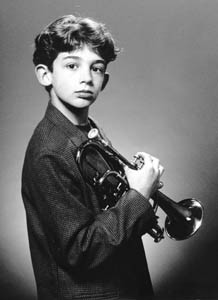
ON A HUSHED Fairfield stage the Solano Symphony Orchestra is poised to perform Haydn’s Trumpet Concerto in E-flat major. The audience draws a quiet, collective breath as a young kid marches in from the wings dressed in a miniature black tuxedo and swinging a gleaming trumpet in his small hand.

Meet Oliver Hunt. At 13 years old, this Petaluma Junior High School eighth-grader is being touted by some as a young trumpeter in the vein of jazz legend Miles Davis.

On this evening last December, Hunt switches from jazz to classical, trills and all, for the Haydn composition. But a cool jazzy style still colors the performance of the 4-foot-11-inch trumpet player–who stands as tall as the seated adult musicians–as he keeps the rhythm by tapping his size-4 foot.

The talented Hunt has been playing for only five years, but he’s already sounding as polished as many musicians who’ve spent a frustrating lifetime attempting to perfect their art.

On Feb. 10, Hunt brings his talent to the Luther Burbank Center to perform with his quartet in a benefit concert that also features classical pianist Arro Beaulieu.

Debuting this month is Cedra, a new compact disc recording by the Oliver Hunt Quartet (which also features Hunt’s father, Robb, on piano). The recording includes classics such as “All the Things You Are” and “It Never Entered My Mind.”

In person, the young trumpet player comes across as diligent and mature, despite his tender years. In fact, it’s hard not to believe you’re not chatting with a small-boned 50 year-old as you look into Hunt’s earnest face. “I guess to some extent I’m unusual,” he admits seriously. “I certainly differ from the other children.”

That’s for sure. His bedroom contains a collection of stuffed animals and comic books, but it also sports an array of jazz and classical music on the shelves. A number of different horns, including a fluegelhorn, a trumpet, and two cornets, are all carefully laid out on a rack for easy access for whenever Hunt wants to practice.

The question is more when doesn’t he want to drill.

“I usually try to get in four solid hours each day,” he explains. As soon as Hunt wakes up in the morning, he puts in a good hour and 15 minutes, then practices for another hour after he gets home from school. After getting through his homework, Hunt puts in yet another hour or so on the horn.

“All the practice really adds up,” he says, adding that juggling schoolwork, his other hobby of Olympic-style diving, and music can be tough. “You think about the music all day and the complication of it–but usually I can manage,” he says.

Hunt took up the trumpet at age 8 after endlessly watching a Miles Davis video with his father. “When it came time to join the school orchestra I decided to play a brass instrument because I always liked the sound,” he explains.

Miles Davis hasn’t been the only musical influence on Hunt, who idolizes old-time jazz giants the way most kids his age sing the praises of Britney or the Back Street Boys.

“I also like Chet Baker,” Hunt says. “[Baker’s] sound and the fluidity in his playing are teaching generations of players. And Clifford Brown also inspired me because his phrasing influenced all of bebop.”

Hunt, who describes himself as “a well-built individual with big hair” who doesn’t yet have a girlfriend, says his plans for the future involve–what else?–more music.

“I plan to become a trumpet virtuoso and make a living out of that, probably, ” he says. “Overall, no matter what I do I’d like to be a great trumpet player.”

Random notes: This May 11 marks the 20th anniversary of reggae superstar Bob Marley’s death, and Bay Area celebrants once again will commemorate his life with a pair of memorial concerts during Black History Month. On Friday, Feb. 9, Groundation, a 13-piece band, will present a tribute to Marley, performing songs from the late singer/songwriter’s rich repertoire. The show at the Mystic Theater in Petaluma begins at 9:30 p.m. That same night, across town at the Phoenix Theatre, the Northern California reggae band Strictly Roots will perform its own songs at a Bob Marley birthday bash (actually, Marley was born on April 5). That show kicks off at 8 p.m. Meanwhile, the Maritime Hall in San Francisco will offer a three-night Bob Marley Days 2001 concert series beginning Feb. 23 with Capleton (a.k.a. Jamaican dancehall star Clifton Bailey). The reggae nights continue Feb. 24 when Toots & the Maytals preach their soulful Jamaican gospel (always one of the highlights on the reggae calendar) and Marley’s son Ky-Mani Marley closes out the run on Feb. 25.

The Classic Jazz Benefit and Auction takes place Saturday, Feb. 10, at 6 p.m. at the Luther Burbank Center, 50 Mark West Springs Road, Santa Rosa. Proceeds go to Willow Wood Waldorf School. Tickets are $30. 707/829-1330.

From the February 8-14, 2001 issue of the Northern California Bohemian.

© Metro Publishing Inc.

Open Mic

0

Madly in Love

THE FIRST GIRL I ever fell for was Bonnie Burger, the ponytailed blond who sat in front of me in second grade. To my hyperactive 8-year-old mind, Bonnie was the most beautiful human to have graced the ever-shifting tectonic plates of the previously pathetic planet. For weeks, she was all I thought and dreamed about. I personally defaced at least a dozen desks with pocket-knifed inscriptions of her name, and lost my first fist-fight defending her honor after some Neanderthal fifth-grader dared to call her “Bonnie Booger.”

Then the beautiful Bonnie Burger moved to Georgia.

Thirty years later, I happened upon an old yearbook and found her picture, in all its pimply, buck-toothed glory. Yikes! Was I crazy? This was the girl I lost a tooth over? Now that I remember it, she didn’t even like me.

Well, it turns out that I may have actually been crazy.

A team of international biologists have published a study that may prove it. “Alteration of the Platelet Seratonin Transporter in Romantic Love” shows evidence that when human beings fall in love, their brains undergo a sharp 40 percent reduction of the chemical seratonin, the same 40 percent reduction observed in people with severe obsessive-compulsive disorder. In other words, falling in love really is like losing your mind–at least temporarily. OCD sufferers–Jack Nicholson played one in As Good as It Gets–become irrationally fixated on certain objects, activities, or persons. Humans in the early bloom of love become similarly fixated on the object of their desire, able to moon over them for disgustingly long periods of time and to perform extraordinarily bizarre acts–like spending 75 bucks for a dozen thorny red vegetables–in order to attract their paramour’s attention.

The authors of the study offer an explanation for this phenomenon that is, from a propagation of the species point of view, scientifically sound. “Without intense emotion,” says co-author Hagop Akiskal, “no one in their right mind would fall in love.”

Going nuts, then, is as vital to love and romance as candlelight dinners and engagement rings and legally binding marriage certificates. Probably even more so.

Therefore, as Feb. 14 approaches, with the heady weight of science behind me, I encourage you to get a little crazy this time. It’s good for you, and it’s good for the species. And Bonnie Burger, wherever you are, have a Happy Valentine’s Day.

From the February 8-14, 2001 issue of the Northern California Bohemian.

© Metro Publishing Inc.
‘Hannibal’

Joy of Cooking

‘Hannibal’ provides gourmet horror

By

TO SAY THAT the movie Hannibal has more brains than the book may be giving too much away, as well as lending the wrong impression to an already queasy audience. Credited to David Mamet and Steve Zaillian, the script preserves the guts of Thomas Harris’ entertaining yet repellent bestseller. The screenplay cuts back the travelogue and the novel’s homophobia. Best of all, the movie changes the book’s ending, which was like having Holmes and Moriarity ending up in bed together.

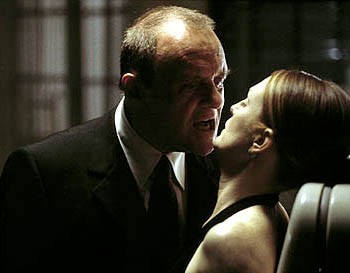
In this sequel to The Silence of the Lambs, FBI special agent Starling (Julianne Moore, replacing Jodie Foster) is in disgrace with the department, troubles exacerbated by the sexual insults of a preppy Justice Department liaison played by Ray Liotta. Starling’s well-publicized failure draws the attention of Anthony Hopkins’ Dr. Hannibal Lecter, who is disguised as “Dr. Fell” and working cozily as a curator at one of the city of Florence’s private galleries.

Director Ridley Scott’s best gift as a director is creating cities for the screen. He mixes in the city of Florence, the old city and fire-lit slums, making it the perfect lair for Lecter. Lecter’s living victim, Mason Verger (Gary Oldman), a vengeful and disfigured millionaire, happens to own the Biltmore estate in Asheville–North America’s largest private home. At the end, Clarice Starling is pursuing Dr. Lecter through downtown Washington, D.C., and the chase ends in front of the Italianate castle of Union Station. The buildings add fairy-tale qualities to the story, even as much as Lecter’s baroque way of handling those who get in his way.

Is Hannibal more than deluxe horror? The answer is no. Though the film is greatly improved over the book, there are still the structural problems in all these locations: anti-hero and heroine only connecting at the ending; villain and anti-hero sharing only a scant minute together.

Still, Oldman’s makeup astonished even this fan of the grisly craft. He looks like an evil fetus painted by Francis Bacon. Because of his bad eye, the light has to go on slowly for Oldman’s Verger’s room. A rheostat buzzes as it gradually gets brighter and that memorable face is revealed; the effect is like a cabinet of horrors in some decaying penny arcade.

Compared to Jodi Foster’s Clarice–the lamb that outsmarted the wolf–Hannibal’s version of Starling isn’t that complex a character. (Part of the trouble is that the character of Starling has been strip-mined by several seasons of TV’s The X-Files–Agent Scully is clearly based on The Silence of the Lambs‘ heroine). Still, Julianne Moore is a better actress than Jodie Foster, having been places and made choices Foster hasn’t approached. The woman’s cool reactions belie Lecter’s cheap Freudian idea that Starling is still bolluxed up about her dead father.

The story is titled Hannibal, and Hannibal’s what you get. This film exists for its gilded shock, and it delivers. I’d praise it with the words a horror-loving friend always uses for the most wicked horror films: “It’ll make you feel really bad.”

From the February 8-14, 2001 issue of the Northern California Bohemian.

© Metro Publishing Inc.
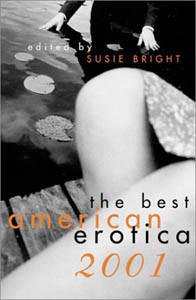
‘The Best American Erotica 2001,’ ed. Susie Bright

Ready for romance? Books can help! Really!

By Patrick Sullivan

AH, LOVE. Is any human endeavor more fraught with frustrating little mysteries? Was it Winston Churchill or Puff Daddy who called romance “a riddle wrapped inside an enigma smothered in secret sauce”? Both, probably: great minds think alike.

Chief among the puzzles: Why do we fall for people who don’t love us back? Also, why do weird, icky people fall in love with us? And, perhaps most important, how can we find out whether our special someone wears boxers, briefs, or something pink and lacy?

News flash: books can help! They have the wisdom of the ages. They provide fresh insights from thoughtful minds. And, properly displayed, they make us look much more intelligent, thus activating that lusty little gene in our beloved that craves a brainy companion–check and mate, to quote the chess nerds.

But not just any books will do. Of the thousands of new volumes rolling off the presses at American publishing houses this year, roughly 97.5 percent offer how-to advice about love and sex. The remaining 2.5 percent serve up fiction about the same subjects.

Sure, you could roll around in this haystack until you felt the prick of the needle, but there’s no need to waste time. Only two new books are indispensable for your bedside table: Hot Chocolate for the Mystical Lover (Plume; $13), edited by Arielle Ford; and The Best American Erotica 2001 (Touchstone; $13) edited by Susie Bright.

At first blush, of course, no two books could seem more different. Yes, they both contain love stories of a sort (and both cost $13), but that’s where the resemblance ends–on the surface, anyway.

Arielle Ford has put together a romantic collection of tales about people (one man and one woman, inevitably) brought together in amazing ways by various higher powers. The stories–written by both ordinary folks and such spiritual superstars as rock singer Kenny Loggins–begin like this: “It finally occurred to me that angels might know more about love than I do.” Or like this: “The first time I encountered Ken was somewhere on the astral plane–in a dream.”

Sexpert and cultural provocateur Susie Bright has assembled a collection of short fiction about people (one man and one woman, two men, two women, two men and one woman, one man and a sex toy, and a few more creative combinations) brought together by another higher power–human lust.

THESE STORIES, authored by writers ranging from erotic website editor Cara Bruce to O’Henry Award-winning writer Nathan Englander, usually begin like this: “I work in a place ‘nice girls’ don’t usually visit.” Or like this: “What I love most about Jason’s cock is not its size but its grace, in every sense.”

In Hot Chocolate for the Mystical Lover, people learn the identity of their beloved from a psychic, an astrologer, a dream, or by looking closely at people’s auras. In a fascinating foreword, spiritual adviser Deepak Chopra explains the concept of soul mates that helped inspire this book: “A soul mate would therefore be a perfect archetypal relationship that’s vibrating at the same frequency of consciousness and evolving at the same rate as well.”

Vibrations of a different sort are at work in Best American Erotica, where our heroes and heroines find their lovers by doing things like following them into the stall in a restaurant bathroom. In the introduction to this year’s collection, Bright explains her own inspiration for sifting through the mountains of erotica to find these choice picks: “When I see the plethora of erotic books and Web sites, I say, ‘Good for them.’ Good for their initiative, their hard clits and wet pants.”

But don’t let these piddly differences throw you. Beneath the surface, these two books have a few important things in common. Yes, Hot Chocolate offers true stories that read like fiction, and Best American Erotica offers short fiction that often reads like the truth. But both books offer plenty of helpful advice on mastering the challenging art of love.

Want to know what to do if a disembodied voice suddenly commands you to go seek your soul mate at the New York Aquarium? Hot Chocolate answers that very question in “Happily Ever After,” a story by Marcia Zina Mager. (And no, the solution is not to check yourself into a psychiatric hospital and start a vigorous course of antipsychotic medication.)

Need advice on the best lubricant to use if you’re starting a vigorous love affair with your bathroom sink? Open up Best American Erotica 2001 and you’ll see that Matt Bernstein explores the issue in his story “Sink.”

Both books also use humor to make their points.

In “”You’re Not Going to Like What We’re About to Tell You, Said the Psychic,” world-weary Hot Chocolate writer P. G. Osbourne offers some dating tips: “I selected my dates carefully, weeding out every astrological sign that had ever caused me grief. That essentially left the sign of Taurus.”

In “Deflower,” Best American Erotica writer Rosalind Christine Lloyd details a steamy encounter that begins when a woman attracts the narrator at a flower stand by doing something obscene to a hapless pink rose. After a bout of sadomasochistic lovemaking, the narrator leaves her newfound friend quivering and satisfied, commenting, “In hindsight, I think she learned a valuable lesson about disturbing flowers.”

Finally, both books answer another question that probably occurs to most readers: Who are the people writing this stuff? In the author notes in the back of Hot Chocolate, we learn that Nicholas C. Newmont is “a clairvoyant, hypnotherapist, and expert in palmistry.” He even gives a phone number!

Best American Erotica contributor Todd Belton, explains his author note, “knows the location and exact contents of every single fetish fiction page on the Web.” But sorry, ladies: Belton provides no contact info, so you’ll have to go elsewhere in search of your soul mate.

From the February 8-14, 2001 issue of the Northern California Bohemian.

© Metro Publishing Inc.
‘Popcorn’

Stale ‘Popcorn’

Play’s riff on ‘Natural Born Killers’ is old news

By Daedalus Howell

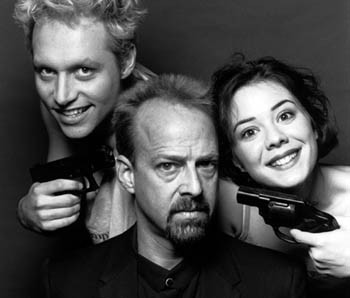
Rohnert Park-based Pacific Alliance Stage Company’s production of playwright Ben Elton’s Popcorn (directed by Michael Grice) has little pop but a lot of corn. A riff on Oliver Stone and Quentin Tarantino’s ill-fated 1994 collaboration Natural Born Killers (at odds with Stone, Tarantino later disowned the film), Popcorn explores what would happen if a couple, inspired by the fictional bullet-ballet flick Ordinary Americans, went on a murder spree that eventually ends at the film director’s Beverly Hills abode. Read: Irony with a capital Why.

Billed as a “comedy thriller,” the play provides laughs that are thin, but palatable, like rice paper. But the thrills pale in comparison to putting a raisin in one’s navel. Why a raisin? Hey, why this play?

One of the primary problems is that the play endeavors to indict the self-indictment of its source material–like slapping the hand that gives the proverbial slap on the wrist, then biting it because it fed them.

Are certain forms of entertainment (specifically those generated by the mythic Bitch Goddess of Hollywood) a sublimation of our wicked and never-to-be-realized desires or their very inspiration? Alas, it’s a question as old as the pay dirt from which it sprouted. As one character asks rhetorically, “Weren’t there any sickos before we had movies?” The answer is yes, though some would argue that now there are more–though they’re less creative.

Filmmaker Philip Kaufman’s Quills recently mapped this well-trodden territory masterfully. But alas, chicken-and-egg conundrums don’t make for lasting public debates, and where Quills posed innovative new questions, Popcorn still can’t answer the old ones.

A tepid Grand Guignol that frequently suffers from screen envy (the unfortunate attempt by some dramatists to import glitzy elements from the cinema into their productions), Popcorn is bloated with gun blasts, sound effects, and SWAT team ropes that drop from the ceiling. It’s all jarring, but not exciting. Of the central characters, James Arquin plays psycho du jour Wayne, though his lanky good looks make him seem more like a gun-toting Backstreet Boy.

Unable to disguise the fact that he is more intelligent than his role, Arquin employs a barrage of stage antics that serve only to remind that he is neither tough nor psychotic. For example, he is constantly chewing–what is he chewing? Apparently just the scenery. Arquin is more white noise than the white trash his character purports to be, though he is oddly likable–not compelling, but likable.

Laura Odeh, usually an intriguing actress, gets to aim low with Scout, Wayne’s wife and sidekick, and (wow!) hits her target. Apart from the inspired eerie giggle Scout emits whenever she is titillated by gore, Odeh is left with little room for invention. One waits for her talents to shine through, but the part is just too cartoonish.

Ken Sonkin, however, delivers a top-drawer performance as the conflicted film director Bruce Delamitri, your Type A Hollywood stereotype–crass, fast-talking, and ingeniously charismatic. Take a gander at Sonkin’s headshot hanging in the theater’s lobby and behold the striking physical transformation Sonkin undergoes for this part–peroxide, Van Dyke goatee, super tan. Sonkin’s performance is the only reason to see this living-history museum of mid-’90s American cinema.

The lesson of Popcorn is that Hollywood bashing should be left to Hollywood–they’ve got the budget for it. Moreover, if you want to be preached at, go to church.

Popcorn is a time capsule opened before it was ripe. Shelve it for 20 years and perhaps it will be relevant. Right now, you’re better off renting the movies from which it steals its shtick. They’re cheaper.

‘Popcorn’ hits the stage on Thursday, Feb. 8, at 7:30 p.m.; Friday-Saturday, Feb. 9-10, at 8 p.m.; and Sunday, Feb. 11, at 2:30 p.m. at Spreckels Center, 5409 Snyder Lane, Rohnert Park. 707/588-3434.

From the February 8-14, 2001 issue of the Northern California Bohemian.

© Metro Publishing Inc.
‘Suicide Club’

0

The Suicide Club.

Bloody Good Show

Low-budget ‘Suicide Club’ offers big bang for the buck

WHEN ROGER Corman, the grandfather of modern independent film, came out with the loony sci-fi oddity Battle beyond the Stars, way back in 1980, the Star Wars homage was touted as the low-budget filmmaker’s most expensive film ever. It cost him $1 million–a mere pittance, even in 1980.

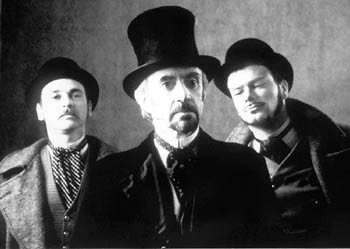
The legendary producer doubled that budget for his latest film, The Suicide Club, directed by relative newcomer Rachel Samuels and based on a short story by Robert Louis Stevenson. Yes, The Suicide Club was made for a whole $2 million, and it’s a tribute to Corman’s knack for doing more with a buck than other filmmakers can do with 50 that this rousing Victorian thriller is as good as it is.

Reminiscent of the classic Edgar Allan Poe adaptations that Corman directed back in the ’60s, The Suicide Club–his first major theatrical release in years–is a stylish and entertaining costume piece that works precisely because it knows how far-fetched it is.

The film is only loosely based on the Stevenson story–and if you’ve ever read that ponderous tale, you’ll know that’s a good thing. The revised-for-speed film version is set in 1899 England and revolves around the happenings at an exclusive organization called “the Suicide Club.”

Run by the shadowy Mr. Bourne (an appropriately devilish Jonathan Pryce), the club caters to rich Englishmen–and one mysterious woman, the haunted Sara Wolverton (Catherine Siggins). They have all, through grief or pain or boredom, lost their appetite for living. What Bourne offers them is simple: “A quick and easy way to exit life.” Every night, the members gather for a morose social hour spent drinking, smoking hashish, toasting one another with glib remarks (“To your bad health”), and mocking the poor folk who’ve tried ending their own unhappiness with psychological therapy–what the stuffy Suicide Clubbers disdainfully call “the new ‘Talking Cure.’ ”

At the sound of a bell, they assemble at a ceremonial table, where a deck of cards is dealt, one card per member. The lucky depressive who gets the ace of spades will be rewarded by a quick death. “Congratulations, Mr. Clayton,” Bourne purrs, the first time the game is played. “Tonight is your night.” To make things even more interesting, whoever draws the ace of clubs is the one assigned to do the killing.

Into this orderly death cult comes the young Capt. Henry Joyce (David Morrissey), a war hero lost in grief since the death of his wife. Eager to die but unable to take his own life, he joins the club after hearing of it in a chance encounter. Once he’s in, of course, there’s no way out.

That Joyce will fall for the beautiful Sara Worthington is a given. That he will find a renewed desire for life in his growing need to protect her can also be assumed, as can the revelation that Bourne is even more monstrous than we first assume. Though few real surprises come along, it is the film’s giddy Gothic exuberance that makes it so entertaining. The story clips along at a swift pace, and though the director botches the continuity once or twice with some confusingly edited action sequences, she generally builds a sharp tension and a fine sense of atmosphere.

The performances are first-rate. Pryce (of Something Wicked This Way Comes) always looks marvelous in a top hat and tails and appears to be having a ball playing yet another bad guy. Morrissey has the right weepy-eyed despondency, and Siggins is a good mix of icy determination and wistful uncertainty.

All told, it’s a satisfying bit of cinematic puffery, with no moral or message to get in its way.

The Suicide Club is two million bucks’ worth of schlocky fun.

‘The Suicide Club’ opens Friday, Feb. 9, at the Rafael Film Center, 1118 Fourth St., San Rafael. For details, see or call 415/454-1222.

From the February 8-14, 2001 issue of the Northern California Bohemian.

© Metro Publishing Inc.
Shirley Horn

0

Upcoming Shirley Horn CD is a romantic affair

By Greg Cahill

MILES DAVIS discovered vocalist Shirley Horn in a Washington, D.C., piano bar in the mid-’60s and immediately recognized her immense talent as a ballad singer. Over the years, the two paid tribute to each other in odd ways–it was Horn who persuaded Davis, after a long hiatus, to begin recording ballads shortly before the trumpet legend’s death. And, in 1998, she earned a Grammy Award for the gorgeous I Remember Miles (her last seven albums have garnered Grammy nominations). You’re My Thrill (Verve), scheduled for a Feb. 27 release, is classic Horn, a sultry seasoned romantic–never overly sentimental or bitter–who blows smoke rings around jazz/pop singer Diane Krall.

From the February 8-14, 2001 issue of the Northern California Bohemian.

© Metro Publishing Inc.
Newsgrinder

Important events as reported by daily newspapers and summarized by Daedalus Howell.

Monday 02.05.01

George Lucas’ own private Death Star, nestled in the hills of Big Rock Ranch in Nicasio, may be running a little dry. The North Marin Water District is at odds with Lucasfilm over the potential diversion of water from Nicasio Creek for a planned seven-acre reservoir to serve George Lucas’ 184,694-square-foot complex, which will purportedly have its own parking facility (tractor beam optional). Lucasfilm’s application was protested by the National Marine Fishery Service and the U.S. Fish and Wildlife Service, but those challenges, as if abated by some Jedi mind trick, have been mysteriously dropped. “They were able to negotiate independently with Lucasfilm [over potential impacts to endangered species],” said Kathy Bare, a water resource control engineer with the state water regulator. (Note: Ewoks are not protected under the Endangered Species Act because they are considered vermin.)

Monday 02.05.01

Beachcomber Morgan Logan found a gray plastic cylinder while walking his dog on Salmon Creek State Beach early Sunday afternoon, reports the Press Democrat. He put the two-foot-long cylinder in his pickup truck and drove it into the town of Bodega, where he wrenched open the cylinder to discover “sand, water, and a device with corroded fins.” A mechanical fish? No! A bomb! Logan admitted, “I’m not an authority, but I knew I didn’t want to have my hands on it anymore.” Sheriff’s officials were called and identified the device as an 81mm mortar round. Though they know not from whence it came, some speculate the mortar shell was left over after a recent incident in which four elderly men in a rubber dingy stormed the shore, exclaiming they were there finally to liberate Normandy.

Monday 02.05.01

Engineering students from the University of British Columbia tethered the body of a Volkswagen Beetle to the railing of the Golden Gate Bridge, drawing first blood in what will undoubtedly become the largest college rivalry in history, reports the Associated Press. Bridge workers cut the car loose, whereupon it sank into the bay. Student Chad Brown would not reveal the culprits. “They still have to get across the border, you know,” he said. Too bad their car is at the bottom of the bay. Plans for retaliation are under way–students from Sonoma State University suggest plaguing the Canucks with unnecessary performing arts centers.

Sunday 02.04.01

Santa Rosa firefighters have scored a $20,000 thermal imaging camera that allows them to “see” through thick smoke and darkness, reports the Press Democrat. The camera, developed by the military, can be carried like a video camera, attached to a helmet, or even used as an Internet “dorm-cam.” Traditionally, firefighters crawl low, carry a hose, and methodically feel their way through a smoke-filled room, hoping to bump into someone. Not unlike many frat-boy activities.

From the February 8-14, 2001 issue of the Northern California Bohemian.

© Metro Publishing Inc.
Advance the Ministries of the Gospel

The Jesus Seminar has many critics. Fundamentalists and biblical experts have been calling the Westar scholars nasty names since the very beginning, using every bad word from "arrogant" and "ludicrous" to "heretical" and "devilish." Ouch. A number of Christian publications have even set themselves up as watchdogs of the Jesus Seminar's work, routinely...

Teen Sex and Virginity

Pledge Break Chastity vs. emotional intelligence By Jennifer Foote Sweeney WHOMP, there it is: a 63-page report on teen sex and virginity derived from the survey of nearly 100,000 adolescents at 145 schools by a handful of researchers funded with money from 19 federal agencies. Talk about tasty media chum. Toss...

Oliver Hunt

Life's a Blast Trumpet prodigy blows them away By Paula Harris ON A HUSHED Fairfield stage the Solano Symphony Orchestra is poised to perform Haydn's Trumpet Concerto in E-flat major. The audience draws a quiet, collective breath as a young kid marches in from the wings dressed in a miniature black...

Open Mic

Madly in Love THE FIRST GIRL I ever fell for was Bonnie Burger, the ponytailed blond who sat in front of me in second grade. To my hyperactive 8-year-old mind, Bonnie was the most beautiful human to have graced the ever-shifting tectonic plates of the previously pathetic planet. For weeks,...

‘Hannibal’

Joy of Cooking 'Hannibal' provides gourmet horror By TO SAY THAT the movie Hannibal has more brains than the book may be giving too much away, as well as lending the wrong impression to an already queasy audience. Credited to David Mamet and Steve Zaillian, the script preserves the guts...

‘The Best American Erotica 2001,’ ed. Susie Bright

Ready for romance? Books can help! Really! By Patrick Sullivan AH, LOVE. Is any human endeavor more fraught with frustrating little mysteries? Was it Winston Churchill or Puff Daddy who called romance "a riddle wrapped inside an enigma smothered in secret sauce"? Both, probably: great minds think alike. Chief...

‘Popcorn’

Stale 'Popcorn' Play's riff on 'Natural Born Killers' is old news By Daedalus Howell Rohnert Park-based Pacific Alliance Stage Company's production of playwright Ben Elton's Popcorn (directed by Michael Grice) has little pop but a lot of corn. A riff on Oliver Stone and Quentin Tarantino's ill-fated 1994 collaboration Natural Born...

‘Suicide Club’

The Suicide Club. Bloody Good Show Low-budget 'Suicide Club' offers big bang for the buck WHEN ROGER Corman, the grandfather of modern independent film, came out with the loony sci-fi oddity Battle beyond the Stars, way back in 1980, the Star Wars homage was touted as the low-budget...

Shirley Horn

Upcoming Shirley Horn CD is a romantic affair By Greg Cahill MILES DAVIS discovered vocalist Shirley Horn in a Washington, D.C., piano bar in the mid-'60s and immediately recognized her immense talent as a ballad singer. Over the years, the two paid tribute to each other in odd ways--it was Horn who persuaded Davis, after...

Newsgrinder

Important events as reported by daily newspapers and summarized by Daedalus Howell. Monday 02.05.01 George Lucas' own private Death Star, nestled in the hills of Big Rock Ranch in Nicasio, may be running a little dry. The North Marin Water District is at odds with Lucasfilm over the potential diversion of water from Nicasio...
11,084FansLike
4,606FollowersFollow
6,928FollowersFollow


