The Bush Administration and the Environment

Bushwhacked!

Horsemen of the environmental apocalypse

By David Helvarg

PRESIDENT George Bush’s naming of former Colorado Attorney General Gale Norton as Interior Secretary and recently defeated Michigan Sen. Spencer Abraham as Energy Secretary suggests that Republicans haven’t learned from the 104th Congress of 1995, when attempts to gut environmental protections helped undermine the short-lived Gingrich revolution. The beliefs Norton and Abraham share about natural-resource exploitation are as close as subsurface oil and gas but completely out of whack with their departments’ stated missions.

As Colorado’s attorney general from 1991 to 1998, Norton pushed programs of voluntary compliance for industrial polluters and opposed government (and voter) initiatives to counter sprawl. She has been an active advocate for “property rights,” the idea that government should compensate developers when environmental laws and regulations limit their profits, while also fighting hard to protect agribusiness access to cheap federal water. Since 1999, she’s worked for Brownstein, Hyatt, Farber & Strickland, a law firm that has lobbied for a range of sprawl-promoting clients, including Denver International Airport and the city’s new taxpayer-financed stadium for its pro football team, the Denver Broncos.

A four-year veteran of James Watt’s Mountain States Legal Foundation, Norton continued to work for Watt after he became President Reagan’s controversial (“We will mine more, drill more, cut more timber”) Interior Secretary.

In 1998 Norton, along with right-wing activist and BP oil lobbyist Grover Norquist, became co-chair of the Coalition of Republican Environmental Advocates. Dedicated to “free-market environmentalism,” the CREA included “wise users,” property-rights advocates, and auto, coal, mining and developer lobbyists. Traditional GOP environmentalists like the late Senator John Chafee refused to join the group.

In 1999 Norton joined the team advising the Bush campaign on developing a conservative environmental agenda. Among those working with her was David Koch of Koch industries, which last year paid a $35 million fine for oil pollution in six states; also Lynn Scarlett, a senior fellow at the antiregulatory Foundation for Research on Economics and the Environment, which according to the Washington Post lived up to its acronym by holding a series of all-expenses-paid “seminars” for federal judges at a Montana dude ranch.

NORTON’S commitment to begin oil drilling in the Arctic National Wildlife Refuge could make her the most controversial interior secretary since her mentor. On the other hand, the media’s focus on her being a pro-choice Republican suggests she’ll also support a caribou’s right to abort before losing its habitat.

Working closely with Norton as energy secretary will be longtime Republican operative and former Dan Quayle staff aide Spencer Abraham, who only last year called for the abolition of the Energy Department (as a cost-saving measure). During his one term as senator from Michigan Abraham fought to limit fuel-efficiency requirements for SUVs, limit renewable energy research, abolish the federal gasoline tax, and open up ANWR to oil drilling. While this won him a zero rating from the League of Conservation Voters, it also scored him close to $450,000 in contributions from energy and natural resource industries in his failed re-election bid. Ironically, he has now become a personal example of recycling.

Aligning with Abraham and Norton will be Don Evans, a FOG (Friend of George) oil executive and $100 million Bush fundraiser. As the next commerce secretary (another department Abraham wanted to abolish), Evans will oversee the National Oceanic and Atmospheric Administration, the lead agency for America’s oceans (which are the source of 25 percent of our domestic oil and 26 percent of our natural gas).

If, following the lead of the oilmen in the White House, Cabinet members Norton, Abraham, and Evans should choose drilling, particularly in the ANWR, as their first environmental battle (something national green groups believe they will), they could quickly find themselves sinking in a political quagmire of their own creation.

This article was first published in ‘The Nation.’

From the February 15-21, 2001 issue of the Northern California Bohemian.

© Metro Publishing Inc.

The Wide-Eyed Gourmet

The simple pleasures of the occasional baking session

By Marina Wolf

I LIKE BRINGING baked goods to people’s houses. Invariably they act as if someone brought a pile of holy wafers fresh from the oven. I suspect the recipe for holy wafers is more complicated than what I do, which is scones, usually, or banana bread. But it’s not what goes into the mixing bowl that matters as much as what comes out of the oven at the end, after that ineffable transubstantiation that kicks in at around 400 degrees.

The spiritual nature of baked goods has been addressed before, most notably by Peter Reinhart, a longtime North Bay resident, master baker, and applied theologian who specializes in bread as metaphor, and also bread as just bread, especially rustic loaves and Celtic harvest breads. His books all deal with baked things in various ways–Crust and Crumb and Brother Juniper’s Bread Book are mostly recipes; Sacramental Magic in a Small-Town Cafe offers great stories; and Bread upon the Waters just gets deep–but they all are written in reverence. I mean, Reinhart has a whole web of theories about the transcendent spirit of the baking process. Bread is his guiding light, a perfect metaphor on his path toward spiritual understanding. Somehow he manages to tie this in to the lives of assorted saints and some of the lesser-known apocrypha, plus tips about bread mixers and steaming the oven.

I appreciate Reinhart’s approach, but when sometimes you’re talking with lay people about baking, you have to go for a more secular approach, something tempered with objective, scientific fact, because baking recipes definitely involve more chemistry than most cooking recipes. There is less room for error, and less opportunity to correct it. A tablespoon of tomato paste missing from a soup will most likely be overlooked. But even a half-teaspoon of, say, baking soda can make the difference between a fluffy scone that you’d want to eat on a Sunday morning and a scone that you could use as a doorstop.

Oddly, the qualities that make baking so scary–structure, discipline, and the laws of chemistry and nature turned loose in the oven–are the same qualities that can make it so easy and enjoyable. All you have to do is follow the recipe, and then blame the cookbook writer if it doesn’t turn out.

But people are still intimidated. They think they don’t have the time, and they opt instead for convenience methods, muffin mixes, ready-bake tubes of cookie dough, and vacuum-sealed pizza crusts. These products are fine for their purpose, and are pretty much the culinary equivalent of the washing machine, as far as women’s liberation goes. I mean, that whole “daily bread” thing is not meant to be taken literally. I don’t care to whip up a little something every day, or even every week, the way housewives did a hundred years ago.

But now that we are so far removed from baking as a daily practice, the occasional baking session can bring on even more intense epiphanies, for the baker and the eater alike. The ingredients are raw: just plain bland flour and fat, salt, baking powder, and sugar in seemingly inedible proportions. You sift and mix them with your hands, dump the whole thing on a baking sheet, and then take a leap of faith.

Yes, faith. Because you never know how the oven is going to act today, or whether the house was just warm enough to get a good rise. Until the glorious moment when you open the oven and see for yourself, you don’t know what you’re going to get. Sometimes it’s a crisis of burnt crust, or an overflow.

But sometimes, that little loaf or scone is the perfect golden thing, and that is a beautiful moment indeed.

From the February 15-21, 2001 issue of the Northern California Bohemian.

© Metro Publishing Inc.

Pine Cone Diner

0

Pining Away

Pine Cone Diner offers upscale fare

By Paula Harris

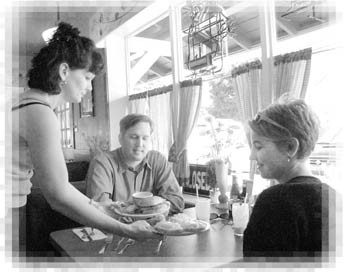
YES, IT LOOKS just like an all-American down-home diner–the type of funky greasy spoon, complete with well-worn counter, red vinyl stools, and plastic booths, reminiscent of the movie Alice Doesn’t Live Here Anymore.

But though the motif is cozy-kitsch–little cafe curtains, linoleum on the floor, and a collection of mismatched plates (all featuring pine cones) on the wall painted Hollywood swimming pool blue–the food is gourmetdom.

The breakfast includes pan-fried trout fresh from Idaho with two eggs ($8.50) and honey-baked ham and cheese omelet ($8.25). Lunch features sandwiches, burgers, soups, and salads. But dinner boasts such ambitious dishes as cherry-wood-smoked pork loin with lavender gastrique–lavender-infused sherry, vinegar, and honey ($15.95), and steak au poivre ($22) with peppercorn brandy sauce.

We first visited the Pine Cone last summer and enjoyed a mug of freshly brewed aromatic coffee and a scrumptious slice of homemade apple-mango cobbler at the old counter, and we’re eager to return for an evening meal.

By night, the place still resembles an unpretentious diner, but there are tea lights glimmering on each of the seven tables. It’s only 6 p.m. but the place is already jammed. The diner doesn’t accept reservations, so we are stuck at the little yellow half-moon table attached to the far wall. Not the best spot–it’s cramped and my chair is constantly bumped by an open door directly behind it. A request to change to a booth, once it becomes free, is denied by our server. Indeed, a closer look at the menu reveals the rule: “Please, where you sit is where you eat.”

Waiting diners are sent with a glass of wine to browse at the bookstore next door. However, service at the Pine Cone tends to err on the abrasive side for such a homey, big-hearted environment. Where’s Alice when you need her?

Our set-faced server recommends crispy Panko prawns ($9.95) to start. Three lightly breaded butterflied prawns are jumbo, but strong-smelling amid a pile of daikon and carrot and a lake of creamy green wasabi sauce. This sinus-clearing sauce is way too strong and obliterates any other flavor, and the menu promises coconut, leeche (do they mean lichee?), and sweet red chili–none of which are detectable–on the plate.

Another starter, billed as “fresh mushroom lasagne,” with smoked tomato coulis, layered portobello mushrooms, organic seasonal vegetables, and highly popular local Cowgirl Creamery cheese ($10.25) is both pleasant and disappointing. Yes, there are layers of grilled veggies interspersed with very mild cheese, but no pasta! We feel cheated since lasagne is an internationally known description for a dish of baked flat noodles. Why no explanation?

The vegetarian in the group fears he’ll get more of the same in his “seasonal organic vegetable platter” ($12.95), so he hurriedly switches his entrée order to the penne pasta ($12.50). Good move. This is the most satisfying dish of the evening. The brown butter sauce clings to the ribbed penne pasta, which is perfectly al dente, and there are soft chunks of roasted butternut squash, coarsely chopped hazelnuts, caramelized red onion, and braised seasonal greens in the dish. The menu also promises dates, but we cannot detect them. The effect is sweet yet savory and texturally very pleasing.

The tried-and-true garlic chicken ($13.50) is another dish we find to be well executed but lacking. A couple of chicken pieces are roasted golden and cooked to juicy (but not at all pink) perfection. Yet we cannot taste any garlic flavor, and wish for it. Likewise the mashed potato (it has more like a whipped consistency) again has us wondering–where’s the garlic? The dish is served with snapping fresh green string beans and a light pan gravy.

There’s a very small wine list with some good-value selections. A bottle of 1998 Yalumba cabernet sauvignon from Australia ($27) is juicy and soft with a fruity rum raisin flavor that accompanies our entrées with ease.

The desserts are a monster hit. A down-home apple pie ($5.25) with juicy brownish apples and a soft crust is served with Clover brand vanilla ice cream and sprinkled with powdered cinnamon. A childhood dream. The flourless chocolate cake ($5.95) is even better, with the most mouth-friendly texture you can imagine. It’s soft and moist, yet toothsome and chewy, and manages to be light yet sinfully fudgy. The cake is served to even more advantage with thick caramel sauce and whipped cream. Yum.

It’s worth a trip to the tiny whistlestop town of Pt. Reyes Station to experience the whimsical Pine Cone, even for just a slice of pie. But be warned, the diner accepts no credit cards.

Pine Cone Diner Address: 60 Fourth St., Pt. Reyes Station; 415/663-1536 Hours: Tuesdays-Thursdays and Sundays, 8 a.m. to 8:30 p.m.; Fridays-Saturdays, 8 a.m. to 9 p.m. Food: Gourmet diner fare Service: Abrupt Ambiance: Funky greasy spoon meets upscale bistro Price: Moderate to expensive Wine list: Small selection Overall: 2 stars (out of 4)

From the February 15-21, 2001 issue of the Northern California Bohemian.

© Metro Publishing Inc.

‘The House of Mirth’

0

House Warming

Why a 19th-century hooker could kick Gillian Anderson’s ass

Writer David Templeton takes interesting people to interesting movies in his ongoing quest for the ultimate post-film conversation.

“DEATH,” purrs author Sheri Holman, dropping a silver spoon into her bowl of Irish stew and reaching for a glass of water. “Death is not as ugly as people think. Death can be a very beautiful thing.”

It’s early evening, and the tiny pub is packed. Our table is within immediate earshot of at least a dozen people, all of whom now turn their heads to see who’s making such unconventional dinner conversation.

If Holman (author of A Stolen Tongue) notices the attention she’s getting, she gives no sign of it. Next, she launches into a highly visual anecdote about holding an old woman’s lungs in her hands–“It was lighter than air, as light as a napkin,” she says–while witnessing an autopsy as research for her latest novel, The Dress Lodger.

Holman displays a real knack for making heads turn. On the page and off.

Set in England during the 1899 cholera epidemic, The Dress Lodger follows Gustine, an unstoppable 15-year-old prostitute, and her fateful alliance with a grave-digging doctor. It has become a book club sensation since its hardcover publication last year. Holman, 34, has a way with death–be it death by cholera or by less natural causes–and her atmospheric resurrection of Industrial Age England has won the New Yorker a quiet cult of fans on both sides of the Atlantic.

We’ve met to discuss another story set in 1899: The House of Mirth.

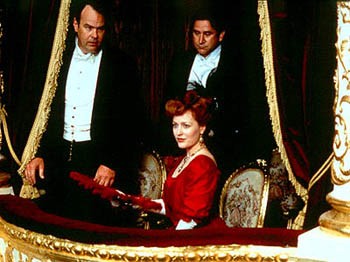
A critically acclaimed film version of Edith Wharton’s masterpiece about class warfare in 19th-century New York City, the movie stars Gillian Anderson (of X-Files fame) as Lily Bart, a woman with serious debts, unappealing suitors, and a Hamlet-like aversion to making up her mind.

Whereas Anderson’s Agent Scully is tough as nails–and would not hesitate to grasp a woman’s lungs in her own hands, by the way–Lily Bart can’t seem to get a grip on anything.

Holman agreed to see The House of Mirth in part because she has a somewhat unique connection to the book. She read it a few years ago when she was in Syria, on vacation with her then-boyfriend, now-husband.

“We were in a town called Hama, near Damascus, and I had horrible dysentery,” Holman explains. “I was so, so sick, and the bathroom was way down the hall where I was staying in this awful, cockroach-infested hotel. So in between trips to the bathroom, I read The House of Mirth.

“I have to admit,” she confesses, with a big smile, “that when you invited me to see The House of Mirth–when I heard those words House . . . of . . . Mirth–my first response was that I felt my stomach clench. I got this intense sense of memory of retching my guts out in that awful hotel in Hama.”

More heads turn; multiple sets of eyes narrow and peer before they all snap nervously away. Holman laughs, shaking her blond-maned head in gleeful mock embarrassment. “But the movie was great,” she adds.

Our talk turns temporarily to less queasy matters, as I suggest similarities between The House of Mirth and The Dress Lodger–mainly that each tale shows the cruelty of class distinction, the rift between the haves and have-nots. But I also argue that poor Gustine’s situation is much more dire than Lily Bart’s. Holman disagrees.

“At least Gustine has a skill,” she says. “She’s willing to do anything because she doesn’t think anything is beneath her. Gustine is fearless because she has nowhere to go but up, but Lily Bart has nowhere to go but down, and it’s that downward mobility that is so terrifying to her. I can identify with that fear.”

On cue, Holman demonstrates her Lily Bart identification by adopting an uncannily accurate expression of wide-eyed astonishment, with an overlay of tight-muscled panic and a smidgen of open-mouthed disbelief.

It’s a good picture, Holman confesses, of how she’s been feeling of late. As The Dress Lodger finds a wider and wider audience, raking up an impressively expanding pile of dollars, the author has been broadsided by an unexpected truckload of anxiety.

“For the first time in my life, I feel I have something to lose,” Holman says. “I think [Lily Bart’s] fear, the precariousness of her position, is a really American thing. In America, it doesn’t matter who you are or what you once accomplished. If you have no money, you lose your standing.

“If Lily Bart had been a different kind of person,” Holman muses, “maybe she could have made the money back, but she’d never been trained for work. She goes to the milliners to try and learn a skill, but she can’t do it. She’s literally fit for nothing.”

Holman pauses, sliding the stew bowl back over for another few spoonfuls.

“It’s weird. As much as we do hate poverty in this country,” she says, “it’s kind of a love-hate relationship. Poverty also has a certain attraction.

“When I first moved to New York from the Midwest, it was partly under the allure of poverty,” she continues. “I had $800 in my pocket. I lived in every bad neighborhood I could live in. I purposefully set myself in harm’s way because I thought that’s what artists did. I really did have a romantic view of being without money. I thought it would ennoble me to cast my lot with lost and drifting people. Instead, it ground me down to almost nothing.”

Fortunately, Holman has more Gustine than Lily Bart in her. She’s fought her way back up, and the odds are good that she’ll be staying up. But speaking of fighting, Holman has one last thing to say about Gustine and Lily.

“If the two of them ever got into a street fight,” she suggests wickedly, “Gustine would kick Lily Bart’s ass.”

From the February 15-21, 2001 issue of the Northern California Bohemian.

© Metro Publishing Inc.

Lou Reed

0

‘Metal Machine Music’ clatters back

By Greg Cahill

PITY THE POOR neighbors. It’s the hot summer of 1975 and Lou Reed–an unlikely superstar with five solo albums, including the 1972 classic Transformer and 1973’s conceptual masterwork Berlin, and the underground cache of having been a member of the Andy Warhol-created art-rock band Velvet Underground–is squirreled away in his New York apartment experimenting with feedback. Lots and lots of feedback.

“Just for fun,” as he recalls, Reed would explore unusual tunings, stand a pair of guitars in front of one of these amplifiers–one of these really big amplifiers–crank up the volume, and just let ’em rip! The guitars would go through a series of tortured transmogrifactions, making all kinds of weird and eerie sounds and blending an electric brew of harmonics previously unheard by the human ear.

It was as if the damn things were alive.

Reed decided to document the effect. Armed with a trusty four-track recorder, he laid down a series of tracks, mixing the album himself in his apartment (the neighbors! The poor fucking neighbors!), manipulating the speed and tone of the basic tracks and separating them into distinct stereo channels–one blaring into the right ear, the other blaring into the left ear, with no middle channel–to give a most disturbing and almost schizophrenic effect, like listening to two pieces of music at the same time.

Then Reed–who was pissed off at his record company for demanding too much product and wanting another “Walk on the Wild Side”-type radio hit–unleashed the finished product, on a major label no less, on an unsuspecting public (bear in mind that Peter Frampton was the biggest thing around at that time). The recording was split into four 16-minute segments (which fit neatly onto four vinyl sides), with a lock groove at the end of side 4 so the damn thing would play for an eternity unless you pulled your stunned self off the sofa to lift the tone arm.

TWENTY-FIVE years ago, Metal Machine Music: An Electronic Instrumental Composition (RCA) hit the record-store racks. It caused an immediate sensation, which is to say no one listened to it at the time and folks are still arguing today if it is high art or a bad joke. Now, the limited-edition 25th anniversary CD version has been released on the Buddha label. It’s still unlistenable, but we have a chance to argue about the meaning of Metal Machine Music all over again.

Of course, gonzo music journalist Lester Bangs of Creem immediately hailed the recording as “the greatest album ever made in the history of the human eardrum.” The more staid Rolling Stone dismissed Metal Machine Music as “a gigantic ‘fuck you’ disguised as a groundbreaking experiment.” In fact, in his 1975 Rolling Stone review, critic James Wolcott likened the recording to “the tubular groaning of a galactic refrigerator” and “spending the night in a bus terminal.” The Trouser Press Record Guide has since noted that “if [Reed] was simply looking to goad people and puncture perceptions, [the album] was a rousing success.”

Reed himself has called the album “the perfect soundtrack for the Texas Chainsaw Massacre.”

LOVE IT or hate it, there is no question that, in those still innocent pre-punk days–the Sex Pistols and their offspring wouldn’t rattle the rafters for another two years–Reed delivered a powerful Dadaist avant-rock statement that has since drawn comparisons to the experimental works of jazz-great Cecil Taylor and such contemporary classical composers as Stockhausen and Elliott Carter. Indeed, Metal Machine Music, for all its atonal ambiance, was a revelation to a handful of young and influential industrial and indie-rock musicians, including Sonic Youth and even Neil Young (who released an entire CD of feedback on 1991’s Arc/Weld), who helped set the tone for modern rock, pop, and techno music in the ’80s, ’90s, and 2000.

“I wasn’t just squealing and making noises,” Reed insisted on the fake spec notes on the back of the original 1975 release, “But if you just like loud feedbacking guitars–well, there it is.”

Judge for yourself. But, dear god, pity on the poor neighbors.

From the February 15-21, 2001 issue of the Northern California Bohemian.

© Metro Publishing Inc.

Newsgrinder

0

Important events as reported by daily newspapers and summarized by Daedalus Howell.

Thursday 02.08.01

Petaluma’s ArgusCourier.com reports that a man and a women were caught in their convertible Camaro (danger sign) in possession of methamphetamine, drug paraphernalia, a loaded handgun, brass knuckles, assorted knives, walkie-talkies, a police scanner, Valium and Vicodin, false vehicle registration, and a suspended license. Had the culprits additionally been underaged, under the influence, and engaged in a sex act, and if there had been a dead hooker discovered in the trunk, the cops believe they might have had a case.

Sunday 02.11.01

Would-be folk balladeer Jim Stone has penned the protest ditty “The Cell Phone Song,” a five-minute diatribe against the popular telecommunications technology. Almost true to folkie form, Stone wrote the song on a bus and later recorded it in a Texas hotel room when on the road (er, for his gig as an architect). Stone’s lyrics describe various acts of violence he would like to inflict upon a cell phone: “I’d like to take a 3/8-inch drill and ventilate its plastic case, or stick it in the oven on high and melt its plastic case.” (Someone get this guy a rhyming dictionary.) “It’s all done in jest. It was a just a way to vent some emotions and have a laugh,” said the Singing Draftsman, who, according to some, put the square in T-square. “I have three daughters and they all think I’m behind the times.” Hey Jim, how ’bout a B-side about Palm Pilots?

Monday 02.12.01

The dry run of the evil Dr. Karl D’ring’s new Weather Manipulator 5000 turned out quite wet for Marinites this week. The Marin Independent Journal reports that a cold storm dumped a blanket of snow on Mt. Tam, which became a veritable winter wonderland for some county residents. Still, one is compelled to ask, why does it seem as if we’re entering another Ice Age in the midst of global warming? “Mother Earth is going through menopause,” D’ring avers. “Hot and cold, hot and cold.” The inclement weather will continue, according to National Weather Service forecaster Jim Carroll: “Showers will taper off in the afternoon hours. By Thursday it will be mostly clear, still chilly at night, but warmer during the day.” Like my ex.

Monday 02.12.01

Humboldt County pot farmers are watching their margins go up in smoke owing to the energy crisis, reports the Napa Valley Register. Many growers use 1,000-watt light bulbs to coax their plants into flowering–each bulb costs about $50 a month to run 18 hours a day, according to American Hydroponics, which sells the bulbs to “tomato and lettuce growers.” Says Napa Sheriff’s Deputy Randy Garcia, “Power is probably the biggest single cost for these guys. The more power they use, the better the quality of the product.” He, uh, guesses.

From the February 15-21, 2001 issue of the Northern California Bohemian.

© Metro Publishing Inc.

Christianity in the Third Millennium

0

After nearly 2,000 years of Christianity, does Jesus have a future in the new millennium?

MANY AMERICANS will find this unlikely–it will surely come as a shock to George W. Bush–but there are a number of religious thinkers in this world who maintain that That Old-Time Religion is seriously showing its age. From the pews to the pulpit, the faith is weakening. There is evidence, in fact, to support the notion that Christianity, as we all know and love or hate it, is (to state it in the proper historical parlance) pretty much doomed.

Church attendance within most denominations is at an all-time low. Among Catholics, so few novitiates are stepping up to take the vows that the church is suffering a severe shortage of priests and nuns. The calm logic of science has cast clear doubt on the fairy-tale myths of seven-day creation and virgin births. Many active practitioners openly admit they no longer believe half the stuff they read in their scriptures or recite in their liturgies. There are even a growing number of Christian priests and ministers who preach that Jesus, while still ranking as an undeniably good soul and a damn fine speaker, may not technically have been a deity after all.

Oops. Sorry.

Now sure, sure. The trumpet could sound an hour from now, and Jesus could descend in a puff of clouds to rapture up the faithful and dump tribulation on the rest of us mortals, an event that would render this discussion embarrassingly moot. Certainly, that’s what John Ashcroft and his fellow fundamentalists are praying for. But if we assume (as the vast majority of practicing Christians these days do) that the Bible’s scary apocalyptic proclamations are mainly metaphorical, then we must face the fact that this world of ours may go on for some time. Unless of course, we destroy it ourselves out of sheer human incompetence.

The question then, assuming the world does continue, is this: Can Christianity possibly continue along with it? Will anyone still be practicing Christianity a thousand years from now, or even a hundred? And if anyone does, will it look anything like the Christianity being practiced today?

These, brothers and sisters, are the questions that Dr. Robert W. Funk, a Santa Rosa theologian and leader of the prestigious Jesus Seminar, has been asking himself for decades. Now he is preparing to go out and find the answers.

Starting this year, a group of nearly 200 religious scholars from around the world will be joining Funk in an epic, soul-rattling research project that is as potentially earth-shattering as it is bold and brazen. In late February, they’ll be gathering in Northern California for the first of several conferences. Titled “The Once and Future Faith,” the gathering will include such world-class thinkers as English author/ theologian Karen Armstrong (The Battle for God), Cambridge professor Don Cupitt (Taking Leave of God, The Sea of Faith), New Zealand’s Lloyd Geering (Tomorrow’s God), and former Episcopal bishop John Shelby Spong (Why Christianity Must Change or Die: Rescuing the Bible from Fundamentalism). The entire group will convene for five days of open-minded hard work. Their goal: to determine through debate and discussion whether or not Jesus can be saved, and to develop an agenda for a full-scale, back-to-the-blueprints reinvention of Christianity.

“It certainly won’t be easy,” says Funk. “It will be very difficult, if it can be done at all. But that’s what makes it so exciting.”

Under Scrutiny: AMG International has set itelf up as a watchdog of the Jesus Seminar’s work.

FUNK, the author of Honest to Jesus and other books, is the founder of Santa Rosa’s Westar Institute, the international nonprofit research foundation best known as the sponsor of the controversial Jesus Seminar. A long-term project involving religious historians from around the planet, the seminar has recently concluded its 16-year historical examination of the Gospels, those four books of the New Testament that describe the life and teachings of Jesus. According to the scholars, less than 10 percent of the words and actions attributed to Jesus can be certified as fully authentic. This means that the rest of it–the manger, the miracles, the resurrection, the stuff about his being the literal Son of God–is entirely fictional, according to the seminarians.

Clearly, these findings challenge modern Christians to consider the relevance of a faith that was born of an ancient mindset, spun from the sociological cloth of now-faded traditions and mythologies. The concept of a spiritual savior–a human sacrifice to wash away the crimes of humanity–doesn’t fly so far in a society that doubts the existence of original sin.

Thus the crisis. Won’t a widening public awareness of the real Jesus cause a shift in the way Christianity is observed? Will the authentic voice of Jesus have a chance against almost 2,000 years of salvation-machine propaganda? So far, Funk and company have avoided those questions. Until now, the scholars have stayed focused on the tidy historical task of identifying the authentic Jesus, deliberately staying away from any theological interpretations of their findings–especially interpretations that have to do with the historical Jesus’ relevance to the modern world.

But that time is over.

“Having completed our work on the Gospels, at least tentatively,” explains Funk, elbows resting on the book-cluttered table of his Santa Rosa home, “we have to go forward now and ask what all of our findings mean. We can’t let it go with just the historical work. Historical knowledge of any religion has consequences. Now we’re asking ourselves what those consequences are.”

What those consequences are won’t be decided right away, Funk insists. The scholars will take their time. The first meetings will serve mainly to take the temperature of the scholars, to find out how many of them think the mainline churches can be reformed and how many feel the churches are simply beyond hope.

“There’s still a lot of power in the mainline churches,” cautions Funk, “and if we can reform them, if we can change their direction . . . ” He shrugs, lets out a sigh. “But I’m very skeptical that we can do that. It’s possible that the world would be better off without Christianity. We may find that it makes the most sense to just let this tradition die.”

AFTER generations of church corruption, after countless barbaric acts done in the name of Jesus, after millions of psyches wounded by Christianity’s well-honed knack for spreading guilt and making us all feel like hell, there are plenty of people who’d welcome the demise of Christianity–on purely humanitarian grounds.

But don’t dress for the funeral just yet.

“Christianity is a very durable religion,” points out Robert Miller, Ph.D. A scholar-in-residence at Westar Institute, he’s the editor of The Complete Gospels and the author of The Jesus Seminar and Its Critics. “Christianity has not only survived,” he says, “but flourished under many hostile environments. It’s adapted itself over and over again. Christianity may well have a long life ahead of itself.”

But this ain’t your father’s Christianity he’s talking about.

“A thousand years from now, Christianity will look very different from what we see today,” he says, “as different as today’s Christianity would look to the Christians of 1,000 years ago. Many things we believe today would have been considered heretical and demonic 1,000 years ago, and in the future, if Christianity does survive, it will be a very different faith.”

Whether it’s a better faith or a worse one is impossible to say.

Raised as a Catholic in Orange County–he still regularly attends Mass–Miller explains that his own faith was challenged after he discovered the depth and richness of other religions, particularly Hinduism. “In the Hindu scriptures,” he says, “I found a depth of insight and spiritual profundity that was more amazing than anything I’d known in my own faith.”

Which points to one of the reasons that Christianity is changing: With the rise of the Information Age and unprecedented access to all corners of the globe, we’ve gained a new appreciation of other cultures, customs, and faiths, and the more we learn of other people, the less “other” they look. After all, it’s easier to dismiss another’s faith when the only religion you understand is your own.

Miller also points out that Christianity has always absorbed the practices of other belief systems. This could be a good thing.

“Look at the way it co-opted pagan Nature rituals and converted them into Christmas and Easter,” he says. In the same way, Miller believes that the Christianity of the future could be influenced by modern notions, including those of science and psychology.

He also hopes that the benevolent philosophies of the historic Jesus–which he and the Jesus Seminar have worked hard to pull out from the salvation-obsessed trappings of the church–will be a major influence on the Christianity of the future.

That will be the tricky part.

“We’ve traditionally claimed too much for Jesus,” says Bruce Miller (no relation to Robert), senior minister of Robertson-Wesley United Church in Edmonton, Canada. “We’ve made Jesus into a god, but his voice is much more valuable to us when we hear it as the voice of a man.”

A longtime fellow of the Jesus Seminar, Miller insists that his life has been richer since letting go of the fabricated Divine Jesus and embracing the authentic “philosopher Jesus,” the one who preached about the Kingdom of Heaven that exists on earth right now; the one who charged his fellow humans to love and take care of one another; the man who called for the end of organized religions.

With that in mind, Miller can’t wait to join Funk and company in developing that radical reformation of the faith.

“We have an opportunity to go back and retrieve a new beginning,” he says. “And if we do, it will change the way we do worship, the way we do prayer, the way we think about God.

“It will shake Christianity to its very core.”

Among the changes that may come is one that currently seems unthinkable. The name of the faith may have to be changed. A thousand years from now, Christianity may have abandoned the word Christ. “I find it not helpful to use a lot of words that ascribe to a theology we don’t want to support anymore,” says Miller. “The word Christ has come to mean a certain thing to certain people: a redeemer, a Messiah, a savior. I think we should stop using the word Christ and the word Lord, and instead focus on the man’s humanity and the beauty of his message.

“By listening to the authentic voice of Jesus, people will make something new. As people find less attachment to the institutions of the religion, they’ll have more interest in finding their own kinds of faith. And Jesus will be a part of that.”

“Eventually,” concludes Miller, “I think people from other faiths will be claiming Jesus, too.”

The Westar Institute’s spring meeting, ‘An Agenda for a Radical Reformation: A Once and Future Faith,’ will be held Feb. 28-March 3 at the Doubletree Hotel, 1 Red Lion Drive, in Rohnert Park. For registration information, call 707/523-1323.

From the February 15-21, 2001 issue of the Northern California Bohemian.

© Metro Publishing Inc.

Mummenschanz

0

Silent Treatment

Wordless testimony to power of movement

By Marina Wolf

TOILET PAPER is an ephemeral medium–certainly not something on which you’d want to launch a career. Yet the Swiss-Italian mime group Mummenschanz did just that with one of its earliest masks, which had functional toilet-paper holders at the appropriate places for eyes, ears, and mouth.

In fact, one of the first numbers that Mummenschanz cofounders Andres Brossard and Bernie Schürch presented to an international audience was called “All the Toilet Paper in the World Is Rolled Backwards.”

Reporting on this and other acts from the 1971 Festival International de la Pantomime, Berkeley performer and educator Bari Rolfe applauded what she called “absurdist mime” as an exciting, if polarizing, force in the changing world of physical theater.

On the more conventional side of the fence were Marcel Marceau and his imitators, tireless whiteface performers whose precise movements were in many ways a throwback to 19th-century romantic pantomime. But the future belonged to performers exploring less stylized movements and more abstract themes–performers like Mummenschanz.

The members of Mummenschanz improvise not only with movement and ideas, but with material, from which new movements and ideas emerge. From the beginning the members of Mummenschanz have always made their own costumes and masks.

“In a way we’re a bit like sculptors,” says Floriana Rossetto–who joined the group in 1971–of this creative process. “We’re in front of our material and then we feel it, we have this vision. You can’t explain it to anyone else.”

Perhaps the best-known Mummenschanz masks are the changeable ones, which the trio had originally investigated as stage devices that would allow them to change masks without having to go offstage and interrupt the flow. But the masks turned out to have their own inherent logic.

One of the first was made from a puttylike substance that could be slapped, pulled, and pushed, by the wearer or by another performer, into a universe of shapes. Another early mask was composed of notepads on which facial features could be drawn and ripped away, page by page altering the expression of the mask.

And of course there was the famous toilet-paper mask. When two such masked figures then interacted, gestures of love, rejection, desperation, and understanding gushed forth, all represented by streams of toilet paper from the appropriate orifices.

THE SURREAL masks and absurd physical formations of Mummenschanz contrasted so much with what the general public knew as “mime” that they seemed to emerge out of nowhere. In fact, like many of its peers, Mummenschanz found its launch point in the work of established French mime teachers, in particular Jacques Lecoq.

“Lecoq didn’t give you the product. He gave you the process,” says Rolfe, who trained with Lecoq in the early 1960s, after getting turned off by the extreme regimentation of Lecoq’s contemporary, Etienne Decroux. “[Lecoq] pushed you to find your own way of doing things.”

Among Lecoq’s passions were masks, ranging from the classic commedia dell’arte forms to ethnic masks to carefully neutral masks of Lecoq’s devising. In his classroom, masks forced the students to work through the body and to learn and express the truth of the mask through movement.

“Anybody who’s studied with Lecoq knows that a mask has a geometry and grammar all its own. You put the mask on your face; in spirit you have it in your whole body,” says Eliot Fintushel, a performer, writer, and instructor in Santa Rosa. “Mummenschanz took that literally, and wore it on their whole body. They demonstrated the principles in the most simple and gigantic way imaginable.”

But Mummenschanz started small. Soon after Rossetto joined Brossard and Schürch in 1971, the three went into creative isolation in a country studio in Switzerland. In a 1974 interview with Bari Rolfe for Mime Journal, Andres Brossard (who died in 1992) recalled the experience: “That was the moment we suddenly felt things coming out of us which were absolutely our own, not influenced by anything or anybody.”

BY THE EARLY 1980s, Mummenschanz had come off three years on Broadway and years of successful touring in progressively larger venues. Not surprisingly, the mimes’ second program featured–as most works have ever since–masks that cover the performer’s entire body and beyond.

This has a practical side: the audience in the back of a large venue needs to be able to see the action. But playing large and relying on economical gestures also has profound roots in the science and art of movement.

“In a gunny sack, life is much simpler,” says Fintushel. “You’re reduced to elements of speed, shape, and weight. And it’s amazing how much can be expressed just through those dynamics.”

Mummenschanz masks are so abstract that many interpretations become possible. Even the programs are drawn out as one long panel of shifting shapes and figures, rather than written, which leaves each viewer free to decide what is happening on stage.

“We are not telling the audience what they have to see or understand. It’s all up to the individual, and that’s what makes the people so happy about it,” says Schürch. “They don’t have to walk out of the show and think, ‘Oh my god, I didn’t understand anything. I’m so dumb.’ They are respected as a whole human being.”

For the current show, “Next,” the Mummenschanz players, now numbering four with the addition of American performers Tina Kronis and Richard Alger, step outside the mask to collectively manipulate it.

The performers are several steps removed, literally, from their own bodies–yet still the mask must remain inside the actor’s soul. “There’s an incredible tension, just lifting up a thing at the right moment and joining it with the others to make one character,” says Rossetto.

So if the mask is removed from the body, moved from the outside with sticks, isn’t that a puppet? Yes, in some ways. It’s also a sign of the postmodern (con)fusion in theatrical arts. Performers freely borrow from other disciplines, with a resultant blurring of boundaries.

For instance, the Portland, Oregon-based Imago, which in the early ’80s was often compared with Mummenschanz, now has veered toward conventional dramatic theater with a decidedly unconventional use of object and movement. For a recent production, Imago developed a set that moves and tilts around a central pivot point.

Many modern-dance companies also are enthusiastic fusionists, incorporating elements of mime, spoken word, acrobatics, and other disciplines into their performances. “Many modern-dance companies have become more theatrical,” says Schürch with enthusiasm. “There isn’t anymore this aesthetic vision of the body like it used to be in earlier years. It is how we started.

“We were ready to do completely new movements,” he says, “to move on the playground where everything all of a sudden is possible.”

Mummenschanz performs Friday, Feb. 23, at 8 p.m. at the Marin Center, Avenue of the Flags, San Rafael. Tickets are $22, $28, and $35; $16 for kids. For details, call 415/472-3500.

From the February 15-21, 2001 issue of the Northern California Bohemian.

© Metro Publishing Inc.
Usual Suspects

Marin’s political elite

By Dick Spotswood

IN POLITICS, “clout” refers to someone who has the skill to actually get a project accomplished. Of those elected to public office, the best learn the skill of working with others. This elite has clout. These men and women, owing to the talent of persuasion, toughness, or the power of their thinking, can move a concept from notion to result. Without these officials, public affairs grind to a halt amid constant meetings and pointless studies.

Who are the five most powerful elected officials in Marin County? Eligibility for the list ranges from our member of Congress, to a supervisor, city or town council member, school board trustee, judge, or anyone elected to local office. Statewide officials, like Sens. Dianne Feinstein and Barbara Boxer move on a different plane. For elected officials to have nationwide clout, they need to show leadership outside their municipality or district.

Such a list is constantly in flux. New people come to office, and it takes a few years for them to see if their potential materializes. Some, like former Assemblymember Kerry Mazzoni and Supervisor Gary Giacomini, leave the fray, yet their clout lingers. Others outside of elected office have as much clout as anyone in office, but that’s a different list. In my personal list of the top five most powerful elected officials in Marin in 2001, I include the following elected officials, in alphabetical order:

San Rafael Mayor Al Boro: Among his colleagues, Boro is the most respected of Marin County’s 55 mayors and council members. It has nothing to do with being mayor of Marin’s largest city. In the past, the top San Rafael post has not necessarily carried much clout outside the Mission City. But Boro understands that every council member has a duty to become involved in issues beyond his or her city’s boundaries. He is one of the few local officials to stick his neck out by backing real transportation improvements. Downtown San Rafael has begun a renaissance under his tutelage, which is proof that Boro has the moxie to make things happen.

Supervisor Hal Brown: Marin’s senior county supervisor, Brown has a well-earned reputation as a fierce defender of the interests of his 3rd Supervisorial District. By all rights, Brown should be the undisputed leader of the board. If he cares about the issue, he fills that role. Brown is frugal in picking issues in which he wants to invest his political capital. He excels in spiking what he regards as foolish initiatives. With gritty common sense, the Ross Valley supervisor can spot a turkey a mile a away.

Marin Superintendent of Education Mary Jane Burke: The job of county superintendent doesn’t carry much real power, since every public school in Marin operates within its own independent school district, with its own superintendent and school board. Burke’s job is limited to coordinating the 11 local school districts. Her power derives from the respect she has earned across the county. A gentle suggestion from Burke often ends up as the final decision. Her credibility exceeds the closed world of academic politics. A few years ago she was a rumored candidate to succeed Mazzoni in the state Assembly, and she would have been hard to beat. When the Sausalito School District was imploding, Burke moved quickly to set up a trusteeship of the district. It was a bold move that worked.

State Sen. John Burton: As president pro pem of the California Senate, Burton is the second most powerful person at the state Capitol. As a former member of Congress and the state Assembly, Burton learned every lesson that his brother, the legendary Rep. Phil Burton, ever taught him. Burton’s focus is on statewide issues, but he is too smart a politician to ignore the Marin portion of his 3rd Senate District. Power, clout, whatever the word, Burton has it in spades. Few people in politics have his ability to make things happen. The trick is to get him interested, but if he cares, it will happen.

Supervisor Cynthia Murray: The freshman supervisor is starting to come into her own. Perhaps the most pro-business supervisor, she has shifted the board’s orientation to include a stronger business reference. She has an excellent working relationship with the Novato City Council, the only city council in her Novato-centered district. This gives her the freedom to expand her influence countywide. Not flashy, Murray has the smarts to know what she wants, and the toughness to fight for it.

Dick Spotswood is a political commentator on KRCB and author of the ‘North of the Bay’ column.

From the February 15-21, 2001 issue of the Northern California Bohemian.

© Metro Publishing Inc.
Open Mic

0

HMO Blues

By Bobbie Jenke

I AM A MEMBER of a large California HMO. I have been living a nightmare after an injury I incurred over two years ago failed to heal, and a subsequent surgery I had to correct the problem made me worse. In the many months after I was first injured, my HMO offered no clear diagnosis or helpful treatment plan. I spent thousands of dollars “out-of-plan” seeking help, after my HMO refused my requests to go to outside providers.

Finally, I sought treatment in another state, Texas. My HMO rebelled loudly in letters and phone calls of denial when I asked to see an out-of-state, out-of-plan Texas surgeon who believed he could help me.

Despite their denials, I went anyway. In Texas, the surgeon said he received a phone call from my HMO denying my treatment in Texas and that the HMO representative used profanity to describe me. The surgeon was extremely upset by this behavior and wrote up the contents of this HMO phone call in his clinic notes. Shortly after my HMO received these clinic notes, my surgery was preapproved and paid for. Unfortunately, the surgery was not done according to plan, and it failed. In fact, it’s made me much worse with unexpected complications.

The Texas surgeon has since done little to help with the complications, and I am left, now more disabled, in the hands of my HMO. I have had to leave my teaching jobs on extended medical leaves, while my HMO delays my disability papers. I have also been forced to pay high medical bills at a university hospital because my HMO refused to preapprove care there. I soon may be forced into bankrupcy and permanent disability.

I was recently told by a main member-services representative at my HMO that I was not entitled to any more appeals. When I asked for the specific “plan” language denying me these rights, she never sent it to me. She also told me in a subsequent conversation that “in essence” I was a selfish person and only thought of myself. I wondered if this woman had an empathetic bone in her body, because if begging for necessary medical care is “selfish,” we injured and sick patients are in huge trouble.

I don’t know what will become of me, but I strongly urge health consumers (that’s all of us) to organize and demand accountability of HMOs at the state and federal level and a change in our current health care system. At the risk of sounding “selfish,” we all deserve better than this.

From the February 15-21, 2001 issue of the Northern California Bohemian.

© Metro Publishing Inc.

The Bush Administration and the Environment

Bushwhacked! Horsemen of the environmental apocalypse By David Helvarg PRESIDENT George Bush's naming of former Colorado Attorney General Gale Norton as Interior Secretary and recently defeated Michigan Sen. Spencer Abraham as Energy Secretary suggests that Republicans haven't learned from the 104th Congress of 1995, when attempts to gut environmental protections helped undermine...

The Wide-Eyed Gourmet

The simple pleasures of the occasional baking session By Marina Wolf I LIKE BRINGING baked goods to people's houses. Invariably they act as if someone brought a pile of holy wafers fresh from the oven. I suspect the recipe for holy wafers is more complicated than what I do, which is scones, usually, or banana...

Pine Cone Diner

Pining Away Pine Cone Diner offers upscale fare By Paula Harris YES, IT LOOKS just like an all-American down-home diner--the type of funky greasy spoon, complete with well-worn counter, red vinyl stools, and plastic booths, reminiscent of the movie Alice Doesn't Live Here Anymore. But though the motif...

‘The House of Mirth’

House Warming Why a 19th-century hooker could kick Gillian Anderson's ass Writer David Templeton takes interesting people to interesting movies in his ongoing quest for the ultimate post-film conversation. "DEATH," purrs author Sheri Holman, dropping a silver spoon into her bowl of Irish stew and reaching for...

Lou Reed

'Metal Machine Music' clatters back By Greg Cahill PITY THE POOR neighbors. It's the hot summer of 1975 and Lou Reed--an unlikely superstar with five solo albums, including the 1972 classic Transformer and 1973's conceptual masterwork Berlin, and the underground cache of having been a member of the Andy Warhol-created art-rock band Velvet Underground--is squirreled...

Newsgrinder

Important events as reported by daily newspapers and summarized by Daedalus Howell. Thursday 02.08.01 Petaluma's ArgusCourier.com reports that a man and a women were caught in their convertible Camaro (danger sign) in possession of methamphetamine, drug paraphernalia, a loaded handgun, brass knuckles, assorted knives, walkie-talkies, a police scanner, Valium and Vicodin, false vehicle registration,...

Christianity in the Third Millennium

After nearly 2,000 years of Christianity, does Jesus have a future in the new millennium? MANY AMERICANS will find this unlikely--it will surely come as a shock to George W. Bush--but there are a number of religious thinkers in this world who maintain that That Old-Time Religion is seriously...

Mummenschanz

Silent Treatment Wordless testimony to power of movement By Marina Wolf TOILET PAPER is an ephemeral medium--certainly not something on which you'd want to launch a career. Yet the Swiss-Italian mime group Mummenschanz did just that with one of its earliest masks, which had functional toilet-paper holders at the appropriate places...

Usual Suspects

Marin's political elite By Dick Spotswood IN POLITICS, "clout" refers to someone who has the skill to actually get a project accomplished. Of those elected to public office, the best learn the skill of working with others. This elite has clout. These men and women, owing to the talent of persuasion, toughness, or the power...

Open Mic

HMO Blues By Bobbie Jenke I AM A MEMBER of a large California HMO. I have been living a nightmare after an injury I incurred over two years ago failed to heal, and a subsequent surgery I had to correct the problem made me worse. In the many months after I was first...
11,084FansLike
4,606FollowersFollow
6,928FollowersFollow