

Dessert Wines

0

Sweet Dreams

Dessert wines don’t have to be a sticky business

By Marina Wolf

DESSERT WINES are the forgotten finale. Until recently, restaurants gave them the last page of the wine list. At home, people think of stale sherry on top of their grandma’s fridge, and say no thanks. But as more restaurants bring dessert wines out from the back, pairing them with everything from chocolate cake to cheese or foie gras, consumers are finding that it’s worth getting to know the sweet stuff.

There’s a lot to learn, too, as dessert wines aren’t created using normal winemaking techniques. For example, a traditional German Eiswein is made from grapes that froze on the vine and then were hand-picked by lantern light. “It’s a very picturesque harvest,” says wine writer Heidi Yorkshire, “but it makes the Eiswein very expensive”–at least $80 for a 375-ml. bottle. More affordable alternatives are ice wines that have been made from artificially frozen grapes, as pioneered by Bonny Doon in the Santa Cruz area. This version of ice wine goes for between $14 and $20.

Or take botrytized wines, made from white varietals raised in cold, wet climes. The botrytis fungus usually shows up on its own, shriveling the host fruits, which must then be picked berry by berry. At Chateau d’Yquem in France’s Bordeaux region, the fields are picked over 10 times a season to get all the grapes at the height of their luscious decay. For fruits of this labor, people will pay hundreds of dollars for a bottle of Sauterne. But not every season is miserable enough to bring on the fungus. So once again, an American winery–Beringer in Napa Valley–came up with a more reliable and less expensive process than Mother Nature: pick the grapes and then apply the botrytis spore.

A basic grounding in dessert-wine background will assist you in understanding the flavor profiles of various wines. A later harvest generally means more ripeness. Botrytis adds a honeyed taste that, when combined with the fruit and floral notes of many white varietals, creates a heady, almost lightheaded, nectar. Tawny ports, which age on wood, have a smoky tinge and are made smooth by prolonged oxidation, or exposure to oxygen, which reduces the harshness of tannins.

IN PAIRING these wines with food, there are really only two main rules: the wine should be as sweet as or sweeter than a dessert; and a strong wine should accompany a very rich dish. Beyond that, you can simply emphasize the matching elements, either in flavor or in intensity. Or you may go for a more subtle approach, calling up contrasting or complementary qualities in the pairing.

Professionals who like dessert wines enjoy playing with these qualities in their pairings. Randy Goodman, co-owner and wine buyer for Wildwood Restaurant in Portland, Ore., sits down every month with his pastry chef, Jennifer Welshhons, to match wines with the changing dessert menu.

Goodman’s favorite pairing couples a chocolate pot de crème with cream sherry. Vanilla and cherries on top of the pot de crème match the sherry and provide a perfect foil for the rich chocolate, explains Goodman. Welsshons’ favorite match is a black-bottom banana cream pie flavored with chocolate, butterscotch, and a rum mousse, and paired with a 5-year-old Malmsey Madeira. “It’s strong enough to stand up to the chocolate and bananas, and also matches the butterscotch elements,” says Welsshons.

It’s not all sweets to the sweet, either. At Elka’s in San Francisco, sommelier Randall Grahm (the winemaker at Bonny Doon) often pairs dessert wines with items in other parts of the menu. The combination of sweet wines with savory foods was highly popular 100 years ago–Diamond Jim Brady, for example, drank Sauterne with oysters–and wine with cheese is a standard, port with Roquefort being one of the classic pairings. But Grahm takes a distinctly modern approach, guiding guests to a Pedro Ximenes sherry with the foie gras, or a German Riesling with Asian-inspired dishes.

“Asian ingredients are very savory and umame-intensive,” explains Grahm. “They have such a persistence of flavor that they will dominate dry wines. Something with low tannins and residual sugar is a much better match.”

When exploring the possibilities of dessert wines, take a page from restaurants: pour small. A normal pour on dessert wines is three ounces, but some restaurants will offer tastes to as small as half an ounce. Dessert wines are usually intense, in both flavor and aroma, and a few sips, with and without food, are enough to give you an idea of the wine.

Such caution leads to an obvious question: How do you store the wine between samplings? The ideal temperature, for opened or unopened bottles, is around 55 degrees, but everything else depends entirely on the wine. Certain dessert wines, such as Madeira or tawny port, can be open for up to a month and a half without losing flavor to oxygen; they’ve already been oxidized during the aging process. A vintage port, on the other hand, has been aged in an anaerobic, or oxygen-free, environment, so it’s more susceptible to oxidation.

The age of the wine is also an issue. Younger wines tend to have more acidity and free sulfites, which defend them against oxidation. But as the bottle ages, those things get used up in protecting the wine from the ravages of any air that might try to get in through the cork. The older the wine, the more quickly the bottle should be emptied.

So, if you ever run across a bottle of 1900 Sauterne, pour it quickly and enjoy.

From the April 5-11, 2001 issue of the Northern California Bohemian.
© Metro Publishing Inc.

DivaBands

0

Sisters in Song

DivaBands showcases local female artists

By Paula Harris

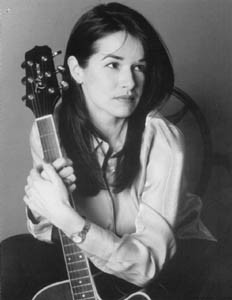
DON’T underestimate Roberta Donnay. The 5-foot-4 pixielike woman (the exact same height as Madonna, as Donnay is quick to point out) with long red hair bops around the Studio B recording studio in Sausalito in her black silk pants and purple velvet jacket with oversize buttons. In her little-girl voice, Donnay chats easily about hitchhiking around Europe as a teen, about her study of Buddhism, and about recently moving in with her new boyfriend.

Good-natured girl talk.

But delve deeper and Donnay’s conversation starts to make references to her Grammy nominations, to her record label, and to her reason for being at the recording studio–mixing a product for a client. It’s then you begin to realize that the 32-year-old Donnay is a seasoned music industry professional.

The alt-rock recording artist, who started warbling at age 5 and describes her high-pitched singing voice as a cross between those of Shawn Colvin and Sting, is a songwriter, a record producer, and something of an impresario in the music biz.

“I really don’t fear the music industry,” Donnay declares. “I’ve been nominated for Grammies, and I’ve also been in big record company offices and been yelled at by record executives. I feel like it’s a big game.”

It’s a game that’s paying off big for Donnay. Last year the Mill Valley resident co-founded DivaBands with comedian Amy Camus. The organization is dedicated to showcasing local ascending women musicians and songwriters–and it’s built a growing audience at venues around the North Bay and San Francisco.

DivaBands kicked off last year when Donnay was offered a gig in San Francisco’s Red Devil Lounge. She assembled an all-female format as a benefit for women’s rights that was devoured by an audience hungry for more Lilith Fair-type gal concerts.

“It was a very interesting night,” recalls Donnay. “I noticed that the audience was completely different from my usual audience. It was mostly women, and it was a very respectful audience, very into listening.”

Donnay was invited to come back and “do that girl thing again” on a weekly basis. “I basically just called all my friends and began begging people to come down,” Donnay explains. “DivaBands started to go and took on a life of its own, with a lot of attention from the community.”

In the last year, DivaBands has showcased more then 64 Bay Area female artists in a variety of venues, including the Mystic Theatre in Petaluma and Sweetwater in Mill Valley.

DivaBands has completed two promotional compilation CDs and is even taking the show on the road. Last year several artists attended the Rockr Grl Conference, a national women’s music gathering in Seattle. As a result, Donnay started getting calls from national women’s music organizations.

“I think there’s a need in the community between artists to have to network with other artists and create a supportive atmosphere,” says Donnay. “Women in general haven’t had that bonding between themselves. We’ve basically been out there in the music scene as recording artists out there on our own.

“It’s just a very isolated business.”

She credits singer-songwriter Sarah McLachlan’s successful Lilith Fair concept with capturing a lot of attention that forced the record industry to sign more female artists.

“Historically, it’s been a lot easier for male artists because rock ‘n’ roll is a male-dominated business,” Donnay says. “Years ago radio would only play one female artist at a time. It only seemed competitive between women because they were really being kept out because the industry is run by men.”

DivaBands is all about getting exposure, Donnay explains. One example of a success story is DivaBands member BeRn, an Irish folksinger who was recently signed with a large independent record label after a talent scout spotted her at a DivaBands concert.

Prospective artists can log onto the Diva website for details on how to send in a package and possibly jump on the bandwagon. The main criteria, says Donnay, are that the band be female or female-fronted, experienced, and have been recently recorded.

Donnay says she sees DivaBands becoming a national organization in the future, with separate divisions such as world music, techno, and hip-hop–so those artists can hook up and do shows together.

“It’s all about girls hanging with other girls,” says Donnay. “It’s like a big slumber party.”

In the meantime, Donnay will continue with plans to expand the organization, with more radio and television exposure and extensive national touring. Next month she’ll take the DivaBands Showcase to New York City for a benefit concert for Afghan women.

“In the end, I’m just a crazed musician who believes the world is better because of art,” she says.

“If we didn’t have art, I don’t think I could stay here very long.”

The next DivaBands Showcase features Susan Z, Kellee Bradley, Holly Figuera, and Hopscotch on Wednesday, April 11, at 9 p.m., Sweetwater, 153 Throckmorton Ave., Mill Valley. 415/388-2820. Cat McLean, Electric Peach, and Charm School appear on April 19, at the 19 Broadway in Fairfax. Admission to both shows is $7. 415/459-1091.

From the April 5-11, 2001 issue of the Northern California Bohemian.
© Metro Publishing Inc.

Joe Jackson

0

Joltin’ Joe

Joe Jackson–the consummate outsider

By Alan Sculley

FEW OF TODAY’S musicians have enjoyed a career where they have explored as many different musical styles and settings as Joe Jackson. Over a two-decade span, the New York-based British-born singer/songwriter has touched on punk-edged pop, songs that have been flavored by reggae and Latin music, 1940s-era swing, jazz, classical, and even more of an adult contemporary style of pop. Occasionally, Jackson’s eclecticism has been rewarded commercially. His first CD, 1979’s Look Sharp, spawned the radio-friendly hit song “Is She Really Going Out with Him?” On the other end of the spectrum, his 1982 release Night and Day has become something of his signature album, with that album’s elegant stylings spawning his biggest hit, “Stepping Out,” as well as the popular ballad “Breaking Us in Two.”

His latest CD, Night And Day II (Sony/Classical)–a street-smart snapshot of urban America–is something of a sequel to that earlier album. Jackson, though, feels that if he were starting out in music today, he’d never get the chance to even begin making albums that enabled him to explore such wide-ranging music.

“It has definitely gotten tougher, no question. The only reason I’m still actually making records and getting any kind of attention at all is because I sort of got my foot in the door awhile ago when things were different. Everything has changed so much,” says Jackson, who cites the British pop personified by the Beatles and the classical music of Beethoven as his two biggest influences. “The more eclectic creativity that I aspire to–once again, the Beethoven and the Beatles–it’s being squashed by big corporations. That’s happening all over in all different fields. I mean, I saw it in publishing when I tried to get my book [1999’s somewhat autobiographical A Cure for Gravity] published. Publishing is the same thing. People say ‘Look, this is a great book. If you’d brought it to us five years ago there’s no question we would have published it. But we’re not going to publish it now because of the way things are, because we’re under so much pressure to produce large short-term profit.’

“That’s what’s going on in the industry. So people who are eclectic, hard to categorize, and so on are just . . . it’s very, very difficult.”

AS IT IS, Jackson remains a vibrant presence on the music scene 21 years after Look Sharp put him on the map with its diverse brand of punkish guitar pop. The 46-year-old native of Portsmouth, England, followed that LP with another album of punchy guitar pop, I’m the Man, before his artistic sense of adventure really began to show. His 1980 album, Beat Crazy, brought a variety of rhythms–reggae being a predominant tempo–into his style. Then in 1981 came Jumpin’ Jive, a CD influenced by 1940s-era swing. Following Night and Day, Jackson explored a jazzier vein once again on Body & Soul before returning to more of a pop-based sound on Big World.

The musical carousel continued. Blaze of Glory (1989), which Jackson considers one of his finest CDs, synthesized Jackson’s pop, jazz, and classical influences into a cohesive whole. Laughter and Lust (1991)tended to be streamlined rock. Later albums, such as 1997’s Heaven and Hell and last year’s Symphony No. 1–which won a Grammy Award in February as the Best Pop Instrumental Album–have shown more of a classical influence.

Considering the variety in his albums, it’s understandable that some people view Jackson as an artist who has played stylistic hopscotch, moving from one style to the next with each album. Jackson himself thinks that perception is far off base. He says his albums have never been limited to just one style, and he sees a strong thread connecting all of the records he has made.

“I see them as being consistently eclectic, but no two eclectics sound the same,” he says. “Eclectic seems to make some people think that it’s not authentic, that there isn’t an authentic voice there. But a lot of the greatest artists in history were very eclectic and were just all over the place and broke all the rules and everything else, including once again Beethoven and the Beatles. But I think that the thread going through it is just me. It’s my personality and my voice and putting different elements together. I think you just see different sides of it on different albums. But you know, people like to make out that I did a jazz album and then a salsa album, then classical. I just think when people read this stuff, no wonder they’re turned off.”

While some might consider Jackson’s latest album, the aforementioned Night And Day II, a shrewd–if belated–commercial move to tie his new CD to the popular 1982 album, Jackson didn’t have a preconceived plan for the new record. “I know people keep asking me, ‘Why did you decide to do Night and Day II?‘ and I never decide to do anything,” Jackson said. “When I start a project I have no idea where it’s going to go.”

The only notion Jackson had going into the project involved a thematic idea.

“There was sort of a vague idea that I wanted to write about New York. I didn’t even know if it could be a whole album or what,” he adds.

The New York theme, as it began to play out in his writing, drew Jackson back to the original Night and Day. Many songs from that 1982 album were centered around the impressions a newcomer to New York had about the city. Just as important, Jackson began to realize his new material also had musical similarities to the songs on the first Night and Day album.

“There’s a certain sound world. They inhabit the same sound world,” Jackson says. “They’re both based around my keyboard playing also with percussion and strings. I think they both draw on a lot of different rhythms, including Latin rhythms. I think that there’s just a similar kind of language. I don’t know if I can define it much better than that. I think Night and Day II is richer and kind of fuller, a bigger picture.”

INDEED, the finished version of Night and Day II strongly echoes its predecessor. And as in that first album, the songs here feel like a series of snapshots of life in New York. This time, they’re told through the eyes of a variety of characters.

“Hell of a Town” captures the darker side that comes with living in a dynamic city. “Stranger than You” reflects the diversity of New York through its references to a kaleidoscope of misfits and offbeat characters. “Dear Mom” finds Jackson spinning a tale of an embittered teenage runaway.

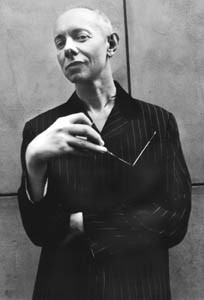
On several songs Jackson recruited guest vocalists to portray his stories. Marianne Faithfull effectively captures the world-weary tone of a 50-something woman feeling alone in the harsh big city. Iranian singer Sussan Deyhim puts the proper accent on “Why,” a song about an immigrant trying to adjust to her strange new surroundings. Drag queen Dale DeVere does an effective turn bringing to life the hardened edge of a transgender hooker working the city’s meatpacking district in the song “Glamour and Pain.”

ONE NOTABLE contrast between the two Night and Day albums is that the new CD is written from the perspective of someone who has been in New York for a decade and a half, as opposed to someone who was a newcomer to the city. Yet, Jackson thinks his feelings about New York City haven’t changed much over the years.

“I think I know it better. I know more sides and so on,” he said. “But I’ve really got pretty much the same attitude to what I had in the first place. I still find it very romantic and very glamorous. And I also am still aware of the sort of dark, scary side that is also there. I tried to put both of those sides into the project. So basically my feeling hasn’t really changed. It’s kind of like when you meet someone and you have a first impression, but then you get to know a lot of different sides to them. But then 20 years later you realize that your first impressions were nevertheless pretty accurate. I think that’s the way I feel about New York. And I still love it and sometimes I hate it.

“But that’s really part of the same thing, I think.”

Joe Jackson performs Thursday, April 12, at 8 p.m. at the Luther Burbank Center, 50 Mark West Springs Road, Santa Rosa. Tickets are $35. 707/546-3600

From the April 5-11, 2001 issue of the Northern California Bohemian.
© Metro Publishing Inc.

‘Himalaya’

0

Yak Attack

Lumbering gracefully through ‘Himalaya’

TAKE A PIECE of paper. Draw a straight line from the upper-left corner to the lower-right. Now draw a few silhouettes–rural peasants, rickety wagons, a handful of yaks–each figure making its way upward along the line.

And there you have it.

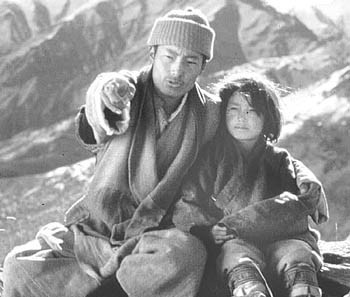
That’s filmmaker Eric Valli’s favorite shot, and in his gloriously visual, Oscar-nominated film Himalaya–the epic adventure of an annual yak caravan making its way through the mountains of Nepal to trade salt for grain–the French-born former documentarian uses that shot over and over and over again.

This is not a bad thing, though some critics have accused the film of “visual redundancy.” Some have gone so far as to call it boring, and if Himalaya were a movie about car racing, they might be right.

But, in fact–this being a story of Nepalese yak farmers on a salt trek–the constant repetition of imagery becomes one of the film’s most powerful tools, reflecting both the beautiful monotony of the Himalayan landscape and the mindset of those who live there. The people of the Dolpopo region–where Himalaya was painstakingly filmed–spend their entire lives on a slope, their day-to-day existence literally an uphill battle.

Tinle (Thinlen Lhondup) is the tenacious, elderly chieftain of a tiny village high in the Himalayas. His son, who had been expected to become the next chieftain, was killed on the most recent trek. When the brave young Karma (Gurgon Kwap) is chosen by the city’s holy men to lead the next caravan, Tinle objects, insisting on leading treks himself until his grandson, Tsering (Karma Wangiel), is old enough to take over the job.

Impatient with the Himalayan tradition that would choose the date of the trek according to the movements of the stars, Karma forms a group of caravaners and sets out before the chosen date.

Unwilling to see Karma force his way into leadership, Tinle pulls together another caravan to give chase, enlisting Tsering, his dead son’s wife, Pema (Lhakpa Tsamchoe), and his other son, Norbou (Karma Tenzing Nyima Lama), a Tibetan Buddhist lama who has not been outside his monastery since the age of 9.

Along the way, the adventurers face punishing trails, blinding storms, and a generational clash that will ultimately decide the future of the entire tribe.

Then there are the yaks.

Among Himalaya‘s many cinematic treasures is its numerous shots of yaks loping along in surprisingly graceful motion. Until now, my own yak-awareness has been limited to a drawing of a yak that represented the letter Y in a kindergarten alphabet book. In Himalaya, with its opening shots of a yak herd thundering breathless down a dusty mountainside, the mighty yak appears to resemble something out of a Star Wars movie, alien and vaguely unreal.

By the end of the film, however, we come to love and respect the yak for its courage and sure-footedness, if not for its apparently limited brains. One nail-biting sequence in which Tinle leads the caravan along a sheer cliff-side as the ground crumbles under their feet stands as evidence of these qualities. In fact, one could say that Himalaya does for yaks what Dances with Wolves did for buffaloes.

In its best moments–the tension-filled cliff scene, a cryptic debate between the village astrologers, a shocking funeral service involving dismemberment and vultures–Valli’s film provides a peek into a world as mysterious as it is breathtakingly beautiful. It may move at a glacial pace at times, but Himalaya is nevertheless a remarkable film, as elegant and graceful as a single line on a piece of paper.

‘Himalaya’ opens Friday, April 6, at Rialto Cinemas Lakeside in Santa Rosa (707/525-4840) and the Rafael Film Center in San Rafael (415/454-1222). For details, see .

From the April 5-11, 2001 issue of Metro, Silicon Valley’s Weekly Newspaper.

© 2001 Metro Publishing Inc. MetroActive is affiliated with the Boulevards Network.

For more information about the San Jose/Silicon Valley area, visit sanjose.com.

Kenneth Cleaver

Consumer Correspondent

March 17, 2001 Consulate General of Ireland Ireland House 345 Park Ave., 17th Floor New York, New York 10154-0037

Dear Irish Consulate:

My maternal grandmother immigrated to this country 70 years ago, and her life is an Irish-American success story. After several years working as a domestic on a New England estate she met her husband, also an Irish immigrant, and enjoyed a life of considerable prosperity and happiness. She and her late husband owned a home and begat two wonderful daughters, the eldest of whom is my mother.

While we have enjoyed her immensely, I’m afraid the family’s consensus is that she must be returned to Ireland within the next year. She is a sweet and wonderful woman, but we can no longer stomach her mawkish poetry, songs, and country folktales, most of which involve her encounters with ill-tempered Co. Cavan livestock. She has become quite a nuisance.

I would be greatly obliged if you could forward the appropriate paperwork for repatriation.

Sincerely, Kenneth Cleaver

Mr. Kenneth Cleaver P.O. Box 810 Bedford, NY 10506 March 28, 2001

Thank you for your letter. Your grandmother seems to be one of the many success stories who emigrated from Ireland to make a new life in the United States, and I am sure you treasure her.

In response to your query, your grandmother, as an Irish national, is free to return to Ireland at any time, should she so wish. There is no “repatriation” scheme in place for this purpose. Should you require any additional information on Ireland, please do not hesitate to contact me.

Yours sincerely, Cait Moran Vice Consul

From the April 5-11, 2001 issue of the Northern California Bohemian.
© Metro Publishing Inc.

Noelle Oxenhandler

Forbidden Love

Noelle Oxenhandler tackles a taboo topic in ‘The Eros of Parenthood’

By M. V. Wood

NOELLE Oxenhandler keeps bracing herself for a heavy helping of hate mail. The Sonoma County author says she wrote The Eros of Parenthood to “reclaim the natural joy in the physical love parents feel for their children.” But read those words again: Eros, parenthood, joy, physical love, children. Could you get more controversial?

Oxenhandler knows she has left herself vulnerable to being misread, for things to be taken out of context. And then someone could point a finger at her, say that she doesn’t take child sexual abuse seriously enough. Perhaps someone could even twist it around enough to say that she’s indirectly promoting child molestation.

But that hasn’t happened–not yet, anyway. Instead, the message of The Eros of Parenthood (St. Martins Press; $25.95), released in February, seems to resonate with people.

“I did a radio talk show in New York, and call after call was from people telling me how relieved they were that there’s a book like this,” Oxenhandler explains as she sits in the garden of her Glen Ellen home.

Talking about the physical love we have for our children has become a national taboo, says Oxenhandler, 48, a longtime contributor to The New Yorker and the author of A Grief out of Season, a book about divorce.

But it’s a truism of psychology that it’s what you can’t acknowledge that creates problems, and Oxenhandler hopes her book will prompt people to communicate about the topic and to explore their own feelings.

In The Eros of Parenthood, Oxenhandler argues that in our fervor to protect children from sexual abuse, the most innocent and nurturing of physical interactions have become suspect. Society has become so vigilant about touching children that the most tender of moments between parent and child are sometimes filled with anxiety and fear.

Some parents hesitate to be affectionate, Oxenhandler says, and others feel a judging gaze bearing down on them. Some even fear that their actions may be misconstrued and that their child may be taken away by a government child protection agency.

“This unease does not come out of the blue,” Oxenhandler writes. “It is not a hallucination or a psychic projection. I have only to pick up the newspaper to realize just how suddenly this haunting presence can materialize into brute reality. There are so many stories.”

Among the most shocking examples in Oxenhandler’s book is a case in the early 1990s of a young mother in New York who panicked because she felt some arousal while breast-feeding her daughter. She called up a local hotline for information. If she had been directed to the La Leche League, anyone there could have assured her that this feeling is normal. Some of the reason for it is chemical: The hormone oxytocin encourages a mother’s production of milk, but it is also the same hormone that controls a woman’s pleasure during orgasm, so the overlap is not surprising.

Unfortunately, the community volunteer manning the phones did not direct the mother to the La Leche League. Instead, the young woman was referred to a rape crisis center, which in turn reported her to the child-abuse hotline. The mother was arrested and the child was taken away for an entire year.

It was this unease as Oxenhandler was mothering her own young daughter, this feeling of a stern and frowning face gazing over her shoulder, that prompted the author to write an essay for The New Yorker about five years ago. In it she described this “eros of parenthood” as an “upswelling of tenderness, often with a tinge of amazement, that expresses itself primarily in touch. In its intense physicality, it partakes of the love that also exists between grownup lovers–but it is different in some absolutely crucial ways.”

Oxenhandler says now, “When I finished writing the essay, I was done with it on a personal level. But then, after it was published, the phone just kept ringing and ringing. For about a two-week period there, it wouldn’t stop.”

Agent after agent was asking Oxenhandler if she could write a book on the subject. “I thought about it for quite some time,” she explains. “And I decided that the subject material was rich enough for a book.”

She said that one of the biggest surprises in researching the book was to find how difficult it was to interview people for The Eros of Parenthood.

“It often felt like I was in some oppressive regime in which people were too scared to talk,” Oxenhandler says. “They would look left, then right, and then whisper to me.”

Oxenhandler interviewed one man who wanted to tell her how beautiful his little boy looks when he was taking a bath: “But even that was a huge taboo,” she recalls. “Every time he came close to saying something like that, he would preface it with ‘This is so hard to say.’

“If this book can help people talk openly about the subject of physical love between parent and child,” she says, “if it can help one father be able to say, ‘My son is so beautiful when he’s naked,’ without having to preface it with ‘This is so hard to say,’ then I’ll consider my work a success.”

Oxenhandler’s book is full of interviews, research, references to scientific studies. But what sets it apart from most sociology- and psychology-related books is that Oxenhandler is first and foremost a writer, an artist.

She does become excited when she talks about the psychological and social concepts described in her book. But the times that she really leans forward in her seat, the times when her hands flash about trying to draw explanations in the air, is when she talks about her craft.

Oxenhandler remembers how thrilled she was when she got the idea of using Goldilocks to represent the journey we take in figuring out what is “too hot” and “too cold” when it comes to being intimate with our children. She recalls what a relief it was to remember the poem “The Bath” by Gary Snyder and how she could use that as a vehicle to explore child sexual abuse.

Her prose is beautiful, and she loves to play with words and rhythm as she smoothly weaves her message within the stories. The book reads less like an analysis of a social issue and more like an homage to the love between parent and child.

“I always knew that I would be a writer,” says Oxenhandler, who wrote her first novel at age 8. “It came naturally to me, and I loved doing it. And I also loved living in California. But I felt that I needed to exile myself from both creative writing and California for a long time. So, I became a philosophy major in college, and I moved to New York.

“But now I’m back in California and I’m back to being a writer,” she continues. “And I feel that I’ve come full circle. I feel very much at home.”

Noelle Oxenhandler reads from “The Eros of Parenthood” on Thursday, April 5, at Readers’ Books, 130 E. Napa St., Sonoma. For details, call 707/939-1779. Oxenhandler reads again on Friday, May 11, at the Sitting Room, 170 E. Cotati Ave., Cotati. For details, call 707/795-9028.

From the April 5-11, 2001 issue of the Northern California Bohemian.
© Metro Publishing Inc.

Open Mic

0

Open Mic

Swift Kick

By Sophie Annan

ENVIRONMENTAL activists keep filling my e-mailbox with complaints about proposed oil drilling in the National Arctic Wildlife Refuge, as if I could possibly care about the fate of polar bears and caribou, and with forwarded newspaper editorials saying really mean things about President Dubya. They call some of his recent actions “brazen thuggery” and him the Toxic Texan and the Pollution President.

They whine that the Arctic refuge could only yield a six- to nine- months supply of oil for the United States, hardly worth the bother and expense, much less the environmental destruction.

So? I say have at it–the sooner we get this over with, the better. More oil, more spills, more destruction of the ozone layer, more global warming, more dead coral reefs can only hasten the end of civilization as we know it, and what thoughtful person could complain about that?

These people carry on about saving the earth, code for saving their own elitist necks, and about preserving at least some animals and wilderness areas for their spoiled children and grandchildren to enjoy. So selfish. So short-sighted.

If environmentalists really wanted to save the earth, they’d know President Dubya is their best friend. Forget oil drilling for a moment and take a close look at his cunning promotion of arsenic in drinking water and more CO2 in the air and you see where he’s heading–getting rid of human beings. And that will almost certainly save the earth.

Oh sure, Dubya and brother Jeb, the Florida governor, don’t want oil drilling in the Gulf of Mexico, but that just proves my point–they’re NIMBY environmentalists. Gotta have something nice to look at while they wait for the end.

So bring it on–more SUVs, more nuclear plants, more global warming, more mining; drill for oil, drill for gas, and burn lots of coal, drain those rivers, cut down those trees, spray those pesticides, dump garbage in those oceans, cut back health care and treatment for drug addiction, and stop those abortions, because the more people we have using it up in one last riotous orgy, the faster the earth can start recovering from us. Besides, the unwanted children of the poor are always good for at least one thing, as Swift observed.

Poison, starvation, epidemics–every little bit helps.

President Dubya: a true friend of the earth. He just doesn’t like people.


Sophie Annan is a writer who lives in Santa Rosa, at least for the moment.


From the April 5-11, 2001 issue of the Northern California Bohemian.

© Maintained by .


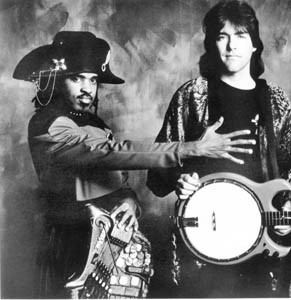
Roy “Futureman” Wooten, Bela Fleck

0

Weird Science

Futureman: Drums can change human evolution

“THERE’S an ancient, ancient myth that is very, very cool,” reveals the musician-inventor-scientist-composer known as Futureman. His expressive, energetic voice is being channeled through the telephone from somewhere on the East Coast, where the eccentric percussionist has been touring with the jazz-bluegrass-fusion quartet Bela Fleck and the Flecktones.

Born under the name of Roy Wooten (his typically bizarre bio says he arrived on this planet on Oct. 30, 2050), Futureman provides the offbeat beats for one of the music world’s most unconventional ensembles.

Fresh from their recent Grammy win for best jazz recording, Bela Fleck and the Flecktones have been riding a new peak of success on a wave that started with their formation over 10 years ago.

This morning, however, what Futureman’s got on his mind is . . . well . . . Futureman apparently has a lot of things on his very imaginative mind.

“What this ancient myth says is this,” Futureman explains. “If you stand before a statue and play perfect golden ratios, you will bring the statue to life. Now, myth is a mirror we hold up to ourselves, to show us an archetypal principle.

“So what I want to know is this,” he continues. “What if we are the statues the myth refers to? What if we are the ones animated by the playing of perfect golden ratios?”

Sensing that his listener doesn’t know what the hell he’s talking about, Futureman laughs.

“Stand up,” he says, “and let your arms hang to your side with your fingers pointed to the ground. If you measure the distance from your fingertip to the floor, that’s 1, and then measure from your fingertip to your head, that’s 1.618. That’s the perfect golden ratio. Measure from your chin to your nose, then your nose to the top of your head, that’s 1 to 1.618. And so forth and so on. The body uses this over and over. So what if we are animated by this principle that is so fundamental to our architecture?”

IT’S ENOUGH to make your head spin. And spinning heads is one of Futureman’s favorite tricks. Onstage, performing with banjo master Bela Fleck, bassist Victor Wooten (Futureman’s brother), and saxman Jeff Coffin, the musician’s out-of-this-world attitude hits critical mass.

There is no easy way to describe the music of Bela Fleck and the Flecktones. Innovators of the highest order, they blend sounds and styles that have no business being heard together. And yet, once played, the music sounds as if it was always meant to be performed that way.

The band’s live gigs have won special acclaim because the prolific foursome are constantly finding new ways to play. “We’re coming up with new music every day,” Futureman says. “So onstage you’ll hear stuff that is only a few days old. It excites me.”

Futureman knows a thing or two about how to work a crowd. He’s a conscientious backup performer, but when he has the spotlight, he goes into a frenzy, playing his invented instruments (including the drumitar, which basically puts a drum kit into a guitar) and strutting and jumping around the stage like a man possessed. And he sometimes shares his ideas with the audience during shows, going off on rambling monologues that have been known to compel his bandmates to leave the stage for a break.

But performing with Fleck is not enough for Futureman. His immediate plans are to help bring about nothing less than a new spurt of human evolution.

His recent all-star percussion camp–which recently drew some of the grand masters of the drum community to the Nashville area–was one major step along the way. Drums, Futureman says, have always been a part of the evolutionary process. How so? Futureman’s explanation, as hypnotic and brain bending as the final round of a poetry slam, is not a short one.

“The connection between drums and evolution is this,” he says. “As a percussionist, as a drummer, I’m actually seeing the drum set a little differently than as a mere drum set. I see the drum set as a piano, and I see the piano as a drum set.

“What I mean is,” he continues, “when you follow the arc from the very first beat on the very first log drum all the way up to the sophistication of the modern drum set–which is an attempt to put all the parade drums together for one person to access–that’s a profound arrival.

“Now I see that as part of an evolution that goes all the way back to the piano, which is a percussion instrument in its harmonic context, in the sense that there are so many choices and they’re all hammered events,” he concludes. “I see the piano as an extension of the drum set.”

Evidently evolution sometimes needs a little help. To lend a hand, Futureman has accommodated by inventing a whole new kind of instrument that splices together a drum set and a piano. Called the RoyEl, its keyboard was designed to represent the periodic table of elements, and Futureman has already begun to compose evolutionary music. He describes these compositions as “transcendental hymns” and has now completed an entire album of this music, titled Evolution d’Amour. But this musical evolution will have to wait, because Futureman isn’t ready to release it yet.

“In the whole scheme of things, I see this album as volume 7,” he says. “I have this album done, but the record I have out now, The Seamless Script, is the one I think of as volume 1. Volume 1 is going to lead back up to volume 7. Like the Star Wars movies.”

Futureman’s excitement is contagious. Just listening to him talk about the power of rhythm is enough to make a person want to dance.

“Rhythm is fundamental,” he says. “Everyone has to find his rhythm, like Michael Jordan talks about finding his rhythm on the basketball court, or Muhammad Ali talks about getting his rhythm going in the ring. He ‘float[s] like a butterfly, sting[s] like a bee.’ He’s groovin’, he’s shufflin’. ‘What are you gonna do, champ?’ ‘I’m gonna dance. I’m gonna dance. We’re gonna get a rhythm. We’re gonna get groovy with this thing!’

“We talk about Bruce Lee, a martial artist, who would sit for hours listening to Indian rhythms,” Futureman continues. “Why? Because he was partaking of their understanding of mathematics. They could break rhythm. Bruce Lee was working with something called broken time, because in sparring with someone, he said, even if he were your equal, you can set him up, lure him into a rhythm, and then break the rhythm to create your opening. But it’s all off of the rhythm.

“See what I mean?”

Bela Fleck and the Flecktones perform Sunday, April 8, at 8 p.m. at the Luther Burbank Center, 50 Mark West Springs Road, Santa Rosa. Tickets are $19.50 and $24.50. 707/546-3600.

From the March 29-April 4, 2001 issue of the Northern California Bohemian.

© Metro Publishing Inc.

The Mighty Mighty Bosstones

0

Brotherly Love

The Mighty Mighty Bosstones display creative freedom and fearlessness on their latest CD, ‘Pay Attention’

By Alan Sculley

Dicky Barrett, lead singer for the Mighty Mighty Bosstones, knew when the band released their 1997 CD Let’s Face It, chances were good that it would be a commercial breakthrough. When the Boston group arrived on the national scene in 1990, they were one of the few bands playing ska. And their sound, which reshaped the skanking sound of ska by adding a strong element of energetic punk rock, put a decidedly different twist on the more poppy and soulful style of late-’70s, early-’80s ska groups like the Specials, Madness, and the English Beat.

But by the late 1990s, the times had caught up with the Bosstones. Ska was widely viewed as the next big trend in alternative music, and the Bosstones were sure to benefit. That thought worried Barrett perhaps more than it excited him. He wondered if long-time fans would think the Bosstones had sold out by reaching a larger audience.

“Well, it was scary with the last album,” the gravel-voiced singer says. “I think a lot of the success, I don’t really take full credit for. At that time, in 1997 and 1998 a lot of things were happening musically. Green Day was all over the radio. Rancid was on the radio. You can talk about No Doubt.

“The list goes on. So the musical climate and the temperature at the time to be the Mighty Mighty Bosstones, it was perfect. So it was natural that we ended up on the radio, too. But we were also afraid of that because we’d been a band for so many years. We’d been the Bosstones when Motley Cure and Quiet Riot were a band. And then when grunge became really popular, we were still the Bosstones. And we remained true to what we are. But then all of a sudden what we were doing became suddenly popular and you can use the word trendy. So we were a little bit afraid.

“But once we got over that hump and people said now the rest of the world knows what I knew all along and our fan base and our core audience, all those other terms, and our friends and the people who had been supporting us for so many years, once we realized they were proud of us and said it’s about time and we’re glad you guys are successful, then you’re able to do whatever you want,” Barrett adds. “Now we’re completely fearless. We’re afraid of nothing.”

Perhaps one reason the group’s core fans stuck with the band was because the Bosstones tried to avoid any perception that they were trying to cash in on the popularity of ska–even as Let’s Face It was going platinum and spawning the radio hits “The Impression That I Get” and “The Rascal King.”

“The same people who were saying ska is the next big thing, are the same exact people who are saying ska is dead,” says Barrett, explaining why the Bosstones tried to distance themselves being part of the ska revival. “It’s like, I knew that it didn’t matter. It was more important for us to be the Bosstones than to be flagwavers for ska as a trend. For years ska was a musical style and a type of music that we have a passion for, that’s fine. We’ll wave that flag. But ska as a trend, to me, is bogus because that comes from bogus people, people who say it’s the next big thing, until all of a sudden what Korn and Limp Bizkit do becomes popular.

“Ska as a musical styling and as a type of music we’ve loved for years. That will always exist, if for no other place, it will exist in our hearts.”

Now the Bosstones have graduated from cult status to mainstream popularity without losing their core audience or their integrity, and Barrett realizes the band can work from a real position of strength. And the creative freedom and fearlessness the band felt influenced the latest Bosstones CD, Pay Attention.

“It allowed us to allow the songs to be exactly what they wanted to be and not say does it have to be this or should we do that,” Barrett said. “That’s something we’ve never really done, but within, the freedom seemed so right. It seemed so endless. And to not take advantage of it, to not say people who like the Bosstones like the Bosstones because they’re the Bosstones, and that’s up to us to decide who the Bosstones are (would have been a mistake). We have great followers, great supporters and great people who enjoy the Bosstones. We’re stoked … I think that it’s a wonderful gift and a really really good album to the people who have been supporting us for so many years.”

Indeed Pay Attention is immediately recognizable as the work of the Bosstones–which include vocalist Barrett, bassist Joe Gittleman, guitarist Nate Albert (since replaced by Lawrence Katz), drummer Joe Sirois, saxophonists Roman Fleysher (who recently replaced Kevin Lenear) and Timothy “Johnny Vegas” Burton, trombonist Dennis Brockenborough and dancer/backing vocalist Ben Carr.

Songs like “Let Me Be,” “Where You Come From” and “A Temporary Trip” are among the songs that fit the band’s familiar hybrid of horn-laced punk and ska. But there are also some twists. For one thing, the band’s ability to craft strong vocal melodies–a talent that especially blossomed on Let’s Face It–has grown even more prominent on Pay Attention songs like “Sad To Say,” “The Skeleton Song,” and “All Things Considered.” “I think I’ve run from it in the past, and I think that because I came from punk rock, I think I ran from melody,” Barrett said. “But I’ve always loved songs. I’ve always loved good songs and I’ve always loved music. I don’t think I’m a tremendous singer. I think I write really good lyrics and I think that when it comes to performing the Bosstones songs live on stage, I’m good at it. But I think it was more there’s nothing to be afraid of. Why be afraid of melody? If I have the ability to sing a song, why not sing a song? And I think there’s still a lot of energy that can come out of a really solid melody.”

The CD also puts more emphasis on the guitar work of Albert–particularly on “Allow Them,” “Finally,” and “I Know More”–tunes that all lean more toward a straight-ahead rock sound. This move was inspired in part by the impending departure of Albert so he can spend time with his ailing mother.

“Nate being an exceptional guitar player, such a great guitar player, we decided that maybe this album should be, although we’ve done guitar heavy songs in the past, let’s not be afraid to really show Nate for the kind of player he is,” Barrett says. “We knew up on our radar screen was the very realistic possibility, and at certain times I’m sure we were in denial that he wasn’t going to be able to tour because of the condition his mother’s been in for many many years. And being on the road with her being as sick as she has been, there was a realistic possibility that he wouldn’t tour anymore. So it was kind of a tribute to him that when people talk about the Bosstones years from now, if they talk about the Bosstones, it would be a shame for it not to be said that Nate was an amazing guitar player.”

After the CD was completed, Albert indeed left the group. And while Barrett holds open the possibility that Albert could contribute to CDs in the future, the group is moving forward.

“It’s difficult,” Barrett says. “He’s our brother and he’ll forever be a Bosstone. He was there from the beginning and he was there as long as he could be. But his mother is sick. Every time he was on the road, he lived with the fear that she would pass away and he was going to live the rest of his life thinking I should have been there to take care of here. I should have been there. He didn’t really want to go through that again. And whatever happens will happen, but he is comfortable knowing he’ll be able to take care of his mother.”

The Mighty Mighty Bosstones perform Tuesday, April 3, at 8 p.m. at the Phoenix Theater, 201 Washington St., Petaluma. Tickets are $17 general, $15 Sonoma State University students. 707/664-2382.

From the March 29-April 4, 2001 issue of the Northern California Bohemian.

© Metro Publishing Inc.

Sonoma Valley Film Festival

0

More than two dozen films screen Thursday-Sunday, March 29 to April 1, in Sonoma during the fourth annual Sonoma Valley Film Festival. Here are a few festival highlights:

The Unknown: Players from the Santa Rosa Symphony accompany a screening of the restored version of Lon Chaney’s classic film. Richard May, vice president of preservation for Warner Brothers Studios, speaks on the restoration of classic films. Friday, March 30, at 7 p.m. at the Sebastiani Theatre. A reception follows at 9:30 p.m. at the Sonoma Valley Museum of Art.

Una Cena Fiorentina: The festival’s gala event features a cocktail reception, Italian food, dancing, an art auction, and awards, plus appearances by festival filmmakers. Saturday, March 31, 6:30 to 11:30 p.m. at Cline Cellars, 24737 Arnold Drive. $165.

Screenwriters’ Panel: Screenwriters like Pamela Gray (Music from the Heart) and Jane Anderson (If These Walls Could Talk) discuss the trade. Saturday, March 31, at 10 a.m. at the Sebastiani Theatre. $8.

Critics’ Panel Discussion: Film critics like Jan Wahl of KRON and Mick LaSalle of the San Francisco Chronicle discuss the state of cinema. Sunday, April 1, at 11 a.m. at the Sebastiani Theatre. $8.

All films screen at two theaters in Sonoma: Sebastiani Theatre, 476 First St. E., on the Plaza; and Sonoma Cinemas, 200 Siesta Way, off Highway 12. Full festival schedules are available at Copperfield’s Books in Santa Rosa, Petaluma, and Sebastopol; Readers’ Books in Sonoma; and other locations around the county. For more information, surf over to www.sonomafilmfest.org or call 707/258-5929.

From the March 29-April 4, 2001 issue of the Northern California Bohemian.

© Metro Publishing Inc.

Dessert Wines

Sweet Dreams Dessert wines don't have to be a sticky business By Marina Wolf DESSERT WINES are the forgotten finale. Until recently, restaurants gave them the last page of the wine list. At home, people think of stale sherry on top of their grandma's fridge, and say no thanks. But...

DivaBands

Sisters in Song DivaBands showcases local female artists By Paula Harris DON'T underestimate Roberta Donnay. The 5-foot-4 pixielike woman (the exact same height as Madonna, as Donnay is quick to point out) with long red hair bops around the Studio B recording studio in Sausalito in her black silk pants and...

Joe Jackson

Joltin' Joe Joe Jackson--the consummate outsider By Alan Sculley FEW OF TODAY'S musicians have enjoyed a career where they have explored as many different musical styles and settings as Joe Jackson. Over a two-decade span, the New York-based British-born singer/songwriter has touched on punk-edged pop, songs that have been flavored...

‘Himalaya’

Yak Attack Lumbering gracefully through 'Himalaya' TAKE A PIECE of paper. Draw a straight line from the upper-left corner to the lower-right. Now draw a few silhouettes--rural peasants, rickety wagons, a handful of yaks--each figure making its way upward along the line. And there you have it....

Kenneth Cleaver

Consumer Correspondent March 17, 2001 Consulate General of Ireland Ireland House 345 Park Ave., 17th Floor New York, New York 10154-0037 Dear Irish Consulate: My maternal grandmother immigrated to this country 70 years ago, and her life is an Irish-American success story. After several years...

Noelle Oxenhandler

Forbidden Love Noelle Oxenhandler tackles a taboo topic in 'The Eros of Parenthood' By M. V. Wood NOELLE Oxenhandler keeps bracing herself for a heavy helping of hate mail. The Sonoma County author says she wrote The Eros of Parenthood to "reclaim the natural joy in the physical love parents...

Open Mic

Open MicSwift KickBy Sophie AnnanENVIRONMENTAL activists keep filling my e-mailbox with complaints about proposed oil drilling in the National Arctic Wildlife Refuge, as if I could possibly care about the fate of polar bears and caribou, and with forwarded newspaper editorials saying really mean things about President Dubya. They call some of his recent actions "brazen thuggery" and...

Roy “Futureman” Wooten, Bela Fleck

Weird Science Futureman: Drums can change human evolution "THERE'S an ancient, ancient myth that is very, very cool," reveals the musician-inventor-scientist-composer known as Futureman. His expressive, energetic voice is being channeled through the telephone from somewhere on the East Coast, where the eccentric percussionist has been touring with the jazz-bluegrass-fusion...

The Mighty Mighty Bosstones

Brotherly Love The Mighty Mighty Bosstones display creative freedom and fearlessness on their latest CD, 'Pay Attention' By Alan Sculley Dicky Barrett, lead singer for the Mighty Mighty Bosstones, knew when the band released their 1997 CD Let's Face It, chances were good that it would be a commercial breakthrough....

Sonoma Valley Film Festival

More than two dozen films screen Thursday-Sunday, March 29 to April 1, in Sonoma during the fourth annual Sonoma Valley Film Festival. Here are a few festival highlights: The Unknown: Players from the Santa Rosa Symphony accompany a screening of the restored version of Lon Chaney's classic film. Richard May, vice president of preservation for Warner Brothers...
11,084FansLike
4,606FollowersFollow
6,928FollowersFollow