Jerry Garcia

0

High on Bluegrass

Jerry Garcia’s bluegrass roots are showing on legendary ‘lost’ tapes

By Greg Cahill

IT’S ONE of the most celebrated bootleg recordings in pop history. In 1993, mandolinist David Grisman invited his old pal Jerry Garcia–then enjoying some of his most commercially successful days as the Grateful Dead guitarist–to join him and bluegrass picker Tony Rice for a laid-back afternoon session at Grisman’s home studio in Mill Valley. The result was an intimate gathering that evoked a friendly front-porch feeling.

Some months later, Grisman heard that the jam session had found its way onto KBAI radio in New York, and deadheads were swapping the tapes at shows. The recording even popped up in a shipment of bootleg CDs that the Dead confiscated.

Perplexing.

But then Grisman discovered that a pizza delivery boy had lifted a cassette version of the sessions from Garcia’s kitchen counter.

That episode is immortalized in The Pizza Tapes (Acoustic Disc), newly released on Grisman’s CD label. It’s a real gem, sometimes brilliant, sometimes not, but filled with warmth. The recording retains the banter–and false starts–that took place during the session. The trio tries its collective hand on Lefty Frizzell’s “Always Late” (a hit a few years earlier for country star Dwight Yoakam), jams on George Gershwin’s “Summertime,” and noodles its way through Bob Dylan’s “Knockin’ on Heaven’s Door.” There’s even a rare Garcia vocal rendering of a tentative “Amazing Grace,” sung at the request of Grisman’s wife.

The closing track, on which Garcia sings “The House of the Rising Sun,” is worth the price of admission alone.

For Garcia, the bluegrass sessions were a return to his country roots.

In 1992, I had a chance to sip tea with Garcia on a rainy morning at the Dead’s San Rafael office, located in a big Victorian a couple blocks from the downtown, and talk about his renewed interest in bluegrass.

“My grandmother was a big Grand Ole Opry fan,” Garcia recalled. “Yeah, I grew up in San Francisco listening to the Opry every Saturday night on the radio without knowing what I was hearing. In fact, my first 45 was a Hank Williams record, a song called ‘The Love Bug Itch.’ It was a really stupid song,” he added with a laugh, “but, hey, it was Hank Williams.”

At the time, Garcia–long regarded as one of rock’s most innovative electric guitarists–had begun nurturing his affinity for bluegrass breakdowns and hillbilly spirituals, playing occasional concerts with Grisman and some of the hottest country pickers this side of Kentucky. Grisman had just released Bluegrass Reunion (the first of six Acoustic Disc recordings featuring the duo), to which Garcia contributed two tracks. That CD was a traditional outing with bluegrass great Red Allen and featured banjo player Herb Pedersen, fiddler Jim Buchanan, and bassist James Kerwin.

In 1992, Grisman and Garcia had teamed up for a gorgeous self-titled CD featuring bluegrass-inflected renderings of B. B. King’s trademark “The Thrill Is Gone,” the Dead’s “Friend of the Devil,” and Irving Berlin’s “Russian Lullaby.”

“For me, that was a rich experience,” Garcia said of the recording while puffing a low-tar cigarette and showing satisfaction at being “one of the guys” during the no-frills sessions.

THE GRISMAN/GARCIA projects underscore a long-standing relationship between the two musicians. “He’s a real livewire and kind of a perfectionist,” Garcia said of the notoriously finicky Grisman. “We fire each other up in a way that I think is very interesting–and it’s interesting for the audience. But it’s one of those things that doesn’t bear too much analysis.

“After all, musical chemistry doesn’t yield to a rational yardstick.”

Ironically, the pair had first met by chance in 1964, when Garcia was on a pilgrimage to the East Coast in search of authentic bluegrass music. At the time, Grisman was leading a group of upstart bluegrass players called the New York City Ramblers, still fresh from their upset victory at the prestigious Union Grove fiddle competition in North Carolina.

“I had my banjo, he had his mandolin,” Garcia explained. “We cranked a little bit and he kind of tested me. I guess he wanted to see if these guys from the West Coast could play.”

Returning to San Francisco, Garcia fretted over the lack of good bluegrass players in the Bay Area and found himself regretting what he perceived as his own lack of virtuosity. “I wanted the bluegrass stuff to be perfect, and I wasn’t happy if it wasn’t,” he said.

Instead, he passed his time in Mother McCree’s Uptown Jug Champions, a local jug band that included guitarist Bob Weir–then a rebellious 15-year-old kid who’d been expelled from high school–and blues harmonica enthusiast Ron “Pig Pen” McKernan. In 1965, that band went electric, changed its name to the Warlocks, and added drummer Bill Kreutzmann and bassist Phil Lesh. By August of 1966, they had changed their name again, this time to the Grateful Dead, moved to the Haight-Ashbury district, and begun playing at Bill Graham’s psychedelic emporium the Fillmore Auditorium and other local venues.

Yet bluegrass continued to influence Garcia. With their acoustic instrumentation, three-part vocal harmonies, and narrative lyrics, Working Man’s Dead and American Beauty, both recorded in 1970, marked a momentary shift from the band’s signature freewheeling jazz-rock jams. “For me, it was one of those things where I didn’t want to spend the rest of my life in a studio making records that are too fucking weird for anybody to listen to,” Garcia said. “Besides, we recorded [Working Man’s Dead] around the same time as Live/Dead, which gave us a chance to scratch our itch for the weird shit.”

Coincidentally, American Beauty features Grisman playing mandolin on two tracks: “Ripple” and “Friend of the Devil.” The sessions were recorded on the day Grisman moved to the Bay Area, an auspicious event that compelled him to settle in Stinson Beach, near Garcia and fellow musician Peter Rowan. In 1973, Grisman and Rowan persuaded a moonlighting Garcia to pick up his five-string banjo for the first time in a decade for the short-lived Old & in the Way. That band–including fiddler Vassar Clements and bassist John Kahn–recorded one live album at the old Boarding House in San Francisco. The Grateful Dead’s Round label issued an album of those live sessions, also called Old & in the Way. In 1996, Grisman released the stellar Old & in the Way: That High, Lonesome Sound, also culled from the Boarding House dates.

Despite the long break between projects with Grisman, Garcia maintained that bluegrass remained “a vast reservoir” to which he returned time and again. “I think of this as an ongoing thing in my life,” he said. “And as long as it’s comfortable for both of us, I’d be happy to keep doing it part of every year.”

Fittingly, Garcia’s last known recording, made just two weeks before his death in 1995, was with Grisman in the small basement studio in which he had found so much peace and contentment.

From the May 4-10, 2000 issue of the Sonoma County Independent.

© Metro Publishing Inc.

Rebecca Solnit

0

Happy Trails

‘Wanderlust’ takes a fascinating tour of the history of walking

By Patrick Sullivan

“EXPLORING the world is one of the best ways of exploring the mind, and walking travels both terrains,” writes Rebecca Solnit, explaining the impetus behind her new book, Wanderlust: A History of Walking (Viking; $24.95).

To which your uneasy responses might well be, “A whole book?” and “On walking?” But relax, fellow pilgrim, because this is one journey well worth taking.

In postmodern America, we’ve just about given walking the bum’s rush. Travel by car is faster, surfing the Internet is more fun, and, frankly, the whole concept is so 20th century, isn’t it? But Solnit finds this trend ominous. Walking, she believes, is an irreplaceable way of engaging with the natural world, the human community, and our own mind. In Wanderlust, she explains why.

In her opening chapter, Solnit argues that the human mind moves best at the speed of human feet. But that belief doesn’t keep her book from ranging far and wide across a broad field of human knowledge and experiences, examining two-footed travel from a hundred different perspectives, drawing on an extensive range of sources to give us the history, the literature, the philosophy, the sexual politics, and the anthropology of walking.

Humanity is the only animal species that walks comfortably on two legs. But anthropologists, Solnit explains, can’t agree on why we became bipedal. The most entertaining theory is R. D. Guthrei’s 1974 proposal that hominids got up on two legs so that males could use their exposed penises as a “threat display organ” to intimidate rivals, a notion that leads Solnit to speculate on the origins of human laughter.

But however we became upright, we’ve been walking ever since, with dramatic consequences. Walking changes the world, as Solnit explains. Wordsworth wanders around England, writing poetry that changes the way society views nature. John Muir strides across America and helps create the ecological mindset that gave rise to America’s park system. Novelist George Sand replaces her dainty petticoats with men’s trousers and finds that women can take pleasure in walking the city streets.

Wanderlust strides alongside a host of intriguing walkers of all types, from poets to activists to nature lovers to prostitutes. Along the way, the author uncovers spiritual insights, fascinating personalities, and delicious ironies of history.

Poet Gary Snyder climbs Marin’s Mount Tamalpais with Jack Kerouac and Allen Ginsberg. An elderly woman calling herself Peace Pilgrim walks across the United States on a quest for world disarmament.

Then there’s the pilgrimage of German filmmaker Werner Herzog, who makes an extravagantly passionate gesture worthy of a character from his films. Upon learning that his friend film historian Lotte Eisner was dying, Herzog decided to make the trip to her hospital in Paris on foot, a journey of hundreds of miles. Plagued by bad weather and leg pains, Herzog wrote in his diary, “Why is walking so full of woe?” But when he arrived at his friend’s bedside, he experienced the sublime peace of a quest fulfilled.

Solnit quotes from novels, people’s diaries, and her own journals at least as often as she references scientific papers. Indeed, Wanderlust has a deeply literary tone–a fact enhanced by the author’s formidable way with words. Walking in the Marin Headlands, she sees some wildflowers and describes them as “small magenta cones with their sharp black points that seem aerodynamically shaped for a flight that never comes, as though they had evolved forgetful of the fact that flowers have stems and stems have roots.”

In the end, the author returns to her starting point. Walking, she concludes, should be viewed in ecological terms as an indicator species, the decline of which is an early warning sign of systemic trouble. In other words, when our feet leave the ground, we end up just spinning our wheels.

Rebecca Solnit reads from Wanderlust on Thursday, May 11, at 7:30 p.m. at Readers’ Books, 130 E. Napa St., Sonoma. For details, call 939-1779.

From the May 4-10, 2000 issue of the Sonoma County Independent.

© Metro Publishing Inc.
Farmers’ Markets

0

Farmers’ markets spring to life

By Paula Harris

IF YOU GROW IT they will come, especially if it’s fresh, juicy, crunchy, fragrant, or ripe. Growers are once again beginning to showcase their flourishing yields of locally grown fruits and veggies and setting up stalls at farmers’ markets in parks and parking lots around the North Bay.

It’s a movable feast of greens, squash, berries, peaches, herbs, and much more that signifies the arrival of warm weather, frosty drinks, sizzling barbecued veggies, and cool salads.

Each local farmers’ market has its own particular character. In some instances, the markets are more akin to community meeting places, with the addition of live music and arts and crafts exhibitions. Some markets hold cooking demonstrations and samplings. And many farmers are becoming savvy about the value of the personal touch and are offering customers recipes, information, and the occasional story about their produce.

What occurs is an old-fashioned social exchange that’s rarely achieved (with any real sincerity) in the big-box supermarket down the street. So, for a change, forsake that squeaky warped-wheeled wire cart and instead select a woven basket and troll the stalls at the nearest farmers’ market.

Here’s what’s going on locally, according to the latest information from the California Federation of Certified Farmers’ Markets.

Sonoma County

Cloverdale: Downtown Plaza; Saturdays, 7 a.m. to noon, June-October; 894-4470.

Healdsburg: West Plaza parking lot at North and Vine streets; Saturdays, 9 a.m. to noon, May-December; and the Plaza; Tuesdays, 4 to 6 p.m., June-October; 431-1956.

Petaluma: Walnut Park, Fourth and D streets; Saturdays, 2 to 5 p.m., May-October; 762-0344.

Santa Rosa: Oakmont, bank parking lot, White Oak and Oakmont drives; Saturdays, 9 a.m. to noon, year-round; 538-7023.

Original Farmers’ Market, Santa Rosa Veterans Bldg., 1351 Maple Ave., Santa Rosa; Saturdays and Wednesdays, 8:30 a.m. to noon, year-round; 522-8629.

Wednesday Night Market, Fourth and B streets; Wednesdays, 5 to 8:30 p.m., May 31­Sept. 6; 524-2123.

Sebastopol: New Town Plaza, Petaluma Avenue at McKinley Street; Sundays, 10 a.m. to 1:30 p.m., May-November; 522-9305.

Sonoma Valley: Depot Museum parking lot, First and Spain streets; Fridays, 9 a.m. to noon, year-round; and Sonoma Plaza at Napa Street; Tuesdays, 5 to 8:30 p.m., April-October; 538-7023.

Napa County

Calistoga: In front of the Sharpsteen Museum, 1311 Washington St.; Saturdays, 8 to 11 a.m., summer months; 942-4769.

Napa: First and Main streets; Thursdays, 4 to 8 p.m., May-September; and West and Pearl streets; Tuesdays, 7:30 to noon, May-October; 252-7142.

St. Helena: Hwy. 29 and Grayson-Crane Park; Fridays, 7:30 to 11:30 a.m., May-October; 265-8602.

Yountville: Compadres Bar & Grill parking lot, 6538 Washington St.; Wednesdays, 4 to 8 p.m.; year-round; 257-8481.

Marin County

Novato: Sherman and Grant streets; Tuesdays, 4 to 8 p.m., May-November; 800/897-FARM.

Pt. Reyes Station: Toby’s Feed Barn, 15479 State Route 1; Saturdays, 9 a.m. to 1 p.m., May-October; 415/633-9153.

San Rafael: Civic Center, Hwy. 101 and San Pedro Road; Sundays and Thursdays, 8 a.m. to 1 p.m., year-round; 800/897-FARM.

Shopping Hints

Forget the shopping list–just get to the market and see what looks good, then go from there.

Look, smell, touch, and try to sample and compare produce at different stalls before you purchase anything.

Be adventurous. Ask the grower for advice on how to select and prepare unusual items if you need to.

Tote your own bags or baskets–keep the squashable items in their own bag.

Take the kids–it’s more fun and entertaining than the supermarket. Buy them fresh-baked breads and honey sticks (and encourage them to chat with a local beekeeper, so they appreciate the work that goes into food production).

Shop early for optimum variety and freshness. Or shop late in the day while growers are packing up and haggle for a cheaper price.

Get to know the farmers. Quiz them on selection and cooking procedures. Become a “regular.”

On warm days, plan to go home immediately afterward or bring a cooler to stash delicate items like ripe strawberries or tender spinach. Be careful about leaving the fresh produce in a stifling car. Try to eat the goodies on the same day.

From the May 4-10, 2000 issue of the Sonoma County Independent.

© Metro Publishing Inc.
Usual Suspects

0

Activists respond to police-abuse report

By Greg Cahill

LOCAL SOCIAL JUSTICE advocates say they are encouraged by the results of a long overdue report on police misconduct and excessive use of force, but agree it will be difficult to get public officials to act on the recommendations.

The federal report, approved last week by the U.S. Commission on Civil Rights and leaked April 21 to the local daily (weeks before its scheduled release), notes that panel members are “appalled” by the police-involved deaths of eight people over a 25-month period leading up to the commission’s February 1998 public hearing.

“The Advisory Committee agrees with community spokespersons who said that the number of events should be cause for alarm for all citizens of the county,” the report states.

The civil rights panel recommends that the Sonoma County Board of Supervisors and the Santa Rosa and Rohnert Park city councils create independent civilian-review boards with the power to, among other things, investigate police-involved shootings or alleged misconduct; promote improved procedures for filing a citizen complaint; enccourage increased ethnic, gender, and language diversity in law enforcement ranks; and support better training in cultural diversity and handling of domestic violence cases and of suspects experiencing psychiatric and drug- or alcohol-induced episodes.

“This report is important,” says Judith Volkart, attorney and former chair of the Sonoma County chapter of the American Civil Liberties Union. “It’s the first time an outside group not affiliated with local law enforcement has focused on the pattern of police behavior and the pattern of mistrust in the community, and listened to everyone. These are the recommendations and we need to pay attention–it’s everyone’s responsibility.

“I think the report has to be accessible to the community and people have to get together and educate themselves on what review boards are. The community has to take this into its own hands in these three locations and create public forums in other towns.

“I can see a couple of organizations maybe taking a leading role in organizing these public forums.”

However, the lengthy delay in issuing the final report, which commission members expected would require only three months, has taken a lot of the steam out of drives to establish support for independent civilian-review boards, and allowed the Santa Rosa Police Department to create a civilian advisory panel that has no investigative powers and is little more than a vehicle for public relations.

“As far as momentum continuing and accelerating [goes], I think community interest [in civilian review boards has dissipated,” Volkart says. “At the moment there are no efforts I’m aware of. People were waiting for the report. There were local hearings in Santa Rosa after the civil rights hearing and a lot of interest, but the mayor at the time said we don’t need a review board.”

Meanwhile, Santa Rosa Mayor Janet Condron, local law enforcement, and the editorial board of the Press-Democrat have been quick to denounce the report. At an April 21 press conference, Condron asked, “Is [independent civilian review] really what’s needed in this community? We don’t think so.”

In a scathing April 22 editorial, the Press-Democrat opined that the 61-page report is nothing more than “reams of boilerplate, anti-police rhetoric [with] few specifics and even fewer helpful recommendations. . . . It didn’t help that the commission chose to pretend that the police agencies’ most harsh critics represented the opinions of all Sonoma County residents. Then the commission accuses police of ‘marginalizing’ its critics. Funny, we thought people who carried signs that say all police officers are killers do a pretty good job of marginalizing themselves.”

SUCH PUBLIC ridicule isn’t deterring social justice advocates. “It’s not over, it’s just beginning,” says Suzanne Regalado, executive director for the Sonoma County Peace and Justice Center. “Some of us were waiting for the report to come out to see what the next step would be, certainly with regard to an independent civilian-review board.

“There is a whole move to create open and free dialogue in our community that’s being tackled in lots of different areas. It’s time for our city councils, Board of Supervisors, and law enforcement agencies to be a part of that in a real way.”

Indeed, the civil rights panel seemed to anticipate the vacuous insights of its critics: “[I]t is the right and responsibility of citizens to protest police practices they view as unwarranted, unnecessary, or a gross abuse of discretionary authority. We provide police officers with the responsibility to enforce the laws and protect individuals and property. We do not grant them authority to be arrogant or to abuse this trust.

“For a law enforcement department to view citizen concerns about police practices as a threat makes a mockery of this trust, and the consequences are community fear, ineffective policing, and deteriorating police-community relations.”

Staff writer Paula Harris contributed to this article.

From the April 27-May 3, 2000 issue of the Sonoma County Independent.

© Metro Publishing Inc.
Russian River Mercury Contamination

0

Photograph by Michael Amsler

Heavy Mettle

State regulators ponder mercury contamination in the Russian River. Is Judith Eisen its first victim?

By Janet Wells

THREE YEARS AGO, Guerneville artist Judith Eisen was following her bliss, living in an idyllic beach hamlet in Thailand, using canvas and paint to capture stunning limestone cliffs and coral-studded azure water. She lived in a thatched-roof house, did yoga on the sand, crafted a book of postcard prints of her paintings. She introduced the beauty of Asia to her two grown daughters when they came to visit.

Then, one day in 1997, she got sick. Paradise became a whirl of fatigue, nausea, dizziness, stomach cramps, bowel problems, weakness, and muscle pain, forcing Eisen to embark on a nightmarish journey to unravel the mystery of her illness.

After almost two years of tests, special diets, and utter exhaustion, Eisen was astounded to find out that she has high levels of mercury, a toxic substance that is indelibly interwoven with northern California geology, history, and health.

Used during the gold rush, and once considered a strategically important material by the U.S. military, mercury mines dotted the hills all over Northern California. The bottom dropped out of the mercury market in the 1970s, and the mines have long been abandoned. But mercury is not a thing of the past: the Central Valley pumps about 460 pounds of the material a year into San Francisco Bay, and Bay Area industry is allowed to discharge another 70 pounds a year. Because of mercury, along with dioxins, pesticides, and PCBs, fish from San Francisco Bay is off limits for pregnant women and children.

In a January 1999 article, the Independent revealed that 200,000 cubic yards of mercury mine waste, containing 590,832 pounds of the heavy metal, have been eroding from an abandoned mine site into creeks that drain to Tomales Bay, a once pristine estuary nestled among the coastal hills on the Sonoma-Marin border. A recently completed $3 million cleanup effort has stemmed the flow of contamination, but Tomales Bay ducks show dangerously high levels of mercury, and ongoing fish studies may well show elevated mercury levels in Tomales Bay sharks and clams.

In Sonoma County, tailings from the Mt. Jackson mercury mine–located a few miles upstream from Eisen’s home–were used more than 15 years ago for road base during construction of the sewage treatment plant in Guerneville. While county health officials found no contamination from the mine waste, North Coast Regional Water Quality Control Board senior engineer Bob Tancreto has conceded that, after almost two decades, the wells and creeks in the mine area may “deserve another look.”

Eisen doesn’t know whether living near an abandoned mercury mine site for 20 years contributed to the elevated levels of mercury in her system. The source of Eisen’s mercury exposure will perhaps never be ascertained, and it’s not even certain that mercury is at the root of her illness. But in a world that is increasingly polluted by industrial waste, pesticides, chemicals, car exhaust, rampant viruses, and bacteria, Eisen wonders if she is the proverbial canary in the coal mine–and a harbinger of a health crisis on the horizon.

THIRTY YEARS AGO, a person complaining of acute fatigue, dizziness, nausea, and pain without any obvious source was as likely to be referred to a psychiatrist as a doctor. Now Western medicine must cope with an increasing number of patients presenting complex, often vague and seemingly inexplicable symptoms. Remember the rash of chronic fatigue syndrome in the ’80s and ’90s–a controversial diagnosis used to cover a puzzling array of complaints.

In short: the doctor may have little idea what’s really going on.

In Eisen’s case, the initial diagnosis was fibromyalgia, the current popular catchall for elusive muscle pain and fatigue.

Dressed in a plaid flannel jacket, she tells her story over a decaf cappuccino laced with honey. With her square face, shoulder-length gray hair, and strong thick hands, Eisen, 57, looks as much like a rancher as an artist. But her energy level is in striking contrast to her solid build. Her blue eyes fade with fatigue as the conversation stretches into an hour. “[The doctors] told me there was nothing they could do for me, and that I should go home and learn to live with it,” she says. “I was in such a torment of pain all the time. There was no relief from it.”

While Eisen suspects that the poisioning started while living near the Russian River, she first noticed something wrong in Thailand in early 1997, when a minor leg injury didn’t heal after weeks of rest. “I thought I’d sprained a ligament from doing yoga,” she says. “Until that point in time I had been a really healthy person in my life and very strong physically. I’d never had an illness that I didn’t get over.”

Soon she was hit with bouts of dizziness and nausea. Eisen thought she had the flu or a cold. After two months, she realized she wasn’t improving and sought advice from doctors in Singapore and Malaysia. In May, she called Talia, her oldest of two daughters, who was alarmed enough to arrange for her mother’s immediate departure from Thailand. Eisen had to use a wheelchair to get to and from the airplane.

Back in Sonoma County, broke and sick, Eisen got on the county medical plan and started a battery of tests at Sutter Medical Center in Santa Rosa. Doctors diagnosed her leg problem as an arthritic condition and treated it with arthroscopic surgery. Then came the fibromyalgia diagnosis, which Eisen feels was a brushoff. “They couldn’t be bothered. That’s what happens to most people who have weird things,” she says. “I’ve talked to people who have immune deficiency problems who get treated as if they were crazy.”

Nursed by her daughter, Eisen spent several months bedridden, in a haze of pain. In early fall, she went to see a naturopath who works as a local physician’s assistant. “He likes these kinds of diseases,” Eisen says. “It’s kind of like a puzzle and a challenge to unwrap it and figure it out.”

First came an elimination diet–rice and vegetables only, which gave Eisen her first taste of improving health: after six months on the diet, she was able to once again sleep regularly.

A new battery of tests, tracking allergies and bowel function, showed that Eisen’s immune system was working overtime, treating almost everything as an invader. The naturopath put Eisen on a rotational diet, a decades-old nutritional program to minimize the effects of food allergies. Meal planning came in the form of a spreadsheet, with grains, fruits, and dairy rotated into her diet on a very selective basis. After several months, Eisen started to notice less muscle and joint pain.

Then the naturopath asked if Eisen had ever been tested for heavy-metal poisoning. She hadn’t, so she carefully clipped several strands from the back of her scalp and sent them to the Great Smokies Diagnostic Laboratory in North Carolina. Rarely ordered by hospitals, the hair test is one of the methods recommended by the U.S. Department of Health and Human Services to evaluate mercury exposure.

Eisen’s test results came back in January 1999: on the laboratory’s zero-to-1 scale, Eisen’s mercury level was 3.2. She also showed elevated levels of lead, another known toxin. “My doctor said, ‘Oh my, this could be causing all your problems,’ ” she says.

Eisen used the Internet to research mercury poisoning, and says that, indeed, her symptoms fit the profile.

MERCURY, linked to myriad health problems, including nausea, vomiting, skin rashes, seizures, and brain damage–even death–is a nasty substance in several forms. Liquid mercury can be absorbed through the skin. Mercury vapors can be inhaled from spills and incinerator waste.

Cinnabar, the reddish-brown ore form of mercury that was mined in California and processed using high temperatures, is not apparently hazardous to humans. But the waste from ore processing becomes a threat when it comes up through the food chain, turning into an organic substance that bioaccumulates, causing long-term health problems for animals and people. Exposure to the organic form of mercury is often attributed to eating too much tainted fish and shellfish.

Eisen has eaten a mostly vegetarian diet for years, although she ate fish locally, and in Thailand indulged in one particular dish–pla rad prik–fish cooked in hot red chile paste. Eisen can’t pinpoint any specific mercury exposure, but she theorizes that living for two decades in mercury-rich Sonoma County could have seeded her system, which was then spiked by the Thai fish to levels high enough to make her sick.

“It was like getting hit by a sledgehammer,” she says of her illness. “I never felt well after that. I can tell you now that my immune system was collapsing. But then I certainly didn’t think of mercury poisoning.”

John Risher, senior toxicologist for the Agency for Toxic Substances and Disease Registry in Atlanta, Ga., is skeptical. “A 3.2 [mercury level] indicates that you have been exposed more than the typical American,” he says. “But it is absolutely not a level that would produce health effects.”

Bob Smith, vice president of elemental analysis at the Great Smokies Laboratory disagrees. “The level of mercury [regulators] react to is when mercury is coming out of their mouth and they are ready to be mined,” he says.

Eisen’s mercury level–especially in combination with her elevated levels of lead, since the two have dramatic synergistic effects–could definitely be causing her problems, Smith contends. “People with mercury have much higher allergy levels because it affects the pathways by which the body detoxifies.”

Risher acknowledges that the acceptable levels established by government agencies may be off base for some individuals who are far more sensitive to environmental toxins. “There is a great variability in the human population,” he says. But Risher maintains that Eisen’s case doesn’t “make sense. Mercury is a naturally occurring element. We’re all exposed to it all the time.”

MERCURY POISONING is comparatively rare. Last year, 90 people called a national emergency response line reporting mercury exposure, Risher says. All of those were accidental cases–kids finding the silvery liquid in a warehouse, someone breaking an old thermometer. Risher has had only one case of mercury exposure via food, in a woman who ate fish two to three times a day.

“She did have some symptoms that could be attributed to mercury,” he says. “She had a hair [mercury] level of 69 parts per million.”

Eisen’s lab test results translate into a mercury level of about just over three parts per million. The Food and Drug Administration has set the acceptable level of mercury in seafood at one part per million. Eisen knows she may be on a wild-goose chase in pursuing mercury as the cause of her illness. But it’s worth a try, she says. “Nobody in traditional medicine has anything to say about what to do about mercury poisoning, or immune deficiency syndromes for that matter,” she says. “I’m taking a chance that this is going to help me.”

On the advice of her naturopath and doctor, Eisen has started intravenous chelation treatments, a three-hour ordeal during which salts are pumped through her bloodstream to eliminate heavy metals from her system. The $100 treatments are not covered by insurance, and Eisen relies on her daughters to foot the bill. Once she completes 10 treatments, she will wait four months for new hair growth, then get another hair test to see if the levels of heavy metals in her body have decreased.

Eisen continues to carefully monitor her food intake, and she remains on permanent disability, unable to get back to her painting.

“I live with a constant level of pain and fatigue. Chronic fatigue is nothing like being exhausted,” she says. “It’s a total absence of energy, like your system is folding in on itself. You can’t move.”

“I raised two girls alone,” she adds. “I worked two to three jobs, put myself through school at Sonoma State, got a bachelor’s [degree] and a teaching credential, and I painted. That’s what my energy level was like. Today I have maybe four hours of energy a day. Then I have to head for bed.”

But, she says, that is a vast improvement over her state two years ago, when she needed a wheelchair to return to Guerneville. “I don’t know if what happened to me could be helpful to anyone else,” Eisen says. “But people who think they have other things, they might have mercury or heavy-metal poisoning.”

Eisen’s fear is that she represents the beginning of a marked and rapid decline in human health stemming from environmental pollution. Instead of painting, doing yoga, and traveling in Asia, she spends her time reading and researching. She rattles off statistics about increasing air pollution, dioxins, and viruses. She quotes works by doctors, scientists, and environmentalists. She has become an ardent critic of a corporate and regulatory culture that fosters the continued use of chemicals and toxins.

“There are all these agencies that say, ‘This is an acceptable level of toxin.’ When I was growing up, it probably was an acceptable level of toxin. Maybe we had one or two or three areas where toxins were a factor in our lives. Now we have 15 or 20 areas.

“When Rachel Carson wrote Silent Spring [in 1962], she said we’ve got to watch out for poisons and toxins in the water and the air,” Eisen adds. “It wasn’t visible then. But it’s [decades] down the line and every single thing she predicted came to pass.”

Eisen hopes that cases like hers bring focus to the issue before the data become irreparably doomsday. “Most people still don’t want to hear anything about the high level of pollution. Who wants to know about pesticide residue in food?” she says. “There’s no place on the planet that’s poison free.

“Who wants to know that?

“We’ve had to live with the slogan ‘Progress is our most important product’ for years. We’ve had to take a lot from corporations because of that attitude,” she adds. “It isn’t helpful to criticize the past, but now we just don’t have that much slack left in our environment. Unless we start giving a high priority to our environment and our health, and stop letting corporations make decisions about what the human environment is going to be like we’re going to see illnesses like mine in epidemic proportions.”

From the April 27-May 3, 2000 issue of the Sonoma County Independent.

© Metro Publishing Inc.
Poetry Renaissance

0

Rising above: Petaluma poet Eugene Ruggles, co-organizer of a poetry festival to benefit the Phoenix Theatre, says poetry will always survive, whatever the challenges presented by a new age. Others aren’t so sure.

Poetry in Motion

Is the art form enjoying a renaissance, or is its new popularity just a lot of hype?

By Paula Harris

WHEN JANICE Mirikitani was 8 years old and growing up on a chicken ranch in Petaluma, she’d often curl up on her grandmother’s old rocking chair under a tree in the backyard and scribble down verses. In those days, back in 1958, Mirikitani never dreamed that in the year 2000 she’d be named San Francisco’s poet laureate.

To the young Japanese-American girl, poetry was just an empowering tool.

“I needed a vehicle to make myself more visible,” she recalls. “And writing poetry on a page made me feel visible.”

These days Mirikitani’s poems often include rural images of nature–a testament to the riverfront town where she grew up. On Sunday, April 30, the celebrated poet is slated to return to Petaluma to join some of Northern California’s best-known poets in a benefit performance for the Phoenix Theatre, the venerable alt-music venue and youth hangout.

Lawrence Ferlinghetti, San Francisco’s 1999 poet laureate, is easily the most famous name on the list of those taking the stage. But the festival, which caps off National Poetry Month, will also feature a host of local talent, including Don Emblen, Sonoma County’s own poet laureate.

All told, it’s one of the biggest poetry events the North Bay will see this year. But is it a sign of bigger things to come? Are young people embracing the art form? Is poetry breaking out of the coffeehouse ghetto and marching into the mainstream?

It turns out even the poets slated to read at the festival don’t agree on the answers to those questions.

Mirikitani sees nothing short of a renaissance at work in the art form. In the 1960s and 1970s, poetry provided a rebellious outlet for outrage and self-expression, she says. But the art form languished in the more materialistic and complacent 1980s and early 1990s.

THESE DAYS writing, reading, and sharing poetry–whether in coffeehouses, on the Internet, or in bookstores–is gaining popularity again, particularly among the Generation Y set.

“There’s a resurgence,” says Mirikitani. “Now there’s rap, there are poetry slams that are more crowded than rock concerts, and young people are arming themselves with words. Alcohol, drugs, and violence are ways to escape our pain. Words are the way in which we find true reality and affirm it.”

Mirikitani says that teens’ attraction to poetry often begins with an interest in song lyrics and music rhythms. “It starts with what speaks to them,” she says. “Poetry used to be thought of as inaccessible and square –now it’s a cool way to communicate.”

The genre’s newfound popularity doesn’t end there. In 1996, the Academy of American Poets’ campaign officially designated April as National Poetry Month. Volunteers gave away copies of poetry books on subways and placed anthologies in hotel rooms next to the Gideon Bibles.

And the word has spread. There are Internet sites, such as Poetry.com, which offers $100 a day to the winner of a contest in which people drag words from a box to create a poem on the screen. Films such as Il Postino, Shakespeare in Love, and Slam have helped popularize the art form. And some poetry books–such as pop singer Jewel’s A Night without Armor–have made the bestseller lists.

Dan Jaffe, CEO of Copperfield’s Books and Music, which has stores in Santa Rosa, Petaluma, and Sebastopol, agrees that the genre is enjoying a resurgence. “We’ve given [poetry books] more space in the stores,” he says. “So we’ve seen an increase in sales.”

In addition, poetry readings and the raucous rituals known as poetry slams–verbal boxing matches that are noisy enough to drown out the hissing cappuccino machines–are regular events at bookstores and coffeehouses.

But not everyone is enthusiastic about the proliferation of poets and poetry. Some critics bemoan the multitudes of bad poets and bad poems produced by all the hype–pointing a finger at folks like Jewel. Others believe the art form’s newfound popularity is just so much hype.

“There’s a good deal of talk about poetry these days,” muses current Sonoma County Poet Laureate Don Emblen. “I was asked to read at the Sebastopol Apple Blossom Festival recently, but only 20 people showed up. I makes me wonder what all the happy talk about poetry is about. There’s a sort of myth in this country. People say they value poetry, but they don’t really read it.”

According to Emblen, sometimes audiences will turn out for highly publicized readings featuring “big names.” But, he adds, “most people writing poetry aren’t big names. They’re just people trying to figure out a way to say what they see, feel, and hope for.”

However, Geri Digiorno, organizer of the Petaluma Poetry Walk event for the past five years, says the local poetry scene is thriving.

“It’s very active–I can’t believe the turnout for some of the readings, ” she says. “There’s a real interest.”

But Emblen says most regular readings are just vehicles for poets to entertain one another.

“It ends up being an incestuous arrangement where we just read to each other,” he says. “The chief value of readings is getting people to become enthusiastic about poetry–but it’s often like preaching to the converted.”

Longtime Petaluma poet Eugene Ruggles, whose goal is to start a poetry and fiction magazine for local teens and who is helping to organize the upcoming festival, sees a more positive side.

“Poetry is one of our oldest arts–it’s as old as religion, perhaps even older. It will never die out,” he says. “It’s part of the human psyche experience, and it’s a testament and a witness to all the tragedy and all the triumphs that surround us.”

Meanwhile, San Francisco’s newest poet laureate remembers those long-ago days rocking on her grandmother’s chair and learning how to find her voice in words–and she agrees.

“I think poetry is so powerful that it will survive any twist or turn,” says Mirikitani. “It’s the distilled expression of truth. The poet will always call the souls back to where they ought to be.”

The Poetry Celebration Benefit takes place on Sunday, April 30, at 7 p.m. at the Phoenix Theatre, 201 Washington St., Petaluma. The suggested donation is $5 to $7. For details, call 762-8009.

From the April 27-May 3, 2000 issue of the Sonoma County Independent.

© Metro Publishing Inc.
‘High Fidelity’

0

Author Bret Easton Ellis on guilty pleasures, illogical musical tastes, and the provocative film ‘High Fidelity.’

Writer David Templeton takes interesting people to interesting movies in his ongoing quest for the ultimate post-film conversation. This is not a review; rather, it’s a freewheeling, tangential discussion of art, alternative ideas, and popular culture.

“I never understood why some magazines do those annual ‘Guilty Pleasure’ lists,” says author Bret Easton Ellis, speaking by phone from his parent’s den in sunny Los Angeles. “You know the kind of list I mean? The one where some filmmaker or critic writes about all the movies he thinks of as ‘guilty pleasures?’

“Well, I never understood what that meant,” confesses Ellis, who’s visiting from New York. “I mean, why would pleasure be guilty? And why would you have a list of movies or songs that you think you should feel guilty about liking?

“Hey, if you liked it, you liked it.”

It is mid-afternoon, and Ellis–the controversy-causing author of Less Than Zero, American Psycho, and the recent Glamorama–has just returned from a matinee screening of High Fidelity, the critically-acclaimed film starring John Cusack.

Based on the best-selling book by British writer Nick Hornby, High Fidelity follows a callow, selfish, music-obsessed record store owner (Cusack). The main character is a not-quite-grown-up guy who is undergoing an extended psychological melt-down triggered by the unceremonious exit of his gorgeous girlfriend–she being the latest in a long string of humiliating romantic debacles.

Ellis liked High Fidelity–and he’s not ashamed to say so.

“Though I thought it would have been a stronger movie if it hadn’t had such a happy ending,” he admits. “But of course, this is Bret Easton Ellis speaking.”

Anyone who’s read the ultra-harsh American Psycho–or the sharp, fashion-world mayhem of Glamorama, for that matter–must know what he means.

Often deeply cynical, Ellis’ books aren’t likely to inspire a wave of rampant optimism among their readers. Even the relatively tame new movie-version of American Psycho, significantly less upsetting than the book, has added to Ellis reputation as a guy who doesn’t mind bumming people out. On the other hand, since the release of Less Than Zero in the late 1980s, Easton has not lacked for eager readers, so he’s clearly not alone in his views.

He even ends up on an awful lot of those ‘Guilty Pleasure’ lists.

And speaking of lists, the characters in High Fidelity are fairly obsessed with them. At the drop of a hat, Cusack and friends–specifically the acerbic, smart-ass record store clerk played by singer Jack Black–will invent a list of their five most degrading break-ups, or their five worst jobs, or the five top songs about death or rain or policemen or cowboys or just about anything.

“And what was sort of refreshing about the movie,” observes Ellis, “was its unapologetic elitist attitude about those songs, in terms of not caring if the audience knew a lot of these musical groups. It was cool that it didn’t pander to the lowest common denominator, that it stayed smart. These guys knew what they liked, and didn’t apologize for it.”

“On the other hand,” I point out, ‘They were disgusting snobs. They terrorized anyone with different musical tastes.”

“Exactly,” Ellis replies. “That’s the point. They were trying to be intellectual about something you can’t be intellectual about. And they learn that.

“We all have these intellectual notions and attitudes about music, all the things we learn from reading about music, the way we shape our own tastes and the way we want to present ourselves to the world–in terms of saying, ‘I really like this and this and this, and I don’t like that’–yet at heart, we really do react to music emotionally,” he continues. “We don’t react to it intellectually. The albums we might admire a lot are not necessarily the albums that we play the most, or the songs that mean the most to us.

“When you’re that age, and you’re of a certain class, there’s a part of you that is displaying yourself, that wants people to approve of you because of your cultural preferences. But really, at heart, the things that make you who you are the things you connect with on an emotional level, the things that matter the most to your heart and not your head.”

He pauses a moment.

“I know that, coming from Bret Easton Ellis, this must sound kind of sappy,” he allows. “But I do think it’s true. And I think that’s basically what High Fidelity is all about.

“It’s about growing up and accepting that who you are . . . is who you are.”

Who Bret Easton Ellis is, in terms of favorite movies, is a guy who especially loves The Phantom of the Paradise. The Paul Williams movie. From the seventies.

“Exactly,” he affirms. “I have to watch that movie at least once a year. I also own the soundtrack. Yet I know there are very few people who would put it anywhere near their top ten. What are your favorites?”

Well, since were sharing so openly, I deign to list my favorite movies, one of which–also from the seventies–is, um, Barbara Streisand’s A Star is Born.

“Really? Wow. Have you seen it recently?” Ellis asks. “It’s one of the worst movies ever made.”

“I know,” I reply. “I must have responded to it emotionally.”

He pauses. Perhaps he’s re-thinking his whole there’s-no-such-thing-as-a-guilty-pleasure argument.

“Well, that is totally valid,” he finally allows. “That’s why art is democratic. There isn’t a list of rules we have to follow in order to respond to something. It’s different for everyone. We respond the way we respond.”

Web extra to the April 27-May 3, 2000 issue of the Sonoma County Independent.

© Metro Publishing Inc.
‘Beautiful People’

0

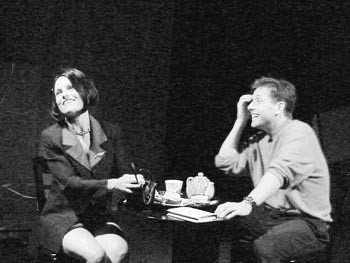
Beautiful People, a new film by Jasmin Dizdar.

Crowd Scene

‘Beautiful People’ paints a rich portrait of a group of Bosnian refugees

By Nicole McEwan

“WAR IS LIKE LOVE,” wrote Bertolt Brecht. “It always finds a way.” But somehow the survivors endure–even prosper–just beyond its shadow, suggests Jasmin Dizdar in Beautiful People, his kaleidoscopic portrait of a group of Bosnian refugees trying to make sense of their new lives in London, circa 1993.

They’re strangers in a strange land, and their sense of wonder and confusion is succinctly captured in a film that applies comedy like a salve and accepts the deepest absurdities as routine occurrences. From its opening, in which two passengers brawl on a packed city bus, to the scene in which a naive housewife discovers heroin in her son’s jeans, takes a sniff, and proceeds hanging laundry, stoned out of mind, the film creates a tableau of wildly intersecting lives in which anything can happen, and does.

Drawing on a huge cast of characters, the former Yugoslavian writer/director takes on the human condition and the way synchronicity sometimes creates order out of chaos. It’s a style of storytelling commonly associated with Robert Altman, although Dizdar’s vision is not quite as sprawling and considerably shorter, at a mere 107 minutes. The result is a film that leaves you wanting more.

As it turns out, the transit hooligans were former neighbors in Bosnia, one a Serb, the other a Croat. Their passion-driven fisticuffs lands them both in the hospital–in the same room. Beside them, a sour-tempered Welsh anarchist stews in his own political agenda.

Angered by the bourgeois gentrification of his poor, yet picturesque village, the anarchist had attempted to firebomb some luxury vacation homes–the one plot that literally blew up in his face. Now his task is to keep his irrational roommates from killing each other–a pointed reference to the way war is more a state of mind than a point on a map.

The film’s other characters include the black-sheep daughter of a politician, her penniless ex-Yugoslavian beau, a BBC reporter whose latest trip to Bosnia brings on a spectacular nervous breakdown, and a harried OB/gyn (and father of twins) in the throes of a nasty divorce. The relative insignificance of Dr. Mouldy’s marital turmoil comes into sharp focus when he meets a young refugee couple who beg him to kill the baby he is about to deliver–a child conceived of rape.

Whimsical, tragic, but ultimately hopeful, Beautiful People is an intelligent, though flawed look at life after wartime. Particularly clunky is the too-rapid redemption of some fairly unredeemable characters in the film’s final moments–a regrettable dip into blatant sentimentality. Still, Dizdar is first-person-familiar with the material’s emotional landscape, so it’s hard to fault him for celebrating survival. Dr. Mouldy sums things up nicely in the film’s final line: “If life changes just a little bit in your favor, it can be so beautiful.” Lying in a cradle nearby is a cheerfully gurgling infant. Her name: “Chaos.”

From the April 27-May 3, 2000 issue of the Sonoma County Independent.

© Metro Publishing Inc.

Homemade Bread

0

Eager home bakers learn from bread champion

By Marina Wolf

HOMEMADE BREAD, in this country at least, is spoken of in almost spiritual tones. Oh, the feel, the smell, the whole rapturous process. But sit for a few hours under the tutelage of champion baker Craig Ponsford and you’ll be trading your touchy-feely tune for a calculator and a good electronic scale.

Not that the baker-in-chief at Artisan Bakery in Sonoma isn’t entirely devoted to bread. He earned first place in bread bakery at the Coupe du Monde in 1996 and coached the gold medal-winning American team at the International Baking Olympics in 1999. His reverence for bread is quiet, almost subliminal. What stands out is his utter faith in the science of baking.

This attitude can be a shock for students who attend his baking classes, such as the one held two weeks ago at Ramekins Sonoma Valley Culinary School. Ponsford’s weekend “clinic” is less about research than it is about detox and rehab: home bakers have to let go of baking habits that have sustained them for so long.

The class opens with a half-inch-thick packet and a barrage of timing and temperature: room temperatures, water temperatures, friction temperatures (the heat added to the dough during the mixing process).

This turns out to be the easy bit.

Ponsford then launches into Baker’s Percentages, the formulas for bread recipes that are based on the weight of the flour, with all other ingredients noted as percentages of the flour weight. This weekend’s loaves will have 70 percent hydration, that is, water is 70 percent of the flour weight. Salt is 2 percent, yeast is 1 percent. (Calculations must include the weights of ingredients in the pre-ferment, or starter.) Flour, water, salt, and yeast are all that ever go into a French loaf, but the variations and fluctuations in the formula are endless.

At this point, most class members are staring at the white board in some dismay. Though the muttering is indistinct, the meaning is clear: What do all these numbers have to do with bread?

It’s a good moment to move from theory to practice, and Ponsford moves to one of the work stations to weigh pre-ferment, flour, water, and salt into the mixer bowl. His mixers at Artisan handle 500 pounds of dough at a time; this one protests at five pounds, even when Ponsford carefully jacks the bowl up and down to more evenly mix the dough. Still, it takes only a minute or two before the dough is placed in a bowl, sealed in plastic wrap, and set aside to rise.

Now the home bakers eagerly huddle around their work stations, looking like high-school science students in their white aprons and with their smudged notebooks. Some have come from as far away as Oregon and Massachusetts to stare intently into the grinding maws of the mixers.

They don’t want to miss a thing.

AFTER THE DOUGHS have been set out for rising and the students take a quick break for lunch, Ponsford moves on to the much-anticipated critique session of the breads that the students were asked to bring to class. He starts with a soft-crusted French loaf, squeezes and hefts it with practiced fingers, then holds it to his nose, looking for all the world like some kind of bread psychic.

“Our doughs today were wetter than you’re used to, huh?” he asks, raising his eyebrows at the woman who brought the loaf. She nods–yes, a lot.

The pale bottom indicates insufficient heat from the stone. A pizza stone is the culprit, and Ponsford shakes his head sadly–it just isn’t thick enough to retain heat when the cooler loaf of bread hits it. Ponsford cuts open the loaf to reveal a very dense crumb, a very fine pattern of airholes that some people like, but are death to the classic definition of French bread. A dry dough like this means the dough is less elastic and can’t expand to accommodate the yeasty gases. “Don’t be afraid of wet,” he says, not for the last time today. The woman nods seriously, taking notes all the while.

Ponsford moves on to the other loaves, which range from a rustic ciabatta, whose charming crust hides streaks of unblended flour, to a stubby, anemic-looking baguette that he half-jokes about breaking the bread knife on. As he makes his way through the heap of hopefuls, Ponsford keeps asking the bakers about the recipes. They either don’t remember or they give him measurements in cups. “I can’t tell you what’s going on with these breads,” he says, setting aside a brick-shaped whole-grain loaf.

“I need to see the percentages.”

It’s the end of day one, and by this time most of the students’ doughs have overrisen, but no one objects to a quick shaping lesson before class adjourns. The dough is floating and soft as a cloud, but Ponsford merely folds it gently to increase its body. “I’ve never punched a loaf of bread in my life,” he says, deftly turning the dough mass and cutting pieces away for shaping.

“Punching is from a tradition of building up bread to handle machinery. It makes a strong dough, but it’s too tight for the gases to do their work properly.”

He quickly models batards and baguettes, his hand and thumb moving as fast as a sidewalk magician’s. “Don’t worry,” he says to the bakers crowding around him to stare at his hands. “Tomorrow at the bakery, you’re each going to have the chance to shape at least 10 or 15 loaves of bread.”

After class, Ponsford admits that it’s probably not fair to have them bring in their bread on the first day. “They’re bringing in everything that I trashed earlier,” he says, stretching his flour-dusted work boots in front of him. “But I don’t feel bad about knocking them a little bit, because if they listened to anything I said, they’ll have 100 percent improvement the very next time they bake bread.”

PONSFORD’S confidence is borne out the next day, when the students take their loaves out of the commercial-sized ovens at Artisan Bakery. They had arrived at the bakery at 7 a.m.–a lucky few had to get up at 1 a.m. to feed the pre-ferment.

Now, just before lunch, the fruits of their labor are coming out of the oven, golden and beautiful. Ponsford cuts open a few loaves, cautioning against making a quick judgment–“You have to taste it cold. Even Pillsbury dough tastes great to me out of the oven”–but the effects are apparent immediately, in the sturdier crust, the larger holes. There is some variation, of course, with four fermentation processes and 14 pairs of hands, but the improvement is easily 100 percent.

Over lunch, the students are tired, but enthusiastic about the results. Harvey, a civil engineer from Walnut Creek, says he was most impressed by the weighing of ingredients. Before, he used cups, and the results varied so much. “There was no precision, no real understanding of why I was doing it.”

Cindy, a homemaker from Sonoma, agrees. Though she’ll continue to use her whole grains and honey, any technique is an improvement. “You can read a book a thousand times, but you won’t understand what tacky or shaggy is,” she says, chewing tiredly on a cold piece of pizza. “There’s nothing like watching a baker do his stuff.”

From the April 27-May 3, 2000 issue of the Sonoma County Independent.

© Metro Publishing Inc.
John Scofield

0

Funkified: John Scofield is one of the big three of contemporary jazz guitar greats.

Blue Notes

John Scofield–reluctant guitar hero– performs at the Mystic Theatre

By Greg Cahill

HE’S HEARD IT all before. John Scofield draws a deep breath and patiently answers yet another inquiry about his role in the oft-maligned jazz fusion realm. “I come from a time when there wasn’t a generic way to play fusion,” explains the former Miles Davis sideman. “I always liked rock and blues and funk, and jazz was something I studied my whole life and wanted to get into. Before I knew it, I was in fusion bands. But I hadn’t learned to play by listening to those kinds of bands. So I came up with my own version of it.

“You know, I’m a bebopper who rocks.”

And who knows how to strut some decidedly soulful funk.

Scofield’s most recent CD, Bump (Verve), is a contagious collection of 12 original instrumental funk-driven grooves that features members of the New England jam band Deep Banana Blackout and bassist Chris Wood of Medeski, Martin, and Wood.

It’s easy to see why Cashbox magazine once hailed Scofield’s hazy blue guitar style–he’s considered, along with Pat Metheny and Bill Frisell, part of the holy trinity of contemporary jazz guitarists–as “the missing link between mainstream and fusion guitaring.”

This visionary with six steel strings–the most imitated jazz guitarist alive–continues to eschew musical clichés and avoid the pitfalls that plague less imaginative players, as is evident in on his brilliant interpretation of “Coral” on the newly released tribute CD As Long As You’re Living Yours: The Music of Keith Jarrett (RCA). That track reinforces Scofield’s reputation as a fine balladeer, a notion underscored by 1991’s lyrical waltz “Time on My Hands” and 1996’s mostly acoustic Quiet.

In fact, Scofield, 48, is a skillful jazz improviser who consistently displays a level of inventiveness that most can only dream about.

The new CD is the follow-up to the uneven 1997 Medeski, Martin, and Wood collaboration, A Go Go (Blue Note), which failed to gel musically. This time out, Scofield knew exactly what he wanted and how to get it. “I wanted to do a record of my tunes in the groove area, rather than straight-ahead jazz,” says Scofield. “I wanted even more of a funk feel than I’d gotten before.”

Although having a 12-year-old son and a college-age daughter helps him keep his ears open to new sounds, it’s his own philosophical flexibility and musical agility that enable him to move from a session like Bump to an upcoming recording with drummer Billy Higgins, post-bop saxophonist Kenny Garrett, bassist Christian McBride, and pianist Brad Mehdau. Or to jam with Southern rockers Govt. Mule. Or to sit in with ex-Meters bassist George Porter Jr., drummer Zigaboo Modeliste, and the Dirty Dozen Brass Band horns.

“I guess I’ve had a pretty good look at some really great players,” Scofield says. “The soulfulness of your music goes up when you play with musicians at that level. It’s what makes jazz more real, more spiritual, and more of a celebration. They bring out what I thought jazz was all about to begin with–this great spontaneity where the whole becomes greater than the sum of the parts.

“That’s what I’m going for–keeping that tradition alive.”

OF COURSE, Scofield has had plenty of time to learn from the masters. The Ohio-born and Connecticut-bred guitarist has recorded or toured with such jazz giants as Kansas City pianist and bandleader Jay McShann, the late Charles Mingus (3 or 4 Shades of Blue), drummer and bandleader Billy Cobham (Life and Times, Funky Thide of Things), and, from 1982 to 1985, Miles Davis (Decoy, Star People, You’re under Arrest, Siesta).

“A lot of those guys were my favorite musicians when I was growing up,” Scofield explains. “You know, I just loved their records as a kid. And to play with them and observe them just humanized the music and made me see that it’s possible to do various things with music, achieve certain sounds.

“And it just made me stronger.”

As a prolific solo artist, Scofield has steered clear of the fastest-gun syndrome that has infected the fusion genre. “Yeah, well . . . ah, there are a lot of people who have rejected that,” he says, shrugging off the notion that he is a reluctant guitar hero.

“For me, it was never really much of a question. I like pure music, and all the people I admire do not rely on histrionics, although I do like Chuck Berry,” he adds with a laugh. “But the whole heavy-metal mentality never got to me at all.”

Instead, it’s “the honesty of the statement” that matters most.

“I’m just a guy playing a real story,” he concludes. “It’s so hard to play music, and there is so much involved that anybody who takes the time to showboat is almost ruled out in my book because I know how much it takes just to play.

“As soon as it becomes like show business, it becomes less interesting. One of the good things about jazz is that it’s not Hollywood–and that’s why I like it.”

The John Scofield Band, plus Las Macosas, performs Thursday, April 27, at 8:30 p.m. Mystic Theatre, 21 Petaluma Blvd. N., Petaluma. Tickets are $18 and $20. 765-6665.

From the April 20-26, 2000 issue of the Sonoma County Independent.

© Metro Publishing Inc.

Jerry Garcia

High on Bluegrass Jerry Garcia's bluegrass roots are showing on legendary 'lost' tapes By Greg Cahill IT'S ONE of the most celebrated bootleg recordings in pop history. In 1993, mandolinist David Grisman invited his old pal Jerry Garcia--then enjoying some of his most commercially successful days as the Grateful Dead...

Rebecca Solnit

Happy Trails 'Wanderlust' takes a fascinating tour of the history of walking By Patrick Sullivan "EXPLORING the world is one of the best ways of exploring the mind, and walking travels both terrains," writes Rebecca Solnit, explaining the impetus behind her new book, Wanderlust: A History of Walking (Viking; $24.95). ...

Farmers’ Markets

Farmers' markets spring to life By Paula Harris IF YOU GROW IT they will come, especially if it's fresh, juicy, crunchy, fragrant, or ripe. Growers are once again beginning to showcase their flourishing yields of locally grown fruits and veggies and setting up stalls at farmers' markets in parks and parking lots around the North...

Usual Suspects

Activists respond to police-abuse report By Greg Cahill LOCAL SOCIAL JUSTICE advocates say they are encouraged by the results of a long overdue report on police misconduct and excessive use of force, but agree it will be difficult to get public officials to act on the recommendations. The federal report, approved last...

Russian River Mercury Contamination

Photograph by Michael Amsler Heavy Mettle State regulators ponder mercury contamination in the Russian River. Is Judith Eisen its first victim? By Janet Wells THREE YEARS AGO, Guerneville artist Judith Eisen was following her bliss, living in an idyllic beach hamlet in Thailand, using canvas and paint to...

Poetry Renaissance

Rising above: Petaluma poet Eugene Ruggles, co-organizer of a poetry festival to benefit the Phoenix Theatre, says poetry will always survive, whatever the challenges presented by a new age. Others aren't so sure. Poetry in Motion Is the art form enjoying a renaissance, or is its new popularity...

‘High Fidelity’

Author Bret Easton Ellis on guilty pleasures, illogical musical tastes, and the provocative film 'High Fidelity.' Writer David Templeton takes interesting people to interesting movies in his ongoing quest for the ultimate post-film conversation. This is not a review; rather, it's a freewheeling, tangential discussion of art, alternative ideas, and popular culture. ...

‘Beautiful People’

Beautiful People, a new film by Jasmin Dizdar. Crowd Scene 'Beautiful People' paints a rich portrait of a group of Bosnian refugees By Nicole McEwan "WAR IS LIKE LOVE," wrote Bertolt Brecht. "It always finds a way." But somehow the survivors endure--even prosper--just beyond its shadow, suggests Jasmin Dizdar in...

Homemade Bread

Eager home bakers learn from bread champion By Marina Wolf HOMEMADE BREAD, in this country at least, is spoken of in almost spiritual tones. Oh, the feel, the smell, the whole rapturous process. But sit for a few hours under the tutelage of champion baker Craig Ponsford and you'll be trading your touchy-feely...

John Scofield

Funkified: John Scofield is one of the big three of contemporary jazz guitar greats. Blue Notes John Scofield--reluctant guitar hero-- performs at the Mystic Theatre By Greg Cahill HE'S HEARD IT all before. John Scofield draws a deep breath and patiently answers yet another inquiry about his role...
11,084FansLike
4,606FollowersFollow
6,928FollowersFollow


