Open Mic

0

Used Goods

By Atticus Hart

REMEMBER the New Millennium? Or, more precisely, all the speculation, anticipation, and nervous jitters that hung in the air in 1999 as the world contemplated the turn of the century. All those stories about a brave new world, a world awash in wondrous things, a world waiting for a bright, shining future–stories filtered through the luster of a booming economy and the hi-tech miracle. In our naiveté, we were so hungry for the future that the media convinced us the New Millennium would start on Jan. 1, 2000, one whole year ahead of schedule.

We craved change. We bought the story. Start the party, we chimed.

And then there were the doomsayers. Get ready, they warned, Armageddon is coming. The reckoning is just around the corner. Hear the bell toll. It’s Judgment Day.

We all heaved a collective sigh of relief when the year 2000 rolled around, our computers were free of apocalyptic viruses, and the stock market was rising faster than Bill Clinton’s crotch at the sight of a fresh-faced young intern.

And then came the long, slow slide and the Sept 11 reality check at the World Trade Center and the Pentagon. It’s not so new anymore, this century of ours. Now it’s the Used Millennium–already covered in a thick layer of debris and despair. Consumer confidence has crashed (although ostentatiousness abounds in the North Bay)and all around us the empire is crumbling, the barbarians are at the gate.

It’s a wicked world, my grandmother used to say as she sat up late at night, huddled in front of the oven, hunched over a cup of strong black tea, and munching burned toast and dried seaweed. Yeah, it’s a wicked world. Lighten up, Granny, my friends used to tell her. What the hell did she know anyway?

But how right she was–the cranky cynic with the vocabulary of a dockworker, suddenly elevated to the status of a wise sage. Now I see that we can deceive ourselves into believing anything, into believing that the future holds hope, hope for national security, hope for job security, hope for safe passage through a world spinning out of control.

The wickedness is everywhere. And it’s another 99 years before the turn of the next century, before the next batch of fools convince themselves that it’ll get better, that mankind will find a way to set aside ancient blood feuds, that the world holds a bright, shining future–someday.

Ninety-nine years–and already it’s time to find a way to get rid of this torn-and-frayed epoch, sweep it aside, sell it to the highest eBay bidder, alongside the broken pieces of the World Trade Center that went online within moments of America’s tragic hour.

Any takers? One century, slightly used, as is, in need of repair.

Send your spare meds to Atticus Hart, c/o the Northern California Bohemian.

From the September 27-October 3, 2001 issue of the Northern California Bohemian.

© Metro Publishing Inc.

‘Hearts in Atlantis’

‘Hearts’ Attack

Stephen King steps into Norman Rockwell’s shoes

By

IT’S HARD to figure out how audiences will react to Hearts in Atlantis. On the one hand, we’ve been softened up by recent terror and are ready to have the nostalgia nerve pinched. On the other, this film is very close to the dregs of the bottomless barrel of Stephen King, upon whose book Hearts in Atlantis is based.

Here King is working in the Norman Rockwell field, in a story that crosses Needful Things with Stand by Me.

In 1960, in a New England town, the fatherless boy Bobby Garfield (Anton Yelchin) is being raised, sort of, by his mom Liz (Hope Davis, better than her role). A world-weary stranger named Ted Brautigan (Anthony Hopkins) moves into the apartment upstairs. He turns out to have the gift of second sight and is a fugitive from mysterious pursuers.

Events come to a head when Liz leaves her son for a weekend, despite her suspicions that the old man might be unnaturally fond of boys. (The fact that she suspects such a thing proves what a silly creature she is.)

Hopkins can be an evil delight, as we’ve seen when he’s played Dr. Lecter or Picasso, or in the mad scenes in Titus. He can also be Sir Anthony Hopkins, living embodiment of a stale theatrical tradition that always seems like class to American (or in this case Australian) directors. Here, mostly he’s the latter.

Hopkins is impressive in a pair of scenes: one, a little monologue about the last touchdown of football great Bronko Nagurski; second, in the most typically Stephen King moment in the film, when he uses his gifts as a psychic to cow a neighborhood bully.

It’s actually David Morse who gives the most memorable performance. In the film’s opening and closing sequences, Morse plays the elder Bobby, forced by a funeral to revisit his lost past. Morse emotes the anger and confusion of grief beautifully.

And to his credit, director Scott Hicks (Shine) does tend to dry up this wet material, though Hearts in Atlantis is overproduced to the extreme. Occasionally, Hicks recalls director Terrence Malick in passages of afternoon reveries, wind chimes on the front porch, a farewell scene first half-hidden and then eclipsed by white sheets on a clothesline.

In one moment, Hopkins quotes Ben Jonson on the subject of time, “the old, bold cheater.” Screenwriter William Goldman (The Princess Bride) is as old and bold and cheating as anyone in the business.

Some may swallow the film’s “truths” whole: that childhood is our happiest time, a fabulous land like Atlantis, and all else is ashes. Our first kiss “is the one you’ll measure all others by” (what, that dry smooch with Sandra Baldwin? She was 6 years old and had a lazy-eye patch!). Finally, that a negligent mother ought to watch her step.

There are neither enough supernatural or film noir elements here to disguise the sour tastes of Goldman’s moralizing, or to hide the film’s grim approval of the way Liz gets a harsh lesson on the importance of being a stay-home parent.

From the September 27-October 3, 2001 issue of the Northern California Bohemian.

© Metro Publishing Inc.

News Bites

0

Woolsey defends her war vote

By Greg Cahill

IT AIN’T EASY being a liberal in these volatile times: At a Santa Rosa High School forum on Sunday afternoon, Rep. Lynn Woolsey, D-Petaluma, defended her decision to back a congressional resolution authorizing President Bush to use force against nations that support or harbor terrorists. Woolsey, a devout liberal in one of the most liberal districts in the Bay Area, admitted that the vote was a “difficult” personal decision. However, Woolsey said she wanted to stand firm against terrorism and insisted that the resolution doesn’t give Bush carte blanche to wage war.

Rep. Barbara Lee of Oakland cast the sole vote in the U.S. Congress against the resolution. Several of Woolsey’s constituents expressed concern that military action will harm innocent civilians and further inflame anti-American sentiments.

In a published statement issued before the forum, Woolsey noted, “Clearly, these attacks demand justice, and it is essential that when the United States responds, we do it in a measured and deliberate way. We don’t need to be the cowboy here. We need to work with the full support and cooperation of the international community.”

Throughout the North Bay, hundreds of California Air and Army National Guard personnel, along with armed forces reservists, awaited call-up to active duty in the event the United States commences additional military operations overseas.

Meanwhile, the North Bay this week experienced firsthand the heightened security put in place after the Sept. 11 attacks on the World Trade Center and the Pentagon. On Sept. 21, Santa Rosa police evacuated 30 homes after the FBI identified a possible link between a stolen Golden Gate Transit bus found in Santa Rosa and the theft in Sacramento of several barrels of highly explosive rocket fuel. The FBI is investigating the incidents. The night before, low-flying jets rattled nerves in Petaluma when two U.S. fighter jets buzzed the city after a small private plane reportedly switched off its transponder and “slipped off the radar.” Authorities had assumed the plane had made an unauthorized landing at the local airport. Police questioned two pilots who had landed before the F-16s arrived. No arrests were made.

Protest Planned

OPPOSITION to a widescale, indiscriminate U.S. military action in response to the Sept. 11 terrorist attacks is mounting in the North Bay, where several antiwar demonstrations already have taken place. On Saturday, Sept. 29, a Women’s March Against War is scheduled in conjunction with a National Day of Action against an armed solution to the current world crisis. The protest, at 11 a.m., will begin at the Federal Building, 777 Sonoma Ave. E., Santa Rosa. It is being organized by the Purple Berets, a Sonoma County women’s advocacy group. In a Sept. 24 press release, the group noted that while members are “shocked and saddened by the events of Sept. 11,” the Purple Berets are no less shocked by “the insistent drumbeat pulling the nation irrevocably toward war. . . . As women dedicated to the struggle for women’s equality and liberation, we know that struggle is never served by military action, and cannot ignore the effect of such a war on the innocent women and children of the region.” For details, call 707/887-0262.

Health Costs on the Rise

HOLD ON to your wallet: health-insurance costs are climbing in the North Bay. With no new state or federal dollars expected for a bailout, a summit meeting of Sonoma County business and healthcare industry leaders last week concluded that insurance premiums will rise and patients can expect higher copayments, responsibility for paying a larger share of premium costs, and a shift away from the managed care that some say brought costs down in the 1990s.

Meanwnhile, it also was announced last week that Medicare HMOs in several California counties–including Marin–will withdraw service from seniors next year, forcing the elderly to seek more expensive insurance coverage. PacifiCare, the second largest Medicare HMO provider in the state, plans to withdraw its Secure Horizons Medicare HMO coverage completely from the eight California counties it serves.

From the September 27-October 3, 2001 issue of the Northern California Bohemian.

© Metro Publishing Inc.

‘Captain Corelli’s Mandolin’

0

Island Lovers

‘Italian Affair’ author fiddles with ‘Captain Corelli’s Mandolin’

Writer David Templeton takes interesting people to interesting movies in his ongoing quest for the ultimate post-film conversation. This is not a review; rather, it’s a freewheeling discussion of art, alternative ideas, and popular culture.

LAURA FRASER would take a love story over a war story any day. Blood and gore, it seems, make the San Francisco author cringe and shudder, which is what she does through much of Captain Corelli’s Mandolin, the new Nicolas Cage World War II epic that swings manic-depressively between operatic scenes of misty-eyed romance and frightening moments of blood-soaked slaughter.

A stripped-down version of Louis de Berniere’s bestselling novel, the film follows the wartime romance between an Italian soldier-mandolinist (Cage) and the Greek beauty Pelagia (Penelope Cruz), whose charming little island, Cephalonia, is occupied by the Italian army for several months during the war.

Love occurs. Breasts are exposed. Bullets rip through quivering flesh.

E cosi e finito,” Fraser sighs gratefully when the credits finally roll. “And so, it is over.”

With that, we head out in search of pizza.

Fraser, 40, is the author of An Italian Affair (Pantheon, $22). Written in novelesque second person, the unique travelogue recounts the writer’s sexual and spiritual adventures with a married Italian professor, whom Fraser met while mending a post-divorce broken heart on the little island of Ischia, west of Naples.

During the two-year affair, Fraser met the professor in various romantic locations around the globe. Many of those spots–like Ischia, the Aeolians, and Catalina–were islands.

But more on that later.

“The movie is, as they’d say in Italian, esagerato,” pronounces Fraser, sipping a beer while waiting for our pizza to arrive. “It was a big, operatic tearjerker where every emotion is exaggerated–the love speeches, the earthquakes–everything is overblown.”

Overblown, in particular, are the stereotyped portrayals of the Greeks and Italians.

“Especially the Italians,” she says. “I mean. the first thing out of Cage’s mouth is ‘Bella Bambina!’ Then there’s all that ‘We Italians, we love food, and wine, and making love’ stuff. Hollywood has a tendency to look at all Italians that way.”

“It’s not just Hollywood,” I point out. “Italian travel brochures tend to push that image as well.”

“True,” she allows. “Don’t get me wrong. Italians do put a high priority on eating and drinking and making love. They live their lives with a sense of gusto that American’s don’t. It’s one of the things I love about Italy. But that’s not all there is to Italians. They have a serious, dark side too.”

“How did Cage rate as an Italian?” I ask.

“Well, of course, he is an Italian-American,” she reminds me. “Actually, his accent wasn’t that bad.”

SHE ASKS if I’ve ever seen the film Mediterraneo, the 1991 Oscar winner about a band of Italian soldiers who are transformed from killers into human beings while stationed on a small Greek island.

That film, she argues, was a better representation of Italians, and also showed the transformative power of beautiful places, particularly of islands.

“Islands, says Fraser, “are great places to fall in love. In the book, just going to Italy to get over heartbreak, wasn’t enough. I had to go to an island. On an island, there’s a sense of leaving the rest of the world. It wasn’t until I got on the boat to Ischia that I truly believed I could leave something behind me, could leave some pain behind me.

And, evidently, find something as well.

“I think that, to fall in love, you have to have a sense that you’ve stepped outside your regular world,” Fraser says.

“There’s something about a place like Catalina Island or the Aeolian Islands, north of Sicily, that gives you a sense of space, that makes you feel vulnerable, that makes it possible to open up to another person.”

Corelli and Pelagia might agree. Had they met in, say, San Francisco, who knows if they’d have even noticed each other?

“Though, as far as cities go,” Fraser says, “San Francisco is not a bad place to fall in love.”

From the September 27-October 3, 2001 issue of the Northern California Bohemian.

© Metro Publishing Inc.

X

0

Punk 101

One band’s ‘Wild Gift’ to rock and roll

By Greg Cahill

X WASN’T the first punk band to make the scene in Los Angeles, Rolling Stone once reasoned, but it definitely was the first one that mattered. At a time when most L.A. punk bands merely aped the sound of their London and New York counterparts, X invented a unique metal-edged, high-octane rockabilly-based sound that stood head and shoulders above the pack, thanks to deep roots in the storytelling tradition of Woody Guthrie.

Music writer J. D. Considine once opined that the band’s strong suit was that its early songs were “so obviously and audaciously intelligent, with verses that read more like poetry than punk doggerel.”

Over the years, and especially in the solo works of singer/songwriter Exene Cervenka and ex-hubbie John Doe, the band members have continued to produce intelligent underground rock, reuniting for occasional concert tours.

New reissues show that X remains the only L.A. punk band that matters, pioneers of an edgy brand of Americana music rich in country-inflected harmonies and guitars, unafraid to explore the nation’s seamy underbelly, and inviting comparisons to film noir and the work of Bowery bum-cum-Beat poet Charles Bukowski.

Now, 20 years after the release of X’s 1980 debut, Los Angeles (Slash), the band is once again being acknowledged for its influence with the release of expanded and digitally remastered versions of its first three albums on the Rhino label.

Los Angeles, 1981’s Wild Gift, and 1982’s Under the Big Black Sun–all produced originally by Doors’ keyboardist Ray Manzarek–were reissued last week with several bonus tracks, including previously unreleased outtakes and demos.

The X material is part of a wave of similar expanded ’70s and ’80s reissues flooding the marketplace these days and showcasing Elvis Costello, Velvet Underground, David Bowie, T Rex, and others.

Los Angeles–hailed as one of the most astonishing debuts ever and ranked No. 4 on Spin magazine’s recent Top 50 Punk Albums of All Time list–is steeped in the dark side of that city’s urban mythology. It includes the demented rapist portrait “Johny Hit and Run Paulene,” an amped-up take on the Doors’ “Soul Kitchen,” and the existential angst of “The World’s a Mess (It’s in My Kiss).”

The gem among the X collection–although all these influential recordings belong in the library of any serious rockhound–is Wild Gift (Slash), voted No. 1 Record of the Year by both the L.A. Times and the New York Times upon its release. This is the ultimate ragged ode to lost souls, from the desperate plea of “Adult Books” to the fatalism of “We’re Desperate.”

The expanded reissue contains seven bonus tracks, including three singles mixes and a fiery live version of “Beyond and Back” (previously released on the 1997 X anthology).

Under the Big Black Sun (Elektra) is a darker, more menacing, and more rock-oriented album, colored by a desire to pen songs outside of L.A.’s gritty bar scene and reflecting the depression that settled on Cervenka after the death of her sister. In many ways, this is X’s most accessible album (although I confess to preferring the less even and often maligned fourth album, 1983’s More Fun in the New World). “Motel Room in My Bed” is as close to a pop song as the band ever got, and the plaintive “Come Back to Me” (an homage to Exene’s sister) echoes the great R&B death ballads of the ’50s, replete with guitar arpeggios and a sax solo.

Worth owning just to hear X in rehearsal and rewriting the Marty Robbins’ C&W classic “El Paso.”

From the September 27-October 3, 2001 issue of the Northern California Bohemian.

© Metro Publishing Inc.

Rossetti’s

0

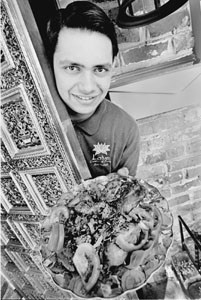
An Italian feast: Chef Martin Perez prepares lunch at Rossetti’s, a Marin County tradition.

Mamma Mía!

Rossetti Italian Restaurant and Deli a great spot for lunch

By Paula Harris

TOO OFTEN workday lunches are reduced to serviceable but questionable forms of nutrition that are far from fun. Consider the dubious-looking shrink-wrapped egg salad sandwich hastily grabbed from the nearest convenience store; the bag of Fritos deposited by the vending machine; or the stick of chewing gum retrieved from some pocket, and you get the sorry picture.

That’s why taking time out for a relaxing lunch at the weekend can be such a treat. Less expensive than dinner, and plenty of time to burn those cals. Yes, leisurely lunching has its charms.

Strolling along San Rafael’s Fourth Street on a Saturday at noontime amid shoppers, joggers, and a convergence of tight-bodied bicyclists, there are many inviting lunchtime possibilities.

A good one is Rossetti Italian Restaurant and Deli (one of a pair; the original is in San Anselmo), which, though also open for dinner, offers some marvelous midday fare.

Known for its regional Italian specialties, Rossetti is a trattoria-cum-delicatessen that’s more functional than romantic, with various counters strewn with colorful bottles of Torani syrup flavorings, wines, and condiments.

But a glowing wood-burning fire and stacks of logs add a rustic warmth, and it’s the perfect way to cook up the restaurant’s excellent pizzas and focaccia bread.

Diners are seated on the comfy padded banquet running along the length of one wall and pretty metal-backed chairs near the entrance and window. The deli ambiance is further softened by small hanging lamps, purple and green-painted ceilings, mosaic-type art on the walls, and fresh flowers peeping out of miniature straw-bottomed chianti wine bottles on each table.

One lunch specialty here is the “Focacce,” grilled pizza-bread sandwiches filled with a variety of tasty combos like grilled chicken and roasted vegetables ($7.95), or prosciutto with smoked mozzarella and fresh tomatoes ($8.50).

We get to sample this treat when the server brings us a helping of puffy, warm, and cheesy strips of focaccia bread.

The appetizers are great. The Swiss chard ($5.95) is steamed and served cool. This luscious starter tastes of pure goodness. It’s decorated with pieces of red onion and lemon slices and bathed in a stellar olive oil.

The caprese ($7.95) is a satisfying opener. Slabs of chalky-white mozzarella cheese are interspersed with fresh sweet organic tomato slices flecked with fresh basil, and the whole dish is rendered meaty by slices of piquant black olives and more olive oil.

The downside is the service. Although prompt and pleasant, our waiter had absolutely no knowledge to impart to his customers. Could he recommend a red wine? He didn’t know. Are the pastas made here? He didn’t know. Are the desserts made in-house? He didn’t know. While it may be difficult to keep track of a constant turnover of wait staff, training should be crucial.

Turns out the pasta is made in-house. The trenette al funghi ($7.75) is a lusty pasta dish of homemade small fettuccini with mushrooms sautéed in olive oil, garlic, capers, and fresh tomatoes–very good.

Also recommended is the pollo marsala ($9.95), a chicken breast with the lush almost sweet flavor of Marsala wine tempered by slivers of earthy mushrooms in the sauce, plus onions and capers. They made very good use of capers here, knowing that several of these flavor bombs go a long way. This dish comes with a portion of small boiled potatoes and a medley of mixed vegetables.

Certain desserts are also made in-house, but on the proprietor’s recommendation we split a coconut sorbeto ($4.25), a lovely refreshing coconut sorbet flown in from Milan. It’s swirled with caramel and cream and served in a coconut shell. The whole delight is infused with the nutty flavor and fibrous texture of coconut meat. Yum.

If you can handle wine with your lunch without zonking out, Rossetti has a good list featuring fairly inexpensive Italian wines–most run from $23 to $28 a bottle.

Rossetti Italian Restaurant and Deli 909 Fourth St., San Rafael; 415/258-9555. Hours: Lunch and dinner daily from 10 a.m. to 10:30 p.m. Food: Italian Service: Wait staff needs training Ambiance: Cozy trattoria-deli Price: Moderate Wine list: Inexpensive and varied selection, almost all Italian Overall: 3 stars (out of 4)

From the September 27-October 3, 2001 issue of the Northern California Bohemian.

© Metro Publishing Inc.

Nick Hornby

Nick Hornby examines dilemma of rock critics

By Gina Arnold

NICK HORNBY is the avowed hero of most rock journalists. Along with cartoonist Matt Groening (The Simpsons) and screenwriter Cameron Crowe (Almost Famous), he is one of the very few who have made good in another writing genre.

I’ve never met rock writers who didn’t think they had the great rock novel up their sleeve, but Hornby’s High Fidelity came closest to making the grade. Normally, writers feel jealous of those who write anything successful, but High Fidelity captured the loser/listmaker mentality so perfectly that all but the sourest of us were grudgingly reconciled to his genius.

Hornby’s latest, How to Be Good, however, has little to do with rock or fandom. Instead, How to Be Good (Riverhead; $24.95) is about a female doctor’s failing marriage. Her husband, David, is a writer, and in this backstory lies the novel’s philosophic problem.

In addition to the inevitable failed novel, David writes a column for a local newspaper called “The Angriest Man in Holloway,” in which he rants about things that annoy him, including old people fumbling for their change in buses.

Hornby doesn’t say so, but I believe David is an intentionally distorted picture of rock critics and their snarky, pointless, jaded, and cynical view of life. In the book, David undergoes a metamorphosis, coming to hate his own cynicism and attempting to become “good” via various selfless but annoying gestures, such as inviting homeless people to live in his spare room.

Of course, these tactics fail miserably and ruin his marriage. Even more tragically, neither David nor the book ever really figures out a solution to his dilemma: How does one reconcile one’s critical–i.e., worse–self with one’s liberal, caring, and humane beliefs? Hornby doesn’t know the answer, but I admire him for exploring the question.

At some point, many critics recognize that their writing, their talent, their very point of view on life is, in the end, not a very admirable way to earn a living.

Sure, the world needs critics: without them, the arts (especially rock) would be in even a worse state, aesthetically, than they are. But being a critic creates a conflicted state in the critic. No one believes that our impulse to criticize stems not from hatred but from love, because it’s a lot easier to say something sucks than to say why it’s good. It makes for better reading–and writing. Hornby’s own work is a good example. Lately he’s been writing for The New Yorker, and his paeans to his favorite artists–Steely Dan, Lucinda Williams, and Radiohead–have been weak and unconvincing.

A more successful article, however, appears in the Aug. 20 issue, in which he analyzes the Billboard Top 10 for the week of July 28, including records by P. Diddy, Melissa Etheridge, Destiny’s Child, Blink 182, and D12. Hornby takes them down one by one, brilliantly and sensitively, especially D12, a side project of Eminem’s: “Ever since Elvis, it has been pop music’s job to challenge the mores of the older generation: our mistake was to imagine ourselves hipper and more tolerant than our parents. The liberal values of those who grew up in the 1960s and ’70s constitute an Achilles’ heel: we’re not big on guns, consumerist bragging, or misogyny, and that is the ground on which Eminem and his crew choose to fight. I know when I’m beaten; I can only offer sporting congratulations.”

The rest is just a flash of the angriest man in Holloway, without so much contempt. And probably to Hornby’s (or David’s) chagrin, the piece is both brilliant and a far better comment on the futility of criticism than How to Be Good.

Gina Arnold is a music journalist.

From the September 27-October 3, 2001 issue of the Northern California Bohemian.

© Metro Publishing Inc.

Mill Valley Film Festival

0

Worlds of Wonder

Mill Valley Film Festival offers global visions

and Patrick Sullivan

For better or worse, the 24th annual Mill Valley Film Festival will take place in the early days of a whole new world–a world that began on Sept. 11. But while that day of terror has made travel difficult, all but one of the filmmakers invited to this international film festival will be in attendance. And all film prints are expected to arrive, even those coming from Beirut and Haifa.

By odd coincidence, this year’s festival features an abundance of films from around the world that, in the words of festival programmer Zoe Elton, show people enduring “extreme adversity, which they survive by learning compassion.”

From the Indian film Calmness (Oct. 9 at the Sequoia; Oct. 13 at the Rafael)–about a mother trying to forgive her son’s murderer–to the Robert Carlyle and Kiefer Sutherland drama To End All Wars (Oct. 6 at the Sequoia; Oct. 14 at the Rafael), the theme of compassion and forgiveness runs through the entire festival. “It’s something that we need right now,” says Elton.

The 11-day festival celebrates the accomplishments of a number of big names in contemporary cinema. MVFF kicks off on Thursday, Oct. 4, with a celebrity-packed opening night gala at the Mill Valley Community Center. On Saturday, Oct. 6, the festival salutes Ismail Merchant and screens the acclaimed director’s new film, The Mystic Masseur. Enjoy a “Pleasant (ville)” evening on Tuesday, Oct. 9, at a tribute to acclaimed indie actor William H. Macy. Jonathan Winters appears on Wednesday, Oct. 10, for an onstage interview and a screening of clips from this comic actor’s long career. On Thursday, Oct. 11, the festival offers a tribute to actor Malcolm McDowell. And finally, on Saturday, Oct. 13, celebrate the multitalented Sissy Spacek’s offbeat career.

World cinema always has a big presence at MVFF. Of special note is this year’s focus on films from Iran, that paradoxical land of government censorship and brilliant filmmaking talent. Seven Iranian films will be screened, including the promising The Legend of Love (Oct. 5 at the Sequoia; Oct. 6 at the Rafael), an allegoric tale about a woman’s search for her lost love from director Farhad Mehranfar (Paper Airplanes).

The festival also gives fans a chance to get an early look at some highly anticipated films from quirky American talents. On Oct. 6 and 7 at the Sequoia, catch Novocaine, a nasty little thriller starring Steve Martin as a dentist diving into the dark side of dental hygiene. On Sunday, Oct. 14, at the Rafael, see The Man Who Wasn’t There, the Coen Brothers’ new noir flick (which is set in Santa Rosa!).

Most films screen at two venues: the Rafael Film Center, 1118 Fourth St., San Rafael; and the Sequoia Theatre, 25 Throckmorton Ave., Mill Valley. Film festival schedules are available at both theaters and at many North Bay bookstores and coffeehouses. For details, call 925/866-9559 or log on to www.mvff.com.

From the September 27-October 3, 2001 issue of the Northern California Bohemian.

© Metro Publishing Inc.

Chill Valley Film Festival

0

Local action: The colonel (actor Erik Chipchase) reviews his troops in John Harden’s ‘Breakfast with the Colonel,’ shot on a shoestring at the Marin Center and other North Bay locations.

Chilling Out

Rejects from Mill Valley Film Fest find new home

WHEN SANTA ROSA filmmaker John Harden first read the letter from the Sundance Film Festival, he wasn’t all that upset. Though his years-in-the-making feature-length film–a futuristic satire called Breakfast with the Colonel–had just been soundly rejected, Harden remained optimistic. Confident. Upbeat.

“All year long I’d been watching rejection slips come in from different festivals,” he explains, “all the while thinking I still had an ace in the hole. I still had the Mill Valley Film Festival.”

The affable Harden, 39 (who is the manager of the production department at the Bohemian), had enjoyed success with MVFF once before. In 1991, his documentary short Crute Mobile–which was selected to play on PBS’ acclaimed POV show–screened in Mill Valley. So he thought getting the new film into the festival seemed reasonably certain.

Then came the rejection letter from Mill Valley.

“At first I was just depressed,” Harden says. “The way I look at it, [the Mill Valley Film Festival] is too exclusive of local filmmakers. I don’t think it’s all about quality. I’ve seen some real stinkers at the festival. Shouldn’t being a local stinker give you some edge?”

Good question. Petaluma filmmakers Mitch Altieri and Phil Flores have been thinking about the same issue since Long Cut, their locally filmed drama, was passed over by Mill Valley. Says Altieri, “We were extremely shocked. We thought this was a festival that would support our film. Maybe they have to shove local films out of the way to make room for all the big-name prestige films.”

Flores, on the other hand, isn’t quite so surprised that Long Cut was cut. “It stings a bit, but I understand,” he says. “Our film is not for every audience. It’s a strange film. It probably didn’t fit the tone of this year’s festival. And maybe Mill Valley is a little dislocated from its own local filmmakers. I don’t know. It doesn’t bother me that much.”

But it does bother Harden, whose malaise gave way to an impulse to action. “Dammit,” he recalls deciding, “I’ll just have my own film festival!”

This reaction, a mix of disillusionment and good old American defiance–with perhaps a drop of the juice of sour grapes–began to take shape in Harden’s mind: he would create a film festival showcasing only movies that Mill Valley had rejected. Who wouldn’t want to see that? He posted a notice on the Internet and immediately received 16 replies from other disgruntled filmmakers–and thus was the Chill Valley Film Festival born.

Alongside Breakfast with the Colonel (co-created with San Rafael’s Glen Kinion), the Oct. 13 event will include Glen Grefe’s Nutcracker, a psychological thriller; and several yet-to-be-determined features and short films–all 100 percent guaranteed to have been flushed by the Mill Valley Film Festival.

Now, when it’s suggested that these films might have been turned down because they were maybe, ahem, not that good, Harden just laughs.

“Could be,” he says. “I certainly can’t be objective about my own movie. I think it’s pretty good. What the Chill Valley Film Festival will do is allow people to come see for themselves what was winnowed out.”

Right. By looking at films that were turned away by Mill Valley, film fans can learn a bit about the process of film selection at a prestigious international film festival. It’s a bit like seeing the outtakes on your Titanic DVD.

Worlds of Wonder: Mill Valley Film Festival offers global visions.

How, exactly, are films selected for the Mill Valley Film Festival? The short answer, according to the festival’s programming director Zoe Elton, is “very carefully.”

Each year, MVFF receives between 800 and 1,000 submissions, including shorts, full-length feature films, and documentaries. From these, says Elton, around 200 are ultimately chosen. Of those, approximately 70 are feature films.

“There are a lot of filmmakers out there,” she says.

Film selection is a two-tiered process. All submissions first pass through a screening committee made up of film professionals–writers, directors, and producers–from around the country. Each screener makes recommendations, which are passed on to a team of programmers, who look at the most highly recommended films. At least two specialized programmers–foreign-film specialists, documentary specialists, etc.–look at every film.

In response to Harden’s concern that local filmmakers aren’t properly represented, Elton explains that, of the films selected under this year’s American film program–that’s 21 flicks–more than a third were made by Bay Area directors.

NOT BAD, she says, when you consider this fact: “When we started, 24 years ago, we had to scrape around for local films.” Elton says, “The Bay Area has become a remarkable breeding ground for filmmakers. This is what Coppola and Lucas and Kaufman were dreaming of when they came here in the ’70s.”

As for Harden and any other locals who don’t make the cut, Elton understands their disappointment.

“You have to applaud anyone who completes a film, especially a feature film,” she says. “When it gets turned down, it’s hard not to take it personally.”

For Harden, as plans for the Chill Valley event develop, the pain of rejection is growing dimmer. Now he’s enjoying the connections he’s making with local filmmakers.

“After toiling in isolation for so long,” he says, “It’ll be fun to get together, show off our films, and swap stories.”

And, no doubt, compare a few rejection-slip battle scars.

The Chill Valley Film Festival takes place on Saturday, Oct. 13, from 1 to 11 p.m. at the College of Marin’s Olney Hall, 835 College Ave., Kentfield. Admission is $10. 415/457-8811 or chillvalley.com.

From the September 27-October 3, 2001 issue of the Northern California Bohemian.

© Metro Publishing Inc.

‘The Adventures of Prince Achmed’

0

Dark Victory

Shadows shine in ‘The Adventures of Prince Achmed’

By Patrick Sullivan

ONCE UPON a time, there was a clever girl whose skill with scissors was beyond compare. In her deft hands, these simple tools could produce paper wonderlands full of brave princes, evil wizards, and fearsome monsters. When she grew up, she created what may be the first animated feature film ever made.

Ten years before Walt Disney brought Snow White and the Seven Dwarfs to the big screen, German experimental filmmaker Lotte Reiniger–the woman with the magic hands–and her collaborators finished The Adventures of Prince Achmed. In 1926, this silent masterpiece of silhouette animation began dazzling audiences from Berlin to Paris. But in 1945, Reiniger’s original print was destroyed in the Battle of Berlin.

Now the film is back, recently restored by the British Film Institute to its full-color, 35 mm glory, complete with the original score by composer Wolfgang Zeller.

The story itself is pure Arabian Nights–often entrancing, sometimes unintentionally hilarious, but always entertaining.

The epic tale begins when the caliph’s court in Baghdad is thrown into an uproar by the arrival of the mysterious African Sorcerer. The caliph covets the sorcerer’s magical flying horse and unwisely tells the wily knave to choose any treasure in return. Naturally, the scheming sorcerer wants the caliph’s daughter, the lovely Princess Dinarzade.

When the woman’s brother, Prince Achmed, intervenes, the sorcerer tricks the intrepid young man into mounting the magic horse, which promptly carries him off to parts unknown.

That doesn’t much bother Achmed, who is “young, and brave, and eager for adventure.” After discovering how to control his magic mount, he lands on a mysterious island, where he discovers true love with the exquisite Princess Peri Banu, ruler of the spirit land of the Waq Waq.

But the sorcerer ain’t done yet. Transforming himself into the most evil kangaroo ever seen on film, he tricks the prince again, kidnaps Peri Banu, and sells her to the emperor of China (another symptom of the strong strain of racial-sexual anxiety that runs through the film). Then the sorcerer goes back for the prince’s sister.

As the film explains, “Great was the might of the African Sorcerer,” so Prince Achmed continues to get his butt kicked until he wises up and enlists allies–the fearsome Fire Mountain Witch, plus Aladdin and his famous lamp. With magical help, the prince bests a staggering array of supernatural baddies, from the vengeful spirits of the Waq Waq to a hilariously carnivorous elephant with giant fangs.

Anyone who imagines that shadow puppets captured frame by frame on film cannot tell a compelling story has not seen The Adventures of Prince Achmed.

These characters are often more fun to watch than those found in the most finely detailed computer animation from Pixar. Especially good is the African Sorcerer, whose insectile body goes through incredible contortions as he scuttles through the scenery or transforms into various terrifying creatures.

Reiniger’s film also offers stunningly dramatic visuals that make very effective use of background color. In one notable scene, the prince watches Peri Banu and her maidens as they shed their magic flying cloaks to bathe in a lake. This enchanting interlude is heart-stopping in its ethereal black-on-blue beauty.

The only disquieting thing about this film (besides the racial stereotypes) is the troublesome questions it raises about 21st-century animators.

Seventy-five years after the debut of The Adventures of Prince Achmed, filmmakers have amazing technical innovations at their disposal. But most of them have a lot to learn from an old-fashioned storyteller named Lotte Reiniger.

‘The Adventures of Prince Achmed’ screens Sept. 28-29 at 7 p.m. at the Sonoma Film Institute, Sonoma State University, 1108 Darwin Hall, 1801 E. Cotati Ave., Rohnert Park. $4.50. 707/664-2606.

From the September 27-October 3, 2001 issue of the Northern California Bohemian.

© Metro Publishing Inc.

Open Mic

Used Goods By Atticus Hart REMEMBER the New Millennium? Or, more precisely, all the speculation, anticipation, and nervous jitters that hung in the air in 1999 as the world contemplated the turn of the century. All those stories about a brave new world, a world awash in wondrous things, a world waiting for a...

‘Hearts in Atlantis’

'Hearts' Attack Stephen King steps into Norman Rockwell's shoes By IT'S HARD to figure out how audiences will react to Hearts in Atlantis. On the one hand, we've been softened up by recent terror and are ready to have the nostalgia nerve pinched. On the other, this film is very...

News Bites

Woolsey defends her war vote By Greg Cahill IT AIN'T EASY being a liberal in these volatile times: At a Santa Rosa High School forum on Sunday afternoon, Rep. Lynn Woolsey, D-Petaluma, defended her decision to back a congressional resolution authorizing President Bush to use force against nations that support or harbor terrorists. Woolsey,...

‘Captain Corelli’s Mandolin’

Island Lovers 'Italian Affair' author fiddles with 'Captain Corelli's Mandolin' Writer David Templeton takes interesting people to interesting movies in his ongoing quest for the ultimate post-film conversation. This is not a review; rather, it's a freewheeling discussion of art, alternative ideas, and popular culture. LAURA FRASER...

X

Punk 101 One band's 'Wild Gift' to rock and roll By Greg Cahill X WASN'T the first punk band to make the scene in Los Angeles, Rolling Stone once reasoned, but it definitely was the first one that mattered. At a time when most L.A. punk bands merely aped the sound...

Rossetti’s

An Italian feast: Chef Martin Perez prepares lunch at Rossetti's, a Marin County tradition. Mamma Mía! Rossetti Italian Restaurant and Deli a great spot for lunch By Paula Harris TOO OFTEN workday lunches are reduced to serviceable but questionable forms of nutrition that are far...

Nick Hornby

Nick Hornby examines dilemma of rock critics By Gina Arnold NICK HORNBY is the avowed hero of most rock journalists. Along with cartoonist Matt Groening (The Simpsons) and screenwriter Cameron Crowe (Almost Famous), he is one of the very few who have made good in another writing genre. I've never...

Mill Valley Film Festival

Worlds of Wonder Mill Valley Film Festival offers global visions and Patrick Sullivan For better or worse, the 24th annual Mill Valley Film Festival will take place in the early days of a whole new world--a world that began on Sept. 11. But while that day of terror has made travel...

Chill Valley Film Festival

Local action: The colonel (actor Erik Chipchase) reviews his troops in John Harden's 'Breakfast with the Colonel,' shot on a shoestring at the Marin Center and other North Bay locations. Chilling Out Rejects from Mill Valley Film Fest find new home WHEN SANTA ROSA filmmaker...

‘The Adventures of Prince Achmed’

Dark Victory Shadows shine in 'The Adventures of Prince Achmed' By Patrick Sullivan ONCE UPON a time, there was a clever girl whose skill with scissors was beyond compare. In her deft hands, these simple tools could produce paper wonderlands full of brave princes, evil wizards, and fearsome monsters. When she...
11,084FansLike
4,446FollowersFollow
6,928FollowersFollow