Tsunami Bomb

0


And A Bottle Of Rum: Tsunami Bomb are more punk rock than pirate.

Taking the Reigns

Tsunami Bomb return to the North Bay in Californopia Tour

By Sara Bir

It’s the postspring break, presummer vacation period for the collegiate crowd, a time when sunny afternoons, good-natured rowdiness, and loud music can easily take precedence over one’s studies. Sticking to the books will only get harder when Petaluma’s Tsunami Bomb makes a rare stop in the North Bay on Saturday, May 11, with a free outdoor concert at Sonoma State. San Diego-based Unwritten Law and the Orange County band Something Corporate share the bill with Tsunami Bomb for the Californopia Tour.

Riding the crest of a wave built by intensive touring and passionate live shows, Tsunami Bomb have attracted a far-reaching base of devoted fans that has generated a mounting buzz in the punk-rock world. Last year, they scored a supporting slot on the Vans Warped Tour–this decade’s answer to Lollapalooza–and this summer the band will return to play 15 dates on the Warped Tour 2002.

After signing with Kung Fu Records (home to the Vandals and the Ataris), Tsunami Bomb recently wrapped up recording their first full-length album, The Ultimate Escape, in Los Angeles with producer Steve Kravac. Previously Kravac has worked with MXPX, 7 Seconds, and blink-182. “Steve is really pushing us to another level for this album. We pushed the boundaries a bit more with this one, I think,” said bassist Dominic Davi in the band’s recording journal. The Ultimate Escape is slated for release in September.

Some fans have come to describe Tsunami Bomb as “pirate punk,” largely due to their delicious purple vinyl Mayhem on the High Seas EP, whose song “3 Days and 1000 Nights” contains a barrelful of yo-ho-ho’s and whose cover art depicts a neon-bright pirate chick splashed across the sleeve. The term, however, is hardly representative of the band’s high-energy guitars, pop-punk hooks, and comic-book lyrics.

Like any ambitious North Bay punk band, Tsunami Bomb cut at least half of their teeth playing at the venerable Phoenix Theatre. Davi started the band in the late ’90s, but the true roots of Tsunami Bomb’s present incarnation really began once drummer Gabriel 37 and vocalist Agent M (an energetic cross between a vamp and a pixie who sports a trademark streak of blue in her hair) came on board.

Hunter, the bass player for spooky goth-punkers AFI, noticed the band at their Sonoma County shows and in 1999 put out Tsunami Bomb’s first two releases on his label, Checkmate Records: the B-Movie Queens, a split EP with the band Plinky (who then merged with an early Tsunami Bomb to form the basis of Bomb’s current lineup), and Mayhem. Both are out of print and fetch upwards of $40 on eBay.

Shortly after The Invasion from Within, the band’s first nonvinyl EP, came out in 2000, guitarist Brian Plink quite and was replaced by Mike (that’s right, just Mike). Keyboardist Oobliette Sparks also parted ways with Tsunami Bomb before a tour supporting the Ataris, and the band opted not to replace her, a decision that has led their music to brandish more rock and less pirate.

Last year, Tsunami Bomb appeared on the Live 105 Local Lounge, Volume 3 CD, and the band’s “Take the Reins” on the Warped Tour 2001 compilation CD proved a standout track. The Sonoma State stop will be Tsunami Bomb’s last date in Northern California until the Warped Tour returns to San Francisco in July.

Current MTV sensations Unwritten Law have been gaining exposure through their single “Seein’ Red,” which has landed them appearances on Last Call with Carson Daly and the Late Late Show with Craig Kilborn. Rolling Stone referred to Unwritten Law’s latest album, Elva, as “No Doubt overdosing on testosterone.” There could barely be a more appropriate live soundtrack for an end-of-the-year concert on a college campus. Unwritten Law dabble in more musical styles than the average So-Cal punk band, flirting with thrash and emo in their ska-tinged songs.

Young and fresh-faced (vocalist and pianist Andrew McMahon is all of 19), Something Corporate recently released their first major-label album, Leaving through the Window, whose single “If You C Jordan,” has garnered radio airplay throughout the country. Though they cite Elton John and Billy Joel as influences (hence the piano), Something Corporate still maintain a modern rock guitar edge to their pop-punk sound. The Orange County band will be playing the main stage of this summer’s Vans Warped Tour 2002 along with Tsunami Bomb.

The Californopia Tour stops at Sonoma State’s Main Quad on Saturday, May 11, at 2pm. Sonoma State University, 1801 E. Cotati Ave., Rohnert Park. Free. 707.664.2382.

From the May 2-8, 2002 issue of the North Bay Bohemian.

© Metro Publishing Inc.

Outback Steakhouse Restuarant Chain

0


Photograph by Michael Amsler

Chain Gang

A walkabout through the forbidden pleasures of the Outback Steakhouse

By Sara Bir

The directions to just about any Outback Steakhouse in the country might be similar: just past the Circuit City, to the right of Best Buy, behind the Cinema Googolplex, crowning the top of a hill like a gigantic, abandoned shoe box. Peckish for protein and too indecisive to agree on an actual neighborhood restaurant, two friends and I had landed at Outback by default; in a lackluster antithesis of Mallory’s majestic compulsion to scale Mt. Everest, we chose Outback “because it’s there.”

For some, taking a meal without luxurious necessities like freshly ground pepper and extra virgin olive oil feels dreadfully wrong, as wrong as neglecting to wear pants to work or not buckling your seat belt. This is one of the marks of a true gourmet–the type of person who frowns on salt that does not originate, unrefined, from the sea. Gourmets are not likely to admit that they have, once or twice, tested their refined palate at a franchised restaurant. Even less likely is an admission that they liked it. Perhaps even crave it.

Iodized table salt does have its time and place. The snowy grains attain perfection when sprinkled profusely over a glistening mound of golden-brown French fries poking their pointy heads through the top of a grease-spattered cardboard sleeve, yearning for ketchup to bless their starchy crowns. French fries whose crisp, salty-sweetness is to be tempered with alternating sips via plastic straw of fizzy kiddie-mead that manages to cleanse the palate and still maintain its definitive saccharine character. This is the beauty of a chain restaurant. This is its worth.

I know it’s wrong; I’ve read Fast Food Nation. But I only enter those cookie-cutter refueling centers to satisfy unidentified biannual cravings. It seems petty–even downright irresponsible–to stuff money into a national chain’s advertising budget by munching on trucked-in, genetically altered fries rather than supporting dedicated local chefs who are on their feet over 12 hours a day trying to keep their organic bistros open. Perhaps this is why some chefs have a notorious weakness for fast food, because it represents the complete opposite of everything they stand for, making it a forbidden thrill to enjoy something that, at its core, we all know is evil.

These are corporations who put Olympic-committee-level amounts of planning into reconfigured crouton distribution proposals or the launch of the Exploding Cran-Razzamatazz Volcano™ mixed drink; even so, some are better at it than others. Despite differences in price and quality, there are few distinctions between fast-food and sit-down franchises. You step through their glassy doors and enter a suspended reality, an edible Disneyland, another dimension where location is not a singular instance, but a universal shopping mall. A chain is a chain, freaky and possibly rewarding, but still freaky.

The Belly of the Beast

The fumes of meat over Outback’s industrial indoor “barbie” (what our antipodal counterparts call a grill) overtake us before we even get through the door. The host sends us off to wait for a table with an industrial-strength pager and we sit, staring with glazed eyes at a television tuned to ESPN amidst random boomerangs and mounted faux mini-marlins dotting the walls.

A fat man sits alone with his Outback pager, taking up the whole bench as he waits for his table. Already seated and digging into their salads (one part shredded cheddar and jack cheeses to one part lettuce) are others of his bulk. Here, in the comfortable darkness and calculated din under mass-produced neon beer signs, the spacious booths are spread apart like picnic tables at an indoor campground, and a hard-working person can be a glutton with sanctioned anonymity.

Which is just what we were planning to do.

Once we’re seated, the host shuffles us over to our booth as ’80s new-wave favorites play over the speakers. Our waiter appears in a red polo shirt and black pants–the generic uniform of all wait staff at casual eateries–and deals out logo-emblazoned paper coasters. “HimynameisJosh, I’llbeyour-servertonight. Our specials are potato soup and our fish tonight is a mahi-mahi. Wouldyoulikeanythingtogetyoustarted?”

Glutton Guilt: These are a few of our favorite things.

How about 22 ounces of beer? These tankards are an Outback trademark, enough to get anyone started and then some. To create a perception of value, Outback and its chain-linked ilk make portions impressively (and inedibly) huge–you begin by eating food because it feels good, but you end by eating food until it hurts–creating a bizarre parallel between the dining habits of ancient Roman aristocracy and modern patrons at Hometown Buffet. This effortless access to prolific second and third helpings shifts the emphasis of dinner out as respite to dinner out as recreation, making the experience a leisure activity with an unfortunately high impact on the body.

Australian for Food, Mate

The typical American identifies the following things with Australia: “Crocodile” Dundee, The Crocodile Hunter, INXS, koala bears, and fat beer cans. Australians basically eat like we do, only in a different accent, so to construct a whole empire of Australian steakhouses, Outback had to fictionalize and miniaturize an entire continent to distinguish themselves from the John Wayne aura of other interchangeable midprice steakhouses. Outback Steakhouse has taken advantage of our blank Aussie impression to create an alter-Australia, as defined by their menu: Grill everything on the “barbie” and punctuate every description with an exclamation point. The menu items are Australian only in the vernacular used in naming them–“The Ab-original Bloomin’ Onion,” “Walkabout Soups of the Day”–thus making this an Australian-themed restaurant rather than an Australian restaurant. No Vegemite sandwiches or Anzac biscuits or lamb to be found anywhere at the Outback, though the wine list has a respectable selection of affordable Australian wines.

Oddly enough, it’s the gimmicks–mascots, special drinks, sombreros for birthday celebrations–and not the food itself that differentiate one chain from the next. The Hard Rock Cafe and Bubba Gump Shrimp Co. both offer caesar salads, but one establishment has Axl Rose’s leather codpiece on display while the other has a replica of the Nikes Tom Hanks wore in the movie.

Josh returns and squats down at the head of our table, awaiting in serf position to take our order. I don’t know which CEO first brainstormed this maneuver, but it spread like wildfire throughout casual, sit-down chains across the country. I think it’s vile. I wanted to say, “Josh, I respect you. Please get off your knees and take my order like a human being, because right now what you are doing makes me feel that you are about to give us all a blow job.” Customers at most of these places earn their money by figuratively getting on their knees for someone, so the whole idea must be for the diner to feel empowered, in control, and therefore more likely to spend money. I tell the now waist-level Josh that I would like a Bonzer Salad, thank you, and that is all.

The Bonzer Salad promises your typical chicken breast sliced over your typical greens, tossed with an Asian dressing and a “special crunch.” Special crunch? Last time I had a special crunch it was inside a Nestlé chocolate bar. But I feel daring. My friends select “Land Rovers,” aka steaks.

And they are good steaks; I try pieces of both, since they each rival a teenage boy’s basketball shoe in size. Outback prepares steaks by first dipping them in clarified butter, then seasoning, and then giving them the barbie treatment. This they are indeed doing correctly: Generous amounts of fat and salt make meat tast-ee. When cooking at home, bringing yourself to give food big, wet French kisses of butter instead of tiny, dry pecks with Canola oil can be cringe-inducing. Let someone else surround your food with yummy fat and sodium behind closed doors; it’s easier to accept, and the palate-pleasing result is one that keeps people going out to eat.

Not all restaurants stress the importance of generous seasoning to their kitchen staffs, but you can bet a franchise will. And if not, it’s only because the food comes half-prepared–portioned, seasoned, and flash-frozen–thereby eliminating the chance for human error . . . and the opportunity for culinary creativity.

My Bonzer Salad is a satisfying treat, a less challenging version of the sort of thing that would have shown up on the menu of a trendy late-’80s fusion restaurant. The chicken is moist and thinly sliced, and the salad arrives doused with the perfect amount of a flavor-packed dressing, dominated by sesame oil and undercut with the sweetness of honey. Prior to digging in, I scrutinize my salad for signs of special crunch, though I can identify no such thing . . . until I spy a semi-intact curl of a Frito chip. A-ha! This is the executive stroke of genius–that a corporate kitchen will take lunch box snack food and secretly scatter it through your $9 salad.

I try some of the blue cheese dressing–my dining companion swore it was good–only to discover the stuff is nothing but blue cheese crumbles and mayonnaise. Everyone likes blue cheese crumbles and mayonnaise, so of course a dressing mixing the two and nothing else will be a big hit. Outback’s menu takes maximum advantage of the fact that any salad, appetizer, or entrée that can be reasonably laced with bacon, cheddar and jack cheeses, or sour cream will be. The Aussie cheese fries are gilded with the aforementioned two cheeses and bacon, plus ranch dressing on the side. Just what is the flavor profile they are shooting for here? Why not toss in a packet of lard and some popcorn topping for good measure?

The Temple of My Familiar

But even though my outer food snob turns its nose up at crossing shrimp with ranch dressing, my outer food whore is more than happy to wolf down the small, doughy loaves of bread that keep appearing at our table. The steaks are cooked to their requested doneness, Josh provides us with prompt and cordial service, and all of the food is well-seasoned.

This is the one steadfastly good thing about chain restaurants: The food will always be seasoned correctly. A chain’s existence relies on its consistency, for if an Outback in West Virginia did not offer an identical experience to an Outback in California, then customers would be faced with a dreadful, gnawing uncertainty. For a finicky crowd’s spectrum of demands, generic menus and ample parking make chain restaurants the lowest common denominator for overworked parents and fussy kids. Afloat in familiar brand names, favorite upbeat pop songs, easy-to-navigate paths to the bathroom, and a moderate din that diffuses any need for deep conversation, we can bond instantly with recognizable food that plunges us, headfirst, into the fleeting deep-fried therapy of a spa of gluttony.

We pay our bill; the price of my Outback salad rivals that of a salad at a fine-dining restaurant. You cannot, however, enjoy fine dining without thinking, and the only thing I had to think about at Outback was how to chew my food and swallow it, and how pleasing the Men at Work song playing in the background sounded. Chain restaurants do the thinking for us, which can be a real treat . . . sometimes. The problem is that there are a lot of people who are habitually choosing not to think.

Often, the determining factor that makes a restaurant a favorite restaurant is not that the food is spectacular or the service outstanding, but simply because being there feels right. Slipping into the overblown comfort factor that franchised restaurants try so damned hard to create is, for some, an escape, while for others it is an act of subjecting yourself to an eerie Twilight Zone of eating out. Where does the novelty stop and the brainwashing start? I don’t know, but if I wait another five years before I venture into an Outback Steakhouse, I am sure I will enjoy my salad.

From the April 25-May 1, 2002 issue of the North Bay Bohemian.

© Metro Publishing Inc.

Fast Food Favorites

0

Glutton Guilt

Sara Bir

The following nationally available meal items are my own particular favorites:

McDonald’s Hamburgers. I enjoy these, perhaps two or three times a year, in moments of sheer weakness and/or desperation. A McDonald’s hamburger has its own unique, nonhamburger-like taste, making it a thing entirely unto itself. Cheese, I find, disrupts the delicate medley of flavor; it is also 10 cents more.

Anything from a Dairy Queen. DQ used to be a must-have for any two-bit, population-50 boondocks town, and their ensuing expansion has drained the quaint, everytown feel of the joint. Dennis the Menace is still on the paper cups, however, and Peanut Buster Parfaits still taste divine until you get to the last third of it and find yourself needing to puke. This area of California is tragically lacking in DQs, and while Foster’s Freeze can pinch-hit, it is no substitute.

Burger King’s Whoppers. These do taste like hamburgers, thanks to a little novelty called Flame Broiling™. I find Burger King to be of little use for anything else.

Breakfast from Nation’s Giant Hamburgers. Nation’s, a small, California-only franchise with no North Bay representation yet, splices together elements of fast food, Denny’s-style diners, and high-school cafeterias. You walk up to the counter, order from the limited but entirely serviceable menu, and wait until your number is called and your food arrives, made-to-order. As the name implies, the burgers at Nation’s are giant–but, breakfast being my favorite meal, why bother with those when pancakes and eggs are available 24 hours a day? Nation’s breakfasts are also giant: the Giant Three-Egger, the Giant Two-Egger, and the Jr. Giant (that would be a one-egger). These plates come with about half a loaf of toasted bread, a kilo of semisoggy hash browns, and a side of bacon, or its ham or sausage equivalent in volume.

Nation’s boasts two highly desirable qualities in eateries (tastiness of food nonwithstanding): Everything is cheap and the atmosphere is conducive to lingering. Though hardly the intimate town hangout, Nation’s has booths aplenty from which to gawk at the ethnically and economically diverse Nation’s clientele. Under bright fluorescent lighting, a steady parade of cell-phone-toting businessmen, teeneaged homies, Sunday churchgoers fresh from the service, and badly dressed indie rock nerds like me devour our giant portions, gloating at the immense value (high in calorie, low in cost) of our meals.

Nation’s also serves pies, which are proudly displayed in two lit glass cases that flank the counter. Nation’s pies are flavorless and without character, but the mere merit of them being pie is enough to win a fraction of my favor; Nation’s pie will do in a pie emergency. A standard piece of nation’s pie is one quarter of a pie. Even given my earthshattering love of pie, I cannot manage to put back the Giant Three-Egger and chase it with half of half a pie, a popular Sunday morning brunch habit of select Nation’s customers.

Lyon’s of California’s pie. Lyon’s, like Denny’s, is overpriced and shitty. Denny’s seems to be outperforming Lyon’s in terms of customer attendance, giving nighttime at Lyon’s a voyeuristic, postapocalyptic feel. Serving pie superior to Nation’s, Lyon’s butter-flavored, vegetable-shortening-layered crust delivers a flaky and acceptably toothsome treat. The fruit-filled pies are gummed up with an abundance of modified starch thickener that outweighs the shriveled berries or day-glo cherries, but when topped with artificially flavored vanilla ice cream, the glop is by then so thick that it makes no difference at all. I like to go to Lyon’s when I want to be out of the house and ignored–which is just what Lyon’s wait staff will do to you.

The scoop of bright yellow cornmeal pudding stuff that comes with entrées at Chevys. It’s thicker than polenta and pastier than the masa filling in tamales and way sweeter than both–almost a dessert, but not quite. Anyone who has eaten this stuff knows what I am talking about, and they know it is good.

From the April 25-May 1, 2002 issue of the North Bay Bohemian.

© Metro Publishing Inc.
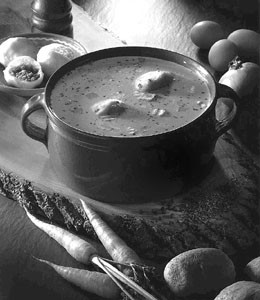
Asparagus

0

Spearhead This

Asparagus offers all this and purple rubber bands too

By Sara Bir

The moment that asparagus fans have been waiting for all year has arrived. It’s asparagus season now, and the little green bundles of joy plummet in price from $3.99 a pound to “buy one, get one free.” Get it while it’s hot, because when asparagus comes around, you gotta eat it up.

Distinctive, versatile, and luxurious, asparagus holds a treasured spot worldwide. Americans favor thinner stalks of green asparagus, whereas it is the thicker, white asparagus of southern Germany that many Europeans treasure. Ancient Romans coveted asparagus, serving it with a pungent sauce of fermented fish. In China, asparagus spears are candied and served as special treats.

California leads the nation’s asparagus production with more than 50,000 metric tons harvested annually. Although it is available year-round, asparagus tastes best during its natural growing season: late March through June. Since asparagus begins to lose its flavor as soon as it’s picked, it’s important to buy the freshest spears you can find (local, if possible). Look for firm, smooth stalks and closed tips when buying, and take a peek at the cut ends of the stem: The drier they are, the more time has passed since they were picked. If you’re going to keep asparagus around for a few days before cooking it, store the bunch in the refrigerator, upright in a few inches of water, just like flowers.

There’s no consensus on what the best type of asparagus is–thick or thin, green, white, or purple; it sort of depends on the purpose. White asparagus, a subtly earthy delicacy, is grown under mounds of dirt to prevent its exposure to light, a labor-intensive process that creates a less grassy, slightly bitter flavor. Purple asparagus looks exotic, but–alas!–turns green when cooked.

Thinner, pencil-sized stalks are more tender and don’t need to be peeled. Their dainty size makes them ideal for a crudité platter, slaw, or salad; if the asparagus is especially sweet, you can even serve it raw.

Thicker spears have a tough skin that may need to be peeled from the bottom end to just under the tip; a heavy-duty vegetable peeler is perfect for this task. Even though it requires extra work, thicker asparagus is found by some to have more flavor and a more succulent texture.

Thick or thin, the lower third of the stalk is tough and woody, and needs to be removed. Some just take the bunch and cut straight through, but you can snap the bottom of the stalk off, which will naturally break right at the woody part. And save the bottoms, which are excellent for stock. You can also infuse canned stock with asparagus tips if you are making risotto.

You don’t want to cook asparagus al dente, but you also don’t want to boil it to a limp, slimy mess. When you can easily insert a knife into the thickest part of the stalk, it’s done. My favorite method is pan-steaming, a fast and effortless way to cook a pound of spears (perfect for omelets or a small dinner). Simply lay the prepared raw asparagus in a skillet and add about a quarter inch of water. Cook over high heat; if it looks like most of the water has evaporated, add a little more. After five minutes or so, it’s done, and you don’t have to wait for any water to boil.

Another easy way to steam asparagus is to stand the whole bunch–tied with kitchen twine, if you want to be tidy about it–upright in an inch or two of salted, boiling water in a large saucepan, and cover. If you boil or pan-steam asparagus for a pasta, reserve some of the flavorful cooking water and add it to your sauce.

Asparagus stands up to bold flavors and rich sauces, so it’s great as an element in more complex dishes–stir-fries, savory bread puddings, sandwiches, omelets, and even curries–but for a simple treat, all it needs is a quick dressing. A squirt of lemon, a dip in bagna cauda, a drizzle with sesame oil, or a kiss of browned butter will make asparagus’ flavor shine. In England, thick asparagus is served as its own course, often with hollandaise.

One thing asparagus does not go well with is wine; a member of the lily family (along with onions and leeks), its sulfur compounds make wine taste bitter. This has never deterred me from indulging, to be honest, but just make sure that you don’t waste a good Chablis by serving it with asparagus. If you insist on pouring wine, stick to a light Sauvignon Blanc or a Riesling.

Or, you can put the asparagus in the drink: At the upcoming Stockton Asparagus Festival (April 26-28), a (hopefully small) percentage of the 20,000 pounds of asparagus served will go into aspara-ritas, yet another twist on the classic margarita–which is, even for the versatile asparagus, a stretch. Luckily, you need not resort to putting it in mixed drinks: Asparagus is perhaps best when cooked simply and eaten with your fingers, just as the Romans did.

Now, for that distinctive after-dinner smell: Eighty percent of the population will develop an odor in their urine after eating asparagus. The majority cannot metabolize aspartic acid, a natural chemical that creates the odor, so it goes straight through our system, making our urine stink. Another theory has it that only certain people have a gene for smelling the pungent chemicals, while others believe that the gene for producing the chemical in the first place is the missing link. In any case, you’re the only one who has to know if asparagus makes your pee smell or not, so what difference does it make? Eat, eat!

Roasted Asparagus with Parmesan, Olives, and Lemon

Preheat oven to 450 degrees. Trim and peel a pound of asparagus; place in a roasting pan and drizzle with a scant tablespoon of olive oil. Sprinkle with salt and the zest of half a lemon; toss and roast, turning asparagus every few minutes. When the asparagus is almost ready but not quite done (10-20 minutes, depending on thickness of the stalks), scatter with 4 or 5 pitted, slivered black olives and enough shaved parmesan cheese to suit your taste. Continue roasting until cheese just starts to brown, and serve.

From the April 25-May 1, 2002 issue of the North Bay Bohemian.

© Metro Publishing Inc.

Healdsburg Arts Council

0

Pride and Joy: Council president Janet Norton shows off Healdsburg’s new creative home. At right: Pam Sibley.

Blooming Art

Healdsburg Arts Council sets up shop downtown

By Sara Bir

Downtown Healdsburg, on a sunny spring day, buzzes with the quaint energy of a small, tourist-driven town: Storefronts display boutique items, clothing hung on racks flutters in the breeze, straw-hatted pedestrians pass over the sidewalks.

And now the Healdsburg Arts Council joins them with a new 2,350 square foot facility just off the plaza named–fittingly enough–Plaza Arts. “We feel we are providing a home in the heart of Healdsburg for creative activity and learning,” says Janet Norton, the council’s president. “It’s a wonderful opportunity to be in the community.”

Mingling scents of paint and drywall filter through the spacious, high-ceilinged interior of Plaza Arts, a work-in-progress dotted with tarps, ladders, and other signs of industrious improvement. The council signed a three-year lease for Plaza Arts in the beginning of March and has since been busy converting the space. “Every time I go by here there are people hammering, volunteers sanding and painting,” says Norton. “We spend almost seven days a week working.” About 25 volunteers have been doing all the work, with the exception of electric wiring and putting up studs. Plaza Arts celebrated its grand opening on April 24 with the gallery’s premier show, “Healdsburg: Our Town.”

“We’re for our member artists, to benefit people who want to learn more about art,” says board member Donna Schaffer. “This community has amazing art potential.”

Plaza Arts represents a big step ahead for the council, whose goal is to strengthen the community through art programs such as the annual Healdsburg Jazz Festival, juried art shows, literary salons, and student scholarships. Since their inception in 1993, the council has made do with a small office and no permanent gallery space. “We have been looking at something like this for a number of years,” says Norton. “We did a Community Cultural Plan in 1999, and the most universal request was for an arts facility.”

Previously, the council used donated spaces for art shows. “We did ‘Art on the Move’ for the first five to seven years. We had three or four locations around town and would literally bus people around to view art for a day,” Schaffer says. “The thing about a one-day event is that it takes so much work to set it all up, and then it’s all over in a day. We really needed a long-term commitment on a space. Now we can plan things into the future, and there’s a chance we can raise our hands for traveling exhibitions.”

In addition to gallery space for exhibits, Plaza Arts will house a cooperative gallery for artists. Hidden in the back is a workshop area where local and visiting instructors will hold classes for painting, sculpting, and drawing. Participants will have the freedom to really get into the art and not worry about mucking things up. “This is for people to come and make a mess,” assures Schaffer. “We’re hoping school groups can tour through that gallery and then come back here and do an art project.”

Plaza Arts’ workshop will also allow the council to offer more intensive classes. “Now that we have a permanent space, it is much easier to get on the calendars for well-known instructors,” Norton says.

“We are an all-volunteer organization,” says Schaffer. “We don’t have an executive director, we’re not paying anybody a big salary, and that’s why I think that we can afford this facility. I only want to do one fundraiser, and that’s the fundraiser that’s coming up.” After a benefit silent auction of the items in “Healdsburg: Our Town,” the council plans to fund Plaza Arts with fees paid by artists submitting their works for display, tuition for workshops, and commissions on artworks sold.

“It is meant to be a facility that benefits everybody,” says Schaffer. “We want to benefit the 3-year-old kid to the 98-year-old woman.”

‘Healdsburg: Our Town’ is open until Saturday, April 27, when there will be a gala and a silent auction of the pieces to benefit Plaza Arts. There will be wine, light food, and a performance by the Healdsburg High School Jazz Combo from 4 to 6pm. Plaza Arts will be open daily from 10am to 8pm. 130 Plaza St., Healdsburg. 707.431.1970.

From the April 25-May 1, 2002 issue of the North Bay Bohemian.

© Metro Publishing Inc.
The Velvet Teen

0


Photograph by Sarah Sanger

The Power Of Three: The Velvet Teen kicks off a tour to support their new album. L-R: Logan Whitehurst, Judah Nagler, Josh Staples.

A Special Gift to You

The world outside of Sonoma County finally gets their share of Velvet Teen

By Sara Bir

If memory serves, the first time I saw the Velvet Teen was in 2000 at a sparsely attended afternoon pizza party at the now defunct Inn of the Beginning in Cotati, back when the band was still “that new thing Judah’s doing.” Last Friday, on the final night of their first coast-to-coast tour, they played in Petaluma to a packed Phoenix Theatre with fans ranging from the typical sneaker-clad teenagers to adults sprouting gray hair.

But even if I lived in Alaska and had never seen the Velvet Teen to begin with, I’d still love them. Such mesmerizingly sincere and unabashedly gorgeous songs are impossible to keep from getting under your skin, and at a time when indie rock is dotted with staid and pretentious bands, music that you can so effortlessly attach yourself to is a rare treat. When a band puts on a good show, it makes you float; when the Velvet Teen put on a good show, they make you melt. And I have melted, I have, every time I’ve seen them.

The Velvet Teen’s escalating recognition is most immediately owing to the release of their debut full-length album, Out of the Fierce Parade, released in March. An opening slot with Death Cab for Cutie on the first night of this year’s prestigious Noise Pop festival in San Francisco only added to the buzz. The bulk of that momentum, however, is passionate word-of-mouth fueled by frantically downloaded mp3s and spellbinding live shows; the band’s recent tour recruited not only new fans, but also allowed those already familiar with the recorded material their first glimpse of live Velvet Teen.

“I’ve been on a few tours with different bands, and this is the only tour I’ve been on where there was at least one person there that knew our songs and was there to see us,” said Josh Staples, the group’s bassist, before Friday’s show. “At one show, a couple of people drove, like, six hours, from Iowa to Nebraska. Out of 30 shows, there were only a couple ones that were kinda lame, and there were still people that were there to see us–otherwise, they could have been way lamer, if there was nobody there.”

All three members have been playing in Sonoma County bands for years: Singer-songwriter Judah Nagler joined the ska outfit Tin Circus in high school before playing bass in the arty, geek-rock Little Tin Frog. Nagler and Little Tin Frog drummer Logan Whitehurst began to write very nongeek-rock songs together as a secret side project; when Little Tin Frog broke up, the side project became the Secret Band. Josh Staples, who played in the Conspiracy, Edaline, and the Wunder Years, came on as bass player, and the trio became the Velvet Teen, previously the name of Nagler’s electronica-infused side project.

A prolific songwriter, Nagler’s talent and age (all of 21) make him a bit the prodigy. “Music is all I’ve known my whole life,” he says. “If I go a week without writing a song, I feel like I’m all out of place.”

Drummer Whitehurst also stays busy with his own solo project, Logan Whitehurst and the Junior Science Club, whose They Might Be Giants-inspired silliness could only be further from the Velvet Teen’s material if it were a hardcore band. Whitehurst also did the etchings for Out of the Fierce Parade‘s cover; all three band members are graphic designers, making them the only band I know who face a dilemma over which one designs the next flyer.

After the self-released EP The Great Beast February and the Immortality 7″ on Petaluma’s Pandacide Records, the Velvet Teen went to Seattle for a week to record Out of the Fierce Parade with Death Cab for Cutie’s Chris Walla. That the first pressing of the album sold out and left some stores temporarily out of the CD proves how listeners have taken to the band; on only their second week on the CMJ charts, Out of the Fierce Parade had already reached #82. But it was a random kid I spotted in Santa Barbara this past weekend proudly wearing a Velvet Teen T-shirt that proved that the band’s popularity is hardly a North Bay phenomenon anymore.

Instead of knitting their brows to create something completely original yet contrived, the Velvet Teen are not afraid of allowing their songs to sound pretty, embracing the traditional structure of a pop song instead of sparring with it. Their respect for choruses, bridges, hooks, and vocal harmonies is such that they elevate three-minute songs to the holy stratosphere where Lennon/McCartney and Goffin/King compositions float in ethereal pop divinity, transcending the saccharine confines of lesser hands. Critics toss around references to Radiohead (falsetto vocals), Jeff Buckley (soaring ballads), and Smashing Pumpkins (flashes of big guitar), and while there is validity to all these comparisons, the Velvet Teen’s ability to stratify catchiness with profundity to create a sound very much their own defies such marginalization.

Out of the Fierce Parade is an excellent, powerfully beautiful album, produced and performed with a subtlety that galvanizes the strength of the melodies and the pensive nature of the lyrics. Nagler’s vocals have the restraint of a weeping angel, propelling songs that are sparse and lush at the same time. The album’s spot-on pacing weaves through the spine-tingling opening ballad, “A Special Gift to You,” to the upbeat rocker “Radiapathy,” to “Into the Open Air,” a gilded anthem that marks the centerpiece of the album and may be the most arresting rock and roll song ever written in 6/8 time. Out of the Fierce Parade is the most complete and exciting recording I’ve heard this year so far.

“They have this incredible dynamic where each song is the polar opposite of the previous track, and their live show brings it all together,” says Ezra Caraeff of Slowdance Records, the Velvet Teen’s Portland-based label, who first became aware of the group when a friend who had played a show with them was so blown away by their performance that he insisted Caraeff take a listen. “If they continue to relentlessly tour,” says Caraeff, “they will become a very well-received band. They have worked very, very hard–I’ve never met a band in my life who has been so organized and determined. Plus, when it comes down to it, they just really like to play music.”

The boys promised on their website to document the antics of their tour via on-the-road postings, and the resulting tour journal entries reveal not only their wit and creativity, but also Josh’s rampant love for the old-school video game Galaga. To keep fans abreast of the band’s travels, Nagler jerry-rigged a tracking device for their van, so that a big red dot flashed on a map on the website over their location.

With a short tour with the Gloria Record coming in mid May and a possible jaunt to Canada in June, the Velvet Teen will have no shortage of time to spend in their sweet-ass van, a mighty touring machine complete with a television, a dustbuster, and a temporarily broken speedometer. “We’ve put 30,000 miles on it in the past eight months, and it seems to be doing fine,” says Josh. And the Velvet Teen seems no worse for the wear either.

The Velvet Teen play a teens-only show May 11 in Palo Alto at the Mitchell Park Teen Center, and at Bottom of the Hill in San Francisco on May 17 with the Gloria Record.

From the April 25-May 1, 2002 issue of the North Bay Bohemian.

© Metro Publishing Inc.
‘Panic Room’

0


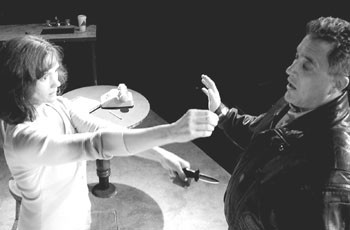
Fear Factor: Jodie Foster (right) and Kristen Stewart huddle behind closed doors.

Steel Trap

Mr. Fix-It deconstructs ‘Panic Room’

Writer David Templeton takes interesting people to interesting movies in his ongoing quest for the ultimate postfilm conversation. This is not a review; rather, it’s a freewheeling, tangential discussion of art, alternative ideas, and popular culture.

Homebuilder Lou Manfredini doesn’t like to waste materials–or words. As the straight-shooting host of Chicago’s long-running Mr. Fix-It radio show–finally enjoying national syndication after a seven-year run on WGN-AM–Manfredini, renowned construction expert and master of household tools, has earned a reputation as a knowledgeable guy who speaks his mind and gets right to the point.

For example: Having finally caught up to the hit Jodie Foster thriller Panic Room–about a newly divorced mom (Foster) trapped in her new home’s self-contained, steel-reinforced “panic room” as sledgehammering burglars try desperately to get to the safe that’s hidden there–Manfredini does not squander his time with pleasant postfilm chitchat.

“That,” he succinctly pronounces, “was the worst movie I’ve ever seen in my life!” He’s laughing as he says it, but I suspect he means every word. “Oh, I hated it,” he reasserts. “Though Jodie Foster is always a delight to watch. I’d like to meet her some day. But the movie drove me crazy. Remember when they were first breaking into the wall? That wall was drywall, not plaster. There’s no way an old building like that would have had drywall in it. It would have been plaster. I notice things like that. But, hey, at least the popcorn was good.” Myself, I liked Panic Room, and I tell him so. But then, I don’t know anything about drywall.

Manfredini is crisscrossing the country this week, promoting his new book, Mr. Fix-It Introduces You to Your Home, a room-by-room guide to how a modern house functions and what steps to take should it stop functioning. While out on the road, Manfredini, a proud father of four school-age kids, pretty much jumped at the chance to see a film that doesn’t revolve around talking animals. That Panic Room is in part a movie about home-security construction is just gravy on the meatloaf.

Speaking of food, Manfredini’s colorful critique of the film begins with what wasn’t in the panic room, supposedly built and stocked by the paranoid millionaire who’d previously owned the house and who, evidently, did not enjoy eating.

“Some food would have been good,” Manfredini states. “Think about it. They had everything else in there. They had fire blankets and shaving kits. So obviously, the mindset behind the panic room is that I could lock myself in there for X amount of days. So how about a Snickers bar? How about a bag of chips? Maybe a Pepsi. Would that be so bad? Here’s my advice for those out there who are going to be building panic rooms because of this movie: A little food goes a long way.”

“Supposedly,” I interject, “in the few weeks since this movie has come out, there has been a sharp increase in requests for these kinds of safe rooms.”

“Well, when it comes to your home and wanting it to be safe, some people go a little overboard,” Manfredini replies, “which, in my opinion, describes wanting a panic room in your house. If anything, this movie proves the adage about safety and security in the home: If someone really wants to get in, they can get in. There are ways to breach any type of security system if someone wants to badly enough.”

I resist the sudden urge to call home and make sure my wife and kids are safe; instead, I pose a question that should be right up Mr. Fix-It’s alley.

“The bad guys have bags of tools,” I remind him, “but they seem to have no clue how to use them. What advice could you give that could help these guys get into the panic room?”

“OK, here’s the thing,” he replies. “In their defense, they didn’t think anybody had occupied the house yet, so the panic room was supposed to be unlocked. But there’s Jodie and her kid, they’re in the room, the door is made of steel, and they won’t come out. So if I were their leader, I’d have said, ‘Hey, I’ll be right back.’ I’d have gone to my apartment and gotten a torch, and just cut the door open with the torch. It would have been done in about, I don’t know, 10 minutes, 15 at the most. Instead, they spend the whole movie whacking at it with a sledgehammer.”

“Maybe they should’ve read your book first,” I chime in.

“At least,” he agrees. “And here’s another thing, another little flaw in the movie. Remember the propane tank the burglars use? When they’re trying to pump gas into the panic room? It had a quick-connect fitting on the end of it, which means that they couldn’t have put that garden hose on it and gotten any gas out of it. It had to have had a male-female connection, one that pierces a ball inside, like an air hose at a gas station.”

“You’re really trying to ruin this movie for me, aren’t you?” I reply.

“Hey, don’t mess with Mr. Fix-It when it comes to truth in construction supplies,” Manfredini laughs. “I don’t even want to hear about it.”

“I’m afraid to ask, but is there anything else?” I query.

“Yeah. Plenty,” he says. “When the guy is standing there trying to break through the ceiling with that same sledgehammer, he never has a speck of dust on him. Right? I’ve knocked down more plaster ceilings than I can count, and I’m telling you, you look like Casper the Ghost when you’re done, but this guy was clean as a whistle.”

“Maybe he’s neater than you are,” I suggest.

“Not likely,” Manfredini retorts with a chuckle. “They’d have been coughing and gasping. There was only a little sprinkle of plaster on the floor. It would have been everywhere. I really can’t believe you liked this.

“And here’s another thing,” he goes on. “In this movie, Jodie Foster has just been dumped by her husband. How is that possible? Look at how good she looks. What is she, 40 years old? She looks fantastic! How could he leave her? And may I add that she’s also a fine actress and an excellent director. If she ever wants to do a remake of Little Man Tate, I’d be happy to play the bald, fat guy.”

“You’re not bald,” I remark.

“Yeah, but someday I will be,” Manfredini laughs. “By the time Jodie Foster casts me in a movie, I’ll definitely be bald. And by the way, I noticed you didn’t say I wasn’t fat. What’s with that?”

From the April 25-May 1, 2002 issue of the North Bay Bohemian.

© Metro Publishing Inc.
Buddha Bar – Six Degrees

0

California Masala: DJ Cheb i Sabbah mixes up the Asian grooves.


Photograph by Chris Woodcock


Just Chillin’

Buddha Bar fizzles; Six Degrees sizzles

By Greg Cahill

The Buddha Bar in Paris has emerged as one of the landmarks of the global musical bazaar that is contemporary electronica, particularly the growing chill-out scene comprised of mostly relaxing music that provides a backdrop for cocktails and conversation. The Buddha Bar, an ultrahip nightspot created out of a vast warehouse, is to the vibrant Parisian world-music community what Studio 54 was to New York’s disco world: a stylish cocktail, dinner, and dance palace, this one replete with carefully crafted soundscapes and dominated by a majestic 20-foot-tall golden Buddha. It also is a trendsetting musical mecca in its own right, the modern hot club of France.

For the past two years, the French import label George V has been bringing the sounds of the Buddha Bar to the American masses. The earlier releases, including last year’s Amnesty International 40th anniversary tribute, ranged from Egyptian star Amr Diab’s sha’bi stylings to a spoken-word piece by Demi Moore.

Now readily available at such huge retail chains as Borders Books (the San Rafael outlet boasts an extensive chill-out and groove section), the Buddha Bar release and its ilk are making their way into the musical mainstream. With the release of Buddha Bar IV, the latest multidisc collection of studio-tweaked tunes from resident producer and arranger David Visan (the child of a Romanian father and a Vietnamese mother), the Buddha Bar builds on its reputation as a brand name while simultaneously underscoring the strengths and weaknesses of this music.

Buddha Bar IV is a mixed bag that can be dramatically uplifting and frustratingly flat. This latest two-CD set (selling for a hefty 40 bucks) is split into companion Dinner and Drinks discs. In general, it follows the pattern of its predecessors, compilations of Far Eastern spirituality, bubbly European electronica, and Mediterranean musical potpourri. You might assume that these discs would possess their own energy levels, but the emotional range on the second disc runs from the utterly infectious Spanish brass instrumental “Loco” by Loving Paris (the highlight of the set) to a reflective solo classical piano piece.

The problem, as critics have noted in the past, is that while this music has a hip edge and occasionally transcends exotic regional sounds set to insipid 4/4 dance beats, it also can be annoyingly anonymous.

Not so over at the San Francisco-based Six Degrees label, where a series of new chill-out and groove releases shows that electronica can be distinctive and much more than mere background music for a boomer supper party. Recline: A Six Degrees Collection of Chilled Grooves is an intriguing 11-track compilation that serves as a good sampler for some of the label’s more laid-back tracks, including “Skin on the Drum” by politico rapper Michael Franti and Spearhead, and a remix of “Mais Feliz” by Brazilian samba queen Bebel Gilberto.

The more danceable Asian Travels 2 dishes up Indian and Pakistani vibes mixed with ambient, electronic, and dance grooves with new tracks and remixes of songs by DJ Cheb i Sabbah, Banco de Gaia, Karsh Kale (whose 2001 Six Degrees CD Realize was one of the year’s best electronica releases), and Govinda, among others. The crème de la crème of the new Six Degrees material, however, is Sabbah’s own Krishna Lila (in stores June 4), the long-awaited follow-up to 2000’s acclaimed Maha Maya. And it’s a gem.

Sabbah is an Algerian-born magic man whose work is awash in serious classical Indian music and who deftly blends modern elements–like thunderous sub-bass beats and Blade Runneresque sound montages–without sounding trendy or succumbing to cheesy electronic effects. Where 1999’s phenomenal Shri Durga drew on classical Indian ragas, bagra, mantras, and hip-hop beats, Krishna Lila also includes five devotional bhajans (both Northern Hindustani and Southern Carnatic traditions) and features top Indian musicians (sarodist K. Sridhar, violinist K. Shivakumar, and vocalist Radhika Rajiv, to name a few), as well as bassist Bill Laswell and percussionist Karsh Kale.

The result is a complex cultural blend that will stand up for years to come and already represents the best of the genre.

From the April 25-May 1, 2002 issue of the North Bay Bohemian.

© Metro Publishing Inc.
Selective Service

0

A Model For Peace: Elizabeth Stinson opposes giving the Selective Service the right to register people at the DMV.


Photograph by Rory Mcnamara


Licensed for War

Should the Department of Motor Vehicles promote Selective Service registration?

By Tara Treasurefield

Before registering with the Selective Service System, 18-year-old Kevin Smith of Sebastopol thought long and hard about how it would feel to kill someone. Now a committed pacifist, Smith is carefully documenting his conscientious objector status.

Senator Jackie Speier introduced SB 1276 in the California State Legislature in February. Smith worries that if SB 1276 becomes law, it will make Selective Service System registration so easy that other young men won’t be nearly so thoughtful as he has been. The current version outlines a program modeled after Motor Voter, the National Voter Registration Act of 1993, which allowed people to register to vote while renewing or applying for a driver’s license. Similarly, SB 1276 would allow men to register with Selective Service when they apply for a driver’s license. Will they call it Motor Soldier?

Whatever they call it, Speier plans to make the idea a reality by changing the state’s driver’s license application. To sign up with Selective Service, draft-age men would simply sign their names to the front of the application. The DMV would forward their names and addresses to the SSS, who would then register them. A statement on the back of the application would alert young men that federal law requires them to register with the SSS and list the consequences of their failing to do so.

This plan is Speier’s inspired attempt to save her bill from an otherwise certain death. The original version authorized the Selective Service to register male drivers without their permission. That would have forced young men to either give up their right to refuse to register with the SSS or give up their right to apply for a driver’s license.

Valerie Small-Navarro, an attorney with the American Civil Liberties Union in Sacramento, says the amended bill is far better than the original. But she’s concerned that it would encourage men to register without knowing what Selective Service is or does.

The Senate Transportation Committee will consider the amended bill on April 25, and it may not pass. A key issue is that some members of the committee oppose using the driver’s license for purposes unrelated to driving.

Defending the practice, Richard Steffen, Speier’s chief of staff, says, “We’ve done that with child support. If you’re in arrears with child support, you can have your driver’s license denied.” And of course, Californians can register to vote at the DMV.

In any case, it seems odd that two liberal Democrats, Senator Speier and Assemblywoman Strom-Martin, are backing SB 1276. Strom-Martin explains that she wants to make it easy and convenient for young men to register with Selective Service and stresses that she’s not interested in tracking young men for SSS.

Speaking for Speier, Steffen says, “She’s a firm believer that everybody should be in the pool. Even disabled people, quadriplegics, have to register.” In addition, he says, “Some people who drop out of school aren’t aware of the registration requirement. [Providing this information through the DMV] would be a way to protect them from the penalties.”

Over the last three years, 16,000 draft-eligible Californians have failed to register with Selective Service. Those who don’t register before the age of 26 are permanently ineligible for federal employment and federal student aid, prohibited from practicing law, can’t take certain law enforcement jobs, and could be sentenced to five years in prison and a $250,000 fine.

The federal government knows which California drivers do and do not register with Selective Service. Since 1990, the DMV has been sending the SSS quarterly reports of drivers between the ages of 17 and 21. The SSS compares the reports to the information in its database, notes the names that aren’t there, contacts the missing young men, and urges them to register. It also forwards the names and addresses of nonregistrants to the U.S. Department of Justice.

Elizabeth Stinson, director of the Sonoma County Peace and Justice Center, challenges links between the DMV and Selective Service. She asks, “Why should the military have access to kids who apply for a driver’s license?”

The real issue, says Stinson, is how to handle conflict. “We’re opposed to violent solutions. We have to find ways to deal with conflict nonviolently, to dialog, to look at different sides of every situation. We have to model peace to our children.”

From the April 25-May 1, 2002 issue of the North Bay Bohemian.

© Metro Publishing Inc.

Hank Williams III

0


Photograph by Jean Laughton


Hellbilly Hank

Country singer wrestles with a family legacy

By Greg Cahill

He’s a walking contradiction. Hank Williams III –born Shelton Hank Williams–is the grandson of country legend Hank Williams and son of country rocker and hellraiser Hank Williams Jr. He sports honky-tonk genes that any alt-country wannabe would give his left nut for. His cover of “Long Gone Daddy” on Timeless, last year’s Grammy-nominated tribute to Hank Sr., gave that all-star project some much-needed authenticity. But Hank III, who makes his North Bay debut on April 24 at the Mystic Theatre, is also a diehard Black Sabbath fan who used to play drums in a punk-thrash band called Buzzkill and whose musical heroes run closer to Kurt Cobain than Roy Acuff. These days, Hank III is promoting his new country album, Lovesick, Broke, & Driftin’, while battling Curb Records to release a rock album that’s been languishing in the can for months.

Country. Punk. To Hank III, whose three albums salute the whiskey-soaked boundaries of honky-tonk Americana, it’s all the same. “I was lucky enough to start hanging out with guys like [alternative country singers] Wayne ‘The Train’ Hancock and Dale Watson,” he told MSNBC in a recent interview. “They were showing me you can still be punk rock and hardcore [country] in a more old-school way.”

Still, being the grandson of a music legend who has been hailed as “the most important voice in country music history” can be a mixed blessing. In a recent review of Lovesick, the Fort Worth Star-Telegram pondered “the burden of being Hank III” and wondered if Williams isn’t too distracted “trying to fit himself into those notions of what he should be singing about” instead of finding his own voice.

No doubt about it, 29-year-old Hank III walks a fine line. Tall and lanky, he’s the spitting image of his grandfather, who died in 1953 after a life of alcohol and drug abuse–at age 29–in the back seat of a Cadillac on his way to a concert in Canton, Ohio. Hank Sr.’s hit single at the time: “I’ll Never Get Out of this World Alive.”

As the son of Hank Jr. and his second wife, Gwen Yeargin Williams, Hank III grew up in Atlanta and Nashville, often not seeing his father for years at a time. Cursed with a learning disability, Hank III fared poorly in school. When his father’s band passed through town, his young son would sit in on drums and was quick to learn the benefits of life as a musician. “Growing up and going to my dad’s shows and seeing the excitement of all these people, the cigarette smoke and all the drinking, girls running around with their shirts off,” he told MSNBC, “at 12 years old, 11 years old, that was like, ‘Wow, look at that!'”

As a teen, it didn’t take long to realize that he could either struggle financially in a punk band or cash in on his famous name. He moved to Branson, Mo., the country-music theme park, and started playing Hank Sr. songs for two shows a day at a local theater.

Eventually his punk sensibilities kicked in and Hank III started pumping up his sets with hardcore honky-tonk à la the Texas-born Wayne Hancock. In 1996, Curb Records released Hank III’s solo debut, Three Hanks: Men with Broken Hearts, which paired him with his father and used some of Hank Sr.’s recordings. But it was 1999’s solo album Risin’ Outlaw, which included two honky-tonk classics by Hancock, that heralded Hank III’s arrival.

Lovesick, produced by Williams with no regard for country radio, signals his intention to handle the family business with twangy, hard-rockin’ vengeance. “I finally got to do it predominantly my way,” he told Country Standard Time. “I’m pretty stoked about it. At least I’m proud of it. It makes you feel more like you’re doing what you’re supposed to do and not like a puppet. I’m here to be kind of creative and not to be told what to do.”

Hank Williams III performs on Wednesday, April 24, at 8pm, at the Mystic Theatre, 23 Petaluma Blvd. N., Petaluma. The Mother Truckers open the show. Tickets are $18. 707.765.2121.

From the April 18-24, 2002 issue of the North Bay Bohemian.

© Metro Publishing Inc.

Tsunami Bomb

And A Bottle Of Rum: Tsunami Bomb are more punk rock than pirate.Taking the ReignsTsunami Bomb return to the North Bay in Californopia TourBy Sara BirIt's the postspring break, presummer vacation period for the collegiate crowd, a time when sunny afternoons, good-natured rowdiness, and loud music can easily take precedence over one's studies. Sticking to the books will only...

Outback Steakhouse Restuarant Chain

Photograph by Michael AmslerChain GangA walkabout through the forbidden pleasures of the Outback SteakhouseBy Sara BirThe directions to just about any Outback Steakhouse in the country might be similar: just past the Circuit City, to the right of Best Buy, behind the Cinema Googolplex, crowning the top of a hill like a gigantic, abandoned shoe box. Peckish for protein...

Fast Food Favorites

Glutton GuiltSara BirThe following nationally available meal items are my own particular favorites:McDonald's Hamburgers. I enjoy these, perhaps two or three times a year, in moments of sheer weakness and/or desperation. A McDonald's hamburger has its own unique, nonhamburger-like taste, making it a thing entirely unto itself. Cheese, I find, disrupts the delicate medley of flavor; it is also...

Asparagus

Spearhead ThisAsparagus offers all this and purple rubber bands tooBy Sara Bir The moment that asparagus fans have been waiting for all year has arrived. It's asparagus season now, and the little green bundles of joy plummet in price from $3.99 a pound to "buy one, get one free." Get it while it's hot, because when asparagus comes...

Healdsburg Arts Council

Pride and Joy: Council president Janet Norton shows off Healdsburg's new creative home. At right: Pam Sibley. Blooming Art Healdsburg Arts Council sets up shop downtown By Sara Bir Downtown Healdsburg, on a sunny spring day, buzzes with the quaint energy of a small, tourist-driven town: Storefronts...

The Velvet Teen

Photograph by Sarah SangerThe Power Of Three: The Velvet Teen kicks off a tour to support their new album. L-R: Logan Whitehurst, Judah Nagler, Josh Staples.A Special Gift to YouThe world outside of Sonoma County finally gets their share of Velvet TeenBy Sara BirIf memory serves, the first time I saw the Velvet Teen was in 2000 at...

‘Panic Room’

Fear Factor: Jodie Foster (right) and Kristen Stewart huddle behind closed doors.Steel TrapMr. Fix-It deconstructs 'Panic Room' Writer David Templeton takes interesting people to interesting movies in his ongoing quest for the ultimate postfilm conversation. This is not a review; rather, it's a freewheeling, tangential discussion of art, alternative ideas, and popular culture.Homebuilder Lou Manfredini doesn't like to...

Buddha Bar – Six Degrees

California Masala: DJ Cheb i Sabbah mixes up the Asian grooves. Photograph by Chris WoodcockJust Chillin'Buddha Bar fizzles; Six Degrees sizzlesBy Greg CahillThe Buddha Bar in Paris has emerged as one of the landmarks of the global musical bazaar that is contemporary electronica, particularly the growing chill-out scene comprised of mostly relaxing music that provides a backdrop for...

Selective Service

A Model For Peace: Elizabeth Stinson opposes giving the Selective Service the right to register people at the DMV. Photograph by Rory McnamaraLicensed for WarShould the Department of Motor Vehicles promote Selective Service registration?By Tara TreasurefieldBefore registering with the Selective Service System, 18-year-old Kevin Smith of Sebastopol thought long and hard about how it would feel to kill...

Hank Williams III

Photograph by Jean LaughtonHellbilly HankCountry singer wrestles with a family legacyBy Greg CahillHe's a walking contradiction. Hank Williams III --born Shelton Hank Williams--is the grandson of country legend Hank Williams and son of country rocker and hellraiser Hank Williams Jr. He sports honky-tonk genes that any alt-country wannabe would give his left nut for. His cover of ...
11,084FansLike
4,446FollowersFollow
6,928FollowersFollow

