
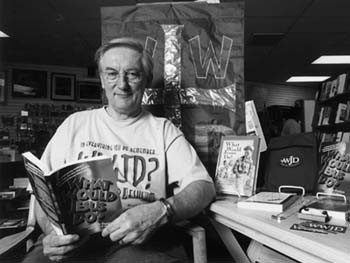
Dr. Martin Griffin

One Jump Ahead


Michael Amsler

Farsighted: Dr. Martin Griffin’s life’s work is simply to save the planet and our souls.

Marty Griffin’s land-ethic revolution

By Dylan Bennett

A S A PHYSICIAN in the 1950s, Marty Griffin should have been content to make money and enjoy his social standing in affluent Marin County. No one would have expected him to question–let alone counterattack–the advance of urban “progress” that promised to make Marin more like Los Angeles.

But Griffin’s consciousness had been imprinted as a child with a deep love of nature. In the 1920s, his family often vacationed along the natural beauty of the Russian River. A fateful Boy Scout outing in 1932 from his Oakland home to the Canyon Ranch on Bolinas Lagoon etched in his teenaged mind the beauty and wonder of birds nesting in tall trees. The Golden Gate Bridge was not yet built and the word ecology didn’t exist.

Nearly 30 years later, in 1961, Griffin learned of plans to build a freeway over the Marin Headlands to Bolinas. A luxury marina project threatened to fill in the lagoon and destroy the bird colony of Canyon Ranch. The idea of it outraged his sensibilities. And this time the boy was man, an intellectual warrior trained in zoology at Berkeley and medicine at Stanford.

He would join the fight.

Not only the effort led by Griffin and the Marin Audubon Society to preserve the Marin coast from urban development, but also the ongoing struggle over the Russian River are the subjects of Griffin’s new book, Saving the Marin-Sonoma Coast: The Battles for Audubon Canyon Ranch, Point Reyes, & California’s Russian River (Sweetwater Springs Press; $29.95), due to be published in March.

The book is both a personal memoir of Griffin’s successful conservation efforts in the postwar era and an action manual for Sonoma County citizens to understand and influence the use of their own natural surroundings.

Griffin, now retired from his practice as an internist (and the former director of the Sonoma Developmental Center), is the owner of Hop Kiln Winery on Westside Road, co-founder of the Friends of the Russian River, and one of Sonoma County’s foremost conservationists. His tale reads like a folksy business thriller, with the future of the earth in the balance–a well-rounded lesson in ecology, politics, and activism, illustrated with over 200 photographs and original maps.

As the president of the Marin Audubon Society in 1961, Griffin hatched what he called a “plot” to save Marin. He purchased key properties in the path of the proposed west Marin freeway and marina and set them aside for permanent wildlife habitat.

It was a strategy that had worked before. In 1957, Griffin was tapped by Caroline Livermore, the wealthy, high-society woman who had formed the Marin Audubon Society to help prevent the landfill and marina development proposed for Richardson Bay off Tiburon. Griffin learned to flash the cash for strategic parcels selected specifically to block development.

Griffin’s first score on the coast was the Canyon Ranch itself, with a sale price of $400,000. But he closed the deal with only a $1,000 personal check, persuading the Marin Audubon Society to raise the rest of the money.

In this manner, a well-trained, would-be Establishment Man became a nature gangster–using the power of the almighty dollar to invert the purpose of private property and give the earth back to itself. “I was one jump ahead of the developers,” Griffin chuckles, seated in the living room of his peaceful west county home.

In all, Griffin bought some 30 strategic parcels of tidelands and uplands totaling more than 1,600 acres and costing upwards of $1.5 million. Some people simply donated their land. These efforts killed the proposed freeway and homes for 150,000 people once planned for west Marin.

W HEN GRIFFIN MOVED to the Russian River in 1975, he found yet another fight, this time over the same wildlife habitat he loved as a boy. “The Russian River was paradise,” writes Griffin, recalling childhood memories. “I thought it was the most inviting and sumptuous river I’d ever seen. The river was crystal clear and safe to drink, filtered through miles of gravel between us and the next upriver village, Geyserville.”

But by 1961 this was no longer the Russian River of his youth. Already paradise had fallen. The enemy was, and still is, Griffin argues, habitat destruction from agriculture, disastrous gravel-mining practices by unregulated mining corporations, and a county Board of Supervisors subservient to these interests.

The river’s many creeks funnel erosion through damming, agriculture, and steep-slope vineyards. This “apocalyptic erosion problem … could eventually destroy the viability of the salmon fishery and the wine-grape industry and, all the while, continue endangering drinking-water supplies,” Griffin says. In his book, Griffin shows how Sonoma County risks a drinking-water disaster, uncontrollable flooding from channelized streams and unchecked urban growth, and the death of the river.

The remedy he suggests is a “land ethic revolution” to gain political control at the county level and establish effective land-use and slow-growth population strategies. His “plot” to save Sonoma County is a prescription for mass rail transit, accountable public agencies, and a comprehensive hands-off policy for the Russian River. Finally, Griffin says plainly, the county needs a new planning department “led by the nation’s finest ecologically trained planning staff and backed by alert citizen planners.”

“Unless we face the challenge squarely and recognize that the cumulative impact of mediocre water- and land-use planning forced on our counties by land speculators, co-opted politicians, and the like is blighting our land and our economic future, we will continue to see a steady decline in the health of our families and communities, and in the quality of our lives,” says Griffin forcefully. “The world of wildlife–egrets and salmon, songbirds and frogs–is a reliable indicator. We must heed its warnings.”

Cynics and pessimists might say these ideas are idealistic and unlikely. But with this insightful book, the residents of Sonoma County have their wake-up call–Griffin has “belled the cat,” as he likes to say–and whether they join the fight is up to them.

Dr. Griffin holds a slide show and lecture on Monday, Feb. 23, at 7:30 p.m. SRJC Petaluma Center, Mahoney Library, 680 Sonoma Mtn. Pkwy. Free. 527-4372.

From the February 19-25, 1998 issue of the Sonoma County Independent.

© Metro Publishing Inc.
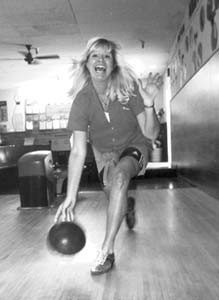
Girls Magazines

Eye Candy


Jim Malucci

Go Ahead and ‘Jump’: Braces, freckles, and dark skin aren’t fashion liabilities in the world of ‘Jump’ magazine, one of the new rags devoted to the emerging “real girl” market of teens. ‘Jump’ ain’t bad, but it’s not as good as several indie publications.

New mags put the real back into girls’ reality

By Liza Featherstone

TRYING TO SEDUCE as many underage girls as possible, corporate publishing has adopted the buzzword “real” as its come-on of the moment. Rightly sensing that there is a vacuum in the teen magazine market–the fastest-growing segment of the population has, like, nothing to read–publishers have dreamed up Jump, Teen People, Twist, and Glossy. Teen People, which hit the newsstands this month, promises “real teens, real style.” Jump‘s slogan is “For girls who dare to be real.” It makes sense that realness should become a market niche–existing teen magazines like Seventeen and YM being so decidedly unreal.

But how much realer is this new crop? Reality is a place where bodies come in all shapes and sizes, and girls have a political, intellectual, and creative life of their own. Despite their pretenses, commercial teen magazines’ reality bureaus are still pretty short-staffed.

Teen People deserves some credit for putting out a model-free magazine. Only a third of Teen People is devoted to fashion and beauty, and it has refreshingly little advice about how to find a boyfriend. Teen People also nods to the not-so-girly girls with profiles of girl sport climbers and in-line street skaters. But it’s a sad commentary on the state of the glossies that these achievements are even worth mentioning, since Teen People is clearly nothing more than a way to hook future People readers on celebrity worship.

Jump, just a few issues old, from fitness-oriented Weider Publishing, is a refreshing paean to the active girl–“stylin’ snowboarders” and girl hockey players fill its pages; nail polishes recommended are quick-drying (which assumes you have something better to do than sit around and fan your nails). Jump clearly has feminist intentions, but at points reads like a ’90s Cosmo: Pressure to be skinny is replaced by pressure to be “buff,” and a plea to girls not to worry about being model-perfect is written by a boy. The message is clear: It’s OK that boys and magazines still have the last word on what makes you sexy.

Twist, a bimonthly just launched by Bauer Publishing, fails at realness even more dismally. It does try to boost girls’ body images: “Do our bellies really need busting?” is an eloquent plea for self-acceptance, and the magazine commendably names “Anti-Waifs” as a “Trend We Love … Finally!” But check out their wussy examples–Jewel, Jennifer Aniston, Neve Campbell–no Janeane Garofalo or, hello, Kate Winslet. Is it too utopian to hope that actresses with real meat on their bones could be presented as sexy icons in a commercial teen magazine? Aggravating as these body problems are, Twist‘s assault on girls’ minds is even worse. We know only one thing for certain about a girl who picks up a magazine: She doesn’t spend every single minute of her life watching TV. So what else does Twist recommend she read? Books that might as well be TV shows because they are: the Party of Five, Buffy the Vampire Slayer, Moesha , and X-Files book series. Then there’s Glossy, a Web magazine newly launched in print, which doesn’t remotely aspire to realness. It makes YM look like the Seneca Falls Declaration.

SO, ULTIMATELY, what’s a girl to read? Luckily, there are a number of alternatives to these mind-numbing infomercials: independently published magazines written by and for teenage girls. These magazines are not only more feminist than their glossy counterparts, they’re far smarter, more racially diverse, and yes, more real.

Rochester, N.Y.-based Blue Jean, an ad-free bimonthly, offers, to use its own words, an “alternative to the fashion and beauty magazines targetting young women.” Ani DiFranco graces the cover of the January/February “Women We Love” issue with gritty style–not your father’s Esquire‘s “Women We Love.” Blue Jean also loves Third Wave activist Rebecca Walker, soccer star Mia Hamm, teen novelist Jean Crowell, and Hard Candy nail polish entrepreneur Dineh Mohajer; and features interviews with both Missy “Misdemeanor” Elliott and Rosa Parks. To subscribe to this gently funkified Ms. for girls, send $29 (for the next six issues) to 7353 Pittsford-Victor Road, Suite 201-203, Victor, NY 14564-9790 (or call 1-888-4BLUJEAN and pay by credit card).

TEEN VOICES, a national quarterly, takes on issues from teen pregnancy and body mutilation to “Snowboarding on the Cheap!” Articles ask: Was the court decision in the Boston Latin affirmative action case fair? Are cartoons sexist? Do animals have rights? How do you get over shyness? Should you get a tattoo? Teen Voices has a fine mix of politics, personal stuff, book and record reviews, fiction, and poetry. To subscribe, send $20 to P.O. Box 120-027, Boston, MA 02112-0027.

Hues, a feisty, multicultural quarterly, has a high-quality, attractive, innovative layout. A recent issue features “Get on the Bus!,” an account of Philadelphia’s little-covered Million Woman March; “Making It Big,” a profile of a successful and gorgeous 190-pound model who’s outspoken in her criticism of the fashion industry; and a cultural dialogue between two young Indian women about arranged marriage. Hues was recently acquired by New Moon publishing, the creator of the younger girls’ magazine New Moon; it will go bimonthly next year. To get the next six issues, send $19.99 to P.O. Box 3587, Duluth, MN 55803-3587.

Reluctant Hero is a Canadian quarterly with some serious feminist analysis–“Birds do it, bees do it, boys sure do. Why is it so taboo for girls to have a libido?” Reluctant Hero also explores cliques, sexual harassment, and peer mediation, and asks that timeless question that you will probably never see in a commercial teen magazine: “Why Are Girls So Mean?” For more info, e-mail re*****@*ol.com or call 416/656-8047. To subscribe, send $19.26 to 189 Lonsmount Drive, Toronto, Ont., M5P 2476.

Though Jump, Teen People , and Twist are a step in the right direction, girls themselves can do so much better. It’s too soon to say for sure how many readers the mainstream newcomers have attracted, but Teen People is reportedly selling like Titanic. The independents don’t attract Gap ads, and, at least in Blue Jean‘s case, wouldn’t even if they could; they need support. Let’s hope the talent behind this girls’ alternative press gets the encouragement it deserves to keep on keeping it real.

From the February 19-25, 1998 issue of the Sonoma County Independent.

© Metro Publishing Inc.

Dale Messick

Starr Gazer


Michael Amsler

Brush with Greatness: Although cartoonist Dale Messick, 92, can no longer ride it herself, she keeps her gleaming Harley-Davidson motorcycle at the ready in her garage. Sometimes a fellow cyclist will motor her around perched on it.

Brenda Starr’s Dale Messick is a firecracker

By Daedalus Howell

I’M A HALF-ASSED celebrity–everyone knows Brenda Starr but nobody knows me,” laughs cartoonist Dale Messick. “I still get fan letters after all these years–five or 10 a week. They all want a sketch and an autograph because people collect these things. People collect anything. That’s why I never take my [dental] bridge out–they might collect bridges!”

Messick is the creator of intrepid, fire-haired comic-strip news reporter Brenda Starr–an enduring conflux of stouthearted vixen, über-frau, and svelte, impeccably coiffed career woman with a penchant for breaking news and difficult men.

In June, Starr will be 57 years old, but thanks to the disparity of cartoon years vs. human years, she looks little older than she did when she tumbled full-grown from Messick’s imagination. Likewise, her spry and delightful creator appears only a fraction of her 92 years.

In her characteristic deadpan, Messick downplays her accomplishment.

“The only remarkable thing that I think I did was that I was married twice, divorced twice, had a horrible automobile accident that almost killed me, had a baby, and in 43 years never missed a deadline.”

A Hoosier born in South Bend, Ind., just days before San Francisco’s 1906 earthquake, cartoonist Messick has resided in Sonoma County near her daughter and granddaughter since the death of her husband several years ago. The walls of her Oakmont home are strewn with awards, plaques, and photographs of conventions at which she was honored. The Redwood Chapter of the California Writers Club recently named her an honorary member, and in April the National Cartoonists Society will present her its version of the Oscar.

Displayed on a far wall of her art studio is a poster-sized blowup of the postage stamp the U.S. Post Office issued to commemorate her comic strip. Of the dozens of early cartoonists so honored, Messick is the only one still alive and the only woman.

Raised by artistically inclined parents in a cultural region that little valued artistic expression, let alone that of a precocious child, Messick grew up markedly different from her childhood contemporaries. Profoundly near-sighted, the young Messick couldn’t see the looming face of the classroom clock, slowing her mastery of time-telling at an age when such skills are an important social factor (queries about the time of day still cause her a flash of anxiety). Worse yet, her spelling was atrocious, and she was left-handed at a time when that would earn one a beating.

MESSICK’S ABILITY to draw became an obvious refuge, and the talent she nurtured throughout her school years eventually garnered her a position designing greeting cards at a Chicago publishing house when in her early 20s. Later, in 1933, she migrated to New York and earned a staggering Depression era salary of $50 a week, nearly half of which she sent back to her family in Indiana.

“I had $30 a week to live it up,” remembers Messick of her windfall. “You could walk down 42nd Street and have bacon and eggs and toast and coffee and hash brown potatoes and orange juice–the works–for 25 cents.”

In the late ’30s, comic books began to swell in popularity as the appeal of dime novels and “weird fiction” pulps began to evaporate. Recognizing a possible market threat to their Sunday comics pages, large metropolitan newspapers produced ancillary comic-based publications to safeguard their readerships. To this end, the monolithic Chicago Tribune–the universal appeal of its Dick Tracy and Terry and the Pirates strips notwithstanding–began devising a booklet that required eight new strips.

“This friend of mine in New York gave me the tip about it,” says Messick, who had altered her given name of “Dalia” to the more sexually ambiguous “Dale” in order to thwart the male-chauvinist editors she routinely encountered. “If I sent in my stuff and they knew I was a woman, they wouldn’t even look at it. So, [as Dale] I wrote up a story and sent it in to them. They accepted my comic and gave it the center page. Out of eight unknown cartoonists, I was the only one who survived. That was my big break,” she recounts. “I went into the Chicago Tribune-New York News syndicate and I was the only woman. . . . I never was really accepted.”

A LTHOUGH SCIENTISTS have never bothered to note the event in the annals of astronomical history, on June 30, 1940, a Starr was born. The early Brenda was very much a mirror of her creator’s inspiration–the screen siren Rita Hayworth. Like Hayworth, Brenda was feisty, dauntless, unabashedly sexy, and, as Messick laughingly reports, “had this gorgeous red hair that could go through any sort of adventure and look great.”

In equal parts a soap opera and action-adventure serial, Brenda Starr was immediately embraced by a readership comprised of both sexes, whose tastes seldom went coed in a comic strip. Some male fans, misapprehending Messick’s gender owing to her unisexual pseudonym, even asked the cartoonist for jocular tokens of fraternity.

Says Messick, “I used to get fan letters from guys who requested a ‘daring picture’ of Brenda. Well, you know what they wanted–I had made Brenda very sexy. I’d send them a little sketch of Brenda Starr going over Niagara falls in a barrel and say, ‘I hope this is daring enough.'”

Brenda Starr joined the profusely male pantheon of comic heroes during an era that spanned the Depression, World War II, and the I Like Ike and I Love Lucy-goosiness of the ’50s. Her prosperity was, in part, a product of World War II’s strong female workforce. Like the affable Rosie the Riveter caricature, Brenda Starr was an exemplar of girl power–a white-collar analogue of the buxom factory gal.

In this atmosphere of patriotism and sisterhood, the strip flourished (after all, Brenda Starr did her part for the war effort) and compounded the early success it achieved in the 18 months before Pearl Harbor.

By the time the war ended and women workers were ousted by returning GIs who subsequently knocked them up with the Baby Boom, Brenda Starr was securely fastened to the pages of daily newspapers as far-flung as Australia, ultimately boasting a worldwide readership of 60 million.

“I’ll read strips from 20 or 30 years ago and get hooked. I wrote it, I drew it, and I forgot it. I still say that I have better stories in there than they have on television today,” avers Messick, who has maintained a collection of her entire Brenda Starr oeuvre–15,000 strips in all. “Probably after I’m dead and gone they will discover that and use my stories.”

Hollywood, however, has already heeded Messick’s counsel and in the late ’80s brought a lackluster cinematic version of Brenda Starr to the screen under the aegis of Princess Di’s Starr-crossed beau, film producer Doti Fayed. In a tragic fit of poor casting, Fayed insisted his then-paramour Brooke Shields become Suddenly Brenda.

“She really wasn’t the Brenda Starr type at all,” Messick says of Shields’ performance. “Let me tell you, the movie was so bad it never even won the ‘Worst Movie of the Year Award.’ Don’t see it, it’s awful.”

After 43 years of meeting strenuous deadlines (her strips were drawn six weeks before publication), Messick retired in her late 70s. Brenda Starr continues to be drawn by other artists for the Chicago Tribune-New York News syndicate–an endeavor Messick does not begrudge, though she has no compunction about voicing her criticism.

“Now it doesn’t look like Brenda at all,” Messick contends. “She looks more like she works at a bank. No glamour, no curves, no fashion–but it’s still going pretty good.”

Since her retirement, Messick has developed new strips, including a weekly one-panel series for the Oakmont Gardens Magazine dubbed Granny Glamour. The comic features a saucy senior full of such punchy, homespun aphorisms as “You’re in when your foxy grandpa’s pacemaker opens the garage door.”

“This is all I know,” Messick says simply. “All my life I’ve been creating and drawing. I don’t have much time left–I’m living on borrowed time–so with the few years I have left, I want to do what I want to do and that’s to work in my studio.”

As Granny Glamour says, “When you quit and just sit, that’s it.”

From the February 19-25, 1998 issue of the Sonoma County Independent.

© Metro Publishing Inc.
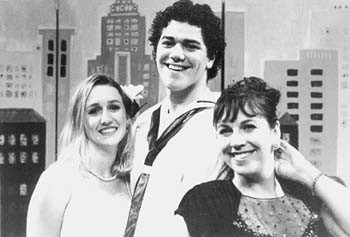
Talking Pictures

0

Question Authority

By David Templeton

In his ongoing quest for the ultimate post-film conversation, David Templeton interrupts the business trip of the best-selling novelist Katherine Neville–author of The Eight–to discuss the richly symbolic movie The Apostle.

The hotel dining room is nearly empty as I walk in from the rain and begin my search for Katherine Neville. At 9 a.m., it appears to be either too early for breakfast, or too late; only a handful of the hotel guests are present, scattered throughout the immense, abundantly windowed room that overlooks a dramatically stormy San Francisco Bay.

Toward the back, beside the window, Neville has seen me before I’ve noticed her, and she waves me over to her table.

“I almost called you last night,” she says warmly. “I saw the movie yesterday afternoon, and when I came out of the theater I could almost not wait to talk about it, but I decided to force myself. Will you have some breakfast?”

Neville is the best-selling author of the genre-busting historical/fantasy/mystery/ adventure The Eight (Ballantine, 1988). A novel about the quest for the eight missing pieces of Charlemagne’s chess set, it defied easy categorization (one critic called it “a feminist Raiders of the Lost Ark“) as it climbed the charts exactly one decade ago. After a foray into more conventional forms of literature, Neville is now preparing for the release of The Magic Circle (Ballantine, 1998), a book so rich and wide in scope it makes the previous effort seem like a mere warm-up.

Skipping back and forth throughout time and across the globe, The Magic Circle begins during the last week in the life of Jesus as a new 2,000-year cycle was beginning. Spanning the millennia and incorporating dozens of historical figures up to 1989, The Magic Circle ends as a young woman attempts to solve the mysteries within a secret collection of ancient manuscripts that may suggest what is in store for mankind as the current cycle gives way to the next. Ultimately, Neville’s gleefully inventive and entertaining novel attempts nothing less than to find a common link between all the world’s religions and faiths.

In town for a series of meetings with various agents–a filmed version of The Eight is not far off, Neville hints–she was eager to see Robert Duvall’s magnificent, Oscar-nominated film, The Apostle, yet to open anywhere near her home in Radford, Va., deep in the very Bible-belt terrain visited in the film. It’s the story of a grinning, sinning, and winningly charismatic preacher, who is convinced he hears the voice of God and abandons his identity following an explosive tragedy. Renaming himself The Apostle, he attempts to find redemption by rebuilding a tiny church in the backwaters of Louisiana.

“I was thinking about something all the time I was watching the movie,” Neville says, sliding her grapefruit aside and leaning forward, “how by the time I was 10 or 12 I really didn’t believe in God at all–I sort of believed in God the way you believe in Santa Claus, like it would be nice if there were a benevolent old man in the sky who took care of us–but I wasn’t interested in organized religion.” In her early teens, in the mid-1950s, she began studying yoga and embarked on a lifelong exploration of all the different spiritual idealogies she could grasp, including Sufism, Druid transformation, Shivaism, paganism, and, more recently, various Christian-based belief systems such as Mormonism and the Jehovah’s Witnesses.

“I think what really happened to me was that, at some point, I just started to feel like I was not alone,” she explains. “That there was someone hanging around with me. That scene in the film where Robert Duvall goes up in the attic and has his big argument with God? That was so real to me. There have so many times that I’ve gone, ‘God, I am really pissed off with you!’ So at some point, I developed this personal relationship with God.”

“Outside of any formal religion telling you how to do it?” I ask.

“Yes, but not just outside it,” she replies. “Almost ‘in spite of’ or ‘as opposed to.’ It was when I visited Africa that, for the first time, I began to see the reason for religion. Before that, I used to ask myself the question, ‘If religion is so boring and stupid, why is it so popular?'”

“So, what did you come up with?” I wonder.

“Well, that’s another thing I was thinking about all during the movie,” Neville says. “I think people really need it. All the people who went to this man’s church were given something they needed. First of all, a fabulous group experience. And that’s the way the original pagan religions were, they were part of the community.”

“Duvall’s character believed he was the chosen one of God,” I say. “Have you ever felt that you were chosen for any special purpose?”

“The short answer is no. Not the way you mean,” she laughs. “I’d say I don’t feel chosen, so much as pointed. I’ve always known what I was supposed to do, that I was supposed to write, and that I was to ask questions.”

“And have you found any answers?”

“Some,” she nods. Smiling, she adds, “They’re in the book. “But the answer, I believe, is simply in asking the right questions to begin with.”

From the February 19-25, 1998 issue of the Sonoma County Independent.

© Metro Publishing Inc.
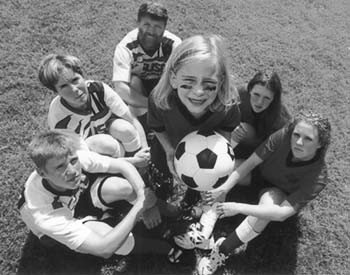
Teen Suicide

0

Suicide Watch


Michael Amsler

Cry for Help: “I thought I was the only one who feels this way,” says Heather, a Santa Rosa teen who has struggled with intense feelings of alienation, “but that’s so untrue.”

With suicide rate soaring among local teens, forum will search for solution

By Paula Harris

THINGS FINALLY SNAPPED a couple of days after New Year’s for Heather Cartwright, a bright and sensitive 18-year-old Santa Rosa Junior College student. Family issues, trying to cope with the holidays, and the difficult breakup with her boyfriend earlier that morning were suddenly intolerable.

“I completely lost it,” she confides. “I couldn’t deal with the pain.”

In desperation and under cloudy skies. Heather drove to the Golden Gate Bridge where, for several hours, she wandered back and forth across the chilly span contemplating the jump into the freezing bay more than 249 feet below. All afternoon she stood there crying, but no one stopped.

“I was leaning over the edge and suddenly I got really scared–scared that it would be so final,” she recalls in a shaky voice.

Heather got back into her car and drove home.

It’s been a scary pattern for the Santa Rosa teen, who is an engaging girl with wavy red hair and a sweetly shy smile, and whose goal is to become a teacher with a degree in child psychology. Curled up on a plaid sofa in her cozy sitting room with her ginger cat, Sid, while the rain beats monotonously outside, Heather says that looking back through old journals reveals that she’s had suicidal thoughts since the age of 15. Two months before the Golden Gate Bridge incident, Heather had overdosed on pills and alcohol. “I took everything I could find,” she says. Before that, she had halfheartedly tried to slit her wrists. “Partly for attention or as a cry for help and partly to feel physical pain instead of emotional pain,” she explains.

“And I thought I was the only one who feels this way, but that’s so untrue.”

She is right. Every year, thousands of youths die in North America, not from cancer or heart disease, but by their own hand. Statistics show that, in most U.S. states, suicide is the third leading cause of death among 15- to 25-year-olds (after homicide and automobile accidents), and it’s the second most frequent reason teens are hospitalized. The adolescent suicide rate has tripled since 1960–the only age group for which an increase has occurred over the last three decades.

The grim problem is also being felt locally. Last week, a third student within 18 months at Forestville’s El Molino High School committed suicide. “It’s a problem that’s definitely on the rise,” says Daniel Pickar, chief of Child Family Psychiatric Services at Kaiser Permanente in Santa Rosa.

Pickar will co-host a workshop on comprehensive treatment of suicidal adolescents, at an upcoming three-day conference in Santa Rosa and Sonoma called “The Crisis of Youth Suicide: Identifying and Helping Teens at Risk.”

“The goal [of the conference] is to reduce adolescent suicide in Sonoma County,” says conference coordinator Natalie Beck of the Sonoma County Academic Foundation for Excellence in Medicine. “Our feeling is that suicide is preventable and many people are interested in the issue, but there has to be a cohesive way to bring people together.

“We see this as a first step to get the county mobilized on the issue.”

The conference will include six workshops taught by a range of experts, as well as discussions by a panel composed of adolescents who have attempted suicide and parents whose kids have either attempted or committed suicide. The event is geared to those who work professionally with adolescents but also is open to community members.

According to Pickar, in Sonoma County there were three teen suicides in 1993; two in 1994; three in 1995; seven in 1996; and six in 1997. He adds that a national survey taken in the past year indicates that one out of every four high school-aged teens has considered suicide. One out of 10 has attempted it.

While girls attempt suicide two to three times more often than boys, males commit suicide at a rate of about three to one. In Sonoma County in 1996, five out of the seven suicides were males and two were females; and in 1997, all six were males. In addition, males use more lethal means. Five of the six suicides last year were from self-inflicted gunshots, and one was a hanging. Pickar says females tend toward overdose or self-cutting.

Experts also point out that there’s a disproportionate number of suicide attempts and completions by gay teens. “Thirty-five percent of all attempts and actual suicides committed by youths between 14 and 21 are gay, lesbian, bisexual, transgendered, or questioning individuals,” says Jim Foster, a counselor with Positive Images, a local support group for teens struggling with these issues. “It’s because of internalized homophobia, sexual-identity issues, and isolation. These kids don’t dare open up to anyone. They may think it’s acceptable in society to come out, but it’s not safe. Then they get into despair, and gay teen depression is lethal.”

Warning signs of suicide.

THE PROBLEM OF teen suicide needs to come out of the shade,” says Susan, a Petaluma mother whose daughter Megan, 15, gulped down 200 painkillers on July 4 while her mom worked in the garden. Fortunately, the teen was found in time and rushed to the hospital. “People do have suicidal thoughts, and the more the public and health-care officials realize it’s a common human feeling and we shouldn’t be taught to hide it, the better.

“Teens have so much more on their plate now–it’s double and triple the pressure.”

The reasons for the rise in teen suicides are considerable and complex–from the influence of peer pressure and what’s happening in the school environment, particularly regarding sexual-identity and ethnic issues (young African-American men also commit a disproportionate number of attempted and completed suicides, says Foster); to parents being less available, high rates of divorce, and the breakup of the nuclear family.

Common motivational factors that play into teen suicide are self-punishment and retaliatory abandonment. In both cases emotional pain and resultant anger are clear contributors. “Some teens have an overpowering sense of self-blame and exaggerate their own shortcomings,” says Pickar. “A number of high-achieving kids do poorly and can’t handle it.”

For the individual who feels the pain of chronic emotional abandonment by his or her parents, the act of suicide may be the only way the teen can convey his or her pain. Plus, adolescents tend to respond more quickly and more dramatically to a situation than do adults.

There’s also pressure on teens to grow up too quickly in a harsh culture that does not support them, experts say. “They have sexuality thrust in their face by the media, the movies, and everything else,” says Pickar, adding that gothic rock groups glorifying violence, self-mutilation, death, and suicide may attract a segment of vulnerable kids who are struggling with alienation from society and with depression.

Indeed, the father of a 15-year-old Burlington, N.D., boy claims his son shot himself in 1996 after listening to fright-rocker Marilyn Manson’s lyrics, including a song he called his son’s favorite, “The Reflecting God”: “One shot and the world gets smaller./ Let’s jump upon the sharp swords and cut away our smiles./ Without the threat of death, there’s no reason to live at all./ My world is unaffected, there is an exit here.”

But Heather disagrees that music could cause someone to pull the trigger on oneself. “Depression is an illness and anyone can get it. It’s not caused by songs or movies,” she says. “I want people to understand that, and I want them to know the only thing that saved me was when I reached out my hand and begged for help and trusted the people around me to do what’s best for me.”

The conference “Crisis of Youth Suicide: Identifying and Helping Teens at Risk” will be held Friday, Feb. 27, from 8:30 a.m. to 5 p.m. at the Luther Burbank Center, 50 Mark West Springs Road, Santa Rosa. There will be a separate two-day training workshop, from 8:30 a.m. to 4:30 p.m., on Saturday, Feb. 28, and Sunday, March 1, at the Hanna Boys Center, 17000 Arnold Drive, Sonoma. For more information, call 527-6223.

From the February 19-25, 1998 issue of the Sonoma County Independent.

© Metro Publishing Inc.

Short Reivews

Winter Reads

Short takes for long nights

We’re almost as blessed with prolific authors as we are with rain in this county (seeing the rain as a blessing has become an important psychic stave at this point). And indeed, psychic staves, healing, and travels of all types emerge from the shelves as the themes for this winter of our content as we curl up to journey, learn, and feel better with the help of local Sonoma County writers. Synopsis by Gretchen Giles and Marina Wolf.

Nancy Bruning and Helen Thomas
Ayurveda: The A-Z Guide to Healing Techniques from Ancient India
Dell Publishing; $5.99

PUTTING THE ENTIRE discipline of Ayurveda into a book the size of a kitchen sponge may be a little like making flashcards for heart surgery, but Santa Rosa chiropractor Helen Thomas does her best, creating a book that works for either beginners or serious practitioners.

The potential for a “medicine cabinet” approach looms large in A-Z guides to health such as this, but Thomas and co-author Nancy Brunin avoid it, for the most part. The different elements of the discipline are covered adequately–though one must acknowledge the difficulty of reading three- or four-column charts crammed into such a small-format book–and the pages of symptomology and remedies that fill the rest of the book offer understandable holistic regimens for over 60 health and beauty problems.–M.W.

Judy Reynolds Dumm
The Flying Ferry Boat: An Amazing San Francisco Adventure
Peak Experience Arts & Publishing; $8.99

I HAVE YET TO WITNESS a staging of the Three Little Pigs that rivals my dad’s, which showed weekly in our back hallway for years and ended with the wolf flying not up the chimney but being flushed down the toilet (way-cool sound effects). Rich oral traditions like this are rapidly fading in our high-gloss, high-tech age of pop-up dinosaurs and beeping video games. But then along comes Santa Rosan Judy Dumm’s lovingly polished piece of interactive storytelling to keep the flame alive.

Dumm has certainly retained that seat-of-the-pants “and then what happened, Grandma?” sense in her rollicking Bay Area travelogue of 10-year-old Donald. The Flying Ferry Boat could and should inspire families to come up with their own lists of special places and activities, and spin a private web of adventure.–M.W.

Ida Rae Egli, editor
No Rooms of Their Own: Women Writers of Early California, 1849-1869
Heyday Press; $14.95

THERE’S NOT A LOT of room for women in the grand drama of early California: scruffy-bearded miners get most of the lines. But with the second edition of her capacious anthology, SRJC professor Ida Rae Egli offers other characters for our consideration: female explorers sifting through words, not gravel, for their own sort of gold.

The plainly elegant biographical introductions testify to the hard lots of these 15 writers, in a conscious echoing of Virginia Woolf’s theme. Whether they suffered from moving or from being moved aside, women wordsmiths of that time and place struggled mightily to participate in the exploding West Coast culture, with the “sagebrush realism” that fed a hundred publications in the Bay Area and beyond. More than a century later, Egli’s skillful collection of these women’s best efforts has become a priceless inheritance for anyone looking to dig deeper into our region’s literary past.–M.W.

Michael Goddart
Spiritual Revolution: A Seeker’s Guide
DeVorss & Co; $12.95

BROKEN INTO 52 short-read capsules, Santa Rosa writer Michael Goddart’s Spiritual Revolution takes from the teachings of religious leaders and saints the world over and distills their words into easy-to-read simplicities that, frankly, are perfect for the bathroom shelf.–G.G.

Richard Strozzi Heckler
Holding the Center: Sanctuary in a Time of Confusion
Frog Ltd.; $12.95

UNLIKE THE AUTHORS of many self-improvement and fitness books, Petaluma psychologist and aikido master Richard Heckler can write. What a pleasure to read the elegantly constructed sentences with which he delineates his transformation through martial arts from a schoolyard bully to a conscious seeker. Informed by his experiences as a man, a father, a horse trainer, a psychologist, and–with his wife–the co-director of Petaluma’s Rancho Strozzi Institute, Heckler argues that community is all around us–we need simply to learn how to see and tap into it. His method is through the somatic style of bodywork, but his writing illuminates the many possibilities of the mind and soul.–G.G.

Jonathan London
Illustrated by Frank Remkiewicz
Froggy’s First Kiss
Viking; $14.99

PROLIFIC CHILDREN’S author Jonathan London is at it again, adding to his Froggy oeuvre with this latest tale of the little green guy whose first crush on Frogilina makes his stomach feel as if he’s eaten caterpillars for breakfast and whose uninvited surprise kiss makes him the laughingstock of the school bus. Because this is Froggy, and because this is the wise London, Froggy’s crush isn’t important; the idea of love is. Rather than exploring the burgeoning of a second-grader’s feelings with mockery, Froggy’s First Kiss ends with Froggy loving and being loved by his parents–people who only laugh when you kiss them if you’ve just eaten lots of messy peanut butter from a spoon.–G.G.

Ralph Metzner
The Unfolding Self: Varieties of Transformative Experience
Origin Press; $14.95

HIS PSYCHEDELIC DAYS at Harvard with Timothy Leary and Richard Alpert (Ram Dass) may be past, but consciousness scholar Ralph Metzner, a resident of Sonoma, has continued on in the 35 years since, researching psycho-spiritual phenomena and delving into the experiential possibilities of transformation. Metzner’s newest release, the second edition of his 1987 pioneering work, Opening to Inner Light, pulls together the results of his search into a satisfying encyclopedia of epiphany and inner change.

Metzner’s work lends coherence and literacy to a topic that can sometimes flounder in a sea of warm and fuzzies. He identifies 12 key metaphors for inner transformation–such as “captivity to liberation,” “purification by inner fire,” and “death and rebirth”–and then presents in succinct detail the religious, literary, and artistic traditions that support the metaphors. It’s almost an index to innermost shifts, the ones that are so hard to talk about, that wake us with visions in the middle of the night. For effing the ineffable, there is no substitute.–M.W.

Sukie Miller with Suzanne Lipsett
After Death: Mapping the Journey
Simon & Schuster; $23

THIS BOOK IS OF especially poignant significance to those who knew and loved Sonoma County writer Suzanne Lipsett, the amender and organizer of psychologist Sukie Miller’s examination of afterlife “experiences.” Published posthumously after Lipsett’s death from cancer last year, After Death postulates that the end of the body’s life is the beginning of a four-part journey of an entirely different stripe. Working from a multicultural perspective that draws on traditions and beliefs the world round, Miller posits the familiar map that when the soul leaves the body, it enters a waiting place in which the “traveler” is transformed from corporeal being to spirit. In the second phase, the spirit is judged based on the acts of the previous life, and then forwarded to the third phase, the realm of possibilities. Here, according to Miller, “the traveler enjoys–or endures–the fruits of judgement.” Finally, the soul is either sent back to earth to reincarnate or escapes to the universal wheel of life, ceasing to inhabit a body. Complete with ending appendices that a terminally ill person may use to envision his or her own journey, After Death is certain to be of interest and comfort to those on both sides of the bier.–G.G.

James Sean and Tim O’Reilly, editors
The Road Within: True Stories of Transformation
O’Reilly & Associates; $17.95

SEBASTOPOL’S O’REILLY & Associates are much beloved by computer freaks and genuises alike for their entertaining and illuminating computing guides. They are also adored for their Travelers’ Tales series of journeying guides. Now the O’Reilly brothers band together to collect and edit this series of tales about inner journeys, with voices ranging from author Annie Dillard to religion scholar Huston Smith. Based on actual travels in actual foreign lands, these short essays illuminate the transformation of the soul on foreign soil.–G.G.

Karl Ashley Smith
Haiku Cottage: Designing the Eloquent Small Home
Futura Bold Books; $12

SANTA ROSA ARCHITECT Ashley Smith uses the three tenets of the 17-syllable haiku form of Japanese poetry to inform his philosophy of home planning, building, and use. Springing from the notions of wordlessness, the infusion of nature, and the importance of creating a sense of time and place, Smith’s book shows the floor plans and designs for seven different “Haiku Cottages.” Part philosophical polemic on living with grace and ease and part self-promoting guide to his own aesthetic, Haiku Cottage offers another way of living with your home.–G.G.

From the February 19-25, 1998 issue of the Sonoma County Independent.

© Metro Publishing Inc.
Solomon Says

0

Devil’s Advocate

By Norman Solomon

GLORY DAYS are here again! Not that I’m complaining about the last few years. Some great events have made headlines. But, as the Grim Reaper, I’m not easily satisfied. And right now, I can hardly contain my excitement.

With prospects growing for high-tech weaponry to shatter a lot of bodies soon, I deeply appreciate the enthusiasm for such marvels in the American news media. The mood is auspicious for us to get comfortably numb, so that Iraqi people blown up by U.S. bombs won’t seem like real people. Hooray!

To make matters better, reporters and pundits often act as though the bombs are aimed at just one person–Saddam Hussein. When NBC’s Meet the Press aired on Feb. 8, host Tim Russert was in step with questions like “What would an air attack on Saddam really accomplish?” and “Should the United States attack him with a massive attack from the air?”

It helps that the U.S. government has attached natural-sounding names to deadly assaults. Our media have obliged by referring to the 1991 Gulf War as “Desert Storm” –likening the carnage to a force of nature.

And it’s good that very little footage of the human suffering made it onto American TV screens. Sure, I’d personally enjoy watching the gore on television, but that might set off protests from the bleeding hearts.

I’ve been gratified to see the top names of journalism so fully on my team. For instance, when the war ended seven years ago, CBS anchor Dan Rather concluded an interview with a U.S. general by shaking his hand and exclaiming, “Congratulations on a job wonderfully done!”

The human destruction was a media footnote. So, after the war ended, U.S. News & World Report buried the death toll as a one-paragraph item: “Although top U.S. commanders last week estimated that Iraq suffered at least 100,000 military deaths during the war, other sources in the Gulf say the final total–including civilian fatalities–will be at least twice that. These sources say the allied aerial attacks inflicted far more casualties than previously thought.”

Since then, sanctions against Iraq have taken several hundred thousand more lives. According to recent estimates from UNICEF, 4,500 Iraqi kids under 5 years old are dying every month, mostly owing to the continuing sanctions.

Somebody else’s problem!

Happily, the news media haven’t stopped applauding the use of the latest technology to kill Iraqis. President Clinton probably remembers the accolades he won in the early summer of 1993. Time magazine praised his announcement of a U.S. missile attack on Baghdad as “one of his finest moments.”

Of course, there are always some moaners and whiners, like the White House panel that just warned against bombardment of Iraqi chemical sites. Releases of poison gas, even in small amounts, could have severe health consequences–and the victims could include American soldiers as well as Iraqis. Hey, the more the merrier!

One of my favorite pastimes is observing the tortuous efforts to find legal justification for attacking Iraq. Although the U.N. Security Council now refuses to give approval, there are always reporters available to say that old Security Council resolutions gave a blank check for the United States to attack on its own say-so. When there’s a will, there’s a way.

I have fretted that some journalists might take it upon themselves to spread the vile contagion of conscience. But not to worry! The specter of computer-guided missiles raining on Iraqi people seems to mesmerize America’s media professionals. With few exceptions, they’re too dazzled to make trouble.

This kind of glorified warfare against the defenseless provides a lot of secondary gains for me. It sets a fine example for callousness and tacit cruelty in all walks of life. If people are accustomed to hardening their hearts to random Iraqis–a child in bed, say, or a family at the dinner table–then extreme insensitivity can calcify and extend to others, seen and unseen, abroad and at home.

So, as the Grim Reaper, I’m very happy. After all, I hate life. Nothing gives me more joy than to see it extinguished. And, now more than ever, I love the American news media.

Norman Solomon is a syndicated columnist. His most recent books are Wizards of Media Oz (co-authored with Jeff Cohen) and The Trouble with Dilbert: How Corporate Culture Gets the Last Laugh. Bob Harris will return next week.

From the February 19-25, 1998 issue of the Sonoma County Independent.

© Metro Publishing Inc.

Guy Clark

0

Lone Star


Michael Amsler

Storyteller: Singer/songwriter Guy Clark performs this week at the LBC.

Texas tunesmith Guy Clark is still livin’ his dream

By Greg Cahill

DURING HIGH SCHOOL, I had a summer job at a shipyard, building the last big wooden shrimp boats that were made before they switched over to steel,” says singer and songwriter Guy Clark, recalling his stint as a carpenter’s helper in the sweltering Gulf coast town of Rockport, Texas. “Those guys were master craftsmen and carpenters. Just to watch them work was a life-changing experience, seeing the finesse and the way they went about it.

“Their attitude was ‘faster is not better.’ I try to take that same approach with my songs, with quality taking precedence over quantity.”

That painstaking approach is evident on the newly released Keepers (Sugarhill), a set of live recordings that showcase Clark’s whimsy and country roots. The album marks a return to the North Carolina label for Clark, who has been hailed as everything from “the common man’s poet laureate” to “the 13th apostle.”

While Clark isn’t exactly a household name, his songs–including “The Last Gunfighter Ballad,” “Desperadoes Waiting for a Train,” “Heartbroke,” and “Oklahoma Borderline”–have scored hits for such country luminaries as Ricky Skaggs, the Highwaymen, Vince Gill, and Rodney Crowell.

Progressive country singers and songwriters like Crowell, Lyle Lovett, and Nanci Griffith often cite Clark as a major influence.

Few in the country genre have the same knack for storytelling as Clark, whose folksy vignettes and character studies often resonate with a gritty realism reminiscent the novels of John Steinbeck.

“A lot of my songs are based on real people, although there’s a certain amount of dramatic and poetic license, which I assume I’m entitled to take,” he explains with a laugh, during a phone interview from his home outside of Nashville.

In the past, those songs often spoke longingly of broken lives and unfulfilled dreams. For instance, “Let It Roll,” from his classic 1975 debut Old No. 1 (Sugarhill), told the story of a flophouse elevator operator and dying wino who had been jilted by a Dallas whore. It was inspired by a salty merchant seaman named Sinbad whom Clark and fellow Texan Townes Van Zandt had once met in a Houston bar.

These days, Clark is living his own dreams, writing some of his most lighthearted material and making the kind of records he wants to hear. The source of that inspiration is the vast West Texas prairie, a spiritual touchstone where Clark visits families and “savors the real barbecue” sold in local rib joints.

“Being a songwriter, there’s a certain independent stance you have to take–you’re not copying other people’s songs, you’re trying to create something of your own,” he says. “That’s the kind of thing you’re raised with in West Texas–or any other part of Texas–that you can do anything you put your mind to. After all, we’re just two or three generations away from being an independent nation in the Lone Star State. You’re imbued with that spirit growing up, and I think it spills over into songwriting as well as a lot of other fields of endeavor.

“You just can’t get rid of that.”

Guy Clark performs with Texas singer/songwriter-cum-sculptor Terry Allen (whose works will be on exhibit at the neighboring California Museum of Art at a special reception at 7 p.m.) on Friday, Feb. 20, at the Luther Burbank Center’s Merlo Theater, 50 Mark West Springs Road, Santa Rosa. 8 p.m. Tickets are $20. Call 546-3600 for information.

From the February 19-25, 1998 issue of the Sonoma County Independent.

© Metro Publishing Inc.

Osake Sushi Bar and Grill

0

Sake Service


Michael Amsler

Making It with Maki: While Osake’s sushi is toothsome, the tempura and many of the house specials disappoint.

Osake not much to Chu on

By Paula Harris

GARY CHU’S NAME is synonymous with gourmet Chinese food in Santa Rosa. For years, customers have flocked to sample both traditional and creative dishes at Chu’s downtown restaurant, which projects a classy, pristine atmosphere several steps above many of the more humble ethnic establishments. Having successfully established this format, Chu is attempting to duplicate it in his new restaurant, Osake, which features Japanese and robata cuisine.

The atmosphere at Osake is also upscale, with a starkly handsome dining room. The silvery gray-green decor is sophisticated and cool–bordering on cold; the very low recessed accent lights are so dim that the green exit sign outglows them. There are no candles, totally bare expanses of wall, a long black curved sushi bar, and a large fish tank near the entrance. A cadre of servers is clad smartly in white shirts and black pants.

Osake has been open only for several weeks, so we are hoping that initial kinks can be worked out. Our first visit was a less than stellar experience. A chilled glass of sake smelled nasty (it was the glass, not the wine); an inattentive, unhelpful server seemed keen to rush us out; and our three-course meal left us so unsatiated that we dashed to the supermarket on the way home for cheese and crackers to stave off lingering hunger pangs. Not good. Especially after shelling out $40 for this fancy Japanese dining experience.

Our second venture into Osake faired better. Our server was patient and attentive, and the glasses were sparkling. But the food was still hit-and-miss.

The miso soup ($2), normally so comforting and life-giving in Japanese eateries, tasted watery and lacked substance; and the potato croquettes appetizer ($4.50) consisted of a dark, overcooked bread-crumb coating containing a smooth, mashed potato filling. Even the pool of mild barbecue sauce could not save the dish from tasting bland.

But the wakama salad of seasoned seaweeds ($4.50) was a winner, delightfully refreshing, cool and green, with spicy accents of chopped red chili pepper. The cold seaweed slivers were satisfying, not at all fishy in flavor and almost meaty in texture–like a vegetarian steak tartare.

Osake features a good variety of sushi. Both nigiri (raw or cooked fish atop seasoned rice) and maki (fish or vegetables rolled with toasted seaweed and wrapped in seasoned rice) are well represented. The sushi is ordered as a pair and prices range from $3 for most veggie, egg, and squid varieties to $9 for the spider roll featuring crispy, tasty soft-shell crab. The sushi was enlivened by sweet bites of exceptionally fresh pink slices of pickled ginger served on the side with a mound of wasabi. However, the sushi morsels were held together with an overly gluey rice that still tended to fall apart.

One of the recommended house specialties is the crispy chicken with daikon ($9.50). This was a disastrous mix of acidic daikon radish (which had a sauerkraut flavor) heaped atop chicken coated in more overcooked and greasy bread crumbs. The chicken was stuffed with apple slices and served on a bed of shredded white cabbage. It was a strange, heavy-handed German-Japanese concoction.

Another specialty, the robata vegetables ($7.95), cooked on an open fire grill, was disappointing. Pieces of sweet corn; slices of zucchini, onion, red and green pepper, and carrot; a couple of mushrooms; a single clove of garlic; a tomato; and a small bit of Japanese eggplant, arrived on slim wooden skewers–each holding one or two of the grilled vegetables. It was a less than generous serving, and no better than something you could whip up yourself on the backyard hibachi.

Our favorite dish of the evening was the grilled salmon with miso sauce ($12). Beautifully presented on a distinctive square plate, the fish was grilled so lightly that the coral-hued flesh remained delicate and moist. It came with a flavorful, semi-salty miso sauce and a portion of expertly cooked Japanese wheat noodles–an exotic and inventive combination.

But the vegetable tempura ($10.95) was a letdown. We were expecting light, crisp, and greaseless morsels. What we sampled were heavy, stodgy, and grease-laden. The veggies had no snap and the batter was too cloying; perhaps the cooking oil hadn’t reached an adequate temperature for frying.

The restaurant has a limited dessert selection. Probably the most exotic item is the green-tea ice cream ($2), which had a mild tea flavor and a rich, heavy texture.

Of course, you could always try a glass of sake for dessert. Nigori ($5 a glass) is a cloudy, country-style unfiltered sweet rice wine. Served cool, it resembles a glass of skim milk and tastes smooth and sweet.

There are 11 premium sakes available, each served room temperature in a chilled glass. Tsukasa Botan ($6 a glass; $60 a bottle) was medium-dry and easy to drink. Name Hage, described as “dry, crispy, and smooth” ($6 a glass; $60 a bottle), was sharper and more of an acquired taste. For those who prefer their sake steaming, there is hot Sho Chiku Bai. There’s also a selection of beers and wines. A Benziger 1995 Carneros Chardonnay ($20) made a pleasing partner to our selections.

Osake also has an adjoining karaoke bar open Friday and Saturday nights where you can warble away for $1.50 per song.

Osake Sushi Bar and Grill
2446 Patio Court, off Farmers Lane, Santa Rosa; 542-8282
Hours: Monday-Friday, 11:30 a.m. to 9:30 p.m.; Friday and Saturday, 5 p.m. to 1:30 a.m.; karaoke lounge open Friday and Saturday nights.
Food: Gourmet Japanese; sushi,robata grill specialties
Service: Inconsistent–can be helpful or aloof
Ambiance: Asian chic; cool and sparse with low lighting
Price: Moderate to expensive
Wine list: 25 items; large selection of premium sakes, small selection of beers
Overall: * * (out of four stars)

From the February 19-25, 1998 issue of the Sonoma County Independent.

© Metro Publishing Inc.

Rafael Film Center

0

House of Dreams


Janet Orsi

Cinema Paradiso: Mark Fishkin is creating a new North Bay art house.

Rafael Theater stirs after long slumber

By David Templeton

F ROM ACROSS the street, obscured by a gray torrent of rain, the time-worn art-deco marquee of San Rafael’s historic Rafael Theater rises up conspicuously above an unsightly barricade of wet wooden beams and weather-soaked boards, behind which hides the remainder of the building that was once among the most beautiful and popular movie palaces in the Bay Area.

Shut up tight since 1989–when the Loma Prieta earthquake caused the theater to be deemed seismically unsafe–the Rafael’s future seemed as dim as the now-ruined light bulbs still outlining the fading marquee. Thanks to the Film Institute of Northern California–which two years ago renovated the classic Lark Theatre in Larkspur–working with a fierce cadre of North Bay film buffs and some expert fundraisers, the Rafael Theater is just beginning an astonishing transformation: not only is it scheduled to open again by the end of this year, but it intends to do so as one of the Bay Area’s hottest new filmgoing destinations, a living museum of cinematic history that will trace the art of the movies from the silent-film era straight into a high-tech, interactive future.

“It will be a museum of the moving image,” says Petaluma resident Mark Fishkin, executive director of the Film Institute, which also produces the Mill Valley Film Festival. “We’ll be able to greet people in the lobby, saying, ‘Come on in. This is what movies used to be like.’ And they can have that experience, and then we’ll say, ‘Now, let’s show you what movies are becoming.'”

Fishkin is standing in the theater’s lightless lobby–a work crew accidentally disabled the electrical power box–inches away from a curtain of rain leaking onto the broken-tile entryway in an atmospheric chorus of drips and splashes that echo all through the cavernous expanse of the room.

Ann Brebner, project chairperson for the Rafael Film Center, as the new three-screen complex will be called, shines a flashlight around the lobby, illuminating various architectural features of the nearly 100-year-old building, now fully retrofitted to appropriate seismic standards. Brebner points out the sweeping balcony, ornate wooden moldings, and a marvelous faded mural of an unclad female figure rising up out of a swirling mist.

“Silent movies began playing here in 1918,” Brebner relates. “It was the Orpheus Theater then, until it burned down in 1937 and was reopened in ’38 as the Rafael.” She shines the light on the mural again. “She was covered up by mirrors when we found her,” she says, feigning a gasp. “Apparently they hid her in 1961, when the Rafael began showing a lot of Disney movies. It was evidently deemed inappropriate for children to walk in and see a naked lady up on the wall.”

T HE PROJECT IS A long-awaited dream for Fishkin and Brebner. The finished Rafael Film Center will feature a 350-seat theater in the original auditorium–restoring the existing art-deco features–minus the original balcony, which will be converted into a 125-seat theater in the style of the Orpheus’ silent-movie house. A third theater, with 90 seats–reflecting a high-technology film theater of the future–will be established in the adjacent building, directly over the planned cafe that will lead into the main lobby of the complex.

All this was supposed to have opened last fall, but production was halted when fundraising efforts ran out of steam. An expanded board of directors has created a special committee of experienced fundraisers to find the necessary cash to complete the $6.8 million job. At first hoping to avoid taking on debt, the Film Institute has now given in, accepting a $3 million construction loan and taking on an additional $3 million bank loan.

“We hope to raise the remaining monies to pay off the loans sometime during the construction period,” Fishkin says. “But at least we now have the flexibility to continue with the project.”

Donations are actively being sought, and a number of innovative enticements are being offered. For instance, the first donor to contribute at least $1 million will receive the honor of lending the name of their choice, perhaps in memory of a loved one, to the theater complex as a whole. That name will be the official corporate name of the facility, used in all literature and on the letterhead. For smaller donations, naming rights will be given on everything from the individual theaters to the upstairs lobby and the grand staircase.

In addition to the Film Center’s museum status, the complex is expected to serve as a major educational asset–with classes invited in to view films that correspond to the students’ curriculum–as well as to be a desirable environment in which to view small independent movies, and even rare specialty films that will be available nowhere else.

“For instance, some marvelous films are available in several different languages,” Brebner enthuses. “We envision being able to show one film in three different languages, all at the same time, a different language for each screen. We want people to walk by the theater and to be able to say, ‘There’s always something in there for me. There’s something that relates to who I am and where I come from.’

“That,” she smiles, “is part of our dream.”

To contribute to the Rafael Film Center’s fundraising campaign, call 415/383-5256.

From the February 12-18, 1998 issue of the Sonoma County Independent.

© Metro Publishing Inc.

Dr. Martin Griffin

One Jump AheadMichael AmslerFarsighted: Dr. Martin Griffin's life's work is simply to save the planet and our souls.Marty Griffin's land-ethic revolutionBy Dylan BennettA S A PHYSICIAN in the 1950s, Marty Griffin should have been content to make money and enjoy his social standing in affluent Marin County. No one would have expected him to question--let alone counterattack--the advance of...

Girls Magazines

Eye CandyJim MalucciGo Ahead and 'Jump': Braces, freckles, and dark skin aren't fashion liabilities in the world of 'Jump' magazine, one of the new rags devoted to the emerging "real girl" market of teens. 'Jump' ain't bad, but it's not as good as several indie publications.New mags put the real back into girls' realityBy Liza FeatherstoneTRYING TO SEDUCE...

Dale Messick

Starr GazerMichael AmslerBrush with Greatness: Although cartoonist Dale Messick, 92, can no longer ride it herself, she keeps her gleaming Harley-Davidson motorcycle at the ready in her garage. Sometimes a fellow cyclist will motor her around perched on it. Brenda Starr's Dale Messick is a firecrackerBy Daedalus HowellI'M A HALF-ASSED celebrity--everyone knows Brenda Starr but nobody knows me,"...

Talking Pictures

Question AuthorityBy David TempletonIn his ongoing quest for the ultimate post-film conversation, David Templeton interrupts the business trip of the best-selling novelist Katherine Neville--author of The Eight--to discuss the richly symbolic movie The Apostle.The hotel dining room is nearly empty as I walk in from the rain and begin my search for Katherine Neville. At 9 a.m., it appears...

Teen Suicide

Suicide WatchMichael AmslerCry for Help: "I thought I was the only one who feels this way," says Heather, a Santa Rosa teen who has struggled with intense feelings of alienation, "but that's so untrue."With suicide rate soaring among local teens, forum will search for solutionBy Paula HarrisTHINGS FINALLY SNAPPED a couple of days after New Year's for Heather Cartwright,...

Short Reivews

Winter Reads Short takes for long nights We're almost as blessed with prolific authors as we are with rain in this county (seeing the rain as a blessing has become an important psychic stave at this point). And indeed, psychic staves, healing, and travels of all types emerge from the shelves as the themes for this...

Solomon Says

Devil's AdvocateBy Norman SolomonGLORY DAYS are here again! Not that I'm complaining about the last few years. Some great events have made headlines. But, as the Grim Reaper, I'm not easily satisfied. And right now, I can hardly contain my excitement. With prospects growing for high-tech weaponry to shatter a lot of bodies soon, I deeply appreciate the enthusiasm...

Guy Clark

Lone StarMichael AmslerStoryteller: Singer/songwriter Guy Clark performs this week at the LBC.Texas tunesmith Guy Clark is still livin' his dreamBy Greg CahillDURING HIGH SCHOOL, I had a summer job at a shipyard, building the last big wooden shrimp boats that were made before they switched over to steel," says singer and songwriter Guy Clark, recalling his stint as a...

Osake Sushi Bar and Grill

Sake ServiceMichael AmslerMaking It with Maki: While Osake's sushi is toothsome, the tempura and many of the house specials disappoint.Osake not much to Chu onBy Paula HarrisGARY CHU'S NAME is synonymous with gourmet Chinese food in Santa Rosa. For years, customers have flocked to sample both traditional and creative dishes at Chu's downtown restaurant, which projects a classy, pristine...

Rafael Film Center

House of DreamsJanet OrsiCinema Paradiso: Mark Fishkin is creating a new North Bay art house.Rafael Theater stirs after long slumberBy David TempletonF ROM ACROSS the street, obscured by a gray torrent of rain, the time-worn art-deco marquee of San Rafael's historic Rafael Theater rises up conspicuously above an unsightly barricade of wet wooden beams and weather-soaked boards, behind which...
11,084FansLike
4,606FollowersFollow
6,928FollowersFollow