Spins

0

Mixed Bag


Counter Balance: Singer/songwriter Beth Orton yearns.

Sonny, Louis, Goldie, and Beth

Louis Armstrong
Master of Jazz, Live in Chicago, 1962
(Storyville/Mobile Fidelity)

Sonny Stitt
Just in Case You Forgot How Bad He Really Was
(32 Jazz)

HERE IS A HOT PAIR of previously unreleased live dates from two radically different but totally engaging artists. Trumpeter Louis Armstrong wasn’t exactly setting the world on fire when he recorded this sizzling set of Dixie-influenced jazz. Kennedy was in the White House, Camelot was in full swing, and Satchmo still had three years to go before his commercial career reignited with the pop hit “Hello Dolly,” which blew the Beatles off the top of the charts. Still, Armstrong was a master of electrifying Dixieland swing, uptempo rags, and Southern blues ballads–and he’s in top form on this gold-plated audiophile release from the Sebastopol-based Mobile Fidelity label.

On the other hand, reedman Sonny Stitt never got his due, and his talents were seldom showcased properly on wax. But this badass CD culled from a long-lost recording of a 1981 live date–taped just months before his untimely death–from the now-defunct Keystone Korner in San Francisco shows just how visceral Stitt could be on alto or tenor sax. This is authoritative jamming at its best from this former Miles Davis sideman. It’s also a fitting tribute to the long-gone tradition of jazz at North Beach clubs, where giants of the genre like Miles Davis and Thelonious Monk would carouse in the wee hours. Billed as a bebop summit, this essential recording features Stitt, alto saxophonist Richie Cole (a longtime fixture on the Sonoma County jazz scene), tenor and alto saxophonist John Handy, pianist Cedar Walton, vibist Bobbie Hutcherson, drummer Billy Higgins, and bassist Herbie Lewis. All these musicians are underrated; captured in their prime, they now come across as something of a dream team. Not to be missed.
GREG CAHILL

Beth Orton
Trailer Park
(Dedicated)

THIS IS A FINE late 1997 sleeper. The British singer/songwriter is best known in the pop music world as the lone human voice to appear on the Chemical Brothers’ techno powerhouse Dig Your Own Hole. Her own disc is nothing like techno, but instead occupies a strange space between folk-rock and dreamy ambiance. The triumph here is production: Orton isn’t a stunning writer or vocalist, but her achingly cool homeliness seems naturally suited to this tasteful blurring of Celtic-tinged Euro-pop, lo-fi alterna-lounge, electro-whimsy, and old-school song craft. Acoustic touches from violin and cello effect a sparse edginess that creates definition within the dreaminess. Yet the spaciness belies a solid and consistent emotional grounding. In short, this is the record Sarah McLachlan could make if she wasn’t so full of her own hipness–a perfectly modern piece of yearning, rainy-day romanticism.
KARL BYRN

Goldie
Saturnzreturn
(Full Frequency Range Recordings)

BRITISH TECHNO producer Goldie’s ambitiously grand 1995 disc Timeless is a benchmark of the drum ‘n’ bass subgenre. His double disc follow-up, Saturnzreturn, sinks under more hollow ambitions. The first disc is a 50-minute pseudo-symphony called “Mother.” It starts with seven minutes of sound effects appropriate to the boiler-room scenes in Titanic and then takes another 20 minutes to even start moving. “Mother” is superficially cerebral, and its droning vocals indicate that Goldie is aspiring to create a classical work in the vein of Polish composer Henri Gorecki’s trendy Symphony No. 3 (which is, unfortunately, already pretty boring itself). After this grueling exercise in dullness, it’s impossible to feel motivated by the livelier and more colorful second disc, which nods to soul, jazz, and punk, and features a cameo by veteran rapper KRS-1. Even on this disc, Goldie still mistakes mere swooshes, bleeps, and clatters for substance. He could benefit from simplifying his art, but Saturnzreturn reveals that his ideas are thin in the first place.
K.B.

From the February 12-18, 1998 issue of the Sonoma County Independent.

© Metro Publishing Inc.

Civilian Police Review Boards

0

Deadly Force


Michael Amsler

Mad as Hell: Copwatch organizer Jeff Ott is calling for an independent probe into 8 recent police-involved killings in the county–an unprecedented number. But a civil rights panel formed after the shooting last year of Kuan Kao, pictured on the right, by a Rohnert Park police officer will review only deadly-force policies.

Forum on police-involved deaths sparks hot emotions

By Paula Harris

T HERE’S DEFINITELY a lack of mutual communication and respect,” says community activist and Copwatch organizer Jeff Ott when asked to sum up the state of relations between local law-enforcement officials and social justice groups in the county.

At this point, that strained relationship has become even more awkward as the much-anticipated public hearing by the U.S. Commission on Civil Rights–which has been reviewing eight local police-involved deaths in the past two years–approaches on a swirl of allegations from those on both sides of the issue.

That hearing was prompted by the April 29 shooting of Kuan Chung Kao, 33, by Rohnert Park Police Officer Jack Shields in a late-night incident that drew national media attention and sparked charges by community activists that the killing was racially motivated.

No one knows quite what to expect from the upcoming hearing, but it’s drawing mixed feelings.

By all accounts, the Feb. 20 hearing will be a vastly toned-down version of what the commission had originally conceived. Instead of a joint forum convened equally by state and federal officials, 11 of the commission’s 16-member State Advisory Committee will preside over the meeting, with the feds announcing last week that they will take a diminished role. In addition, the commission has reversed its decision to subpoena witnesses after objections from law enforcement officials led to a letter of protest from Santa Rosa Police Chief Mike Dunbaugh.

Dunbaugh asked the commission to reconsider its involvement because of the concerns of officers who had already been cleared of any wrongdoing in the cases. “Some people have gone through multiple layers of review and have been exonerated and vindicated,” he says. “They’ve been wondering the whole time if they are going to have to go through this again.”

He and other officials will attend voluntarily, Dunbaugh says, adding that he has not yet been informed about the meeting’s agenda or format.

Tom Pilla, a civil rights analyst for the U.S. Commission on Civil Rights, says the forum will include an open session at which individuals can discuss law enforcement policies, practices, and procedures. Within several months, the committee will distribute a report and make recommendations to the U.S. Justice Department. The White House also gets a copy.

“This is going to be a starting point,” says Victor Hwang, a civil rights attorney with the Asian Law Caucus who has been critical of the handling of the Kao case. “We’re not going to solve community issues without open dialogue. The good thing [about the forum] is the recognition of how serious a problem this is. After the forum, it will be up to local folks and law enforcement to work together to build some long-term solutions.”

Mary Frances Berry, chairperson of the U.S. Commission of Civil Rights, has emphasized that the hearing will not focus on individual cases of alleged police brutality. That is upsetting to some victims’ families who say they want impartial, independent investigations. The cases already have gone through internal affairs investigations and, in some instances, through a review by the Sonoma County District Attorney’s Office. All the officers involved in the incidents have been cleared.

It appears that the only outside review of the cases most likely will take place in the civil courts, where there are several wrongful-death lawsuits pending over the police-involved deaths, including a $50 million suit filed last week by Kao’s widow, Ayling Wu, against Rohnert Park officials.

“We’re stuck with the court process, which should be the last resort, but in Sonoma County it seems to be the only resort for these sorts of questions,” says John Crew, director of the Police Practices Project for the ACLU of Northern California.

Still, he believes the upcoming forum will provide “a powerful outside analysis” of the deadly-force policies of the police in the county. “We’ve had too much secrecy about police policies, practices, and procedures in Sonoma County,” he says. “If flaws are identified, the forum can encourage reform. If there are no flaws but some misunderstandings, the forum can help correct or explain them.”


Michael Amsler

Under Review: Santa Rosa Police Chief Mike Dunbaugh says he is willing to consider civilian police review boards–if they’re handled correctly.

NOT EVERYONE AGREES. Some critics charge that local police have engaged in cover-ups, and fear that law enforcement officials are holding themselves above the law. “These people are playing judge, jury, and executioner,” laments Darlene Grainger, the twin sister of Dale Robbins, 40, a local man who was shot dead in the lobby of the Santa Rosa Police Department in January 1996 after allegedly wielding a metal steering-wheel club lock at officers. A federal judge subsequently cleared the officer involved in the shooting, but a Sonoma County grand jury report criticized the department’s own internal investigation of the case.

Dunbaugh says the countywide protocol of investigations is currently being rewritten.

Grainger alleges, however, that questions surrounding the circumstances of her brother’s death have never been answered.

The string of officer-involved deaths of eight men in a two-year period began just days after the March 29, 1995, execution-style shotgun slaying of popular Sonoma County Sheriff’s Deputy Frank Trejo, 58, by state parolee Robert Scully, 38. Trejo was the first officer killed in the line of duty in the county in 20 years, and his murder caused some to speculate about police now having a “payback” motive.

“I don’t think there is a pattern–it would be a mistake to make that allegation,” responds Dunbaugh. “What needs to be looked at is that officers are confronted more often in dangerous situations, so if there’s an increase of those situations, then there’s an increase in the use of force to counteract this. The job is much more complicated and riskier. Officers are confronted weekly with people who want to hurt them.”

The Santa Rosa Police Department hires just one out of every 100 candidates tested, he says. “We do a good job of screening people who want to do this job for the wrong reasons.”

A Sept. 17-23 edition of the SF Weekly noted that statistics show that “police in bucolic Santa Rosa kill more citizens per capita than cops in crime-ridden cities like San Francisco and New York.” But Dunbaugh says the stats don’t support the notion that there are more officer-involved shootings of late. “In the last five years in Santa Rosa, there were seven shootings, but there were 11 the five years before that,” he observes.

As for the criticism, Dunbaugh contends that most of the public support the police. He insists that such local activists as the Purple Berets and Copwatch–which have been highly critical of local law enforcement’s actions–are trying to alter that perception.

“[These groups] have every right to have a point of view and be involved in social issues,” he says, “but there are some misrepresentations and what appears to be a strong political agenda overriding senses of good judgment and honesty.”

DURING THE FALL, a coalition of law enforcement officials and local community groups met to iron out their differences. Talks broke down in November after two surprise announcements by law enforcement officials: a county grand jury would design a new review policy to examine all future officer-involved deaths, and plans were under way to create a new civilian police review panel to study police procedures, but not specific cases.

Activists, who had been pushing throughout the year for county and municipal civilian police review boards, felt betrayed by the announcements because the new policies were formed without their involvement. Law enforcement officials countered that the groups had the mistaken impression that the proposed review panel would include representatives from police agencies.

They argued that the grand jury is a randomly selected group of voters and could serve as a model for the panel.

But Nancy Wang of the Redwood Empire Chinese Association and others complained that this is a poor example, since the grand jury is controlled by the district attorney and holds closed-door meetings.

Dunbaugh says that press reports claiming he was against a citizen’s police review board are inaccurate. He now says he is willing to consider it, but adds, “What I’ve experienced so far has been false information, emotion, political agendas, no concern for money or the people it will impact, and an interest in kangaroo courts by a small group of vocal individuals with significant special interests.”

The U.S. Commission on Civil Rights public hearing will be held on Friday, Feb. 20, from 8.30 a.m. to 5 p.m. in Room 410 of the State Office Building, 50 D St., Santa Rosa.

From the February 12-18, 1998 issue of the Sonoma County Independent.

© Metro Publishing Inc.

Hepatitis C

0

Silent Killer


Michael Amsler

Shot in the Dark: After 10 years of intravenous drug abuse, Carly McFarland has turned to regular alpha interferon injections to control a potentially fatal liver disease.

Public health officials warn of hepatitis C outbreak

By Dylan Bennett

C LEAN FROM intravenous drugs for 10 years, she thought that months of always feeling tired were the result of turning 40 years old. But after she got blurred vision, extreme nausea, insomnia, and pain in “the upper quadrant of the abdominal area,” Carly McFarland saw a doctor, was diagnosed with hepatitis C–a potentially fatal liver disease–and began treatment with alpha interferon.

“It is working,” says McFarland, a parts manager in a Santa Rosa copy company. “I passed the three-month test. It had decreased my viral load from 2 million to 5,000.

“That’s very good.”

A large protein produced by virus-infected cells, interferon inactivates viruses. But boosting this natural resistance to infection hasn’t been easy.

When asked if she has side effects from alpha interferon, McFarland says, “Oh, yes, lots. General anxiety, joint pain, I feel like I have arthritis all the time. Nausea, major nausea: the first few weeks I threw up a lot, but that passed. A lot of tiredness, sickness, achiness; you feel like crap all the time. But, hey, if it’s going to work, I can deal with crap for a year.”

The recent deaths of two local HCV-infected drug treatment workers and the ominous results of newly available blood tests have put hepatitis C virus center stage in the minds of Sonoma County public health officials, who say they are in dire need of federal and state money for public education and testing.

HCV spreads through contact with blood and causes death through cirrhosis of the liver. Unlike with other types of hepatitis, no vaccine or cure exists for HCV. The only known treatment is expensive and ineffective in more than 50 percent of patients. Five to 10 percent of those infected are expected to die from virus. People commonly contract HCV from contaminated intravenous drug injections and blood transfusions.

Country singer Naomi Judd, who retired from the stage in 1991, is the most famous victim of the potentially fatal liver disease.

Last month, a symposium about HCV, hosted by local public and non-profit health agencies and held “by popular demand” on a rainy weekday afternoon at the Santa Rosa Veterans Building, drew over 100 people, including many from the drug-abuse recovery community. The event was inspired partly by the deaths of Doug Patricks, former director of the Santa Rosa Treatment Program, a methadone clinic treating heroin addicts, and Ronnie Ruggles, a psychological technician at the Drug Abuse Alternative Center.

“It feels like where HIV was 15 years ago in terms of knowledge,” says Michael Spielman, DAAC’s executive director.

The largest group of people highly at risk are those who have taken drugs intravenously anytime in the last 30 years. A smaller but equally at-risk group includes hemophiliacs and other recipients of clotting-factor concentrates before 1987. Other groups at risk include a broad swath of mainstream society–anyone who received a blood transfusion or solid-organ transplant before 1992 has a 6 percent chance of infection. And for nearly half of all transmissions of HCV, there is no medical explanation.

Evidence shows that HCV can be contracted also by snorting cocaine if infected blood gets onto a straw used for inhaling cocaine and then passed around.

HCV makes even sharing a shaving razor or getting a tattoo a possible health risk. “Tattooing is a potential risk of transmitting the virus, of course, if the person doing the tattooing doesn’t clean his needles properly, tattoos somebody who has hepatitis C, and then tattoos you,” says Dr. David Staples, a physician who specializes in the treatment of HCV.

Because HCV has a latency period of 20 to 30 years, officials say people who experimented even just a few times with intravenous drugs decades ago may only now be feeling symptoms. About 1.8 percent of the population is thought to carry the virus.

In Sonoma County, of 280 cases detected last year, 10 were acutely ill. In all, fewer than 1,000 cases of HCV have been officially tallied in the county, but thousands more residents are thought to be unknowingly HCV-positive. Nationally, 4 million people are infected, and 30,000 new cases are identified each year. HCV is now the leading cause of liver transplants. The 8,000 yearly deaths from HCV are expected to triple in the next 10 to 20 years.

The cause for concern among health officials is the lack of awareness and late-breaking knowledge of HCV. Blood tests have been available only since 1990–a very brief period from a medical perspective.

Lee Tillman, director of the Santa Rosa Treatment Program, says his facility inadvertently began testing methadone clients for HCV only a year ago. Tillman says a survey of methadone clients revealed much ignorance and denial of HCV.

“We are making a lot more diagnoses because we are able to make a diagnosis now and we weren’t able to before,” says Staples. “And there is a tremendous population out there that were infected back in the ’50s and ’60s, when they were doing drugs for a short period of time, got infected then, and are being detected now.”

Spielman says about 85 percent of Sonoma County’s estimated 10,000 intravenous drug users, past and present users of heroin or methamphetamine, are probably HCV-positive. “Those people would be highly at risk, and they are not being regularly tested,” says Spielman, “It’s a rare, rare case when you hear about a person who cleaned up 10, 15, 20 years ago who doesn’t have hep C.”

The county public health department does not offer testing.

“We don’t have the resources to go out and test all of the populations that need to be tested,” says Dr. George Flores, the county’s public health officer. “We don’t even offer hepatitis C testing through the public health department in this county. We refer people to their own physician for that testing. That could be costly. Especially people who don’t have insurance have a barrier there.”

The two tests for HCV cost over $100 each, adds Flores.

“The federal and state government needs to step on board with this and make resources available,” insists Flores. “This is not just a county issue. In fact, it’s a nationwide issue, or international issue. We’re finding that many countries around the world have the same problem.

“Hepatitis C is like an iceberg. We’ve only seen the tip of this iceberg.”

In fact, the state government has joined the fight against HCV. State Sen. Richard Polanco, D-Los Angeles, introduced Senate Bill 694 in late January “to develop a statewide strategy that encompasses diagnosis, prevention, and treatment,” according to legislative assistant Chris Flammer. “This bill includes the public health side of hepatitis C , as well as folks who are incarcerated. There is a tremendous problem among the incarcerated,” he says. “With our legislation we want to have some medical protocol on the treatment side, a decent state-wide game plan in respect to education about hep C, and for diagnosis. We want this to be a very encompassing, comprehensive piece of legislation.”

Flammer says the bill should be ready for the governor’s signature or veto by the end of August. Meanwhile a cure is “not on the immediate horizon,” and HCV patients must survive with less-than-perfect treatment. Doctors administer the expensive drug alpha interferon for an initial period of six months to reduce the “viral load” in some HCV patients.

For those who meet the criterion for alpha interferon treatment, the drug offers at best a 30 percent chance of shaking the virus. Staples says that after six months of treatment, 10 to 15 percent of patients respond by losing the virus, and that after a year of treatment, 15 to 30 percent of patients do.

“We are trying to develop a treatment that is more effective than what we presently have,” says Staples, “because I would be the first to admit that alpha interferon is not ideal treatment. It’s expensive. It has side effects associated with it. It doesn’t work nearly as often as we’d like to see it work.”

STAPLES recommends stress reduction and a high-fiber diet to all of his patients, but notes that healthy living is not a proven cure. “It makes common sense to lead that kind of lifestyle, but I can’t say it clinically makes a difference.”

For Rickey Summerfield, 43, a carpenter and drug addict hailing originally from Georgia, and suffering from advanced cirrhosis of the liver, only an organ transplant in August of last year could make a difference. “The hepatitis took me down,” says Summerfield with a gentle Southern accent. “Within a year’s time I went from healthy to ‘probably not going to last but a couple more months.’ If I hadn’t had a transplant in August I doubt I’d be speaking to you right now.”

Summerfield says his symptoms included severe mental confusion and water retention that caused him to gain 40 pounds in two weeks. Doctors had to literally drain the water out of his body. “It was really uncomfortable,” recalls Summerfield. “But it was a lot better than having the water inside you. I woke up one night and couldn’t breath. The fluid had backed up to where my lungs weren’t working correctly.

“For me, with the hepatitis and advanced cirrhosis, I compared it to rotting to death. My body was rotting on the inside–a real bad ugly feeling. I don’t think anything could be worse.”

One local drug treatment official said Summerfield was “extremely lucky” to get the liver transplant and patient-advocate doctor at UC Davis. Former drug addicts, he says, have virtually no chance for an organ transplant at San Francisco hospitals that have serious bias against such individuals. Death from cirrhosis, also called end-stage liver disease, comes from a variety of complications, including internal bleeding, infections, coma, kidney failure, or “just wasting away because the people become so weak and the liver fails to support them any longer,” explains Staples.

Staples says HCV is not a virus that is transmitted through casual contact, and people don’t have to be afraid of being around other people who have HCV unless they have some kind of intravenous exposure.

Without a cure, vaccine, or effective treatment to look toward, Spielman and Flores bang the drum of education and testing.

Spielman emphasizes that people who fit in any of the high-risk categories should get themselves tested. He also proposes needle-exchange programs. “If they have HCV, they can start living a more healthy lifestyle, just like with HIV,” he reasons. “There’s not really a cure for HIV, but there are things you can do. Alcohol is certainly the killer. If you have hep C, first you should stop drinking.

“HCV ties right back into needle exchange and the importance of stopping the spread of HCV, because it is a stoppable and preventable disease if people don’t stick their heads in the sand. Now that we have the test and HCV is out of the blood supply, the next step is to cut HCV out of the addict population by needle exchange.”

Flores warns against perceiving HCV as a disease that only drug addicts have. “Public awareness is very important around this,” pushes Flores. “Hepatitis C virus is not just a thing to say is confined to the substance-using population, because indeed it’s not. We need to become more informed across the board.

“Those who need to be tested include grandmothers and grandfathers, many of whom are in advanced stages now, having had a transfusion years ago.”

From the February 12-18, 1998 issue of the Sonoma County Independent.

© Metro Publishing Inc.
Rafael Film Center

0

House of Dreams


Janet Orsi

Cinema Paradiso: Mark Fishkin is creating a new North Bay art house.

Rafael Theater stirs after long slumber

By David Templeton

F ROM ACROSS the street, obscured by a gray torrent of rain, the time-worn art-deco marquee of San Rafael’s historic Rafael Theater rises up conspicuously above an unsightly barricade of wet wooden beams and weather-soaked boards, behind which hides the remainder of the building that was once among the most beautiful and popular movie palaces in the Bay Area.

Shut up tight since 1989–when the Loma Prieta earthquake caused the theater to be deemed seismically unsafe–the Rafael’s future seemed as dim as the now-ruined light bulbs still outlining the fading marquee. Thanks to the Film Institute of Northern California–which two years ago renovated the classic Lark Theatre in Larkspur–working with a fierce cadre of North Bay film buffs and some expert fundraisers, the Rafael Theater is just beginning an astonishing transformation: not only is it scheduled to open again by the end of this year, but it intends to do so as one of the Bay Area’s hottest new filmgoing destinations, a living museum of cinematic history that will trace the art of the movies from the silent-film era straight into a high-tech, interactive future.

“It will be a museum of the moving image,” says Petaluma resident Mark Fishkin, executive director of the Film Institute, which also produces the Mill Valley Film Festival. “We’ll be able to greet people in the lobby, saying, ‘Come on in. This is what movies used to be like.’ And they can have that experience, and then we’ll say, ‘Now, let’s show you what movies are becoming.'”

Fishkin is standing in the theater’s lightless lobby–a work crew accidentally disabled the electrical power box–inches away from a curtain of rain leaking onto the broken-tile entryway in an atmospheric chorus of drips and splashes that echo all through the cavernous expanse of the room.

Ann Brebner, project chairperson for the Rafael Film Center, as the new three-screen complex will be called, shines a flashlight around the lobby, illuminating various architectural features of the nearly 100-year-old building, now fully retrofitted to appropriate seismic standards. Brebner points out the sweeping balcony, ornate wooden moldings, and a marvelous faded mural of an unclad female figure rising up out of a swirling mist.

“Silent movies began playing here in 1918,” Brebner relates. “It was the Orpheus Theater then, until it burned down in 1937 and was reopened in ’38 as the Rafael.” She shines the light on the mural again. “She was covered up by mirrors when we found her,” she says, feigning a gasp. “Apparently they hid her in 1961, when the Rafael began showing a lot of Disney movies. It was evidently deemed inappropriate for children to walk in and see a naked lady up on the wall.”

T HE PROJECT IS A long-awaited dream for Fishkin and Brebner. The finished Rafael Film Center will feature a 350-seat theater in the original auditorium–restoring the existing art-deco features–minus the original balcony, which will be converted into a 125-seat theater in the style of the Orpheus’ silent-movie house. A third theater, with 90 seats–reflecting a high-technology film theater of the future–will be established in the adjacent building, directly over the planned cafe that will lead into the main lobby of the complex.

All this was supposed to have opened last fall, but production was halted when fundraising efforts ran out of steam. An expanded board of directors has created a special committee of experienced fundraisers to find the necessary cash to complete the $6.8 million job. At first hoping to avoid taking on debt, the Film Institute has now given in, accepting a $3 million construction loan and taking on an additional $3 million bank loan.

“We hope to raise the remaining monies to pay off the loans sometime during the construction period,” Fishkin says. “But at least we now have the flexibility to continue with the project.”

Donations are actively being sought, and a number of innovative enticements are being offered. For instance, the first donor to contribute at least $1 million will receive the honor of lending the name of their choice, perhaps in memory of a loved one, to the theater complex as a whole. That name will be the official corporate name of the facility, used in all literature and on the letterhead. For smaller donations, naming rights will be given on everything from the individual theaters to the upstairs lobby and the grand staircase.

In addition to the Film Center’s museum status, the complex is expected to serve as a major educational asset–with classes invited in to view films that correspond to the students’ curriculum–as well as to be a desirable environment in which to view small independent movies, and even rare specialty films that will be available nowhere else.

“For instance, some marvelous films are available in several different languages,” Brebner enthuses. “We envision being able to show one film in three different languages, all at the same time, a different language for each screen. We want people to walk by the theater and to be able to say, ‘There’s always something in there for me. There’s something that relates to who I am and where I come from.’

“That,” she smiles, “is part of our dream.”

To contribute to the Rafael Film Center’s fundraising campaign, call 415/383-5256.

From the February 12-18, 1998 issue of the Sonoma County Independent.

© Metro Publishing Inc.
Talking Pictures

0

Eccentric Glory


Gemma La Mana

Last Action Heroes: Bill Pullman and Ben Stiller create original characters.

To each his own in ‘Zero Effect’

By David Templeton

David Templeton drops by the home of renowned eccentric Mickey McGowan–a frequent Talking Pix guest–to discuss the delightfully off-the-wall mystery Zero Effect.

FROM THE STREET, Mickey McGowan’s tree-lined San Rafael house is surprisingly indistinct, almost invisible. It is not till you mount the front steps and come face to face with a front porch strewn with old, plastic doll heads and piles of floppy, shockingly weathered teddy bears, and a windowsill lined with weird, staring statuettes, that you realize you’ve entered the world of someone unencumbered by run-of-the-mill notions of standard home decorating.

This, in spirit at least, is the Unknown Museum, a world-renowned holding tank of odd, television-inspired memorabilia from the ’50s, ’60s, and ’70s. Although the museum is currently closed to the public, McGowan is featured along with the museum in the brand-new book Self-Made Worlds: Visionary Folk-Art Environments (Aperture, 1998). McGowan dwells happily with his wife, Finnlandia, here in this off-kilter wonderland of quirky fond remembrances and, in terms of the sheer volume of artifacts, complete sensory overload.

“If we were open, it would be far more chaotic,” says McGowan of the museum, leading the way into a kitchen cluttered with old metal lunchboxes, giant plastic hamburgers, jars containing pickled Pee-Wee Hermans, and open cabinets crammed tight with food products popular 40 years ago. “There’d be hanging mobiles of white sandwich bread, plus bathroom scales laid out like stepping stones to follow.”

I am reminded of a line in the foreword to Self-Made Worlds, describing the featured artists: “Remarkable manifestations of the idiosyncratic; the eccentric glory of the human imagination.”

Which brings us to Zero Effect.

Starring Bill Pullman as Daryl Zero, the world’s most private “private eye,” Zero Effect is a small, loopy film with original ideas and a twisted, emotionally satisfying foundation. Daryl Zero, one of the freshest characters to hit the screen for some time, is a master detective who is terrified of the world outside his heavily guarded apartment, a man whose eccentricities threaten to keep him apart from the woman he suspects is a blackmailer, and with whom he unexpectedly falls in love.

“I loved this movie,” McGowan exclaims. “Real, true, affectionate love. And Daryl! What a wounded puppy. I loved him immediately. You could tell right away that he’s mentally ill, obviously, but he’s a genius. From the moment you first see him, you know that if he didn’t just happen to have it together enough to do the private-eye thing, he’d be out on the streets or in some mental hospital somewhere, like a lot of crazy artists who get into a weird eccentric lifestyle and then can’t channel it into something productive.

“He’s a heart-on-my-sleeve, take-me-or-leave-me, I’m-messed-up, I’m-paranoid kind of a guy, standing there saying, ‘Here I am!’ Someone like me can relate to someone like Daryl Zero completely.” Laughing, he adds, “Well, not completely. Let’s just say I relate on many levels.”

For example, McGowan frequently employs a Zero-like mindset while scouring garage sales and exploring dumpsters in search of artifacts for the museum.

“I like his philosophy of ‘Why be looking for one thing when you can be looking for everything or anything?’ That’s the nutshell of his professional approach,” McGowan says, standing up to make some tea. “That’s the way I am when I go out to a garage sale or an estate sale: I’m looking for whatever happens to be in front of me. I don’t go out with something particular in my head.

“That’s conceptual shopping,” he adds, “and I certainly don’t subscribe to that.”

On the subject of eccentricity, my curator host is a practiced expert.

“Eccentricity is anything deviating from the norm, of course, whatever that norm might be,” he says, and then observes that in the book Incredibly Strange Music (ReSearch, 1993), in which he discusses his immense collection of rare, hard-to-find records, “I defined strange music like this: take Barry Manilow, who is not particularly strange in the United States. Well, all right, true, he’s strange, but he’s mainstream, or was at the time I first said that.

“But if you take a Barry Manilow record into a village in the African wilds,” he insists, “it would seem eccentric, at least certainly odd or strange.

“Eccentricity is not a bad thing,” he continues, returning to the table. “It’s actually very good. I don’t mind it when people label me an eccentric. I’d be surprised if they didn’t at this stage. I mean … ,” he opens his eyes wide and waves his arm in a sweeping circle, “… just look around you.

“There are sometimes unkind assumptions made about eccentric people, though,” he says. “I’ve been visited by reporters in the past who flat-out ask me things like, ‘Was your father as crazy as you are?’

“When the museum reopens, I plan to have a little card to hand out to reporters, with a list of questions I will no longer be bothered with. Or,” he leans forward, having a flash of inspiration, “maybe I’ll attach a pull-string to myself–like many of the great dolls of our time–with 12 standard answers to any dumb question.

“Reporters could simply pull my string and then just quote whatever comes out,” he grins, clearly warming to the idea.

And what answers would he program himself to say?

“Oh you know, the classics,” McGowan replies. “‘I love you,’ ‘Please play with me,’ and, just in case, the ever-popular ‘Go away. I want to be alone now.'”

From the February 12-18, 1998 issue of the Sonoma County Independent.

© Metro Publishing Inc.
Romantic Wines

0

Blushing Cup


Michael Amsler

Roses Are Red, Violets Are Blue, This Wine Is Great, and So Are You: You don’t have to be a poet to laud a night of love.

Seeing red is just right for romantic wines

By Bob Johnson

AS A SINGLE DAD for more than a dozen years, it has been a long time since I’ve done any serious dating. When it comes to romance, I’m more than a bit rusty. In order to obtain some truly useful information for a report on romantic wines–in honor of the February romance ritual known as Valentine’s Day–I called upon a female acquaintance for counsel.

“What,” I asked her, “is your idea of the perfect romantic date?”

“Hmm,” she hummed. “We’d get dressed up and go out to dinner–not to eat, but to dine. We’d have some good conversation, some good food, some good red wine, and then, later on … well, you know.”

Of course, I know. I may not have been dating much lately, but I’m not dead. After the dressing up, the good conversation, and the good food would come … good dessert!

But back to the good wine.

Without question, a romantic dinner is one of those occasions that cries out for wine. And not just any wine. If you’re trying to impress a date, this is the time for red wine.

Fortunately, red wine isn’t hard to find. It’s produced in virtually every wine-growing region around the world, although the quality lessens as the climate grows cooler. In Italy, where some of the world’s most romantic men reside (so I’m told by the aforementioned female friend), a red wine is called rosso. In France, it’s rouge. And in Spain, it’s tinto.

The United States makes its fair share of red wine, too, with most answering to the name of a varietal grape: cabernet sauvignon, merlot, zinfandel, and so on. And some of America’s finest red wine is vinified in Sonoma County.

In fact, one of the most highly sought-after cabernets in the world is the Alexander Valley bottling from Silver Oak. Other outstanding Alexander Valley cabs come from Jordan, Geyser Peak, Chateau Souverain, Simi, and Clos du Bois.

In the mood for merlot? You can’t go wrong with Sonoma County bottlings from St. Francis, Matanzas Creek, Chateau Souverain, or Armida.

The Dry Creek Valley is zinfandel country, with excellent renditions provided year after year by Lytton Springs, A. Rafanelli, Quivira, J. Pedroncelli, Alderbrook, and Mazzocco.

No, you don’t have to go “over the hill” to find world-class bottlings. More good news: If you’re a romantic on a budget, red wines of comparable quality from Sonoma County typically cost less–sometimes much less–than their Napa Valley counterparts.

The Sonoma County red wines that follow are rated on a scale of one to four corks, with one cork being equivalent to first base on the “make-out” scale; two corks equaling second base; three corks equaling third base; and four corks equaling a home run. Batter up! …

Field Stone 1994 Alexander Valley Cabernet Sauvignon
($13-$15)
This is a wine that has been on the market for several months, yet for some inexplicable reason can still be found on many wine shop shelves. The nose conjures up images of caramel, cream, and chocolate-covered cherries, while the flavors lean toward black cherry, cocoa, and cassis. As flavorful and satisfying as many cabs costing twice as much. Rating: 3 corks.

Cardinale 1993 Meritage ($60)
The Wine Spectator (referred to simply as “God” by wine geeks) recently panned this bottling from Kendall-Jackson and, frankly, I don’t get it. While it’s not as fruit-forward as the 1992 version and will benefit from a few years in the bottle, this still is great juice. The grapes used in the blend come from both Sonoma and Napa counties, and the resulting wine is a smorgasbord of flavors, ranging from raspberries to plums and from chocolate to vanillin oak. Rating: 3.5 corks.

Stonestreet 1995 Alexander Valley Merlot ($21-$24)
If it didn’t say merlot on the label, one could confuse this wine for a cabernet. It’s big and bold, and the fact that it’s unfiltered allows all the aromas and flavors of the fruit to shine. It smells like a combination of coffee roastery at daybreak and mom’s kitchen when she’s baking a chocolate cake, and it’s loaded with jammy fruit and smoky oak flavors. Certainly a candidate for aging, but why wait? Rating: 3.5 corks.

J. Fritz 1995 Dry Creek Estate Merlot ($15-$18)
If you like the taste of fresh berries, you’ll love this wine. And if you enjoy the floral aroma of cabernet franc, this also is the wine for you; cab franc comprises 20 percent of the blend. Balance is provided by just a hint of vanillin oak. Like the Field Stone cabernet, a true bargain. Rating: 3 corks.

Supplies of these wines vary; the J. Fritz merlot, in particular, could sell out quickly. That’s the bad news. The good news is that wines like these tend to be gobbled up by restaurateurs, who include them on their wine lists. Furthermore, all are wonderful food wines, making them ideal companions to a romantic dinner … no matter how you define “romantic.”

From the February 12-18, 1998 issue of the Sonoma County Independent.

© Metro Publishing Inc.
A Surprise Party

0

Middle Rage

By Daedalus Howell

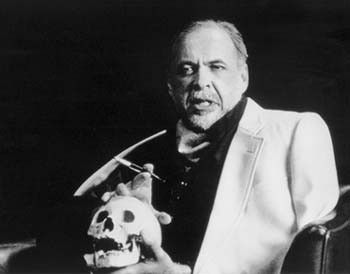
IF EVER A WIZ there was, Fred Curchack is one because, because, because, because, because, because–because of all the wonderful things he does. Petaluma’s Cinnabar Theater is host to playwright/performer Curchack’s latest foray into solo theater–A Surprise Party–in equal parts a black comedy for graying baby boomers, a one-act suicide note, and testimony that introspection assists the licking of mortal wounds.

An adroit hybridization of live performance and video projection, A Surprise Party hinges on an emotionally defeated man intending to voluntarily lie down for the dirt-nap on his 50th birthday. Yes, it is reminiscent of Swiss-born Hermann Hesse’s quasi-autobiographical tome to archetypal psychology, Steppenwolf.

In Hesse’s novel, Harry Haller (the scantily camouflaged author) achieves spiritual gestalt after a Jungian-doused venture into his unconscious–symbolized by the Magic Theater, a psychic cabaret of projections, deflections, and divertissements.

Correspondingly, in Curchack’s work, Theo Shmaltzsky (a writer/performer and paper-thin simulacrum of the similarly employed and aged Curchack) is also going to off himself at the half-century mark, but Shmaltzsky’s Magic Theater is not simply a metaphor–you actually pay to sit there, in the dark, in Petaluma. With remarkable poise and humor, Curchack has forged an erudite and tumultuous production that ponders the interrelation of art and artist, the fleeting notion of identity, and a generation’s fear of inconsequence.

But is it autobiography?

Not one liable to libel, Curchack forbids audiences to perceive A Surprise Party as a staged roman à clef and in the program cautions that “any resemblance of any fictional people to any real people is imaginary.” Hmm. One cannot help but scour for a semantic loophole.

The video projection of roughly hewn camcorder footage (the quaint production values bring a deliberate, homemade familiarity to the piece) allow Shmaltzsky to interact with a Fellini-like roster of personalities who arrive to gleefully witness him do himself in.

Curchack portrays an exhausting 17 characters in all, including a cigar-chewing ex-wife, ex-girlfriends (both living and dead), his parents, his children, a mentor, and a cavalcade of friends that boasts a pair of deluded, upscale New Agers and the psychotherapist mother of a suburban cannibal in its ranks.

As writer and actor, Curchack invests each member of this guest list with poignancy and vim–even his less-developed characters, those perceptibly ripe for caricature (the requisite “Guido” and a tattooed punk son), are spared their default settings and effloresce marvelously.

Likewise endowed with dimension and shading is the unseen video-narrator, referred to as Vox, presumably Curchack’s abbreviation of the Latin term vox populi, meaning “voice of the people” but often used to imply judgment. Hence, the omnipotent, tracheotomy-voiced Vox (undoubtedly inspired by the evil computer-intelligence Alpha Soixante in Jean-Luc Godard’s Alphaville) offers a continuum of hypercritical analyses of Shmaltzsky that encompasses such piquant observations like “[He] can’t see his prick past his paunch,” as the video proves with an image of the character’s bare, genital-concealing midsection.

Throughout the show, Curchack evinces his knack for comic hyperbole and pedagogic digression. At one point, he demonstrates the function of phonemes and diphthongs by vocalizing in tandem with a tight shot of his gaping, video-projected mouth. The effect is bedeviling but eerily irresistible.

Compounding the work’s self-referentiality is the fact Curchack shot his video accompaniment in an interior beset by mirrors that often reveal the video camera either mounted on a tripod or suspended by his own grip. Be assured this is not just happenstance: Curchack’s authoring is total; perceived nuisance is nuance.

With no production staff (only Vicki Pesetti provides assistance during the performances), Curchack is not only the director and star of The Surprise Party, but also the designer of the lighting, costumes, makeup, and sound effects. Such totality of effort makes for exquisitely intimate theater, and Curchack refreshingly manages to stifle any issue of narcissism and self-adulation despite the work’s confessional tone.

Empathetic audiences beware: Curchack so convincingly performs the exegesis of Shmaltzsky’s suicide that it is difficult to quell the impulse to discreetly pass him a crisis hotline number after the show.

Theater-lovers should pray that Curchack survives this production.

A Surprise Party bursts forth Friday-Saturday, Feb. 13-14, at 8 p.m. at the Cinnabar Theater. 3333 Petaluma Blvd. N., Petaluma. Tickets are $8-$12. 763-8920.

From the February 12-18, 1998 issue of the Sonoma County Independent.

© Metro Publishing Inc.
Pat Metheny

0

Adventures in Guitarland


Through a Looking Glass: Jazz guitarist Pat Metheny performs Feb. 23 at the Luther Burbank Center.

Metheny explores uncharted terrain

By Greg Cahill

ASK PAT METHENY about detractors who have complained over the past 20-odd years that he has bent all the musical rules and the acclaimed jazz guitarist and composer just laughs. “In my case, music is something that goes way beyond job description,” he says. “It’s something that is inside my bones. It’s something that I’ve devoted virtually every waking minute to since I was 11 years old or so.

“The way all of that gets dissected or discussed [by others] is irrelevant to the reality of the music itself.”

These days, the Grammy-winning Metheny–smart, articulate, and eminently likable–is still breaking musical barriers with his trademark blend of experimental technology and melodic improvisation. During a rare 12-month “break” in New York, Metheny reunited last year with his own group, featuring longtime keyboardist Lyle Mays, to record Imaginary Day (Warner), an adventurous, texturally rich set that highlights his own remarkable fretwork on a 42-string guitar, among other instruments. The bold album veers wildly from a bluesy version of Indonesian gamelan music to an edgy techno blast reminiscent of Nine Inch Nails. Last year, he participated in British free-jazz guitarist Derek Baily’s exploratory quartet that resulted in a three-CD live document, The Sign of 4 (Knitting Factory). His 1997 collaboration with bassist Charlie Haden, Beyond the Missouri Sky (Verve), topped the jazz charts last year and is still selling well.

More recently, he contributed to bassist Marc Johnson’s newly released The Sound of Summer Running (Verve), which teams Metheny for the first time with avant-jazz guitarist Bill Frisell. “It was a dream,” he says of the project. “It was like neither one of us could do anything wrong.”

THAT PRETTY MUCH sums up Metheny’s career of late. One of the few young players to emerge with his integrity intact from the experimental ’70s fusion era–a movement that quickly dissipated into a mix of overindulgent wank and pop-lite fluff–Metheny doesn’t mince words when the topic shifts to the media’s love affair with such rebop artists as Wynton Marsalis. “It’s having a really minor effect on the music and virtually no effect on the culture at large,” he says. “Frankly, if I want to hear music that’s in that zone, I’m going to listen to Duke Ellington or Miles Davis or John Coltrane. Unfortunately, I haven’t heard anybody who’s advanced that way of playing or even come close to the level of playing expressed by the original guys.

“The famous Miles quote is, ‘Didn’t we do it right the first time?’ The answer is, ‘Yes, they did.'”

While he apologizes for any disrespect he may show his peers, Metheny feels strongly that improvisational musicians have a duty to chronicle the times in which they live.

“When you listen to a Louis Armstrong record from the ’20s, you not only get this great music, you get this whole vibe, almost a look at how people talked to each other and the clothes that they wore. With Miles Davis in the ’60s, you also got a sense of the instrument technology and the way people heard things. The things that made that particular moment in culture distinctive are very often embodied in the casual, almost offhand narrative playing that jazz players are in the business of doing,” he explains.

“When you’re in the middle of the times, like we are right now, we’re so inside it that it doesn’t seem to us like there’s anything special going on. But there are things about our time that are going on right now that we can’t even see. Because of the improvisational nature of jazz, the sort of documentary quality that a lot of jazz recordings have, there is this extra thing that will be real valuable for people in the future when they go looking for a sense of what was happening in our time.”

AND WHERE does Metheny’s work fit into the overall jazz picture? “My particular relationship with the music has nothing to do with the idiom–I don’t care if it’s called bebop or fusion, and that’s a term that emerged eight or 10 years after I’d already started doing what I was doing. I was just playing what I wanted to play,” he insists.

“As for the word jazz or any of these other words that get thrown around to describe certain idioms, ultimately and with all respect to everybody, I could give a shit. It has no real meaning to me.

“In the same way as whatever was said about Bach or Mozart or Frankie Valli and the Four Seasons, all of that criticism is irrelevant in the face of what they actually did. The music speaks in the language of music perfectly fine. In my case, the thing that will matter is what it all sounds like in the end. How it fits into the jigsaw puzzle of modern contemporary culture is something that it’s fun to sit around and talk about over dinner for a half an hour.

“But ultimately, it’s just that–just a bunch of guys talkin’.”

The Pat Metheny Group performs Monday, Feb. 23, at 8 p.m. at the Luther Burbank Center for the Performing Arts, 50 Mark West Springs Road, Santa Rosa, Tickets are $29.50. For details, call 546-3600.

From the February 12-18, 1998 issue of the Sonoma County Independent.

© Metro Publishing Inc.

Other People’s Money

0

Good Greed


Michael Amsler

Old Guard: Lucas McClure, left, and Robert Parnell fight for the old-fashioned ways of their company.

‘Other People’s Money’ takes over

By Daedalus Howell

A MBROSE BIERCE once laconically defined the American invention of the corporation as “an ingenious device for obtaining individual profit without individual responsibility.” Bierce’s explication becomes the thesis for a rambunctious economics tutorial/history lesson/seriocomedy currently offered by the Pacific Alliance Stage Company: playwright Jerry Sterner’s Other People’s Money, aptly directed by Robert Currier.

Written in 1989, Other People’s Money is Sterner’s summation of ’80s-style corporate avarice tied to the David and Goliath myth’s slingshot. New England Wire and Cable is the infirm holding of an otherwise profitable enterprise under siege by corporate raider Lawrence Garfinkle (Gary S. Martinez), who intends to plunder its assets and shut it down.

Andrew Jorgensen (Robert Parnell), the Wire and Cable patriarch, and his managerial sidekick William Coles (Lucas McClure) discover their corner-store business ethic is outmoded in the “Greed Is Good” business environment. Enter hired gun Kate Sullivan (Susan Papa), an attractive young attorney not above sexual politicking and muckraking. In the balance hangs the fate of 1,200 factory workers (see director Michael Moore’s semidocumentary film Roger and Me for a gorgeous parallel) and the old-fashioned way of doing business.

Will the Moloch of big business erase yet another visage from the landscape of free enterprise? Sure.

In the present era of Microsoft, Starbucks, and HMOs, Sterner’s play does not clear the hurdle between timely and timeless–the ’80s are over, the corporations have won–and an unheeded cautionary tale does not qualify for canonization. Other People’s Money now works best as a time capsule, a documentary drama whose philosophical assertions apply to an elapsed epoch in economic history.

If only director Currier had shaved the play’s moralizing to an imperceptible stubble. The excellence of this production notwithstanding, Currier’s treatment could have been a smidgen closer to perfection had it been a resolutely harrowing history lesson rather than an expired admonition of what could pass.

As the bloated Garfinkle, the splendidly cast Martinez brings a barking, tough-guy cadence to his dialogue that is despotic without obscuring the corporate thug’s hatchling humanity.

The smoky-voiced Papa’s performance as the gallant and haughty legal-beagle Sullivan is a convincing amalgam of emotional nuance and manner. Papa is indefatigable, sexy, and spirited in the role and pairs well with Martinez (their scenes are the show’s finest).

McClure brings a soothing presence to Coles with his consistent, well-hewn portrayal, making the emotional resignation of this mild-mannered company man eerily palpable.

As Bea, the ever-faithful office crone and romantic confidant to old man Jorgensen, Vlada Claire offers a poignant and tear-laden performance with much grace and aplomb.

And Parnell excels with playwright Sterner’s arguably stereotypical codger, adding dimension and light where lesser artists would stumble into hackneyed and facile characterization. Parnell’s Trumanesque plea to his shareholders near the play’s end is a dexterous tour de force, a triumph (the plot notwithstanding), and the actor absolutely shines.

Michael Grice’s set design is a pragmatic split of the Spreckels Center studio stage between Garfinkle’s cool New York digs and New England Wire and Cable’s homey, wood-paneled Rhode Island office–both fittingly dressed in either the flat-black hues of Sharper Image paraphernalia or dopey trophies, ashtrays, and office amenities. Scenes are so ably punctuated by light designer Brad Nierman that the action nearly “cuts” together like a movie.

Thankfully, Pacific Alliance Stage Company’s Other People’s Money does not downsize, restructure, or otherwise lay off its talent. Though it can’t emancipate audiences from corporate serfdom, it certainly shows us how we got there.

Other People’s Money plays Thursday-Sunday through March 1 at the Spreckels Performing Arts Center, 5409 Snyder Lane, Rohnert Park. Thursday at 7:30 p.m.; Friday-Saturday at 8 p.m.; Sunday at 2:30 p.m. Tickets are $10-$12. 584-1700.

From the February 19-25, 1998 issue of the Sonoma County Independent.

© Metro Publishing Inc.

Manson Family Picnic

0

Serial Kidders


Rick Downe

No Picnic: A cheerful double take on the Manson Family.

Color the ‘Manson Family’ for fun

By David Templeton

RETIRED NAVY PETTY Officer Rick Downey of Santa Rosa was relaxing and camping by the side of a turtle-filled lake about 10 years ago when he was befriended by a congenial group of people who had staked out a nearby site. They seemed nice, offering to share their food and recreational pharmaceuticals. Downey felt fortunate to have made the acquaintance of such generous, free-spirited souls.

They partied all weekend and then parted ways.

It wasn’t until three years later that Downey–while channel-surfing on the tube–happened upon a Geraldo Rivera show about convicted murder-conspiracist Charles Manson. Geraldo was grilling a group of smiling, sincere-looking hippies.

Their faces seemed familiar.

Suddenly, Downey recognized them as the very same folks he’d once so memorably picnicked with, yet they were now proudly identifying themselves as being longtime members of Manson’s still-existent “Family.”

“I’d say that was a pivotal moment in my life,” laughs Downey. “For the first time I was able to get a fresh perspective on the Manson thing, to get beyond the old stereotypes of the Mansons being nothing but insane murderers! Sure, the people who went to jail in the ’60s [for the multiple Manson-engineered murder of Sharon Tate and others] were not very nice people. But the ones I met,” he insists, “were very nice people. Really!”

Maybe so. At any rate, the story served Downey well for years, as he retold it in order to entertain and (often, he admits) to irritate co-workers.

There is now the possibility that Downey will be able to irritate thousands of strangers as well.

He has just published Manson Family Picnic (Playroom Press; $6.50), an adaptation of the strange event, here envisioned as a children’s coloring book, in which the Manson Family is depicted as friendly turtles, with Huey, Eldridge, and Bobby turning up in the form of three black bears who tear up campgrounds as a political act. Co-written with Santa Rosa musician Garth Powell and capably illustrated by Downey, who had never drawn before, the 44-page book is available only through online orders. And despite a glowing review from none other than Zippy the Pinhead’s Bill Griffith, who called the book “funny, wacky stuff!,” Downey has been unable to persuade any bookstore to place the book on public shelves.

“Maybe the mainstream public isn’t ready for it yet,” he gamely allows.

THE MANSON FAMILY Picnic would be little more than an audaciously bizarre prank were it not for the fact that Downey and Powell have managed to co-opt the unwitting assistance of both Vincent Bugliosi–the former Los Angeles district attorney who prosecuted the Manson case–and of Charles Manson himself.

Bugliosi’s contribution is an undeniably amusing letter–reprinted as the book’s foreword– that begins, “I can’t comment on what you sent me because it doesn’t appear to be a book and I really don’t understand what you sent me. But I wish you the best with whatever it is.”

Manson, now serving his life sentence at Pelican Bay State Prison, has ended up contributing the afterword in the form of a demented, three-page-long, rhyme-loaded missive, written in a freaky chicken-scratch of longhand gibberish, photocopied as is onto the final pages of the book. It was apparently Manson’s response to being sent the galleys of the volume.

“It’s a newspaper face, gesture race, tokens broken, word said yet unspoken,” Manson earnestly scribbles. “Spain Change, toe kwan do whip-per-snap-per–Golden midnight, non sans dreact pere-pere plus trying to prove nothings to prove bottom line mind . . .”

One thing is for sure: it’s a perversely fascinating read.

“He seems to be changing his thought pattern every three words or so in that letter,” Downey says, appreciatively.

“I dearly love that letter,” adds Powell, a drummer and poet who has actually performed the letter on stage. “It’s a very powerful piece. Let’s face it, Manson’s entire existence in jail has been 30 years of performance art.”

Hold it a minute.

It’s all well and good to try and see beyond stereotypes, but the guy being celebrated is responsible for one of the most horrifying crimes of the 20th century.

“Well, I wasn’t trying to glamorize Manson,” Downey replies, a tad taken back. “I was really just trying to have fun.”

“Oh, you couldn’t create more celebrity for that guy if you tried,” Powell says. “Manson is an icon, like it or not. And if you read the books on the subject, you have to conclude that Manson was only a low-rent nut case, but was somehow whipped up into looking like one of the great monsters of the era. Let’s face it, if the Manson Family didn’t just happen to have murdered a bunch of rich white people, no one would have cared nearly as much.

“But we are a monster-making culture,” he adds. “And Manson gets to play one of our monsters right now.”

“My experience with the Manson Family was so different than what you would expect when you hear the phrase ‘Manson Family,'” continues Downey. “It was kind of eye-opening. According to Bugliosi, there were over 100 members of the Family at one time, and only eight were involved in the murders. That leaves a lot of others who were not necessarily bad people.

“But if everyone else in society wants to believe that all of Manson’s followers were evil and should go to Hell, well, that’s their business.”

In spite of his defense of those particularly Mansonites, Downey insists he does not revere Manson. In fact, he’s even gone so far as to, well, tease him.

“Yeah, I took one of his letters to me,” he explains, “and I cut all the words apart, rearranged them into all new sentences, and mailed it back to him. I don’t think he liked it very much. I got another letter, politely asking me to stop writing.

“I think I’ll leave the guy alone from now on.”

From the February 19-25, 1998 issue of the Sonoma County Independent.

© Metro Publishing Inc.

Spins

Mixed BagCounter Balance: Singer/songwriter Beth Orton yearns.Sonny, Louis, Goldie, and BethLouis ArmstrongMaster of Jazz, Live in Chicago, 1962(Storyville/Mobile Fidelity)Sonny StittJust in Case You Forgot How Bad He Really Was(32 Jazz)HERE IS A HOT PAIR of previously unreleased live dates from two radically different but totally engaging artists. Trumpeter Louis Armstrong wasn't exactly setting the world on fire when he...

Civilian Police Review Boards

Deadly ForceMichael AmslerMad as Hell: Copwatch organizer Jeff Ott is calling for an independent probe into 8 recent police-involved killings in the county--an unprecedented number. But a civil rights panel formed after the shooting last year of Kuan Kao, pictured on the right, by a Rohnert Park police officer will review only deadly-force policies.Forum on police-involved deaths sparks hot...

Hepatitis C

Silent KillerMichael AmslerShot in the Dark: After 10 years of intravenous drug abuse, Carly McFarland has turned to regular alpha interferon injections to control a potentially fatal liver disease.Public health officials warn of hepatitis C outbreakBy Dylan BennettC LEAN FROM intravenous drugs for 10 years, she thought that months of always feeling tired were the result of turning...

Rafael Film Center

House of DreamsJanet OrsiCinema Paradiso: Mark Fishkin is creating a new North Bay art house.Rafael Theater stirs after long slumberBy David TempletonF ROM ACROSS the street, obscured by a gray torrent of rain, the time-worn art-deco marquee of San Rafael's historic Rafael Theater rises up conspicuously above an unsightly barricade of wet wooden beams and weather-soaked boards, behind which...

Talking Pictures

Eccentric GloryGemma La ManaLast Action Heroes: Bill Pullman and Ben Stiller create original characters.To each his own in 'Zero Effect'By David TempletonDavid Templeton drops by the home of renowned eccentric Mickey McGowan--a frequent Talking Pix guest--to discuss the delightfully off-the-wall mystery Zero Effect.FROM THE STREET, Mickey McGowan's tree-lined San Rafael house is surprisingly indistinct, almost invisible. It is not...

Romantic Wines

Blushing CupMichael AmslerRoses Are Red, Violets Are Blue, This Wine Is Great, and So Are You: You don't have to be a poet to laud a night of love.Seeing red is just right for romantic winesBy Bob JohnsonAS A SINGLE DAD for more than a dozen years, it has been a long time since I've done any serious dating....

A Surprise Party

Middle RageBy Daedalus HowellIF EVER A WIZ there was, Fred Curchack is one because, because, because, because, because, because--because of all the wonderful things he does. Petaluma's Cinnabar Theater is host to playwright/performer Curchack's latest foray into solo theater--A Surprise Party--in equal parts a black comedy for graying baby boomers, a one-act suicide note, and testimony that introspection assists...

Pat Metheny

Adventures in GuitarlandThrough a Looking Glass: Jazz guitarist Pat Metheny performs Feb. 23 at the Luther Burbank Center.Metheny explores uncharted terrainBy Greg CahillASK PAT METHENY about detractors who have complained over the past 20-odd years that he has bent all the musical rules and the acclaimed jazz guitarist and composer just laughs. "In my case, music is something that...

Other People’s Money

Good GreedMichael AmslerOld Guard: Lucas McClure, left, and Robert Parnell fight for the old-fashioned ways of their company.'Other People's Money' takes overBy Daedalus HowellA MBROSE BIERCE once laconically defined the American invention of the corporation as "an ingenious device for obtaining individual profit without individual responsibility." Bierce's explication becomes the thesis for a rambunctious economics tutorial/history lesson/seriocomedy currently offered...

Manson Family Picnic

Serial KiddersRick DowneNo Picnic: A cheerful double take on the Manson Family.Color the 'Manson Family' for funBy David TempletonRETIRED NAVY PETTY Officer Rick Downey of Santa Rosa was relaxing and camping by the side of a turtle-filled lake about 10 years ago when he was befriended by a congenial group of people who had staked out a nearby site....
11,084FansLike
4,606FollowersFollow
6,928FollowersFollow