
All in the Timing

Perfect Timing

A big bravo to All in the Timing

By Daedalus Howell

THE ACTORS’ THEATRE production of David Ives’ All in the Timing, a sextet of superbly comic one-acts, is so good, so astounding, so flawless that it betokens the supernatural, devilish pacts of souls swapped for profound talent. Numerologists may check their math to assure themselves that this show is indeed one crucial digit from marking the beast. Six plays, six directors, seven actors: 667–whew, close call.

An award-winning collection of short pieces, All in the Timing is testimony to Ives’ genius as a playwright. Actors’ Theatre meets the dramatist on his level with a crackerjack stable of double-cast performers and remarkably concordant directors. The community of talents at work in this production bespeaks utopia.

Sure Thing is a snappy social satire depicting a pair of romantically aligned strangers bungling through their maiden conversation at a cafe. Whenever the couple capsizes with an ill-conceived stab at communion, the dialogue is comically reset by a loud bell. As the fledgling paramours, an affable Brian Bryson and Jill Wehrer (masters of the uncomfortable pause and apprehensive grimace) are commendably directed by Celeste Thomas.

This piece is the perfect introduction to Ives’ often esoteric humor.

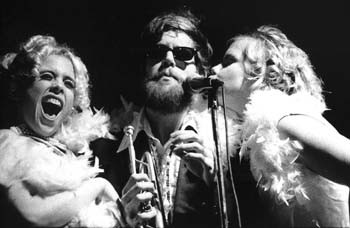
Words, Words, Words riffs on the philosophical adage that monkeys typing for an infinite amount of time will eventually result in the script for Hamlet. Actors Frankie Travis, Michael T. Galusha, and Robert Conrad appear as three primates (sardonically named Kafka, Swift, and Milton, respectively) amid a writing jag.

Costumed in Ema Phelps’ Tweedle-Dee twist on monkey regalia, the performers play Ives’ rapier wit to the hilt, turning the blade until one’s belly aches from laughter.

Director Sheri Lee Miller’s deftly interpreted The Universal Language finds lanky Ken Griffin as Don, the originator and sole instructor of the onomatopoetic language “Unamunda,” a veritable linguistic love child of James Joyce and Dr. Seuss intended to unite the world. Enter Dawn (the absolutely marvelous Sheila Groves), a stutterer who pines for verbal release through Unamunda.

What follows is sheer hilarity as the players’ agile oratory skills (Griffin is so adept at the nonsensical prattle he should have his tongue bronzed) are swimmingly deployed through a first lesson. Groves’ characterization of the nervy Dawn is so delectably sweet it should be eaten with a spoon.

Groves also appears as the wife of the title character in director Joe Winkler’s biting Variations on the Death of Trotsky, Bryson reappearing as the slain Bolshevik, a mountaineer’s axe wedged in his head. Bryson is marvelous as the befuddled Trotsky enduring several possible permutations of his own death. Galusha, too, is delightful as Trotsky’s nebbishy gardener-cum-assassin.

In The Philadelphia, Bryson directs Griffin and Conrad as diners who discover they are victims of a “Philadelphia”–an episode of metaphysical disorder that dictates they can get only the opposite of what they order from salty waitress Wehrer. Conrad is sublimely hilarious as Al, a brackish dime-store philosopher and apparent veteran of such paranormal inconveniences.

Closing All in the Timing is AT artistic director Argo Thompson’s immaculately directed Philip Glass Buys a Loaf of Bread. The perfect crescendo to AT’s lineup, Ives’ piece posits what the brand-name composer would experience were he to run into a former lover at a bakery. In an astute parody of Glass’ avant musical trappings, Thompson’s cast (most of the above, with Bryson as Glass) launch into a operatic tour de force of voice and movement with exhilarating results.

If you can see All in the Timing, do see it; go now. This is what theater is meant to be.

All in the Timing plays Thursday-Sunday through March 21. Thursday-Saturday at 8 p.m.; Sunday at 2 p.m. Actors’ Theatre, at the Luther Burbank Center, 50 Mark West Springs Road, Santa Rosa. Tickets are $6-$12. 523-4185.

From the March 5-11, 1998 issue of the Sonoma County Independent.

© Metro Publishing Inc.
The Scoop

Speed Kills

By Bob Harris

THERE’S A NEW disease sweeping across our beloved land, an epidemic virus that can affect your speech, impair your judgment, and even cause aggressive behavior. The infection is most rampant among the Pentagon, the White House, and the news media. And it’s almost completely undiagnosed. You may be suffering from it yourself.

I’m referring, of course, to … the tragedy of Speedmouth.

Speedmouth strikes swiftly. One day, someone says the entire phrase, “Weapons of Mass Destruction.” The next day, it comes out as “WMD.” “Chemical and Biological Warfare” quickly becomes CBW. “No Fly Zone” collapses into NFZ.

And once Speedmouth attacks, the disease spreads swiftly. What begins as a hallway parlance infecting isolated policy wonks (who contract the contagion when data overload affects their mental immune system), a Speedmouth infection can suddenly surface in a White House press briefing and instantly reproduce like Ebola into the mouths and keyboards of reporters eager to parrot any military phrase in an effort to sound really butch.

Next thing you know, even TV-exposed housewives in Kansas are afflicted, rattling off meaningless Speedmouth phrases over tea at the card table with the somber gravity of a nuclear briefing in the war room.

“Never mind the CNN PR SNAFU at OSU, the DCI’s POV on UNSCOM correlates with CIA and NSA intel, confirming the CW about AP reports on WMD and CBW, so the CCC is projecting A-10s and F-16s into the Iraqi SOG … gin.”

This, my friends, is a shocking case of Speedmouth. This poor woman has no idea what she’s saying, but she’s convinced it means we have to bomb someone.

Unfortunately, while we understand the cause, the only known cure is a long and difficult one:Read a book.

BY NOW YOU’VE READ various news reports about last week’s skirmish at Ohio State between two CNN reporters and three Clinton advisers on one side and a small but vocal minority of the folks they supposedly work for on the other. A large group of normals, caught in the middle, was left trying to decide whom to trust.

If you saw the fiasco live on the tube, you already know that much of what was said, both during and after the show, was completely false. First, let’s be clear about what that TV show was–and was not. This was not a “town meeting.” At a real town meeting, priorities are decided as a result of what the people have to say. This CNN deal was set up so the big shots could explain priorities that had already been decided. The two are fundamentally different. The first is a form of genuine democracy. The latter, which happens so often we’re starting not to notice the difference, is what Noam Chomsky calls “manufacturing consent.”

And CNN was not just reporting the news. It cut a deal with the White House to get exclusive rights to the show by footing the bill, handling the logistics, and giving the speakers a worldwide audience. CNN did not demand–as an objective reporter might –that people who disagree should receive equal space and time. So, bottom line: CNN paid to produce a high-profile TV talk show starring Bernard Shaw as Oprah, featuring a unanimous group from one side of the debate about Iraq, presented to sell the official policy to the people.

In fact, White House aides actually complained the next day that the audience hadn’t been screened in advance, so anyone who lined up for a ticket–even the riffraff who ask embarrassing questions!–could get in. In other words, the real problem was the sloppy intrusion of actual democracy into the staged event.

That so many commentators deemed Clinton foolish for allowing such an outbreak to occur–without noting that it’s also the fundamental thing we’re supposed to be defending–tells you more about us media people than it does the protesters.

Once the press and citizenry begin giving the president the power of a generalissimo, how long will it be until he actually becomes one? Personally, I didn’t much care for a lot of what the protesters said, and I sure wasn’t fond of the way they said it. But they deserve credit for being hip enough to treat the event like the cheap stunt that it was all along.

From the March 5-11, 1998 issue of the Sonoma County Independent.

© Metro Publishing Inc.

Carol Flinders

Zazen!


Michael Amsler

Spirit’s slake: Carol Flinders pairs theory with practice in At the Root.

Carol Flinders’ search for a feminist spiritualism

By Marina Wolf

STANFORD IN THE EARLY ’60s wasn’t exactly a hotbed of spiritual exploration. But that’s where Petaluma author Carol Lee Flinders got her start, taking every course that had even a whiff of religion in it. “It was very slim pickings, of course,” she says of her early search. “But I remember a course on the theological novel of modern Europe that was taught by a man of really visible spirituality, which was what I was looking for.”

Flinders went on to UC-Berkeley to pursue medieval studies, specializing in women mystics, and devoted the rest of her time to Eastern Indian meditation. Her extensive background in and obvious love for both disciplines is part of what makes her newest book, At the Root of This Longing: Reconciling a Spiritual Hunger and a Feminist Thirst (HarperSanFrancisco; $21), so satisfying.

Flinders’ commitment to meditative practice began when many other women were making a different commitment … to feminism. Yet she felt she was being true to her incipient feminism, and not only by choosing a teacher with a matrilineal heritage and a powerful affinity for Mahatma Gandhi’s feminist-leaning philosophies. “I thought that if I could take care of the basics–ego, greed, anger–the rest would just fall into place.”

Flinders soon moved to a meditation center near Petaluma and continued research and teaching at UC-Berkeley. But conversations with her female students, and her own lingering anger, slowly stirred her out of her quest for egolessness into a fierce inner meditation/mediation between two seemingly contradictory forces. “It was like being close friends with two people who couldn’t seem to be in the same room together,” Flinders says. “You can work around it for a while, go out with them separately. But at a certain point you get very impatient with that. If you love them both, they should be able to talk.”

Over the course of many years, Flinders did get her two sides to talk. At the Root of This Longing is essentially a record of that dialogue, revealing what she calls “the critical stress points along the interface between feminism and spirituality.” How, for example, can a woman quiet the mind through silence, as many spiritual disciplines demand, and yet find her own voice to speak out against injustice? Does eliminating ego mean staying a doormat, or can one find and retain an authentic identity? What about desire? Can a woman reclaim her body and its longings even while she restrains them for the sake of inner stillness? And how can one reach out to “take back the night” and stay inwardly focused at the same time? It’s a daunting list of opposites that Flinders succeeds in reconciling into a potently beautiful conceptualization of feminist spirituality.

What happens when woman’s spiritual nature is ignored or attacked is illustrated by a key point from the Mahabharata, an Indian epic. In the story, the Princess Draupadi is seized from her private chambers as the final prize in a royal gambling match. Her supreme faith saves her, but the chaos and destruction that follow constitute a clear warning of what happens to a culture that dishonors the power and gifts of its women. “What the Mahabharata means us to realize,” writes Flinders, “is that the desecration of women–of the feminine principle, for that matter–is the sign and symptom of a civilization that has absolutely lost its moorings.”

In these terms, Flinders argues, our society is far gone. It hit her with fresh force after the kidnapping and murder of Polly Klaas in 1993, a private tragedy that struck a public chord of grief. That Flinders had told the story of Princess Draupadi at a conference only hours before Richard Allen Davis broke into Polly’s bedroom was too brutal of a juxtaposition for Flinders to look away from: “I had to ask whether I was doing everything I could, whether feminism didn’t still have some urgency for me.”

Her answer (or answers) to this question conclude At the Root of This Longing on a uplifting note, one that she echoes again when asked about her further plans. It depends on the response from readers, she says. “I really want to start a conversation that would be very far-reaching and not even necessarily involve me,” she says.

That’s feminist “no me-ness” for you.

From the March 5-11, 1998 issue of the Sonoma County Independent.

© Metro Publishing Inc.

Talking Pictures

0

Sweet and Sour


K. Wright

Love Stinks: Former ‘Saturday Night Live’ comic Adam Sandler is out of love.

A relationships expert analyzes love, loss, and ‘The Wedding Singer’

By David Templeton

In his ongoing quest for the ultimate post-film conversation, David Templeton takes author, psychologist, and relationships expert John Amodeo to see the disarming romantic comedy The Wedding Singer.

DR. JOHN AMODEO has been warned. He knows that The Wedding Singer–starring B-movie comedian Adam Sandler as Robbie, an optimistic crooner-for-hire specializing in wedding receptions, who endures a horrifying depression after he’s dumped by his fiancée at his own wedding–is no work of art: it’s crude, rude, and entirely predictable. In spite of this, I’ve let him know, the genuinely funny new love story is, um, kind of sweet. Surprisingly sweet. Virtually everyone who’s seen the darn thing, in fact, has immediately popped out those same two words: surprising and sweet. Surprising because Sandler’s films have never been accused of being remotely likable, and sweet because … it just is.

“It was very sweet,” Amodeo confirms, exiting the theater with a wistful smile. “It was very positive, very upbeat … very sweet.”

That’s not all, either.

“I think The Wedding Singer is an accurate comment on the pervasive superficiality of many modern relationships,” Amodeo enthuses. “It points to the real possibilities that exist for a more mature relating of two people’s hearts, one that creates a foundation for a more lasting and satisfying romance.”

Not bad for a movie in which the main character, in the midst of his post-break up doldrums, writes an earnest little love song with the abrupt chorus, “But it was all bullshit! It was all a goddamn joke! And when I think about you, I hope you fuckin’ choke!” (By the way, that’s not the sweet part; the likable aspects of the story are explored through Sandler’s tentative love affair with Julie, a kind-hearted, unhappily engaged waitress played by Drew Barrymore.)

Amodeo is familiar with the ups and downs of love, as demonstrated by his successful North Bay therapy practice and his writings. His popular 1994 book, Love and Betrayal: Broken Trust in Intimate Relationships (Ballantine), is now in its fourth printing, and he’s just finishing up work on another, an enlightening comparison of youthful notions of love and those of more emotionally mature lovers.

“The movie made a good contrast between what I call ‘young love’ and ‘mature love,'” he points out. “Young love is the kind of thing where you think, ‘I’m looking for someone to take care of me for the rest of my life, since I don’t feel I could take care of myself.’ Looking for someone to fill the inner emptiness. It’s ‘You make me whole,’ rather than my becoming a whole person who can connect with another whole person.

“In young love,” he adds, “you’re mainly looking for someone to be your caretaker.”

“If that’s the case,” I observe, “then ‘young love’ isn’t necessarily relegated only to young people, is it?”

“Oh, not at all,” Amodeo agrees. “Love is not a function of age. It’s a function of maturity. People have young fantasies of love long into their 60s and 70s. Some have mature fantasies while still in their 20s.

“What happened with Julia and Robbie is,” he continues [and if you don’t want to know whether or not the film has a deliriously happy ending, read no further], “that over time they came to experience each other’s joys and sorrows, I think. They got to connect on more than just a superficial physical level, but on a feeling/emotional level, which created the foundation for a more mature love.

“Robby and Julia got to share real human sorrows. They had the depth and maturity to recognize from their own experience what the other’s sorrows were. There was real empathy between them. Without that kind of empathy and compassion there can be no mature or lasting love.”

THE FUNNIEST MOMENTS of the film are those when Robbie is the most disheartened: his spirited disruption of a wedding reception with a snarling rendition of the song “Love Stinks”; his audaciously depressed love song that ends with a demand for someone to put a bullet in his head; the scene at a wedding when all the lovelorn guests rally behind him when he dares to say, “Like me, none of you will ever know true love.”

“It was pretty real,” Amodeo laughs. “Robbie was expressing what people often want to express, but hold themselves back from expressing. It was great that he could get into the depths of his pain.”

“But, um, isn’t that kind of unhealthy?” I wonder.

“Not at all. It’s good to go with those feelings,” he replies. “It’s good to feel your anger and pain, it’s good to go into the depths of that stuff. Because out of those depths, if you work with it, you can emerge a more open person.”

“Is it a function of young love, then,” I ask, “that when you’re dumped, you sometimes swear off love altogether?”

“Sure,” he nods. “A lot of people do that. When the illusion is exposed, people become very cynical and bitter. They close down their heart to connecting with anyone, taking on the safe belief that love is not possible for them. It’s very tragic. But it’s not necessarily the end of love for them, any more than it was the end of love for Robbie when he was left standing at the altar.

“What you have to do is to mine your pain,” Amodeo states with calm authority. “You can mine that pain for the golden lessons that are buried there. Then you will be open to even deeper intimacies, even sweeter connections, than you ever were before.”

From the February 26-March 4, 1998 issue of the Sonoma County Independent.

© Metro Publishing Inc.
Jesus in the Movies

0

Sweet Jesus!

Salvation Saga: “The message of Jesus is the way he lived,” says director Paul Verhoeven, who will speak March 5 in Santa Rosa as part of the Jesus Seminar. “That he ultimately was killed was something that just happened.”


Director Paul Verhoeven discusses the importance of Christ’s life on film

By

THE STORY OF JESUS–that troubling legend of mankind at its worst and its best–has been a subject for the movies since the beginning of cinema. But a movie, generally speaking, is meant to please everyone, and this is almost impossible when the subject is Christ. Filming the story of Christ tends to offend both the pious and the impious. Watching yet another version of the Passion Play, New Yorker magazine film critic Pauline Kael asked the rhetorical question, “Why do filmmakers think it’s such a good story, anyway?” What’s left out of the story says as much about a society as what is included.

On March 5, the Santa Rosa-based Westar Institute hosts a panel discussion and public forum on the problems of portraying Christ in the movies. The institute yearly hosts the Jesus Seminar, a gathering of religious scholars to discuss the secular, historical roots of Christ, based on archaeological finds, newly discovered documents, and new translations of the Gospels. The internationally renowned group fights the popular notion, as George Bernard Shaw put it, that confusion is the proper condition in which to read the Bible. The institute has also published, through its own publishing house, W. Barnes Tatum’s Jesus at the Movies: A Guide to the First Hundred Years (Polebridge Press; $17.95).

At the forum, Tatum, a professor of religion at Greensboro College, will be getting together with the Episcopal priest Jim Friedrich and B. Brandon Scott, a professor of the New Testament at the University of Tulsa. Joining these divines will be the well-known director Paul Verhoeven, a Jesus Seminar fellow who is seriously attempting to film a new life of Jesus.

The idea could draw mockery–OK, here’s the maker of the ridiculous strip-fest Showgirls and the sci-fi flick Total Recall wanting to film a Passion Play (Matthew 12:33: “A tree is known by its fruit”). But there are a few historic parallels, there being nothing new in the picture business: Nicholas Ray, who made the 1961 King of Kings, later directed a soft-core porn picture titled Wet Dreams; Zalman King, who played the Messiah in The Passover Plot, is now wealthy from his own soft-core films such as Delta of Venus and 9 1/2 Weeks; and did you ever see Pier Paolo Pasolini’s Salo, the Italian director’s version of the exploits of the Marquis de Sade? Much rougher sledding than Showgirls, yet Pasolini also made The Gospel According to St. Matthew, one of the more admired versions of Jesus’ life.

The same temperament that finds transcendence in sex–the magic of one person merging into another–may eventually seek it out in the transcendence of faith.

During a phone interview, Verhoeven acknowledges that the life of Christ in Israel is a departure from the story of showgirl Nomi in Las Vegas. “It’s different from my usual American work, yes, but not so different from my European work, like Turkish Delight and Soldier of Orange. Here I’ve made RoboCop, Total Recall, Starship Troopers … it’s sometimes difficult breaking away from science fiction. But in [my native] Holland, my work was very much about autobiography and biography.”

I ask Verhoeven if he believes in the Resurrection. “I believe in the Resurrection of the Word,” he says. “I believe the disciples felt that Jesus was with them again. The [story of the] fingers in the wound I doubt, but I think the disciples felt a strong force around them, though the Church has postulated Jesus resurrected in body and came back. The Jesus Seminar has clearly stated that Jesus was buried and his body was decomposed.”

RAISED A CATHOLIC, I’d been trained to believe that Jesus went to the cross in measured steps, fully aware of where he was heading. But after reading histories of the bureaucratic hot-potato game the various Judean authorities played with the case of Jesus, the Crucifixion seems more like a ghastly mistake on behalf of three parties: the Romans, the Jews, and Jesus himself.

“The Jesus Seminar describes it as ‘a car accident,'” Verhoeven says. “My guess is that Jesus was a Jewish cynic, witty and sharp, but then he had a change of mind and believed that the Kingdom of God was approaching. Remember that he was crucified for being king of the Jews, as a crown pretender.”

What about the dramatic problem of telling a story in which everyone knows the ending? “Well, what about Titanic?” Verhoeven responds shortly.

The writer Graham Greene, another good Catholic, noted on his travels that the poorer the country, the bloodier the crucifix. To inspire faith and sympathy, Jesus has to look more beat up than anyone else in a beat-up land. How do you film a crucifixion?

“The Crucifixion doesn’t have to be close to the camera,” Verhoeven allows. “It can be far away–it’s still the same story, the movements and details. These are the two ways of doing it: the more artistic way and the visceral. The political side of the film will be important, to remind people that the Roman government was crucifying people all the time. Maybe we’ll follow an earlier Crucifixion. It was a normal thing. Mark and all of the other gospel writers state it very simply, ‘He was crucified.’ His readers knew exactly how bad that was, how gruesome and terrible.

“But it would be wrong to stress this as the most important thing about Jesus. [Missionary doctor] Albert Schweitzer, who wrote about Jesus, said that only through suffering and pain can we get close to Jesus. Still, what Jesus was talking about was love, a happy, evangelical message. Of course, as Nietzsche comments, the evangelical message was immediately made de-evangelical, to emphasize the suffering.

“The message of Jesus is the way he lived. That he ultimately was killed was something that just happened. By seeing it as a sacrifice we diminish the importance of what he’s thinking. Putting the Cross and the Resurrection at the heart of the story has diminished the importance of Jesus’s message.”

As Pax Americanus supersedes Pax Romanus, Jesus’ story has an uneasy, pertinent side, something that ought to haunt any world power when it contemplates earthly power and glory. “Did you hear about that town hall meeting about Iraq?” Verhoeven asks. “Think of America’s own partnership with Indonesia, despite the massacres in Eastern Timor. We want Indonesia to be quiet and tranquil, so we can participate in their riches. Just like Rome, we want these countries to be quiet and docile.”

An important part of the message of Jesus is the frustrations of an occupied peoples about their oppressors. Considering such matters as the history of Jesus doesn’t sink Jesus beneath wisdom like a stone, as that cloying line of Leonard Cohen has it. Instead, study rebuilds respect for Jesus’ still revolutionary wisdom.

Paul Verhoeven and other fellows of the Jesus Seminar speak on “Jesus at the Movies” on Thursday, March 5, at 7:30 p.m. Flamingo Hotel, Fourth Street and Farmers Lane, Santa Rosa. Tickets are $10. 523-1323.

From the February 26-March 4, 1998 issue of the Sonoma County Independent.

© Metro Publishing Inc.

The Scoop

Air, Fire & Earth

By Bob Harris

YOU’VE SURELY HEARD BY now about the tragedy in Aviano, Italy, where a U.S. jet cut the wire supporting a ski-lift gondola, causing 20 people to fall to their deaths. You’d surely hope that afterwards, somebody in the military would have stepped forward right away, explained what happened, and accepted responsibility in an honorable manner.

You’d hope.

Brig. Gen. Guy Vanderlinden (whom I loved on Barney Miller) is the deputy commander of NATO naval strike support forces in southern Europe, which are maintained so we can respond to trouble in northern Africa or the Middle East. (They’re also just in case Switzerland suddenly freaks out and declares war on France. Which could happen. You can’t trust the Swiss. Oh, sure, they look harmless with their clocks and lederhosen and instant cocoa. But I’m onto you, you twitchy Swiss misfits. I’m onto you.) Sorry. I digress.

Anyhow, so this Gen. Vanlindenhosen guy is explaining after the accident how a state-of-the-art EA-6B Prowler could happen to plow right into the cable supporting this ski lift and kill all these people. And this is what he said, direct quote:

“I do not believe the pilot diverted from the approved route.” Oh.

OK, Gen. Vanlandingpad, let’s see if I’ve got this straight: You’re saying that his approved route was directly into this ski lift. Y’all planned that.

As a training exercise, just in case Saddam Hussein equips the Republican Guard with ski lifts and gondolas. You’ve got a countermeasure. I see.

The Italians didn’t buy it. They said the pilot was miles off line and flying way too low. Which, after a bunch of denials, the Pentagon eventually admitted. The Marines also denied that the plane had a flight data recorder. Which they turned over to the Italians a couple of days later.

Will the Pentagon ever learn? What happened in Aviano was an accident. What happened afterward wasn’t.

And that’s why a lot of people don’t trust the military.

SOMETHING NEW and bad comes out about the tobacco companies almost every day. The latest: According to papers recently publicized by members of the Congressional Black Caucus, the sultans of smoke spent years consciously targeting black people, even though they were fully aware that cigarettes can kill.

Genocide? Nah.

Remember, these very same tobacco executives also marketed specific cigarettes to women, younger smokers, and especially–judging from all the giant Marlboro ads–sexually insecure white men.

All of which is plenty bad enough. And it gets worse.

It turns out that in 1972, tobacco giant Brown & Williamson also planned to manipulate the taste of their cigarettes to attract new customers. One idea they considered was to lure young people by creating a cigarette simulating the taste of cola.

The documents flatly state, “It’s a well-known fact that teenagers like sweet products,” and then list a number of different ideas for inventing a sweetened, Pepsi-tasting cigarette.

What were they planning to call it? “Smoka-Cola”? I can just see the billboard slogan: “Your breath stinks–and you burp!” That’ll impress the chicks. Heck, they should have even caffeinated the stuff. That way, an avid user could start the day with coffee, cigarettes, and a sugary donut … and then burst into flames before lunch.

How do we punish the executives who lied to Congress about the existence of so many of these documents? Maybe we could just sentence them to a lifetime of using their own products.

LAB TESTS PROVE: Being poor can damn near drive you nuts. Believe it or not, my life wasn’t always this glamour-filled joyride of all-night political humor parties with buxom showgirls.

No, I was actually poor myself once.

Anybody who really deals with poverty can tell you that one of the worst effects is psychological. Look, y’ever go to a party, and you were sort of the geek? Maybe your clothes were out of style, or maybe you didn’t know anyone, and so it was hard to get anybody to talk to you? It takes about 10 minutes before you’re feeling lousy about yourself, even though objectively you’re still just as cool as ever.

OK, now imagine that’s the whole world. Everywhere you look, everyone is richer and better dressed, and they don’t even want to look at you because they find you depressing.

Only it’s not a party. It’s real life.

That could be hard to cope with, right? Now there’s scientific proof. A new study of almost 10,000 people in the United Kingdom has found that the lower your income, the more likely you are to suffer from depression and other common mental disorders.

Inversely, you might imagine that being rich might make you more emotionally stable. Actually, the study doesn’t show anything of the kind. Which wouldn’t surprise anyone in Los Angeles or Washington, where celebrity self-destruction is sort of a local feature.

St. Louis has the big arch; Pittsburgh has the inclined trains. L.A. and D.C. have Roberts Downey and Dornan.

Bottom line: Money really doesn’t buy happiness. But enough to get by can rent a reprieve from despair.

From the February 26-March 4, 1998 issue of the Sonoma County Independent.

© Metro Publishing Inc.

16 Horsepower

0

Revved Up


Michael Amsler

Four Horsemen of the Rockalypse: 16 Horsepower

16 Horsepower: Christian rock that even a sinner can love

By Gina Arnold

REMEMBER the old saw “What do you get if you play a country and western song backward?” The answer: “You get your wife back, you get your house back, you get your dog back, and so on”–the joke being a play on country music’s reputation for being a self-pitying litany of cornier-than-thou woes.

But if country music is associated with syrupy sentimentality, it is also a rich field for exactly the opposite sensation. It is, as Nick Tosches writes in his wonderful book Country, “aflash with images of sex, violence, and redneck existentialism.”

As Tosches indicates, there is a whole school of thought whereby a certain strain of folk, country, and rockabilly music–far less popular, but much more convincing than the stuff coming out of Nashville–is the most menacing art form around.

Jerry Lee Lewis is, of course, the mother of this line of country. Australian punk rocker Nick Cave’s twisted take on American country is equally awash with folksy roots and scary biblical references. The Afghan Whigs, the Rev. Horton Heat, and even Bruce Springsteen all see the inherent irony of rock music being used to speak on godly subjects–an irony they all play on to a greater or lesser degree.

16 Horsepower is the latest great American act to deliver up folk-tinged alternative country-rock with a very, very, damaged core, as evidenced on the band’s newly released Low Estate (A&M).

This is picking and a grinning with a vengeance; the mandolin never sounded quite so mean as it does on “Brimstone Rock,” the opening track. The song begins with singer David Eugene Edwards yelping, “Listen closely to me now my darlin’ girl/ There’s one who’s out to have you an jus’ his breath will burn your curls.”

That “one” is, of course, the devil, a character who stars in many of 16 Horsepower’s songs. Even the title of the album comes from the Bible (“Set not your mind on high things but condescend to men of low estate, and be not wise in your own conceits”).

But make no mistake. The band’s allegiance to country is a conceit, and the use of words like “kin” and “ain’t” is highly calculated. Although the band is based in Denver, two of its members, drummer Jean-Yves Tola and bassist Pascal Humbert, are actually French. This geographical fact may account for the band’s powerfully imaginative take on Americana. Europeans are often fascinated by the Bible belt’s harsh view of Christianity, and Low Estate is very, very Flannery O’Connor: literary, eerie, steeped in the idea of the failings of religion.

Perhaps to add to its mystique, the record was recorded on a Lousiana plantation. Don’t tell these guys that most Americans live in condos and housing estates and have long since given up Bible-thumping for The X-Files and Oprah–they do not want to know.

SONICALLY, 16 Horsepower is a pleasingly scary-sounding outfit, full of furiously vitriolic melodies and startling imagery. Edwards’ voice is weird and jumpy, very close in spirit and timbre to that of the Ass Ponies’ Chuck Cleaver; moreover, Edwards neatly mixes biblical words like “ye,” “hath,” and “beseech” with redneck vernacular, delivering lines like “that little Jesus freak needed a good ass clockin'” with great effect.

The only thing is, “effect” is the right word for it, because despite 16 Horsepower’s hickoid instrumentation and folksy tempos, Low Estate has about as much in common with both folk and the kind of Nashville country characterized by Reba McEntire and Garth Brooks as ska, punk, or opera.

Instead, songs like “Sac of Religion,” “Ditch Digger,” and “Black Lung” are rocked up and stylized, thoroughly intellectualized takes on the topic of the contradictory nature of religion. But they are no less enjoyable for that.

Indeed, 16 Horsepower’s point of view isn’t unique, nor is the band going to shake the souls of either the believers or the unbelievers among us. But the group’s music is certainly far better done, more sincere, and more convincing than many an act that purports to take God’s name in vain.

Unlike Marilyn Manson, 16 Horsepower at least has a soul to lose.

From the February 26-March 4, 1998 issue of the Sonoma County Independent.

© Metro Publishing Inc.

Women and Their Worlds

0

Women’s Work


Michael Amsler

… Is Never Done: Studio Be founder Lennie Dean honors women playwrights.

Series showcases female playwrights

By Daedalus Howell

IN HIS BOOK A Brief History of Time, physicist Stephen J. Hawking relates an apocryphal story about a lecturer heckled by an elderly woman during an address on cosmology. Apparently the dowager decried the lecturer’s observations on the physical universe and the earth’s place in it as “rubbish” and then offered her own vivid philosophy: “The world is really a flat plate supported on the back of a giant tortoise.”

When the bemused speaker queried, “What supports the tortoise?” the woman sagely replied, “It’s turtles all the way down.”

Likewise, inspired by national observation of Women’s History Month, in March, the worlds of two local theater companies–Actors’ Theatre and Studio Be–will collide in a collaboration that, cosmologically speaking, is women all the way down.

Next month, the troupes present their staged-reading series Women and Their Worlds –five plays written, directed, performed, and sponsored by local women. The series is one of several prospective partnerships between Actors’ Theatre and Studio Be–and the latter’s first production since relinquishing its cramped quarters in Santa Rosa’s Lincoln Arts Center (Studio Be is refuged at AT’s Luther Burbank Performing Arts Center digs).

Among sundry points of concordance between the two is their decision to preserve Studio Be’s long-established staged-reading program at the new Actors’ Theatre location. With the March observance of women’s contributions imminent, the series’ theme was an apropos selection, as the observance (originally Women’s History week) was created by Sonoma County progressives 20 years ago.

Devising the lineup of Women and Their Worlds proved revelatory for Actors’ Theatre director Lennie Dean, as she foraged through the annals of plays by women long suppressed by a constituency of male critics and historians. She cites influential early-20th-century critic Brander Matthews’ comments as indicative of the once prevailing perception of women dramatists: “[Women] lack the inexhaustible fund of information about life which is the common property of men,” he states. “Female storytellers not only lack largesse in topic but also lack a strictness in treatment. Deficient in scientific imagination, women are constitutionally unable to draw plans and execute them.”

Throughout the series, such attitudes will be explicated during pre-show talks conducted by Dean and further explored in post-show discussions led by the directors.

“At [a theater bookstore] in San Francisco, I picked up a collection of plays written by women I had never heard of before,” recalls Dean. “I began to read these plays and felt so ignorant. In 30 years of doing theater, I had never heard of some of these women.”

Roused and inspired, Dean molded the series to reflect women’s contributions to theater throughout the 20th century. Included in the production is a play by the all-but-canonized Lillian Hellman (Children’s Hour, 1934), as well as historically overlooked dramatists Amelia Rosselli (Her Soul, 1898) and Elizabeth Robins (Votes for Women, 1907).

“These plays are really stunning, they’re incredible. There are so many that I didn’t choose that I can’t wait to do for next year. I’m just thrilled at how many plays there are that are so good,” Dean avers.

Behind the scenes, Dean and Thompson have enlisted local stagecraft veterans to helm each reading. Mary Gannon, Danielle Cain, Maureen Studer, and Sheri Lee Miller each direct, as does Dean with playwright Tina Howe’s Birth and After Birth.

“She’s an absurdist at heart. She was trained in Paris, she knew Ionesco–that’s where her love and life live,” Dean says of the prolific Howe, often maligned by a predominantly male theater establishment for her experimental forays. “The first plays that she did were accepted off-off Broadway, but as she moved closer to Broadway she got slammed because ‘it’s not OK for a pretty woman from Boston to write this absurdist stuff.'”

ACTOR’S THEATRE alumna Miller closes the series with her interpretation of Paula Vogel’s How I Learned to Drive, a seriocomic portrait of a woman’s persistent memory of sexual abuse and driver’s ed. The play was a bombshell for Dean.

“I read that play and it affected me so much I wept,” Dean says. “I was so moved by how well constructed it is and how [Vogel] deals with these very sensitive subjects in the most profound way.”

Dean has every intention of parlaying Women and Their Worlds into an annual affair. Dean and Thompson have even bandied the possibility of bringing distinguished female playwrights to next year’s event as well as showcasing more talented women from the county. “Several other people have said, ‘I’d like to contribute.’ I said, ‘Wait–we’ve got big plans for next year,'” says Dean. “This is an appetizer to a great feast. It’s just going to grow and grow and grow.”

Women and Their Worlds

EACH EVENT in this month-long series of Sunday evening staged readings (there are no costumes or sets) begins at 6 p.m. with a director’s discussion of the featured playwright. A post-play discussion follows.

March 1: Her Soul by Amelia Rosselli (1898); directed by Mary Gannon
March 8: Votes for Women by Elizabeth Robin (1907); directed by Danielle Cain
March 15: The Children’s Hour by Lillian Hellman (1934); directed by Maureen Studer
March 22: Birth and After Birth by Tina Howe (1974); directed by Lennie Dean
March 29: How I Learned to Drive by Paula Vogel (1996); directed by Sheri Lee Miller

All shows at Actors’ Theatre, at the Luther Burbank Center, 50 Mark West Springs Road, Santa Rosa. Suggested donations are $3-$5. Call 523-3544.

From the February 26-March 4, 1998 issue of the Sonoma County Independent.

© Metro Publishing Inc.

Alleged Police Brutality

0

Great Divide


Michael Amsler

On the Agenda: Tanya Brannan of the Purple Berets, left, Steven Campbell of the Homeless Coalition, and Karen Saari of the October 22 Coalition testified before the U.S. Commission on Civil Rights last week about alleged police brutality.

Aftermath of civil rights hearing: Now what?

By Paula Harris

WHILE the U.S. Commission on Civil Rights report on alleged local police brutality isn’t due for six months, some who attended a daylong hearing last week that underscored the division between police and social justice advocates are working with renewed vigor to bridge the gap between the two sides.

“In order to move forward, we have to find some middle ground and begin hearing each other,” says Elizabeth Anderson, director of the Sonoma County Center for Peace and Justice. The center’s board of directors met Monday night and renewed their determination not only to advocate for civilian police review boards, but also to initiate discussions in each city about police-community relations. “We need to begin to identify what we can do.

“We’re on the right track–the community just needs to keep building on what’s been started.”

In the wake of last week’s civil rights hearing, which examined police policies and procedures that may have contributed to between eight and 11 police-involved deaths in the county in the past two years, issues now being explored include looking at how other communities have handled similar police-community relations issues, Anderson says. “We don’t need to reinvent the wheel,” she says, adding that if the county needs to bring in outside experts, it should do so. Also, she adds, local law-enforcement agencies could start additional cultural sensitivity training immediately, without waiting for the U.S. Commission on Civil Rights report. “We don’t have to sit on our hands.”

Sonoma County Human Rights Commissioner June Moes is hopeful that better understanding can be achieved during an upcoming Human Rights Commission forum. The commissioners (six of whom attended the state and federal hearing) all agree that steps must be taken to mend the split between community members and law enforcement officials. “Obviously, we need dialogue, and my hope is that the commission can pick up the ball and run with it,” says Moes, stressing that the county commission is not anti-law enforcement. Of the 13 commission members, two are Santa Rosa police officers and another is a retired law-enforcement official.

Both Anderson and Judith Volkart of the American Civil Liberties Union of Sonoma County stress the need for local government to become more involved in the debate over police practices. The women had sent personal invitations to all city council members and Sonoma County supervisors to attend last week’s hearing. “The agenda now needs to be set by local communities,” says Volkart. “Each of the communities needs to begin looking at policies, procedures, and hiring practices of local law enforcement that will reflect community values while still preserving the safety of officers.”

MEANWHILE, Volkart is concerned by the tone of law enforcement officials–many of whom have complained that statements made to the panel were “distorted”–during and after the hearings, and worries that it may be tough to re-establish talks. “It sounds like they are locking the door and shutting us out,” she says. “They don’t seem eager or even willing to have discussions.

“But the best weapon police can have is their community’s confidence.”

Law enforcement officials contacted for this article did not return calls this week.

Others encourage the ongoing attempt to foster communication. Don Casimere, a former Berkeley police sergeant who for the past 14 years has worked on civilian police review for the Richmond Police Commission, believes “citizens can objectively and fairly impact police services.”

Casimere was part of a panel of police procedure experts who testified at the Feb. 20 civil rights hearing.

This week, Casimere said both law enforcement officials and the community have work to do in building better understanding between local police and community members and overcoming barriers to communication to restore confidence and improve relationships between the various factions.

“There needs to be further dialogue,” he says. “It doesn’t need to stop because the commission is no longer in town.”

City and county government should take some responsibility for further talks, he adds, so that not all the burden falls on community groups.

“It’s not police against the community or the community against the police. I’d think enlightened police executives would welcome citizens’ advice on community matters and not be intimidated or angered by input,” Casimere says. “It doesn’t have to be either hard-nose enforcement or community policing. Police are charged with enforcing laws, but there has to be a balance, with police officers providing services to the public that people are entitled to.

“We’re talking about bringing the ‘them’ and ‘us’ together to make ‘we’–a community.”

ALL IN ALL, committee members were perplexed by the tenseness in the room and the level of hostility and outrage in Sonoma County. “I’ve never seen such an intensity of interest and a ‘them’ and ‘us’ attitude,” said U.S. Commission on Civil Rights Vice Co-Chair Cruz Reynoso, a former California Supreme Court justice.

He scanned the packed room and pointed to the symbolic yellow badges worn by some as an example of the divisiveness.

“There’s something here not completely healthy.”

During their presentation, Police Chiefs Mike Dunbaugh and Patrick Rooney and Sheriff Jim Piccinini reeled off lengthy lists of their departments’ accomplishments.

“Congratulations on the public service activities, but the reason we’re here today is to discuss policies and procedures,” State Civil Rights Advisory Committee member Dena Spanos-Hawkey reminded them. “I live in Los Angeles and when you top us that’s pretty incredible.”

However, Piccinini said the committee was “being misled by specialinterest groups.” Not so, said Volkart. “It’s not a few fringe elements and activists,” she told the civil rights panel, adding that some factions who are concerned that police seem to be refusing to give up investigative control to the community are not “anti-law enforcement.”

From the February 26-March 4, 1998 issue of the Sonoma County Independent.

© Metro Publishing Inc.

The Scoop

Fornigate, Part II

By Bob Harris

HERE’S SOMETHING unexpected: Bill Clinton’s recent troubles may have diminished him in the eyes of some Americans, but opinion polls show that most of us actually couldn’t care less. Even though most think he hasn’t been entirely honest, Clinton’s approval rating is at an all-time high. What exactly does that mean?

Looking more closely, the polls also show that Clinton’s numbers went down only while his denials were carefully worded. “The charges I have seen are untrue” certainly sounds like there might be something we don’t know yet. However, once his denials became absolute, the approval ratings began to increase, rising dramatically after a State of the Union address that refused even to acknowledge the scandal’s existence.

The number of people who believe that illicit sex took place has remained fairly stable. So Clinton hasn’t changed anybody’s mind, though he has changed how they feel about what they think. The only logical conclusion: we really don’t mind when politicians lie. The only thing we do mind is when they do it unconvincingly.

Nixon, for example, was popular when he lied confidently. Look at the old newsreels. In the 1950s, he seemed to truly believe his congressional opponents were communist fellow travelers. Boom, bang, instant VP. But later on–about the time he claimed to have a “secret plan” to end the war in Vietnam (when in fact some of his aides were actually trying to derail peace talks)–he seemed to believe his own baloney less and less. Watch his face. By the time of the resignation speech, you could see in his eyes that even he knew there was hardly any point in pretending anymore. And so off to San Clemente he went.

JFK, on the other hand, was terrific. In the 1960 debates, Kennedy accused Nixon of being soft on Cuba, knowing full well (having earlier received a CIA briefing himself) that Vice President Nixon was in the loop on the CIA’s secret anti-Castro programs. No way could Nixon respond–hey, here, look at all this secret stuff we’re doing–so JFK nailed Nixon with a false charge, looked good doing it, and we’ve loved him ever since.

(That said, the current cottage industry in linking Kennedy to Marilyn Monroe, Sam Giancana, the Sasquatch, and assorted other sordid trysts isn’t to be trusted, either. If you follow the footnotes on these claims closely, you’ll find that they’re mostly facile repetitions of never-proven charges made 30 years ago and claims of “witnesses” like Judith Campbell Exner, whose stories grow larger and more detailed as years pass–precisely the opposite of genuine human recollections. However, following footnotes isn’t something many writers often do.

Similarly, virtually no evidence other than her say-so exists to support Monica Lewinsky’s story, but the press and public continue to act is if everything has already been proven.

Fair enough. Clinton wanted to be just like JFK; he’s finally getting the rest of his wish. If Hillary ever wears a pink pillbox hat, the first thing Bill should do is duck.

Ronald Reagan? Same deal: He could look us right in the eye and claim that 80 percent of air pollution came from trees, that Jimmy Carter never debated Gerald Ford, or that Grenada was a threat to national security–and say it all with such sincerity that it had to be true. Sure, Trident nuclear missiles can be recalled after launch. Sure, the Panama Canal Zone is U.S. soil. Sure, the Contras were the moral equivalent of our Founding Fathers. Sure, the congressional ban on aid to the Contras was never intended to apply to something like, oh, aid to the Contras. …

We loved that lying buffoon so much we’ve renamed Washington National Airport after him.

George Bush broke records for popularity during the Gulf War, when misplaced patriotism allowed him to lie with absolute confidence: Kuwait was a democracy; the U.N. coalition was more than a fig leaf for U.S. policy; Iraqis really ripped babies from incubators; smart bombs and stealth airplanes really work; and the war wasn’t ultimately about oil. We tied ribbons and sang songs and gave people dirty looks if they didn’t play along.

But Bush lost our confidence when he lost his own. He never really seemed to believe that the tax hike he approved wasn’t really a reversal of his “read my lips” pledge; that the best way to create jobs is by cutting the tax on capital gains; or that Dan Quayle was actually qualified for the job. And so off to the golf course he went.

This preference for leaders who can (a) tell us what we want to hear, even if it’s illogical or just plain false, and then (b) seem to be speaking the truth, even when we’re already certain they’re being dishonest, might explain why voters reward not the clearest thinkers but the most delusional.

So what the latest polls actually reveal isn’t anything unique. All it means is that we’ve decided that Clinton is officially in the major leagues. We don’t actually believe what he’s saying is true, but he says it so convincingly that we like having him as our leader.

Which leads me to make you this promise: From this day forward, I promise that I will lie to you on a regular basis. But I also promise to do my personal best to make sure you feel good about the way I do it.

It’s the least I can do to earn your trust.

From the February 12-18, 1998 issue of the Sonoma County Independent.

© Metro Publishing Inc.

All in the Timing

Perfect TimingA big bravo to All in the TimingBy Daedalus HowellTHE ACTORS' THEATRE production of David Ives' All in the Timing, a sextet of superbly comic one-acts, is so good, so astounding, so flawless that it betokens the supernatural, devilish pacts of souls swapped for profound talent. Numerologists may check their math to assure themselves that this show is...

The Scoop

Speed KillsBy Bob HarrisTHERE'S A NEW disease sweeping across our beloved land, an epidemic virus that can affect your speech, impair your judgment, and even cause aggressive behavior. The infection is most rampant among the Pentagon, the White House, and the news media. And it's almost completely undiagnosed. You may be suffering from it yourself. I'm referring, of...

Carol Flinders

Zazen!Michael AmslerSpirit's slake: Carol Flinders pairs theory with practice in At the Root.Carol Flinders' search for a feminist spiritualismBy Marina WolfSTANFORD IN THE EARLY '60s wasn't exactly a hotbed of spiritual exploration. But that's where Petaluma author Carol Lee Flinders got her start, taking every course that had even a whiff of religion in it. "It was very slim...

Talking Pictures

Sweet and SourK. WrightLove Stinks: Former 'Saturday Night Live' comic Adam Sandler is out of love.A relationships expert analyzes love, loss, and 'The Wedding Singer'By David TempletonIn his ongoing quest for the ultimate post-film conversation, David Templeton takes author, psychologist, and relationships expert John Amodeo to see the disarming romantic comedy The Wedding Singer. DR. JOHN AMODEO has been...

Jesus in the Movies

Sweet Jesus!Salvation Saga: "The message of Jesus is the way he lived," says director Paul Verhoeven, who will speak March 5 in Santa Rosa as part of the Jesus Seminar. "That he ultimately was killed was something that just happened."Director Paul Verhoeven discusses the importance of Christ's life on filmBy THE STORY OF JESUS--that troubling legend of mankind at...

The Scoop

Air, Fire & EarthBy Bob HarrisYOU'VE SURELY HEARD BY now about the tragedy in Aviano, Italy, where a U.S. jet cut the wire supporting a ski-lift gondola, causing 20 people to fall to their deaths. You'd surely hope that afterwards, somebody in the military would have stepped forward right away, explained what happened, and accepted responsibility in an honorable...

16 Horsepower

Revved UpMichael AmslerFour Horsemen of the Rockalypse: 16 Horsepower16 Horsepower: Christian rock that even a sinner can loveBy Gina ArnoldREMEMBER the old saw "What do you get if you play a country and western song backward?" The answer: "You get your wife back, you get your house back, you get your dog back, and so on"--the joke being a...

Women and Their Worlds

Women's WorkMichael Amsler... Is Never Done: Studio Be founder Lennie Dean honors women playwrights.Series showcases female playwrightsBy Daedalus HowellIN HIS BOOK A Brief History of Time, physicist Stephen J. Hawking relates an apocryphal story about a lecturer heckled by an elderly woman during an address on cosmology. Apparently the dowager decried the lecturer's observations on the physical universe and the...

Alleged Police Brutality

Great DivideMichael AmslerOn the Agenda: Tanya Brannan of the Purple Berets, left, Steven Campbell of the Homeless Coalition, and Karen Saari of the October 22 Coalition testified before the U.S. Commission on Civil Rights last week about alleged police brutality.Aftermath of civil rights hearing: Now what?By Paula HarrisWHILE the U.S. Commission on Civil Rights report on alleged local...

The Scoop

Fornigate, Part IIBy Bob HarrisHERE'S SOMETHING unexpected: Bill Clinton's recent troubles may have diminished him in the eyes of some Americans, but opinion polls show that most of us actually couldn't care less. Even though most think he hasn't been entirely honest, Clinton's approval rating is at an all-time high. What exactly does that mean?Looking more closely, the polls...
11,084FansLike
4,606FollowersFollow
6,928FollowersFollow