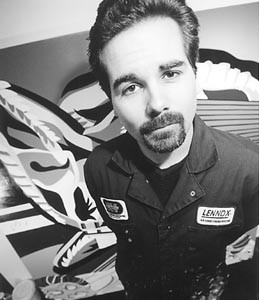
Loudon Wainwright

0

Loud ‘n’ Clear


Hugh Brown

Troubadour: Forget road kill–Loudon Wainwright plumbs the depths of the soul

Loudon Wainwright III, storyteller on wry

By David Templeton

I’LL BE RIGHT with you,” says Loudon Wainwright III, answering the phone on the fifth ring. “I just want to turn down the old television–I’ve had Clinton up for a while.”

Oh. Right. Clinton. This interview is taking place, it so happens, on the very same day that the president’s infamous grand-jury video is being aired all over the world, part of the GOP’s transparent effort to turn its Democratic nemesis into road kill on the public opinion highway. Wainwright, who’s been keeping up with the whole debacle–and who doesn’t think Clinton looks half bad defending himself on the video–certainly knows a thing or two about road kill: Though he’s written hundreds of ingeniously crafted, inventive, and beautifully melodic songs throughout his 30-year career in music, he is probably best known for the campfire classic “Dead Skunk in the Middle of the Road,” a Top 20 hit in 1972.

Not to mention that he’s the father of rising music star Rufus Wainwright.

When Wainwright the elder arrives in Sonoma County Oct. 8 at the Mystic Theater in Petaluma, he’ll be performing songs selected from 16 albums recorded over the last three decades. His latest, Little Ship (Virgin), has been enthusiastically pointed to–by scads of publications from Entertainment Weekly to the New York Times–as an example of a singer-songwriter working at the top of his craft. With background vocals by Shawn Colvin, the CD is Wainwright doing what he does best: zigzagging from silly, tongue-tying goofball songs–the horny, pun-filled “Breakfast in Bed” and the manic-depressive “The World (Is a Terrible Place)”–to songs of heartbreaking honesty and frank personal insight (“Four Mirrors,” about his growing resemblance to his father, and the wise-in-hindsight “Our Own War”).

Then there are the songs, such as “Bein’ a Dad”–with the lyric “A daughter and son can be sort of fun, as long as they don’t defy you./ They’ll treat you like a king, they’ll believe anything, and they’re easy to frighten and lie to”–that can literally make an audience laugh and cry at the same moment. That’s a nasty little trick that Wainwright, a masterful worker of live crowds, seems to take special delight in.

“A show should be just that, a show,” he says when he picks up the phone again. “There should be a certain theatricality to it. I don’t see myself as a recording artist so much as a performer. I love to perform, to spontaneously banter with a crowd. The stage is the most natural environment for me.

“There are certainly nights when I don’t enjoy myself, for whatever reason,” he allows. “But in general, I love to stand up there and jump around and sing these songs.”

By “these songs,” Wainwright does not necessarily mean the one about the dead skunk. Though he will still occasionally surprise an audience with it, he rarely sings that particular song any more.

“That was a long time ago,” he says, good-naturedly. “And there are lots of other, better songs to sing.”

AS FOR THE PATENTED LW3 acerbicity, he doesn’t think he necessarily deserves a reputation as folk music’s reigning pessimist. This in spite of such songs as “The World,” with the verse “The world is a crappy old hole, from bottom to top and from pole to pole./ No, there’s no good news, this world’s useless./ I’m out of here, that’s my goal, ’cause the world is a crappy old hole.” This performed on a banjo, “the ‘happy’ instrument of folk music,” as Wainwright calls it.

“Well, the world is a crappy old hole, sometimes,” he laughs. “But ‘sometimes’ is the key word. I don’t want people to think I’m a complete misanthrope. The truth is that the world is interesting and amazing and beautiful–and it’s also a terrible place.

“Actually,” he adds, “I mainly wrote that song to mess with and piss off Pete Seeger,” the world’s greatest promoter of the Happy Banjo mindset.

As for son Rufus, Wainwright affirms that he’s done pretty damn well for himself. “As well he should,” he beams. “He’s extremely talented, I must say. His sister Martha, also, who sings on his record and who’s sung on my albums–she’s also doing very well. She’ll be cutting her own record soon, it looks like. So both of those kids are off and running.”

He pauses a split second, then adds one more remark to describe his parental pride. Not surprisingly, it sounds like the lyric from an LW3 song. “I’m proud of them, jealous of them, annoyed by them,” he says. “Hopefully, they’ll buy me a house.”

Loudon Wainwright III performs Wednesday, Oct. 7, at 8 p.m. at the Mystic Theater, 21 Petaluma Blvd. N., Petaluma. Tickets are $15. For details, call 765-6665.

From the October 1-7, 1998 issue of the Sonoma County Independent.

© Metro Publishing Inc.

Wild Mushrooms

0

Dig It!

Michael Amsler


A quick-and-dirty guide to the velvet underground

By Marina Wolf

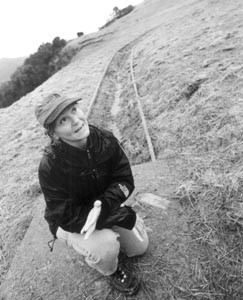
THE SUN AT Salt Point State Park is strong. Even the cool air in the coastal woods has a toasted resin smell to it. But Pete Petersen, my contact at the Sonoma County Mycological Association and the planner of the day’s expedition 20 miles north of Bodega Bay, assures me that there already have been mushroom sightings here this season, so we may get lucky. Pete’s been ‘shrooming for 35 years, so I’ll follow his lead any day.

The rest of the party–Sue Davidson, Elissa Rubin-Mahon, and Elissa’s 13-year-old daughter, Ariel Mahon, all members of SOMA–are ready for the hunt, with wicker baskets, rusty knives, and well-worn guidebooks. And they are enthusiastic, even though their predictions have been dire about the likelihood of finding anything today.

“It’s very dry, much drier than last year,” says Elissa, who has been hunting mushrooms since 1981. “Last year was a really early year, and the mushrooms were abundant. This season at the places I was finding pounds of mushrooms last year, I’ve only found one very small one.”

This particular spot, known to generations of Russian- and Italian-Americans as a jackpot for succulent porcini and chanterelles, is seeing increased traffic as other hunting grounds closer to cities have been covered up by housing developments. “It takes generations of growth before boletes [porcini] and chanterelles come up,” Elissa says. “If you wipe out an area, they usually doesn’t come back for a while.”

Which is not to say that you need to travel to pristine wilderness to find good ‘shrooms. “I have a spot in my neighborhood that I check out now every year,” chirps Sue, a cheery older woman who looks as though she might teach home-ec when she’s not crawling around in the woods.

“Yeah, we have chanterelles that come up not too far from us in the winter,” Elissa answers absentmindedly from the little hollow to which she had made a beeline. She pulls up a stack of pine needles and lets out the first call of the day: “I found some!”

The creamy yellow lumps emerge under Elissa’s careful fingers. “They’re a little dry,” she says, “but they’re not old.” She cuts the two blooms free and hands the mushrooms over to Pete, who holds them up to my nose. They give off a faint apricot smell, overlaid by an irresistible aroma of dusty old velvet, and the pale skin darkens with exposure and handling to a burnished gold. Everyone is tangibly excited by this first find. “There’s a happiness in going out to the woods, hunting stuff,” Pete explains. “It goes back to when we were hunters and gatherers thousands and thousands of years ago.”

Sue nods her head vigorously. “You’re hardwired to do it. It feels really natural.”

AFTER THE THRILL wears off a bit, Sue and Ariel head off down the gully, while Elissa pares the stems clean. “Part of mushrooming is intuition,” she says matter-of-factly, scraping the tender flesh with casually perfect strokes. “I almost get a feeling in the pit, in the solar plexus, that something’s starting to happen, and I’ll come and look.”

Another part of mushrooming is, of course, practice, which is where SOMA comes to the rescue with frequent outings and workshops for dedicated seekers and curious members of the public alike. To ward off any mycological misadventures–every rainy season seems to bring on a small but well-publicized crop of ill-informed individuals in need of mushroom-related liver transplants–SOMA hosts a mushroom fair every winter, with mycologists on hand to indentify fungi, and the group sponsors a year-round helpline. Accessible through directory information, the recording gives contact numbers for some of SOMA’s senior members, outlines emergency procedures for bad- or worst-case scenarios, and reiterates the mushroom novice’s mantra: Don’t eat it until a pro says you can.

The pros on hand know exactly what we’re looking for. Elissa resumes her intent scrabbling around the pine trees, while Pete demonstrates the finer points of mushroom structure to the fascinated Independent photographer. I catch up with Ariel, who seems a precocious youngster indeed. Latin terms spring from her lips with unstudied ease, interspersed with gossip about other mushroom hunters and enthusiastic tales of her outings with mom. Ariel has been mushrooming since the age of 4. Sheesh.

I’m never going to catch up.

AS WE CLAMBER around the side of the ravine, the two older women exchange sites and recipes for their favorite fungi. We have covered a swath of hillside a couple of hundred feet long, and still I have found nothing.

I ask Elissa to come with me to the other side of the glen. By now, the bottom of her basket is thickly covered with chanterelles, and I harbor a vague hope of her mushroom magnetism rubbing off on me.

Then I look down at the base of a tree not 25 feet from the parking lot and see a glint of blonde in the dark forest floor. “Hey,” I call out weakly, the excitement mounting in my chest, “is this one?” The others come quickly, and Pete kneels down next to me for a closer look. Yes, it is a chanterelle. Grinning like an idiot, I wrap it proudly in paper towel and put it in Pete’s basket.

Back at the parking lot, my head fills with visions of a future full of wild, flavorful fungi. I could do this–a lot. But the logistics of mushroom hunting are daunting. Mushroomers can be secretive about disclosing their favorite spots–this group asked me to avoid naming the specific site that we’re hunting in–and in any case, only three public parks in Sonoma County are open for gathering: Salt Point, Tomales Bay, and Samuel P. Taylor.

“Basically you need to find people who own private property,” says Pete.

“We’re really trying to work toward getting all of the state parks open,” adds Elissa. “Right now, they’re saying, oh, there’s too much pressure, there’re too many people picking here. Our belief is that if they opened everything up they would spread the activity out.”

Potentially that leaves the gate wide open for commercial harvesters–who can pick up $2-$7 cash for a pound of chanterelles–for whom this particular group of mushroomers has a certain disdain. “The commercial pickers travel in caravans,” says Elissa. “They start in the summer in Alaska, in trailers and vans, and they work their way down. They’re not supposed to do it here. But I’ve seen at the north end of the park when bolete season is upon us, 20 or 30 vans of people.

“You know they’re out there doing it.”

Nods and murmurs from the others accompany Elissa’s complaint, but the conversation eventually turns back to recipes for the chanterelles in hand (general consensus calls for a quick sauté in butter).

It’s hard to stay worked up about porcini poachers after exercising one’s hunter-gatherer instincts, which are probably, as Ariel suggests, closer to the stomach than to the brain.

SOMA meets on the third Thursday of the month, from September through May, at 7 p.m. at the Sonoma County Farm Bureau (970 Piner Road, Santa Rosa). Membership is $15 per household. The mushroom hotline is 833-1097.

From the October 1-7, 1998 issue of the Metropolitan.

© Metro Publishing Inc.

Mark Fishkin & Mill Valley Film Fest

0

A Life in Film


Cinematic vision: Mark Fishkin of Petaluma is executive director of the Northern California Film Institute, which presents the Mill Valley Film Festival.

Janet Orsi


Mark Fishkin ushers in
Mill Valley Film Fest

By Greg Cahill

ASK MARK FISHKIN, co-founder of the Mill Valley Film Festival, about his most embarrassing moment at the popular North Bay event and he shakes his head and moans. “There’s always the story about the time we showed Nicholas Ray’s last feature a dozen or so years ago,” he recalls, nursing a cup of espresso at a Petaluma riverfront cafe. “We were doing a tribute in memoriam to him. Acting legend John Houseman was in the audience, sitting next to me. We were going to show a short clip from Rebel without a Cause before showing Lightning over Water, his last film.

“Instead, the clip from Rebel without a Cause went on and on and on. Houseman turned to me and said, ‘Mark, are you going to show the whole movie?'” says Fishkin, impersonating the late thespian’s droll speech.

“I said, ‘No, of course not,’ and went up to the booth to find out what was going on. I found the projectionist lying on the floor with the whole print of Lightning over Water on top of him–he had dropped the platter.

“He looked up at me, red-faced, sweating, his eyes twice their normal size, and said, ‘It’s OK! It’s OK! Give me five minutes to fix it!’

“I spent the next half hour running back and forth to the concession booth and handing out free popcorn and wine before finally announcing that the tribute had to be canceled. It took the projectionist all night to put the print back together.”

These days, the popular film festival–which attracts a large contingent of Sonoma County film buffs–operates much more smoothly and has become quite prestigious.

The 21st annual Mill Valley Film Festival runs Oct. 1-11, with screenings held at the Sequoia Theatre in Mill Valley and the Lark Theatre in Larkspur. The fest will feature a wide selection of independent films and dozens of international features, including several world and U.S. premieres, a tribute to British actors Derek Jacobi (Love Is the Devil, I Claudius) and Helena Bonham Carter (A Room with a View, Howards End), several filmmaking seminars, and a children’s film series. It opens tonight with a screening of poet Maya Angelou’s directorial debut Down on the Delta and closes with the modern fairy tale Pleasantville, the new film from Gary Ross (Big, Dave).

Over the years, Fishkin adds, the film fest has become “more than a sum of its parts,” helping both independent filmmakers who don’t get enough support in the marketplace and a public faced with an increasingly narrow range of choices at the box office.

“We also have a hidden agenda where we illustrate what an amazing medium film is and how it can influence people,” confides Fishkin, 49, who lives in Petaluma with his wife, Lorrie, and their 9-year-old daughter, Lindsay. “We’ve all heard about how it can influence people negatively in terms of children viewing violence. One would also hope that you can influence people positively.

“I believe film gives us the ability to see who we are, where we are, and how we relate to each other, to the planet, to political, environmental, and social issues.”

Ironically, it was filmmaking, and not film programming, that lured Fishkin, a New York native, to the Bay Area in 1976. “I once heard Francis Coppola at the Telluride Film Festival talking about good ways to break into the film industry,” Fishkin says. “He confirmed my gut feeling that it should be done through screenwriting.

“Of course, I had visions of six figures dancing in my head.”

Appalled that a community the size of Marin had virtually no alternative cinema, Fishkin began programming a weekly College of Marin film series. For a while, he considered buying the old Plaza Theatre in Petaluma (now the Mystic Theater & Dance Hall), but decided it would cost too much to remodel the aging movie house.

He later took over Mill Valley’s legendary Saturday Night Movies held at the local Odd Fellows Hall. It was a logistical nightmare. The small staff, mostly student volunteers, had to set up and tear down folding chairs between each show. And then there were the auditorium’s poor acoustics.

“The sound in the hall was so bad that I really could only show films with subtitles,” he laughs.

When the “losses became too much and the headaches too great,” Fishkin bailed out of the enterprise. In October 1977, he and fellow film buffs Rita Cahill and Lois Cole organized a three-day film festival. It featured three film tributes, Coppola’s Rain People, and George Lucas’ The Filmmaker.

“We did a very innovative program that I would not be embarrassed to repeat today,” he says.

It was a big hit. Since then, the fest has gained considerable stature in the industry. It now ranks as one of the top U.S. film fests. Among its success stories was the 1987 world premiere of Walking on Water, with Edward James Olmas and Lou Diamond Phillips. That film later went on to achieve critical acclaim and commercial success as Stand and Deliver. It received a 10-minute standing ovation at its premiere.

Fishkin is especially gratified at the role the film fest has played in nurturing such independent films as The Crying Game, My Left Foot, Like Water for Chocolate, and Strictly Ballroom–films that until recently would have enjoyed only a limited audience but which have gone on to widespread success. “That’s encouraging,” he says. “I also feel some gratification that our growth has paralleled the growth of the independent filmmaker movement.

“I think we’ve had some role in that.”

And even though that early ill-fated homage to Nicholas Ray ended in disaster, many of the fest’s other tributes have ranked among Fishkin’s most memorable moments. Among those who have been spotlighted are Olmas (Zoot Suit, American Me), John Frankenheimer (Seven Days in May, The Year of the Gun), and Jack Arnold (The Incredible Shrinking Man, The Creature from the Black Lagoon).

“It was an especially great thing to see how the audience responded to Jack Arnold,” Fishkin points out. “People came to the midnight screening of The Creature from the Black Lagoon in 3-D glasses and even brought their kids because they wanted them to experience this classic horror film.

“Jack wasn’t in very good health even then, but he just wanted to acknowledge the crowd. When he stood up and faced the audience–with his 3-D glasses on–the roof almost caved in from the applause. He cried.

“It was an incredibly moving moment.”

The Mill Valley Film Festival box office is located at the corner of Blithedale and Throckmorton avenues in Mill Valley. For program and ticket information, call 415-383-5346.

From the October 1-7, 1998 issue of the Sonoma County Independent.

© Metro Publishing Inc.
Spins

0

Psyched!

Various Artists Nuggets: Original Artyfacts from the First Psychedelic Era, 1965-1968 Rhino

THEY SAY you always return to the music of your youth, so in the spirit of public disclosure I offer this fact: I was weaned on a steady diet of psychedelic nuggets.

Fuzz tone, feedback, and swirling Farfisa organs–I couldn’t get enough of ’em. The Standells, the Shadows of Knight, the Count Five–all were staples on my cheesy Sears & Roebuck phonograph.

That said, Nuggets–newly reissued as a four-CD box set, replete with 118 tracks and a 98-page color booklet–is something of a nugget itself. Originally released in 1972 as a two-LP anthology (compiled by Lenny Kaye, who went on to fame as punk diva Patti Smith’s guitarist and musical collaborator), the collection is one of the few sets consistently included on lists of all-time greatest rock albums.

In this digital age, Santa Monica-based Rhino Records several years ago released Nuggets as three separate CD volumes. This beefed-up version (which features the original two-LP version on one glorious disc) underscores the lingering influence of a subgenre that can still be heard on college radio (thanks to garage bands like the Lyres) and as source material for psychobilly bands like the Cramps and even Neil Young (who covered the Premier’s party hit “Farmer John,” which is included here).

While some of these tunes are featured on classic rock stations–most notably the Standells’ 1965 hit “Dirty Water” and the Kingsmen’s 1963 masterpiece “Louie Louie”–most of these truly qualify as nuggets of the psychedelic era. And you’d be surprised how many big-name then-unknowns pop up: John Fogerty (the Golliwogs), Todd Rundgren (Nazz), Ted Nugent (Amboy Dukes), Dan Hicks (the Charlatans).

But some of the best stuff is the hard-to-find long-out-of-print singles by regional teen bands who locked on to a blues groove here, a Yardbirds lick there, and ran with it for two minutes of unadulterated proto-punk garage rock. Case in point: “Primitive” by the Groupies, a New York band that transformed a rather poorly played guitar riff from Howlin’ Wolf’s trademark “Smokestack Lightning” into a monster track of malevolent mood.

An absolute must for any serious rock hound. GREG CAHILL

Patty Griffin Flaming Red A&M

IN GENERATION LILITH, Patty Griffin is a cut above the pack–a tough rocker who’s not self-absorbed like Courtney Love, an emo-folkie who’s not juvenile like Jewel, an idealist-dreamer who’s not vague like Sarah McLachlan. Her deepest strength is a soul-baring humanism that hits universals via detailed portraits. The new track “Tony,” for example, has as its object a suicidal homosexual teen, but its subject is the pervasive doubt that we all use to block human contact. Griffin’s new disc, Flaming Red, falls short of her gripping debut Living with Ghosts not because she replaces the debut’s acoustic starkness with a full-bore modern-rock sound, but because she doesn’t offer enough colorful portraits like “Tony” or the stunning stories “Poor Man’s House” and “Sweet Lorraine” from the debut. Still, her willingness to streamline her writing while exploding her sound is the sign of a brave artist who is pushing her audience to join her where her “heart is big and sore.” KARL BYRN

From the September 24-30, 1998 issue of the Sonoma County Independent.

© Metro Publishing Inc.

The Scoop

Porn Starr

By Bob Harris

NOW THAT Kenneth Starr has put his finishing strokes (cough) on his report concerning President Clinton, Monica Lewinsky, three cans of candied yams, a turnip, and a bag of elastic bands, stories about other politicians are now surfacing as well.

In fact, at least one, Sen. Dan Burton, has even pre-emptively released details of his personal life, just to ward off any future chance that his own interoffice mash notes might someday be released in paperback.

This is cool.

Something similar happened a few years ago when Washington went through a spasm of confessing past drug use. Clinton, as we all know, didn’t inhale, although now we can reasonably assume we know why his breath was so short. Newt Gingrich also admitted to the demon weed, rationalizing it was merely a function of his presence on a 1960s college campus. Which is a weird thing for him to say, since that also rationalizes free love, protesting the war, and living in a VW microbus, all of which done at the same time would get kind of crowded. And a bunch of other politicians chimed in with their own confessions of drug use until suddenly no one cared much anymore.

A similar level of story burnout might happen with the sex thing. In the last couple of weeks, in addition to the president’s tale of woe (and if you read footnote #210, it’s more of a tale of whoa!) we’ve also been treated to sudden revelations about (a) the aforementioned Sen. Dan Burton, R-Ind., a story that ran in two columns on page A5 in many papers; (b) Rep. Helen Chenoweth, R-Idaho, an admission that got 200 words page A14; and (c) Sen. Henry Hyde, R-Ill., a story that was passed by 57 news organizations before Salon.com tackled it.

At this rate, in six months Al Gore could get caught having oral sex with an endangered tree-fowl, and it wouldn’t even reach the papers.

Make up your own spotted owl jokes here.

Surveys indicate that while most of us certainly don’t approve of making the Oval Office an erogenous zone, we also wish this media circus would just stop, one way or another. In short: Let’s get Clinton resolved, and then let’s get these tawdry sex scandals out of the front pages and back into the sports section where they belong.

Which means that maybe the best thing we can do to make this go away is to start confessing all of our own sexual transgressions.

So as a public service, here are mine. I confess: I have had sex with people other than myself; I am filled with remorse and I can only ask for your forgiveness. This is a very difficult time, both for me, and … well, nobody else. But still, I hope I can now return to the important business of writing this commentary.

NOW THAT the Starr report is out in paperback, I wonder exactly in which section bookstores will stock the thing. Current Events and Politics would make the most sense, but really it could work in a lot of sections.

The White House staff would probably file it in the Horror and Mystery section, and a lot of Republicans would want it in True Crime, although it probably won’t wind up in either.

With all the publicity, Performing Arts might be a little more likely. Or given the speedy nature of the interludes, the report might better belong in the business section under Time Management.

Then again, the cigar thing makes me think it really belongs more in the Hobbies section, but Clinton’s long list of alleged girlfriends might also make the report appropriate to Collections.

Kramerbooks, the Washington, D.C., bookstore that got subpoenaed, probably stocks the report in Local Interest, and frankly I think Monica really ought to swing by and autograph a few copies, just as a thank-you for her own upcoming book deal.

My suggested title for Monica’s new book: Gargling with History.

Hey, if they do a Books-on-Tape version of the Starr report, who’s gonna narrate? The Democrats would probably want Woody Allen, whose delivery would suggest the sadly bumbling nature of the encounters–and whose presence would make Clinton look downright upright by example–but if you’re a Republican, there’s only one choice: James Earl Jones.

Imagine millions of people hearing the Starr text delivered in that Darth Vader Voice of Doom: “The president unbuttoned her blouse and touched her breasts without removing her bra. …”

You can almost hear the audience recoiling in fear: He’s a madman! Somebody stop him!

Then again, since (a) the sex scenes are less titillating than the personal ads in the back of most of the weekly papers that carry this column; and (b) the report barely mentions the serious stuff like Travelgate, Filegate, and Whitewater–all of which together got exactly two more mentions than my Aunt Treva, and she’s never even been to the White House–maybe we can already guess where a lot of copies of the Starr report will ultimately wind up: the Bargain Bin.

At least I hope my Aunt Treva hasn’t been to the White House.

From the September 24-30, 1998 issue of the Sonoma County Independent.

© Metro Publishing Inc.
Karen Leonardhas

Sacred Bones

Author Karen Leonardhas revised Jessica Mitford’s 1963 investigative classic The American Way of Death. Now she has a bone to pick with funeral home directors

By Stephanie Hiller

D EATH is not only sometimes painful, frequently inconvenient, and only seldom desired, it’s expensive. From nursing homes to fancy hospitals, the process of leaving the planet is enormously costly, yet enormously profitable for those who usher us out. Not the least of our beneficiaries in death is the undertaker. And today, the price of a funeral, never a bargain basement deal, is exorbitant.

Our “remains,” as the mortician prefers to call a cadaver, are a valued commodity for a prosperous $16 billion-a-year industry tending to some 2 1/2 million deaths a year. And just like the other industries that supply the food, the medicine, and all the other goods and services on which we depend, the funeral industry is becoming increasingly corporatized. Says author Karen Leonard, head of the Sebastopol-based Redwood Funeral Society, one of 150 similar groups nationwide that provide funeral information to consumers, “You know the song lyric, ‘My soul belongs to the company store’? Well, your body belongs to Wall Street.”

And, she laughs heartily, “It’s become nothing more than a commerce of corpses.”

Leonard is also the researcher for the revision of the late muckraking journalist Jessica Mitford’s best-selling exposé of the funeral industry, The American Way of Death, originally published in 1963 and just released in a new edition by Knopf.

“Decca,” as Mitford was known to her friends, was the idol of the intellectual left until her death in 1996 at the age of 78, and the heroine of investigative journalists everywhere. “She was amazingly funny,” syndicated columnist Molly Ivins once said about her, “and such a class act. She was just enchanting.”

Born to a highly aristocratic English family, Mitford was a confirmed Communist till her dying day.

“She was engaged with life at every moment,” says Leonard, who lived and worked at Mitford’s home during the months before the journalist’s death. “She’s the only person I know who cut a rock-‘n’-roll record in her 70s. She liked to have an entourage of people around her all the time. They were from all walks of life, but she treated them all with the same gracious hospitality.”

Leonard first met Mitford at a national meeting of the Funeral and Memorial Societies of America and was outraged to discover that Mitford’s address had received no prior publicity.

While carrying out her own activities, Leonard hurriedly set up appointments with reporters. None of them showed. Mitford, who had been waiting alone in her room for two and a half hours, was beside herself. She came into the lobby and “all but raised her cane at me! I was devastated. My dream was to work with Decca on one of her books.”

IT was the corporatization of the industry that spurred Mitford to revise her book. She felt that people need to know that Duffys’ Funeral Parlor, though it still bears the family name, may no longer belong to the Duffys.

Careful to conceal their ownership of established, no longer independently owned mortuaries, three large corporations have been taking over the U.S. industry during the past 10 years, performing one out of every five funerals nationwide. More than half the industry in California is corporate-owned, and out of 3,000 cemeteries and crematoria, only 300 remain independent.

The most well-known cremation outfit, the Neptune Society, is owned by Stewart Enterprises, the third largest international conglomerate.

The corporatization of the industry means that we have less control over our own dead bodies. Texas-based Service Corporation International, the Loewen Group, and Stewart have jacked up their profit margin by consolidating such services as embalming and funeral transportation to accommodate several mortuaries at one time, creating highly lucrative economies of scale. But the profits have not been passed on to the consumer.

Chain mortuaries usually raise prices–sometimes as much as 100 percent–after acquiring an established independent home. With funeral prices increasing three times faster than the cost of living, final arrangements are now the third largest expense families face. “It’s a cornered market,” Leonard is quick to point out. “Everybody dies.”

For the most part, survivors, too busy and often too distraught, are not inclined to shop around. The average full funeral in America is now $4,850, according to the National Funeral Directors’ Association. Add another four grand for the average cemetery charges, and an American death costs as much as most folks in this country spend for the down payment on a house.

Leonard, 45, began researching the funeral industry 10 years ago, when she became a partner in a highly unusual enterprise: the Funerary Art Gallery in San Francisco. It all started one day when Leonard was talking with a couple of old friends about their careers. A student of gerontology at Sonoma State University, Leonard was very disappointed when she figured out that the only way she could make a living in that field was in administration.

Her friends had similar frustrations. Leonard’s best friend of 27 years told the group she had recently received a news clipping from her mother depicting a woman selling caskets. Her mother’s scribbled comment read, “Maybe this is what you and Karen should be doing.”

“We thought of artists and craftspeople making caskets. Overnight we were hearing from artists all over the world,” Leonard says. “A lot of them were very famous artists and had incredibly uniquely wonderful stuff. Artists had always paid a role in memorialization until the American funeral industry set up, and now everything was mass manufactured.”

People who came to the gallery looking for a reasonably priced casket later returned, saying funeral directors wouldn’t take their caskets “because the bottom might fall out!” Sometimes mortuaries even damaged the caskets, then claimed they were of inferior quality. Disturbed, Leonard went undercover to search for an honest funeral director.

At one of the biggest mortuaries in San Francisco, she and her partners were met at the door by two funeral directors. “It was plush city, and we were nervous, because we were retailers, we were the enemy,” Leonard says. They were shown a film in which two types of casket were displayed, the protected and the unprotected. “I asked the funeral director what they were protected from,” Leonard says. “He leaned forward, put his hands on the desk, and said, ‘Aliens and foreign objects reaching the body of your loved one.'”

The metal and mahogany boxes sealed with a tight rubber gasket create an anaerobic environment in which bacteria thrive, reducing the body in a matter of months to a noxious putrefaction and releasing gases that are capable of exploding the container. Indeed, when the casket is headed for a mausoleum, the savvy mortician will pop the seal on the way to the cemetery, just to let in some healthy fresh air, to avoid possible damage to the crypt walls if the lid blows.

LEONARD had just finished reading The American Way of Death. “I loved it! I thought it was the best book I had ever read,” she says. Entering the casket room, Leonard was amazed to discover that the selections were arranged exactly as Mitford had described 20 years earlier, with the lower-priced items arranged in the “Aisle of Resistance” and the better models in the “Aisle of Prosperity,” a sales design created many years ago by the infamous W. M. Krieger to seduce the consumer into buying the “better”–fancier, cushier, longer-lasting–casket.

Leonard visited lots of funeral homes. Then one day she found what she was looking for. At Pacific Internment, she met funeral director Frank Rivera, an ex-cop. “While I was in the office, he was on the phone,” Leonard recalls, “telling a customer, ‘You don’t have to do embalming to view the body.’

“That’s when I knew I had found an honest funeral director.”

Leonard calls embalming “the heart and soul of the American way of death. It’s what makes undertakers necessary,” she says, making it very clear that she’s not in this just for the fun of it.

Preparing the body, transporting it, and arranging the memorial service do not require special training or professional certificates; these tasks can be performed by the families.

But embalming is a technical procedure that must be learned, and, involving as it does the removal of essential bodily fluids, it is highly regulated. Hence it is embalming alone that endows the funeral director with the professional status–and inflated income–he or she craves. Most people assume that embalming is required for reasons of public health and that it preserves the body. Neither is true.

If anything, embalming is the hazard. Blood-borne pathogens removed from the corpse are a biohazard, and the toxic chemicals used in the process are pollutants.

Nor does an embalmed body last longer than a refrigerated stiff. Why, then, are bodies embalmed? Funeral directors speak about the importance of the “memory picture” of the beloved that retains the appearance he had in life. Such a picture is essential for grief therapy, funeral directors murmur. For many families, it’s an unforgettable image of debt.

Pacific Internment offered the consumer a choice. Prices were reasonable; the casket sold for twice, not five times, the wholesale price. But it would not have been appropriate for Leonard to advertise her favorite mortuary at the gallery. Instead, she began posting price lists of all the mortuaries so that her customers could be informed.

The law requires that a price list be offered at the outset, but many mortuaries skip this step, or offer 10-page brochures that the bereaved do not read. Leonard began consulting with customers, informing them of their rights.

Leonard’s education in funeral affairs was advanced considerably when, quite by accident, she called the Bay Area Funeral Society, thinking it was a funeral home. Started by Mitford’s husband, attorney Bob Treuhaft, the society was the most radical of the non-profit consumer organizations. There she met Ernie Landauer, who persuaded her to open a branch in the North Bay.

“There were 2,000 names on the membership list. Unfortunately, no one had checked on these people for a long time,” Leonard says. “More than half had moved on from that address–or from this life.”

It was through her work for the Funeral and Memorial Societies that Leonard had the opportunity to meet Mitford again–under more favorable circumstances. Landauer urged her to write Mitford and report her own activities on the consumer’s behalf.

“She won’t know it’s you,” he advised. Leonard began a correspondence that culminated in a phone call one stormy day in 1995. Says Leonard: “‘I’m thinking of revising The American Way of Death,’ she told me, ‘but I just can’t consider doing it unless you’ll be my researcher.'”

Leonard went to the author’s home in Oakland with some trepidation. Mitford was rushing out to attend a protest against the hospital that had recently cared for her; she didn’t recognize the woman she’d railed against some years before. Among all the Funeral and Memorial Societies nationwide, Leonard is the only member who is not a retiree.

“Most of the funeral societies have become middlemen for the funeral industry,” Leonard explains. “The members are elderly, white, well educated. Their main interest is lowered costs, and the industry provides services to them at slightly reduced rates.”

The Redwood Funeral Society, by contrast, has become a true consumers’ advocacy organization, doing price surveys, educating the public about consumers’ last rights, and actively advocating for legislation to protect the consumer from the tricks of the undertaker’s trade. A rule designed to do just that was passed in 1972 in response to the outcry raised by Mitford’s book, but it has not been enforced.

THIS SPRING, the RFS completed a survey of Sonoma County funeral homes. Those owned by the three corporate giants charge as high as twice as much as the others, and three times as much as Pacific Internment’s Frank Rivera does. Prices for direct cremation (no funeral, no embalming, no viewing the body) range from $905 at Pleasant Hill Mortuary to a whopping $1,839 at Eggen & Lance, which is owned by SCI. By contrast, Pacific Internment offers direct cremation for $530 to members of the RFS, who can prearrange without prepaying, avoiding the industry’s prepayment trap, which allows them to use members’ money while members pay the interest on it, and never turns out to be quite enough to cover all the costs when the time comes. Leonard states unequivocally that the FTC has gone “into cohoots” with the National Funeral Directors Association. “For 10 years,” she says, “SCI had had to tell the FTC when they purchased a new mortuary. SCI went to the FTC to reopen the ruling, stating that this was too much of a financial burden.

“The FTC generously dropped the requirement!”

The consumer advocacy board of the Department of Consumer Affairs is composed entirely of members of the industry. “When you go to Sacramento, you can tell the public is not welcome,” says Leonard. The goal of the board is not to handle complaints or otherwise protect the consumer. “It’s to raise the requirements of funeral directors to make sure small business people cannot afford to get into the business, and to make themselves professionals like doctors and lawyers,” Leonard says.

A 1997 ruling states that nobody who has not obtained training approved by this board of funeral directors and embalmers is permitted to help arrange or discuss funeral transactions, or even participate in arranging for transporting a dead body. Not only must you have proper training; you must work for a mortuary.

“Most people didn’t even know you had the right to care for your dead,” says Leonard, “so I went on an educational campaign–and they started doing it!”

The Natural Death Care Project in Sebastopol, for example, exists to guide families through the process of caring for the body at home and transporting it to the crematorium in a simple cardboard or pine box, without the intervention of a funeral director.

In the past five years, over 300 deaths in Sonoma County have been handled this way, at enormous savings. But more important, families who have cared for their dead say that the experience of washing and preparing the body and laying it out at home is not at all creepy or weird; it is actually rewarding, allowing for full closure with the beloved friend or relative and a firm sense of the reality of death.

Local funeral directors say the industry has been affected by the work of the Natural Death Care Project and others to the tune of $70,000 a year. And word is spreading. The NDCP is planning to do workshops with health-care professionals at Kaiser this summer on alternatives to the fraudulent practices of the funeral industry. The Redwood Funeral Society is trying to develop a special project to inform the clergy of their parishioners’ options.

It’s free choice that Karen Leonard is after, and the right to our sacred bones. “We have to take apart laws that amount to restraint of trade. . . ,” she says. “The funeral industry doesn’t [have the right to] tell us how to deal with our deaths. We [should] decide what we want.”

How a society cares for its dead reflects the values it holds dear. For Leonard, the reign of the modern-day mortuary shows that we are still confusing monetary worth with human worth, still believing that spending a lot of money can prove or else compensate for the love we felt but couldn’t share.

“We have to change the way we deal with our dead,” Leonard says. “We have to take a look, as a culture, at the soundness of our minds.”

Karen Leonard will discuss The American Way of Death Revisited on Monday, Sept. 28, at 7 p.m. at Copperfield’s Books, 2316 Montgomery Drive, Santa Rosa. .

From the September 24-30, 1998 issue of the Sonoma County Independent.

© Metro Publishing Inc.
Lost in Cyberspace

0

Resignation Rag

By H.B. Koplowitz

They had sex, sort of. He lied about it, sort of. So what. When you raise your hand and swear to tell the truth, the whole truth, and nothing but the truth, it’s supposed to mean something. Impeach the bastard. Let him go. He committed adultry. So did you. Round and round and round it goes, and when it will ever stop, God knows. Ironically, there’s only one person with the power to make Monicagate go away, and only one way for him to do it. It may be the only power he has left.

But until he does, the rest of us will have to resign ourselves to more Monica madness, even in cyberspace.

Ironies abound in this Greek-American tragedy. Ironically, the same Congress that gave us the Communications Decency Act to control smut on the Internet publishes Independent Counsel Kenneth Starr’s smut on the Internet. And Americans who said Congress should stop obsessing over Monica Lewinsky get their first exposure to “Thomas“, the Congressional website that keeps track of legislation, because they wanted to see Starr’s report on Monica Lewinsky.

“Thomas” was created by Congress in 1995 to make information about federal legislation freely available to the public. Named after Thomas Jefferson (who, ironically, had his own moral turpitudes), the website lets you look up legislation by bill number, keywords and other search options. “Thomas” also has an online version of the Congressional Record, bill summaries, House and Senate calendars, roll call votes, public laws, committee reports, a guide to how laws are made and historical documents including broadsides from the Constitutional Convention and Continental Congress, the Declaration of Independence, the Federalist Papers and the Constitution.

An estimated 5.9 million people read Starr’s report on the Internet the first two days, including 3.6 million who read it at news sites. But plebs seeking their morning Monica shot got a different kind of jolt if they logged onto the website of the New York Times on Sept. 13. For much of that day, the Times website was hijacked by hackers, who replaced its front page with a rant from self-described “Internet terrorists” calling themselves HFG, or Hacking For Girlies.

No damage was done, but like recent hacks of Motorola, Justice Department and CIA websites, the real danger is in what they COULD have done. Instead of posting juvenile jokes about cigars, theoretically, HFG could just as easily have changed the content of “Times” stories, and even of Starr’s report.

Of course, juvenile Monica websites continue to proliferate. Links to many can be found at “The Best of Monica Lewinsky“. Numerous sites have versions of “Clinton Body-Count“, a list of persons associated with the Clintons in one way or another, from Vince Foster to Barry Seal, who have died under “questionable circumstances.”

And if you’re too lazy to wade through the “legalisms” of the Starr report and want to get straight to the sleazy stuff, the website of the “Kenneth Starr Report Analyzer Engine” lets you type in strategic words and phrases, such as “obstruction of justice” or “cigar,” and each occurrence is displayed on your screen.

Is the Starr report about impeachment (12 occurrences) or sex (367)? Does the report focus more on perjury (32), or oral sex (72)? You make the call.

It’s only fitting that Starr’s report was first released to the public on the Internet. Cyberspace has been on top of this scuzzy story from the beginning, especially through Matt Drudge’s Drudge Report, which first revealed details of an affair between the president and an intern. Now Drudge is reporting that a video has surfaced of the prez getting chummy with yet another young lady near the Oval office, and that other White House groupies are on the verge of revealing their own close encounters of the Clinton kind.

And the hits just keep on coming. The next big video release is expected to be Clinton’s testimony to the Grand Jury, and coming soon, Monica II, testifying live on TV in front of the House Judiciary Committee. It’s tragic that a Commander in Chief would be hounded from office for having an affair. Ironically, in this instance it also appears inevitable.

As does the possibility that if Clinton does not resign, there will be yet more stories of “youthful indiscretions,” and the nation will be treated to what is being called the Doomsday Scenario, a bipartisan scorched earth policy in which all the skeletons in all the closets of Congress, courthouses, statehouses and news bureaus are outed.

They will have gotten themselves, and won’t that be fun.

From the September 24-30, 1998 issue of the Sonoma County Independent.

© Metro Publishing Inc.

Kindertransport

0

Dark Journey

Kindertransport.

‘Kindertransport’ tells story of survival

By Daedalus Howell

BEFORE ENTERING Actors’ Theatre’s production of Kindertransport, audiences are advised to stuff their pockets with the Kleenex thoughtfully provided in the atrium. You will need it. You’re going to cry. Consider wearing a life preserver, perhaps even hip-waders.

Inspired by the real-life evacuation of 10,000 Jewish children from prewar Nazi Germany and their subsequent placement in English foster homes, Kindertransport chronicles the emotional predicament of a woman navigating the harrowing floodwaters of survivor’s guilt.

The play simultaneously depicts two epochs in the woman’s now normal English life. Evelyn (née Eva Schlesinger, marvelously portrayed by Mollie Boice and Rebecca Miller as the mature and younger versions, respectively) has spent a lifetime reinventing herself so as to obscure a painful past that includes the loss of her parents and the lascivious advances of a child-abusing Nazi, among other hardships. To Evelyn’s deep chagrin, her original identity is exhumed by her inquisitive 20-something daughter, Faith (played by Michelle Olmstead), from a trunk in a family storage room. An emotional cataclysm ensues as Evelyn systematically deconstructs the Memory Lane she has built to bypass her former life.

Director Tim Hayes’ spare production strips the play down to its essential emotional elements, leaving no room for the easy manipulation often associated with material of this nature. Hayes seems to engender real sentiment on the part of his players, and the audience benefits. It makes the difference between seeing a play and experiencing it.

Boice is simply exhilarating as she moves her character heedlessly into the play’s emotional white water. Her Evelyn is whole and palpably pained, and her experience is so effectively conveyed that it becomes our own.

Miller expertly portrays Eva’s transformation into Evelyn, traipsing from German to English accents with expert character shading, as when her voice subtly quavers when she first insists on being called Evelyn.

The play’s emotional tautness mercifully slackens with the comic asides of the gracefully understated Olmstead, whose comedic sensibilities are well suited for the part of the nosy daughter Faith. Adding further comic relief is Cameron McVeigh, who ably inhabits a handful of roles, including an officious English postal worker and a persnickety officer. McVeigh also does chilling turns as a Nazi and as a German children’s book character, the Rat Catcher (a riff on the Pied Piper, the play’s key motif).

Sheri Lee Miller is superb as Evelyn’s biological mother, Helga, whose spiritual deterioration marks one of the play’s rueful plot points. Also turning in a fine performance is Betty Cole-Graham as Evelyn’s adoptive English mother, Lil.

Yes, Kindertransport throws open a lot of emotional floodgates, but in the end, it will invariably buoy your soul.

Actors’ Theatre’s production of Kindertransport plays through Oct. 24 at the Luther Burbank Center, 50 Mark West Springs Road, Santa Rosa. Thursdays-Saturdays at 8 p.m.; Sundays at 2 p.m. Tickets are $6-$12. 523-4185.

From the September 24-30, 1998 issue of the Sonoma County Independent.

© Metro Publishing Inc.
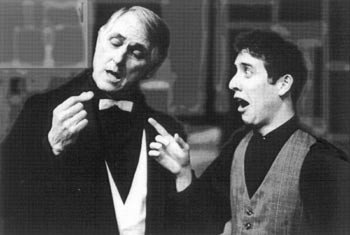
Reduced Shakespeare Company

Bible Belt

The Bible: The Complete Word of God (Abridged), playing Oct. 8 at the Sebastiani Theatre.

Reduced Shakespeare takes on the Big Book

By Patrick Sullivan

THEY’VE MADE a splash at the Kennedy Center, been called blasphemous by religious protesters, stolen the show in broadcasts on NPR and the BBC, and wowed the crowd in London and Jerusalem. They’ve even braved an uncertain welcome in the sunny but conservative city of Texarkana, where liquor sales end at the dusty Texas border. But Reed Martin of the Reduced Shakespeare Company says coming back to play at the Sebastiani Theatre in his hometown of Sonoma is still no walk in the park.

“It’s funny, but I do get nervous,” Martin says. “I grew up here. Most nights I’m at the theater, I don’t know anyone in the audience. Then we do a benefit for the Sebastiani and there are 400 people and I know all of them.”

Martin serves as both writer and performer in the unique three-man theatrical troupe, which has built a growing international reputation for … well … reducing things. The complete works of William Shakespeare, the history of the United States, and Wagner’s bloated Ring Cycle have all come under the company’s satirical knife. Now the company is bringing The Bible: The Complete Word of God (Abridged) home to Sonoma County.

Whatever the source material, Reduced Shakespeare’s method is the same: Take weighty (even ponderous) cultural material that occupies armies of dedicated scholars, and render the whole thing in hilarious fast-forward on the stage. That simple recipe has been packing houses around the world for more than a decade.

“I think we’re successful because we just have a really good time doing it,” Martin says. “The sloughing around isn’t always enjoyable, but those two hours onstage are always fun, and I think people see that.”

The company–which was founded by former member Daniel Singer of Santa Rosa–combines slapstick, cross-dressing, and sight gags with more subtle jokes that delight even people who love Shakespeare (or American history) the most. There are no sacred cows, and even the audience itself is fair game.

“If any latecomers come in to the show, we thrash them,” Martin says with a laugh. “Or if somebody’s crinkling a candy wrapper, well, everybody in the audience is looking at them anyway, so we might as well stop and make a bit of it. … We come through the fourth wall and just react to whatever’s happening.”

The act requires an unusual set of skills, to say the least. Ordinary theater hardly prepares someone to bounce around the stage re-enacting the death of Abraham Lincoln at top speed. At first glance, then, Martin’s résumé sounds oddly traditional–even stuffy. He has a B.A. in theater and political science and an M.A. in acting. He’s even performed in very ordinary productions of Hamlet. As the Reduced Shakespeare folks might say, “Boring!” But then, things get unusual.

“After eight years of university, I ran away and joined the circus to work as a clown,” Martin says. “Which left everyone saying to my parents, ‘What do you think about that?'”

After two years of clown work, where he learned how to work an audience, Martin fell in with the Reduced Shakespeare and was soon touring the world. Before long, the company was performing in England. But weren’t they worried about insulting the Bard in the country of his birth?

“It turns out it’s nothing like that,” Martin says. “I mean, if anything, the British have had Shakespeare forced upon them even more than people here. And also, as with all of our subjects, it’s done affectionately. We’re mocking ourselves as much as we’re mocking the subject matter. … I think they’re flattered that we spend so much time on it, and we do it the way they think three stupid Americans would do Shakespeare.”

THAT’S NOT TO SAY that everyone appreciates Reduced Shakespeare’s irreverent approach to the sacred texts. Sign-waving protesters greeted the company’s Bible show when it played in Ireland. A lawyer in England tried unsuccessfully to use that country’s blasphemy laws to shut down the play. And in Texarkana, some religious students dramatically expressed their distaste for the troupe’s unique take on American history.

“One of the speeches in the history show is full of anagrams,” Martin recalls. “You rearrange the letters in American and it spells ‘I can ream.’ You rearrange the letters in George Washington and it spells ‘Gaggin’ on wet horse.’ And if you rearrange the letters in Spiro Agnew, it spells ‘Grow a penis.’ Right about then, we had 150 home schoolers in the balcony stand up in unison and walk out. So I think we did our job that day.”

But although the actors have fun with their source material, Martin says they also show it respect. In particular, he insists that the troupe was careful to make the Bible show “irreverent, but not blasphemous.” Religious people, he says, tend to enjoy the performance once they actually see it.

“Opening night in Ireland, we had four clergymen in the audience,” Martin says. “Three of them loved it, and one wasn’t that tickled by it. I don’t know that he found it blasphemous, but I think it just made him sort of uncomfortable. I guess if you’re sitting there in collar, every time a joke comes up, everybody looks at you to see if they can laugh.”

That respect also means that Reduced Shakespeare gets the facts straight, except when they skew for comic effect. Some even call the company’s work educational: Could this be the only way to get modern audiences to flock to see Shakespeare?

“Well, we’ve had that question in another form,” Martin says wryly. “The negative side is ‘Are you pandering to people’s short attention spans?’ … But I think we get people interested. People who don’t have a proclivity won’t go see Hamlet anyway. But we do definitely get teachers who tell us that the kids went to see our show and then they wanted to do Romeo and Juliet in the school production.”

Controversy, whether educational or religious, is not the main problem facing Reduced Shakespeare. The real challenge, Martin says, is finding new material, new cultural monuments to cut down to size. So what’s next on the troupe’s agenda?

“I just got back from Los Angeles, from rehearsing our new show, our first musical,” Martin says. “We’re condensing the Millennium. We’re calling it The Millennium Musical, Abridged to the 21st Century.”

The Reduced Shakespeare Company will perform The Bible–The Complete Word of God (Abridged) on Oct. 8 at 8 p.m. at the Sebastiani Theatre, on the downtown plaza, Sonoma. Tickets are $17 for adults, $12 for seniors and for children 12 and under. 996-2020.

From the September 24-30, 1998 issue of the Sonoma County Independent.

© Metro Publishing Inc.

Keb’ Mo’

0

Mo’ Blues

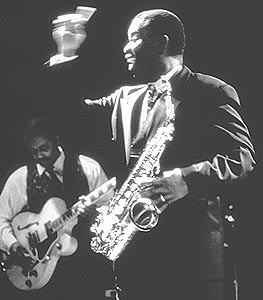
Slow Down.

Frank Ockenfels


Bay Area bluesman Keb’ Mo’ at LBC

By Alan Sculley

I KNOW I’m known as an acoustic blues guy and I know I’m in that genre,” says bluesman Keb’ Mo’. “I know that’s probably my best genre. Probably my best performances are in that area.

“But I don’t know, I think at the end of the day people just want to feel good. They put on a record, they just want it to sound good. They want it to make them feel good. It should flow with life. If it doesn’t follow the little box I’m supposed to be in, about what I’m supposed to be, so be it.

“Because if I stay what I’m supposed to be, then there’s a group of people who talk about why you don’t try something else. And then when you do something else, people wonder why you don’t stay the same way. So you know, Ricky Nelson says it the best: ‘You can’t please everybody, so you’ve got to please yourself.'”

It took Keb’ Mo’–his real name is Kevin Moore–some 20 years to define himself as a blues player with the release of his 1993 self-titled CD. But it’s not as though he hadn’t recognized his affinity for the style long before that.

In fact, he remembers as a teenager being absolutely enthralled by a performance by acoustic blues artist Taj Mahal, who today remains a major influence. “He came right to my school,” Moore recalls. “It was like an inkling, a preview of things to come. I always felt that show was for me.”

But at that point, Moore didn’t feel that he could answer his calling to the blues. It was the 1970s and blues had fallen out of favor in urban areas like Compton, the L.A. suburb where Moore grew up.

“I wanted to be hip. I was afraid, which was indicative of my life for the next 20 years,” he says.

By the late 1980s, Moore still hadn’t found his focus, but he stuck with music, taking odd jobs along the way to make ends meet. Finally in 1990, things started to fall into place when he was invited to play a role as a musician playing Delta blues music in Rabbit Foot, a play produced by the Los Angeles Theater Center.

The role gave Moore the opportunity to delve further into the music of such acoustic Delta blues artists as Big Bill Broonzy and Mississippi John Hurt. “You have a month to really dig through that music and really explore it and get into it while the actors are learning their lines. It’s a wonderful process.

“You talk about the music, you talk about the motivation of the piece, how the music relates to what you’re doing to it.”

In the course of preparing for his role, Moore discovered that Delta blues was a style that felt natural to him. “It was closer to the source,” says Moore. “It was closer to the heart of where blues came from. I could feel it.

“I could feel the Delta calling.”

SINCE THEN, Moore has been on a fast track. A cassette of his songs netted him a deal with Okeh Records, a label that was being relaunched by Epic Records. His 1993 self-titled debut immediately earned him recognition as a blues artist to watch, and his 1996 follow-up, Just Like You, cemented Moore’s stature as one of the most promising new artists in blues. That CD won the 1997 Grammy for Best Contemporary Blues Album, and Moore also won prestigious W.C Handy Awards in 1997 and 1998 as Acoustic Blues Artist of the Year.

Now Moore is hoping to build on those achievements with his third studio CD, Slow Down. The CD may redefine Moore’s image. With the exception of the solo acoustic “I’m Telling You Now” and a cover of Robert Johnson’s “Love in Vain,” the remaining 10 songs feature full-band arrangements. Several tunes, such as “Soon As I Get Paid” and “Muddy Water” rock quite convincingly. While Moore’s songwriting on Slow Down has justifiably been praised, a few early reviews of the CD have found fault in the slick production.

“I think the polish people are hearing isn’t necessarily in the performance, but in the post-production, the mix rather than the presentation of it, and in the care taken in recording,” says Moore, who co-produced the CD. “We sat down and we got sounds, and we spent a little more time beforehand.

“But we went in and performed.”

Keb’ Mo’ performs Friday, Oct. 9, at 8 p.m. at the Luther Burbank Center, 50 Mark West Springs Road, Santa Rosa. Tickets are $25. 546-3600.

From the September 24-30, 1998 issue of the Sonoma County Independent.

© Metro Publishing Inc.
Loudon Wainwright

Loud 'n' ClearHugh BrownTroubadour: Forget road kill--Loudon Wainwright plumbs the depths of the soulLoudon Wainwright III, storyteller on wryBy David TempletonI'LL BE RIGHT with you," says Loudon Wainwright III, answering the phone on the fifth ring. "I just want to turn down the old television--I've had Clinton up for a while."Oh. Right. Clinton. This interview is taking place, it...

Wild Mushrooms

Dig It!Michael AmslerA quick-and-dirty guide to the velvet undergroundBy Marina WolfTHE SUN AT Salt Point State Park is strong. Even the cool air in the coastal woods has a toasted resin smell to it. But Pete Petersen, my contact at the Sonoma County Mycological Association and the planner of the day's expedition 20 miles north of Bodega Bay, assures...

Mark Fishkin & Mill Valley Film Fest

A Life in FilmCinematic vision: Mark Fishkin of Petaluma is executive director of the Northern California Film Institute, which presents the Mill Valley Film Festival.Janet OrsiMark Fishkin ushers inMill Valley Film FestBy Greg CahillASK MARK FISHKIN, co-founder of the Mill Valley Film Festival, about his most embarrassing moment at the popular North Bay event and he shakes his head...

Spins

Psyched! Various Artists Nuggets: Original Artyfacts from the First Psychedelic Era, 1965-1968 Rhino THEY SAY you always return to the music of your youth, so in the spirit of public disclosure I offer this fact: I was weaned on a steady diet of psychedelic nuggets. Fuzz tone, feedback, and swirling Farfisa organs--I couldn't...

The Scoop

Porn Starr By Bob Harris NOW THAT Kenneth Starr has put his finishing strokes (cough) on his report concerning President Clinton, Monica Lewinsky, three cans of candied yams, a turnip, and a bag of elastic bands, stories about other politicians are now surfacing as well. In fact, at least one, Sen. Dan Burton,...

Karen Leonardhas

Sacred Bones Author Karen Leonardhas revised Jessica Mitford's 1963 investigative classic The American Way of Death. Now she has a bone to pick with funeral home directors By Stephanie Hiller D EATH is not only sometimes painful, frequently inconvenient, and only seldom desired, it's expensive. From nursing homes to fancy hospitals, the process...

Lost in Cyberspace

Resignation Rag By H.B. Koplowitz They had sex, sort of. He lied about it, sort of. So what. When you raise your hand and swear to tell the truth, the whole truth, and nothing but the truth, it's supposed to mean something. Impeach the bastard. Let him go. He committed adultry. So did you. Round and round...

Kindertransport

Dark Journey Kindertransport. 'Kindertransport' tells story of survival By Daedalus Howell BEFORE ENTERING Actors' Theatre's production of Kindertransport, audiences are advised to stuff their pockets with the Kleenex thoughtfully provided in the atrium. You will need it. You're going to cry. Consider wearing a life preserver, perhaps even hip-waders. Inspired...

Reduced Shakespeare Company

Bible Belt The Bible: The Complete Word of God (Abridged), playing Oct. 8 at the Sebastiani Theatre. Reduced Shakespeare takes on the Big Book By Patrick Sullivan THEY'VE MADE a splash at the Kennedy Center, been called blasphemous by religious protesters, stolen the show in broadcasts on NPR and the BBC, and wowed the...

Keb’ Mo’

Mo' Blues Slow Down. Frank Ockenfels Bay Area bluesman Keb' Mo' at LBC By Alan Sculley I KNOW I'm known as an acoustic blues guy and I know I'm in that genre," says bluesman Keb' Mo'. "I know that's probably my best genre. Probably my best performances are in that area. ...
11,084FansLike
4,606FollowersFollow
6,928FollowersFollow


