Betty’s Fish & Chips

0

Fish Tale


Michael Amsler

Down the chippy: Betty’s Fish & Chips is a local favorite.


Betty’s–a welcome catch

By Paula Harris

GROWING UP in London may have warped my culinary preferences forever. For years, I thrived on chocolate digestive biscuits for breakfast, shepherd’s pie and mushy peas for lunch, Marks & Spencer double cream-filled Victoria sponge cake for tea, and fish and chips for supper.

Fish and Chip Night usually occurred on those none-too-rare evenings when my mother was at a loss over what to prepare for yet another dinner for a family of six, and she recoiled at the thought of my father taking over the kitchen to experiment with one of his strange Maltese dishes. Hell, last time he mistook ginger roots for the beloved Jerusalem artichokes of his youth, boiled them up, and, well, the flat hasn’t smelled the same since.

Mum, a staunchly proud Yorkshire lass at heart, would resort to her childhood comfort food. Inevitably, it was always found “down the chippy.”

At that time, the absolute best fish and chips in town were at the Seashell Fish Restaurant and Takeaway on Lisson Grove in London, opposite the social security office. The queue of salivating customers with empty shopping bags would begin to snake out the Seashell’s door and down the road even before the first pale-coated fish fillet hit the ferociously bubbling oil.

Back at our pad, battered fish aromas would eventually seep upstairs heralding my mother’s arrival, and she would return with her loot. She would deposit hefty, piping hot, newspaper-wrapped parcels of fried food on the kitchen counter while we scurried about grabbing plates and malt vinegar. We’d sink our teeth into tender, flaky cod, plaice, or haddock enveloped in ultra-crisp golden-brown batter, and into industrial-size chips, all doused with lashings of tangy malt vinegar and sprinkled liberally with salt. The biggest chips were saved, crammed between slabs of bread as thick as fists (doorstops, we called them), and a thick layer of butter to create wonderful chip butties that sank in the stomach like lead boots.

Ah, those were the days, my friend.

Betty’s Fish & Chips in Santa Rosa attempts to re-create the feeling of the local corner chippy, with a touch of an olde world tea shoppe thrown in. The cheery, bustling eatery and take-out is decorated with British souvenirs, such as a tea towel depicting Scottish castles and a poster of the Houses of Parliament. The tables and small cozy booths are set plainly with a little glass bottle of malt vinegar, a miniature container of Heinz tomato ketchup, salt, pepper, and a vase of fake flowers.

There’s a spotless stainless-steel open kitchen where the fry cooks work rapidly while servers busily but cheerfully take orders.

We wet our whistles with a bottle of Sharps non-alcoholic beer ($1.95) as we perused the menu. Betty’s has a good selection of draught and bottled beers (including Pale Ale and Watneys) and a tiny wine selection. But we ultimately decided to follow wine guru Hugh Johnson’s advice and pair our fish and chip dinner with a nice cup of tea. The tea ($1.25), served with milk (of course!), was Lipton’s and arrived in whimsical individual china teapots that sit atop matching cups. The cuppa tasted good, though not as strong and reviving as the typical Brit brews.

We began with onion rings ($3.95), which were good–hot and crunchy with a not-too-oily batter, and sweet-flavored onions. But the breaded french-fried mushrooms ($3.95) made a poor impression. The breaded exterior was too thick and the mushrooms inside soggy and overcooked. The accompanying sprinkling of Parmesan cheese and ranch dressing did nothing to save this dish.

Fish and chip meals range from $3.99 for small (one piece of fish) to $11.95 for jumbo (four pieces). Betty’s uses Icelandic cod exclusively, which has a very mild flavor and pleasant flaky texture. The batter is crisp, golden brown, and not too thick. But the chips are more like regular American fries (not shoestring, but not the thick, irregular-cut starch-laden gems I remember). Still, the chips are served hot, golden, and crispy, so we can’t complain too much.

Larger appetites can tuck into the Icelandic cod burger ($7.50), which features three pieces of cod served on an onion bun, topped with lettuce, red onion, tomato, and “secret sauce.” It’s accompanied by chips or cole slaw. Or opt for Betty’s Special ($9.35), a sampler featuring a piece of cod, two tender-sweet, deep-fried prawns, two large deep-fried (but somewhat bland) scallops, chips, and creamy homemade cole slaw.

Desserts are all housemade and feature some great, fresh-baked, oversized individual pies that might just have been pulled out of grandma’s ancient oven. Betty’s may not be quite the same kettle of fish as the Seashell, but it’s a good, cheerful place to satisfy your craving for Brit fare “down the chippy.”

Betty’s Fish & Chips
Address: 4046 Sonoma Hwy., Santa Rosa; 539-0899Hours: Sundays, 4 to 8 p.m.; Tuesdays-Thursdays, 11:30 a.m. to 8 p.m.; Fridays-Saturdays, 11:30 a.m. to 8:30 p.m.; closed Mondays
Food: Seafood
Service: Good, fast, and upbeat
Ambiance: Bustling but cozy; can be crowded with take-out customers
Price: Inexpensive
Wine list: Very small wine selection; mostly draught and bottled beer and soft drinks
Overall: ** 1/2 stars (out of 4)

From the October 8-14, 1998 issue of the Sonoma County Independent.

© Metro Publishing Inc.

Talking Pictures

0

Catfight


Animal attraction: Simoóm: Passion in the Desert tells a tale of interspecies love.

Author Barry Lopez gets passionately angry about ‘Passion in the Desert’

By David Templeton

David Templeton takes interesting people to interesting movies in his ongoing quest for the ultimate post-film conversation. This time out, he teams up with esteemed nature writer Barry Lopez to see the adventure film Passion in the Desert.

BARRY LOPEZ pushes through the swinging double doors, which close behind us with a reverberating thwap-thwap-thwap as we stand blinking in the the sunny afternoon. Glancing back at the little dark screening room we’ve just escaped, Lopez shudders perceptibly, as if to shake off the memory of the film we’ve just seen.

“I found it tremendously offensive,” he says of Simoóm: Passion in the Desert, an adaptation of Honoré de Balzac’s 19th-century novella about a despicable French soldier–lost in the Egyptian desert and pursued by evil, bumbling Bedouins–who develops a semi-erotic bond with a female leopard. Lopez, whose award-winning work (Arctic Dreams, Of Wolves and Men) has for years offered keenly focused insights into the natural world–and humankind’s disturbing love-hate relationship with it–has no problem with the idea of the film or, at least, the idea of Balzac’s original work. It was merely the film’s simple-minded execution of that idea–and what my guest detected as its unsettling underlying message–that has provoked his considerable moral outrage.

“Briefly,” he calmly declares, taking a seat at a nearby cafe and pulling his coffee closer, “this film was a complete adolescent fantasy, a piece of psychotic European racist rubbish.”

That’s the brief version.

But Lopez is hardly finished. In fact, throughout the next half hour, while seldom raising his baritone above the soft volume of casual conversation, this esteemed adventurer–a man who’s visited both the Moab region of Utah and the deserts of Jordan, those two very different locations that were made to stand in for Egypt in the film–repeatedly finds himself searching for the right way to sum up the baseness of Passion in the Desert.

“It’s all about white power,” he observes at one point. “It’s about the ineptitude of indigenous people, the interchangeability of landscapes–it doesn’t make a damn bit of difference whether you’re in Utah or Jordan–it’s all crap.” Later he says, “It’s all the notion that nature is window dressing for human ideas. It’s a film made outdoors by people who live indoors and have never been outdoors in their lives.”

In reference to a scene in which the soldier, driven to jealousy by the intrusion of a frisky male leopard, weaves a rope and ties up the female, he says, “The whole thing was patently misogynist. Why in God’s name did he tie her up? I’ll tell you why. Because ‘The bitch wouldn’t do what she was told.’ I’m telling you, this stuff is at the heart of modern pornography.”

Ultimately, debating the film’s comparison to old Tarzan movies, Lopez offers, with a hint of chuckle, “Oh, I think Tarzan is a cut above this. I’d rather have seen two hours of Johnny Weissmuller,” followed by “Frankly, I was embarrassed for the animals.”

But what about the notion that “civilized” people, cut off from society and lost in the wild, might end up discovering a bit of ancient wildness within themselves, might be altered forever by the enormity of that experience? These thoughts have always intrigued human beings, including such authors as Rudyard Kipling, Walt Whitman, and Gretel Erlich. In Lopez’s own work, especially his stunning new collection of essays–About This Life: Journeys on the Threshold of Memory–an open-minded observance of the natural world always results in emotional transformation.

“It’s the great European longing for reunion with nature,” Lopez nods. Extending his left hand, he tightens it into a grasp, explaining, “We’re always trying to find a way to hold on to our highly technological suburban lives, and yet still–” (here he sets his right hand, palm open, on the table) “–and yet still stay in touch with nature. But nobody wants to say that the cause of this,” raising the left hand, “is the death of that,” raising the right. “Or at least it’s the death of segments of it.”

ABOVE ALL, Lopez’s strong reaction seems based in his awareness that many of us tend to unquestioningly accept what we see in films. Because most people are denied the globe-hopping contact with nature that Lopez has been fortunate to experience, our ideas of that world are formed by secondhand means, accurate or not.

“It’s analogous to the problem in nature photography today,” he elaborates, “in that you can no longer trust anything you see photographed in a magazine. You take an animal and photograph it at the zoo, then you take a landscape and photograph it over here, and you just glue them together–whether the animal ever lived in that landscape or whether it behaved like that, we don’t know anymore.”

Pausing again, he sips thoughtfully at his cup.

“You know, no one can figure all this stuff out for themselves–that’s why we have neighbors,” he says. “But in a country such as ours we are made to feel isolated. That’s the only way that consumerism will work–to split everybody up, and to make sure that nobody shares, either things or ideas.”

“But if you have a neighbor, you can ask them what they thought, and they might say, ‘Well, you know, I’ve been to Egypt and I’m familiar with the history of ideas in France at the time Balzac was writing, and I can offer these insights.’ So in that way, everyone can pool what they know, and then turn to the charlatan and say, ‘We don’t want you in here. You can’t come in here again. You are a danger to our children.’

“As far as Passion in the Desert goes, I’d prefer that we never have to explain this film to a child, to explain what’s wrong with it, to explain how it cheats us of nature’s true beauty. I’d prefer,” he concludes, the hint of a chuckle returning, “that it just dried up and drifted away.”

Simoóm: A Passion in the Desert plays Oct. 12-14 at 7:15 and 9:15 p.m. in Marin as part of the Mill Valley Film Festival at the Sequoia II, 25 Throckmorton Ave., Mill Valley. Tickets are $7. 415/383-5346.

From the October 8-14, 1998 issue of the Sonoma County Independent.

© Metro Publishing Inc.
California Small Works Exhibition

0

Small World

Michael Amsler


Exhibits showcase art in the miniature

By David Templeton

SMALL IS BIG. Very big. Though it may be only a seasonal phenomenon, every autumn–for 10 years running now–a growing number of artists band together in solemn celebration of the enigmatic beauty of smallness.

The epicenter of all this size-mic activity is Santa Rosa’s California Museum of Art, sponsor of the 10th annual California Small Works Show, a wildly popular, statewide, juried exhibition featuring works of measureless artistry but minimal stature.

All entries in the highly competitive show must be smaller than 12 inches in all directions. According to CMA director Gay Shelton, the museum received almost 800 entries last year; even more have come in this year. Of those, only 150 will be selected for the exhibition, scheduled to run from Oct. 14 through Dec. 20. The show itself has become one of the county’s best-attended fine art events, drawing thousands of visitors.

“The community has grown to love this show,” grins Shelton, taking a break on the museum’s sunny, sculpture-enhanced outdoor patio.

“I think people visiting the show like that there is such a large variety of pieces,” she observes, noting that, because of the miniature scale of each piece, there is room for more artwork.

“It’s pretty exciting seeing so much art in one room,” says Vicky Kumpfer, the Small Works coordinator. “It’s an aesthetic potpourri. It’s like taking a statewide survey of art.”

“Then too,” Shelton adds, “it’s a very competitive show, so there’s the suspense of it that is appealing. Who will get in and who won’t?”

The job of selecting which pieces make it into the show has traditionally fallen to a single juror, always an artist, with carte blanche to choose according to his or her aesthetic tastes. This year’s juror is East Bay artist Deborah Oropallo, a painter/printmaker whose work shows a keen interest in images that are hidden behind one another.

Oropallo’s task is a daunting one. With a final goal of choosing 150 pieces, she’ll have to turn down eight for every one she picks.

But what about those artists whose work is not selected? After all, many exceptional entries are rejected merely because they don’t fit the juror’s specific vision.

Fortunately, there is another Small Works show in town. Formerly titled the “Second Chance Show,” the newly named “Small Works–Alternative Visions” is a non-juried exhibition–also coordinated by Kumpfer–that was started three years ago and is run by the Santa Rosa Parks and Recreation Department. Starting Oct. 19 at the Finley Community Center, the massive exhibition works as a pressure valve, letting off some of the artistic steam generated at CMA. Not that Alternative Visions deserves to be thought of as a parking lot for CMA’s rejects. On the contrary, the alternatives show is a glowing affirmation of the remarkable quality of work being generated by California artists.

“The nice thing about visiting the alternative show,” explains Kumpfer, “is that you end up seeing that it’s not necessarily quality that is juried out of the CMA show.”

That main thing that both exhibits have in common, of course, is the remarkable respect for art wrought on a intimate scale. Small works are often indescribably potent.

“The small pieces give you a very specific, very introspective experience,” Kumpfer affirms. “A big work, a landscape, for instance, has the ability to draw you into it. But with a small piece, you often end up absorbing it into yourself. That’s a remarkable experience, and it’s one of the things that art is all about.”

The California Small Works Exhibition runs from Oct. 14 through Dec. 20 at the California Museum of Art, LBC, 50 Mark West Springs Road, Santa Rosa. A reception will be held Oct. 16 from 5 to 8 p.m. Exhibit hours: Wednesdays and Fridays, 1 to 4; Thursdays, 1 to 8; weekends, 11 to 4. First day of the exhibit is free; normal admission is $2. 527-0297. “Small Works–Alternative Visions” runs from Oct. 19 to Dec. 18, with a reception on Oct. 23 from 6 to 8 p.m., at the Finley Community Center, 2060 West College Ave., Santa Rosa. Exhibit hours: Mondays-Thursdays, 8 a.m. to 7 p.m.; Fridays, 8 a.m. to 5 p.m.; Saturdays, 8 a.m. to 1 p.m. Admission is free. 543-3737.

From the October 8-14, 1998 issue of the Sonoma County Independent.

© Metro Publishing Inc.

Robin Troy

Video Fiction?

Floating’s tired story of cowboy love won MTV’s fiction contest.

Michael Amsler


‘Floating’ serves up cold cowboy clichés

By Patrick Sullivan

IT SOUNDS LIKE a Zen riddle: If MTV gave out awards to novels, what kind of novels would win those awards? That clears the mind in a hurry, doesn’t it? But shake off that meditative trance, because that’s not the new Backstreet Boys album in your hands–it’s an honest-to-god book with the MTV seal of approval.

At first glance, Robin Troy might seem to be a pretty lucky writer. Floating (MTV Books/Pocket Books; $12) is both her first novel and the winner of the MTV fiction contest. That leaves Troy in a position some first-time authors would envy: Her fiction is now in the hands of the slickest marketing geniuses on the planet, which means her debut novel might go double-platinum. But here’s the downside: Troy’s fiction is now in the hands of the slickest marketing geniuses on the planet, which must make any author slightly queasy.

As a physical object, Floating seems designed to provoke the same reaction as a stuffed animal (or a Backstreet Boy). The book is little, it’s funky-looking, but most of all, it’s terribly cute. The chapters are all roughly 10 pages long (just about right for perusal during a lengthy commercial interruption), and the chapter numbers are set in huge type, which means the reader can see the next break coming from several pages away. Enormous design effort has gone into making this book the literary equivalent of a music video, full of quick cuts and perspective changes.

So the author already faces an uphill battle to convince the reader that her novel provides a more meaningful experience than, say, going down to the mall to see Spice World II: Girl Power Goes Global. The big surprise is that, buried beneath this slickness, Troy’s work initially offers a rough little gem of a story.

Twenty-something Ruby Pearson is a giant of woman stuck in a desert pit stop of a town–Whitticker, Ariz., population 641. She married her cowboy high-school sweetheart, Carl, because she thought he was her fast ticket to the wider world. But their love and Carl’s ambition have both withered under the shadow of Ruby’s high-watt charisma and powerful personality.

Driven to drunken rage by his growing feelings of inadequacy, Carl picks up an empty pistol, robs a convenience store, and then speeds out of Ruby’s life into the waiting arms of the police. Once in jail, Carl is bothered less by the separation from his wife or their 8-year-old son than by the fact that Ruby will at last get her hands on the one thing that he’s always been able to call his own–his beloved horse. So he uses his one phone call to contact his estranged brother, Sean, and invite him to take the animal. For reasons of his own, Sean makes the trip to Whitticker and encounters Ruby. Romantic complications ensue.

It might have made an interesting tale. Unfortunately, it’s also one that the author (who grew up in Connecticut and graduated from Harvard) doesn’t seem qualified to tell. Write what you know, runs the old maxim. But whatever Troy knows, it doesn’t seem to be rodeo cowboys and small towns in Arizona. Whitticker comes off like a B-Western stage set, and the ruggedly handsome Sean seems cobbled together from every Marlboro Man cliché ever minted. The book’s priceless description of him as “six foot five, with broad shoulders and skin golden as the desert sand at sunset” takes us deftly into the territory of the kind of romance novel that features Fabio on the cover.

Even less convincing is the author’s portrayal of Ruby’s young son: “I think you’re the oldest eight-year-old I’ve ever met,” Sean tells Brian. The reader is compelled to agree, since Brian often seems more like 45 as he is forced to take on the heavy narrative burden of describing his parent’s tumultuous relationship.

The book does a bit better with Ruby and her troubled husband, who are easily the most human characters in this eerily artificial novel. But that’s not enough to save Floating. In the end, the book’s cutesy layout seems perfectly matched to its ephemeral literary impact. If this is the future of fiction, just bring on the music videos.

From the October 1-7, 1998 issue of the Sonoma County Independent.

© Metro Publishing Inc.

Ultima Online

Screen Scene


Michael Amsler

Cyber citizens: A growing number of role-playing gamesters nationwide are swept up in the virtual world of Ultima Online, an Internet game that sports a local server.

Ultima Online: Virtual theater of the fantastic

By Christopher Pomeroy

POROFO, the flaxen-haired neophyte archer from the township of Yew, carefully makes his way through the towering trees of Yew forest. This is the youth’s first excursion from town, and his blood boils with anticipation. The deep wilderness is beautiful, mysterious, and the lush songs of the woodland animals seem, to him, to speak of excitement. What will he find around the next boulder: an undiscovered ruin perhaps, a hungry ogre, a leprechaun’s chest of gold? From behind a tree, suddenly there emerges a man in white robes wielding a sword. He approaches Porofo with the obnoxious gait of a battle veteran.

“You, my friend, have chosen a poor path,” he says.

Naively, Porofo answers with a bow, “Excuse me, good sir, could you perhaps point me to adventure?”

“My name is Whiteshay Lavay, brigand of these woods,” the stranger explains, “and the only point you’ll receive from me is the end of my sword.”

A few moments later, my computer-generated alter-ego, Porofo, is slain, and his murderer is rifling through his equipment.

So much for the wannabe hero. I obviously have a lot to learn.

Thus–with a bit of poetic license–goes my first experience on Ultima Online, a virtual fantasy world and computer role-playing game created by Austin-based ORIGIN Systems Inc., or OSI. Each month, over 90,000 players log onto the game from their home PCs and assume the roles of thieves, wizards, warriors, blacksmiths, and even kings in a world of dragons and dungeons, damsels and dastards.

Ultima Online is the most popular in a growing number of similar role-playing games found on the Internet.

The game, which can be roughly described as a graphical chat room set within a fully interactive, Tolkienesque fantasy world, takes place in the mythical land of Britannia.

The world, based on OSI’s popular Ultima line of solo computer role-playing games, offers 200 million square feet of virtual play area, 12 cities, seven dungeons, and 50 types of fanciful and mundane creatures, and covers terrain ranging from desert to arctic ice. It is so large, in fact, that OSI claims it can take a player as long as 45 minutes to cross its largest city (Britan) and 10 hours to traverse the world.

UO gamers pay a pretty shilling for the pleasure of exploring Britannia: around $60 for the software, plus a monthly subscription service ($10 a month, first month free). The software is available anywhere computer-game software is sold.

To handle the number of players–mainly from the United States, Canada, and the Pacific Rim–OSI has set up nine replica Britannias (same cities, geography, and creatures, but different players) on computer servers scattered throughout the United States. Many local players choose to play on the Mountain View-based Sonoma server (also called “Shard” in game-speak), because of its proximity and name.

Each day, Sonoma Shard plays host to nearly 2,000 players, from Sonoma County and beyond. It is an interesting place: a sword-and-sorcery virtual playhouse in which a drama takes place every hour. However, unlike the thespian craft proffered by your community theater, the Sonoma Shard of UO sports a cast of thousands, with each member writing his or her own lines.

Players Aplenty

JOHN, an avid UO player I met online, cheerfully invites me to his house to explain how the game is played. Or at least, how he thinks it should be played. The Santa Rosa native is a big fellow; not so much fat as burly–the type of casual guy who prefers T-shirts and jeans, regardless of the occasion. John’s computer/game room is an amateur museum for all things fantastic. There are maps of J.R.R. Tolkien’s Middle Earth, cluttered piles of genre novels, and stone gargoyles perched precariously upon Sheetrock walls. Next to the window hangs a cabinet full of meticulously painted metal figurines, each modeled after a legendary creature or a heroic protagonist.

Lots of swords and buxom women.

Admiring the figures, I remark, “Impressive.”

“Yeah,” he answers, “I’ve two more crates of them in the basement.”

Abundance–that’s one way to describe John. He spends between four to five hours a day playing UO–and on weekends sometimes more. Of course, “dedicated” might fit as well. John, a 24-year-old nursing assistant, takes the game seriously.

“It’s a lot like improvisational acting to me–at least, the way I try to play,” he says. “I love playing a character like someone from fiction. When I was younger, I wanted to be an actor, but I’m not any good at it–my voice is flat, and I’m shy.”

On Britannia, however, it’s a different tale.

John plays several characters or parts on UO, but his favorite is Sven Silvertune, a talkative minstrel who wanders through Britannia almost aimlessly, spreading tales and reciting poetry. Peering over John’s shoulder, watching him control Sven from his keyboard and mouse, I am struck by the quality of the game’s graphics and sounds.

Voyeurlike, I watch the exploits of his onscreen persona as if he is floating 30 feet above his head. The game, which is rendered in three dimensions and 16 million colors, is gorgeous. The trees are vibrant, the cities exciting. Even the sounds draw me into the complex environment: bird songs, footsteps, growls of faraway monsters.

Most interesting, however, is the fact that every time I pass another character, I might be walking by a player from Wisconsin, or Tokyo, or maybe Sebastopol.

Onscreen personae communicate via text, which displays over their heads; they are also capable of a few visual expressions such as bowing and saluting. John explains to me that not all the people Sven communicates with onscreen are controlled by human hands. “They’re robots,” he says. They are controlled by the computer, he explains.

Each Shard, he adds, is populated by a number of computer Non-Player Characters, or NPCs. Just about anyone you run into can be a robot: shopkeepers, healers, beggars. There are a limited number of ways to interact with them, determined by their function in the game. For instance, you can purchase supplies from a shopkeeper, give money to a beggar, etc. NPCs are easy to discern from actual players; they speak in full sentences (most UO players use abbreviations), and they aren’t Britannia’s greatest conversationalists. You can ask a NPC a dozen times what her favorite color is without a proper response.

I know. I tried.

Playing UO, John is focused. His fingers dart expertly across his keyboard, striking special key sequences called macros that allow Sven to perform preprogrammed actions. For instance, if he hits the “alt” key and the “p” key, Sven recites his favorite poem and takes a bow.

John admits he is a bit obsessed with assuming roles. Sven Silvertune even speaks entirely in Elizabethan English–as do the NPCs, by the way–or as close as John can manage.

“I’m not anal about it. It’s not like I majored in the subject. It just seems more appropriate to the atmosphere of the game.”

As interesting as John’s emphasis on online acting is, I find it far from the norm. Most UO players spend their time hunting monsters, earning money, and increasing their persona’s expertise in dozens of in-game skills. For instance, Andy, a 33-year-old Petaluma production worker and a self-described “game freak” since he was a child, is attracted by the strategy involved in becoming a proficient UO player. He can most often be found playing either Genghis, a master swordsman, or the Scoundrel Horndog, a grandmaster thief.

However, no matter what character Andy is playing, he is still essentially himself while in-game–just with different looks and abilities.

Andy, an articulate man whose only real regret about UO is that it interferes with his other love, chess, spends most of his mental energy discovering stratagems to improve his characters and destroy monsters. He excitedly inundated me with schemes to defeat Britannia’s most powerful creatures. His ideas, which he says are common among serious players, are quite clever. One tactic involves tossing bags of flour to block the advance of a demon (a programming function causes the creature to halt movement when his path is obstructed), and then attack it with spells and missile weapons.

Players like Andy who enjoy challenging the UO universe have a lot of in-game tools to manipulate. Each persona has dozens of skills at his or her disposal, as well as an equal number of magic spells, and equipment options. Do you want to be a spell user who can also use a sword? A warrior who forges his own armor? Both and more are possible on UO, and there are compelling arguments for the strategic value of them all.

Mike, a 42-year-old medical equipment manufacturing rep from Santa Rosa, revels in the conundrums served up by such choices. “I’ve actually always enjoyed poring over the charts, looking over data and different categories,” he says. Websites abound that discuss the power and proper usage of skills and weapons in the game. Mike spends a lot of his free time on the game. As we speak, he pauses to interact with another player. I can hear his furious typing through my phone receiver.

The word dedicated comes to mind again.

When I casually mention, “This game seems to take nearly as much time as real life,” his keyboard momentarily silences, and with a light chuckle Mike replies, “I like living in this little world.

“I only wish I could make as much money in the real world as I do on UO.”

When asked how he role-plays, Mike says that he isn’t necessarily playing himself while on UO. “It’s more like me when I was 22 and vice president of my fraternity.”

Fraternity humor is a bit of trademark for Mike online. He said he likes to mix bits of the modern world into the fantasy as subtle jokes.

For instance, he formed a group called the Lords of Morning Wood. Although this sounds like a perfectly acceptable fantasy name, Mike is alluding to a Beavis and Butt-head episode that involved the dawning of a certain portion of the male anatomy. This is not to say Mike is entirely all joke when it comes to UO. He has strong opinions about those who adversely affect play for other players: exploiters who abuse game flaws to create invincible characters, as well as thieves and player killers (called PKs) who prey on new gamers.

Villainous PKs, like that fellow in the opening paragraph, along with the monsters that randomly roam the world, make Britannia a dangerous place to wander. Interestingly enough, this causes even primarily strategy-minded players to join with others socially as a matter of survival.

“You cannot survive or do well on your own in the world. The old saying about no man being an island is very true on UO,” says Andy, who believes this is one of the best aspects the game.

For fun and prosperity, players join guilds, online associations of like-minded gamers. These loose organizations train new players, protect members, and generally provide a hub for people to meet and go monster hunting. Guilds also serve as dramatic flashpoints since members of rival guilds often war against one another. Andy believes the social necessities of UO actually help the development of interpersonal skills.

“I’m not saying that a game should have a social value, but this one does.”

The cyber-community that has evolved on the various UO Shards is one of the most exciting aspects of the game. In fact, experiments in player-created living communities have become one the hottest trends on UO. The Sonoma Shard is home to one of the largest such experiments: the desert city of Oasis.

Sanctuary in the Desert

OASIS is unlike the 12 “official” Britannia cities in that all of its shops, inns, and entertainments are provided entirely by players, as opposed to NPCs. Nestled in one of Britannia’s northernmost deserts, the city was formed by four Sonoma Shard players: Jonas, Flaeme, Lady Rei, and Smitten w/Love. They developed the idea after growing bored with the framework provided by the game.

“After all, you can only slay monsters for so long before it loses its appeal,” says Lady Rei, a graduate student at UC Berkeley. Oasis’ founding is both a story of the ingenuity of its creators and a testament to the flexibility of the game. Built into the structure of UO is a realistic (OK, an economist would balk, but realistic for a game) supply-and-demand economic model, as well as ways for characters to become part of it.

Through the use of persona skills and readily available tools, players can make their own weapons, mine ore, cut lumber, create cabinets, and so on. I was amazed to find out that even something as mundane as baking bread is possible given the right skills, flour, water, and fire.

“We spent a long, long, long (did I say long?) time earning money by collecting a large (350-plus) flock of sheep, which we took turns shearing,” says Lady Rei.

Lady Rei would spin the wool into clothing material that was sold to NPC merchants and other players. The resulting half million gold pieces acquired from their capitalistic enterprise was used to purchase the deeds for the buildings that first formed Oasis.

OASIS HAS BECOME a popular destination on Sonoma Shard; its fame, in fact, has spread to other Shards that have mirrored it with their own player cities. In part, this success has been due to city-sponsored gladiatorial events called “Fight Nights.” During these tournaments, players come to combat one another in a series of battle rings. On such nights, Oasis’ virtual population of 100 can be boosted to as much as 300.

However, Fight Nights are merely a bridge to bring more people to the city. Rei explains that their goal in founding Oasis “was to establish a fully functioning city where players come to role-play their chosen characters in an environment different from the OSI city templates.”

Those who come to fight in Oasis’ bloodfests are not the only denizens of the city. Living in the city are residents such as jesters, bakers, preachers, smiths, loggers, miners, guards, innkeepers, bartenders, and waitresses.

On a good night, when the place is full and the role-players in full force, I have to admit, Oasis is one of my favorite places on UO. It encapsu- lates everything good and bad about the game. Wandering around its nearly 100 buildings are all manner of UO players: gamers, social players, actors, bullies.

In a sense it is alive, and very much like our own world, only dressed in tunics and funny armor.

“I think virtual-world gaming mirrors reality extremely well in terms of the percentages of assholes and pleasant, helpful folk,” says Lady Rei. “As in real life, a few bad apples can ruin the experience for the well-behaved majority.”

Wandering around the city in my guise as Porofo (newly resurrected), I notice a female persona dressed in shimmering plate mail armor warning a new player to avoid the dangers of the wilderness. At the same time, a message pops up on my computer informing me that the gold from my backpack is being stolen.

The thief–“Ha! Ha! Ha!” is displayed over his head–runs away and disappears from my screen.

I still have a lot to learn.

From the October 1-7, 1998 issue of the Sonoma County Independent.

© Metro Publishing Inc.
The Lady’s Not for Burning

Burning Passion


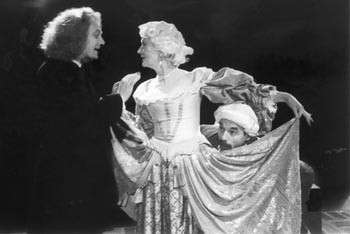
Hot date: Elly Lichenstein and Lucas McClure star in The Lady’s Not for Burning.

‘The Lady’s Not for Burning’ lights up Cinnabar’s 25th anniversary season

By Daedalus Howell

CRANK UP Richard Strauss’ Also Sprach Zarathustra, grab a femur, and get down like an awestruck monkey: There is a monolith in our midst (à la 2001). This season marks the silver anniversary of Petaluma’s Cinnabar Theater–a veritable monument to local theater, whose A-class productions have been emblematic of innovation for the past quarter century.

This landmark year opens with playwright Christopher Fry’s pyrotechnic verbal extravaganza The Lady’s Not for Burning, under the expert direction of Lucas McClure. Written in verse, Fry’s play is a riotous frolic of wit and romance set in millennial-mad 15th-century England.

Enter Thomas Mendip (the ever affable Lucas McClure), a world-weary ex-soldier who has become dead-set on taking leave of life after contracting a virulent bout of existential philosophy. He pleads guilty to the murder of a missing “rag and bone man” and demands capital punishment from Mayor Hebble Tyson (an appropriately supercilious Sean Casey), who, of course, thinks him too foolish for further thought. Complicating Mendip’s death wish is the arrival of Jennet Jourdemayne (a positively glowing Elly Lichenstein), who has been accused of witchcraft–specifically, of turning the same “rag and bone man” into a dog. Love ignites between the two even as sundry complications are foisted upon them, including an impending doom at the stake. Together, McClure and Lichenstein produce more onstage sparks than an ice skater going for the land-speed record on asphalt. McClure’s droll, vitriolic deliveries are well matched to the playwright’s exquisitely crafted repartee, and Lichenstein plays Jennet with refreshing intelligence, sass, and romantic appeal. The lovestruck couple achieves a sweet and sexy banter that spans the gamut from salvos to salvation in two (slightly trimmed) acts.

Jennifer Hirst also turns in an accomplished performance as the man-hungry Alizon Eliot, the initial love interest of fratricidal brothers Nicholas and Humphrey Devise (Eric O’Brien and Scott Mayer respectively, whose blustery delivery occasionally overwhelms the play’s subtle word-play).

Eugene Markoff shines as the venal Justice Edward Tappercoom, and Laurel Watt conveys a nuanced lunacy as the daft matron Margaret Devise.

But absolutely and unequivocally stealing the show for the duration of his lamentably brief stage time is J. Rene Bonel as the inebriated nincompoop Matthew Skipps. The broad comedy of the character’s rants and manner brings the house to convulsive laughter. If comedy is about timing, then clock-perfect Bonel is surely Swiss-made (even though he boasts the production’s only authentic English accent).

Cinnabar’s The Lady’s Not for Burning bodes well for the theater’s continued longevity and for the remainder of its 25th season. As they say, “It’s full of stars.”

Cinnabar Theater’s The Lady’s Not for Burning plays through Oct. 10 at 3333 Petaluma Blvd. N., Petaluma. Thursdays, Fridays, and Saturdays at 8 p.m.; Sunday matinee, Oct. 4, at 3 p.m., Oct. 4. Tickets are $10-$14. 763-8920.

From the October 1-7, 1998 issue of the Sonoma County Independent.

© Metro Publishing Inc.
The Dog Pound

0

Vegging Out

By Mad Dog

THE UNITED STATES government has just made it easier for us to eat a balanced diet. How did they do this? Not by requiring brewers to add 14 essential vitamins and minerals to beer. And not by passing a law that says no one can get up from the table unless they finish all their Brussels sprouts. No, they simply declared that from now on, salsa is a vegetable.

By promoting salsa from a lowly condiment to its new position, the Agriculture Department’s Food and Nutrition Service (motto: “Eat all you want, we’ll grow more”) made it so the nation’s schools can now buy salsa and be reimbursed for it. Before this they were free to serve it but had to either make it themselves or pay for it out of their own pocket, and we all know everything tastes better when it’s free.

How they did this was simple: they reclassified salsa as a vegetable salad. Right. And Godzilla‘s the new Gone with the Wind. If this is the beginning of a trend and they expand this Kondiments for Kids program, it won’t be long until the youth of America will be lunching on a healthy, hearty, and filling all-vegetarian meal consisting of salsa, mustard, pickles, and soy sauce. And why stop there? Let’s call Cheetos dairy, potato chips a vegetable, pretzels a grain, and fruit roll-ups a fruit serving.

The ketchup industry must be fuming. It wasn’t bad enough that they lost first place in the condiment race a couple of years back, with people buying salsa to the tune of $700 million a year, but now salsa has succeeded where they couldn’t.

You might remember when the Reagan administration tried to turn ketchup into a vegetable. Even with all of Heinz’s 57 varieties of lobbyist behind them they couldn’t muster the backing they needed. It might be political. It could be sociological. Chances are it’s just the difference between Reagan and Clinton. Well, other than the fact that Clinton doesn’t need Viagra.

It’s a good thing they didn’t succeed. I can envision children everywhere eyeing that big plop of ketchup alongside their Fish Stick Hash. Then they’d eat it and be so full they wouldn’t be able to touch the Lime Jell-O with Crunchy Gym Sweepings they got for dessert.

Now they’ll get salsa instead, which is supposed to be a major improvement. But is salsa really better for you than ketchup? Or is it just trendy right now? Personally, I think its popularity stems from the fact that there’s only one way to spell salsa and that makes everyone feel better about themselves when they write a shopping list, and we all know we need our Minimum Daily Requirement of Self-Esteem as set by the President’s Council on Misty Crystal Empowerment and Feeling Good about Ourselves.

Russians apparently don’t have this problem. Well, they may have the self-esteem problem but not the ketchup one. That’s because they don’t like the stuff. Recently, when three Russian sailors stopped in San Francisco on the final leg of a three-year trip, they bought a six-pack of ketchup to take with them. According to the captain, they did it for all the right American reasons.

“I don’t like ketchup,” he said, in an article in the San Francisco Chronicle. “None of us likes ketchup. But the ketchup was very cheap.”

If there’s one thing you learn after three years in a 40-foot boat it’s how to be a smart shopper. They say they’ll probably throw the ketchup overboard on the way to Hawaii, along with a four-pound jar of gourmet jelly beans. That’s a double slap in the face for Ronald Reagan. Someone needs to tell these guys the Cold War is over.

I THINK the real reason behind this salsa reclassification is that the United States is jealous of the European Union. The Europeans are busy signing up new members, preparing to issue new money, and creating new food rules. We, on the other hand, have no new members, our new paper money looks as if it came from a Monopoly set, and the best we can do is imitate them by making up our own food rules.

A couple of years ago–and I swear I’m not making this up–the European Union decided that, for the sake of trade, carrots are fruit, escargots (which the French consider to be not only snails but edible) are fish, quail are no longer poultry, curved cucumbers and bent bananas are illegal, and restaurants serving cheese and celery sandwiches must have separate boards to carve the cheese and celery.

This is serious stuff. Here in the United States these laws would be considered unnecessary and downright frivolous, especially the one about cheese and celery sandwiches. That’s not because we think it’s OK to cut those blasphemous ingredients on the same board, but rather that no one in this country could walk into any self-respecting restaurant and order a cheese and celery sandwich without having the waitress say, “Hey Bud, where do you think you are? The European Union?”

But now we’ve taken the international lead again, returning ourselves to World Power status by being the first country to make salsa a legally reimbursable vegetable. That’s something you couldn’t buy with all the Eurodollars in the world.

From the October 1-7, 1998 issue of the Sonoma County Independent.

© Metro Publishing Inc.

Talking Pictures

0

Father Figure

By David Templeton

For five years, Writer David Templeton has been taking interesting people to interesting movies in his ongoing quest for the ultimate post-film conversation. His guests have included Joan Baez, Larry King, Suzie Bright, Barry Lopez, and Ram Dass. This week, he meets up with best-selling author Gus Lee–a West Point graduate and former San Francisco deputy district attorney–to catch the latest Merchant-Ivory epic, an adaptation of Kaylie Jones’ autobiographical novel A Soldier’s Daughter Never Cries.

James Jones, the author of the classic novels From Here to Eternity, The Thin Red Line, and Some Came Running, was known to be a hard-drinking, hard-hitting man–but with a heart as soft as butter when it came to his children. He was a soldier, decorated with a Purple Heart during World War II, and a writer with a knack for clean, honest realism and a grasp of the dimension of human tragedy.

Of that there is little debate.

How good a father Jones really was, however, has been open to discussion since the 1990 publication of A Soldier’s Daughter Never Cries. Written by his daughter, Kaylie Jones, and now a film starring Kris Kristofferson and Barbara Hershey, the semi-autobiographical novel tells the story of the Willis family, an eccentric but genuinely loving American family living in France during the ’60s and early ’70s. In the film, lyrically directed by James Ivory, the parents’ alcoholism and temper tantrums are greatly downplayed. What is left is a complex, fascinating look at a haunted man whose parenting may have been progressive to a fault: He encourages truth-telling at all costs–to the point where his adopted son Benoit is never allowed to forget that his real mother abandoned him–and encourages his 14-year-old daughter Channe to have her boyfriend sleep over (“I’d rather have you doing it in your own bedroom than in the back seat of a car. Especially my car,” he says).

The film is sure to spark heated post-film discussions: Was James Jones an enlightened dad, way ahead of his time, or was he a permissive, oblivious screw-up whose “tolerance” actually amounted to emotional abuse?

“I think you can find the answer by looking at how his kids turned out,” suggests Gus Lee, the best-selling Colorado-based novelist and former San Francisco deputy district attorney. “In the movie at least, his son is so closed up he can’t even talk about his feelings, and his daughter has said yes to so many guys that now she’s afraid she’s earned a reputation as, in her own words, ‘the school slut.’

“I think,” he deduces, “that this is evidence that something was out of balance there.”

Not to say that Lee disliked the film. On the contrary, he agrees that Soldier’s Daughter is among the year’s best. He also agrees that Jones was an extraordinarily gifted writer.

From Here to Eternity was the first book I ever read about the military,” he recalls. “It had a melancholy sadness to it that I found remarkable.” The famous epic was one of 50 novels that were mandatory reading for all newcomers to West Point. Lee remembers it as the best of the batch.

As Jones did, Lee has used his military experience in his own writing career: Honor and Duty (1995) was based on his West Point experience, and autobiographical details were woven into 1991’s poetic China Boy. His lengthy stint with the San Francisco district attorney’s office brought him close to the issue of “at-risk teens,” a subject at the heart of his latest book, the superb courtroom thriller, No Physical Evidence.

Perhaps it is this issue in particular–the plight of children wounded by their own families–that is at the core of Lee’s surprisingly personal response to the film. That and the fact that he is a father as well–and has put enormous effort into assuring that his own son and daughters need not look elsewhere for love.

“In my case,” says Lee, his voice and manner both forceful and soft-spoken, “I set out, not only to avoid becoming the father that I thought my own dad was, but not to be a father at all. I was going to avoid marriage and fatherhood absolutely, because I was convinced that would be a failed venture. So when I ended up becoming a husband and a father, I really tried to be different.

“My father had no idea what his daughters were doing,” he explains. “He controlled them in areas in which he should have given them freedom, and in areas in which he should have provided care and attention and focus, he was absent.”

Later in our discussion, Lee will tell me that early this year, his father–at the age of 91–after a lifetime of anger and a turbulent relationship with his children, announced that he was all done with being angry. Shortly thereafter, he moved in with Lee and family in Colorado. Within two months, he had, in his son’s own words, “reversed half a decade of bad relationship.”

When Lee’s father passed away in March, enough healing had taken place that he was able to openly mourn the man he was once terrified of becoming.

“What I’ve done,” he explains, “is to listen to my kids in the way I wish my father had listened to me. I’ve tried to give them the respect I know they want, by listening, by paying attention, by providing time. When they come in, even if I’m in the middle of writing the best passage I’m going to come up with all week, and I know it–I’ll go, ‘How can I help you? What’s up?'”

“That’s to make up for the years, the first five years of my son’s life, when, if he interrupted me, I’d say, ‘Eric, I’m busy right now.’ In other words, ‘I’m doing something important, and you’re not. You don’t fit into the important category.’

“When I realized I was doing that,” he acknowledges, quietly, “I knew I was in danger. So I turned it around. I did not want my son and daughters to become the kind of kids that give up feeling, like Benoit, or to become the girl who sleeps with so many guys, like Channe. I didn’t want that for my kids. I didn’t want them to ring that bell and then regret it.”

Lee admits that it isn’t a simple matter to change, but points again to his father, able to learn a vital new trick at the age of 91.

“When a parent decides to change, though, it isn’t easy for the kids, either,” he smiles. “They’ll think, ‘What are you doing? Why are you suddenly going out of your way to listen to me?’ And hopefully there is a reason other than ‘I want you to avoid sexual promiscuity.’ Its more than that. It’s really, ‘You’re so much better than that. You’re so much better than the way I’ve treated you.’

“I’m convinced that if any of us succeed in life,” he adds, “we succeed because of the time that others were willing to invest in us. That’s how we learn what we are worth.”

As for James Jones, Lee concludes, “I think he meant well, but he had his own wounds he couldn’t drink away. And I think he ended up teaching his children the wrong lessons.”

Web extra to the October 1-7, 1998 issue of the Sonoma County Independent.

© Metro Publishing Inc.
Mill Valley Film Festival

0

Indie Scene

By Greg Cahill

UNTIL RECENTLY, Sonoma County film buffs found slim pickings when it came to independent films. Sure, there’s the good work of the Sonoma Film Institute, a long-standing local resource. And, more recently, local multiplex owner Dave Corkill has committed a screen at his theaters in Petaluma and Sebastopol to showing top independent films.

Are we grateful–believe it!

Yet, by virtue of its sheer magnitude–more than 110 films, ranging from big-name Hollywood features to animated shorts–the 20th-anniversary Mill Valley Film Festival, running Oct. 1-11, is a veritable smorgasbord of celluloid for ravenous North Bay film fans. This year is no exception. From the Oct. 1 opening-night gala–Down in the Delta, poet laureate Maya Angelou’s directorial debut–to the closing night screening of Pleasant-ville, Gary Ross’ modern fairy tale, the festival this year offers something for everyone.

Most screenings are at the Sequoia Twin Theatres in Mill Valley or the Lark Theatre in Larkspur. Call 415/383-5346 for details, or check online for schedule information.

Here are a few highlights:

Dancemaker (Oct. 3): As a protégé of the late, great Martha Graham, Paul Taylor over the years has shown spectacular strength, first as a dancer and later as a groundbreaking choreographer. Director Matthew Diamond delivers a candid, behind-the-scenes look into the usually closed world of the lofty New York modern-dance scene.

Genghis Blues (Oct. 3): In 1995, Paul Pena, a blind San Francisco bluesman, became the first foreigner to master the ancient esoteric art of Tuvan throat singing, traveling to that Central Asian republic of Tuva to participate in a tri-annual song competition. What a long, strange trip.

Nadro (Sunday, Oct. 4): Filmmaker Ivana Massetti’s stirring documentary about 75-year-old Ivory Coast poet, writer, and artist Frederic Bruly Bouabre. Beautifully photographed in black and white (except when Bouabre’s vibrant paintings are displayed at a Paris exhibit), Nadro ranks as one of the finest portraits of an artist ever committed to film.

Gods and Monsters (Oct. 6): A fictional account of the last days of Hollywood legend James Whale, creator of the classic horror films Frankenstein and Bride of Frankenstein. This adaptation of Christopher Bram’s acclaimed novel Father of Frankenstein features bravura performances by Ian McKellen (as the flamboyant and emotionally tormented Whale) and Brendan Fraser (as the homophobic Frankenstein-like yardman who befriends him). As the plot twists, Gods and Monsters reveals a melancholy and haunting tale about the plight of a creative genius who ultimately cannot distinguish the fictional monsters he has created from the monsters within himself. Highly recommended.

Maternal Love (Oct. 10): This Iranian film, set against the backdrop of strict Islamic society, tells the story of a street waif who becomes obsessed by the female counselor who ventures to his reform school. Often heart-wrenching, this universal tale of love features a remarkably mature performance by 10-year-old Hussein Solimani. A world premiere.

My Son the Fanatic (Oct. 10): Pervez is a Pakistani taxi driver living in the United Kingdom who loves everything British, including a prostitute he meets on the streets. At home, his teenaged son Farid is becoming consumed by his Islamic faith and is rejecting his father and everything that he stands for. This contemporary love story, set in the sometimes tragic, sometimes comic clash of cultures and generations, features a complex mix of sexuality and religion, freedom and constraint, love and transgression.

From the October 1-7, 1998 issue of the Sonoma County Independent.

© Metro Publishing Inc.

Estero Americano

Cool Water


Michael Amsler

Nature’s way: Local teens hoist a fence post near the Estero Americano in a restoration project that helps rebuild their lives. The innovative project is co-sponsored by the Sonoma Land Trust and the Family Life Center of Petaluma.

Troubled youths find healing waters at environmentally damaged estuary

By Stephanie Hiller

A A windswept hill overlooking a dazzling estuary, a group of bright-eyed youth installing a heavy fence post, and the restoration of land trampled by cattle and invaded by roads make a very pretty picture. And when these are boys whose lives were once twisted by delinquency and abuse, the scene becomes charged with social significance.

An innovative partnership between the Sonoma Land Trust and the Family Life Center of Petaluma is behind this unique project, which was the brainchild of Rick Bennett, farm and public policy adviser for the UC Cooperative Extension and also an SLT trustee. “When the kids see the benefits of their work, there’s a tremendous sense of accomplishment and belonging,” says Bennett.

“Initially, the kids feel apart from the land, but after a week, they see it as friendly, as also home. If these young men get a sense of the land as a viable creature, maybe when they’re changing the oil in their cars, they won’t dump it down the drain.”

Bennett got together with David Katz, SLT executive director, to involve youth in its land restoration program for its newly acquired 86-acre parcel on the Estero Americano on the Sonoma-Marin border. “We were looking for ways to involve people with the land more than just walking around saying how beautiful it is,” says Katz. The SLT has been buying and restoring Sonoma County lands since it was formed in l976, to help stop the disappearance of open space in a rural area threatened by development.

More than 30 percent of the county’s open farmland–over 900,000 acres–has been lost to other uses since the 1950s. The Land Trust has more than 10,000 acres now under its protection, and over 60 volunteers who annually walk the properties to assess their condition, but the Estero project is the first time youth have been involved.

Strong winds race through tall grasses and ripple the shining waters of the estuary, which is within the Gulf of the Farallones National Marine Sanctuary. The isolated hilly grasslands on Estero Lane in Bodega Bay are a stunning landscape damaged by various types of erosion, resulting in siltation of marine breeding areas, disturbance of nesting areas, increased turbidity of the water, and raised water temperature. Home to migratory waterfowl, shorebirds, eagles, and red-tailed hawks as well as deer and small mammals, the land has been overgrazed by sheep for many years.

Native range grasses are nonexistent, and many invasive plants have begun to take hold.

Restoration of the wetlands will be visible in only one year, according to Bennett. Installation of a high-tensile fence will control grazing while allowing deer to roam freely. The road will be regraded and regraveled to reduce runoff, and existing erosion will be repaired. Some revegetation of the wetland area bordering the Estero will also be undertaken. When they revisit the land next spring and summer, kids will see the fruits of their labor. “It improves their self-esteem,” Bennett says, “which is so fundamental to who we are as people.”

THE YOUNG PEOPLE who come to live at the Family Life Center are youth whose sense of self has been damaged by the unfortunate things that have already happened to them in their short lifetimes. The FLC’s goal is to provide a stable and nurturing environment where they can recover from the wounding they have endured, emerging with renewed confidence to make a fresh start in their lives.

“Giving the child exposure to the land in an unspoiled area–[having them] actually be able to touch the land–lets their spirit come out and play,” says Jamie Goetz, wilderness program coordinator for the FLC. While kids are aware of the major threats to planetary survival, “a lot of them are pretty uninformed about the simpler things,” he adds, “[like] where their water comes from, where the water goes when you flush the toilet.”

The Wilderness Program, in which this restoration project will be an ongoing weekly activity, has the intent of “building a sense of community and self-confidence, [with youths] working together as a team to get things done that they wouldn’t be able to do for themselves.”

Out on the windy hillside, the kids look alert and engaged, as if the fresh cold gusts of air have relieved them of their masks of indifference and disdain, and reawakened their radiant innocence.

“It’s cool,” says Chris, 17. “It’s just, like, fresh. Not at all stagnant.”

He stares out across the Estero, where earlier he had noted a man driving a truck across the grasses (probably checking on his cattle, Chris surmised). “There’s more stuff to look at here. It gives me, like, a good feeling. Feel more free, kinda.”

Jason, also 17, had worked on the land last year. “I didn’t think anything we did was going to make a difference,” he says. “Now I see that it did make a difference. That makes me want to work even harder today!”

He doesn’t like being out there, though, preferring the city. “But if I can help nature,” he explains, “I’ll do it. Nature needs a lot of help.”

The rest of the boys are clumped together around the new fence post, taking turns with the tamper bar to pack the soil as hard as it had been before the post-hole digger penetrated the ground. One boy suggests they make sure it is absolutely level. Bennett walks to the back of the pickup truck to hand him a T-level.

He’s been smiling all the while, telling the kids how long it takes–10,000 years–to build topsoil, pointing out where the lines of erosion are. “Thousands of years ago,” he explains, “this whole place was under the ocean.”

The kids are intrigued. “Oh yeah?”

For Rick Bennett, too, this work is a healing. “I’ve seen these boys sit down with me in a meadow and share their hearts,” he concludes.

From the October 1-7, 1998 issue of the Sonoma County Independent.

© Metro Publishing Inc.

Betty’s Fish & Chips

Fish TaleMichael AmslerDown the chippy: Betty's Fish & Chips is a local favorite. Betty's--a welcome catchBy Paula HarrisGROWING UP in London may have warped my culinary preferences forever. For years, I thrived on chocolate digestive biscuits for breakfast, shepherd's pie and mushy peas for lunch, Marks & Spencer double cream-filled Victoria sponge cake for tea, and fish and chips...

Talking Pictures

CatfightAnimal attraction: Simoóm: Passion in the Desert tells a tale of interspecies love.Author Barry Lopez gets passionately angry about 'Passion in the Desert'By David TempletonDavid Templeton takes interesting people to interesting movies in his ongoing quest for the ultimate post-film conversation. This time out, he teams up with esteemed nature writer Barry Lopez to see the adventure film Passion...

California Small Works Exhibition

Small WorldMichael AmslerExhibits showcase art in the miniatureBy David TempletonSMALL IS BIG. Very big. Though it may be only a seasonal phenomenon, every autumn--for 10 years running now--a growing number of artists band together in solemn celebration of the enigmatic beauty of smallness.The epicenter of all this size-mic activity is Santa Rosa's California Museum of Art, sponsor of the...

Robin Troy

Video Fiction? Floating's tired story of cowboy love won MTV's fiction contest. Michael Amsler 'Floating' serves up cold cowboy clichés By Patrick Sullivan IT SOUNDS LIKE a Zen riddle: If MTV gave out awards to novels, what kind of novels would win those awards? That clears the mind in a hurry,...

Ultima Online

Screen SceneMichael AmslerCyber citizens: A growing number of role-playing gamesters nationwide are swept up in the virtual world of Ultima Online, an Internet game that sports a local server.Ultima Online: Virtual theater of the fantastic By Christopher Pomeroy POROFO, the flaxen-haired neophyte archer from the township of Yew, carefully makes his way through the towering trees of Yew forest....

The Lady’s Not for Burning

Burning PassionHot date: Elly Lichenstein and Lucas McClure star in The Lady's Not for Burning.'The Lady's Not for Burning' lights up Cinnabar's 25th anniversary seasonBy Daedalus HowellCRANK UP Richard Strauss' Also Sprach Zarathustra, grab a femur, and get down like an awestruck monkey: There is a monolith in our midst (à la 2001). This season marks the silver anniversary...

The Dog Pound

Vegging OutBy Mad DogTHE UNITED STATES government has just made it easier for us to eat a balanced diet. How did they do this? Not by requiring brewers to add 14 essential vitamins and minerals to beer. And not by passing a law that says no one can get up from the table unless they finish all their Brussels...

Talking Pictures

Father FigureBy David TempletonFor five years, Writer David Templeton has been taking interesting people to interesting movies in his ongoing quest for the ultimate post-film conversation. His guests have included Joan Baez, Larry King, Suzie Bright, Barry Lopez, and Ram Dass. This week, he meets up with best-selling author Gus Lee--a West Point graduate and former San Francisco deputy...

Mill Valley Film Festival

Indie SceneBy Greg CahillUNTIL RECENTLY, Sonoma County film buffs found slim pickings when it came to independent films. Sure, there's the good work of the Sonoma Film Institute, a long-standing local resource. And, more recently, local multiplex owner Dave Corkill has committed a screen at his theaters in Petaluma and Sebastopol to showing top independent films.Are we grateful--believe it!...

Estero Americano

Cool WaterMichael AmslerNature's way: Local teens hoist a fence post near the Estero Americano in a restoration project that helps rebuild their lives. The innovative project is co-sponsored by the Sonoma Land Trust and the Family Life Center of Petaluma.Troubled youths find healing waters at environmentally damaged estuaryBy Stephanie Hiller A A windswept hill overlooking a dazzling estuary, a...
11,084FansLike
4,606FollowersFollow
6,928FollowersFollow

