Housing Crunch

0

Labor of love: Susan Ohlson, pictured with her dog Caspian, helped transform a couple of acres of bare ground in Santa Rosa into a neighborhood for low-income families, with supervision by the Burbank Housing Development Corp.

Time but No Money

Sweating for the American Dream –sweat equity builds a local following

By Yosha Bourgea

WHEN SUSAN OHLSON started building her house, she had no experience in carpentry and knew nothing about construction. But she didn’t let that stop her. “I had no clue how to do this,” Ohlson says. “But my attitude was, OK, well, I’m going to learn.”

In May of 1998, the Santa Rosa neighborhood of De Turk Commons was nothing but a couple of acres of bare soil and 32 low-income families, most of whom, like Ohlson, were new to the construction business. But they shared the dream of owning their own homes, and the willingness to help one another build them from the ground up. Under the supervision of the Burbank Housing Development Corp. in Santa Rosa, they began to make their dream a reality.

“The first couple of weeks, we didn’t have any idea what we were doing. There was a lot of shoveling of dirt,” Ohlson recalls. Soon, the family crews began laying the foundations, tying rebar, and driving stakes. Everyone learned to move quickly when the cement trucks arrived. Even on days when rain threatened to dampen enthusiasm, the work continued.

Ohlson discovered that she had a knack for framing the structure of the houses. As she placed two-by-fours and installed floor joists for the second story, the process of building her home became a labor of love.

“I was able early on in the project to submit changes,” Ohlson says. “I changed a hallway closet into a kitchen pantry. Instead of a sliding glass door off the kitchen, I put in French doors.”

It would have been nearly impossible for Ohlson, a secretary and single mother, to work the required minimum of 30 hours a week on her own. Fortunately, she had assistance from her 19-year-old son, Holland, and from what she calls her “church family,” fellow members of City Life Fellowship who volunteered their time on weekends.

At the end of last May, crews completed construction on the houses of De Turk Commons, and the residents finally moved in. A grateful Ohlson hosted a dinner of thanks for the 20 or so volunteers who had perspired on her behalf. After a year of hard work, she had what so many people struggle for: a house of her own.

“SWEAT EQUITY” is the somewhat undignified term for an arrangement whereby prospective homeowners can work off part of the cost of a house by helping to build it. John Lowry, executive director of Burbank Housing, prefers the term “mutual self-help housing,” although he acknowledges that it’s less catchy.

“We emphasize the mutual aspect of the program,” Lowry says. “It seems important to me that people have some investment in the house that makes them feel attached to it. If people are just handed a house, they may not behave like homeowners. This program provides an experience for them, an emotional equity. It also tends to weed out the people who are not willing to do the work.”

Since 1986, Burbank Housing has supervised the completion of 11 self-help projects throughout Sonoma County, with a total of 287 housing units. Three more projects in Santa Rosa, Windsor, and Cloverdale are slated to begin within the next two years. Quarry Ridge, a Healdsburg project, has halted construction until further notice because of a delay in funding.

Lower-income, first-time home buyers who qualify for the self-help program are required to put in at least 30 hours of construction labor per week per family, although many families choose to do more. A down payment is not required. Included in the package is a deferred payment second loan that does not need to be paid off unless the home is sold again. Most participating families have insufficient income to qualify for even a 5 percent loan in the conventional housing market.

De Turk home buyers wound up with reduced first mortgages averaging $115,000, which, at a 5 percent rate offered through the California Housing Financing Agency, translates to monthly mortgage payments of about $600. In contrast, the same houses in the conventional market would have had a first mortgage of about $140,000, a higher rate–about 7 percent–and a monthly mortgage payment of some $900.

In a red-hot housing market that is quickly moving out of the reach of low- and moderate-income families, these subsidies often can make all the difference for families with limited financial resources–if they are willing to commit to as much as a year of manual labor. Under the technical supervision of Burbank Housing employees, families work together pouring foundations, putting in siding, roofing, installing windowsills and baseboards, hanging doors and cabinets. Roxanne Trujillo, Ohlson’s friend and next-door neighbor at De Turk Commons, says she learned to use a powersaw while building her house.

“They don’t need to have construction skills, although, of course, we’re delighted when we find anyone who does,” Lowry says.

What participating families do need to have is a good credit rating and low debt obligations. In many cases, particularly in rural developments, that means Mexican-American immigrants–farmworkers who are much less likely to have bad credit than whites in the same income range. Mexican-Americans also are more likely to have two-parent families, making it easier for them to meet the labor requirements.

“Most [white families] we work with don’t seem to have trouble living near minorities,” Lowry says, “but quite a few of them are uncomfortable with becoming a minority–that is, being the only white family on their block.”

THE RELATIVELY RECENT history of self-help housing in America actually begins with minorities. In 1964, a group of Quakers in the San Joaquin Valley sat down with local Mexican-American farmworkers and asked them what it was that they wanted most. The workers’ most frequent response came as a surprise: not higher wages, not improved working conditions, but a place they could call their own. In response, the Quakers began searching for ways to make home ownership affordable to low-income families. The following year, they incorporated Self Help Enterprises, the first self-help housing organization in the country.

Today there are 10 groups in the state of California that offer sweat equity programs. Burbank Housing is the only such group in Sonoma County.

One reason that self-help housing is not more widespread is that it isn’t a moneymaking concept. Burbank Housing, a non-profit corporation, covers most of its costs through other projects, including conventional rental housing. The costs of development for self-help housing programs are so high in relation to values that the market remains far from lucrative.

“It’s the same dilemma that private builders face [when they’re] trying to do low-end first-time home buying,” Lowry says. “If you were very efficient, you could do nothing but sweat equity and cover your costs. But it would be tough.”

A more subtle obstacle is the cultural standard by which Americans judge their houses, particularly houses they own. Renting a house in a crowded urban neighborhood is one thing, but who wants to spend 30 years making mortgage payments on one?

“We have a much greater expectation of what homes should be than other cultures,” Lowry says. “[In America] the expectation is that you need to have a garage and you need to have individual road access.”

Burbank Housing has what is probably the highest-density self-help program in the country. Although many prospective home buyers feel the need for privacy and plenty of space, that ideal is becoming more and more difficult to achieve. In the rapidly escalating local housing market, finding an affordable house–any house–is a challenge.

“A single family lot is a luxury in Sonoma County,” Lowry says.

TODAY, THE HOUSES of De Turk Commons are still noticeably newer than the ones across the street. The new paint gleams in the winter sunlight; in each front yard, a young tree is tied to a wooden stake. “The neighborhood is much quieter than I thought it would be,” says Ohlson, scooping up her shih tzu, Caspian, from the front lawn. “There are lots of small kids, but they’re very well behaved. The neighbors are just wonderful.”

Inside, the house is surprisingly spacious. At the top of the carpeted staircase are three bedrooms, including a guest room that Ohlson will convert into a sewing room next year. Warm sun streams through the south-facing windows.

Although the tree out front has just begun to sink its roots, Ohlson plans to watch it grow for a long time. The house is her son’s inheritance, something she hopes will remain in the family for generations. In a way, it’s also a gift to herself.

“I don’t know if I could just walk in and buy a house after having had this experience,” Ohlson says. “I know how this house was put together. I’ve always been a renter, and whenever I had a problem I had to call the landlord.

“I’ve got the education now, where I know how to do the stuff myself.”

To be placed on the Burbank Housing mailing list for upcoming sweat equity projects, call Mariella Zapata at 573-5902.

From the January 20-26, 2000 issue of the Sonoma County Independent.

© Metro Publishing Inc.

‘Galaxy Quest’

0

A seasoned Star Trek fan talks about greedy T.V. stars, long lines, bad hairpieces, and the new film ‘Galaxy Quest’

Writer David Templeton takes interesting people to interesting movies in his ongoing quest for the ultimate post-film conversation. This column is not a movie review; rather, it’s a freewheeling, tangential discussion of life, alternative ideas, and popular culture.

“It happened at StarCon ’97,” says Jerry Franceschi, his exuberant voice shifting into storytelling mode for the umpteenth time this hour. “Down in Los Angeles. My buddy Darryl and I went down there knowing that a few of the original cast members of Lost in Space–including Mrs. Robinson herself, June Lockhart–were going to be there signing autographs. So we were excited–but we could never have anticipated what actually happened.”

At the beginning of my remarkably lively conversation with Franceschi–a lifelong science-fiction fan, Star Trek enthusiast, and self-described “huckster” of “movie prop memorabilia, from Batman to Star Wars to Star Trek“–our discussion was focused on Galaxy Quest, the increasingly popular movie–it started out in 8th place on Christmas day and has so far climbed up to fifth, mainly due to some insanely positive word-of-mouth–that spoofs the aging stars and nerdy fans of a fictional Star Trek-like television show.

But it’s not easy keeping Franceschi on any one subject.

On the subject of Star Trek–and anything else of science-fictionish orientation–the 37-year-old, Mill Valley-based stone mason–a natural born story-teller–exhibits enough high-energy enthusiasm and delight to power the electrical needs of 10 StarCons. In conversation, that enthusiasm sends him spinning from one topic to another like an over-powered dilithium crystal dropped into a sub-space anomaly.

Or something.

At any rate, Franceschi has been to countless Star Trek conventions of the kind parodied in Galaxy Quest, first as a young, wide-eyed teen–“With shekels in my pocket,” he tells, “and a serious lust for realistic looking Star Trek phaser and tricorders”–and now as a seasoned craftsman and dealer of hand-made science fiction props, with over 140 different swords, rayguns, and space-bound doodads.

“I thought the film was a very clever parody. And yes, the convention scenes in Galaxy Quest were great,” he says. “Have you ever been to a Star Trek convention?”

“Well, no,” I confess. “But I know a lot of people who have.”

“Well,” Franceschi chuckles, “they’re exactly like the ones in the movie. Just like that, with all these strange people dressed in home-made costumes, drooling over the old stars and acting like nerds. It’s pretty great!”

In the film, Tim Allen plays the William Shatneresque “captain” of the Galaxy Quest Crew. It’s a sharp, well-honed performance.

“Tim Allen did a good job of playing poor Bill,” Franceschi agrees. “He had the same kind of friendly rapport with his fans. I always call Shatner poor Bill because I remember the Star Trek conventions of the late 1980s, before the first movie came along and put a few million dollars in his pocket, when poor Bill would show up in his Bill Shatner-hairpiece–which looked kind of bad back then–and the longest his autograph line would be was about 12 people.”

The movies, of course, rejuvenated poor Bill’s career, much as Tim Allen’s fellow crew members (including Allen Rickman and Sigourney Weaver) are spiritually resurrected when a band of actual aliens draft the actors into a real life-and-death adventure in space–complete with fiendish lizard-like enemies and unstoppable rock-monsters.

“The rock monster, by the way, was stolen from Star Trek V–The Final Frontier,” says Franceschi. “Though the rock monster never appeared in the final film.” It seems the original script called for six rock monsters to chase Captain Kirk across the dessert, but the budget would only afford one rubber rock-man suit. After the scene was filmed, however, “It looked like a guy in a rubber rock suit, chasing Shatner around with his hairpiece in a spin.” So the scene was dumped.

“Actually, I think they should have left it in,” he says. “Ask any Star Trek fan. Rubber suits and fake Styrofoam boulders are what that show is all about.” Just like Lost in Space, which brings us back to Franceschi’s story.

In preparation for the StarCon event, Franceschi had made up a batch of collectible trophies, with a six-inch replica of Lost in Space’s Jupiter II space craft, mounted on a wooden base. “They looked like little Jupiter II Emmy Awards,” he laughs. “They were hilarious.” Knowing that some of the L.I.S. cast would be at StarCon, says Franceschi, “Darryll and I each dragged our own Jupiter II’s down there to be autographed.”

Almost immediately, Franceschi encountered Jonathan Harris, otherwise known as the evil Dr. Smith. Harris, whose presence at the convention had not been advertised, eagerly signed the trophy–for ten bucks.

“Ten bucks is the going rate for an autograph at these things,” he says. “that’s how these guys make their money these. Next, I ran into Bill Mumy [Will Robinson], who was also not expected to be there. So he signed the Jupiter II. And there goes another ten dollars.” Franceschi and his buddy then got in a long autograph line leading past a table where all the remaining Lost in Spacers were waiting in a row–beginning with Angela Cartright [Penny Robinson] and ending with June Lockhart.

Multiple $10 bills changed hands.

“Finally, I got up to June Lockhart,” says Franceschi, “And she’s got these white gloves on, like she’s afraid of getting a germ from the unwashed masses. I set the Jupiter II down in front of her and ask her to sign it for me, right?” He pauses for effect.

“So she picks it up, turns it to the right, turns it to the left, and says, ‘Hmmmm. This is an interesting artifact. I’ll sign it for a hundred dollars.’

“‘A hundred dollars?’ I said. ‘Everyone else signed it for 10 bucks.’ And she said, ‘But if I sign it, it will be worth a lot of money. So I’ll sign it for $100.” Franceschi balked, he says, but later in the day, as the stars were packing up to go, “Darryll went up to her, dropped down on his knees, and begged her to sign for ten dollars. She looked around and said, “I’ll do it for fifty.'” Eventually, he talked her down to 20, and Franceschi made sure the deal applied to himself as well.

Gee whiz, is a June Lockhart autograph really worth begging for?

“Oh, absolutely,” Franceschi laughs. “All in a days work.”

From the January 20-26, 2000 issue of the Sonoma County Independent.

© Metro Publishing Inc.

Slamfest 2000

By Natalie Sibert Freitas

SINCE THE DAYS when Alice Cooper started playing with snakes on stage, metal and all its mutations have held tight to a dedicated following. Now, metal madness seems to be on the upsurge again in Sonoma County.

On Thursday, Jan. 27, Rumors nightclub will host its first metal mania event with Slamfest 2000, a show featuring eight Northern California bands.

Patrick Warner of Aurora Sound is teaming up with Hedge-hog Productions to co-present the event, which he hopes will pump new energy into Sonoma County’s metal scene. “There has always been a steady interest in metal shows,” Warner says. “My hope is to renew the scene as it was back in the days of Magnolia’s and the Cotati Cabaret, when bands like Ice and Parallax played.”

Among the bands that will take the Slamfest stage are Spitkiss; Ripstoke, which plays a Black Sabbath-style of music; Sonoma County’s longest running metal masters, Skitzo; and the Heat Creeps, who offer a fast mix of punk, rockabilly, and metal.

“All of the bands have a very good stage presence, which was a huge motivation for selecting them,” Warner says.

From the January 20-26, 2000 issue of the Sonoma County Independent.

© Metro Publishing Inc.

Spitkiss

0

Golden Boys

Tech-metal and body paint rule when South Bay baddies Spitkiss hit town

By Sarah Quelland

AFTER CLAMPING DOWN on their hometown scene with a tenacious grip, Spitkiss strike out from the heart of Silicon Valley with their aggressive, industrialized tech-metal to participate in Slam Fest 2000 on Jan. 27 at Rumors nightclub in Santa Rosa (see sidebar).

Highly creative, the band is a continually evolving artistic project and tends to make each live show a real event, bringing a performance-art quality to its high-energy rock concerts.

Led by vocalist Adam Bannister, a tall, long-haired rocker who’s been described as “a prettier version of Al Jourgensen and Rob Zombie,” this five-piece group features Justin “Chicken” Winokur on guitar, Jason Shaw on bass, Boris Popkoff on keyboards, and Dan Lawson on drums.

When the band released its sophomore CD Violence Is Golden (hereafter VIG), Bannister came out painted from head to toe in gold. At a benefit show last March Spitkiss chose a more subversive look for the night, sporting dignified dark suits. More recently, the band has taken on a sexy cowboy air, wearing ragged cowboy hats and incorporating a dusty Western twang into some of its material.

At one recent Bay Area show, Spitkiss took a futuristic approach with holographic clothing, a variety of metal and plastic hardware in their hair, and computer monitors onstage flashing cryptic messages like “Defragging Spitkiss,” “Fragmentation Increasing,” and “System Overload.”

Though the band’s roots are tangled up with the likes of Ministry (one of the forefathers of this genre) and demonstrate elements of Nine Inch Nails, Marilyn Manson, Orgy, and others of that ilk, Spitkiss have developed their own musical identity with their dark, dusky melodies, prowling guitars, and harsh, quivering vocals–not to mention their esoteric sense of humor (the band slapped a sticker that read “Warning: This Product Promotes Violent Sodomy–The Commission Against Violence, Sodomy and Violent Sodomy” on VIG before distributing the CD).

With two full-length albums released on AntiMI Records (Not for Human Consumption and VIG), Spitkiss have distanced themselves from their initial “Goth band” stereotype and acquired a more eclectic and diverse following.

Moshter Mash: Rumors nightclub hosts its first metal mania event with Slamfest 2000.

TORMENTED THEMES of pain, isolation, and anger carry throughout the band’s tumultuous lyrics and are emphasized in its heavy music. The single from VIG titled “Digits” has gotten the band a lot of attention and has appeared on several compilations, including San Francisco radio station LIVE 105’s first Local Lounge disc. With its angry guitars, fluid synths, gruff vocals, and demented lyrics–“You, passionless little mess/ I must confess that I caused your death/ Save the world, kill yourself/ Do it myself,” that later fall into the brutal chorus “Anger/ Violence/ Sex”–“Digits” is just one of many Spitkiss songs that worm their way into your consciousness.

Given the chance, the wounded “Deeper Scratch,” which finds Bannister mourning “I am I and you’re not me/ When I sink it’s far too deep/ Be the one, right now, today/ It’s a lie, you don’t care about me,” could be the next to get noticed.

During live performances, the band pulls no punches and unleashes a vigorous fury, with Bannister thrashing about the stage, writhing with aggression, hurling himself into the air with anger-fueled flips, and swinging upside down from almost anything available. Beating himself with his microphone, he leaves almost every show bloody, his wavy blue-black hair a tangled, sweaty mess. Winokur plays his guitar with a vicious, determined intensity, while Popkoff bounces off the keyboards with an energy barely afforded by his instrument. Bassist Shaw is known as the quiet one, taking a softer approach and generally keeping to the side of the stage.

Confident without being cocky, Spitkiss seem to have a healthy attitude toward their music and the ever-changing musical climate. With bands like Orgy enjoying commercial success, and Nine Inch Nails’ latest two-disc opus The Fragile garnering so much critical approval, Spitkiss have definite potential to ride into the commercial arena on those coattails and work on setting the new standard from within.

Slamfest 2000 will be held on Thursday, Jan. 27, at 6 p.m. at Rumors, 120 Fifth St., Santa Rosa. Admission is $8. 545-5483.

From the January 20-26, 2000 issue of the Sonoma County Independent.

© Metro Publishing Inc.

‘Mating Cries’

0

Mating Cries.

True Beauty

‘Mating Cries’ merits love at first sight

By Daedalus Howell

LADIES AND GENTLEMEN, a dynamic duo of thespians has descended upon local stages–award-winning theater veterans Conrad Bishop and Elizabeth Fuller are making a new home in Sebastopol. As a respite from a national tour, the lifelong collaborators are bringing Mating Cries, their suite of six original micro-plays exploring the slings and eros of amour, to their new home for a single weekend.

Judging from a mid-January performance in San Francisco, Mating Cries is a splendid brew of art and love, delivering a hearty serving of wit, insight, and stagecraft sure to arouse even the most curmudgeonly paramour.

From the get-go, Bishop and Fuller’s sparkling onstage chemistry is awesomely apparent–imagine an Elaine May and Mike Nichols for the west county set. Opening the production is the charming playlet “Dreamers,” in which the couple trade punchy epigrams about love, loaded with such suggestive gems as Fuller’s line “I want a bouquet of lovers–but they wilt.”

Later, “The Dreamers” finds Bishop and Fuller parsing the personal ads of a mismatched couple, whose sheer loneliness hastens compromise of their ideals. Though this is well-trodden territory for parody, Bishop and Fuller offer new and satisfying gags and provide insight into how far a heart will bend before it breaks.

The weak link in Bishop and Fuller’s otherwise brawny theatrical chain is their first-act closer, “Freeway,” which gets caught on the rough shoulder of an overwrought “highway-of-life” metaphor. It’s the tale of garrulous newlyweds represented by grotesque puppets who ride through a series of pap platitudes until, mercifully, they wreck and die.

Though the first act dead-ends in “Freeway,” Bishop and Fuller come roaring back full throttle in the second act with “At the Prom with Kali,” which finds an Omaha teenager going stag at his senior prom until he cuts the rug with the Hindu goddess of destruction. The deadpan setup is worth a chuckle, but the story take a fulfilling tack as the young lover becomes mired in his harrowing erotic tryst.

The equally satisfying “Transcripts” finds a pair of typists in the midst of their labors while Fuller’s lovesick character realizes her internal musings about her colleague are somehow bleeding into their shoptalk.

Bishop and Fuller are versatile performers, but they’re also crackerjack playwrights, as indicated by their deft retelling of the Greek myth of “Baucis and Philemon.” The story–in which an aged couple show hospitality to a couple of gods disguised as mortals who reward them by turning them into intertwining trees–is a bittersweet exploration of lifelong love.

The production values in Mating Cries are a study in economy–the sets and props are minimal, the music is spare, and the costumes are merely suggestive. In lieu of spectacle, however, Bishop and Fuller offer the eloquence of their performances and the comic profundity of their text.

As they suggest in their program, “Erotic bonding is often difficult in this world we’ve created, but nevertheless, it’s a really good idea.” That sentiment applies equally to Mating Cries.

Mating Cries plays on Friday and Saturday, Jan. 21 and 22, at 8 p.m. at the Subud Center, 234 Hutchins St., Sebastopol. $10-$15. 824-4307.

From the January 20-26, 2000 issue of the Sonoma County Independent.

© Metro Publishing Inc.
Kayaking the Russian River

0

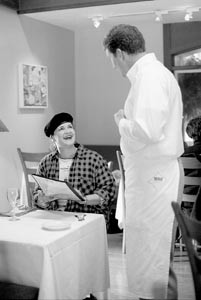
Nature’s way: Amid the serenity and grandeur of nature, kayaking along the Russian River can contribute to a sound mind and healthy heart.

River Dance

Life on the water–a meditation on kayaking the Russian River

By Sarah Peyton

WITH THE KAYAK gliding along, the rounded head, broad snout, and enormous dark eyes of a critter sinking quickly beneath the surface shouldn’t startle a first-time paddler. Especially since in this neck of the woods, it’s way more likely to be a seal or sea lion than a gator.

Instead, it’s this chance to view the abundant and diverse animal and plant life from the eye level of a harbor seal that makes paddling the lower Russian River endlessly fascinating.

There are as many reasons to love Sonoma County’s natural environment as there are people to describe it. With all its variety one characteristic connects the region: a river flows through it.

When I first moved to Sonoma County some 20 years ago, I missed San Francisco terribly. But I soon fell in love with the Russian River and its beautiful twisty course past Monte Rio cabins, ancient stands of redwoods, and firs near Duncans Mills, to the mouth at Jenner. I still cannot resist the lure of the river, and I return again and again to the same places, always feeling like a tourist.

When my kids were small, my best-loved summer days were spent on the Russian River. While some friends favored quiet, out-of-the-way beaches, We preferred Monte Rio beach. We liked the snack-bar food, swimming in the shallow warm water, lounging on the beach, soaking up the sun’s heat.

With our striped towels, plastic pails and shovels, beach chairs and umbrellas, we’d spread along the ecological edge of the river like migrating shore birds. Though it’s hard to believe now, not many years ago you could spend entire days among vacationing strangers and never hear cell phones or beepers.

Hours floated by deliciously unscheduled.

The cacophony of children playing, the idle chatter of adults, the noise of loud and guffawing teens, and even the occasional sounds of a baseball game wafting from a radio reminded me of my noisy childhood outings to crowded East Coast beaches.

For me, looking at Guerneville artist Mary Robertson’s luminous paintings of the Russian River invariably recalls these summer afternoons. She perfectly captures the filtered late afternoon light on the river that makes everything appear lit from within.

On the hottest afternoons, my kids and I would paddle upstream on a flotilla of tubes and rafts. As the kids got older, we’d rent canoes, venturing farther and staying away from land longer. That’s when I first learned to distinguish the screech of an osprey from that of other raptors. One afternoon I drifted past a large turtle sunning itself on a rock. The importance of the river as a home to wildlife is easier to see when you’re skimming its silken surface like a sea otter or a harbor seal.

Canoes are fine, but tippy, and after years of piling kids in canoes, I longed to paddle on the river by myself. Finally, a little over a year ago, a friend and I bought several used kayaks. They’re the sit-on, self-bailing, polyethylene type. With a lifejacket, paddle, wool socks, and polar fleece pants, for me venturing on the Russian River is practically a year-round sport.

This is what I’ve discovered. No matter where you put in on the lower Russian River, once you’re afloat, the hustle of modern terrestrial life instantly retreats. Paddling toward the sea from Duncans Mills makes me feel like an Aleutian explorer.

The Russian River supports a huge number of bird species. I’m now a bird watcher. In a little over a year of observing birds from my kayak I can identify dozens of different species of waterfowl and raptors, including ospreys, red-tail hawks, kingfishers, kites, all types of herons, egrets, cormorants, ducks, and geese.

A friend who has toured rain forests throughout Central and South America says that while kayaking the lower Russian River she’s spotted a greater variety of exotic birds and in larger numbers than in any other region in the world. And like so many coastal residents, these birds are relatively undisturbed by kayaks.

I often float by statuesque great blue herons hunting by the shore without ruffling feathers. I’ve watched more than one osprey–the only raptor that hovers over the water and plunges into it feet first for fish–grab a wriggling fish from the water a few feet from my kayak and fly off with it.

Near the mouth of the river at Jenner brown pelicans gather in the fall. These huge, lumbering birds–which look more like Disney creations with their long bills and wide flapping wings than the efficient fisher-birds they are–were nearly lost in the 1960s and 1970s owing to pesticide poisoning, specifically DDT. The ban on DDT helped brown pelicans make a dramatic comeback by the mid-’80s, writes naturalist Susan Tweet in Seasons on the Coast. Unfortunately, according to Tweet, fisher-birds throughout the world are still threatened because DDT continues to be widely applied in South America. In the United States, residential use of pesticides is skyrocketing, and some of them degrade into DDT.

Harbor seals–the shy, cow-eyed pinnipeds that are seen lolling at the mouth of the Russian River–are awkward and easily startled on land. But in the water they turn sleek and graceful and seem friendly and curious. It isn’t uncommon for them to pop up alongside a kayak and keep pace for awhile.

“Hey, lady,” yelled a kid one day last fall. “Otters are following you.” Sure enough, I looked back and saw three sleek otters. Quickly the otters sped passed me, and soon I was following them. Unlike harbor seals, otters are as graceful on land as they are on in the water. And if playfulness is any measure of intelligence, some wildlife experts say, these fun-loving members of the weasel family may the smartest of all wild animals. The three otters–possibly a mother and her young–swam from riverbank to riverbank. They scampered up the banks, rooted around, tumbled over one another, all the time blissfully unworried about my presence or perhaps even putting on a show for my benefit.

One afternoon I spied a mountain lion creeping down a hillside and drinking from the river, only to vanish into the woods seconds later. On New Year’s Day, back on land after a day of kayaking, I peered through binoculars, transfixed by a bobcat pouncing on a gopher in the fading sunlight.

You can travel the globe, watch nature shows on cable, or scan the Internet for information about wildlife. Or you can kayak the Russian River and see more species of birds, water creatures, and other animals in a single afternoon than most people see in a lifetime–and get a cardiovascular workout in the process.

Getting Started

THE FOLKS at the headquarters of the Russian River Recreation and Park District recommend kayaking on the river in the summer and fall. The river is usually flat then, making it safe for people of all ages and skill levels.

In Jenner, the boat ramp next to the visitors’ center provides easy access near the mouth of the river. State park officials advise against going too close to the mouth of the river. Lifeguards have rescued many capsized kayakers.

You can also launch a boat from the Willow Creek environ-mental campground. You have to haul the boat from the parking lot to the river. Day-use fees are $2 per car per day. For more information, call Russian River District Headquarters at 865-2391.

Several local companies will give you boating lessons, haul and rent kayaks, and serve as guides. Check the local yellow pages for more information. In Duncans Mills, call Gold Coast Kayaks at 865-1441.

From the January 13-19, 2000 issue of the Sonoma County Independent.

© Metro Publishing Inc.

Usual Suspects

0

Town Hall Coalition comes to Sonoma

By Yosha Bourgea

WEST COUNTY residents aren’t the only ones concerned about the environmental hazards of vineyard expansion; they’ve just been raising the most hell about it more loudly. Now the Town Hall Coalition initiated by the Occidental Rural Alliance has a sister group in Sonoma Valley, where people have been rubbing shoulders with grape leaves for years. Next Tuesday evening, the Sonoma Valley Town Hall Coalition will hold its first public meeting to provide a forum for those who have been rubbed the wrong way.

Among the hot-button topics to be discussed are water issues, pesticide use, soil erosion, and the loss of natural habitat. Scheduled speakers include former Sebastopol Mayor Lynn Hamilton, who helped initiate the West County Town Hall Coalition; land conservation consultant Joan Vilms, Alan Buckman of the Department of Fish and Game, Patti Clary of Californians Against Toxic Substances, and Ed Wilson, an attorney specializing in water rights.

In the parched Sonoma Valley, where wells already are beginning to run dry, issues of water usage are particularly critical. Grapes, which require more irrigation than many other crops, are unfairly favored by lenient agricultural laws, coalition members say. “It’s not equal rights,” Hamilton says. “In fact, ag takes the rights away from other people. [Growers] can come in without a permit, dig a well next to your property, and drain you dry.”

Earlier this week, members of the Town Hall Coalition’s citizen action committee petitioned the Board of Supervisors for a moratorium on deep-water wells until adequate regulations can be established. Committee members also want to update the county groundwater ordinance, which has remained essentially unchanged since 1971.

Sonoma resident Marilyn Goode, one of the organizers of the new Town Hall Coalition, says she expects a strong showing from the well-established Sonoma Valley Vintners’ Association at the first meeting. “I think they’ll be very defensive,” Goode says, noting that the Vintner’s Association is holding a public meeting of its own on Feb. 22.

But despite the undercurrent of animosity, Hamilton says the Town Hall Coalition is not anti-agriculture. “This is directed at all development,” Hamilton says. “Is agriculture development? We think it is. If you’re in the ag industry, you get special deals and subsidies.

“We really support agriculture. But something is wrong here.”

The Sonoma Valley Town Hall Coalition will meet Tuesday, Jan. 18, from 7 p.m. to 9 p.m., in the Sonoma Community Center’s Andrews Hall, 276 E. Napa St., Sonoma. For details, call 996-5701 or e-mail to******@***ic.net.

Ghilotti 4 101

IT’S NO SURPRISE that the financial disclosure forms for Citizens 4 101, officially released on Monday, show overwhelming support from the construction industry. Measure B, which would raise the sales tax a half-cent for eight years to pay for improvements to Highways 101 and 116, received almost $199,000 in contributions from mid-October to the end of 1999, more than half of it coming from construction interests.

Construction company owner Jim Ghilotti loaned the campaign $50,000 in seed money.

Measure B supporters who contributed $1,000 or more include California Alliance for Jobs ($25,000); EUCA PAC ($25,000); North Coast Builders Exchange ($25,000); OCLI ($25,000); Peterson Tractor Co. ($10,000); Ghilotti Construction ($5,000); Dutra Group ($5,000); Pace Supply Corp. ($5,000); Syar Industries ($5,000); Oak Grove Construction ($2,000); Motion Analysis Corp. ($1,000); and Stevenson Supply and Tractor Co. ($1,000). Citizens 4 101 also received three major loans, one from Standard Structures CEO Dick Caletti for $20,000 and two from Ghilotti Construction for $15,000 and $35,000.

Ghilotti Construction is the most significant financial backer, although Jim Ghilotti insists he has been misrepresented by the press. “Jim Ghilotti hasn’t contributed a dime to this,” Ghilotti says. “Ghilotti Construction has.”

A recent daily article, Ghilotti says, unfairly singled him out as an individual contributor and also failed to note that $30,000 of the money his company loaned to Citizens 4 101 has already been paid back. Ghilotti also says the contributed funds would not give his company any kind of advantage in regard to receiving highway improvement contracts, should Measure B pass in March.

“That would be illegal,” Ghilotti says. “And anyway, the contract goes to the lowest bidder. I’m going to be in line with a bunch of others.”

This week begins an advertising blitz on behalf of the controversial measure, which supporters say will relieve traffic congestion and improve highway safety. Citizens 4 101 has already hired Arno Political Consultants for $61,000 to help promote the measure. Expect direct mail and radio and TV advertisement, as well as old-fashioned door-to-door stumping.

From the January 13-19, 2000 issue of the Sonoma County Independent.

© Metro Publishing Inc.

Pilates Fitness

0

Pilates-based fitness center works to connect

INSIDE the nondescript, easy-to-miss Santa Rosa building that houses Monica Anderson’s Tone fitness center, three brand-new students lie sprawled on the floor, softly gasping with effort. Carefully balanced on long foam half-tubes that run the length of the spine, the concentrating trio perform various abdominal exercises and stretches as Anderson coaches them through their first introduction to the increasingly popular training method known as Pilates.

Based on the work of the late German-born fitness champion Joseph Pilates (pronounced Puh-lot-tees), this yoga-like exercise method employs a series of techniques that Pilates developed in New York in the 1920s, when he was asked to train the dancers working under George Balanchine and Martha Graham. Because dancers require a way to strengthen their bodies without adding bulk, the Pilates method–incorporating floor exercises designed to develop and balance the body while educating the dancer’s mind about the body’s limits, and a series of highly focused routines performed on Pilates-designed machines–was ideal for the injury-prone world of ballet.

Now Pilates-based exercise programs and Pilates equipment can be found in gyms and physical therapy offices across the country–and now in Sonoma County. According to Anderson, the recently opened Tone is the only fitness center in the county to offer a Pilates-based exercise program.

Catering to those who want an alternative to the large, chain fitness centers, as well as to people on the mend from back injuries and the like, Anderson’s small, highly individualized program has been building its clientele steadily since opening day last October.

“The Pilates method is about wellness and balance and healing,” she explains, as the class ends and the new students enthusiastically bound to their feet. “This is deep work, but Pilates is a subtle method. It’s not as harsh on your body as some other training methods.”

THE PILATES MACHINES, with names like the Reformer and the Trapeze Table, are unlike anything you’d expect to find at most fitness clubs. Employing an adjustable series of springs for resistance, the Reformer–which Anderson spryly demonstrates to the class–looks something like a horizontal springboard, with which the subject uses his or her legs to trampoline back and forth, rather than up and down.

This, according to Anderson, is a popular exercise for dancers and skaters, as it is much safer than actually leaping into the air, yet it helps build a sense of balance while developing the body strength necessary for actual leaps and spins on the ice or on the dance stage. In fact, since opening its doors, Tone has become a popular training spot for local ice skaters, offering classes for skaters of all ages and experience levels.

As important as physical exercise and body development are, according to Tone manager Alyson Dobbert, the Pilates method stresses the mental aspects of physical training as well. This, she says, is where Pilates gets its reputation for being so similar to yoga.

“Our clients learn to think about their bodies, to understand their muscles and the way the whole body works in harmony to itself,” she explains. “It’s a thinking person’s exercise, connecting body and mind.

“Training,” she adds, “imparts understanding.”

Pleased by the modest success that Tone has already experienced, Anderson and company are expecting greater results as word of mouth spreads around the county. “This is a great thing. I definitely believe we fill a need that exists in Sonoma County,” Anderson says.

“This is not your basic hot body gym,” adds Dobbert with a laugh. “It’s a place you can relax and learn about your body, and, if you’ve been injured, where you can get the tools you need to heal.”

The Tone Fitness center is located at 850 Fourth St., Santa Rosa. For details, call 526-3100.

From the January 13-19, 2000 issue of the Sonoma County Independent.

© Metro Publishing Inc.
Housing Crunch

0

Michael Amsler

Growing Pains

High-density housing goes hand in hand with urban growth boundaries. So why isn’t anyone willing to talk about it?

By Janet Wells

HIGH-DENSITY affordable housing sure has a lousy reputation: monolithic facades, postage-stamp yards, slovenly upkeep, breeding ground for crime. No one wants that kind of a project in the neighborhood, right? Since the bulk of home construction in the county continues to be the politically palatable suburban ranch house, most Sonoma County residents haven’t had to grapple with the issue.

But with the onslaught of urban growth boundaries in Sonoma County, coupled with the region’s ongoing population boom, the key to the future may be high-density housing.

“Higher density. Not high density,” Sonoma County Conservation Action’s Mark Green corrects, with an edge of frustration. “We’re not talking 12-story apartment blocks. We’re talking eight units to the acre.

“There’s a disconnect between the mental picture of what people see high density meaning and what it really means,” Green adds. “You have to deal with neighborhood organizations who think that affordable housing means crack housing, which is absurd. Neighbors get all in a twist at the idea of low-income housing. Affordable-housing [residents] in Sonoma County–you’re talking about dentists.”

Sonoma County, with its rolling hills and open pastureland, seems to invite endless development. Cookie-cutter subdivisions with bucolic-sounding names abound. But the supply of land isn’t endless, and voters have made it clear that they want to curb growth and contain sprawl. In 1996, Sonoma County became the first in the nation to establish comprehensive growth boundaries by voter approval. Santa Rosa, Sebastopol, and Healdsburg adopted boundaries, followed two years later by Cotati, Petaluma, and Windsor.

Rohnert Park is revisiting its four-year boundary, and Sonoma is considering jumping on the bandwagon. And Sonoma County is hardly alone. Urban growth boundaries have been approved in a dozen cities around the Bay Area.

A growing number of environmentalists and urban planners say that the easy part is adopting growth limits. The tough part is getting people to live within them–which means letting go of a keystone of the American Dream: the spacious home with white picket fence, mammoth yard, detached garage. It’s too soon to determine the impact of Sonoma County’s newly inducted growth boundaries. But one thing is clear: development will eventually bump up against the boundaries. The question is how to accommodate the county’s projected 116,000 jump in population over the next 20 years–without pushing the boundaries out.

The answer lies in clustering smaller, more densely compacted homes near mass transit and jobs, and leaving open space–well, open, rather than covered with sprawling ranchettes.

In Silicon Valley, where a building boom has cut the residential land inventory in half in less than five years, a report by Strategic Economics in Berkeley calculated that communities there could provide for up to 99 percent of the growing workforce by embracing higher-density housing. Sonoma County affordable-housing advocates say the same is true for the North Bay area.

“We can’t go out. We have to go up,” says Petaluma housing director Bonne Gaebler. When the Petaluma City Council recently approved an 88-unit development on four acres, its only question was why the project didn’t go up three or four stories.

“And it’s in a residential neighborhood,” Gaebler says. “Our council is trying to walk the talk.”

But in Sonoma County, Petaluma seems to be somewhat of an exception. So far, local planning efforts have done little to slow the pace of single-family home construction.

In the Bay Area, there were 11,748 permits issued for single-family homes in 1995, and 16,823 in 1998, a 43 percent increase, according to the Real Estate Research Council of Northern California.

In Santa Rosa, the percentage of single-family homes compared to multifamily units has ballooned precipitously since the mid-1980s, when half of the homes built were multifamily. In 1997, just 2 percent of the homes built were multifamily. And the single-family homes aren’t exactly winning praise from environmentalists or affordable-housing advocates. “People are calling them McMansions,” says Chris Brown of Greenbelt Alliance. “It’s a retiree with a 3,000-square-foot home with four bathrooms. One for the wife, one for the husband, one for the dog. It’s people with too much house.

“People should be able to buy whatever they want. At the same time there are lots of people who can’t buy anything because there is so much land being taken up by huge expensive houses,” Brown adds.

“We are going to have to make a choice,” Green says, “between paving everything we love about this place and living at higher densities. Thus far, most of the city councils have just failed to stand up to developers who just want to do the same old turn-the-crank subdivision out of lack of vision or unwillingness to take a chance.”

Tim Coyle, senior vice president with the California Building Industry Association, puts the onus on “political opposition” as the barrier to higher-density development.

“To say theoretically that home ownership will take the form of stacked housing is to mistake what the public is demanding. Most Americans prefer a detached single-family home,” Coyle says. “If the market suddenly changes so that they suddenly want higher-density multifamily housing, then we’ll build it.”

Poppycock, Green says. People need to be educated about housing options. And if developers came up with innovative, well-designed projects, the demand would be high.

“Three stories, with shops below, a real mix of residential, commercial, and offices, so that you have a village-style community again,” Green muses. “Where those things get built, they are incredibly desirable. The transit-oriented housing in Portland, Oregon, is the most valuable rental property on a square-foot basis in the area. It’s a great place to be.”

On the front lines: Attorney David Grabill is representing plaintiffs in a housing suit against the county. Construction of multifamily housing has less to do with politics and market demand and more to do with financing and vacancy rates, says Santa Rosa’s Community Development Director Wayne Goldberg. The climate for multifamily housing clearly is getting rosier: In 1998, the city issued permits for 600 units of multifamily housing, compared to a paltry 12 units the year before.

“The city doesn’t build housing, developers build housing, and they have to get loans and financing. There are a lot of people involved in those decisions,” Goldberg says. “When the vacancy rates are higher, people are not going to build apartments in that market. When they get as low as they have recently, a number of units are coming on line.”

Housing density is one of the crucial issues in a lawsuit against Sonoma County. The lawsuit charges the county with failing to comply with state housing laws that require jurisdictions to facilitate the development of affordable housing.

“There has been a very, very strong resistance in county government to high-density housing where the need is very great,” says Santa Rosa attorney David Grabill, who filed the lawsuit on behalf of the Sonoma County Housing Advocacy Group, as well as three plaintiffs who have been unable to find affordable housing. “It’s just a battle every step of the way.”

In an attempt to settle the lawsuit, the county recently hired a consultant to search for housing sites for low- and very-low-income residents. “We’re hoping that the survey will identify some land the county could rezone for high-density affordable housing,” Grabill says. “We’re not optimistic that they’re going to do it voluntarily. We expect that it’s going to end up having to be decided by a judge.”

If Grabill wins, he says, it could mean that the county would be barred from issuing any construction permits as long as the housing element remains out of compliance. “But the county can appeal, we can appeal,” Grabill says. “It doesn’t mean we’re going to get any houses built.”

Sonoma County Supervisor Mike Reilly counters that unincorporated county lands are the wrong place for high-density housing. “The thrust of our general plan since 1979 has been to try to protect the agricultural and rural areas from a lot of development and try to direct most of the development into the incorporated areas along the 101 corridor,” he says. “People in the cities have told us, through the urban growth boundaries, that that’s what they want.”

Urbanized, high-density development belongs in the cities, Reilly adds. “The county gets responsible for everything else. We’ve got the big regional parks, farmland. You don’t want the same level of urbanization in those areas. It’s not good planning.”

STILL, REILLY CONCEDES, the issue of affordable housing is at a critical juncture. “I think there needs to be a real dialogue between the environmental community and the people concerned about affordable housing. We need to see if there is common ground there. The market clearly has taken everything out of reach.

“My brother moved out from Maryland and wanted to live in Sonoma County,” Reilly says. “He was catatonic with sticker shock at the housing prices. He’s now living in Vacaville.”

Many folks are in a similar position. And it looks as though the exodus of people settling for housing in outlying areas may continue, since few planners predict a high-density housing boom just over the horizon.

“Everyone likes these good ideas until they come next door,” says Greg Carr, Sonoma County’s manager for comprehensive planning. “That’s what’s difficult. In an area like Bennett Valley where the housing is well maintained, in a homogenous neighborhood, you’re unlikely to have anyone interested in higher density. . . . You have to wrestle with how it fits in the neighborhood.

“Cities aren’t going to rush in and start adopting 30- to 40-units-an-acre housing projects just because of urban growth boundaries,” Carr adds. “I wouldn’t expect to see those types of changes until they started doing updates and started running out of land.” *

Schmutz and Schmaltz

Making high density palatable

OAKLAND ARCHITECT Mike Pyatok’s professional goal is to make affordable housing welcome in a community. How does he do it? By paying attention to schmutz and schmaltz.

“Rental housing is often disliked by the homeowner communities because the amount of design that goes into it is often minimal,” Pyatok says. “We need to be sensitive to the cultural preferences of homeowners.”

Pyatok uses updated interpretations of Craftsman, Mission, Victorian styles–the schmaltz–to give affordable housing the look and feel of something well crafted and more expensive. Schmaltz, he says, helps the permit-approval process along, as well as fostering neighborhood acceptance.

“Part of it is to be a good neighbor and to fit in so the people can live there without being stigmatized,” says Pyatok, whose firm designs about 80 percent of its projects for non-profit affordable-housing corporations.

The Pyatok-designed Tower Apartments in Rohnert Park have won several awards, and the development is a far cry from the typical stacked flats housing six families around a common stairwell. The project has 25 units an acre with two- to three-story buildings sharing large courtyards. In addition, all the units have back patios or terraces–which is where the schmutz comes in.

“Schmutz is the messy, dirty side of life,” he says. “Everybody’s house has a front, sides, and back. The back is where you can let your hair down and relax. Multifamily housing should have the same opportunity.”

From the January 13-19, 2000 issue of the Sonoma County Independent.

© Metro Publishing Inc.
Hess Collection Winery

0

Crowd scene: Art is on the march at the Hess Collection Winery in Napa, which houses some of the most compelling art in the North Bay, including Crowd, by Polish sculptor Magdalena Abakanowicz.

Pour on the Art

Napa’s Hess Collection boasts more than wine

By Paula Harris

STARTLING. That’s the only way to describe it. You unsuspectingly round a corner inside the airy, elegant art gallery at Napa’s Hess Collection Winery, and suddenly there they are . . . about 18 life-size, headless figures that seem to be advancing toward you from one corner of the room.

Quite a jolt. But the piece, which resembles an eerie army on the march, is just one of many vivid and thought-provoking surprises awaiting visitors at the winery’s permanent exhibition of contemporary art, which Art in America magazine calls one of the top 200 collections in the world.

The piece, titled Crowd and fashioned from resin and burlap by Polish sculptor Magdalena Abakanowicz, sometimes even spooks the Hess staff, as employees laughingly admit during a tour of the facility.

Wealthy Swiss entrepreneur and winery founder Donald Hess, 62, reportedly believes Crowd symbolizes the mindlessness of living in a totalitarian state. Not that Hess himself is around to comment, mind you. The elusive art collector, winery creator, and mineral-water magnate lives in London and jets in to check on the Napa winery and art gallery every couple of months.

A dedicated cadre of staffers keeps the facility running like clockwork between his visits. They’re eager to talk about their multifaceted boss, who has successfully blended and showcased his two passions–art and wine–under one sophisticated roof.

According to Roberto Ceballos, supervisor of the Hess Collection Visitors’ Center, Donald Hess started collecting art in the 1930s. “It was a certain rebellious move, since [Hess’] father believed walls should be left white,” says Ceballos, adding that Hess essentially taught himself about the world of art. “In the beginning, he bought a print and didn’t realize for a long time that it was an original Picasso!” he says with a laugh.

The fascination bloomed, and these days Hess owns art collections in Switzerland and England, and keeps some works in storage, in addition to the permanent exhibition in the Napa facility. After decades of careful purchases, he has assembled the most important art collection in the wine country, according to Gay Shelton, director of the Sonoma Museum of Visual Art in Santa Rosa.

“The Hess Collection showcases artists who’ve made history around the world with their work–they’ve all had some impact in the formation of culture,” Shelton says. “It’s like something you’d see at a major museum.”

YOU REACH the property by wending your way up the twisty Alpine-like road of Mount Veeder. The grounds boast terraced gardens and a reflecting pool that in the summer is filled with water lilies.

The two ivy-covered limestone buildings of the original winery (formerly the Christian Brothers’ Mont La Salle), which date back to 1903, have been carefully restored. One of the historic structures now houses the art.

This personal collection consists of about 140 pieces on two main floors of gallery space, including works by such internationally acclaimed artists as Francis Bacon, Robert Motherwell, Frank Stella, Magdalena Abakano- wicz, Gerhard Richter, and many more.

“[Hess] doesn’t try to collect from a particular country. He just has to feel passionate about the piece,” says Ceballos, himself an artist.

Hess has amassed his collection in painstaking stages, getting to know each artist as he goes. The winery founder says that before he purchases art he must be so haunted by a piece that he wakes up thinking about it.

“[Hess] always has to walk away, then be drawn back later before he’ll buy a piece,” Ceballos explains.

The gallery is spacious, airy, and minimalist, with a soaring entryway. It’s all crisp white walls and ceilings, subdued lighting, and huge stretches of bleached oak floor, as polished and expansive as an ice rink. Shafts of weak winter sun slant down from window skylights that offer idyllic views of the terraced vineyards on the steep volcanic slopes of Mount Veeder.

The whole effect is calm and glacial, with lots of white space. It’s perfect for contemplating the stunning diversity of art in the collection.

Super Wall Flower by American artist Alan Rath is an electronic swirl of aluminum, ropelike cables, and large speakers all entwined on one wall. The piece, which is motion-sensitive, seems to come alive as you pass by. Another piece by Rath, called Clock II, makes use of cathode-ray tubes and garish green and yellow LED screens to depict human hands.

Things aren’t always what they seem. A bronze sculpture by Dutch artist Armando that appears to be a flag could just as easily be a hatchet. And what looks like errant infantile scribbling by American artist Bruce Robbins is actually the intricate depiction of an aerial view of the path forged by migrating elephants through long grasslands. The piece, titled Elephant Crossing, was created using oil and encaustic on canvas.

Two works by the Scottish Boyle Family are studies in stark reality. White Cliffs of Dover is a realistic craggy crevice complete with sprouting vegetation and a trickle of red-brown rust, while Lorry Park with Concrete Kerb looks like a massive chunk of mud decorated with tire tracks, footprints, and crushed Coke cans.

One painting, Flight by Gilbert and George, deals with wine drinking–and hints at Hess’ sense of humor. A flock of airborne people soars above two figures holding wine glasses. At the bottom of the picture, the flyers’ heads are strewn about on the ground. The obvious interpretation is that wine guzzling can make you fly high, but later you crash with an almighty headache.

The most recent additions to the collection are several works by Robert Rauschenberg, an artist who believes everything has a use after it’s been discarded and who is a master of creating poetic pieces out of garbage.

The Rauschenberg works–which are temporarily filling in for several pieces now on loan in England–have previously graced the Guggenheim Museum and London’s Tate Gallery. Four pieces are on display for the first time ever in California–which underscores the fact that North Bay residents don’t have to go far to encounter landmark works of contemporary art.

“If you’re interested in getting a taste of contemporary art, [Hess] is a great primer locally,” Shelton says. “It’s a world-class collection.”

The Hess Collection , at 4411 Redwood Road, off Highway 29 in Napa, is open 10 a.m. to 4 p.m. daily for winetasting (minimal charge) and free self-guided art tours. No appointment is necessary to view the art. 255-1144.

From the January 13-19, 2000 issue of the Sonoma County Independent.

© Metro Publishing Inc.

Housing Crunch

Labor of love: Susan Ohlson, pictured with her dog Caspian, helped transform a couple of acres of bare ground in Santa Rosa into a neighborhood for low-income families, with supervision by the Burbank Housing Development Corp. Time but No Money Sweating for the American Dream --sweat equity builds a local...

‘Galaxy Quest’

A seasoned Star Trek fan talks about greedy T.V. stars, long lines, bad hairpieces, and the new film 'Galaxy Quest' Writer David Templeton takes interesting people to interesting movies in his ongoing quest for the ultimate post-film conversation. This column is not a movie review; rather, it's a freewheeling, tangential discussion of life, alternative...

Slamfest 2000

By Natalie Sibert Freitas SINCE THE DAYS when Alice Cooper started playing with snakes on stage, metal and all its mutations have held tight to a dedicated following. Now, metal madness seems to be on the upsurge again in Sonoma County. On Thursday, Jan. 27, Rumors nightclub will host its first metal mania event...

Spitkiss

Golden Boys Tech-metal and body paint rule when South Bay baddies Spitkiss hit town By Sarah Quelland AFTER CLAMPING DOWN on their hometown scene with a tenacious grip, Spitkiss strike out from the heart of Silicon Valley with their aggressive, industrialized tech-metal to participate in Slam Fest 2000 on Jan. 27...

‘Mating Cries’

Mating Cries. True Beauty 'Mating Cries' merits love at first sight By Daedalus Howell LADIES AND GENTLEMEN, a dynamic duo of thespians has descended upon local stages--award-winning theater veterans Conrad Bishop and Elizabeth Fuller are making a new home in Sebastopol. As a respite from a national tour, the...

Kayaking the Russian River

Nature's way: Amid the serenity and grandeur of nature, kayaking along the Russian River can contribute to a sound mind and healthy heart. River Dance Life on the water--a meditation on kayaking the Russian River By Sarah Peyton WITH THE KAYAK gliding along, the rounded head, broad snout,...

Usual Suspects

Town Hall Coalition comes to Sonoma By Yosha Bourgea WEST COUNTY residents aren't the only ones concerned about the environmental hazards of vineyard expansion; they've just been raising the most hell about it more loudly. Now the Town Hall Coalition initiated by the Occidental Rural Alliance has a sister group in Sonoma Valley, where people...

Pilates Fitness

Pilates-based fitness center works to connect INSIDE the nondescript, easy-to-miss Santa Rosa building that houses Monica Anderson's Tone fitness center, three brand-new students lie sprawled on the floor, softly gasping with effort. Carefully balanced on long foam half-tubes that run the length of the spine, the concentrating trio perform various abdominal exercises and stretches...

Housing Crunch

Michael Amsler Growing Pains High-density housing goes hand in hand with urban growth boundaries. So why isn't anyone willing to talk about it? By Janet Wells HIGH-DENSITY affordable housing sure has a lousy reputation: monolithic facades, postage-stamp yards, slovenly upkeep, breeding ground for crime. No one...

Hess Collection Winery

Crowd scene: Art is on the march at the Hess Collection Winery in Napa, which houses some of the most compelling art in the North Bay, including Crowd, by Polish sculptor Magdalena Abakanowicz. Pour on the Art Napa's Hess Collection boasts more than wine By Paula Harris ...
11,084FansLike
4,606FollowersFollow
6,928FollowersFollow