There are easier ways to spend a life than confronting evasive presidents, riot police, war crimes, billionaires and the occasional smug pundit before breakfast.
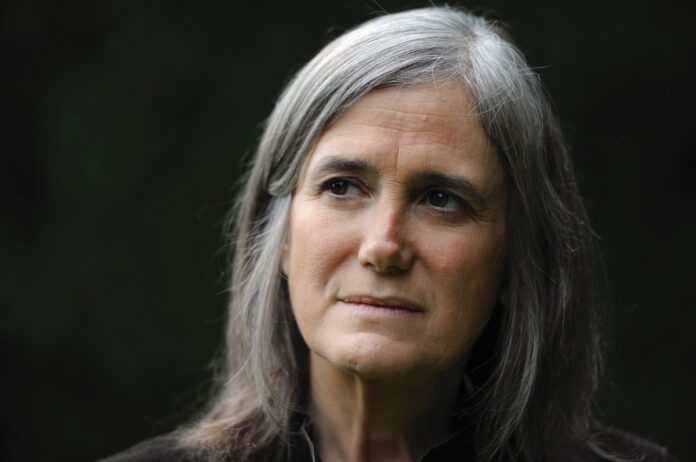
Amy Goodman chose otherwise.
For three decades, Goodman has hosted Democracy Now!, the daily independent news program. Now, the new documentary Steal This Story, Please!—co-directed by Oscar-nominated filmmakers Tia Lessin and Carl Deal—argues that Goodman’s project is larger than one broadcaster, a model for independent journalism in precarious times.
Goodman and Lessin bring the film to Sebastopol this Monday, April 20, to Rialto Cinemas, where it will screen and be followed by a Q&A.
The documentary follows Goodman through decades of frontline reporting—from East Timor to Standing Rock to the daily organized tumult of the Democracy Now! studio—while tracing the parallel decline of corporate journalism and the rise of concentrated media ownership. It is, at moments, stirring, poignant, maddening and occasionally funny.
When I spoke with Goodman recently, I asked what it felt like to have the camera turned on her for once.
“Painful,” she said, laughing. Then she quickly redirected credit outward, praising Lessin and Deal as “masterful filmmakers” who “deeply care about democracy.” That instinct—to point away from herself and toward the mission—explains one of the many reasons the film works so well. It is in no way a “celebrity profile” but rather a demonstration of an ethos and expertise that both inspires and beguiles. It makes audiences want to do something.
“I really do think independent media will save us,” Goodman said.
That may sound grandiose until one surveys the ruins. Local newspapers hollowed out. Hedge-fund ownership. Billionaires buying legacy outlets, then erasing entire beats and bureaus as if public knowledge were an unaffordable luxury.
Goodman did not mince words about the present moment. She cited newsroom cuts at major outlets and a broader capitulation to political and commercial pressure. “These are extremely serious times,” she said. “I don’t know all the forms that journalism will take, but I think they’re important.”
Will the proliferation of platforms such as Substack and podcasts fill the growing void? Maybe, but as Goodman points out: “Collaboration and cooperation are very important. Also, not having paywalls so that anyone, whether they can afford to pay for a Substack or not, is able to get access to the information.”
To that end, Goodman noted that democracynow.org is “a great aggregator of trusted sources of news all over the world.” In fact, Democracy Now! recently marked its 30th anniversary with a celebration at Riverside Church in New York. Goodman described appearances by Angela Davis, Bruce Springsteen, Patti Smith and Michael Stipe, all culminating in a group performance of “People Have the Power.”
“We’re brought to listeners, viewers and readers,” she said. “Not by weapons manufacturers; not by oil, gas and coal companies; not by banks and financial institutions when we cover inequality.”
That funding model matters because every newsroom answers to someone. The question is whether that someone is a shareholder or the public. Goodman has an image of what media can be at its best: “a huge kitchen table that stretches across the globe that we all sit around and debate and discuss the most important issues of the day.”
It’s a lovely metaphor, especially in an era when so much media feels less like a kitchen table than a food fight.
All About the Story
The title Steal This Story, Please! refers to Goodman’s long-held belief that journalism should spread, not hoard (with a bit of a nod to Abbie Hoffman’s Steal This Book for good measure). Scoop-culture fetishizes exclusivity; Goodman has her own perspective:
“I consider it a failure if we’re the only ones who have a story,” she said.
She pointed to Democracy Now!’s early coverage of the Dakota Access Pipeline protests at Standing Rock, where mainstream networks largely looked away until independent footage—dogs released on protesters, including footage of one dog with blood on its muzzle—forced broader attention. In one day, she said, the video drew millions of views.
People care, she insisted. They are not apathetic so much as underserved. That distinction is a key argument to both the film and Goodman’s career. Her wager has always been simple: Give people consequential stories told through authentic human voices, and they will respond. She has little patience for what she called “the no-nothing pundits—people who know so little about so much explaining the world to us and getting it so wrong.”
Instead, Goodman seeks the person closest to the event, often the person whose life—not merely their opinion—is on the line. Throughout, she brings copious empathy to the table, but a question looms: How does she carry the emotional weight of covering suffering for so long?
“When you hear someone speaking from their own experience,” she said, “it changes you.” She added, “I am inspired by the people I interview.”
It’s clear her worldview is not built on institutions but on citizens—often battered ones—who still manage to act with courage. “I think there is nothing more patriotic than dissent,” she said.
To wit, she reminds, “I don’t think you ever achieve democracy. I think you have to fight for it every single day.”
‘Steal This Story, Please!’ begins on Friday, April 17, at Rialto Cinemas, 6868 McKinley St., Sebastopol. The 3:40pm, Monday, April 20 screening will be followed by a Q&A featuring Amy Goodman and Academy Award-nominated director Tia Lessin, moderated by the Bohemian’s Daedalus Howell.