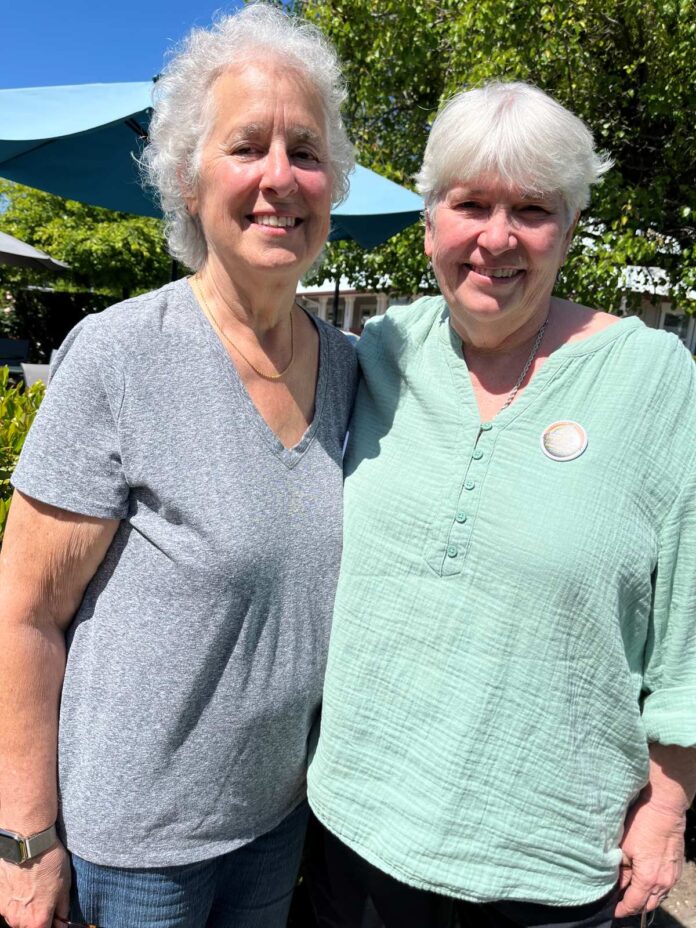
As Pam Adinoff says, “We are not doing a parade.”
Adinoff, along with her partner, Nancy Kelly, is organizing Sonoma County’s first ever Dyke March for June 21 in Santa Rosa. “We’re doing a march. It’s a little more political. It’s about visibility,” she noted.
Not that they have anything against parades. In fact, they will be participating in the Santa Rosa Pride Parade June 6. And the Sonoma County Pride committee is a major donor to the Dyke March.
The two women, and their 15-member organizing committee, just believe it is crucial to shine a spotlight on their sapphic sisters at this moment, whether those sisters identify as lesbian, bisexual, non-binary, transgender or whatever.
And, yes, it’s all those “new” words people use to identify themselves that Kelly and Adinoff said is what separates younger queers from older queers, and that’s the gap they hope to bridge with the Dyke March.
“How do we create intergenerational community when nobody agrees on the words we use?” Adinoff questioned. And then she answered her own question. “It is by drawing on our history to lift up other lesbians, and then counting on the younger generation to spread the word. It’s not about being perfect. It’s just about being respectful,” she said.
But this is not just a philosophical notion. In the early months of organizing the march, Kelly and Adinoff met with groups of younger LGBTQ people and learned that what would draw them to something called a “dyke march” was inclusivity. Some of these young people are now part of the all-volunteer dyke march committee.
Inclusivity and visibility in a threatening time is the central theme of the march. The invitational postcard says, in both English and Spanish, “We organize in a moment of immense and escalating backlash—against trans lives, queer rights, reproductive freedom, marriage equality, racial justice, our immigrant communities and democracy itself.”
While this desire to include might be a phenomenon of the current time, dyke marches are not new. The first one, organized by the Lesbian Avengers in 1993, was, according to a 2025 story in The Advocate, a “response to how male-dominated LGBTQ+ spaces had become. It started as a raucous show of solidarity, joy and anger, and in the decades since, it has continued to be a way for Dyke-identifying folks to build community and fight back against an unjust system.”
This first ever Sonoma County Dyke March continues that sense of having fun while fighting back—it just incorporates a much bigger umbrella.
Frances Fuchs, a longtime Sonoma County LGBTQ activist, said this is what drew her to join the committee as its number one tech and graphics volunteer.
“In particular, I found it welcoming to be out as a bisexual woman, in a way that allows for that larger community,” she said in a telephone interview.
Adinoff, who lives in Petaluma, and Durham, North Carolina resident Kelly, have been bridging their own geographical gap for the past five years, conducting a bicoastal relationship since they met at the Provincetown Women’s Weekend in 2021.
“It was like at first sight,” Adinoff joked. “I laughed so much when I was around her. She still makes me laugh.”
While they are both experienced organizers—Kelly as an events planner and Adinoff as a sales rep and lesbian activist—this is their first big undertaking together.
Gathering begins at 10am, the march at 11am, and the Lez-a-Palooza will run until 2pm. They said they are expecting about 500 to 700 participants, who will march from the parking lot at Santa Rosa City Hall to the Lez-a-Palooza event in Court House Square.
The two women emphasize that the march will be short and wheelchair and walker accessible, since it will be entirely on the sidewalk. And the “carnival-like” fair in the Square will be completely interactive, with games, face painting, hula hooping and more, all offered at booths run by LGBTQ-friendly businesses and organizations. There is no admission charge.
For more information, visit socodykemarch.org.