
Usual Suspects

0

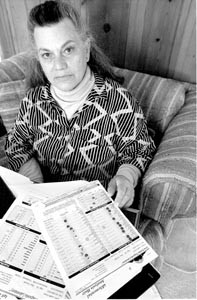
Wright stuff: Nothing rotten in Santa Rosa, says Councilwoman Sharon Wright. Critics disagree.

Flippy Floppy

Santa Rosa City Council does about-face on planning appointment

By Janet Wells

THE SANTA ROSA City Council engaged in some furious backpedaling this week, voting to undo the week-old appointment of a planning ommissioner who failed to turn in his application on time and who has a glaring potential for conflict-of-interest tangles.

After two rounds of straw balloting, the council voted 5 to 2 last week to appoint Ghilotti Construction Co. manager Paul Donaldson to a four-year term replacing retiring Commissioner Frances Dias. Councilwoman Marsha Vas Dupre voted for Donaldson, then went on the warpath after learning that he submitted part of the application for the position 11 days after the Nov. 19 deadline and waited another 42 days to turn in the completed form.

Donaldson’s employer, Ghilotti Construction, has numerous contracts with developers whose projects would come before the Planning Commission and the City Council. Donaldson maintained that his job would not hamper his ability to fairly perform as a commissioner.

“Something stinks in Santa Rosa,” Vas Dupre writes in an e-mail to Usual Suspects. “I would guess that some incentives were provided to the four majority members of the council to convince them that this young, unseasoned man be selected for the Planning Commission.”

The city followed its usual procedure when searching for a new planning commissioner: the position’s requirements–and its application deadline–were listed in the local daily newspaper on Nov. 10.

Twelve people submitted applications, and Vas Dupre and City Councilwoman Sharon Wright, acting as the council subcommittee, whittled the field to five applicants, who interviewed for the position on Jan. 18.

City Attorney Rene Chouteau told West End Neighborhood Association president and Santa Rosa City Council candidate Carol Dean that the council isn’t bound to follow its procedure and can appoint commissioners at will.

But, says Dean, by not following the accepted selection process, the council is treading on thin ice. “The worst of all is the appearance that the majority on this council is making a backroom deal, once again bending the rules to fulfill a hidden agenda,” Dean told the council at this week’s meeting.

“Nobody through the whole process told me I had missed any dates,” says Donaldson, who adds that the council is “hanging” the reversal of his appointment on his late application. The real reason, he says, is “politics,” although he declines to be more specific.

AT THIS WEEK’S council meeting, City Manager Ken Blackman blamed his former secretary, as well as the screening committee and the City Council, for failing to note the tardy date on Donaldson’s application. “Bureaucrats don’t miss that stuff,” scoffed council gadfly Jack Osborne. “This looks so darn bad, like you have a filing date for friends.”

Councilwoman Noreen Evans, who voted against Donaldson’s appointment, agrees that the council’s actions seem to exceed mere sloppiness. “It looks like somebody decided to go around the deadline and get that application filed.

“Who it was or why it was, I can’t speculate on that.”

The Donaldson appointment spurred some critics to argue that the motivation rested on the fact that the council majority backs a pair of upcoming ballot measures that would raise local sales taxes to fund freeway improvements. The campaign to promote one of those measures is supported financially by Jim Ghilotti, who owns the local construction company for which Donaldson works.

Mayor Janet Condron dismissed speculation that the council had a darker purpose. “The implication that there is something wrong here is totally inappropriate,” she said.

Wright also said she “took exception to the inference that there was something deceitful.”

Attorney Dick Day–a member of the board of directors of Sonoma County Conservation, speaking as a member of Concerned Citizens for Santa Rosa–was happy to speculate for the council: “The whole appearance is that the applicants did not represent the pro-development stance of the council and [they] went to some trouble to find someone after the [deadline] date who would.”

Donaldson was part of last year’s Leadership Santa Rosa program, which has been criticized for grooming political insiders to fill appointee positions.

Evans, along with Vas Dupre and Councilman Steve Rabinowitsh, pushed hard to persuade their colleagues to toss Donaldson’s application and appoint in his stead Allen Thomas, who was the council’s second choice last week.

“Allen Thomas has years and years of working with his neighborhood and coming before the council and Planning Commission. He’s been a very articulate representative for the West End neighborhood,” Evans says.

“I thought he was a better candidate. I was concerned about Mr. Donaldson’s lack of experience in the community and civic matters and also his potential for conflicts of interest.”

The council compromised, tossing out Donaldson’s application, but declining to appoint Thomas outright. Instead, on Feb. 8, the council will recast votes for the remaining four applicants.

“It’s a little disconcerting that the people who follow the rules are not respected,” Thomas says. “And I think it’s a lot deeper than Allen Thomas not getting on the Planning Commission.

“There’s a level of mistrust.”

Editor Greg Cahill contributed to this article.

From the January 27-February 2, 2000 issue of the Sonoma County Independent.

© Metro Publishing Inc.
Ramekins

0

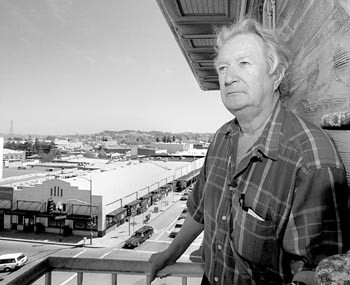
Watching the kettle: Instructor Jay Harlow (center) gives pointers to aspiring cooks Jeff Williams and Steve Hoeft over a bubbling cauldron of minestrone.

Somethin’ Cookin’

A daylong visit to Ramekins, a visionary new culinary school that caters to kitchen-savvy home cooks and eager amateurs

A MIGHTY HISS of steam billows up from the gargantuan stove as a herd of white-apron- clad students stand about in a loose semi-circle. They stretch up on tiptoes, eyes wide with appreciation as instructor Jay Harlow expertly tosses chicken breasts onto the waiting fire. Knives of all sizes lie about the room, along with the boned remains of numerous chickens.

Bowls of chopped-and-diced-and-julienned carrots, mushrooms, cucumbers, onions, lettuce, potatoes, and chard, alongside several platters of glistening marinated chicken, stand waiting on a table nearby, where one student, a young gentleman with a very sharp knife, is methodically slicing a cucumber, his forehead furrowed in happy concentration. Harlow–the bestselling author of West Coast Seafood and Beer Cuisine–after exhorting the class to “come on back and grab a chicken breast,” glides over to encourage the hard-working knife-wielder.

“Still practicing?” he says, taking in the rising pile of cut vegetables. “Excellent work. Looks good.” Then he’s off to oversee the ongoing chicken preparations and to cheer on his students as they carefully apply all those vegetables to a massive, bubbling cauldron of minestrone. Weaving through the students, he now tackles the making of dessert: a rainbow-colored cranberry and citrus compote. “Stir the fruit gently,” coaches Harlow, peering over as the fruit mixture simmers on the stove.

“If you listen carefully, you can hear the cranberries popping.”

Everyone falls quiet, ears trained forward, listening for the sound of exploding berries. When it happens–a series of soft, liquidy snaps–an audible sigh of delight moves through the room, mingling with the sounds of overhead fans, banging pots, and clanking utensils.

And so goes a typical day at Ramekins Sonoma Valley Culinary School.

A singularly remarkable, noticeably whimsical training facility for experienced home cooks and complete novices, Ramekins–the brainchild of General’s Daughter restaurant owner Suzanne Brangham–opened its spoon-handled doors just 18 months ago, in a unique custom-designed rammed-earth building (based on an architectural method that employs vast amounts of compressed clay and soil, but no wood in its basic structure). From the beginning, Ramekins was a certified culinary phenomenon, attracting students and tourists from across the country, while drawing the enthusiastic praise–and the teaching services–of renowned cookbook authors and four-star celebrity chefs from around the world. This morning’s class, called “Knife Skills with Jay Harlow,” is one of Ramekins’ hands-on classes, in which the students–both men and women, mostly non-professional, ranging in age from fresh-faced teens to seasoned seniors–are invited to work side by side with the instructor, sharpening their skills while preparing a complete meal in the school’s bright, light-filled kitchen.

Harlow’s class–now chopping and slicing and sizzling and simmering its way to an end, just in time for lunch–is today’s morning offering; across the hall, in the gorgeous demonstration kitchen-theater, author Michele Anna Jordan is already at work preparing for her sold-out afternoon session, titled “Risotto for Winter.” As Harlow congratulates his students on a job well done, they return the compliment with a warm round of applause.

Then it’s out to the dining room to taste the fruits of their labor.

In the kitchen: Steve Mailho sniffs a sauce while Jay Bolton looks on.

A RAMEKIN–as any self-respecting foodie will tell you–is a small fluted French baking crock, great for baking but most commonly used, these days, to hold butter and jam. They are inexpensive devices, unpretentious, handy and useful, lightweight and easy to pick up and carry with you. As metaphors go, the simple ramekin was a perfect, if not immediately obvious, symbol of Brangham’s user-friendly vision for the new school. That the funny little word bears an auditory resemblance to the term “rammed”–as in “rammed-earth” architecture–added rhyme and reason to Brangham’s decision to name the place Ramekins.

Located in downtown Sonoma–in the midst of the wine country–the school has seen a dramatic increase in applicants from outside the area. According to culinary director Bob Nemerovski, only about a third of Ramekins’ students are from Sonoma County, with another third hailing from Marin County and San Francisco and “parts south of San Jose.”

The remaining students are, basically, from everywhere else, a development that Brangham and Nemerovski never expected, but prepared for just in case. Along with the school and the classes, priced at $40 and up, Ramekins’ other attraction is a plush five-room bed-and-breakfast operation–including a regal chef’s suite for visiting celebrities–located in the upstairs portion of the building, arrived at via a typical Brangham invention: a stairway with a spindled banister made of green wooden asparagus stalks. Throughout, every detail giggles whimsy as it whispers elegance.

“Well, we believe in treating people well,” says Nemerovski.

The bivalved heart of Ramekins, of course, is the twin kitchen facility, where chefs such as Mollie Katzen, John Ash, Gary Danko, Narsai David, Mark Miller (Coyote Cafe) and Joyce Goldstein have blended their expertise with Nemerovski’s distinct philosophy; namely, that a cooking class should be part education, part entertainment–and should always end with really good food. “Since putting out our second catalog of classes,” Nemerovski says, “there are very few chefs who, when I call to invite them to teach at Ramekins, say, ‘Who? What’s Ramekins?’ Now they just say, ‘When should I be there?'”

“IT’S A WONDERFUL PLACE, a wonderful facility,” says Harlow, getting the buffet line to dish up the chow his class just created: sautéed chicken breasts with Madeira sauce, classic minestrone, and tossed green salad. Dessert will be served later by Ramekins’ attentive staff of helpers, under the direction of assistant manager and host Andrea Koweek, now busy pouring wine, red and white, at each of the students’ dining tables. Harlow, who’s been teaching at Ramekins since it first opened, is clearly enamored of the place. “Some cooking schools, especially those aimed at professional chefs, are very stuffy,” he says. “But Ramekins is organized with the belief that cooking should be fun. Ask anyone who was here today. These people had fun.”

That is immediately obvious. Throughout the enormous, peak-ceilinged dining room–packed with such Brangham touches as a hearth-side coffee table with many large bananas reclining under the glass top–the energy level is that of a rock concert crowd immediately after the show. “I’m just grateful I didn’t cut myself,” laughs Jeff Williams, one of the “Knife Skills” students, now carrying his plate to a nearby table. “I always feel exhilarated after a class,” says Nancy Vizi, who counts herself as a Ramekins regular. “I love it. Afterwards, I don’t want to stop talking about how much fun it is.”

Brangham stops in to chat with Harlow, and makes sure to quiz the students on their experience. Then she makes a shocking confession. “I love food, but I don’t know how to cook,” she admits with a laugh. “I have a few more projects on the table; then I’ve promised myself I’m going to take a few cooking classes myself.”

Photograph by Michael Amsler

TODAY’S morning class, with its even blend of male and female students, is fairly typical of Harlow’s past offerings. “Jay gets a good mix of men and women,” says Koweek, who elaborates, “We’re getting more and more husband-and-wife teams coming in for classes, though pastry classes still tend to skew female while sausage-making workshops always tend to skew male.”

Adds Nemorovski, “This one guy came in recently and said, ‘All right, I don’t know who you are, I’ve never been here before, but I’m glad my wife is interested in you rather than in Ricky Martin. She left your catalog in the bathroom, she’s dog-eared the pages, and she’s circled the dates. I decided I’d better take the hint,’ and he bought those classes for her. Now they’re both big fans.”

Joanne Weir, host of PBS’ Weir Cooking in the Wine Country, is another big fan of Ramekins.

On-site this week for a special program–in which she worked with a dozen professional chefs, not Ramekins’ main clientele, but a group that was instantly enamored of the school’s facilities–has taught at the school a number of times. “Aside from the staff and the facility itself,” she says, “I always find that the students are almost always just wonderful. They are savvy and intelligent, and they are interested and eager. And they are clearly here to have a good time.”

Weir, who’ll be back in March for a spring cooking class, has seen a strong national trend toward cooking schools, with many grocery store chains installing teaching facilities and running classes on the side. “It’s the next big thing in entertainment,” she says, “and Ramekins knows that.

“Above all, they know how to put on a really good show.”

Photograph by Michael Amsler

IT’S SHOW TIME in the demonstration theater, and the students–the audience–have taken their seats, three to a table, each table preset with cutlery, wine glasses, and packets of recipes and instructions. Every seat affords a clear view of the kitchen “stage”–with video monitors showing the stovetop and an overhead mirror revealing events on the counter–where Michele Anna Jordan, relaxed and happy after hours of prep work–“I tend to be ridiculously ambitious with my classes,” she says–is chatting with incoming folks as the Ramekins staff bustle about offering students iced tea and mineral water. Dean Martin sings from overhead. “Music is a very important part of the cooking process,” she jokes easily. “But you have to choose carefully. Either Dean Martin or Puccini are good for cooking risotto, while the Ramones are great when you have a lot of chopping and prep work.”

And the class begins.

Jordan, one could argue, is the purest embodiment of the food-education-entertainment trinity that rules the Ramekins philosophy. As she deftly prepares one risotto dish after another, from Golden Beet Risotto & Walnuts to Polenta Cakes & Warm Mushroom Vinaigrette to Grilled Pork Tenderloins with Apricot Risotto to Turkey & Cranberry Risotto, she dispenses pages of facts and cooking tips–“Always use an ice cream scoop to make your risotto cakes”–along with numerous witty observations: “Risotto is a Zen-like experience because you have to stand here and constantly stir it. It’s also useful for getting other people to do tasks you don’t want to do. ‘Honey, the cat just threw up. Could you get that? I’m making risotto.'”

Once Jordan has talked us through the making of Golden Beet Risotto, the kitchen staff whisks the food out of the room and promptly returns to serve it up to the students–along with more wine. The room is filled with fervent murmurs of mid-meal appreciation. Jordan loves it. This prep-and-joke-and-serve process is repeated several more times, with each dish she demonstrates, until at last, as the class ends–with the requisite round of applause–Jordan happily announces, “Once you’ve practiced a while, once you really know risotto, once you’ve learned the basic principles, you’ll be able to make risotto without ever looking at a recipe.

“Now . . . go do it.”

Fruits of their labor: Students savor the results of their cooking class.

BY ALL OUTWARD appearances, Ramekins seems to be on its way to further success, with long-distance plans to compile a Ramekins cookbook and a series of videos; there may even be a Ramekins cooking show somewhere down the line. Until then, Nemerovski is focusing on extending Ramekins’ good word of mouth, building on the school’s growing reputation as a full-on, must-experience wine country phenomenon. Nemerovski is doing so, he says, by fine-tuning the day-to-day details of keeping the place running smoothly and by paying attention to customers, every comment, good or bad.

“We’ve run nearly 500 classes in 18 months,” says Nemerovski, “with over 225 instructors. We’ve sold over 12,000 seats, and in that time we’ve had exactly five letters suggesting some little thing that we could do better. And in each case, we’ve made the appropriate changes. The main Ramekins rule is that basic rule of retailing,” he says, laughing. ” ‘Always assume you can do more to make your customers happy.’ And with a place like Ramekins, making people happy is a whole lot of fun.”

From the January 27-February 2, 2000 issue of the Sonoma County Independent.

© Metro Publishing Inc.
Mustard Festival

0

Ol’ Yeller

Mustard Festival spreads it on

By Marina Wolf

IN NAPA VALLEY, Mother Nature gets the last laugh on those who think the coldest time of the year is the dreariest. Long after the harvest crush of tourists has faded, crazy yellow blooms of wild mustard burst out along fences and between bare rows of gnarled vines. “It actually lends the valley to a whole other season that people don’t ever see,” says Patrick Finney, host chef for this year’s ambitious Napa Valley Mustard Festival.

The festival, running Jan. 29 through March 25 (see sidebar), is meant to honor the sunny mustard plant, all parts of which are actually edible. But in these parts, the wild weed gets used primarily for garnish. Even in the mustard festival chef competition, the mustard principle usually comes from prepared mustard instead of the whole seed.

If you’re having problems envisioning sophisticated cuisine incorporating the yellow spice, perhaps you’re stuck in that hot-dog-and pretzel paradigm. Let Finney help you out with the dish that earned him the title 1999 Chef of the Year at last year’s festival: smoked chicken with a mustard-cream sauce, served on a crispy wonton and accompanied by apple-Maui onion chow-chow. This exotic dish also earned the Napa Valley Wine Train chef the “People’s Choice” honor, but Finney isn’t resting on his laurels. He’s already engaged in “research and development” on his entry for this year’s competition.

Finney doesn’t use mustard as a mustard-season gimmick. This humble condiment, in all its variations, has a regular place in Finney’s rolling pantry, adding savor and a hint of sharpness to some of the train’s signature dishes. In his chicken liver and truffle paté, for example, Finney accents the dish with both Dijon and whole-grain mustard. Another dining-car favorite is his sturgeon with a saffron-mustard beurre blanc sauce. The traditional white-wine-and-butter sauce is touched with the intense color of saffron, and then spiced up with mustard at the very last minute, a key point for anyone cooking with mustard, says Finney.

“You never want to boil or overheat mustard,” he explains, “because it becomes very bitter. Add it at the last minute, unless you’re dealing with the whole seed.”

FOR THIS YEAR’S opening event, “Mustard Magic: Une Soirée Française,” Finney is planning another old favorite: a rack of lamb rubbed with a mild achiote paste before roasting, and then sauced with a chipotle pepper and whole-grain mustard concoction. “I’ve done this the last couple of years and people have asked for me to do it again.” He laughs. “I don’t want to let anybody down.”

As with anything in Napa Valley, the annual Mustard Festival has a serious wine component. Bernard Portet, president and winemaker at Clos du Val, is this year’s host winemaker, lending a decidedly French flair to the proceedings. But still one pauses over the question–maybe it’s that classist, anti-mustard prejudice again–what kind of wine does one drink with mustard flavors?

For starters, it’s not usually an issue because most chefs prefer to keep the mustard in a complementary role, harmonizing gently with the primary flavors of the dish. “If you get to the point where mustard is the main flavor, then you’ve pretty much defeated the purpose of the dish,” Finney says. “You might as well be serving a bowl of mustard.”

The primary considerations, then, are the main ingredients of the dish, but mustard’s pungency cannot be ignored. In the case of his sturgeon dish, Finney recommends a sauvignon blanc, a fumé blanc, or even a chardonnay, “depending on how it was made,” he says.

“I’d want some woody overtones to cut the strength of the mustard.”

Those who can appreciate that subtlety are the target ticketholders to the Mustard Festival. But Finney relates a story that illustrates the pull of mustard’s magic on foodies of all ages. Either that or it might be another only-in-the-Bay Area item. Last year he brought in samples of mustard for the kiddies at his son’s elementary school. They dipped and nibbled mustards from all along the spectrum, from French’s brand–a staple for hot-dog lovers–to samples from the Mount Horeb Mustard Museum in Wisconsin. The hot-dog mustard ended up with the most praise, but not all of it.

“It was funny to watch,” says Finney. “Definitely hot-dog mustard was the favorite, but there were a number of children who tried the other ones–raspberry, apricot, zinfandel–and liked them very much. They probably went home and turned their parents on to them.” *

Festival Schedule

Mustard Magic Art, theater, music, and even aerial artistes load the opening event with an oh-so-French feel at the Culinary Institute of America at Greystone on Saturday, Jan. 29, at 7 p.m. The many-storied stone mansion lends itself to wandering and tasting from the offerings of Napa Valley chefs and winemakers. CIA-Greystone is at 2555 Main St. in St. Helena. Tickets are $95 per person in advance, $125 at the door. For information or tickets, call 259-9020.

Savor St. Helena The little town that could invites weekend guests to its downtown for a tasteful street fair that covers all of the important points: food, wine, music–ooh, and window-shopping! Tasting tickets and wine glasses are available on-site. Saturday, Feb. 13, from 11 a.m. to 3 p.m. For a list of participating businesses and restaurants, see the website at www.StHelena.com, or call 963-4456.

The Awards Chefs go for the gusto in the night that decides the Mustard Festival chef for next year. Sensory scientists from UC-Davis and food journalists from all over judge the recipes, then the public samples and votes for its favorite. Clos Pegase Winery hosts in its reception hall and caves. Friday, March 10, at 7 p.m. Tickets are $75 per person in advance, $100 at the door; net proceeds benefit Napa Valley art, historical, and educational organizations. 259-9020.

!Olé Mostaza! Robert Mondavi Winery opens its doors for an evening of fine art, rare wines, and great auction packages, along with Latin music and appropriate hors d’oeuvres. Saturday, March 11, at 7 p.m. Tickets are $65 per person; proceeds benefit the River School, Napa Valley’s art-based charter school. 253-6813.

The Marketplace A foodie fantasy come true at the Napa Valley Exposition, where dozens of demos and scads of samples, plus music, exhibits, arts and crafts, and other great divertissements fill the building. Saturday and Sunday, March 11-12, from 11 a.m. to 5 p.m. Tickets are $7 for adults, $2 for children 12 and under; tasting package is available for $25. 259-9020.

A Taste of Yountville The most gourmet restaurants per capita and more high-class fun per square foot in this afternoon of good taste and the good life, hosted by eateries and retailers up and down the downtown. Tasting tickets are available on-site; most demonstrations are free. Saturday, March 18, from 10 a.m. to 4 p.m. 944-0904.

Other events include a golf benefit, a marathon, a Blessing of the Balloons, and a photography contest, the finalists of which will be announced at “The Photo Finish,” the wrap-up extravaganza on Saturday, March 25, at 7 p.m. Tickets are $65 per person in advance, $75 at the door. For further details about any of the festival events, call 259-9020.

From the January 27-February 2, 2000 issue of the Sonoma County Independent.

© Metro Publishing Inc.
Walter “Wolfman” Washington

0

Howlin’ Wolf

“Wolfman” Washington comes knockin’

By Alan Sculley

WALTER “WOLFMAN” Washington spent most of the ’90s with his music career in limbo in the United States. In the early ’90s, singer, songwriter, and guitarist Washington, 57, had stepped up to a major label, signing with Point Blank, a label owned by Virgin Records. But the bluesman’s lone CD for the label, Sada, came and went with little notice, and he was not retained by the label.

Instead, Washington found himself struggling through much of the decade to keep his career afloat while he tried to find a new record deal.

Blue Moon Rising, a CD Washington had recorded in the early ’90’s was finally picked up for release in 1995 by a small European record label. But the CD was never issued in America. It wasn’t until 1997, when Washington re-signed with Rounder Records–the label that had originally signed him in the mid-’80s–and released the CD, Funk Is in the House, that his stateside fans finally got a new batch of music.

Washington certainly didn’t intend to have such a long gap between studio records. But at least when he did get to release a CD in America he felt he returned in peak form.

“Just within the last two or three years, say, the music really started changing to the point where you can hear the tightness,” Washington says. Much of the reason for the musical cohesion is because of the development of Washington’s six-man backing group, the Roadmasters. Unlike many solo artists whose bands seem like easy-to-replace hired guns, Washington clearly views the Roadmasters as an integral part of his musical team. The involvement of the band members is obvious just by looking at the songwriting credits on Funk Is in the House.

“If they’re going to be playing the music, they’ve got to be [involved],” Washington says. “Some cats, they just tell the band you play that and you play this. But I give them a chance to express themselves. Of course, it kind of helps me, too, to understand who I’m working with and the type of people, the potential that they have. If the cats feel all they do is just play music and not be involved, you feel like left out, in a sense.”

Further evidence of the Roadmasters’ impact on Washington’s sound can be heard in the performances on the Funk Is in the House CD. Washington and the Roadmasters show off their blues and soul chops on a cover of Ray Charles’ “Mary Ann,” while on “Wolf Funk” Washington’s guitar playing adds a strong jazz accent to the funky foundation provided by the other musicians.

MEANWHILE, on bluesy soul ballads like the Washington-penned “When the Answer Is Clear” and Jerry Butler’s “I Stand Accused” the Roadmasters give Washington a sympathetic backdrop to showcase his rich vocals. Washington understands the importance of his band, in part because he spent a large part of his career as a sideman himself. And his mentor, singer Johnny Adams, wasn’t shy about sharing his knowledge with Washington and giving the guitarist a strong voice in the music Adams recorded. Washington had met the singer early in his career.

Adams, in fact, helped Washington, who had just quit the 12th grade, to get his first steady gig as a guitarist in the house band at the Dew Drop Inn in New Orleans. The house band backed a number of national acts that were booked to play at the club. One of those stars, Lee Dorsey (who was on a roll behind the hit singles “Ride Your Pony” and “Working in a Coal Mine”), gave Washington his first taste of life as a touring musician when in the early ’60s Dorsey hired the guitarist for his touring band.

For two and a half years, Washington backed Dorsey at theater and festival shows around the world.

After leaving Dorsey’s band, Washington did stints with R&B diva Irma Thomas and others. In the early 1970s, he also began working again with Adams, a partnership that lasted nearly 20 years. Washington served as a featured player on such critically acclaimed Adams albums as From the Heart (1984), Room with a View of the Blues (1987), and Walking on a Tightrope (1989). During this period, he also began fronting bands as a solo artist in his own right.

ON TOUR, Washington and his band would play an opening set and then back the acclaimed singer during Adams’ headlining sets. “Johnny helped me out a lot,” Washington recalls. “When I was out with Lee, all I did was play music. And so when I came back, Johnny asked me if I could sing. He heard me singing. He said, ‘Man, why don’t you come by the house sometime and I’ll show you how to utilize your voice?’–you know, like in ranges and hearing what you can do with your voice and how you can make different notes and sounds and hear yourself how you want to sing things.

“It took a while for me to find that, but after a while it just came natural.”

In the mid ’80s, Washington decided it was time for him to step up his career as a solo artist and bandleader in earnest. He continued to record with Adams, but having signed with Rounder Records (the label for which Adams recorded), Washington shifted his focus toward his own career. Three albums released on Rounder–Wolf Tracks (1986), Out of the Dark (1988), and Wolf at the Door (1991)–earned Washington praise for his unique blend of New Orleans funk, soul, and blues, and his talents as an expressive guitarist and singer established him as a promising force on the blues scene.

“This time I’m staying with Rounder,” Washington explains. “I’m not going to be venturing all over. It seems to be working pretty good for me.”

Walter “Wolfman” Washington performs Tuesday, Jan. 25, at 8 p.m. Dominic’s Ristorante, 3600 Stony Point Road, Santa Rosa. Tickets are $8 in advance, $10 at the door. 584-8803.

From the January 20-26, 2000 issue of the Sonoma County Independent.

© Metro Publishing Inc.

Usual Suspects

0

New info on Tim Smith’s spending sprees

By Greg Cahill

RECENTLY OBTAINED state documents reveal new details about numerous “questionable” campaign contributions in connection to a 1998 probe of Sonoma County Supervisor Tim Smith. The documents paint the picture of a career politician who frequently has sought campaign contributions and charged expenses to his campaign committee, even during non-election years and sometimes while performing official duties for which the county or other jurisdictions provide reimbursement.

“He is always campaigning,” the report noted, “as evidenced by the fact that he ran unopposed in 1992.”

This year, Smith, the three-term incumbent in the 3rd Supervisorial District race, has set a new record for campaign fundraising in his effort to fend off challenger Noreen Evans, a Santa Rosa city councilwoman. As of Dec. 31, Smith had amassed a $65,655 war chest and spent only about a third of it; Evans had raised $66,615 and spent four fifths of the money.

According to the 1998 report filed by the Fair Political Practices Commission, Smith once claimed a $37.63 purchase at Victoria’s Secret as a campaign expense, and billed the campaign committee for a raincoat that he said was needed for inclement weather while “walking the streets” during a campaign.

During a 13-week period between March and June of 1993, Smith visited a Safeway market 13 times (including three times in four days) and claimed $584.94 in groceries as campaign expenses for fundraising events during a non-election year.

“There is a fine line [between personal and political matters], and he considers political events to include times he has entertained persons whose support he covets or whose names were [solicited] for placement on a fundraising list for future reference,” the report noted.

Some of Smith’s other questionable past expenses included food, wine, and spirits used at a 1993 Crescent City camping trip held as a “thank you” for contributors, campaign workers, and supporters. “These were unadvertised events and anywhere from 20 to 50 people would stop by for barbecues and such during the two weeks he would be there,” the report stated. “He would bring his children on the trips, but attendees were mostly people other than family members.”

Among the charges on the past campaign expense receipts he provided the FPPC were $984 for a plane trip to New Orleans to attend a Federal Emergency Management Agency meeting (he charged the campaign committee through a credit card and then paid a FEMA reimbursement to the committee, reporting it as a contribution); $354.73 for a computer desk; $50.29 for a meal at Julio’s Rooftop Pizzeria in Washington, D.C. (which even Smith conceded might be “stretching it” in terms of a legitimate expense); and $23.45 for cigarettes and photo processing.

Smith admitted to being “quite blasé” in the past about the way he recording his expenses. He told investigators that he often didn’t keep track of smaller events–which he called “coffees”–because he “is always fundraising.”

The report noted that he has used campaign funds for memberships to the NAACP, the Hispanic Chamber of Commerce, Sonoma County Alliance, Social Advocates for Youth, and the Heart Association. He also has charged to his campaign committee activities related to appearances at local events, as when KRCB-TV has solicited him to be “auctioned off” and to buy someone lunch.

“He views his participation in such events as being political . . . ,” the report noted.

TWO YEARS AGO, the FPPC fined Smith $18,000 for failing to fully disclose how he spent campaign funds between 1993 and 1996. The new information details numerous other expenses deemed questionable by state investigators, but not included in the original 12 counts.

Smith has denied misusing any of the $13,300 in previously disputed campaign funds, saying he spent the money on “legal purposes.” He has argued that the fine–the largest ever levied against a Sonoma County politician–was the result of sloppy record keeping. But Daryl East, chief of enforcement for the FPPC, has said that the commission had reason to suspect that Smith used campaign funds for personal use.

At the time, Smith told investigators that he had no explanation for failing to keep accurate records other than that he was “lazy” and believed that credit-card statements were sufficient for complying with stringent state record-keeping requirements.

The law requires that the FPPC bear the burden of proof in such cases. The lack of sufficient records prevented investigators from filing additional charges in connection to all the questionable expenses uncovered during the probe.

“The FPPC maintained that I did not keep accurate enough records under their regulations,” Smith commented this week. “All funds used by my campaign are for campaigning and fundraising purposes. We paid the fine, and we learned from our mistakes, and it won’t happen again. That’s the end of it.”

From the January 20-26, 2000 issue of the Sonoma County Independent.

© Metro Publishing Inc.

‘Private Eyes’

0

Private Eyes.

Undercover

‘Private Eyes’ offers intriguing puzzles

By Daedalus Howell

PLAYWRIGHT Steven Dietz’s romantic comedy qua detective play Private Eyes marches to the beat of a different conundrum. Marking an estimable debut for director Dodds Delzell, Actors’ Theatre’s production is canny, sexy proof that a love triangle can have more than three sides.

Nebbish actor Matthew (Peter Downey) suspects his mercurial actress wife, Lisa (Danielle Cain), is having an affair with their British director, Adrian (Steven Abbott). To complicate matters, the three are in the midst of rehearsing a play penned by Adrian depicting an affair not dissimilar to the one possibly at hand.

Matthew’s jealous probing of the situation is aided and abetted by Cory (Beverly Bartels), who might be a private eye, a jilted wife posing as a private eye, or even a jilted wife posing as a private eye who is working undercover as a waitress at a restaurant that might just be a rehearsal set within the characters’ own play. Whew.

Peeling back the onion, skin of Private Eyes’ various potential realities is Matthew’s psychiatrist Frank (Kristina Poe), whose analysis of the play’s events also begins to feel uncomfortably deceptive.

Dietz’s work is a play within a play to the nth degree. Its dramatic pauses are more pregnant than a Russian nesting doll. Imagine Borges with gags. Fantastic leaps of theatrical logic abound, and nary a scene passes without some order of revelation spawning yet another meta-reality. Here, the space-time continuum is compressed into either a seamless Möbius strip or an entangled Gordian knot, depending on one’s attitude.

Director Delzell excels, however, at navigating Dietz’s labyrinthine turns and succeeds at staging an evocative and challenging work that’s hilarious to boot.

Downey is superb as the suspicious husband who can no longer discern if his convictions are real, rehearsed, or simply idle patter to pass the time on the therapist’s couch. Cain, too, turns in a compelling portrayal as his wayward wife with a high-energy performance that is devilishly crisp.

Likewise, Abbott does a fine turn as Adrian, the starchy auteur gone adulterer, delivering a number of the show’s best lines, including “Honesty shouldn’t be an afterthought, it should be a last resort.”

Poe does well with her portrayal of the sober shrink and is a welcome ballast to the general insanity that begins to cloud the plot. But it’s Bartels’ scene-stealing sleuth Cory who accounts for much of the play’s laugh-out-loud moments. Replete with an impenetrable poker-faced air and Lauren Bacall-esque purr, Bartels lays it on deliciously thick with her sledgehammer delivery of lines like “I prefer dick” when discussing her professional title or when she downs a stolen single-serve bottle of airplane brandy in one sultry swig.

Ron Bartels’ set design, composed of slanted walls adorned in mahogany wainscoting, is reminiscent of an M.C. Escher print–the perfect model for this production. Astute listeners will note that sound designer Amy Curley culls her soundtrack from a laundry list of detective flicks.

Less of a whodunit and more of a “who’s-doing-who?,” Actor’s Theatre’s production of Private Eyes is both a delightful, highbrow romp through a dressing-room looking glass and an entertaining evening of theater.

Private Eyes plays through Feb. 19 at 8 p.m. on Thursdays, Fridays, and Saturdays and at 2 p.m. on Sundays, at Actors’ Theatre, Luther Burbank Center, 50 Mark West Springs Road, Santa Rosa. $10-$15. 523-4185.

From the January 20-26, 2000 issue of the Sonoma County Independent.

© Metro Publishing Inc.
Chai

0

High on Chai

Indian drink adapts to U.S. market

By Marina Wolf

I CALLED DIRECTORY assistance the other day to get the phone number of a chai company in Santa Cruz. We were doing OK until we hit the second part of the name. “Chai. Is that C-H-I…?” No, ma’am. It’s not “chia” (watch it sprout!) or chi (good energy, though) or chi-chi (all right, maybe a little bit of that). It’s just chai, the spicy, milky hot drink that hit the cafe scene in the mid-’90s and hasn’t let up.

In recent years, sales have steadily increased, growing 30 percent a year to reach a projected $22 million in 1999. And there are more than a hundred American chai companies, offering not only “traditional” masala, or spiced chai, but also brews with a decidedly American twist: decaf chai, green-tea chai (get those anti-oxidants), ginseng chai, herbal chai, chocolate chai. It comes in bulk blends, tea bags, or in concentrate to froth, nuke, or otherwise heat with whole milk, or soy milk, or skim milk, or water.

Spiced chai has come a long way from the boiled beverage that is poured out in countless households, street stands, and train stations throughout northern India. The chaiwallahs, or chai purveyors, keep it low-tech: coarsely crushed black tea leaves, a dose of ground spices, milk, and water, boiled until thick and murky and served in cups that could be Styrofoam or cheaply fired clay, but that always are disposable.

THIS SIMPLE preparation captured the senses of visiting Americans, who came to India in the Peace Corps or as visitors to ashrams or just as subcontinental tourists. Back home in the states, so the legend goes, chai flowed through the underground, riding on the wave of all things Indian. Take Masala Chai, the company I was looking up in Santa Cruz. Founder Raphael Reuben acquired the taste for chai at an ashram in upstate New York in the early ’70s and began selling a packaged chai blend in 1980.

Masala Chai and other early chai pioneers may have started a trend in more ways than one. “[Raphael] Americanized the recipe,” says co-owner Susan Beardsley. “Eastern versions never have all these spices. Usually they only have one or two. And they’re a lot sweeter.” The Masala Chai mix is sold largely to the health-food market, says Beardsley, so the mix is even less sweet than other American commercial brands.

On this point opinions vary; some say the American chai is much sweeter and creamier than its Indian ancestor. But for sure it’s less savory. Fresh Cup, a trade publication for specialty coffee and tea purveyors, reports that many versions produced for U.S. markets have reduced or eliminated the measure of savory spices–fennel, aniseed, and the peppercorns that are key to a really biting blend. It’s just one small step away from chai’s ayurvedic origins, in which a balance of spices is meant to support the body’s own inner balance, and one giant step toward making complex Indian spicing more accessible to an American audience. What’s left is very American: sweet spices, like cinnamon, cardamom, cloves, and ginger, and warm milkiness that many of us never seem to outgrow.

Deaf Dog Coffee in Petaluma has been serving chai since it opened more than three years ago; in two years its use has almost doubled. “It’s still only 2 or 3 percent of our sales, but we go through an awful lot of containers,” says Deaf Dog co-owner Liz Salisbury. Manager Gail Finne reports that she still gets some people asking about the drink, but others seem quite comfortable with it: “We’re getting more people asking for straight chai.”

Ugh.

Normally, chai mix is blended half and half with milk or a milk analog such as soy milk. But Americans have been quick to make chai their own. In Chai: The Spice Tea of India (Storey Books, 1999), author Diana Rosen and her contributors propose chai cocoa, mocha chai, and such cocktails as toddies; and just about every cafe has its own specialties. A’Roma Roasters in Santa Rosa, for example, offers chai milkshakes and what they call a ‘chai spritzer”: chai mixed with fresh-squeezed lemonade.

Owner Dayna Irvine says they had been making their own chai up until a year ago, when they switched to a concentrate from Oregon Chai, a Portland-based company whose mixes are among the most popular for cafe owners. “In order to prepare chai from scratch properly, you need to boil it over the stove,” says Irvine. “We just couldn’t keep up with the demand.”

Then there are those who will always make chai from scratch. The manager at Sizzling Tandoor confirmed that they make their own chai (and sounded bemused, if not somewhat offended, at even being asked). Their recipe was more a process than a recipe. “Black tea, cardamom, cloves, cinnamon stick, ground up,” he listed carefully. “Boil it, put in sugar and whole milk, boil again.” How long does the whole thing take? “About 15 or 20 minutes.”

OK, EVEN A SLACKER cafe can steam up a chai from a mix faster than that. And though chai, in its native country, is meant as a relaxing drink with friends and family, we could only expect that Americans would want their chai hot and fast. But, as with all things in a convenience pack, one has to wonder how far chai has moved from its original state. I don’t know the answer; I’ve never been to India.

But I am inclined to doubt the translation between a soot-covered station and a sanitized espresso counter.

There are more than just miles between the two.

Chai Try

IN THE INTEREST of experimentation, I thought I’d do a taste test on homemade chai and chai mix from a container. I mixed the home brew from a recipe in Chai: The Spiced Tea of India (“Diana’s Favorite Chai,” on page 33, if you want to look it up) and had my lovely and capable assistant mix and nuke the chai concentrate, Mountain Chai from Celestial Seasonings. Here was the process for both:

From Scratch

Locate cardamom–10 minutes.

Locate moldy ginger, scrape until acceptable–5 minutes.

Place cardamom and other whole spices in pan with water and bring to boil, then lower heat and simmer–7 minutes.

Rip open tea bags to measure (the recipe called for Assam, but I’m sure the chaiwallahs would love the convenience of Lipton. Oh, and each tea bag holds a teaspoon)–3 minutes.

Sweep up spilled tea–2 minutes.

Add milk and sugar to spice blend and heat to almost boiling–1 minute.

Turn off heat, add loose tea, stir, and let sit for 3 minutes.

Strain tea and wipe cup–1 minute.

Total: 32 minutes.

Mix

Fill cup halfway with concentrate, fill rest of way with milk, nuke until hot.

Total: 3 minutes.

Results of blind taste: The chai mix had great aroma, but not as much flavor in the mouth, certainly not as much as some of the blends I’ve had in cafes. They must be adding something extra. It also was not nearly as sweet as the home brew, which I found quite satisfying, maybe not 29 extra minutes’ worth, but certainly enough to really wrap up that home-cooked Indian meal right. My assistant called the homemade chai “curiously stronger” and said she would be more likely to choose a chai mix for an evening’s worth of drinking.

From the January 20-26, 2000 issue of the Sonoma County Independent.

© Metro Publishing Inc.
Small

Livin’ Large

In a global era, why we hunger to be small

By Richard Rodriguez

IN THE LAST DAYS OF 1999, Americans had many reasons to feel big. We were in outer space, repairing a telescope to peer into infinity. On Earth we were the world’s superpower. On Wall Street, money piled on money. And we were masters of a technology that promised the world: anything you might want, any time of the day.

But even while Americans were feeling very big, there were signs that an alternate mood was abroad in the land–call it a hunger for small.

The darkest side of that yearning has been most obvious among the white loners who are united in the forest against the complicated idea of America. More routinely, at American high schools, as we learned from Columbine High, the cafeteria is separated into camps, even while the student body grows spectacularly varied.

Is it possible that the more global, the larger our lives become, the more we will yearn for the small? Will there be more Quebecs, as there are more North America Free Trade Agreements? More chapters of the Crips and the Bloods, as that abstraction we call Southern California extends into the desert?

Parents purchase their son a computer for Christmas. They tell themselves they are giving their child the world; in real time, they are giving him solitude. The child ends up alone in his room, entering chat rooms where he meets people just like himself.

The loudest advertisers of bigness, of course, have been the cyber-rich. They are rich, out of all proportion to the rest of us. In the age of big, they are gigantic.

Last month, Jeff Bezos, founder of Amazon.com, Time magazine’s Man of the Year, was telling us he envisions a retail operation that can offer nearly anything we might ever want. The fawning media never asked Mr. Bezos about the loneliness computers make some people feel–and why it is that the primary business of e-retailing has been pornography.

No matter. In the age of bigness, hype replaces insight. Gossip replaces news. The people who matter are celebrities, people of no matter. And the wisest in the land are billionaires.

Indeed, a recent survey found that a majority of American teenagers expect to be millionaires in their lives. No economics teacher, apparently, has gotten around to teaching them about inflation: What happens to your million dollars when everyone else is a millionaire?

In San Francisco, studio apartments currently go at $2,500 a month in my neighborhood. The “utility vehicles” get larger and larger, look like tanks. But there’s no place to park.

I know a 20-year-old who has maybe $30 million. Trouble is, he can’t find an apartment. He wants Pacific Heights and a view of the Golden Gate Bridge. He has $2.1 million to spend on the place. There is nothing available at that price.

Suddenly, there are signs of a counter-mood, call it a New Bohemianism, in favor of small. A few weeks ago, you could see it, albeit masked, on the streets of Seattle, during the World Trade Organization meeting. Inside the hotels, business executives and government ministers talked global trade. Outside, self-styled “anarchists” took aim at Starbucks. Those masked strangers in Seattle were, in some cases, communards, but they were, I suspect, also children of the American suburb.

They are the ragged edge of a broader middle-class discontent with the large–with sprawl, and the loss of the intimate scale.

Tom Wolfe, the novelist, observes that, driving along a freeway, the way one knows one has left one town and entered another is by the repetition of store signs: Gap; Ross; Costco.

I SPEAK HERE not as a neutral. In 1999, the small bookstore in San Francisco in which I was a partner closed its doors. The usual reasons–the superstores and e-retailing. The odd thing, the interesting thing, was that at the party we gave for our customers, several hundred people came and not a few of them wept, wept openly, at the loss of a place downtown where their faces were recognized and their idiosyncratic tastes were remembered, by human beings.

Real estate developers are not oblivious to the hunger for intimate scale. Recently they have been building malls that resemble faux main streets. Politicians, meanwhile, are speaking of “open spaces,” trying to placate an impatience as the traffic slows to three miles an hour.

Who would have guessed that, at the end of a century given to bigness, a daughter of California, Butterfly, would perch in the upper branches of a redwood tree for two years to protect it from being cut down? When she finally relinquished her vigil she was weeping and she knelt to kiss the tree’s ancient roots.

In October, I was at an environmentalist meeting in Denver where the entire day was spent talking about the necessity for claiming vast parts of the West as “wilderness.” What struck me was that the participants were clearly the winners in today’s global economy: The women wore Chanel; the men wore handmade cowboy boots.

There is in the environmental movement, at its very heart, some desire to reverse our relationship with nature. There is a desire to protect nature, so that nature in another way might loom over us.

BESTSELLING BOOKS are written these days about great storms at sea. It’s as though, at a time when we have trained Moby Dick to jump for our amusement at Sea World, we yearn to fear the sea. We want to feel small, at sea.

The very rich are spending many thousands of dollars to climb Mt. Everest. Not-so-rich teenagers, devotees of “extreme sports,” take their boards and their ropes to the snow or to the water or cliff’s edge. They talk about the exhilaration of falling.

We are left with this paradox: Never have Americans had so many reasons to feel themselves gigantic upon the earth; never have so many Americans wanted to feel themselves dwarfed on the earth.

All during the New Year, I kept thinking of Jonathan Swift’s 18th-century satire Gulliver’s Travels. In one chapter, Gulliver wakes up to find himself a giant in the world. In another, he finds himself tiny.

Thus did 1999 come to an end with a strange mixture of mood. With all the talk of the stock market and technology, there was also the knowledge that a lone hacker could penetrate big business, big government, and our own home computer. With all the talk of globalism, there was also the knowledge that we live in a borderless world, defenseless against a lone terrorist.

In the end, big and small are ratios, each in relationship to the other. California, for example, has more gated communities than any other state, at the same time that California is melting into a global society with the highest rate of miscegenation of any state in the mainland United States. Small creates big and vice versa.

We are going to have to learn how to balance the two. We are going to have to learn how to balance globalism with the need for an address.

If we continue living in an America that’s publicly given only to the big, we may end up alone, while our children sit in their rooms at computers, in a country owned by three corporations, and threatened always by a hacker who may be our daughter.

This article originated with the Pacific News Service. PNS editor Richard Rodriguez, author of Hunger of Memory, writes on culture for Harper’s, the Los Angeles Times, and the News Hour with Jim Lehrer.

From the January 20-26, 2000 issue of the Sonoma County Independent.

© Metro Publishing Inc.

‘Fantasia 2000’

0

Nose to Nose

Humor expert Allen Klein on life, death, happy endings, and ‘Fantasia 2000’

Writer David Templeton takes interesting people to interesting movies in his ongoing quest for the ultimate post-film conversation. This is not a movie review; rather, it’s a freewheeling, tangential discussion of life, alternative ideas, and popular culture.

I’M LATE–and that’s just the beginning of it. Having sprinted several blocks along the streets of San Francisco after playing “Where’s Waldo?” with local parking spaces, I’m nearly hit by a speeding bike messenger as I cross the street to enter Metreon, the cavernous new high-tech entertainment complex. Pulling my daughter’s jingling, multicolored jester’s cap from my backpack, I reluctantly slip the thing onto my head and start searching for a tall, bearded fellow wearing a clown nose.

That will be Allen Klein. A best-selling author (The Courage to Laugh, The Healing Power of Humor, and others) and public speaker, Klein is known in certain circles as a “jolly-tologist.” Having never met before, however, we’ve settled on this whimsical hat-and-nose recognition system by which Klein–who is no stranger to either whimsy or clown noses–and I will be able to find each other.

The system works, although by the time I get there Klein is merely holding his nose in his hand.

“I was wearing it for a while,” he says, laughing, as we snap up our tickets and scamper, bells jangling, toward the immense Imax theater, where Fantasia 2000–recently released in 75 Imax theaters around the world–has just begun.

An update of Walt Disney’s classic 1940 animated spectacle, this new version features all-new segments of animation set to rousing classical music: a pod of whales cavort amid Antarctic icebergs, then take unexpected flight among the rolling clouds, set to Ottorino Respighi’s soaring Pines of Rome. Donald Duck helps Noah fill the ark as Edward Elgar’s Pomp and Circumstance thunders by, and Hans Christian Andersen’s classic story “The Steadfast Tin Soldier” springs to Disney-fied life with the Allegro from Dmitri Shostakovich’s Piano Concerto No. 2. Finally, as Igor Stravinsky’s manic-depressive Firebird Suite plays on, the sprite-ish spirit of spring rises from her winter sleep and awakens the earth, is chased and destroyed by the lava-spewing spirit of fire, and finally rises from death to bring life once more to the world.

“What an incredible experience,” sighs Klein, as we make our way from the theater. “I admit I was feeling a bit rushed and tense there, but the moment I sat down and saw those whales and the little funny baby whale–it all just melted away.”

KLEIN, WHO SPENDS his weekends at his “other home” in Sebastopol, knows a thing or two about the influence of art and humor on the human mind and emotions. A sought-after expert on the healing powers of laughter, Klein has handed out thousands of clown noses at his seminars. A former art director for the Captain Kangaroo Show, in the ’60s, Klein says his knack for whimsy changed his life after the death of his wife in the early ’70s. It was his wife’s ability to laugh at tragedy, even during her illness, that inspired Klein to return to college for a degree in human development, with an emphasis on humor. He was soon asked to write and speak on the subject.

“Suddenly,” he explains, “I was a jolly-tologist.”

As we discuss Fantasia 2000 over lunch, I mention my one quibble with the film: the ending of “The Steadfast Tin Soldier” segment, significantly altered from Hans Christian Andersen’s bittersweet original. In this one, the tin soldier wins the heart of the ballerina doll and defeats the evil jack-in-the-box; in the original, both the soldier and the doll perish in the fireplace–leaving only a small tin heart in the next morning’s ashes.

“Well, happy endings are important,” Klein says. “Granted, I never read the original story, but I was satisfied with the ending of this one.”

Klein even believes that fiction’s happy endings can be healing.

“Happy endings have an incredible power,” he says, “a power that can help get people through difficult times. We can look at a movie think, ‘Hey, my life is kind of terrible, but maybe there’s a reason to hope, maybe a happy ending is around the corner, maybe if I keep going, things will turn around for me–like they did for the person in the movie.’ ”

“Yet there are those who would argue that happy endings give us a false expectation that everything will turn out wonderfully,” I reply. “Beyond movies and books, is there really any such thing as a happy ending?”

“Well, when my wife died she was 34,” Klein says. “Until then I’d always thought, ‘Here’s the woman I’m going to spend my life with.’ My daughter was 10, and suddenly we’re dealing with a terminal illness, and then we’re dealing with someone’s death at an early age, and suddenly I feel that I’m alone in the world with a 10-year-old daughter to raise.

“I couldn’t see any happy ending to that story.

“But I had to force myself to say, ‘There’s got to be something else to this story,’ ” Klein recalls. “So what am I supposed to do with my life now?’ I know it’s cliché-ish, but good things often come out of bad.

“You know, the real truth is,” says Klein, reaching into his pocket to present me with my very own clown nose, “that there are no endings–happy or otherwise. Life is not a movie or a short story or a novel, with a final reel or a final page. I may die, but the story continues without me.

“We saw that today in the movie, in the last sequence,” he reminds me. “The big fire, total destruction, and yet there was a rebirth of life. Life, death, and birth, and life–our story keeps on going.

“I don’t know about you, but I’m pretty happy about that.”

From the January 20-26, 2000 issue of the Sonoma County Independent.

© Metro Publishing Inc.

Sue Murphy

0


Murphy’s Law

Comic Sue Murphy savors the spotlight

By Paula Harris

FUNNYWOMAN Sue Murphy is ticked. She’s waging her own personal battle with cyberspace–and so far the Web is winning. Case in point: Just try looking up this stand-up celebrity and television comedian (she just appeared on Late Night with David Letterman) on an Internet search engine and what do you get?

Sure, there are scads of websites–but most are related to Sue Murphy, a real estate agent in New England. Other sites refer to another female comic named Sue Costello who played the TV role of a waitress/stand-up comedian named (what else?) “Sue Murphy” in the short-lived sitcom Costello.

It’s all rather confusing.

Finally, there are the sites about our Sue Murphy, the observational comic who grew up in Menlo Park in the South Bay and now lives in Los Angeles. But Murphy laments these are filled with none-too-useful snippets of misinformation and ancient jokes.

The quip that crops up most online goes: “You know when you walk into a room and can’t remember what you walked in for? Do you realize this is how dogs spend their lives?”

Murphy doesn’t care to have it repeated to her. “That’s so old,” she groans over the telephone. “It’s the oldest joke I’ve ever written, and for some reason that keeps getting quoted. You know how the Internet just has a tendency to repeat itself and things get cycled through and cycled through and become extremely irrelevant? It’s very interesting to me.”

Murphy, 40-ish and single, with a kicky short haircut and large, expressive eyes, is talking from her Los Angeles pad. Lauryn Hill croons in the background while Murphy chats and fiddles with her computer.

This is just a short break in the popular comedian’s hectic schedule. The following day she will head to Sacramento for stand-up gig at Punchline. Then, on Friday, Jan. 28, Murphy hosts the “Battle of the Comedy Titans”–a comedy show at the Luther Burbank Center–which will feature past San Francisco Comedy Competition winners Vinnie Favorito and Don Friesen.

Murphy, a former actor, never intended to be a comic herself. She transitioned into stand-up via the world of theater. During the golden years of San Francisco comedy, she worked as a team with Dan St. Paul, whom she met when both acted in a play.

In 1989, when Murphy had just started branching out in stand-up solo, she placed sixth in the fabled San Francisco Comedy Competition, which has helped launch several heavy-hitting comedic careers, including those of Marsha Warfield and Robin Williams.

Murphy’s live shows are now in high demand. She has also appeared in a multitude of stand-up comedy shows and sitcoms on TV, and currently has her own half-hour special airing on Comedy Central. In addition, she’s a regular on the Tonight Show and is the voice of the wisecracking Latara in the ABC Saturday morning cartoon Ewoks.

Murphy says she cannot describe her comedic style. “I just be myself, like any good comedian. I believe you have to be true to yourself,” she says.

So where does she get the inspiration for her act? “I probably will talk about this [interview],” she says with a sudden, explosive chuckle. “Actually I’m inspired by everything–anything that happens. I can be getting my gift with purchase at the Clinique counter. I have about 10 minutes on Cinnabons right now because of a particular event at the Cinnabon stand in Chicago O’Hare Airport.”

Like fellow female comedian Paula Poundstone, Murphy does not think of herself in terms of being a woman comic. “If you’re funny, you’re funny,” she explains. “Obviously, I’m female and I have a certain point of view that must be affected by that in some degree. I agree with Paula completely in that I think she and I are similar in the way that we don’t necessarily only talk about our experiences from a female point of view–it’s just about living your life.”

Right this second, Murphy is living her life by pounding on the computer and announcing her latest project in the battle with cyberspace–the creation of her own website. “It’s not going to be a fancy website but just a vehicle for getting the right information over,” she says. There’s nothing that makes me more angry than misinformation.”

DESPITE her complaints about cyberspace, Murphy can’t be all that mad at technology since she offers to e-mail over a few new jokes, which appear almost instantly: “Las Vegas is promoting itself as a family vacation spot. Because you know what kids like . . . hookers and pawn shops,” says one.

“How did I end up owning so much crap? I know at one point on my life I owned a futon and a bong and I was happy,” says another.

This second quip must kind of ring true for Murphy, who describes herself as “an organizational fool.”

“You have to be when you’re living in a million different places at one time. I’m feeling a little overwhelmed because as I look around I realize I’ve got a lot to organize,” she sighs. “The last three weeks have just been so enormously busy–my house has turned into my purse.”

Still, Murphy thrives on all the activity. “What’s great about doing stand-up is that it’s always an ongoing, growing, changing, interesting thing and always current for me,” she explains. “It’s always about where you are now, and for me, what I did five years ago is so irrelevant to what I’m doing now, so it’s always changing and always interesting.”

The sound of computer keys are evident once again as Murphy muses about her future website, which is currently under construction. “I can’t use ‘suemurphy.com’ because of the woman who’s a real estate agent in New England–and I don’t think she’s going to sell me her address,” she says.

“But my site is coming to a computer near you soon,” she adds excitedly.

Suddenly Murphy checks the time and has to go. Meet people. Write material. Design a website. Get organized.

Any final comedic comments to leave us with? “Actually, I’m not a comedian–I’m a real estate agent in New England,” she deadpans. “I just like to fly into Santa Rosa and fake comedy in between four-bedroom-two-bath sales. . . . It’s a shoddy ruse, but I’m trying to pull it off.”

Sue Murphy hosts “The Best of the San Francisco Comedy Competition” on Friday, Jan. 28, at 8 p.m. at the Luther Burbank Center, 50 Mark West Springs Road, Santa Rosa. Tickets are $21.50-$24.50. For details, call 546-3600.

From the January 20-26, 2000 issue of the Sonoma County Independent.

© Metro Publishing Inc.

Usual Suspects

Wright stuff: Nothing rotten in Santa Rosa, says Councilwoman Sharon Wright. Critics disagree. Flippy Floppy Santa Rosa City Council does about-face on planning appointment By Janet Wells THE SANTA ROSA City Council engaged in some furious backpedaling this week, voting to undo the week-old appointment of...

Ramekins

Watching the kettle: Instructor Jay Harlow (center) gives pointers to aspiring cooks Jeff Williams and Steve Hoeft over a bubbling cauldron of minestrone. Somethin' Cookin' A daylong visit to Ramekins, a visionary new culinary school that caters to kitchen-savvy home cooks and eager amateurs A MIGHTY HISS...

Mustard Festival

Ol' Yeller Mustard Festival spreads it on By Marina Wolf IN NAPA VALLEY, Mother Nature gets the last laugh on those who think the coldest time of the year is the dreariest. Long after the harvest crush of tourists has faded, crazy yellow blooms of wild mustard burst out along fences...

Walter “Wolfman” Washington

Howlin' Wolf "Wolfman" Washington comes knockin' By Alan Sculley WALTER "WOLFMAN" Washington spent most of the '90s with his music career in limbo in the United States. In the early '90s, singer, songwriter, and guitarist Washington, 57, had stepped up to a major label, signing with Point Blank, a label owned...

Usual Suspects

New info on Tim Smith's spending sprees By Greg Cahill RECENTLY OBTAINED state documents reveal new details about numerous "questionable" campaign contributions in connection to a 1998 probe of Sonoma County Supervisor Tim Smith. The documents paint the picture of a career politician who frequently has sought campaign contributions and charged expenses to his campaign committee,...

‘Private Eyes’

Private Eyes. Undercover 'Private Eyes' offers intriguing puzzles By Daedalus Howell PLAYWRIGHT Steven Dietz's romantic comedy qua detective play Private Eyes marches to the beat of a different conundrum. Marking an estimable debut for director Dodds Delzell, Actors' Theatre's production is canny, sexy proof that a love triangle can have...

Chai

High on Chai Indian drink adapts to U.S. market By Marina Wolf I CALLED DIRECTORY assistance the other day to get the phone number of a chai company in Santa Cruz. We were doing OK until we hit the second part of the name. "Chai. Is that C-H-I...?" No, ma'am. It's...

Small

Livin' Large In a global era, why we hunger to be small By Richard Rodriguez IN THE LAST DAYS OF 1999, Americans had many reasons to feel big. We were in outer space, repairing a telescope to peer into infinity. On Earth we were the world's superpower. On Wall Street, money...

‘Fantasia 2000’

Nose to Nose Humor expert Allen Klein on life, death, happy endings, and 'Fantasia 2000' Writer David Templeton takes interesting people to interesting movies in his ongoing quest for the ultimate post-film conversation. This is not a movie review; rather, it's a freewheeling, tangential discussion of life, alternative ideas, and...

Sue Murphy

Murphy's Law Comic Sue Murphy savors the spotlight By Paula Harris FUNNYWOMAN Sue Murphy is ticked. She's waging her own personal battle with cyberspace--and so far the Web is winning. Case in point: Just try looking up this stand-up celebrity and television comedian (she just appeared on Late Night with...
11,084FansLike
4,606FollowersFollow
6,928FollowersFollow