

Bush vs. Gore

Moore or Less

George hasn’t done anything Al wouldn’t have

By Michael Moore

WELL, 101 DAYS into the Junta and the fear mongers are having a heyday, aren’t they? Even good liberals and Democrats have joined in the mantra. To listen to them, you’d think George W. Bush had opened the gates of hell and unleashed the legions of Satan upon the American people.

These good people actually believe that Jr. has given the go-ahead to put the arsenic back in the water, spew massive CO2 emissions into the air, tear up our national forests, and rape the Alaskan wilderness. With all the fury that has been whipped up, I’m sure any minute we’ll also hear that Baby Face Bush recently held up a 7-Eleven in Denver, and now plans to release bubonic plague into the atmosphere over Ohio.

Now, don’t get me wrong. There’s no doubt that this illegal squatter in the Oval Office is not to be trusted farther than you can throw Katherine Harris. But, please, let’s cut the crap and tell the truth: George W. Bush has done little more than continue the policies of the last eight years of the Clinton/Gore administration. As hard as that is for many to swallow, that is the truth–and the sooner you stop the scare campaign, the sooner we’ll be able to fight Bush in a way that will stop him for good.

For eight long years, Clinton/Gore resisted all efforts to reduce the carbon dioxide in the air and the arsenic in the water. Just last October, Senate Democratic leader Tom Daschle and 16 other Democrats successfully led the way to stop any reduction of arsenic in the water. Why? Because Clinton and the Democrats were beholden to the very industries who had financed their campaigns–and who were responsible for high levels of arsenic in the water.

On top of that, Clinton/Gore became the first administration in 20 years not to demand higher fuel efficiency standards from Detroit. Millions of barrels of oil that did not need to be refined and spewed out into our air were guzzled unnecessarily. It wasn’t that way under Reagan. His administration ordered that cars had to get more miles per gallon. Under Bush I, the standards were made even stricter. Under Clinton–zip. Nothing. How many more people will die from cancer, how much faster will global warming be sped up thanks to Bill and Al being in cahoots with one of their chief patrons, the top lobbyist for the Big 3 auto companies–Mr. Andrew Card, currently the chief of staff for the man occupying the federal land at 1600 Pennsylvania Avenue?

Am I the only one who remembers one of the most lavish inaugural parties thrown for Clinton after his election? The host: General Motors and its man-about-town in DC, Andrew Card.

YES, THERE IS a difference between the Democrats and the Republicans. The Democrats say one thing (“Save the planet!”), and then do another, quietly and behind the scenes with all the bastards who make this world a dirtier place. The Republicans just come right out and give the bastards a corner office in the West Wing. In some ways, maybe it’s better we see the evil out in the open rather than covered up in a liberal sheep’s clothing that seems to fool a lot of people.

Clinton waited until the final days of his presidency to suddenly sign a number of presidential decrees and regulations to improve our environment and create safer working conditions. It was the ultimate cynical move. Wait ’til the last 48 hours of your term to finally do the right thing so that your “legacy” will be improved. Every one of these regulations Bush has “overturned” was signed by Clinton in December and January. And that’s all he did–sign worthless pieces of paper.

Do you believe Clinton removed the arsenic from the water? Not only did he NOT do that, not only did he make us drink arsenic-laced water for the last eight years, this order he signed stipulated that the arsenic was not to be removed from the water “until 2004.” That’s right. Look it up. Clinton’s big environmental do-good act in the last minutes of his term guaranteed that we would be drinking the same levels of arsenic we’ve been drinking since 1942–the last time a real Democrat had the guts to stand up to the mining interests and reduce the levels of this poison. The Canadians and Europeans did it long ago. Clinton made it official that we would all be drinking arsenic during the entire Bush administration. Maybe he was doing us a favor.

And how about those CO2 emission regulations that Bush II overturned? Did I say “overturn?” Overturn what? All Bush did was maintain the Clinton status quo. He said, in essence, “I’m going to pollute the air at the very same levels Clinton did during his entire eight years, just as you are going to drink the same arsenic in the water under my watch as you did under Clinton’s.”

And, like the built-in three-year delay in his arsenic reductions, Clinton’s orders on the toxic emissions in his last days specified that they were not to be totally reduced ‘”until 2008, per the Kyoto agreement.” So, after violating the Kyoto accords he had signed by doing nothing about CO2 in the past few years, he then tries to look good by doing nothing about CO2 for another seven years! So the air that was dirty is still dirty and will remain dirty, just as Clinton had ordered.

THE LIST GOES ON and on. For eight years Clinton did nothing about carpal tunnel syndrome as it relates to OSHA regulations. Then, in the middle of pardoning some rich guys during his all-night kegger on Jan. 19, he decides to finally do some good for all those women who sit at keyboards all day and who, with their crippled hands, went to the polls twice to make him their president.

Friends, you are being misled and hoodwinked by a bunch of professional “liberals” who did nothing themselves for eight years to clean up these messes–and now all they can do is attack people like Ralph Nader who has devoted his entire life to every single one of these issues. What unmitigated gall! They blame Nader for giving us Bush? I blame them for being Bush! They suck off the same corporate teat and they support stuff like NAFTA, which, according to the Sierra Club, has doubled the pollution along the Mexican border where the American factories have moved. And then they wring their hands over Bush and his “reversals”! Where is Orwell when we need him? How much slicker can the doublespeak get?

Had Clinton done the job those of us who voted for him in 1992 expected him to do, we wouldn’t be in the pickle we’re in.

So spare me all the handwringing and indignant moralizing. Those who want to turn Bush into some sort of cartoon monster have an agenda–to keep most of us from seeing the beast that they themselves have become. Of course, they hate Nader. He’s an ugly reminder that they sold out a long time ago–and he didn’t. Blame Nader, blame Bush, it’s all part of the same distraction, to keep you from focusing on this one, very important fact: Republican arsenic or Democratic arsenic, it really is the same damn crap being forced down your throat.

Filmmaker and author Michael Moore is waiting for the party to get started.

From the May 10-16, 2001 issue of the Northern California Bohemian.

© Metro Publishing Inc.

‘Town & Country’

0

Beatty-bashing sex experts aren’t aroused by ‘Town & Country’

Writer David Templeton takes interesting people to interesting movies in his ongoing quest for the ultimate post-film conversation. This is not a review; rather, it’s a freewheeling, tangential discussion of art, alternative ideas, and popular culture.

“Oh my god! That was so painful!”

“You know, I’d really like some mint tea.”

And there you are.

The first of these two evocative utterances is delivered by Anne Semans, author and sex expert, as our group emerges, shaken and shell-shocked, from the sorry little theater where we’ve just seen Town & Country, a very bad sex comedy starring Warren Beatty and a group other people who really should have known better. The second remark–the one about tea–is made a few moments later by Cathy Winks–also an author, also a sex expert–and is directed at a waiter as we gather in a nearby restaurant to sip hot, comforting liquids and try to make some sense out of whatever it was we just saw.

This won’t be easy.

Released after a three-year stint sitting on a studio shelf somewhere, the long-delayed Town & Country is a farce about a rich, married architect (Beatty) who alienates his wife (Diane Keaton) by flirting and/or sleeping with a string of neurotic women (Natasha Kinski, Jenna Elfman, Andie McDowell), including a life-long friend (Goldie Hawn), who is the wife of his best pal (Gary Shandling), an antique dealer having his own affair with a cross-dressing stud-muffin. The film attempts to skewer the self-obsessed lifestyle of the rich and bored. It wants to be smart and tries very hard to be funny.

It stinks.

“Have you ever had a dream,” asks Semans, “that goes on and on and almost makes sense–while you’re having it–but when you wake up, you say, ‘Oh. That was one of those weird, nonsensical, bad dreams that just . . .won’t . . end?’ This movie was like that. ”

“All I know,” says Winks, “is that it just made sex look like something losers do.”

Losers.

Exactly. Without exception, the men of Town & Country are all losers, bumbling dorks who can’t formulate a coherent apology and who take their instructions entirely from their genitals. And the women! The women are either sex-crazed nutballs, babbling graduates from bimbo school, or shrill, shrieking shrews. Come to think of it, the only positive thing that can be said of this film is that both genders are represented equally, each portrayed as despicably as the other.

“It was impressively even handed, I’d say,” Winks observes. “In Town & Country, everybody comes out looking bad.”

Anne Semans and Cathy Winks are the co-authors of numerous books on the subject of sex, including The New Good Vibrations Book of Sex and The Woman’s Guide to Sex on the Web. Just this month, they’ve celebrated the release of a brand new, much-anticipated guide book that is already sending pleasant little shock waves through bookstores and bedrooms around the country. The Mother’s Guide to Sex: Enjoying Your Sexuality Through All Stages of Motherhood (2001, Three Rivers Press, $14.00) is a sensible, sensitive how-to for women committed to the notion that becoming a mother does not necessarily signal the demise of a really great sex life.

Unlike many sex guides, this one is not afraid to be funny. In fact, it’s hilarious. Packed with catty asides and knowing jibes of the laugh-out-loud variety, the book has loads of practical, remarkably creative suggestions–check out the “Valentine for your Vulva” section–as a playful reminder to mothers (and fathers, too) that a healthy sense of sexual desire, while often a laughing matter, is certainly no joke.

Which brings us back to Town & Country.

In a pointed reference to my companions’ previous books, I make the observation that the movie might have been funnier had it thrown in a timely internet sex scene or two. Or perhaps the odd sex toy. Alas, there are no such moments.

“There wasn’t even very good sex in it.,” says Semans. “It was just that silly kind of sex.”

“That jokey, scrambly, pratfall-y kind of sex,” adds Winks. “Which can be totally great in real life. Occasionally. But in this movie . . .”

“With guys like Warren Beatty,” Semans says. “Or Gary Shandling . . .”

“. . . It’s just embarrassing. It’s painful . . .”

“. . . It’s depressing.”

Indeed. It’s enough to give jokey, scrambly, pratfall-y sex a bad name.

As the movie opens, Beatty and Keaton are celebrating their 25th anniversary, an event that coincides with Beatty suddenly forgetting his wedding vows. With the energetic lack of sexual self-control he exhibits all over town, it’s amazing the guy lasted 25 years.

“How do you make it through 25 years of happy monogamy,” Semans wonders, “and then . . . what? He finally has a mid-life crisis?”

“At the age of 60?” Winks laughs. “Warren Beatty’s at least 60, isn’t he?”

“And all of a sudden he’s jumping on every woman who says hello.”

“Every woman who walks within ten feet.”

“It was such a weird thing,” Semans muses. “On one hand, it perpetuated the whole stereotype of men being led around by their penises–but at the same time, it was every man’s wet dream, because every woman he ran into . . .

“All of them young, all of them gorgeous,” Winks slips in.

“. . .all ended up sleeping with him!” Semans shouts.

“It doesn’t happen that way in real life, guys,” Winks semi-exclaims. “Time to grow up! Warren Beatty, time to lose your persona of the whole bumbling-yet-irresistible, craggy, aging-before-your-very-eyes male. It doesn’t work.”

“I know. Ouch. Can we just not do that anymore?” Semans says. “I just don’t believe that Jenna Elfman or Natasha Kinski or Andie McDowall would fall all over themselves to get into this guy’s bed.”

Yes. Well. Though clearly a risky move at this point, I choose to mention that Clint Eastwood–not to mention a zillion other rich Hollywood types–is married to gorgeous young women around Jenna Elfman’s age.

“It’s different if you’re famous,” Semans argues, amiably. “Famous guys can get younger women. But in these movies, they usually aren’t playing famous guys. They’re just . . .old guys, ordinary Joes who end up with young women.”

“Besides, Clint is a sexy guy,” replies Winks, smiling wickedly. “Unlike Beatty, he’s aged well.”

From the May 10-16, 2001 issue of the Northern California Bohemian.

© Metro Publishing Inc.

‘The Cripple of Inishmaan’

0

Visual Blarney

Actors Theatre shines on Emerald Isle

By Yosha Bourgea

THE CRIPPLE of Inishmaan, now playing at Actors Theatre, is set in 1934 on an island off the west coast of Ireland, where the big news among the locals is the recent arrival of an American film crew on the neighboring island of Inishmore. The film being made is Robert Flaherty’s Man of Aran, one of the first Hollywood “documentary-dramas.” (Actors Theatre shows a videotape of the film in the lobby during intermission.) Its depiction of rural life portrayed the islanders as a harmonious community of people “untainted by the corruption of the outside world.”

This idealized view had a great influence on American perceptions of the Irish, although–as playwright Martin McDonagh suggests–the reality of life on the Aran Islands was probably a good deal less than romantic.

The social circle on this island is downright vicious, thanks in no small part to the efforts of Johnnypateenmike, the local “news man,” whose occupation in life is the spreading of malicious gossip in exchange for free food. Brian Shears looks every inch the part of the irascible Johnnypateen and, despite being occasionally tongue-tied by the brogue, gives a credible, slyly subversive performance.

“Ireland mustn’t be such a bad place, sure,” Johnnypateen says, “if Hollywood film crews want to come there.” This is a refrain echoed by most of the other islanders, who are partial to refrains in general. The two aunties Eileen (Phoebe Moyer) and Kate (Coralie Persse), regulars on Johnnypateen’s route, repeat themselves so often that their dialogue begins to sound ridiculously existential. McDonagh is tweaking the lucky-charms Irish stereotype, turning up the quaintness factor, the better to disturb us with the offhand cruelty of his characters.

Johnnypateen, for example, encourages his 90-year-old Mammy (Beverly Bartels, under plenty of makeup) to drink herself to death; this is both funny and horrible. Slippy Helen (Laura Odeh), a local girl, throws raw eggs at anyone she dislikes, particularly her simpleminded brother, Bartley (Brendan Ryan). And everyone mocks the ugliness of Cripple Billy, the most vulnerable inhabitant of the island. “Do you like me?” Billy asks Helen, and she responds tartly: “Would you like you if you weren’t you?”

Cripple Billy is played by Aidan O’Reilly in one of the most striking, seamless performances in local theater this year. O’Reilly heaves himself around the stage with the left side of his body twisted and immobilized, using the awkward efficiency of someone who’s been doing it all his life. (So convincing is his body language that it is actually startling to see him stand upright for the curtain call.) With a flawless accent and a seriocomic approach that is spot-on, the performance of this very talented young actor anchors the whole ensemble.

Brian Bartlett’s set design is also perfectly suited to the barbed-tongue-in-cheek tone of the play. The rough trapezoids of wall, door, and shelf are absurdly off-kilter, like something out of The Flintstones. It is the visual equivalent of blarney, which is McDonagh’s theme.

The way of life on Inishmaan is eccentric, no doubt, but how much of it is truthful and how much is colorful exaggeration? Again and again, the audience is set up for an “appropriate” emotional response, then surprised into uncertainty. The Cripple of Inishmaan is a prickly valentine to a part of the world where life is harsh, but never hopeless. Ireland mustn’t be such a bad place, sure, if plays like this are written about it.

‘The Cripple of Inishmaan’ runs through June 9 (Thursdays-Saturdays at 8 p.m., and Sundays at 2 p.m.) at Actors Theatre, Luther Burbank Center, 50 Mark West Springs Road, Santa Rosa. Tickets are $18. For reservations, call 707/523-4185.

From the May 10-16, 2001 issue of the Northern California Bohemian.

© Metro Publishing Inc.

Kenneth Cleaver

Consumer Correspondent

The President’s Challenge Poplars Research Center 400 E. Seventh Street Bloomington, IN 47405-3085

Dear President’s Challenge:

Of my many memories of adolescent emasculation, few have taxed my self-esteem for as long as the debacle of my seventh-grade President’s Challenge pull-up test. Perhaps it was payback for dogging it in the 600-yard run or spending so many gym . . . I mean, “physical education” . . . classes manufacturing spit wads in the boys’ room. With the help of a physical trainer and a cultural climate conducive to equal-opportunity narcissism, I have now developed a respectable frame. But at age 13, strength was not my strength. Even the surge of desperate adrenaline in the presence of a coed peer group could not furnish me with the necessary muscle for a pull-up. Not one!

Strangely enough, children’s sports etiquette can often serve as a model for adult society. Could you imagine the Israelis and Palestinians calling a “do over”? Luckily, I’m not a disputed Holy Land, but a post-adolescent therapy patient. Upon the advice of my therapist, I have been trying to conquer outstanding traumas. In essence, healing myself through a series of “do overs.” I would be forever in your debt should you grant me another pull-up test. My current workout regime features numerous pull-ups of the wide, parallel, and traditional grips, and I feel physically and psychologically ready for the challenge. My therapist stresses the need for the test to be as accurate a re-creation as possible, so I would appreciate it if you could stock the test site with roughly 60 boys and girls 12 and 13 years of age.

I realize this might be tricky to coordinate, but my schedule is flexible.

Thanks in advance, Kenneth H. Cleaver

Mr. Kenneth H. Cleaver P.O. Box 810 Bedford, NY 10506

Dear Mr. Cleaver:

We regret to inform you that we are unable to provide you with any setup such as you have requested. We recommend that you contact a school in your area to see if one of the instructors is able to help you realize your objective. Best of luck to you in your positive endeavors!

Sincerely, Sarah K. Schuetz Graduate Assistant

From the May 10-16, 2001 issue of the Northern California Bohemian.

© Metro Publishing Inc.

Open Mic

Open Mic

Promises Kept

By Ianthe Brautigan

I MADE A PROMISE to the author Primo Levi a couple of years ago. Levi spent his life writing about the unspeakable horror and evil that he had experienced in Auschwitz. I told him after finishing his Survival in Auschwitz that I would never forget. (Levi died in 1987–I’m a bit odd because I speak to the dead.)

I was reading about the Holocaust because I wanted to try to understand how the murder of millions of Jews could have happened in the midst of the modern world as I knew it. This promise I made is why I ended up driving to Sonoma State University a couple of Sundays ago with a friend of mine, who is a minister, to attend a Yom Hashoah Observance.

It was a spectacularly beautiful spring day, and the last thing I wanted to do was go into a dark auditorium and remember the Holocaust. The sky was a robin’s-egg blue, and everything was so fresh and bright that I was almost tempted to believe that such a thing as the Holocaust could never happen again.

My friend jolted me back into reality when she mentioned that last summer there had been acts of arson on Jewish synagogues in Sacramento.

The auditorium was filled with lots of people, young and old. One by one, six survivors of different concentration camps slowly stood and walked up to a small altar and lit a candle. Although people spoke, music was played, and prayers were given, the service was introspective. Everyone seemed to be deep inside his or her own thoughts, yet there was tremendous comfort in being part of this gathering of people. Nobody in this room needed to have anything explained about the realities of racism. Nor did anyone who participated in the service try to come up with any easy answers.

“You’d like to shout for help–but from whom? With what voice? With what words?” Mihail Sebastian wrote those words during World War II. As a Jewish writer living in Bucharest, he knew all about the German government’s insane goal of exterminating an entire race of people, yet he was trapped. America was turning away Jewish refugees, and European countries were falling like dominoes.

There was no refuge.

As I left the auditorium, I realized that I couldn’t leave the memory of the Holocaust behind me, so I brought my remembrance out into the light.


Santa Rosa writer Ianthe Brautigan is the author of ‘You Can’t Catch Death: A Daughter’s Memoir.’


From the May 10-16, 2001 issue of the Northern California Bohemian.
© Maintained by .


‘Blow’

0

Movie-talk authors look for the hidden moral lesson in ‘Blow’

Writer David Templeton takes interesting people to interesting movies in his ongoing quest for the ultimate post-film conversation. This is not a review; rather, it’s a freewheeling, tangential discussion of art, alternative ideas, and popular culture.

Talk about the ultimate subjects for the ultimate post-film conversation. Ronald Madison is the Movie Shrink. An innovative New Jersey-based psychologist, Madison, 50, has built a unique reputation for his use of popular movies–from Lassie and Mary Poppins to Dead Man Walking and Do the Right Thing–as conversation starters, as ice-breakers, as psychological touch-stones, in his successful therapeutic work with emotionally troubled adolescents.

Corey Schmidt, 28, is a freelance writer and New York P.R. executive. The daughter of sports filmmaker Louis Schmidt, she grew up in a household where the routine watching of classic films was strictly required, where films were used as deliberate discussion topics to bridge the tricky generational gaps between parent and child.

It seems that Hollywood movies aren’t merely a mind-numbing, mass-produced entertainment product designed to numb the masses and promote consumerism; according to Madison and Schmidt, movies heal.

Or can, if used properly.

To explain how, the two long-time film fans have joined forces and written Talking Pictures: A Parents’ Guide to Using Movies to Discuss Ethics, Values, and Everyday Problems with Children ( Running Press, 2001, $14.95). The one-of-a-kind guide book is broken into age-appropriate sections, focusing on provocative themes such as “Fantasies and Fears” (suggested films for discussion include Peter Pan, Escape to Witch Mountain and Bambi), “Gender and Self Identity” (October Sky, Wizard of Oz, Yentl), and “Sex and Romance” (Reality Bites, Summer of 42, Kids). Reading through the book, one quickly understands what has been demonstrated for years in University town coffeehouses: even lousy movies can be good for getting people to talk.

Which brings us to Blow.

Starring Johnny Depp, the much-hyped Ted Demme film is the true story of George Jung, a Boston slacker who briefly achieved enormous wealth–if we are to believe his claims–by teaming up with Colombian drug-king Pablo Escobar to become the first person to smuggle massive quantities of cocaine into America. The real George Jung is now in prison, and the strenuously sympathetic movie–which plays more like an earnest parole request than an honest biography of a serial drug dealer–is definitely inspiring comment.

“Jesus, if I’d known drugs were that easy to score,” said a young man I overheard in the movie theater, “I wouldn’t have waited till college to start using.”

Perhaps this film won’t be appearing in future editions of Madison and Schmidt’s book, which does suggest The Doors, Clean and Sober, and Basketball Diaries as movies that might jump-start useful conversations about drugs and alcohol.

“I deal a lot with kids who have drug issues,” says Madison, “and as I was watching Blow, I was thinking, ‘Well, this is not a movie you’d ever want a kid to see without planning to have a discussion afterwards. Blow is Basic Drugs 101. It’s How to Start an Entrepreneurial Drug Selling Business 101.”

“As an author of a book geared to helping parents tackle difficult issues with kids, this is probably not a film we would have selected to use,” agrees Schmidt. “Not that it couldn’t be used with kids, but you’d have to be very careful.”

Indeed. As an anti-drug movie, Blow is about as effective an effort as Reefer Madness, and may, in fact, inspire as much new drug use as that film did in its day. But the comparison isn’t really a fair one. Rising to Blow’s defense, Schmidt points out that the movie obviously wasn’t meant to be a cautionary tale about the dangers of drugs, so it shouldn’t be criticized for not being that.

“It’s a good movie. It’s just not a movie about drug abuse,” she insists. “It’s more of a movie about addiction to material needs. It’s a movie about greed.”

Madison agrees that Blow is not a film about drug addiction. He pegs it as a film about stupidity. “Especially among the population of kids I work with, this film could be used to have discussions about decision making,” he surmises. “You could say, ‘Look at the decisions this guy is making. Look at how he doesn’t see the big picture.’

“You could ask whether or not they think the guy’s use of drugs had any effect on how well he made those decisions, and you could look at how his decisions affected all the people around him–his parents, his wife, his daughter. You could use blow to ask a lot of open-ended questions.”

Such as?

“How about, ‘What the hell was this guy thinking?'” Madison offers with a laugh. “I mean, didn’t he think ahead? What do you expect when you’re dealing with someone like Pablo Escobar? Didn’t he realize that, in the end, it would probably all turn out in some disastrous way?”

“There are a lot of interesting things in this movie that you could talk top kids about,” adds Schmidt. “You could just ask, ‘Did you like this guy?’ He’s a pretty likable guy, I thought. So you could ask, ‘Can someone be a likable person and still do something horrible?'”

“I didn’t like him a bit,” remarks Madison. “I thought he was a bumbling schmuck who made everyone miserable. What’s likable about that?

“On the other hand, George Jung is useful to illustrate what happens when a person doesn’t step back and take a look at their own behavior. Blow shows how a person, if they don’t look at the consequences of their actions, can end up playing out the same kinds of mistakes made by their family or by the people they hang out with.”

But is that a message kids will hear, whether inspired by a cool Johnny Depp movie or otherwise?

“Sure,” says Schmidt. “They’ll at least be willing to think about it.”

“Kids will hear you,” says Madison, “if you don’t make it sound like you just came down from Mount Sinai. Kids will be more than willing think about things if you just make little observations and avoid preaching.”

To illustrate this, Madison names another movie: Ordinary People.

“There are some great pieces in there,” he says, “where the therapist talks to the kid, and makes these very short, to-the-point comments. ‘Life is good.’ ‘Feeling pain is good. It says that you’re alive.’ And he leaves it at that.

“The good therapists do that, and the good movies do that.”

From the May 3-9, 2001 issue of the Northern California Bohemian.

© Metro Publishing Inc.

Sven Nykvist

0

Tragic Magic

Sven Nykvist film both sad and enlightening

HE SAID, “Let there be light,” and there was light–and movies were never the same again. Sven Nykvist had set a high new benchmark of artistry and beauty.

While Nykvist’s name may be most familiar to trivia nuts, hardcore cineastes, and the actors and directors who actually make movies, one could hardly say that his work is obscure.

Considered one of the greatest cinematographers of all time, the Swedish-born Nykvist enjoyed a behind-the-camera career that spanned five decades, chalking up 123 films to his credit, including Crimes and Misdemeanors, The Unbearable Lightness of Being, The Postman Always Rings Twice, Agnes of God, King of the Gypsies, and Sleepless in Seattle. He won Oscars in 1972 and 1983 for his work on the Ingmar Bergman films Cries and Whispers and Fanny and Alexander, respectively. It was in his early films with Bergman–The Virgin Spring, The Winter Light –that Nykvist first began to forge his reputation as a master of lighting, photographing his scenes with an expressive simplicity that ran counter to the technically slick lighting schemes that is often the norm.

In the opening seconds of the luminous new documentary Light Keeps Me Company–a labor of love by Carl-Gustaf Nykvist, Sven’s movie director son–we are treated to a vast scrolling list of the cinematographer’s films. At nearly the same moment, we are ushered into a tragic revelation.

Nykvist has progressive aphasia–a rare brain illness that causes words to become mixed up and eventually leads to complete loss of speech–diagnosed in 1997 during the filming of Woody Allen’s Celebrity. With his condition rapidly worsening and communication becoming increasingly hard, Nykvist was forced to retire. Celebrity was his last film.

That Nykvist, a reigning master of the visual image, should be taken out of his career owing to a deterioration of his use of words is a sadly ironic plot twist worthy of a Bergman masterpiece. Though Light Keeps Me Company goes to great lengths to avoid become mired in such sadness, a sense of melancholy can’t help but pervade the film, turning it into something deeper, more emotional than a mere congratulatory tribute.

There are the expected clips of Nykvist’s greatest works, interspersed with interviews from a who’s-who roster of stars that includes Bergman and Allen, along with Susan Sarandon, Roman Polanski, Richard Attenborough, Melanie Griffith, and Gena Rowlands. We hear the words of Nykvist, recited by an unnamed actor, reflecting upon his life–he was the son of strict Christian missionaries who forbade the watching of movies–and telling a few colorful stories along the way. And we see Nykvist (beautifully filmed, wrapped in a cocoon of warm light) rooting through a trunk of old videotapes and knickknacks, demonstrating the setup of a camera, receiving a medal from a Swedish film society.

But the Light’s best trick is its inclusion of the text, spread in bits throughout the film, of Hermann Hesse’s novel Siddhartha, Nykvist’s favorite book. The tale of a life lived in search of perfection, Hesse’s masterpiece lends a splendid harmony to the story of Nykvist, a remarkable man who spent his life trying to capture light in a bottle. What this movie wonderfully proves is that, more often than not, Sven Nykvist succeeded.

‘Light Keeps Me Company’ makes its Bay Area premiere Friday May 4 and runs through Thursday, May 10, at the Rafael Film Center, 1118 Fourth St., San Rafael. All shows are at 6:45 p.m. 415/454-1222.

From the May 3-9, 2001 issue of the Northern California Bohemian.

© Metro Publishing Inc.

Wine Myths

0

Myth Busters

The truth about wine

By Bob Johnson

MYTHS abound in virtually all aspects of our business and personal lives. You have to have money to make money. An apple a day keeps the doctor away. A good defense will beat a good offense every time. Most myths possess at least a shred of truth, and often are closer to being correct than incorrect; they’re just hardly ever entirely accurate. And, generally speaking, these assumptions and assertions are harmless. So it is in the world of wine, where Champagne labeled “extra dry” actually is quite sweet, and where consumers put more faith in highly subjective numeric ratings than in their own taste buds.

Allow me a few inches of newsprint to bust a few of the more common vinous myths. Also, with that thread-of-truth caveat in mind, allow me to recommend an equal number of myth perpetuators.

Myth No. 1: Vineyard-designated wines are superior to other wines. A vineyard designation, in and of itself, is no guarantee of quality, let alone superiority. I’ll grab a bottle of “California” cabernet from one of the giant wine “factories” over a “Gila Monster Hill Vineyard” offering from Bakersfield any day of the week.

A vineyard-designated wine simply offers the aromas and flavors of the grapes grown in a particular vineyard–the good, the bad, and the smelly.

Candid vintners will tell you that most vineyard-designated wines could have been improved by at least some blending, and that once the nuances imparted by oak barrels become a part of the wine, most of the distinctive vineyard characteristics are neutralized.

There is one commonality that almost all vineyard-designated wines share, however: a premium price.

Myth Perpetuator No. 1–Chateau St. Jean 1998 Robert Young Vineyard Chardonnay, Alexander Valley ($25). When the chardonnay grapes grown in the Robert Young Vineyard are subjected to malolactic fermentation, they produce a liquid that tastes more like imitation butter-drenched popcorn than wine.

So winemaker Steve Reeder transforms this delicate fruit into a non-malolactic wine, big on fruit and spices, that earns critical praise even in challenging vintages. Rating: 3.5 corks (out of 4).

Myth No. 2: “Old Vine” zinfandel is superior to zin grown in less venerable vineyards. While it’s true that older vines tend to produce smaller yields and grapes with more concentrated flavors, there is no guarantee that these flavors will be “better.”

Furthermore, there is no agreed-upon definition of “Old Vine.” Much like human age, “old” depends on the image one holds. To an 18-year-old, 40 years sounds ancient. To a 40-year-old, 65 years may represent the beginning of one’s second carefree youth.

Myth Perpetuation No. 2–Pedroncelli 1997 Pedroni-Bushnell Vineyard Zinfandel, Dry Creek Valley ($15). While this wine is not promoted as an “Old Vine” zin, the vineyard that produced it dates back more than half a century.

The wine is rich and intense, with lots of berry (black, rasp, and boysen) and black pepper flavor. Ideal alongside a pepperoni pizza or barbecued fare. Rating: 4 corks.

Myth No. 3: “Reserve” wines are superior to “regular” bottlings. As is the case with the term “Old Vine,” there is no mandated or generally accepted definition of “Reserve” or its many permutations, including “Private Reserve,” “Cellar Reserve,” “Winemaker’s Reserve,” and so on. Often, but not always, “Reserve” wines spend more time in oak barrels than “regular” wines do. Because barrels are expensive, prolonged oak aging can significantly inflate the wine’s price. (It also can overwhelm the fruit flavors, but that’s another story.)

Myth Perpetuation No. 3–Windsor Vineyards 1997 Private Reserve Cabernet Sauvignon, Russian River Valley ($20.50). An excellent wine from an exceptional vintage, with subtle vanillin oak framing a solid core of luscious cherry/berry fruit. Given the quality, a relative bargain (especially for a “Reserve” wine). Rating: 4 corks.

AS I ENTER the home stretch of this exercise in myth busting and perpetuating, allow me to recommend a twin-myther: Dry Creek Vineyard’s 1999 Reserve Fumé Blanc ($18). Not only does the “Reserve” designation carry no meaning, but neither does the “Fumé Blanc” name. Fumé Blanc is a phrase concocted by Robert Mondavi, a vintner who has been around longer than most “Old Vine” zinfandel vines. It’s simply another name for sauvignon blanc, although some (but not all) wineries invoke it to imply sauvignon blanc aged in oak. This twin-myther was, indeed, aged in oak barrels–both French and American–for eight months. But there’s still plenty of fruit flavor, along with an alluring floral aroma provided by the addition of a dollop of viognier to the blend. Rating: 3.5 corks.

Here’s one final myth for the road; it is perhaps the most common, and least accurate, wine myth of all: Price equates with quality.

From the May 3-9, 2001 issue of the Northern California Bohemian.

© Metro Publishing Inc.

Britney Spears and Pepsi

Sex & Spears

Taking the Britney and Bob challenge

By Lara Riscol

ONCE UPON a time, a little blond Baptist girl from Louisiana busts into international stardom, snagging the biggest ever, multiyear sponsorship pact with a ruling cola conglomerate. The teen queen named Britney Spears hits Forbes’ Top 10 list of most powerful celebrities, pushing Bruce Willis, Michael Jordan, and Oprah Winfrey down the fame-and-money ladder.

“I have strong morals. I believe in God. I’m saving myself for marriage,” chants the self-proclaimed virgin as she strips, struts, gyrates, and thrusts in a belly- and boob-baring getup, while singing “I’m not so innocent.” The mass marketing of Britney inspires fashion trends for pre-pubescent girls and teen slut websites for, well, everyone, everywhere. Shortly after the rising Lolita graduates from the Mickey Mouse Club, a geriatric senator named Bob Dole runs for U.S. president.

Coached by the religious right, the Republican candidate preaches abstinence-only as America’s answer to teen pregnancy, abortion, and STDs. During elections Congress passes the Welfare Reform Act, laying out nearly a half billion dollars to scare American youth to keep their legs shut and pants zipped. The federal and state funding feeds a bulging born-again virgin movement and spawns Christian-run programs that decree sex within marriage as the “standard for human sexuality.”

Conservative Bob loses the presidential race, but soon scores a lucrative Viagra advertising deal. The former chastity champion now peddles the little blue pill that permits him to once again get it up and ride strong after prostate surgery and nearly 80 years on the planet.

Bob meets Britney when the abstinence stud and virginal slut team to peddle his latest little blue friend, the Pepsi can. For those of you who missed the trio’s commercial debut, the spot is hot. Britney strips; then, with her dance troupe of workers, romps through a warehouse in faded hip-hugger jeans and white bustier, with flashes of her pierced belly and pushed-up bosom. Cut to a fast-food cook standing before the TV staring, jaw dropped, while food sizzles on the grill behind and Britney sizzles on the screen before him. The ad climaxes with Bob, too, overheating as he grins and shakes his head, then says, “Easy boy” to his barking dog or, maybe, his Viagra-triggered member.

We’re all titillated. The ad is so fun, fast, and sexy that I’m a Pepsi convert, and I don’t even drink cola except now and then with rum. I’m a Britney fan, and I loathe her music. I’ve also warmed to Bob and his dry sense of humor.

BUT, ALAS, this story is not about me but about the next Pepsi generation growing up hostage to America’s schizophrenic approach to sex. Teens are the casualties in a culture war that reduces our basest, most transcendent drive to extremes. Youth are left to flounder under the intensified hypocrisy and mixed messages of a nation that can’t move beyond sexuality’s marital ideal or commodified reality.

Federal policy says teens shouldn’t have sex, but commerce bombards us with half-naked nymphets hawking the latest magazine, music, movie, video game, gadget, fashion. Amid the sexual gluttony of our media and marketplace, church and government brazenly pull information from youth and push chastity until marriage, calling it balance. I call it paradoxical. Neither excess nor repression develops into sexual intimacy or connection, let alone responsibility.

Bob’s right-wing cohorts undercut sex education and family planning to protect kids’ innocence. Abstinence-only programs are up 3,000 percent since 1996. President George W. has proposed increased abstinence funding, fulfilling his campaign pledge to make nonmarital chastity a priority, at least for others. His brother, Florida Governor Jeb, is reallocating $1 million of family planning funds into the pregnant pot of abstinence-only programs, about half now headed by Christian groups.

Meanwhile, Britney and team milk her god-given attributes to mobilize armies of budding wannabes by sanitizing her sexuality, and legions of horny men by fetishizing her purity. Pimping its teen gold mine, PepsiWorld.com spotlights her gyrating torso, cropped just under the crotch, just over the breasts, not unlike her bastard-sister porn sites. Coke has recruited fellow Mouseketeer alum Christina Aguilera to go tit to tit with Britney in the cola wars starting in May, and the media are already manufacturing the rivalry between the “soda pop princesses.”

The moral of this story is muddy except that I should have purchased Pepsi stock before the Britney deal. Maybe teens can’t have sex, but adults can package teen sex to sell goods and keep our economy strong. Or if you’re single, and especially under 20, you can peddle sexuality, but you can’t piddle your paddle.

Possibly the moral is that we should either admit teenagers are sexual beings–who shouldn’t be denied information and access needed to make healthy decisions–or stop leering at them while sipping our Pepsi. But that’s just a fantasy.

Lara Riscol is writing ‘Ten Sex Myths That Screw America,’ a book she began while completing a master’s degree in contemporary issues and public policy at the University of Denver. This is the second in a two-part series on soda pop and society.

From the May 3-9, 2001 issue of the Northern California Bohemian.

© Metro Publishing Inc.

Nortec Collective

0

Break Beats

Techno meets mariachi on new CD

By Karl Byrn

ELECTRONIC dance music failed to conquer the pop charts in the late ’90s, but may yet have the last laugh as the preferred medium for global pop-music innovation. Techno now takes the place of rock and hip-hop as the universal link, offering a template for hybrid sounds of modern culture that can be heard worldwide on TV commercials, at underground raves, and throughout current rock and R&B hits.

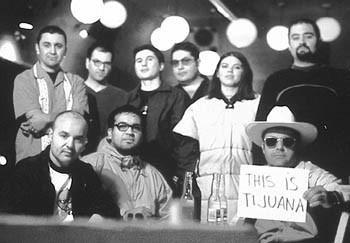
Latin music has also recently entranced the world-pop ear. In California, a Rock en Español movement has generated moderate heat in recent years. So it’s no surprise to hear a dance disc like The Tijuana Sessions, Vol. 1 (Palm Pictures), by Nortec Collective, a batch of tracks that stews feisty regional border sounds with hip club-culture groove, all by young artists from a city most Americans only associate with cheap tourism and tequila hangovers.

The disc’s jacket boasts the accurate claim that “Nortec Collective is not a genre or a group . . . but an entire electronic aesthetic. Nortec stands for norteno-techno; Tech-Mex cut and paste; the convergence of high-tech, low-tech, and traditional northern Mexican music.” Simply put, this is techno-meets-mariachi/salsa. In recent world-pop terms, the nearest precedent is the 1997 British compilation Anokha, a disc featuring artists like Talvin Singh and State of Bengal, who spiced current dance tracks with traditional sounds from India.

If you’re imagining Moby remixing Herb Alpert and the Tijuana Brass, you’re close. The Tijuana Sessions, Vol. 1 swings from straight house-disco hardness to semi-acoustic trance ambiance to electro-soul, hitting a smooth blend between cheap, earthy localism and sophisticated electronica. The peppy rhythms of salsa, reggae, rhumba, and bossa nova dominate the collection, with dusty samples of instruments like the cowbell, accordion, timbal, and tuba fleshing out the break beats in the same way sitar and tabla completed Anokha.

For the Nortec Collective artists, blending natural sounds with modern tracks is all about fills–the space between beats where a trumpet lick kicks in some fire, where scratchy percussion maintains the pulse, where accordion chords mimic Euro-pop. Techno’s favored drum-‘n’-bass model is echoed with rumbling congas and timbal loops playing a consistent high to the dublike low of blaring tubas and seemingly broken, rather jazzy synth riffs.

Hip culture aside, the Nortec Collective is accessible as hell. Fussible (the performing name of disc producers Pepe Mogt and Jorge Ruiz) offer the spacey influence of Kraftwerk, plus a jamming synth-funk solo on “Casino Soul.” Bostich and Terrestre could be Stereolab as they navigate through their busy, soundtrack-ready, Brazilian- flavored lounge-funk. Plankton Man plays Reggae Floyd with a smooth jazz guitar solo on “No Liazi Jaz.”

While Terrestre’s tellingly titled “Norteno de Janeiro” showcases the disc’s melding of electro-pop with Latin/Caribbean roots, it’s Hiperboreal’s “Tijuana for Dummies” that makes the most sense. Sparse and thumping, it projects an earthiness that’s easier and deeper than the jazz sax fills, Euro-beats, and the disc’s single diva vocal sample.

On The Tijuana Sessions, Vol. 1, those elements are all understated examples of the familiar, specific roots that Nortec Collective shares with a growing, global electronic style.

From the May 3-9, 2001 issue of the Northern California Bohemian.

© Metro Publishing Inc.

Bush vs. Gore

Moore or Less George hasn't done anything Al wouldn't have By Michael Moore WELL, 101 DAYS into the Junta and the fear mongers are having a heyday, aren't they? Even good liberals and Democrats have joined in the mantra. To listen to them, you'd think George W. Bush had opened the...

‘Town & Country’

Beatty-bashing sex experts aren't aroused by 'Town & Country' Writer David Templeton takes interesting people to interesting movies in his ongoing quest for the ultimate post-film conversation. This is not a review; rather, it's a freewheeling, tangential discussion of art, alternative ideas, and popular culture. "Oh my god! That was...

‘The Cripple of Inishmaan’

Visual Blarney Actors Theatre shines on Emerald Isle By Yosha Bourgea THE CRIPPLE of Inishmaan, now playing at Actors Theatre, is set in 1934 on an island off the west coast of Ireland, where the big news among the locals is the recent arrival of an American film crew on the...

Kenneth Cleaver

Consumer Correspondent The President's Challenge Poplars Research Center 400 E. Seventh Street Bloomington, IN 47405-3085 Dear President's Challenge: Of my many memories of adolescent emasculation, few have taxed my self-esteem for as long as the debacle of my seventh-grade President's Challenge pull-up test. Perhaps it was...

Open Mic

Open MicPromises KeptBy Ianthe BrautiganI MADE A PROMISE to the author Primo Levi a couple of years ago. Levi spent his life writing about the unspeakable horror and evil that he had experienced in Auschwitz. I told him after finishing his Survival in Auschwitz that I would never forget. (Levi died in 1987--I'm a bit odd because I...

‘Blow’

Movie-talk authors look for the hidden moral lesson in 'Blow' Writer David Templeton takes interesting people to interesting movies in his ongoing quest for the ultimate post-film conversation. This is not a review; rather, it's a freewheeling, tangential discussion of art, alternative ideas, and popular culture. Talk about the ultimate subjects...

Sven Nykvist

Tragic Magic Sven Nykvist film both sad and enlightening HE SAID, "Let there be light," and there was light--and movies were never the same again. Sven Nykvist had set a high new benchmark of artistry and beauty. While Nykvist's name may be most familiar to trivia nuts,...

Wine Myths

Myth Busters The truth about wine By Bob Johnson MYTHS abound in virtually all aspects of our business and personal lives. You have to have money to make money. An apple a day keeps the doctor away. A good defense will beat a good offense every time. Most myths possess at...

Britney Spears and Pepsi

Sex & Spears Taking the Britney and Bob challenge By Lara Riscol ONCE UPON a time, a little blond Baptist girl from Louisiana busts into international stardom, snagging the biggest ever, multiyear sponsorship pact with a ruling cola conglomerate. The teen queen named Britney Spears hits Forbes' Top 10 list of...

Nortec Collective

Break Beats Techno meets mariachi on new CD By Karl Byrn ELECTRONIC dance music failed to conquer the pop charts in the late '90s, but may yet have the last laugh as the preferred medium for global pop-music innovation. Techno now takes the place of rock and hip-hop as the universal...
11,084FansLike
4,606FollowersFollow
6,928FollowersFollow