Pomegranate

0

Pomegranate publishes visual treats

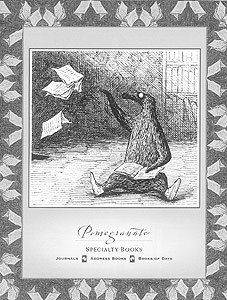
A GREEN-jacketed man offers a treat to an unimpressed dog calmly hovering upside-down in midair. A colonial gentleman, stoic and proud, stands before his latest invention, a freestanding, yard-long coil of processed meat. A seafood salad attacks a would-be gourmand. An imposing man casually removes his goatee.

It may come as a shock, but these bizarre visions of the imagination have something in common with the timeless architectural masterpieces of Frank Lloyd Wright. For that matter, they share something with M. C. Escher, Edward Gorey, Claude Monet, and Maxfield Parrish.

Strange, but true. These world-renowned artists, along with the floating dog and his oddball friends–which are the unmistakable ink drawings of British artist and author Glen Baxter–can all be found in beautifully rendered “coffee-table” books imprinted with the curious little name: Pomegranate. And they were all published in Sonoma County.

Pomegranate Communications, housed in an unimposing business complex in Rohnert Park, is one of the publishing world’s foremost, if unconventional, producers of quality art books–and ancillary merchandise (calendars, note cards, journals, and the like).

Pomegranate was founded 30 years ago by Thomas F. Burke, as a spinoff of his successful efforts printing and hawking psychedelic rock-concert posters at the Fillmore in the 1960s. With an optimistic enthusiasm that could have been born only of the hippie movement, Burke created a company devoted to creating altered states of the mind through the mesmerizing medium of art.

The success of Pomegranate lies in that enthusiasm, a passion shared by the world-class artists that the company is able to recruit. “Artists like to work with us,” says Katie Burke, Pomegranate’s publisher (and Thomas Burke’s wife). “We respect them, and they appreciate that.” For that matter, so do book buyers. Pomegranate’s insistence on quality and attention to detail, says Burke, “is the main focus of who we are. It’s our identity in the marketplace.”

That identity has lead to the company’s position as a primary publisher of books for museums. Pomegranate partners with such lofty names as the Smithsonian Institution, San Francisco Asian Art Museum, and Museum of the City of New York to produce numerous collections.

Given the luster of these associations, it’s a testament to Pomegranate’s versatility that it also published Steve Schaecher’s Outhouses by Famous Architects and Johnny Otis’ Red Beans and Rice and Other Rock and Roll Recipes. “We’re not a stodgy publishing house,” allows Burke with a laugh.

Though Pomegranate’s stable of artists includes such superstars as B. Kliban and the aforementioned Boulet–whose lush paintings of animal spirits and Earth goddesses are almost synonymous with the New Age movement–the company has always sought to find up-and-coming artists to present to the world. The fall catalog includes Gaiastar Mandalas: Ecstatic Visions of the Living Earth, by relatively unknown artists Bonnie Bell and David Todd.

“It’s harder in today’s marketplace to introduce contemporary artists,” Burke says. “There are fewer opportunities for unknown artists. But we will absolutely continue, whenever and however we can, to bring new artists to the world.”

Let’s hope that, as suggested by Glen Baxter’s floating dog and exploding fork–found in the brand-new Unhinged World of Glen Baxter–Pomegranate will also continue to give us the works of famous figures that we’ve somehow forgotten.

“Absolutely,” Burke insists. “We’re always asking ourselves, ‘What other cool stuff can we find and put out there into the world? Just for fun?’ ”

From the September 20-26, 2001 issue of the Northern California Bohemian.

© Metro Publishing Inc.

Open Mic

0

By Greg Cahill

OVER THE PAST SEVERAL DAYS, President Bush has worked hard to demonize–and dehumanize–the Taliban rulers in Afghanistan in preparation for a possible war with that faraway land. But few Americans are aware that until the Sept. 11 terrorist attack on New York and Washington the Taliban were our allies in the war on drugs. The United States this year gave the Taliban $43 million to help fight the flow of heroin from that opium-producing region.

Strange bedfellows.

The ironic twist in that tryst is that Afghanistan is the subject of United Nations trade sanctions that were implemented against the regime at the behest of the United States itself.

This arrangement has gotten very little press attention. But in a May 22 op/ed piece in the Los Angeles Times, syndicated columnist Robert Scheer contemplated what he called Bush’s “Faustian deal with the Taliban” and decided it is a deal with the devil.

“Enslave your girls and women, harbor anti-U.S. terrorists, destroy every vestige of civilization in your homeland, and the Bush administration will embrace you,” Scheer opined. “All that matters is that you line up as an ally in the drug war, the only international cause that this nation still takes seriously.”

The gift, announced by Secretary of State Colin Powell a few days before the op/ed piece ran, was just part of a larger aid package that Scheer noted makes the United States the main sponsor of the Taliban and rewards that “rogue regime” for declaring that opium growing is against the will of God.

“So, too, by the Taliban’s estimation, are most human activities,” Scheer wrote, “but it’s the ban on drugs that catches this administration’s attention.”

A mixed message? You bet. But then the United States has never hesitated to back every tinhorn despot that comes down the pike if the price is right: former Panamanian strongman Manuel Noreiga, now a convicted drug trafficker rotting in a federal prison, once enjoyed American patronage.

“The war on drugs has become our own fanatics’ obsession and easily trumps all other concerns,” wrote Scheer. “How else could we come to reward the Taliban, who has subjected the female half of the Afghan population to a continual reign of terror in a country once considered enlightened in its treatment of women. . . . The Taliban fanatics, economically and diplomatically isolated, are at the breaking point, and so, in return for a pittance of legitimacy and cash from the Bush administration, they have been willing to appear to reverse themselves on the growing of opium. That a totalitarian country can effectively crack down on its farmers is not surprising. But it is grotesque for a U.S. official, James P. Callahan, director of the State Department’s Asian anti-drug program, to describe the Taliban’s special methods in the language of representative democracy: ‘The Taliban used a system of consensus-building,’ Callahan said after a visit with the Taliban, adding that the Taliban justified the ban on drugs ‘in very religious terms.’ ”

Of course, as even Callahan admitted, those who didn’t obey the Taliban’s theocratic edict would be sent to prison or even face death.

“IN A COUNTRY where those who break minor rules are simply beaten on the spot by religious police and others are stoned to death, it’s understandable that the government’s ‘religious’ argument might be compelling. Even if it means, as Callahan concedes, that most of the farmers who grew the poppies will now confront starvation. That’s because the Afghan economy has been ruined by the religious extremism of the Taliban, making the attraction of opium as a previously tolerated quick-cash crop overwhelming.”

For that reason, the opium ban was doomed, Scheer summized, unless the Bush administration was willing to pour far larger amounts of money into underwriting the Afghan economy.

“The Taliban may suddenly be the dream regime of our own drug war zealots,” Scheer concluded, “but in the end this alliance will prove a costly failure. Our long sad history of signing up dictators in the war on drugs demonstrates the futility of building a foreign policy on a domestic obsession.”

A costly failure, indeed. If only Scheer hadn’t been proven right.

Greg Cahill is the editor of the ‘Northern California Bohemian.’

From the September 20-26, 2001 issue of the Northern California Bohemian.

© Metro Publishing Inc.

‘Dark Hollow’

Dark Angel

Local lawyer gives horror fiction a home in ‘Dark Hollow’

By Patrick Sullivan

I CHUCKLE a little because I don’t think of myself as a horror writer,” says Peggy Roth. “I’m not a dark, creeping Goth character. . . . But I like that otherworldly element.”

She’s right. If you were picking faces out of a lineup to find the editor of a literary magazine devoted to horror, Roth wouldn’t be your first choice.

Not every horror aficionado has to sport the creep factor of an Edgar Allan Poe. But Roth, a 34-year-old attorney and mother of two, has a bright smile, an easy laugh, and absolutely no trace of the macabre about her. By day, she works in the Family Support Division of the Sonoma County District Attorney’s Office.

At night, though, Roth pours precious time and energy into publishing Dark Hollow, an annual offering of chilling fiction and poetry from local writers, including a piece or two by Roth herself.

“Being scared is raising a passion, like being excited or falling in love or other things that I enjoy,” Roth says. “It’s stimulating. I think anybody that likes riding on a roller coaster can understand.”

Founded by Roth in 1999, Dark Hollow appears in local bookstores on the first day of every autumn to offer stories, poems, and art about restless corpses, murderous lovers, and haunted taxi cabs.

“I’m looking for well-crafted fiction or poetry that gives people a chill,” Roth explains. “It doesn’t always have to horrify, but it should contain some element that’s spooky–though I have published a number of pieces that just speak to the atmosphere of autumn, that don’t really have a real big chill factor.”

Now in its third year, Dark Hollow is slowly expanding its readership: Roth has doubled circulation to 200. Also growing is the magazine’s pool of contributors, who range in age and experience from a talented sixth-grade student to Sonoma County Poet Laureate Don Emblen.

Indeed, among the best pieces slated to appear in this year’s issue is Emblen’s “Rolling Blackout”: “More absolute than night/ that comes on by degrees,/ this black envelops us,/ our faces, arms, and legs/ as though we’ve dropped into a sack,/ unwanted kittens to be drowned.”

Publishing high-quality writing is Roth’s main goal. “Sonoma County isn’t a really big place, and this is a very particular niche,” she says. “So [the magazine] really has to appeal to people who just want to read quality writing. If I only picked things for their shock value or their horror content, I don’t think I’d get very far.”

Some would-be contributors err in the other direction. Roth wants it known that she does not publish break-up stories.

“I would say the biggest disconnect people have is that they interpret dark as psychologically dark,” Roth says. “So I get a lot of stories about, ‘Oh, I’m so miserable and suicidal because he left me.’ And that doesn’t really qualify for me.”

Roth’s interest in horror dates back to a childhood encounter with The Dracula Book of Great Vampire Stories, a bloodcurdling collection of vampire-themed fiction. Masters of the genre like Poe and Stoker teamed up to work their dark magic on her young mind.

But Roth doesn’t want you to get the wrong idea about her as a kid: “I didn’t sit in the library for hours at a time reading horror books,” she says. “But I read a few that really piqued my interest. And I certainly watched tons and tons of television and movies.”

In college, Roth worked on a literary magazine. Although a published poet, she had never seen any of her horror-themed work in print before she started Dark Hollow shortly after moving here from San Francisco. The task of creating a magazine from scratch turned out to offer a few more challenges than she’d expected.

“It still doesn’t seem like a big deal, but I now know there are a lot of tedious elements to it,” she explains. “When you have the vision, it’s all about the creative side of things. You’re going to get all these writers and sift through all this quality material.

“And then you realize, ‘OK, I have to input the work, and I have to edit it, and then I have to format it, and market it,'” she continues with a laugh. “So I think some of that stuff took me by surprise.”

Roth says she’s in for the long haul. She plans to have a website up in the next few months; she also wants to carefully expand circulation. And she hopes Dark Hollow will find new pockets of readers and writers in love with fear.

“I would love to discover that there are lots of people out there who secretly love horror and being scared,” she says, “because have I got a magazine for them.”

The writers featured in the new issue of ‘Dark Hollow’ read their work on Friday, Sept. 21, at 7 p.m. at Copperfield’s Books, 138 N. Main St., Sebastopol. For details, call 707/823-2618.

From the September 20-26, 2001 issue of the Northern California Bohemian.

© Metro Publishing Inc.

Local Literary Journals

Bust Out Stories

This biannual journal of short fiction by North Bay writers was founded in 1995. A new issue came out in July and is available at local bookstores and coffee shops. For details, e-mail [email protected].

The Dickens

The fifth annual edition of this literary magazine published by Copperfield’s Books is due out in November. Each issue offers fiction, creative nonfiction, and poetry by North Bay authors. www.copperfields.net.

Tiny Lights

The seventh annual contest issue of the Petaluma-based journal of personal essays was delayed by computer glitches, but you should now be able to purchase it at bookstores around Sonoma County. www.tinylights.com.

From the September 20-26, 2001 issue of the Northern California Bohemian.

© Metro Publishing Inc.
Fall Literature From the North Bay

North Bay writers serve up poetry, novels, & much more

By Greg Cahill and Patrick Sullivan

HOW BUSY are North Bay authors? Busy enough that we don’t have room to review all the novels, short-story collections, children’s books, or poetry chapbooks produced by local creative types in recent months. But here we offer a broad sample of work produced in the increasingly prolific literary scene.

Marsha Diane Arnold Metro Cat (Golden Books; $19.95)

Susie is the “fanciest cat in Paris”–until her life turns upside down when she gets lost in the subway system in this charming children’s book from Sebastopol author Marsha Diane Arnold. Can the former cover model for Fancy Cat Magazine adjust to a new life performing with an elderly street musician? Believe it, baby!–P.S.

Cydney Chadwick Flesh and Bone (Avec Books; $14)

A short-story collection that opens with a tale of a man’s relationship with his contact lenses is not for everyone. Yet Penngrove author Cydney Chadwick has a gift for using the mundane minutiae of everyday life to weave compelling accounts of postmodern alienation and despair in the lives of such characters as a nameless apartment dweller who comes to rely on a neighbor’s marijuana habit. These accounts also offer a dry, painful humor: “When he ventures down the stairs to his mailbox he is still a famous poet, but while on the street amidst others he is not quite as renowned. The further he gets from his apartment the less well-known he is.”–P.S.

Terry Ehret Translations from the Human Language (16 Rivers Press; $14)

Award-winning Petaluma poet Terry Ehret offers another collection of powerful, profoundly moving poetry. The book’s first piece, “Thirst,” displays Ehret’s kinetic way with words: “This year I’ve felt the push of antlers/ thrusting out of my head.” Particularly relevant in light of current events is a poem titled “Among the Involuntary Missing” and dedicated to Polly Klaas: “Grief, I think, is the only emotion that endures,/ rearranging who we are, living/ alongside us, ghosts/ everywhere, even in the long warm evenings/ where you think they would not dare to follow . . .” –P.S.

Joan Frank Boys Keep Being Born (University of Missouri Press; $17.95)

“All she could claim to have achieved in the past decade, it began to dawn on her, was the avoidance of harm.” With that realization, the lonely woman in the well-crafted opening tale of this short-story collection makes a decision her brain warns her against: she gets involved with a married man. But the result is far from what she–or the reader–expects. Indeed, avoiding the predictable is one of Frank’s strengths as a writer. This Santa Rosa author also has a gift for character and description that makes this collection a pleasure to read. Her subject matter ranges from women confronting the trials and tribulations of middle age to the extraordinary reproductive organ of the beleaguered Carlos Artiga: “When it commands release Carlos has no choice. He will be unable to undertake the day’s appointments until the tyrannical member is given its way.”–P.S.

Suzanne Gold Daddy’s Girls (Perfect Productions; $25)

A mother and her two daughters take turns narrating this sprawling tale of a family disintegrating under the terrible pressures of jealousy, family dysfunction, and madness. Author Suzanne Gold, a Marin County psychologist who has schizophrenia in her family, drew on personal experiences to delve deeply into the impact of mental illness on the three women at the heart of her book. Unfortunately, though the author offers an interesting (and often heartbreaking) perspective on schizophrenia, her characters are all too often one-dimensional and predictable–especially the mother, who seems to have ridden in on a broomstick from Oz.–P.S.

Jonah Raskin More Poems, Better Poems (Running Wolf Press; $6)

The overwhelming superiority of the author in every field of human endeavor is the theme of this collection of 21 poems. One excellent reason to attend local poetry festivals is to hear Raskin–a professor of communications at Sonoma State University–read some of this work aloud. This stuff is pretty funny in print, but the poet gives it enough spin in person to bust a gut or two. From “Sexier”: “I’m sexier than you and/ I have more sex appeal and more sex drive, too/ a libido you’d die for. In fact, I’m the male sex symbol for the 21st century!” Or try “More Buddhist”: “I’m a better Buddhist than you, my beloved/ I breathe better and/ Sit better and meditate more often–I’m more Karmic than you and/ I’m the captain of the Koan.” And so on. You may know a few people who will not realize these poems are satirical. Never trust those people again.–P.S.

Lee Torliatt Golden Memories of the Redwood Empire (Arcadia; $19.99)

Do you remember when Egg Queen Martha King came to town? Probably not. What about the tussle between Women’s Christian Temperance Union members and Sonoma County’s growers of wine grapes and hops back in the Prohibition era? No? Ever hear about the Petaluma car fire of 1912? Quite a conflagration. Sit back and let Lee Torliatt, a fifth-generation native of Sonoma County and vice president of the Sonoma County Historical Society, reminisce about the good–and bad–old days in this thoroughly entertaining and highly informative 128-page paperback. It’ll give you a chance to catch up on the riot that ensued after the 1943 Big Game between the Santa Rosa and Petaluma high schools.–G.C.

Milly Lee Earthquake (Frances Foster Books; $16)

“This morning the earth shook and threw us from our beds. We were not hurt, just stunned.” So begins this children’s book based on the experiences of the Santa Rosa author’s mother in San Francisco’s Chinatown during the 1906 earthquake. Yangsook Choi illustrates this charming adventure, which offers an exciting (but not terrifying) way to introduce young kids to a remarkable slice of history.–P.S.

Tosca Lenci Daughter of the Excision (LP Publishing; $7.50)

“I shall give you poetry, without end,” begins this chapbook by the Sonoma author who two years back gave us Beloved Disciple, Daughter of Logos. Concerned with the issues and imagery of love, sexual politics, and religion, Daughter offers a wide variety of verse, including this: “FUDGE, FUDGE, TELL THE JUDGE/ MOMMA’S GOT A NEWBORN BABY/ WRAP IT UP IN TISSUE PAPER/ SEND IT DOWN THE ELEVATOR/ UPSTAIRS, DOWNSTAIRS/ OUT THE BACK DOOR.” –P.S.

Megan McDonald Judy Moody Gets Famous (Candlewick Press; $15.95)

“You’re not in one of your famous moods again, are you?” Judy Moody’s dad asks. That’s a silly question to ask the moodiest girl in third grade, who is deeply e-n-v-i-o-u-s that her archrival, the pointy-headed Jessica Finch, just scored top honors in the big spelling bee. And the more Judy tries to catch up and win her own 15 minutes of fame by overachieving, the more she gets i-n-f-a-m-o-u-s for getting into trouble. Sebastopol children’s author Megan McDonald has delivered a charming sequel to last year’s award-winning Judy Moody. And once again, Peter Reynolds’ expressive line drawings are an excellent match for McDonald’s lighthearted style. –P.S.

T.E. Watson I Wanna Iguana (Paw Prints Press; $16.95)

The ironic disparity between a young boy’s grand ideas about iguanas and the quotidian reality of the creatures in question forms the linchpin upon which this illustrated children’s book turns. For example, the narrator expresses this belief: “My iguana would speak a foreign language because it comes from a different country.” But, as readers may be aware, most iguanas have abandoned their native language in hopes of landing a job at McDonald’s. John Raptis delivers appropriately whimsical illustrations–P.S.

From the September 20-26, 2001 issue of the Northern California Bohemian.

© Metro Publishing Inc.

Donations

Donations

The devastating effects of the Sept. 11 terrorist attacks that took the lives of many innocent people–including more than 4,000 workers in and around the World Trade Center and the Pentagon, hundreds of emergency personnel at the scene, and the passengers and crews of four U.S. airliners–will continue to have a huge impact for families and communities for years to come. A number of relief organizations have set up funds earmarked specifically for the families and survivors of the attacks. Your cash donations can help:

The United Way The September 11th Fund United Way 2 Park Ave., New York, NY 10016 212/251-4035 Online: national.unitedway.org (Donors may specify the community where they want their donation to help (New York City, Washington D.C, or other affected areas).

New York Firefighters 9-11 Disaster Relief Fund 1127 Broadway Ave., Suite 102 Tacoma, WA 98402 Phone: 877/863-4783 Second Phone: 253/274-0432 Fax: 253/274-0309 E-mail: [email protected]

The American Red Cross Disaster Relief Fund Online: www.redcross.org On Saturday, Sept. 22, dozens of Sonoma County businesses are sponsoring the Spirit of America Picnic, a benefit for the American Red Cross and for the New York City Police and Firefighters’ Widows and Orphans Fund. The event takes place from noon till 5 p.m. at the Luther Burbank Center tent pavilion, 50 Mark West Springs Road, Santa Rosa. There will be carnival games, an Uncle Sam/Statute of Liberty lookalike contest, and live music.Tickets are $20 for adults; $5 for youth age 6 to 16 (free for children 5 and under). For details, call 707/577-7608. Or to make a donation to the American Red Cross, call 800/HELP-NOW; 800/435-7669 (English-speaking); or 800/257-7575 (Spanish-speaking)

The Salvation Army The Salvation Army National Capital and Virginia Division (for relief efforts at the Pentagon) P.O. Box 18658 Washington, D.C. 20036 800/SAL-ARMY (800/725-2769)

From the September 20-26, 2001 issue of the Northern California Bohemian.

© Metro Publishing Inc.

9-11 Tribute

“And Death Shall Have No Dominion”

By Dylan Thomas

And death shall have no dominion. Dead men naked they shall be one With the man in the wind       and the west moon; When their bones are picked clean       and the clean bones gone, They shall have stars at elbow and foot; Though they go mad they shall be sane, Though they sink through the sea       they shall rise again; Though lovers be lost love shall not; And death shall have no dominion. And death shall have no dominion. Under the windings of the sea They lying long shall not die windily; Twisting on racks when sinews give way, Strapped to a wheel,       yet they shall not break; Faith in their hands shall snap in two, And the unicorn evils run them through; Split all ends up they shan’t crack; And death shall have no dominion.

And death shall have no dominion. No more may gulls cry at their ears Or waves break loud on the seashores; Where blew a flower may       a flower no more Lift its head to the blows of the rain; Though they be mad and dead as nails, Heads of the characters hammer       through daisies; Break in the sun till the sun breaks down, And death shall have no dominion.

From the September 20-26, 2001 issue of the Northern California Bohemian.

© Metro Publishing Inc.

Taylor Maid

0

Something brewing: Occidental coffee and tea maker Mark Inman is at the forefront of the fair-trade movement.

The Coffee King

Taylor Maid Coffee’s co-founder stirs it up in the java jungle

By Paula Harris

MARK INMAN downs between 10 and 20 steaming hot cups of joe each day, mainly potent espressos and deeply fragranced brewed coffees–an alarming amount, even by his own admission. But he wouldn’t have it any other way. “I’ve been a coffee person for 15 years. It’s more than a job for me,” says the feisty 33-year-old co-founder and roastmaster for the Occidental-based “green” company Taylor Maid Coffee. “Basically my entire life is surrounded by it.”

He’s not kidding. Inman no doubt needs all that caffeine-caressed elixir as aromatic gasoline to get him though his punishing 12-hour workday schedule, a daily grind that typically runs from 8 a.m. to 8 p.m.

Inman, who’s known in the field as a coffee connoisseur, the equivalent of a “nose” in the perfume industry, kick-starts his mornings by roasting and sampling coffees from different farms, with a view not only to purchasing them himself, but to give feedback to other groups that send him their blends. Midday is the time for board meetings and phone conferences, and afternoons are normally tied up with training sessions, with writing for two trade magazines, and with daily operations.

“My mind is always buzzing around with new ideas, new concepts, and possibilities about where the coffee industry can go,” gushes Inman, not batting an eye when using the term buzzing. “I usually overcommit myself to a lot of outside extracurricular things just because I’m interested in what the possibilities are.”

Indeed, the energetic Inman (who races mountain bikes and runs in his limited spare time) last month completed a trip to Peru, where he was one of three American judges selected to drain java in a quest to find the 20 best coffees in that South American nation. Those farmers selected will now reap 10 times their normal earnings.

It’s all in keeping with Taylor Maid’s overall philosophy to positively affect the lives and communities of coffee growers around the world who no longer depend on agrochemicals.

The 10-year old company started life as an herb farm in Occidental. At the time, Inman, a roaster for 10 years in the mainstream coffee biz, became dismayed by the profit-grabbing practices he encountered. So he and his business partner Chris Martin, 47, started the Taylor Maid coffee line, the first 100 percent organic coffee line in Northern California. More recently another partner, Julie Baron, 37, joined the company to develop a line of organic teas.

“My goal is to create a company where the bottom line is not always about profit, but to create a greater mission,” explains Inman, who also helped start the Organic Coffee Association, a national group that promotes organic coffees globally.

TAYLOR MAID is a pioneer in the green-business movement: recycling waste on-site; using biodegradable or recyclable packaging; promoting other green companies and organic farming groups; and using only shade-grown crops (to protect the ever-decreasing numbers of migratory birds).

In addition, the company is trying to break the chain of poverty for growers in other countries, using the fair-trade coffee system to ensure farmers a living wage.

“I have commitments to farmers in 16 different countries that I will find them a place to sell their products in the United States,” says Inman. “We’re working to help develop and increase economic and educational standards in those countries.”

Inman says many consumers don’t consider coffee an agricultural product, requiring backbreaking work. “The idea of Juan Valdez in a sense is true,” he explains, “that a human being picks that coffee and processes it from start to finish. You can compare coffee with wine–and yes, wine may be handpicked, but it’s not hand-processed all the way through; with coffee it’s amazingly labor intensive.”

Inman adds that the quintessential cup of joe yields qualities as complex as some of the finest cabernets in the world. “The perfect cup of coffee would be a single-country-origin coffee,” he says, touting a recent discovery–a Nicaraguan organic coffee called Miraflor–in wine-snob terms. “This one has got nice rounded acidity–almost tannic in acid structure–a very floral and bright note to the top end of the coffee, and a rich velvety body. If you French-press or really prepare these coffees properly, not just use a filter brewer, and really let these coffees sit in your mouth and think about them, they have much more complexity than wine. There are so many flavors going on.”

One of the biggest detriments to well-crafted coffee is overroasting, according to Inman. “In California, people drink coffees that are roasted way too dark,” he scolds. “If you were to give a lighter roast coffee a try and brew it strong, you’d find that you’d have no reason to put sugar or cream in that coffee. You’d pick up a lot more sweetness and a lot more complexity. . . .”

Inman’s voice trails off excitedly. He’s already planning his next pot of joe.

From the September 20-26, 2001 issue of the Northern California Bohemian.

© Metro Publishing Inc.

Kenneth Cleaver

Consumer Correspondent

Staples Inc. Attn: Customer Service 500 Staples Drive Framington, MA 01702

Dear Staples:

I am responsible for managing a small office and in recent months have ordered copy paper, binder clips, seven file folders–all from Staples. Last week, the ink cartridge ran out during a crucial fax. I replaced the cartridge within seconds, and the fax transmitted without delay. If the nightly news had featured office plays of the week, I would have been on it.

When I have finished placing my order, your operators inquire whether I need candy and coffee, pens and copy paper. I politely decline. I do not think your operators mean to be rude. I do not think they wish to suggest that I am incompetent, that I am not thoroughly abreast of the state of my supplies. I presume your marketing analysis finds that such reminders, however irksome, increase revenues significantly. I do not possess the arrogance to suggest changing your policies to suit me, only that you incorporate my needs into your current practice. Unfortunately, the competency with which I manage an office does not extend to my personal life, which is a ceaseless carnival of angst. Thus my request is that Staples matches its marketing pitches with my personal growth challenges. For instance, “Are you sure you don’t need any pens or notebooks?” would be followed by “If you both recognize the relationship is going nowhere, why are you still sleeping together?” Or, “Are you all set with folders and copy paper?” would be matched with “”She’s a happily coupled lesbian living in Europe; it was a fling, get over it.”

I will continue to purchase supplies from Staples and stomach your cajoling pitches if you will return favors with my own. I scratch your back; it is only fair, and good business sense, that you scratch mine.

Sincerely, Kenneth H. Cleaver

Dear Mr. Cleaver,

We are in receipt of your letter and appreciate your feedback; we take our customers’ recommendations very seriously.

I would like to assure you that your comments have been shared with our marketing department, as well as our call center management team, where such information is used to provide our customers with the best catalog shopping experience possible.

Thank you again for your comments and for shopping at Staples.

Respectfully, Devon Whitney-Deal Customer Relations Manager Office of the President

From the September 20-26, 2001 issue of the Northern California Bohemian.

© Metro Publishing Inc.

Robert Cray

0

Blue Soul

Robert Cray is feeling satisfied

By ALAN SCULLEY

ROBERT CRAY being an artist who has recorded a dozen studio albums and has established a readily identifiable sound that draws liberally from classic Memphis soul and smooth yet punchy blues, it can be tempting to think that one Cray CD sounds pretty much like the rest. That could easily be the first impression with Cray’s new CD, Shoulda Been Home (Ryko). It boasts the familiar trademarks fans have come to expect from the 47-year-old singer-guitarist–such as the wrenching ballads dealing with heartache and wayward lovers, Cray’s silky smooth vocals, the tight, grooving interplay between Cray and his longtime bandmates, keyboardist Jim Pugh, drummer Kevin Hayes, and bassist Karl Sevareid.

Yet Cray–a Novato resident–can point to enough new wrinkles on Shoulda Been Home to make a case that the CD is as notable for its differences as for the traits it shares with the other albums that make up his catalog. “I think when one listens to the current record, you hear a lot of different influences,” Cray says.

And some of those influences are ones that Cray says he feels give the disc a unique identity. For starters, the CD includes covers of two Elmore James blues songs–the rollicking hard-swinging “Cry for Me, Baby” and the gut-bucket ballad “12-Year-Old Boy.” One actually has to go back several Cray albums–to 1995’s Some Rainy Morning –to find him doing this sort of straight-ahead blues.

“It’s just the songs weren’t there,” Cray says, explaining the absence of blues material on recent records.

“That’s what happens for me. The songs weren’t there.”

Shoulda Been Home marks the second straight album in which the Robert Cray Band has worked with producer Steve Jordan. It also was recorded in the same studio–Woodland Studios in Nashville–as Cray’s preceding CD, the 1999 release Take Your Shoes Off. On such early albums as Bad Influence, Cray forged a close partnership with Dennis Walker, who co-wrote with Cray many of the songs and produced each of the group’s albums. But with the 1993 album Shame + a Sin, Cray split with Walker and assumed production duties. Cray says he hasn’t minded giving up some of the control over his albums, even though Jordan is a highly proactive producer who takes a major role in everything from song arrangements to getting precise instrumental sounds for each song. “I’m open to new ideas, especially with somebody whose work I admire,” he explains. “He’s also a great person to get along with.”

The teaming of Jordan and Cray has proven to be a potent combination. The acclaimed Take Your Shoes Off, a CD that explored Cray’s deep roots in the Memphis soul sound of the ’60s and ’70s, earned the Cray Band a Grammy Award for best blues album.

Cray had won Grammys before, but this award had a special meaning to him. “What was really cool was the fact that this particular band won a Grammy,” Cray says, noting that the earlier awards were with a different edition of his band. “With Jim and Kevin coming in ’89 and Karl in ’92, it’s been 10, 11 years, 12 years for somebody being in this band and being nominated a lot, and they finally got to take one home.

“That was really cool.”

The Robert Cray Band performs Friday, Sept. 28, at 8 p.m., at the Luther Burbank Center for Performing Arts, 50 Mark West Springs Road, Santa Rosa. Tickets are $35. 707/546-3600.

From the September 20-26, 2001 issue of the Northern California Bohemian.

© Metro Publishing Inc.

Pomegranate

Pomegranate publishes visual treats A GREEN-jacketed man offers a treat to an unimpressed dog calmly hovering upside-down in midair. A colonial gentleman, stoic and proud, stands before his latest invention, a freestanding, yard-long coil of processed meat. A seafood salad attacks a would-be gourmand. An imposing man casually removes his goatee....

Open Mic

By Greg Cahill OVER THE PAST SEVERAL DAYS, President Bush has worked hard to demonize--and dehumanize--the Taliban rulers in Afghanistan in preparation for a possible war with that faraway land. But few Americans are aware that until the Sept. 11 terrorist attack on New York and Washington the Taliban were our allies in the war on...

‘Dark Hollow’

Dark Angel Local lawyer gives horror fiction a home in 'Dark Hollow' By Patrick Sullivan "I CHUCKLE a little because I don't think of myself as a horror writer," says Peggy Roth. "I'm not a dark, creeping Goth character. . . . But I like that otherworldly element." She's...

Local Literary Journals

Bust Out Stories This biannual journal of short fiction by North Bay writers was founded in 1995. A new issue came out in July and is available at local bookstores and coffee shops. For details, e-mail [email protected]. The Dickens The fifth annual edition of this literary magazine published by Copperfield's Books is...

Fall Literature From the North Bay

North Bay writers serve up poetry, novels, & much more By Greg Cahill and Patrick Sullivan HOW BUSY are North Bay authors? Busy enough that we don't have room to review all the novels, short-story collections, children's books, or poetry chapbooks produced by local creative types in recent months. But here we offer a broad...

Donations

Donations The devastating effects of the Sept. 11 terrorist attacks that took the lives of many innocent people--including more than 4,000 workers in and around the World Trade Center and the Pentagon, hundreds of emergency personnel at the scene, and the passengers and crews of four U.S. airliners--will continue to have a huge impact for families and...

9-11 Tribute

"And Death Shall Have No Dominion" By Dylan Thomas And death shall have no dominion. Dead men naked they shall be one With the man in the wind       and the west moon; When their bones are picked clean       and the clean bones gone, They...

Taylor Maid

Something brewing: Occidental coffee and tea maker Mark Inman is at the forefront of the fair-trade movement. The Coffee King Taylor Maid Coffee's co-founder stirs it up in the java jungle By Paula Harris MARK INMAN downs between 10 and 20 steaming hot cups of joe...

Kenneth Cleaver

Consumer Correspondent Staples Inc. Attn: Customer Service 500 Staples Drive Framington, MA 01702 Dear Staples: I am responsible for managing a small office and in recent months have ordered copy paper, binder clips, seven file folders--all from Staples. Last week, the ink cartridge ran out during a crucial fax. I replaced the...

Robert Cray

Blue Soul Robert Cray is feeling satisfied By ALAN SCULLEY ROBERT CRAY being an artist who has recorded a dozen studio albums and has established a readily identifiable sound that draws liberally from classic Memphis soul and smooth yet punchy blues, it can be tempting to think that one Cray CD...
11,084FansLike
4,606FollowersFollow
6,928FollowersFollow
