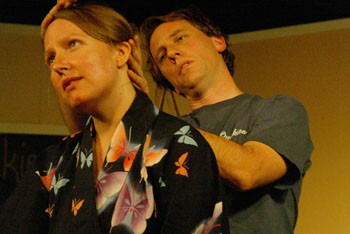
‘Blue Crush’

0

Surf and Turf

Best-selling memoirist Joelle Fraser on hanging in Hawaii, obsessing on guys, and ‘Blue Crush’

Writer David Templeton takes interesting people to interesting movies in his ongoing quest for the ultimate postfilm conversation. This is not a review; rather, it’s a freewheeling, tangential discussion of art, alternative ideas, and popular culture.

I guess I haven’t seen that many teen movies lately,” admits Joelle Fraser, underscoring her confession with the kind of contagious laugh that makes everyone within earshot burst a into smile. Fraser–author of the instantly notorious, critically lauded memoir The Territory of Men–has just experienced her first “teen movie” in several years (she’s 35) and, it turns out, was quite impressed. “If all teen movies are like Blue Crush,” she says, “then–wow!–I’ve been missing out.”

Note to Joelle Fraser: most teen movies are nothing like Blue Crush–though that’s not to say that the film’s a masterpiece. Blue Crush is a little sloppy around the edges, but nevertheless it was full of pleasant surprises for first-time author Fraser, in part because it bore so many eerie similarities to her own life story, as described in heartbreakingly poetic detail in her sensational new book.

Blue Crush, based on a magazine article about Hawaiian surfer girls, follows the gritty adventures of three hard-bodied surfer girls in modern-day Hawaii, primarily Anne Marie (Kate Bosworth), who dreams of competing in a major surfing competition but has a lot of issues to overcome: men, mothers, fear of drowning–that kind of thing.

To anyone who’s read Fraser’s book, it will come as no surprise that what slammed her the hardest about Blue Crush was not the film’s extraordinary surfing scenes, the all-night partying, or the icky hotel schtick. It was Anne Marie’s painful struggle to avoid following in the footsteps of her mother, in regards to living for men and compulsively giving up her own dreams.

“That stuff really hit me,” Fraser says. “I could so identify with that young girl, wanting to shake that off, that whole ‘like mother, like daughter’ expectation that people have. It’s so hard, wanting to say ‘No. That’s my mother. That’s not me,’ and at the same time having to face the fact that, yeah, who my mother is and what she’s done is a big part of me.”

In the movie, Anne Marie’s friends are more than aware of her self-destructive nature, and when she begins to skip surfing practice to go romping with a vacationing quarterback, they are quick to tell her she’s messing up.

“And they’re right,” Fraser agrees. “It’s hard to devote yourself to a man and devote yourself to a dream. It really is. A guy will ruin your focus. And for what she was doing–preparing for that surfing contest–she needed 150 percent of her focus.

“To pursue a dream,” she goes on, “you have to become single-minded and somewhat obsessed. And when you have a guy, you spend all your time thinking about him instead of your dream. It can change the direction of your life. All of a sudden, instead of having a hundred doors open, you are with a guy–and there are only these 10 doors available.”

I ask Fraser if she thinks this is a positive movie for teen girls to see.

“Oh, yeah. This is a movie for any girl who wants to be inspired, and for any guy who is willing to start seeing girls in a different light. Girls will be so inspired by this story. And then the other thing was watching a girl kick ass like that. I think it’s good for guys to see that. I really think a movie like this, if it’s seen by enough young people, can change the way men and women relate. It could actually increase the level of respect there is for women, both in the way men see women and the way women see themselves.

“I know if I had a kid,” she says, “I’d make them see this movie.”

From the September 12-18, 2002 issue of the North Bay Bohemian.

© Metro Publishing Inc.

Morrissey

0

Viva Moz!

Morrissey turns the LBC into the Land of 1,000 Sideburns

By Sara Bir

Welcome to our poetry recital,” Morrissey said after opening his show at the Luther Burbank Center on Monday, Sept. 9. “We are not Hall and Oates,” he assured the crowd, alluding to the very ’80s rock duo’s upcoming LBC performance that was printed up in the program directly across from Morrissey’s bio.

It was a textbook Morrissey comment–witty, dry, self-deprecating, and just a wee bit snobby. But it also brought up an interesting point, because Hall, Oates, and Morrissey all share something in common, besides professionally going by their last names. Neither has an upcoming album to tout, and neither has released much new material to speak of in the past five years. Why is Morrissey on tour now? And how did the universally idolized former frontman for the Smiths, perhaps one of the ’80s most influential bands, come to play the Luther Burbank Center in Santa Rosa on a Monday night? Bands like America or Night Ranger can devolve into has-been dinosaur rock oblivion, but does Morrissey belong with them?

Morrissey may have receded from pop’s indie forefront, but he’s hardly burnt out or a has-been. Morrissey will never be a has-been, not to the millions of fans who slogged through tough and tender times with nothing but tapestries of girlfriends in comas and dead queens to keep them afloat.

And that’s one of the best parts of a Morrissey concert–the crowd itself. Morrissey knows this, and he plays to all of the stalwart followers pressed up against the edge of the stage, taking their gifts (on this night, a custom-bedazzled jean jacket) and hurling bouquets gallantly back into the audience.

He did all his Morrissey poses and flung the cord on his microphone around like a bullwhip–a pouty, erudite Elvis–and people just went nuts. Girls wore their sharpest vintage dresses, and the guys slicked up their hair all big. Today’s youth was underrepresented (those awful teenage years are when we need Morrissey’s parables of self-loathing the most), replaced by yesterday’s youth–mostly grown-up products of Smiths albums.

Mozzer–with flatter hair, age adding character to his face, and a bit more flesh on his body–sang through his solo catalogue, tossing in a fair amount of recent material, which lacked the acerbic punch of his older stuff. But he and his long-time backing band put on a tight, charismatic show peppered with witty between-song banter. He even piped two Smiths classics, “I Want the One I Can’t Have” and “Barbarism Begins at Home.”

All songs met a warm reception, but the older material got more hands waving in the air up front. I wonder how many people were there to see what Morrissey’s doing now, and how many were there just to see Morrissey.

That’s what’s so weird, because Morrissey, new album or no, is still cool. Morrissey: still cool. Hall and Oates: not very cool. They’re all musicians, though, and that’s what musicians do. They play music and sing in front of people, and just because once fresh and spry paragons of rock eras past are not talked about by today’s youthful record-buying public as much as, say, Papa Roach, it does not diminish the impact they made and continue to make, nor does it render their music irrelevant–whether you are Morrissey, Hall & Oates, or the Rolling Stones.

It’s easy for critics to come down on what some may call “nostalgia acts,” because rock and roll culture is youth culture and when crow’s feet and renditions of hits from 20 years ago enter the equation, it can all seem farcical or even pathetic. And while veterans from Neil Young to Sonic Youth continue to grow artistically, and Hall and Oats remain, creatively speaking, frozen in time, they are all doing their jobs as musicians and still rocking away with dignity intact–which, to many fans, is all that matters.

From the September 12-18, 2002 issue of the North Bay Bohemian.

© Metro Publishing Inc.

Chinese Wine

0

Cultural Exchange: Pacific Vintage Group hopes to capture the huge–though not necessarily ripe–Chinese market with their Sausalito wine.

Red Menace

Introducing wine to China may not be easy, but it’s no harder than bringing Chinese wine to America

By James Knight

Conditions are perfect in the wine country this harvest season. The days are sunny, the nights cool, and thousands of acres of new vineyards planted during the wine boom are ripening in the sun. Conditions are perfect for a wine glut.

It happens every time. Vineyards boom, sales flatten, prices fall. Hardest hit may be the Central Valley, where Chardonnay is practically given away, but this glut will soon be worldwide. Enter a maverick Santa Rosa company with a plan to import wine from the nation that has driven almost every other industry to its shores–China.

Not rice wine or plum wine, not even “red sorghum” wine. Cabernet Sauvignon.

The People’s Republic isn’t exactly on the map when it comes to the king of grapes. China, which has been admitted to the World Trade Organization, may be the origin of your clothes, shoes, barbecue grills, telephones, and countless plastic gizmos. Could a flood of price-busting Chinese Merlot be far behind? Barring a flood, Santa Rosa entrepreneur Kent Godwin is aiming for at least a trickle.

Godwin is president of the Pacific Vintage Group, formed in 1998 to explore the Chinese wine market. Godwin, who studies Chinese language and kickboxes in his spare time–and who appears generally to be a walking advertisement for the wine country lifestyle–is fashioning a marketing program to introduce the pleasures of the fermented grape to the Chinese. In the meantime, he is planning to import Chinese-made wine to the United States later this year. Saying that there might be a market especially in the Chinese community and restaurants, he cautions that “the key is to make sure it’s California-friendly.”

Pacific Vintage Group’s first idea was to sell California wine in China. The French are already getting in on the game: according to Godwin, a French supermarket chain in metropolitan Beijing and Shanghai has an impressive selection of wine, including some of the major Californian players like Gallo and Kendall-Jackson. “They’re not doing gangbusters; they’re keeping shelf space from their competitors,” Godwin explains.

But Godwin and company, among others, are working on inculcating the Chinese with an appreciation for wine. They have developed a Chinese wine with a uniquely American image. It’s called Sausalito, because “it sounds nice and might roughly translate to golden hills.”

Many before have tipsily contemplated that market, stupefied by a hallucination of never-ending sales. If 1.3 billion people had just one glass of wine a year . . . The figures inspire wine marketers to madness, drooling into their stemware. Still a developing country, China’s middle class of young, urban professionals is expected to eventually number 300 million, 10 times larger than the potential market of the United States. If the average Joe–or Chou–were to knock back an occasional glass of California wine after work, demand would race ahead of supply far beyond the setting sun.

But it may be a slow boat to China. Godwin quotes the saying, “China is the land of opportunity, and always will be.” The middle class is actually less than 9 percent of the population, and even in the urban metropolises of Beijing and Shanghai, the qualifying income is around $1,200. The top price a bottle of wine can fetch is about $4. Tariffs and duties on imported wine don’t help, almost doubling the shelf price. That will be reduced to 14 percent under the World Trade Organization agreement.

And then would-be wine vendors have to promote dry, grape wine in a culture that is largely oblivious to that genre of refreshment. It’s curious, since grapes have been grown in China for 4,000 years and wine made for almost two millennia. The Seven Sages of the Bamboo Grove, sort of the beatnik poets of the third century, cavorted famously, singing the praises of wine for its loosening effects on the creative mind, and its loosening effects generally.

But most Chinese, being pragmatically inclined, have in the past chosen rice wine or grain spirits–which deliver the most bang for their yuan. Enter the revolution. In the past decade, the government has officially promoted the healthful virtues of wine. The subtext is that moderate wine drinkers are likely to be less soused and more productive workers, and also that hard spirits divert a lot of grain that could be better used as food.

In modern Shanghai, where there is already a Starbucks around every corner, wine has indeed acquired a sophisticated “western” status image. Taste is yet to be learned, however. Wine is often poured into Coke, even at formal banquets.

Marketing dry wine in China requires an unconventional approach. “How do you get the attention of 1.3 billion people?” Godwin asks. Sausalito has captured 1 percent of the market in Shanghai–a huge achievement for a $6-$7 wine in the ultrapremium category. Some of its success may be due to its unique image.

Sausalito comes in a handsome package, with a real cork. The label reads “Presidential Selection,” and below, Thomas Jefferson sits in presidential repose (U.S. presidents are highly regarded in China). Jefferson seems to have a small cocktail table in front of him, using possibly an early draft of the Constitution as a place mat. Across from him the Statue of Liberty is unmoored in space, and in the background is some scenery that Godwin admits is more evocative of a Chinese estuary than Virginia.

The label bears a stamp that reads, “Napa Sonoma California Vineyards,” yet the wine is made in northeastern China, with some bulk French hooch to top it off. This is not unusual–in China, you can pretty much put anything you want on a label, and in the bottle.

Even with their success with Sausalito and their more price-competitive brand, Red Angel, Godwin says they are basically positioning for the future. At best, results will be slow in coming. But when they come, everyone will want to be there.

About the prospect of cheap, Sino-Franco wine flooding the shelves of a supermarket shelf near you, Godwin just doesn’t see it happening. He points out that it never happened with the much better quality South American wines. Anyway, hoping that the economy of the giant across the Pacific continues to grow, the upbeat Godwin says, “We’ll just sell them our good stuff!”

From the September 12-18, 2002 issue of the North Bay Bohemian.
© Metro Publishing Inc.

Jack Stuppin

2

Why Is Jack Stuppin at the SCM?

By Gretchen Giles

Amateurishly conceived with careful cloud lines and predictably squiggled trees, West County painter Jack Stuppin’s garishly undulating canvases worry the walls of the SCM through Oct. 6.

A plein air artist who ordinarily paints in the swift breeze of the actual outdoor scene that pleases him, Stuppin this time retires to his studio to redaub past work. Using computer technology, he has digitally scanned smaller works in larger proportion and painted upon them again, adding what catalogue writer Mark Van Proyen terms “fantastical variations.”

Why is the SCM, with all of its high aspirations, exhibiting this particular artist’s work?

“The Jack Stuppin show really represents the phenomena of the county and the reality of the county,” museum director Dr. Natasha Boas assures. “It was a collaboration with the Sonoma Land Trust. It made many people very, very happy. It brings many constituencies together, and it visually represents and celebrates the county. What I was doing with this show was making us think about the landscape in a broader way.”

To which I can only reply that, yes, the canvases are broad.

Lacquered or shellacked to sheen hotly in the museum’s keen lighting, Stuppin’s earnest paintings, which aim, I suppose, for a blotchy childlike primitivism, embody the worst of Sonoma County landscape painting. He appears to begin copiously at the top of each canvas and then busily work straight down in a businesslike manner without regard to passion, beauty, or truth. Emotion alone would buoy these works, as would even just faithful representation. Instead, these churning canvases boil emptily.

This is what we can expect of SCM’s focus on regionalism?

There is no joy in slamming the efforts of a well-regarded philanthropist and citizen who has given generously to many area institutions. Jack Stuppin is a good man who means well but whose work, in this writer’s fervent opinion, is simply not worthy of the canonizing imprimatur of a one-man show in an ambitious, forward-looking institution that will next showcase Hassel Smith and James Turrell.

From the September 12-18, 2002 issue of the North Bay Bohemian.

© Metro Publishing Inc.

Rock Revisionism

0

Memo to Mick

Rock revisionism kinda spoils it, dude

By Greg Cahill

Bloody hell, those rock icons are a sentimental lot. At least, that’s the impression you get after viewing 25 X 5: The Continuing Adventures of the Rolling Stones, a 1990 Columbia Video release that is now something of a rock relic in its own right.

At a time when the Stones hype machine is running at full throttle–a worldwide tour, the release of remastered versions of the band’s first 22 ABKCO CDs, and the upcoming release of the new greatest hits collection Forty Licks (Virgin)–it’s interesting to recall that 12 years ago the much ballyhooed Bad Boys of Rock were behind a carefully orchestrated big-budget scheme to clean up their image.

We’re talking rock revisionism taken to new heights. In this very authorized video, executive producer Lorne Michaels (creator of Saturday Night Live) and filmmaker Andrew Solt (who directed the acclaimed 1988 film Imagine: John Lennon), offered an often exciting and fast-paced look at the band’s then 25-year career.

There was enough behind-the-scenes material, rare film footage, and juicy comments from guitarist Keith Richards about his heroin addiction to satisfy the most diehard Stones fan. Digitally remastered and remixed from original TV broadcasts, the vintage footage captured much of the excitement that marked the Stones’ 1964 arrival on the pop-music scene.

Much of the band’s early appeal was due to a surly, working-class stage persona (you’d never know that Mick was an economics major and Keith attended art school), providing a sharp contrast to the clean-cut British Invasion acts.

So why was so much of this 130-minute production spent downplaying the band’s reputation as decadent rock stars? Evidently, the Bad Boys of Rock, as they billed themselves in those early years, were looking for (cringe) respectability. For instance, singer Mick Jagger noted in a 1989 interview shot for the rockumentary that “the Beatles were just as cynical as we were.” He laments that producer Andrew Loog Oldham chose to portray the Stones in a more ominous light.

Oldham, Jagger continues, manufactured the Stones’ bad-boy image by encouraging newspapers to play up the “Would you want your daughter to marry a Rolling Stone?” angle and neglecting to mention that the band often visited “sick children in the hospital.”

Obviously, the Stones were having second thoughts about their place in history. The result of the Solt biopic was a myopic family portrait that swept under the carpet the eccentricities and indiscretions that could have provided a revealing look at the lives of some of the most influential musicians of the rock era. Instead, the Stones came across as middle-aged men retouching a tarnished image–adding botox to the character lines, if you will.

One of the most glaring examples of this revisionism is the shallow treatment given by Solt to the Stones’ disastrous 1969 appearance at the Altamont Speedway in Livermore. At that ill-fated concert, organized by Stones management and attended by 300,000 fans, Hells Angels who were working as security guards fatally stabbed spectator Meredith Hunter while the Stones played onstage just a few feet away. The incident was captured by the Maysles Brothers in their feature-length documentary Gimme Shelter. The murder shocked Jagger and had a chilling effect on the band, which retreated into a long hiatus from live concerts.

Yet in 25 X 5, Jagger makes only a fleeting, uneasy comment about the episode, calling Altamont “disorganized, a mess” and failing to mention the killing.

The denials continue with a full five minutes spent discrediting Cocksucker Blues, an unreleased documentary filmed during the tour that showed the band on their worst behavior. Jagger and Richards nixed the film’s release, saying it gave a distorted account of the band members who, they say, were only mugging for the cameras.

The Solt video closes with home movies of Jagger relaxing with longtime squeeze Jerry Hall and their children, and wedding shots of band members Richards, Ron Wood, and Bill Wyman, all of whom tied the knots in the months before the film’s release. Very cozy.

You have to wonder if the band shouldn’t have heeded the advice given by Who guitarist Pete Townshend during their 1989 induction to the Rock and Roll Hall of Fame. Townshend said: “Don’t try to grow old gracefully; it wouldn’t suit you.”

Who could have guessed that rock’s greatest outlaws would have become so repentant in the sunset of their careers?

From the September 12-18, 2002 issue of the North Bay Bohemian.

© Metro Publishing Inc.

Pay Wage Wars

0

Wage Warriors: Left to Right: Joan Panaro, the Rev. Thomas Kimball, Marty Bennett, Michael Allen, and Bruce Kennedy are fighting the good fight.

War of the Wages

Will Santa Rosa bridge the pay gap?

By Tara Treasurefield

Matthew Smith (not his real name) has a wife, three children, and two jobs. He gets up at 4am five days a week, and his day is over when he drops into bed at 11pm.

The only wage earner in his household, Smith maintains this work schedule because it’s the only way he knows to keep his family out of poverty. Of his two jobs, he prefers the one that pays him $14 an hour. His greatest fear is that these precious hours will be reduced: it’s a tough economy, and the company has recently made cutbacks.

Smith receives no sick leave or vacation time. When he doesn’t work, he doesn’t get paid.

Smith’s other job, which pays $10 an hour with minimal benefits, is at a company that has a contract with the city of Santa Rosa. A living wage ordinance in the works for Santa Rosa would raise Smith’s wage by over $2 to $4 an hour, depending on whether benefits are included.

The Santa Rosa living wage ordinance would affect 400 city employees, as well as employees of city contractors. Because Sonoma County and nearby cities may follow Santa Rosa’s example, supporters say that a living wage ordinance in Santa Rosa could make a significant contribution to reversing income inequality and addressing the needs of the working poor.

Though Smith can only afford a two-bedroom apartment, all in all this family of five is lucky to have a roof over their heads. According to the California Budget Project, more California workers earned poverty-level wages in 2000 than in 1989. Also in 2000, 26 percent of the state’s workers earned wages that were too low to bring a family of four above the poverty level.

An added pressure on families attempting to rise out of poverty is the spiraling cost of housing. The National Association of Home Builders reports that in 2001 families earning $61,800 could afford only 15.3 percent of the homes available in Santa Rosa. That’s way out of reach for Smith, whose annual gross income is about $42,000.

Finding affordable rentals is equally challenging. According to the Living Wage Coalition of Sonoma County, in 2001 the average rent of $1,020 for a two-bedroom, one-bath apartment required a wage of nearly $20 an hour.

In an attempt to bridge this gap, over 80 local jurisdictions throughout the nation–including Berkeley, Fairfax, Hayward, Los Angeles, Oakland, Pasadena, Richmond, San Francisco, San Jose, Santa Cruz, Santa Monica, Ventura, and West Hollywood–have passed living wage ordinances, and 60 others are considering it.

San Anselmo is expected to pass an ordinance in September or October. Sometime after that, the Living Wage Coalition of Sonoma County will introduce a revised version of the ordinance that the Santa Rosa City Council rejected last year.

If approved in its current form, the ordinance will ensure that eligible workers are paid $12.25 an hour with benefits or $14 an hour without benefits. As an employee of a city contractor, Smith would receive the raise.

The proposal also applies to employees of companies that receive subsidies from, and/or have lease agreements with, the city. Businesses with fewer than six employees are exempt, as are seasonal city youth workers and student interns. Nonprofits covered by the ordinance wouldn’t have to comply with its wage and benefit standards until three years after implementation.

Lynn Hollander, a member of the Living Wage Coalition, explains why she supports a living wage. “The city of Santa Rosa–the people of Santa Rosa–should not be subsidizing poverty, which is what happens when contracts are awarded to firms that pay very low wages to their workers. People should not have to live that way.”

The Reverend Tom Kimball, minister of First United Methodist Church and a member of the Interfaith Committee on the Living Wage, has a similar view. “A fair day’s work deserves a fair day’s pay. No one who works for a living should have to struggle in poverty. Our city should [help] poor people rise above that.”

Though he tentatively supports a living wage, Santa Rosa City Councilman Steve Rabinowitsch has reservations about the proposed ordinance. “It has certain impacts to the city. There are some budget issues we need to make sure that we address. There are also potential impacts to local businesses. We need to study it and come up with a wage level that makes sense for Santa Rosa.

“We’ll be concerned about contractors, as [the ordinance] could impact the price of services. The city may have to spend more money for services, and we’re under a lot of budget pressure. . . . There will be a lot of discussion about it [and about] what level it should be.”

Keith Woods, chief executive officer of North Coast Builders Exchange in Santa Rosa, opposes local living wage ordinances. “We believe the city should not get into determining what wages should be for private employers,” he says. “The last [version of the living wage ordinance], in our mind, was so badly flawed and had so many unanswered questions that we think the city did the right thing in not setting up a task force to study it.”

The Santa Rosa Chamber of Commerce opposed the living wage ordinance last year and will probably oppose it again this year. Mike Hauser, president of the Santa Rosa Chamber of Commerce, says, “The minimum wage is either a state or federal issue, and adopting living wage ordinances at the local level is onerous to the business community.

“Let’s say that a small business in Santa Rosa wants to bid on a significant project,” Hauser continues, “but their pay scale is below what the ordinance would mandate. How would they manage that? Would they create two wage structures, one for city projects and one for other projects? And what if some high roller comes in and can easily afford [to pay more]? That’s all dependent on the wages and fringe benefits the ordinance calls fair. The dirt’s in the detail.”

Rabinowitsch stresses that a living wage ordinance won’t solve all the problems that face the working poor. “Wages compared to the cost of living are low, particularly in our area with housing prices being so high. . . . I’m supportive of the concept of living wage as a tool to help address the problem. At the same time, it’s only one piece. The minimum wage is too low. It’s inadequate for people to live on, and even a living wage only affects certain groups of people.

“Many other things need to occur. There’s a bigger societal problem of inequality, and unequal distribution of income.”

Fairfax Town Councilman Frank Egger also believes that the minimum wage is too low. “The federal and state governments are in denial about the real cost of living–in San Francisco, California, Washington, D.C., all over,” he says. “We have a state minimum wage of $6.75 an hour, and it should be $10. You can’t [even] find a teenager to help you with your yard work for $6.75! Defense contractors make billions of dollars, CEOs make millions of dollars–and elected officials are worried about the impact of raising the minimum wage. The reason they’re concerned, I guess, is that the big campaign contributors are the CEOs that pay these low wages.”

Egger is the author of the Fairfax Living Wage ordinance, which provides the highest living wage in the nation: $13 an hour with employer-paid benefits and $14.75 without benefits.

Stephen Harper is chairman and founder of the Faith-Based Coalition, a group that supports low income and special needs housing in Sonoma County. He describes the minimum wage as a “poverty” wage. “The [federal] government has issued guidelines as to at what point the poverty line is, and the [federal] minimum wage falls below that line,” he says. “I believe that businesses have a moral and ethical mandate to pay people a wage that can support them within their community, and that would be a living wage.”

In fact, the government’s method for setting the poverty line hasn’t changed since the mid 1960s. Many analysts and government programs, including Food Stamps and Section 8 Housing Subsidies, define the actual poverty line as 100 percent to 250 percent above the federal poverty line.

Until state legislators and Congress increase their respective minimum wages, it appears that local jurisdictions will continue to pass living wage ordinances.

But what about Santa Rosa? Marty Bennett, co-chair of the Living Wage Coalition, says, “We’re currently talking to the Santa Rosa City Council to see if there are four votes [for the living wage ordinance], and haven’t yet decided when to introduce it. In early September, we’ll distribute [the revised ordinance] to all city council members and candidates. We’ll lobby each one and attempt to make the living wage a campaign issue.”

On Sept. 21, the Living Wage Coalition will hold a Town Hall Meeting called “Living Wages and Economic Justice” at Santa Rosa Junior College. “This forum will help spotlight the proposed living wage ordinance and bring together various constituencies seeking to win a progressive majority on the Santa Rosa City Council,” says Bennett.

Also at the forum, the coalition will release a UC Berkeley report on a study of the impacts of a living wage law on the city of Santa Rosa and its contractors. Based on the experiences of other cities that have passed ordinances, researchers found that at least half of the anticipated costs of a living wage ordinance would be offset by a decrease in employee turnover and increases in training and productivity.

Though the living wage ordinance wouldn’t eliminate the need for Matthew Smith to hold two jobs, its passing would make his life easier. “I’ll be able to cut back on my hours,” he says. “I’ll be able to get more sleep and to spend some time with my wife and children.”

For details about the “Living Wages and Economic Justice” Town Hall Meeting, call 707.545.7349, ext. 220. The Living Wage Coalition of Sonoma County’s website is www.livingwagesonoma.org.

From the September 12-18, 2002 issue of the North Bay Bohemian.

© Metro Publishing Inc.

Pele deLappe

0

Love’s Labor Won

Petaluma artist Pele deLappe’s passionate journey

By Gretchen Giles

Possessing an uncanny knack for always being at the right place at the right time, Petaluma artist, writer, and activist Pele deLappe squeezed the best from the 20th century. Born to what she terms “nutty, bohemian” parents in 1916, she was introduced to the grossly myopic James Joyce in a Parisian cafe at age 10, took her first lover at 14, was dismissed from traditional education by her father and sent to art school before she was 15, and regularly entertained Frida Kahlo as an afterschool drawing buddy.

By 19, deLappe was already a member of the Communist Party, had seduced the great Mexican muralist David Alfaro Siqueiros and discarded him, had lived at the artist colony in Woodstock, N.Y., and was firmly ensconced in her own apartment in Manhattan. What was left for a young proletariat to do?

“Why the hell don’t you get married?” her father asked, handily supplying the candidate, a Marxist attorney who would indeed become deLappe’s first husband.

While men would come and go and often come back again into deLappe’s life, her most enduring love–beset as love affairs always are with equal parts enmity and passion–was the Communist Party. Whether petitioning the Works Progress Administration to more fairly choose artists for its plum assignments, picketing with angry longshoreman, marching with disenfranchised farm workers, or standing on a Petaluma street corner each Saturday protesting the Bush administration’s nefarious ways, deLappe’s one constant has been change, a flux that she has documented tirelessly through both her writing and her art.

Now 86, deLappe has published an autobiography, Pele: A Passionate Journey through Art and the Red Press, and has an exhibition of her lithographs, sketch books, and drawings showing through Oct. 25 at the University Library in the Jean and Charles Schulz Information Center at Sonoma State University. Professor Emeritus of Literature at UC San Diego Bram Dijkstra joins her in a special reception Sept. 13 to discuss the bloom of her youth, the art and culture of the 1930s and 1940s.

A trim, alert woman dressed against the late summer heat in a cool blouse and skirt, deLappe now lives in the art-rich apartment she sometimes shared with her “beloved comrade,” the late North Bay painter and eccentric Byron Randall. Randall and deLappe’s paths crossed many times during their lives, but the two didn’t fall madly in love until deLappe was 74. Randall died two years ago, though deLappe sometimes still speaks of him in the present tense. “It took a long time, but I finally did find my one true love,” she smiles.

The SSU exhibit is mainly concerned with the black-and-white lithographs deLappe produced during the Depression. Free to visit Harlem as a teenager, hanging out in jazz clubs sketching the musicians and patrons, visiting the freak shows at Coney Island, or documenting the poor along San Francisco’s waterfront, the artist’s cakey, voluptuous women, carefully rendered dwarfs, and sad-eyed workers possess a still, deep reverence for humanity.

DeLappe is dubbed a social realist by some for her portrayals of everyday people, but Professor Dijkstra begs to differ. Dijkstra is just finishing a book on the era titled American Expressionism. “I wouldn’t call her a social realist, as it is a false term,” he says by phone from his San Diego home. “It was invented in the ’40s to brand all this art as somehow being connected with communism. Socialist realism was considered to be the art of Soviet Russia. . . . The workers were all heroic and muscular, and the women were all blonde and beautiful and shining with happiness.

“That’s certainly not the case in Pele’s work,” Dijkstra continues. “Her realism is influenced by numerous forms of modern art, and consequently is a kind of expressionist realism. It shows the passionate concern, the emotional connection that she made to her subjects.”

No longer a party member–“We severed relations by mutual agreement,” she says crisply–deLappe worked for much of her life as a journalist for the San Francisco- based Communist newspaper The People’s World, doing everything from drawing topical caricatures to editing feature stories to illustrating essays.

“I got mad at them,” she says of the communist organization. “We’d gone through some very difficult times in relation to The People’s World being controlled by the party back East, and a lot of us found that unacceptable. The [paper] wasn’t a party organ and didn’t expound just one view. It had a labor orientation and was culturally broad.”

Her art and journalism career interrupted by child rearing and the dull necessities of making a living, deLappe was consigned for 19 dreary years supporting her family as a designer at Moore Business Forms, a job she describes as “a fate worse than death in some ways. . . . It wasn’t all negative, but it just lasted too long.”

Yet the revenge of a long life is surviving the dreariness to enjoy the good, which in deLappe’s case means remaining active and alive to the world around her.

Jabbing her finger at a newspaper story about the possibility of a war with Iraq, deLappe says, “I feel very badly that my daughter and other people’s daughters and sons aren’t having as good a time as we did. There are a lot of dead ends, and there’s this war threat all the time. It suddenly dawned on me when I read Gore Vidal’s book Perpetual War for Perpetual Peace that we have been at war since WWI. . . . Words fail me.” She shakes her head.

How has she kept her sense of urgency? Many older people choose to tune out the vagaries of the day. DeLappe will have none of it. “I don’t have a choice,” she says firmly. “I’m still alive and still part of society and still an artist. I can’t stop functioning in relation to other people.

“And,” she smiles, “I refuse to take it lying down.”

‘A Passionate Journey: The Works of Pele deLappe’ exhibits through Oct. 25 at the Jean and Charles Schulz Information Center, SSU, 1801 E. Cotati Ave., Rohnert Park. Reception with deLappe and Bram Dijkstra, Friday, Sept. 13, from 6pm to 9pm. Monday-Saturday, 10am to 5pm. Free. 707.664.2122.

From the September 12-18, 2002 issue of the North Bay Bohemian.

© Metro Publishing Inc.

‘Lance Sterling: Off the Case’

0

On the Case

Darwin Meiners’ Trick Knee Productions acts up with ‘Lance Sterling: Off the Case’

By Sara Bir

While some schmuck of a studio was ponying up millions for Eddie Murphy to make a hackneyed blob of drivel like The Adventures of Pluto Nash, Darwin Meiners and a cast and crew of 13 were scoping out spots in Santa Rosa. They were on the hunt for readymade sets for a movie whose budget was so low that it was more of a subbudget. Pluto Nash: millions. Lance Sterling: tens–if you don’t factor in Meiner’s “production equipment” (i.e., a digital camera and an iMac). And here’s the obvious yet ironic part: Guess which movie doesn’t suck?

The good news is that this kind of thing is happening all over the world. The better news is that there are more places than ever to see the products of such renegade filmmaking. Which leads us to the upcoming big-screen world premiere on Sept. 7 of Lance Sterling: Off the Case. Granted, the screening is at the Santa Rosa Junior College and not Grauman’s Chinese Theatre, but that does not matter to Meiners, whose Trick Knee Productions (also an indie record label) has been the motor behind Lance Sterling, the detective-movie project that wouldn’t die.

Francis Ford Coppola took 10 months to shoot the two-and-a-half-hour Apocalypse Now, but Meiners beat him flat out, taking a decade to make a one-hour movie. About a dorky detective. Filmed not in the Philippines but in Santa Rosa. There are no helicopters, but there are zombies.

“One of the reasons it took so long was I put so much of myself into it,” says Meiners, 31, who wrote, directed, edited, and played the title role in Lance Sterling. “I had the computer, I had the camera, I had the story, and then I was in it. It was just too much.”

Still, unlike American Movie‘s obsessive but misdirected Mark Borchardt, Meiners kept a loose atmosphere on the set–wherever it happened to be. “For the most part, we used whatever was available. The last scene, we have a big fight in a pool. We just used an apartment-complex-without-their-permission kind of thing. We got in and out real quick.”

To Meiners, the beauty of having a slender budget meant that there was no choice but for extreme creativity. “There’s a scene at the end where we get captured and the bad guy’s going to kill us, but he can’t just kill us, he’s got to put us in some kind of trap. He’s going to turn on the poisonous gas. So like, how are we going to do poisonous gas? This old building [where we were shooting] had this shitty air conditioner . . . so, like, there it is, there’s the poisonous gas.

“So when he flips [the switch], it goes bum-bum-bum–it sounds like he’s pumping something in. And that’s kind of funnier than if we had some kind of special effect. I mean, the first Star Wars was amazing, and the new one sucked.”

The birth of decidedly less-than-suave detective Lance Sterling came about, as most movies do, from another movie. “I saw Dead Men Don’t Wear Plaid by Steve Martin. I though it was the funniest thing I’d seen in a long, long time. It gave me an idea, this whole spoof thing, being into film noir and that whole era of movies.” Hence Lance Sterling’s black-and-white footage and intentionally quasi-timeless look, with a soundtrack that culls songs from Booker T. & the MG’s to Hall and Oates (who are, oddly enough, kind of central to the story).

If you’re gonna make a detective spoof, you might as well hit all of the traditional filmmaking conventions while you’re at it. “The plot is a guy whose lifelong ambition is to catch this other guy. In these old Lee Marvin and James Bond movies, that’s always what happens. We’ve got the boss who’s trying to get Lance off the case, we’ve got the love scene, we’ve got the zombie scene, the fight scene–it’s terribly ridiculous. This is definitely fun-stupid or stupid fun–you could just decide for yourself.”

Possibly the biggest obstacle–for most of the 10 years–was the problem of locating equipment. “Every time I get interested in making movies, technology changes. I didn’t have any money, I couldn’t buy a camera, so I was trying to use other peoples’ cameras. I had a friend who was taking a film class, we had access to the Junior College film stuff, and then that class got finished and we didn’t have a camera anymore. Then I was going out with this girl, and she had a camera. And then we broke up, so I didn’t have a camera anymore.

“So I bought a camera, and everything was going great. And I bought a computer and I plugged it in, and I was looking at it and I thought, ‘God, going from analog to digital looks terrible.’ So I went out and got a digital camera, I went and got a new computer. Here we are, four computers later, and probably five or six cameras later, and we just finished the movie.”

As for all of that initial effort with all of those different cameras, it didn’t go to complete waste. “In the end credits, I put original footage from 10 years ago. There’s people in it that look thinner and have longer hair. It shows me smoking a cigarette–a clove cigarette! Instead of faking that whole serious thing, we were serious, and it was so, so bad. Jesus!”

Meiners (who works at an insurance company when he’s not doing Trick Knee-related stuff) assures that it would be a blast to be able to make movies full-time, but he retains a good grasp on the reality of the day-job world and the knowledge that productive people are happy people. “It’s fun to do on the side. People are always telling me I do too much and I need to take a day to settle down, but I’m always busy, I’m always having a good time. Maybe if it was my job I’d have a lot of spare time and I wouldn’t be having as much fun. It makes you feel like you have a meaning.

“That’s kind of what I do. I get projects and I finish them–even if it takes 10 years, for God’s sake. I’ve gotta love it–it’s costing me a shitload of money, all these computers.”

Obsolete computers aside, one advantage to the rapid improvements in digital technology is that now anyone who wants to make a movie can. And making them they are.

“Two years ago,” Meiners says, “I was looking at film festivals, and no one would take digital media. And these festivals are allowing people with digital media in there now. The quality is so good that you can’t really put your nose up to it anymore. It’s just a different canvas. Obviously, it would be much cooler to have a whole analog rig, but it’s just not realistic. You can buy a camera for a thousand bucks, you can buy an iMac for a thousand bucks–you can make a pretty good movie for about 2,500 bucks.”

To some, that may still seem a steep price tag for what might be considered a potentially demanding and stressful hobby. “Making decisions, having ideas, and having them fail and then work–that whole roller-coaster ride is the only reason I do it,” says Meiners. “And it gives me a reason to hang out with some friends who I don’t see that often. It kept me in touch with these people for 10 years.”

Which is as good a reason as any for making a movie.

‘Lance Sterling: Off the Case’ premieres on Saturday, Sept. 7, at 9pm, at the Santa Rosa Junior College’s Newman Auditorium, 1501 Mendocino Ave., Santa Rosa. Tickets are very limited. The Velvet Teen will be debuting the video for “Radiapathy,” Deep Blue String will be releasing their new CD, ‘Start,’ on Trick Knee Productions. $5 donation. Tr*******@*******nk.net or 707.480.9077.

From the September 5-11, 2002 issue of the North Bay Bohemian.

© Metro Publishing Inc.

Neil Dunaetz

0

A Slave to the Seasons: Neil Dunaetz, whose produce once graced the tables of Chicago’s Ritz Carlton, lets his melons grow large while he remains small.

Self-Fulfilling Prophecy

For Neil Dunaetz, growing the best produce is rewarding but bittersweet

By M. V. Wood

Neil Dunaetz is not particularly good at social niceties. He’s like one of those people who treat the greeting “Hi, how are you?” as a question. It’s not that he’s mean. If anything, he’s quite kind. But of course, being nice and being adept at niceties are two very different–and often diametrically opposed–conditions.

So he’s standing here before me, the passion in his voice, his eyes, and his very stance radiating forth, and he’s telling me that he and I and everyone around here have blood on our hands. Oh, perhaps the exact words he’s using aren’t so dramatic. But the voice and eyes and stance make up for that.

Along with the metaphorical blood, Dunaetz has a cantaloupe in his hands. He picked it from his farm just hours ago. It’s ripe and fragrant, organically grown and pure. He cuts into it, and perhaps that juice running down his fingers is good enough to wash away the bloody sins.

He finishes slicing, wipes the blade on his shirt, and hands the bowl to me. We’re sitting on his one-acre farm in Sebastopol, which seems to hold about six acres worth of produce. Tomatoes, green beans, and other vegetables are growing high up on trellises. There’s hardly any room to walk between the rows of corn. Melons cover the ground. Cosmos and other flowers that lure beneficial bugs dot the landscape. Everywhere you look, the land is teaming with life, with color–with food.

Upon seeing the small farm, it’s hard to believe that all that produce, growing in such compact conditions, could possibly receive enough sunlight and nutrients and care to live, let alone thrive. But I had tasted it before. So I know that the exceptional flavor of this cantaloupe is no aberration. Satisfied customers at farmers markets have been know, to stand in front of Dunaetz’s table directing other buyers to his stand.

Sarah Stegner, the dining room chef at the Ritz-Carlton in Chicago, still remembers Dunaetz. “That man grew the best tomatoes I’ve ever tasted in my life,” she blurts out as soon as I mention his name. Dunaetz grew produce for the Ritz before moving to Sonoma County. “We still miss him,” Stegner says. “I mean, there are definitely good growers still around here, but Neil–he’s something else. He’s absolutely fanatical about the care he gives his plants.”

“I don’t sell produce I’m not proud of,” Dunaetz says. “If something is just good enough, I’ll sell it with apologies. If it’s really good, then that’s fine. If it’s so good that you wouldn’t mind dying right there and then because you had a chance to taste it–well, then I’m happy.”

Attaining happiness, it seems, has never been a simple feat for Dunaetz. He has found it difficult to be happy as long as he knows that others in the world are suffering.

Dunaetz, 47, spent most of his years in Chicago crusading for social justice. He paid his rent and bills by cleaning other people’s homes. But the bulk of his time and spirit went toward attempting to educate others about the wrongs of the world and trying to correct them.

The pressures, burdens, and sorrows of that way of life took their toll on Dunaetz. Feeling drained and depressed, he took a year off to travel around the world. And then he went back to the family farm in the Midwest and helped his father there for two seasons.

“And that was it. I knew that this is what I need to do. It’s what I want to do,” Dunaetz says.

“Out here in nature, you realize how huge it all is and how tiny you are. But if you can just let go of ego and let yourself be small, then there’s so much more you can be a part of. And when you finally see how insignificant you are, it’s such a wonderful, liberating feeling. Then you see it’s not up to you to save the world.”

“Being out here, growing food . . .” Dunaetz has the tendency to stop in midsentence to think and search for the right words. Sometimes he thinks out loud, circling the point he wants to make until he zeros in on it. Other times, like right now, he considers it silently. And then he finally continues. “These past five years I’ve spent farming, I’ve been the happiest I’ve ever been in my life.”

I suspect it’s this very sense of happiness that leads him to cultivate some of the best produce around. I assume that at some point Dunaetz made a deal with the universe. A deal that many of us make.

No matter how much we may believe in social justice and equality, we look around and see that things aren’t equal. And it very well might be a simple stroke of luck that Dunaetz and you and I were born in a time and place where we have the privilege to choose to do that which brings us joy. But you look around and wonder, “At whose expense?” So the deal is made.

And I imagine Dunaetz deciding that he would give up his draining crusade on behalf of the world’s suffering people and enjoy some happiness of his own. But in return, he would provide his community with the best possible food he could grow. Perhaps the privilege of choosing self-fulfillment just fell in his lap. But he would work to deserve it. Or at least that’s the way I imagine the deal going.

Dunaetz tries to tread lightly on the planet. These days, the word “consumer” is used as a synonym for “American.” But I don’t believe that would be correct usage in his case. He owns a sparse wardrobe consisting mostly of T-shirts, shorts, and jeans. He buys some food, but usually eats from his garden. He rents a place. But most of the time, he lives outdoors on the farm, inside a tent he set up in a clearing near the tomato plants. There’s a sleeping bag in there and a number of books. Right outside there’s a hammock, a couple of chairs, a cooler, and a table made out of four old garbage containers with a piece of plywood on top.

He likes to have a little extra cash so that he can go to a conference here and there. Other than that, most of the money he makes goes right back into the farm. But then there’s the car. He has to use plenty of fuel to take him to all the different farmers markets in the county so that he can sell his produce and make enough money to allow him to keep farming. He finds so much joy in farming, but I’m sure he sometimes wonders, “My happiness at whose expense?”

“Our policy in the Middle East has everything to do with getting cheap fuel and sustaining our way of life,” he says, with that passion in his voice and eyes and stance. Following the Sept. 11 attacks last year, Dunaetz gave away his produce for free at the next Sonoma Farmers’ Market. At the same time, he also gave everyone an earful of his take on U.S. foreign policy. That talk, I believe, must be pretty similar to the earful I’m getting right now.

“Our country imposes injustice and unhappiness on so many people around the world, and we’re keeping quiet about it because we’ve been bought off,” he continues. “We don’t want to change our lifestyle.”

What saves Dunaetz from sounding condescending and self-righteous is that, if you listen carefully, you can hear the sorrow in his voice when he adds: “If we had to pay the real cost of gas, I, for one, wouldn’t be able to go to all those farmers markets and sell my produce.”

Neil Dunaetz sells his produce at the following farmers markets: Napa and Healdsburg on Tuesdays; Sonoma on Fridays; Oakmont on Saturdays; and Sebastopol on Sundays.

From the September 5-11, 2002 issue of the North Bay Bohemian.

© Metro Publishing Inc.

Catherine Austin Fitts

0

Power to the People: Catherine Austin Fitts has spent her career trying to bring economic independence to individuals.

On the Money Trail

The dangerous world of Catherine Austin Fitts

By Mari Kane

Enron. Arthur Anderson. WorldCom. Global Crossing. Some of the biggest players in corporate America, and what do they have in common? They are all perpetrators of reporting fuzzy numbers as revenue to pump their stock prices. But in the realm of creative accounting run amok, one institution stands apart as the mother of all financial fraud–the Department of Housing and Urban Development.

Although HUD’s mission involves “spurring economic growth in distressed neighborhoods,” the reality is that HUD is an agency run and managed by the departments of Treasury and Justice, Lockheed Martin, JPMorgan Chase, Dyncorp, Harvard, AMS, Arthur Anderson, and others that use the agency for their own for-profit interests.

All this according to Catherine Austin Fitts, the self-described “cleaning lady” whose job it was to clean up financial messes such as the savings and loan scandal at HUD. Few people know more than Fitts about how the money works in Washington–and now that Enronitis is spreading, Fitts has found a willing audience for her insight on how complicated financial schemes get cracked and implemented at the highest corporate and governmental level. The software she has developed, if implemented, is poised to revolutionize the way communities and individuals use their money.

When Fitts left the Wall Street firm of Dillon Read and joined HUD in 1989 as Assistant Secretary of Housing, what she found was an agency awash in conflicts of interest and fraud that was subservient to the big-money people in the financial community.

Moreover, she discovered that HUD had never tracked its financial results on a location-specific basis, so each field office had no idea how the money worked in its jurisdiction. By putting together a crude place-based cash-flow map, she found that HUD’s business had been substantially distorted by the way the data had been presented. Her numbers proved that S&L and HUD fraud were perpetrated by the same networks, in the same places, and involved the same use of federal credit.

“In Washington, everyone was talking about the S&L and HUD scandals as if they were separate, but it was clear that place-based financial data would have told us what had happened, who had profited, and how to prevent it from happening again,” Fitts recalls. “It also became apparent that our investments in communities conflicted with the other federal, state, and local investments in that place.”

Fitts was fired by the Bush administration in 1990 after only 18 months on the job. She was told the day after she left that the preparation of place-based financial accounting and statements had also been terminated.

Out of work, Fitts decided to dedicate herself to the concept of helping communities finance themselves. Fitts founded a new company, Hamilton Securities Group, which in 1993 won a contract with HUD to manage its $500 billion portfolio.

After her discouraging experience in the employment of HUD, the things that gave Fitts the most hope were digital technology and the advent of the Internet, which were both becoming more and more accessible to the public. Hamilton’s contract with HUD provided an invaluable opportunity to draw from what Fitts describes as “the richest database in the world on how the money works in neighborhoods.”

When HUD decided to auction off a portfolio of defaulted mortgage loans, Hamilton introduced a proprietary place-based bidding software and an online database of information so that the portfolio could be bid upon in an open, competitive auction. With it, little guys were able to compete with big, publicly traded players for the first time.

The problem, she found, was that the model was too effective. In 1995, Fitts’ team auctioned $950 million worth of multifamily mortgages in the Southeast. It was estimated that by selling them the old-fashioned way the sale would bring $350 million, but thanks to the innovations implemented at Hamilton’s recommendations, the loans sold for $710 million and, according to Fitts, “took the world’s breath away.”

Although the sale hurt some big players, it helped taxpayers save $2 billion in defaulted loan sales. That accomplishment raised eyebrows and sent a loud message to HUD that all this time they had been dealing with low bidders.

One of the reasons Hamilton was called in to help with the sale is because HUD needed to raise its loan recovery rates in order to issue more mortgage insurance without congressional appropriations. Hamilton came in with its optimization software, blew away the market with wildly successful loan sales, brought HUD’s recovery rates up from 35 percent to 70 percent and 90 percent, and HUD was able to generate $2.2 billion in new revenue and new credit.

But the story didn’t end happily ever after. In 1997, HUD canceled Hamilton’s contract and the loan sales program while continuing to use the new recovery rate assumptions in order to get new credit originations. That is a clear case of, in Fitts’ words, “cooked books.”

And, Fitts notes, HUD is currently out of compliance with its own accounting rules. In 1999, under the direction of HUD Secretary Andrew Cuomo, HUD’s Inspector General refused to certify its own financial statements as required by law, while admitting that $59 billion somehow disappeared. The explanation given was accounting systems failure, and the matter was dropped without investigation.

“In 2000 I visited with a senior staff assistant to [Senator] Kit Bond, the chairman of one of the appropriations committees for HUD,” remembers Fitts. “I asked her what she thought was going on at HUD, and she said, ‘HUD is being run as a criminal enterprise.’ Then Bond, the committee, and my congressional delegation, all Republicans, all voted a $1.7 billion increase in HUD’s appropriation.”

Starting in 1994, Hamilton Securities Group began building an easy-to-operate computer software system to track the money flows in any given region. The program, Community Wizard, provided the kind of transparency needed to expose cooked books. Former Hamilton employee Carolyn Betts remembers the power of Community Wizard, even in its infancy.

“It was in the beta stage, so it was not complete, but with each piece of information it became more and more powerful,” recalls Betts. “The HUD field office people went absolutely crazy when they saw it. You could go in with a pointer on a map and get to information on expenditures by each HUD program. It was a pretty beautiful program and would have become unbelievably powerful.”

To imagine the Wizard at work, Betts says, picture a place-based website with modules. For each place, you could pull up a map, like on Mapquest, and see information such as the socioeconomic characteristics of the residents or the amounts of revenue generated by private companies.

The developers at Hamilton got geocoded information from every government agency and private contractor they could, including information on all payments made by the federal government to contractors. Depending on which side of the law you sit, Community Wizard could be either a godsend or a threat.

In the fall of 1996, Hamilton became the target of nightmarish covert operations, smear campaigns, harassment, and criminal investigations. The Community Wizard technology was ultimately destroyed in 1998 when Department of Justice agents stormed in and wrecked Hamilton’s office. Fitts suspects that Wizard held secrets which may have revealed that some U.S.-guaranteed mortgage securities were fraudulently issued and were illegally draining HUD’s reserves.

Thanks to Hamilton’s innovations, HUD was able to save taxpayers over $2 billion through the defaulted loan sales. In spite of that, the agency refuses to pay Hamilton over $2.5 million worth of outstanding invoices. To top it off, John Ervin, a HUD contract servicer, brought a qui tam (whistleblower) suit against Fitts that accused her of committing fraud against HUD to the tune of $3.8 million.

So the cleaning lady of fraud is now being sued for allegedly committing fraud against the most fraud-ridden agency in the U.S. government. Is this a great country or what?

Fitts has continued to develop groundbreaking technologies to separate the U.S. government from the tentacles of corporate America and give economic control back to the people. Her latest is called a Solari.

“A Solari is an investment advisor and databank for a neighborhood of 10,000 people or less that promotes transparency and literacy about how the time and money works, while raising and reengineering capital within that place,” Fitts explains.

The Solari Action Network is an investment advisory company founded by Fitts in 1998, and its launch date is set three months after the feds pay Fitts the monies owed under Hamilton contracts. Once launched, the first thing needed is a Community Wizard-like technology to give average people the confidence to approach complex financial situations.

The second part of a Solari is the creation of a trust structure for shareholders, an investment pool, if you will. This plan includes nonvalue, voting “A” shares owned by a self-perpetuating group of entrepreneurial neighbors. The nonvoting “B” shares have monetary value and are sold to whomever “A” shareholders determine. First they are sold to the community, but ultimately they can be traded on the stock market. The “A” shareholders only make money on “B” shares, which encourages all neighbors to optimize total equity in the place.

Here is a theoretical example. If the town of Forestville had a Solari Network, its “A” shareholders could, by using Community Wizard, determine that residents send $2 million to HUD, which takes $1 million for “overhead” and plans to use the other $1 million to renovate four housing units in Mirabel Heights. If the shareholders estimate the actual cost of construction to be $200,000 if financed locally, they can tell Washington to cancel the HUD expenditure and save residents $1.8 million in taxes. This would be a sophisticated way of telling Washington to shove it. Moreover, it’s a method for residents to distance themselves from a “criminal enterprise.”

“If HUD is spending money outside of the Constitution and failing to comply with the law, it would be improper to give them money because by doing so, we would be encouraging criminal activity,” says Fitts.

Fitts envisions Community Wizard being reinvented on a decentralized basis, one for each neighborhood. She has already agreed to help one community in California build its own version through a website.

“I will reinvest the proceeds from litigation judgments or settlements, and/or capitalizing Solari as part of a global settlement, into venture capital that will fund as many locally developed Community Wizards as possible,” Fitts promises. “My hope is that online collaboration will lead to a much more dynamic network of databases and tools to take control of the money flow.”

Catherine Austin Fitts can be reached at ca*******@****ri.com. Fitts’ writings can be read at www.solari.com.

From the September 5-11, 2002 issue of the North Bay Bohemian.

© Metro Publishing Inc.

‘Blue Crush’

Surf and Turf Best-selling memoirist Joelle Fraser on hanging in Hawaii, obsessing on guys, and 'Blue Crush' Writer David Templeton takes interesting people to interesting movies in his ongoing quest for the ultimate postfilm conversation. This is not a review; rather, it's a freewheeling, tangential discussion of art, alternative ideas,...

Morrissey

Viva Moz! Morrissey turns the LBC into the Land of 1,000 Sideburns By Sara Bir Welcome to our poetry recital," Morrissey said after opening his show at the Luther Burbank Center on Monday, Sept. 9. "We are not Hall and Oates," he assured the crowd, alluding to the very '80s...

Chinese Wine

Cultural Exchange: Pacific Vintage Group hopes to capture the huge--though not necessarily ripe--Chinese market with their Sausalito wine. Red Menace Introducing wine to China may not be easy, but it's no harder than bringing Chinese wine to America By James Knight Conditions are perfect in the wine country...

Jack Stuppin

Why Is Jack Stuppin at the SCM? By Gretchen Giles Amateurishly conceived with careful cloud lines and predictably squiggled trees, West County painter Jack Stuppin's garishly undulating canvases worry the walls of the SCM through Oct. 6. A plein air artist who ordinarily paints in the swift breeze of the actual...

Rock Revisionism

Memo to Mick Rock revisionism kinda spoils it, dude By Greg Cahill Bloody hell, those rock icons are a sentimental lot. At least, that's the impression you get after viewing 25 X 5: The Continuing Adventures of the Rolling Stones, a 1990 Columbia Video release that is now something of a...

Pay Wage Wars

Wage Warriors: Left to Right: Joan Panaro, the Rev. Thomas Kimball, Marty Bennett, Michael Allen, and Bruce Kennedy are fighting the good fight. War of the Wages Will Santa Rosa bridge the pay gap? By Tara Treasurefield Matthew Smith (not his real name) has a wife, three...

Pele deLappe

Love's Labor Won Petaluma artist Pele deLappe's passionate journey By Gretchen Giles Possessing an uncanny knack for always being at the right place at the right time, Petaluma artist, writer, and activist Pele deLappe squeezed the best from the 20th century. Born to what she terms "nutty, bohemian" parents in 1916,...

‘Lance Sterling: Off the Case’

On the Case Darwin Meiners' Trick Knee Productions acts up with 'Lance Sterling: Off the Case' By Sara Bir While some schmuck of a studio was ponying up millions for Eddie Murphy to make a hackneyed blob of drivel like The Adventures of Pluto Nash, Darwin Meiners and a cast...

Neil Dunaetz

A Slave to the Seasons: Neil Dunaetz, whose produce once graced the tables of Chicago's Ritz Carlton, lets his melons grow large while he remains small. Self-Fulfilling Prophecy For Neil Dunaetz, growing the best produce is rewarding but bittersweet By M. V. Wood Neil Dunaetz is not particularly...

Catherine Austin Fitts

Power to the People: Catherine Austin Fitts has spent her career trying to bring economic independence to individuals. On the Money Trail The dangerous world of Catherine Austin Fitts By Mari Kane Enron. Arthur Anderson. WorldCom. Global Crossing. Some of the biggest players in corporate America, and what...
11,084FansLike
4,446FollowersFollow
6,928FollowersFollow