Anaba Wines

0

Yes, the enigmatic name sounds vaguely like an ancient Egyptian god or an enlightened entity from esoteric Buddhism—like a jackal-headed bodhisattva smiling upon a tantric underworld. Hey, that would be cool—but Anaba is named for the Anabatic wind, a cool breeze that flows from the San Pablo Bay and gets hotter as it rises with the Sonoma hills. Anaba is the evocative replacement for Castle Vineyards & Winery, which was acquired by the Sweazey family in 2006.

It’s a mystery why they packed up and left that hot location just off the Sonoma Plaza. The new joint is also a high-traffic location, but at the busy intersection of highways 116 and 121, where thousands of motorists daily pit what wits they can muster against the ultimate challenge: a four-way stop. A run-down old farm house has been renovated into a nice, modestly decorated tasting room, although the back of the bar is mirrored and my preference is for a more pleasing view than myself and other winetasters.

Anaba Wines advertise themselves as Rhône specialists, which is somewhat exciting, but current releases do not include the Grenache and Syrah of Castle days, which lessens the thrill; Anaba also squishes those Burgundian grapes known as Pinot Noir and Chardonnay. The 2007 Coriol Sonoma Valley White ($28) opens with a Viognier-like bouquet of flowers and a hail of white raisins, but the body is all Marsanne-Roussanne, heavy and languid, thick with apricot nectar and raisins; while slightly syrupy in body, it’s not actually sweet.

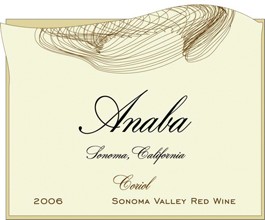
Hinting at raspberries and white pepper, the 2006 Coriol Sonoma Valley Red ($28) is more winning for its warming, soft palate than for big fruit besides ephemeral hickory-smoked dried apples and raspberries. The complex, warm earthiness makes sense: the Rhône varietal grapes come from a hot pocket in southern Sonoma Valley and a cool stretch at the north. Precious few cases of the 2008 Sonoma Rosé ($18) were made, but a taste of fresh watermelon, raspberry and Greek yogurt can be arranged if one asks extra nicelike.

With the wind in my heart and the wine in my head, I retraced my steps to the gravel parking lot out back, and stopped short. There it was, the fine southern Sonoma view of verdant vineyards climbing the skirts of blond-domed hills, framed by palm trees swaying in the anabatic wind. And it was good.

Bargain bottle alert: Currently there’s an absolute fire sale on the remaining Castle wines. For information go to www.castlevineyards.com.

Anaba Wines, 60 Bonneau Road (at Arnold Drive), Sonoma. Open daily, 10:30am to 5pm. Tasting fee $10. 707.996.4188.


View All

New’n & Notable

David Lear and the Rep go way beyond normal with giddy goth-punk ‘Midsummers’

By David Templeton

I’ve seen at least a dozen productions of Midsummer Night’s Dream, performed every which way you can imagine. I’ve seen the show staged as if by a bunch of bored circus performers, I’ve seen it staged as a Victorian dreamscape, all floating beds and doors opening onto mysterious night skies. I’ve seen modern-dress productions with kids on rollerskates and actors arriving on stage in VW buses. I’ve seen it staged as written, with the actors decked out in Athenian robes and wreaths of laurel in their hair. Until last weekend, I’d have said I’ve seen the Bard’s best-beloved comedy performed every way imaginable, but I have to admit, I’ve never seen anything like the Midsummer Night’s Dream currently running as the opener of Sonoma County Repertory Theater’s annual Sebastopol Shakespeare Festival. Running outdoors through July 26 at Sebastopol’s Ive’s Park, this production, directed by theatrical visionary and wild man David Lear, turns the show on its head, finding jokes and humor in the parts people usually play for drama, and injecting regular jolts of intensity, danger, and outright creepiness in moments usually just played for laughs. The show bears a striking visual style that defies description, but I’ll try. Think of it as Pagan-Goth-Punk with some dashes of ’70s arena rock.

Hansom (with plenty of hair)

0

lonely musician

Join Date: Mar 13, 2009

Posts: 1

im 26 a well known musician and need a quality woman


why is bieng a musician such a blessing and curse

every time i meet a woman they either intimidate by my presence orjealous that i know so many people

isint there a girl who wants 2 b treated like a queen

taken 2 the most beautiful places/people and music?

why is being rich at heart not good enough?

been asking theese questions 4 7 years now

+ still unhappy

happy in my life right where i want 2 b

teaching children,freeing minds,creating musicians

just missing that love

so heres what i can tell u

i have no house(buy choice)

i travel the west coast playing/producing/promoting music

im at a show about 6 days a week

dont have alot of money but dont need it

u probably know me or have seen me

i have a lot of hair(very hansom)

love children

and free

if your still interested please respond

because im a well know musician i have 2 keep who i am a secret

untill i trust u

thanx

ps …..sorry bout the spelling im in a hurry

Coffee Futures

0

07.15.09

French roast. Dark roast. Burnt. Smoky. Charcoal. White mocha. Venti latte. Extra caramel macchiato.

What the hell happened to the coffee?

In an industry dominated by sugary sweet drinks, small cafes and roasters have taken their love of coffee back to the basics. Starting with carefully selected coffee crops, various roasters now spend countless hours formulating the perfect roast for their beans. In order to best display all the characteristics of a bean, more roasters find themselves roasting lighter, a huge departure from the extra-dark French roast that still dominates the coffee world.

The French method of roasting, the darkest on the spectrum, started in Southern France with the discovery that double roasting eliminated all the negative characteristics in even the poorest grade coffee. This allowed for a more palatable, smoky-charcoal flavor present in all French roast coffees today. But all that’s beginning to change.

Beyond the roast, cafes now use more effective brewing techniques to showcase all the complexities of a coffee within a single cup, primarily with a French press, which does not use a paper filter. Without the filter, the oils and flavors stay intact, leaving a richer, more balanced, paper-free taste.

This simple yet effective brewing technique remains the closest process to a professional coffee “cupping.” At a cupping, hot water is poured over coarse grounds. After the grounds form a crust, the taster breaks the crusts, smells the aroma and sifts the crust off with a spoon. The taster then slurps the coffee in spoonfuls, getting a complete, unfiltered appreciation of the coffee and all its characteristics.

The French press only deviates from this method with its metal-mesh filter. Small amounts of sediment do reach the cup with this brew method, but that remains its only downfall. Glass French presses work well for personal use, but the insulation and durability of the stainless steel Bodum press makes it adored by cafes and coffee lovers.

The Clover, used by Ritual Roasters and found in select Starbucks, is an $11,000 machine that brews cups of coffee individually. This high-tech, paper-free method takes a small amount of grounds, variable to the type of coffee, and uses hot water and vacuum power to essentially create a French press brew, without any sediment or mess. The brew time adjusts to the type of bean as well, allowing the user the control to brew a perfect cup.

While Local 123 in Berkeley still uses paper filters, owners Katy Wafle and Frieda Hoffman have set a new standard in freshness and choice. Customers have the option of four different single-origin coffees. Upon order, the coffee of choice brews before the customer. This creates an intimate, interactive and conversational process Wafle and Hoffman call a “pour-over.”

During the pour-over, a precise amount of coffee is freshly ground into a paper cone, and the cone is placed above a cup. Hot water is poured through the filter and into the cup before the customer’s eyes. “It gives us an opportunity to engage the customer and take them from fragrance to aroma, and have them experience the coffee,” Wafle explains. Since each cup of coffee is made to order, virtually no waste is created. Wafle and Hoffman have also eliminated syrups and sweeteners from their cafe, which prevents customers from hiding their coffee behind sugar.

Cafe Noto in Windsor does something very similar called a Brew Bar. Just like Local 123, they offer options of single-origin coffees as well as blends, which they brew through unbleached paper filters upon order. “It gives more antioxidants,” manager Jen Leytem explains. These filters still absorb some oils and in turn some flavor but prevent more of the papery taste found in bleached filtration.

Of course, the brewing system also relies on the coffees it brews. Roasters are now choosing beans more selectively. As opposed to buying a variety of beans within a country, roasters seek out specific crops within countries for their individual characteristics, just like terroir informs wine. The term “single-origin farm” is being used to speak to a crop’s uniqueness.

For example, a Panamanian coffee crop from the Elida Estate holds notes of lemon, verbena and green apple, while a Panamanian crop from the Don Pepe Farm reveals notes of cocoa and plum. Instead of associating a crop with its country of origin, growers and roasters have become very specific to farm and sometimes the particular lot within a farm; microclimates within a farm have a huge impact on the variation of flavor and characteristics in a coffee.

Though the convenience of Starbucks and Peet’s cannot be replicated by a small, high-quality, sustainable cafes, there are some alternatives worth exploring in the North Bay. Here exist complex coffees that can stand alone without sugar, vanilla, cream and cocoa. The future of coffee looks a little lighter and a little brighter.

Hot Stuff

Cafe Noto(single cup brew, single-origin coffee) 630 McClelland Drive, Windsor; 707.836.1830. www.cafenoto.com.

Flying Goat Coffee(French press, light roast coffee, single origin whole bean and espresso) 324 Center St., Healdsburg; 707.433.3599. 419 Center St., Healdsburg; 707.433.8003. 10 Fourth St., Santa Rosa; 707.575.1202. www.flyinggoatcoffee.com.

Ritual Roasters(French press, light roast coffee, single origin whole bean and espresso) In the Oxbow Public Market, 610 First St., Napa; 707.253.1190. www.ritualroasters.com.

Taylor Maid Farms(single-origin coffee, medium roast coffee) Available in bulk at most fine markets. Their outlet store only serves samples and those are made in auto-brew machines. 7190 Keating Ave., Sebastopol; 707.824.9110. www.taylormaidfarms.com.

 

Quick dining snapshots by Bohemian staffers.

Winery news and reviews.

Food-related comings and goings, openings and closings, and other essays for those who love the kitchen and what it produces.

Recipes for food that you can actually make.

Young Classics

0

07.15.09

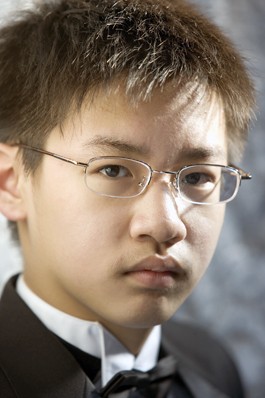
Performing beside a dreamily lit stack of oak wine barrels last July, classical pianist Conrad Tao embodied the true spirit of Napa Valley’s annual Festival del Sole: world-class music set among the North Bay’s most picturesque locales. But unlike the small private audience that gathered to watch him in Calistoga Ranch’s wine caves, this virtuosic performer couldn’t partake in the festival’s winetastings and events. Tao was only 13 at the time.

Like the accomplished adolescent performer, the festival itself is impressive in its youth. Founded in 2006, by former pianist Barrett Wissman with performing-arts attorney Richard Walker, Festival del Sole combines classical music with Napa wines, five-star cuisine and such spectacular venues as castles and cellars. This year’s lineup includes classical-music superstars soprano Renée Fleming and violinist Sarah Chang, and actor Robert Redford. It also welcomes Tao back for the third time.

“I always look forward to the festival,” Tao says, now a worldly 14. “It’s such a gorgeous place to be and a wonderful place to make music.”Tao’s first performance at Festival del Sole was the stuff of musical biopics. When a headlining pianist canceled due to illness a week before his scheduled performance, festival organizers had to frantically find a replacement to perform Prokofiev’s challenging Piano Concerto no. 3. Luckily for Tao and for the festival, someone had seen him play the Prokofiev piece earlier that year at the Juilliard Concerto Competition and suggested that they call up the young pianist.

When his manager first called him, Tao wasn’t sure if he had enough time to prepare. Although he only had a week, Tao understood that this performance could be a career-making one. After 10 minutes of thought, he called his manager back and agreed to perform.

Besides limited rehearsal time, the practically unknown Tao faced some skepticism among certain festival organizers. Festival director and cofounder Walker remembers some who doubted whether such a young person could have both the technical proficiency and the adequate emotional maturity to handle the intensity of Prokofiev. Tao proved them wrong.

“He came and blew everybody away,” Walker says. “It was a discovery for us. He’s sensational.”

Though Tao has been giving public piano recitals since he was four, the Festival del Sole served as a kind of grand coming out party for his musical career. He played alongside the Russian Philharmonic Orchestra and got to meet famed violinist Joshua Bell. Since then, his career has taken off, featuring performances with the San Francisco Symphony Orchestra, the Fort Worth Symphony and the Verbier Festival in Switzerland and, most recently, at the Ravinia Festival in Chicago. He’s also an award-winning violinist and composer.

Reviewers have wondered if Tao has bionic hands and often comment on the depth of expression and emotional force of his performances. For Tao, it’s just what he does.

“I just end up doing what comes naturally,” Tao says. “Most people take what I do naturally and view it as mature or intense. For me, the most important thing is to take the heart and soul of music and express it the best I can.”

One might expect someone so young and accomplished to embody some of the unfortunate stereotypes of child stardom: obsession, single-mindedness and isolation. But not so, according to Walker.

“He is a great kid who is also a normal kid,” Walker says. “He’s not someone living in a bubble. “

Tao has played all over the world with legendary performers and conductors, but he is also someone young people can relate to. For Walker, this makes Tao a perfect performer for Festival del Sole, which endeavors to make classical music more accessible. The festival donates tickets to youth groups, hosts a free young artists series, and prides itself on the amount of artist and audience interaction.

Tao performs at the festival’s opening night gala on July 18 on a slate with Chang and pianist Andrew von Oeyen. Following the performances, Palmaz Vineyards hosts a twilight dinner on the terrace overlooking Napa Valley. Like most 14-year-olds who aren’t world-renowned musicians, Tao will have to wait a few years before even sipping the Cabernet Sauvignon.

The Festival del Sole lights up July 17&–25 at various locations. Free&–$125. For a complete schedule and ticket information, visit www.festivaldelsole.com, call 888.337.6272 or email in**@*****pa.org.


Him talk dirty sometimes

0

07.15.09

In the spirit of Lenny Bruce, his irrepressible muse and mentor, Paul Krassner has been talking dirty and influencing people for more than half a century. Unlike Bruce, he’s never been arrested and jailed for obscenity, and unlike Bruce, who died of a heroin overdose, he’s well into his 70s. He continues to talk dirty and he continues to be adored by the likes of Arianna Huffington, who wrote the preface for his latest collection, Who’s to Say What’s Obscene? Politics, Culture and Comedy in America Today (City Lights; $16.95). He appears July 18 in Napa.

All of the essays in Krassner’s new book have been published before—in High Times, The Huffington Post, The Nation and The L.A. Weekly—but they all read as though they were written yesterday. That’s because Krassner is always shocking, always provocative and for all his shenagigans, amazingly serious about the pornography of power and the obscenity of war (as well as Somali pirates and piracy on the web).

A standup comedian since the 1950s, and the founding editor of The Realist, the satirical magazine that gave birth to the underground press of the 1960s, Krassner isn’t afraid to make fun of anything or any one. I’ve known Krassner since 1970, when he published an article of mine in The Realist that spoofed Timothy Leary and Eldridge Cleaver. It was Krassner’s talent then to treat those two gods of the counterculture as irreverently as he treated the politicians in the White House and the generals into the Pentagon. A sycophant he never was. Today, his comedic spirit goes marching on in the guise of Jon Stewart and Stephen Colbert.

Who’s to Say What’s Obscene? offers a romp through the annals of American humor. Krassner has known most of the great 20th-century comedians, including Lenny Bruce, Mort Sahl, Richard Pryor and Chris Rock. In these pages, he pours out the funny stories about them that he’s saved up for years; whether they’re true or not is another story. As Norman Mailer points out in an article that’s reprinted here, Krassner has a knack for outrageous embellishment in the manner of Jonathan Swift’s Modest Proposal. Krassner, as Huffington asserts in her laudatory foreword, belongs in Swift’s “savory tradition.”

Krassner is also funny in person and his gravelly voice fills a room. It seems fitting that after a lifetime of making fun of back-room deals and of alcohol, too, he’s appearing in Napa at Back Room Wines. He’s as irreverent about himself as anyone else.

Paul Krassner reads from Who’s to Say What’s Obscene? at Back Room Wines on Saturday, July 18. 1000 Main St., entrance on First Street, Napa. 5pm. Free. 707.226.1378.


Museums and gallery notes.

Reviews of new book releases.

Reviews and previews of new plays, operas and symphony performances.

Reviews and previews of new dance performances and events.

Flush Not

07.15.09

Decades ago, North Bay toilet-flushing etiquette was revised to accommodate a severe water shortage. As the next shortage approaches, evolving etiquette says don’t even think about flushing drugs down the can. They will not really go away. The water supply is already diminishing under increasing demands, so the concentration level of pharmaceuticals is rising. Meds in the waterways have contributed to genetic aberrations in water organisms.

Some of us remember this political cartoon: two trout are underwater below a discharge pipe labeled “Rx waste.” One trout says to the other, “The Viagra in the water is making me want to swim upstream, but the Prozac is making me too tired.” Laughter here should be of the nervous sort.

The tricky thing about all the free pharmaceuticals we’re getting in our water is not being able to choose which drugs we want and how much we want to absorb. Ask any frog about what full immersion in untreated public waterways is like, and he or she will point a webbed finger at some nearby offspring with hermaphroditic organs. George Washington could never have predicted when he crossed the Potomac that one day the waterway would contain such high concentrations of pharmaceutical compounds that a new American bass now swims under the boats there—the “intersex” fish—males bearing eggs.

An estimated 40 million people in this country are drinking water contaminated by trace amounts of chemical goodies from anti-seizure medication to psychotropic drugs. Whether it gets passed first through someone’s urinary tract or whether it gets dumped directly in pill, powder, liquid or capsule form from one of those ubiquitous plastic containers with the child-proof caps, drugs go into the water we will be drinking later.

The most sophisticated water-treatment facility is not capable of removing all traces of drugs from the water because many of the chemical compounds are not broken down during treatment and are thus often released back into the waterways. That water eventually gets back to the tap—or even to that bottle of water with the misleading label and the extra dose of mystery chemicals from the plastic.

Bummer. But don’t reach for the antidepressants yet—there’s more. The global pharmaceutical market is expected to reach $930 billion in three years. A lot less funny than cartoon trout on Prozac is the reality of uncounted species from trout to children exposed to cell-changing drugs in waterways. Weird stuff flushed into waters is stirring up a witch’s brew everywhere. Of 38 samples of wastewater analyzed in France last year, 31 demonstrated the ability to mutate genes. Eighty percent of 139 waterways sampled in the United States contained pharmaceutical compounds.

In this country, an estimated 250 million pounds of pharmaceuticals get flushed each year by medical facilities. The EPA belatedly named pharmaceuticals a pollutant of concern, but nobody goes out and checks the concoctions.

In a country where at this writing billions of dollars are being spent to defeat healthcare reform of any sort, one cannot expect drug companies to pay for environmental damages.

But up north where there is medical coverage for all citizens, pharmaceutical companies are being forced by law to clean up after themselves and pay for the pollution caused by the products they manufacture.

In western Canada, legislation cuts into the profits of pharmaceutical companies by placing the burden back on the manufacturers. There, drug companies have to take back and pay for the proper disposal of unused pharmaceuticals.

Until Americans can accomplish such a legislative feat, citizens can at least keep their old medicines out of the toilet and the waterways by delivering them to a drop-off site. For a list of drop-off sites in Sonoma County, go to www.scwa.ca.gov-projects-safe_meds.php.

For locations in Napa County, call 707.258.6000; and for locations in Marin, go to www.co.marin.ca.us-depts-CD-main-comdev-ehs-waste-sharps_drop-off__locations.cfm. And make sure you ask your favorite hospital, hospice worker, nursing facility or clinic how they dispose of old medicines.


Those Fighting ’60s

0

07.15.09

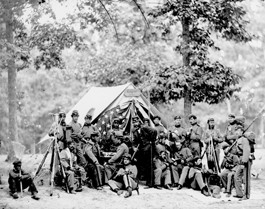
The Civil War is alive and literally booming in the pastoral burg of Duncans Mills. Civil War Days, one of the largest reenactments of the war west of the Mississippi, celebrates its 10th anniversary July 18–19 in the fields outside of town, currently being transformed into the Virginia battlefields of 1863.

Evidently, a strong physical resemblance between Virginia and Duncan Mills evokes the perfect setting for a Civil War reenactment. “The town’s isolation helps spectators pass easily from 2009 to 1863 because there are very few modern contrivances that meet the eye,” says Gary Amari, founding director of the event. Three encampments for public interaction occupy the site: two for Federal and Confederate troops and one for civilians that were displaced during the war. “Our main purpose is to educate the public by having people go into the camps to experience the environment of the time,” Amari says. Nearly a thousand re-enactors attend and recreate large armies for the battles. “We don’t use live shells, but we do shoot off real gun powder in the cannons, so don’t bring very young children or your dogs, because it gets extremely loud,” Amari warns. “We recommend people to bring earplugs.”

Civil War Days was created in 2000 by the nonprofit California Historical Artillery Society (CHAS) as a fundraiser for its “Sponsor a Rescued Horse” program. Over 35 horses have been rescued from the auction block (read: slaughterhouse) after their careers at California race tracks ended, and now board at ranches in Salinas and at Cassini Ranch in Duncan Mills. “We do a unique Civil War impression of mounted artillery,” says Amari. “CHAS owns cannons and rolling stock—wagons, caissons and limbers, rolling ammunition chests used by cannoneers. We are as detailed as we can get, and use authentic tack, saddlery and uniforms.” Only 20 artillery horse teams exist in the United States, and CHAS owns four of them. “If we weren’t supporting these beautiful horses,” Amari says, “they would be turned into food. We’re doing something useful.”

Civil War Days runs Saturday–Sunday, July 18–19. Saturday, 9am to 5pm; Sunday, 9am to 3pm. Battles on Saturday at 1pm and 4pm; Sunday at 11am and 2pm. $5–$10; under five, free. Freeze Out Road, Duncans Mills. Parking is $5 per car. Cash only. 707.922.5901.


Museums and gallery notes.

Reviews of new book releases.

Reviews and previews of new plays, operas and symphony performances.

Reviews and previews of new dance performances and events.

Consider the Oyster

0

07.15.09

WATERY, GRAVE: The perceived decimation of native eel grass in the estero where Drakes Bay Family Farms raises oysters is among environmentalists’ concerns.

The past few years have seen tremendous back and forth between Drakes Bay Family Farms, a commercial operation within the confines of Point Reyes National Seashore, and environmental groups who want to keep the area a protected wilderness. A new chapter in the saga of fishing rights began this June when Sen. Dianne Feinstein sought to extend Drakes Bay Family Farms’ permit for an additional 10 years.

Feinstein attached a provision to the end of the Department of Interior Environmental Appropriations bill that would extend the Drakes Bay Farms’ lease at Drakes Estero, an estuary feeding into Drakes Bay, from 2011 to 2022.

Feinstein’s action comes on the tail of a recent report from the National Academy of Sciences (NAS), commissioned by Feinstein’s office, claiming that there is insufficient evidence to prove serious environmental harm caused by Drakes Bay Farms.

“The 10-year extension of the Drakes Bay Oyster Company’s lease will preserve 30 jobs at the last remaining oyster farm cannery in California, while making sure that the ecology of the estuary is protected,” Feinstein wrote in an email message issued from her office.

Despite these claims, the Save Drakes Bay Coalition, a collection of North Bay activists and such national advocacy groups as the Sierra Club, are protesting the move by Feinstein. The coalition’s greatest concern regards the possible implications of the rider for national parks across the country. According to Fred Smith, executive director of coalition member group West Marin Environmental Action Committee, the language inserted by Feinstein could have significant impact across the country.

“We’re unaware of another natural park wilderness area that has ever been undermined by Congress for the sake of a private business that does not enhance visitors’ experience,” Smith says. “This is going to encourage other private businesses with ‘sun-setting rights’ in wilderness areas to challenge wilderness designation.”

The bill itself does include language that prohibits the permit extension from acting as precedent for any other businesses in national parks besides Point Reyes. Feinstein defends her action by pointing to this provision of the rider.

For Smith, this means very little. “Just because it’s written out doesn’t make it true,” he says. “There’s nothing as far as I can tell that is legally binding in that language.”

Sen. Barbara Boxer has also endorsed the measure, but the Save Drakes Bay Coalition hopes to work with Congresswoman Lynn Woolsey, who has previously questioned the extension of the fishing permit. They are rallying their supporters to urge the congresswoman’s opposition. However, Woolsey’s support currently lies behind Feinstein and Boxer.

“I have always been committed to one simple principle: that I will never support any proposal that would allow oyster harvesting at the cost of harming the local ecosystem,” Woolsey wrote in a recent email to the Bohemian. “This legislation strikes a careful balance that will protect the beauty of Drakes Estero for years to come.” In the House vote, Woolsey supported the bill.

When the 1976 Point Reyes Wilderness Act designated the Drakes Estero area a “potential wilderness area,” Johnson’s Oysters had operated a farm there since 1940 and was given a permit to fish there for an additional 40 years. When Kevin Lunny, a third-generation West Marin rancher, bought the farm in 2005, the land lease still faced expiration in 2012.

Though he was not available for interview before press time, Lunny has long asserted the sustainable practices and environmental responsibility of his farm. Feinstein, too, has stated that the presence of an oyster farm actually improves the local ecosystem by restoring a native oyster population that existed prior—a claim to which Smith and the Save Drakes Bay Coalition argue there is little or no supporting evidence.

These positions on the environmental impact of the farm come after a long and heated history of debate, allegations and shifty science.A 2008 report conducted by the National Park Service claimed that oyster feces cause a buildup of harmful sediment, which in turn threaten the harbor seal population. That report has been much maligned for using faulty data and poor science. The recent NAS report stated the Park Service greatly overestimated the oyster farm’s effect on the seal population. However, nothing is entirely conclusive. The NAS will continue to carry out investigations on the effect of the farm this fall, and the Marine Mammal Commission will conduct its own independent review on the seal population.

The Environmental Appropriations bill also includes a 33 percent budget increase for the Environmental Protection Agency. For any environmentally concerned congressperson, that’s a hard bill to knock down.

Other than the actual environmental impact of the farm or the potential benefit of the larger bill, Smith sees Feinstein’s actions as simply bad policy.

“Considering that American support for the Wilderness Act is really broad-based across the country, I don’t believe this bill would pass as a standalone bill,” he says. “That they’re using a rider to bypass public process, that’s my key concern.”


Anaba Wines

David Lear and the Rep go way beyond normal with giddy goth-punk ‘Midsummers’

By David TempletonI’ve seen at least a dozen productions of Midsummer Night’s Dream, performed every which way you can imagine. I’ve seen the show staged as if by a bunch of bored circus performers, I’ve seen it staged as a Victorian dreamscape, all floating beds and doors opening onto mysterious night skies. I’ve seen modern-dress productions with kids on...

Hansom (with plenty of hair)

lonely musician Join Date: Mar 13, 2009 Posts: 1 im 26 a well known musician and need a quality womanwhy is bieng a musician such a blessing and curseevery time i meet a woman they either intimidate by my presence orjealous that i know so many peopleisint there a girl who wants...

Coffee Futures

07.15.09French roast. Dark roast. Burnt. Smoky. Charcoal. White mocha. Venti latte. Extra caramel macchiato. What the hell happened to the coffee?In an industry dominated by sugary sweet drinks, small cafes and roasters have taken their love of coffee back to the basics. Starting with carefully selected coffee crops, various roasters now spend countless hours formulating the perfect roast for...

Young Classics

07.15.09Performing beside a dreamily lit stack of oak wine barrels last July, classical pianist Conrad Tao embodied the true spirit of Napa Valley's annual Festival del Sole: world-class music set among the North Bay's most picturesque locales. But unlike the small private audience that gathered to watch him in Calistoga Ranch's wine caves, this virtuosic performer couldn't partake in...

Him talk dirty sometimes

07.15.09In the spirit of Lenny Bruce, his irrepressible muse and mentor, Paul Krassner has been talking dirty and influencing people for more than half a century. Unlike Bruce, he's never been arrested and jailed for obscenity, and unlike Bruce, who died of a heroin overdose, he's well into his 70s. He continues to talk dirty and he continues to...

Flush Not

07.15.09Decades ago, North Bay toilet-flushing etiquette was revised to accommodate a severe water shortage. As the next shortage approaches, evolving etiquette says don't even think about flushing drugs down the can. They will not really go away. The water supply is already diminishing under increasing demands, so the concentration level of pharmaceuticals is rising. Meds in the waterways have...

Those Fighting ’60s

07.15.09The Civil War is alive and literally booming in the pastoral burg of Duncans Mills. Civil War Days, one of the largest reenactments of the war west of the Mississippi, celebrates its 10th anniversary July 18–19 in the fields outside of town, currently being transformed into the Virginia battlefields of 1863. Evidently, a strong physical resemblance between Virginia and...

Consider the Oyster

07.15.09 WATERY, GRAVE: The perceived decimation of native eel grass in the estero where Drakes Bay Family Farms raises oysters is among environmentalists' concerns. The past few years have seen tremendous back and forth between Drakes Bay Family Farms, a commercial operation within the confines of Point Reyes National Seashore, and environmental groups who want to keep the area a protected...
11,084FansLike
4,446FollowersFollow
6,928FollowersFollow