Talking Pictures

0

Moby Deal

By David Templeton

In his ongoing quest for the ultimate post-film conversation, David Templeton takes a meeting with renowned Fortune columnist, corporate insider and novelist Stanley Bing to discuss Michael Moore’s entertaining new business-bashing documentary The Big One.

When Stanley Bing sat down last week to watch The Big One–Michael Moore’s fascinating new comedy-documentary about corporate greed in America–his initial response–as he explains it this morning–was somewhat, um, multi-leveled.

“I had a complicated reaction to it,” Bing admits, with a quick, matter-of-fact nod of his head. “I agreed with the politics of it, but I find Michael Moore himself to be somewhat problematic. I like his combination of extremely passionate, heartfelt, focused, and intelligent politics about corporate America, with which I agree 100 percent. What I find hard to take is the cult of personality that Michael Moore surrounds himself with. The movie is all about him, Michael Moore, and his goodness-in-the-face-of-evil.

“As much as I agree with what he says in the movie, I do find him to be a bit obnoxious,” he adds, then pauses an instant, as a tiptoeing technician– preparing for a radio interview Bing will give shortly– lays down cable beside us. After a moment of thought, Bing’s eyebrows raise and he says, “I really didn’t mean that to sound as harsh as it came out.”

In spite of it’s flaws, The Big One stands as among the most entertaining, provocative, and downright funny movies of the year so far. Kind of an “author/activist’s travelogue,” the film follows Moore–who previously brought us the groundbreaking Roger & Me–as he embarks on a cross-country book tour to promote his book popular Downsize This. Along the way, Moore alternates between playing working-class stand-up before throngs of faithful fans, and doing what he does best: invading corporate lobbies in an attempt to ask the CEO some difficult questions, mainly, “Why are you laying workers off at a time when you are enjoying record profits?”

“A very important question,” Bing agrees. “The thing that makes him so important as a social critic is that very few people are asking those questions right now. Most people are asking, ‘How can I get 15 percent on my investment instead of 12 percent?” He bursts into laughter, adding, “That’s the pervailing cultural question right now. And so Moore goes and makes an end run around the whole fatuous debate about investments and what’s a smart investment and all this other stuff, and he’s saying, ‘We’re destroying the fabric of American life so that we can keep this spiral of ever increasing profitability going. Maybe it’s time to ask if there isn’t perhaps a saner paradigm.’

“There is a wonderful, powerful naiveté underneath his work, because he expects better of capitalism. While a less idealistic person would say, ‘Well, this is America. We chew people up and spit them out. That’s what we do here.'”

Bing, in his long-running Big Biz humor column in Esquire and Fortune magazines, and now in his terrific new novel Lloyd: What Happened–A Novel of Business (Crown, 1998), deftly tackles many of the same issues that Moore does, though with a far lighter touch and a much different perspective.

The pseudonymous Stanley Bing is, in fact, Gil Schwartz, a senior V.P. of communications working within the belly of the beast at corporate giant CBS. In his new novel, best described as a board-room screwball comedy, Bing/Schwartz gives us Lloyd, a nice-enough mid-level executive saddled with the horrifying task of implementing his company’s downsizing, all in service of an impending merger affectionately known as “Moby Deal.” Lloyd’s comic attempts to retain some shred of his rapidly peeling morality–illustrated by delightfully off-the-wall, full color graphs and charts–is the heart of Bing’s loosely plotted but fast-paced, sharp and biting satire.

Like Moore, Bing takes offense at the way employees are treated by the very companies that benefit so greatly from their hard work and dedication.

“In this movie,” continues Bing, “I’m most fascinated and most interested by the view of the people of America that Moore shows, the visceral feeling you get of what it means to a person to have just lost their job–which is incredibly powerful and beautifully done. The points that he makes are trenchant and incredibly important, because I don’t believe that anyone else is really making them the way that he’s making them. When you see the actual faces of people–that woman that came up to him in the book store, and said that she’d just been laid off that day–corporations don’t see that.

“When they downsize, they don’t really think about that person.”

“How can they not?” I can’t help but ask . “How can a corporation not realize that the payroll checks are being cashed by real humans with real lives?”

“They know, but they don’t think about it,” Bing states. “There are a lot of rationalizations that businesses make. You may lay off thousands, but look! There are 80 thousand that you are safeguarding! They remind themselves that this is business, that you are doing it for the shareholders, whatever rationalization allows them to sleep at night. And they do sleep at night. Very well, in fact.

“I don’t think that it’s written in stone, though, that you have to do terrible things in order to serve your stockholders,” he laughs. “Doubling your profits every year, though, you probably have to do some pretty nasty things.”

Which brings us back to Lloyd.

“In an almost obverse way, a different way than Moore is looking at things, Lloyd is going at some of the same points,” Bing observes. “As Lloyd becomes more successful, it is necessary for him to become a worse person. And the actions that he is forced to take– both by his company but also by his desire to support his family and to be successful and to, you know, to live his life–these actions bounce back eternally and undermine whatever native goodness he might have. He’s tormented about the things he has to do.

“But not to the point where he would ever not do them.”

“He does come around … somewhat,” I point out, referring to Lloyd’s plan to harpoon Moby Deal in order to save his friends jobs. “And though he may be only fictional, I find his actions hopeful.”

“Lloyd finds a higher ethic, yes,” the author smiles. “The higher ethic that Lloyd decides to practice at that point is friendship. For Lloyd, friendship transcends greed. That’s about as good as it’s going to get at that level. In the end, though I wouldn’t say Lloyd suddenly ‘gets religion,’ but he does suddenly decide to do the right thing.”

Not that Michael Moore would ever see Lloyd as a hero, I suspect.

“I don’t know about that,” Bing retorts, happily. “I would hope that Michael Moore would see my picture of corporate America, and recognize it, and find the truth in it–and find my moral outrage to be equal to his.” With a final chuckle, he adds, “It’s just that he uses a bludgeon to express himself and I use a scalpel and a very fine tweezer.”

From the May 7-13, 1998 issue of the Sonoma County Independent.

© Metro Publishing Inc.

Full-time Teaching

0

F/T Job Wanted

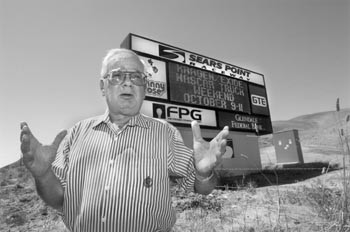
Making a fine point: SRJC history instructor and Academic Senate member Marty Bennett gathers support to back a bill hiring more full-time faculty.

Michael Amsler


SRJC instructors join statewide call for more full-time teaching positions

By Paula Harris

IT’S 5:30 A.M. as part-time Santa Rosa Junior College history instructor Alix Alixopulos edges his old Ford van (actually a traveling makeshift office–crammed with text books–that has logged more than 200,000 miles) onto freeway commuter traffic.

The longtime Sonoma County adjunct instructor and Santa Rosa resident spends tedious hours on Highway 101 shuttling between college campuses. He teaches morning classes in Pleasant Hill, beyond Vallejo, then drives back to Santa Rosa to teach afternoon and evening courses at SRJC.

Alixopulos, 57, a “freeway flyer” (the term used for traveling adjunct faculty) for about 13 years, calls his situation a form of migrant labor. He hates the instability and the commuting but tolerates the exhausting lifestyle because of his love for the work. Alixopulos longs for a full-time position, but, in his own words, “it’s never going to happen” because of the disparity between full- and part-time faculty positions at community colleges.

“[Administrators] would rather hire part-timers, or someone at the lower end of the pay scale,” says Alixopulos, who has 30 years’ teaching experience. “People like me get kind of trapped, but I teach because I love it.”

According to the California Federation of Teachers, two out of three faculty members in community colleges statewide are part-time employees. In the fall of 1997, the part-time instructors in California’s community colleges composed 43 percent of staff positions, a far cry from the 25 percent mandated by law 10 years ago. A December 1997 report by the state chancellor’s office found that only four of California’s 71 community college districts have achieved that goal–SRJC is in a three-way tie for the 16th ranking in the state for the highest percentage of hours of credit instruction taught by full-time faculty.

Typically, in a trend that’s being increasingly felt nationwide, employers are hiring part-timers as a cost-cutting measure. These faculty members are poorly paid, receive no benefits, and have little in the way of support.

“A part-timer is paid 62 percent of what a full-timer is paid in hourly assignments,” says Marty Bennett, an SRJC history instructor and a member of both the CFT and the American Association of University Professors. SRJC has 305 full-time faculty and 755 part-time instructors, he says.

In addition, tenured faculty are not being replaced when they depart or retire, leaving few instructors on the time-honored tenure track. Critics say the total effect undermines the teaching profession and erodes the overall quality of higher education.

However, there are some attempts to reverse this budget-driven trend. Last week, the SRJC Academic Senate, which represents the faculty, unanimously passed a resolution recommending that the college commit an annual portion of its budget to increasing the ratio of full-time to part-time faculty by at least 20 percent over the next five years.

The Academic Senate also voted to create a resolution on giving pro-rata pay to adjunct faculty.

Bennett says some SRJC departments, such as computer information sciences, English, and English as a second language, are seriously hurt by the imbalance. “We envision having a task force to look at needs of particular departments on campus,” says Bennett.

The move by SRJC is tied to the statewide effort to boost staffing levels. A number of legislative bills seek to create 2,000 new full-time faculty community college positions annually for five years. Other bills would create a permanent budget category to fund full-time jobs and would require part-time faculty to be compensated at a salary of a full-time faculty member with comparable training and experience.

ON MONDAY, a rally in Sacramento sponsored by the CFT and co-sponsored by the state Academic Senate, the California Teachers Association, and the Faculty Association for California Community Colleges underscored the situation.

“There’s a great need for change,” says rally organizer Tom Tyner, president of the Community College Council of the CFT, during a telephone interview from his Fresno office.

“Part-time staff are at a great disadvantage, and the majority are not choosing to work part-time, but they have no option. It’s the only avenue into community college teaching right now.”

Critics say the overreliance on temporary part-time faculty is detrimental to students. Through no fault of their own, part-time faculty are not as accessible on campus, are less available for mentoring, and have little say in the decision-making at the college. “Now most of my energies are spent commuting,” says Alixopulos, adding that there’s little time left to plan classes.

“You’re reduced to what you can do without too much preparation.”

Tyner says such hiring practices send a negative message to students. “They see the hypocrisy and irony of our educating and training them for gainful full-time employment while using primarily part-time employees. It’s exploitation,” concludes Tyner, who likens the situation to the United Parcel Service’s strike last August when part-time UPS workers made a compelling case that garnered widespread public support.

“We’re hopeful that the legislative route will be successful. If not, there are other alternatives for us to pursue like the UPS workers did,” says Tyner, adding that a strike is definitely a possibility. “When you have over 30,000 part-time faculty throughout the state, you have the numbers to shut the entire system down if the situation gets desperate enough,” he warns.

He says the money is available to create the jobs through legislation, but that the public needs to be made aware of the situation. “Any support we can get at the local level filters up to the state level,” he says.

“Ultimately it will depend upon public concern and financing from state and local levels.”

Meantime, Alixopulos and thousands of other freeway flyers continue to take to the roads to pursue their dream of academia. “Most part-timers would give anything to be able to work full-time,” he says. “Teaching isn’t a hobby for us.”

From the May 7-13, 1998 issue of the Sonoma County Independent.

© Metro Publishing Inc.

Spins

0

American Classic

James Michin III


John Fahey CD sets the record straight

John Fahey
America
(Takoma/Fantasy)

IN 1971, John Fahey released the single LP America that many consider a masterpiece–a classic example of solo acoustic guitar from the man who defined the instrumental folk genre. Unfortunately, only about half of the original work made it onto vinyl because someone convinced the guitarist that a double album wouldn’t sell. Now. thanks to the ability of digital technology to squeeze lots of info onto a single shiny CD, Fahey fans for the first time get to hear this landmark work in its entirety (actually, two minutes were cut since current CDs can hold only about 79 minutes of music).

It’s a real treat.

The reissue is rapturous in its beauty–a majestic, spacious work as grand in its deceptive simplicity as the early American landscape from which it draws inspiration. This new version features nine additional songs that were meant to make up the first LP of the ill-fated two-record set, including inventive recastings of American hymns, gospel, and folk songs; a cover of country blues legend Skip James’ “Special Rider Blues”; a breathtaking arrangement of the third movement from Dvorak’s Eighth Symphony; and the lost masterworks “America” (thought to be the only recording of Fahey playing a 12-string guitar) and the 11-minute mini-opus “Dalhart, Texas, 1967.”

Considering that this brilliant Maryland guitarist rarely records or performs anymore–beset by a deep depression and inner demons–and is seldom able to attain the same level of virtuosity when he does, this release is all the more welcome.
Greg Cahill

Fastball
All The Pain Money Can Buy
(Hollywood)

THE LEAD SONG and modern-rock radio hit “The Way” begins with the static sounds of a radio straining to lock onto a weak broadcast signal while the opening verse unfolds. By the second verse, the band kicks in as you’re transported to rock-radio heaven on this Tex-Mex-styled tale of an older couple who set out in an RV for a family reunion, but never make it. And so it goes throughout this young Texas trio’s sophomore album of quirky, guitar-fueled songs, which achieve both a classic rock and a thoroughly modern vibe at once. With nary a dud among the 13 tunes, influences leap out of the shadows, from Beatle-ish (“Got to Get You into My Life”) horns and Byrdsian guitars to Who-like drum flourishes and alternative legend Big Star-tinged harmonies. A cinch for cruising those upcoming hot summer days and nights.
TERRY HANSEN

Soulfly
Soulfly
(Roadrunner)

SINGER MAX Cavalera may have quit his job as frontman for the champion heavy-metal band Sepultura, but he hasn’t strayed far from their path. His last solo project, Nailbomb, was daring and sample-oriented, but the eponymous debut disc from his new group Soulfly sometimes sounds like a carbon copy of Sepultura’s landmark 1996 disc Roots. That’s good news for fans of that band’s growling, snappy ferocity, as Soulfly echo Sepultura’s embrace of the crisp rhythms and deep tones of their native Brazil. But Cavalera almost misses the very thing that makes Sepultura’s minimalisn work: an undeniable and urgent sense of purpose. Hip-hoppers might say that he is keeping it real, just as rockers say his song remains the same.
KARL BYRN

Taj Mahal and the Hula Blues Band
Sacred Island
(Private Music)

OVER THE YEARS, singer and songwriter Taj Mahal has gone from blues purist to pop idol to blues purist to… . well, the name of his current outfit says it all. This adventurous tunesmith–and former Hawaii resident–has hitched a ride with veteran members of the International Messengers Band, laying down gentle island rhythms, reggae covers, calypso/blues hybrids, and some of the most scintillating after-hours jazz I’ve heard in ages. Occasionally Taj overreaches on this potpourri of sound–ironically, the album’s only straight-ahead Hawaiian number is a bit of clunker–but name another modern bluesman with his sense of exploration or downright funkiness.
G.C.

From the May 7-13, 1998 issue of the Sonoma County Independent.

© Metro Publishing Inc.
Robert Funk

Bible Belter


David Light

Da Funk: Jesus Seminar scholar Robert Funk is shaking up religious convention.

The Gospel according to Robert Funk

By Patrick Sullivan

ONCE UPON A TIME, Robert Funk was a teenage evangelist preaching to packed revival meetings. “I did that when I was starting out, sort of being a hotshot. I knew how to make people laugh, make them cry,” Funk recalls with a self-deprecating chuckle, voice tinged with regret. A lot has changed since those evangelical days.

Now, as he sits in his busy Santa Rosa offices, the bespectacled, white-haired Funk is preaching a new gospel … literally. The architect of a collaborative scholarly effort called the Jesus Seminar, Funk is the focus of a massive firestorm of controversy over the group’s radical reinterpretation of the heart of the New Testament.

Essentially, the Jesus Seminar places Jesus Christ under the scholarly microscope. The deeds and words of Jesus as portrayed in the gospels are collected and evaluated by experts from various fields in an effort to establish their historical authenticity. The results then have been published in the seminar’s 1995 bestseller The Five Gospels and in the newly released The Acts of Jesus (HarperSan Francisco; $35).

The shock waves generated by the final tallies have yet to quiet down. “We found that only 16 percent of the events we evaluated from the gospels were likely to be authentic,” says Funk, a distinguished biblical scholar.

Indeed, the portrait of Jesus that emerges from the two books is deeply at odds with Christian orthodoxy. Forget the miracles: Funk dismisses anything like the idea of Jesus walking on water or raising the dead. Even the cozy stable in Bethlehem is out; it seems Jesus was actually born in Nazareth. More seriously, the historical Jesus is portrayed by the Jesus Seminar as a charismatic iconoclast who attacked contemporary religious institutions and social mores with revolutionary zeal and biting humor.

Of course, scholarly challenges to religious doctrine are nothing new. Riven by uncertainty, fraying into fundamentalism, Christianity might seem to some to be an easy target. But Funk argues that the Jesus Seminar’s findings constitute an important new crisis for the faith.

“The rediscovery of who Jesus really was has powerful implications for the Christian tradition, for the institutions that grew out of this figure,” Funk says. “If we allow him to have something to say about those institutions, they’re going to suffer a new and sweeping reformation.”

THIS CONTROVERSIAL effort had its beginnings here in California in 1985, when Funk, troubled by religious doubts and hungry for truth, put out a call for scholars to come together to discuss biblical issues. He was pleasantly surprised to have 35 people show up to the first meeting.

“Nobody had ever inventoried all the words attributed to Jesus or collected all the stories told about him, so I wanted to do that first,” Funk says. “I guess I have the Tom Sawyer approach to painting fences. You have a big fence to paint, you get a bunch of people to help you paint it.”

The big question tackled by the Jesus Seminar concerned the origin of what we now accept as the standard accounts of the life of Jesus. The first written narrative gospel, the Gospel of Mark, wasn’t put down on paper until 50 years after the crucifixion. So how was information about these remarkable events transmitted across this half-century gap?

Circulated by word of mouth, subjected to reinterpretation and distortion, the discrete stories and sayings of Jesus were further shaped and augmented by Matthew, Mark, Luke, and John when the evangelists turned the tales into coherent narratives.

“They were told and retold and passed around as single anecdotes,” Funk says. “The same thing happens in the transmission of jokes today. We hear them and retell them and change them a little every time.”

The scholars of the Jesus Seminar attempted to evaluate how much truth survived by watching for anachronisms, historical inaccuracies, and narrative impossibilities. They also asked medical experts to help explain accounts of miraculous healing and came up with some surprising theories, including the notion that Jesus may have exercised his powerful charisma to cure what we would today consider psychosomatic afflictions.

To people of faith unsettled by all of these revelations, Funk offers his compassion. For decades, he has struggled to hold on to his own deeply held religious beliefs, and he knows how troubling it can be to see them slipping away. While he still considers himself a Christian, he also knows that every day new scientific discoveries punch holes in the old framework of belief.

“I have a very deep sympathy for those people who are losing their faith,” says Funk. “The myths that we live by have deep emotional roots–they’re wrapped around our hearts.”

Of course, not everyone accepts the Jesus Seminar’s findings. Critics argue that the portrayal of Jesus as an iconoclastic opponent of religious institutions is suspiciously close to exactly what the seminar might be expected to find–God in their own image. To that criticism, Funk replies with some heat. “Most people who criticize that way never stop to think that the same thing also applies to them,” he argues.

“The thing to do is to look at the actual evidence.”

But he also acknowledges that the uncertainty among religious scholars holds true even among his allies. No one is sure what Christianity will look like in the new millennium. “I know many of the theological leaders of the churches, and I know they’re at sea, as all of us are,” Funk says. “We’re about to cross a watershed of enormous significance. What’s on the other side is difficult to say.”

From the May 7-13, 1998 issue of the Sonoma County Independent.

© Metro Publishing Inc.
The Quilters

Sleepy Time

Quilters is nothing but existential bleakness.


‘Quilters’ prone to induce slumber

By Daedalus Howell

WARNING: Pacific Alliance Stage Company’s production of Molly Newman and Barbara Damashek’s Quilters may cause drowsiness. While viewing, avoid consuming sedatives or tranquilizers. After viewing, use caution when driving a motor vehicle or operating heavy machinery. Keep out of reach of theater critics.

Directed by Wendy McGlothlin Wisely, Quilters is the hodgepodge metaphysical travelogue of matriarchal colonist Sara (Elizabeth Benedict) and her progeny. Together, they traipse across a frontier America studded with hardships and sacrifices dutifully recorded in the blocky hieroglyphs of quilt squares. Add music, stir in schmaltzy revelations, give myriad nods to tradition, and Quilters is a joyously American and imminently marketable populist romp.

Yes, quilting is a valuable part of the American cultural milieu, an art form rife with its own symbolic vocabulary and systems that have spanned generations, but a prosaic mosaic of sketches stitched together with a gossamer thin plot line does not constitute an interesting production no matter how clever an analogy it is to its namesake.

Those with a penchant for quilts, sugar-coated American history, or zealot girl-power, however, will forgive this musical’s foibles and appreciate the talents behind it–indubitably doing their best with an inadequate script.

Fresh-faced, Bambi-eyed Hollie Martin plays kid sister Dana with a charming guilelessness apropos of the Brady Bunch’s pigtailed munchkin Cindy. In the course of one act, Dana–who eventually freezes to death–cradles an afflicted-looking cornhusk doll, pleads God to throw the on-switch for her menstruation, and dresses like Shirley Temple whenever “talent scout” is uttered (her tedious character arc warrants this last, trifling embellishment).

Martin’s ability to stave off a self-indemnifying smile while playing the naive Dana betokens a poker face carved from stone, and though she makes a noble attempt to inflate the flat role, her obvious talents only cram in its singular dimension.

The part of elder sister Lisa, admirably endured by Donna Turner, is also an uninspired wax dummy in the shape of a pioneer woman. Turner is one of the lucky ones, however, as she is allowed to drop the hayseed persona during her character’s brief tenure as an officious schoolmarm (throughout the production, the players speak in the grating, rough-hewn dialect of the pioneer era as though they used the Webster’s to jack the wagon ’cause the wheel was broke).

Benedict, Cindy Brillhart-True, Leslie Cook, Susan Lamb, and Kristen Greer also turn in performances that swell against the suture of their characters’ shoddy stitching. They sing and harmonize well and undoubtedly benefit from Wisely’s direction talents– but the show, as written, squanders their abilities.

Under the expert musical direction of bassist Tom Martin, the band does a damn fine job finessing the Andrew Lloyd Webber out of Damashek’s wannabe traditional bluegrass-folk score. Flanked by fiddle, mandolin, and clarinet virtuoso Gus Garelick and guitarist Carl Sokol, Martin proves an able bandleader with an impressive proclivity for airy musical interpretation.

Set designer Jeremy Hamm and light designer John Kelly forge a play area that so epitomizes existential bleakness that, were The Wasteland scribe T. S. Eliot to see it, he would chuck his Nobel Prize in the furnace from shame. Dominated by a barren, sparsely lit, gray backdrop with a low, jagged horizon line done up in fiery hues, Hamm’s set deftly underscores the alienation early settlers must have felt in America’s virgin terrain.

The wanderlust of Quilters’ characters may prove contagious by the close of the second act such that audience members may pioneer into the parking lot and go westward home.

The Quilters plays May 7 at 7:30 p.m., May 8-9 at 8, and May 10 at 2:30, at the Spreckels Performing Arts Center, 5409 Snyder Lane, Rohnert Park. Tickets are $8-$14. 707/584-1700.

From the May 7-13, 1998 issue of the Sonoma County Independent.

© Metro Publishing Inc.
Open-mike Poetry

Stand and Deliver


Michael Amsler

Syntax for sale: Open-mike poetry night at Actors’ Theatre.

Poetry night: An up-and-down world

By Marina Wolf

ALLITERATIVE swear words are fired from the stage like fusillades from an angry rifle. The 40-odd audience members, in attitudes ranging from beat nonchalance to literary ecstacy, absorb the spoken-word rant with easy aplomb. On stage, the young woman in the brown corduroy jacket is just warming up, hips rolling in time to her verbal jabs, a radiant mist of sweat emerging under the bright theater lights.

The new poetry slam night at Santa Rosa Actors’ Theatre, scheduled for the second Monday of each month, is going well. The leisurely open-mike period has set the tone as “rowdy casual,” and the shoot-from-the-hip energy of the poetry slam fits right in, pitting artists’ on-the-spot performances against each other for 10 bucks and the chance at advancing to the final “Grand Slam.”

Afterward, praise washes over the lobby like wine spilling out of a too-small paper cup.

Meanwhile, over in Sonoma, the butcher paper hangs thick and impenetrable over the windows of the former Tin Can Coffee Company. After more than two years of dispensing coffee and comfort to two groups of open-mike readers, the owner closed the doors and sold the space less than a couple of months ago to the local chain of Johnny’s Java.

Welcome to the world of open-mike readings: feast or famine, with no rhyme or reason. A couple of long- termers keep going, but a recent one-two punch of closure and relocation has shaken the followers of this noble institution, and suggests that it’s not as secure as could be.

Certainly if love of literature were enough, Gail D’Arcy would still be in business. She opened the Tin Can Coffee Company in 1996, and started the open-mike poetry reading first thing. She kept the coffee flowing, and even passed the hat. But the cost per square foot was too high. “You’ve got to have a situation where you can afford to do it … . In order to stay in business you have to break even,” she says. “The open mikes don’t do much to increase revenue.”

Revenue is invariably the reckoning point for new or low-traffic locations; noise is another, and almost as difficult to deal with. Writers are generally sensitive people, who want the attention of the audience on them, not the whooshing of the espresso machine. Owners just want to keep the business moving. The reading at Lucy’s Cafe in Sebastopol, which ran for three short months, came to an end over that very issue. As William Judd, the reading organizer, has it, the very first event was heavily punctuated by the workers doing dishes. He then suggested trying an after-hours session, but people not involved in the reading were still coming in. In the third session, Judd put his foot down and asked the servers to keep quiet, and the next week the owner called off the Sunday afternoon experiment, offering different times, all during working hours, or perhaps a rental fee, which Judd declined. (At press time Judd still had not found a replacement venue.)

Other cafes fare a little better. The Copperfield’s Cafe in Petaluma has had an open-mike reading hosted by Geri Di Giorno for about a year. Her involvement with the Petaluma Poetry Walk and other literary events pegs her as a prime candidate for facilitator fade–“I am looking for someone to take over the Copperfield’s reading,” she admits–but that the reading still happens is a testimony to her commitment in the face of indifference. “[Here] we are at the mercy of regular patrons and the machines,” she says ruefully. “We’re coming in to read poetry, and the owners are doing something to generate business.”

On the other hand, there is Sally Spittles, owner of the Willow Wood Market Cafe. Spittles has been hosting, and often participating in, monthly open-mike readings in the back of her Graton market for over two years. Based on the few coffee cups and many water glasses that stood on her tables at the end of the most recent gathering, she probably takes in just enough money from her readers to pay for the coffee grounds. But it’s not a problem.

“The building is already there, the business is already there–all we have to do is open the doors,” she says. “We don’t make any money off of it, but I don’t have any employees working then, either. So it’s negative income, but it’s not a financial burden.”

EVEN GIVEN IDEAL open-mike conditions–strong coffee, a good sound system, rent paid through the end of the year–veterans of the literary scene know that open mikes have always come and gone. The Russian River Writers’ Guild has been hosting open mikes for years at locations all over Santa Rosa and the west county: Garbo’s in Guerneville, Copperfield’s in Sebastopol, Johnny Otis’ now defunct nightclub, Mudd’s Cafe, Higher Grounds.

Clearly, keeping the readings going in one place is a challenge.

“It doesn’t bring much money in,” says 20-year guild member and poet David Bromige, veteran of many a reading. “Or perhaps it disrupts things too much for the other patrons… . I think poetry is a profound disturbance, so it draws profoundly disturbed persons sometimes. Maybe the other patrons just get up and go to another cafe.”

Psychiatric assessments aside, Bromige has a point. Open-mike poetry is not toe-tapping jazz. People do not pack the house for unknown writers. To sustain a reading, the owner or proxy has to be committed to the concept, and have a certain amount of largesse to offer as a business entity. Because when the crunch of running a business hits, readings are often the first things to go.

But open mikes never seem to fade away entirely. Bromige has been approached about organizing something at Incredible Records in Sebastopol, just next door to Lucy’s Cafe. Over in Sonoma, even while the displaced readers from Tin Can mourn the loss of their space, writing-support groups at the Writers’ Center offer free-write, followed by open reading, for a very reasonable session fee.

And those with their ears to the track can always find open mikes at community events and festivals.

No matter where or how long.

From the May 7-13, 1998 issue of the Sonoma County Independent.

© Metro Publishing Inc.
The Scoop

Cow-ardly Acts

BS on the air, in the rivers

By Bob Harris

SHOULD advertisers or major corporations be able to affect the news you hear, simply because they’re powerful? Obviously, no. Once you let people dictate the news for their own interests, it ain’t news anymore.

However, in Tampa, two investigative journalists, Steve Wilson and Jane Akre, are suing their former bosses at the local Fox TV affiliate. Why? Because, their suit claims, they were fired simply for doing their jobs too well. Evidently the duo wrote and produced a series of reports that would have upset somebody with pockets.

The reporters in question have a combined 44 years of experience, three Emmys, and a National Press Club Award. The people they’re suing work for Rupert Murdoch. Choose your side. The series they produced concerned a suspected cancer-promoting substance in the milk supply. The cause is apparently bovine growth hormone, a synthetic hormone that cranks up milk production. Many farmers say BGH burns out the cow, and although the FDA approved the stuff a few years ago, some highly reputable labcoats worry it might lead to cancer in people who drink the milk.

BGH is banned in Canada and most of the European Union, but it’s legal in the United States, where it’s made by Monsanto–the same chemical geniuses who brought you PCBs and Agent Orange. Both of which were supposedly safe as well.

Wilson and Akre’s series outlined the growing health concerns about the additive, the consequences of which, they discovered, are already swishing around inside every jug of milk in the state. Truth is an absolute defense in American libel law, so reporters who do their homework should have nothing to worry about, right?

However, before the story got on the air, a Monsanto attorney wrote an intimidating letter to the Fox higher-ups. So the lawsuit says that Fox management buckled instantly, forcing the reporters to do dozens of distorted rewrites in an effort to appease the giant chemlords. Eventually the story was killed, the reporters fired.

If you want to know more, the cool folks at FAIR (Fairness and Accuracy In Reporting) intend to follow the lawsuit in their monthly magazine, Extra!, and in their biweekly Extra! Update. If you’re concerned about the integrity of the news, check them out at http://www.fair.org/.

In addition, the reporters have placed the details of the case, including the lawsuit itself and supporting documents, on their website http://www.foxBGHsuit.com. The site also includes the reporters’ version of the TV series and the phonied-up rewrites the guys in the ties apparently tried to get them to do. If you want to know how interviews and sound bites can be subtly framed to change the meaning of a story, this is an instructive case study.

When surveyed, most Americans don’t want to drink BGH-produced milk. But thanks to Fox news executives, Tampa residents still don’t know exactly what they’re drinking. They have, however, learned a lot about house fires, car chases, and fashion trends on Oscar night.

If it doesn’t exist to provide useful information, there’s hardly any point to reporting the news. Then again, if you’ve seen a lot of TV news, you already know that hardly anybody does.

THIS ONE WAS PICKED out by the watchful eye of Wayne Grytting, who nobly devotes himself to chronicling what George Orwell called “Newspeak”: the twisted phrases and euphemisms created by politicians, corporations, and PR people to turn reality completely on its head.

You know the drill: armies calling sneak attacks “pre-emptive self-defense,” or politicians calling a tax increase “revenue enhancement.” Two decades ago, National Airlines even once called a plane crash “the involuntary conversion of a 727.”

Well, if you’re concerned about your drinking water, fear not, gentle reader. As Grytting notes, the state of Washington has found a way to completely eliminate an entire category of pollution with the stroke of a pen.

See, a bunch of dairy farms up there are fairly close to some major rivers, which means cow manure is apparently seeping right into the water supply. Yeesh. Granted, nature does dilute the stuff as it gurgles along the river, and cities do have treatment plants. But some folks are still worried that there might just still be a little more cow in their water than there ought to be.

Which means if you’re a legislator, you gotta test and find out, and then if it’s true, you gotta write some laws or do a cleanup or build new treatment plants, and you probably also need to hassle with the dairy people … and really, with all the money a politician needs to raise just to keep the darn job anymore, who in a legislature has that kind of time?

Fortunately, there was a solution: Senate Bill 6161. The Dairy Nutrient Management Bill simply deletes the phrase “dairy manure” from Washington state laws entirely, replacing it with the much happier-sounding “dairy nutrients,” which are defined as “any organic waste produced by … cows.”

The bill passed, by a vote of 97 to 1.

The only legislator who voted “against” was a former septic tank installer.

Who apparently knows a complete bunch of bull, uh, nutrient, when he sees it.

From the May 7-13, 1998 issue of the Sonoma County Independent.

© Metro Publishing Inc.
Ralph Metzner

0

Born Again


Lee Ballard

Cultivating the spirit: Ex-LSD guru-turned-transformative psychologist Ralph Metzner, a Sonoma resident, has published an updated version of his classic The Unfolding Self.

Legendary psychotherapist Ralph Metzner produces new incarnation of his classic volume on transformation and rebirth

By David Templeton

THERE IS A FAMILIAR painting hanging over Ralph Metzner’s living room couch. Instantly recognizable as one of visionary artist Susan Boulet’s most famous works, its striking image of a handsome Native American shaman wearing the ceremonial skin and head of a large gray wolf–or is the shaman transforming into the wolf before our eyes?–has been reproduced on postcards, prints, and posters around the world, decorating the dormitories and wooded sanctuaries of countless free-thinking neo-pagans and metaphysical adventurers across the globe.

What sets Metzner’s copy apart from all the others is that his Boulet is not a print.

“It’s the original,” he shyly confesses, a slight shrug rising and falling as he leads a tour through his art-filled, comfortably rambling house near downtown Sonoma. It is congruous with Metzner’s status as a central figure of the transformative consciousness movement that he would become the keeper of a painting that is arguably one of the better-known symbols of an expanding cultural acceptance of traditional, multi-ethnic, decidedly mystical spiritual systems.

After all, Metzner is responsible to a great degree for the mid-’60s burst of consciousness that started it all in the first place.

Such praise appears to embarrass Metzner, perhaps the humblest–certainly the least publicized–of that once-notorious human potential trio of Harvard professors that also includes Timothy Leary and Richard Alpert, aka Ram Dass. Now considered something of a psychedelic Holy Trinity, Metzner, Leary, and Alpert created a stir with their studies of LSD-induced spiritual experiences, and co-authored the classic book The Psychedelic Experience.

After leaving Harvard, each ventured his own way: Leary went underground, Alpert traveled to India, and Metzner, after years of practicing psychotherapy in a variety of settings during which he wrote numerous books–including the groundbreaking Opening to Inner Light in 1986–eventually settled in the Bay Area.

Metzner is a Distinguished Professor of Psychology at the California Institute of Integral Studies in San Francisco, where he has taught since 1975.

After years of working in relative solitude, Metzner has once again entered the public spotlight with the recent release of The Unfolding Self: Varieties of Transformative Experience (Origin Press; $14.95), an expanded and renamed edition of the long out-of-print Opening to Inner Light, which sold 10,000 copies in its original incarnation. Much has changed in the popular culture during the last 13 years. With the miraculous resurrection of Metzner’s sadly neglected book–an examination of 12 universal metaphors employed by the world’s many religions to describe the experience of spiritual transformation, with two new chapters and a spate of new illustrations–a whole new generation of scholars and seekers is suddenly taking notice of Metzner once again.

“I’m very happy,” Metzner succinctly states. “I’ve long wanted it be republished.”

RICH IN FOLKLORE and psychological insight, The Unfolding Self explores the obvious meanings and hidden meanings of those central metaphorical ideas we use to describe our most profound spiritual metamorphoses: stepping from darkness into light, for example, and the image of being set free from inner captivity, of dying and rebirth, of being cleansed in the heat of a purifying fire. The restored chapters treat the metaphors of integrating the inner wild animal, and unfolding the Tree of Life.

“The book is really about the idea of psycho-spiritual transformation,” Metzner summarizes, “and the way people experience it according to the classical traditions. The new chapters are the kind of ecological themes that have become much more central a part of my focus in the time since the book was written.”

A pivotal force in the book’s timely re-release is its publisher, Byron Belitsos of Origin Press. Something of a visionary himself, Belitsos is the founder of IntegralSpirit.com. An innovative web-magazine and on-line community dealing with issues of integral spirituality points of view, the site also sells books that deal with similar themes–several hundred thousand are listed–and is fast becoming known as an Amazon Book Service for the spiritual community.

Origin Press, Belitsos long-planned brainchild, has only just made its publishing debut, with the Metzner reissue as its first offering.

“Ralph is perfect for us, actually,” says Belitsos. “He’s brought a terrific amount of scientific thought and academic methodology to these very esoteric realms. People know Leary. They know Ram Dass. It’s time for Ralph Metzner to be known.

“I personally think he’ll end being considered the most important writer of the pack.”

Asked how he feels about being eternally grouped with–and compared to–Leary and Ram Dass, Metzner’s eyes light up. “I feel fine about it,” he smiles. “I was very close to them, I remained very close to Leary right up until his death, and I was with Ram Dass last night. We’re close friends. I feel very fortunate to have had two such great spirits, great beings, as my teachers, my friends, my mentors.”

Leary’s death of cancer, Metzner points out, and his publicly voiced intention of experiencing his own death as the ultimate trip, brought Leary a level of wide respect and admiration that he had been deprived of throughout his life. His fearless view of death as just another transformation may, in fact, have helped raise the nation’s consciousness in regard to its inability to deal with the notion of dying.

“Coming near to death is probably, from my experience, the trigger for the most profound kind of transformative experience,” Metzner softly remarks. “Whether it’s a near-death experience of the classical kind, where someone is in an accident and then moves out of their body, or through a loved one dying, either a child or a parent.”

Metzner has experienced such an event firsthand; his own son, Ari Krishna Metzner–to whom the book is dedicated–was killed in an accident in 1974.

“Sometimes,” he adds, “the transformation comes, as with Leary, in coming near to one’s own death in illness. People have been miraculously transformed through such experiences.”

Metzner’s work seems to suggest that there is a built-in desire to transform ourselves into better, or perhaps only different, human beings. “People do want transformative experiences,” he affirms. “We all desire personal growth and change. People go on vision quests in search of change. They involve themselves in various spiritual practices. It’s a very general, very human thing.

“[Healing specialist and author] Andrew Weil and others now say–and I agree with him–that healing is the natural capacity of the human organism, or any organism for that matter,” he muses, gazing up again at the painting of the shaman caught halfway between two versions of himself. “We are spiritual beings,” Metzner concludes.

“To seek a spiritual vision, to have a desire to experience spiritual healing, that is something that is inherent in every single individual.”

From the May 7-13, 1998 issue of the Sonoma County Independent.

© Metro Publishing Inc.

Short Reviews

Spring Gleaning

A potpourri of reads by local authors

SHOP LOCALLY and read whatever you like, but don’t pass over a chance to support local authors whenever possible. This season has something for everyone, from Bruce Henderson’s gripping true-life whodunnit Trace Evidence to a exhaustive travel guide for diehard tequila lovers. Enjoy. Synopses by Mary Bishop, Steve Bjerklie, Shelley Lawrence, Patrick Sullivan, David Templeton, and Marina Wolf.

Shoshana Alexander
Women’s Ventures, Women’s Visions
(Crossing Press; $14.95)

“MMM, GIRL, you oughta be sellin’ this!” Every woman who’s ever heard this enthusiastic comment, or something like it, has also heard the scared little rejoinder in her head two seconds later: I don’t know how. But there is no shortage of role models for would-be women business owners, as this Sebastopol author points out in her introduction to Women’s Ventures: we’re just lacking the old-girl network. This inspiring collection of first-person narratives from 29 women entrepreneurs offers a much needed link in that fledgling web. The stories come from a wide range of informants, from a new-mother caretaker in Atlanta, Ga., to award-winning TV producer Marcy Carsey. In this small book is information on financing, advertising, employing, living, all the more engaging because it doesn’t feel like advice, but quiet, friendly sharing of personal truth.
M.W.

Edwin C. Anderson Jr.
The Promise That Was America
(Self-Published; $21.95)

SANTA ROSA attorney Edwin Anderson here reveals the historical successes and failures of America. By delving into the lives of specific characters that range from George Washington to Lyndon Johnson and Robert NcNamara, Anderson invites us to reflect upon the past as well as the present and future. His book encourages us to take a serious look at ourselves and the way our country has evolved.
S.L.

James A. Autry and Stephen Mitchell
Real Power: Business Lessons from the Tao Te Ching
(Riverhead Books; $23.95)

THE FACT THAT “Dow” and “Tao” are pronounced exactly the same in English may or may not be the reason why Sonoma resident Stephen Mitchell, famed for making Genesis, Job, and Rilke accessible, and James Autry, a former Fortune 500 company executive, teamed up to find the pearls of business advice buried within Lao-tzu’s text of ancient Chinese wisdom, the Tao Te Ching. But no matter. This graceful, spare book (200 pages) elegantly describes how Lao-tzu’s sage advice reveal good business sense. “Can you coax your mind from its wandering and keep to the original oneness?” may not appear to have application in the boardroom or on the trading floor, but the authors find it: “People who are driven by crisis are letting circumstances define their lives instead of allowing all things to arise in the space in which work is performed.” Many such ancient/modern pearls are to be found here.
S.B.

George Bowering, Angela Bowering, David Bromige, and Michael Matthews
Piccolo Mondo
(Coach House Press; $35)

YOU CAN TAKE the boy out of Canada, but you can’t take Canada out of the boy, as Sonoma County transplant David Bromige proves in his collaborative coming-of-age novel set in 1961 Vancouver, B.C. In this semi-stream-of-consciousness production, four college students become ensnared in a web of Canadian government intrigue … ha-ha, Canadian intrigue, that’s an oxymoron, right? Well, if a brilliant flash of light at the edge of the night sky doesn’t grab you, check out Piccolo Mondo in its entirety at the Coach House Press website at www.chbooks.com/home.html. Remember to leave a tip.
M.W.


Lance Cutler The Tequila Lover’s Guide to Mexico: Everything There Is to Know About Tequila … Including How to Get There
(Wine Patrol Press; $16.95)

PART TRAVEL book and part love letter, this guide is a highly personal, brightly written romp through the land of the blue agave, the mythic plant from which all tequila blessings flow. Lance Cutler, a Sonoma-based author with a legendary wine cellar, uses the same wine-appreciation skills he’s honed for years as he takes his wife from one tequila distillery to another, pointing out nifty technical and historical facts, as well as giving tips on how to find the often-remote distilleries themselves, and where to find a bite to eat once you get there.
D.T.

Jack Fritscher
The Geography of Women: A Romantic Comedy
(Palm Drive Publishing; $9.95)

ERA IS AURA in lesbian-themed fiction, or at least it should be. A good piece of lesbian period fiction will make prevailing political and moral attitudes perfectly clear, but not overwhelming. By that standard, at least, The Geography of Women is a success, melding nuclear-age normalcy with small-town eccentrism. At their juncture in southern Illinois lives Laydia Spain O’Hara (say it out loud), a spunky tomboy. (Is there any other kind?) Fritscher has a talent for well-turned folk phrasing, no matter which way the character leans (Fritscher writes primarily gay male themes). And though the basic plot bears a striking resemblance to Fannie Flagg’s Fried Green Tomatoes, one is willing to forgive in the face of such exuberance.
M.W.

Kendall Haven
Bedtime Stories
(Storystreet; $5.95)

“AAHH, okey-dokey, boys, aahhh, a story, ummm … ” starts out Jimmy and Jason’s dorky dad each night. The twins are convinced that their father is quite possibly the nerdiest man alive, telling bedtime stories comparable to his status as such. But … was it possible that their dad’s stories could maybe … come true? As the stories get progressively spookier, join Jimmy, Jason, their dad, and their elementaryschool mates as local storyteller Kendall Haven–who has performed for more than 2 million children and 800,000 adults in 40 states–takes you through a walk of weirdness.
S.L.

Kendall Haven
Stepping Stones to Science: True Tales and Awesome Activities
Great Moments in Science: Experiments and Readers’ Theatre
(Libraries Unlimited; $22.50, $24)

AN ELEMENTARY-school teacher’s dream, Kendall Haven’s Stepping Stones to Science provides a fun, hands-on way for second- through fifth-graders to learn about science. Covering topics from physics to electricity to evolution, Haven’s storybook/workbook begins each section with an amusing anecdote, which is followed up with an experiment that can be performed by the students. Each section also includes “Topics to Talk About,” a short list of items that teachers can use to spark discussions among their students. All in all, a practical and entertaining way to break into the world of science. Haven’s Great Moments in Science is an intelligent sequel to Stepping Stones to Science. Aimed at students from grades 4 to 9, the book is a series of skits that can be acted out by students using thespian outlines of the glories of scientific stuff like genetics, rocketry, and chemistry, to begin with.

Haven’s skits provide a way for middle-school students to learn about science without feeling bored or patronized, and the books provide a helpful teacher’s guide to aid discussions.
S.L.

Bruce Henderson
Trace Evidence
(Simon & Schuster; $25)

CHILLING FICTION is what it reads like, but with a deft and compelling voice, Sebastopol author Bruce Henderson–best known for his bestseller And the Sea Will Tell–unravels a true-crime drama. Trace Evidence is the story of serial killer Ray Biondi, who stalked his prey along lonely highways of the West. By abducting, sexually assaulting, and strangling his victims in one jurisdiction and dumping their bodies in another, he created an investigative quagmire for detectives. Drawing on hours of exclusive interviews with key investigators and others–including the killer’s wife, who never spoke to authorities– Henderson bores into the psychological complexities of his characters with meticulous accuracy. The eerie case revealed here clearly illustrates how the disparate elements of rage, repression, and family dysfunction combine to create a killer. Trace Evidence is composed with Hitchcocksian precision. It’s stark, sharp, disturbing, and will haunt you for days.
M.B.

Christine Hunsicker, editor
A Dog’s World
(Traveler’s Tales; $12.95)

DO YOU FEEL like a class-A deserter as the Pathetic Puppy Eyes turn on you while you head out the door to, say, Bangladesh? Here is a collection of true stories that tell what happens when dog owners succumb to The Look, avoiding the subsequent guilt, and take their dogs along for the ride (or flight, as the case may be). This addition to the “Travelers’ Tales” series is an actual guidebook that provides maps to foreign lands in a series of heartwarming anecdotes involving dog-lovers (among them such noted authors as John Steinbeck, James Herriot, and Pico Iyer) and the dogs they love.
S.L.

Michele Anna Jordan
California Home Cooking: American Cooking in the California Style
(Harvard Common Press; $16.95)

FROM ALMONDS to zinfandel, Michele Anna Jordan takes her reader through a dazzling repertoire of over 400 recipes that are genuinely imbued with a taste of California. Jordan writes so passionately on the topic of California cuisine that it’s impossible not to get excited about her ninth cookbook. More than just a straight-ahead cookbook, it includes such vignettes as “Okie Burritos” and “Banana Flowers” that educate us about California’s history in a most palatable way. Jordan breathes such life and personality into her recipes that she’ll have even the novice cook running to the stove after page three. Reminding us of farmhouses and ranchos, and emphasizing casual contemporary fare, California Home Cooking wholeheartedly celebrates, just as we are so apt to do, the pleasures of the table.
S.L.

David E. Manley
A Root of Jesse
(Strawberry Hill Press; $14.95)

FROM THE PEN of Sonoma author David Manley comes this globe-trotting, autobiographical tale of three generations of family life. Drawing on memories and old letters, the author carefully charts his family’s unusual journey from life as missionaries in early 20th-century India to relocation in the rural Sonoma County of the 1940s. Along the way, Manley offers vivid snapshots of his grandfather, a fiercely proud German missionary with relentless evangelical zeal; his mother, a beautiful flapper dramatically out of place in colonial India; and World War II-era Healdsburg at a time when “Los Angeles seemed as distant as New York City.”
P.S.

Lloyd Pedersen
The Vintage
(Joyce and Co.; $26)

THE NORTHERN California wine country plays host to this first novel by Sebastopol author Lloyd Pedersen. The Vintage follows the stormy fortunes of the proud but bitterly divided Morello wine dynasty as the family grapples with passion, politics, and intrigue after the end of Prohibition. The retired author draws on his decades of experience working with the U.S. Treasury Department as an inspector in the wine industry to add to this sprawling epic. Perhaps not surprisingly, a government agent figures prominently in the novel, as he squares off against the family’s unscrupulous patriarch, Uncle Louie.
P.S.

Rayford Clayton Reddell
Miniature Roses
(Chronicle Books; $14.95)

RAY REDDELL brings his love of miniature roses to light with this charming book. An expert caretaker of his more than 8,000 personal rosebushes, Petaluman Reddell certainly knows his stuff when he advises his reader on planting techniques, the different possibilities of fertilizers, what to do when disease strikes your babies. Artfully illustrated by the award-winning photographs of Saxon Holt, Miniature Roses will have the reader wondering how it was possible to go all of those years without knowing how to properly tend such species as “Hot Tamale,” “Party Girl,” and “King Tut.”
D.T.

Patricia Lynn Reilly
Be Full of Yourself! The Journey from Self-Criticism to Self-Celebration
(Open Window Creations; $15)

THE COVER of Patricia Lynn Reilly’s nifty new book Be Full of Yourself! is elegantly simple, yet potent: a bright red apple posed against an ascending backdrop of rich, mysterious blue. It makes you hungry just looking at it, but what does it mean? When you examine the pages inside, you suddenly get the point: This is none other than Eve’s apple, womankind’s first great no-no in a long history of opportunities for knowledge and empowerment that have been denied to Eve’s sisters down through the ages. Based on Reilly’s celebrated traveling workshops called “The Journey from Self-Criticism to Self-Celebration,” the book is an examination and dismantling of the question most often asked by women in the workshops: “What is wrong with me?” The author of the best-selling A God Who Looks Like Me guides readers into the heart of this disempowering question, and out the other side with a bold, glorious answer that may end up changing brave women’s lives forever. Take a bite. We dare you.
D.T.

Sara Spaulding-Phillips and Trish McLean
Sacred Beginnings: Honoring the Goddess Within
(Imagin Publishing; $11.95)

QUESTIONS FOR a writer: What does it mean to toss a crown of flowers over the edge of a volcano? How does it feel to follow one’s thoughts and longings into the fiery abyss? Sara Spaulding-Phillips, a Santa Rosa writing teacher, visited Hawaii with an eagerly emotive group of writers. The group meditated and wrote in starts and leaps along the lines of Natalie Goldberg’s topic-based exercises, and the results of their journey are included in this book. If you’ve ever done this kind of writing work, you’ll have some idea of what lies within: lines that sear like lava, lyrics that taste of ashes, all written from a burning core of desire.
M.W.

From the May 7-13, 1998 issue of the Sonoma County Independent.

© Metro Publishing Inc.
Schug Wine

0

Passion Play


Michael Amsler

Family affair: Walter and Gertrude Schug have an abiding love for “European-style” wines.

Walter Schug has a thing for fine pinot noir

By Bob Johnson

FEW WINES of the 1970s compared in quality to the Insignia bottlings from Napa Valley’s Joseph Phelps Vineyards. The blend would change from year to year–a little more cabernet one year, a touch more merlot the next–but the resulting wines always were aromatic, rich, flavorful, and memorable.

Those legendary Insignia bottlings were crafted by Walter Schug, a native of Germany who grew up on a wine estate in the Rhein River Valley. Schug’s home was unique in that it was the only pinot noir estate in a region known for producing world-class riesling. Schug fell in love with pinot noir at an early age, and in 1959 moved to the United States in hopes of making his mark with pinot noir.

While making wines at Phelps, Schug gained experience with all the traditional Bordeaux grapes, produced highly touted blends of Insignia even in challenging vintages, and also gained a reputation for making fine riesling. Phelps’ wines were receiving worldwide recognition, and Schug’s star was rising.

Despite his success, however, Schug was not happy. “At Phelps,” he asserts, “I was making just about every kind of wine you could think of, except the kind I wanted to make: pinot noir. I insisted on making pinot noir, and literally had to leave my job in order to do it.”

He left Phelps in 1983, founded his own winery, and in 1991 moved the operation to Sonoma County’s Carneros appellation on the Napa border. “I admit that, in the beginning, we had to make a lot of chardonnay to pay for my ‘hobby,'” Schug recalls. “Back then, our production was about two-thirds chardonnay and one-third pinot noir. Today, it’s just the opposite, and all the growth we’ve enjoyed (from an initial 8,000 cases to 20,000 cases this year) can be credited to pinot noir.”

Why would an experienced winemaker with a worldwide reputation for making one of America’s great red wines chuck it all to concentrate on a varietal like pinot noir–a grape viewed by many vintners as “difficult” with which to work?

“I am interested in delicacy and finesse,” Schug explains, “and there is no wine that portrays those qualities better than pinot noir. True, knowing exactly when to pick pinot noir can be a challenge because the flavor components don’t always match up with the sugar levels. True, it’s a grape that requires special handling; it doesn’t like to be beat up. But harvested at the right time and handled gently, it can produce aromas and flavors unequaled in any other wine.”

Schug says he makes his wines in the European style, which may explain why, in the early years, he found it easier to sell his wares to people on the East Coast. “People in the East cut their teeth on European wines, especially French, and that’s the style we have been making from the beginning,” Schug says.

What is meant, exactly, by a “European” style?

“Every European winemaker, myself included, grew up believing that a wine should express both its varietal characteristics and its regional characteristics,” he says. “That means the wine should stand on its own, without the various winemaker embellishments, so the flavors of the fruit are foremost.”

That’s not to say that Schug is an opponent of oak barrels; in fact, more than 500 such barrels line the walls of the Schug Winery’s underground caves. He simply believes that oak should provide an enticing nuance to a wine, not a dominant flavor.

“We use only 15 to 20 percent new oak barrels each vintage, and store the rest of the wine in barrels that are anywhere from 2 to 6 years old,” Schug says. “We also use intermediate-sized cooperage [larger casks] to age some of our wine. In this way, we always end up with wines which are very fruit-forward and a true expression of where they came from.”

These days, more of Schug’s pinot noir grapes are coming from his own estate vineyard, near Highways 116 and 121 on Bonneau Road in Sonoma. He also purchases grapes from other vineyards, one of which dates back 40 years.

Schug always has viewed his winery as a family business. His wife, Gertrude, also comes from a winemaking family, and their son, Axel, hopes to one day carry on the family’s winemaking heritage. Meanwhile, Schug is content to finally be able to fulfill his lifelong dream of making world-class pinot noir. “This is our love and our hope,” he says earnestly. “It truly is a family business. It’s our life.”

The Wines

Schug 1996 Pinot Noir North Coast
Made entirely from Carneros grapes but so designated to differentiate it from the winery’s signature “Carneros” bottling. Light in structure but jammed with fruity flavors of raspberry and cherry, and a hint of spice. $14. Rating: 3 corks.

Schug 1996 Pinot Noir Carneros
“This is our bread and butter wine,” says Schug. “It possesses the structure and flavors people should expect from a bottle of Schug wine.” Those flavors include smoky berries and cherries, along with a rich earthiness that leads to a smooth, silky finish. Very French in style, and at $18, priced at about half of what you’d expect to pay for a comparable French Burgundy. Rating: 4 corks.

Schug 1995 Pinot Noir Heritage Reserve, Carneros
Rich and intense, with flavors of black cherry, vanilla, cassis, and tobacco. Not for the faint of heart. Will benefit by about five years of additional cellar aging. $30. Rating: 3.5 corks.

Wines are rated on a scale of 1 to 4 corks: 1 cork, commercially sound; 2 corks, good; 3 corks, excellent; 4 corks, world-class.

From the May 7-13, 1998 issue of the Sonoma County Independent.

© Metro Publishing Inc.

Talking Pictures

Moby DealBy David TempletonIn his ongoing quest for the ultimate post-film conversation, David Templeton takes a meeting with renowned Fortune columnist, corporate insider and novelist Stanley Bing to discuss Michael Moore's entertaining new business-bashing documentary The Big One. When Stanley Bing sat down last week to watch The Big One--Michael Moore's fascinating new comedy-documentary about corporate greed in America--his...

Full-time Teaching

F/T Job Wanted Making a fine point: SRJC history instructor and Academic Senate member Marty Bennett gathers support to back a bill hiring more full-time faculty. Michael Amsler SRJC instructors join statewide call for more full-time teaching positions By Paula Harris IT'S 5:30 A.M. as part-time Santa Rosa Junior College history instructor Alix Alixopulos...

Spins

American ClassicJames Michin IIIJohn Fahey CD sets the record straightJohn FaheyAmerica(Takoma/Fantasy)IN 1971, John Fahey released the single LP America that many consider a masterpiece--a classic example of solo acoustic guitar from the man who defined the instrumental folk genre. Unfortunately, only about half of the original work made it onto vinyl because someone convinced the guitarist that a double...

Robert Funk

Bible BelterDavid LightDa Funk: Jesus Seminar scholar Robert Funk is shaking up religious convention.The Gospel according to Robert FunkBy Patrick SullivanONCE UPON A TIME, Robert Funk was a teenage evangelist preaching to packed revival meetings. "I did that when I was starting out, sort of being a hotshot. I knew how to make people laugh, make them cry," Funk...

The Quilters

Sleepy TimeQuilters is nothing but existential bleakness.'Quilters' prone to induce slumberBy Daedalus HowellWARNING: Pacific Alliance Stage Company's production of Molly Newman and Barbara Damashek's Quilters may cause drowsiness. While viewing, avoid consuming sedatives or tranquilizers. After viewing, use caution when driving a motor vehicle or operating heavy machinery. Keep out of reach of theater critics.Directed by Wendy McGlothlin Wisely,...

Open-mike Poetry

Stand and DeliverMichael AmslerSyntax for sale: Open-mike poetry night at Actors' Theatre.Poetry night: An up-and-down worldBy Marina WolfALLITERATIVE swear words are fired from the stage like fusillades from an angry rifle. The 40-odd audience members, in attitudes ranging from beat nonchalance to literary ecstacy, absorb the spoken-word rant with easy aplomb. On stage, the young woman in the...

The Scoop

Cow-ardly Acts BS on the air, in the riversBy Bob HarrisSHOULD advertisers or major corporations be able to affect the news you hear, simply because they're powerful? Obviously, no. Once you let people dictate the news for their own interests, it ain't news anymore. However, in Tampa, two investigative journalists, Steve Wilson and Jane Akre, are suing their...

Ralph Metzner

Born AgainLee BallardCultivating the spirit: Ex-LSD guru-turned-transformative psychologist Ralph Metzner, a Sonoma resident, has published an updated version of his classic The Unfolding Self. Legendary psychotherapist Ralph Metzner produces new incarnation of his classic volume on transformation and rebirthBy David TempletonTHERE IS A FAMILIAR painting hanging over Ralph Metzner's living room couch. Instantly recognizable as one of visionary artist...

Short Reviews

Spring GleaningA potpourri of reads by local authorsSHOP LOCALLY and read whatever you like, but don't pass over a chance to support local authors whenever possible. This season has something for everyone, from Bruce Henderson's gripping true-life whodunnit Trace Evidence to a exhaustive travel guide for diehard tequila lovers. Enjoy. Synopses by Mary Bishop, Steve Bjerklie, Shelley Lawrence, Patrick...

Schug Wine

Passion PlayMichael AmslerFamily affair: Walter and Gertrude Schug have an abiding love for "European-style" wines.Walter Schug has a thing for fine pinot noirBy Bob JohnsonFEW WINES of the 1970s compared in quality to the Insignia bottlings from Napa Valley's Joseph Phelps Vineyards. The blend would change from year to year--a little more cabernet one year, a touch more merlot...
11,084FansLike
4,606FollowersFollow
6,928FollowersFollow

