Spins

0

Midnite mover: Beck Hansen.

In the Mix

Postmodern pastiche reigns on new CDs

Beck Midnite Vultures DGC

HE’S BIG. He’s bad. He’s back. He’s Beck. Over the past decade, singer/songwriter Beck Hansen, 29, earned his rep as a major celebrant of junk culture. Armed with a portastudio, drum machine, keyboard, guitar, and a suitcase filled with samples, Beck has drawn from hip-hop, folk, experimental rock, psychedelia, rock and roll, and soul to create what the All Music Guide has aptly dubbed “a colorful, messy, and willfully diverse brand of post-modern rock filled with warped satiric imagery and clumsy poetry.”

His ironic 1994 hit “Loser” vaulted him out of the underground and onto MTV, and last year’s highly accessible acoustic-oriented Mutations made him a worldwide critics darling. The newly released follow-up, Midnite Vultures, is a hi-tech, beat-heavy, horn-laden dance extravaganza that owes a debt to the artist formerly known as The Artist Formerly Known as Prince.

The new disc is rife with the trashy, disposable quality–hey, he’s even recycling his own songs, or does “Broken Train” not sound like “New Pollution”?–that inhabits so much of Beck’s previous work. And that’s exactly what gives it so much charm.

All in all, this is a mixmaster’s wet dream, veering wildly from Parliament-style R&B to country-flavored pedal steel guitar to cheesy pocket calculators.

Korn, Limp Bizket, and Rage Against the Machine may be re-establishing the dominance of guitar rock on the cusp of the 21st century, but Beck continues to make a strong case for the viability of the postmodern pastiche.

The trashman cometh . . . Greg Cahill

Material Intonarumori Palm/Rykodisc

STYLISTICALLY, Material take a similar approach to Beck, but with far less rewarding results. Ubiquitous producer/bassist Bill Laswell (doesn’t this guy ever sleep?) anchors this loose-knit, long-lived coalition of rappers and beat gurus that once featured the debut recording by a young songstress named Whitney Houston.

This time out, the perennially strange Kool Keith teams up with Kut Masta Kurt to set the tone with “Conspiracies,” an apocalyptic vision of environmental disaster bolstered by eerie sci-fi sound effects, assorted samples, and brain-searing guitar feedback.

Unfortunately, Laswell and his crew take themselves entirely too seriously; material that would be funny or ironic in Beck’s hands simply comes across as cliché and glib here. Other tracks feature Flavor Flav of Public Enemy (who delivers some of the most lame-o lines in recording history), Parliament/Funkadelic keyboardist Bernie Worrell, rappers Ramm Ell Zee, and the Ghetto Prophets.

This Material is severely lacking in substance. G.C.

Breakbeat Era Ultra-Obscene XL/1500/A&M

TALK ABOUT hyphenated genres: the only accurate category for Breakbeat Era’s Ultra-Obscene is drum ‘n’ bass/Euro-pop/techno-jazz/punk-funk/ambient-rock. Acclaimed British DJ Roni Size steered the nascent drum-‘n’-bass genre into jazz on his aptly titled 1997 debut New Forms, and his new project again jumps where no electronica has gone before.

Jazz touches like vibraphone abound, but the focus is split between a dense barrage of ultramodern hyper rhythms and the icy Bjork-like vocals of Leonie Laws. The idea of a frontperson for a techno act is novel, and Size stretches the drum-‘n’-bass model–snare and cymbal skittering double-time over dublike bass–into more conventional beats and riffs.

Despite the aggressive clutter, Ultra-Obscene is cerebrally reflective, with barely an ounce of memorable melody or lyric but tons of a striking sonic whole opening the door to pop’s future. Karl Byrn

From the December 2-8, 1999 issue of the Sonoma County Independent.

© Metro Publishing Inc.

California Cabernet

0

King Cab

You can’t beat a good California cabernet

By Bob Johnson

CABERNET Sauvignon grapes have been planted in the Bordeaux region of France for nearly a century longer than in California. So it’s easy to understand why California winemaking pioneers looked to the French for direction and guidance with this most noble of grapes.

In the early 1980s, however, the pendulum started to swing the other way. California cabernets, for a variety of reasons, began to gain in richness and ripeness, and French vintners took note. In a number of blind tastings–wine evaluation sessions during which the identities of the wines are revealed only after they’ve been rated–French winemakers actually gave higher marks to California cabernets than to their own Bordeaux bottlings. It was embarrassing for the French–much more so than the whole Jerry Lewis-idol worship thing–and eye-opening for the wine-drinking world.

Today, winemakers and wine writers who taste a great many California cabernets and French Bordeaux wines each year generally agree that the advantage enjoyed by the French for so many years has all but disappeared. The French may still possess an edge in history and lore, but when it comes to what’s in the bottle, crafters of California cabernet take a back seat to nobody.

According to journalist James Laube, who literally wrote the book on California cabernets, what sets the Golden State’s wines apart from many other fine wines of the world is their “incredible complexity of aroma and flavor, and amazing longevity.” Many cabernets of the 1990s have earned acclaim for their versatility; they not only can age gracefully, but are delicious and satisfying upon release.

In other words, one need not wait a decade before opening a bottle of California cabernet.

THE CABERNET sauvignon grape is hearty and durable, grows vigorously in many climates, and is relatively easy to harvest. Viticulturists have found that employing techniques to limit their vigor can yield wines of great depth, richness, intensity, concentration, and structure. While some grapes are one-dimensional or otherwise fairly “simple,” cabernet sauvignon grapes–when planted in the right place, maintained properly, and smiled upon by Mother Nature–produce wines with layer upon layer of aromas and flavors.

This is why California cabernets today are so sought-after, and why some bottlings are sold as “futures,” never making it to the mass market.

Perhaps the most symbolic event in the evolution of California cabernet came just two decades ago when Baron Philippe de Rothschild, owner of Mouton-Rothschild, teamed up with California wine pioneer Robert Mondavi to create Opus One–a marriage of both French and California winemaking technologies applied to California cabernet sauvignon grapes. The partnership generated a surge of foreign investment in the California wine industry, and the bubble of French superiority was burst forever.

While the Napa Valley produces a vast majority of California’s “high-end” cabernet sauvignon, Sonoma County vintners slowly but surely are gaining on their neighbors to the east.

For instance, take Chateau St. Jean’s Cinq Cepages, a cabernet-based blend that also includes the four other classic Bordeaux blending varietals: cabernet franc, merlot, malbec, and petit verdot. Representing the bounty of the county, its grapes were sourced from no less than three appellations within county lines–Alexander Valley, Knights Valley, and Sonoma Valley–and the resulting wine satiates the senses.

The Cinq Cepages, which earns four corks on our four-cork scale, is every bit as rich and complex as Napa Valley cabs that command $100 or more. This means the $33 suggested retail price is well worth the investment.

Other local four-cork cabernets that could be considered underpriced in today’s inflation-infected wine market include Benziger’s 1996 Sonoma Mountain Reserve and B.R. Cohn’s 1996 Olive Hill Estate, each priced at $35.

If that’s still too stiff a tariff, be informed that a handful of local cabs–each boasting “Sonoma County” on the label and earning a 3.5-cork rating–can be had for $15 or less. These include the 1996 Sebastiani ($15), the 1997 Sonoma Creek ($12), and the 1996 Gallo of Sonoma ($10).

Two popular bumper stickers of our time urge us to “think globally and act locally,” and to “kiss French, but drink Californian.” When it comes to cabernet sauvignon, an admittedly twisted morphing of these sentiments would be apropos: Drink locally, and kiss off the French.

Do the Math

WINE SPECTATOR magazine recently rated California cabernets currently in release, and Chateau St. Jean’s 1996 Cinq Cepages was outranked by only five wines.

Those five bottlings have three things in common: all are from the 1996 vintage; all hail from the Napa Valley: all have three-figure price tags.

The magazine’s ratings: Bryant Family, $120, 99 points; Dalla Valle (Maya), $100, 98 points; Harlan Estate, $125, 97; Opus One, $125, 96 points; and Screaming Eagle, $125, 96 points.

Of this quintet, only the Opus One is readily available in the marketplace; the others are highly allocated and often difficult to find.

Which brings up the question: Why bother?

The Chateau St. Jean Cinq Cepages retails for around $33, and there’s plenty of it to go around; more than 11,000 cases were made.

From the December 2-8, 1999 issue of the Sonoma County Independent.

© Metro Publishing Inc.
Anime Film Festival

Blackjack, playing on Sunday, Dec. 12, at 6:30 and 8:55 p.m. at the Rafael Film Center’s anime festival.

Rising Sun

Trailblazing producer Fred Ladd kicks off an anime festival at the Rafael Film Center

By

LIKE RADIOS, cars, and cameras, Japanese animation–or anime–was first imported to America because of its inexpensiveness but stayed because of its inventiveness and style. At this point, however, American children don’t seem very interested in the difference between an American cartoon and a Japanese one.

This November, the depressingly successful Pokémon: The Movie had the biggest weekend opening of any animated film in history, despite its paralyzingly dumb plot and stagnant animation. Meanwhile Miramax released Hayao Miyazaki’s superb 1997 film Princess Mononoke to more critical renown and far less loot. The most popular animated film in the history of Japan, Princess Mononoke was everything Pokémon isn’t–subtle, beautifully animated, and intelligent.

The two films–one a relentlessly marketed spinoff of a video game, the other a genuine work of art–reflect the two facets of Japanese animation. Both those facets are on display at the Rafael Film Center in San Rafael, which is hosting an impressive festival of anime from the roots up.

Opening the fest on Friday, Dec. 10, is a program of the television episodes that began the story of anime in America: episodes of the 1960s programs Astro Boy, Gigantor, and Kimba the White Lion. Introducing the cartoons will be Fred Ladd, the producer who brought the shows to the United States in the early 1960s.

Before Ladd began his fateful partnership with Astro Boy, he was a writer and animator who packaged European cartoons for America, including the full-length animated film Pinocchio in Outer Space. An NBC executive had seen an episode of Tezuka’s Tetsuan Atomu (“Mighty Atom”) on television while on a trip to Tokyo, and Ladd believes that he was called in to look at an episode on the grounds that the show, which he retitled Astro Boy, was a Pinocchio story. It’s the tale of a robot who wants to be a real boy, built by a lonely professor whose human son had been killed.

“These executives didn’t speak Japanese any more than I do,” says Ladd, speaking from his office in the San Fernando Valley. He acquired a literal translation of the episodes from which his scripts were derived.

At his appearances at the Rafael, Ladd will show his own prints, talk about the early years of anime, and discuss his relationship with the talented Osamu Tezuka. Astro Boy and Kimba were the work of the great Tezuka–called “the Walt Disney of Japan”–and Mushi studios.

Younger readers, who grew up with a Sony in their living room and a Toyota in their driveway, won’t remember how hot the memory of World War II still burned nearly 40 years ago, or how commonly the phrase “made in Japan” was used as a joke about gimcrack quality. In bringing Japanese animation to America, Ladd was building a bridge. He never could have anticipated the huge amount of traffic that bridge would one day carry.

Those who can’t remember Astro Boy’s oddly angled hair–which perplexed most second graders who tried to draw it–may remember the jaunty march “Astro Boy Here We Go.” Ladd added this theme to the show.

“It wasn’t a Japanese custom to have theme songs with lyrics,” Ladd says. “They’d never contemplated it. But the theme proved popular in Japan, too.”

After Astro Boy, Ladd brought out Gigantor, a tale of a boy and his giant robot based on Mitsuteru Yokoyama’s comics.

Ladd also imported Kimba the White Lion, the first color animation made in Japan. You know the story–Kimba is a lion cub whose father dies and who tries to fill his place as king of the jungle. Just as Gigantor seems to have been the source for The Iron Giant, so Kimba seemed to spawn The Lion King. But Ladd is more amused than disgusted at the coincidences.

“There was a lot of outrage among the otaku [Japanese animation fans] when The Lion King came out,” he recalls. “I was at a screening of The Lion King, and when it came to the point of bringing the camera up the side of the cliff, I said, ‘Don’t tell me–we’re going to see his father in the clouds’ . . . and sure enough . . . the similarities are unmistakable, I think. They deny ever having seen Kimba the White Lion at Disney–so all I can do is say is good luck and wish them a nice life.”

THE RAFAEL’S program includes Kiki’s Delivery Service, a coming-of-age story starring the apprentice witch Kiki (screening Saturday, Dec. 11, at 4 p.m., and Sunday, Dec. 12 at 1:30 and 4 p.m.). The 1989 film is by director Hayao Miyazaki, who also directed Princess Mononoke and My Neighbor Totoro. Also on hand for the children is a night of Sailor Moon episodes starring the fetching, half-dressed astronaut (Friday, Dec. 19, at 5:30 and 7:45 p.m.).

The intricately plotted Wings of Honneamise, which follows the adventures of an ambitious space cadet, plays Tuesday, Dec. 14, at 6:40 and 9:15 p.m., and there are episodes of various Japanese animated television shows. including Tenchi Muyo (Saturday, Dec. 18, at 6:45 and 9:15 p.m.), the adventures of a high school boy enchanted into multidimensional adventures by a 700-year-old demon. For the kids, Gundam Wing (Saturday, Dec. 11, at 6:40 and 9:15 p.m.) is about to make its March debut on the Cartoon Network.

There’s plenty for adults, too. The visually innovative Ghost in the Shell tells a futuristic tale of a cyborg spy weapon that develops a mind of its own (Monday, Dec. 13, at 6:45 and 9 p.m.). Cowboy Bebop (Friday, Dec. 17, at 6:45 and 9 p.m.) is a space-adventure tale set in a slummy space colony.

Cowboy Bebop is screened with the cult anime Perfect Blue, which has been compared to Silence of the Lambs by some critics. But the film’s clever tricks with narrative and the nature of reality don’t disguise its salient features. Boiled down, it’s yet another story of a half-naked chick being chased by a bulging-eyed maniac.

From the enigmas of Princess Mononoke to the highly marketable Pokémon, anime ranges from the most plot-free spinoffs of video games to serious meditations on human life. This series at the Rafael is a broad sampling, and yet it’s only an introduction.

From the December 2-8, 1999 issue of the Sonoma County Independent.

© Metro Publishing Inc.

Hand Cooking

0

Get a Grip

The very best kitchen utensils–and, hey, they’re free

By Marina Wolf

I RECENTLY discovered the most amazing kitchen tools. They never need sharpening. They’re perfectly weighted, easy to clean, and completely rust-resistant. They’re instantly adjustable to almost any kitchen task. And, best of all, I never have to worry about leaving them behind at a potluck.

Are you poring over the cooks’ catalogs yet? Well, you won’t find them there, but don’t worry. You probably already have a set: your hands.

Hands are the original kitchen implement. Heck, opposable thumbs–the very evolutionary development that enables us to hold steering wheels and cell phones–originally came about so we could get a better grip on our food. Why not use those puppies for good, not evil? Williams-Sonoma can only dream of coming up with something so ingenious. They can squeeze lemons, fold enchiladas, fish a pickle out of the jar. Hands let you sprinkle just the right amount of sugar, test a strand of spaghetti, throw raisins in the cookie batter; heck, you could even mix the cookie batter with your hands, if you felt like it. With your hands, you can pick bits of shell off an egg, press crumbs back onto the side of the cheesecake–or just whisk them away into your mouth. The question is not what can you do with your hands, it’s what can’t you do with them.

In cookbooks or cooking classes, or in the Saturday morning cooking shows, we’re not really taught to explore these options. There’s something about handling food too much, with the hands, that just makes modern-day Americans a little uncomfortable. The discomfort goes beyond perfectly valid, if slightly paranoid, concerns about hygiene into the area of taboo.

Every year there are more and more ways to handle food without touching it: bread mixers, food processors, salad spinners, 10 kinds of tongs. They say these innovations are to speed things up, to keep things neat, but I think it’s a convenient cover for not having to soil the hands with anything so mundane, so earthy.

BUT IT’S ONLY the home cooks who are so apprehensive. Chefs, for the most part, don’t have any compunctions about putting their hands all over your dinner plate. They know the truth: in order for food to be cooked and arranged properly, touching it is essential.

But all too often, home cooks pick up their food as though they’re picking up a dead mouse: with their fingertips, pinkies extended. A few of my acquaintances have commented on my speed in prepping ingredients, but that’s just a side effect of using my whole hand to get firm with the food, to hold it down and scoop it up, glop and all.

I’m beginning to appreciate some other reasons for getting back to the hands-on approach. Ripping lettuce by hand, for example, gives the fingers a chance to find those soft broken spots that, under the uncaring knife, might end up in the salad bowl. Warming tortillas or chapatis over an open flame is too tricky for a slow pair of tongs; the fingers, on the other hand, move much more deftly, and immediately sense when the bread has reached the correct flexibility (and temperature–ouch, hot, hot!). Working bread dough by hand possesses its own subset of particular pleasures: the cool, soft flour; the soft give of the unbaked loaves as you gently place them on the baking stone; even the flour crust around the fingernails, perhaps giving you an earthy thrill.

Best of all is that sweet spot, after about eight sweaty minutes of kneading, when the dough transforms from sloppy to satiny smooth. That’s a beautiful thing.

It’s funny that I’m only now discovering the culinary potential of my hands. When I was younger, I knew these things instinctively. My favorite hands-on task, beyond pounding the occasional bowl of bread dough, was the annual turkey massage. Though my mother was no kind of culinary genius, she taught us (unwittingly à la Julia Child) to rub the Thanksgiving turkey with butter, inside and out, before putting it in the roasting bag. Now I understand the science behind the procedure, that a sheen of butter browns the skin and crisps it up nicely, while the gravy gets an added richness.

But back then I figured it was just a weird little family tradition.

It was a simple ritual, but it felt huge: the fate of the feast rested heavily on our youthful shoulders. First we lugged the thawed turkey from the cold garage and unwrapped it in half of the double sink. Pretending to be surgeons, we pulled the neck and the mysterious bags of giblets out, then ran water through the carcass and toweled it off carefully, patting the bird dry under the “armpits.” We had to stand on a step stool to get leverage, but with a mighty collective effort, we could pick it up and make it dance along the sink rim, flapping its featherless wings. After getting over the giggles that performance inevitably inspired, we laid the turkey down in the pan and began the massage, rubbing cold chunks of butter over the pale, goose-pimpled flesh, until the butter softened and spread in slick golden patches.

CONSIDERING THE STATE of our magnificently greasy hands, that we never actually dropped the turkey on the floor was some kind of minor miracle. But the list of our health-code violations was plenty long even without that. We stuck our unwashed fingers in the cooling cranberry sauce. In between, we petted the cat, pulled each other’s hair, and played Monopoly (you know what they say about money and germs).

We dribbled raw turkey juice over the countertops and onto the floor, where our youngest siblings were crawling happily.

Those were the blissful days before anybody really paid attention to salmonella (which was not rampant then) and other digestive disorders; everyone was oblivious, most of all a pack of enthusiastic kids wrestling with a 25-pound bird. But no one ever got sick.

And everyone always loved the turkey.

From the December 2-8, 1999 issue of the Sonoma County Independent.

© Metro Publishing Inc.
Spins

0

Antipop.

Rock-o-Rama

New CDs by Primus, RATM, & more

Rage Against the Machine The Battle of Los Angeles Epic

IT’S EASY to imagine that Rage Against the Machine have painted themselves into a corner with their scathing rap-metal political thunder, but it’s a tremendous corner to be in. The huge, heavy, hip-hop-informed aggro-funk hybrid they pioneered on their 1992 debut is now the given modus operandi for chart-making hard rock, and their third disc, The Battle of Los Angeles, proves they’re still the best–best because their mammoth riffs are an explosive groove of Zeppelin/Sabbath stomp, because singer Zack De La Rocha’s sharp and topical lyrics are the equal of his rap hero Chuck D (of Public Enemy), and because they play, not with angst-ridden style but with revolutionary conviction. Tom Morello’s guitar palette has expanded further into abrasive sound effects and blues innuendoes, marking him as a pre-millennial guitarist in the textural mode of U2’s The Edge. Indeed, Rage have picked up the torch of revolutionary heroism that U2 have abandoned. De La Rocha echoes that fervor on the disc’s closer, “War within a Breath,” as he growls, “Everything can change on a New Year’s Day.” Karl Byrn

Primus Antipop Interscope

YOU CAN TELL that Primus head honcho Les Claypool is an avid fisherman because he never lets his fans off the hook. On this outing, the Forestville bassist casts, gulp, hook-heavy thrash-funk tunes bolstered by the addition of new drummer Brain and a host of big-name underground rock stars, including guitarist Tom Morello of Rage Against the Machine and Tom Waits. The result is rock with a vengeance–there’s no catch-and-release policy for the perennially strange Claypool as he handles the mavens of his skewed world while canonizing an easygoing Petaluma buddy (“Natural Joe”) or eulogizing a lacquer-finish-sniffin’ teen (“Lacquer Head”). Triple bass drumbeats, laser-sharp guitar riffs, and thumping bass lines all the way. Greg Cahill

Go Kart Go Run for Tin PopSmear

The Slow Poisoners Great Spiders and Diamond Powder PopSmear

THERE ARE NO fading embers of alt-rock for San Francisco’s Go Kart Go (heard here on Santa Rosa’s PopSmear label). In fact, on their debut Run for Tin, the band steps back a few years for a yearning guitar/vocal drive that recalls the Replacements and Sebadoh. The band succeeds in earnest rocking and catchy songcraft, and tracks like “Nirvana (The State)” and “Ending My 20s” provide an offhanded anthemic quality that’s still radio-friendly. On the other hand, it’s almost refreshing to see San Francisco’s Slow Poisoners adopt an old-fashioned brand of psychedelia. Rather than using current neopsych models like post-rock instrumental improv or hip-hop pastiche, the Slow Poisoners make their multimedia CD debut an echo of classic British chamber-rock à la the Beatles’ Sgt. Pepper’s, the Who’s Tommy, and Syd Barrett–era Pink Floyd. But, for all the effort, their weirdness and cellos don’t equal great rock. K. B.

Picks of the Week

The Who Live at Leeds and Who’s Next MCA/Mobile Fidelity

THIS PAIR of newly reissued, audiophile-quality CDs from the Sebastopol-based Mobile Fidelity showcase the quintessential British power-pop band. 1970’s Live at Leeds is an electrifying rock tour de force that surges with such classic teen anthems as rockabilly legend Eddie Cochran’s “Summertime Blues” and the Who’s own “My Generation.” The band can offer up a hippie jam that wanders into the 14-plus-minute range, but also stay true to their pop roots with a curt 2:07 version of “Substitute.” Who’s Next, first released in 1971, was meant to be songwriter and guitarist Pete Townshend’s masterwork, Lifehouse. The Who gave up on that ambitious follow-up to Tommy and later released some of the tracks as the truncated Who’s Next–still one of the best ’70s rock albums, thanks to introspective rockers like “Bargain” and the anti-counterculture anthem “Won’t Get Fooled Again” (check out Keith Moon’s creaking drumming stool on this stunningly remastered rendering). This 16-song CD includes several added tracks (first released in 1995) that loosely replicate the intended Lifehouse album. G.C.

From the November 24-December 1, 1999 issue of the Sonoma County Independent.

© Metro Publishing Inc.
Joyce Goldstein

0

Eating alla Ebraica

Author Joyce Goldstein explores the culinary heritage of Italian Jews

By Marina Wolf

POLENTA, pomodori, pepperoni . . . these are some of the products that Italy is known for. Many sharp-eyed gourmets know that these ingredients–corn meal, tomatoes, peppers–were brought back from the New World. But, as Joyce Goldstein outlines in her excellent introduction to Cucina Ebraica: Flavors of the Italian Jewish Kitchen (Chronicle Books, 1998; $29.95), these ingredients were most likely introduced to the country by the Jewish population that was always small–never more than a few hundred thousand–but remarkably significant in terms of the evolution of Italian food as we know it today.

In retrospect, this influence was one of the few silver linings to the cloud of anti-Semitic oppression that cloaked medieval and Renaissance Spain and Italy, according to Goldstein and her sources. Some Jews had lived in Italy from 200 B.C., and their persecution has been documented for nearly that long.

“The Jews were allowed to do only certain professions, and import and trade was one of them,” says Goldstein.

Because of this segregation, the Sephardic Jews in Spain were uniquely positioned to be among the first to see the new vegetables brought in on Columbus’ ships. Driven away by the Spanish Inquisition, the Spanish Jews brought the new crops to Italy, where the Jews in trade there would have been the first to try them out and introduce the vegetables to the rest of the Jewish population.

In spite of these important contributions to Italian cuisine, Jewish Italian food has gotten very little attention in the United States. The reason is simple: most Jewish immigrants to the United States have been Ashkenazi, from Central and Eastern Europe. This population brought in food that can be delicious, but all too often home-cooked Ashkenazi food is interpreted as bland and overdone, says Goldstein. “Sephardim are in the minority here, but they got better food,” she says with a wry laugh.

Goldstein has sought out that “better food” for most of her professional life. Square One, her acclaimed restaurant in San Francisco, was a showcase for Mediterranean specialties. And her next book explores even more far-flung regions of Jewish culinary influence: Greece, Turkey, North Africa, the Arab countries.

Over the centuries the diaspora of Sephardim from Spain spread across the Mediterranean and Middle East, even to India and China, leaving ever-shifting communities of Jews to adapt new foodstuffs to the age-old demands of kosher law.

Kosher law regulates the serving of certain seafood (no shellfish or fish without scales) and animals (only cud-chewers with cloven hooves, slaughtered in a kosher fashion). Most important, kosher law requires that meat and dairy be kept separate at all times: no Parmesan over a meat sauce, no cream-based desserts at the end of a meal with meat. Non-Jewish cooks may be perplexed at these restrictions, and of course do not need to observe them, but they will find a wealth of possibilities within these ancient dictates.

Finding the traditions in the first place was an act of both faith and scholarship for Goldstein.

“I am a food historian, in addition to being a good cook.” What she found in her research were fragments, recipes presented in Italian cookbooks as regional specialties, without any indication of their Jewish-influenced history. Or they were oral traditions jotted down by friends of friends, with all the spotty directions that usually entails: “add a handful of flour” or “roast until done.” Even if the recipe appeared in one of the few Italian Jewish cookbooks, Goldstein still had to do some research. “Often people print the recipe, but they never bother to show you the roots of the tradition,” she says.

FOR CLUES, she most often turned to such simple things as ingredients. Take eggplant and fennel, for example. Now thoroughly integrated into Italian cookery, these vegetables once were as segregated in the greengrocer’s window as the Jews were themselves in larger society. The Jewish Italians picked up on them first, which meant that other Italians avoided the vegetables well into the 19th century. Dishes were also named alla ebraica or alla giudia (pronounced “judea”), or perhaps included a biblical figure in the name: crema di carciofi Ester (artichoke soup, symbolizing the bitterness in life) or pollo Ezechiele.

Such weighty biblical connotations could be lost on most cooks. But even a “cultural Jew” such as Goldstein says her work at the crossroads of culture and cuisine has changed her life in subtle but important ways.

“It has made me aware of my Judaism in a very different way,” Goldstein says thoughtfully.

“I am not necessarily going to become kosher or an Orthodox Jew, but I have developed a huge admiration for the ability of a culture to stay joyfully alive.”

Joyce Goldstein will be demonstrating a dairy-free holiday menu from Cucina Ebraica at Ramekins Sonoma Valley Culinary School on Wednesday, Dec. 1, from 6:30 to 9:30 p.m. Registration fee is $55. For details or to register, call 933-0450.

From the November 24-December 1, 1999 issue of the Sonoma County Independent.

© Metro Publishing Inc.
Nick Bantock

Damned Close

A richly visual tour of 10 imaginary Hells

By Heather Zimmerman

THE CONCEPT of emotional baggage gets a literal interpretation in Nick Bantock’s new book, The Museum at Purgatory. Bantock, the artist/author best known for his sumptuously illustrated epistolaries in the Griffin & Sabine trilogy, turns his exotic imagination to an intriguing vision of a secular afterlife, where, at least as far as Purgatory, you can take it with you–a few things, anyway.

Bantock’s Purgatory (HarperCollins; $25) hardly matches the religious version of a souls’ holding area only marginally better than Hell. Although this Purgatory does exist between the earthly world and the true afterlife, it’s as a kind of serene, non-judgmental city where the dead can decide for themselves where to head next: the Utopian states, among them Avalon, Nirvana, and Eden, or the Dystopian states, which include Pandemonium, Styx, and Hell.

Purgatory’s museum houses items that have accompanied some uncertain souls to Purgatory to help them decide their destinations. These items are collections of life-defining objects that the dead gathered throughout their lives in their studies, hobbies, work, or obsessions.

In The Museum at Purgatory, Bantock once again uses his talent for making a fantastical fictional artifact seem absolutely real. Curator Non, an amnesiac, narrates a heavily illustrated tour of 10 collections that have personal resonance for him and later shares his own story: because he arrived in Purgatory with no memory, his life-defining collection is made up of the obsessions of these other collectors. The book works on many levels; the most obvious and practical is that Bantock finds a clever showcase for some of his 3-D works that don’t lend themselves to publication as well as the collages that made the Griffin & Sabine series so popular.

Purely an art book, with its photographs of unusual sculpture, both beautiful and slightly grotesque, and fanciful, bizarre objects (where, other than in a Bantock book, can you find bottled angel essence or psychically charged Persian carpets?), The Museum at Purgatory will look great on the coffee table.

Not quite so astute as his illustrations, Bantock’s text relies heavily on amateur psychology in the collectors’ case histories, as told by the curator, which accompany samples from their collections: a mummy-gathering archaeologist dreaded the future and thus stayed focused on the past; a board-game designer satisfied his competitive nature with his creations.

When at last we learn something of the Curator himself, the knowledge proves to be a little disappointing, a little too pedestrian, perhaps, compared to the fascinating assortment of people who interested him.

FORTUNATELY, it is not just Curator Non’s personality that gradually takes shape in these collections. There seems to be a thinly veiled hint of Bantock himself in some of these characters, most whimsically in Matrice Levant, a maker of spinning tops who created an elaborate fake history for his creations that people accepted as reality.

One of Levant’s tops supposedly originates from the Sicmon Islands, the fictional South Seas home of Sabine in the Griffin & Sabine trilogy. Another collector devotes his life to studying the link between words and images, trying to understand their connection. This collector tortures himself over whether or not his scholarship succeeded, but Bantock’s own soul might be free of such worries. This is a beautiful, imaginative book that, in both visual appeal and content, demonstrates the emotion with which we can imbue objects, and, more specifically, art–whether it’s simple admiration or disgust at outward appearance, or a deeper, more personal resonance. With The Museum at Purgatory, Bantock offers something of a visual catalog of the nature of art itself–it means different things to everyone, but it always means something.

From the November 24-December 1, 1999 issue of the Sonoma County Independent.

© Metro Publishing Inc.
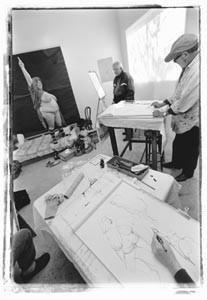
Battle of the Blues

Smoking Guns

Local bands duke it out at Battle of the Blues

By Natalie Sibert Freitas

WHICH IS SONOMA County’s best up-and-coming blues band? Maybe you have an opinion already formed in your mind, or perhaps you don’t have a clue as to what the local blues scene has to offer. In any case, on Thursday, Dec. 2, we’ll get an answer of sorts when four local blues bands duke it out for the title at the first Annual Battle of the Blues at Rumors Nite Club in Santa Rosa.

Ron LaFranchi, Sonoma County native and owner of Hedgehog Productions, is the mastermind behind the event. A good deal of LaFranchi’s motivation for the contest sprang from his frustration about how other battle of-the-band events are often run.

“I wanted a less political approach to selecting a winner, which is why the audience will vote to select the winners,” he says.

Generally, so-called expert panels are used in judging such contests, but LaFranchi’s approach is a more honest one–it acknowledges that music fans are sometimes better judges than those in the business.

LaFranchi chose the battling bands based on their talent, original material, and the fact that they are lesser known. The lineup currently includes the Aces, Hall of Mirrors, Hott Spell, and Blue Blazes.

“I could have easily added Eric Lindell to the bill, for example, but I felt there are other bands that are as deserving but less visible,” he says.

The location is equally important to LaFranchi: “I also wanted a good venue and found Rumors to be that,” he says. “It has a capacity of 500, a large stage, probably one of the largest dance floors in Northern California, and an exceptional sound and light system.”

The competition will feature a wide variety of blues stylings, and each band will be given a 45-minute set to perform original material and one cover tune.

“Having the bands play a cover song will help give the audience some point of reference, since it’s unlikely they’ll be familiar with the originals,” LaFranchi said.

Attendees will receive a ballot with their admission ticket. The votes will be tallied and the winners announced at the end of the event. The lucky first-prize winner will receive recording time at Prairie Sun Recording Studios–pure gold to any musician.

LaFranchi is no stranger to the local music community. He manages the bands Pen Fifteen, Powerbalance, and Butter B Down and has produced a long list of benefit concerts for Kid Street Theater, the Polly Klaas Safety Fair, and, most recently, the “Rockin’ for Rio” show put on to help flood and mudslide victims of Rio Nido. As if that weren’t enough, LaFranchi also booked the Moonlight Restaurant & Bar in Santa Rosa for a two-year spell and is currently booking live acts on Thursdays at Rumors.

LaFranchi’s desire to renew interest in the local blues scene also plays a huge role in his creating this contest.

“Unfortunately, many of the blues bands in this county are cover bands, and my heart is in supporting original blues music,” he says. “The Battle of the Blues will be an annual event to continue to support original blues music and hopefully build up the blues audience once again.”

Catch the Battle of the Blues on Thursday, Dec. 2, starting at 6 p.m. at Rumors Nite Club, 120 Fifth St., Santa Rosa. Tickets (for 21 and over only) are $10 and are available at Stars Music in Petaluma and Santa Rosa, Backdoor Disc and Tape in Cotati, and Rumors Nite Club in Santa Rosa. For details, call 545-5483.

From the November 24-December 1, 1999 issue of the Sonoma County Independent.

© Metro Publishing Inc.
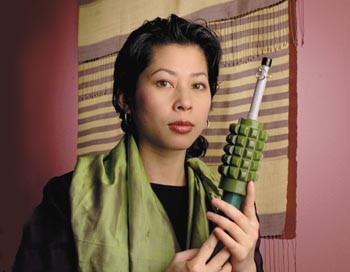
‘Greed: The Multi-Million Dollar Challenge’

0

Seven Deadly Sins a potential windfall

By Bill English

SAINT THOMAS Aquinas never actually ranked greed as one of the Seven Deadly Sins. He preferred to call it avarice. But then old Tom was never a program director for Fox Television. When you work for Rupert Murdoch, you’ve got to keep it punchy. Greed has a ring to it that mere avarice can never hope to achieve. The word has an underbelly odor of insatiable appetites, a scent you can smell right through your fiber-optic cable.

Welcome to Greed: The Multi-Million Dollar Challenge.

Here’s a new program that bills itself as the most dangerous and richest game show in TV history. In this time slot, contestants climb the Tower of Greed on their way to the ultimate prize of $2.2 million. There’s nothing demure or refined about Greed. But this isn’t a shameless attempt to cater to the lowest common denominator, either. No, this is a bona fide art form–a total revelation into the utter darkness of the human heart.

Greed is more than good–it’s pluperfect.

The show is emceed by veteran game-show host Chuck Woolery. You will recall that Woolery became a household name by hosting The Love Connection. Today that classic would surely be renamed The Lust Show and have a much harder edge. The genius of The Love Connection was the payoff. Chuck gave contestants to each other. OK, the show threw in a cheap date, but the bottom line was that you won a member of the opposite sex. Back then, Woolery was more than aware of his status as a prime-time pimp–but now Chuck has become a full-blown Satan.

The ardent scent of The Love Connection was tame compared to the animal nose of Greed. Here’s an hour on Thursday night that simply reeks of base and carnal desires. And Chuck is all over depravity like gonzo journalist Hunter S. Thompson at a Republican fundraiser. Greed has exposed the wolf in Woolery. He gleefully dangles cash beneath the noses of salivating players as he asks them: “Do you feel the need for greed?” When the Terminator lights begin to flash, the whole studio holds it breath. Will one of the players turn on a fellow contestant and eliminate him or her? One woman, when recently challenged for her share of the big bucks, almost burst out in tears. She knew she was doomed, a weak link cut from the herd

Greed is indeed an awesome show, but why stop there?

SURELY, all the Deadly Sins are worthy of prime time? Who could deny that America is ready for The Sloth Show? Think of it as a contraction of the “nothing” concept that made Seinfeld such a smash. In fact, The Sloth Show might well be a new vehicle for Jerry. You could bring back all the old characters–only they’d do much less. The whole show could be shot on Jerry’s couch.

Or what about The Hour of Envy?

Talk about a surefire hit! In an era when the rich have so much and the poor so little, it would really stir things up. Hosted by President Trump, it would feature the first head of state ever to preside over a game show. Trump would drag the disenfranchised kicking and screaming through the lavish lifestyles of his trendy friends until the needy were openly weeping.

Cruel, you say? Well then, let’s play The Gluttony Game.

Hosted by a digital reincarnation of John Candy, this show would feature contestants eating themselves to death. Too gross? Are you kidding me? Think of the product-placement possibilities. Food companies would be clamoring to get edibles on this feast of entertainment.

Of course, with Jerry Springer already airing the anger thing, that pretty much leaves us with pride. Not really much happening here. Because anyone with a shred of pride wouldn’t humiliate him/herself on national television for any amount of money.

But never underestimate the ability of the American people to wallow in shame in the eye of the tube. At times it seems as if we’re all scampering for one last moment in the spotlight before they close the set.

OK, kill the floods–that’s a wrap.

From the November 24-December 1, 1999 issue of the Sonoma County Independent.

© Metro Publishing Inc.

‘The Insider’

0

The Insider.

Inside Out

A seasoned whistle blower talks about media censorship and ‘The Insider’

Writer David Templeton takes interesting people to interesting movies in his ongoing quest for the ultimate post-film conversation. This is not a film review; rather, it’s a freewheeling discussion popular culture.

PETER PHILLIPS never watches 60 Minutes. He doesn’t read Time or Newsweek. And, contrary to what you might expect from a professional news-watcher, Phillips never watches the news. Instead, he scans the transcripts of news reports and random news programs; he pours over newspapers, absorbing “a couple hundred publications” every week.

He does not own a television. “Well, I had a TV, with satellite service, for one day,” he says with a chuckle.

The intense, soft-voiced, white-bearded Phillips is the director of Project Censored, the renowned 24-year-old program–an offshoot of the Sociology Department at Sonoma State University–that monitors news and news services, producing a best-selling annual compendium of important stories ignored, often for dubious reasons, by the mainstream media.

Of his aforementioned one-day perusal of the major news programs, Phillips has this to say: “It was nothing but garbage. All day long. Then there was a MSNBC special on Hitler. Then they started comparing Hitler to Milosevic–and that just pissed me off. That’s simple-minded NATO propaganda. It’s bullshit.

“I haven’t watched TV since.”

He takes a breather to get another cup of tea. When he returns, sliding his mug onto the scarred coffeehouse table, Phillips–who looks a little like Santa Claus, only edgier–smiles broadly. “So what were we talking about?”

Well, we were talking about 60 Minutes. And before that, we were talking about The Insider. A new Disney film starring Al Pacino as former 60 Minutes producer Lowell Bergman and Christopher Plummer as the intimidating reporter Mike Wallace, The Insider tells the sordid, engrossing true story of Jeffrey Wigand, a reluctantly heroic tobacco company insider who lost everything–and suffered numerous death threats–when he agreed to speak to Wallace on camera about his employer’s misdeeds.

After Wigand’s segment was filmed, the network buckled under in the face of a lawsuit threatened by the tobacco company that Wigand had worked for. After a bitter fight–in which Bergman, who shortly thereafter left the network, resorted to leaking his story to the New York Times–the segment was finally aired.

But 60 Minutes’ reputation had been forever soiled.

IRONICALLY, it was the story of how 60 Minutes sat on Wigand’s interview that was widely reported, while the substance of that interview–that tobacco companies had been deliberately engineering cigarettes to be more and more addictive–was downplayed.

Phillips liked the film.

“Unfortunately, it says too little about a big problem,” he shrugs. “The Insider is saying that there are still good journalists out there, and that is true. There are good journalists, firm believers in the First Amendment. And they are increasingly bent and pushed around by Big Media.

“And it’s true, it’s all true,” Philips continues. “But the problem is far worse than that. At the end of the movie, 60 Minutes has fixed its problem, they’ve come clean, they’ve run the story–only now they’re a little bit bent.”

The truth, according to Phillips, is that 60 Minutes was always bent–along with every U.S. mainstream newspaper and news organization. “It’s been said before,” says Phillips. “We are the best-entertained, least informed society on the planet.”

As an example, he mentions the inordinate attention given to the O.J. trial–and the stifling effect it had on other, more vital journalistic endeavors.

“Eighty-three column feet were devoted to O.J. in the Los Angeles Times the year of the trial,” Phillips divulges. “Why didn’t they write about how Chevron hired the helicopters that flew toward the Nigerian oil platforms, guns blazing, killing the student demonstrators?”

The powers that be, obviously, felt we’d rather hear about the private life of Kato Kaelin.

“These people who are supposed to be exposing the system are actually supporting the system,” Phillips concludes. “When you get as wealthy as Mike Wallace, when your contract is paying you millions a year, you can’t help but feel a little beholden to the powers that be.

“Because, guess what? You’re part of it now.”

From the November 24-December 1, 1999 issue of the Sonoma County Independent.

© Metro Publishing Inc.

Spins

Midnite mover: Beck Hansen. In the Mix Postmodern pastiche reigns on new CDs Beck Midnite Vultures DGC HE'S BIG. He's bad. He's back. He's Beck. Over the past decade, singer/songwriter Beck Hansen, 29, earned his rep as a major celebrant of junk culture. Armed with a...

California Cabernet

King Cab You can't beat a good California cabernet By Bob Johnson CABERNET Sauvignon grapes have been planted in the Bordeaux region of France for nearly a century longer than in California. So it's easy to understand why California winemaking pioneers looked to the French for direction and guidance with this...

Anime Film Festival

Blackjack, playing on Sunday, Dec. 12, at 6:30 and 8:55 p.m. at the Rafael Film Center's anime festival. Rising Sun Trailblazing producer Fred Ladd kicks off an anime festival at the Rafael Film Center By LIKE RADIOS, cars, and cameras, Japanese animation--or anime--was first imported to America because of its...

Hand Cooking

Get a Grip The very best kitchen utensils--and, hey, they're free By Marina Wolf I RECENTLY discovered the most amazing kitchen tools. They never need sharpening. They're perfectly weighted, easy to clean, and completely rust-resistant. They're instantly adjustable to almost any kitchen task. And, best of all, I never have to...

Spins

Antipop. Rock-o-Rama New CDs by Primus, RATM, & more Rage Against the Machine The Battle of Los Angeles Epic IT'S EASY to imagine that Rage Against the Machine have painted themselves into a corner with their scathing rap-metal political thunder, but it's a tremendous corner...

Joyce Goldstein

Eating alla Ebraica Author Joyce Goldstein explores the culinary heritage of Italian Jews By Marina Wolf POLENTA, pomodori, pepperoni . . . these are some of the products that Italy is known for. Many sharp-eyed gourmets know that these ingredients--corn meal, tomatoes, peppers--were brought back from the New World. But, as...

Nick Bantock

Damned Close A richly visual tour of 10 imaginary Hells By Heather Zimmerman THE CONCEPT of emotional baggage gets a literal interpretation in Nick Bantock's new book, The Museum at Purgatory. Bantock, the artist/author best known for his sumptuously illustrated epistolaries in the Griffin & Sabine trilogy, turns his exotic imagination...

Battle of the Blues

Smoking Guns Local bands duke it out at Battle of the Blues By Natalie Sibert Freitas WHICH IS SONOMA County's best up-and-coming blues band? Maybe you have an opinion already formed in your mind, or perhaps you don't have a clue as to what the local blues scene has to offer....

‘Greed: The Multi-Million Dollar Challenge’

Seven Deadly Sins a potential windfall By Bill English SAINT THOMAS Aquinas never actually ranked greed as one of the Seven Deadly Sins. He preferred to call it avarice. But then old Tom was never a program director for Fox Television. When you work for Rupert Murdoch, you've got to keep it punchy. Greed...

‘The Insider’

The Insider. Inside Out A seasoned whistle blower talks about media censorship and 'The Insider' Writer David Templeton takes interesting people to interesting movies in his ongoing quest for the ultimate post-film conversation. This is not a film review; rather, it's a freewheeling discussion popular culture. ...
11,084FansLike
4,606FollowersFollow
6,928FollowersFollow
