Cookbooks

0

On the Shelf

New cookbooks cater to every taste

By Greg Cahill and Marina Wolf

The Rose Pistola Cookbook Broadway; $35 By Reed Hearon and Peggy Knickerbocker

SINCE ITS OPENING in 1996, the Rose Pistola in San Francisco has been a focal point of the burgeoning North Beach cafe and restaurant scene. Everyone from the New York Times to Gourmet has sung the praises of this fine Italian eatery (which garnered a prestigious James Beard Award in its first year). Chef and restaurateur Reed Hearon offers 140 Italian recipes that reflect his simple adaptations of Genoese and Ligurian cuisine. The entertaining (and let’s face it, cookbooks are mostly about entertainment) and informative aspect of this unpretentious volume are the interspersed profiles spotlighting such Bay Area food producers as Sue Conley of the Cowgirl Creamery at Tomales Bay Foods in Point Reyes Station and organic farmer Warren Weber of Star Route Farms in Bolinas, as well as a hundred and one tips on keeping it simple. G.C.

Moosewood Restaurant Daily Special Clarkson N. Potter; $35 By The Moosewood Collective

I STOPPED USING my Moosewood cookbook a couple of years ago. The back index pages were falling out, and I was getting a little tired of cheesy casseroles and beans, beans, beans. But the newest offering in the Moosewood Restaurant library (there are eight books so far, not including Mollie Katzen’s solo efforts) may be just the thing to bring me back to the meat-free fold, at least for lunch. The collectively owned and operated Moosewood Restaurant has been serving up mostly vegetarian fare for more than 25 years. The collective’s efforts recently earned Moosewood a place in Bon Appetit‘s list of the most revolutionary restaurants of the century. Never has the collective’s dedication been so delicious–and accessible–as in Moosewood Restaurant Daily Special. The book offers close to 300 recipes that form the backbone of the restaurant’s lunch menus. Here there are soups enough to drown a horse, and salads of all sorts to revive it. The offerings span the globe, from Algerian Tomato Soup with Vermicelli to Westphalian Vegetable Stew, and the presentation spans the spectrum of dietary requirements–vegan, low-fat, low-carb, quick-n-easy. Each recipe is accompanied with a string of possible accompaniments, following Moosewood’s simple tradition of the daily special: soup and a selection of salads. M.W.

Julia and Jacques Cooking at Home Knopf, $40 By Julia Child and Jacques Pepin

DO TOO MANY cooks spoil the broth? Not if the cooks are TV chefs Julia Child and Jacques Pepin, whose opinionated approaches to good cooking are as delightful as they are different. The PBS television show featured the two master chefs engaged in unscripted discussions about all of their favorite foods and ways to make them. Predictably, the resulting show was a bit, er, lively at times, but hey, a vigorous exchange of views can only benefit the art. The companion cookbook has captured much of the vibrancy of the television show, with each concept, ingredient, and recipe flanked by comments from both chefs. In this book, even simple salads merit the full focus of Julia and Jacques’ attention, and the resulting dialogue is full of good flavorful hints at what cooking can and should be. Don’t let the detailed photography and simple layout fool you: this is not a book for beginners, who may not be able to deal with the ambiguity and diversity of views that are inherent, perhaps even essential, to the book’s structure. However, it is the perfect tome, weighty and filled with some of the classics from French and American cuisine, for the home cook who is reasonably comfortable with sharp knives, multistep recipes, and special orders at the butcher counter. M.W.

The Northern California Best Places Cookbook Sasquatch; $19.95 By Cynthia C. Nims and Carolyn Dille

YOU COULD ARGUE about the exclusion of some very fine restaurants from this anthology of recipes and essays, but there’s no denying that the folks who made the cut are all worthy. This Seattle-based publisher is known for its culinary guidebooks, and this is the first attempt to cull those collections for the firm’s first cookbook. There are a few challenging items included here, but for the most part the authors have kept their offerings mercifully simple. And you’ll recognize several North Bay names, including Hemenway’s in Santa Rosa, Belle de Jour Inn in Healdsburg, Huckleberry Springs Country Inn in Monte Rio, Glenelly Inn in Glenn Ellen, the Gables Inn in Santa Rosa, Brix of Yountville, Half Day Cafe in Kentfield, and the Wine Spectator Restaurant at Greystone in St. Helena. And while you may find the braised Napa cabbage and Beaujolais sauce from Left Bank in Larkspur too daunting, the tequila-marinated Cornish hen (from Las Camelias Mexican Restaurant in San Rafael) is a walk in the park. G.C.

From the November 11-17, 1999 issue of the Sonoma County Independent.

© Metro Publishing Inc.

Wine Country Cuisine

0

Blurring the borders of regional food. Or just what the heck is wine country cuisine?

By Marina Wolf

CERTAIN regional-based food fads have come and gone–from blackened Cajun everything to red-hot Southwest machismo–yet the hyper-awareness of American regional food is reaching an all-time high. Regional showcases, symposiums, and culinary tours–including the Fine Cooking tour hosted recently in Sonoma County–are sprouting up around the country. Saveur magazine (“A World of Authentic Cuisine”) is running stories about Baltimore crab soup, East Hampton fish bakes, and St. Louis’s Little Italy. Upscale restaurants in Nashville serve pork marinated in balsamic vinegar with bourbon gravy, and chefs in New England are talking seriously about “New Maine Cooking.” Meanwhile, the old-but-new California cuisine is queen of kitchens up and down the Gold Coast, and a strange newcomer called “wine-country cuisine” is creeping into the parlance.

Forget melting pot. The metaphor for our contemporary culinary culture is a varied buffet with several hundred little platters.

Observers ascribe the increased interest in regional-based fare to an overall heightened interest in foods.

“People aren’t just interested in recipes anymore,” says food historian Sandra Oliver. “They want the story behind the story. Once you start looking at the history of your food, you’re bound to run into regionalism.”

Louis Osteen, chef-owner of Louis’s in Charleston and a leading proponent of deep-South cooking, agrees. “People are catching up to European interest in good food,” he says. “And when you talk about really good food, you have to talk about regional food.”

The question is, how much of the talk about regionalism is an authentic interest in the expression of place and how much is restaurant hype?

And how much further can it go?

Hype or Help?

IN GENERAL, chefs and restaurateurs have been fairly upfront about the value they place on regional cuisine as a marketing hook in an ever-competitive and sophisticated business.

In the February 1993 issue of Nation’s Restaurant News, Osteen says of his cooking, “Low-Country cooking [of the coastal Deep South] is geographical, traditional, cultural . . . and it’s a real good marketing aid, too.”

John T. Edge, director of the Southern Foodways Alliance at the Center for Southern Studies at the University of Mississippi in Oxford, is another proponent of Southern food traditions, combining an academic point of view with the enthusiast’s appetite. He has little patience with the faux Southern specialties that have ended up on the menus of national restaurant chains.

Yet even he is able to look upon the p.r. buzz about regional cuisine in a fairly calm manner. “I think right now there’s a good mixture of both [marketing and authentic cuisine],” he says. “The thing is, if you can sell people Low Country or Mississippi Delta or some subregional variant, then they’re going to feel like they’re having a special dining experience.

“I think it’s very smart marketing.”

The South, of course, is struggling with particular culinary stereotypes–“grits, greens, and grease,” as Edge so eloquently puts it. But other regions have found equally compelling reasons to establish their own regional style. In Hawaii, for example, local chefs and promoters began organizing such chef events as “The Great Hawaiian Cook-Off” and “A Taste of Paradise: Dining with the Great Chefs of Hawaii” to spiff up resort-town offerings for a new wave of food-savvy tourists.

“Now we’re more concerned with not hiding the flavors of the natural ingredients, whether it’s the fish or the produce. That notion comes from mainlanders. The locals, they don’t really care,” says Keith Cevoli, executive chef with Celebrations Catering and creative partner with Beverly Gannon, one of the leading promoters of what is now called “Hawaiian regional cuisine.”

Even “California cuisine” has emerged as an eminently marketable catch phrase, used both inside and outside of California’s geopolitical boundaries to sell a certain concept. Its use has become an issue for even the most seriously committed California-style chefs, some of whom are beginning to be a little leery of the phrase’s overuse. “It doesn’t mean that much anymore,” says John Ash, culinary director at Fetzer Vineyards in Hopland, whose John Ash & Co. restaurant helped define the term.

“It’s just a phrase. The term California, anything California, has this special cachet to it. It’s the golden land, the beautiful people. Its value for a lot of people, as much as anything, is its marketing cachet.”

Indeed, for every region whose gastronomic identity has recently emerged to public recognition, you can find a chef from that region who refuses to be pigeonholed. Caprial Pence, for example, is an acknowledged pioneer in what is called “Pacific Northwest cuisine,” which generally means an elegant and satisfying blend of local products with an Asiatic flair on the plate and/or palate. But Pence is quick to dismiss the very field that she leads. “I think it’s just somebody wanting to put a name on it, I really do,” she says. “I did some work with a woman who’s doing her thesis on Northwest food, and she kept asking me if there was a Northwest cuisine. I said no. I think a cuisine is dictated by specific dishes that have been made for years and years, and there just aren’t dishes like that here.”

California Dreaming

BY PENCE’S strict definition of cuisine, few regions in the United States would have their own cuisine. Certainly not California, a state that has existed for just 151 years. There are vinegars in Italian attics that are twice as old. But many chefs will testify that California cuisine is an established tradition. “To me, California cuisine describes something very specific,” says Mary Evely, executive chef at Simi Winery in Healdsburg.

“It means fresh, seasonal foodstuffs, quick cooking, and bright, fresh sauces and seasonings.”

California cuisine is widely considered to be the child of chef Alice Waters and her groundbreaking food at Chez Panisse in Berkeley in the early ’70s. Her showcasing of absolutely fresh seasonal foods in simple preparations was a masterful amalgamation of then current trends such as vegetarianism and nouvelle cuisine.

But in some ways, she was simply continuing and magnifying an already existing style of California cooking, says Janet Fletcher, a Napa-based food writer and author of a book on California cuisine forthcoming from the Williams-Sonoma publishing company. “They didn’t call it California cuisine, but there was already an identifiable Cal way of entertaining [in the ’40s and ’50s],” says Fletcher.

“A lot of it was outdoors. There was grilling even then. There were Asian influences on the food, and there was much greater use of fresh vegetables than in other parts of the country.”

What about the new phrase “wine-country cuisine”? That’s a little too new, even for these winery chefs. It’s true that in most wine-growing regions of the world, the food has developed alongside the wine. But American wine country is still too new for it to be a useful descriptor, says John Ash. “In California we’re still very much in the adolescent stage, where we’re finding out what works with what wine,” he says. “It’s complicated by the fact that food styles and wine styles are changing so quickly that there’s never been a gestation period for them to kind of perk along together.”

But lack of a distinct, dish-based orientation hasn’t stopped California cuisine from spreading as an attitude or strategy, asserts Daphne Derven, curator of the American Center for Wine, Food, & the Arts in Napa. “One of the hallmarks of what we call California cuisine is taking a tradition and exploring it,” says Derven. “You could almost say it’s a metaphor for American cuisines. We take a traditional ingredient or technique or preparation, and modify it to fit the current circumstances.”

Other parts of America, though, have had the relative isolation and specific ingredients necessary to establish a cuisine in the traditional sense. In the South, for example, barbecue is a close contender. “Someone observed once that barbecue in the South is the closest America has to the regional cheeses and wines of Europe,” says John T. Edge of the Southern Foodways Alliance.

“You drive 50 miles and it changes.”

In the Northeast, island communities such as East Hampton, the region covered in the September/October 1998 issue of Saveur, have been farmed and fished for nine or 10 generations, with a simple style of cooking that has seen little change over the past 300 years.

Food in the Future

WHERE DOES that leave us? Even when we stipulate that regional cuisines do exist, at least in the homes of the people of the region, and that even though California cuisine isn’t 400 years old, it does have some meaning in the collective mind of the food world, we are still left with sorting out the complicated nomenclature and indistinct future of American regional cooking.

The first problem stems primarily from media and restaurant abuse of phraseology, which, it would seem, is a necessary hazard of the business. Mary Evely of Simi Winery recalls visiting a Southwestern restaurant where the food was described as “elemental American cuisine.”

She and her dining companion spent a good hour before dinner trying to guess what such a cuisine might entail, and arrived to find it merely the California cuisine concept–fresh, local, seasonal–prepared with Southwestern ingredients.

“The chefs are just trying to define their cooking to the prospective customers,” says Evely. “It’s hard to intellectualize what is essentially a sensory experience.”

And however difficult or pervasive the use of regional cuisine as a hook, it’ll never catch up with reality.

California cuisine has spread over the land, even changing itself as its practitioners begin integrating Asian influences more fully into their techniques. Southern food, which many people think of as static since before the Civil War, is evolving as new influences have come in with recent groups of immigrants; some neighborhoods on the Mississippi Delta now boast as many pho noodle shops as fried-chicken shacks, says John T. Edge.

It’s the story of food. “Blurring boundaries is inevitable. It’s the story of cuisine over millennia,” says Janet Fletcher. “People move and ingredients move, and therefore ideas [about food] move, too.

“It would be impossible to stop.”

Paradoxically, even while American regional cuisines are shifting in fusion, they are being split into ever smaller and more place-specific parts. Call it the opposite of fusion cuisine: fission cuisine. Chefs, ever on the lookout to spiff up the menu with esoteric ingredients, do the next best thing and elevate simple ingredients–duck, lettuce, peaches–by slapping a geographic label on them, the more specific the better.

Increasingly the word terroir is being used to describe produce and food products. In winemaking, terroir refers to the different climatological, hydrological, and geological influences on a particular patch of land, and the differences those influences make in aroma and flavor of different bottlings of the same varietal of wine. It stands to reason that grapes aren’t the only fruit that would vary with changes in the environment.

For other chefs, micro-regional eating is as much a matter of gastrology as it is of gastronomy. Take Ralph Higgins of the award-winning Higgins Restaurant in Portland, Ore., whose devotion to eating locally takes on an almost macrobiotic air. Higgins believes that there are actual physical benefits to be had from eating from the place you’re in. “If you eat faithfully what’s available in that region at any given time of the year, you’ll automatically be getting more nutrition,” says Higgins.

“Your body goes through cycles where it adapts to climactic changes, and the plants and animals [in that same area] are following those same cycles.”

Home Cooking

NUTRITIONAL analysis aside, it’s entirely possible that Higgins’ brand of micro-regional cuisine will indeed be the wave of the future in regional cookery in American restaurants. Restaurants have good reasons to foster this attention to detail. It creates a strong unified statement to customers. It supports local producers.

Regional cooking may even be the catalyst of a return to a region’s roots. In the south, chefs have dressed up many down-home classics of the Southern kitchen, which has in turn increased appreciation of the food in the general population.

“Rediscovery of Southern food by restaurants has changed Southern culture and Southern cooking more than anything,” says Edge. It’s turned the Southern-food stereotypes on their ear, and what’s more, it’s changed the way Southerners see themselves. “In some ways it’s emboldened Southerners who may have had a chip on their shoulders about their own food,” Edge says. “They’ve figured out that if cornbread is worthy of a mahogany inlay table, it’s worthy of their tables at home.”

Clearly, then, the reinterpretation of regional food by restaurants is a powerful act. If we have scorned our food roots, the respect that food gets by being on a white tablecloth bridges the alienation. Scattered by time, tide, and interstate transportation, we can return to our homelands, at least in our minds and in our stomachs, with a single bite.

That is an elemental magic, and essential to feeling at home in the world, according to Daphne Derven.

“In the world today, we have become so global,” she says. “To feel like we’re really here, we need to celebrate the spot we’re in . . . and regional cuisine helps us do that.”

But when chefs–and mea culpa, writers–take poetic liberties with the naming of cuisines, we may be stirring up the already murky waters, clouding the regional heritage that is already hard enough to find.

“It seems like such small stuff, but little by little it’s being picked away,” says Sandra Oliver with a sigh. “If you’re not aware what your regional foods are, it’s hard to defend them.”

From the November 11-17, 1999 issue of the Sonoma County Independent.

© Metro Publishing Inc.

The Hill Guides

The Hills are alive . . . and they’re writing travel guides

By Yosha Bourgea

KATHLEEN HILL was in a bookstore in Seattle one day, browsing through the travel and cooking sections, when she noticed there were no books on the Sonoma Valley area. It got her thinking about the advice her late friend M.F.K. Fisher had once given her: “Write about what you know and love well.”

Hill, a resident of Sonoma, had just finished work on a dictionary with Gerald, her husband and writing partner. The idea of writing about food and travel, she says, sounded like heaven: all those complete sentences.

The first two books were self-published tours of Victoria and Vancouver Island, where the Hills spend part of each year, and Sonoma Valley. Positive reviews from publications like Wine Spectator helped spread the word, and the authors soon were approached by the Globe Pequot Press. Only a couple of years later, the series of Hill Guides is five books strong, and a sixth, on Santa Barbara and the central coast, is poised to come out “at any second,” Hill says.

The Hill Guides (Globe Pequot Press; $14.95) are a remarkably readable series of travel books that happen to focus on food and wine. In addition to the usual rundown on where to stay and what to gawk at, the guides include colorful, opinionated descriptions of the best local restaurants and wineries, interspersed with gourmet recipes from the chefs along the road. The effect is mouthwatering.

The “How to Be a Visitor and Not a Tourist” section in each guide offers tips on how to enjoy yourself without alienating the locals; in general, being quiet and respectful of others seems to be what goes over best. However, there are exceptions.

“Don’t worry about looking like a tourist in Napa Valley,” write the Hills. “The Valley is made for tourists! The wineries and restaurants thrive on your visit and are well aware of that fact, so you will be treated well. Just dress comfortably and bring your tastebuds and money.”

The Napa Valley guide is new this year, as are guides to the Monterey and Carmel area and the Northwest Wine Country. The geography of the latter includes British Columbia, Oregon, Washington, and Idaho “in the Cascadian spirit of natural rather than political boundaries,” the authors write. “Nature does not know governmental borders, and we believe that humans ought to ignore them a little more. We would like to encourage people to live more regionally and less provincially.”

That sense of region shows up strongly in the Hills’ writing, which is warm, chatty, and knowing throughout. The small picture of the authors on the back cover of each book enhances an overall feeling of intimacy, as if the reader has been invited along on a family expedition. It’s a quality that big-league guides like Fodor’s and Frommer’s conspicuously lack, even if they may be more encyclopedic.

Though yupscale tourists are clearly the target audience here (who else splashes out for a weekend of winetasting in Napa?), the Hills never condescend or assume. True, the $65 prix-fixe menu of Yountville’s renowned French Laundry gets a mention, but so does the greasy-spoon ambiance of Ford’s Cafe in Sonoma, of which the Hills write: “The walls tilt slightly, the people tilt slightly, the American flag gets stolen, and the building floods when Sonoma Creek overflows.”

Wine, a popular if controversial product around these parts, gets an appreciative but not gushing treatment in the Hill Guides. A section at the back of each book highlights the history of the region and the effect of the wine industry before, during, and after Prohibition.

“We see a couple of attitudinal differences that distinguish British Columbia wineries from U.S. wineries, particularly those in California,” write the Hills. “Generally B.C. vintners help each other instead of competing against each other. Many B.C. vintners are content to sell the wine they make and stay small, instead of aggressively striving to top their own or someone else’s sales figures. . . . Many B.C. wineries sell out their releases each year.”

Even those who like the taste of wine but can’t tell an oaky cabernet from an impetuous syrah are encouraged to relax and enjoy. “Either learn winespeak thoroughly or don’t worry about it,” say the authors. “The faker is the only one laughed at.”

From the November 11-17, 1999 issue of the Sonoma County Independent.

© Metro Publishing Inc.

Live Organ Donation

0

Holding her own: Diagnosed with advanced kidney disease, local author and grief counselor Sukie Miller has had several friends and relatives consider the possibility of making a living donation of one of their kidneys. But so far none has panned out.

Living Gifts

Thinking about donating organs after your death? How about coughing up a kidney now?

A shimmering blanket of warm, midmorning Sebastopol sunshine has wrapped itself softly around Dr. Sukie Miller, who sits waiting by the telephone, talking easily–though not without emotion–of her own possible death. Up above, a long, narrow skylight reveals a sky of blinding-bright blue, as Miller–her legs curled up beneath her, swaying gently as she speaks–sits below, her expressive 58-year-old face gliding in and out of the sunlight, literally glowing with light before easing back into soft shadow.

“I was always a smoker,” Miller says, laughing, shaking her head in mock shock and wonder, “so I thought it would be cancer that would get me. Also, I treat a lot of people with cancer, so I figured, ‘Hey! Cancer’s my disease.’ But, kidneys? What the hell is a kidney? Forget about it.”

Last March, as Miller prepared for a national book tour, she was diagnosed with advanced kidney disease. The popular lecturer, author, and therapist–ironically, one of the world’s leading experts on the subject of death and grieving–learned that her kidneys were failing at an alarming rate. She would need a transplant as soon as possible. Should her kidneys continue to deteriorate as she waits for a donor organ to become available, she’ll need dialysis.

Without such measures, she will die. “I couldn’t believe it,” she says. “I was sure the doctor had made a mistake. I crawled home, canceled everything for a week. You could say, in California-speak, that I ‘went into retreat.’ The truth is, I cowered in the corner, sobbing. I was a wreck, just overwhelmed.

“And I kept saying, ‘Kidneys? What did I ever do to my kidneys?’ ”

The answer is that Miller, according to her doctors, did nothing to bring on the disease. As many people, newly diagnosed with kidney disease, quickly learn, the condition is likely caused by some common viral infection picked up in childhood, or after years of unchecked high blood pressure. Unlike conditions such as heart disease, however, there is no known treatment to reverse the damage.

Which leads Miller to her next question.

“When do I get a new kidney?” she shouts, her hand tapping the phone lightly. “The average wait for a donor kidney, one that comes from a cadaver, is three to five years.”

According to U.S. government reports, as of Nov. 1, there were 43,317 people waiting for kidneys, and a total of 65,963 patients waiting for donor organs of any kind. The only alternative to waiting is to find a suitable living donor who is willing to give one of his or her kidneys to the patient in need.

It’s not an easy prospect.

When Miller–who has no immediate family–was first diagnosed, a flood of offers came in, an even dozen friends and associates, asking to be tested for suitability. Several were immediately eliminated for having a non-compatible blood type; Miller is type O, so her donor must also be type O. After a series of blood tests were performed, it turned out that two of Miller’s potential donors were a match, but after further reflection, the donors both backed away from their initial offer, expressing serious concerns that hadn’t been present at the time they first volunteered.

“I understand, of course,” Miller says, graciously. “Their impulse to offer their kidney was a very heartfelt one. If I’d needed a pint of blood, nobody would have given a second thought, but giving up a kidney–even when you can function perfectly on just one–is not something that is common in our culture yet.

“So I understand. But it’s been hard on me. I had my bags all packed. I was mentally preparing myself for surgery. And now I’m waiting again.”

The phone rings. She’s clearly been expecting this call. A second cousin, also type O, has offered to be tested. She’s calling to say that she just returned from having blood drawn and is preparing to send it off to the hospital in Los Angeles, where the surgery will be performed.

“God bless you!” Miller exclaims. “But I have to be completely straight with you.” She then tells her cousin of the two last-minute cancellations, and says, “Frankly, I don’t think I can take a lot more of that. So please think this through before you proceed, and be sure this is something you are really comfortable with.”

They talk about what happens next: by Wednesday morning, the hospital will know if the donor’s blood is rejected by Miller’s, and by Friday they will know if the kidneys are a match.

Miller shares details of the procedure, performed laparoscopically, that will have them both in the hospital for two to four days. “So here’s the really important thing,” Miller jokes. “If you give me your kidney, will I still be able to yell at you?”

Down to My Bones: An open letter from a bone marrow donor to a recipient.

THERE’S AN ORGAN shortage in America. According to the U.S. Department of Health and Human Services, of those now waiting for organs, only about a third are certain to undergo a transplant, leaving the remaining patients to wait, growing more ill as time passes. Best estimates are that 5,000 of those patients are certain to die before receiving a donor organ.

An estimated 18,000 to 20,000 additional organs each year are needed to meet current and projected demands.

There are many reasons for the shortage of available organs, the majority of which have always been taken from deceased donors. There’s been a sharp decline in those carrying donor cards on their driver’s licenses, and, ironically, a decline in fatalities as safety-belt and motorcycle-helmet laws have been more strictly enforced.

Also, as medical science improves the reliability of transplant procedures, and makes better drugs used to prevent the new organs from being rejected by the recipient’s body, there has been an increase in the number of transplants performed.

In 1998, 2,345 heart transplants were performed, 862 lung transplants, 4,487 liver transplants, and 12,166 kidney transplants. Of the last, 4,016 were donated by living people.

Last April, a congressional hearing took place before the House subcommittee on health and the environment to address the shortage of transplant organs. At that time, Dr. Robert Metzger, co-chair of the United Network for Organ Sharing’s Council on Organ Availability, made a bold proposal of a way to meet the demand for donor organs.

His suggestion solution: recruit more live donors.

In 1996, according to U.S. Morbidity and Mortality reports, there were 3,960 surgeries in the United States that involved living donors, a number that rose to 3,905 in 1997 and up to 4,100 by the end of 1998. This increase, though slight, reveals a very positive gradual trend.

Medically, live transplanted organs are preferred over cadaveric organs because, simply put, they last significantly longer. The half life of a cadaveric kidney is around eight years, compared to 15-24 years average for a kidney from a live donor.

Congress has been asked to help by requiring Medicare and other third-party payers to foot the bill for lost wages and out-of-pocket expenses that some donors incur when they undergo organ donation surgery. Additionally, such groups as the National Kidney Foundation would like to see Medicare pay for more than three years’ worth of anti-rejection drugs. Without the drugs, transplanted organs will begin to fail, requiring additional transplants, putting obvious strain on an already overstrained organ-transplant system.

In October, Vice President Al Gore announced a number of federal grants to various donor education programs, and unveiled a large-scale national public-awareness advertising program, aimed at increasing the country’s organ donation literacy level–and spark an increase in donors, living and not.

In Minnesota, a strong effort is under way to increase the number of donations from non-related living donors.

Most transplant units now ban any walk-in donations, and willing non-related donors–be they friends, business associates, or even in-laws–must undergo lengthy psychological tests that immediate family members are not subjected to.

Still, as the public education goes head-to-head with a powerful cultural squeamishness about organ donation, the number of non-related organ donors is gradually increasing. In September, an anonymous Minnesota woman made headlines when she was allowed to donate a kidney to a total stranger. An Arizona businessman gave a kidney to an employee’s son.

According to Margaret MacPhail of Santa Rosa’s Satellite Dialysis Center–where almost a third of the patients are on transplant-waiting lists–a local woman successfully donated a kidney to a member of her church.

“Doctors are much more willing to consider spouses and friends than they once did,” says MacPhail. “There’s been such a significant decline in available organs that a lot of transplant units have had to reconsider what they would call an appropriate donor.”

Some have even suggested that a move to anonymous organ donors–much like blood donors in modern-day blood and bone marrow drives–is the answer to our national organ shortage. An ethics debate on the subject is currently going on within the medical community.

“Because of the incredible emotional, psychological, and physical impact of donation, most transplant centers feel that some connection to the recipient is really important,” says Nancy Swick, transplant coordinator at Santa Rosa Memorial Hospital.

Swick is herself a transplant recipient. Seven years ago she received a kidney from her brother-in-law–something that would once have been strongly discouraged–and both are feeling wonderful today.

“I’m pretty lucky,” Swick says, clearly meaning it. “Anonymous donation may become common in the future,” she concedes, “but I would never want to see any strong-arming of people. If people decide they can’t be donors, for whatever reasons, that decision has to be honored.”

LYNN CHABOT-LONG, of Wisconsin, can quote organ donation statistics as if she were reciting Bible verses or the multiplication table. She laughs at the suggestion that most people who have either given or received an organ–including the members of deceased donors’ families–immediately become unofficial transplant educators.

“It seems that way, doesn’t it?” she says with a chuckle. “Once you’ve undergone this experience, it becomes a kind of passion, wanting to raise public awareness about organ donation.”

Thirteen years ago, Chabot-Long gave one of her kidneys to her then-seriously ill brother. It was an event, she says, that significantly changed her life.

“It was a marvelous experience, really, a once-in-a-lifetime thing,” she explains. “Most donors feel that way. It’s like giving birth. My brother was going to die. But today, he’s alive.”

She is quick to say that she studied the subject extensively before offering her own vital organ. “I wouldn’t have made the decision to do it if I wasn’t convinced that I’d come through it fine,” she says.

Her book, A Gift of Life: A Page from the Life of a Living Organ Donor, was written to guide others thinking about becoming a donor. She’s become a tireless organ activist, encouraging others to sign their donor cards, eagerly telling her own story to nervous folks who are thinking of becoming living donors.

“It’s a difficult thing to do, to become a living donor,” Chabot-Long admits. “I understand that. It’s not for everyone. But all it takes to be a donor is to sign your donor card. Only 19 percent of those who don’t carry donor cards have actually decided not to be donors. The rest are still thinking about it, or haven’t gotten around to signing the card.

“If all of those people signed their cards today, there wouldn’t be five-year waits for organs. And a lot fewer people would die waiting.”

BACK IN SEBASTOPOL, Sukie Miller hangs up the phone. She stretches her arms out, spreading her fingers in the sunshine, shrugging as if to say, “Now we’ll see happens next.

“I’ve started looking at my life, the way I have my clients look at their own lives,” she says. “And you know what? I’ve had a terrific life. I’m carrying no baggage, there’s nothing I’ve left unsaid or undone. I love my life. And now I’m not ashamed to say that I want more of it. I want to live more. I want to learn more.”

Asked what she’s learned so far, as a result of her illness, she closes her eyes. After a moment, she says, “When I was first diagnosed, and I started getting calls from friends saying, ‘I’ll give you a kidney. Take one of mine,’ I learned something I never knew.”

As she leans forward, her face begins to glow again, illuminated by the light.”I always knew I was popular,” Miller says with a sigh. “But I never knew I was loved.”

For information about learning your donor type, call the Blood Bank of the Redwoods at 545-1222. Contact Heart of America at 800-366-6711 for information on how to become a bone marrow donor.

From the November 11-17, 1999 issue of the Sonoma County Independent.

© Metro Publishing Inc.
Tierra Vegetables

0

Some like it hot: Tierra Vegetables is a little on the chili side.

Burning Desire

Tierra Vegetables champions the chipotle

By Marina Wolf

“OH, NOW LOOK at those!” says Lee James of Tierra Vegetables, reaching into the low-lying tumble of pepper plants and plucking out a reddish-purple fruit. “They look even prettier all piled up in a box,” she says as she rubs off the field dust and takes a bite. “People think the field must be pretty, too, but when it’s later in the season the plants fall over and the weeds come in . . .” Then she notices my stare and stops mid-stride. “I didn’t even think to offer,” she says and rummages again for a pepper. “Do you want one?”

I do, but I feel hesitant about biting right in the way Lee does. What she eats like apples could be incendiary devices to mortal folks. After all, Lee, with her brother Wayne James and his wife, Evie Truxaw, are the people who helped put chipotle chilis on the North American map. Tierra Vegetables’ seven varieties of smoked chilis were recently dubbed an endangered American foodstuff and brought on board a metaphorical food ark by Slow Food, a global organization dedicated to good food and traditional foodways. Sure, Tierra grows regular garden stuff at three sites around the county, but Lee, Wayne, and Evie love chipotles first and foremost. Hell, even their hordes of shelties love chilis.

Lee is quick to assure me that this pepper is a sweet pimiento, but I still hesitate, rubbing the dust off as an excuse to look around. The field looks like any other well-used piece of farmland in the middle of the harvest season. Watermelon rinds from the failed melon plantings lie in little heaps at the end of the rows. Tractor ruts provide a rough track for Wayne, who walks barefoot everywhere–damp fields, gravel driveways, a chicken crossing–and now uses his calloused toes to poke at the first plant in a row of greens. “These white-top beets aren’t doing so well. Since when do we get leaf miner in October?” he exclaims, glaring at the leaves that are withering up brown and dry along the edges of the pale tender leaves.

Wayne’s barefootedness is just another example of Tierra’s laid-back atmosphere. The buildings are weather-beaten, the flowers out front are spent in the fall heat, brown and trodden upon. The James don’t have time to prettify their farm. They’ve got 60 people to fill produce boxes for, and they’ve got chilis to smoke.

“You can’t grow a chipotle; it’s a process,” says Lee later at her house in Healdsburg. “People still can’t figure that out. They’re always asking for fresh chipotles. But it’s a smoked, dried thing. You don’t pick them like that.”

Lee is leaning on a key part of the process: the homemade smoker. Over the 10 years that Lee, Wayne, and Evie have been picking their peppers, the smoker has seen several incarnations, from an old refrigerator with holes poked in it to the current model, a cement-and-brick behemoth sporting two chimneys, an automatic fan system, and shelving space for up to 400 pounds of fresh chilis at a time. It’s not as picturesque, perhaps, as the traditional chipotle smoking in Oaxaca, where the peppers cure above an open fire for days. But it’s definitely a step up in terms of quantity and quality control, and it gets the job done.

No bed of roses: Brother and sister team of Wayne and Lee James have established a red-hot business built on their locally grown chilis.

The beginnings of Tierra’s chipotle empire are equally unromantic. I expected a tale of mysterious scents, a glimpse through a shaded southern courtyard, a sizzle on the tongue from that first memorable taste. But in fact, the whole thing started simply enough when a customer at their booth at the Marin Farmers’ Market asked for chipotle peppers. Up until then, none of the Tierra folks had tasted chipotle, and Lee remembers her first encounter with the smoky chili as not very inspiring. “It was terrible,” she says straight out. “It tasted like creosote. So we said, ‘We could make it better than that.’ ”

And so they did, after years of tinkering with the factors that go into making a smoked, dried chili: heat, air, smoke, time. The formula that Tierra has settled on is deceptively simple: five days in the smokers, followed by up to two weeks in a dryer if the chili is a jalapeño or some other pepper with thick flesh or high oil content. The firebox burns dry logs of prune and other fruit woods, which give off a clean, pure-smoke smell, like a well-built campfire.

I had half-expected the air to sting with the pungent aroma of toasted chili. But these peppers are not cooked, only air dried in the smoker. “You don’t want the temperature to get too hot or you’re going to lose all the flavor,” says Wayne after inspecting the height of the flame hovering over the one log inside. Another secret to the incomparable Tierra aroma: dried basil stems on the fire. I jerk my head up and sniff at the smoke, the aroma of which has changed from campfire to college dorm room. “That smells like . . .”

Wayne and Lee grin knowingly. “Yep,” says Lee. “It smells like another green herb that you smoke.”

In such a relaxed atmosphere, it’s hard to get worked up about anything. But I’m still curious about something. Getting picked for the Slow Food ark is both an honor and a warning. Is it true that chipotle making is an endangered art?

“Well, there will always be chipotles,” says Wayne as he closes the lid on the firebox. “There will always be commercially produced chilis.”

Lee nods her head in grim agreement. “It’s the process that’s being lost.”

From the November 4-10, 1999 issue of the Sonoma County Independent.

© Metro Publishing Inc.

Duke Ellington

0

For Duke

CD tributes celebrate Ellington’s centennial

By Greg Cahill

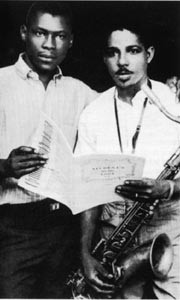
MARIN JAZZ WRITER and educator Grover Sales dubbed him “our greatest composer,” and the flood of recent CD reissues and tributes celebrating the 100th anniversary of the birth of Edward Kennedy Ellington show just how rich that legacy remains on the cusp of the 21st century. “[Duke Ellington’s] veiled, princely psyche, more complex than [Louis] Armstrong’s or [Fat] Waller’s, was given to philosophical turns and levels of sophistication uncommon for jazz musicians of his time,” Sales wrote in his authoritative work Jazz: America’s Classical Music (Prentice-Hall/Spectrum, 1984). “Duke’s uncanny coming to terms with commercial, racial, and internal pressures that collapsed less hardy peers from Fletcher Henderson to Charlie Parker has long been a source of fascination–and annoyance–to critics-spectators of the maddening clash between the Duke as artist and the Duke as a crowd-pleasing showman.”

The current focus rests largely on the Duke as artist. The Lincoln Center Jazz Orchestra, under the guidance of trumpet wiz Wynton Marsalis, has toured the country with a pair of Ellington programs (both of which stopped earlier this year at the Luther Burbank Center) and released the energetic PBS soundtrack Live in Swing City–Swingin’ with the Duke (Colum-bia), which included the delightfully obscure jazz stomp “Happy Go Lucky Local.” And this year’s San Francisco Jazz Festival featured Orchestral Ellington: A Centennial Celebration, a rare Oct. 22 performance of his sacred concerts. The monthlong festival wraps up its closing week Nov. 4 at the Palace of Fine Arts with a Jazz on Film program, A Portrait of Duke Ellington, hosted by producer Orrin Keepnews, who supervised the release of classic RCA recordings on the recent 24-CD box set of RCA material.

While there are a plethora of new and recent Ellington CD releases, geared to every budget, the complete RCA recordings (a more affordable three-disc sampler is available) is by far the most ambitious. Spanning Duke’s career from 1927 to 1973, the voluminous set kicks off with the landmark “Black and Tan Fantasy,” which marked the leap from such cornball novelties as “Animal Crackers” to the more impressionistic mood pieces to which Ellington would return over the years. The collection moves genially through classic Ellington fare like “Mood Indigo” and “Sophisticated Lady” to some truly unusual offerings–including a seldom-heard waltz-time version of “Take the ‘A’ Train” and 1966’s contagious go-go send-up “Blue Pepper (Far East of the Blues)”–all of which underscore Ellington’s remarkable ability to change with the times while remaining true to his musical vision.

THE RECENT ANTHOLOGY Impulsively Ellington! A Tribute to Duke Ellington (Impulse), a dynamic collection of Ellington covers, is one of the year’s best homages to the Duke. The list of players, all recorded between 1961 and 1966, reads like a Who’s Who of ’60s Jazz and includes such Ellington sidemen as saxophonists Johnny Hodges, Paul Gonsalves, and Ben Webster, all claiming the spotlight. The tunes range from swing master Lionel Hampton’s breezy “Ring Dem Bells” to free-jazz saxophonist Archie Shepp’s bold deconstruction of the Ellington chestnut “In a Sentimental Mood.” Highly recommended, and an suitable adjunct to the recently reissued Soul Call (Verve), a 1966 live concert that showcased Ellington’s knack for reinventing the jazz orchestra.

Meanwhile, jazz patriarch Ellis Marsalis last week released Duke in Blue (Columbia), which includes seductive solo renderings of such popular Ellington piano ballads as “Prelude to a Kiss” and “Melancholia,” some of the most beautiful music ever written.

“For all his crochets, quirks, and put-ons, Ellington could still astound, even to the last . . . ,” Grover Sales concludes in his 1984 book. “[H]e remained a prolific, often inspired composer and his piano an ever-increasing source of wonder. This magic, or hope of it, kept us coming back to Ellington to the end.”

And it still does.

From the November 4-10, 1999 issue of the Sonoma County Independent.

© Metro Publishing Inc.
Teen Mothers

0

Babies making babies: Maria Serrano, 16, hoists her 6-month-old son, Marco. Sonoma County is the only place in the greater Bay Area to clock an increase in teen births.

Sex Ed 101

Despite a $165 million state teen pregnancy prevention program, Sonoma County’s teen birthrate is on the rise

By Janet Wells

UP SEVERAL TIMES during the night to feed her 2-month-old daughter Marisa, Michelle Muniz sports the sleep-deprived look of a new mom: distracted, tired smile, eyes a little puffy. Her day starts at 5 a.m., getting Marisa dressed, then revolves around appointments, dirty diapers, feedings, studying, and cleaning house.

Pretty typical, except for the homework.

As Muniz hones her skills as a parent, she also bones up on 10th-grade math, English, and science. With a light-blue V-neck sweater, black stretchy bell-bottoms, and platform sneakers, Muniz looks every inch a high school sophomore. She had her baby in August, just two weeks after her 16th birthday.

“[The pregnancy] was unplanned,” the hazel-eyed Muniz readily admits. “It was my not being responsible with birth control.”

Muniz is well aware that her life is very different from most high-schoolers. She lives in a two-bedroom Rincon Valley apartment with Marisa’s father, 18-year-old Mario Onate, as well as his mother and her boyfriend. Graffiti adorn the complex fence, and shopping carts are overturned in the otherwise tidy side yard. Muniz relies on vouchers for milk, eggs, cheese, and infant formula to supplement Onate’s income from his job at a lumber company.

“My sister was a teen mother. I didn’t want to have kids, I wanted to wait until I was married. I saw how hard it was for her, but . . . ,” Muniz’s voice trails off, then becomes matter-of-fact. “I was looking for love and caring and support in all the wrong places.

“Well, not the wrong places,” Muniz corrects herself, pausing again. “I was going to get an IUD when I found out I was pregnant.”

Marisa is one of hundreds of babies born each year to Sonoma County teens. Compared to the statewide average of almost 57 births for every 1,000 teenagers, Sonoma County’s rate of just under 38 births per thousand puts it below the statistical red zone.

What has local educators and public health officials puzzled, however, is that while the state and national teenage birthrates fell for the sixth year in a row, Sonoma County’s teenage birthrate went up in 1997 (the most recent figures available), bucking the trend, and clocking in as the only county in the greater Bay Area to have an increase in teen births.

Santa Clara, Alameda, Mendocino, Lake, and Solano counties all have a higher birthrate than Sonoma County, but showed decreases of 3 to 18 percent in 1996-97. Napa, with a teenage birthrate of 34 per 1,000 teenagers, dropped an impressive 23 percent in one year. Even Marin County, with a statewide low of 19 teenage births per 1,000, still carved out a 10 percent decrease.

The state spends more than $165 million annually on teenage pregnancy prevention, and numerous programs on the local and federal level target teen pregnancy, with the goal of shrinking a phenomenon that has hefty social and economic consequences for the young parents, as well as for taxpayers.

According to a recent report on the consequences of adolescent risk-taking behavior, teen moms are less likely to complete school and more likely to be single parents. Children of teenage mothers are more likely to be in poorer health, have lower cognitive development, and have less success in school.

The estimated annual cost to taxpayers of births to young women ages 15 to 17 is at least $6.9 billion in public assistance, health care, foster care, court costs, and lost tax revenues.

THE TEENAGE birthrate is a touchstone for myriad social and cultural issues, and is carefully monitored by education and public health officials. So after a five-year decrease of about 10 percent, what happened in Sonoma County to make the birthrate go up by half a percent?

Statistical anomaly, says county Public Health Officer Dr. George Flores. “Sonoma County already had one of the lowest teen birthrates in the state. We don’t have as much to go down as the state would overall … although we still have room for improvement, don’t get me wrong,” he says. “We’ve had very good participation targeting teen and out-of-wedlock pregnancy and male responsibility.”

Some educators say, however, that the county’s mishmash of prevention programs offer inconsistent information and access. In addition, while some innovative programs get results, others are geared more toward what adults want teens to do and think, rather than toward teens’ needs.

“We have to provide them with information they can use,” says Cindy Dickinson, women’s health program coordinator at the Southwest Community Health Center.

“We’re wanting to make sure they get a comprehensive program that talks about abstinence as well as how to access family planning and how to prevent STDs and how to use a condom.”

California’s education code mandates that schools providing sex education stress abstinence first, and then heterosexual monogamy if teens are going to be sexually active. There is little standardization of sex education in Sonoma County’s public schools, with discussions of birth control and pregnancy as likely to be in science or social studies as in physical education class. Teachers have leeway in deciding how and what to present to students, and often invite outside educators to the classroom, which means that sex education comes from groups ranging from Planned Parenthood to those with more conservative agendas.

Muniz remembers hearing about birth control, sexually transmitted diseases, and HIV in middle school and in her freshman year of high school. But the admonitions didn’t resonate. Like many teens, Muniz had other things on her mind, with an adolescence complicated by family discord.

Her parents split up when she was 11, and, until her mother moved to Novato a few years later, Muniz shuttled between two homes. As a freshman, she dropped out of high school and moved out of her dad’s house, first to her grandparents, then to live with her boyfriend, three years her senior.

“There are no excuses for pregnancy, of course,” she says. “But If I were to be a normal student going to high school, that would have made a difference for me.”

Family is one of the unsung keys to preventing teen pregnancy, Dickinson says. “What’s really lacking, what we all want to work on, is getting parents involved in talking with kids, so parents know their kids are talking about sex and family planning, and kids know what parents are feeling about sexual involvement,” she says. “It seems that a lot of parents don’t have the skills to communicate.

“Kids are looking for information, looking to see if there’s someone they can talk to about sex,” Dickinson explains. “If they talk with their parents, it means they might end up postponing sex or using protection.”

THE FACTORS behind teen pregnancy are much more complicated than many educational policy wonks realize, says Marian Heath Benner, program manager for the teen pregnancy prevention program at the Sonoma County Office of Education.

“It’s an issue of poverty and an issue of crime and a political issue,” she says.

Teen pregnancy rates are highest by far among Hispanic teenagers statewide, with more than 100 pregnancies per 1,000. One of the teen pregnancy hot spots in the Bay Area is southwest Santa Rosa, which has a large Hispanic population.

“It’s a cultural norm, coming from the families, that it’s OK to have kids young, OK to be dating older men. That’s also exacerbated by poverty,” Heath Benner says. “Sometimes the only way out for these girls is to have a baby and get out of the house.”

Heath Benner’s program targets the southwest Santa Rosa area, with a five-year grant for seven elementary schools, Cook Middle School, and Elsie Allen High School.

At Cook Middle School, students talk about postponing sexual involvement during the weeklong “Baby, Think It Over” program that gives kids a reality check in the form of an 8-pound computerized doll.

Students lug the doll around for four days, trailing the usual baby accouterments–the ungainly diaper bag and stroller. “Baby” is programmed to cry at particular intervals, and if it wakes “Mom” or “Dad” up, they must insert a key in the doll’s back to turn it off. The internal computer registers neglect, shaking, or throwing as abuse.

Heath Benner took a doll home for her 16-year-old daughter to check out. “After an hour, she said, ‘Mom, can you watch this baby for me?’ These kids start getting the idea of what it’s like to have a baby.”

At the high school level the focus of Heath Benner’s program changes, responding to older teens who are becoming more sexually aware and curious.

“Health education has been coming through in the disease prevention-type model, the ‘If you do this, you’re going to get this. Here are the ways you can protect yourself.’ It’s the bad side of it,” Heath Benner says.

“We do the safer sex formula. The safest way is to abstain, but we acknowledge that we have a substantial population of high school students who are sexually active, and [we] want them to be safe. That’s why the relationship stuff is so important and birth control is so important.

“I started asking high school kids what they wanted to know,” Heath Benner adds. “They said, ‘How do you have a relationship? How do you break up with someone and stay friends?’ We try to focus on that, on how relationships are different, and issues around intimacy. We talk about how men’s and women’s brains are wired differently. They love that stuff. It makes lights go on for them.”

But the most effective birth control, says Heath Benner, is hope for the future. “A lot of kids don’t have a vision for themselves after age 20. They don’t see themselves at age 28 or 30. They don’t think, ‘If you have a baby now, what’s going to happen? How’s that going to derail your plans?’ ”

MUNIZ FITS the picture of an aimless teenager, who, by her own admission, spent time doing “stupid stuff” before she got pregnant. She credits Adera High School, a program for pregnant and parenting teens on the Elsie Allen campus in Santa Rosa, with getting her back on track. While she was pregnant, Muniz learned CPR and prenatal care, and got firsthand parenting experience taking care of babies left in the Adera nursery while their mothers went to class. She met other teens in her situation, and received encouragement and support to stay in school.

Now that she’s had the baby, Muniz is doing home study until Marisa is old enough to receive immunizations and go to school with her.

Muniz’s advice to other teens has the ring of experience to it: “It’s better to use protection if you do choose to have sex. If you get pregnant, that’s a bigger responsibility.”

She had to grow up fast, she says, and accept some drastic changes to her social life.

“Sometimes I feel like, ‘Can someone come and take her away for a day?’ But if I get frustrated when she is, she can feel my stress,” Muniz says. “I have to deal with it calmly.

“I gave up my friends,” she adds, her voice a little wistful. “Some of the closest stop by, but I haven’t talked to some since the first visit. What would they be doing for me anyway if they can’t handle me with a baby?

MARISA WAKES up and begins to fuss in her auto-rocking bassinet. “Is that a dirty diaper or is it a hungry bunny?” Muniz asks, picking Marisa up and swinging her brown-eyed daughter in the air.

“This is way more interesting,” she says, with just a hint of resignation, as she settles back onto the couch. “That was pointless then. I was a frisky little girl. I’m still a girl, but now I have a little baby, so I can’t be off the wall and do crazy stuff.”

Soon she and Marisa will be leaving the house at 6:45 each morning to catch a bus to Adera. For the first time, Muniz has a future in mind: graduation from high school in two years.

“It’s really important to get your education, especially if you have a little one to take care of,” she says, smoothing her daughter’s shock of brunette hair. “You don’t want to work at McDonald’s all your life.”

From the November 4-10, 1999 issue of the Sonoma County Independent.

© Metro Publishing Inc.

‘Hudson/Shaw/Wiley: Collaborations’

0

Three of a kind: Robert Hudson creates sculpture, painting, and prints in his Cotati studio. Both his solo work and prints created in collaboration with Richard Shaw and William T. Wiley can be seen at a new exhibit at the University Art Gallery.

Artful Alliance

A trio of veteran North Bay artists has turned collaboration into an art form

By Paula Harris

IT’S NO MERE CHANCE that three of Northern California’s best-known contemporary artists are once again sharing the spotlight. Robert Hudson, Richard Shaw, and William T. Wiley are longtime buddies (we’re talking decades here) and creative cohorts. Now an upcoming exhibition at the University Art Gallery at Sonoma State University–“Hudson/Shaw/Wiley: Collaborations”–will feature a series of prints created by the trio, as well as individual pieces by each artist.

“It’s a unique opportunity to see these artists collaborating together and to see some newer pieces by each one individually mixed in,” promises art gallery director Michael Schwager. “It should be a really exciting show, [with] lots of things to look at. It won’t be spare or minimal by any means–this will be an explosion of color and imagery!”

These richly layered prints, dense with textured patterns, surreal images, and passages of text, were dreamed up collaboratively in what the artists have described as a creative “free-for-all” at Magnolia Editions, an Oakland-based print publisher, during a six-month period in 1997.

The prints are primarily collagraphs–a technique that allows artists to make unique and complex print images from a wide range of objects adhered to blocks on an etching press–with various other media, such as graphite and collaged elements.

The trio’s history runs deep–all the way back to childhood in the case of Wiley and Hudson, who grew up in Washington State together.

“I’ve known Wiley since the fourth grade in 1948 or so,” says Hudson, 62, who lives in Cotati. “We went all through high school together and attended the San Francisco Art Institute together in the 1960s. That’s where we met Richard Shaw.”

Their bond has been strong throughout the years. Shaw and Hudson recently collaborated on a series of porcelain sculptured vessels, shown at San Francisco’s Yerba Buena Center, that was made during a residency at the Addison Gallery of American Art at Phillips Academy outside Boston.

Shaw and Hudson also recently participated in the media-attention-grabbing exhibit at the Oakland Museum, presented by Wiley and fellow artist Mary Hull Webster and provocatively titled “What Is Art For?,” which bluntly questioned the roles and relationships of museums, artists, and museum-goers.

According to Schwager, the three artists have in the past been loosely connected to the spontaneous, surrealist Bay Area Funk movement. “Although all of them bristle when you bring up whatever ‘ism’ they’re part of,” he observes with a laugh.

Ask Hudson to comment and there is a shade of resentment in his voice. “We’ve been kind of pigeonholed into [the Funk movement],” he says, eager to dismiss the subject. “It’s been hard to deal with.”

Vet.

Essentially, says Schwager, what all three have in common is a sense of irony and satire in their work. They use puns in their titles and inject some humor into their collaborated pieces, but individually their work is distinct.

Versatile and prominent artist Wiley possesses a Zen-like philosophy (which some have dubbed “dude ranch Dada”) and uses an extensive set of symbols and motifs that has both universal and personal meanings in his work. His art often responds to real-life tragedies and disasters, but he also tends to use puns in his titles. Indeed, Wiley is given to word games and frequently includes texts and stories he’s written within his artwork.

Often, too, Hudson’s creations make references to nature and to Native Americans: “[Hudson] was very inspired by Native American symbols and colors when he grew up,” says Schwager. “But it’s really kind of a hodgepodge of all sorts of things, including sculpture and painting and ceramics–always very colorful.”

Shaw has been identified as a leading ceramic artist. He is a master of trompe-l’oeil illusionism. For example, one of his works features a series of 4-foot-tall walking-stick figures that appear to be entirely fashioned from twigs, sticks, and playing cards–but on closer inspection are actually assembled from clay.

“The three artists have different techniques, but they all share a similar sensibility,” says Schwager. “The collaboration which forms the bulk of the exhibition is a joining of all these different sensibilities, the idea of putting together all sorts of images. What’s interesting is some pieces in the collaboration look truly like a little bit of each of them is in there in equal parts–yet in others one artist’s image dominates, and you can really recognize that maybe one idea started with Richard or Wiley and the other two kind of joined in.”

Hudson, who instigated the SSU exhibit, calls the collaboration a real learning experience. “There are some similarities in our work but also plenty of differences–that’s what made it nice working together because one thing would lead to another thing and then someone would get an idea and we’d just have an open run at the drawings,” he recalls. “We usually had about four or five of them going at the same time.”

The result is a very complex dense overlay of different representations. For example, an intricate piece entitled Diecon, features a skeleton from an anatomy book, various textures and patterns, and hand drawings, amid spatters of color.

Another print features a central image of a Heineken beer coaster, photographs of unidentified folk circa 1935, a collage, a painter’s palette, and a snow scene from Japan that may have come from a postcard.

“These mixtures of images are drawn from various places and put together,” says Schwager. “The different elements don’t have an obvious association–but by the time Hudson, Shaw, and Wiley have finished with them, the pieces end up being quite magical.”

“Hudson/Shaw/Wiley: Collaborations” opens with a reception for the artists on Thursday, Nov. 4, from 4 to 6 p.m., and runs through Sunday, Dec. 12, at the University Art Gallery, SSU, 1801 E. Cotati Ave. Rohnert Park. The gallery is open Tuesdays through Fridays, 11 a.m. to 4 p.m.; and Saturdays and Sundays, noon to 4 p.m. Admission is free. For details, call 664-2295.

From the November 4-10, 1999 issue of the Sonoma County Independent.

© Metro Publishing Inc.

Holiday Wines

0

Talkin’ Turkey

Select the ‘perfect’ wine this Thanksgiving

By Bob Johnson

‘TIS THE SEASON. No, not that season. Not quite yet, anyway. ‘Tis Thanksgiving season. So let’s talk turkey. And stuffing. Not to mention mashed potatoes, giblet gravy, cranberry sauce, candied yams, and corn bread. Selecting a wine for the Turkey Day dinner table is akin to selecting a wine in a smorgasbord. In a word, it’s impossible. Take away all the side dishes and you still have a challenging decision to make. A roast turkey with corn-bread stuffing and a cream gravy calls for a chardonnay or sauvignon blanc. But that same formerly feathered friend with a sausage stuffing and pan gravy would be better complemented by a red wine such as syrah or zinfandel.

Toss in the flavors and spices and textures of the aforementioned sides, and you have a sensory explosion that no single wine could possibly stand up to. As this realization has solidified in my brain over years of fruitless searching for that “perfect” Thanksgiving wine, I’ve learned to think plural, as in multiple bottles of vino.

And since Thanksgiving is about family and hearth (not to mention girth), I also like to open homegrown wines on this special day.

See if this strategy would work for you . . .

Start with one bottle of white wine and one bottle of red. I recommend chardonnay and pinot noir because most people like these varietals, and some outstanding examples are crafted in Sonoma County.

Among chards, you can’t go wrong with (in order of ascending price) Belvedere (Sonoma County), Geyser Peak (Russian River Valley), Sapphire Hill, Armida Reserve, Sonoma-Cutrer (Les Pierres Vineyard), or Kistler (Sonoma Coast).

For a pleasing pinot, look for Mark West, Alderbrook, Davis Bynum Limited Edition, Stonestreet, or Williams-Selyem.

Since the Thanksgiving meal is protracted, to say the least, figure on one bottle of wine for each two diners. If two bottles won’t suffice, add two more, a sauvignon blanc and a zinfandel.

Superb sauvignon blancs are made by Taft Street, Quivira (the Reserve rendition is striking), Dry Creek, and Hanna.

Zesty zins from Sonoma County are too numerous to mention. A short list would include Seghesio, Rabbit Ridge, Murphy-Goode, Fritz, Nalle, and Deerfield Ranch. (Tip: If it says Dry Creek Valley on the label, chances are there’s tasty juice inside the bottle.)

Wine Time: A can’t-miss holiday four-pack.

IF YOU DREW the short straw and also are hosting the in-laws, you’ll need still more wine. The next types to add would be a gewürztraminer and a syrah (a.k.a. shiraz).

The best gewürz in the county is made by Alderbrook, a contention supported by the sweepstakes award bestowed upon the ’98 vintage at the recent Harvest Fair competition. Need more incentive to try it? You can buy it for less than nine bucks.

Syrah/shiraz shoppers should seek out releases by Cline (a Harvest Fair gold medal winner), Geyser Peak (always dependable), or Clos du Bois (which just released a Reserve Shiraz that is wonderful).

What about merlot? you ask.

What about it? I retort.

Yes, merlot is extremely popular right now. Yes, some people drink it daily. And, yes, local vintners (Mietz, Pezzi King, Lambert Bridge, St. Francis, and Matanzas Creek, among many others) do an excellent job with it.

But because it has become ubiquitous, it has lost some of its specialness. And the Thanksgiving table deserves to be populated by special wines for the special people who will be consuming them.

Need yet another red? Try a petite sirah, a grenache, or a mourvedre.

Still lacking a sufficient supply of white wines? Add a viognier, a chenin blanc, or a Riesling. With a little shopping, you can find local renditions of all three varietals, not to mention some enticing blends.

So when you set the Thanksgiving table, put two or three wine glasses at each place setting, uncork all the bottles you’ve selected, and let your diners have at it. Take the pressure off yourself, and let them make the food-and-wine pairing decisions.

And if you get any complaints, you’ll know who not to invite next year.

From the November 4-10, 1999 issue of the Sonoma County Independent.

© Metro Publishing Inc.

Hate on the Internet

0

Web of Hate

Local forum reveals how the Internet helps spread racism

By Yosha Bourgea

FINDING RACISM on the Internet is easier than you might think. On a recent visit to yahoo.com, one of the most widely used search engines, all it took was inputting the word white, which when entered immediately brought up an extensive list of white-supremacist websites. At the top of the list was the site for the American Nazi Party, an organization based in Eastpointe, Mich., and that caters to angry Caucasians.

“Bold action is the only way to shock White people awake,” according to the website’s manifesto–that and apparently the caps-lock button. “Too many others would rather try to TALK the problem away,” the ANP homepage reads, “while we realize that the time has come to FIGHT!”

From the ANP site, interested parties can access a list of literally hundreds of white-supremacist websites, from Stormfront (which provides German and Spanish translations of its propaganda, and claims to have accumulated more than 2 million “hits” since 1995) to various distributors of Nazi art and swastika jewelry, and from “pro-White country music” to the Aryan Dating Page, where lovelorn racists can place personal ads without fear of accidental miscegenation.

One website consists solely of a photograph of Adolf Hitler, with the caption: “This time, no more Mr. Nice Guy.”

The increasing presence of such material on the Internet, as well as its easy accessibility–significantly easier, for example, than finding pictures of naked women–has not gone unnoticed by more inclusive citizens’ groups, who worry about its impact on impressionable children and teenagers. Is there a difference between hate speech and free speech? How, if at all, should racist rhetoric on the Net be controlled?

Those questions and others will be addressed Nov. 5 at “Hate on the Internet,” a forum sponsored by the Hate-Crime Prevention Network of the Sonoma County Commission on Human Rights. The seminar–featuring speakers from such watchdog groups as the Anti-Defamation League as well as the FBI and the Department of Justice–will touch on how the Internet is being used by extremist groups to disseminate information and widen their support base.

“We know the Internet is one area where there is a rapid increase in information that is preaching hate,” says Lorene Irizary, director of the county Commission on Human Rights. “We need to be aware of what’s being said and suggested.”

THE FIRST RACIST website went up in 1995. Four years later, Jonathan Bernstein of the Anti-Defamation League estimates there are close to 400 full-time sites–including websites targeting preteens–although the actual number is probably higher. From traditional groups to newer organizations, the racist right has quickly discovered the power of the Internet.

“What is happening is that parents are extremely naive about what their kids can find on the computer,” says Bernstein, one of the speakers at the seminar. “It makes TV look innocent.”

Taking a cue from crusaders against Internet pornography, the ADL has developed a “hate filter” program that parents can use to block sites with key words or images of hate.

Bernstein, a regional director of the ADL, knows how serious the threat of racism can be. A man whose job regularly takes him close to hatred, Bernstein once found himself between the crosshairs when the leader of an Oklahoma militia group targeted him for issuing a report about the group’s threats against the federal government. The leader was arrested with bomb-making equipment and videotapes of Bernstein, whom he had been planning to kill the next day.

“The FBI was on top of things, but I got a better appreciation of what it means to be a hate-crime victim,” Bernstein says.

The essential message of racism, which begins by establishing the notion that there are different races of Homo sapiens in the first place, doesn’t change. But the way it’s packaged does. “The Klansman who once had trouble reaching a hundred people with a poorly printed pamphlet can now do it much easier,” says Mark Potoc, director of publications and Information for the Southern Poverty Law Center.

Potoc, who edits Intelligence Report, an investigative news magazine that covers the radical right, also will speak at the seminar. “These formerly isolated supremacists turn on the computer in the morning and now feel that they are part of a ‘happening’ movement,” he adds.

The tactics that online bigots use to appeal to kids include racist crossword puzzles, coloring pages, and even video games. For more literate users, there are sites that offer “evidence” that the Holocaust never happened, presented in dispassionate language and bolstered by sources and statistics that look impressive at first glance. Rebellious teenagers, says Potoc, are attracted to the idea that these official-looking websites have information that more conventional society ignores.

“This is a group–college-bound youth–that [until now] hadn’t been reached by the racists,” Potoc says. “White-supremacist groups are looking to develop their leadership cadre for tomorrow, and they have more interest in reaching the brighter kids.”

While Potoc has nothing against the ADL’s hate filter, he argues that it is a weak preventative measure and no substitute for parental involvement. Kids, he says, will find the information whether it’s forbidden or not–just as they do with pornography.

“Are you gonna spend your years as a parent searching your kid’s room for Playboy in the closet, or are you going to sit down and talk to your kid about respect for women?” Potoc asks rhetorically.

“The only inoculation [against hate] is parents talking to their kids.”

The “Hate on the Internet” seminar will be held on Friday, Nov. 5, from 8 a.m. to 5 p.m., at the Courtyard by Marriott in Railroad Square, Santa Rosa. To register, contact the Sonoma County Commission on Human Rights at 565-2693. The registration fee is $25 and includes lunch and materials

From the November 4-10, 1999 issue of the Sonoma County Independent.

© Metro Publishing Inc.

Cookbooks

On the Shelf New cookbooks cater to every taste By Greg Cahill and Marina Wolf The Rose Pistola Cookbook Broadway; $35 By Reed Hearon and Peggy Knickerbocker SINCE ITS OPENING in 1996, the Rose Pistola in San Francisco has been a focal point of the burgeoning...

Wine Country Cuisine

Blurring the borders of regional food. Or just what the heck is wine country cuisine? By Marina Wolf CERTAIN regional-based food fads have come and gone--from blackened Cajun everything to red-hot Southwest machismo--yet the hyper-awareness of American regional food is reaching an all-time high. Regional showcases, symposiums, and culinary tours--including the Fine...

The Hill Guides

The Hills are alive . . . and they're writing travel guides By Yosha Bourgea KATHLEEN HILL was in a bookstore in Seattle one day, browsing through the travel and cooking sections, when she noticed there were no books on the Sonoma Valley area. It got her thinking about the advice her late...

Live Organ Donation

Holding her own: Diagnosed with advanced kidney disease, local author and grief counselor Sukie Miller has had several friends and relatives consider the possibility of making a living donation of one of their kidneys. But so far none has panned out. Living Gifts Thinking about donating organs after your death? How about...

Tierra Vegetables

Some like it hot: Tierra Vegetables is a little on the chili side. Burning Desire Tierra Vegetables champions the chipotle By Marina Wolf "OH, NOW LOOK at those!" says Lee James of Tierra Vegetables, reaching into the low-lying tumble of pepper plants and plucking out a reddish-purple fruit....

Duke Ellington

For Duke CD tributes celebrate Ellington's centennial By Greg Cahill MARIN JAZZ WRITER and educator Grover Sales dubbed him "our greatest composer," and the flood of recent CD reissues and tributes celebrating the 100th anniversary of the birth of Edward Kennedy Ellington show just how rich that legacy remains on the cusp...

Teen Mothers

Babies making babies: Maria Serrano, 16, hoists her 6-month-old son, Marco. Sonoma County is the only place in the greater Bay Area to clock an increase in teen births. Sex Ed 101 Despite a $165 million state teen pregnancy prevention program, Sonoma County's teen birthrate is on the rise By...

‘Hudson/Shaw/Wiley: Collaborations’

Three of a kind: Robert Hudson creates sculpture, painting, and prints in his Cotati studio. Both his solo work and prints created in collaboration with Richard Shaw and William T. Wiley can be seen at a new exhibit at the University Art Gallery. Artful Alliance A trio of veteran North Bay artists...

Holiday Wines

Talkin' Turkey Select the 'perfect' wine this Thanksgiving By Bob Johnson 'TIS THE SEASON. No, not that season. Not quite yet, anyway. 'Tis Thanksgiving season. So let's talk turkey. And stuffing. Not to mention mashed potatoes, giblet gravy, cranberry sauce, candied yams, and corn bread. Selecting a wine for the Turkey...

Hate on the Internet

Web of Hate Local forum reveals how the Internet helps spread racism By Yosha Bourgea FINDING RACISM on the Internet is easier than you might think. On a recent visit to yahoo.com, one of the most widely used search engines, all it took was inputting the word white, which when entered...
11,084FansLike
4,446FollowersFollow
6,928FollowersFollow