
Sonoma Antique Apples

0

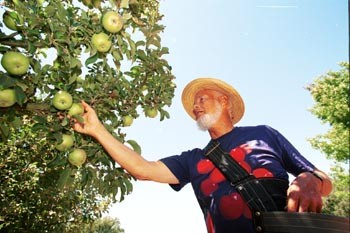
Picky, picky: Terry Harrison of Sonoma Antique Apples in Healdsburg has traveled throughout the United States in search of obscure apple varieties..

Antique Apples

Heirloom apples forgotten, but not gone

By Marina Wolf

NEXT TIME you’re at the grocery store, pay attention as you pass by the apples. Red, green, and yellow, maybe green with red stripes, right? Now, don’t buy anything. You know what they taste like. Instead, sit down and read a few excerpts from The Book of Apples (Ebury Press, 1993) and ponder the possibilities:

Ashmead’s Kernel: “Strong, sweet-sharp intense flavour reminiscent of fruit or acid drops and of Nonpareil [another apple], but sweeter than its probable parent. Firm, white flesh.”

Duchess of Oldenburg: “Very beautiful, boldly striped and mottled in red over pale yellow with bloom. Savoury, quite brisk, juicy, soft, deep cream flesh. Cooks to very lightly flavored purée.”

Reinette Rouge Étoilée: “Vivid flush and star-shaped russet freckles account for name. Intense, quite sharp flavour of raspberries; juicy firm flesh, often stained pink under skin and around core. With keeping, becomes drier, sweeter, and flavour seems almost distilled into raspberry essence.”

These are just three of the more than 2,000 varieties described in The Book of Apples, which catalogs the holdings of just one horticultural orchard in England. On the other side of the Atlantic, the New York State Agricultural Experiment Station in Geneva, N.Y., has either germ plasm or actual trees representing close to 4,000 varieties and records the existence of over 7,000.

Such numbers raise the question: Where have all the apples gone?

“Asking where the heirloom apples have gone is like asking where the Model Ts are,” says Tom Vorbeck, owner of Applesource, an apple-tasting service based in Illinois. “They’re still around, but they’re never going to be in significant commercial production again.”

“Significant commercial production” is perhaps a subjective phrase, as it turns out. A particular apple may have been all the rave for English Victorian garden parties, or it may have been the premier cider apple all along the Eastern seaboard in the late 1700s. Some apples have been in recorded cultivation for several hundred years. But in all that time, no one apple, or even half a dozen apples, ever dominated the market.

Before they were heirloom, these apples were grown either in home orchards for home consumption or on relatively modest-sized farms for local markets. The technology didn’t exist yet to keep them for very long; consequently, apple varieties were once nearly as seasonal as good peaches, with the first arriving in early August and the very last stalwart keepers ripening into perfection well into spring. Apples were chosen not only for their harvest dates and keeping properties, but also for specific end uses–hard and nonalcoholic ciders, sauces, pies, preserves, and a full menu of flavors and textures for eating fresh at the end of a meal.

By the mid-1900s, though, the many varieties of apples had lost much of their significance for people who had neither the space nor the time to make their own cider and applesauce, let alone grow their own food. Instead, people went to supermarkets, where, even in the produce department, appearance and packing determined shelf placement, stock rotation, and sales. Apple breeders searched out uniformly pretty and “inoffensively flavored” specimens–Red Delicious being the most (in)famous, and the public ate them up: at the height of their popularity in the ’60s, ’70s, and ’80s, around 50 million boxes of Red Delicious apples were being shipped out of Washington state each year.

“Most Americans buy with their eyes, not with their taste buds,” says Hoyt Adair, owner of the Classical Fruits nursery in Moulton, Ala. “You put Spitzenburg on the shelf, no one would buy it.”

Reportedly one of Thomas Jefferson’s favorite apples, the Esopus Spitzenburg has an acclaimed flavor. The Book of Apples calls it “rich [and] fruity,” with “lots of character.” As often happens, one person’s character is another’s character flaw: the Spitzenburg also suffers from a condition called russeting, or rough patches.

OTHER OLD-TIME apples certainly have their share of flaws that have proven fatal in the world marketplace. For starters, not all old apples taste that good.

“Just because you find something in an old orchard doesn’t mean it’s great,” says Terry Harrison of Sonoma Antique Apples in Healdsburg. The Harrisons have traveled the country to investigate apples, but they’ve left more than a few behind. “Some we didn’t collect because we didn’t think they were good enough.”

Even if an apple tastes great, it may produce lightly, erratically, or only every second or third year–all problems for a farmer who needs a regular, predictable crop for income. Others aren’t strong enough for weather extremes or are too susceptible to diseases (although there exist some heirlooms that have remarkably high resistance to the diseases indigenous to their region). Delicate or smaller apples such as the perfumed Lady apple have naturally higher labor costs, being more time-consuming to pick. The Gravenstein, a regional favorite in Northern California, where it was brought by Russian explorers in the early 1800s, nonetheless is like many old-time apples in not keeping well. Others have the reverse problem: they keep too long, requiring long storage to mellow, a disadvantage in our culture of instant gratification.

But the increasingly gourmet tastes of America, not to mention a heightened interest in local agricultural specialties, have fueled a renewed interest in these apples, say growers. “People are starting to realize that they don’t want beautiful apples. They want a good-tasting apple,” says Sam Benowitz, owner of Raintree Nursery in Morton, Wash. “We’re lucky to have a really terrible apple [the Red Delicious] as the standard. It makes people really interested in other varieties.”

IN RESPONSE, growers and breeders are moving their wares to a very modern arena and putting their catalogs on the Internet. But to cultivate new consumers, they rely on a very old-fashioned event: tastings. Hoyt Adair in Alabama now has close to 1,000 visitors during his tasting event. And the Harrisons of Sonoma Antique Apples get several hundred people to try 35 different apples at their tasting in early October.

“Apple tastings are really the best way that people find out about these apples,” says Carolyn Harrison.

Most growers agree that America’s new longing for old-time tastes has as much to do with nostalgia as it does with flavor. “Nostalgia plays a large part,” says Judy Wells of Southmeadow Fruit Garden, in Baroda, Mich., home of more than 300 apple varieties. “We get so many calls from people that start, “Grandma had a tree in her front yard, and it was the best apple.’ ”

But if Grandma moved to the suburbs and commercial sales are impossible, where does that leave the apples? Right where they were 100 years ago: firmly in the hands of a few farmers and dedicated home orchardists. “You can put them in a preservation orchard or save their germ plasm,” says Carolyn Harrison. “But if you want to really keep them alive, you’ve got to get them out there in everybody’s orchard.”

From the August 10-16, 2000 issue of the Sonoma County Independent.

© Metro Publishing Inc.
Zero-Tolerance Policies

Running Scared

Public schools practice less-than-zero tolerance

By Sarah Cottrell Stokes

WHAT IF you were an artist in high school? And you were putting together your portfolio for acceptance into art school, working hard to represent yourself with different styles, all recognized by other serious and professional artists? What if someone then told you your work was threatening, assuming that you might even be a danger to your fellow students, and took you out of school for the remainder of your senior year?

It’s hard to imagine, but 17-year-old Sarah Boman, an honor student at Bluestem High School in Leon, Kan., faced this very situation just a few months ago.

It started with a piece of artwork she posted on the door. It was done in a style known as “repetitive art” in which the artist spirals words from the center outward. Boman’s graphic piece detailed the psychotic ramblings of a schizophrenic man obsessed with finding out who killed his dog. “I did it in the last 10 minutes of school, during tutorial–I just took it and hung it on the [art classroom] door. I did that with a lot of my work,” Boman says.

The next day, a school office employee saw the work and immediately took it down, according to Boman. It was brought before the principal. The principal felt it was inappropriate, even threatening, and Boman was called in for questioning.

During the meeting, Boman was allowed to go to the bathroom. “I took the original and tore it up and flushed it down the toilet. I was so scared. I never got in trouble before,” Boman says.

She was told the school operated under a zero-tolerance policy for violence. She was suspended for five days and was allowed to return to school only after a hearing with the school board.

Boman went home and called her mom. “I told her, ‘I think I’m going to be arrested for a piece of artwork I did.’ ” Boman wasn’t arrested, but that day was the beginning of a fight that involved the American Civil Liberties Union, the school board, and the U.S. District Court House in Wichita, Kan.

First, three representatives of the school board, gathered to hear what had happened and to hear people defend her. Thirty people showed up, including her parents and her sister. While the board agreed that Boman wasn’t dangerous, it refused to allow her to return to school.

“They decided I wasn’t a threat, but in case anything happened they didn’t want to be held responsible,” Boman says. She didn’t get officially expelled, but she received a suspension of 81.5 days–the rest of her senior year, exactly.

“I couldn’t believe it,” Boman says, remembering the moment vividly. “I told them that I would do anything to get back in school. I told them that I would take a psycho test. I would paint backdrops for the school plays. Anything to get back in.”

SINCE the school board wasn’t going to let that happen, Boman asked for help from the ACLU, who got her a lawyer, Paul Rebein. They began a negotiation with the school board, during which Boman and several other witnesses testified for her. Jill Eggers of Wichita State University and Mary Kay of Bethany College, both women artists with a master of fine arts degree, were among her supporters.

Boman’s hometown also rallied around her. “There were people outside with signs and they were singing ‘Kumbayah.’ The whole town wore yellow ribbons. A lot of people didn’t understand the [art] piece itself, but they know me. They thought the school went overboard.”

During this time, Boman’s initial fear turned into a sense of injustice. “I felt that the school board was trying to use me as an example,” Boman says. “I’ve never been in trouble. I’m a straight A and B student. They all know who I am and what I’m about–they know that I’m not a threat and that I am a serious artist. But at that point they didn’t really care.”

Boman’s legal counsel agreed. Once they felt they had built a strong enough case in Boman’s favor, they went before the U.S. District Court for a preliminary trial. Judge Wesley E. Brown heard from both sides and decided not to send it to trial.

“The judge said that I should go back to school and that the five days of original suspension was punishment enough. Anything further was basically uncalled for and really not legal,” Boman remembers. Judge Brown told the school board they were right to pursue the situation, but should have known within 15 minutes that Boman did not present a threat.

BOMAN immediately returned to her senior year. But things were not quite back to normal. “I didn’t expect anything would change, but some people were kind of mean,” Boman admits. “As time went by, people loosened up. I think there were kind of hard feelings. I don’t know if some people felt that maybe the judge ordered the wrong thing–I’m not sure what it was, really.”

Now Boman is looking forward to starting this fall at Bethany College in Lindsborg, Kan., where she has received a scholarship and plans to study (of course) art. “I’m very much looking forward to college. You can explore every realm of being without having to worry about limitations, about the way things are going to be perceived. People are more open-minded. You can focus on improving the meaning behind your art.”

The experience may be behind her, but Boman says that her art continues to be influenced by what happened. “I used to draw people scared of clowns and weird creatures. All I’ve drawn since I got back is people.”

Things have settled down, and Boman seems pleased about where her life is now headed. Remembering something Judge Brown told her the day of her preliminary trial, Boman gets serious.

“He told me not to prove him wrong. He said, ‘Young lady, you and your father know that today you received justice. Now it’s up to you to calm things down.’ ”

With a bright future ahead of her, Boman is doing exactly that.

From the August 10-16, 2000 issue of the Sonoma County Independent.

© Metro Publishing Inc.
The Great Voucher Debate

0

Ballot Primer

Getting ready for Prop. 38 and the great voucher debate

By Tate Hausman

LOOKING for a new blood sport? Then try this fun experiment: Enter a crowded room of education reformers, experts, professors–maybe even senators–and yell, “Vouchers!” If you don’t get trampled in the ensuing fray, you’ll be treated to quite a show.

Listening to some education policymakers, the average observer might think that the Great Voucher Debate represents a full-scale Armageddon, where the righteous are violently battling the wicked over the future of American public schools. The very term voucher has become a hollow buzzword that kills intelligent debate.

What the rhetoric fails to explain, of course, is what exactly vouchers are all about, and why the public–including California voters, who will vote for the first time on the issue when Proposition 38 hits the ballot in November–should either support or condemn them. The following voucher Cliff Notes, including key definitions of the terms used by policymakers and the media, should properly arm you with the jargon and opinions necessary to fling yourself headlong into the Great Debate.

Definitions:

* Voucher: A fixed amount of public money–usually about $2,000 to $3,000–that a state or school district gives to parents to enable them to send their children to private schools. The voucher pays for some or all of a private-school tuition, and the parents pay the remainder. Voucher plans have been implemented, with varying degrees of success, in Wisconsin, Vermont, Ohio, and Maine, and have been suggested or planned in many other states. Also called “tuition vouchers,” “tuition choice plans,” or “public scholarships.”

* Private Scholarship Program: Identical to a voucher system, but funds come from private philanthropists and foundations instead of from taxpayers. More than 30 cities, including Indianapolis, Cleveland, Washington, New York, and Los Angeles, have private scholarship programs.

* Donor Tax Credits: Income tax credit–usually around $500–given to anyone who donates money to private scholarship foundations or public schools. Would encourage private voucher programs at public expense.

Arguments for vouchers:

1. All children, regardless of their class background, deserve the opportunity to attend good schools. Vouchers would allow any child to attend a private school, which is better than a public school.

2. Introducing vouchers into the school system will make education a consumer good. This will naturally create competition in the market, which will create better schools. Bad public schools will either lose all their funding and close or be forced to improve their “product.”

3. Vouchers will give low-income parents–especially minorities–some leverage in the monolithic system that dominates their children’s lives. Since public schools, even in the inner city, are disproportionately controlled by middle- or upper-class whites, vouchers would give lower-class and minority parents the economic clout they desperately need to have a voice in their local schools.

4. The government never uses funds as efficiently as the private sector. Diverting public funds into private hands will stretch taxpayer dollars further.

5. By not allowing public funds to go to sectarian schools, the government is impinging on the freedom of parents to express their religious views, in violation of the First Amendment.

6. Any change in public education is good change since it challenges the status quo and creates innovation. Public education is too protected by its own inertia and bureaucracies, notably teachers’ unions and school boards. Vouchers will upset that inertia and create positive change.

7. Many public schools are unsafe. All children deserve to learn in the safe, drug-free, disciplined environments that private schools offer.

Arguments against vouchers:

1. Private schools are not necessarily better schools–in fact, they can be tuition-hungry diploma mills that allow lax discipline and poor academic standards in return for high tuitions and parental donations.

2. Competition in and between schools means cutting costs to produce cheaper, easier products. If schools are always concerned about their bottom lines, they will be tempted to reduce staff, to buy low-quality, cheap materials, to increase teachers’ burdens, and to pay teachers less–all of which have been proven to impinge on good teaching.

3. Vouchers will transfer too much power into the hands of consumers, whose decision to exploit the vouchers will undermine public school teachers and administrators by significantly decreasing their funding.

4. Diverting much-needed funds from already strapped public schools will only damage public education. Public schools need more support from our treasuries, not less.

5. Most private schools (in some states as many as 90 percent) are religiously affiliated–largely with the Catholic Church. Through vouchers, public money will inevitably be used in religious schools, violating the principle of the separation of church and state.

6. Vouchers will threaten the job security of many underpaid, overworked teachers, especially the most dedicated ones working at the toughest inner-city schools. Good teachers will be shuffled from school to school at the whim of a highly volatile market, destroying their ability to teach effectively.

7. Studies have shown that private schools are not necessarily any cleaner than public schools. Discipline, safety, and drug abuse depend on the administration of the school, not its funding sources.

From the August 10-16, 2000 issue of the Sonoma County Independent.

© Metro Publishing Inc.
Usual Suspects

In Recovery?

Is local law enforcement warming up to advocates for the mentally ill?

By Patrick Sullivan

IS A THAW developing in the icy relationship between Sonoma County law enforcement and advocates for the mentally ill? Alarmed by a rash of jail suicides and police shootings involving the mentally ill over the last few years, activists have frequently accused local police and the Sonoma County Sheriff’s Department of not understanding the special challenges posed when law enforcement officers confront victims of mental illness. But now representatives of the Sonoma County chapter of the advocacy group National Alliance for the Mentally Ill are getting two unprecedented opportunities to make their case to law enforcement officials, and one NAMI representative calls the situation “hopeful.”

On Aug. 4, NAMI representatives delivered a special presentation to the Sonoma County Law Enforcement Chiefs’ Association. The three-member NAMI team urged the gathering of local police chiefs and Sonoma County Sheriff Jim Piccinini to improve training for law enforcement officers to help them deal humanely with the mentally ill in arrest situations.

The U.S. Department of Justice estimates that more than a quarter million inmates in America’s prisons and jails suffer from mental illness, according to NAMI, and both police and jail guards frequently face difficulties dealing with the mentally ill. In Sonoma County, such problems have led to at least five suicides or suicide attempts by inmates at the Sonoma County Jail since 1996. Advocates charged that inmates were poorly evaluated for special mental health needs and denied medication.

The NAMI team, which included a representative from the organization’s Sacramento office, urged the chiefs and the sheriff to take advantage of training that NAMI makes available to law enforcement agencies. The speakers also urged Sonoma County law enforcement to implement special mental-illness emergency response teams modeled on a program in Memphis, which NAMI says has been very effective in reducing mortality in arrests of the mentally ill.

“NAMI has been working with police departments around the country with very beneficial results,” explains Nora Ernst, former NAMI vice president and the group’s current Forensic Committee chairman.

Though the team had only 15 minutes on Aug. 4 to make its case, both NAMI members and at least one chief came away with positive impressions.

“It feels really hopeful to me, but we don’t have anything definite set yet,” explains NAMI president Sharon Barrett. “My impression was that Sheriff Piccinini was pretty open. He seemed interested and was asking questions.”

Piccinini did not return calls requesting comment, but Petaluma Police Chief Pat Parks says he thought NAMI offered useful information. Parks added that he’s open to considering bringing the organization’s training program to Petaluma.

“There is definitely a need in law enforcement for additional training for issues around the mentally ill,” Parks says. “Any training that we can bring to our respective organization would have a benefit, provided it’s by knowledgeable presenters.”

On a less positive note, Ernst says she does wish her team had been offered more time. And she wishes more chiefs had expressed interest in NAMI’s training proposals.

“We had two requests for more information,” Ernst says. “It was hard to judge in 15 minutes how we were received, but at least they know that there is an organization that can help with training and information. This is the first time we’ve ever been asked to address the chiefs, so we see this as a very positive step.”

THIS WEEK also saw NAMI score a rare tour of Sonoma County’s Main Adult Detention Facility. Piccinini approved the tour, which allowed a large NAMI team to inspect the jail.

Feedback from the tour should be available next week, but speaking in advance, Ernst explained what the team was looking for. Members have closely inspected a recent report by the state’s Board of Corrections report on jail conditions in Sonoma County.

“NAMI is particularly concerned with the mental health unit and the new health-care contractor,” she explained. “I have studied the Board of Corrections report in detail, so I will be looking for things like how the cameras work, the size of the cells people are kept in, and how observations are conducted.”

Ernst had originally invited members of the media, including reporters from the Sonoma County Independent and the Press Democrat, to tag along on the tour. But she says Piccinini nixed that idea after Ernst sent him a list of names of those going on the tour.

“He said that if the media wanted their own tour, they could set that up separately from ours.” Ernst explained.

In the past, Piccinini has denied such requests from the Independent following a series of articles critical of health care at the jail. Calls to Piccinini attempting to set up a new media tour of the detention facility were not returned.

Usual Suspects loves tips. Call our hotline at 527-1200 or e-mail us at In**@******re.com.

From the August 10-16, 2000 issue of the Sonoma County Independent.

© Metro Publishing Inc.

Sex Clubs Lure GOP Conventioners

0

Ready for reform: NAMI members say Sheriff Jim Piccinini is receptive to talking about possible changes.

Photograph by Michael Amsler

Shaky Start

Philly sex clubs lure GOP conventioneers

By Jennifer Bleyer

IF, LIKE ME, you don’t frequent executive boardrooms, cattle ranches, Catholic churches, or the Upper East Side of Manhattan, you may never have seen a registered Republican. Indeed, they are elusive figures. In television specials presenting them in their natural habitats, one notices how deftly they camouflage themselves against the surface of a yacht or an oil field, how delicately they prey on a mutinous shareholder. They are fascinating creatures, and it was impossible to resist going on safari to observe their fleshly presence in the wilds of Philadelphia.

They were spotted devouring sandwiches under the “Wawa Hoagie Day” tent, demonstrating that the words “free food” elicit a ravenous primal response regardless of income level. They were later seen pouring drunk out of a Young Republican party, displaying their particular brand of humor to the stone-faced hipsters on trendy South Street (“You must be a conservative, am I right?” they guffawed, with no response).

After so much frolicking around town, the Republican-at-play was finally traced to Delilah’s, Philadelphia’s premier gentleman’s club. Delilah’s is, as they say in the business, a really classy joint. Large tuxedoed men hold open the door and escort guests through a metal detector.

The main room is a cavernous space that seats 200 comfortably, with a 60-foot runway decorated in patriotic red, white, and blue streamers and a banner reading “Welcome GOP Delegates!”

Three or four nude girls at a time writhe onstage as others extend their hospitality to men around the room.

Our subject Republicans were spotted in their requisite khakis and polo shirts, swilling Budweisers and taking in the scenery.

On my first night observing Republicans at Delilah’s, a flock came in with some of their woman Republican friends. The ladies sipped cocktails, their blonde hair in headbands and legs crossed at the ankles. They cooed politely when the dancers climbed the brass pole and slid down it suggestively.

The men sat at the side of the stage, simultaneously talking on their cellphones and tucking dollars into G-strings, demonstrating the multitasking aptitude of the 21st-century Republican.

One of them was overheard saying, “Look who just came in over on your right, the former White House . . .”

The end of his sentence was drowned out by the infectious beat of the “Thong Song,” and the lanky, bespectacled man to whom he referred disappeared into a private room with a lithe black dancer with small, perky breasts.

A black dancer!

Surely a demonstration of Gen. Colin Powell’s promise that the Republicans will “earn the mantle of Lincoln” and “help bridge our racial divides.”

The dancer reappeared after an hour without her customer, and I asked where he went. “Well, he asked me if I would go home with him. I was like, no, I don’t do that. Then he asked me if any of the girls here do that, and I was like, no, so he left.”

She told me his name, and indeed, he was a former Reagan White House staffer, now skulking back into the surrounding city.

ON NIGHT 2 at Delilah’s, three young Republicans were drooling over a size-DD blonde in 6-inch spike heels when an image of George W. Bush was projected on the giant TV screen behind the stage. “I feel like I’m back at the convention!” they shouted, cheering and clapping. The girls onstage, confused, responded with extra-ferocious jiggles.

A cluster of Republicans in the corner took a particular liking to a beautiful short-haired brunette, who looked vaguely like Rick Lazio with a boob job. One of them went off with her for a private dance, and she came out seeming exasperated, gesticulating wildly to a bouncer. True to the rigors of scientific inquiry, I asked what had happened.

“Oh, he just kept trying to put his hands on me, and I kept having to push him back. We don’t allow touching at Delilah’s, and he just didn’t get it. But he tipped me well, that’s for sure.”

Ah, Republicans are good tippers! And people call them greedy bastards who hoard the nation’s wealth. Rubbish!

I spent one last evening at Delilah’s. A small herd of Republicans sat transfixed by a curvy Hawaiian dancer. Her breasts were like huge effervescent balloons; it seemed that at any moment, she would float toward the sky, lifted by their amazing buoyancy. I asked one of them how the convention was going so far. “Oh, it’s just great. I only managed to get in because I’m an elected official, and it’s just such an honor to be there. So, do you work here?”

A blonde dancer came and sat on his lap, and he grinned broadly into her cleavage. But he didn’t have inappropriate relations or do anything funny with a cigar, somehow confirming Dick Cheney’s vow that the Republican Party will restore “decency and integrity to the Oval Office.”

Indeed, three days of watching the mysterious Republicans at Delilah’s revealed them as racially sensitive, financially generous, and morally upstanding creatures. Onward to Washington in November!

From the August 10-16, 2000 issue of the Sonoma County Independent.

© Metro Publishing Inc.

Charles Becker

0

Fruitful endeavor: Charles Becker’s art attracts big bucks and critical questions.

Photograph by Michael Amsler

Brush with Success

Pop art is all a matter of perspective for Santa Rosa painter Charles Becker

By David Templeton

“I’m a 19-year-old hippie from San Mateo,” says Charles Becker, age 47. “I’m into black-light paintings and crazy kinds of art. I have no idea where I’m going in my life or what I want to do, but I think I might want to be an artist.”

This is how Becker–the former- hippie-turned-world-renowned-painter–describes the moment, 28 years ago, in which he stepped out of the dark, literally, and came face to face with his destiny.

“It’s late at night, and I’m stumbling around,” Becker recalls, his voice and face growing more passionate as the memory unfolds. “All of a sudden I’m looking into the window of this art gallery, and there’s this painting, this ‘still life,’ very traditional, all lit up in front of me. The painter is an Italian master named Roberto Lupetti–the man who would become my teacher–but I don’t know that yet. I stand there frozen, shaking, goose bumps running up and down my body. I can’t look away. It’s a painting of a silver platter filled with fruit, resting on a big marble table, with a gold drape behind it. And the colors are just bursting out at me. It’s just so full and vibrant and real. I stand there and I swear this painting is shimmering.

“So now I know,” he says. “Now I know what I’ll be doing for the rest of my life.” He takes a breath, lets it out, and smiles.

And that is how Charles Becker became a painter of apples.

“That’s me, the painter of apples,” groans Becker, playfully. “One of the greatest challenges I have is critics who think I just paint apples.”

It is a gross oversimplification of Becker’s talent to say that he is a mere apple painter. And yet, on the walls of Becker’s light-filled Santa Rosa studio, apples figure rather prominently. And not just apples–there are oranges and plums and pomegranates and strawberries, dripping with dribbles of gleaming juice so realistic that visitors have been known to lean in close to the paintings, peering sideways at the canvases to see if they might not be truly wet. It’s enough to make anyone salivate.

Becker knows this. Making people salivate is one of the things he lives for.

“In fact,” he jokes, “we’re seriously thinking of putting in a produce stand.”

With luck, it will be there this weekend, when Becker holds a rare open house at his studio. Open to the public, the event will allow Becker’s many fans (his critics and detractors too, for that matter) to meet the artist and catch a close-up glimpse of his workplace–and his work.

The young Becker spent two years with Lupetti, studying the shapes and shadows and lights and darks that are the building blocks of an artist’s craft. As Becker describes it, he spent those years “learning to see.” From Lupetti–one of the painters recruited to restore the Sistine Chapel–Becker learned to use tools that would lead him to his current position as one of the leading painters of still lifes.

IT’S A STRANGE little phrase: “still life.” In the face of Becker’s vibrant, richly detailed, strikingly imaginative paintings, those two little words seem woefully inadequate. Becker is clearly not content with mere representations of goblets and flowers and teapots and plums. An undisputed master of trompe l’oeil–or tricking the eye–he builds lushly colored neverworlds with his images of shimmering goblets, glowing porcelain cups, stained and shadowy books stacked haphazardly high, and fruit–piles and piles of fruit.

According to Roland Weinstein, owner of the San Francisco&-based Weinstein Gallery, Becker uses the traditional still-life form while simultaneously pushing the very limits of the tradition.

“Rather than paint a simple apple,” Weinstein submits, “he paints a portrait of that apple with colors that make it seem more than real. He gives it a little more curve and cleavage so it has a sensual energy all its own. He starts with the real and pushes it to the edge, incorporating elements that keep the viewer thinking and guessing.”

By all accounts, Becker is among the most successful painters of still lifes on the planet; his paintings have been shown in exhibitions around the world, and his limited editions sell for tens of thousands of dollars. His work has been commissioned by numerous magazines, and following a five-painting series for Absolut Vodka–featuring the distinctive Absolut bottle integrated into Becker’s now-recognizable collections of food and finery–Becker’s career is at an all-time high.

Yet there are those who feel that Becker’s eye-tricking paintings amount to little more than artistic stuntsmanship. Others merely write him off as a “commercial artist.”

“Charles Becker has great facility as a painter,” allows Gay Shelton, director of the Sonoma Museum of Visual Art. “But he does still lifes. It’s a style that was popular 200 years ago.”

Attempting to explain why Becker’s critics are so quick to dismiss him, Shelton says, “It’s pop-culture art. It fails to take advantage of 200 years of human psychic development. He’s painting the kind of thing that’s easy for the viewer to get without engaging you intellectually or psychologically, as abstract art can. [Becker’s work] doesn’t produce the question in the viewer ‘Oh, what am I seeing?’ In the face of this kind of art, there are really no questions at all.”

WITH THE POSSIBLE exception of the question “How the heck does he do it?”

“I first need to make my canvas very smooth, so I put a lot of ground on it, and then I sand that canvas very carefully,” Becker explains. He likes linen canvas, which he coats with three layers of gesso before sanding.

After doing an underpainting in charcoal, he begins to paint, working with “very richly pigmented” oil paints–the brightest he can find–and soft sable brushes, building the complexly structured images slowly, using as few brushstrokes as possible.

Becker recites these facts slowly, with a barely audible sigh–almost as if it were physically painful to reveal such mundane, such prosaic, such technical details.

“I actually don’t want people to think about the painting part of my work at all,” he admits. “I don’t want them thinking about brushstrokes. I want people to be so dazzled that they are unaware of the canvas or the paint. I want them to be fooled. I think that’s fun.”

As for his critics, he’s heard it all before. “I’ve could be called worse things than a pop artist,” Becker says. “I’ve heard the theory that representational art doesn’t give you anything to think about or react to.

“Well,” he remarks, “a still life sure gave a 17-year-old hippie from San Mateo something to react to. I’ve seen people be moved to tears by these paintings. They obviously are reacting to something. I’ve received notes from couples who said they had to rush home and make love after seeing one of my paintings, because it was so rich and lush and sensuous it turned them on and kept them up all night.

“I don’t know about you,” Charles Becker says, smiling proudly, “but I can’t think of a better response to a painting than that.”

From the August 10-16, 2000 issue of the Sonoma County Independent.

© Metro Publishing Inc.

Other Offerings Around the North Bay

0

Marin Shakespeare Company

The 11th season of the company’s “Shakespeare under the Stars” offers three plays. The slapstick-filled The Cmplt Wrks of Wllm Shkspr (Abridged) runs through Sept 17 (Sundays at 8, through Sept 17, with no show on Aug. 27). Cyrano de Bergerac, based on Edmund Rostand’s classic love story, runs through Aug. 19 (Fridays and Saturdays at 8 p.m.). The Merchant of Venice runs Sept. 1&-30 (Fridays and Saturdays at 8 p.m., with special matinees on Sept 3 and 10 at 4 p.m). All plays take place at the Forest Meadows Amphitheatre, Dominican College, San Rafael. Tickets are $20 for adults, $18 for seniors, and $12 for youth. 415/456-8104.

Shakespeare at Stinson

The Bard goes to the beach (or darn near, anyway) in this company’s performances. This year, catch The Comedy of Errors through Aug. 13, and Macbeth from Sept. 1 through Oct. 15. And for God’s sake, bring a blanket, because when the sun goes down, the temperatures plunge. The action starts Fridays and Saturdays at 7 p.m. and Sundays at 6 p.m. on Hwy. 1 at Calle del Mar, Stinson Beach. Tickets are $18 for adults, $13 for ages 16 and under. 415/868-1115.

The Avalon Players

Now in its 20th season, the company offers The Taming of the Shrew through Sept. 24 every Sunday at 7 p.m. at Buena Vista Winery, 18000 Old Winery Road, Sonoma. Tickets are $17 for adults and $5 for children 10 and under. 938-1266, ext. 1466.

Sonoma Valley Shakespeare Festival

Catch three plays in revolving repertory during this nine-year-old company’s season. Henry V runs Aug. 19 and 20 and Sept. 3 and 8. Twelfth Night runs Aug. 13 and 18 and Sept. 2. Good Night, Desdemona, Good Morning, Juliet runs Aug. 19 and 20 and Sept. 3 and 8. Shows take place at Gundlach Bundschu Winery, 2000 Denmark St., Sonoma. Tickets are $20 for adults, $18 for seniors, and $10 for ages 12&-18. Call for times. 584-1700.

From the August 10-16, 2000 issue of the Sonoma County Independent.

© Metro Publishing Inc.
Putting Your College Education On Hold

Putting your college education on hold

By Erica Silverstein

DO YOU EVER FEEL as if your life has been planned out for the next 10 years and you can’t do anything about it? Finish high school, go to college, choose a major, study for another four years, get a job in the real world, and hole up in a small apartment. Guess what? It doesn’t have to be that way.

But I thought it did during my senior year of college. While my friends were planning for grad school or interviewing for the perfect job, I couldn’t bear to think about my next step. I didn’t know what I wanted to be when I grew up, and I didn’t feel ready to make that decision. I wanted time off to travel, to meet new people, to learn more about myself. I wanted independence and a chance to live by my rules.

Most students feel the same way I did a few years ago, says Robert Gilpin, founder of Time Out Associates (a company that offers consultations for teens wishing to take time off from school). “Many high school and college students reach a point where they realize that another year of school or work is not the right way for them,” Gilpin says. My case was different because I waited till my college graduation to take time off. Most students do it right after graduation from high school or in the middle of their college career, according to Gilpin.

Close to 2 million teens will graduate from high school this year, and very few have considered alternatives to going to college. But plunging back into academic life isn’t the best route for everybody, for a variety of reasons.

Some girls have lived in the shadow of their male classmates and want to taste achievement, independence, and adventure. “Other students need a chance to collect [themselves], refocus, and find a better sense of [themselves],” Gilpin says.

Your teen years are about discovering who you are and what you want out of life. If school can’t give you those answers, maybe a different kind of experience can. College is expensive, so there’s no use in enrolling when it’s not the right time for you to be there. Besides, unhappy students are more likely to fail school.

Once you decide that you’re ready to tromp off to Asia or do community service in South America, you might run into an obstacle–your parents. Gilpin offers the following logical arguments to convince Mom and Dad that taking time off is a smart thing to do.

Colleges Love It

TAKING A YEAR to discover something new about the world and yourself looks great on college applications. Learning Spanish in Peru or building houses for the poor in Arkansas will shine brighter than great SAT scores and piano lessons, which so many other applicants have. A mature student with real-life experiences has a clearer idea of what she wants to get out of her education, and people in the admissions office know it.

It’s Cheap

YOUR PARENTS might fear that they’ll have to pay for another year of tuition if you go abroad for a year. While some programs do cost a hefty amount, most are on the lower end. Some community service programs are paid for by governments, and work-abroad programs allow you to earn money while you’re there. Tuition at foreign universities is often lower than tuition in the United States, so Mom and Dad can let you explore and still make their next house payment.

You’ll Be More Focused

MANY PARENTS worry that their kids won’t return to their studies after taking a break from them. But students who take a break often come back more focused on their studies, Gilpin says. If all else fails, you can always negotiate a summer adventure between school years.

Pick a Program

NOW THAT YOUR parents are on your side, you can figure out how to spend the year and when the application is due. If you want to take time off before college, plan on asking the admissions office if you can wait a year to attend after being accepted. Colleges are usually happy to let you start a year late, as long as you give them a good reason.

Finding a program can be easy, given the large number of opportunities available. Check out Transitions Abroad, the Time Out Associates website, and Peterson’s to find a range of study, work, travel, and community service program ideas.

Some programs, like Sojourn Nepal and Cultural Homestays International, allow you to get into another culture while you study abroad. Career- focused girls can try programs like Dynamy, which offers internships in various fields. Do-gooders flock to City Year to do community service in the United States or to Involvement Volunteers to help out in Australia and other countries around the world.

I worked in Scotland, thanks to the British Universities North America Club, an organization that provides work permits and job-hunting assistance to Americans in the United Kingdom. I showed up in Edinburgh with no more than a suitcase and a hostel reservation and soon had a job and a house-sitting gig. I traveled and made friends from Australia, Scotland, and England, and even learned to drive on the left side of the road. Best of all, I gained confidence and learned that taking risks can be fun.

Three months after I graduated from college in the United States, I stood on the craggy hills of Arthur’s Seat looking down on Edinburgh Castle, Holyrood Palace, and the waters of the Firth of Forth leading out to the North Sea. I knew that for six months this land would be my home. I would become a person who belonged here, and I was looking forward to meeting that person.

This article originally appeared on Chickclick‘s teen channel, Missclick. Erica Silverstein is an editor at a travel website based in San Francisco.

From the August 10-16, 2000 issue of the Sonoma County Independent.

© Metro Publishing Inc.

The Merry Wives of Windsor

0

Lust in the dust: Gerald Haston and Eric Thompson star in Sonoma County Repertory Theatre’s outdoor production of The Merry Wives of Windsor, Shakespeare’s randy comedy of romantic misadventure, opening Aug. 18 in Sebastopol.

Sonoma County Rep airs out Shakespeare

By Daedalus Howell

IT’S NOT uncommon to hear drunks caterwauling in the park–but it’s far rarer that their bawdy antics receive applause. Sonoma County Repertory Theatre hopes it’ll happen come Aug. 18, when Shakespeare’s paunchy merrymaker Sir John Falstaff and his brood begin a bender in Sebastopol’s Ives Park as part of the company’s outdoor production of The Merry Wives of Windsor.

SCR’s annual “Shakespeare in the Air” programming (later performances will be held in Courthouse Square in downtown Santa Rosa) is now in its eighth year and firmly fixed in the firmament of local theater tradition.

“Every year, people talk to me on the street and ask which Shakespeare we’re doing,” says SCR artistic and executive director Jim DePriest. “They talk to all their neighbors and friends and get all their kids to come out.”

Of all of Shakespeare’s creations, Falstaff is the most aligned with the Freudian concept of the id. The rotund rogue is completely motivated by his appetites–or at least those that originate in his stomach and below. In The Merry Wives of Windsor, Falstaff gets an eyeful of two comely wives of Windsor and schemes to seduce both of them. He is unaware, however, that the women share not only confidences, but also the identical love letters he has sent both of them. In retaliation, the ladies set about teaching Falstaff a lesson.

DePriest, who directs the play, credits the informal, rustic setting and the natural ambiance of the park (grass, trees, and limited plumbing) with supplementing the Shakespearean experience.

“Performing Shakespeare’s plays in parks is certainly nothing new, but what I think makes it so great is that having them outside just gives the play more of a festival feeling, especially when you’re serving food and wine,” he says, adding that theatergoers are encouraged to bring a picnic dinner or purchase one from the smorgasbord of catered suppers available at the evening shows.

Though DePriest has had success staging Shakespeare indoors, he enjoys the freedom outdoor productions afford both the theater artists and the audience–a fact that’s appreciated by theater companies around the North Bay .

Other Offerings Around the North Bay

“It’s a totally different feeling than being within the restrictions of those walls and rigid seating. Out at Ives Park, the audience can put out a blanket or a folding chair and spread their food out,” DePriest says. “It’s also different in terms of just basic ‘stage pictures,’ because if you have somebody turn upstage or even give a profile, their voice just goes off up into the timbers.”

DePriest also appreciates the “natural” setting the park lends to the outdoor shows and leaves much of the art direction of the productions to the civic planners and preservationists of yore.

“Some of the park’s trees have been there for probably a hundred years and are 70 and 80 feet tall,” he says. “They add a natural background to the stage that you can’t duplicate inside a theater. It’s just magical.”

Another bit of theatrical magic occurs with the physical transformation of veteran Sonoma County actor Gerald Haston into the mountainous, pleasure-seeking Falstaff. Seventy pounds of padding and one pair of lamb-chop whiskers later, Haston’s Falstaff looks something like a debauched Neil Young on a fare-thee-well tour.

“We’ve got him as big as the lobby of one of our theaters. At one point he has deer antlers on his head–it looks very funny,” says DePriest, who has a soft spot for the period evoked by Shakespeare’s comedy. “I like the period in which the play is written–you’ve got all the brightly colored costumes and actors coming up through the audience who could just reach out and grab somebody’s wine if they want to, they’re so close.”

THOUGH they’re too young to legally commandeer one’s cabernet, many younger actors are included in the production’s cast. Many of these folks were homegrown in the SCR’s in-house Young Actors Conservatory before graduating to the stage.

“We are very pleased to be able to cast students, current and alumni, when we have a role that is age- appropriate in one of our productions,” says artistic director Diane Bailey. She adds that on Sept. 3 at 4:30 p.m. an hourlong selection of scenes from Shakespeare’s oeuvre will be performed by some of the company’s young thespians, preceding one of the Courthouse Square engagements of The Merry Wives of Windsor.

“Because these students need to be able to act with professional actors, they receive specific coaching from the conservatory director, especially vocal training to meet the needs of performing outdoors,” says Bailey.

The Young Actors Conservatory’s present director, Steven David Martin, comes armed with 10 years of experience performing, directing, and teaching Shakespeare with the Alabama Shakespeare Festival. He has tailored this year’s conservatory curriculum to performing the Bard’s works.

“We’ve had great success with casting our most talented young actors in our Shakespeare productions because of our talented and dedicated conservatory directors, Jennifer King and Steven David Martin,” says Bailey. “The invaluable learning experience for our young actors is one they will carry with them their entire life and career.”

IN THE PAST, SCR has fielded calls from theatergoers concerned about the safety of attending a play performed in the urban jungle of a burgeoning metropolis like Santa Rosa–especially after sunset. Though bemused by such concerns, DePriest simply assures them that “Shakespeare in the Air” is relatively hazard-free entertainment.

“It’s interesting–when we were doing Shakespeare in Courthouse Square last summer, I had about 20 calls from people asking, “Is it really safe to come to downtown Santa Rosa at night?’ ” he recalls. “What that tells me is that the public perception of Santa Rosa is much different than the reality. It’s in that transition between a small town and a city.

“The people that called me took exception to people on the street asking them for quarters, or some of the kids over in the park who dress and do their hair differently than the rest of the population,” he continues. “They’re intimidated by that? God, I mean, this is a city! It has city problems and all kinds of people downtown, but, as I tell people, I feel perfectly safe walking downtown at night. It is quite a benign place, I think.”

Theatergoers, beware: Roving merrymakers abound in city parks through August. Be particularly wary of the fat ones wearing antlers.

The Merry Wives of Windsor begins Friday, Aug. 18, with a gala fundraising dinner and performance. Tickets for the fundraiser are $50 and must be purchased in advance. Subsequent performances run through Aug. 27 (except for Monday, Aug. 21, when there is no show) at Ives Park in Sebastopol; audiences should bring lawn chairs or blankets and can bring picnics or purchase boxed dinners for $5 to $8 at the park. The play moves to Santa Rosa’s Old Courthouse Square Sept. 1&-3. Both venues open at 5:30 p.m., with a 7 p.m. curtain. Admission is $15. Tickets are $5 for the Young Shakespeare performance on the square Sept. 3 at 4::30 p.m. All performances free for kids 12 and under. For details, call 544-7278.

From the August 10-16, 2000 issue of the Sonoma County Independent.

© Metro Publishing Inc.

Community/Law Enforcement Relations

0

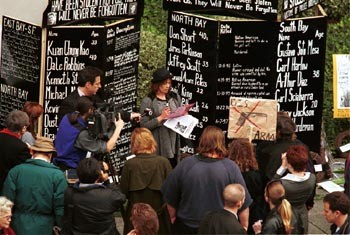
Deadly toll: Outside the 1998 U.S. Civil Rights Commission hearing, demonstrators erected a makeshift memorial to those killed in police-involved incidents.

Blue Shield

Forum focuses on police relations

By Greg Cahill

LOCAL LAW enforcement officials mostly dismissed the findings of a 1998 U.S. Civil Rights Commission panel critical of police practices and policies that may have contributed to the deaths of several people over a two-year period. But a group of progressive organizations, politicians, and media won’t put the issue to rest.

Cruz Reynoso, the former California State Supreme Court Justice and vice chair of the U.S. Civil Rights Commission, will be the keynote speaker at an Aug. 10 forum on community/law enforcement relations in the Sonoma County. Reynoso, who served on the Supreme Court from 1982 to 1987, participated in the daylong standing-room-only hearing in Santa Rosa at which the panel heard testimony from law enforcement officials and angry citizens. He will deliver a talk titled “Police Abuse: Can We Change the Culture?”

The final report, leaked to the press in late May, criticized law enforcement for several police-involved shootings, including the killing of Rohnert Park resident Kuan Chung Kao. It also portrayed police as out of step with community relations. “Even given the abnormally high number of police-involved deaths in recent years . . . local law enforcement continued to paint a peaceful picture of police-community [relations] that defied all belief,” commissioner Yvonne Lee wrote in the report. “Instead of using the hearing to candidly respond to issues and concerns of the community, local law enforcement chose to raise a blue shield in defense and deny that any such problems existed at all.

“And yet, as my colleague the Honorable Cruz Reynoso noted, I have rarely walked into a situation where I felt the relations were as tense.”

In the appendix to the report, Reynoso wrote that after hearing testimonies he was shocked by the depth of the rift between local law enforcement and citizens. “It was as if there were two Santa Rosas and two Sonoma Counties,” he noted.

For the most part, local law enforcement officials dismissed the report as biased.

“The one point we’re trying to get across to these guys is that until they recognize there is a problem, there can be no dialogue,” says Mary Moore, a west county activist who is helping organize the event. “Instead of acknowledging the problem, they just circle the wagons.”

Santa Rosa Police Chief Mike Dunbaugh says he is disappointed that organizers of the forum have not asked for police participation. He says many of the recommendations outlined in the report are either already in effect or planned, and points out that others–like the call for a citizen police review board–are vague.

Commissioner Lee also has argued that the police community must acknowledge the problem before it can begin to address the situation. “To treat a patient, a doctor must first diagnose the illness,” she continued. “Similarly, to heal a community, all groups must first acknowledge the rift that has grown between them. Before there can be any serious efforts to improve police-community relations, the law enforcement community needs to come to the table as a willing and sincere partner, open to recognizing concerns and viewpoints which may be different from its own.”

Among those sponsoring the police relations forum are the ACLU of Sonoma County; journalist Martin Lee, co-founder of FAIR; the NAACP of Santa Rosa; and the Sonoma Civil Rights Action Project.

The event will be held Thursday, Aug. 10, at 7 p.m. at the First Methodist Church, 1151 Montgomery Drive, Santa Rosa. For details, contact Mary Moore at 874-2248.

From the August 3-9, 2000 issue of the Sonoma County Independent.

© Metro Publishing Inc.

Sonoma Antique Apples

Picky, picky: Terry Harrison of Sonoma Antique Apples in Healdsburg has traveled throughout the United States in search of obscure apple varieties.. Antique Apples Heirloom apples forgotten, but not gone By Marina Wolf NEXT TIME you're at the grocery store, pay attention as you pass by the...

Zero-Tolerance Policies

Running Scared Public schools practice less-than-zero tolerance By Sarah Cottrell Stokes WHAT IF you were an artist in high school? And you were putting together your portfolio for acceptance into art school, working hard to represent yourself with different styles, all recognized by other serious and professional artists? What if someone...

The Great Voucher Debate

Ballot Primer Getting ready for Prop. 38 and the great voucher debate By Tate Hausman LOOKING for a new blood sport? Then try this fun experiment: Enter a crowded room of education reformers, experts, professors--maybe even senators--and yell, "Vouchers!" If you don't get trampled in the ensuing fray, you'll be treated...

Usual Suspects

In Recovery? Is local law enforcement warming up to advocates for the mentally ill? By Patrick Sullivan IS A THAW developing in the icy relationship between Sonoma County law enforcement and advocates for the mentally ill? Alarmed by a rash of jail suicides and police shootings involving the mentally...

Sex Clubs Lure GOP Conventioners

Ready for reform: NAMI members say Sheriff Jim Piccinini is receptive to talking about possible changes. Photograph by Michael Amsler Shaky Start Philly sex clubs lure GOP conventioneers By Jennifer Bleyer IF, LIKE ME, you don't frequent executive boardrooms, cattle ranches, Catholic churches, or the Upper East Side...

Charles Becker

Fruitful endeavor: Charles Becker's art attracts big bucks and critical questions. Photograph by Michael Amsler Brush with Success Pop art is all a matter of perspective for Santa Rosa painter Charles Becker By David Templeton "I'm a 19-year-old hippie from San Mateo," says Charles Becker, age 47. "I'm...

Other Offerings Around the North Bay

Marin Shakespeare Company The 11th season of the company's "Shakespeare under the Stars" offers three plays. The slapstick-filled The Cmplt Wrks of Wllm Shkspr (Abridged) runs through Sept 17 (Sundays at 8, through Sept 17, with no show on Aug. 27). Cyrano de Bergerac, based on Edmund Rostand's classic love story, runs through Aug. 19 (Fridays and...

Putting Your College Education On Hold

Putting your college education on hold By Erica Silverstein DO YOU EVER FEEL as if your life has been planned out for the next 10 years and you can't do anything about it? Finish high school, go to college, choose a major, study for another four years, get a job in the real world, and...

The Merry Wives of Windsor

Lust in the dust: Gerald Haston and Eric Thompson star in Sonoma County Repertory Theatre's outdoor production of The Merry Wives of Windsor, Shakespeare's randy comedy of romantic misadventure, opening Aug. 18 in Sebastopol. Sonoma County Rep airs out Shakespeare By Daedalus Howell IT'S NOT uncommon to hear drunks...

Community/Law Enforcement Relations

Deadly toll: Outside the 1998 U.S. Civil Rights Commission hearing, demonstrators erected a makeshift memorial to those killed in police-involved incidents. Blue Shield Forum focuses on police relations By Greg Cahill LOCAL LAW enforcement officials mostly dismissed the findings of a 1998 U.S. Civil Rights Commission panel critical...
11,084FansLike
4,606FollowersFollow
6,928FollowersFollow