
Food, Sex and Film

Passion Fruit

‘Chocolat’ the latest in long line of films to focus on the sensuality of the palate

By Michelle Goldberg

IN FILMS, BOOKS, and magazines of the past two decades, a forbidden pleasure has been brazenly unveiled. It has been lushly, lovingly photographed, help up as the antidote to stultifying societies, as the source of sensual liberation, or as a passion so terrifying that it annihilates our dignity and reduces our egos to quivering plasma.

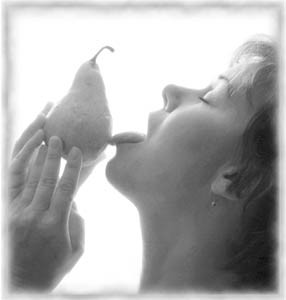
I’m not talking about sex–that’s old news. No, the newest source of pop-culture fascination and bawdy celebration is food. In the age of The Zone diet, celebrity wasting syndrome, and 24-Hour Fitness, all kinds of media now fancy themselves daring for reveling in the joys of eating and the force of appetite.

This season brought us Chocolat, the latest in a long line of food porn, food romance, and food confessionals that includes films like Babette’s Feast, Like Water for Chocolate, and Big Night, books like Isabel Allende’s Aphrodite and Jeffrey Steingarten’s The Man Who Ate Everything, and magazines like Bon Appetit and Saveur.

Lasse Hallstrom’s new film Chocolat is a fable about the power of food and pleasure to overcome a small town’s puritanical prudery. Juliette Binoche plays Vianne, an exuberant free spirit who wafts into a French village with her young daughter and opens a chocolate shop (during Lent, no less).

This outrages the town’s fastidious mayor, who vows to drive her out of business and accuses her of being in league with the devil. His pieties are no match for Vianne’s confections,though.

A cup of her pepper-spiked hot chocolate is enough to awaken the zesty hedonist in her cranky and bitter landlady, while her rose creams spur a broken, abused wife toward blooming emancipation.

Romances are born and feuds are resolved. Throughout are luscious, tantalizing shots of swirling pots of melted chocolate, moist cake, and earthy crushed cocoa.

Chocolat seems directly inspired by Babette’s Feast, the 1987 Danish film about the transcendent power of a gourmet French meal. In that movie, a Parisian woman exiled in a tiny, harsh Danish village wins the lottery and asks her employers–two sweet, timid, pious old maids–for permission to give them one real French dinner for a village celebration. They acquiesce but soon panic, fearing perdition for allowing such flagrant indulgence.

Together the townspeople vow to eat the food without noticing it, keeping their thoughts turned heavenward.

Babette’s Feast is a far better film than Chocolat in part because it respects even its most sanctimonious characters, and it doesn’t conceive victory as overturning their age-old beliefs. Instead, as the townspeople consume Babette’s turtle soup and fine champagne, a glow settles over them and their spirituality is heightened and expanded.

Gourmet food here is almost like Ecstasy–whatever you’re doing, it makes it better.

Nevertheless, like Chocolat, the best parts of Babette’s Feast are its lingering shots of food being prepared, served, and savored. The camera caresses trays of truffle-stuffed quail resting in golden puffed pastry, ruby goblets of red wine, and inky caviar. After the relentlessly drab, austere images that dominate the beginning of the film, these shots are their own kind of feast.

What’s interesting about these films, as well as Big Night and the scads of food memoirs that line bookstores, is why there’s so much drama in simply admitting to the intense pleasures of taste.

ON ONE LEVEL, of course, all these delicacies are intended as a metaphor for sex or as a symbol of female sensuality vs. male rationality. That’s the theme of Allende’s 1998 book Aphrodite, a musing on eating and eroticism in which she writes, “The most intense carnal pleasure, enjoyed at leisure in a clandestine, rumpled bed, a perfect combination of caresses, laughter, and intellectual games, has the taste of a baguette, prosciutto, French cheese, and Rhine wine.”

Chocolat certainly attempts to give its food a similarly sexual cast. An old woman confesses to her priest about eating chocolate, “I thought just one little taste . . . it tortures you with pleasure.” Vianne flusters the mayor by offering him a white chocolate-tipped “Venus’ Nipple.” When he finally attacks the chocolate shop, the first thing he destroys is a chocolate Venus de Milo, which he angrily knifes.

But this explanation doesn’t fully explain the recent fetishization of food. After all, in our sex-saturated age, carnality hardly needs to be sublimated. What little sex there is in Chocolat isn’t treated with anything approaching the drooling reverence implicit in shots of Vianne’s treats.

Food here isn’t just a symbol. The mayor is finally undone when, in the midst of his rampage, a speck of chocolate touches his lip, sparking an epic gorge that leaves him chocolate-smeared and unconscious overnight in Vianne’s shop window.

Yet the mayor is never otherwise depicted as a lecher–even after his ostensible liberation, he’s still chaste and proper in a burgeoning courtship. Food is his temptation and his salvation.

Sex is almost beside the point.

Similarly, in Aphrodite, the descriptions of sex lack the rhapsodic passion of Allende’s writing about food. A chapter grandly called “The Orgy” is about what to serve at a bacchanal, not what to do at one.

“What would I serve at my orgy? If I had unlimited resources, I would offer the guests platters with raw and cooked shellfish, meat, game birds, and cold fish, salads, sweets, and fruits–especially grapes, which always appear in films about the Roman empire.”

It’s almost as if the sex is just an alibi for all this food talk, since these days it’s far more socially acceptable to be obsessed with fornication than with dinner.

FOR PROOF, see Henry Jaglom’s 1990 film Eating, which is like The Boys in the Band of food movies. A hysterical wallow through middle-class women’s starvation, shameful bingeing, food guilt, and eating disorders, it’s the other side of films like Chocolat, and it demonstrates why so many artists feel the need to defiantly assert their appetites.

Eating is both so scathingly honest and screechingly melodramatic about many women’s anguished relationship to food that it’s hard to figure out whether it’s empathetic or subtly misogynist.

Set at a multigenerational, all-female birthday party in Southern California, it’s full of women hiding in corners and bathrooms to shovel cake in their faces, scenes and confessions of bulimia, angry rants and despairing laments about dieting and the eternal pull of the refrigerator door.

Nor is this the only film that dwells on eating and hunger as perversity. There’s Peter Greenaway’s 1989 The Cook, the Thief, His Wife & Her Lover, a gaudy Grand Guignol largely set in a restaurant and culminating in a scene where a villain is forced at gunpoint to eat a dead man trussed and roasted like a pig–revenge for the villain’s cruelty and his insatiable gluttony.

In Seven, a gourmand is forced by a serial killer to eat himself to death. And the film version of American Psycho dwells endlessly on the absurd meticulousness and hollow innovations of nouvelle cuisine, evidence of the stylized emptiness of all protagonist Patrick Batemen’s pleasures.

Just as sexual liberation would be meaningless without sexual shame, so films like Chocolat wouldn’t make any sense without the deep sense of ambivalence about the way we eat that’s dramatized by these movies. Images of Babette’s perfectly browned birds or Vianne’s pots of melted chocolate wouldn’t be so resonant if such foods weren’t forbidden or fraught with guilt.

Food porn, like the regular kind, may reveal a culture’s lusts, but it’s also a key to its repressions.

From the February 8-14, 2001 issue of the Northern California Bohemian.
© Metro Publishing Inc.

Bahia Development Controversy

Bahia Brawl

Novato project prompts protest

By Greg Cahill

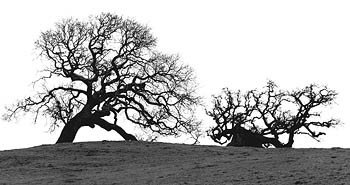
OPPONENTS of a 424-unit housing development in the Bahia section of Novato are alleging that dirty politics are behind the recent Novato City Council approval of the project, which would result in the cutting of 3,300 oak trees in a 70-acre virgin oak forest at the mouth of the Petaluma River.

The Citizens to Save Bahia campaign, co-chaired by Pat Ravitz and Lynn Emrich, is pushing ahead with plans to place a referendum on a ballot to overturn the council action. Ravitz says the group will meet the Feb. 8 deadline after “an incredible response” by local residents to the petition drive. “It’s very encouraging,” she says.

On Dec. 12, the City Council approved the controversial project in a manner that critics found most manipulative–after a candlelit protest march, which included horseback riders, and a lively public comment period at which 100 residents raised concerns, the council waited until 3 a.m. to cast its vote, when most of the protesters were nestled in their beds. The project was passed by a 4-1 majority. It will be built by Art Condiotti, who a few years back became the target of angry Rohnert Park homeowners who took legal action over alleged shoddy construction.

“We are very pleased with the action the City Council took, and we’re going to move forward,” Herb Williams, president of Delphi Team.com, the political consulting firm representing the developer, told the San Francisco Chronicle. “The opponents have said the same thing about this project for 22 years. You can only cry wolf so often. The fact is, we are going to keep 22,000 trees. We are not raping the ecosystem.”

All four of the council members who approved the project–Mike DiGorgio, Jim Henderson, Pat Ekland, and John Mani–were aided in their election bids by Williams, who also works for Condiotti.

“They treat this area as if it has no value,” says Bahia resident Rick Fraites, noting that the project is adjacent to sensitive wetlands. “But the fact is, it has tremendous natural value to this community.”

The Bahia project–including nearly 200 luxury houses up to 4,000 square feet each, none of which is classified as affordable housing–will add almost 4,000 new car trips to local roads and Highway 101 every day. In addition, the Citizens to Save Bahia campaign says, the Bahia project will almost triple the size of the existing neighborhood, placing a financial burden on police and fire services. It also could add over 200 students to already crowded local schools.

THE BATTLE over the Bahia development has been raging for more than 20 years. In 1978, another developer wanted to construct 2,000 homes at the site, but environmental opposition and fiscal problems put that project on hold. In 1994, the City Council approved an environmental study that would have allowed more than 700 homes, but the council members asked the developer to reduce the number of units.

Fraites says the referendum campaign is designed to stop the project and give the Marin Audubon Society a chance to negotiate with Condiotti to purchase the land for a nature preserve. Williams has pledged to fight the referendum.

Odds and Ends:

MARIN COUNTY is facing a glut of costly special elections. The May 22 recall election aimed at District Attorney Paula Kamena will cost at least $500,000. If the Novato referendum of the City Council’s approval of a 424-home expansion of the Bahia neighborhood qualifies, another special election will likely be set in late spring unless the council agrees to hold off until November. That election will cost $100,000 unless the Novato City Council decides to consolidate the referendum with the November 6th municipal election. Now we have the Tamalpais Union High School District’s Measure “A,” a $121 million school-facility improvement bond. It will be decided at a March 6 special election that will cost $260,000.

Dick Spotswood contributed to this article.

From the February 8-14, 2001 issue of the Northern California Bohemian.

© Metro Publishing Inc.

Sade

0

Vocal Warming

Sade alters the atmosphere around her listeners

By Gina Arnold

MUSIC, some wag once said, is the only art form that its followers don’t need to study to appreciate. And it’s true: all of us know things about music that we didn’t learn in school. We know, for example, that all times and places have a soundtrack of their own. I, for instance, wouldn’t want to hear the Rage Against the Machine first thing in the morning–or even in the middle of the night. There is morning music, afternoon music, and evening music.

But the best kind of music is so supple, so transcendent, that it colors the air around it, transforming whatever the day holds into an entirely different plane, turning, for instance, a slow morning into a sexy one, or a wistful evening into a night full of hope.

Such a quality is rare indeed in the pop world, but one does occasionally come across it–in the music of English blues singer Sade, for example. Sade’s voice is thin and wispy, her music is rather quiet, but if you let her into your living room, I guarantee that the atmosphere will alter–and, to my mind, for the better.

Her music has the exact quality that T. S. Eliot referred to in his poem The Love Song of J. Alfred Prufrock, when he wrote, “I know the voices dying with a dying fall/ beneath the music from a farther room.” When Sade sings, it sounds as if someone is humming a tune in a meadow nearby–or, to quote the album’s title cut, “the music in the man’s car next to me.”

Sade is not, however, a prolific artist. Reclusive is more like it. Lover’s Rock (Sony) is her first LP in eight years–her fifth in 15–and this paucity of output (along with her poise and beauty) is part of her perfection. She doesn’t overdo anything, including her presence on the pop scene, with the result that when she does show up, one feels oddly relieved.

Lover’s Rock isn’t full of songs about Caribbean gangsters and scenes of renunciation. Instead, it relies on pure emotion and statements of intent: “You are the lover’s rock/ that I cling to.” Musically, the songs on Lover’s Rock recall numbers like “Sweetest Taboo” and “(Love Is) Stronger than Pride,” but there is something soothing about them that goes beyond the album’s smooth, mellow-jazz surface qualities.

In a way, Lover’s Rock contains elements of artists like Portishead and Dido, but in fact, Sade’s roots are much more in the blues than in techno–the English blues, that is. Indeed, the opening track, “By Your Side,” sounds remarkably like a song by Eric Clapton (if Clapton could sing better).

And the other songs have a similar slow-hand groove, albeit one with extremely subtle instrumental touches: an acoustic guitar chord here, a faint flavor of horns or strings there, some light percussion. “Flow” could almost be called repetitive or even monotonous, if it weren’t for Sade’s emotional intensity.

“Somebody Already Broke My Heart” is typical of Sade’s oeuvre, a subtle song about the pain of love. “King of Sorrow,” in which she sighs, “I have already paid for all my future sins,” is equally downbeat. But that’s what the blues are all about: lightening others’ loads by sharing one’s own pain. As Sade sings herself on the final cut, “Love is kind, and love can give . . . it’s only love that gets you through.”

That’s been her (highly romantic) stance all along, and she’s obviously going to stick to it.

Of course, the blues are normally associated with African Americans. Sade (a.k.a. Helen Folasade Adu) is black but of Nigerian descent. She grew up in England, and her version of the blues diverges quite a bit from the traditional form we most often associate with the idiom. There are no seven- or 12-bar blues here, no high, intricate vocalizing à la Aretha Franklin or Etta James.

Sade’s blues are just as blue, but they’re a cool blue, a new blue, if you will, invented and nurtured in London in the ’80s. Sade lives an immensely private life, but she doesn’t worry about sounding inauthentic or losing face for not having “lived the blues,” because her personal blues have nothing to do with heroin use, jail time, or sharecropping.

On the other hand, no one’s ever going to question Sade’s blues credentials. Her songs are as blue as one could wish and, as such, uplifting in their way. Combined with her monumental vocal poise, her sweet and tender songs, and her extreme beauty, she is, simply put, an artist of great dignity and merit–and an artist with whom one enjoys spending time, morning, noon, and night.

From the February 8-14, 2001 issue of the Northern California Bohemian.
© Metro Publishing Inc.

Wine Songs

0

San Rafael singer/songwriter Al Stewart gives homage to the fermented grape

By Bob Johnson

Summer 1976 Universal Amphitheater Los Angeles.

Nearly every seat of this magnificent, open-air concert venue has been filled for a performance by Al Stewart, whose “Year of the Cat” single and album has instantly transformed a Scottish folk singer into an American pop icon. I am 18 years old, and my date for the evening is a stunningly beautiful 17-year-old blonde named Sheryl. It had taken me a full year to muster the courage to ask Sheryl out. When she readily accepted my offer, I was flabbergasted.

Stewart and his band put on a memorable show, blending love songs from his early recording days with the history-tinged folk/pop/rock tunes of Year of the Cat.

By the time we make the drive back from L.A. to Sheryl’s bayside home on Newport Beach’s Balboa Peninsula, it is a quarter past 1 a.m. We exit my forest green Ford Pinto hatchback and walk to the wood and stained-glass front door of the house.

Without saying a word, and with no prompting (other than telepathic) from me, she leans in and kisses me on the lips. She then looks in my eyes and quietly says five words that have haunted me ever since: “That could become habit forming.”

I smiled sheepishly, told her I had a great time, returned to my car and drove the remaining half-mile to my home. I did not sleep at all that night. Torn between a burning desire to develop a new “habit” and the teenage anxiety that I may not live up to her expectations, I never asked Sheryl out on a second date.

She came over to me and kissed me in play Taking my hand between her legs as she lay And she looked in my eyes but I turned them away Finding no words fit to say And I hated myself, but could not move, I was shattered in my confidence, But it was no sense at all, but too much sense That took me to the bridge of impotence.        –From Al Stewart’s “Love Chronicles,” 1969

Fall, 1989 Ritz-Carlton Hotel Dana Point, Calif.

Now divorced for three years and the father of a stunningly beautiful 10-year-old daughter, I have been enjoying wine for about five years, and writing about it for two. But I have never tasted the heady, sweet, European elixir known as Port.

That changes on a hillside garden terrace overlooking the Pacific, where I join several hundred fellow imbibers at a three-hour vino free-for-all involving more than a hundred wineries from around the world.

Up until now, my wine experiences have been limited to California bottlings, with the odd French Burgundy or Bordeaux added to the mix on special occasions. As I sample one Port after another, of varying vintages and pedigrees, my mind and tastebuds are awakened to a vast new world of possibilities.

Then it seemed that I was traveling Through the granite hills of Dao With a vineyard spread in front of me In a carriage headed south. Night came with the skies aflame And all that I saw Was all mine to claim.        –From Al Stewart’s “King of Portugal,” 1988

July 18, 1999 Conejo Creek Park Thousand Oaks, Calif.

It’s about an hour before Al Stewart is due to take the stage for a now all-too-rare performance. The sound-check completed, Stewart joins me for a pre-arranged interview on the splintered seats of a park picnic table.

Knowing that he has discussed and dissected his songs with countless journalists over the years, I decide to focus on another topic of mutual interest: wine. Inevitably, there is a musical link.

“We’re all familiar with Andy Warhol’s observation about everyone getting 15 minutes of fame,” Stewart says. “For me, in retrospect, it was Year of the Cat.

And that remains the one song fans expect him to play at every concert. But Stewart says he doesn’t mind, because it provided the wherewithal for him to invest heavily in wine.

He has spent untold hours exploring the cellars of historic French wineries, and today, as a resident of San Rafael, lives just a stone’s throw from the Sonoma County and Napa Valley wine regions.

Stewart has been collecting wine for more than three decades, and is amused by the fact he now gets more ink in wine publications than in music periodicals. “When the Wine Spectator devotes a whole page to you, but you’re not in the music magazines anymore, it’s kind of odd,” he says.

Odd? Perhaps. But there is no denying the artistic link between making good music and crafting fine wine. Even though technology is used in both pursuits, nothing gets done without human intervention, interpretation and passion. Nothing of any lasting worth, anyway.

Stewart says his wine collection has dwindled to “a little over a thousand bottles” in recent years, but he figures that’s plenty to carry him “happily into senility.”

I’m sometimes trapped by the close confines Of the age I’m born into Though there were others worse than mine Well I miss what I can’t do. Join the feast of Ancient Greece See Alexander’s library Maybe clink a champagne toast With a jazz age dancing queen.        –From Al Stewart’s “Josephine Baker,” 1988

Jan. 28, 2000 The Palms Playhouse Davis, Calif.

On a brisk, breezy evening, not far from the university that has educated countless winemakers and grape growers, a capacity-and-then-some crowd patiently waits for Al Stewart to take the stage.

When introduced, he is greeted warmly. On this night, he begins his performance with an apology. He says he has been battling the flu, and his voice is a bit raspy. “But after eight bottles of Evian and two bottles of wine,” he says, “here I am.”

At one point between songs, he speaks of just returning from Los Angeles, where he had been recording with guitarist Laurence Juber, an alumnus of Paul McCartney’s post-Beatles Wings band (on the run).

“A record company approached me about making an album about wine,” he says. “I remember pausing for a moment and thinking, ‘This must be a dream.'”

By the end of the year, the dream had become reality in the form of Down in the Cellar, a 13-cut CD devoted almost entirely to fermented grapes.

“Touts Les Etoiles,” an ode to Dom Perignon, is sung partially in French, while “The Shiraz Shuffle” pays homage to the wines of Australia. Most of the tunes embrace Stewart’s trademark historical perspective.

And one, in particular, takes me back nearly a quarter of a century to an unforgettable kiss.

You’ve got this impulsive nature Maybe you were born that way Sometimes it leads you into danger Sometimes you can make it pay On a night like this one Fly a red balloon On an endless beach of summer Under a wine-stained moon.        –From Al Stewart’s Under a Wine-Stained Moon, 2000

From the February 1-7, 2001 issue of the Northern California Bohemian.

© Metro Publishing Inc.

Open Mic

0

R U Camping?

By C.D. Payne

“CAMPING OUT” is the term my wife uses for folks like us whose living arrangements lack those essential finishing touches. Alas, she has been camping out her entire married life. Though we have been in our present house nearly five years, the living room still sports gold-veined mirror tiles and fake wood paneling, the kitchen is a festival of disco-era browns, and assorted wallpapers-from-hell accent other rooms. My wife is eager to remodel, but I think it would be less stressful just to post a large sign proclaiming: “The décor of this house does not necessarily reflect the taste of its occupants.”

Here is a short test to determine if you, too, are “camping out”:

Your computer sits on a card table, +5 points. It sits on the box it came in, +10 points.

Your books are stacked on bricks and boards, +5 points.

Your home is more “animal barn” than Pottery Barn, +5 points.

A blanket covers your hand-me-down couch, +5 points. The blanket features NFL team logos, +10 points.

Embroidered hand towels hang in your guest bathroom, -5 points.

The dominant aroma in your home is: Eau de kennel, +5 points. Rose potpourri, -5 points. Methamphetamine brewing, +15 points.

You subscribe to Architectural Digest, -5 points.

Posters are thumbtacked to your walls, +5 points. The posters are of Metallica, +10 points.

Your mattress is: On a solid wood bed, -5 points. On the floor, +5 points. You sleep on the couch, +10 points.

In your two-car garage you have space to park: Two cars, -5 points. One car, 0 points. Not even a bicycle, +10 points.

Your bathroom can best be described as: Color-coordinated, -5 points. Eclectic, 0 points. Grungy, +5 points. A pit, +10 points.

You own a book on feng shui, -5 points. You’ve actually read it, -10 points.

Teenagers are in the home, +20 points.

Your house is equipped with wheels, +30 points.

RATE YOUR SCORE:

0 to 25 points: Martha Stewart would be proud.

25 to 50 points: Caution, some camping detected.

50+ points: Greetings, fellow campers!

Writer C. D. Payne camps out in Sebastopol.

From the February 1-7, 2001 issue of the Northern California Bohemian.

© Metro Publishing Inc.

Wide-Eyed Gourmet

Americans fed up with diet research

By Marina Wolf

THIS IS NEWS? Apparently it was to the researchers at the Fred Hutchinson Cancer Research Center who surveyed 1,751 adults on their eating habits and attitudes about nutritional guidelines. Hell, I would have taken 100 bucks and saved them the trouble and expense. Anybody who ever was a teenager could tell you that you push on people hard enough, they’re going to turn around and do the opposite.

The researchers called the most rebellious of the eaters “nutrition skeptics,” and attributed their attitudes to the confusion that surrounds much of nutrition and food science. Who wouldn’t be confused? Even the scientists are confused. Sure, they call it “progress” or “advances in scientific understanding,” but that’s just so they won’t be embarrassed when, six months down the road, somebody else comes up with contradictory research results. It all boils down to a seemingly never-ending series of public flip-flops and flimflammery that doesn’t wind up doing a lot for public health or morale.

For example, did you know that saccharin is actually not a hazardous material? Although my local coffeehouse is still putting out Sweet and Low with that old-timey, alarmist fine print, any day now those pink packets should be lookin’ a bit less crowded on the back, now that federal researchers have determined that saccharin is not a carcinogen.

Turns out that in order to develop cancer at lab-rat rates, you’d have to eat a mug of saccharin every day for a couple of years. Now, a teenage boy could do that at the drop of a double dare, but not even the most calorie-conscious coffee drinker would consider that level of intake. This seems like something that would be a fairly obvious element in a study protocol. News reports of the declassification of saccharin were almost giddy, which is odd, when you think about it. I mean, it’s not as though the nation was holding its breath. (If you were, you can stop now and drink your damned diet soda without the paranoia.)

Or how about that whole margarine debacle? You’ve been scrupulously avoiding butter and eating that nasty fake stuff for years, and now it turns out that stick margarine can increase the risk of heart disease. Or how about Olestra? Now that is argument and rebuttal all rolled into one package of low-fat, high-flatulence potato chips.

FORGIVE ME if I sound a little cynical. Call me a “nutrition skeptic” and develop patronizing government programs to instruct me in really simple, one-syllable words about how fat is bad, fruit is good. Run, Jane, run. Run from fat. Here’s a data point for you: I’m not stupid, and I’m not particularly frustrated by the nutrition pronouncements. I just ignore them and listen to what my body wants to eat.

Sometimes, when the announcements are really flying, I’ll go into this snarly little “Futurama” fugue state of dystopic daydreams. In the future, the stuff that isn’t high-fat will have been decalorified, vitaminized, bioengineered, or otherwise retrofitted to keep up with the latest in nutritional food science. It’ll be a given that there are side effects for everything we eat, and then at last the labels will have to focus on real issues, things that we want to know in order to take an informed gamble.

Exactly what percentage of people developed flatulence while eating these chips? How many people would rather gnaw off their own limbs than eat this? How many food stylists were employed to make the picture on the label more appealing?

Warning: Objects within are grosser than they appear.

From the February 1-7, 2001 issue of the Northern California Bohemian.

© Metro Publishing Inc.

Winter Roots

0

Root Awakening

Discovering the earthy pleasure of winter roots

By Marina Wolf

WINTER-MENU malaise. It’s that feeling that you get when the produce aisle has gone monochrome. Fortunately, there are several courses of treatment. You can buy frozen veggies, those icy but green ghosts of harvests past. You can drop great wads of cash on produce from other lands. Or you can dig deeper and get into the earthy, undersung root vegetables.

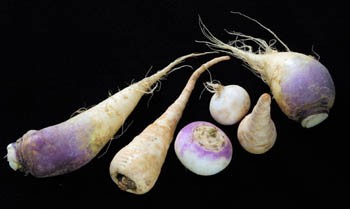
Even the names carry a smell of cold earth and guttering fireplaces: turnip, rutabaga, parsnip. And their knobby, hairy appearance somehow does little to inspire confidence in their culinary properties. But these three roots remain regulars on menus of savvy chefs who recognize the economic and gastronomic merit of choosing seasonal produce.

“Right now, especially in Chicago, there’s not much available to us without turning to Argentina, Chile, for stuff that is expensive,” says Heather Terhune, chef/owner in Chicago’s Atwood Cafe, where the root-vegetable chicken pot-pie is a customer favorite during the winter months. “It makes my life a lot easier, not paying a lot of money to get pencil asparagus and Guatemalan green beans.”

Beyond the financial savings, chefs are also beginning to realize the creative potential of these roots, which provide a perfect playing field for flavors from curry to cinnamon, and can be incorporated into soups, into side dishes, and, with very young vegetables, even into raw salads. A database search through Foodwatch, a firm that provides trend research and consulting to the restaurant industry, unearths several pages of dishes using these utilitarian roots. We find parsnip pommes Anna siding with roasted spring pig and rhubarb chutney at Hamersley Bistro in Boston and vanilla-scented carrots and turnips with roasted Maine lobster at Masa’s in San Francisco. Brix in Napa Valley presents turnips along with English pea purée, pea vines, and pomelo as an accompaniment to grilled rare ahi tuna, and mashed, puréed, and/or caramelized parsnips are everywhere.

Most often, these underappreciated vegetables simply wind up on the menu under the more poetic heading of winter vegetables. “We say purée of winter vegetables. If we listed it as purée of rutabaga, people would want to switch that out,” says Cory Schreiber, chef/owner of Wildwood Restaurant in Portland, Ore. “I feel sorry for the rutabaga commodity commission because they’re kind of a hard sell.”

Both turnips and rutabagas (the latter a cross between a wild cabbage and a turnip) bear the additional burden of being from the cruciferae family (that’s the cabbage and mustard group). As cruciferae, their nutritional value is fairly high, with both turnip roots and greens being significant sources of vitamin C. But they also inherit the family tendency to be bitter unless prepared correctly. Parsnips are actually sweet, much like carrots, and become even sweeter after winter frosts. They were candied and used in cakes by the Greeks and Romans, but lost out in medieval Europe when that other root vegetable, the potato, was imported from America.

MOST CHEFS smooth out the flavors of these vegetables by roasting them. In Terhune’s potpie, the vegetables are roasted whole, then diced into the pie filling. Soothing soups in cool-weather flavor combinations, such as parsnip and pear or rutabaga and turnip, are created after the roots have been roasted. “It gives them a nutty sweetness by bringing out natural sugars and caramelizing them,” says Terhune. “Then we can add other elements, like butter and bacon. Rutabaga and bacon actually go really well together; the smokiness of the bacon complements the rutabaga well.”

Schreiber agrees that whole roasting is, in general, the way to go if you want to emphasize the full flavor of the vegetable (this holds true for other roots such as sweet potato or beets as well). He suggests puréeing rutabaga and turnips with cream, butter, and a potato to thicken them–the roots have some starch in them, but not enough to hold together on their own–and then matching them with meats that are a little on the heartier side of things, such as braised lamb shank or brisket.

When creating more exotic fare, Schreiber finds that any of these roots are a suitable base for stronger flavors. For past menus, he has created an unusual sweet side dish from turnips, in which pieces of turnip are cooked down in a little water and honey. The turnips develop a nice glaze, which is then seasoned with black pepper, cinnamon stick, and juniper berries. “Turnips can absorb some pretty pungent flavors because they’re a neutral vegetable,” says Schreiber.

Of course, the best way to influence the final flavor of any root vegetable dish is to make sure that you’ve properly selected and stored the vegetables in the first place. In Roots: The Underground Cookbook, authors Barbara Grunes and Anne Elise Hunt recommend buying firm, small-to-medium roots, no more than three inches in diameter for turnips and rutabagas, and carrot-sized for parsnips (smaller, when you can find them). If you’ve never cooked or eaten these roots, just buy a few to start. You don’t have to rush out and build a root cellar or dirt storage to keep piles of roots through winter. Just store them well in a plastic bag in the refrigerator (parsnips and turnips) or in a cool dry place (rutabagas).

Anyway, you may decide you’re more of a Guatemalan-bean person.

From the February 1-7, 2001 issue of the Northern California Bohemian.

© Metro Publishing Inc.

Anniversary Reflections

0

By Susan Bono

I WANT TO BE in love again. It is my most exalted state. When my heart is held captive, my long, slumped spine lifts straight, my walk goes willowy. I am dazzled by my very breathing. Love sharpens my wits, but softens my tongue. I become an expert interpreter of gesture and glance. I can read secrets in my beloved’s eyes, gauge the intensity of his desire as he leans close, inhaling my perfume. With love, every moment is a dance whose intricate movements I have somehow anticipated and stepped into with unstudied grace. Lately, I long to hear the music that would accompany a new passion.

I am thinking about this as I walk with my husband in the coastal hills of Marin County. I have been married 11 years today to a man I love, but that, as we all know, is not the same as being in love with him. I follow behind as we walk a steep trail through live oak and manzanita. A strong breeze twirls the leaves like green lassos overheard. It rushes in the dry grass with the pulse of beating blood. We are alone under the violent red manzanitas thrusting huge and arterial from the spongy earth. We gawk at moss-covered oaks twisted into fetal forms. It’s as if the two of us are wandering in the womb of the world. But somehow all this primordial splendor serves only to make me long for those early days of courtship, when even a ride in an elevator could feel like a deliciously feral adventure.

We climb on without speaking, and I try to imagine what this journey would have felt like 18 years ago when we first met. I would have paced softly, almost stealthily, behind him on this narrow track, feasting on the movements of his slender hands, his sure but surprisingly delicate feet. The natural beauty of the scene would have served only to magnify his glory. Everything about him would have been perfect.

Today, I notice he needs a haircut. He breaks the silence only to ask me the time. A lone butterfly appears, drifts daintily earthward, and is crushed under my true love’s athletic shoe. A short while later, I am temporarily blinded by a branch he has let spring back across the path. He soon picks up his pace, engrossed in the uphill challenge, forgetting me entirely as he disappears in the distant foliage. I have to shout for him to wait.

As I struggle to catch up, I observe his still-handsome profile silhouetted in the slanting afternoon light. I am disappointed to note that the sunstar, captured for an instant between his slightly parted lips, fails to engender even a prickle of response in the dark, secret places of my being. The swirling wind that catches at us both does not send my spirit flying forward to seek his. As I approach my partner in life on this windswept hillside, my primary emotion is annoyance, for now that I’m finally able to stand beside him, he is already turning to continue on.

We eventually do pause on a promontory to consider the view. “Look,” he says, pointing, but for the life of me I can’t figure out what he wants me to see. So much for the days when I could practically read his mind. When he moves to give me a lukewarm kiss, we falter and bump noses. I get the feeling the party’s over. The orchestra has packed up and headed home.

BACK IN THE CAR, we settle into our seats without touching, unable to maintain a conversation that engages either of us. It’s so much easier to slip into what could be called a companionable silence and let the stereo fill in the gaps. I remember when we used to travel this same stretch of highway in his battered VW, my hand resting on his neck or knee, the music buzzing in the tinny radio speakers a perfect soundtrack to our romance. The songs that accompany this evening’s summer sunset speak of love, but put me in mind of all the aerobics classes I’ve been missing. This is music I do sit-ups and leg lifts to. My husband heads to the gym with a Walkman tucked in his duffel bag. I suspect we have both come to value a torch song primarily for its power to stir a desire for firmer stomachs and thighs.

The romantic restaurant has misplaced our reservation. When we arrive, the only available seating is at the long counter overlooking its famous grill. As we study our menus, I feel somewhat indifferent to what’s offered, for without the tender pangs of sexual appetite, I know the food, however excellent, will never enter the realm of culinary foreplay. I do not worry about my intake of garlic or the amount of daintiness required to eat my selection. Maybe the champagne we order will liven my palate.

As we sip from narrow flutes, I am startled to feel my husband’s arm around the back of my chair. I am drawn into the warm circle of his regard. At the same time, I compare this sensation of quiet pleasure to my long-ago cravings for his touch. We don’t hold our faces close as we once did, reading the secret signs of lips and eyes, but remain focused on the antics of the four men working behind the counter. Do those men like the feel of our eyes on their backs? Does our curiosity spur them on to perform more gracefully, just as I might under the watchful gaze of a new lover?

Three chefs command the grill area, whisking delicate sauces and searing bite-sized morsels of beef over sudden eruptions of flame. As they juggle hot pans and sharp blades in their cramped work area, they are, by necessity, rather like newly smitten lovers in their awareness of one another’s movements. I think of how seldom my husband works with me in the kitchen now, in spite of his inventiveness with food and my yearnings for assistance. We no longer view such cooperative endeavors as potential romantic opportunities. Reaching for the vegetable peeler at the same moment, we are irritated rather than thrilled by the touch of the other’s hand. We collide so often, so obviously in each other’s way, we both feel clumsy, out of step.

The fourth cook, tall, blond, a bit gawky, works in isolation off to the left. He is in charge of salads and desserts, creating abstract designs with crudités and sweet sauces on chilled plates. I have rarely even glanced in his direction, but as the check arrives, he turns and looks directly into my eyes. His angular face breaks open into a radiant smile, while his arms, loaded with salad plates, open in a gesture of embrace.

I am instantly flooded with heat, pinned helpless in the glare of this unsolicited flattery. Suddenly, I feel like I do sometimes when we are with another couple and I want my husband and woman friend to disappear for just a few moments so I might throw myself into the other man’s arms. It’s as if I’m afraid I’ll die if I have to look one more time into my husband’s all-too-familiar face and see my all-too-familiar self reflected in his eyes. I want to slide my arms around another’s warm neck. I want his whisper in my ear. I want to be caught in a cloud of scent and excitement. Surely the press of a different body against mine would allow the sense of my own mystery to come back to me. I seem to have lost the ability to bewitch my mate. Perhaps in the embrace of another, I could find that power again.

Under the influence of that intoxicating attention, I visit the ladies’ lounge. There, I am confronted by the ordinariness of my reflection in the beveled mirror. Dark circles haunt my eyes, and my hairdo and clothing seem frowsy and worse for wear after our trek in the hilly wilderness. I half expected to find myself gazing into the eyes of a newly awakened goddess. I suppose it will take more than the passing acknowledgment of a flirtatious man in a chef’s toque to transform me.

I take a deep breath before leaving the restroom. In order to rejoin my husband, I’ll have to pass that man in the tall starched hat. Will he see me and beam again? Will I trip on the carpet or collide with a hurrying waiter under his amused stare? As I make my way toward the man who has learned to wait so patiently after all these years, I feel as awkward as the teenager whose greatest thrill and dread is walking past that certain boy on the way to her seat in Algebra. But as I totter down the length of the restaurant, no one pays me any mind, neither my spouse nor the fickle man behind the counter.

When I stumble up against the edge of my husband’s shoe, I get his practiced hand under my elbow to steady me. I think of the times he puts gas in my car, watches the kids so I can go out, gets up first on winter mornings and turns on the heater. His capacity for maintaining the machinery of daily existence seemed sexy to me once. I am grateful for his touch now and follow him blindly toward the exit.

THE NIGHT air is surprisingly sultry as we step into the lively darkness and make our way among the weekend crowds. Afraid I’ll be left behind, I grab my protector’s hand, which, as usual, simply hangs from his wrist, warm, but wooden. I experience the sensation of carrying an object, a medium-sized book or clutch bag. Before I release my hold, I draw his attention to the music booming from an open nightclub door, knowing he will never suggest that we go inside and dance. I make do with imagining his fingertips on the small of my back, lightly guiding me through the smoky clamor of the bar onto a crowded dance floor. We could dance to the tune we’re hearing now, laughing and replaying the dance steps of our early adolescence–the Twist, Jerk, Pony, Swim. If the next number turned out to be a slow one, we could always duck out, since he has never really learned to lead, and I seem to have misplaced my ability to follow.

I look up at the bold-faced moon, languid on a blanket of luminous clouds, and wonder what it would be like to follow someone into the fragrant park across the way. Would our kisses become the velvet of rose petals open to the night air, or would my companion and I go hard and sharp as the pair I now observe emerging from a dark side street to join the other revelers? The volume of this man’s banter is turned up too loud, his cologne nearly overpowering. His date is pretty and young, but her eyes glitter in the darkness. As they pass us, I watch her snake a bold hand into one of his back pockets as she catches the glance of another prowling man.

More likely, I would find myself re-enacting my own version of the next scene we encounter. A woman my age leans against a whitewashed wall, arms crossed, shoulders hunched. She is trying to discourage the attentions of a slightly swaying man who leans too close and breathes blurred words at her averted face. Her reluctance is clear in her downcast gaze, but even now she is lifting her head and going into the bar with him.

More eyes and long teeth flash predatory in the moonlight. More loutish shouts and shrieking laughter, boozy clouds of scent and smoke. I had forgotten that being in love first requires the hunt for a lover. Even the capture of a sitting duck takes place in a wilderness of uncertainty. I remember those long ago days spent half sick with impatience and fear, waiting for calls or letters that could never have come often enough. I recall being mortified by a man’s indifference, humiliated by rejection. I remember dishing out my own helpings of dismissal.

Just before we reach the car, a couple steps out of a doorway ahead of us. They have obviously survived the initial hazards of the hunt and are frolicking in the phase of love I have been fantasizing about. As they walk side by side, the air between them seems charged, like the particles found in textbook diagrams illustrating magnetic flow. The two of them are generating an energy field that holds them close in a humming intensity nearly audible to passersby.

“Should we do something tomorrow?” the young woman asks sweetly, with a smile that suggests doing nothing would be equally delicious. When her small, playful hand brushes her lover’s bare forearm, he temporarily forgets how to walk. I nearly laugh out loud as she swiftly takes advantage of the pause, rising on tiptoe to taste the point of his chin as if it were an exquisite chocolate. He falls back a little, somewhat stupefied by his good fortune, then sweeps her joyously into his arms. He waltzes his pony-tailed Cinderella down the uneven sidewalk, confident that the toll of midnight will never strike.

I watch them disappear, and feel the smile lingering on my face. I imagine that wherever they go, this arduous pair is met with expressions as indulgent as mine. I think back to my tall, blond angel of the grill and wonder if his extraordinary grin was actually intended to include my husband. Did we present a picture of intimacy that gladdened his heart, triggering his blessing? In that man’s eyes, we, too, may have appeared to be dancing, not the bright, hot mambo of early courtship, but the slow sarabande of the undeniably coupled.

THIS POSSIBILITY does not dissipate my longing for those dances of a younger time. I still yearn to be lifted out of plodding predictability into the spellbinding rhythms of desire. I already have a partner, but I wonder what music is playing in his head.

We drive home on deserted country roads, looking out at strange glowing columns of clouds, lurid in the moonlight. “Crawling Eye weather,” my mate remarks. He mimics a few bars of soundtrack from one of the cheap horror movies we used to watch on the portable black-and-white TV in his apartment bedroom. I tentatively slip my fingers under the warm curls at the back of his neck, remembering a time they flowed past his shoulders. He keeps his eyes on the road, the earth maintains its steady spin, but we both know why the other is laughing.

Susan Bono is a local writer and teacher who edits and publishes ‘Tiny Lights,’ a journal of personal essays. This essay, written a decade ago, finally made it out of her files to win the creative nonfiction award in Copperfield’s Books ‘The Dickens’ this year. She is wondering what she might write about her 21st anniversary, now that she and her husband have figured a few things out.

From the February 1-7, 2001 issue of the Northern California Bohemian.

© Metro Publishing Inc.

Usual Suspects

Cotati business park sparks criticism

By Greg Cahill

DOES Sharon Wright always get what she wants? A few years ago, the current City Councilwoman and then mayor of Santa Rosa told a gaggle of local media types gathered at an informal City Council luncheon that she wanted to give the city a cool new moniker to lure high-tech firms away from the burgeoning telecom valley nestled on the outskirts of nearby Petaluma.

That might also help to entice Nordstrom and Pottery Barn to Santa Rosa as well, said Wright, slipping into her best Chamber of Commerce-booster mode. It didn’t matter that the city had no major high-tech firms at the time.

Well, Nordstrom and Pottery Barn aren’t on the horizon, but it looks like Finland-based telecom giant Nokia Corp. might be headed for the City of Roses. In a major coup, published reports predict that Nokia is bailing out of the controversial South Sonoma Business Park in Cotati, a major development slated for 35 acres in the heart of Sonoma County’s smallest city–and may be headed for the proposed Santa Rosa Corporate Center on Sebastopol Road near Stony Point.

Nokia, the world’s largest manufacturer of cellular phones, is searching for a new home for its world headquarters with an eye on Sonoma County. But opposition to the Cotati business park–planned by San Rafael developer Tom Monahan in the wake of a massive hi-tech expansion out of Marin County and by far the largest project ever proposed for the small city with the reputation for the county’s most rancorous politics–is growing with the recent release of the project’s environmental impact report.

“If you think traffic is outrageous now, consider what it will be like to have thousands more cars on the road in this small area,” opined former Cotati City Councilwoman Pia Jensen in a recent letter to this newspaper. “If you think housing and land prices are outrageous now, consider what it will be like when all the new people come into your neighborhood, outbidding one another for the few homes existing currently and the few new ones slated for construction in Cotati. If you think energy, water, and sewer rates are outrageous now, consider what your rates will be like when demand skyrockets for industrial activities and increased population density.”

Cotati residents will get their first chance to respond to those concerns next week during a pair of planning workshops designed to inform the public about the potential impacts.

According to the hefty EIR, the proposed business park will result in 2,510 new jobs and increase demand for up to 1,476 new housing units–this in a city of slightly more than 6,000. The project would contribute to “a significant and unavoidable” increase in traffic on the already congested Highway 101 corridor, notes the EIR. In addition, the report states that the cumulative effects of the business park, coupled with 16 other approved or planned developments in the immediate area, would have “considerable and significant” impacts on the rural character of the city.

On Monday, Feb. 5, at 6 p.m. a workshop on the project’s possible impact on wetlands will be held at Cotati City Hall (201 W. Sierra Ave.). A Planning Commission meeting will follow at 7 p.m.

In a related matter, John King of the South County Resource Preservation Committee last week addressed the Cotati City Council about that organization’s pending California Environmental Quality Act lawsuit against the city of Rohnert Park. King told the council and onlookers that Cotati, as well as other communities in and around Rohnert Park, are at “ground zero” in respect to the impacts resulting from Rohnert Park’s own ambitious expansion proposals for 4,500 new homes and 5 million square feet of commercial and industrial space.

Attorney Susan Brandt-Hawley, who is representing the SCRPS, is reviewing documentation supplied by Rohnert Park officials in response to the lawsuit.

Just rewards

Sonoma County library chief Roger Pearson will receive the ACLU’s 2001 Civil Liberties Award for his work resisting pressure to censor the library system’s Internet access. The event will be held Saturday, Feb. 3, at 6 p.m. Call 707/765-5505 for details. . . . Brock Dolman, director of the permaculture program at the Occidental Arts and Ecology Center, is the recipient of the Occidental Chamber of Commerce annual Environmental Achievement Award, selected by public balloting.

Usual suspects likes tips. E-mail your item to su******@******an.com.

From the February 1-7, 2001 issue of the Northern California Bohemian.

© Metro Publishing Inc.

Newsgrinder

Tuesday 01.30.01

Coach Craig Brennan may have answered the age-old question of how wrestling coaches get their veins to pop from their necks, reports the Marin Independent Journal. The Marin Catholic High School mat wrangler was arraigned in Marin Superior Court on drug charges stemming from his mid-January arrest, when authorities said they found him with a baggie of methamphetamine on the school campus. “Stoned Cold” Coach Brennan is charged with possession of methamphetamine, being under the influence of drugs, and most likely to be played by Harvey Keitel in a made-for-TV drama. Brennan, who is free on his own recognizance, says optimistically, “I think these charges will be dismissed.”

Monday 01.29.01

Extra! Extra! Read all about it: Bat Boy and the Samurai Kid strike again! The Press Democrat reports that the devious duo stormed a Santa Rosa 7-Eleven on Sunday and proceeded to chase the clerk away by wielding a baseball bat and a Samurai sword before emptying the cash register. No word if the would-be yakuza was shamed by this low-ball heist and sliced off his own pinky.

Saturday 01.27.01

Donald Breckwoldt, citizen hero, found a live bomb in his Terra Linda yard and brought it into the San Rafael police station’s front lobby, prompting closure of the station and adjacent City Hall, reports the IJ. Breckwoldt nailed it when asked why he took the explosive device to the police instead of calling 911: “I don’t know. I just did it. It was a stupid idea.” Always chivalrous, Breckwoldt brought his girlfriend, Vickie, along for the perilous ride. “We go everywhere together,” he said. “We had to go to San Rafael anyway to get lunch, so we dropped this off.” According to the hero, the police station staff summarily “freaked.” Breckwoldt, who says he has no known enemies other than Lex Luther, said he is “a little ticked off” about the incident. “It worries me that some lunatic is out there blowing up things and scaring people to death,” he said. “If I catch him, there ain’t going to be no fingerprints left. I want this mother caught quick because he deserves to spend life in prison.” Word.

Wednesday 01.24.01

Petaluma’s ArgusCourier.com reports that a vandal who etches a bizarre epitaph into downtown Petaluma store windows has racked up an estimated $10,000 karmic debt. Most of the damage was caused by the etching, but there has also been some spray painting as well, said Sgt. Mark Hunter (who apparently found his name on a crumpled piece of paper in the writers’ lounge of cable network). The police department is working with the city’s graffiti abatement team, however, officials are mystified by the culprit’s tag, which reads “Got windows? Call Morty’s Window and Glass Co.”

From the February 1-7, 2001 issue of the Northern California Bohemian.

© Metro Publishing Inc.

Food, Sex and Film

Passion Fruit 'Chocolat' the latest in long line of films to focus on the sensuality of the palate By Michelle Goldberg IN FILMS, BOOKS, and magazines of the past two decades, a forbidden pleasure has been brazenly unveiled. It has been lushly, lovingly photographed, help up as the antidote to...

Bahia Development Controversy

Bahia Brawl Novato project prompts protest By Greg Cahill OPPONENTS of a 424-unit housing development in the Bahia section of Novato are alleging that dirty politics are behind the recent Novato City Council approval of the project, which would result in the cutting of 3,300 oak trees in a 70-acre virgin...

Sade

Vocal Warming Sade alters the atmosphere around her listeners By Gina Arnold MUSIC, some wag once said, is the only art form that its followers don't need to study to appreciate. And it's true: all of us know things about music that we didn't learn in school. We know, for example,...

Wine Songs

San Rafael singer/songwriter Al Stewart gives homage to the fermented grape By Bob Johnson Summer 1976 Universal Amphitheater Los Angeles. Nearly every seat of this magnificent, open-air concert venue has been filled for a performance by Al Stewart, whose "Year of the Cat" single and album has instantly...

Open Mic

R U Camping? By C.D. Payne "CAMPING OUT" is the term my wife uses for folks like us whose living arrangements lack those essential finishing touches. Alas, she has been camping out her entire married life. Though we have been in our present house nearly five years, the living room still sports gold-veined...

Wide-Eyed Gourmet

Americans fed up with diet research By Marina Wolf THIS IS NEWS? Apparently it was to the researchers at the Fred Hutchinson Cancer Research Center who surveyed 1,751 adults on their eating habits and attitudes about nutritional guidelines. Hell, I would have taken 100 bucks and saved them the trouble and expense. Anybody who ever...

Winter Roots

Root Awakening Discovering the earthy pleasure of winter roots By Marina Wolf WINTER-MENU malaise. It's that feeling that you get when the produce aisle has gone monochrome. Fortunately, there are several courses of treatment. You can buy frozen veggies, those icy but green ghosts of harvests past. You can drop great...

Anniversary Reflections

By Susan Bono I WANT TO BE in love again. It is my most exalted state. When my heart is held captive, my long, slumped spine lifts straight, my walk goes willowy. I am dazzled by my very breathing. Love sharpens my wits, but softens my tongue. I become an expert interpreter of gesture and glance. I...

Usual Suspects

Cotati business park sparks criticism By Greg Cahill DOES Sharon Wright always get what she wants? A few years ago, the current City Councilwoman and then mayor of Santa Rosa told a gaggle of local media types gathered at an informal City Council luncheon that she wanted to give the city a cool new moniker to...

Newsgrinder

Tuesday 01.30.01 Coach Craig Brennan may have answered the age-old question of how wrestling coaches get their veins to pop from their necks, reports the Marin Independent Journal. The Marin Catholic High School mat wrangler was arraigned in Marin Superior Court on drug charges stemming from his mid-January arrest, when authorities said they found him with a...
11,084FansLike
4,606FollowersFollow
6,928FollowersFollow