‘The Gleaners and I’

0

Second Harvest

Varda film finds poetry in scavenging

THE FILMS of Agnes Varda are famous for leading viewers to places they never expected to go. Occasionally these destinations are as bleak as the empty roadside where Sandrine Bonnaire is found dead in 1985’s heart-rending Vagabond. Other times, as in the 1987 comedy Le Petit Amour, you round a corner expecting more farce to find yourself authentically moved by the odd romance between 15-year-old video-nerd Mathieu Demy and 40-year-old divorcée Jane Birkin. Even in her many short films and documentaries, Varda indulges her delight in defying expectations.

Consider The Gleaners and I, a charming new documentary about people who collect things others have left behind. The film begins simply, with a straightforward definition of gleaning–“To pick up grain that the reapers have left behind”–and several shots of 19th-century paintings in which bands of gleaners are oh-so-romantically portrayed, stooping in picturesque fields to pull leftover wheat stalks from the ground.

Suddenly we’re shown a real-life gleaner, an elderly French woman who talks of gleaning the wheatfields as a child during the wars, a practice that has almost disappeared. At this point, we think we know what kind of film this will be–an homage to a fading agrarian custom. But this is a Varda film, so of course we’re mistaken.

What follows is a winding journey among a colorful array of modern gleaners–Gypsies, artists, homeless people, gatherers, rummagers, anarchists, and dumpster divers. These are people who, by necessity or choice, take what others have left behind. This in turn becomes an examination of waste itself, illustrated by such images as the mountains of leftover produce after an open-air market.

Varda, whom cineastes have affectionately nicknamed the Grandmother of the French New Wave, has produced magnificent, daringly experimental movies since the mid-1960s. An icon among students and lovers of film, she has spent the last 40 years redefining the language of cinema, inspiring generations of young men and, notably, young women to take up the camera.

But Varda has been doing something else these years as well: she’s been growing old. One of many underlying themes in The Gleaners is Varda’s love-hate relationship with her aging body, a fascination that appears in short, delightful flights-of-fancy where she does a bit of her own gleaning, capturing curious shots of her own aging hands–“Fascinating and ugly,” she narrates–or her wrinkled, cherubic face peering impishly from behind a handless clock. “A clock without hands is my kind of thing,” she says. “You don’t see time passing.”

These intimately autobiographical diversions beautifully support the film’s subtle message: that in a world with so much richness, nothing should be wasted, or left unexamined and unused.

‘The Gleaners and I’ opens Friday, June 1, at the Rafael Film Center, 1118 Fourth St., San Rafael. For details, see , or call 415/454-1222.

From the May 31-June 6, 2001 issue of the Northern California Bohemian.

© Metro Publishing Inc.

African Marketplace and Film Exposé

0

A marketplace of ideas: Morris Turner of Rohnert Park has created the African Marketplace and Film Exposé.

Paint It Black

Film fest organizer hopes to raise cultural awareness

By Paula Harris

“SOMEONE once said it’s a very small world, and it’s true,” muses Morris Turner, executive director of Missing Pages Productions, a local nonprofit organization focused on helping cultivate a richer understanding of other cultures. “And things are altering dramatically.”

Indeed, the local demographic is a-changing. Peek into the maze of work cubicles at any high-tech company in Telecom Valley and the faces staring back at you will likely mirror the make-up of the globe.

“We’re having to work with people who look different than we do and whose cultural background and mores are different than those of people in the United States,” Turner continues. “And in order for the community and even for business to be successful there has to be an awareness of what the cultural values are of those people and an appreciation.”

Turner, 51, an African-American resident of Rohnert Park, has lived in Sonoma County for 30 years–long enough to remember when Santa Rosa had a single stoplight. These days, he’s on a mission: He wants to share the cultures of what he calls “underrepresented populations” with the rest of the community.

“It’s always been a need that’s gone lacking,” he explains. “And for a long time the community has been able to survive without really addressing the issue.” But Turner and his organization are ready to close the gap with the African Marketplace and Film Exposé, a two-day event co-sponsored by the Sonoma Museum of Visual Art (see “Into Africa,” above).

“The museum has a history of creating multicultural programming,” explains SMOVA director Gay Shelton. “This grew out of some of that activity, and I feel delighted to offer this and to give underrepresented but vital ethnic communities more exposure.”

Turner hopes the event will be a valuable learning tool. “People will have the opportunity to really be immersed in the African experience as it has occurred around the world and is occurring here in the United States,” he says.

The event features films by domestic and foreign filmmakers that highlight the lives of African people throughout the diaspora. For example, Black Survivors of the German Holocaust tells the little-known story of what African Germans experienced and endured before, during, and after the reign of Hitler.

Also featured is Djembefola, a high-energy film about African music that highlights the importance of family and culture within the context of a global community. It features Mamady Keita, former master drummer for Les Percussions de Guinea, who recently performed in Sonoma County.

And The Bronze Buckaroo (filmed in 1938), while relying on stereotypes consistent with the times, has historical interest since it depicts an all-black cast in a B-movie western. “For some people it’s never crossed their minds that there were black cowboys,” says Turner, who is author of America’s Black Towns and Settlements, a historical reference guide to pioneer black communities.

In addition, the event’s marketplace will include more then 20 Bay Area vendors offering a variety of wares such as art, jewelry, and stone carvings directly from Africa. There will also a number of children’s performances in the marketplace and five African-based children’s films.

Turner says youth advocacy played a major role in shaping the event, the first of its kind in the county. “It’s our responsibility as adults to provide an environment where children can be nurtured, supported, educated, and raised in a safe situation, and part of that safety is to acknowledge who they are culturally,” he says. “I really think that that’s an issue the American public has pretty much swept under the rug. Our country is in denial around the issue of race and culture.”

Turner hopes the African Marketplace and Film Exposé will become an annual happening, and he has other events in the same vein planned, such as the Cross Cultural Writers Forum, which takes place Sept. 15.

“We hope that, by offering this type of exposure to other cultures, people can begin to understand one another better and to appreciate the contribution of all people to our community as well as to the world,” he says. “I want to collaborate with people who are like-minded, and I don’t want geography to be a barrier.”

The African Marketplace and Film Exposé, a two-day event celebrating the cultural uniqueness of Africa and African Americans, will be held June 1-2 at the Luther Burbank Center for the Performing Arts, 50 Mark West Springs Road. A two-day ticket is $5; a two-day family pass, $10; admission is free for kids under 16 years. For more information, call 707/794-0729.

Friday, June 1

6 p.m. Opening-night gathering.

7 p.m. Wild Women Don’t Have the Blues. This film explores the lives and times of Ma Rainey, Bessie Smith, Ethel Waters, and other legendary blueswomen.

Saturday, June 2

11 a.m. to 6 p.m. African marketplace features African fabrics, jewelry, natural body treatments, art, and traditional foods. Also on offer: events and activities such as face painting, storytelling, children’s films, and African music.

Noon Madam C. J. Walker: America’s First Black Women Millionaire is a film that chronicles how Sara Breedlove rose from washer woman to successful entrepreneur.

1:30 p.m. The Bronze Buckeroo, filmed in 1938, was the first to feature an all-black cast in a western B-movie. It stars Spencer Williams Jr. (of Amos and Andy fame) and Herb Jefferies, former lead singer for the Duke Ellington Band.

3 p.m. The film African Americans in World War II: A Legacy of Patriotism and Valor reveals the untold story of African Americans in the “war to end all wars.”

4:30 p.m. Djembefola, a high-energy movie that traces the journey of Mamady Keita, former master drummer of Les Percussions de Guinea, from Brussels, where he teaches traditional drumming, back home to his village and family.

7 p.m. The West Coast premiere of Black Survivors of the German Holocaust documents in graphic detail the personal untold stories of African Germans before, during, and after the reign of Hitler. Recommended for mature audiences only.

From the May 31-June 6, 2001 issue of the Northern California Bohemian.

© Metro Publishing Inc.

Dick Lehr, Gerard O’Neill

FBI and Irish mobsters: a match made in hell

By Patrick Sullivan

WHAT IF YOU opened your front door one night and three notorious mobsters ushered themselves inside? What if these stone-cold killers sat around your kitchen, playing with guns as they offered you a paltry sum for your brand-new business? And what if they threatened the life of your daughter, just to emphasize that this was the kind of offer you couldn’t refuse?

You might turn to the FBI. But that might be a big mistake. Just ask Stephen Rakes, a Boston liquor-store owner in exactly this situation who discovered that organized crime in his city had a special advantage.

Sure, the Irish mob in Boston, led by the ruthless James “Whitey” Bulger and Steve “The Rifleman” Flemmi, employed the usual band of thugs and leg-breakers. But for decades, this murderous pair also had ringers in their roster.

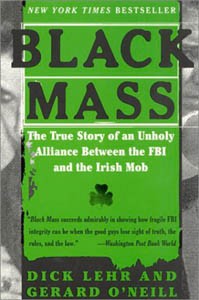
Key agents in the Boston office of the FBI were deep in Bulger’s back pocket, a scandal detailed in Black Mass: The True Story of an Unholy Alliance between the FBI and the Irish Mob (Perennial; $14).

Written by Boston Globe reporters Dick Lehr and Gerard O’Neill, Black Mass reveals that the FBI helped Bulger and Flemmi get away with everything from racketeering to murder. They even helped Bulger take away Rakes’ liquor store.

Maybe this doesn’t come as a big surprise. After all, the Federal Bureau of Investigation has weathered scandals galore, with the latest black eye coming in the McVeigh case, in which the bureau illegally withheld evidence from defense attorneys. And, let’s face it: things have never been exactly hunky-dory over at our nation’s most high-profile law enforcement agency, which J. Edgar Hoover ran much like the Gestapo.

But the Boston case knocks the props out from under one of the FBI’s most cherished myths–that G-men can’t be corrupted. Indeed, as Lehr and O’Neill reveal, agents sometimes come pretty cheap: the mobsters bought off one FBI supervisor for decades with $7,000 and a few cases of wine.

The affair began with good intentions and acres of ambition. Desperate to strike a blow at the Italian Mafia in Boston, a young FBI agent named John Connolly saw a chance to create a special informer relationship with Bulger. With Bulger and Flemmi’s help, the FBI brought down La Cosa Nostra, sending its leaders to prison and shattering its influence in the city.

Meanwhile, as the relationship between Bulger and Connolly deepened, the Irish gangster became untouchable. His underworld rivals were often eliminated by arrest. And even when Bulger used murder to get his way, he could count on his pet FBI agent to quash any inquiry by law enforcement. Connolly seemed willing to go to almost any lengths to protect his informants, and he had plenty of help from other agents.

This cozy relationship, which allowed Bulger and Flemmi to operate a lucrative web of criminal enterprises, lasted until other law enforcement agencies finally did an end run around the FBI in the mid-’90s and built a bullet-proof case against Bulger’s mob. Unfortunately, Bulger never went to trial–the mobster fled town after getting an inside tip about his impending arrest. He is still at large today.

What’s to be learned from this unholy mess? You could chalk the problem up to human fallibility: FBI agents can go bad, just like anyone else. But critical observers of the agency say the Bulger-Connolly affair deserves a longer look. They wonder how many other John Connollys are out there.

Dick Lehr and Gerard O’Neill discuss ‘Black Mass’ on Thursday, June 7, at 7:30 p.m. at Murphy’s Irish Pub, 464 First St. E., Sonoma. For details, call Readers’ Books at 707/939-1779.

From the May 31-June 6, 2001 issue of the Northern California Bohemian.

© Metro Publishing Inc.

Open Mic

Open Mic

A Tribute

By Karen Pierce Gonzalez

MONTHS AND MILES away from Veterans Day, I salute the dying efforts of my friend Michael, 54, a Vietnam medic who did not choose to serve his country.

Agent Orange has claimed the parts of his body not yet ravaged by a recent stroke. Penniless in Arizona, away from the California lifestyle of high-tech pacing that helps give birth to road rage capable of triggering anyone’s post-traumatic stress, he’s eking out the rest of life in a one-room cabin surrounded each winter by two feet of snow.

Next month the Veterans Hospital plans to cut out part of his jaw in an effort to “control” the spread of war’s poison in his bones. He’s hoping it’s only the left side of his rugged face, corralling the combined disease and stroke damage to just that one side. This leaves his right leg, arm, and hand free to steer his walker and to cook discounted day-old beef into stew (the meat’s cost per pound almost fits his dwindling budget).

Unable to work, he still waits for state disability. The process takes three months once it’s been determined he’s disabled. To date, the determination, now in its third month, has not been finalized.

Waiting for approval he hopes won’t come too late, Michael sifts through his belongings, sending me the “more precious” things. Among them is an aerial view of a lotus-seated Buddha in Da Nang. He came to know and love this deity almost as much as life itself. The peaceful white symbol of “infinite love,” combined with small needles filled with heroin, made it easier for him to forget the Asian wife and child he lost in a village attack.

Today he calls me just to hear the voice of a friend; someone who’s seen him crawl away from heroin and alcohol, but not away from the long-term wounds of war.

“The clock is ticking,” he says calmly.

I start checking airfares. I want to be there in time–to wrap him in a new, soft, warm bathrobe that comforts his tired, polluted body, and to read his favorite poems aloud, the Psalms of King David, a musician of the soul, much like my friend Michael. He fights the good fight now on new ground. Not one to surrender to victories of war, he will go bravely into the night, a veteran of honor any day of the year.


Karen Pierce Gonzalez, a Rohnert Park-based writer, is the founder of Preserving the Sacred, which does public relations work for sacred and cultural events.


From the May 31-June 6, 2001 issue of the Northern California Bohemian.

© Maintained by .


Kenneth Cleaver

Consumer Correspondent

September 12, 2000 Mr. George Perkovich, Program Director W. Alton Jones Foundation 232 East High Street Charlottesville, NC 22901

Dear Mr. Perkovich:

As twilight descends on my goatee years, the downwardly mobile bachelor must review his endeavors and assess his prospects. Difficult questions must be answered with courageous honesty and prescience. Should I have used a different font on my résumé? Why am I paying for cable? How much longer will my cynicism and tomfoolery quell a burgeoning nervous breakdown? The answer most relevant to this communiqué is my recent decision to forge a career as a barstool philosopher, injecting that sage with a much-needed dose of profundity, cleanliness, and not infrequent sobriety. From smoky rural saloons to romper room college bars, I will combine a hobo ruggedness and road warrior work ethic with a modest Red Roof Inn lifestyle.

A one-man museum, encyclopedia, sociopath, scholar, shaman, comedian, conflict negotiator, sex object, sex subject, and compassionate asexual listener. From the bullpen of the Chicago Cubs to the bull markets of Asia to everyday bullshit, no subject will find me without an informed and original comment. Kenneth Cleaver will exist as a necessary anachronism to the cultural homogenizing forces of economic globalization, connecting our nation with stories of the road, free from the parade of sycophants that encumber celebrity status. The new picaresque iconoclast understands media, but repudiates its solipsism and megalomania. I will not sell tickets. I will not have a website, I will not give readings to uppity Oprah book clubbers at Barnes & Noble. Ingratiating myself to fellow drinkers from town to town will be my true reward.

From the W. Alton Jones Foundation, I require a modest salary of $20,000 per annum and reimbursement for travel and accommodation, roughly estimated at $600 per week. In return, you will receive biweekly reports summarizing my endeavors with tallies on the number of people I’ve educated, agitated, amused, and copulated with. I hope you will consider this unique opportunity for giving birth to a new American hero.

Sincerely, Kenneth H. Cleaver

December 12, 2000

Dear Mr. Cleaver:

Thank you for your recent inquiry regarding possible funding from the W. Alton Jones Foundation. We were much amused by your creative writing. Unfortunately, as you might imagine, our response to your request must a negative one. The W. Alton Jones Foundation’s Secret World program focuses primarily on the prevention of nuclear war and prevention of the massive release of radioactive materials. Our Board of Trustees has had to make the difficult decision to focus our limited resources only on projects which fall clearly into these specific categories. For this reason, the Foundation would be unable to offer any assistance. We do, however, offer encouragement that you will continue successfully “educating, agitating, and amusing” (if not “copulating”) your way through life. Our society desperately needs the few, rare hobo sages and comic shamans in its midst, whether it believes this or not.

Sincerely,

Laurie Blomstrom, Program Assistant (sort of on behalf of the W. Alton Jones Foundation)

From the May 31-June 6, 2001 issue of the Northern California Bohemian.

© Metro Publishing Inc.

Kenneth Cleaver

Consumer Correspondent

August 29, 2000

Ms. Elizabeth Toledo, Executive Director National Gay and Lesbian Task Force 1700 Kalorama Road, NW Washington, DC 20009-2624

Dear Ms. Toledo:

The mainstream gay rights movement has made a solid case for gay marriage by framing it within the context of civil rights and social justice issues. Inequities in taxation, health insurance, hospital visitation, and inheritance rights all highlight the second-class status of gay and lesbian relationships. Legalized gay marriage holds the potential to obliterate institutionalized heterosexual privilege while asserting a parity of esteem between gay and straight America.

Markedly absent from the debate is a rallying cry, which, if harnessed properly, will create the groundswell of support necessary to legalize gay marriage in all 50 states. I happened upon this idea while in the kitchen of a newly married friend. There I found some of the most gorgeous culinary accoutrements this side of William Sonoma, all the booty of their recent union. They even had a blender-phone!–a telephone combined with a traditional blender. Instead of ringing, it blends. A blender-phone!

My best friend David, a radical homosexual, argues that bridal registries are merely slops the ruling class feeds those who replicate–and thus reinforce–its oppressive structures. He points out that it is not the bourgeoisie that fills a bridal registry, but the wedding guests. David is less interested in common sense than in plotting the demise of heterosexual propagandist Nora Ephron.

There is nothing inherently reactionary about wanting a bridal registry. The desire for kitchenware transcends race, class, gender, and sexuality. Many would-be activists may shrug their shoulders about legal battles in Hawaii and Vermont, but show them what they’re missing from Pottery Barn, show them the blender-phone, and we have ourselves a movement!

Sincerely, Kenneth H. Cleaver

October 12, 2000

Kenneth H. Cleaver P.O. Box 810 Bedford, NY 10506

Dear Mr. Cleaver:

Thank you for your letter of late August regarding gay marriage. It is a cleverly satiric piece with several salient points.

LGBT marriage is a civil rights issue. Unfortunately, not all LGBT individuals see it as such and some succumb to apathy. Did you happen to see the article in the Washington Blade last month reporting on the findings of a study suggesting that same-sex marriages could generate up to $10 billion annually in additional federal income taxes? It reminded me a bit of your letter.

Thanks again for writing.

For equality, Elizabeth Toledo

From the May 24-30, 2001 issue of the Northern California Bohemian.

© Metro Publishing Inc.

‘A Knight’s Tale’

0

A modern-day jousting pro takes on ‘A Knight’s Tale’

Writer David Templeton takes interesting people to interesting movies in his ongoing quest for the ultimate post-film conversation. This is not a review; rather, it’s a freewheeling, tangential discussion of art, alternative ideas, and popular culture.

Matt Machtan looks like a knight. Even here, perched on a 21st-century office chair inside the 10th-floor meeting room of a San Jose office complex–where we’ve rendezvoused to discuss the medieval action-adventure A Knight’s Tale–Machtan, dressed in slacks and a loose gray shirt, exudes a conspicuously knightly vibe.

With his flyaway hair and neatly trimmed beard, Machtan looks a lot like Roger Rees (the Sheriff of Nottingham in Robin Hood: Men in Tights)–only younger, stronger, and more capable of killing me.

Aside from his edgy, semi-swashbuckling appearance, there is also a touch of royalty about Machtan, an aura of strict, well-spoken politeness and etiquette. Is it the modern embodiment of the ancient code of chivalry? Or only the instincts of a highly skilled marketing manager, his official position at Mari Telecom, the Korean-based maker of the popular online game MageWar?

Of course, Matt Machtan is called marketing manager only on weekdays. On weekends, when he’s out thundering across a muddy field, wielding giant sticks to knock men off horses, people tend to call him sir.

Like hot-blooded young William (Heath Ledger), the would-be-champion of A Knight’s Tale, Machtan is a professional jouster. In fact, he’s a two-time bronze medalist, competing in the American Jousting Association’s World Jousting Tournament in Oklahoma in 1999, and again in Colorado in 2000.

Currently on the injured list–he wrecked his shoulder in a fall from a horse last October–Machtan has performed at Renaissance festivals around the country, first competing in Wisconsin, where he honed his skills as a squire for four years before embarking on his training as a competitive jouster. Also, like William’s dreams, Machtan’s dreams of becoming a knight run all the way back to childhood.

“I was always the kid who was running around on the front lawn with the wooden sword, the paper armor, and the garbage-can lid,” he says. “My brothers and sister too. We’d invite other kids in the neighborhood, and we’d all get dressed up in whatever armor we could find or make out of grocery bags or whatever, and by the end of the battle, the lawn would be littered with bits of paper. It was glorious.”

Glorious too, are the jousting sequences in A Knight’s Tale, which follows the low-born William’s dangerous scam to pass himself off as a knight, rising in fame and fortune as he wins joust after joust, portrayed as the medieval equivalent of football, complete with fans pounding their feet while chanting, “We will rock you.”

While Machtan found the film’s anachronistic touches to be somewhat irritating–“When I’m charging at an opponent with my lance ready,” he says, “it’s not Queen that I have in my head”–he was definitely roused by the sight of horse-riding knights smashing into each other.

“The hits. The falls. The excitement. That’s good stuff,” he declares. “It definitely got my juices flowing. Being smashed in the chest with a lance. Taking a fall to ground in front of a cheering crowd. I could relate to that because I’ve done it.”

It’s no surprise that the film has been popular among Machtan’s fellow jousters–“My brothers in arms,” he calls them–or that many professional jousting experts have found certain things in A Knight’s Tale to quibble with.

“Let’s just say that the exploding lances–on every single pass–were significantly Hollywoodized.”

“Jousters aren’t supposed to shatter their lances on impact?” I ask, incredulous. In the movie, William explains that breaking a lance during a pass is the way you score a point. Three shattered lances and you win the match. Unseat your opponent and you win his horse. “So all of that is, what? Basically horseshit?”

“Basically,” Machtan says. “Historically speaking, there was a time, for a short while, that knights would joust with hollowed-out lances, which tend to shatter on impact. But they stopped doing it when one of the kings got killed. By a wood shard. Through his visor.”

Through his . . ? Oh. O-u-ch!

“Exactly,” he agrees. “While it’s fun to break a lance–and I have done it–it’s not necessarily the safest thing in the world.” As I go on wincing at the thought of a two-foot sliver slicing through my retina, Machtan continues his knowledgeable condemnation of the movie’s broken-lance fetish.

“Then there’s the cost factor,” he says. “If you broke a lance of every pass, you’d be buying new lances all the time. You’d go broke in a single season. Today, we tend to use shaved-down tree trunks.”

The way to make a modern lance is to find a heavy tree trunk and take a lathe to it, shaving the lumber down to the proper thickness and length. Though Martha Stewart may know a better method, Machtan says this is the way most jousters accomplish the task. Others, Machtan included, make their lances with good, strong dowels.

“Very effective,” he says.

In A Knight’s Tale, William’s first joust is played for laughs, Unprepared and untrained, he reveals none of terror or anxiety that I would feel if it were me being charged at with a massive dowel.

“I imagine you were a little nervous?” I ask Machtan.

“A little?” he recalls with a laugh. “It’s scary enough to joust in practice, with no one watching, but this was terrifying. Even so, I remember getting this intense, sudden shot of adrenaline, just before I started maneuvering my horse forward into a run, and then another big shot of adrenaline, in the split second before the other guy’s lance struck me.”

“BAM!” he shouts. “BAM! Oh yeah! It was the best feeling in the world!”

As for the actual impact, he compares it to taking a significant tackle in a football game. He liked it. “From that moment on, I was hooked,” he says, grinning like a boy in a paper suit of armor. “Though jousting isn’t really that scary anymore, I still get that adrenaline rush. Every single time.”

Machtan’s goal for the future, aside from taking the gold once his doctor releases him to compete again–“In three months and nine days,” he says–is to see jousting reach acceptance as an recognized competitive sport. If A Knight’s Tale becomes a hit, it could go a long way toward increasing public awareness of jousting associations like the AJA.

Machtan even predicts that jousting will one day be featured at the Olympics.

“Hey, they’ve already got things like ballroom dancing. As an Olympic sport.” Machtan shakes his head, wounded at the very thought. “So my dream is not that far-fetched. The way I look at it, the Olympics have equestrian events, and they have fencing.

“Next step, Olympic jousting.”

From the May 24-30, 2001 issue of the Northern California Bohemian.

© Metro Publishing Inc.

Open Mic

0

Open Mic

49 Questions

By Atticus Hart

WHO’S IN CHARGE HERE? Who’s running this show? Why is the customer service so bad? Do none of us take pride in our in our work anymore? Is God dead or just jaded? If life is so precious, why doesn’t it come with a warranty? Why are the finance charges so steep?

Where is the operating manual?

What are we trying to live up to? Why is it so hard to give ourselves permission to succeed? To fail? Are successful people really smarter than the rest of us? Are they really better looking? Are they happier? Or are they just more vain? More driven? More ruthless?

What is social Darwinism and where can I get some?

Is there really a hell? Is it big enough to contain all the people–my boss, my high school gym teacher, my ex, my snotty neighbors–who annoy me? Is it hot enough to burn away the pain of existence? Do you suffer alone? Where are the angels? Do you burn in your own private hell of your own making? If so many people are so miserable, why don’t we all do something about it? Do you ever lie awake in the dead of the night and wonder how many other sleepless souls share your plight?

Why does your boss treat you like a soulless automaton? Why are you willing to sell out for a good dental plan, an overpriced house made of plastic and pressboard, and a $350-a-month lease on a Lexus?

Do you ever take the time to think about the feelings of others? To see yourself the way they see you? To humble yourself? To drop that facade of righteousness? That pretense of purpose? That veneer of authority?

What stops you from expressing your love?

If you had imagined this life when your were 9, how would your choices have been different? What’s keeping you from being the person you thought you could be back then? Was life really simpler in those days or did we all just have our head stuck in the sand? Do you delude yourself into thinking that you’re in control of your destiny? What does your boss say about that? Your landlord? Your spouse? The government? Do you ever try to cut through the illusions? Or have you just packed it in?

Why can’t we be happy in the moment?

Who’s in charge here?


Atticus Hart lives in Bodega Bay. He used to believe in a master plan. Now he spends his time avoiding the pitfalls of his making.


From the May 24-30, 2001 issue of the Northern California Bohemian.

© Maintained by .


Restaurant Customer Horror Stories

0

Chef’s Revenge

A veteran cook dishes up restaurant justice

By Bob Engel

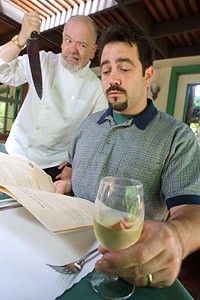
EVEN AFTER 26 years in the restaurant business, rude or just plain grumpy customers can still gall me. While simple bad manners can be forgiven, some behavior cries out for justice. Most patrons exhibit a gratitude and contentment befitting their circumstances. After all, they are being waited upon and fed. They don’t have to cook or do the dishes, and they aren’t obligated to invite their hosts back. These diners express satisfaction with the service and appreciation of their meal. Perhaps they even have as their motto “If you can’t say something nice, don’t say anything at all.” Waiters know that the customer who responds with a terse “fine” to an enquiry about his meal may be withholding some slight criticism.

Their reticence is respected.

Regretfully, other patrons take advantage of the relationship of diner and wait staff to engage in a fantasia of master and servant, an opportunity to play at upstairs/downstairs, re-creating for a few hours the class society of 19th-century England. Despite widespread comic representations of the surly waiter, it is more likely to be the customer who is churlish, petulant, and difficult.

For the most part, restaurateurs and staff take these less than exemplary human beings in stride. As one former employer told her staff, “The customer is always wrong, but we can’t let them know it.” Occasionally though, a guest’s conduct may be so egregious that some form of comeuppance is appropriate. I am not referring to anything so vulgar as spitting in their soup, a common icon of rebellion that hopefully never occurs in practice. No, the opportunity to serve rude customers their just deserts should be both more straightforward and more creative than that.

In the early ’80s, I worked for a man who was a devotee of Werner Ehrhart’s EST movement, one of those self-empowerment cults that sprang up in the wake of more benign spiritual groups. EST was based on an elaborate series of self-serving theories, and the owner had swallowed it all. He turned straightforward matters of employee relations into intricate exemplars of his staff’s psychological flaws. But we were able to forgive him for his peculiar management methods because he had an equally unique take on his relationship with his customers.

We all know that some customers seem to delight in complaining about their dining experience. One suspects that this is part of what they look forward to when they go out for dinner. Perhaps Mama refused them their bottle, or forced them to eat spinach too early, or never let them speak at the table. Such customers arrive with their antennae bristling, ready to detect any shortcoming. They are inpatient when they wait for their table; and when they are seated, their sensitive feng shui alerts them to the unsuitability of their placement in the room. The soup for them is always cold, the refill of their water never sufficiently prompt. The field of their negativity is well known to attract stray hairs onto their plates.

These ingrates are every restaurateur’s nightmare, and while waiters generally accept them as Job did his boils, my former employer with his EST training had found a more direct response. On more than one occasion I heard him tell customers, “Look, if you want to have a bad time here, that’s OK with me, but don’t lay the blame on us. This is your trip and you’ve got to accept responsibility for it.”

Huzzah. That’s hitting the nail on the head. His employees forgave him many of his trespasses because of this singular line of reasoning, and never mind that he applied it to both the overly sensitive and the genuinely affronted.

WHILE SOME customers arrive at the door primed to find fault, other guests turn from Jekyll to Hyde only after a few drinks too many. A few cocktails or a bottle of wine can make the food taste better, the conversation seem wittier, and the tip more generous, but a certain proportion of patrons make ill-tempered and unpleasant drunks.

A former sous-chef told me of a chic Napa eatery that was beset with a party of four businessmen whose mutual reaction to alcohol was to lose all social grace. Regretfully for the other diners, their table was in the middle of the small restaurant. As the evening progressed, they became louder and more obnoxious. Finally, one of the men in the party began to make lewd comments about their young bus girl.

Enough. The owner strode out to their table and asked them quietly but firmly to leave. Showing no sign of complying, the men engaged the chef in debate but stood their ground. The owner told them that they need not pay for their meal, but that they must leave immediately. Still no sign of movement from the table.

“Get out!” the owner cried, hoping that he might bring the communal force of the other diners to his side and shame the offenders into retreat. They didn’t budge. It was a Mexican standoff. Would he call the police? Grab a cleaver from the chopping block?

The owner’s brilliant solution was this: he flipped the four corners of the tablecloth to the center of the table, gathered it into a bundle, and with a rattle of plates and glassware hoisted it all in the air. Red wine dripped from the bottom of the sack as he carried it back to the kitchen. The men sat at a completely stripped table. They had not a glass or a fork. The dark vinyl top of the bare table glinted where the wine had spilled. The miscreants had no choice but to leave; and as the door closed behind them, the other diners burst into polite applause.

So it is most often the owner of a restaurant who feels at liberty to break the bounds of decorum. An employee, no matter how tempted, must know that to retort tit for tat in a tête-à-tête with a customer could mean his or her job. But an inventive waiter once solved an affront to his Gallic pride without simultaneously endangering his employment.

Michel was a very successful waiter, who despite spending half of his 30 years in the United States maintained a strong French accent, no doubt because it improved his tips. One evening he had particular difficulty with a couple about his own age. It was the gentleman who caused the problem. He ran Michel ragged, flaunted his–generally inaccurate–knowledge of wine and kept a running commentary of asides to his date about the inadequacy of the service and the deficiencies of the food. Between each course Michel fumed in the kitchen, describing the boor’s latest offense. “Now, ee says zee wine eez corked. It eez not.” According to Michel, the man’s girlfriend could see right through the lout, and she graced Michel with sympathetic glances while her date prattled on. “She eez too goud for eem,” Michel complained.

Michel presented the bill. The man paid with a credit card, adding a tip of exactly 10 per cent. The couple lingered at their table long after the bill was paid, the gentleman oblivious to his date’s restlessness.

As they were leaving, the man excused himself to go to the men’s room, and Michel took the opportunity to speak momentarily with the boor’s date. “Per-aps,” said Michel, “you would like to go out sometime with a man who eez more generous and more appreciative.” He handed her his telephone number.

She called the next day. They dated for over a year. Michel sometimes referred to her humorously, but with real affection, as “the best teep I ever got.”

Yet for every boorish patron who gets what’s coming to him, there are many that escape unscathed, at least in this life. But restaurant people–chefs and waiters and owners alike–share a superstitious belief in a restaurant hell. If through some fault they are assigned to this torment it will mean an endless cycle of rotten produce, dishwashers who don’t show up for work, nights when the items you’ve prepped heaviest for are ignored and obscure dishes are ordered in droves.

They take solace from the belief that on the other side of the swinging doors of that hell, former despots of the dinner table are spending their eternity at the worst table in the house, eating cold soup with a dirty spoon, and finding a succession of unsavory hairs in every dish.

Bob Engel is the former chef at Russian River Vineyards.

From the May 24-30, 2001 issue of the Northern California Bohemian.

© Metro Publishing Inc.
Barbara Ehrenreich

Hanging Out

Barbara Ehrenreich rediscovers America’s working poor

By Jonah Raskin

OLD KARL MARX could be oh so wrong, and yet oh so right. He was dead wrong about communism, which he called the salvation of humanity, but dead right about capitalism, which even back in the 19th century he described as a global economic system. Of course, in America, you wouldn’t want to bank on Marx’s ideas. Here, as Wall Street brokers like to remind you, ragged workers are reinvented as rich stockholders, and the toiling masses spend more time at the mall than at the barricades.

Barbara Ehrenreich, a longtime crusading journalist and political activist, knows perfectly well the familiar story of the upwardly mobile, commodity-consuming American working class. Still, she’s kept her faith–through economic boom and economic bust–in democratic socialism (with a feisty feminist twist) and with a modified version of Marxism. In The Worst Years of Our Lives: Irreverent Notes from a Decade of Greed (Pantheon Books, 1990), the best-selling collection of her sassy essays, she noted that the rich were getting richer, the poor were getting poorer, and social upheaval seemed inevitable.

“The Marxist vision at last fits America’s future,” she suggested.

Still, she was shrewd enough to add that in America, predictions about a workers’ revolution are dicey. “For one thing, Americans are notorious for their lack of class consciousness or even class awareness,” she wrote.

Now, in Nickel and Dimed: On (Not) Getting By in America (Metropolitan; $23), a newly published firsthand account of her brief, mostly unhappy life as a waitress, a cleaning woman, and a Wal-Mart salesperson–Ehrenreich seems more confident making predictions about worker protest, and less inhibited as a rabble-rouser, though she doesn’t resort to Marxist terms like “exploitation” or Marxist slogans like “Workers of the world, unite!”

Ehrenreich’s writings–she’s a fiery pamphleteer as well as a cantankerous columnist–have always exploded with anger about economic and social injustice. Now she seems more outraged than ever before about the havoc that the capitalist system has caused at home to almost all of us, whether we’re middle class or working class.

“Wherever you look, there is no alternative to the megascale corporate order, from which every form of local creativity and initiative has been abolished by distant home offices,” she writes in a chapter that depicts the diabolical and dehumanizing world of Wal-Mart, Wendy’s, and Home Depot that’s all over America. “What you see–highways, parking lots, stores–is all there is, or all that’s left to us here in the reign of globalized, totalized, paved-over, corporatized everything.”

Surely Karl Marx himself would find himself applauding Ehrenreich’s indictment. In her last chapter, she seethes with indignation about the absence of civil liberties and democratic rights in the “low-wage workplace.” Sounding like author and social critic George Orwell of 1984 fame, she rails against the ominous power of corporate Big Brother. “We can hardly pride ourselves on being the world’s preeminent democracy, after all, if large numbers of citizens spend half their waking hours in what amounts, in plain terms, to a dictatorship,” she exclaims.

Nickel and Dimed is meant to disturb, and it does.

With unemployment and inflation both rising, and with fears of a recession, this could be a timely book that invigorates public discourse about our economy. It might also make affluent Americans feel more compassionate toward workers at the bottom of the corporate pyramid.

Nickel and Dimed began as a Harper’s magazine article about the author’s experience trying to make ends meet as a waitress in the fast-food industry near her home in Florida. Reader response was so positive that she decided to do a book on the subject. Ehrenreich might have retreated to a research center. She might have amassed government statistics and conducted formal interviews with working folk. Instead, she plunged into the often invisible world of work among America’s outcasts and untouchables.

What she proved, in dollars and cents, is that it’s impossible for a single person to survive on the wages at the bottom of the economic ladder.

“Immersion journalism” is the term the industry uses to describe what she’s done. Many of the writers I know call it “hang-out journalism.” Still others refer to it as “undercover reporting.” Whatever the term, it’s the best way–often the only way–to unearth the awful truths about the powerful and the powerless in an age when governments and corporations are increasingly secretive, and when PR flacks issue a steady stream of lies. As Ted Conover–the author of Coyotes and Newjack, and the best-known “hang-out” journalist of our age–explains, “The truly meaningful things about a people are not learned by conducting an interview, gathering statistics, or watching them on the news, but by going out and living with them.”

I’ve learned that lesson myself when I’ve written about political exiles and fugitives and about the underground drug economy in Northern California.

Ehrenreich’s low-paying jobs in Florida, Maine, and Minnesota proved to be more surprising than she had imagined. “Before I set out, I didn’t realize how few rights you have in the workplace,” she explains during a recent, long-distance phone conversation, shortly before embarking on a book tour. “My employers had the legal right to search my purse. I felt like I was back in junior high school. I also learned that it’s not easy to live economically on minimum wages; eating in fast-food places can be more costly then eating at home. Sometimes it’s more expensive to be poor than to be rich.”

Of course, Ehrenreich began Nickel and Dimed already knowing volumes about wealth, poverty, and survival. “I’ve been fixated on class issues because of my family history,” she says. “When I was born in Butte, Montana, in 1941 my father was a copper miner. Soon afterward, he became a corporate executive. We moved from Montana to Massachusetts to Southern California. Our houses got bigger and better. By the time I was a teenager I had a firsthand tour of America’s social classes.”

Ehrenreich was also impressed that her father’s economic success didn’t turn him into a Republican, or persuade him to look down on workers who were far less fortunate.

After graduating from Reed College, where she studied chemistry and physics, Ehrenreich earned a Ph.D. from Rockefeller University in New York City and seemed destined for a comfortable career in academia. Then history turned her life upside down. “It was the 1960s,” she explains. “I wanted to do something socially relevant.”

Her first book, which she wrote in 1968 with her then husband John Ehrenreich, was titled Long March, Short Spring. More Maoist than Marxist, as befitted the cultural revolution of that era, it was Ehrenreich’s first venture in hang-out journalism, though she was simply hanging out with rebellious students like herself. More than 30 years later, it’s still one of the most illuminating books about the international student protests of the 1960s.

Last summer, during the Democratic National Convention in Los Angeles, she found herself in the streets, as a journalist covering the protests. “I’m amazed and fascinated by the anti-corporate demonstrations that have taken place from Seattle to L.A. to Quebec,” she says. “I’ve long been a democratic socialist, but I feel a real affinity with the young anarchists. In fact, some of them are my friends.

“From where I stand, it looks like we’re in this together.”

Barbara Ehrenreich talks about ‘Nickle and Dimed’ on Thursday, May 31, at 7:30 p.m. at Book Passage, 51 Tamal Vista Blvd., Corte Madera. 415/927-0960.

From the May 24-30, 2001 issue of the Northern California Bohemian.

© Metro Publishing Inc.

‘The Gleaners and I’

Second Harvest Varda film finds poetry in scavenging THE FILMS of Agnes Varda are famous for leading viewers to places they never expected to go. Occasionally these destinations are as bleak as the empty roadside where Sandrine Bonnaire is found dead in 1985's heart-rending Vagabond. Other times, as in the...

African Marketplace and Film Exposé

A marketplace of ideas: Morris Turner of Rohnert Park has created the African Marketplace and Film Exposé. Paint It Black Film fest organizer hopes to raise cultural awareness By Paula Harris "SOMEONE once said it's a very small world, and it's true," muses Morris Turner, executive director of...

Dick Lehr, Gerard O’Neill

FBI and Irish mobsters: a match made in hell By Patrick Sullivan WHAT IF YOU opened your front door one night and three notorious mobsters ushered themselves inside? What if these stone-cold killers sat around your kitchen, playing with guns as they offered you a paltry sum for your brand-new business? And what...

Open Mic

Open MicA TributeBy Karen Pierce GonzalezMONTHS AND MILES away from Veterans Day, I salute the dying efforts of my friend Michael, 54, a Vietnam medic who did not choose to serve his country.Agent Orange has claimed the parts of his body not yet ravaged by a recent stroke. Penniless in Arizona, away from the California lifestyle of high-tech...

Kenneth Cleaver

Consumer Correspondent September 12, 2000 Mr. George Perkovich, Program Director W. Alton Jones Foundation 232 East High Street Charlottesville, NC 22901 Dear Mr. Perkovich: As twilight descends on my goatee years, the downwardly mobile bachelor must review his endeavors and assess his prospects....

Kenneth Cleaver

Consumer Correspondent August 29, 2000 Ms. Elizabeth Toledo, Executive Director National Gay and Lesbian Task Force 1700 Kalorama Road, NW Washington, DC 20009-2624 Dear Ms. Toledo: The mainstream gay rights movement has made a solid case for gay marriage by framing it...

‘A Knight’s Tale’

A modern-day jousting pro takes on 'A Knight's Tale' Writer David Templeton takes interesting people to interesting movies in his ongoing quest for the ultimate post-film conversation. This is not a review; rather, it's a freewheeling, tangential discussion of art, alternative ideas, and popular culture. Matt Machtan looks like a knight....

Open Mic

Open Mic49 QuestionsBy Atticus HartWHO'S IN CHARGE HERE? Who's running this show? Why is the customer service so bad? Do none of us take pride in our in our work anymore? Is God dead or just jaded? If life is so precious, why doesn't it come with a warranty? Why are the finance charges so steep? Where is...

Restaurant Customer Horror Stories

Chef's Revenge A veteran cook dishes up restaurant justice By Bob Engel EVEN AFTER 26 years in the restaurant business, rude or just plain grumpy customers can still gall me. While simple bad manners can be forgiven, some behavior cries out for justice. Most patrons exhibit a gratitude and contentment befitting...

Barbara Ehrenreich

Hanging Out Barbara Ehrenreich rediscovers America's working poor By Jonah Raskin OLD KARL MARX could be oh so wrong, and yet oh so right. He was dead wrong about communism, which he called the salvation of humanity, but dead right about capitalism, which even back in the 19th century he described...
11,084FansLike
4,606FollowersFollow
6,928FollowersFollow