‘Waking Life’

Pie in the Sky: Big ideas get a beautiful setting in ‘Waking Life.’

Big Dreams

‘Waking Life’ offers animated course on modern philosophy

By

Waking Life offers an unforgettable tip on how to tell the difference between dreaming and wakefulness. Supposedly a dreamer has a hard time visualizing numbers on a digital clock, fine print, or shades of lighting. If you think you’re dreaming, try flicking a light switch; if the room doesn’t dim, you’re in a dream–and now it’s time to take charge of it.

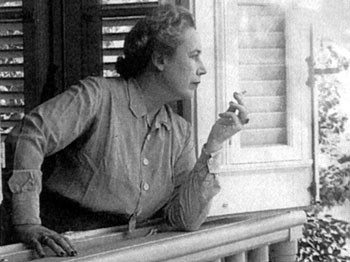
This latest film from Richard Linklater (Slacker, Before Sunrise) is a tour through a sleeper’s dream state. Waking Life features an unidentified traveler (voiced by Wiley Wiggins) who drifts through a chain of conversations with other figures. Sometimes he tries to awaken and finds himself in another dream. He never quite emerges into the real world.

The film is rotoscoped by Bob Sabiston, director of those unsettling burnt-orange Earthlink television commercials, with the eyes and mouths floating in little lazy circles. The animation gives a tendency to make backgrounds wobble and shift.

While the coloring is lovely, the way the facial features drift here may make those who remember that short Canadian cartoon “The Big Snit” think: “Stop shaking your eyes!” Watching Waking Life, I had the twin sensations of being fascinated and seasick.

The images drift, but Linklater’s little mosaic of ideas forms a scheme. If we could control the action in our dreams, we’d have a little taste of being God. But in our waking life–the true subject of this film–how much are we in control?

Linklater’s dialogues form a treatise on the freedom to act. Robert C. Solomon, an existentialist prof from the director’s beloved Austin, gently counters the old argument that the godless can’t really have happiness in their lives. But the dreamer also encounters postmodern philosophers, who speculate that we’re all just functions of social programming. “I’d rather be a gear in a big deterministic physical machine than just some random swerving [sic],” says one grad-student type.

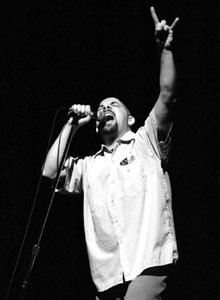
And the director follows the idea of free will to a negative extreme: if we’re all free to do as we please, why not just go on a murder spree? Linklater stages that argument via the ravings of a jailed psycho, voiced by Charles Gunning. On a less threatening level, we drift by a few intellectual thugs, striding purposefully to nowhere.

Waking Life has a length problem common to all unplotted films; after the first hour restlessness sets in. And where are all the women? There are a handful of memorable female characters here, particularly a dialogue by Julie Delpy and Ethan Hawke (continuing some of their discussions from the film Before Sunrise–and in a bed at last). Still, it’s mostly men who have their say.

One warning about Waking Life: Egghead haters, beware! Still, these dialogues on the unchained mind are music to the ears right now, when almost all the public discourse is one big howl for conformity. “Things have been tough for dreamers,” says one of the characters here.

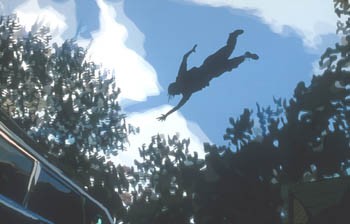
Jonathan Schell, the informed pessimist who wrote The Fate of the Earth, wrote that the most horrific aspect of Sept. 11 was watching people rain from the sky. I love Waking Life for its beginning and ending, a beautiful anecdote to that horror: a man aloft, gently pulled into the sky, a symbol of limitless possibilities and freedom.

‘Waking Life’ opens Friday, Nov. 2, at Rialto Cinemas Lakeside, 551 Summerfield Road, Santa Rosa. For details, see , or call 707/525-4840.

From the November 1-7, 2001 issue of the Northern California Bohemian.

© Metro Publishing Inc.

Politics At Sonoma Farmers’ Market

Farmer plants seeds of dissent at local farmers’ market

By Tara Treasurefield

“I WAVE NO FLAG. I support no war against the peoples of the world. I oppose U.S. policies that impose injustice and misery on so many people around the world.” These are the words that farmer Neal Dunaetz wrote on a sign that he displayed at the Sonoma Farmers Market on Sept. 14. Alarmed by the increasing presence of the American flag and by talk of war and vengeance, Dunaetz made space for alternative views. He attracted people to his stall by giving away produce and, while he had their attention, engaged them in a discussion about U.S. foreign policy, a move that has stirred a storm of controversy over free-speech issues in that usually quiet Sonoma County town.

Some welcomed the opportunity to share ideas and information that the mainstream media scrupulously avoid. Others were deeply offended by what struck them as insensitive, even treasonous, behavior. One vendor carried a sign of his own throughout the market: “America–love it or leave it!” and at one point thrust it in Dunaetz’s face.

To avoid further conflict, on Sept. 25 the Farmers Market board of directors circulated a statement to all vendors that read in part, “The Farmers Market should not be a place to air political views. We hope vendors will consider how their actions impact those around them.” One or two vendors say that market manager Hilda Schwarz discouraged them from displaying the flag, and on Oct. 2, the town’s weekly community newspaper, the Sonoma Index Tribune, ran a front-page article critical of the market’s board of directors.

Rushing to the defense of their flag, irate patriots flooded the Index Tribune with letters condemning the Farmers Market board, and on Oct. 9, a half dozen members of the local chapter of the Veterans of Foreign Wars, some carrying huge American flags, walked through the Farmers Market.

Assembling at Dunaetz’s stall, the veterans found that he had pinned a burnt American flag to his shirt and was passing out a letter that described America as a bully, the people who destroyed the World Trade Center as brave, and the bombing of Afghanistan as a crime against humanity. Some insisted that Dunaetz leave the market. One veteran even urged him to leave the country, and offered to pay his airfare.

But several nearby shoppers supported Dunaetz and expressed their own opposition to the war. Longtime Sonoma resident Bette Timm was furious with those who were trying to silence Dunaetz, and shouted, “He has a right to speak!”

Sonoma Mayor Ken Brown, a Vietnam War veteran, says, “My personal reaction is that the burnt flag and letter are like a poke in the eye. But I believe he has a right to his opinion.”

Retired Navy Capt. Bob Piazza agrees. “We were willing to sacrifice our lives for the right to free speech, the right to carry arms, all the freedoms we have in this country. The minute we prevent, or attempt to prevent, those who disagree with the country’s current policies from voicing their opinion, we’ve just defeated the reasons we spent our time in the military,” he says.

A former Vietnam combat medic, Ted Sexauer, not only defends Dunaetz’s right to speak; he also shares some of his views. He says, “I believe that bombing Afghanistan is absolutely the worst thing we could have done. We need to stop terrorizing poor people who happen to live where resources ‘vital to the United States’ are found. I know very well I’m not the only one who feels this way, yet our voices are not represented in government or the media. This country needs its loyal dissenters.”

Since Oct. 9, Dunaetz has received four anonymous phone calls threatening him with bodily harm, and four others from people who were content to simply call him names. Marty Bennett, a professor of history at Santa Rosa Junior College, isn’t surprised. “Always, when this nation goes to war there’s an attempt to suppress dissent and to force all patriotic Americans to rally around the flag,” he says.

There’s no question that the threats against Dunaetz are unlawful and unconscionable. But he isn’t simply an innocent victim; his words and actions have been intentionally provocative. Unrepentant, he says, “The world doesn’t need one more voice mourning American deaths while ignoring the countless victims of U.S. aggression all over the world. Americans should be asking what’s happening that people have so much hatred they’d actually sacrifice their lives to give such a kick to this country.

“Because we live in a democracy,” he says, “we’re responsible for the actions our government takes.”

From the October 25-31, 2001 issue of the Northern California Bohemian.

© Metro Publishing Inc.

Cuban Music CDs

0


Havana Nights: Lydia Cabera

Spirit Quest

Smithsonian’s new CDs exorcise Cuban ghosts

By Greg Cahill

OVER THE YEARS, Americans have plundered Cuba for everything from sugar cane to yuppie music, world-class cigars to cheap sex. But few take the time to appreciate the subtleties of this complex society. A pair of newly released CDs on the Smithsonian/Folkways label explore the 19th-century religious roots of Cuban culture with its deep ties to the spiritual and social traditions of West Africa.

The two volumes–Havana, Cuba, ca. 1957: Rhythms and Songs for the Orishas and Havana Cuba, ca. 1957: Afro-Cuban Sacred Music from the Countryside–are culled from an obscure 14-album series recorded in the field and collected by revered ethnographer and folklorist Lydia Cabera and photographer Josefina Tarafa. The original albums were pressed for a small label and privately issued. The two new discs–which include rare bembe lukumi ritual drumming of a bygone era in the rural province of Matanzas, as well as ceremonial urban rhythms from Havana–reveal some of the most significant threads of Afro-Cuban music history and underscore Cuba’s prominence in the web of Afro-Atlantic music in Brazil, Trinidad, Miami, New York, and elsewhere.

For her part, Cabera was no stranger to Cuban culture. Born in 1900 to a prominent Havana family, she moved to Paris in 1927–the same year that American entertainer Josephine Baker became the toast of Paris, sparking a huge interest in black culture–to study painting at the Ecole des Beaux Arts. During her schooling, Cabera began to delve into the art and religions of India and Japan, which reawakened her interest in Afro-Cuban subjects. Cabera later said that she discovered Cuba on the banks of the Seine.

It was a period that incubated Cabera’s first published work, Cuentos Negros de Cuba (Black Tales of Cuba), originally written to entertain a friend, a Venezuelan novelist convalescing in a Swiss sanitarium.

In 1938, Cabera returned to Cuba, restoring a dilapidated Spanish colonial mansion. During the next few years, she expanded her studies of the island’s African heritage. That research culminated in 1954 with the publication of Cabera’s masterwork, El Monte, with photography by Tarafa.

Cabera’s contributions as a musicologist are perhaps the least-known aspect of her celebrated life’s work. With Tarafa’s portable tape recorder and the assistance of two sound engineers, Cabera recorded secretive Santeria priests, many of whom were descendants of Nigerian Yoruba slaves, evoking orishas (or spirits) through ceremonial songs that serve today as a window on life in the 19th-century sugar mills and slave plantations that peppered the landscape.

The languid chants, the clattering rhythm sticks, the pulsing drums–these are songs that salute the powerful Shango (king of Oyo Yoruba), pray for protection from the scourge of smallpox, or honor the otherwordly protectors of the land.

For those serious about searching for the roots of Afro-Cuban music, Cabera is the ideal guide on that armchair spirit quest.


Photograph by John Cohen

Spin du Jour

Various Artists
There Is No Eye: Music for Photographs (Smithsonian/Folkways)

He’s a renaissance man. Musician, filmmaker, sound engineer, and photographer John Cohen (a member of the Grammy-nominated old-timey folk ensemble the New Lost City Ramblers) aimed his camera lens on some of the pivotal folk, bluegrass, blues, and beat figures of the ’60s. Set for a Nov. 6 release, this companion CD to the newly published book “There Is No Eye” (PowerHouse Books), includes a smartly packaged 32-page booklet of photos and previously unreleased tracks by Bob Dylan and the Rev. Gary Davis, as well as classic material by Elizabeth Cotton, Bill Monroe, Doc Watson, Muddy Waters, Woody Guthrie, and many others. At a time when interest in American roots music is running high–thanks to the smashing success of the “O Brother, Where Art Thou?” soundtrack and the buzz on the upcoming multi-episode PBS documentary series on roots music–Cohen’s work captures the passing of the torch from backwoods authenticity to traditional urban folk music. A nice addition to any serious folk- and roots-music collector’s library. (GC)

From the October 25-31, 2001 issue of the Northern California Bohemian.

© Metro Publishing Inc.

Open Mic

Open Mic

Smoke & Candy

Remembering the dead on All Hallows’ Eve

By Noelle Oxenhandler

“WOE UNTO THOSE that are consoled” is the opening line of one of the poet Rilke’s most famous letters. He wasn’t writing in the wake of a national catastrophe, he was writing to a countess who had lost her father, but a few days ago the words came back to me as though he had just written them for this particular moment in America.

I’d gone to my local grocery store and, as I walked up to the doors, I was amazed to see that there were pumpkins for sale. Something about them made me feel I should avert my eyes, gather a long black veil close around me. There was something too vibrant, almost obscene, in their orange ripeness. And though they were probably grown in fields not far from my house, the pumpkins looked like a form of exotic contraband, like something smuggled in from a very foreign, far-off country.

“Surely you don’t mean we’re going to do that this year, do you?” I felt like saying to the young man in a white apron who was arranging the pumpkins on a bale of hay. “This is not the time for jack-o’-lanterns and candy corn, for children in pink tiaras and batman capes.”

The very thought of Halloween seemed utterly inappropriate this year, like mixing a festival and a funeral.

But then I remembered where I’d been last year at the end of October.

It was a small town in southwestern Mexico, about an hour from Puerto Vallarta, where I’d gone with a small group of friends. Though we’d been told it wasn’t a town that did much of anything for the Day of the Dead, at dusk we found ourselves irresistibly drawn to the cemetery.

The closer we got, the more charged the atmosphere became. People were streaming in from all directions: in beat-up cars, on bicycles, on foot. Many of them were carrying round wreaths, wrapped in plastic, that looked like big pizzas made of ribbon. Others were carrying shovels, rakes, brooms, and radios.

In stalls just outside the cemetery’s stone wall, women were cooking tortillas, tamales, and corncobs in their husks. For a few centavos, you could buy a hot snack and chomp on it as you lingered in the warm air around the stalls. The cemetery itself was obscured by smoke: the gray smoke rising from the women’s hot coals mixed with a bluish haze on the other side of the wall.

Entering through the cemetery’s gate, we saw where the blue haze came from. The cemetery was in a state of disrepair–perhaps from the most recent earthquake that had rattled its walls and made cracks in its paths. Everywhere there were piles of loose stone and broken chunks of cement. In small clusters around the graves, family members were tending the site. They’d gather the stones and set them aside, then rake the dead leaves and grass, sweep the litter, make a pile of the debris and set it on fire. As they worked, they chattered to one another. Some played music from their radios. Children darted in and out, leaping from one grave to the next, playing hide-and-seek behind the headstones.

Some people looked quite sad. When we peered over their shoulders, we saw that the graves they were tending were fresh. My friends and I had come with a man named Carlos, whose father had died the year before. “He died very suddenly,” he told us. “He wasn’t very old. He would be so happy to know that my daughter is engaged.”

Taking a handkerchief from his pocket, Carlos wiped a layer of ash from the photograph of his father’s face that smiled from under its small dome of glass.

Remembering the intimacy of that gesture, of the evening’s mix of sorrow and gaiety, I thought of the words that followed Rilke’s “woe unto those that are consoled. What he meant by that strange line was that we must not forget the intimate connection between life and death. He was actually offering the countess what he felt to be the truest consolation: the knowledge that “life always says simultaneously Yes and No” and the belief that this knowledge need not be overwhelming.

“One should not fear that our strength might not suffice to bear any experience of death,” he wrote, “even were it the nearest and the most terrible; death is not beyond our strength; it is the measure mark at the vessel’s rim: we are full as often as we reach it–and being full means for us being heavy.”

Perhaps, with our hearts that our heavy indeed, it is precisely the simultaneity of Yes and No that we can grieve and celebrate this year on the last night of October. Though the ancient meaning of All Hallows’ Eve has been all but lost to us in the chainstore flood of ghoulish props and packaged treats, perhaps there is something that we might retrieve, something that our Mexican neighbors seem to understand so well. Then, in the light and shadow of carved pumpkins, we grown-ups could keep each other company, as we remember our so recent dead, and as our children gather candy amid the rubble and the smoke.

Glen Ellen writer Noelle Oxenhandler is the author of ‘The Eros of Parenthood’ (St. Martin’s Press, 2000) and a longtime contributor to ‘The New Yorker.’

From the October 25-31, 2001 issue of the Northern California Bohemian.

© Metro Publishing Inc.

Word Core

0

First Words: Poetry slam champion Big Pappa E (a.k.a Eirik Ott) leads the newly formed Word Core into the North Bay for a performance on Nov. 2 at Sonoma State University.


Photograph by Rory Macnamara


Poetry in Motion

Word Core puts a new spin on an ancient art

By Patrick Sullivan

POET EIRIK OTT is sleeping in on a Tuesday morning, snuggling in bed with his two cats. But don’t get the idea that he’s comfortable. “I’m starting to get sick, and I’m really hoping it’s not anthrax,” he says. “I’m in a little college town, and I’m thinking, what a perfect place to dump anthrax.Think about what it would do to the national psyche.”

Does that sound wussy? Well it might, because Eiric Ott, who sports the ironic stage name Big Pappa E, is the self-proclaimed king of wussy-boy poetry. But that doesn’t mean he’s not willing to take on a challenge.

As co-founder of a brand-new band of poets called Word Core, the 34-year-old Ott is also in the spearhead of a movement to spread a new gospel of poetry to a nation that is, as he sees it, hungrier than ever for the spoken word. Calling themselves “a rock band that uses words instead of power chords,” Word Core is on a mission to take poetry beyond English classes, beyond coffeehouses, and even beyond the increasingly popular poetry slam format.

Ott, who now lives in Chico, recalls going to a poetry reading in an L.A. coffeehouse some years back that still makes him bristle with scorn: “They sucked. They were terrible. There was just people reading from pieces of paper, moaning and groaning about their girlfriends.”

Word Core–which performs Nov. 2 at Sonoma State University–is out to change that. Drawing on influences ranging from hip-hop to punk rock to spoken-word artists like Henry Rollins, this four-man team offers a performance that’s about as far from a quiet little coffeehouse reading as you can get. “Give us an audience and we will rock them,” Ott says.

Of course, Ott and his crew are hardly the first to take up this challenge. For more than a decade now, poetry slams have been shaking up traditions by offering dramatic live readings that encourage fierce competition and audience participation. The members of Word Core have done their share of slamming. In fact, Ott and fellow Word Core member Eitan Kadosh were on a San Francisco team that took top honors in the 1999 National Poetry Slam in Chicago.

But the team’s win there underscores Ott’s ambivalent attitude toward the slam scene. At the end of the competition, Ott, Kadosh, and their comrades were tied for first place with a San Jose team. Many people in the 3,000- member crowd were insistently calling for a sudden-death elimination round to pick one winner. But the poets demurred. “We don’t take this scoring shit seriously, so we refused,” Ott recalls. “We said, ‘If you guys are calling for a death match, there’s something wrong.’ So we tore the trophy in half and shared it.”

Ott, despite his own rock-star rhetoric, is disturbed by the fact that some poets are simply not comfortable with slamming. “It’s very in-your-face and masculine,” Ott says.

Some critics also charge the slam format with elevating attitude over craft. Word Core does its share of screaming and joking. But Ott says that quieter pieces can work more sophisticated wonders. “To make that audience fall into rapt silence where all you can hear is the ice machine in the back of the room, ahh–that’s even better than making them scream,” Ott says.

Word Core aims to combine the best parts of the slam world with elements that offer a better chance for thoughtful, sophisticated poetry to reach people. “We have faith in the audience,” Ott says. “They’re not crows and we’re not dangling keys in front of them.

Whatever else poetry may be to the members of Word Core, it’s certainly not a hobby. All four members have toured extensively before, spending night after night on living room couches. But Word Core–which will perform its third show ever at SSU–represents an even bigger commitment for this crew, who used to make real money being bartenders, graphic designers, or substitute teachers.

“We’ve all quit our jobs to be poets,” Ott says. “How fucking ridiculous is that? Excuse my language, but how do you explain that to your parents?”

Word Core performs Friday, Nov. 2, at 7 p.m. at Sonoma State University’s Cooperage, 1801 E. Cotati Ave., Rohnert Park. Tickets are $5. 707/664-2382.

From the October 25-31, 2001 issue of the Northern California Bohemian.

© Metro Publishing Inc.

Charlie Haden

0

Bassist and bandleader Charlie Haden has consistently been at the heartbeat of modern jazz, whether churning out dissonant sounds as a member of Ornette Coleman’s landmark 1959 free-jazz ensemble or laying down profoundly lyrical bass lines with guitarist Pat Metheny on the ethereal 1996 collaboration Under the Missouri Sky (Verve). The roots of Haden’s latest project, Nocturne (Verve), goes back more than 20 years when the bassist led his avant Liberation Music Orchestra to Cuba. Nocturne-a stunning collection of boleros from Cuba and Mexico-teams the Haden with pianist Gonzalo Rubalcaba, saxophonist Joe Lovano, drummer Ignacio Berroa, and violinist Federico Britos Ruiz and brings this remarkable band to the San Francisco Jazz Festival on Wednesday, Oct. 31.

How good is it? “In a perfect world,” Billboard opined, “the sun would never rise without some jazz radio station having played Nocturne in its entirety.

Haden and his cohorts perform at the Herbst Theatre, Van Ness & McAllister, San Francisco. Tickets are $20/$27/$38 Gold Circle. 415-776-1999. For schedule details, check out www.sfjazz.org.

From the October 25-31, 2001 issue of the Northern California Bohemian.

© Metro Publishing Inc.

Poe Dismuke

0

Peek Into His Vision: Poe Dismuke finally gets his due at a new exhibit.


Growed Up

Two new exhibits invigorate apple country

By Gretchen Giles

HAIR AND TEETH and dung and bone. Pull and bull and tongue and donkey. Children’s collections and grandmothers’ vanities and adult dirty secrets and rusty old bedsprings and a sweet slice of brain, served up by a xylophone. Oh my!

How does childhood appear once one is firmly on the wrong side of the Garden gate, Paradise lost, erotic knowledge found–some of it mourned? In two very different Sebastopol exhibits, East Bay assemblagist and photographer Susan Danis and Petaluma sculptor Poe Dismuke peer in, noses pressed up.

Showing through Nov. 30 at the MeSH Gallery, Danis’ “Earthly Delights” exhibit presumes the prissy concerns of a woman’s World War II vanity table as seen with the disgustless awe of a child crouched under the ruffle. From that vantage, one could silently witness the indignities of maintaining dignity: false teeth, matted brushes, wigs and extensions, the midget denture of filthy seed pearls. How does the harridan in curlers emerge an hour later better resembling a movie star? Through gunk and yuck and damned hard work.

Turning the homely domesticity of vacuum hose heads into dusty vulvas (Rapunzel’s Hair), Danis often builds within a traditional painting’s frame, a lurid girly-pink plastic stuff weighing down her unlikely objects. The surface looks satiny and plump, like the cheap sheen of a Valentine chocolate box, yet it is as resinous and thick as the waxy callus of a hardened foot.

The childhood mania for collections, notably seashell collections, is booted upside down in such works as Eraser Head Mandala. Here, whitened shells are fenced back into the frame with yellowing molars, ivorying plastic Tiparillo cigar filters, an oversized house fly, and pencil erasers flattened by foot or tooth or both. The uncanny melody of the color of Danis’ objects is as lyrical as their proximity is unsettling.

Painstakingly wrought, Danis’ other assemblage pieces showcase careful years of pack-rat wonder. Eggs such as Fabergé never imagined sit on pedestals, obsessively covered in a writhing of Medusa-like metal bungees that connect and snake all over (Spring Egg); keys intact, shackled entirely in useless doorlocks (Locks, Hair, Hooks); or as blind as a hirsute cousin of the Addams Family (Uovo Peloso).

But perhaps it’s her photographs that are the most fun, if fun indeed is to be had within this knowingly naïve look at adulthood. Flawlessly composed shots such as Feast place a silky plate of skinned bull testicles in heartbreaking proximity to a woman’s naked breasts. Color photos juxtapose internal organs with toddler’s instruments, snarls of dime-store yarn, the oily sheen of a tomato seed. The colors draw in, the subjects surprise.

Both compelling and repelling, “Earthly Delights” nonetheless forgives us for being flawed and wasteful and human–for growing old–in a way that childhood’s own immortal rigor never does.

Down the street at the Quicksilver Mine Co., Poe Dismuke’s “Ad Hoc” collection of sculpture and assemblage shows through Nov. 18. Always allowing a peek into his version of a mad boy’s playroom, Dismuke’s main offerings here are wall pieces that wink and leer and whirr and move when fiddled. The Mona Lisa herself provides the main pun, whether moustachioed or rolling one wild eye upon a lever-pull. But the masterpiece of “Ad Hoc” is Otis, Dismuke’s life-sized bedspring donkey. Never missing the joke, Dismuke has a bicycle honk-horn on Otis’ rump, its belly full of smart junk, the overall piece an outstanding example of California funk art. How lucky to be able to stroll into a gift shop in rural Sonoma County and stumble across something usually cordoned off in a museum. Dismuke deserves his due.

“Earthly Delights” continues through Nov. 30 at the MeSH Gallery, 6984 McKinley St., Sebastopol. Hours are Monday-Tuesday and Friday-Saturday, 10 a.m. to 5 p.m.; Wednesday-Thursday, 10 a.m. to 6 p.m. 707/823-1971.
“Ad Hoc” exhibits through Nov. 18 at the Quicksilver Mine Co., 154 N. Main St., Sebastopol. Hours are daily, 10 a.m. to 5:30 p.m. 707/829-2416.

From the October 25-31, 2001 issue of the Northern California Bohemian.

© Metro Publishing Inc.

Creative Cooking

0


The Culinary Creative

Learning to cook outside the box

By Marina Wolf

FOOD IS A funny thing. In the hands of a professional chef, it can be a work of art, an epicurean extravaganza of color, smell, texture, taste–a veritable Rembrandt. But sometimes, in the hands of a busy, preoccupied, and amateur artist such as myself, food ends up like something out of a paint-by-numbers kit.

I used to blame myself for this and to accept my friends’ compliments with grudging grace. I knew my food wasn’t great cooking, and I didn’t know why. I followed recipes to the letter, and still ended up with something that only vaguely resembled the original masterpiece. It was all there in form and content. But the process was strangely unsatisfying and exhausting, and the end product lacked the glow of true inspiration.

I call this phenomenon “cooking inside the box.” It sounds like a line of convenience foods, and in a way it is. When I’m stressed out or just not paying attention, I end up abdicating my thoughts and feelings and senses in favor of a pre-measured formula and hope for the best. But this is a short-term answer to an ongoing dilemma. Staying inside the lines makes me feel uptight; straying outside the lines by mistake makes me embarrassed.

It feels like a no-win situation, and I know I’m not alone in this. I’ve observed several of my friends getting anxious about cooking from recipes, and not being entirely satisfied with the results. Part of the problem, of course, is that most of us are several generations removed from any kind of intuitive kitchen wisdom. Our world has changed too fast for those instincts to evolve with us. Now we have ingredients that our ancestors never knew, and plenty has dulled our wit until we’re barely fit to put a bag of food in a microwave.

But the real crimp on our kitchen creativity is that we have come to lean on recipes. Once there were no recipes, only oral instructions from Mom or Grandma, picked up as you helped around the hearth. Once everything was done as professional chefs do today, in pinches and handfuls. Our pioneer ancestors didn’t call it art or creative cookery. They called it “making do.” When the first cookbooks came out a few hundred years ago, the directions used to call for enough water to moisten, and then “bake until done.”

Then Fannie Farmer and her colleagues invented the modern cookbook. At the turn of the 20th century, this proprietor of the Boston Cooking School trained housewives and immigrant women how to cook “American food,” with little seasoning and precise measurement. She also was one of the first cookbook authors to offer recipes in the format we know today (ingredients, then process in strict chronological order). And though there is much to be said for straightening out procedures when the reader is starting from square one, even a well-organized recipe can be a real pain in the ass.

For starters, it’s too hard to hold open the pages, which get all stained and crinkly anyway. Following a cookbook derails the experiential process, forcing the cook to always look ahead, to check one’s progress and mark off ingredients. There’s too much to-do list, and not enough art. These days recipes invariably end in a flurry of nutritional information that reduces it all to chemistry and calories and cholesterol (not a very heartening perspective when you’re trying to have fun). And to add insult to injury, many recipes don’t work at all.

How to change this state of affairs? To paraphrase Shakespeare, first thing let’s do, we’ll kill all the cookbooks. Maybe not kill them, but rip away their chokehold on our creative urges. I’m saying this as someone who has shelves overflowing with cookbooks, so you know I’m serious. We must use cookbooks sparingly, treat them less as lesson plans and more as guidebooks, containing one cook’s record of his or her journey through pies or Thai food or vegetarian entrees.

Subverting these cookbooks to your own purpose is the simplest way to reclaim your culinary creativity. Read recipes with an eye toward ruining them. Don’t be afraid. There are no cookbook police that will come swooping down on your kitchen if you finish a dish with cilantro instead of basil, or if you sprinkle peaches instead of blueberries on your coffee cake. You’ll be surprised at how empowered one little tweak can make you feel. The first time I cooked tempura I used sweet potato, even though it wasn’t on the list of vegetables. I felt so daring and inventive, and it was delicious.

Next, try to memorize a few recipes that are easily adaptable to other ingredients. These can be as simple as omelets, or as complicated as paella, but you should practice and experiment until they are yours. For example, some of my specialties are polenta, minestrone, and scones. They have become the things that people ask for, and I’m comfortable enough making them that I can relax and play with them a little, using seasonal variations and different seasonings. Find your own signature dishes; make your mark at the dinner table. As you become confident in your recipes, you will want to nail some more.

The key is to pick the ones that are really easy to adjust. A great book for this is Mark Bittman’s The Minimalist Cooks at Home (Broadway Books; 2000). My household has had a ball with his pan-seared steak, seasoned with ginger, garlic, onion; the pan sauce can be made from wine, vinegar, soy sauce. We’ve tested the process on pork chops, and we’re gearing up for chicken breasts.

Are you afraid to ruin good food? Start small. Pick recipes that don’t cost too much to make and remake as necessary. Add new ingredients in small increments, ditto if you are increasing the amount of an ingredient, and taste as you go. Experiment on your family-with full disclosure beforehand!

Do I sound wild and crazy? I’m not, really. I still use my cookbooks often, and I’m nowhere near the free-wheeling, flame-throwing chefs on Saturday morning TV. But more and more lately, I am finding my own sense of flair and fun. And I’m learning that creativity, not hunger, is the best sauce.

From the October 25-31, 2001 issue of the Northern California Bohemian.

© Metro Publishing Inc.

Java Jive 7 Winners

0


Illustration by Kelly Doren

Past Imperfect

Java Jive 7 winners give angst for the memories

Edited by Patrick Sullivan

DOES THE PAST burn away like a lit fuse? Or does it pile up behind us like unwashed laundry? Does it haunt us like a vengeful spirit? Or does it just irritate, like a popcorn kernel stuck in a molar? Speak, memory, we urged–and it roared like a lion in Java Jive 7, the seventh edition of the Bohemian‘s annual coffeehouse writing contest.

This year, we asked local scribes to demonstrate their talent by delivering 500 words or fewer on this year’s theme: “Angst for the Memories.” The result was a deluge of prose and poetry about personal histories real and imagined. There was pathos. There was parody. There was a letter from a cow.

Somehow, with the aid of our esteemed judges, we picked three winning pieces and two honorable mentions. You’ll find these visions of the past imperfect below. And you’ll get a chance to see the winning writers read their work in person on Sunday, Oct. 28, from 3 to 5 p.m. at Copperfield’s Books, 140 Kentucky St., Petaluma. That’s also where we’ll award this year’s prizes: Copperfield’s gift certificates, big bags of coffee, and even a copy of Dostoyevsky’s Notes from the Underground.

Admission is free.

At this reading, you’ll also meet our able Java Jive judges: Guy Biederman, a local writing instructor; Susan Bono, editor of Tiny Lights, a journal of personal essays; and Jonah Raskin, a professor of communications at Sonoma State University. Our thanks to them. And thanks, also, to every writer who entered this year’s contest.

First Place

Bus Stop
By Jim Arnold

I still think about it, years later. I was in back of a Golden Gate bus, riding down 101 to the city. It was that eerie blackness before sunrise, everybody either sleeping or fitful. Except me and one other guy reading our newspapers. He’d open his arms wide, turning pages and slapping creases under those rude little lights. I did it much quieter.

There was a woman sitting on the aisle, about half way up. All of a sudden, she threw off her neck pillow and just started singing in this big deep voice, a gospel sound with silly words. Then she stood up in the aisle, singing, swaying, and laughing loud. Pretty soon everyone else was up too, just as if it was natural. Singing and swaying, and somehow they all knew the words.

No way was I getting up. I was the only one who didn’t, and it was actually embarrassing just sitting there. I’m not much of a singer or dancer. And I was wearing a suit. I didn’t know the song anyway.

People were laughing like crazy. The lady who started it was loudest, and she’d pitch a high note the way big ladies do. They started rocking the bus, their arms pulling on the overhead racks, swaying in time with the song. I can’t remember the tune now. Just something about “bluebirds and blueberries,” and the chorus had “who cares about the kitchen.”

The driver was laughing too hard to sing. Big belly laughs, his head thrown back as if somebody else was driving. Then he stopped the bus on the shoulder, turned on the inside lights, and opened the door.

Everybody oohed and ahhed when they saw the door open, and they started dancing to the front. They looked a little silly, singing, giggling, and wiggling their bottoms in time. That’s the image that’s stuck with me most. Each one grabbed the hips of the next person in line, dancing out the door, then on up the ravine in the dark. You probably know the spot. On the west side of 101, down the hill toward the bridge. Pretty soon they’d disappeared into the fog, still dancing, holding the next person’s hips, wiggling and shuffling as if they knew where they were going.

I sat there for a long time. The traffic kept passing by, so I got up and turned off the lights. The transit people came, then the CHP. I didn’t mind all their questions, really. But they weren’t very nice, and they made me miss my meeting.

The 7:32 bus was canceled after that, and I heard there’s a new fence at the ravine. I haven’t actually been on the bus again. I’ve been trying some “make money in the privacy of your home” thing.

I think about it. I’d had some chili the night before. I wasn’t feeling too good, so maybe that’s why I didn’t catch on. I’m not much of a follower, anyway.

Second Place

In Sight of Land
By Judith Stephenson

With me, it’s Venus envy. Just look at her–if

Botticelli was right, she floated to shore on the smallest, curling waves, standing on her pearled half-shell, glorious, unafraid, self-aware–symbol of the new woman, drawn in by evolution’s tide from that black water farther out. I’m only a human, just hoping to walk on dry land some day. Seems like I’ve been swimming hard, weathering storms, coughing up salt water for too long. I’m weary of these leaky dinghies, of fishing boats that never reach the pier. My yachts turn into Flying Dutchmen; my yawls founder; my surfboards wipe out. I can’t get to shore. So maybe this deep place is my home. Maybe here’s where I learn to stand up and walk.

Third Place

Fourth of July
By Leonore Wilson

I’m out on the lawn, Veterans Home. Families wait, anticipating the routine in heaven– wad of sparks: red blue white yellow blue white red, bop bop bop and the shirr-rr of whistles. One little Green Beret, dead drunk, asks for a part of my blanket. How can I refuse as the bombs begin while his head rests on my shoulder? He looks up at me with that big smile, tells me he fought in four wars. Ah ah another cracker hits the stars.

Name’s Cricket, he says. What’s yours? Cricket’s four-eleven in a tidy suit; fat wine stain on the crotch. He’s drunk too much, he knows that, apologizes, tells me, You have a beautiful face. Can I touch it? Yes, I say, and he starts to sob, tells me the story of the sheets, how his mother couldn’t tolerate his bed wetting so she hung his soiled sheets up on the front porch for the entire town to see. He begins to weep, Why’d she do that? he asks. Why? And I shake my head. I don’t know either, he says. I ran away, joined the army at 16, becoming the best damn Green Beret in the entire fuckin’ nation, and he sobs again saying, How could my mama be so cruel? You wouldn’t do something like that, would you? Would you? Cricket Cricket? the voice of another vet chimes in. Did you see that? See what? A burst of yellow crosses the sky followed by red white and blue.

Cricket tells me he got his name for jumping out of airplanes invisible behind the enemy lines and before I know it the show’s over and Cricket has his head in my lap saying he’ll leave me everything that he’s a rich man really and could I escort him back to his room, he’s afraid, ready to fall. I’m a millionaire, lady, really a millionaire. He takes my hand in his, says. Can I kiss you please, can I?

Out of pity or duty, I let him and we hold hands across the lawn in front of all the families. Why am I doing this, I think. Why? And he takes me to his room where his deaf-mute roommate looks up from the TV and starts to laugh, a boisterous laugh and Cricket shows me old photographs stuck to his wall, all three of his brothers, each one perishing in a different war, and the deaf-mute is still laughing while Cricket tells me he got the man to speak the other day only one word–water–but he knows he’ll get more. All he needs is a little nurturing, the guy is shell-shocked. Will you sit on my bed?

Cricket says, I’ll get you a cold one, I say No, that’s OK, some other time. My heart says, other time? And he says, Ma’am, thank you thank you, and he weeps.

Honorable Mention

Us
By Brandina C. Ely

Yeah, I remember you. I remember us and that is what makes me chuckle real soft. Real slow, I’m so very aware of that foreign sound coming from my own throat. Bet you never thought of me and yourself put together like that. Because if you did, that sound from your throat would come out just as odd and unbalanced as my chuckle and that would scare you.

Us. It wasn’t something we chose, so I don’t blame you so much anymore. It was a need fulfilled on your part, and my part? I was there, so it couldn’t have very well been anybody else, could it? Us. You know I used to feel special lying beneath you. Up close, your brown sideburns reminded me of your tightly kinked pubic hair. I could always smell the salt and driveway’s dust in your hair. Thick, delicious hair I would have loved to drink, had there been more time. When it was us, there was always that urgency to our lovemaking. Our lips pressed closed in determination to get the job done quick. To this day I still don’t know what your breath smells like, only what it sounds like. Our nostrils flared as the farm’s acres and acres of dead grass formed a crackling sea around us. Our breathing labored as the manure beneath your knee gave way to dust and you’d scramble for a better foothold in which to jut into me.

God, we were so young. You were so fierce and you burned so strong in your pride. Your anger made my skin sear against yours and nothing hollow was ever carved from between us. I smelled your masculinity before you entered me and I took sweet secure solace watching your muscles harden every thrust you bore upon me. I never once looked toward your eyes as you recklessly drove yourself up inside me. The slap, slap of your wet belly against mine always made me blush, as you worked above and within me. Your buttocks so taut and concave in their furious rhythm. Your hips so slim they barely held up a pair of low-slung Levis. Your skin so arrogant in its unblemished youth while you drilled my very spine into unheeded rock and hot dirt.

When it was just you and I, my mind would drift beside us and make shapes of the scars we burned together. My soul always remained beneath you, bruised and pinpricked until bitterly consumed by your seed. Now, I think of us and wonder what I would have seen had I looked into your eyes just once? My selfish lover’s eyes, born from the same womb as mine.

Honorable Mention

A Millennium Cow Ruminates
By Lucy Aron

Dear Mr. Spielberg:

Have you heard about the Maglev? It’s a train that runs on a magnetic field and can top 250 mph. One of your senators rode a Maglev in Germany and wants to buy one for his state. He said everything goes by in a blur, but it’s exhilarating. Yikes! Does that sound like life nowadays or what?

Cows aren’t known for their smarts–most of us are going to wind up as some guy’s hamburger for God’s sake–and we don’t read the New York Times or Vanity Fair, so how hip can we be, right? But we’ve been watching you, and it’s scary out there.

Everything’s going faster–cars and catamarans and the Concorde and computers, then there’s Jiffy Lube, Insta-Soup, Quick Smog (don’t ask). I’m not suggesting they ought to slip Nembutal into the cornflakes, and this probably sounds retro what with the speed gods they worship every morning at Starbucks, but instead of the Yellow Brick Road doesn’t all that bustle make you think Twister meets Titanic? And we haven’t even talked road rage, fossil fuel, bovine growth hormone (if it makes us grow faster, what’s it doing to you?).

I know movies won’t change the world, but what about a movie with a cow hero? You’re into critters–that over-the-top-grumpy guy with all the teeth in Jaws, and that ET who looks like a turtle. Anyway, people would see creatures who don’t whine if the bus is 10 minutes late or fight over who got there first–or over anything for that matter, but that’s another movie–and take time to smell the weeds and aren’t stressed out and maybe there’s a connection.

Not a message movie where you bludgeon people over the head with some Universal Truth, but a subliminal feel-good ride that eases overwrought brains down to a civilized alpha. By the time people amble out of the theater they’ll look at each other and go, “Whoa, I think I’ve just had a Zen moment. Maybe those cows are on to something.”

Instead of another clichéd couple of hours watching Bruce or Keanu chase bad guys around the place and all that gloom and mayhem, there’d be Guernseys, Jerseys, Dutch Belteds! Isn’t that refreshing? We dawdle and plod incomparably. Pretty scenery, too. We’re green freaks, so you could even bill the movie as an eco-flick. The studio’s promo department would love that. Appeal to the environmentalists. And while we’re talking demographics, the movie would be a natural for the ranchers. Get the tree-huggers and cowboys together for a change.

I wouldn’t dream of telling you how to do your job, but I see fading in on some cows grazing on a hill, while on the soundtrack the Eagles are singing “Peaceful, Easy Feelin’,” maybe dissolve to a two-shot of cows contemplating a field of daisies. . . . The mind reels.

Yours udderly,
A. Holstein

From the October 25-31, 2001 issue of the Northern California Bohemian.

© Metro Publishing Inc.

News Bites


Mug Shot: District Attorney Mike Mullens

Trial Begins

Plaintiff testifies in DA harassment trial

By Greg Cahill

THE PLAINTIFF in a high-profile civil trial took the stand on Monday and told the jury in a Petaluma courtroom that she was “shocked, angry, and upset” when a colleague in the Sonoma County District Attorney’s Office allegedly joked about killing his wife and running away with the plaintiff.

April Chapman, a top investigator at the DA’s office, claims that she was sexually harassed by prosecutor Bruce Enos, with whom she shared an office and who reportedly made unwanted sexual overtures. In the complaint, Chapman further alleges that District Attorney Mike Mullens retaliated against her by demoting her.

Mullens, who is preparing to run for his third term in the March 5 election, has declined to comment on the case. On Monday, the first day of the trial, attorney Michael Senneff, who is representing Mullens, said the DA took prompt action to protect Chapman when she reported the harassment and requested a transfer.

“[Mullens] made the decision that he immediately needed to transfer her to protect her,” Senneff told the jury.

Chapman and her attorney, Gary Moss, contend that the transfer was tantamount to a demotion and constituted undue retaliation for blowing the whistle on Enos. As a result of the transfer, Chapman–a former sheriff’s deputy with a reputation as a top criminal-fraud investigator–was sent back to the front office to handle case-prep work, maintaining her salary but exposing her to humiliation in an entry-level position handling paperwork and serving subpoenas.

“We consider that to be an adverse business decision,” Moss told the Bohemian earlier this month, “the equivalent of a demotion.”

In a published report, Enos’ attorney, Gail Flatt, admitted that her client made “stupid off-the-cuff remarks” about killing his wife, but denied that her client had harassed Chapman.

This is not the first time Mullens has been on the firing line over his terse management style and his handling of women’s issues. The DA’s office has been criticized repeatedly in the past for its mishandling of cases related to women’s issues, specifically the investigation and prosecution of rape, sexual assault, and domestic violence cases.

In 1999, a deputy district attorney was removed from a rape case after the Women’s Justice Center of Santa Rosa complained about “lying,” “demeaning” behavior, and “prosecutorial misconduct” in the handling of the case. In 1996, Maria Teresa Macias, a Sonoma Valley mother, was murdered by her estranged husband after the DA’s office and Sheriff’s Department failed to act on numerous complaints and botched the woman’s restraining order. The family of Macias has filed a wrongful death suit against Sonoma County law enforcement agencies that were involved in the case.

That trial is scheduled to begin next spring.

Moss, who has deposed more than two dozen witnesses in the Chapman case, said he will present evidence that shows Mullens’ mishandling of the Chapman complaint is consistent with his past management decisions.

“His management style is very much an issue here,” Moss said. “His decision was made very impulsively, in almost a rash manner. And we have other evidence that it is not unusual for him to make ill-considered decisions without conferring with staff.

“He’s a strong-willed person and that serves him well as a DA in the types of decisions he has to make, but it certainly worked against him and my client in this instance.”

From the October 25-31, 2001 issue of the Northern California Bohemian.

© Metro Publishing Inc.
‘Waking Life’

Pie in the Sky: Big ideas get a beautiful setting in 'Waking Life.' Big Dreams 'Waking Life' offers animated course on modern philosophy By Waking Life offers an unforgettable tip on how to tell the difference between dreaming and wakefulness. Supposedly a dreamer has a hard time visualizing numbers on a...

Politics At Sonoma Farmers’ Market

Farmer plants seeds of dissent at local farmers' marketBy Tara Treasurefield"I WAVE NO FLAG. I support no war against the peoples of the world. I oppose U.S. policies that impose injustice and misery on so many people around the world." These are the words that farmer Neal Dunaetz wrote on a sign that he displayed at the Sonoma...

Cuban Music CDs

Havana Nights: Lydia CaberaSpirit QuestSmithsonian's new CDs exorcise Cuban ghostsBy Greg Cahill OVER THE YEARS, Americans have plundered Cuba for everything from sugar cane to yuppie music, world-class cigars to cheap sex. But few take the time to appreciate the subtleties of this complex society. A pair of newly released CDs on the Smithsonian/Folkways label explore the 19th-century religious...

Open Mic

Open MicSmoke & CandyRemembering the dead on All Hallows' EveBy Noelle Oxenhandler"WOE UNTO THOSE that are consoled" is the opening line of one of the poet Rilke's most famous letters. He wasn't writing in the wake of a national catastrophe, he was writing to a countess who had lost her father, but a few days ago the words came...

Word Core

First Words: Poetry slam champion Big Pappa E (a.k.a Eirik Ott) leads the newly formed Word Core into the North Bay for a performance on Nov. 2 at Sonoma State University.Photograph by Rory MacnamaraPoetry in MotionWord Core puts a new spin on an ancient artBy Patrick SullivanPOET EIRIK OTT is sleeping in on a Tuesday morning, snuggling...

Charlie Haden

Bassist and bandleader Charlie Haden has consistently been at the heartbeat of modern jazz, whether churning out dissonant sounds as a member of Ornette Coleman's landmark 1959 free-jazz ensemble or laying down profoundly lyrical bass lines with guitarist Pat Metheny on the ethereal 1996 collaboration Under the Missouri Sky (Verve). The roots of Haden's latest project, Nocturne (Verve), goes...

Poe Dismuke

Peek Into His Vision: Poe Dismuke finally gets his due at a new exhibit.Growed UpTwo new exhibits invigorate apple countryBy Gretchen GilesHAIR AND TEETH and dung and bone. Pull and bull and tongue and donkey. Children's collections and grandmothers' vanities and adult dirty secrets and rusty old bedsprings and a sweet slice of brain, served up by a...

Creative Cooking

The Culinary CreativeLearning to cook outside the boxBy Marina WolfFOOD IS A funny thing. In the hands of a professional chef, it can be a work of art, an epicurean extravaganza of color, smell, texture, taste--a veritable Rembrandt. But sometimes, in the hands of a busy, preoccupied, and amateur artist such as myself, food ends up like something out...

Java Jive 7 Winners

Illustration by Kelly DorenPast ImperfectJava Jive 7 winners give angst for the memoriesEdited by Patrick SullivanDOES THE PAST burn away like a lit fuse? Or does it pile up behind us like unwashed laundry? Does it haunt us like a vengeful spirit? Or does it just irritate, like a popcorn kernel stuck in a molar? Speak, memory, we urged--and...

News Bites

Mug Shot: District Attorney Mike MullensTrial BeginsPlaintiff testifies in DA harassment trialBy Greg CahillTHE PLAINTIFF in a high-profile civil trial took the stand on Monday and told the jury in a Petaluma courtroom that she was "shocked, angry, and upset" when a colleague in the Sonoma County District Attorney's Office allegedly joked about killing his wife and running...
11,084FansLike
4,606FollowersFollow
6,928FollowersFollow