‘Home Wellness Handbook’

‘Home Wellness Handbook’ offers do-it-yourself advice

By Patrick Sullivan

Can anybody cure America’s ailing health-care system? Most people who aren’t independently wealthy are intimately familiar with the dreary symptoms: escalating prices for care and insurance and prescriptions, insurance companies that won’t cover even some basic or lifesaving treatments, doctors whose bedside manner is better suited to a fast-food restaurant than a hospital, and so on. And as costs climb, doctors’ groups go belly-up, and insurance companies reduce their coverage, the situation will only get worse.

How bad is the crisis? Bad enough that one California doctor recently announced on KQED’s Forum that the state’s health-care system is “on the verge of collapse.”

Various remedies have been proposed, from a patients’ bill of rights to a national health-care system. But all of these seem to go nowhere. Perhaps that’s because the insurance lobby wields one of the biggest clubs on Capital Hill. To use a medical analogy, it’s as if our political red blood cells have been bought off by a virulent strain of the flu. And that doesn’t seem likely to change soon.

What can health-care consumers do? One good response: Take more responsibility into your own hands. If health care is about to become even harder to get than it already is, ordinary people had better learn everything they can about taking care of themselves. And since going to med school is even more expensive than the average insurance plan, one place to start is in the bookstore.

Along comes The Complete Home Wellness Handbook (Rebus; $34.95), a new book by John Edward Swartzberg and Sheldon Margen, two doctors on the editorial board of the UC Berkeley Wellness Letter, a popular and respected monthly newsletter published by the UC Berkeley School of Public Health.

This authoritative and easy-to-read tome offers advice on home remedies, prevention, and self-care, covering everything from heartburn and hay fever to heart disease and HIV/AIDS.

The best ways to avoid needing a doctor is to not get sick. To that end, this book’s authors offer an excellent guide to basic wellness strategies. The ideas are simple: don’t smoke, stay active, control your weight, and eat a good diet rich in fruits and vegetables. But knowing something is good for you doesn’t always make it easy to do, so it’s a big plus that the doctors offer easy-to-understand advice on how to achieve such goals as ending a nicotine habit.

Some readers will be fascinated by the A-Z guide on ailments and disorders. Hypochondria is not covered, but just about everything else is. Want to know the best way to cope with airplane ears or altitude sickness? Wish to end that bout with anal itching? Need to employ the best means to control your cholesterol? Want the latest advice on avoiding sexually transmitted diseases? It’s all covered in The Complete Home Wellness Handbook. And if you need more info, the wellness directory offers plenty of ideas on where to get details.

The book also offers plenty of interesting advice on coping with our deeply pathological health-care system. There is an especially good explanation of the obstacles and pitfalls facing those who seek mental health treatment–turns out it can mark you for life with insurance companies, making coverage harder to get and more expensive. No, you’re not paranoid: They really are out to get you.

The authors also discuss the pros and cons of alternative treatments, from acupuncture to massage therapy–though some defenders of such therapies may think the book errs on the conservative side in evaluating these treatments.

Among the best things in the book is a section explaining how and why patients should establish clear communication with their doctors. In fact, readers may feel an irrepressible urge to photocopy these pages and deliver them to their own physicians, perhaps underlining these lines: “Poor interpersonal skills can hurt the doctor as well as the patient. Several studies concluded that patients are more likely to sue for malpractice if they feel that a doctor is uncaring–that is, doesn’t listen to them, rushes them, and fails to inform them adequately.” Any of that sound familiar?

Occasionally, the authors do seem a little behind the times, such as when they observe and deplore the fact that cigar smoking and “trendy cigar bars” have been growing in popularity. Didn’t cigar bars go out with the ’90s?

But the overwhelming majority of advice offered here will give solid comfort to folks bedeviled by a health-care system that seems focused on anything but offering health care.

The authors of The Complete Home Wellness Handbook rightly caution that their book is not a substitute for access to a living, breathing physician. But given the state of America’s medical system, this handy tome may be the closest some of us get.

From the January 17-23, 2002 issue of the North Bay Bohemian.

© Metro Publishing Inc.

Sonoma Ecology Center

0

Sonoma Ecology Center embroiled in chemical controversy

By Tara Treasurefield

This is a case where the harm caused by a biological pest far outweighs the potential for harm from glyphosate,” says Mark Newhouser of the Sonoma Ecology Center. Newhouser is talking about a $1 million project he’s coordinating that is designed to eradicate the invasive plant arundo from watersheds in the Bay Area.

Glyphosate is the SEC’s main tool in this effort. Since that’s the active ingredient in Monsanto’s controversial herbicides Roundup and Rodeo, its use by the SEC has some of the organization’s natural allies up in arms. Many environmentalists say the SEC is headed in the wrong direction.

“Glyphosate is no more going to eradicate arundo than any other method,” says Patty Clary, executive director of Californians for Alternatives to Toxics. “A totally different mindset is necessary. There needs to be a community-based approach. All kinds of people who care about their watershed need to get involved.”

Rabyn Blake, cofounder of Santa Monica Mountains Coalition for Alternatives to Toxics, worries that children who play in watersheds may be exposed to the herbicides being used there. She advocates manual removal of arundo.

Been there, done that, says Newhouser. “Originally, we went the strictly mechanical route–smothering, cutting, uprooting–and were beaten,” he says. “The arundo grew back and thrived. Volunteers left frustrated, and we lost a restoration opportunity. After careful consideration and review of the science, we found that glyphosate can be used effectively and without environmental harm.”

There’s no question that arundo is a problem. It outgrows native plants, provides poor habitat for animals, and thrives in streambeds, causing flooding and property damage when it breaks loose in clumps. Arundo is also a fire hazard. It grows to a height of 25 feet to 30 feet, burns when green, and can carry fire into the canopy of mature native trees that are unadapted to fire, including cottonwoods, alder, maple, and willow.

“Then arundo resprouts from its hardy, fire-resistant rhizomes,” Newhouser explains. “Soon, a monoculture of arundo dominates riparian life. Ecological balance is disrupted, and biodiversity is lost.”

And the SEC is far from alone in arguing that using glyphosate is necessary. The organization’s partners in the Arundo Eradication Project include the UC Davis Information Center for the Environment, the San Francisco Estuary Institute, and the Environmental Protection Agency.

Newhouser stresses that eradication is only a small part of what SEC and its partner organizations are doing. “We’re not just out eradicating plants,” he says. “We’re trying to eliminate problems and augment the natural environment by stabilizing banks, planting trees, and educating the public about living in harmony with the environment.

“If used in the proper way, glyphosate is good for the environment,” Newhouser continues. “But there’s so much distrust that people are ready to fight something that could be good for them.”

Blake admits to a great deal of distrust. “Several state agencies are managing an ongoing program within the Santa Monica Mountains to do spraying and painting with Roundup,” she says. “They produce all kinds of studies to show that it is safe. But other studies link glyphosate to non-Hodgkin’s lymphoma and Parkinson’s disease.”

Robert J. Kremer, a microbiologist with the USDA Agricultural Research Service and professor of soil science at the University of Missouri, also has reservations. “Glyphosate is systemic,” he says. “It is transported within the plant and is not broken down. It may even be excreted into the soil through the roots.”

If glyphosate is overused, says Kremer, it is potentially detrimental to the health of beneficial plants.

A high level of glyphosate use is possible, since the eradication project also treats other invasive plants, including fennel, Himalayan blackberry, broom, perennial pepperweed, cape ivy, and tamarisk. “If another invasive species is in the vicinity of the arundo, they’ll go ahead and remove it,” Newhouser says. And SEC has submitted a proposal to expand the project to the whole state.

In response, Kremer advises restraint.

“Adverse effects may not be seen for some years after initial applications,” Kremer says. “The best recommendation is to be very cautious with the use of Roundup, because there are biological and ecological impacts other than simply eliminating the undesirable plant species.”

From the January 17-23, 2002 issue of the North Bay Bohemian.

© Metro Publishing Inc.

ZAP Zinfandel Tasting

0

The Sin of Zin

Can America’s populist wine survive success?

By James Knight

For some, the Super Bowl is on a Saturday. Sure, it’s the Super Bowl of all wine tastings, but that’s not just cork-sniffing hype. It’s the annual ZAP Zinfandel Tasting, which in 10 years has grown from a few dozen aficionados to capacity crowds at San Francisco’s Fort Mason Center.

Made up of wineries and individual members, Zinfandel Advocates and Producers aims to promote Zinfandel as America’s original world-class wine. At some point I signed up for their mailing list, heeding their rousing call to serve and protect “America’s Heritage Grape.” But I was eager to reap some benefits besides a T-shirt and mailings for endless boutique releases that I can’t afford.

My chance came to volunteer a few hours at last year’s tasting, thereby earning my ticket for the remainder of the legendary event, which offers more than 500 Zinfandels from over 250 wineries. The only real limits Zin fanatics face here are time and stamina.

When I arrived, volunteers were bumping into each other, so I was cut loose for a while. The morning is trade only, but I meandered freely with my all-access pass, taking care not to tipple too much before my duties.

The successful event has grown to the point that it’s taken over both the Herbst and Festival pavilions, each showcasing different appellations. The tasting is the last–and most accessible–in a week of high-ticket events (which this year runs from Jan. 23-26). But Zin’s populism shows through even in the $135 black-tie, multicourse dinner and auction event–which is blue jeans optional.

The spin on Zinfandel as all-American grape is more than just going jingoist in the glass. While all vinifera grapes were imported from Europe, Zinfandel has no counterpart in Old World wines. California Cabernet is compared to Bordeaux. But Zinfandel arrived on these shores like many Americans, an anonymous immigrant from somewhere in Eastern Europe whose original name was bowdlerized as if by some Ellis Island immigration agent.

Zinfandel was first employed as a table grape in 1830s New England, then headed west to California, where it was a hard-working producer of jug wine in the 19th and 20th centuries. In the last several decades, Zin attained cult status and then mainstream success as a premium varietal.

When at last I reported for duty, I was sent outside to guard the entrance to a special tasting for members of the press. For hours I stared at Alcatraz Island, with no company except for seagulls and the occasional chatty smoker. But as the press tasting wrapped up, leaving hundreds of half-empty bottles, I was assigned the final task of simply locating each winery they belonged to and redistributing them.

During my seaside sojourn, the ambiance of the pavilions had altered considerably. At 1:30, the general public spilled past the ropes like a rock concert crowd. The aisles were packed elbow to elbow, khakis to khakis, and the drafty old military piers echoed with the buzz of over 9,000 Zin fans.

When I had pushed between purple-toothed festivalgoers who pointed and hooted at my whole case of wine, and dodged the dump-bucket crew wheeling bathtub-sized quantities of swirl and spit byproduct, the wineries were surprised to find they even had a half a bottle coming back to them. But I earned my ticket.

I staggered toward my reward, complimentary glass in hand. Five hundred Zins in two hours. My naive tasting goal, to locate the perfect Zin, crumbled under the sheer volume of hooch.

Besides the usual suspects, the variety of wineries ran from Acorn to Zoom, with outfits like Hellacious Acres and JugHead in between. I revised my aim of trying hard to like Sierra foothills Zins, and then I just weaved towards the Sonoma offerings.

After a usual afternoon of wine tasting, one’s palate tends to distinguish less between each succeeding wine. After an afternoon at ZAP, one’s palate growls and barks in confusion.

I sampled the annual ZAP bottling that is a melting pot of wine donated by member wineries. Another is made from the fledgling vines of the Heritage Vineyard, where clones from century-old vines are being grown in an effort to develop a sort of science of Zin.

At last, in the back of the Festival Pavilion, Sonoma County’s own Coturri provided the idiosyncratic flavors to wake up my taste buds, with their organic wine fermented with natural yeasts.

But before I could get a second wind, we were swept out the doors like bar patrons at closing time. I bumped into one of the overflowing tables of bread and cheese and had to nosh my way out.

The crowd outside, still in thrall to the grape, created a scene somewhere between a wedding reception and a soccer riot. I joined others streaming away across the grassy park, feeling a light-headed tinge of pride that Zinfandel, despite its newfound chic, appeared to still be the quaff of choice of the hoi polloi.

The 11th Annual Zinfandel Tasting takes place on Saturday, Jan. 26, at Fort Mason Center in San Francisco. The event runs from 1:30 to 5 p.m. in the Herbst and Festival pavilions. Admission is $45 in advance or $50 at the door. For details, call 415.345.7575. Or try the ZAP website at www.zinfandel.org.

From the January 17-23, 2002 issue of the North Bay Bohemian.

© Metro Publishing Inc.
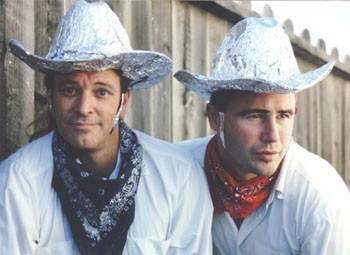
‘The Devil’s Backbone’

Haunted House Marisa Paredes and Eduardo Noriega are spooked.

Crimson Tide

Rising level of gore swamps the mood of ‘The Devil’s Backbone’

By

The Spaniards and the Mexicans excel at ghost stories–how could they not, with their histories? And they’ve been making a lot of them for American filmgoers of late: for example, take last year’s The Others, Alejandro Amenábar’s entertaining tale of a traumatized war widow (Nicole Kidman) confronting a gothic mansion.

And here comes another interesting offering. Under Spanish producer Agustín Almodóvar, Mexican director Guillermo del Toro (Cronos, Mimic) helmed The Devil’s Backbone (El Espinazo del Diablo), an often gruesome tale about a bedeviled boys’ school in the middle of the Spanish desert.

The culmination of the fascist triumph in the Spanish Civil War is at hand, symbolized by an unexploded bomb standing sentinel in the middle of the courtyard, a dud dropped from one of Franco’s planes.

A political refugee kid (Fernando Tielve) arrives, and the lonely boy is soon visited by the school’s ghost, nicknamed the Gasper, a phantom whose ectoplasmic blood still leaks into the air around him.

Those who may know about the ghost’s history but aren’t talking include a kindly, widowed, one-legged teacher (the handsome Marisa Paredes, from Almodóvar’s All About My Mother), a thieving fascist handyman (Eduardo Noriega), and Casares (Federico Luppi), a civilized but impotent old poet and science teacher.

Because of wartime scarcity, Casares drinks the alcoholic broth from the biology lab’s “pickled punks,” to use the carny parlance, meaning the bottled bodies of stillborn infants. One of the dead babies is a spina bifida case, hence the film’s striking but essentially irrelevant title. For what it’s worth, the white-haired professor calls his drink “agua de limbo.”

While The Devil’s Backbone is full of oddity, style, and atmosphere, it is–at first–so classical that it’s stiff. Then the gradual rise in brutality inundates the picture, alienating those drawn by the mood, the eeriness of the Gasper, Paredes’ air of secrecy, and the J. G. Ballardish sight of the rusty, totemic bomb threatening the school.

Unique, certainly, but maybe just too gory for poetic horror and too poetic for gore.

‘The Devil’s Backbone’ opens Friday, Jan. 18, at Rialto Cinemas Lakeside, 551 Summerfield Road, Santa Rosa. For details, see or call 707.525.4840.

From the January 17-23, 2002 issue of the North Bay Bohemian.

© Metro Publishing Inc.
Juan Garcia Esquivel

0

Pop! Boink! Wow!

Arranger Juan Garcia Esquivel quietly signs off

It was in the mid ’80s that I first discovered the music of Juan Garcia Esquivel,” recalls Mickey McGowan, Marin County record collector and pop culture historian. “His records were always in the easy-listening bins in used record stores–and he still is.

“But when you think about Juan Garcia Esquivel, creator of the great 1962 album Latin-Esque, and the recently rediscovered 1960 masterpiece See It in Sound, he’s 180 degrees from easy,” McGowan continues. “Esquivel was among the most challenging arrangers in the business.”

Juan Garcia Esquivel died in Mexico on Jan. 3, just short of his Jan. 20 birthday. He would have been 84. His death was not announced until late last week, after his body had been cremated and his ashes scattered. The news wasn’t unexpected: Esquivel had been ill for some time, confined to his bed the last several years. But it still came as a shock to his fans. And fans he had, though Esquivel had not released a new album of music for decades.

Known as the King of Space-Age Pop, Esquivel was, in the late ’50s and ’60s, one of the hottest acts going. Born in 1918 in Tampico, Tamaulipas, Mexico, he became a popular bandleader in Mexico, appearing on radio, television, and film before RCA discovered him in 1958 and lured him to America.

With a strong sense of musical whimsy–and a degree in engineering–Esquivel was fascinated with the latest achievements in stereophonic sound. In his earliest RCA efforts–Other Worlds Other Sounds, Exploring New Sounds in Stereo–Esquivel sought to push stereo music to its limits, weaving unusual sounds into his music, Ping-Ponging them from one side of the headphones to the other.

“His music was in that weird gap between the familiar and the completely strange,” says McGowan, whose own musical tastes were explored in detail in the book Incredibly Strange Music (Re/Search). “You had to bridge it with your own ear.”

Insisting that lyrics often prevented one from truly experiencing the music, Esquivel took songs like “Sentimental Journey” and “The Look of Love” and laced them with choruses of comic book exclamations: “Pow! Boink! Zoom!”

“Esquivel was the spicemeister of orchestrated music,” says McGowan. “He was one of the great musical stylists of the 20th century.”

David Harrington, violinist and musical director of San Francisco’s Kronos Quartet, agrees. “Esquivel,” he says, “basically invented the stereo. The technology existed, and then he came along and showed the world what to do with it.”

According to Harrington, Kronos’ upcoming album, titled Nuevo, owes a huge debt to Esquivel. Not only will it include a cover of Esquivel’s classic 1968 hit song “Mini Skirt,” the entire CD is designed as an Esquivelesque adventure through the street sounds and music of Mexico.

“I love Esquivel’s sense of playfulness,” Harrington concludes. “His use of sound, his recognition of the textures of sound, were one-of-a-kind.”

From the January 17-23, 2002 issue of the North Bay Bohemian.

© Metro Publishing Inc.
Dr. Martin Luther King, Jr.

0

More Than A Dream: MLK’s radical legacy shouldn’t be whitewashed.

King Fling

MLK Day has become a feel-good lie

By Geov Parrish

On Jan. 15, Dr. Martin Luther King, Jr. would have turned 72. If he had survived. And in every conceivable sense of the word, he has not. At least, not in white America.

In many ways, Ronald Reagan did the worst possible thing for the memory of Dr. King by acceding–reluctantly–to the holiday that bears King’s name. Because the holiday has become a feel-good lie.

King is, along with Mahatma Gandhi, one of the two most revered symbols of nonviolence in the 20th century. He spent his too-brief adult life defying authority and convention, citing a higher moral authority, and giving hope to people of color seeking liberation on six continents. MLK Day, the holiday (observed on Jan. 21), has only made new generations of white people mislearn King’s story.

King is not a legend because he believed in diversity training and civic ceremonies, or because he had a nice dream. He is remembered because he took serious risks and, as the Quakers say, spoke truth to power. He is also remembered because, among a number of brave and committed civil rights leaders and activists, he had a flair for self-promotion, a style that also appealed to white liberals, and the extraordinary social strength of the black southern churches behind him.

What little history TV will give us in the next week or so is at least as much about forgetting as about remembering. It will flaunt self-congratulatory patriotism that King was American, but it will skip real self-examination about the American racism that made him necessary and how our government, at every level, sought to destroy him. We hear “I have a dream”; we don’t hear his powerful indictments of poverty, the Vietnam War, and the military-industrial complex.

We see Bull Connor in Birmingham; we don’t see arrests for fighting segregated housing in Chicago. We don’t hear about mainstream America’s contempt at the time for King and his reputation among conservatives as a Commie dupe. We don’t see retrospectives on his linkage of civil rights with Third World liberation. We forget that he died in Memphis lending support for a union (the garbage workers’ strike) while organizing the multiracial Poor Peoples’ Campaign that demanded affordable housing and decent paying jobs as basic civil rights. We forget that many of King’s fellow leaders weren’t nearly so polite. Cities were burning. We remember Selma instead.

And we forget that of those many dreams King had, only one–equal access for nonwhites–is significantly realized today. And nearly a half-century after the Montgomery bus boycott catapulted a 26-year-old King into prominence, even that is on shaky ground.

We rarely acknowledge that the overt racism of Montgomery in 1955 is no longer so overt, but still part of America in 2002. It shows up in our geography, in our jails, in our voting booths, in our shelters and food banks, in our military, and yes, in the very earnest and extremely white activist groups that still carry the banner on these issues.

In 2002, TV land’s MLK has no politics. And, for that matter, no faith. If the King of 1955 or 1965 were alive today, he would be accused of treason for his pacifism, as he was reviled for “Communism” then. Instead of the FBI vainly trying to bring him down, he, and most of his associates, would be prosecutable under new antiterrorism statutes.

And the moral outrage of Americans that made his work so effective? We don’t do that anymore. A couple of months ago we nearly starved millions of Afghans to death–instead of the few hundred thousand dying at the hands of U.S.-backed warlords today–and virtually nobody even noticed, let alone cared, in this country. It’d take a whole lot more than police dogs to make the news today. Ask any global justice demonstrator.

Instead, for white America, King’s soft-focus image often reinforces white supremacy. (See? We’re not so bad. We honor him now. Why don’t those black people just get over it, anyway? We did.) Dr. King, a nonviolent martyr to reconciliation and justice, has become a Hallmark card, a warm, fuzzy, feel-good invocation of neighborliness, a file photo for sneakers or soda commercials, a reprieve for post-holiday shoppers, an excuse for a three-day weekend, a cardboard cutout used for photo ops by ungrateful Supreme Court justices.

He deserves better. We all do.

Geov Parrish writes for WorkingForChange.com, where this article originally appeared.

From the January 17-23, 2002 issue of the North Bay Bohemian.

© Metro Publishing Inc.

Bobcat Goldthwait

0

Mouthing Off: Comedian Bobcat Goldthwait headlines the Laughter Arts Festival at the LBC.

Hard Laughter

A long, winding conversation with comic Bobcat Goldthwait

Bobcat Goldthwait has a 400-foot penis. It’s in storage somewhere in Los Angeles with a lot of other props used in The Man Show, the crude but addictive Comedy Central show starring Adam Carolla and Jimmy Kimmel for which the adjective-defying Goldthwait has been directing episodes.

That’s right. Bobcat’s a director.

Though best known for his unshakable appearances in offbeat films (One Crazy Summer, Burglar, Scrooged, Hot to Trot, Blow, and the Police Academy movies), and his death-defying standup routines (anyone remember when he set fire to Jay Leno’s chair?), Goldthwait has been gradually moving behind the camera, directing episodes of gleefully tasteless TV shows.

Then, of course, there was the legendary Shakes the Clown, which Goldthwait wrote, directed, and starred in, a film so critically reviled it was destined to amass a huge cult following–which it has.

But back to that penis.

When Goldthwait, 39, calls up from his home in Los Angeles–ostensibly to talk about his Jan. 26 appearance at the Luther Burbank Center’s big Laughter Arts Festival comedy event–I have to ask about the interview I once read where Bobcat signed off by saying, “I gotta go. I have to figure out how to stretch a penis 400 feet.”

“That episode actually aired, too,” he now says with a laugh. “It was a spoof of a scene from the movie Porky’s–the one where the lady gym teacher grabs the guy’s penis after he sticks it through the hole in the locker room wall. So we shot that version, and Jimmy Kimmel was playing the guy with his penis in the hole.

“But in our version,” he continues, “the gym teacher actually runs out the door with the penis, and she hooks it to the back of a truck and then drives around the block with it. Whatever. Eventually, I digressed to having kids skipping rope with it–which is kind of creepy, but that’s what we did.”

“Wow. What did you use for the penis?” I ask.

“Many, many things,” he replies. “Our effects guy is like Q from the James Bond movies. He brings me in one day and shows me all these penises. One was just a regular hose painted pink. Then he had stuff made out of Silly Putty. One was a big cloth penis, which was pretty elastic, actually.”

There is a short pause.

“Hey,” Bobcat says, “I’m just doing God’s work here.”

“You know,” I suggest, “after Survivor Africa ended, they auctioned off the props for charity. Maybe you should do that with The Man Show.”

“You mean auction off the 400-foot penis? Yeah. I’m sure someone would buy that. I know Jimmy bought Rosie O’Donnell’s bondage gear from that terrible Garry Marshall film, Beyond Eden or something.”

“Exit to Eden,” I report. “It was awful.”

“Was it ever,” Bobcat agrees. “I’ll use one of my stock jokes: That movie was so bad I can’t believe I wasn’t in it. I’ve actually been saying that lately about Snow Dogs. Have you seen the commercials for that thing? It really looks like something I should have been in.”

At least doing the voice of one of those damn dogs.

“You know,” he says a few moments later, after learning that his hell-bound interviewer is the proud owner of a brand new Jesus Christ action figure (with Miracle Gliding Action!), “for years I’ve been wanting to make a movie called Teen Jesus. It’d be, you know, about Jesus during his angst-ridden teen years. Kind of a Dawson’s Creek meets The Greatest Story Ever Told thing. It’s something I’ve always wanted to get going. And from what you tell me, the action figure’s already a done deal, so I’m really encouraged about this now.”

An attempt to swing the conversation back toward his LBC appearance fails. Instead, Goldthwait slides into a discussion about standup comedy in the post-Sept. 11 world.

“You know, after any tragedy, you can crack jokes,” he says. “After. The problem with 9-11 was that we were still in the middle of it for a long time. We still are, I guess, but people have gone on with their lives, so some things are kind of funny again.

“When you’re in the middle of something that has not ended, you can’t laugh. When my mom passed away, I still found myself cracking jokes and stuff at the wake, you know? But while she was actually still dying, I wasn’t too hilarious to be around, that’s for sure.”

“They do say laughter is a healing thing,” I offer.

“Laughter is healing. Yeah, right!” he says. “I really don’t believe laughter is a healing thing. The majority of the laughs I’ve had in my life were based on cruelty. I don’t know how healing it was whenever I was getting ridiculed. Or when I was ridiculing someone else. But sometimes it was real fucking funny.”

At last he gets around to talking about coming to Santa Rosa.

“The comedy show, yeah,” he happily grouses. “They’ve given it some hacky acronym–the Laughter Arts Festival, I think. Which seems to suggest they were desperately scrambling for something that spells ‘laugh,’ though in this case it’s ‘LAF, ‘ without a U, a G, or an H. But with an F, and where the hell that came from I don’t know–though I am pretty fond of the letter F.”

Admitting that he’s been doing a whole series of these comedy events around the country, with different comedians at different times, he asks who else will be on the bill. Told that he’ll be performing alongside Richard Lewis, Kevin Meaney, and Jake Johannsen, Bobcat says, “Oh, wow, that’s a whole new

lineup.” Pausing a beat, he adds, “Forget it. I’m not comin’. I don’t like those guys.”

“So,” I ask, “assuming you change your mind and do show up, what can people expect from the experience?”

“Uh–me,” he replies, “regurgitating old routines from the ’80s, basically. That’s my act in a nutshell. I’ve been doing standup for years, and I have a certain act now. I hope people like it. Though when I play in the Midwest, people are sometimes kind of freaked out, ’cause I guess they expect me to be the guy I played in the Police Academy movies. So they’re shocked that I don’t just stand on stage and scream for 45 minutes.”

“You actually have something to say?”

“Hell no. I don’t have anything to say,” he laughs. “But I have taken the time to write a few humorous jokes.”

The Laughter Arts Festival takes place on Saturday, Jan. 26, at 8 p.m. at the LBC, 50 Mark West Springs Road, Santa Rosa. Tickets are $33—$38. 707.546.3600.

From the January 17-23, 2002 issue of the North Bay Bohemian.

© Metro Publishing Inc.
‘The Royal Tenenbaums’

0

Head Games

Nerdy novelist examines the brainy pain of ‘Royal Tenenbaums’

Writer David Templeton takes interesting people to interesting movies in his ongoing quest for the ultimate post-film conversation.

“Wow. Um . . . This could possibly bore me.” Andrew Sean Greer, author and self-described “secret nerd,” has come to a dead stop here at the far end of the Exploratorium, the world-renowned San Francisco museum famous for its whimsical blend of science, technology, and art.

Having worked our way past hundreds of humming, buzzing, spiraling machines, echo tubes, tornado chambers, and circular wave umbrellas, we’ve come to the entrance of a special exhibit. Titled “Mathematica: A World of Numbers . . . and Beyond,” it promises to be a series of displays demonstrating various principles of mathematics.

Admits Greer, “I’m like a kid. I love to watch all the machines and push all the buttons, but I’m kind of too impatient to stand around and read all the explanations.”

“Well,” I confess, “that makes two of us.”

Thankfully, “Mathematica” has no shortage of buttons to push and levers to pull. But we’re not really here to learn about minimal surfaces and projection geometry anyway. No, we’re here to discuss The Royal Tenenbaums, the critically lauded oddball of a film starring Gene Hackman, Luke Wilson, Ben Stiller, Gwyneth Paltrow, and Anjelica Huston.

In the movie, which follows a New York family full of one-time geniuses, Hackman and Huston play the long-divorced parents, Royal and Etheline, whose kids were all child prodigies who’ve grown up into outrageously failed adults. Chas (Stiller), a mouse-breeding entrepreneur, is now a paranoid safety addict. Margot (Paltrow), a playwright whose first work was staged at age 12, hasn’t written a word in half a dozen years. And Richie (Wilson), a one-time tennis champ, has been living on a cruise ship since a dramatic meltdown on the court at Wimbledon.

Since The Royal Tenenbaums explores the eccentric underbelly of genius, it only seemed fitting to bring our discussion of the film to the world’s most eccentric science museum. And who better to discuss it with than Andrew Sean Greer, author of the sensational new novel The Path of Minor Planets (Picador, $23). A poetic, surprising story of love, sex, death, and meteors, Greer’s novel features a very large array of brilliant astronomers and hard-driven scientists, none of whom–like the poor Tenenbaums–is all that adept at negotiating everyday life on Earth.

“One of the things I liked about The Royal Tenenbaums,” says Greer, “was the way it shows that smart people, even geniuses, are also very ordinary people with very ordinary problems.”

We’ve stopped to stare at a tall, narrow, glass-fronted box illustrating the concept of the bell curve. We watch as little balls randomly fall from above, bouncing down through a maze of pegs, each coming to rest in one of many slots at the bottom. While a few balls make their way into slots at the far edges of the box, where they sit all alone, the majority end up in a great big pile right in the middle.

“That,” Greer remarks, “is really eerie.” We move on, pausing again at the celestial mechanics display, a giant model of the solar system resembling a misshapen funnel. At the push of a button, a steel ball is released to race around the diameter of the funnel, gradually slipping lower and lower with each revolution down toward the exit hole at the center.

“I read this one book about the sociology of scientists,” says Greer, one eye on the ball as he talks. “It was very moving. It told about the career disappointments of brilliant people, how you could be an academic star in graduate school but then get assigned to a job at a nonresearch university–and then you’re stuck in that position forever, unable to move on to Harvard or somewhere important, because you’re forever viewed as a nonresearch kind of scientist.

“How disappointing that must be,” he continues. “I never thought about that before. I just always assumed that brilliant people got to do whatever they wanted to do.”

This brings him back to the Tenenbaums. “We assume that if, as a kid or a young person, you write a hit play or figure out a way to make a lot of money or establish yourself as a sports prodigy, then you’ll live happily ever after,” he says. “Or at least, that you’ll amount to something. These people didn’t, and they have no idea what went wrong.”

“And still,” I suggest, “everyone, secretly, wants to be a genius. Or at least be thought of as smart.”

“I think most people do think of themselves as smart,” he replies, “whether they are or not, while a lot of smart people think they’re not smart enough. They think they’re frauds, the way Margot Tenenbaum says at one point, ‘I’m not a genius. I never was a genius.'”

Greer now turns his full attention to the metal ball, moving at a ridiculous speed toward the center hole of the funnel, a planet accelerating its orbit as it draws closer to the sun.

“Come on! Come on!” Greer encourages the ball. “Yes! It’s sinking into the sun! The Earth is falling into some sort of gravity well!”

Finally, the ball drops out of sight, and Greer cheers.

“Now that,” he says, “was cool!”

From the January 10-16, 2002 issue of the North Bay Bohemian.

© Metro Publishing Inc.
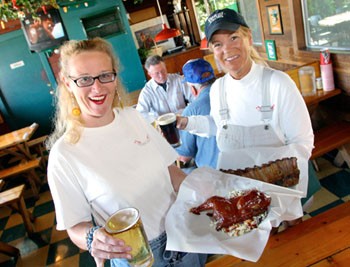
Julia’s Kitchen

0

Wild Child

Canteen ambiance mars fine cuisine at Julia’s Kitchen

By Paula Harris

One way to attract SUV-loads of salivating visitors to your brand new restaurant is to name it after Julia Child, that heavy-boned American food icon who has been dubbed the patron saint of the pantry. That’s what Napa’s new tourist magnet, the American Center for Wine, Food, and the Arts (COPIA), a $55-million foodie paradise, has christened its gourmet dining room. And the famous moniker seems to be bringing in diners by the drove.

But hold on to your potholders–don’t expect to catch a glimpse of the gourmet grande dame here. Child’s donated personal collection of copper cookware, on display at the center, is probably the closest you’ll get to the beloved chef.

Although she’s bestowing her name to a commercial enterprise for the first time, the 89-year-old Julia Child (who also serves as a trustee to COPIA, jumping on the Robert Mondavi-driven bandwagon with other icons Alice Waters and Martha Stewart) is not in attendance.

The cooking at Julia’s Kitchen is done by Mark Dommen, who has worked at San Francisco’s Fleur de Lys and New York’s Lespinasse.

Dommen focuses on creating upscale French-Californian dishes using regional and seasonal produce, especially produce and herbs from COPIA’s 3 1/2-acre landscaped organic gardens located outside the sprawling 80,000-square-foot building.

Although COPIA is surrounded on three sides by the scenic Napa River, and though the views of water, gardens, and rows of newly transplanted mature olive trees are picturesque, the center is surprisingly harsh and plain inside.

Julia’s Kitchen, despite the cozy name, is no less industrial. With its narrow open kitchen, sharp-edged decor, cold stainless-steel touches, gray concrete floor, and high noise level, the place resembles a busy office canteen rather than a premier restaurant.

There are big overhead lamps and pale green walls. The only softness comes from the heavy white tablecloths. The prep kitchen, which includes a tile installation in shades of blue by renowned contemporary artist Jorge Pardo, can be seen in glimpses though a swinging door–and it seems more aesthetically inviting than this spare dining room.

That’s one strike against Julia’s. The other is that, although the restaurant offers a highly touted chef’s tasting menu featuring five courses for $55, or $75 with wine pairing (lunch prices), they are only capable of offering it to entire tables and can’t accommodate vegetarians.

When my vegetarian companion offered to pick veggie items from the regular menu, I thought I would get the tasting menu but was rather snootily told the chef couldn’t accommodate a vegetarian on the tasting menu. This seems ludicrous in a top-class destination restaurant such as Julia’s.

Still, despite the drawbacks, the food is noteworthy.

A roasted onion and saffron soup ($10.50) arrives without liquid, just chubby, curled rock shrimp, tiny pearl onions, and fresh, snipped chives in the bowl. The server pours in the steaming, creamy soup from a silver teapot. The effect is like drinking velvet and silk with a rich salty tang from the saffron and shrimp. Comfort city!

The baby beet salad ($10.50) makes great use of the garden treasures and is composed of small, very sweet beets, frisée, and curly cress, plus warm chèvre cheese, candied walnuts, and sherry wine vinaigrette.

Hungrier visitors may prefer the sunchoke risotto appetizer ($11), which is a creamy, delicate delight featuring Jerusalem artichokes cooked with arborio rice and enlivened with hazelnuts, garlic, chives, and parmesan cheese.

A roasted monkfish ($19.50) is a sturdy seafood entree accompanied by rabe, applewood smoked bacon, and meaux mustard vinaigrette. Very tasty, although I question the recommended glass of Zinfandel with this dish.

For the ultimate in tenderness, try the braised veal short ribs and delicate sweetbreads ($21). The dish boasts butterlike meat with the sweetbreads crisply fried, plus turnips, rutabagas, celery root, and carrots. My one quibble is that it just tasted too salty.

One of the most exciting vegetarian dishes–both visually and gustatorily–that we’ve seen in a while is the roasted winter squash skewer ($16.50). The thick and colorful slabs of various garden-fresh squashes resemble a shelf of tiny books on their skewer.

A tiny trio of crème brûlées in vanilla, coffee, and chocolate are all chilled, smooth, and ultra intense–but the vanilla wins my vote.

Julia’s Kitchen offers 25 wines by the glass, several wine flights, and a 240-bottle wine list boasting vinos from the United States, Europe, Australia, and New Zealand.

Currently the restaurant is open only for lunch, but there are plans in upcoming months to offer dinner also. In the warm weather, Julia’s Kitchen plans to expand its current seating to outdoor dining.

Center organizers say diners will be able to eat on the paved deck or in the gardens where a wood-fired oven is installed. I would recommend going alfresco and giving the hyperactive dining room a miss.

Julia’s Kitchen Address: Inside COPIA, 500 First St., Napa. 707.265.5700. Hours: Thursday-Monday, 11:30 a.m. to 4 p.m. Plans to open for dinner later in the year. Food: French-Californian Service: Good though rushed Ambiance: Loud, intense noise level and a very sparse and industrial setting Price: Expensive Wine list: Great selection befitting the center Overall: Food 3 stars; ambiance 1 star (out of 4)

From the January 10-16, 2002 issue of the North Bay Bohemian.

© Metro Publishing Inc.

Emergency Contraception

0

Birth Control

Getting morning-after pill still far from simple

By Patrick Sullivan

California women in need of emergency contraception can now obtain the so-called morning-after pill without a doctor’s prescription. At least that’s how the process is supposed to work under a new state law that went into effect Jan. 1.

But don’t count on waltzing into a local pharmacy and getting the drug anytime soon. “I just asked the pharmacist, and she says you need a prescription,” explains an employee at a Longs Drugs in Santa Rosa. “I don’t know, maybe you should try one of those little clinics.”

That’s exactly the kind of delay and uncertainty the new law is supposed to end. The morning-after pill–actually a combination of ordinary birth control pills–can prevent pregnancy after unprotected sex. However, the first dose must be taken within 72 hours, so the law aims to speed access by cutting out the need to see a doctor.

But it turns out that pharmacies can’t start dispensing the drug until state officials finish developing a mandated curriculum to educate participating pharmacists, according to Steve Smith, communications manager with the legislative arm of Planned Parenthood.

“The process is expected to be completed some time in April,” Smith says. “That’s when people should actually be able to use the law as it’s intended.”

The morning-after pill has faced fierce opposition from pro-life groups, who argue that the new law could lead to dangerous misuse of the FDA-approved treatment. The law’s supporters, including the California Medical Association, say it’s a safe and effective way to cut down on unintended pregnancy.

California is only the second state in the nation to permit pharmacists to dispense the drug without a prescription. Morning-after pill advocates say that’s a shame. “There are some statistics that say more commonly available emergency contraception could prevent more than 1 million pregnancies a year [in America] and more than 800,000 abortions,” Smith says.

Last Night

About 12,000 people braved uncertain weather to attend Santa Rosa’s First Night celebration on New Year’s Eve. But that turnout may not be enough to ensure the survival of the alcohol-free arts and music event.

One big problem: Only 5,000 First Night attendees actually bought the $7-$10 buttons that allow access to indoor attractions, according to the Cultural Arts Council of Sonoma County, which is currently reconsidering its longtime sponsorship of the event.

First Night’s initial budget required the sale of 6,000 buttons to cover costs. But Jim Johnson, the CAC’s new executive director, says the organizers will still break even this year, thanks to some significant last-minute cost cutting. “It looks like the event is going to be in the black this year,” Johnson says. “We’re talking a few hundred dollars.”

The arts council has sponsored First Night for the event’s entire seven-year history in Santa Rosa, but the organization’s board of directors will consider ending that sponsorship at a meeting on Jan. 28.

“It’s not because it wasn’t successful for us, but it’s time for the arts council to look at its future,” Johnson says. “[First Night] may continue under our auspices, or it may not.”

Heavy Petting

Where should Bill Clinton go to find a new dog? A Marin County animal rights group is calling on the former president not to shop at a pet store to replace Buddy, the Clinton family’s dog, who was recently killed in a car accident. In a press release, the Mill Valley-based In Defense of Animals urges Clinton to adopt a new dog from a shelter or an animal rescue group. “For every animal who is purchased at a pet store or breeder, another homeless animal dies in a shelter,” the organization argues.

From the January 10-16, 2002 issue of the North Bay Bohemian.

© Metro Publishing Inc.

‘Home Wellness Handbook’

'Home Wellness Handbook' offers do-it-yourself advice By Patrick Sullivan Can anybody cure America's ailing health-care system? Most people who aren't independently wealthy are intimately familiar with the dreary symptoms: escalating prices for care and insurance and prescriptions, insurance companies that won't cover even some basic or lifesaving treatments, doctors whose bedside manner is better suited...

Sonoma Ecology Center

Sonoma Ecology Center embroiled in chemical controversy By Tara Treasurefield This is a case where the harm caused by a biological pest far outweighs the potential for harm from glyphosate," says Mark Newhouser of the Sonoma Ecology Center. Newhouser is talking about a $1 million project he's coordinating that is designed to eradicate the invasive...

ZAP Zinfandel Tasting

The Sin of Zin Can America's populist wine survive success? By James Knight For some, the Super Bowl is on a Saturday. Sure, it's the Super Bowl of all wine tastings, but that's not just cork-sniffing hype. It's the annual ZAP Zinfandel Tasting, which in 10 years has grown...

‘The Devil’s Backbone’

Haunted House Marisa Paredes and Eduardo Noriega are spooked. Crimson Tide Rising level of gore swamps the mood of 'The Devil's Backbone' By The Spaniards and the Mexicans excel at ghost stories--how could they not, with their histories? And they've been making a lot of them for American...

Juan Garcia Esquivel

Pop! Boink! Wow! Arranger Juan Garcia Esquivel quietly signs off It was in the mid '80s that I first discovered the music of Juan Garcia Esquivel," recalls Mickey McGowan, Marin County record collector and pop culture historian. "His records were always in the easy-listening bins in used record stores--and...

Dr. Martin Luther King, Jr.

More Than A Dream: MLK's radical legacy shouldn't be whitewashed. King Fling MLK Day has become a feel-good lie By Geov Parrish On Jan. 15, Dr. Martin Luther King, Jr. would have turned 72. If he had survived. And in every conceivable sense of the word, he has not. At...

Bobcat Goldthwait

Mouthing Off: Comedian Bobcat Goldthwait headlines the Laughter Arts Festival at the LBC. Hard Laughter A long, winding conversation with comic Bobcat Goldthwait Bobcat Goldthwait has a 400-foot penis. It's in storage somewhere in Los Angeles with a lot of other props used in The Man Show, the crude...

‘The Royal Tenenbaums’

Head Games Nerdy novelist examines the brainy pain of 'Royal Tenenbaums' Writer David Templeton takes interesting people to interesting movies in his ongoing quest for the ultimate post-film conversation. "Wow. Um . . . This could possibly bore me." Andrew Sean Greer, author and self-described "secret...

Julia’s Kitchen

Wild Child Canteen ambiance mars fine cuisine at Julia's Kitchen By Paula Harris One way to attract SUV-loads of salivating visitors to your brand new restaurant is to name it after Julia Child, that heavy-boned American food icon who has been dubbed the patron saint of the pantry. That's what...

Emergency Contraception

Birth Control Getting morning-after pill still far from simple By Patrick Sullivan California women in need of emergency contraception can now obtain the so-called morning-after pill without a doctor's prescription. At least that's how the process is supposed to work under a new state law that went into effect Jan. 1....
11,084FansLike
4,446FollowersFollow
6,928FollowersFollow
