Sonoma County As The Next Silicon Valley

0

Is Sonoma County the next Silicon Valley?

By Shepherd Bliss

Silicon Valley’s high-tech economy has crashed. The dotcom boom that inflated San Jose and San Francisco with short-term gains is over. What’s next? Sonoma County may be the Bay Area’s next economic explosion. First the boom, then the bust. Some will rush in to profit, while the rest pay the costs.

The national media is giving Sonoma County a lot of attention for its probusiness climate, its “good life,” and its wine. This will make the rich richer, but it is not good news for the quality of life for most of us who live here now. The most damaging of the many recent articles about Sonoma County was Forbes Magazine‘s May 27 naming of Santa Rosa as second in the nation in their “Best Places for Business” listing.

Only much larger San Diego offers a more appealing business climate. San Jose fell from first last year to 61st this year. San Francisco tumbled from third to 54th.

The New York Times-owned Press Democrat gleefully reports, “Forget about Silicon Valley–Santa Rosa is the big thing in business.” Santa Rosa’s elevated status on the Forbes‘ list will induce growth for the city of 153,000 people and the county of 471,000 people.

The potential impact of the Forbes‘ ranking upon the city that already strangles the county’s natural resources concerns this organic farmer. There are limits to growth, and Santa Rosa faces those limits, though most in the business sector continue to advocate the kinds of growth that can bring them short-term gains. Many locals, such as myself, are concerned about the long-term implications of such publicity. Business people around the United States and the world read such listings, and some will relocate their businesses here.

The Forbes‘ listing appeals to the high-tech business community. The dean of Sonoma State University’s school of science and technology, Saeid Rahimi, gloats, “This is wonderful news. We take something like this very seriously. This kind of reputation never hurts.”

Actually, it does hurt. Silicon Valley destroyed the rich agricultural heritage that existed in what used to be called the Valley of the Heart’s Delight. It had the largest continuous commercial orchards in the world–some 8 million trees on various small family farms. One can barely find a fruit stand there today, but there are many roads, parking lots, big buildings, malls, and now unemployed workers. Is this Sonoma County’s future, after the bust?

The probusiness reputation for Sonoma County that Forbes contributes to–as does the Wall Street Journal–hurts local people. The “Attractiveness Principle” is a sociological concept that the very things that attract people to a certain region will be destroyed when too many people move there.

Sonoma County is characterized by giant redwoods, rolling hills, a rugged coastline, and the meandering Russian River. A strong environmental community has built up over the years to defend these and other natural resources, including oak woodlands, the Laguna de Santa Rosa and other wetlands, salmon, and wildlife. To accommodate new businesses and people, Santa Rosa would have to expand further into the hills and wetlands surrounding it and displace native vegetation and farmlands.

Certain families have farmed here for generations. Agriculture was always Sonoma County’s top industry, until high-tech replaced it in 2000. Diverse people have been drawn here for decades, including progressive Jews who left New York early in the 20th century to become chicken farmers, 1960s back-to-the-land people, and artists wanting to live in close contact with nature.

In recent years, many children of the county’s historical agricultural families have had to move away. They could not afford to live here any more. Our economy and our population is becoming less diverse than it used to be.

Sonoma County is increasingly becoming a colony of giant multinational corporations dependent upon the global economy. More decisions about our economy are being made by managers in board rooms around the world, rather than by people living, working, and loving being here.

Many farmers have felt crowded out and have moved away, often further north to still-rural Mendocino and Humboldt counties. I have been losing manure sources to fertilize my farm plants. In spite of Professor Rahimi’s assertion that no one is being hurt, some of us are being hurt. But we are the little guys.

Another way that Sonoma County’s national probusiness reputation will hurt us will be through increased pressure to pave over more of the county’s rich agricultural land. “Widen Highway 101!” some demand. “Expand the airport!” others shout, wanting a quicker commute back to Silicon Valley and around the world.

A narrow, bumpy county road leads to my small farm, and I will fight against any expansion of roads and the airport which will further hurt our rural culture and our agricultural base.

From the June 13-19, 2002 issue of the North Bay Bohemian.

© Metro Publishing Inc.

Pub Trivia

0


Raising The Bar: Pub trivia takes bar games to a whole new level.

Drinking Problems

Questioning your drinking? Drink your questions.

By James Knight

Pop quiz: What is the capital of Bolivia? The highest mountain in France? Which Penn Station track does the Chattanooga Choo Choo leave from? Think you can answer those? Now order a plate of pub fare, have a pint of ale, and go for another round. Of questions. Pints, too. If you’re the type that shouts out answers at popular TV quiz shows but find the cathode-ray tube’s contestants frustratingly unresponsive to your intellectual superiority, pub trivia may be able to help.

Pub trivia is a curious phenomenon on the surface. At the same time you’re utilizing your cerebral powerhouse to recall, say, King Lear’s daughters’ names, you’re soaking said powerhouse in draft beer and pitting it in a battle over its oxygen-rich fuel with an ornery belly full of greasy food. Not a little bravado is the key.

Pub trivia games, long popular in the United Kingdom and Ireland, have recently gained converts in this country. Brainstormers, a kind of franchised trivia outfit founded by a Bay Area Irish transplant, runs several quizzes in the Bay Area, including one at the Rose Pub in Santa Rosa. It works like this: a trivia “quizmaster” collects a few bucks from each contestant, arranged in teams, and puts it in the pot. No millionaires are made. It’s more like, who wants to split up $60 among three to six people. Depending on the fineness of your team’s minds–and the greatness of their thirst–you can do better than break even. Helpful tip: Don’t bet the tab on it, brainiac.

A few years ago I shared victories and defeats as part of a regular team. Some friends had been talking about going back to pub trivia. When we finally separated the talkers from the walkers, we had three walkers on a recent Tuesday night to the Rose Pub. We named our skeleton crew the Crain-i-cats, which I came to regret for its subtle yet still overly optimistic reference to our abilities.

Quizmaster Patrick McCool (I don’t think you have to be Irish to assume the mantle of quizmaster, but it may help) laid out the game plan. There would be seven rounds, 10 questions each, including general knowledge, a name-the-tune music round, a mystery picture round, and what he called a “drug round.” Now, here’s a perfect example of a productive application of the knowledge gained from feverish, long hours of study in college days.

The Crain-i-cats are looking good at first. Which 1930s gangster was distinguished by a scar? Of course, the answer to all gangster questions is Al Capone. The answer to all sports questions, by the way, is Babe Ruth. The name of the dude that escaped the den of lions in the Bible? I discover that my team is all agnostic, so I think back to lessons gleaned from evangelical comic books. Got it. So far, we’re acing it.

After each round, the quizmaster manically tallies the scores while the teams huddle on their answers. This breaks down into lively discussions at some tables, shrugs and blank looks at others. Debates are heated, drinks are spilled. Periodic laughter erupts as wits from each group get to the question: The guillotine was originally developed to chop off which part of the body?

Meanwhile, we are handed round two on a worksheet, instructing us to match real and fictional captains with their description. Turns out we don’t know our Captain Kidd from our Captains Hook and Cook.

It’s during the break that some face the temptation to make that call to a friend–which they are not allowed. It used to be easy to spot them sneaking to the phone booth by the bathrooms. With phones in nearly every purse and pocket, the scrutiny must be intense. Our waitress confirms that allegations of cheating can cause a general disturbance. “You think it’s just all for fun,” she says, “well some people take it sooo seriously.” She confides that she was even caught in the fray for allegedly tipping off a team. “Oh, I knew that they already knew it anyway.”

Sometimes the quizmaster breaks the routine for a free-for-all instant prize question–one that anyone who happens to be in the bar can answer. What’s the name for a positive electrode? It’s not an ion, neutron, cathode, or catheter. People will shout out anything to see what sticks.

When the tallies are read, we’re already slipping. Fortunately, you are allowed the anonymity of a team name, often something fanciful like Jehovah’s Witness Protection Program–the arch nemesis of my latter-day team–or the factual Two Guys and Their Mom. The Three and a Half Kittens of the Apocalypse told me they changed their name every week. So if you don’t groan with disappointment too loud and too often, nobody has to know your team is featherweight.

The impetus to original pub trivia games, according to Brainstormers, was early television game shows. The local pub was likely to have the only TV in the neighborhood, and patrons turned their tube-directed shouted answers and challenges of “Why don’t you go on that show?” into home-grown entertainment. For the pubs, the economics are sound: trivia nights fill the house on normally slow Monday to Thursday nights with beer swilling, chip-chowing know-it-alls. Brainstormers even sells trivia kits on their website. For a range of prices, you can order quiz packs and become licensed as your own quizmaster.

Lest you think your team will languish unless you round up a sampling of doctoral candidates, here’s the real trick to the game: Watch too much television. Example: What is 75 percent saltpeter, 10 percent sulfur, and 15 percent charcoal? I turned excitedly to my teammate: Remember that Star Trek episode where an unseen highly evolved alien race makes Captain Kirk battle the lizard leader and they’re on a desert planet and it happens to have saltpeter, sulfur, and charcoal lying around and Kirk makes . . . gunpowder? Yeah, yeah, that’s it!

It’s also wise to keep informed on current events. There’s often some kind of topical angle, from the latest political scandal to the nearest holiday (last December it would have helped to have known the name of Santa’s ninth reindeer and which organization menaces the world each holiday season with the motto “Blood and Fire”).

We got fried on the drug round. The twist was that you had to name the symptom that a brand-name prescription drug is supposed to treat. Hesparin. Dilantin. Diravin. A more experiential approach to pharmacology was of no help. We guessed wildly. Our waitress came back with a fresh pint of Guinness and assuaged our feelings of ignorance. “That team over there?” she gestured to the smug seven maintaining the lead. “They have two pharmacists.”

By the time of the “Death in the ’90s” round (questions that don’t shy from the morbid), we had just about crashed and burned, and the mystery picture round cemented our failure. I recognized Nikita Krushchev.

After we mistook Hendrix for Joplin during the music round (it was a part without vocals, give me a break!) and I couldn’t pick out Elvis Costello from the thicket of pop vaguely familiar as the stuff that I hear from other people’s cars, it was all downhill. We had 34 points out of 51.

Round seven. I’m pushing a pitiless plate of battered and fried objects out of my sight while the quizmaster asks, “What is the common term for myocardial infarction?” We’re trailing by a generous margin, but our stubborn will keeps us going, if only because it would be a damn shame to lose our second to last place to some other ignorant jerks. A history question is next. Which war introduced trench warfare, barbed wire, and a crude flamethrower? Finally, my command of historical facts comes into play. It’s a trick question. World War I–that’s the chump answer. It has to be the Russo-Japanese war of 1905. Ha, nobody knows that! Think I was wrong? You must have watched The Blue and the Gray.

The Rose Pub’s trivia night is held Tuesdays at 7:30pm. 2074 Armory Dr., Santa Rosa. 707.546.ROSE.

From the June 13-19, 2002 issue of the North Bay Bohemian.

© Metro Publishing Inc.

Meritâge

0


Photograph by Michael Amsler

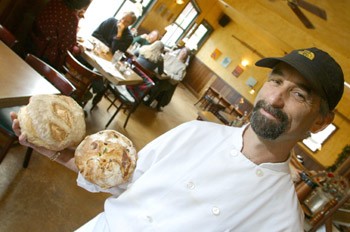
The Sweet Life: Chef Carlo Cavallo shows off his orange brandied french toast.

Not Just for Tourists

Is Meritâge a ‘destination restaurant’?

By Sara Bir

Just what is a “destination restaurant,” anyway? Either it’s a restaurant that locals make a special effort to visit, or it’s a place for people who have made the whole area their destination; i.e., tourists.

Sonoma County is crawling with so-called destination restaurants, in that case, and for a person who lives here, it can be a bit daunting. There are so damn many nouveau-fusion-Californian-whatever places, not a few of which seem to be relying a little too much on their un-updated ratings in travel books to rake in the tourist dollars. And while many of them are very good, it gets difficult to differentiate between them, no matter what particular hybrid cuisine they adhere to.

In this restaurant’s case, it makes “Meritâge” an appropriate handle, for the term refers to an American wine blended from Bordeaux varietals–and owner/chef Carlo Cavallo’s food is a mélange of continental influences distilled though an American sensibility.

During the year I lived in Sonoma, I never once ate at Meritâge, mostly because I never got around to it. Sometimes, part of the experience of dining at a white tablecloth restaurant involves its being a destination–like saying, “We’ll make tonight an occasion; let’s go somewhere.” Now that I live half an hour away in Santa Rosa and I’ve finally had the chance to go there, I’m wishing it hadn’t taken me so long. I can think of more than a few times that visiting guests and I went elsewhere for dinner and would have been much better off just walking down to Meritâge in the plaza.

Meritâge originally opened in 1999 but was forced to close its doors after a fire earlier this year. Reopened in April, it’s been expanded and refurbished, with a gelateria and espresso bar.

We arrived on a Friday evening, though the restaurant only looked to be half full. Either everyone dines earlier there (this is Sonoma, after all), or maybe it was just half empty. We sat outside in a nice little courtyard, comfy and clean, one of the prettiest outdoor dining areas I’ve seen in Sonoma County.

The menu, which changes daily, is well-rounded with plenty of options, thanks in no small part to the fresh seafood bar, which merits its own menu. You can go for raw (oysters and clams) or cooked (shrimp, mussels–plus they have a tank with live Maine lobsters and Dungeness crab). Seafood platters ($40-$60 depending on the size of the platter) on ice are pretty close to a French fruits de mer, an impressive multitiered presentation. There’s lobster, Dungeness crab, oysters, shrimp, mussels, clams, and, in a nontraditional addition, the ceviche of the day.

This is a terrific way to start your meal, especially if you have a bunch of people in your party. Sit outside in the slowly setting sun, sip a glass of Albarino (I’ll get to that), and slurp down the fruits of mother ocean.

I enjoyed the wine list a lot, because it had a good selection of wine by the glass–important when you are a party of two with a long drive ahead of you. We started off with a great glass of Albarino, Condes de Alberei ($6 glass), which is Spanish, actually, but I don’t think Meritâge held it against us. It was crisp and acidic, brandishing a slight mineral edge that went well with our steamed mussels and their buttery, garlicky broth ($7).

The mussels in question were huge green New Zealand mussels, which I found to be a bit more fishy tasting than the more common, smaller black mussels that I prefer. The broth was a bit dingy tasting and lacked aroma. Usually I love to dip my bread to soak up the broth, but not this time. Instead, we focused on the super tapenade that came out with our focaccia and little crackerlike breadsticks that were similar to Italian grissini.

The salads didn’t let us down. I hate shelling out up to 11 bucks at some fancy joint for a salad that sounds highfalutin on the menu but arrives at your table underdressed, blasé, and scarce on the promised goodies. Mr. Bir du Jour got a caesar ($7), which was refreshingly chilled and crisp, and its big, wide shavings of Parmesan obviously came from a block of very good cheese–the best caesar I’ve had in a long while. The dressing was everything caesar dressing is supposed to be, in just the right amounts.

My salad sounded like the edible equivalent of wearing polka dots with plaid: strawberries, fresh corn, gratings of French feta, and sliced almonds over mixed greens tossed with a balsamic dressing. Corn? With strawberries? OK. The corn was slightly too firm and starchy and didn’t contribute much, but the strawberries were dark and perfectly ripe, deeply flavorful and not watery as they often end up in savory salads. The way the firm French feta played off against the almonds, strawberries, and balsamic was terrific. All in all, the scope of flavors and textures made for an interesting combination.

The entrées were well-executed and enjoyable. The dry-aged rib eye with shallot-peppercorn sauce and duchess potatoes ($21) kept Mr. Bir du Jour happy. The steak was nice and juicy and actually redder than his desired medium. And mmm, that sauce was taste-ee, with just a wee bit of carmelized shallot sweetness.

I chose the duck breast over potato risotto with a balsamic reduction ($19). My curiosity about this potato risotto was the deciding factor. Very pretty, precisely diced russet potato cubes (my compliments to the prep cook) stood in for the arborio rice, the clever result resembling in taste a more refined version of scalloped potatoes–very cheesy and creamy. My duck was just a tiny bit beyond medium rare. The balsamic reduction was, on its own, slightly astringent, but against the richness of the duck breast and the creaminess of the potato risotto, that faded away and in the final impression it all worked well together.

I had a glass of Pinot Noir, and I’ll be honest here: I forget what. It was a very forgettable Pinot. Probably I can’t remember my wine because Mr. Bir du Jour’s luscious ’99 Richardson Synergy was 5 million percent better, with hints of cedar, rosewood, and ripe, red fruit with a level of tannins that was not overbearing. Great for a big, fat rib eye.

For dessert I got some kick-ass profiteroles filled with hazelnut gelato and drizzled with warm chocolate sauce. The gelato was super smooth and dense, with a pleasingly subtle hazelnut flavor. Mr. Bir du Jour became all flustered about deciding which sorbet to order, so he got a trio with pineapple, strawberry, and lemon. All three were ideal sorbets, fine-grained in texture and intense in flavor, especially the strawberry.

The service was prompt, accommodating, and nonintrusive but friendly. No beefs there, although I found some crusty stuff caked on the tines of my supposedly clean fork and wasn’t too crazy about that.

One stray crusty fork excepted, Meritâge has a lot to offer: a pleasing ambiance, a great wine list, and many choices on the menu, none of them too earthshattering. Which is fine–you don’t always want to be challenged when you go our for a nice meal.

I’d be happy to make Meritâge a destination for my next occasion dinner.

Meritâge, 522 Broadway, Sonoma. 707.938.9430. Breakfast, lunch, and dinner Wednesday-Monday. Brunch, Saturday-Sunday, 11am-3pm.

From the June 13-19, 2002 issue of the North Bay Bohemian.

© Metro Publishing Inc.

Project/Object

0


Photograph by Marc Steiner

Iconizing An Iconoclast: Project/Object pays tribute to the king of the mavericks.

Frankly Speaking

Zappa tribute band carries the torch

By Greg Cahill

It started, fittingly enough, at a basement jam session. As an homage to Frank Zappa–the late avant-rock singer, guitarist, composer, arranger, and bandleader who died in 1993 after a bout with prostate cancer–a few fans began gathering each year as the loose-knit band Project/Object to mark the anniversary of Zappa’s birth, not unlike the garage-band characters in Zappa’s epic 1979 three-part rock opera, Joe’s Garage.

“A few of the guys and their friends started saying, ‘Hey, this isn’t too bad, you guys should consider taking this on the road,'” recalls singer and guitarist Ike Willis, who had performed and recorded on and off for 17 years with Zappa. “Five years ago, on the day I returned from Israel after performing Zappa songs with a chamber orchestra, [singer and guitarist] Andre Cholmondeley invited me to join Project/Object, and the rest, as they say, is history. I saw this as the best way to keep the music alive, which is what Frank wanted.”

Since 1998, when the New Jersey-based Project/Object first hit the road, the tribute band has enlisted such Zappa alumni as Willis, Napoleon Murphy Brock, Jimmy Carl Black, Ray White, Don Preston, Bunk Gardner, Denny Walley, Mike Keneally, Arthur Barrow, Roy Estrada, Billy Mundi, and Al Malkin. Other notable collaborators have included New York City big-band leader and Zappa-ologist Ed Palerno, Captain Beefheart guitarist Gary Lucas, Al Schnier and Jim Loughlin of the band moe., and Dweezil Zappa drummer Jerry Cuccurullo.

The band–which last year released a live CD and is now on tour with both Willis and Brock–has garnered rave reviews playing covers from all periods of Zappa’s long career. “We treat the music as faithfully as we can,” says Willis, during a phone interview from his Portland home.

There’s no shortage of music from which to choose. Zappa recorded some 60 albums (a few released posthumously), whose songs ran from doo-wop parodies to complex jazz fusion to Edgar Varèse-inspired classical works. Along the way, his bands served as a training ground for some of rock’s best musicians, including guitarists Steve Vai and Adrian Belew, and drummer Terry Bozzio.

An astute collector of ’50s rock and roll and a fan of such modern classical composers as Stockhausen, Stravinsky, and Varèse, Zappa had an early group with Don Van Vliet (whom he dubbed Captain Beefheart), played in a cocktail lounge band, scored a B-movie, got arrested for selling a fake stag-party audio tape to an undercover vice cop, and performed a bicycle concerto on The Steve Allen Show (plucking the spokes and blowing through the handlebars).

And that was all before creating the satirical Mothers of Invention, the eclectic band that railed against conformity and consumer consumption. The band’s double-LP debut, 1966’s Freak Out!, featured biting social commentary (“Trouble Every Day”), pokes at the emerging youth culture (“The Return of the Son of Monster Magnet”), and a bleak sci-fi cautionary tale (“Who Are the Brain Police?”).

Zappa went on to satirize the Beatles (We’re Only in It for the Money), perform the score of his 200 Motels in concert with Zubin Mehta and the Los Angeles Philharmonic, championed free speech after the B’Nai B’rith Anti-Defamation League filed a complaint with the FCC over his song “Jewish Princess,” scored a Top 40 hit with 1982’s “Valley Girl,” and testified before Congress in opposition to Tipper Gore and other advocates of warning labels on recordings. (He later released an album titled Frank Zappa Meets the Mothers of Prevention in their honor.)

“A lot of people think he must have been a really insane guy,” Willis says of Zappa, “but, no, he was a great guy. Very gentle. A great sense of humor, a bent sense of humor. And incredibly intelligent, especially in terms of composition.”

Those compositions, while rigidly structured, lent themselves to the kind of improvisation that gave the songs a life of their own in concert. “We could be in Wisconsin or Minnesota or New Mexico playing the same song, but based on the tenor of the audience or the weather or whether somebody had stubbed their toe in the bathtub that morning, every night would be different,” Willis says. “Same song, same arrangement, but the music always had the X-factor going for it.”

Project/Object, Willis adds, operates in that same spirit. “I’m doing the same thing that I’ve been doing for the last 25 years: I walk onstage, plug in my guitar, and perform the same songs,” he says, “but there’s still room for me to stretch out. The only difference is that Frank isn’t here to enjoy it too.”

Project/Object present the music of Frank Zappa on Sunday, June 23, at 8pm, at the Mystic Theatre, 21 Petaluma Blvd. N., Petaluma. The Brass Monkey brass band also performs. Tickets are $15. 707.765.2121.

From the June 13-19, 2002 issue of the North Bay Bohemian.

© Metro Publishing Inc.
Labor And Social Action Summer School

0

Means of Change: Bill Fletcher advocates “a social force that challenges the wealth and power polarization.”

Photograph by Skipper Gerstel


Spotlight on Tyranny

Labor and Social Action Summer School shines a little light

By Tara Treasurefield

When Bill Fletcher was 13, he read The Autobiography of Malcolm X. He’s never been the same. “It changed my life,” he says. “It gave me a very different insight into the United States, race, and the international situation, and helped me think about what I wanted to do with my life. I’ve been involved in social justice issues ever since.” Now president of TransAfrica Forum in Washington, D.C., Fletcher spends much of his time working to reverse the devastating effects of rampant racism and greed.

“The top 1 percent of the United States population,” he says, “controls close to 40 percent of the world’s wealth,” condemning billions to poverty.

On Friday evening, June 21, Fletcher and two other keynote panelists will have an opportunity to put the spotlight on “corporate tyranny,” which they see as the driving force behind much of the world’s misery. The venue is Sonoma State University, and the event is the opening panel discussion of the fifth annual Labor and Social Action Summer School. Fletcher’s fellow keynoters are Medea Benjamin, founding director of Global Exchange in San

Francisco, and Stephanie Luce, assistant professor of sociology at the University of Massachusetts, Amherst.

Fletcher says that he’ll explain why it’s important for U.S. workers to support unionizing efforts in Mexico, South Africa, Brazil, and other parts of the world. In brief, he says that depressed wages anywhere in the world trigger a race to the bottom everywhere in the world. “Unions are important because there needs to be a social force that challenges the wealth and power polarization that’s going on,” he says.

Like Fletcher, Medea Benjamin began her life’s work at an early age. At the tail end of the Vietnam War, when she was in high school, she became involved in the peace movement. Since then, her work has led her to campaign against obstacles to peace, such as the corporate takeover of the global economic system, the World Trade Organization, the World Bank, unfair labor practices, and most recently, the bloated war industry.

“Defense contractors have undue influence on the U.S. response to Sept. 11,” she says, “and the obscene increase in defense spending has huge implications for labor. It means that there’s no money for teachers to get the increased pay they deserve or for home-care workers to get the kind of benefits they have fought for. It means that it’s harder to continue our struggles around everything from a living wage to more money for social services.”

The third panelist, Stephanie Luce, also found her calling early on. At the tender age of 12 she got her first job as a softball umpire. She soon realized that boys were paid more than girls for this work. Later, she became aware of the steady increase of homelessness in San Francisco and the poverty of farm workers in the valley. As a student at UC Davis, Luce put two and two together and focused her education on living wages, economics, and social justice issues. At the Labor and Social Action Summer School, Luce will discuss the living wage movement.

“Between a quarter and a third of U.S. workers with families earn hourly wages that are below the federal poverty level,” she says. “The federal government has been slow to raise the value of the minimum wage over the last few decades. Many jobs done for cities–such as the janitorial services in public libraries and city halls, or security services–used to be done by city employees who had good wages, a union, and stable employment. In many cases, the push to save on taxes meant that these jobs were privatized.” Luce says that the corporations that now employ these workers provide low wages and poor working conditions.

The Labor School will resume on Saturday morning, June 22, with a plenary session on organizing for social change. Fifteen workshops will follow, under the direction of inspiring and nationally known organizers. Topics include Building a Movement, Living Wage Campaigns, Election Reform, Sexual Orientation and Organizing, Puppet Theater and Direct Action, Coalition Building, Working with the Media, and more. The Labor School will end with appetizers, a no-host bar, networking, and socializing.

The North Bay Central Labor Council is the lead sponsor of this event. The 40 co-sponsors include Petaluma Progressives, Catholic Charities, and the League of Women Voters. For more information, please call 707.545.7349, ext. 219.

From the June 13-19, 2002 issue of the North Bay Bohemian.

© Metro Publishing Inc.

Slow Foods Movement

0


Head Games: A wild-boar roast was one of Michael Dimock’s slow food moments.

Once More, with Relish

Slow Food energizes communities, one table at a time

By Heather L. Seggel

One day last summer, I was riding through Healdsburg with my father on one of our occasional thrift store junkets. The road was wavy with heat, and the car’s black interior was acting as a solar oven, trumping the air conditioner and melting our brains. My dad made a U-turn so abrupt I jumped, then pulled into the shade of what looked like an abandoned produce stand. “Look at that,” he said.

I looked and saw more tomatoes than I’ve ever seen in my life.

Wheelbarrows full of tomatoes, boxes full to overflowing, and row upon row of plants. They were a mess of leafy green at first glance, then suddenly I could glimpse the red, gold, and green fruits peeking out seemingly everywhere. We got out, hoping to find someone, and looked around for five minutes or so. Nobody came, so we picked up four bulging, red heirloom tomatoes so full of juice they threatened to explode before we could set them in the car. We folded up a few dollars and stuck them in a six-pack cooler that was under the funky folding table out front, and left, jokingly watching for police or pitchfork-wielding farmers in the rearview mirror.

The tomatoes. Each one big enough to make a meal, juicy enough to sauce a pound of pasta, as delicate as angel food yet substantial as a steak at the same time. The tiniest dash of salt brought out sweet and acid notes, and a stale baguette drank up the juice and became extraordinary. It was a perfect meal–almost no ingredients, just pure flavor, feeding more than simple hunger.

I didn’t know it at the time, but I was experiencing a slow food moment.

“Those moments can be very nourishing,” said Barbara Bowman. “You took the time to find something wonderful from the earth that someone specialized in growing and that was really delicious and enjoyable.”

As leader of Slow Food’s Healdsburg convivium, or chapter, and head of Sonoma County’s Ark USA committee, which works to protect endangered regional specialties from culinary extinction, Bowman takes deliciousness seriously. It’s a significant part of the Slow Food movement, in fact. Even their manifesto extols the virtues of “suitable doses of guaranteed sensual pleasure and slow, long-lasting enjoyment.” Who could resist?

“It’s more than just getting together and eating well,” cautioned Bowman. She’s right, of course. Slow Food members educate themselves in great detail about the foods they advocate, and the Ark in particular calls for detail-oriented activism and commitment. But when all those things culminate in getting together with friends and pigging out on freshly made organic ice cream, it’s easy to see why more people continue to join and how the movement has grown globally by keeping a local focus and delighting the palates of all involved.

Raiding the Lost Ark

The Slow Food movement started in Italy in 1986, as journalist Carlo Petrini’s inspired response to a McDonald’s opening near Rome’s landmark Spanish Steps. Petrini conceived of the movement (and its mascot, the snail) as both a reaction to and rejection of the encroaching fast-food aesthetic. Rather than identical restaurants throwing together tasteless food for customers to scarf down, Slow Food emphasizes the pleasures of dining on real food in good company at a leisurely pace. Members bring folks to their table, and as word spreads their numbers multiply.

In the last 15 years, that expansion has carried Slow Food to 50 countries worldwide, boasting more than 70,000 hungry members. Slow Food USA has been gaining strength since the early 1990s, with official headquarters opening in New York just two years ago. The United States now has roughly 7,000 members divided among 60-plus convivia (the name comes from Latin for “feast”) and counting. U.S. membership is largely concentrated in the northeastern United States and here in foodie California, where the North Bay alone plays host to five convivia. Interest is also growing in the Midwest and South, which may help the agricultural economies in those areas. Almost any community with a decent farmers market and a healthy curiosity about where its food comes from is ripe for conversion–and is bound to have a good time in the process.

Among the activities various convivia have staged are tours and tastings at community dairies and chocolatiers; a study of honey making complete with an on-site hive, honey, and cheese tasting; and a presentation by a brewer on the finer points of mead making. Events generally contain a teaching segment followed by a tasting, so participants get a feel for how their foods come to be. Sometimes the education occurs more spontaneously and comes with a side of enlightenment.

Slow Food Russian River founder Michael Dimock described an event he participated in a year ago. Friends trapped and fattened a wild boar, and on the day of the event it was slaughtered and prepared with homemade, fresh-from-the-trees applesauce. “We cooked all day,” he said, with about 50 people pitching in. They all ate together at a long table set outside and shared some “terrific” wine. “It was a transcendent moment,” said Dimock. He said the food was exceptional but that it wasn’t the sole source of nourishment, adding, “I’m fed deeply by [Slow Food’s] actions, and by participation with the people involved.”

This hands-on approach gives another spin to the idea of slow food: It’s not just the opposite of fast food; it’s part of a tradition and the product of loving preparation, often on a very small scale. These are the qualities Slow Food members are out to preserve, and the foods that live up to them find a special place in members’ hearts and–if they qualify–on the Ark.

Obscure regional delicacies and “endangered” foods may be saved by the Slow Food movement’s Ark of Taste project. Like its Biblical namesake, the Ark is an attempt to save foods that could slip from our midst, and carry them on into the future. Any Slow Food member can nominate a food item, which then has to meet rigorous criteria before a committee will even sample it, let alone consider it for inclusion. The presence of genetically modified raw materials or transgenic breeding will automatically disqualify an item from the Ark, just as Noah would most likely have sent Dolly the sheep packing come flood time. The food also needs to satisfy the bottom line and exhibit some sales potential. Bowman said the committee looks for foods to be “commercially viable, to have more potential in the marketplace than they’re enjoying now.” If it makes the cut, the group will work to create a sustainable market for the product so it can thrive.

The most recent addition to the Ark USA list is Tuscarora corn, an endangered native species grown by the Five Nations Native Americans in upstate New York. The corn’s inclusion on the Ark has led to the acquisition of a mill and roastery and a growing market for the cornmeal, which lends a measure of economic stability for those who grow and process it. And the toasted cornmeal has found fans among restaurateurs, who have incorporated it into their menus.

Given its protected status, the corn may take off with growing sales among consumers and inspire more planting, or it may remain a mostly local item, but at least it has a fighting chance. Bowman noted that with foods on the Ark, “We’re trying to create a market nationally, but realize many [of the foods] are regional” and may best succeed by staying close to home.

This mission to save foods may seem a tad romantic, but the committee’s goals are ultimately practical with a definite long-range view. The selection committee’s mission statement puts it explicitly: “Future opportunity, not nostalgia for the past, will guide our selections.” They also prioritize locally grown and created products as much as possible.

Bowman described Slow Food as “very grassroots” but with larger ambitions. “We’re appealing to, and conserving, the traditions [connected to] local foods,” she said. Among the local produce to make the Ark USA list are Blenheim apricots, a tree-ripened fruit that blemishes easily and won’t travel well, but bursts with exceptional taste. The Sun Crest peach is also on board for similar reasons. Bowman conceded that Sun Crests aren’t cosmetically perfect. They’re “fragile, but inside they’re the definition of what a peach should be,” she said.

Hopefully, having a place on board the Ark will help these fruits find a bigger share in the marketplace. More people enjoying locally grown foods picked at the peak of ripeness would mean less unripe fruit being planed, trained, and trucked around the world to supermarkets where it sits, perfect-looking but tasteless, the culinary equivalent of Pamela Anderson.

The Ark doesn’t stop at produce. Other local foods to make the cut include the red abalone, Northern California heirloom turkeys, and Vella Cheese Company’s dry aged Monterey Jack Cheese. Fifty years ago, dry aged Jack was produced by over 60 cheese makers as an alternative to Parmagiano Reggiano, which couldn’t be imported from Italy due to wartime complications. Vella is the last remaining producer of this tasty little slice of history, which now at least has a fair shot at surviving into the future. The hope is that if more people are inspired to buy it, more cheese makers will begin producing it again.

The Pleasures of the Table

The benefits of local foods are a cornerstone of Slow Food’s way of thinking: fresher, healthier produce; lower prices for consumers; more income for farmers; more diversity on the farms; less packaging and pollution from transportation. A localized food economy is stronger than one that relies on the imports of transnational corporations, whose vision of diversity tends to involve 10 boxes of cereal with identical ingredients but different labels.

Dimock said one of his main goals as a Slow Food member is “getting people to think about regionalism” as a step toward more sustainable living. “Food is the cornerstone of sustainability and part of [our sense of] community.” One of Slow Food Russian River’s last events was a tasting of duck paired with a variety of Russian River wines, a great way to discover local treasures.

This doesn’t mean all foods from overseas are forbidden or even should be–many convivia stage dinners of authentic ethnic cuisines featuring imported specialty items. Slow Food simply gives priority to the same types of food they always do, regardless of the nation they originate from: those produced by artisans and small-scale farmers for whom quality is key.

Yet another way Slow Food affects change is through community involvement. This starts with consumers and food producers, but extends further into the lives of those involved. The San Francisco convivium has worked with a program that brings chefs into Tenderloin area schools to teach the kids how to cook.

Slow Food Russian River is currently searching for a group with whom to form a similar sponsoring partnership. Dimock has nominated the Occidental Arts and Ecology Center– “They’re awesome,” he enthused–because the nonprofit (formerly the Farallones Institute) shares his interest in permaculture, rammed-earth building techniques, and an intense commitment to sustainability at every level of civilization.

Slow Food Sonoma County has worked in close partnership with young men in Forestville’s Sonoma County Probation Camp, taking them from the garden plot to the dinner table and beyond. The 16- to 18-year-olds grow food in a schoolyard garden, harvest and replant the produce, then learn to cook (and eat) it. This year they’re hoping to grow enough produce to sell some at a farmers market. Working under the supervision of camp chef Evelyn Cheatham, one of the boys grew skillful enough to apply to the Culinary Institute of America. He was also given the honor of helping cook dinner for 150 members attending the first Slow Food USA national congress, held last summer in Bolinas.

If images of kids growing their own food and learning to cook it rings a bell with Bay Area residents, there’s a reason. The idea is similar to Alice Waters’ Edible Schoolyard program, which also teaches kids about food, from garden to kitchen to belly. While Waters embodied the Slow Food aesthetic before the movement even had a name, she’s now the leader of one of Berkeley’s three convivia, giving her another platform from which to spread the gospel of biodiversity, ecology, gastronomy, and tasty, tasty food. That focus on clean, pure, sustainable foods is at the heart of some contentious issues these days, and it’s one of the areas where Slow Food practices radical common sense.

Home Cookin’

The government’s continued refusal to label genetically engineered foods, even as they’ve come to occupy over 60 percent of the products on supermarket shelves, has taken control of what we eat out of the hands of consumers. With 93 percent of Americans polled by ABC News saying they want these foods labeled–a number that rivals President Bush’s much-touted approval rating–the lack of any response has made many feel that their worst fears are justified. And what few kernels of hard evidence have been brought to light thus far have done little to assuage those fears.

The official position of government and science claiming these foods are benign was dealt a significant blow last fall by a New York Times report which found that genetically engineered corn DNA had contaminated some of Mexico’s purest and most genetically diverse corn, despite the fact that genetically altered corn has not been approved for planting there. There’s concern that the modified genes may begin to dominate the population and threaten the genetic diversity that made this corn so special. Largely heirloom species, some varieties are passed on from generation to generation and only grown by subsistence farmers in remote areas. Scientists still don’t understand–and certainly didn’t seem to anticipate–how genetic material could move so far, so fast. However, if it can get to some of the most well-hidden corn on earth, there’s little doubt that our day to day “organic” foods may have been similarly exposed.

Knowing that organic crops grown near GMOs are at risk of contamination by gene transference–as are the people, animals, and insects who live near them and share the land–it’s hard not to want to affect change. With the amount of these products appearing (still unlabeled) in floodlike proportions, an idea like the Ark takes on a new, urgent significance. Slow Food consistently champions those small producers who do the work of keeping food clean and pure themselves, and don’t rely on Monsanto Corporation for pest control.

Slow Food members hope that preserving biodiversity and the pleasures of the table will help the communities involved to become more self-sufficient, and that the fun involved will keep them committed. With their protest-as-dinner-party approach to things, and as long as people stop and follow their taste buds, it’s a good bet that the movement will succeed in its own sweet time.

For more information on Slow Food and how to become a member, see www.slowfood.com.

From the June 6-12, 2002 issue of the North Bay Bohemian.

© Metro Publishing Inc.
‘Bad Company’

0

Facing a summer cineplex awash in Secret Agent movies, espionage expert James Bamford helps separate the ‘Bad Company’ from the good

Writer David Templeton takes interesting people to interesting movies in his ongoing quest for the ultimate post-film conversation. This is not a review; rather, it’s a freewheeling, tangential discussion of art, alternative ideas, and popular culture.

As he stands up, preparing to exit the jam-packed movie theater where we’ve just seen Bad Company — the critically reviled, Jerry Bruckheimer-produced, spy-themed comedy starring Anthony Hopkins and Chris Rock — James Bamford wears the baffled and battered expression of a man who’s just escaped from a raving band of gibbering idiots.

“Oh my God! Who was the technical advisor on this thing — Bozo the Clown?” he wearily grumbles, tossing a backward glance at the credits, still rolling up the screen. Bamford, a Washington-based journalist and expert on the history of modern intelligence gathering — whose investigations into the ultra-secret National Security Agency have spawned two best-selling books, The Puzzle Palace and Body of Secrets — admits to being easily irritated whenever spy flicks get the facts wrong, which, he says, is most of the time.

“This movie illustrates everything that is wrong with modern spy movies,” he sighs. “It also explains why I don’t go to the movies that often.”

Well, Mr. Bamford, you’d better stay out of the theaters for the rest of the summer, because Bad Company is just one small piece in a massive, unprecedented invasion of motion pictures that feature spies, secret codes, clandestine government organizations, and/or the threat of nuclear annihilation. It more-or-less started with the May release of The Sum of All Fears — in which C.I.A. paper-pusher Ben Affleck tries to stop a thermonuclear war — and continued with Enigma, a Mick Jagger-produced art-house thriller about over-sexed code-breakers working at England’s ultra-secret Bletchley Park during World War II. The next few months will see the arrival of The Bourne Identity, K-19: The Widowmaker, and Windtalkers (another WWII code-themed drama), plus Spy Kids 2, Men in Black 2, Austin Powers in Goldmember, and Vin Diesel’s XXX. With the exception of Steven Spielberg’s aforementioned Minority Report, all of these films portray secret agents as heroes, a far cry from the not-too-distant days when films like Enemy of the State, Mercury Rising, and Hearts in Atlantis gave us sneaky secret agents — often in the employ of the real life National Security Agency — who were patently, unapologetically evil.

These days, they’re the good guys.

“Let’s see how long that lasts,” laughs Bamford, nursing a late-night cappuccino at a coffee shop near the theater. “Things may change in a few months if the American people find out that the C.I.A. and the F.B.I. screwed up real bad. If we get proof that a bunch of Government screw-ups let 9-11 happen, then there might be a backlash against movies that portray intelligence people as heroes.”

Until recently, Bamford served as Washington Investigative Producer for ABC’s World News Tonight with Peter Jennings. A Washington D.C. resident, he’s just finished a semester-long stint as Distinguished Visiting Professor at the Richard & Rhoda Goldman School of Public Policy, at the University of California at Berkeley. He’s also concluding a nationwide publicity tour for the paperback release of Body of Secrets (Anchor Books, $14.95), which contains a brand-new, white-knuckle account of the September 11 attacks, including some revealing minute-by-minute details of the event from the National Security Agency’s point-of-view.

“There seems to be a growing hysteria over the whole terrorism issue,” concedes Bamford. “And movies like Bad Company, and all these others, just tie into that and add to the hysteria. There’s nothing wrong with plain-old entertainment, but when you begin to think its something other than entertainment, when you begin to think all of it or parts of it are reality, then we’re in trouble.”

The best spy films, Bamford insists, citing such classics as The Spy Who Came in From the Cold, and even the new Enigma, find plenty of drama in real, honest-to-goodness, explosion-free espionage.

“There’s very little violence in espionage,” he says. “Espionage is cerebral, it’s beaurocratic, it’s all about salesmanship.

“Salesmanship?”

“Basically. A good C.I.A. person is a good salesman,” he says. “What they’re trying to do is to sell the United States to some possible informant who might be tempted towards helping the U.S. Just like in sales, you need a good closer to finalize the deal.”

“Doesn’t sound like much of a Jerry Bruckheimer movie,” I agree.

“It doesn’t. But in reality, it’s just that simple,” Bamford nods. “And it really is dramatic. When an agent swings a new informant, convincing someone to become a traitor and steal their country’s secrets and hand them over, it’s the equivalent of an Air Force fighter pilot shooting down an enemy plane.”

It’s obvious that Bamford holds the business of espionage in high regard. In higher regard, anyway, than the administration currently in control of the country’s clandestine services.

“Espionage is a long, slow business, but it usually works,” Bamford says. “It worked in capturing the bombers of the embassy in East Africa, it captured the first World Trade Center bombers. Instead of sending the Army, Navy, and Air Force over to Afghanistan, waging this macho war against the Taliban, the government could have taken the long, slow route that has, most of the time in the past, always proved successful. We might have Osama Bin Laden in custody right now, if we’d had the patience to use our Pakistan informants and other intelligence sources. It might have taken years, but it would probably have worked, and it wouldn’t have cost any American lives — which the action in Afghanistan did, and it wouldn’t have caused so much anti-American hatred around the world.”

Bamford sees irony in the fact so many spy movies of the last decade focused on the scariest aspects of intelligence gathering — presenting the government as a frightening, unstoppable menace, striving to keep its citizens in the dark while taking away all of our freedoms. This at a time when our freedoms were actually being gradually reinforced, protected from the abuses of the McCarthy and Vietnam eras.

“Now, he says, “so many of the reforms that had been made over the last thirty years are being washed away — but nobody seems to care, because it’s being done gradually. Those reforms were enacted for a reason. It was because these government agencies have abused their power in the past.

“So now,” he continues, “right when our freedoms are disappearing at a rate on one or two a week, the theaters are filled with movies in which the government is the only thing that can save us.”

“With the occasional help of some bankable, streetwise, African American standup comic,” I add.

“Right,” Bamford laughs. “And probably one who can’t act.”

From the June 6-12, 2002 issue of the North Bay Bohemian.

© Metro Publishing Inc.
‘Cherish’

0


Photograph by David Moir/Fine Line

The Trappings Of Home: Tim Blake Nelson and Robin Tunney explore the intricacies of involuntary confinement.

Muse and Views

Indie filmmaker Finn Taylor learns to ‘Cherish’ his wild side

It could have gone either way. Director Finn Taylor (Dream with the Fishes) knew from the start that his low-budget, independent script–revolving around the subject of house arrest–might sound a bit gritty and bleak. The idea grows no more cheery when one learns the details: an emotionally fractured woman, accused of a crime she didn’t commit; her two-year stint in the electronic bracelet program, confined to a crumbling San Francisco apartment; an anal-retentive deputy; a truly creepy stalker. Yet even with raw material like this, Taylor has created a rare little film that reveals itself as unexpectedly charming, completely engaging, and fun–but with just enough gritty stuff to make it remind you of its indie origins.

Which is exactly what Finn Taylor had in mind.

“Independent films–as marvelous as they are–all tend toward dark, cynical, self-serious dramas,” he explains. “Either that or they’re light, broad comedies about nervous teenagers having sex.” What Taylor envisioned was something in between. “I wanted to make a slightly new kind of film,” he says. “Not totally radically new, but just a little bit new, tonewise.”

On the strength of his quirky, original script–inspired by true stories of people in the electronic bracelet program–Taylor was able to attract a cast of actors similarly eager to try something slightly new. According to Taylor, a parade of big-name actresses competed for the part of Zoe, the nerdy, self-doubting, music-obsessed dotcommer who lands in virtual solitary confinement within her own apartment. The part went to Robin Tunney, whose career has been ping-ponging between Hollywood blockbusters (Vertical Limit, End of Days) and edgy independent stuff like Niagara, Niagara. Tim Blake Nelson–the actor-director best known as the goofball Delmar in O Brother, Where Art Thou?–was tapped to play Daly, the strait-laced “bracelet officer” assigned to Zoe’s case. The rest of the cast includes singer Liz Phair, actors Lindsay Crouse and Jason Priestley, and comedian Nora Dunn. A solid hit at this year’s Sundance Film Festival, Cherish was picked up by Fine Line features and now hovers on the brink of its national theatrical release on June 7.

Taylor–conducting this interview moments before a special prescreening of his film at the Rafael Film Center–admits that some of the best moments in the movie came from suggestions or improvisations by the passionate team of actors.

“This script was in my head for years,” he says. “I literally did 1,200 story boards to prepare for it. But, having prepared, I then realized it was OK to play and to take risks and–as corny as it sounds–to try and follow my muse. Sometimes, my muse appeared in the form of the actors themselves, who truly understood what I was attempting.”

Taylor, it so happens, started out as an award-winning poet. Perhaps this explains his elaborately visual flights of fancy and his imaginative use of syrupy ’80s songs (all of which play like a kind of supporting character in the movie).

“Maybe being a poet has something to do with that,” he allows. “The music came about during a trip through Oregon while I was planning this movie. I was listening to the radio–I’d found this channel that played all these vaguely creepy love songs.” Suddenly, the music and the movie became fused in Taylor’s mind. “Once I decided we were using these songs,” he goes on, “I wanted everything in the movie to stylistically reflect those songs–in terms of the way I shot it, the colors we used, or the big, hyperdramatic zoom-outs.”

But Cherish is more than just a cool soundtrack and a sharp look. At its heart, says Taylor, Cherish is about “an unhappy woman who finds her own power when she suddenly has only herself to rely on. I could have made a film about someone in the house arrest program who falls apart and goes nuts. But I think I’m more interested in redemption, in growth, in moving beyond fear than I am in being edgy and pessimistic.”

Mirroring Zoe’s remarkable evolution, Taylor says he too grew while making the film.

“On my first movie, I was so worried about making mistakes,” he says. “On this one, I said to myself, ‘Life’s too short. I’m gonna take some risks. I’m gonna have fun.’ And at Sundance, I realized that that attitude had translated to the audience. It’s like if you’re hosting a party and you get all stressed out over the appetizers and stuff, nobody’s going to have a good time. But if you relax and have a good time, everybody’s going to have a ball.”

Cherish the thought.

From the June 6-12, 2002 issue of the North Bay Bohemian.

© Metro Publishing Inc.
Julia Whitty


Photograph by Richard Upton

The Queen Of Forestville: Julia Whitty charts new territory.

Deep Ecology

Julia Whitty crafts a careful collection

By Jill Koenigsdorf

Forestville author Julia Whitty’s debut short-story collection, A Tortoise for the Queen of Tonga (Mariner Books; $12), is that rarest of birds: a collection of fiction that educates as well as entertains. Mining a large body of knowledge about the natural world from her 20-odd years making documentary films on everything from sharks to spinner dolphins to manatees, Whitty tackles life’s larger concerns: death, reproduction, extinction, loneliness, evolution, suicide, poetry, trust, and humanity’s responsibility and relationship to other species. The 10 stories that compose this book span the globe, exploring flora and fauna, covering vast bodies of historic and scientific terrain. We enter caves in the Dordogne, feel the cruel captivity of the creatures at Ocean World in Florida, go on a safari gone awry in Botswana, spend time with several generations of Tongan royalty, get a glimpse of what Heaven might be like with Darwin and Richard Feynman as residents, even tag along on a scientific dive that has great repercussions for two male friends in Antarctica.

Clearly, from the opening sentence of the O. Henry Award-winning title story–“She died in the palace gardens in 1966, of extreme old age and a heart that had swelled insupportably from nearly two centuries of loneliness”–we are in for an amazing journey. The only thing short about these stories is their length.

There has been a trend in short-story collections in recent years to make them interconnected, as if each story were more like a chapter in a seamless longer work, and I think it is to Whitty’s credit that hers are so distinct. If there is a common thread, it’s the harm done when we remain unconscious of other species or of our own blind spots. It is a tricky task to have a short work of fiction carry such warnings without the author sounding like she is on a soapbox, but Whitty gets her message across in writing that remains alive.

“Lucifer’s Alligator,” a heartbreakingly strong cautionary tale of the hopelessness of creatures in captivity, is a prime example: “Lucifer had been at Ocean World the longest. Twenty years, Amanda, the oldest of the manatees reckoned: crunching on carrots, counting the bites, measuring the steady disintegration of cellulose into liquid. She grew panicky when carrots were scarce. Without carrots, there was no counting and without counting there was no time, therefore no motion, no approach of deliverance.” Perhaps not since Orwell’s Animal Farm has anthropomorphizing been as powerful a literary tool as it is in this story, and again in the title piece, where we see war, birth, death, and the transformation of an entire culture through the eyes of a tortoise.

When Whitty’s settings move closer to home, she writes of the strength of women on their own. In “The Story of the Deep Dark” we meet Phoebe, who “runs a computerized graphics animator called a Harriet in a video house in San Francisco, where her purpose is to transform her clients’ products into things of magic: cans of cat food into waltzing tunas, aspirin into the soothing hands of a masseur, cereal boxes into blooming jungles.”

Phoebe travels to France after breaking up with her boyfriend because he wants children and she does not. She goes to see the cave art of the Dordogne and is immediately confronted with prehistoric depictions of many of the issues she is wrestling with–fertility, males and females, power–which ultimately help her realize that she has made the right decision.

Whitty is best at making complex and seemingly esoteric realms come to life for the layperson. You don’t need to be a scientist to imagine Darwin’s pleasure in seeing the organisms known as cyanophytes, or blue-green algae, when he thinks he may have discovered, posthumously, the origin of life on Earth (“Darwin in Heaven”).

The weakest story in the collection, “Stealing from the Dead,” is also the least nature-related and deals instead with a May-September romance between a young artist and a Byron scholar. After so many stories of life-and-death struggles (and here I think of the wonderful passage in the strongest story, “Senti’s Last Elephant,” where a young girl on safari smells a bad odor, and her mother asks the guide Senti: “‘Is something dead?’ Something is always dead, thinks Senti, but he turns his head and says over his shoulder, ‘No. Just these trees smell dead.'”), we have simply come to expect Whitty to lead us into uncharted territory and to illuminate beautifully all that we encounter there.

Julia Whitty will be reading from her book on Tuesday, July 16, at 7pm at Copperfield’s Books in Sebastopol, 138 N. Main St., 707.823.2618.

From the June 6-12, 2002 issue of the North Bay Bohemian.

© Metro Publishing Inc.

Organically Grown Wines

0


Drink Deep of Life: Organically grown wines differ in the growing, but not in the sipping: It’s all in the nose, the legs, the body.

Off the Beaten Vine

The best organically grown wines of California

By Mari Kane

Everything is organic these days, but perhaps you think that organic wines are somehow inferior, as if made in less-than-sterile labs by aging hippies with more ecological motivation than enological experience. You know this because the one organic wine you tried years ago proves it.

The reality is that today’s organically grown wines have come so far from their well-intentioned roots that you would be hard pressed to single them out from the chemically raised ones. Few wines are entirely organically made (and therefore entitled to use the moniker “organic wine”), meaning they don’t use sulfites as a preservative. Without these sulfites, wines can go bad, which is why the naturally occurring chemical is used, albeit sparingly, in the organically grown wines.

The Producers: A list of organically grown winemakers.

While the following wines do not necessarily taste superior by virtue of their chemical-free farming, I have found that knowing they first did no harm to the environment tends to make them taste all the more sweet. In essence, organically grown wines are good karma in a glass.

Here now, in order of weight and color, are my top picks among the current releases. (Note: the prices are suggested retail from the winery and may be 15 percent to 20 percent less at local outlets.)

White

Alas, I could not find an organic-anything sparkling wine from California, so I’ll start with the next bubblicious thing: Everett Ridge’s 2001 Sauvignon Blanc from the Powerhouse Vineyard in Mendocino County ($14). Slightly sweet and very crisp, with zesty slices of grapefruit and lemon-lime, vanilla, and hazelnut, make it perfect to partner with a strawberry-filled fruit salad with whipped cream.

Who’d have thought Humboldt County raised grapes, given the other high-profit crop they grow, but Briceland Vineyards has some interesting offerings. Their 2001 Sauvignon Blanc ($14) is full-bodied with a soft mouthfeel, but it’s a little too oaky for Thai food. Lolonis Vineyard’s 2000 Fumé Blanc ($13) from their Redwood Valley vineyards in Mendocino has a nose of marshland air and melons; a palette of kiwi, apricot, and cantaloupe; and a long finish of nuts and spices. It could stand up to the spicy and salty alike. Lolonis’ 2000 Chardonnay from the Redwood Valley ($17) is earthy and well-oaked with lovely fruit–an able mate for fish, foul, or veggie.

Bonterra Vineyards has the only organically grown Viognier I could find. Their 2000 Mendocino County ($18) has bright fruit: peaches, apricot, butterscotch, and hazelnut with a hint of sweetness, though not cloying. And what a pleasant surprise from Madonna Estate/Mont St. John–Pinot Grigio! From the Carneros region of Napa, their 2001 Grigio ($22) has forward fruit of lemon-lime, with lots of herbs and nuts and well-balanced oak. A delightful wine to pair with any spicy food. Their 2000 Carneros Chardonnay ($22) is also smooth in the mouth and has ripe fruit, spices, and butterscotch that feel soft, yet chewy and substantive.

Benziger’s 2000 Semillon, Sonoma Mountain ($22) has good tropical fruit–grapefruit, lemon–but not a ton of it. It’s an oaky Semillon with an edge of fruitiness. But if you want a consistently typical California Chardonnay, check out Bonterra Vineyards of Mendocino County. Their 2000 Chardonnay ($13) features clean, fresh apple-pear-peach and figs with well-integrated oak and a soft mouth that’s made to appeal to a broad array of palates. Perfect for summer or to cut the heat of a curry.

Red

Starting off the light summer reds collection is Lolonis Vineyard’s Non-Vintage Carignane from Redwood Valley ($12), an easy, late-afternoon wine to sip on the veranda. It’s approachable and almost refreshing with tannins that don’t bite back.

One of the finest organically grown Pinot Noirs is Davis Bynum’s 1999 from the Lindley’s Knoll vineyard in the Russian River Valley ($45). With big flavors of bright cherry, raspberry, peppers, tobacco, and wood ash, this is a real California-style Pinot. Pair it with pork loin and savor. Briceland Vineyards’ 2000 Pinot Noir from Phelps Vineyard in Humboldt County ($22) is way fruity on the palate, with woody spices on the long finish–the kind of Pinot that grabs you below the throat. Madonna Estate/Mont St. John’s 2000 Pinot Noir of Carneros ($26) has a similarly big schnozz of cherry and tea, and follows with smoky fruit and peppers and hints of Burgundian funk. Perfect with duck breast pâté.

Yorkville Cellars 1998 “Richard the Lion-Heart” Bordeaux blend Red Table Wine from the Rennie Vineyard in Yorkville Highlands ($25) is earthy, complex, and brooding, but with a sweet side. Yorkville also makes the only organically grown Malbec with grapes raised in the Rennie Vineyard. The 1999 Malbec ($17) has a nose of blanched raspberries and cooked eggs followed by a big mouth of roast turkey, blackberries, plums, and black cherry. A bit inky and pleasantly chewy, it’s a wine to accompany blackberry pie. For Rhone lovers, Bonterra Vineyards makes a delicious 1999 Syrah that possesses big aromas of earth and black fruit, a mouth of rich plumminess and smoke with a fleshy edge.

Excellent organically grown Zinfandels are also abundant in California, making it hard to pick a favorite or put them in order. Everett Ridge Vineyards of Dry Creek Valley has a 1999 Estate Zin ($26) that tastes like the fruit in the middle of a blackberry pie. Lush and deep with a smooth mouth, this has concentrated fruit with hints of licorice and a long, jammy finish of blackberries and cocoa.

While less impressive than their Zinfandel, Everett Ridge’s 1998 Estate Cabernet Sauvignon ($24; 10 percent Cabernet Franc) is similarly rich and complex. Wild Hog Winery’s 2000 Estate Zinfandel, Sonoma Coast ($20) is luscious, complex, and full-bodied, bulging with blackberries and candied cherries.

Wild Hog’s 2000 Estate Pinot Noir ($22) is fleshy, with cherry and strawberry, black tea and wood notes. The Frog’s Leap 2000 Zinfandel ($22; 7 percent Petite Sirah, 6 percent Carignane) from Napa Valley is big and spicy with notes of wild cherry, raspberry, and smoke. Soft and silky in the mouth–just what you’d expect from a Napa Valley Zin. Fife’s 2000 Zinfandel, from the iron-rich Redhead Vineyard in Mendocino’s Redwood Valley ($24), is the more delicate of the bunch and unusual in that citric notes accompany the forward fruit of cherry and raspberry. Subtle, but with attitude–perfect for summer barbecues.

The Madonna Estate/Mont St. John’s 1998 Cabernet Sauvignon ($28) is dark and lush, with black fruit, dark cherry, toffee, cocoa, and tobacco in its fat schnozz. With a smooth, velvety mouthfeel, it’s every inch a Napa cab. For their 1997 Petite Sirah, “Private Reserve Orpheus” ($30), Lolonis received a laudable 92 point rating from the Wine Spectator. One look at the inky purple color and dark, hairy legs of the 1999 vintage explains why. This is a great big, voluptuous Petite, rich in plumminess, blackberry, wood smoke, and licorice, with the consistency of a port. Slurp!

What’s left to say but so long and thanks for all the wine!

From the June 6-12, 2002 issue of the North Bay Bohemian.

© Metro Publishing Inc.

Sonoma County As The Next Silicon Valley

Is Sonoma County the next Silicon Valley?By Shepherd BlissSilicon Valley's high-tech economy has crashed. The dotcom boom that inflated San Jose and San Francisco with short-term gains is over. What's next? Sonoma County may be the Bay Area's next economic explosion. First the boom, then the bust. Some will rush in to profit, while the rest pay the costs.The...

Pub Trivia

Raising The Bar: Pub trivia takes bar games to a whole new level. Drinking ProblemsQuestioning your drinking? Drink your questions.By James Knight Pop quiz: What is the capital of Bolivia? The highest mountain in France? Which Penn Station track does the Chattanooga Choo Choo leave from? Think you can answer those? Now order a plate of pub fare,...

Meritâge

Photograph by Michael AmslerThe Sweet Life: Chef Carlo Cavallo shows off his orange brandied french toast.Not Just for TouristsIs Meritâge a 'destination restaurant'?By Sara Bir Just what is a "destination restaurant," anyway? Either it's a restaurant that locals make a special effort to visit, or it's a place for people who have made the whole area their destination;...

Project/Object

Photograph by Marc SteinerIconizing An Iconoclast: Project/Object pays tribute to the king of the mavericks.Frankly SpeakingZappa tribute band carries the torchBy Greg CahillIt started, fittingly enough, at a basement jam session. As an homage to Frank Zappa--the late avant-rock singer, guitarist, composer, arranger, and bandleader who died in 1993 after a bout with prostate cancer--a few fans began gathering...

Labor And Social Action Summer School

Means of Change: Bill Fletcher advocates "a social force that challenges the wealth and power polarization."Photograph by Skipper GerstelSpotlight on TyrannyLabor and Social Action Summer School shines a little lightBy Tara TreasurefieldWhen Bill Fletcher was 13, he read The Autobiography of Malcolm X. He's never been the same. "It changed my life," he says. "It gave...

Slow Foods Movement

Head Games: A wild-boar roast was one of Michael Dimock's slow food moments.Once More, with Relish Slow Food energizes communities, one table at a timeBy Heather L. Seggel One day last summer, I was riding through Healdsburg with my father on one of our occasional thrift store junkets. The road was wavy with heat, and the car's...

‘Bad Company’

Facing a summer cineplex awash in Secret Agent movies, espionage expert James Bamford helps separate the 'Bad Company' from the good Writer David Templeton takes interesting people to interesting movies in his ongoing quest for the ultimate post-film conversation. This is not a review; rather, it's a freewheeling, tangential discussion of art, alternative ideas, and popular culture. As he...

‘Cherish’

Photograph by David Moir/Fine LineThe Trappings Of Home: Tim Blake Nelson and Robin Tunney explore the intricacies of involuntary confinement.Muse and ViewsIndie filmmaker Finn Taylor learns to 'Cherish' his wild side It could have gone either way. Director Finn Taylor (Dream with the Fishes) knew from the start that his low-budget, independent script--revolving around the subject of house...

Julia Whitty

Photograph by Richard UptonThe Queen Of Forestville: Julia Whitty charts new territory.Deep EcologyJulia Whitty crafts a careful collectionBy Jill KoenigsdorfForestville author Julia Whitty's debut short-story collection, A Tortoise for the Queen of Tonga (Mariner Books; $12), is that rarest of birds: a collection of fiction that educates as well as entertains. Mining a large body of knowledge about the...

Organically Grown Wines

Drink Deep of Life: Organically grown wines differ in the growing, but not in the sipping: It's all in the nose, the legs, the body.Off the Beaten VineThe best organically grown wines of CaliforniaBy Mari Kane Everything is organic these days, but perhaps you think that organic wines are somehow inferior, as if made in less-than-sterile labs by...
11,084FansLike
4,446FollowersFollow
6,928FollowersFollow

