Jean Malahni

Photograph by Michael Amsler

Burning for Respect

You’ve probably seen her naked, you’ve probably seen her in flames. But why don’t you know her name?

“Hey,” says Jean Malahni, plopping down beside me on a lightly battered couch in her comfy Kenwood living room. “Wanna look at my photo albums?

“Here’s me falling off a cliff,” she says, turning a page and pointing.

“Here’s me on the wing of an airplane,” she continues. “Here I am falling out of a four-story window after having my throat cut.” And so it goes: there she is burning to death in a car crash; smashing up a truck in Utah; slathered in blood, dying in the dirt. “Oh, and this is me,” she chirps, “falling off a 15-foot bridge into a river full of alligators.”

The afternoon is warm and sunny, filling Malahni’s living room with soft, dusty light. She wears old, faded jeans, an oversized black T-shirt–“Don’t piss me off: I’m running out of places to hide the bodies,” it reads–and a smile wide enough to bridge that gator-infested river she was just leaping into in one of her photos. Malahni, obviously, is proud of her work, proud of her decades-long career as a hard-working, high-falling Hollywood stuntwoman–proud of stunt people in general.

Malahni has done stunts, car crashes, fist fights, and a whole lot of nude body-double work on dozens of movies–The Terminator, Runaway Train, and Slumber Party Massacre II–and countless television shows, including The Fall Guy, The Dukes of Hazzard, and Beauty and the Beast. Her entire career is captured in the various shots collected in these albums all around us, shots populated with some of the most recognizable names in show business: Tom Cruise, Alicia Silverstone, Jon Voight, David Carradine, Hugh Hefner, Madeline Kahn, Rebecca DeMornay, Matt Dillon.

“This one is from Friday the 13th, Part VII,” Malahni says wistfully, turning more pages. “I’m a dead body who falls out of a tree. And that’s me flying over the table in Ice Pirates. I’m so proud of Ice Pirates. It finally made the official list of all-time cult classics.” With every turn of the page, with each new gore-and-mayhem-filled photo, Malahni stops, laughs, flashes that smile–and offers some vibrant tidbit of insider information.

“What a rush!” she exclaims, describing what it’s like to do a fire stunt such as the one she performed in the movie Nomads. “Unless you’ve actually done fire, you can’t know how superhuman it feels to be engulfed in flames and yet not feel hot–you don’t feel heat because of the gel you wear that cools you down. When you’re on fire, you can’t see the camera. You can’t hear directions. All you hear is woooshhhhhhhhhhhhhh! It’s very hypnotic.”

Since taking a break from Hollywood three years ago, Malahni has lived in the comparatively action-free Kenwood, in a house she’s owned since 1976. Her last film was Clint Eastwood’s 1999 drama True Crime, and though she’s still willing and able to take a stunt job now and then–“If it’s something really interesting,” she says–Malahni describes herself as a typical North Bay resident.

“I’m the Martha Stewart of Kenwood,” she insists, laughing. “I’m a mom. I like to garden. I like going to nice restaurants. I enjoy wineries–though, yes, in my spare time, I do still enjoy being set on fire.”

A Little Respect

The personality that Malahni most resembles, in terms of her extracurricular endeavors, is not Martha Stewart but Erin Brockovich–the Erin Brockovich of stuntpeople. For most of her career, Malahni has been trying to persuade the Academy of Motion Picture Arts and Sciences to start giving out Oscars to stuntpeople.

“I’ve been plugging on that for years,” she shrugs, leading a tour of her shady, tree-lined garden. “Handing out flyers at Screen Actors Guild meetings, standing up to make speeches. I’ve never understood why stuntpeople aren’t eligible for an Oscar, but they’ve always told me, ‘We can’t put stuntpeople up for an Oscar. They’d just go out and kill themselves to get an award.’ But that’s ludicrous. That’s the stupidest thing I’ve ever heard!”

Malahni has turned to face me, eyes aflame with a flash of kindled anger, her muscled arms tense and ready for a fight.

“Stuntpeople put safety first,” she exclaims. “We’re the ones who make movie sets as safe as they are. We’re not stupid and we’re not crazy; we’re stuntpeople. If it weren’t for us, movies would be very dull. If it wasn’t for the action scenes that we make possible, Hollywood would make a lot less money every year.”

Fortunately, says Malahni, assistance finally came from an unlikely source. Dietrich Mateschitz, longtime fan of stuntpeople and founder of the Red Bull Energy Drink company–the ones who make those caffeinated cough-syrup-flavored power potions–was persuaded to sponsor the World Stunt Awards show, an annual fundraiser for Mateschitz’s Taurus World Stunt Awards Foundation, which aids stunt professionals who have suffered severe physical injuries on the job or in pursuit of their work. The first award ceremony took place last year in the Santa Monica Air Center’s Barker Hangar.

“It’s kind of cool,” she states, “to see each other when we’re not all torn up or on fire or standing there with fake blood all over our faces.”

On the day of this interview, Malahni is preparing for her trip down to the second annual World Stunt Awards ceremony (which took place on May 19 and was broadcast a week later on ABC), grateful that someone is finally giving stuntpeople their due–“It’s bigger than the Oscars,” she says. She’s still prone to get a little get misty-eyed remembering the shock and surprise she was treated to during last year’s event.

“All through the show, they were showing clips of famous stunts,” she recalls, “and then they did this big tribute to the best vehicular stunts of all time.” The homage began with a clip of Steve McQueen, jumping the cars in the legendary chase scene from 1968’s Bullitt. “And then, to my surprise, they panned to me–hanging from the train on Runaway Train.”

That stunt–in which Malahni doubled Rebecca DeMornay dangling between two bouncing train cars careening through icy Alaska at 55 miles an hour–was greeted by the assembled stunt professionals with a rousing ovation.

“What an honor,” Malahni says, “to cut from Steve McQueen to me, hanging from that damn train. I started crying,” she confesses. “It was a real difficult stunt.”

Becoming Invincible

Raised in San Pedro, Calif., Malahni grew up watching slapstick Disney comedies starring people like Hayley Mills and Kurt Russell, stunt-filled entertainments that only fueled Malahni’s disturbing predilection for tossing herself down flights of stairs and jumping from rooftops or leaping from a moving tram at Disneyland.

“I got in tons of trouble for doing that,” she boasts. Noting their daughter’s inclination toward the world of show business, Malahni’s parents encouraged her to pursue acting, and at the age of 11 she began landing small parts on television–The Waltons, Bonanza, The Brady Bunch–while simultaneously training as an Olympic hopeful gymnast.

After several years, Malahni found herself spending less time with the other actors on the sets and more time with the behind-the-scenes crew. She became especially fond of the stunt workers, whom, she soon learned, were making a lot of money doing the same kinds of things that once landed her in so much trouble. By the time she began seeking work as a stuntwoman, she’d already made a name for herself as a skilled body double, doing the nude shots for famous actresses whose contracts exempted them from getting naked.

“I’ve never had a problem being naked,” she says, nodding to the framed photo on a nearby bookshelf, a tastefully staged nude shot Malahni did for Playboy in 1995 as part of an eye-opening feature on Hollywood stuntwomen. “When my 13-year-old daughter’s boyfriends come over to visit,” Malahni laughs, “she always runs over, real quick, and hides all my nude pictures.”

As further evidence of Malahni’s willingness to bare all, she shows me the Stuntperson’s Directory–a Yellow Pages for daredevils–which describes her as an “all-around Stuntwoman, with and without clothes.” Shaking her head, Malahni adds, “I used to say to the stuntmen I’d meet on the sets, ‘I can do anything you can do–but I can do it naked.'”

While shedding her clothes might have been easy for Malahni, building up her résumé of stunt work was quite a different matter. She was in her early 20s by then, with a young daughter at home, and few stunt coordinators were willing to give her the necessary breaks.

“There weren’t too many single moms doing stunts back then,” she admits. “It was hard to break into the business because of that, because everyone would say, ‘You’re a single mom. You don’t know anybody. Forget it.'”

While waiting for her big chance, Malahni took a job with Chippendales on the female wrestling circuit, appearing in muddy gladiatorial battle all over the United States and Japan. Fortunately, Chippendales brought Malahni and some other performers to Los Angeles to wrestle Regis Philbin, back when he was doing a show called A.M. Los Angeles with Cindy Garvey. She ended up going one-on-one with a bathing-suited Regis–and winning. Suddenly armed with real “television experience” as a stuntwoman, Malahni found that stunt coordinators began to take her a bit more seriously. Her first official paid stunt in the movies was a fight scene in the film Private School, a stunt that required Malahni to fall off a horse.

Then came the call that would make all the difference.

“They called me in to take a gun shot to the chest in a little movie called The Terminator,” she says. She was just one stuntperson out of a dozen or more. “And then James Cameron noticed I looked like Linda Hamilton,” she says, “and they asked if I’d be willing to be Linda’s stunt double for the entire shoot. So I ended up wearing that little pink shirt and tight jeans, just like Linda Hamilton, for weeks on end, running and jumping and hanging out of cars–at three in the morning in downtown L.A.–whenever I wasn’t sitting around playing Trivial Pursuit with Arnold.

“I was always on the team with Arnold and the other bodybuilders,” she says, “so our team always lost.” After The Terminator wrapped–and with no other stunt jobs on the horizon–Malahni went back on the wrestling circuit. “None of us on the Terminator set had any idea that that movie would turn out to be anything special,” she admits. “I saw the trailer in a movie theater in Arkansas,” she recalls, “but I didn’t realize the movie had become a big hit until my roommate in L.A. called me to say, ‘You have to come home. Your phone is ringing off the hook. All these stuntpeople are calling offering you jobs on movies.'”

So she left the wrestling biz for good, returned to Los Angeles, and found that Hollywood was waiting with Band-Aids, burn gel, exploding cars–and open arms.

Dressed to Impress

“Oh my God, this is great!”

Malahni is sitting cross-legged in front of the TV, watching gleefully as a naked woman in a shower stall beats the crap out of another naked woman. The more aggressive of the women is, of course, Malahni, kicking serious ass early in her stuntwoman career. You can’t see her face, but then that’s kind of the point.

“You know, the only bone I ever broke on a movie set was my pinky finger,” Malahni mentions proudly.

After a few more seconds, the scene cuts to several shots of Malahni as Linda Hamilton in The Terminator, then to the aforementioned train stunt from Runaway Train, and on to the fight scene in Ice Pirates, to Showgirls (Malahni was a naked dancer, tripping and falling down the backstage stairs), to Nomads, to Another 48 Hours–and on through her entire career.

The wild and wooly video is a compilation of Malahni’s best stunts, culled and compiled by 15-year-old Kenwood video wiz Sarah Campbell. Malahni had decided she needed a more visual, action-packed version of her résumé and those photo albums to show to future filmmakers in need of talented stuntpeople.

“At the very least,” Malahni says, “It’ll give my kids something so, when I’m dead, they can say, ‘Hey! This was my mom. Can you believe it?'”

Numerous hours and several trips to the video store later, Campbell has arrived at Malahni’s to show off an early version of the compilation.

“Sarah, this is amazing!” Malahni coos, watching her own throat being slashed and her body being dumped out of a window several flights up. The sight appears to put Malahni in a bit of a nostalgic mood.

“That’s a good, pure stunt,” she says. “But it might not happen that way today. These days, computers are cutting a lot of stuntpeople out of their jobs.

“I started doing stunts back in the days when you’d do a Dukes of Hazzard or a Fall Guy, and you’d hit those air ramps and actually jump the line of cars!” Malahni continues. “You’d really slide your motorcycle for 20 feet. Back then you didn’t put it on some computer and add an extra 20 feet to make it look more impressive. We were impressive.”

With so many impressive exploits under her belt, I wonder which stunt stands out as Malahni’s favorite. Reaching for another photo album, she shows me pictures from–not a movie–but her eldest daughter’s wedding. The ceremony, she explains, was held outdoors at a hotel in Carmel, near the foot of a lengthy, multilevel stone staircase. Asked by her daughter to help put some unexpected fun and excitement into the wedding procession, Malahni agreed to appear at the top of the stairs posing as her daughter–identical $300 wedding dress, same fancy hair, the works–and then to trip and do a flailing somersault all the way down the long flight of steps.

“That was one of the funniest stunts I’ve ever done,” she grins.

With a last look, Malahni closes the book and sets it back on the stack with the others.

“It makes me kind of eager to find another stunt real soon,” she admits. “It’s been a while, and there are still stunts I’d like to try. Every stuntperson has a dream stunt they’d like to get a chance to do.”

Malahni knows exactly what her dream stunt would be.

“I’d like to be lit up on fire while naked,” she laughs. “If there was a movie that needed that kind of stunt, I’d do it in a minute.

“That,” she grins, “would be the ultimate.”

From the August 1-7, 2002 issue of the North Bay Bohemian.

© Metro Publishing Inc.

Toby Hickman

0

Forging Ahead: Toby Hickman leaves Waylan Smithy after 29 years.

Iron Man

Blacksmith Toby Hickman keeps the anvil and hammer in good use

By Sara Bir

In a world of synthetic hairpieces, cheap newsprint, and junk mail, it can be easy to forget that some people still craft substantial things of lasting value, using principles distilled from centuries of tradition. What’s tougher to grasp is that people who roll phyllo dough by hand, weave baskets from white oak they cut themselves, or hit hot iron with a hammer are not anachronisms or reactionaries clinging to fading ways of the past as an act of defiance. They are artists who run businesses completely relevant to modern life.

For proof, look no further than Waylan Smithy and its founder and proprietor of 29 years. Blacksmith Toby Hickman, who had owned the Petaluma forge since 1973, retired in June–but not because he was tired of blacksmithing. “One of the reasons I’ve sold the business is that I don’t get to do it anymore, and I want to do it again,” says Hickman, a burly man with a salt-and-pepper beard who surely does look like a blacksmith. “To me, it’s the physical act.”

Hickman decided to become a blacksmith in 1971. “The standard story is that in the early ’70s, I was woodcarving in my garage to hide from my children and I needed tools that I couldn’t afford, so I took a class at a local high school to forge tools . . . and I just fell in love with the forge,” he recounts.

Before becoming Waylan Smithy, the property–a renovated chicken barn in West Petaluma–was Evolution Art Institute, which was started by Michael Gonzales. Gonzales offered Hickman a space to set up his anvil and forge. “So I set up shop, and shortly after that we got some CETA grants–government educational grants–to teach groups of high school to early college-age [kids] skills in working,” Hickman says.

“It bridged me from wanting to be a blacksmith to being a blacksmith,” he adds, “from doing the renaissance fairs and kind of eking out a living. From the renaissance fairs I got architectural commissions; from the architectural commissions, I got introduced into my specialty, which is restaurant and commercial interiors with an emphasis on lighting.”

Commercial interiors may not be the first thing that springs to a layman’s mind when the word “blacksmith” is mentioned, but artfully forged iron creates a striking visual statement. “Forged iron has a texture and a presence that is much richer than any other from of metal,” Hickman says. “If you want slick and harsh modern, it doesn’t work. We usually go into places where there’s mosaics, blown glass, intricate millwork . . . and then we fit right in.”

Waylan Smithy has works in San Francisco’s Boulevard, Jardiniere, Farallon, and Postrio restaurants, as well as the Martini House in St. Helena, and Manka’s Inverness Lodge–all establishments known as much for their impressive interiors as their food. “What I say is, it’s my job to keep you happy until the salad gets there.

“Two hundred years ago, probably one person in every 50 was a blacksmith,” notes Hickman. “They were working with forge and anvil in 1900. By 1920 the anvil and the forge were full of dust and cobwebs.

“Blacksmithing is undergoing an enormous resurgence,” Hickman says. “There are many, many more blacksmiths now than when I started. When we first started blacksmithing, there were a group of us who said, ‘If we hang onto this long enough, we’re going to go through a renaissance the same way that glass and pottery had.’ During the late ’90s, everybody that I knew that was any good at this trade was so swamped with work that they couldn’t possibly get it all done.”

For Waylan Smithy, Hickman didn’t have to go out searching for commissions. “I have a marketing philosophy that I should be the last guy you talk to. What I do is extremely expensive, it’s extremely labor intensive. There’s gas burning, there’s steel, there’s electricity. These people are all skilled. There’s a lot of costs. And so the whole thing ends up being very expensive. There’s two big markets for the kind of work that I do: the very rich building their houses, and high-end commercial venues.

“When I started being interested in blacksmithing, there were, across the country, an entire generation of guys–though there’s a number of notable women–who came to it on their own and then all of a sudden discovered each other. Most went into artistic blacksmithing, which is the decorative end of the trade.”

In the North Bay, Hickman estimates there are between 12 and 15 active blacksmiths. “And each of them tends to have a trade. It’s a pretty solid community–it’s not small. And rarely do we compete head to head. It used to be when a designer found you they thought you were the only blacksmith alive. In the last several years, the design community has become much more sophisticated about the blacksmithing available.”

Hickman does not claim to have a specific style. “I pride myself in being able to work in a number of different styles. I don’t know that I have a style any more, other than the fact that I like really to form the metal. I don’t want people to know what piece of metal I started with.”

Over the years, many blacksmiths have apprenticed with Hickman (a founding member of the California Blacksmith Association and board member of the Artist-Blacksmith’s Association of North America for six years) and gone on to strike out on their own, a fact Hickman dismisses as much their doing as his. “It’s definitely on-the-job learning and I do show them things, and I have some very good people out there who also show people how to do things. A lot of what we do, you have to build the tools to build the job before you can build the job.

“Often,” he continues, “the more time-consuming task is to get something to make the thing rather than to make the thing itself. So not only do I do a lot of training, my staff trains itself.” At the time of the interview, Hickman employed four full-time employees and up to three part-time people.

Without Hickman, Waylan Smithy will still retain its name, which came from Mary Stewart’s novel The Crystal Cave, part of her cycle retelling the Arthurian legend. “It was told that Wayland the smith made the sword [Excaliber]. In England, on the Salisbury Plains, there’s a place called Wayland’s Smithy. It was a legend if you left your horse in a pinny, on a rock, you’d come back in the morning and your horse would be shod.”

Hickman’s retiring hardly means the end of Waylan Smithy; it’s just that Hickman won’t be its owner anymore. “One of the reasons I’m selling my business is that over the last 10, 12 years, I’ve developed a very good client base, mostly lighting shops that depend on what I make for their product line,” Hickman says. “I don’t want them to all of a sudden lose a huge part of their line because I’ve decided I wanted to do something else.” Hickman will keep on blacksmithing, just not on commission. “My plan,” he says, “will be when it’s done, it’s offered for sale.

“Artistic development, business understanding–all that stuff has been an adaptation to allow me to continue to hit hot steel,” reflects Hickman. “It’s the thing that makes me feel good. It’s the feeling of the impact, swinging something heavy and hitting something that yields to that–and yields to it in a way that you intended it to. Just bashing around on hot steel can get to be too much work, but if you actually see something forming under hand, there is an enormous emotional reward.

“I figure somewhere deep in the genetic code of human beings, there is one group that gets some kind of physical reward in the activity.”

From the August 1-7, 2002 issue of the North Bay Bohemian.

© Metro Publishing Inc.
Laguna Vista

Laguna Vista threatens Sebastopol’s very soul

By Shepherd Bliss

A town is saved . . . by the woods and swamp that surround it,” Thoreau declared from the banks of Walden Pond. The “swamp” that protects Sebastopol is the Laguna de Santa Rosa. But the Laguna and the small town that borders it face the biggest development in their recent history.

The Schellinger Brothers construction company wants to build 177 new homes in the Laguna uplands at the city’s southern edge on a 21-acre site off Highway 116. The proposed development includes 40 units of affordable housing, plus retail, office, and commercial space.

Many locals, especially Laguna lovers, are not happy with the proposed Laguna Vista. They contend that Sebastopol will not gain much and will lose a lot, including its small-town character. Some do not want any development in the ecologically sensitive area, whereas others advocate conditions and mitigations that would lessen the project’s negative impacts.

A big fight looms. The developer stands to gain millions of dollars. Affordable-housing advocates support the project because it includes affordable housing. Others appreciate the project’s attempts at “smart growth”–including high-density, residential/commercial mixed-use units and an energy-efficient design. The developer has been open to modifications and has included the community in meetings to improve the project.

In the middle of the big fight are five Sebastopol City Council members. They must decide on the project soon before the coming November elections, in which two plan to run for re-election.

Wetlands such as Laguna de Santa Rosa provide many critical ecological functions, like filtering out toxins from water and absorbing storm runoff. Wetlands are sponges that clean. They also provide wildlife habitat and contain flooding. Over 90 percent of California’s wetlands have been destroyed, which contributes to the worsening of water quality. Each winter the Laguna absorbs tons of water and keeps it from flowing into Sebastopol. The development would sit directly on the edge of the laguna, threatening the quality and quantity of water in the area.

A diverse group of neighbors, local business owners, environmentalists, childcare advocates, and others oppose the project. They have gathered information from the North Coast Regional Water Quality Control Board, the California Department of Fish and Game, the U.S. Army Corps of Engineers (which has jurisdiction over wetlands), and many others to build a campaign against the project.

Two dozen people met on two July afternoons at the home of Bob Evans off Fircrest Avenue, in view of the proposed development. Evans, president of the prestigious Laguna Foundation, observed, “This project would put three-story structures at the extremity of our community, rather than in the core.” He contends that Laguna Vista would be out of character with the neighborhood, which is now open space; it would become urbanized. He pointed to two examples of sites in Sebastopol that would be more fitting for such a development: the lumber yard downtown, and the old tire place on Gravenstein Highway North.

A “Dear Neighbor” letter was recently hand-delivered to my small farm about two miles south of the building site. Written by Holy Downing, it notes that “the project would dramatically increase traffic [by] an estimated 1,700 new car trips daily on Highway 116, which is already overcrowded and accident prone.” The project may eventually cause the two lane rural highway to be widened. About a thousand signatures have already been gathered on a petition, available at Box Office Video in downtown Sebastopol, opposing the project on the basis of traffic congestion.

Whereas many community arguments against the project have been made, there is one main argument in favor of it: advocates note that it would provide desperately needed affordable housing. Some speak of it as “smart development” and an “eco-village.”

An environmental impact report has been prepared for the project, as required by state law, and is available at the Sebastopol Planning Department. It notes that “construction of the proposed project could result in a potentially significant health hazard as a result of potential but unknown contaminated soils and groundwater.” The project is close to the Elphick Road site where the Water Quality Control Board has already discovered contaminated wells.

Numerous letters from citizens also appear in the environmental impact report appendix. One neighbor of the project, Betty Stanfield of Fircrest Avenue, writes, “I am amazed that anyone would even consider adding a huge development (almost a small town) to the Gravenstein Highway crush!” Laguna Vista’s projected 500 residents would comprise more people than various small, unincorporated West County towns, including Occidental, Bodega, Bloomfield, Monte Rio, Rio Nido, and Freestone.

Among the local business owners opposing Laguna Vista is Dian Hudelson, co-owner with her husband of Sprint Copy in Sebastopol. “The 500 new residents might help our business, but it is not worth the loss of the laguna. We live on Elphick and love to walk down into the open space, as do our neighbors. It breaks my heart to consider that we could lose the Laguna, which should be our priority.”

To get a sense of the contested ground, I meandered over to the attractive site, on the eastern side of Highway 116. It is easily accessible by the Fircrest Mobile Home Park, over which the development would tower, and the Cricket House childcare center, which would be demolished. It is easy to see why someone would want to build their dream home and live on this land. It is now beautiful open space with all kinds of birds, including long-necked egrets preening themselves and dancing about magically, and screeching hawks playing in the blue sky above.

One’s eyes rest gently on nearby tall, spreading oaks and then wonder off to misty mountains farther away. Though not very visible by day, signs of wildlife are noticeable: deer, raccoon, fox, coyote, and badgers had left their traces. Laguna Foundation’s Evans says that in recent months “a mountain lion has been confirmed in the area. We see all kinds of mammals, including mink, muskrats, and freshwater otters.” Quail live in the bushes. Dogs and other human pets would endanger such wildlife.

Though I walked through the mobile-home community of over 100 residents at a busy time of day, it was extremely quiet and I saw only one person. Birds were more visible and louder than the traffic. Wes Hunter, a mobile-home resident, spoke for the elderly, some in their 90s, who live there and do not want their quietness disturbed, “We came here to get away from apartment life. Imagine all the cars and the problems they would bring. Where would they all park?”

Former Planning Commissioner Helen Shane co-authored a letter about the project advocating additional conditions. She contends that the new homes would “be bought by high-paid people who now live somewhere else.” Most of the houses could only be affordable to people who would use Sebastopol as a “bedroom community” from which to commute to Santa Rosa or farther south for work.

Whether one supports or opposes this project, it is clear that it will dramatically change the small-town character of a growing Sebastopol and the rural area to its south. Thoreau would feel less welcome here after such a development. He wrote, “When I would re-create myself, I seek the darkest wood, the thickest and most dismal swamp. I enter a swamp as a sacred place. There is the strength, the marrow, of Nature.” The Laguna still has some of nature’s strength and remains a “sacred place,” at least for now.

The first City Council public hearing on Laguna Vista is scheduled for Tuesday, Aug. 6, at 7pm, at the Sebastopol Veterans Memorial Hall, 282 High St. The project’s impact would reach beyond Sebastopol, so all are welcome to the meeting.

From the August 1-7, 2002 issue of the North Bay Bohemian.

© Metro Publishing Inc.
North Bay Barbecue

0

BBQ Heaven: Cynthia Liss and Marilee Owens (left to right) serve it up hot at Rob’s Rib Shack.

Barbecue Odyssey

All she wanted was a pulled pork sandwich

By Sara Bir

Barbecue used to be equated with misery. This was at least the case when I was little and my family, piled in our station wagon, would head down the interstate from Ohio to our South Carolina vacation destination. En route, somewhere in the belly of North Carolina, Dad would inevitably strike out from our charted path to unknown back roads, searching for some long-lost barbecue shack where, in 1961, he had had baby back ribs he could taste to this day.

Naturally, these places no longer existed, or maybe never existed in the first place, and after hours of chasing down twisty, gravel dead ends, we’d wind up at an off-ramp tourist barbecue emporium, built to resemble a big red barn and marked with a sign shaped like a pig wearing a chef’s hat that could be seen five miles away. As an eight-year-old reared on ground beef casseroles and canned soup, the sticky, sultry, charred allure of barbecue eluded me, and I’d pout with resentment at my pork sandwich, wishing it were a nonthreatening McDonald’s hamburger.

I can now understand that, whining children be damned, the elusive and smoky quest for the ultimate barbecue experience is not a compulsion to be denied or taken lightly. When it comes to barbecue, normal people lose all sense of reason. Issues of sauce, of woods for smoking, of cuts of meat, of the pit itself, are cultural flash points, too deep in scope and too rife with emotion to get into here. For purposes of this article, though, these points must be clear:

Grilling hot dogs and burgers over a hibachi is not barbecue; it is grilling. Saying you “barbecued” a hamburger or a hot dog is bad food grammar. According to Vogue food critic Jeffrey Steingarten (who is elaborately opinionated about his food, as any barbecue aficionado should be), “Real barbecue is slow, enclosed cooking at gentle temperatures in moist hardwood smoke.”

As an ideal barbecue foil in texture and flavor, the importance of good coleslaw to the enjoyment of good barbecue cannot be overestated.

A pulled pork sandwich is the ultimate end the noble hog can hope to attain. Good pork barbecue is like candy for grownups.

The whole affair began at Porter Street Barbecue, in that big plaza in Cotati where Oliver’s Market is. The meat on their pork roast sandwich ($4.99 small; $5.49 large) was not shredded as I had hoped, but sliced paper-thin and wielding a respectable smoky flavor. The rubbery roll, like a grocery store baguette, added unnecessary chew and distracted from the meat. Porter Street’s barbecue sauce is a pretty one-dimensional glop, dark-brown-red with a molasses/ketchup thing going on. It could stand more tang and spice. I do commend Porter Street, however, for serving their barbecue sauce warm.

But I was pissed that an eight-ounce side of coleslaw, the cheapest side dish in the universe to produce, is a staggering $2.19. You should not have to pay $2.19 to maintain the rightful barbecue-coleslaw harmony. Porter Street does have cherry 7-Up and RC Cola, two hard-to-find soft drinks whose presence marked the highlight of my experience there.

Next, I turned to Rob’s Rib Shack in Sonoma, which, just off Arnold Drive, automatically has the one-up on Porter Street for its character. Screen doors and outdoor picnic tables facing a golf driving range create a shack-meets-leisurely-affluence atmosphere that’s the epitome of Sonoma.

The meat on a Rob’s pork sandwich is also not shredded (pshaw!) but sliced medium-thin and juicier than Porter Street’s. It’s served piled on a fancy bakery roll that’s somewhere between hard and soft and, at $5.99, comes with a pickle spear and a side of coleslaw. Rob’s barbecue sauce, reddish-orange and mild, is not particularly thick or smooth–an acceptable but unexciting sauce, not as cloyingly sweet as Porter Street’s. The coleslaw was runny, with a watery dressing that had some bite from what I suspect may be horseradish. Via friendly service (I loved to be called “honey”) and a setting infused with its own distinct yuppie roadhouse personality, Rob’s makes the cut, though it’s still not the Brigadoon of barbecue.

The joint I had been yearning to check out was Pack Jack on Highway 116 in Sebastopol, mainly because it looks like it would be a solid barbecue place. For a barbecue joint, looks are not everything, but they are a lot of it–and the homelier, the better. Off-kilter doorjambs, ratty screens, shingles askew, faded formica, window frames in need of paint, yellowed posters and menus tacked up on the walls–these are all very positive indications that you are in the right place. Just driving by Pack Jack, you think to yourself, “Now, that must be good barbecue.” I had the luck to rustle up a Mr. Bir du Jour, and off we went to unlock the mystery: sure, Pack Jack looks great, but does it put out?

We never did find out. A crooked “Closed” sign mockingly faced us down as we pulled into the lot. Pack Jack’s proprietors are out for a month, on what I hope is a well-deserved vacation.

Mr. Bir du Jour then gave me the heads-up on Rasta Dwight’s, a place that, since opening in 1997, has nabbed spots in numerous publications’ Best Of’s. Stashed away in Cotati’s Grapevine Center shopping plaza, its walls are decorated in sunny island murals saturated with that kitschy yet serene tropical turquoise color. Dwight makes everything fresh daily, so cross your fingers that they still have what you want. What I wanted was a pork sandwich, and what Dwight’s had was jerk pork ($7.75, includes one side). As I ordered, I could see Rasta Dwight back there slicing meat with a tender and loving efficiency. It was touching, really.

I took my pork sandwich over to the dining area, set down my tray, and glanced down at my sandwich expectantly. Oh, joy! The pork splayed across the bun beneath me was shredded! The rest of my lunch was spent in rapture. Dwight’s rich, red barbecue sauce was painted judiciously across the pork, enough to moisten and flavor but not so much to overshadow the meat. Its depth and spice packed a sneaky punch that started to kick in midway through. It’s as if the sauce was on delay. Mine was medium, and this was a medium that did not pussyfoot around. Heh!

And oh, the pork, its tender shreds yielding so willingly, melted in the mouth. When pork is cooked right, you don’t need to slice it; it shreds itself. The haunting smoke still lingers on my fingertips. This was the pork sandwich the way I knew pork sandwiches could be. I still prefer squishy white-trash bread to the hard rolls all of my pork sandwiches were built upon, but at Dwight’s I could happily overlook this as the sauce and the juices from the meat penetrated the roll, binding meat, bread, and sauce into one unified whole. Amen.

The coleslaw was the best I’d had so far (creamy dressing, celery seeds), but still not there. But I was too elated with the pork to care. Good meat makes all the difference. One cannot attain the highest state of barbecue without cooking the meat like you mean it, as if you were barbecuing your own children. And even if that last sentence did not come out right, if you know good barbecue, then you know what I mean, and now you must know Rasta Dwight.

But still, nothing is resolved. Who knows what lies beneath this surface-skimming of the hidden smoky pits of North Bay barbecue? It only grows more and more obscured with every deposit of barbecue grease that impregnates the fingernails. Now I not only have to try Pack Jack, I have to go back to Rasta Dwight’s. In the serious world of barbecue, though, complaints are petty.

Porter Street Barbecue. 500 E. Cotati Ave., Cotati. Lunch and Dinner daily. 707.795.9652. Rob’s Rib Shack. 18709 Arnold Dr., Sonoma. Lunch and dinner daily. 707.938.8520. Rasta Dwight’s Barbecue 7981-D Old Redwood Hwy., Cotati. Lunch and dinner Wednesday-Sunday. 707.794.1268.

From the August 1-7, 2002 issue of the North Bay Bohemian.

© Metro Publishing Inc.
‘A Thousand and One Arabian Nights’

0

Photograph by Steven Underwood

Tell Us a Story

‘A Thousand and One Arabian Nights’ weaves yarns

By Julia Hawkins

Leslie Currier’s adaptation of the Arabian Nights, presented by Marin Shakespeare Company, opens with two armed Muslim soldiers who have captured a terrified Arab (performed with gripping presence by Scott Coopwood), whom they take for a spy. He pleads innocent; he’s a storyteller, not a spy. They hesitate to shoot him on the spot, especially since he offers to entertain them and relieve their boredom. And so the storyteller saves his life by telling stories against the dawn. He embarks upon the story of the Arabian Nights, and the play’s first story within a story begins.

Once upon a time, he says, there lived a king named Shahryar (played with good madness by Michael Wiles), who, upon catching his wife in bed with a servant, kills the lovers. Vowing to punish all women–whom he will never trust again–he marries a virgin every night and has her beheaded in the morning, before she has a chance to cuckold him. With his kingdom running short of maids, the vizier’s daughter, educated and wise, is eventually summoned as the next victim.

Scheherezade (the enchanting and heroic Stephanie Gularte), under pretext of telling her sister Dunyazad (the sweet and brave Melissa Thompson) a bedtime tale, launches into her tales. The intricate story weaving continues, with the storyteller and his guards perched on a platform above the stage and the subjects of the initial story telling their own stories below.

Scheherezade tells the story of a poor fisherman (the genial and talented Thomas Lynch) who catches a bottle in his net and uncorks a jinni–a spirit with supernatural powers. Instead of thanking the fisherman, the jinni, furious for having been cooped up for thousands of years, announces he will kill the innocent fisherman. But the fisherman tricks the jinni back inside the bottle until it promises to reward him. The fisherman then catches marvelous fish and becomes rich and lives happily ever after.

This story is a good one, says Scheherezade, but it is nothing compared to the story of . . . and she begins another. Each time Scheherezade reaches a story’s crisis, she, her sister, and the king are interrupted by the dawn call to prayer. Each day, the king must postpone her execution to learn the story’s conclusion.

This story within a story is a classical narrative structure, and we can see why, in this production, it is so effective. Nothing grabs the attention like death, and the listeners–the audience, the guards, the king–are prisoners to its suspense. Not until years of storytelling pass and Scheherezade bears the king three sons does he finally release her from his death sentence. The action then returns to the guards and the storyteller: the guards too are transformed by the stories and release the storyteller.

The production emphasizes the fine art of storytelling. Bruce Lackovic’s set places the storyteller and guards on a high platform and the king and Scheherezade on the side by their bed. The sound producers and musician/ composer Vince Delgado and accompanying musicians sit opposite, while the middle of the stage erupts with the stories’ action. The device of showing the mechanics makes for spell-inding theater. The ensemble of superb actors, especially John Ficarra, Jonathan Gonzalez, and Susan Wilder, handle the stories’ range with ease and authority.

Much has been made of the healing effects of storytelling. Fairy tales and tales of marvels place us in a universe that for all its surprises is yet structured, full of opportunity, and controlled by an all-seeing power. The universe in the Arabian Nights tells us we must accept turns in fortune while keeping our wits.

Scheherezade, by telling an immense range of stories that include women’s infidelity as well as honorableness, cures the king by putting his marital disappointment in perspective. A sense of wonderment is the beginning of philosophy, and the more perspectives we admit, the freer we are to tolerate opinions and behaviors that diverge from our own.

But storytelling is more than a cure. People’s stories are their lives; we do not leave our mark on the world until we have told our story, and our sufferings and triumphs may as well not have occurred if they are not told to someone. Theater tells our stories for us, in great part, but we must also tell our own.

‘A Thousand and One Arabian Nights’ plays weekends through Aug. 25 at Forest Meadows Amphitheatre, Grand Avenue, Dominican University, San Rafael. For ticket information, call 415.499.4488 or visit www.marinshakespeare.org.

From the August 1-7, 2002 issue of the North Bay Bohemian.

© Metro Publishing Inc.

Hope Sandoval

0

Hope Springs Eternal

Ex-Mazzy Star singer still shines brightly

By Greg Cahill

Know this about Hope Sandoval: The famously reclusive Goth-folk singer is genuinely shy and modest. When asked about her life, she sounds, well, almost pained. Why doesn’t she like doing interviews? “For the usual reasons,” she offers during a phone interview from a San Francisco rehearsal studio.

Know this about Hope Sandoval: As the singer with Mazzy Star, a showcase for her soothingly narcotic croon and blue-lit moods, she became the voice of postpunk neopsychedelia in the ’90s. That band, with its fuzzy guitar workouts and plaintive folk musings, recalled the Velvet Underground. Sandoval, a svelte and sexy 36-year-old Natasha Kinski look-alike from East L.A., played a brunette Nico to guitarist David Roback’s laid-back Lou Reed.

In 1990, Roback and Sandoval released Mazzy Star’s debut, She Hangs Brightly (Rough Trade). It became an instant college-radio hit. When Rough Trade’s U.S. branch went south, Capitol Records picked up the disc and three years later released the band’s follow-up, So Tonight That I Might See. It reached the Top 40 and spun off the surprise hit “Fade into You.” But Mazzy Star got minimal press. As music writer Richie Unterberger has noted, “Roback and Sandoval remained as enigmatic and aloof as their music, rarely submitting to interviews and offering mysterious, unhelpful replies when journalists did manage to talk to them.” Some things never change.

Know this about Hope Sandoval: She has a girlish laugh and somewhat coy demeanor that is quite refreshing amid the look-at-me mega-acts driven by the music industry’s multimillion dollar PR machine.

Know this about Hope Sandoval: She’s not punching a clock. Her latest recording project, Bavarian Fruit Bread (Rough Trade), is a partnership with Colm O’Ciosoig, former drummer with My Bloody Valentine, who heads up her new band, the Warm Inventions. It was released last fall after a five-year span between the last Mazzy Star recording. “I don’t really think about time limits,” Sandoval explains. “We just make music and it comes out whenever it comes out, and then people remind us that it’s been a long time between recording projects or whatever.”

Know this about Hope Sandoval: She doesn’t get it when people say she works the dark side of the street. “We were just playing what we felt,” she says of Mazzy Star’s dark tone. “Even now, with the most recent record that Colm and I put out, people have said, ‘It’s so sad and dark.’ But we thought it was really a cheerful record.”

Know this about Hope Sandoval: She may not like to talk about herself, but she loves to talk about the people she admires. In fact, after 15 minutes of dodging questions, Sandoval opens up when asked about her collaboration with Bert Jansch, the seminal Celtic folksinger, songwriter, and guitarist who contributed two tracks to Bavarian Fruit Bread. Sandoval is in awe of Jansch.

She and Jansch met several years ago at an underground show in London. At the time, Sandoval had mentioned to a label representative that it was a fantasy of hers to perform with Jansch, especially if he could show up and open a gig for the band. The label rep said he believed it was possible. The proper calls were made, and Jansch opened a gig, which turned out to be the start of a long friendship.

Sandoval has co-written and recorded a song with Jansch for his upcoming CD. “When he came out to Norway to record with us, it was unbelievable to be in the same room with him,” Sandoval enthuses. “I mean, he’s a genius. It was very emotional for me. After the sessions, I sat in my hotel room listening to the recordings and crying.”

Know this about Hope Sandoval: The title Bavarian Fruit Bread has significance for her. “There really is such a thing as Bavarian fruit bread,” she says cryptically. “But the title is sort of a secret message to someone.” Would she like to share that secret? There’s a long pause. “No,” she demurs with that girlish laugh.

Nuff said.

Hope Sandoval and the Warm Inventions bring their dream-pop to the Mystic Theatre on Thursday, Aug. 8, at 8pm. 21 Petaluma Blvd. N., Petaluma. Tickets are $20. The Soledad Brothers open the show. 707.765.2121.

From the August 1-7, 2002 issue of the North Bay Bohemian.

© Metro Publishing Inc.

‘The Crocodile Hunter’

0

Wild and Crazy

Is ‘The Crocodile Hunter’ a menace to nature–or just a waste of time?

Writer David Templeton takes interesting people to interesting movies in his ongoing quest for the ultimate postfilm conversation. This is not a review; rather, it’s a freewheeling, tangential discussion of life, alternative ideas, and popular culture.

I have precious little time on the road,” yawns author Susan Chernak McElroy, mentally preparing herself to travel from Albuquerque, N.M.–where she’s been for less than 24 hours now–to Colorado for the last few bookstore appearances in what has been an especially jam-packed publicity tour. A renowned animal advocate and bestselling nature writer (Animals as Teachers and Healers, Animals as Guides for the Soul), McElroy has been logging a lot of frequent-flyer miles to promote her newest book, Heart in the Wild: A Journey of Self-Discovery with Animals of the Wilderness. And now that it’s almost over, she’s understandably exhausted.

And just a little cranky.

“The last two weeks have been beyond brutal. I barely have any time to myself at all,” she says and with a throaty laugh adds, “so the fact that I just donated two hours of it to that movie is going to stay with me a long, long time.”

That Movie–and that’s how McElroy will refer to the film from this moment on–is The Crocodile Hunter: Collision Course, a big-screen version of the popular Animal Planet network TV show. It stars Steve Irwin, the beloved Australian zookeeper and super-manic reptile-disturber, a guy who thinks nothing of swimming with carnivorous, 300-pound amphibians or dangling venomous serpents by the tail as he faces the camera to make faces while expounding on nature’s beautiful creatures.

On the surface, one might expect McElroy to eat this guy up. After all, he loves nature, she loves nature; he appreciates the power and spirit of animals, and so does she. That’s why I invited McElroy to see That Movie in the first place.

I was wrong.

“I really don’t care for the guy,” says McElroy, wearily. “And because I don’t care for the guy, it sets me up to look at the movie in a very different light–and it’s a very harsh light.”

“Uh-oh,” I say.

“Don’t worry, I’m not mad at you. I’m mad at the movie,” she says. “I really question the necessity of using wild animals in film at all. Why should these animals give up their freedom and their wildness in order to be movie stars? I honestly think animals should be all digital or just not done at all. I’d like to see a movie where the disclaimer says, ‘None of the animals in this film were real because it is not respectful to animals to keep them in bondage for the sake of a movie.'”

“But the message that Steve Irwin passes along is a good one . . . isn’t it?” I ask. “Isn’t he saying that nature is worthy of respect?”

“Then he should respect it,” she replies. “I hate the fact that that guy–on his show and in That Movie–goes out and harasses animals while saying, ‘Wow! Aren’t these wonderful animals? Isn’t this exciting?’ Well, yeah, but how would he feel if some big moron came running into his house, grabbed his wife by the hair, and as she was screaming and trying to run away, says, ‘Isn’t this a beautiful babe? Just look at her! Look at her hair! Ooh! What an awesome creature!'”

For the record, McElroy does a pretty fair Steve Irwin impression.

“I don’t like people walking through my home and scaring me, walking up to my refrigerator, grabbing a glug of milk and leaving,” she continues. “That would be terrifying, and it’s terrifying for animals too.”

This, she says, is why movies like The Crocodile Hunter are more than just a waste of her time. They are, says McElroy, nothing short of dangerous, in spite of the charm and youthful enthusiasm that Steve Irwin conveys.

“When I was a little kid, I was that enthusiastic about nature too,” she says. “I raided nests. I took fledglings and raised them by myself. I found a tiny ground squirrel once that was outside its nest, and rather than let it go back in, I took it home–and it died. I had that childlike enthusiasm, and I still have it.

“But,” she says with a final chuckle, “I know enough to leave things alone now.”

From the July 25-31, 2002 issue of the North Bay Bohemian.

© Metro Publishing Inc.

‘Sex and Lucía’

Rabbit Hole

‘Sex and Lucía’ dishes up Borgesian erotica from Spain

By

In its native Spain, the film Sex and Lucía is known as Lucía and Sex; the title reversal for export stresses the real appeal of the film in our nation of unsexy movies. But Sex and Lucía really ought to have been titled Emmanuelle on Borges Island.

A Madrid waitress named Lucía (Paz Vega, a cross between Winona Ryder and Patricia Arquette) falls immediately in love with a blocked writer who comes to her restaurant. Lorenzo (Tristán Ulloa) and Lucía have wild sex and move in together. But as the months go past, Lucía begins to realize that she doesn’t have all of the writer’s attention. Is it the book Lorenzo is laboring over–is that her rival? Or is Lorenzo distracted by his own memory of a tryst he had long ago on a faraway beach?

Later, when Lorenzo turns up missing, he is presumed dead under circumstances that Lucía doesn’t really investigate. Most lovers would want to say goodbye, if only to the body. Instead, she decides to go for a vacation on the unnamed Mediterranean island where Lorenzo once lived (and where, we know, he had that one magic evening years ago).

While Lucía is exploring a cliff, she falls into a hole. The hole is real–the opening of a cave. But it’s also symbolic, since once Lucía falls in, the story starts again from the beginning, this time telling us all the details that Lucía knew nothing of.

We learn of Lorenzo’s simmering affair with a nanny named Belén (Elena Anaya), a woman with a fantastically troubled sex life (she lusts after her own mother). And we also learn that the child in Belén’s care has a secret of her own. The little girl is a key to the unfinished business that tormented Lorenzo.

Confused yet? Sex and Lucía would be an easy-to-read sexual melodrama if it weren’t for the Möbius-strip plot. The most flamboyant parts–Belén’s anarchic sex life–may be so unbelievable because they’re fiction within fiction, a creation of Lorenzo’s writing. This could be the story of a writer having a torrid affair with one of his characters.

But the idea of who, what, or where in Sex and Lucía becomes more a matter of opinion than fact, because director and writer Julio Medem (Lovers of the Arctic Circle) delivers some passages with marbles in his mouth. Take, for example, the death of a little girl in a savage dog attack, a sequence so badly directed that you can’t figure out what happened for nearly an hour afterward.

Sex and Lucía offers the familiar disconcerting effect of sitting through a movie in which the reels have been confused. The careless viewer may watch it as fancy-schmancy erotica, upon which level it works very well. However, a dry satire of the banality of men’s sexual fantasies can be just as banal as men’s fantasies themselves.

‘Sex and Lucía’ opens Friday, July 26, at the Rafael Film Center.

From the July 25-31, 2002 issue of the North Bay Bohemian.

© Metro Publishing Inc.

Beth Custer

Beth Hears Her Calling

‘Eclectic’ is too limiting a word for Beth Custer

By

Beth Custer lives about five lives at once in San Francisco, but she’s taking time out for local shows. Her upcoming Point Reyes performance brings in Custer’s latest band, Doña Luz 30 Besos, dubbed in tribute to an abuelita of a landlady named Doña Luz, with whom Custer stayed when she was studying Spanish in Oaxaca.

“Originally, the band was called Doña Luz 30 Minutes, but that sounded too sexual,” Custer says. “Thirty kisses sounded mas suave.”

When not performing with Doña Luz 30 Besos, Custer collaborates with Joe Goode and the Dance Theater, which entails a musical residency at the LAB, a San Francisco arts showcase. Custer also busies herself teaching music and preparing for a long vacation trip to Spain, which will be followed by a recording session for the new Doña Luz album. She is also incubating a new film soundtrack for debut in November at San Francisco’s Castro Theatre–accompaniment to Kote Miqaberidze’s silent film Chemi Bebia (or My Grandmother), a once banned and little-known 1929 Soviet comedy. “It stars an Ernie Kovacs look-alike,” Custer says.

To keep busy, Custer is also taking a crash course in Spanish to further a fascination with Latin music that spurred her recent trip to Cuba. “I think about moving there,” she sighs with true love. “Every street corner has a cafe, where the music starts at 11:30am and goes on till 2am. There’s government support for musicians there, but you have to audition and then get certified class A, B, or C.” Cuba probably doesn’t need to import any musicians, but I bet they could use Custer, a class-A musician if ever there was one.

Mostly, I’d been familiar with Custer’s clarinet playing on the Club Foot Orchestra’s love theme from The Cabinet of Dr. Caligari, a cobwebby waltz that is miles away from her velvety session work on the underrated Connie Champagne album, La Strada.

Custer’s been playing piano since age three. She went from being a young prodigy to a BA in music studies at SUNY, Potsdam. Custer came out West on a bicycling trip and stayed put. In between her many projects, she finished up an MA in clarinet performance at San Francisco State University before turning back to the piano.

Custer grew up expecting to become a classical musician. Indeed, she ended up in one of the most eccentric orchestras since Raymond Scott’s–the Club Foot Orchestra. This ensemble, founded by Richard Marriott, went from a one-room nightclub to international performances of original scores for silent classics such as Metropolis and Nosferatu.

The orchestra’s membership waxed and waned, at one point including the distinctive Ralph Records guitarist Phil “Snakefinger” Lithman. Eventually, Club Foot fielded some CBS money doing the soundtrack for the Twisted Tales of Felix the Cat, a noble attempt to bring back the wonky surrealism of the pre-Mickey Mouse cartoon pioneer.

“It was extremely low pay for a 12-piece band,” Custer said in 1998, “but later you get royalties for these things, and television royalties are pretty happening. It’s gotten me through the bad times financially.”

Work with the orchestra began Custer’s performance of original music. “I went from free improv and solo concerts to writing down stuff. That’s when I started to blossom as a composer.”

The Doña Luz lineup now includes David James (guitar), Jan Jackson (drums and vocals), David Rosenthal (bass and vocals), and percussionist Hugo Godoy. Doña Luz covers songs by the half-Galician, half-Basque musician Manu Chao, including “Lagrimas de Oro.” The band will also bring out new versions of songs from Custer’s former outfit, Eighty Mile Beach, a collaboration between her and DJ/engineer Christian Jones named after a five-person town in western Australia (“Sixteen miles of beach for every person,” Custer figures).

The Doña Luz concert may also include a song that she’s recorded three different versions of, “In the Broken Fields Where I Lie.” The song, an excerpt from her own Vinculum Symphony, is “a final ode to my grandmother,” Custer notes. The Vinculum Symphony is Custer’s other project this year, which she’ll perform with the Minneapolis Symphony.

I sought in vain some vinculum (bond, that is) that connects all of Custer’s work, but it’s easier just to listen to the music of this multifaceted performer for whom the word “eclectic” itself is far too limiting.

Beth Custer and Doña Luz 30 Besos play with Elaine Buckholtz on Saturday, July 27, at 8pm, at Point Reyes Dance Palace, 503 B St., Point Reyes. Tickets are $10. 415.663.1075.

From the July 25-31, 2002 issue of the North Bay Bohemian.

© Metro Publishing Inc.
‘Mr. Smith’

0

Mime Time

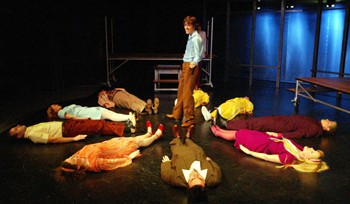
SF Mime Troupe’s ‘Mr. Smith’ ain’t Capra

By Sara Bir

Cracking jokes at the expense of the most tragic event to take place on American soil since the bombing of Pearl Harbor is a bold maneuver. But then again, so is our government’s using the Sept. 11 terrorist attacks as an opportunity to further agendas of globalization and corporate gain. Leave it to the ever trustworthy San Francisco Mime Troupe to bite off such a politically charged mouthful and spit it out as a feisty, lampooning monster. Mr. Smith Goes to Obscuristan, the Mime Troupe’s topical target for this summer’s season, sets its cross hairs once again on the occupants of the White House and the strings they yank.

For those of you unfamiliar with the San Francisco Mime Troupe, they have been performing the lost art of socially relevant musical theater since 1959. They mime not in the sense of grease-paint and silent pantomime but in the sense of mocking and mimicking. In fact, the San Francisco Mime Troupe may be the loudest mimes on earth.

Josh Kornbluth, monologist (“Red Diaper Baby”), filmmaker (author and star of the temp-worker cult epic Haiku Tunnel), and longtime Mime Troupe admirer, takes his first spin at writing a multicharacter script with Mr. Smith Goes to Obscuristan. Kornbluth’s irreverent voice is evident in the script (“the war on terrorism is brought to you by Chevy Trucks!”), but the lasting impression of Mr. Smith –swift set changes, exaggerated props, sweeping motions–is all Mime Troupe.

The Mr. Smith in question is Jeff Smith (co-director Michael Sullivan), a sincere and aw-shucks-pure fireman whose heroism on Sept. 11 has caught the attention of the Bush administration, who send him off as a diplomat to the tiny, sub-dirt-poor nation of Obscuristan. Obscuristan is, in fact, so poor that they are utterly devoid of natural resources, making them the only desert nation forced to import their own sand.

Smith’s mission is to act as a ray of solid American democracy for Obscuristan’s first-ever election. When an upstart candidate, Ralif Nadir, springs up to challenge the rigged victory of president-for-life Automaht Regurgitov (Victor Toman) and Obscuristani oil reserves suddenly come to light, the president of the United States runs across a dilemma: Using the war on terrorism to advance corporate interests is obstructing his actual foreign policy of . . . advancing corporate interests.

The White House-based scenes wield the sharpest humor, with a clueless George W. Bush (Amos Glick, who also played George W. in last year’s 1600 Transylvania Avenue) sneaking around in a smoking jacket, trying to avoid the bulldoggish Cheney (Ed Holmes). When Cheney discovers an open bag of pretzels on the Oval Office desk, he phones the Secret Service: “We got a code P!”

Bush, Cheney, and a buoyant Condoleezza Rice assume they have a fail-safe pawn and generator of positive PR in Smith–they even pass up sending Jimmy Carter for his chumminess with Cuba. The true-blue Smith, however, actually believes in American democracy and sets out intending to adhere to it.

The highlight of the Obscuristan scenes are the newscasts of a Selected News Network reporter, who is out there expressly to produce feel-good, newsless puff pieces about the election. These scenes drive home the lengths the media goes to broadcast what amounts to absolutely nothing whatsoever. There’s a great four-way scene where she’s on a cell phone with her SNN producer (who, naturally, is skiing in Aspen), while Smith is concurrently on the phone with the American ambassador to Obscuristan.

It’s these moments Mr. Smith needs a few more of. Even with a promising setup and excellent send-ups, Mr. Smith never truly gels. The musical numbers (with lyrics by Bruce Barthol and music by Jason Sherbundy) are forgettable and flat; they hold up the action instead of advancing it and waste what should be the play’s biggest opportunities for a laugh.

The plot is rife with chances for screwball twists, but the momentum never builds to the level that you feel it could–it’s as if a page or two of sight gags and verbal digs are missing. What could be great is merely good. Still, the orchestra’s interludes, especially the Middle Eastern-flavored Obscuristani bits, set the scene and punctuate the dialogue well.

Mr. Smith‘s main strength (besides Holmes’ take-charge cameo as Barbara Bush, who, we discover, is still the real brains behind the White House) is that it deals with depressing topics–corporate ruthlessness and the government’s allowance of it, empty media regurgitation of “news,” and America’s constant need to be the world’s top cop–and makes them, through humor, comfortable for the audience to confront. You’re not going to see political humor this bold on Saturday Night Live or a Mark Russell PBS special.

In classic musical theater fashion, everything wraps up tidily and for the best, which is cheesy yet reassuring. As Americans, we can make a difference! I’d forgotten. Seeing Mr. Smith Goes to Obcuristan was a great reminder. Those who feel vastly disappointed by what they see as shifty dealings of our government will leave this play feeling more patriotic than they have in a long time. Which might make up for the guttural laughs Mr. Smith lacks.

‘Mr. Smith Goes to Obscuristan’ plays Thursday, July 25, at 8pm (music starts at 8pm). Analy High School theater, 6950 Analy Ave., Sebastopol. $15 advance; $20 door (tickets available at Town Hall Coalition Center and all Copperfield’s locations). 707.874.9110. The San Francisco Mime Troupe will also perform ‘Mr. Smith’ at the Marin Music Festival in San Rafael on Saturday, Aug. 17, and at the Sebastiani Theatre in Sonoma on Thursday, Aug. 29. For details, call 415.285.1717.

From the July 25-31, 2002 issue of the North Bay Bohemian.

© Metro Publishing Inc.

Jean Malahni

Photograph by Michael Amsler Burning for Respect You've probably seen her naked, you've probably seen her in flames. But why don't you know her name? "Hey," says Jean Malahni, plopping down beside me on a lightly battered couch in her comfy Kenwood living room. "Wanna look at...

Toby Hickman

Forging Ahead: Toby Hickman leaves Waylan Smithy after 29 years. Iron Man Blacksmith Toby Hickman keeps the anvil and hammer in good use By Sara Bir In a world of synthetic hairpieces, cheap newsprint, and junk mail, it can be easy to forget that some people still...

Laguna Vista

Laguna Vista threatens Sebastopol's very soul By Shepherd Bliss A town is saved . . . by the woods and swamp that surround it," Thoreau declared from the banks of Walden Pond. The "swamp" that protects Sebastopol is the Laguna de Santa Rosa. But the Laguna and the small town that borders it face the...

North Bay Barbecue

BBQ Heaven: Cynthia Liss and Marilee Owens (left to right) serve it up hot at Rob's Rib Shack. Barbecue Odyssey All she wanted was a pulled pork sandwich By Sara Bir Barbecue used to be equated with misery. This was at least the case when I...

‘A Thousand and One Arabian Nights’

Photograph by Steven Underwood Tell Us a Story 'A Thousand and One Arabian Nights' weaves yarns By Julia Hawkins Leslie Currier's adaptation of the Arabian Nights, presented by Marin Shakespeare Company, opens with two armed Muslim soldiers who have captured a terrified Arab (performed with gripping presence by...

Hope Sandoval

Hope Springs Eternal Ex-Mazzy Star singer still shines brightly By Greg Cahill Know this about Hope Sandoval: The famously reclusive Goth-folk singer is genuinely shy and modest. When asked about her life, she sounds, well, almost pained. Why doesn't she like doing interviews? "For the usual reasons," she offers during a...

‘The Crocodile Hunter’

Wild and Crazy Is 'The Crocodile Hunter' a menace to nature--or just a waste of time? Writer David Templeton takes interesting people to interesting movies in his ongoing quest for the ultimate postfilm conversation. This is not a review; rather, it's a freewheeling, tangential discussion of life, alternative...

‘Sex and Lucía’

Rabbit Hole 'Sex and Lucía' dishes up Borgesian erotica from Spain By In its native Spain, the film Sex and Lucía is known as Lucía and Sex; the title reversal for export stresses the real appeal of the film in our nation of unsexy movies. But Sex and Lucía really...

Beth Custer

Beth Hears Her Calling 'Eclectic' is too limiting a word for Beth Custer By Beth Custer lives about five lives at once in San Francisco, but she's taking time out for local shows. Her upcoming Point Reyes performance brings in Custer's latest band, Doña Luz 30 Besos, dubbed in tribute...

‘Mr. Smith’

Mime Time SF Mime Troupe's 'Mr. Smith' ain't Capra By Sara Bir Cracking jokes at the expense of the most tragic event to take place on American soil since the bombing of Pearl Harbor is a bold maneuver. But then again, so is our government's using the Sept. 11 terrorist attacks...
11,084FansLike
4,446FollowersFollow
6,928FollowersFollow


