Mary-Kate and Ashley Olsen

0

Under Perfect Skin

Mary-Kate and Ashley Olsen rule the world

By Sara Bir

I went into the Big Lots store to buy discounted Easter candy. What I walked out with was a Mary-Kate and Ashley “Let’s Hang Out” playset, which I set up on my desk at work the next day. It looks like a miniature version of an average teenage girl’s dream rec room: wide-screen TV, laptop computer, fancy stereo, CD tower, splashy-print beanbags. All that’s missing are the doll versions of Mary-Kate and Ashley, but their absence casts the illusion that the twins are on location shooting another direct-to-video romp, soon to return and resume hanging out like any other normal kids.

Real-life Mary-Kate and Ashley Olsen are slender and sunny media-perfect 16-year-olds–goofy and easygoing but not too spirited to be threatening–who are preoccupied with getting their driver’s licenses and probably would never date a ne’er-do-well loser rebel guy. They like to dance, make movies, and shop.

If the tiny contents of the playset represent their true interests, then hanging out for Mary-Kate and Ashley dolls means watching Mary-Kate and Ashley movies, playing Mary-Kate and Ashley Game Boy games, reading Mary-Kate and Ashley paperbacks, browsing through Mary-Kate and Ashley magazine, and perusing www.mary-kateandashley.com. Beyond the size, it’s difficult to discern the difference between the plastic toys and the plastic people.

Even with all of the glitter-caked facets in their ultraspecialized media empire, which span every conceivable commercial outlet known to consumer culture–books, videos, toys, movies, video games, TV shows, a website, a magazine, clothing–the oft-projected image of America’s current favorite twins (excluding the recently unjoined Marias) does not delve much deeper than their mini Meg Ryan haircuts and midriff-bearing, bedazzled designer T-shirts. The living Mary-Kate and Ashley don’t seem to have much to offer that would set them apart from their 8-inch toy counterparts.

Becoming Perfect

Mary-Kate and Ashley Olsens’ path to tween (a most awful contraction for a most awful age, between little kid and bona fide teenager) domination began for them at the tender age of nine months, when the wee bairns shared the role of little Michelle Tanner on ABC’s dreckfest Full House. Starring Bob “America’s Funniest Home Videos” Saget, the show was a sitcom hit with a nine-season tenure. Baby Michelle quickly became the show’s most doted-on character, her toddling appearance in any scene inevitably eliciting canned awws from the studio audience.

You can imagine the charm implicit in discovering that adorable Michelle turned out to be played by not one but two real-life moppets. Enter Dualstar, the company responsible for transforming Mary-Kate and Ashley from little girls into a brand name.

During the middle seasons of Full House, the mothers of fellow child co-stars Candace Cameron and Jodie Sweetin advised the twins’ parents, Dave and Jarnie Olsen, to arrange better payment for their daughters, who were clearly the show’s biggest assets. Dad Olsen hired show business lawyer Robert Thorne to tend to this–which Thorne did, but the lawyer also smelled major untapped money potential beyond the twins’ salary.

This was back when a sulky Macaulay Culkin’s parents were locked in a bitter custody battle over their son, who wanted nothing to do with them. Thorne wanted to arrange a deal that allowed no one else but the twins themselves the option to exploit Mary-Kate and Ashley mania. He called the company Dualstar, with Mary-Kate and Ashley its shareholders and owners. At six, they were entitled to all the profit they made from any feature they starred in; it also made them the only six-year-old producers in Hollywood. The twins went from making $2,400 per episode at the start of Full House to $80,000 an episode by its close in 1995.

So Dave and Jarnie Olsen found themselves with pint-sized goldmines in their hands, and Dualstar’s Olsen machine kicked into high gear. 1993’s quadruple-platinum Our First Video (yes, their first video) set off a domino chain of Dualstar direct-to-video releases that more or less fictionalized MK&A’s real-life childhood onscreen.

When Full House ended its run, the twins Olsen (then 10) were freed up to devote themselves entirely to Dualstar’s ever branching tree of projects. Instead of the show’s demise plummeting the twins’ popularity off a cliff, it propelled their fame into a profitable orbit in its own right.

All of this wheeling, dealing, and working affected the impressionable minds of the child stars not too terribly much, it turns out. According to a 1998 bio, “If the Olsens seem like they are having a lot of fun, it may be because what they do professionally so closely parallels their real-life interests. Among their favorite things to do are to act, sing, shop, watch MTV, enjoy the great outdoors, dance, play baseball, ride horses, and spend quality time with their real-life family.”

That was four years ago, though. Since then MK&A turned candy-sweet 16, sprouted boobs and girlish little figures–as superstars in blossom will–and turned the subject matter of their videos and TV shows away from ballet and ponies to boys, designer handbags, and boys. They launched their own magazine (currently in limbo, as their publisher, H&S Media, went out of business) and two more television series–the Saturday morning cartoon Mary-Kate and Ashley in Action on ABC, and the live-action So Little Time on the Fox Network family channel.

Despite their financial clout, the girls’ allowance in 1998 was a modest $10 a week. Now, even though their schedules are packed, the social lives of Mary-Kate and Ashley have not strayed to big-time jet-set indulgences.

The girls both have nonfamous, long-term steady boyfriends, and–unlike Britney–have not yet been caught smoking, let alone choking on their own vomit on the sidewalk in front of the Viper Room. The adult world hasn’t really caught on to them like it did with Britney, though, and the twins are mostly still a teen phenomenon, leaving the girls more room to be girls and less pressure to be adults.

So even though the busy, high-profile life they lead is by no stretch of the imagination normal, it’s probably as normal as it can be. The girls seem unscandalously well-adjusted. “They like acting,” their father told the Wall Street Journal in 1997. “As soon as they stop enjoying it, it ends.” Apparently, Mary-Kate and Ashley still enjoy acting. A lot. Right now on Amazon.com, there are 59 videos available starring Mary-Kate and Ashley.

Once MK&A hit puberty, Dualstar began preening the twins ad infinitum.The gawky average young girls of white-bread America, who are normal to begin with, can’t covet normality because that’s what makes up their whole life. To them, Mary-Kate and Ashley represent impossibly über-normal, liberated, middle-class princesses, girls who have all the latest styles they desire at their sparkle-polished fingertips and with makeup artists to camouflage any acne they might incur.

They live in L.A. and own their own horses. They fly to the Bahamas and play with dolphins on camera. They have more of a chance of meeting Prince William than 8 billion other girls do. Not only do they have their own website, they have a staff to make it for them. The twins are Nancy Drew, Sweet Valley High, Betty and Veronica, Debbie Gibson, Madonna, Hayley Mills, and the Mickey Mouse Club all rolled up into two boy-crazy, flirtatious, mystery-solving, fashion-spellbound go-getters who use the words “cool,” “awesome,” and “whatever” to excess.

A few years ago they stopped being girls and became miniaturized characters lifted from Friends. You get the feeling that when Mary-Kate and Ashley have their menses, the fluid dappling their maxi pads is as blue and clear and clean as Windex, just like on TV commercials. Real periods for real girls.

In keeping with the further specialization and fragmentation of target demographics, tweens have their own stores, scores of their own magazines, their own wardrobe of pocket video-game systems, and their own technicolor junk foods. Mary-Kate and Ashley, whose product line includes a tie-in to every possible commodity, are ideal Generation Z superstars.

No big companies are competing with Dualstar, which may be the key to the twins’ hefty market share. Mary-Kate and Ashley have an umbrella that extends over not only onscreen entertainment but clothing, books, music, games, toys, and periodicals–and it’s all specifically girl-oriented, whereas the bulk of children’s media is for boys or families. What other tween sensations offer that all-in-one tidy company, one whose motto is “Real Talk for Real Girls”?

Peas in a Media Pod

It’s hard for an Olsen novice to tell the twins apart. Of course they look like each other–they’re twins. But in real life, do they act like each other? Is one painfully shy while the other is a brazen go-getter? Hmm. Here’s a 2000 interview from TheCelebrityCafe.com, straight from the Olsens’ mouth:

TheCelebrityCafe.com: What are some of the basic differences in personalities between the two of you?

Ashley: Well, there are many differences. We each have our own likes and dislikes, like any sisters would, but the basic difference? Probably that Mary-Kate loves to ride horses and I love to dance more.

Alas, there don’t appear to be dark, buried tragic flaws, their own private and exclusive causes for dissent. Mary-Kate is not secretly goth, Ashley is not struggling with sexual identity issues. They are boy-crazy, mall-mad teenage girls who, beyond the fleeting amusement and cotton-candy escapism of their TVmoviestoysmagazinebooksvideo-gamesclothingline, have nothing substantial to offer us. Oprah has a personality, Martha has too much of a personality, and Britney can at least sing. Mary-Kate and Ashley are chirpy pseudotartlets who don’t even offer the thrill of being rebellious.

Their book series (there are six) offer another glimpse at the picture-perfect world MK&A/Dualstar have created. The contrived scenarios in titles like Too Many Teddies, The Case of the Cheerleading Camp Mystery, and Calling All Boys have 10-year-old girls atwitter with vicarious popularity.

Here’s a random sample from the beginning of Two of a Kind: It’s Snow Problem:

“I can’t decide. Should I wear this sweater for the Winter Festival, or this sweater?”

Twelve-year-old Mary-Kate Burke glanced up from her desk. Her twin sister Ashley was standing in the doorway of her dorm room. She held a fluffy pink cardigan in one hand and a black cashmere turtleneck in the other.

“I do look totally awesome in pink.” Ashley held the cardigan up to her chest and struck a supermodel pose. Then she did the same thing with the turtleneck. “But I look totally awesome in black, too. Hmm, major dilemma!”

On to the videos. Faced with all the options at the video store, I had trouble deciding. There was Holiday in the Sun, but Winning London looked better. And, hmm, Our Lips Are Sealed was filmed in Australia. I’ve never been there! I wound up renting two–Winning London and Our Lips Are Sealed–because what better way to dissect the Olsens than by watching not one but two of their movies. One per twin.

After watching Our Lips Are Sealed, I can kind of tell who is who now. Ashley has a higher voice, longer hair, and is made out to be ditzier than Mary-Kate, who is also ditzy, but just the slightest degree spunkier.

Our Lips Are Sealed was really not so bad. It was rather like a made-for-television movie or a throwaway Disney TV special, and those can be fun from time to time. I liked the Mondrian-inspired go-go dresses that the twins wore to the yacht party. And the script did manage a few high points of near cleverness; e.g., a priceless jewel that winds up in Ashley’s possession is called the Kneel Diamond and the movie ends with “Brother Love’s Traveling Salvation Show” playing over the credits.

Turn on Your Heartlight

Even given our possibly shared Neil Diamond soft spot, one thing still bugs me about the dual stars: Mary-Kate and Ashley present a conflicted message with almost every product they pump off the assembly line. Our Lips Are Sealed was supposed to have the moral that “popularity doesn’t matter,” but with trendy outfits aplenty and two cute boyfriends, by the end of the movie the girls have won popularity from everyone.

Their website offers daily thoughts, such as “Put your mistakes to good use; learn from them” and “The simple things in life bring the most happiness.” Then, after absorbing those Zen capsules of inner clarity and truth, you can click on the “Real Beauty” archives and read about how to get your eyebrows waxed, just like your favorite Hollywood stars!

Mary-Kate and Ashley make crummy role models because there is nothing outright objectionable about them until you realize that they are doing their job all too well. So convincing are they as mild-mannered typical teens that you begin to overlook the product placement and feverish materialism that colors every last cross-promotional Dualstar-licensed tidbit.

At KB Toys in the mall, the arrival of the new Mary-Kate and Ashley “Sweet Sixteen” dolls bumped the Mary-Kate and Ashley “Movie Magic” dolls off the display shelves and into the mark-downs. The accessories with the “Sweet Sixteen” dolls were better, but I liked the twins’ clothing for “Movie Magic” more, plus their hairstyles were less scraggly. And only $6.99 per doll! I had an empty “Let’s Hang Out” playset on my desk yearning for them. If I had dolls to occupy it, I could reward myself during the grueling weekdays with little breaks, posing the twins or changing their outfits. My playset was sitting there going to waste!

Little Plastic People

As it turns out, the plastic Mary-Kate and Ashley on my desk have become very comfortable in their plastic Mary-Kate and Ashley world. Sometimes they read their magazine, and they watch their TV show on Saturday morning. On Sundays they ride their horse or go to the mall. And what does the future hold for them? Maybe Ashley will elope with Steve from Blue’s Clues. Maybe Mary-Kate will become a reclusive Buddhist monk, leaving Ashley to hold down Monostar by herself as the “Olsen Twin.” Maybe they will attend Harvard and become brilliant literary critics or physicists.

Or maybe they will go on forever releasing direct-to video frolics (Double Divorcées on the Town, Menopause Madness, You’re Invited to Mary-Kate and Ashley’s Nursing Home Party) into eternity. And maybe, just maybe, no one will care.

From the August 15-21, 2002 issue of the North Bay Bohemian.

© Metro Publishing Inc.

Chili

0

The Chili Diary

Discovering the true meaning of heartburn

By Sara Bir

Some people get silly about chili. I don’t like to think I’m one of them. I’d like to think that I’m very rational and reasonable when it comes to chili. Real chili is red, chock full o’ beef, and has no beans. Right? That’s reasonable, I think.

But not to my friends. Last year a couple of them invited me to their inaugural 4th of July Chili Cook-Off, a casual but competitive affair with perhaps 20 people in attendance. I weaseled my way into judging, figuring that with three other chefs constituting the panel, we’d all be in clear agreement. Nope. Some green stuff with sausage got first place because it “had the best flavor.” Flavor my ass! Chili isn’t green, and it sure as hell don’t have little chunks of sausage floating around in it.

My favorite chili that day was actually vegetarian and laden with beans (which will get you shot in certain parts of the country). But its classic chili flavor (and color–red) was robust, its texture hearty, and its finish long and satisfying. It didn’t win first place.

The chili that I usually make is not, according to the rigid meatless-and-beanless-red definition, truly chili. This de facto chili, a concoction of pinto beans, tomatoes, carrots, parsnips, zucchini, and textured vegetable protein (I call it Hippy Chili), I keep to myself. I should be kind and share it, but I feel the same way about Hippy Chili as I do about the first Mötley Crüe album: I’m too embarrassed about liking it to display my fondness in public.

This is why, upon deciding to enter the second annual 4th of July Chili Cook-Off, I resolved to show all of these misdirected makers of chili what the real deal is. Needing a partner in enlightenment, I drafted my boyfriend, who is slightly inept in the kitchen but a very good sport. Most importantly, he has the most acute sense of smell of any human I’ve yet encountered. My Chili Sous Chef would be a powerful one-man focus group.

All elements in place, the path to Independence Day chili domination began.

Early June, Saturday morning Pounds of beef chuck in a heap on the cutting board. Making special test batch. Am finely dicing beef by hand to make chili extra full of love.

Later Beef almost diced. Criminy, this is tiring.

Still later Blood everywhere! Beef not my undoing: onion was. Pick dime-sized circle of fingertip off cutting board. Swaddle fingertip in masking tape and press on. Figure that I know where my blood has been, whereas the cow’s blood is anybody’s guess–and it’s the cow we’re all eating. Hours later Bloody Finger Chili all cooked. After so much labor, it’s a bit disappointing. Needs more depth. “What do you think of the texture?” I ask Chili Sous Chef. “Is it too thick? Does it seem greasy at all? Can it stand more spice?” No, no, and yes.

Considering last year’s cook-off, I’m curious if effort is worth it. People were taking themselves too seriously. It was dangerous being a judge. The last place team ganged up on me while I was lazily splayed, drunk and full of chili, in the hammock and swung it around in a most violent manner. Very disagreeable to a drunk girl full of chili.

June 29, 8am Make competition chili today, five days in advance. Freezing allows flavors chance to meld properly. You don’t need a freezer to accomplish this, only time, one day of rest–a chili Sabbath.

8:45am Bloody Finger Chili on stove, minus namesake blood; no cuts this time. Had blended my own chili powder, a carefully calculated mix of hot New Mexico chili powder, dusky Pasilla chili powder, whatever constitutes the chili powder in Oliver’s bulk spices, and Asian chili powder, brighter in tone and flavor than North American chili powders. Am hoping this untraditional but not wholly uncouth addition will underscore earthiness of other chili powders and propel them to be truer to own flavor.

Then toasted spices (chili powder, cumin, paprika, cayenne) in dry skillet over low heat, stirring. Don’t lower nose to loose ground spices in the skillet to check on aroma, lest spices go up nose like low-grade cocaine, resulting in itching and burning.

11am Chili done. Decide to assess new chili in form of chili omelet. Mmm. Chili omelet.

11:15am Urgh. Don’t eat chili for breakfast.

1:45pm Can’t move. What was I thinking?

7pm Time for dinner. Not hungry; vile chili burps destroyed appetite for whole day.

July 4, 1:15pm Pack up car with soon-to-be legendary chili and drive off.

1:45pm At hosts’ house. Guns N’ Roses on the stereo. Flags everywhere. Patriotism!

“Where is everybody?” I ask host, actually meaning “Where is the rest of the chili?” Had imagined a dozen clashing chili mercenaries hauling in wily and smoldering chili.

“No one is here except Todd and Selvi,” he says. Geez! What kind of chili contest has only two contestants? Another team came later. They lurk in the kitchen, still finishing their chili. No Chili Sabbath for them! Orthodox Bloody Finger Chili as done as it’s ever gonna be.

3pm Game of backyard jungle croquet gives way to beer-induced pangs of hunger. Everyone gets plastic bowl and spoon; we are to taste all three chilis and then judge them by cheering loudest for our favorite.

Only three chilis and everyone judging? Ominous premonition creeps over me; half of guests are vegetarians. Ninety-five-percent-beef Bloody Finger Chili is doomed.

Chili #1: chunky, meatless, with beans, rusty orange color. Consistency perfect, classic chili flavor and texture. A people’s chili. Chili #2: brothy from whole canned tomatoes, thin, large hunks of bell pepper and some kind of steak hunks floating around in there. Hotter, not as flavorful as #1. Makers of chili #2 recommend eating it with white rice. Rice? Rice is for gumbo, not chili! It was good, their stuff, but not chili yet, having been deprived of Chili Sabbath. Chili #3: our poor dark horse chili. Remember chili omelet disaster and skip it.

3:15pm Try all three chilis mixed together. Our concentrated chili permeates mildness of other two, and all is well and right. Chilis #1 and #2 cannot approach the intimidating breadth and depth of Bloody Finger Chili, but you could eat a big honking bowl of either and feel satisfied, not burdened. Ours is not affable, easygoing chili. It takes active participation to appreciate. It broods.

3:20pm Time to judge/cheer: Bloody Finger Chili garners a few half-hearted “woos”–woos with a lowercase w. It places third.

3:21pm Upon presentation of booby prize–a Bud 40oz–I lose control, shout out, “You guys are just a bunch of wussy vegans, and that’s why we won third place!” Which is not very nice. I think I only half mean it. But I got what I deserved; I had made snob chili, and no one likes a snob. It’s just not fun. I was no fun.

Chili Sous Chef is pleased with our placing–he likes Bud 40s.

We take turns whacking at a piñata. I miss.

8pm Chili and beer all day long take a lot out of you, and what it puts in you is not pretty.

Still have one pint of chili in freezer, sitting like a giant paperweight. Would rather eat secret Hippy Chili, which I should have entered in cook-off. Humbled by chili.

I pass out in Chili Sous Chef’s apartment before most fireworks displays get past preliminary booms and bangs. Have learned lesson, but still contend notion of serving chili over rice.

From the August 15-21, 2002 issue of the North Bay Bohemian.

© Metro Publishing Inc.
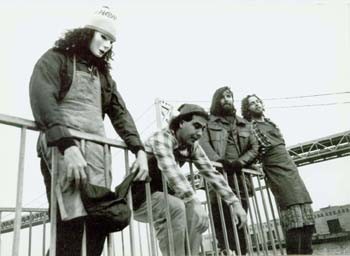
Sonic Youth

0

Radical Adults

Crow’s feet and all, Sonic Youth still manage to make beautiful noise

By Sara Bir

Thank you, Sonic Youth. Your new album is not lame but fresh and exciting, and all is right with the world. Ever since 1995’s Washing Machine, the world’s most high-profile art rockers have been coasting down the low arc of a yawn, with each successive album growing fuzzier in focus and less electrifying to the senses. These weren’t bad albums, they just weren’t as great as we knew they could be. Meandering without direction or juicy hooks, the songs slid by, their dissonant subtle moments stretched too thin to create the compelling sound-picture Sonic Youth once so artfully painted.

The Sonic Youth of Murray Street is the new school, more adult and nuanced band they have become ever since the off-kilter distort-o-rama of Experimental Jet Set, Trash and No Star. This pleases some and displeases others, especially indolent critics who never liked Sonic Youth in the first place, accusing them of being indulgent, overly cerebral avant-guard poseurs.

But therein lies the catch. Sonic Youth’s music isn’t made for thinking and dryly dissecting; it’s made for hearing and feeling. Of course people who don’t dig distortion and feedback and who can’t shut up and just listen won’t like it. But if you do and you can, wet down your lips, because Murray Street is a very good kisser.

Murray Street has no instantly apparent anthem, no obvious MTV pick, and is probably not destined to enter the hearts of passive Sonic Youth listeners. Fine. What Murray Street boasts is a sort of counterdimensional, slow motion, blissed-out blossoming of faraway chiming guitars and a small cacophony of churning alternate tunings that has been years in the making. Taking all of the antimelody noise-making experience they have garnered in nearly two decades of shredding unexplored territory, Sonic Youth has finally perfected sounding big by going smaller.

Murray Street is gossamer-spellbinding, like having the blue netting on the cover (one of the two little girls on the cover is Coco, the daughter of band mates Kim Gordon and Thurston Moore) waft down over you for 45 minutes, blanketing your perceptions and hazing out your brain with all the lavish laziness of a summer afternoon spent swinging stoned in a backyard hammock under green leaves and hovering bumblebees. The seven tracks are well-defined songs, not just collections of pretty bits and pieces (a fate that befell much of 2000’s NYC Ghosts & Flowers).

Lee Renaldo’s “Karen Revisited” buzzes with the vein of New York City diffidence that typically runs through Renaldo’s songs, with his distinctively loping vocal rhythm swirling with momentum. And “Plastic Sun,” Kim Gordon’s lone vocal track, scoots along with the weird schoolgirl taunting (“Plastic girl with plastic hair / plastic eyes with plastic stare / I hate you and your bitchy friends / I hate you and it never ends”) that 40-plus Kim Gordon can still pull off.

Sonic Youth may have grown older, but instead of old and stuffy, they sound wiser. Murray Street marks longtime producer and collaborator Jim O’Rourke’s official spot in the band’s lineup, and with five members now, the glorious walls of layered feedback are sturdier, fuller, more solid–when the whole sonic wave crests, it falls not into a chaotic collapse of white noise but into an intricate swirl of sound. “Radical Adults Lick Godhead Style” even features horns, played with such a frayed drone that they meld naturally with the sunburst of guitar feedback.

Whether all of the band’s audible injection of energy was a result of O’Rourke’s presence in the band or Sept. 11’s fallout, Murray Street is understated Sonic Youth at the top of their game, as powerful as ever from mellowed adults with crow’s feet. The wonderful thing is that even though Murray Street never totally rocks out, you don’t miss it. If that’s what Sonic Youth have been striving for with all of their soporific late ’90s albums up to this point, they’ve finally done it. Murray Street stands on its own without having to rely on dynamic fireworks or superhooks to keep it that way. Even though Sonic Youth will always be the coolest of the kool, it’s rewarding to hear an album that certifies it.

From the August 8-14, 2002 issue of the North Bay Bohemian.

© Metro Publishing Inc.

San Francisco Jewish Film Festival

There’s Still Hope

The SFJFF explores all sides

By

It’s obvious that the 22nd annual San Francisco Jewish Film Festival hosts films about Jewish life and lore. Yet this festival–the first, the most successful, and the most imitated Jewish film festival in the world–always avoids a limited parochial focus. Israel and Israeli films are represented here, including a documentary on the history of the young nation. But two of the most applauded (and yet undistributed) films to come out of France and Italy recently are also part of the bill. The local “best of” selection at the Rafael invites the faithful and the skeptical alike.

Qui Vive (6:30pm, Saturday, Aug. 10) The sequel to the 1989 film Polonaise, about the next generation of a Jewish family hidden by Dutch Christians during World War II. All’s not well for them as they deal with pregnancy and a bad case of the seven-year itch.

God Is Great and I’m Not (8:30pm, Saturday, Aug. 10) Under Pascale Bailly’s direction, Audrey Tautou–the Parisian pixie who had the title role in Amélie–plays a gentile but not gentle supermodel who lands a rarely practicing Jewish veterinarian. When the two plan to marry, she decides to convert. Billed with Not Another Jewish Movie, which follows 11 Bay Area Jewish kids mulling over on camera what the traditions mean to them.

In Search of Peace (Part One: 1948-1967) (noon, Sunday, Aug. 11) An ambitious documentary on the history of Israel, narrated by Michael Douglas and containing interviews with seven prime ministers of the embattled nation.

Blue Vinyl (2:30pm, Sunday, Aug. 11) A classic example of the SFJFF’s eclecticism. In this documentary, Judith Helfand (director of A Healthy Baby Girl) explores the dangerous side of household vinyl siding and the persistent polyvinyl chlorides the stuff is derived from.

Unfair Competition (5:30pm, Sunday, Aug. 11) Ettore Scola’s comedy/drama about Mussolini’s enactment of the racial laws of 1938, viewed through the lens of a plot of two competitive tailors in Rome: one gentile (Diego Abatantuono), one Jewish (Sergio Castellito). The two have a temporary truce going due to a liaison between their son and daughter. When the country’s anti-Semitic laws are enacted, the gentile’s brother-in-law (Gerard Depardieu) pitches in to help.

Esther Kahn (8pm, Sunday, Aug. 11) Jack the Ripper’s neighborhood, Whitechapel, London, is the location for Arnaud Desplechin’s Victorian romance of a Jewish girl (Summer Phoenix) determined to risk everything to become an actress. Ian Holm co-stars as her hard-nosed teacher.

Foreign Sister (6:30pm, Monday, Aug. 12) Director Dan Wolman’s story of a regret-wracked middle-class Israeli woman, Naomi, who meets an Ethopian Copt, or Christian. This illegal immigrant leads Naomi to question the comforts of her home.

Desperado Square (8:30pm, Monday, August 12) Benny Torati’s spin on The Last Picture Show. Desperado Square is a study of Greek Jews living in the backward outskirts of Tel Aviv, where a now closed movie theater stands as the symbol of forgotten dreams and hopes for romance. A movie about movies, and thus the ending note of this year’s festival.

Tickets and more information are available at www.sfjff.org.

From the August 8-14, 2002 issue of the North Bay Bohemian.

© Metro Publishing Inc.
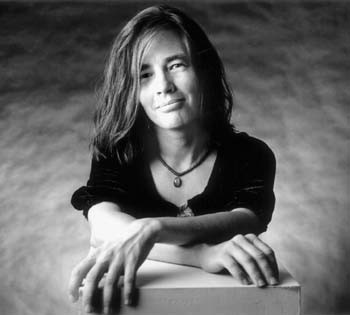
Pie

0

Joy Liu

Pie of My Eye

As easy as what?

By Gretchen Giles

Whoever it was to first utter the terrible lie “as easy as pie” has presumably already suffered a horrible death. I personally feel no remorse or compassion for this passing. I much prefer to embrace the giddy Gallic truth of “as easy as pâté” or the Italianate flourish of “as easy as pesto.” Either of these phrases need merely be uttered in front of a food processor, and voilà (and Prego)–there they be. Easily.

Pie is a different donkey. And like a donkey, pie is stubborn, unpredictable, follows no known tune, and is changeable from moment to moment. There ain’t nothing easy about it.

To be fair, perhaps that awful liar was thinking of filling when he or she first mentioned pie in easy terms. Filling is indeed a cinch. Peel some fruit, cut it up, sugar and spice it, add a bit of tapioca or flour, let it sit. Pick some fruit, sugar and spice it, add a bit of tapioca or flour, let it sit. Open a can, spoon out the pumpkin, sugar and spice it, add evaporated milk, let it sit. In any case, pour the filling into a pan for baking. Which brings us with mighty immediacy to the rub of all pie plights: the damned crust.

Foolproof evidence that cooking is nothing but chemistry for the mouth, the science of crust makes quantum physics seem like preschool fodder. Poke around long enough, and you’ll eventually figure quarks out completely. Spend a lifetime weeping in an apron over a well-floured board, and you still may never discover all of the disparate miracles that must conspire together in order to form a crust. Temperature plays a part, liquid tends to matter, and surely measurement itself demands a starring role in the bawdy passion play that is crust making.

The rest is pure mystery, sometimes containing vinegar, other times calling for unsalted butter, and often demanding shortening, lemon peel, or frozen orange juice–depending on whose time-honored recipe you wreak havoc upon in the tear-stained privacy of your own home.

But leveling flour, eyeing cold liquid, and determining from the little lines on the cube’s package what five teaspoons of butter might look like requires an exactness of spirit that I simply don’t possess. Nor, warns a chilly voice in my soul, may I ever.

Which is why the telephone is such a great invention. Handily picking one up, I call Condra Easley, co-owner with sister Deborah Morris of the Patisserie Angelica in Santa Rosa. I explain that the backyard blackberries are ripening swiftly and that a sepia-tinged string of maternal lineage demands I try to cook them somehow. (Jam is best not discussed here; suffice it to say that the last of former summers’ exertions has finally been scraped off the ceiling.) Pie it must be.

Wah and help, say I.

“You’ve got two options,” Easley helpfully informs. “The kind of crust my mom made, or the kind for those who feel that Crisco is incorrectly classified as a foodstuff. My mom had a no-fail pie crust recipe, and it did have a dash of vinegar to it. You could do the most obscene things to this crust and it would still turn out.”

Obscene is great, as it is almost guaranteed. I urge her on.

“Pastry making is part science and part art,” she instructs, admitting, “I don’t understand all of the scientific mystery surrounding it; I like the art part.” As one who’s stood over a desk greedily gobbling down in full gulps the little pastry tarts that Easley turns out, I’ll trust her on the art part. Gimme, I delicately request, some science.

“Well, one of the biggest problems for home cooks is measurement,” she responds.

Don’t I know it.

“Three of us could each measure a cup of flour and come out with three different amounts. If you’re not weighing it on a scale in ounces, you’re going to end up with variations. That’s also why most home pie crust recipes call for between 8 to 10 teaspoons of water, to account for the variables in the flour amount.”

Back to art, I plead, already beginning to feel defeated.

“Well, I do mine in the Cuisinart,” she says, sadly beginning to not delineate Mom’s no-fail recipe but rather the tetchy French method of pâte brisée. You want no-fail, you call a mom. You want tetchy French, you call a professional chef. Lesson learned.

“I use cold butter, not frozen, and pulse the machine, not just push the ‘on’ button on,” she advises. “You’re trying to suspend the fat in the flour. That’s going to help give you a lighter, flakier dough.”

“Lighter,” “flakier”–good words. I’m nodding and memorizing. “Heavier,” “crumblier,” and “sodden” are my more usual adjectives.

“When it’s time to add the liquid,” she continues, “I always hold back and continue to pulse until the dough just starts to come together, and then I get in there with my hands because sometimes just by looking at it, you can’t tell if it’s working or not.”

Sometimes I can’t tell if it’s working or not with my hands, I mournfully counter. What do you do when the whole thing inevitably falls to hell, a pile of flour with unsuspended fat sort of avalanching onto the board under even the gentlest of pats?

“Sprinkle water in with your fingers as you go,” Easley counsels. “But be careful! The more you knead it, the more gluten you’ll develop. Of course, if you add too little water you’ll get shrinkage. And, if you don’t let it rest long enough, you’ll get shrinkage.”

That sounds awful. What’s shrinkage?

“When there isn’t enough dough to fit the pan,” she says evenly, beginning to sound like a busy pastry chef and store owner caught smack in the middle of the day by an irritating home cook with press credentials.

Well, I offer sweetly, resting is good. How long does that last?

“Go have a glass of wine,” she advises. “Sip it slowly. Perhaps a cognac.”

Resting and wine. I make note that pie crust has some positives I hadn’t considered before.

But we’re back to flour, presumably now a bit tipsy and wielding a rolling pin. “Use as little flour as possible on the board and pin to keep it from sticking,” Easley warns, explaining that again it’s a gluten thing, meaning that it’s a science thing, meaning that certain mysteries shall remain unexplained.

“The final thing I tell my students is that if you want a round, begin with a round,” she continues somewhat cryptically.

I’ve been daydreaming for a moment about chilled glasses of Viognier.

Huh? I ask in professional journalistic style.

“It’s a lot easier to preform your dough into a round shape and press it down, before you start rolling,” she reiterates.

I can only concur. A moment of silence elapses, the sound of customers purchasing little frangipani or figgy-berry tarts in Easley’s shop begins to filter through the phone. I sense that it’s time to add the filling and pop this conversation into the oven, as it were. I thank Easley profusely.

“Remember,” she says, “the great thing about pie is that even if it’s a total flop–it still tastes good.”

That’s one piece of advice I already knew.

From the August 8-14, 2002 issue of the North Bay Bohemian.

© Metro Publishing Inc.
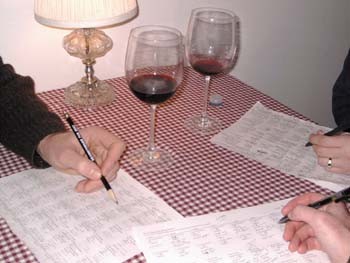
‘The Acoustic Folk Box’

0

Just Folk

Brit folk box spans 40 years of acoustic music

By Greg Cahill

The winds of change are blowing the Brits back to their roots. At a time when the United Kingdom has melded with the culturally disparate European Union (which runs the gamut from France to Turkey), Londoners and their countrymen are embracing a folk-music revival that has gained momentum over the past few years.

The newly released four-CD collection The Acoustic Folk Box: Four Decades of the Very Best Acoustic Folk Music from the British Isles (Topic)–replete with 56-page booklet, biographies, and more than 100 photographs–is a stunning set that definitively chronicles this historic trek in a most entertaining and engaging fashion.

The box begins with skiffle great and Glasgow guitarist Lonnie Donegan’s 1958 cover of the American gambler lament “Jack o’ Diamonds,” the hit song that launched the British folk-music revival and influenced a pair of Liverpool wannabe rockers named John Lennon and Paul McCartney. The long journey ends 40 years later with the traditional folk song “10,000 Miles” performed by second-generation British fiddler and singer Eliza Carthy, the daughter of British folk guitarist and singer Martin Carthy and vocalist Norma Waterson. In between simmers a slurry of rags, reels, airs, and a sea chantey or two–the Bothy Band, the Battlefield Band, the Incredible String Band, they’re all here.

There also are such stalwarts as seminal Celtic folk-rockers Pentangle (with virtuoso guitarists Bert Jansch and John Renbourn), the fiddle and guitar duo Martin Hayes and Dennis Cahill, agit-pop singer Billy Bragg, and Celtic folk-rocker Richard Thompson, often lauded as the best guitarist on the British Isles and a man who knows a thing or two about turning a phrase. The roster of female singers alone is worth the price of admission: Mary Black, Sandy Denny, Maddy Prior, and the ubiquitous Kate Rusby, the ex-Poozies singer who has become the Gen X poster girl of the British-folk revival. But as usual, former Oyster Band singer June Tabor delivers the showstopper, in this case the haunting Civil War death ballad “Lay this Body Down,” performed a cappella and guaranteed to pull your heart strings.

Strangely enough, the hugely influential Fairport Convention–whose lineup has included the likes of Thompson, Prior, and Tabor–is missing in action, though its principle players all are represented as soloists. Still, this is essential listening for any serious folk-music fan.

Townes Van Zandt

Live at the Old Quarter, Houston, Texas (Tomato)

A Gentle Evening with Townes Van Zandt (Dualtone)

Five years after his untimely death (and is there ever a right time?), a pair of new releases (the first, a reissue) capture Texas singer and songwriter Townes Van Zandt in intimate performances that should help build the legend and underscore the talent that made him one of the great country-folk artists of our time. The two-CD set Live at the Old Quarter, recorded in 1973, finds a confident Van Zandt on home turf and running through a sure-fire set of lonely ballads (“Don’t You Take It Too Bad”), talking blues (“Talking Thunderbird Blues”), homages to misfits (his radio hit “Pancho and Lefty”), and covers of tunes by Merle Travis, Lightnin’ Hopkins, and Eugene McDaniel.

A Gentle Evening gets off to a slower start, perhaps because it finds the Texas troubadour on uncertain ground (Carnegie Hall, 1969) and before warming up to the task. The set list is similar to that of the Old Quarter concert. Because Van Zandt had the power to pull you right inside a song and deliver highly personal performances that seem lost in time, you should own them both for the sake of your soul.

From the August 8-14, 2002 issue of the North Bay Bohemian.

© Metro Publishing Inc.

‘Orpheus Descending’

Going Down

‘Orpheus Descending’ fails in style

By Patrick Sullivan

Let’s talk Greek myths. Remember Sisyphus? In a nasty fit of pique, the gods sentenced the poor bastard to Hades, where he was condemned to roll a gigantic boulder up a hill for eternity. He’d grunt, he’d sweat, he’d pour everything he had into the task. And when Sisyphus reached the top, the rock would roll back to the bottom again. His hell was that he’d been given a job that would always overwhelm him.

Now let’s talk community theater. Orpheus Descending, now onstage at Pegasus Theater under the direction of Michael Tabib, is Tennessee Williams’ updated retelling of another Greek myth about Hades. This one concerns a musician who braves the underworld to rescue his beloved from the clutches of death.

It’s no small matter to stage Tennessee Williams. His plays are monuments of pop culture, full of larger-than-life characters and the kind of dialogue that can sound a tad ridiculous coming out of the wrong mouth.

“That’s death knocking for me up there,” explains Lady Torrance. “Knock. Knock. Knock.” Lady (played by Jacquelynn Kathleen) is talking about Jabe, her evil, old husband, who has trapped her in a loveless marriage in a small town full of sharp-tongued gossips and ignorant yahoos.

The daughter of an immigrant bootlegger killed by the Klan, Lady runs her husband’s mercantile store while secretly hoping her wretched spouse will kick the bucket. He’s pretty sick–indeed, he looks positively cadaverous thanks to some nice work by Pegasus makeup artist Autumn Holbrook. But the cantankerous bastard is still lively enough to beat the floor with his cane when he wants his wife to play step-and-fetch-it or slap-and-tickle. Thus the knocking.

Into this thick slice of Southern-fried hell steps a handsome guitar player. Val Xavier (Will Schick) seems like a typical Tennessee Williams sex fantasy, a swaggering troublemaker with a snakeskin jacket and a shady past. But it turns out Val is tired of the wild side and wants to settle down. “I lived in corruption,” he explains. “But I’m not corrupted.”

Despite Val’s dubious employment record, Lady lends him a suit and puts him to work behind the counter in the mercantile store. She also strongly cautions him against hanky-panky. Unfortunately, both soon forget that warning.

Will this end in sorrow? The job of drawing that obvious conclusion falls to the town slut, a wounded woman with a tragic past. “You’re in danger here, Snakeskin,” Carol Cutrere (Maureen Renfo) warns Val. “You’ve taken off that jacket that says ‘I’m wild’ and put on the blue suit of a convict.”

Now let’s talk Sisyphus again. It seems like a tale of black despair. But liberal arts majors may recall that existentialist philosopher Albert Camus invited us to imagine Sisyphus happy. The joy, the meaning, the honor, Camus implied, lay not in achieving success but in making the effort.

Like Sisyphus, Pegasus Theater’s production of Orpheus Descending does not succeed. The acting ranges from competent to marginal to cringe-inducing. As Lady, veteran actress Jacquelynn Kathleen displays an especially surprising degree of difficulty with her lines.

Far worse are some directorial missteps. These range from the irritating use of intrusive canned music to the biggest mistake of all: producing Orpheus Descending at its full length. At more than three hours (including two intermissions), this play is too much for a small theater company full of relatively inexperienced actors. And it’s far too much for the audience. A few judicious cuts could have made a big difference.

Are theatergoers likely to enjoy this play? No. But should they respect Tabib and his actors who, like Sisyphus, make the attempt? Definitely.

‘Orpheus Descending’ continues through Aug. 24 at Pegasus Hall, 20347 Hwy. 116, Monte Rio. For details, call 707.522.9043.

From the August 8-14, 2002 issue of the North Bay Bohemian.

© Metro Publishing Inc.
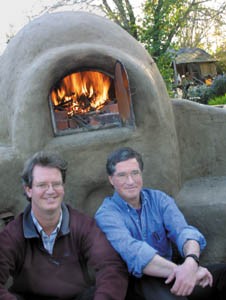
The Towne Dandies

0

Feeling Dandy : The Towne Dandies, described by band member Goeff Ellsworth as “music as art project,” often don silly outfits and tin-foil sideburns.

Sounds Weird

Is it music, theater, or demented performance art? Whatever it is, the indescribable Towne Dandies are having a lot of fun doing it.

By David Templeton

Some things are easy. Some things are hard. Engineering a tunnel between two mid-Atlantic islands is hard. Splitting an atom is hard. Getting Arnold Schwarzenegger to stop making movies is hard. But such endeavors are a paltry piece of cake when compared to the barely surmountable problem at hand: describing what it is that the Towne Dandies do.

Formed several years back by former St. Helena resident Geoff Ellsworth, the Towne Dandies are at first glance a strikingly freeform music group–if you can even call it a group. The Dandies tend to fluctuate in terms of their personnel. Currently peopled by Ellsworth, Jim Pantaleo, Brian Clothier, and Mike Perez, the band is purposefully elastic, routinely adding or shedding members and frequently reducing itself down to just . . . Ellsworth.

All alone. Onstage. Doing whatever a Towne Dandy does. Even he cannot adequately describe the Towne Dandies–he often uses the term “cyber-Western” to describe his act, but that only creates more questions–and experiences some difficulty in explaining the strange appeal his group clearly has among its numerous loyal fans, locally and abroad. “We bring people together by separating them,” Ellsworth says. “Something like that. I don’t really know.”

Recognizing that this description is perhaps not that much help, Ellsworth laughs and tries another approach.

“The Towne Dandies are music as art project,” says Ellsworth, who is in fact an artist, a professional painter of portraits and landscapes. And while he is also an accomplished musician and songwriter, he tends to think of himself primarily as an artist and to regard his eclectic exertions with the Towne Dandies as performance art. “And with all art projects,” he says, “they always take a turn on you. You start out thinking you’re making one thing, but circumstances take you into different directions. So with every one of our Towne Dandies shows, I always just stay open to the possibilities.”

Possible interpretation: This is one eclectic act.

Which pretty much happens to be true.

Ellsworth is speaking by cell phone from San Diego, where he’s been recording the latest TD album. It is somewhat instructive that he refers to the project not as a CD but as a soundtrack. Anyone who’s seen the Dandies in action will be able to relate. The typical TD show is more like a play–a bizarre, funny, and outrageously surreal play–than any concert by any band you’re likely to catch in a bar or club, which is where they usually tend to perform. Most of their shows are themed stories with songs, featuring costumes, props, characters and scripted dialogue tied in around the music, itself a ridiculously hard thing to describe.

Currently, the Dandies are performing two different shows. The first, Stay Cowboy, follows the adventures of a punk-singing cowboy crew who–much like the Knights of the Round Table–hit the trail in search of the legendary Big Belt Buckle, a quest that takes them through barroom brawls, barbershops, Indian casinos, and bad hitchhiking experiences on their way to fame, fortune, and rodeo glory.

The songs, featured on the quirky “soundtrack” titled My First Stampede (BE2 Records), are saddled with affectionately whacked-out lyrics and unexpected where-the-hell-did-that-come-from musical influences. In one odd little track, “Manly Footwear,” the Dandies talk about cowboy boots through arcane historical references set to a steadily driving beat and a guitar-heavy, David Bowie-esque, Spiders-from-Mars melody–if you can call it that–that occasionally sounds like a deranged rock-and-roll chant. “Whether marching to the front / or just coming home for lunch / Manly footwear reigns supreme / and Roman sandals won’t be seen / ‘Cause leather boots are still the style for manly footwear.”

The other Dandies show is That’s What Pirates Gotta Do, which puts extra emphasis on the in-concert props, only with pirate costumes instead of hats and spurs.

Asked how this all came about, Ellsworth tells of the time he watched in awe while a friend’s young son attempted to tell a story, illustrating his adolescent epic by grabbing different toys and spare objects from his room, incorporating each one into his act in humorous ways.

“This kid–he didn’t care what anybody thought,” Ellsworth says. “He was just trying to tell a story anyway he could. It was hilarious.” Shortly thereafter, Ellsworth began infusing his own musical shows with more theatrical elements–props, costumes, characters, even a plot and a story–using the songs to move the drama along rather than just performing a list of tunes.

About those tunes: like everything else the Towne Dandies do, the style of music seems to defy description. It incorporates elements of Western cowboy ballads, punk anthems, techno music, and even French opera.

“I like to think of it as folk music,” says Ellsworth. “You know, it comes from folks, it comes from people, right? I’m a person. It’s music we make up from spare parts, by whatever means available. So it is homespun; it’s grass roots.”

After a moment’s pause, Ellsworth thinks up yet another way to describe it. “If you were in Russia,” he says, “and you just had to make some music, and you had to make it using whatever tools you have–kind of in a postapocalyptic way–you’d say, ‘Hey! I’ve got a couple of sticks and a garbage can–let’s make some rock and roll!’ It’s kind of like that. We’re sitting around and someone says, ‘Hey, we’ve got this Casio sitting here–let’s write a song. Or ‘I hear there’s a great new guitarist in town. Let’s see if he’s willing to come in and put something down.'”

So it’s postapocalyptic music?

“Well, it’s very . . .” Ellsworth tries again. “It’s . . . partially inspired by Kraftwerk and all that bad German techno music I like.” Finally he let’s out a long breath and admits, “Basically, it’s just really kinda silly.”

Though the Dandies music is available over their website (www.townedandies .com), the best way to experience them is live, where the full effect can be felt. Towne Dandies shows attracts a number of experienced fans, but there are always those in the audience utterly unprepared for the show.

“Sometimes people aren’t quite sure what’s going on,” he allows. “Usually people are either laughing or staring at us in mute horror–which I think is pretty great. Whenever I look out at the audience, I never know what they’re thinking. Sometimes I’ll look out at a crowd and think, ‘Oh shit. Nobody’s getting this. Nobody’s responding.’ And then it turns out that they were just . . . watching, but not giving out any emotion. But it turns out that they are very into the show, and they tell us that with their applause at the end.”

Sometimes, of course, they play a venue where the audience is a little bit too unprepared for the Towne Dandies.

“We’ve been in rock clubs trying to do our thing,” Ellsworth says, “and we know it’s the kind of performance that doesn’t really fit with what those people are used to seeing and hearing. And that can cause some, uh, difficulties.”

Difficulties?

“Yeah. You know,” he laughs. “On occasion we’re threatened with getting our asses kicked, etcetera. But that’s OK, because every time we play we also get at least a few new people coming up to us saying, ‘Hey, I really liked that. Whatever that was.'”

So is there a future for a band that cannot be described, that mixes musical styles that should not be mixed, that routinely performs in concert playing other people–that sometimes dresses up as pirates?

Ellsworth doesn’t know that either.

“Who knows?” he laughs. “I could end up as the host of a really cool children’s show on TV. That may be what I’m best suited for.”

Not that he’s planning to give up any time soon. He and his band mates are having too much fun to quit.

“I’m going to keep doing what I think I’m good at, what makes me happy to be doing,” he says. “And if the direction I’m going feels like a good direction, I’ll keep following that path. Hopefully, in the future, it will all congeal into something–and hey, maybe it will finally begin to make sense.”

The Towne Dandies will perform ‘That’s What Pirates Gotta Do’ on Thursday, Aug. 15, at the St. Helena Public Library, 1492 Library Lane. For more information, contact in**@**********es.com.

From the August 8-14, 2002 issue of the North Bay Bohemian.

© Metro Publishing Inc.
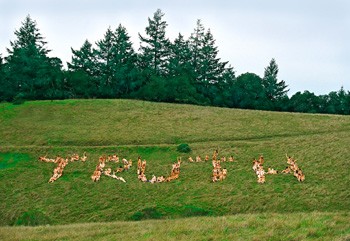
Northwestern Sonoma County Vineyards

Like the legendary ’49ers, wineries have come to northwestern Sonoma County looking for gold–but this time it’s small, round, and purple

By Tara Treasurefield

Annie and Fred Cresswell are bringing up the third generation of Cresswells in northwestern Sonoma County. They have loved the high ridge tops and deep valleys of the rugged coastal hills since they were children. Until 10 years ago, they had no reason to believe that it would ever disappear. Then Walt and Joan Flowers replaced a nearby ridge top meadow with a vineyard, and the Cresswell’s world fell apart.

“Local Indians once used the meadow as their summer meeting ground,” says Annie Cresswell. “It was bordered with redwoods, fir trees, live oaks, and wild nutmeg. The hill is still there, but it’s been completely cleared of trees. They have taken our tree line.”

Cresswell says that vineyards have also displaced wildlife and that for both human and nonhuman neighbors, the heavy equipment, chemicals, dust, traffic, noise, and lights that accompany vineyards and wineries are persistent annoyances and potential health hazards.

The transition from open space to vineyards accelerated in 1998. Sir Peter Michael, a British lord, hired a logger to clearcut 20 acres of his property, which is behind the Cresswell’s home. Michael intended to plant vineyards there, but he neglected to get the required permits for logging and converting timberland to vineyards. Michael was eventually fined $42,000, and the vineyard was put on hold. But the damage had been done. All that remains of the previously wooded area are sprouting stumps in an open field.

Four years have passed since Michael’s brush with the law for illegal logging, and he still doesn’t have the permits he needs to plant vineyards in the coastal hills. But he hasn’t given up. The California Department of Forestry is considering Michael’s application for a permit to clearcut 40 more acres of woodland behind the Cresswell home.

Michael has also applied to the Army Corps of Engineers for a permit to drain the wetlands on his property and replace it with a vineyard. In addition, David Hirsch, owner of Hirsch Vineyard, is planting more grapes, and Walt Flowers, owner of Flowers Vineyard and Winery, is expanding his production. Little by little, the untamed wilds of the Sonoma Coast are being torn apart and replaced with neat, infinite rows of fenced vineyards, and dotted with wineries.

Prospecting for Gold

It’s not that vineyards and wine making are new to the Northwest County, says Cresswell. When she was growing up, a few local residents converted their cattle ranches to vineyards. But what’s happening now is different.

“The industrial vineyards are not neighbors who are just trying to survive on the land and have an emotional attachment to the land,” Cresswell says. “It’s all about profit and nothing about community. It’s like the Gold Rush, but it’s purple this time. We’ve been discovered. We’re on the map as a premium grape-growing region. It’s gotten to the point where we have to do something or there won’t be any woodland left. It will be all vineyards and wineries.”

Daniel Schoenfeld, owner of Wild Hog Vineyard organic winery in the hills above Fort Ross, is more hopeful than the Cresswells. “Once you get to know the people involved, it’s hard to demonize them,” he says. “There are very few people out here that you can’t work with if you have an open mind.”

Schoenfeld also says that comparing vineyard development to the Gold Rush is an exaggeration. “There was a big rush out here about three or four years ago, but that has changed. At the moment, I can’t think of anyone who plans to come in. It’s really expensive to plant grapes, and yield tends to be low here [on the Sonoma Coast] because of the climate and the soil.

“With the exception of people who have too much money,” he says, “people are looking at slowing down sales. There are a few absolute premium people who haven’t had a slowdown. But that’s the exception, not the rule.”

Reports that the wine boom is over have appeared in the mainstream press. Nonetheless, vineyard and winery expansion continues apace in the Northwest County. David Hirsch has 50 acres of wine grapes and is planting 50 more. In March, the Sonoma County Permit and Resource Management Department gave him a permit to build a winery and produce 15,000 cases of wine each year. He originally requested 30,000 cases, but after a meeting with concerned neighbors, he settled for a lower number.

Once a clothing importer and exporter, Hirsch bought his 1,100 acres 30 years ago. He tried sheep ranching first. “We couldn’t make any money at that,” he says. “A ram was a major customer for the wolf. We couldn’t kill the coyotes anymore [when new environmental laws were passed].”

Then a viticulturist told Hirsch that he’d make a fortune if he planted pinot noir grapes. “He was right!” says Hirsch. “[Before], this ranch couldn’t even support one person. Now there are four families and kids, day laborers, and all kinds of suppliers.” That doesn’t mean it’s easy. Hirsch starts work at 4:30am and doesn’t stop until 5pm or 6pm. But like many residents in the area, he still finds time to plant redwoods and Douglas firs to replace trees lost to clearcutting after World War II and to huge fires in 1954 and 1978.

Walt Flowers now has 80 acres of vineyards and says that’s all he’ll ever need. But he does want to make more wine, and to do that, he needs a larger winery. On July 25, the PRMD approved Flowers’ request to increase production from 9,500 cases per year to 20,000. Defending the expansion, which will involve heavy construction in a fragile environment, Flowers says, “We have really tried very, very hard to fit into the community and deal with their concerns. Altogether, our winery, plus the winery expansions, plus all our buildings, totals less than one acre. If you consider vineyards as open space, our property is 87 percent open space.”

It’s generally understood that “open space” is undeveloped, unfenced, wildlife-friendly land–not vineyards.

Land of the Free

In June, environmental consulting firm Leonard Charles and Associates of San Anselmo released a draft report on the environmental impacts of wine industry expansion in northwestern Sonoma County. Residents requested the report and have passed it on to the PRMD. Water tops the list of concerns addressed in the report. Leonard Charles writes, “Vineyards and wineries are diverting the few natural springs, pumping from wells, and/or diverting runoff or stream water to provide water for their operations. These withdrawals deplete stream flows, particularly at the end of the dry season.”

Echoing this concern, Annie Cresswell says, “The South Fork of the Gualala River is on or crosses both [the Flowers and Michael] properties. The river supports coho and steelhead salmon, two sensitive species in this watercourse. [Also], Flowers Vineyards is situated directly above the river, and vineyard pesticides could adversely affect these species.” Vineyard chemicals–and the erosion and sedimentation that result from development–also affect the quantity and quality of neighbors’ drinking water, reports Leonard Charles.

Marlena Guinther, who once worked at Flowers Vineyard and Winery, quit out of concern for the environmental changes that result from wine industry expansion. “So much of the wildlife habitat was removed [by Flowers],” she says. “I didn’t want to be a part of this expansion. . . . There were once herds of wild hog here. I haven’t seen any wild pigs in two or three years. [Vineyard workers] use propane boom guns that give off percussion sounds intermittently to scare off wildlife.”

Traffic is another concern. Elaine Wellin, associate professor of sociology at Sonoma State University, says, “Each week, it seems, we hear a new story about residents being run off the road by large commercial trucks going to vineyards, wineries, and other destinations in the hills.”

Leonard Charles reports that most of the roads in the area are too narrow to even provide a median stripe, and industrial vineyards generate a significant amount of traffic. “Many of the workers in these vineyards commute or, if they are provided farm worker housing on-site, drive to town for supplies and recreation, to school, etc. Grapes are hauled out, equipment and supplies are hauled in, often on large trucks. The increased traffic on these substandard roads poses a significant safety risk for local residents.”

The firm also highlights fire hazard, which strikes a chord with Wellin. “It’s a tinder box out here,” she says. “The fire hazard with visitors and increased labor is enormous. This is not a safe place for people who don’t understand the danger.”

In 1978 fire destroyed the home that Wellin built with her own hands. “From a distance, it looked like Mordor, the desolate land in Lord of the Rings.”

Perhaps the most unusual impact mentioned in the report will affect residents whose ancestors are buried in a cemetery that dates back to the 1880s–and which happens to be on Peter Michael’s property. “It’s a functional cemetery that’s being used today,” says Steve Smith, area forester at the Department of Forestry. “There are questions about continued community access and the ambiance of the area around the cemetery. Unfortunately, where the cemetery is located is the only place that has access to the road.”

Money Talks

Regulators acknowledge that vineyards and wineries have impacts. But, they say, there are limits to what they can do to protect the environment. “We review the project to make sure there isn’t something out there that would create a big problem, like a big slide,” says Chuck Joiner, a division chief for resource management at the Department of Forestry. “We have mitigations to minimize the impact of the conversion. But the county has ultimate control, because they zone the land. If the county zoning allows a vineyard, then when the people apply to us, we’re bound by what the county says you can do there. We don’t control land use. The counties do.”

By far the most popular zone for vineyards in Sonoma County is the Rural Resources Development Zone, which permits not only vineyards but also wineries and bed and breakfast inns. Joiner says that if vineyards were dropped from this zone, there probably wouldn’t be many vineyard conversions. “[But] the board of supervisors would have to approve that change. It’s political, as well as everything else.”

Currently, vineyards are allowed in every zone in the county, including the Timber Production Zone. At the same time, if there’s standing timber on property in any zone, the owner cannot legally log the land and plant vineyards without a permit from the Department of Forestry.

Steve Smith is reviewing Michael’s application to clearcut 40 acres of his property and convert it to vineyards. “We have two incompatible goals,” he says. “These people own the land and they can do what they’re legally allowed to do on the land. On the other hand, we have to minimize their activity in order to lessen whatever damage is done to the environment as they meet their goals. We’re tasked with minimizing the destruction to the environment by suggesting mitigations or solutions. There’s going to have to be some compromise.”

Since its stated policy is to follow the county’s lead regarding land use, there’s a good chance that the Department of Forestry will allow Michael to clearcut the 40 acres and convert it to vineyards. There are also signs that the Army Corps of Engineers will allow Michael to fill in the wetlands on his property and replace it with a vineyard. Jane Hicks, section chief at the Corps, says they’ll “engage in a balancing act” as they make the decision. “Among many other things, we look at generally if there is going to be an economic benefit to the area or the applicant. Will it produce jobs?”

Because Michael’s wetlands are much smaller than other projects the Corps is evaluating, it won’t receive a detailed review. “I know this is a very controversial project locally,” she says. “[But] if we make a determination that the overall project, including the effect of economics, is not contrary to the public interest, then we would issue the permit.”

Wetlands are few and far between in the Northwest County, and they are a critical source of water for wildlife. Michael proposes to mitigate the harm that would result from replacing the wetlands with a vineyard by putting an irrigation reservoir somewhere else on his property. Environmentalists point out that it just wouldn’t be the same, and, currently, Corps reviewers agree. Ultimately, one man at the Corps, the district engineer, will make the final decision about whether to approve or reject Michael’s request.

Taming the Wild

According to Leonard Charles and Associates, the key to protecting the environment is the general plan, which is currently under review. “The existing general plan did not foresee the grape explosion. It did not foresee conversion of land to industrial vineyards, wineries, and bed and breakfast inns. The new land uses permitted by the county over the past few years are causing significant environmental changes. As importantly, they are allowing the character of the community to be destroyed in favor of a typical market-driven industrial economy.”

Leonard Charles recommends that county officials look at the cumulative impacts of all projects as a whole, rather than one at a time, and conduct a full environmental assessment before deciding on land use designations and policies for the new general plan.

The Citizens Advisory Committee is currently holding public hearings on the general plan. In the fall of 2003, the PRMD will consider the Committee’s recommendations. The Sonoma County Board of Supervisors will complete the review process in the summer of 2003, when it will hold the final set of public hearings and make final decisions.

In addition to changing the general plan, Elaine Wellin wants to change prevailing beliefs about northwestern Sonoma County. “The ethos in the county is that no one is here, and we’re just going to be vineyards, wineries, tasting rooms, and bed and breakfast inns. Our enemy is not so much the wineries but this ethos. Plans that affect us are being made in other places, by people who don’t seem to realize we live here.

“We need to be heard,” she continues, “and we are mobilizing mightily in this area. We’re working to let the powers that be know that this isn’t a place where no one cares, where they can just keep throwing out permits for development.”

Cresswell is grateful that the community has come together. “People are sitting up and taking notice,” she says. “I get phone calls daily, thanking me for my work and telling me that the angels are on my side.

“Throughout Sonoma County, many people feel that enough is enough.”

From the August 8-14, 2002 issue of the North Bay Bohemian.

© Metro Publishing Inc.

Cultural Arts Council

0

Photograph by Michael Amsler

Art Derails

Cultural Arts Council jumps the tracks

By Patrick Sullivan

I want to apologize to each and every one of you,” Cultural Arts Council of Sonoma County executive director Jim Johnson told a group of artists Monday night. “It’s obvious I’ve done something to hurt many of you.”

Johnson, who was hired last December, issued the public apology during a meeting held by the council’s board of directors to address controversy over the organization’s management and goals. More than 40 members of the arts community attended, and many expressed concerns about recent events at the arts council.

The Santa Rosa-based arts organization built a reputation for organizing such events as the ARTrails open studio tour and First Night, an alcohol-free New Year’s Eve celebration. But lately the council has been better known for dropping programs and shedding personnel. Five board members have resigned over the past year, including wealthy philanthropist Jack Stuppin. The organization has jettisoned the unprofitable First Night celebration. Budget woes recently prompted the council to lay off two staff members who ran the acclaimed arts education program.

Finally, citing dissatisfaction with management, longtime ARTrails coordinator Elisa Baker resigned, along with administrative assistant Jane Potter. The council is now searching for replacements for every staff member except Johnson. That’s no coincidence according to Baker and other departed staff members, who describe the new executive director’s management style as autocratic. “[Johnson] admits it himself,” Baker says. “He says, ‘This is how I work.’ But we were used to a real team approach, to being treated like professionals who know what we’re doing.”

Johnson won’t comment on personnel matters. But he does admit he made mistakes. “I had a style of management that worked for me in previous jobs,” he said at Monday’s meeting. “But it’s obvious I didn’t gel with the staff here.” He says he’s trying to change the aggressive approach that has made him a lighting rod for criticism.

In a telephone interview, Johnson sighs when Baker’s name comes up. He says he was disappointed by her resignation but promises that ARTrails will continue. “This is not the first time it’s lost a coordinator,” he adds.

Baker ran ARTrails for four years, and many artists were stunned by her departure. Some have even said they’re considering severing ARTrails’ relationship with the council and going it alone.

“[Baker] is just such a great person,” says printmaker Micah Schwaberow, a 16-year ARTrails veteran. “She made the program run so smoothly.” Schwaberow and others were also dismayed by the council’s decision to lay off arts education coordinator Robert Rice and his assistant. Rice created the program, which brings artists into local schools. The 65-year-old painter, who has decades of experience in arts administration, raised $127,000 during his four-year tenure at the council.

“You have an education program headed by a person who does more fundraising than most members of the board, and you fire him,” Schwaberow says. “It’s just bizarre to me.”

But board president Ellen Draper says budget woes left the organization little choice. The grant from the California Arts Council that had funded Rice’s work was ending, and another $41,000 annual grant from the state appeared likely to fall prey to budget cuts. “It’s not just us,” Draper says. “Every arts council in the state has this problem.”

Draper does admit that her board has fumbled its fundraising duties. That’s something she’s trying to change with the help of a consultant, but she asks for patience. “You don’t become a fundraising board overnight,” Draper says.

But some critics say the board’s priorities are the real cause of its financial woes. “I think it’s a lack of energy and initiative,” Baker says. “It takes a certain kind of person to get out there and move and shake and raise money. Frankly, I think they’ve been more concerned with micromanaging. Seems to me there’s a lot of paper shuffling, a lot of trying to find out what their mission and focus is.”

The arts council’s mission is changing based on feedback from the community, according to Draper and Johnson. Draper says she’d rehire Rice if money became available. But her former employee bristles at the idea. “I would not be interested in returning under the present administration,” Rice says. “It’s just not working.”

From the August 8-14, 2002 issue of the North Bay Bohemian.

© Metro Publishing Inc.

Mary-Kate and Ashley Olsen

Under Perfect Skin Mary-Kate and Ashley Olsen rule the world By Sara Bir I went into the Big Lots store to buy discounted Easter candy. What I walked out with was a Mary-Kate and Ashley "Let's Hang Out" playset, which I set up on my desk at work the next day....

Chili

The Chili Diary Discovering the true meaning of heartburn By Sara Bir Some people get silly about chili. I don't like to think I'm one of them. I'd like to think that I'm very rational and reasonable when it comes to chili. Real chili is red, chock full o' beef, and has no...

Sonic Youth

Radical Adults Crow's feet and all, Sonic Youth still manage to make beautiful noise By Sara Bir Thank you, Sonic Youth. Your new album is not lame but fresh and exciting, and all is right with the world. Ever since 1995's Washing Machine, the world's most...

San Francisco Jewish Film Festival

There's Still Hope The SFJFF explores all sides By It's obvious that the 22nd annual San Francisco Jewish Film Festival hosts films about Jewish life and lore. Yet this festival--the first, the most successful, and the most imitated Jewish film festival in the world--always avoids a limited parochial focus. Israel...

Pie

Joy Liu Pie of My Eye As easy as what? By Gretchen Giles Whoever it was to first utter the terrible lie "as easy as pie" has presumably already suffered a horrible death. I personally feel no remorse or compassion for this passing. I much prefer to embrace the giddy...

‘The Acoustic Folk Box’

Just Folk Brit folk box spans 40 years of acoustic music By Greg Cahill The winds of change are blowing the Brits back to their roots. At a time when the United Kingdom has melded with the culturally disparate European Union (which runs the gamut from France to...

‘Orpheus Descending’

Going Down 'Orpheus Descending' fails in style By Patrick Sullivan Let's talk Greek myths. Remember Sisyphus? In a nasty fit of pique, the gods sentenced the poor bastard to Hades, where he was condemned to roll a gigantic boulder up a hill for eternity. He'd grunt, he'd sweat, he'd pour everything...

The Towne Dandies

Feeling Dandy : The Towne Dandies, described by band member Goeff Ellsworth as "music as art project," often don silly outfits and tin-foil sideburns. Sounds Weird Is it music, theater, or demented performance art? Whatever it is, the indescribable Towne Dandies are having a lot of fun doing it. ...

Northwestern Sonoma County Vineyards

Like the legendary '49ers, wineries have come to northwestern Sonoma County looking for gold--but this time it's small, round, and purple By Tara Treasurefield Annie and Fred Cresswell are bringing up the third generation of Cresswells in northwestern Sonoma County. They have loved the high ridge tops and deep valleys of the rugged coastal hills...

Cultural Arts Council

Photograph by Michael Amsler Art Derails Cultural Arts Council jumps the tracks By Patrick Sullivan I want to apologize to each and every one of you," Cultural Arts Council of Sonoma County executive director Jim Johnson told a group of artists Monday night. "It's obvious I've done something...
11,084FansLike
4,446FollowersFollow
6,928FollowersFollow


