
Todd Barricklow

0


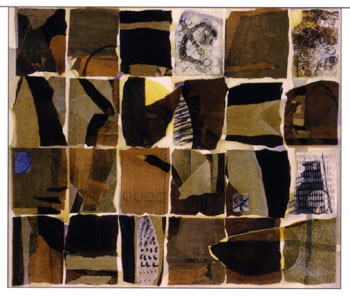
Written in Stone: Images of old technologies and masked bandits populate Todd Barricklow’s monochromatic world. Shown: ‘Secular Sectors.’

Brave New Worlds

A show at Roshambo highlights a world in chaos

By Davina Baum

There’s a world in Todd Barricklow’s head, and he’s slowly transferring it to clay.

It’s a righteous world, a bit of a Robin Hood world. The images, once channeled from head to clay, tell the tale of a group of people Barricklow calls the cleaning bandits–masked men whose mission it is to sweep up corruption, whisk away dirty business. Told in fleeting glimpses in stark black and white, the story unfolds on tiles and rectangular blocks, digestible as a whole or in part: a ladder, an old telephone, a woman with horns.

The cleaning bandits are a metaphor for reform, Barricklow allows, though he says that the length and breadth of the story isn’t something he talks about a lot. “They’re fighting the revolution in their little world,” he says, racing around his Cotati studio.

Just like us.

It’s not necessary to understand the story to appreciate the images. It’s a world born from our fast-moving, high-tech culture, with a touch of paranoia; instruments of surveillance, like cameras and telephones, are prevalent.

The white clay is rolled out into sheets or formed into blocks. Barricklow then paints these with liquid black clay and scrapes the black clay away–like you would a wood block–until the image appears. He’s been working on this series for about a year and a half.

Art is what got Barricklow through high school in the San Fernando Valley, and the bucolic scenery and the ceramics department are what beckoned him to Sonoma State University. “It was a dream,” he smiles.

He can’t imagine working in another medium, for now at least. “I’ve gotten so used to thinking backwards,” he says in reference to the reductive method of his work. “Somehow I’m in this little mental process where I don’t like the way my work looks if I draw it on white paper.” The transformative process–the scraping, the firing, the glazing–tugs at Barricklow’s imagination. “I tried doing wood blocks, but you’re fighting the grain. Linoleum also. When I carve it, it’s so effortless in the clay.”

Barricklow honed his craft at an artist-in-residence program at the Kohler company (of toilet and sink fame). Kohler brings artists into the factory, he explains, and lets them have free use of all the facilities–clay, clay, and more clay. Plus glazes. The experience had a strong effect on Barricklow’s method, because the materials were so different. Kohler glazes were milky and turned his bright colors into pastels, so he switched to black on white.

The method works with his imagery; the cleaning bandits have a fairly strong strain of Luddite in them. Barricklow explains it as “just me trying to go the opposite way of life. Bigger, brighter, better televisions, with how many hundreds of colors? I just want to press the button that says black and white.”

Will Smith, with whom Barricklow shares wall space at Roshambo starting March 1, presses a few more color buttons. “My philosophy is to have a bit of sugar with your medicine. I use color to draw you in.” Smith, who teaches at Santa Rosa Junior College and SSU in the printmaking and drawing departments, illustrates his work with bright, candy colors. “Dark colors would be overkill,” he says.

Certainly, there’s an aspect of the grotesque in Smith’s work that’s brought alive by his use of color. “Directly, the images come from my immediate environment,” he says. “There are birdhouses on the property I live on–sheep, chicks, wild turkeys.” There’s nothing bucolic about the end result, however, after the images have traveled from eye through mind to paper. Bulbous-nosed floating heads and cartoonish ducks populate Smith’s busy canvases, a bright, dystopian world.

“Pretty much any medium goes,” he says. “I just kind of grab what’s there and what’s the right color, anything from watercolor to ballpoint pen, India ink, coffee stains–it’s all fair game.”

Interpretation is fair game too. Smith describes the world depicted in his drawings as “disillusioned characters running around bumping into each other, basically surviving.”

Just like us.

Work by Todd Barricklow and Will Smith will be on display at Roshambo Winery and Gallery from March 8 through April 30. Reception: March 8, 5-8pm. Barricklow and Smith will also be selling T-shirts, pint glasses, and Shrinky Dinks of their work. 3000 Westside Road, Healdsburg. 888.525.WINE or www.winery.cc.

From the February 27-March 5, 2003 issue of the North Bay Bohemian.
© Metro Publishing Inc.

‘Chutzpah!’

0

‘Comrades and Chicken Ranchers: The Story of a California Jewish Community,’ the inspiration for ‘Chutzpah!’


Oh! Oh! Oh!: Alby Kass plays Eli Nitzberg, who is tarred and feathered by red-baiters, in ‘Chutzpah!’

Hatching a Gem

A band of actors join together onstage to resurrect the colorful socialist chicken ranchers of 1930s Petaluma

“Come on folks! Let’s go!”

A sliver of afternoon sun slips in through the blinded windows of a large meeting hall at Sebastopol’s United Methodist Church, warming the room with its light while illuminating a small table on which stands a large cooking pot.

It is, to be precise, a soup pot.

For chicken soup.

On the wall nearby is a large painting of Jesus, surrounded by fluttering doves. With open arms, he is welcoming a tiny group of smiling children. Across the hall, Pauline Pfandler is herding a much different group–eight seasoned actors–toward the waiting piano. It’s time for vocal warm-ups, after which the troupe will practice several of the songs from the musical Chutzpah!, the true-life story of radical Jewish chicken ranchers in Depression-era Petaluma.

Appropriately, many of the show’s songs are in Yiddish, including the haunting folk tune “Ale Brider” (“We Are All Brothers”). Standing in a loose semicircle in front of the piano, the cast serenade the empty room with the stirring words that, roughly translated, say: “We are all brothers / Oh, yes, all brothers / And we sing happy songs / We feel ourselves as one / Oh, yes, we stick together / Something you don’t find everywhere / Oh, oh, oh!”

When the song comes to an end, everyone smiles.

“That was beautiful!” says Pfandler, director of the West County Theater Arts Guild, and also the writer and director of Chutzpah! Pfandler waits a bit before adding, “But it’s not supposed to be beautiful. These people weren’t professional singers,” she reminds the cast. “They were chicken ranchers. I want to hear it again. This time with more roughness. Roughness and realness.”

They do it again.

This time, with less emphasis placed on blending so melodiously and with more passion injected into the meaning of the words–“Un mir zainen ale brider / Oi, oi, ale brider”–it’s definitely rougher and more authentic, a shade less polished and a tad more “chicken ranch.” And the song is still unbelievably beautiful.

“Oh, oh, oh!”

Described by Pfandler as “the story of a most unusual American community,” Chutzpah!–based on Kenneth Kann’s popular book Comrades and Chicken Ranchers–had its official debut last October at Spreckels Performing Arts Center. The show exceeded expectations by selling out every show, including added performances, accumulating a long waiting list in the process.

Fortunately, those who walked away without tickets will have another chance. In the wake of the musical’s stunning critical and box-office success, a band of investors–including local artist and philanthropist Jack Stuppin–came forward to bankroll the play’s further evolution. With a mostly new cast of professional actors, Pfandler and company are preparing for a two-week run at Santa Rosa’s opulent Jackson Theater, followed by three weeks in San Francisco.

When asked what the next step might be if the San Francisco dates become sold-out–the very words are enough to send Pfandler into a dreamy reverie of grins and sighs–she affirms that the show, should it find an audience outside of the North Bay, will be taken farther abroad, and probably to the East Coast. (Did anyone say Broadway?)

“I love this story,” she says. “I think it’s so rich and so wonderful. Now we get to find out if other people agree.”

Borrowing from the colorful oral histories collected in Kann’s book, Pfandler concocted a story line in which an eager journalism student from Berkeley named Madison (played by San Francisco’s Elizabeth Bullard) uncovers an old press clipping that mentions the tarring and feathering of Eli Nitzberg, a socialist Jewish rancher from Petaluma. Recognizing a good story when she hears it, Madison ends up in Petaluma and soon integrates herself into the family of free-spirited Basha Singerman (Lynne Soffer), a descendant of Jewish immigrants who, having escaped the pogroms and anti-Semitism of Eastern Europe, established a thriving community in Sonoma County between 1915 and 1960.

As Basha prepares a steaming batch of chicken-foot soup, she spins a series of stories, brought to life by an ethereal chorus, whose members at various turns step down to embody the characters she describes. It all leads up to the public tarring and feathering of Nitzberg (Alby Kass), a larger-than-life idealist who, in 1935, was attacked by red-baiting vigilantes while assisting local migrant apple pickers to organize a strike for better wages.

Told with a projected background of actual historical photos and news clippings, Chutzpah!–think Our Town meets Fiddler on the Roof, with a dash of Julia Child’s Kitchen–is thrust along by the power of the music, from the Yiddish folksongs like “Ale Brider” and old Woody Guthrie classics, to authentic labor-movement marching songs and the occasional Irving Berlin tune. The show’s musical director is longtime West County Theater Arts Guild collaborator Sonia Tubridy, who–by an accident of fate–stumbled upon an old box dating back to the days of Eli Nitzberg.

“It was the music,” says Pfandler. “All the music, all the old lullabies and folksongs that the Jewish community in Petaluma pulled out and used whenever they came together to sing. It was phenomenal that we were able to get that.

“It was,” she smiles, “magic.”

“Magic,” it would seem, is also the right word to describe Pauline Pfandler.

Here are a few others: Opinionated. Passionate. Funny. Charming. Driven. Unapologetic and idealistic. After graduating from UCLA in 1979, Pfandler spent several years in San Francisco, working the fringes of the theater community before touching down in Minneapolis in 1983. There, she joined forces with a theater company known for unabashedly political shows dealing with poverty, social injustice, and nuclear proliferation. “These were plays that mattered,” says Pfandler.

After two years, Pfandler followed her instincts and relocated to Sonoma County, intent on establishing a theater company that could become a West Coast laboratory for developing socially significant theater pieces. That was 1986.

Since then, she’s mounted over 25 plays, adapting everything from Shakespeare and ancient Sumerian verse poems to a Washington, D.C.-version of The Threepenny Opera and the occasional Dr. Seuss story. In 1997 she formed the West County Theater Arts Guild, and established a studio office in the suite of rooms she rents from the Methodist Church in Sebastopol.

Then, a few years ago, in the wake of a spate of anti-Semitic and anti-gay attacks in the North Bay, Pfandler found herself committed to doing something about the rising tide of intolerance. During a roundtable discussion with a number of North Bay residents–many of them Jewish–Pfandler was told about Comrades and Chicken Ranchers by Kenneth Kann.

“I read it and said, ‘We’ve got to do this book!'” she says. “‘We’ve got to.’ I mean, compared to these people, I’m lamb girl,” she adds with a laugh. “I am not half the radical they were. It’s amazing what these people used to stand up and do. I knew I had to take those stories and turn them into a play.”

Pfandler’s excitement is infectious, and her cast of actors have caught the infection.

“It is an exciting play to be a part of,” acknowledges Alby Kass, taking a break with fellow cast members Bullard, Soffer, Wally Kass, Karen Hirst, and Nathan Place. “Knowing that this is real,” says Alby, “that these people actually lived, makes it especially exciting.”

“It’s more responsibility than an actor is normally trusted with,” adds Soffer. “That’s a challenge, but it’s also an enticement, to bring as much truth as we can to the project.”

Says Hirst, “What inspires me about these people we’re playing, is that they could disagree–about religion and all kinds of things–and yet could still hold their ideals and community together.”

“There’s an old joke about how if you have two Jews you’ll get three different opinions,” says Hass. “This was a community of Jews–some left-wing, some right-wing, some religious, some not–and still they kept the community together until the McCarthy era, when the liberals were finally forced out of the group.”

“It’s about a community,” says Bullard, “that somehow found a way to create a space for everybody.”

“So it’s a show with issues,” laughs Wally, “issues that, unfortunately, are very contemporary.”

“Yeah,” says Place, “and besides that, there are some kick-ass song and dance numbers.”

That said, Pfandler sends the cast back to work. After imbuing “Ale Brider” with the proper degree of roughness and believability, they move on to another Yiddish song, the fiery “Es Brent” (“It’s Burning”): “It’s burning, dear brothers, it’s burning / Oh, our poor little town is burning . . . And all of you are simply standing and looking / With your arms folded, as our little town burns.”

As the cast shift from the music to the action–preparing to stage the fabled tar and feathers scene–Pfandler offers a final observation.

“Every piece of theater is political,” she says. “Paul Robeson once said, ‘You’re either maintaining the status quo, or you are trying to change it.’

“We’re hoping to change it.”

Chutzpah! runs Feb. 27-March 9. Thursday- Saturday, 8pm; Sunday, 2pm. Sonoma Country Day School’s Jackson Theater, 4400 Day School Place, Santa Rosa. $20-$35. 800.773.9010.

From the February 27-March 5, 2003 issue of the North Bay Bohemian.
© Metro Publishing Inc.

Donut Shops

0


Millions Of Donuts Couldn’t Be Wrong: Donuts have experienced a renaissance, thanks to the Krispy Kreme opening. But they appear to still be bad for you.

Do-Nut Believe the Hype

A donut–even a great donut–ultimately is nothing but a donut

By Sara Bir

Passion! What is life without passion, the fiery and noble drive that compels us toward the preoccupations that stir our souls and instill life with meaning. Donut-aroused passion is fair game–donuts may be a piddly sort of thing to get passionate about, but they are so sweet and tasty, especially with black coffee. And there are so many varieties of donut to select a favorite from.

There’s nothing pathetic about donuts in and of themselves, but passion is not the same thing as obsession, and we are now, as a community, collectively obsessed with donuts. Or as Krispy Kreme refers to them in the technically correct spelling, “doughnuts.”

Krispy Kreme opened its first North Bay franchise several weeks ago in Santa Rosa on the ever expanding Santa Rosa Avenue. Articles have appeared in the paper, free hot Original Glazed Doughnuts have been handed out to the business community like the Easter Bunny gives out chocolate eggs, and people have been very, very excited. What gives?

Donuts are a pretty regional thing; one shop’s glazed sour cream cake is another shop’s old fashioned buttermilk. In New York City, there seems to be a Dunkin’ Donuts on every block, as well as a donut and coffee cart on every street corner. Canadians patronize Tim Hortons, a chain that is expanding its presence in the United States as we speak.

And here in California, statistics show that between 75 percent and 80 percent of the independent donut shops are owned by Cambodian immigrants–who, as the ringing of Krispy Kreme’s cash registers mounts into an ominous crescendo, are probably not too stoked at the moment.

These family-run shops tend to be pretty bare-bones, but it’s sort of consistent with the overall donut aesthetic: humble, homely, no-frills. A donut, after all, is naught but a fried wad of dough with a gooey gracing of something sugary on the outside or inside. For centuries, donuts and fritters have been around in multiple forms in any culture that has a fondness for sweets and for frying–which is about half of the cultures on the planet.

But now donuts are hip, and Krispy Kreme is more or less a designer brand, the Fendi handbag of donuts. How did the lowly donut rise to this point? And just how did the donut become hip, and Krispy Kreme the hippest of the hip?

The answer is razor-sharp marketing. For this highly anticipated North Bay coming of the Krispy Kreme kind, the company set its highly tuned PR mechanism into full throttle for wave upon wave of Original Glazed hype. At the Krispy Kreme preview opening on Feb. 3–which was different than the Krispy Kreme “soft opening” a few days before, and different still than the real grand opening to come the following morning at 5:30am–the place looked like a donut war zone.

Two rented security guards roved outside to control the feverish masses, who, because of VIP invitations, had taken time out of their busy days to come and get free donuts at Krispy Kreme, while non-VIP donut consumers, savvy to the soft opening, were shunted to the drive-through.

People stood outside in line as a roving donut boy in a jaunty paper Krispy Kreme hat wandered around, passing out fresh hot Original Glazed Doughnuts to expectant customers. This is the hook, the whole linchpin in the Krispy Kreme draw: the hitherto unimaginable experience of sinking sharp little incisors into a donut mere moments old. It’s a sensation that redefines the concept of what donuts are. A hot Original Glazed Doughnut, just seconds off the glazing rack and maybe a minute out of the fryer, casts off a warmth into the hand of the expectant donut eater like that of a live kitten or puppy. It’s amazingly precious.

Once bitten into, the donut transforms into angel-light wisps of sugar-bathed steam, melting so yieldingly in the mouth. They do down a little too easily, because 170 calories later (which is not so bad–the typical plain bagel is between 150 and 200 calories), after the donut is gone and sliding into the belly, its ephemeral grace and wonder fades within seconds, leaving only a memory and the desire to eat more donuts.

For fans of the neighborhood donut shop, the kind of place where old men read the newspaper and thrifty graduate students study for hours, it’s very easy to poo-poo Krispy Kreme’s streamlined operation as devoid of everything that donuts previously stood for. But a country does not fall under the spell of a donut for nothin’. Are Krispy Kreme donuts that good? We conducted our own little experiment to find out, and that experiment consisted of eating donuts.

Krispy Kreme greeted me, at 8:30am, with a loudspeaker blaring Chic’s disco hit “Le Freak” into my face before I even set foot in the store. Disco and donuts do not mix, unless you add another d into the equation–drink or drugs, take your pick.

Watching the donut-making machinery plugging away on the production floor (what Krispy Kreme calls the “doughnut theater”) while waiting in line was totally mesmerizing. The cascade of just-born Original Glazed Donuts kept on coming, bobbing briefly in the bath of hot fat before going under a thick, white, rushing curtain of glaze. The donuts emerge, shiny, with a glossy sameness. Krispy Kreme does make the prettiest donuts in the business.

The rest of the place feels like the McDonald’s of the donut world. There’s really nothing there to make you want to stick around. The store offers an Internet port for laptops, but I can’t imagine wanting to check my e-mail under the glow of fluorescent lights with the main view being a thousand disgruntled drivers idling in traffic in Santa Rosa’s most God-awful commercial area. According to the press material from Golden Gate Doughnuts (the Northern California Krispy Kreme franchise), the new Santa Rosa and Pinole Krispy Kreme stores “feature a new interior design” with a “warm, coffeehouse atmosphere.”

Tan’s Donuts on Fourth Street in Santa Rosa is not much of a hangout either, but the absence of “Le Freak” and about two dozen customers did more to evoke a warm coffeehouse atmosphere than Krispy Kreme’s sleek, retro interior design. The lady at the counter wore a pink sweatsuit whose color matched the ubiquitous pink box found in little family-owned donut shops across California. Smiling, she was kind and in no huge rush. The place felt genuine.

Our donut tasting was blind, sort of. The donuts were taken out of their boxes and put on separate plates. Conclusions were murky, and the safest thing to say is that personal preference comes into play with great intensity when the subject is donuts. Some tasters found KK’s Original Glazed Doughnuts “kind of oily but light,” while others felt they were “a little too sweet.” Still, they were many people’s favorites.

As evidenced by the sticky shards of glaze I picked out of the carpet at our office, I can vouch that Krispy Kreme’s glaze goes on thicker, hardens faster, and flakes off more easily than Tan’s, whose glazed donuts were likewise well-received. Tasters noted “fluffy and not too sweet” and “good,” though the consensus was that they were considerably more doughy and lumpy than KK’s. So: light and candy-sweet, Krispy Kreme; filling and sticky, Tan’s.

The main thing is not the donuts themselves–it’s the behavior people are exhibiting because of them. There’s really no decent reason for the opening of a donut shop to cause traffic jams, and there’s no excuse for waiting in line for an hour for a donut. We don’t have to wait in line for food, especially not for food with no nutritional value whatsoever. Don’t we have better ways to spend our time–with our families, going on a walk, reading a book?

When you get down to it, it’s all just donuts, and the sugary goodness of donuts can only go so far. Savoring food is a pleasure and a gift; it’s healthful. Festishizing food is not. Must our only joy in these troubled times come from corporate donuts? God help us!

Tan’s Donuts has two locations in Santa Rosa: 1074 Fourth St. (707.568.3988), and 754 Montecito Center (707.538.7687). Krispy Kreme is at 2688 Santa Rosa Ave. (707.541.3700).

From the February 20-26, 2003 issue of the North Bay Bohemian.
© Metro Publishing Inc.

Fostering Change


Photograph by Rory McNamara

We Are Family: Ann Martino, shown with foster children Jacob (left) and Matthew, feels that although fostering children has benefited her life, the system needs fixing.

Fostering Change

Is the California foster care system failing its kids?

By Joy Lanzendorfer

When you know a child needs you, it’s hard letting them go when they are adopted or returned to their natural parent,” says foster parent Joan Froess. “But you do it. And it’s so worth it. For most foster parents, it’s hard to stop once you start.”

Froess, who is president of the Redwood Empire Foster Parent Association, usually fosters newborns, an age group she feels drawn to. Most of her children are drug babies, she says, but sometimes they are removed for neglect or abuse.

Being a foster parent has given Froess’ life meaning. After 23 years and 79 foster children, she feels like she’s made a difference.

Ann Martino has also found foster parenting to be enriching. She’s had 15 children from ages two to 18 go through her home over 12 years. She became a foster parent because she wanted to give something back to the community. But it has given back to her as well. The bonds she created with her children have been lasting.

“I have four grandchildren, even though I’ve never given birth or been married,” she says. “When it comes to some former foster kids, I am their mother. And for all intents and purposes, I am the grandmother of their children.”

But even though the two women agree that being a foster parent is one of the best things they’ve ever done, they differ in their opinions on whether the system works. Froess believes that it does and that it benefits the entire family. Martino is less optimistic.

“Does it work?” she says. “To that I have to answer, what is the alternative?”

There’s no doubt the child welfare system has come a long way since Oliver Twist’s time. Horror stories of children being beaten and starved in orphanages have given way to a system where children are removed from abusive situations and, ideally, placed in safe, loving homes where they have every opportunity to thrive as functioning human beings. That’s a pretty good start for a system that deals with one of the most complex relationships human beings can forge–that between a parent and a child.

But most agree there is still room for improvement. There are 97,000 children in California’s $2.2 billion child welfare system. Two recent reports by the federal government and a state watchdog agency take the system to task for failing the children it was put in place to protect.

According to the reports, children are lingering too long in foster care and being jerked from foster home to foster home before any sense of stability can form. Too many children are returned to abusive situations where they are victimized again.

The report doesn’t demonize foster parents like Marino and Froess. Instead it takes aim at the bureaucracy that prevents them from offering foster children the best care possible. According to one of the reports, the child welfare system is leaderless, bureaucratic, and, despite efforts to reform some areas, has made little progress in meeting the children’s needs.

But how true are such scalding criticisms? Should we be worried about our child welfare system? And how is it affecting Sonoma County’s 540 foster children?

The most significant of the two reports, the 87-page California Child and Family Services Review, or CFSR, was put out by the U.S. Department of Health and Human Services and comes with the threat of an $18.2 million penalty if the California Department of Social Services doesn’t create a plan to fix the problems in the system.

Susan Orr, associate commissioner for the Administration for Children and Families, a division of Health and Human Services, points directly to one of the main oversight failings of the system: “Prior to this review, we’ve just looked at the systems on a process-based level by reviewing rules and regulations and whether the states comply with federal law. The problem with that is that we have never addressed whether or not the children were actually being assisted by child welfare.”

The federal government has reviewed 32 states so far, and none has met more than two of its seven safety and well-being requirements. The government set the bar purposely high so that all states have room to improve. California didn’t meet a single one of the federal requirements and has extra difficulty because its program is so large and its structure–care is handled on the county level and funding on the state and federal level–so complex.

The state acknowledges that it has room to grow.

“The review has provided us with valuable information about what we agree are our priority areas,” says state spokesperson Andrew Roth. “We are working on a program improvement plan due in March that will target these areas.”

But the state is also quick to point out that it did well on many points on the CFSR. Among other things, the federal government noted that California is swift to respond to reports of abuse, provides ample services to families, places children near their relatives, and helps the parent-child relationship while the child is in state care. In addition, California recently won a $17 million award from the federal government for finding homes for hard-to-place children, something not mentioned in the CFSR.

But other areas of the system appear to be lacking. The rate at which children are being revictimized by their abusers raised red flags in the CFSR. Often, the state removes a child from a home–placing the child in foster care–and requires a parent to complete state-mandated requirements, such as drug counseling or anger management. After the parent proves to the state that the home has been improved, the child is usually returned home.

But abuse can still recur. According to the report, 11 percent of children in the state foster system experience a recurrence of abuse within a six-month period, prompting their replacement into foster care. This situation is a double whammy for the children, for not only is the repeated abuse obviously traumatic, but double removal from their parents or guardians can also inflict trauma.

In Sonoma County, 21 children reentered the foster system in 2001, down from 26 children in 2000. But it is difficult to accurately track how many children experience repeat maltreatment, because families can move around and leave the county.

“It does happen,” says Carol Bauer, director of Sonoma County’s Family, Youth, and Children’s Services. “But it’s not due to a failing in the system. Recurrence of abuse is usually due to complex reasons, such as a change in lifestyle or [when] needed services–like anger management–are no longer available to the family in question. Foster care will never solve all those problems. If there’s an expectation that it will, it’s unrealistic.”

The CFSR is also concerned about the rate of abuse in foster care homes, which happens occasionally (about 1 percent of children are abused in their foster homes). Foster parents go through lengthy screening and training before they can take in children, and the compensation is fairly low–approximately $400 to $500 per child per month–so potential abusers are usually screened out. However, one occasionally slips through, though locally the county says it hasn’t seen any abuse in foster homes for a long time.

Another concern introduced by both the CFSR and a report by the independent bipartisan watchdog group Little Hoover Commission, is the length of time children are left in foster care. Ideally, the foster system provides children with care until their home environment becomes safe or until they are adopted.

But according to the Little Hoover Commission, half of children stay in care for six to 36 months and a quarter stay 42 months or longer. The national standard is one year. In addition, many children are placed in multiple foster homes. In 2000, 43 percent of kids were moved three or more times, and 11 percent were moved five or more times. Only a quarter of kids stayed in one home.

“A year to a child is a very long time,” says James Mayer, executive director of the Little Hoover Commission. “For children to thrive, they need a stable, loving environment. This is even more the case when a child has been abused. Some people say that impermanence is the nature of foster care, but we think the system needs to overcome its nature.”

In Sonoma County, kids stay a median of a year and a half in foster care and a little over three years in group homes. As for multiple foster homes, during a six-month period in 2001, 40 percent of Sonoma County foster children were moved twice, 18 percent were moved three times, and 5 percent were moved four times. A little more than a third were placed only once, according to the UC Berkeley Center for Social Services Research.

However, these numbers aren’t always as dour as they sound. For example, if a foster family moves to a new house, it is counted as a move for the child because the new house has to be inspected, but it doesn’t have the same emotional impact as moving to a new family. “Sometimes the data can be misleading,” says Bauer.

Though the federal government was satisfied that California kept siblings together when placing them in the system, the Little Hoover Commission says that only 40 percent of siblings are placed together. If so, it may point to the shortage of foster parents.

“There’s just not enough foster homes in Sonoma County,” says Millie Gilson, director of CASA, a group that works with the local child welfare system to provide kids with child advocates and a stable individual they can go to in need. “The county tries to match foster kids with compatible families, and there aren’t enough parents to do that perfectly. Sometimes the kids suffer because of it.”

Children aren’t getting the psychological care they need, something that along with education is especially important to help foster children function as adults. Though services are available, the system is simply overloaded. CASA, for example, has 37 children on its waiting list right now and can only afford to take on 10 to 20 kids at a time.

In fact, a lot of problems could be avoided if the system weren’t so overloaded. Social workers simply have too much work. The average California social worker carries 27 cases at a time, when it should be more like 12.

“It’s hard to provide intensive care when you are as overworked as these social workers are,” says Bauer. “And, frankly, there are a lot of cases in the system that the government doesn’t need to be involved in. There should be more inexpensive or free community services for families, so they can handle their own problems without the government getting caught up in their lives.”

The California child welfare system also puts little emphasis on prevention of abuse, focusing instead on intervention after abuse has already happened. More services and education would help the situation, but there is little funding available for that.

With all of this criticism, it’s hard to know how well the system really works from the outside. Even on the inside, opinions vary. After foster parent Froess saw the state focus on young infants, the age group she chooses to care for, she became optimistic about the system’s ability to place children.

“It took a lot longer for infants to be placed several years ago,” she says. “Then the state decided to fast-track young children, and now the system does seem to work. We get them into new homes quickly. I don’t see a lot of failures.”

For Martino, the system has had more ups and downs. Though it has worked for some of her foster children, the system has let her other children down, especially the teenagers. In Sonoma County, younger children are put in foster homes while many teenagers are sent to group homes, where they often lead institutionalized lives.

“In some group homes, the kids have to ask to use the bathroom or to go down the hall, so they have trouble thinking on their own and making decisions,” says Martino. “Everything has been severely structured for them. It’s difficult as a foster parent to see that. It’s not something you can completely fix in six months to a year.”

And when these children turn 18 and leave their highly institutional lives, the system shuts its doors and they are expected to be adults.

“They have transitional problems,” says Martino. “They will have some money to live on but they’ll blow it all, which is something a normal teenager might do, only they don’t have a family to bail them out. They are expected to be on their feet. And if they fall down, there’s no one there to help them.”

And Sonoma County, with its high cost of living, can be a hard place to start a life when one has no education or family support. Martino is involved in a transitional program that helps foster kids bridge the gap between adolescence and adulthood. Such support systems seem to help foster children become adults. Of the 26 kids CASA has graduated from the system in the last five years, 18 of them are in some kind of higher education.

Sonoma County has different problems and needs than other counties. As a rural community, it has a smaller number of kids (540 compared to approximately 3,500 to 4,500 in San Francisco or Alameda counties), and the abuse issues are rooted less in hard drug abuse than in physical violence and neglect. County care with funding from state and federal agencies is the best way for the system to be responsive to community problems, believes Bauer.

“Having care at the county level allows the child welfare system to look at what the community needs are without too much interference from the state,” she says.

However, the Little Hoover Commission is highly critical of the distribution of care in California’s foster system. It calls the system leaderless, believes that no one is taking responsibility for the system as a whole, and says too many different government departments are involved. A single case can involve the judicial department, social services, services for drug and alcohol abuse and mental health, and the school district. And, as is common with bureaucracy, blame and responsibility are shifted between departments.

As a result, children can end up lingering unnecessarily in the system as they wait for one department or another to complete a task.

“Say a child is in a foster home because the county requires the parents to seek drug and alcohol counseling, but the parent can’t get treatment because of a bureaucratic reason, and the courts can’t terminate parental rights until the parent seeks or refuses treatment,” says Mayer. “In those cases, the child ends up lingering in foster care unnecessarily. The departments need to work together so that sort of thing doesn’t happen.”

In 1999 the Little Hoover Commission issued a report criticizing the child welfare system. Now, four years later, it says that though money has been thrown at the problem, the situation is still the same.

“More funding hasn’t brought improved outcome for the kids,” says Mayer. “A management system is more important than funding.”

The Little Hoover Commission recommends that California designate a position that would oversee the entire system as well as allow for management of individual counties. That way there would be more accountability among the departments.

The Little Hoover Commission’s criticism of the foster system’s structure doesn’t bode well for Governor Gray Davis, who has proposed shifting $8.3 billion in health and welfare programs from the state to the counties.

As for the CFSR, the state has two years to present a plan to the federal government showing how it will improve in the criticized areas. After that, new goals will be set for the state to reach. If the state reaches each goal, it will not have to pay any of the $18.2 million in penalties, according to Orr.

But whether these changes in the system can fix the problems remains to be seen.

“The government doesn’t make a good parent,” says Mayer. “But as a parent, they have obligations to provide competent care, as we would expect from a natural parent, like safety, stability, healthcare, and education. The system won’t be improved until it is giving the children all those things.”

From the February 20-26, 2003 issue of the North Bay Bohemian.

© Metro Publishing Inc.

‘Krank!’

0

‘September Songs,’ a 1997 Kurt Weill tribute album produced by Hal Willner.


Youth Brigade: ‘Krank!’ takes its inspiration from the music of Kurt Weill and Brechtian ideas of time and space.

Stage Flight

Kurt Weill offers a prescription for modern living

By Greg Cahill

Kurt Weill claimed that he “didn’t give a damn about writing for posterity,” but 53 years after his death the musical-theatrical works of this son of a Jewish cantor live on.

“I think that Weill’s music is beautiful and timeless,” says Lynne Morrow, assistant professor of music at Sonoma State University, which is preparing to stage an ambitious new musical revue of Weill’s work titled Krank! “The harmonic changes are chromatic and quirky, which makes it very interesting for musicians. The fact that he was famous and well-received in Germany, was forced out [by the Nazis], and then immediately well-received in the States is pretty phenomenal. I mean, to work with [lyricist] Bertolt Brecht and then Ira Gershwin and Langston Hughes. Brilliant!”

Krank! (which means “sick” in German) is the brainchild of Morrow, the director of the university’s opera/music theater programs, and stage director Amanda McTigue. The production, which previews on Feb. 27, draws from works throughout Weill’s career and explores what Morrow calls “today’s search for salvation and redemption in a troubled world.”

“Amanda has chosen, because of a tiny budget and her brilliance, a Brechtian approach that includes no set, but employs many props and lots of interesting uses of light and multimedia,” Morrow explains. “There will be screen projections, supertitles, lots of light changes, and live and recorded music.”

There’s no question that Weill’s songs continue to inspire artists. In the ’50s, Louis Armstrong and Bobby Darin both scored hits with their renditions of “Mack the Knife,” perhaps Weill’s best-known composition, and the Doors famously covered Weill’s Teutonic “Alabama Song/Whiskey Bar.”

In recent years, Weill’s often bittersweet compositions and the distinctive growl of his wife and longtime collaborator Lotte Lenya have inspired a wide range of performers. In 1997, Hal Willner produced a popular Weill tribute album that featured performances by P J Harvey, Elvis Costello, Nick Cave, and more.

Weill, born in 1900, began his career in the early 1920s. He was deeply influenced by Stravinsky and committed to the notion that music is a social force. Weill soon rediscovered such tonal and vernacular elements as jazz, which he used in his cantata Der Neue Orpheus (The New Orpheus) and the early one-act stage piece Royal Palace. These were written between two operatic collaborations with the renowned German expressionist playwright Georg Kaiser: Der Protagonist and Der Zar Läßt Sich Photographieren (The Czar Has His Photograph Taken).

By the time Der Protagonist was performed in 1926 (the same year he married Lenya), Weill was already an established young composer. But he had decided to devote himself to the musical theater, and his works with Brecht soon made him famous throughout Europe. He fled Germany in 1933 and moved to Paris, where he worked with Brecht again on the sung ballet Die Sieben Todsünden (The Seven Deadly Sins). Two years later, he settled in the United States.

Weill died of heart failure in 1950. In his obituary, he was identified by Virgil Thomson as “the most original single workman in the whole musical theater, internationally considered, during the last quarter century. . . . Every work was a new model, a new shape, a new solution to dramatic problems.”

Morrow still finds considerable relevance in his work.

“One of the quotes used in the show is, ‘If there is evil in the world, we have agreed to it.’ Amanda and I really believe that,” she says. “But, we also believe that there is hope in the world. And that hope is our connection to each other.”

‘Krank!’ will be staged at the Evert B. Person Theatre from Feb. 27-March 2 and March 6-9. Call for showtimes. Admission: $15 general; $12 faculty, alumni, and staff; $8 students and seniors. SSU, 1801 E. Cotati Ave., Rohnert Park. 707.664.2353.

From the February 20-26, 2003 issue of the North Bay Bohemian.

© Metro Publishing Inc.

Sixteen Rivers Press


Photograph by Mark Trombetta

Writing Down the Bones: Her colleagues at Sixteen Rivers Press laud poet Lynn Trombetta for her craft and form.

River Watchers

Sixteen Rivers Press welcomes a new tributary

By Sara Bir

I say that my manuscript is a hodgepodge, but everybody disagrees with me,” says Lynn Trombetta of her upcoming book. The members of the publishing collective Sixteen Rivers Press did not, apparently, share her sentiments. Their unanimous enthusiasm has led to Trombetta becoming the first new poet to join the seven founding members of the press, a nonprofit Bay Area poetry collective formed to provide a hands-on approach to publishing for San Francisco Bay Area writers. Founded in 1999 by seven women writers, the press is named for the 16 rivers that flow into San Francisco Bay.

The group’s members come from all over the Bay Area–Berkeley, Marin, San Francisco–and Trombetta will be joining Petaluma poet and poetry teacher Terry Ehret as Sonoma County’s second member. In 2001, Ehret’s Translations from the Human Language was one of the press’ two flagship books to be published.

Trombetta’s initial involvement with Sixteen Rivers Press came through Ehret. “She has another book out called Lost Body, which I love, and so I would go to readings whenever she would read, and I took a couple classes from her,” Trombetta says.

It turned out that Ehret was likewise an admirer of Trombetta’s writing. “I’d been watching Lynn’s work probably as long as she’d been watching mine, and watching her manuscript take shape as well,” Ehret recalls. Knowing that Sixteen Rivers would be looking for new manuscripts, Ehret suggested that Trombetta submit hers. “There was a kind of sensibility that Lynn has that I knew would suit what we were trying to do as a collective, which was really a different, very noncompetitive approach to publishing that runs entirely contrary to the way the publishing world works.”

“I heard that Sixteen Rivers was having a call for submissions,” says Trombetta, “and I thought, ‘Oh, [my manuscript] won’t have a chance,’ but I sent it in anyway, and, lo and behold, they liked it. And here I am, part of the press.”

Being a member of the collective is not so simple, though. Members put in an initial cash investment and make a commitment of three years with the collective, handling the unglamorous nuts-and-bolts tasks of running the publishing company. Every member of the press has her own role in designing books, dealing with distributors and printers, booking readings, and keeping track of finances.

“It is a big deal,” Trombetta says. “I’m sort of amazed at how much work is involved. I come to the meeting, and we all have our tasks that we divide up. I never realized all this stuff. It’s very educational and startling to me. You think you’d send your work off to the publisher, and they do all of the work.”

Selected from eight finalists, Trombetta proved an easy fit for the other members of the press. “I and a number of other people sort of scouted Lynn,” Ehret recalls. “I didn’t know that the group would have such a unanimous response to her work, because having seen the manuscript previously, I had to step out of the decision-making process. I watched as we had our first meeting to discuss [Lynn’s] manuscript. Once I realized that the group felt so strongly, I got to stand back and watch them fall in love with Lynn’s work.

“She’s just a very fine poet, very knowledgeable–intuitively or intellectually, or a combination of the two–about craft and form, and it just shows in her work.”

Trombetta came into writing later in life. She’s only been writing poetry for about 10 years, only a third of the time she’s lived on a former dairy farm, up on a hill overlooking Santa Rosa’s Bennett Valley, with her husband, Mark. “I came to [poetry] when my life was sort of falling apart, which is what a lot of people do,” Trombetta explains.

Through writing classes at Santa Rosa’s Angela Center, Trombetta says, “I just started trying to write poetry, and I found it really, really difficult, but challenging and pleasurable, trying to get an accuracy with the language and an accuracy with the emotion.” Now Trombetta herself teaches poetry at the Angela Center, and her poem “Portal, Dark Body, Song,” included in her book, has just been nominated for a Pushcart Prize by the editors of the poetry journal Runes.

Trombetta is still pondering over what to title her book, though she has been collecting possibilities. “I laid a bunch of them on the table and walked by them for a couple of days. It’s really kind of exciting–but frightening too–and wonderful.”

Sixteen Rivers has been forging an identity for itself over the past three years, but the collective’s roots go much further into the past. “There was a group of us that had met originally at the Napa Writer’s Conference in 1981 or ’82,” Ehret relates. “We would get together once a quarter and spend a day writing, because none of us could afford to go to writing conferences. That was the group that eventually evolved into Sixteen Rivers Press.

“We wanted to make beautiful books,” she continues. “We wanted to make books where the author has control over their presentation–maybe that is enough to sell. Or the idea that if you’re willing to learn how to be a publisher, then you don’t have to wait for the publishing world to embrace you–you become the publishing world.”

The entire press meets once a month for three or four hours to discuss business matters; once or twice a month, other members will meet for a work day. The distance between members makes it difficult to meet more often, Ehret says. “We do a lot of e-mail and take care of matters that way, so we’re kind of a virtual press. We don’t have an office, we don’t have a warehouse, we don’t have a literal press. We’re sort of a cottage industry.”

Inviting new members to join is inherent in keeping the membership of the press vital and fresh. “We want to bring in two new members a year, and the idea is there’s an option for two of the founding members to say, ‘Good luck, I’m going to move up to the advisory board,'” Ehret says. “I think those of us who founded the press will probably stick around for a while, but it’s going to change.

“What was really important for us–it took us almost the first three years–was really to figure out who we are and to take each step. Every meeting, we’d end up having to deal with [it], because every decision we made was going to define, in a sense, who we are.

“It was a very slow evolution, but those who come to the press will bring a different vision. We’d like to draw on different voices and, eventually, different ethnicities, generations, cultural backgrounds–genders. I would love to see men in the group.”

None of the members came to the press with any experience in business. In their case, it might have been a plus, as the collective then didn’t have any expectations to shatter or bad habits to shed.

“Every meeting, I’m amazed at getting all of this stuff done,” Trombetta says. “Everybody has their jobs, and they do them. If somebody gets overwhelmed, they say, ‘I need help,’ and people step up to it.”

Trombetta didn’t read much poetry until she began to write it, though now, she says, it’s “practically all I read. I always thought it was something very esoteric and foreign and that I could never, ever do it. A lot of the poems I had read in high school were sort of stodgy, not contemporary poems. I was an English major, and I did love certain poets, but I always thought, ‘Well, they’re so superior.’ I think a lot of people think that way about poetry–that it’s another universe that they don’t belong in.

“Poetry is sneaking into places that it hadn’t gone before, and I think 9-11 had something to do with that. It seems like the country’s having a nervous breakdown, and whenever that happens, you go to art, or you go to the poem for consolation or some sort of answer. Our culture doesn’t have a place for emotion. Billy Collins and Robert Hass were at the Luther Burbank Center, and 1,000 people came and seemed to really enjoy themselves.”

Downtown Shuffle

By Sara Bir

Rumors have been flying about the fate of the Old Vic, an English-style pub on Fourth Street in downtown Santa Rosa. Old Vic co-owner Chris Stokeld said that the building’s owners, the trust Kristians & Langendorf, were denying a renewal of their expired lease to make room for what is reputedly a new brewpub venture by the Russian River Brewing Company, which brewer Vinnie Cilzuro and his wife Natalie purchased from Korbel Champagne Cellars last October.

Bill Hillendell from Empire Property Services, who manages the building, was unable to confirm the news. “There’s no ink on paper at this point,” he says.

Chris and Maude Stokeld have been running the Old Vic for 14 years, and Chris Stokeld wasn’t too happy to hear from their landlords that they have to leave. “$50,000 a year I’ve given them, and they’ve told me to piss off,” he says. The Vic’s last day will be March 31. The Stokelds are currently scouting for a new location, possibly in Santa Rosa, Healdsburg, or Sonoma.

Fellow tenant the Last Record Store is facing difficulty with the same landlord. “Our lease has expired, but in November we had a really bad roof leak, and the landlord delayed fixing it until the lease expired,” says Last Record Store co-owner Doug Jayne. “Now he’s saying that we should have done it. He’s looking for a new tenant, even though we’ve been here for 20 years. We’re on a month-to-month [lease]. If we try to call him up and negotiate, he says no. But someone else can call him up, and he’ll talk to them.”

From the February 20-26, 2003 issue of the North Bay Bohemian.

© Metro Publishing Inc.

‘Lysistrata’

0

the ‘Lysistrata’ script by Aristophanes.


Photograph by Gerrie Patterson

At Their Mercy: Cinesias (Jonathan Graham) begs for sexual healing from Myrrhine (Sara Hernandez) and Lysistrata (Sandra Ish-Albini).

Girl Power

In Aristophanes’ fantasy world, no sex equals no war–equals dick jokes galore

By Sara Bir

People tend to think of classical literature–especially 2,400-year-old plays–as precious and stodgy. Blame it on high school English classes of yore. So when Sonoma County Repertory Theatre’s Lysistrata packs in as many wee-wee jokes as a John Hughes movie, it comes across as either a lowbrow revelation or a violation of good taste. Or both. In any case, Lysistrata elicits some chuckles and will probably spark a few heated debates about the nature of the sexes.

Set in Athens, 411 B.C., Lysistrata sees its eponymous heroine putting her foot down when it comes to putting out. She’s sick of all the men being gone for months at a time fighting the Peloponnesian War, a 20-year battle between the city-states of Athens and Sparta. After gathering together both Spartan and Athenian women, Lysistrata proposes a sex strike: no booty calls until the men’s warlike booty kicking stops. It’s an exercise that tests the willpower of both sexes, and therein lies most of the play’s humor.

Despite the antiwar theme, the core of the conflict boils down to gender issues. It’s also more of a screwball comedy in nature than it is a hard-nosed condemnation of war. Director Jim dePriest’s vision of Lysistrata remains faithful to the original script, except for the amusing deviation in a battle between the Chorus of Old Men and the Chorus of Old Women that’s choreographed in exaggerated slow-mo to Edwin Starr’s “War.”

Rife as the script is with stiff phrases like “pray, do tell,” it’s clear that the comedy nuggets of the play are stiffy puns–visual and verbal. Back in Aristophanes’ day, the actors wore strap-on phalluses to emphasize their masculinity, and dePriest retains this aspect in the plays’ most outrageous aspect. There’s no getting around the fact that gigantic erections are consistent crowd pleasers.

Lead Sandra Ish-Albini plays a strong Lysistrata–even her profile has a classical Greek look. Sara Hernandez’s alluring and sweet-faced Myrrhine and Jonathan Graham as her warrior husband Cinesias, who gets some major dick teasing from his coy, protesting wife, both hit a gratifying comic stride.

The remainder of the cast give competent but not shimmering performances. Some potentially hilarious lines pass by without notice. But the pace is brisk, and the jokes are scattered enough to keep the action interesting. Jerrie Patterson’s costume design–a foolish stocking cap for the most crotchety of the old men and a pouffy blonde wig for Lampito, who likes to embrace her ditzy, feminine side–ably sends out visual clues.

SCR’s Lysistrata coincides with the Lysistrata Project, which will stage worldwide readings of the play on March 3 as a show of opposition to the prospect of war in Iraq. Continuing with their “Talk Back” sessions begun after last season’s Spinning into Butter, SCR will host postplay discussions facilitated by guest panelists from antiwar groups.

It’s interesting to note that in Lysistrata, Aristophanes didn’t so much write an antiwar comedy (though the play is indeed that) as he did an examination of gender. Women were hardly looked upon very highly in Greek society, and in Lysistrata he gives them a strong and intelligent voice.

The question still remains, though: Could a sex strike really put an end to war? Feather-light Lysistrata posits no answers, but it does raise some weighty issues.

‘Lysistrata’ runs through March 8, Thursday-Saturday at 8pm. Main Street Theatre, 104 N. Main St., Sebastopol. $18 general; $15 seniors and students. 707.823.0177 or www.sonoma-county-rep.com. For more information on the Lysistrata Project and other local performances on March 3, visit www.lysistrataproject.org.

From the February 20-26, 2003 issue of the North Bay Bohemian.
© Metro Publishing Inc.

‘Mad. Bros. & Rose’

0

Buy the Maddox Brothers and Rose’s ‘America’s Most Colorful Hillbilly Band.’


Honky-Tonk Honey: Rose Maddox, who became the Maddox Brothers’ frontwoman at the age of 11, sassied and shimmied her way into a solo career.

Flat-Out Git It!

Protorockabilly luminaries Maddox Brothers and Rose get their due in a Pacific Alliance Stage Company production

By Sara Bir

“America’s Most Colorful Hillbilly Band” may have worn dazzling, embroidered satin-and-fringe duds, but their colorfulness was not limited to attire. The Maddox Brothers and Rose brought their raucous live shows, rambunctious onstage personas, and hybrid musical style to audiences all over the country from the ’30s to the ’50s. Bakersfield country music pioneer Buck Owens said of them, “Oh, folks! Were they hot! And not only were they hot, they were fun.”

The Modesto-based band, credited with originating the slap-bass style that came to define the sound of rockabilly, influenced generations of musicians and played a large role in the formation of the “Bakersfield sound” associated with the music of Buck Owens and Merle Haggard. And yet their legacy is largely unknown to a public that continues to embrace the output of modern Nashville and is steadily enthralled with the American roots music that was the backbone of O Brother, Where Art Thou?

Pacific Alliance Stage Company’s Mad. Bros. & Rose: A Rock-a-Billy Revue aims to transport the audience to the time and place that vivacious frontwoman Rose Maddox and her brothers personified. All up and down California’s Central Valley, people grew up dancing to the Maddox Brothers and Rose in boisterous, energetic performances at truck stops, county fairs, honky-tonks, dinner clubs, and just about anywhere they could.

The show is written and directed by Michael Grice, who has twice directed shows by Celtic harpist Patrick Ball at Spreckels Performing Arts Center; Grammy-nominee and bluegrass authority Peter Rowan handles the musical direction.

Grice became aware of the Maddox family about four years ago upon reading of the death of Rose Maddox in the newspaper. “My interest was piqued more then ever about her career and her brothers’, particularly the earlier music that they did,” Grice says. “I thought it would be great to see something like this onstage, because it’s not the kind of country music that you hear any longer.”

The Maddoxes were Oakies who came from Boas, Ala., and rode the rails to California during the Great Depression, picking fruit to get by and eventually settling in the San Joaquin Valley. A young Fred Maddox talked a local furniture store into sponsoring a radio show featuring the Maddox Brothers band, but the company insisted upon the band having a girl singer. Rose Maddox, then 11 years old, was recruited for the job. The group outlasted the Depression and World War II, finally breaking up in 1954.

The revue, set two years before their breakup, focuses more on the Maddox Brothers and Rose’s music than on biographical details. “It’s a musical revue, though there is a dramatic story hidden in it,” says Rowan. “The genius of theater is that you can start from one aspect of it and build on it. You can start with the music and tell that story.”

Grice went through 155 of the Maddoxes’ recordings, narrowing it down to around 30 songs. “There are a lot of songs, and they move pretty fast,” Rowan says. “There’s only a little bit of dialogue. In their banter, there’s a story being told of who they are.”

The first act is a radio broadcast, says Grice. “Maddox Brothers and Rose did hundreds of radio shows all of the time. They’d travel all over the state and do three shows a day.” The intention with the second act, set three hours later at a honky-tonk in Bakersfield called the Blackboard, is to create a feel of listening to a live radio broadcast in the afternoon and then seeing the Maddox Brothers and Rose in the evening, when they really got to let it all hang out.

The irrepressible humor and energy of the Maddoxes manifests not only in the liveliness of their music but in the catcalls and impromptu vocal lampooning audible on their recordings. “In the middle of a gospel song,” Grice says, “they’d do birdcalls in the background while Rose sang about beautiful Louisiana.”

However, when legendary Nashville producer Don Law (known for the smooth “Nashville sound” that propelled the likes of Chet Atkins and Patsy Cline to fame) worked with the Maddox Brothers and Rose in the ’50s, it didn’t click. “He smoothed everything out and made everything right and formed it all together,” Grice says, “and it didn’t have that garage sound that they liked. They just had that raw West Coast feel where they said, ‘Well, we’re just going to do things the way we want to do them and have a good time doing it.'”

Rose eventually left the band to pursue a solo career. “At this time,” Grice explains, “Patsy Cline and Kitty Wells were getting big. Kitty Wells had the first female solo No. 1 single on the country music charts, and it was originally Rose who had recorded it.”

Another groundbreaking attribute of the Maddox Brothers and Rose was their elaborate, gaudy costumes, Grice says. “They were the first to wear the singing-cowboy/vaquero kind of look, all embroidered in silk thread. They had this look that when they came out onstage, everyone went crazy, because it didn’t look like poor, Depression-era clothing.”

Cowboy hats and the Western look were not yet established wear at this time, and though their garish costumes garnered the Maddoxes ridicule from the Nashville establishment, it soon became the look that defined country music.

Keeping the family connections strong, Peter Rowan’s brothers Lauren and Christopher appear in the revue, playing Fred and Cal Maddox. Grice had to take some liberties with the division of the roles, he says, because “I couldn’t find a great standup-comedian bass player who could slap, sing, and emcee a show,” he says, “so I’ve spread certain things around.” In the revue, Fred plays the mandolin and Cliff plays bass, though in real life it was the other way around.

Bringing the Maddoxes back to the stage is a challenging prospect because there’s no videotape of Rose performing to use as a reference. “She shimmied and she kicked, they say, a lot,” says Grice. “I’ve talked to Don [Maddox, the only living Maddox brother] and some other people, and they’ve given me some of what she did onstage. But more of what they talked about was her attitude. She’d cop an attitude up there. If it was a sad song, she was sad. If it was a sassy song, like ‘(Pay Me) Alimony,’ she was sassy. It’s a very difficult role that [actress Cari Lee Merrit] is playing here. Rose would go from a melody to a harmony and back to a melody. Rose is the hardest part.”

Grice approached Rowan about doing the musical direction for the show, even though he didn’t know if Rowan would be into this kind of rockabilly music. “I should have known better,” Grice reflects, “because he’s into any kind of good music. He was immediately receptive, and after finally getting his calendars cleared, here we are.”

“When the audience hears this music,” says Rowan, “they’re going to be transported to a time when even the phrasing was different–especially this kind of music, which is almost a hybrid. It’s sort of like Western swing and a little bit like bluegrass and a lot like down-South music that wasn’t even on the radio, but it was in the churches and square dances and things like that.

“These kind of songs were what people would sit around and play. They’re not quite like folk songs. When people hear this stuff sung live, their minds will be struck by a cadence of another era.”

The cadence continues to speak to audiences–which is why Mad. Bros. & Rose was written with the hope of it becoming a touring show to bring that era alive to a variety of new audiences. “There’s always been a bedrock of people who’ve supported Maddox Brothers music over the years, and we have people out in Lodi and Modesto buying tickets,” says Grice. “There’s a lot of people alive who danced to them, and they’re in their 60s now.”

Hopefully, Mad. Bros. & Rose will catch enough imaginations that a new group of music fans, young and old, will tap their feet to the Maddox family’s enduring hillbilly hybrid.

‘Mad. Bros. & Rose: A Rock-a-Billy Revue’ runs Feb. 13-23. Thursdays, 7:30pm; Fridays and Saturdays, 8pm; Sundays, 2:30pm. Spreckels Performing Arts Center, 5409 Snyder Lane, Rohnert Park. $22 general; $18 kids and seniors. 707.588.3434.

From the February 13-19, 2003 issue of the North Bay Bohemian.

© Metro Publishing Inc.

The Del McCoury Band

0

Buy the Del McCoury Band’s ‘Del and the Boys.’

Buy the ‘Down from the Mountain’ DVD.

Buy Steve Earle and the Del McCoury Band’s ‘The Mountain.’

Buy the Chieftains’ ‘Down the Old Plank Road: The Nashville Sessions.’

Buy the Nitty Gritty Dirt Band’s ‘Will the Circle Be Unbroken, Vol. III.’


All in the Family: The Del McCoury Band play a hard game.

Pickin’ the Hits

Del McCoury Band high on bluegrass

By Greg Cahill

Del McCoury was just 24 years old the first time he met bluegrass pioneer Bill Monroe, a musical hero and towering figure in the country-music world. “I had listened to him from the time I was a kid,” recalls the 65-year-old McCoury during a phone interview from his Nashville home. “My dad always had the Grand Ole Opry broadcasts on the radio every Saturday night, and Bill was my favorite on that show. I never dreamed that I would be able to play with him.

“But it just so happened that I was in Baltimore one night playing banjo with Jack Cooke’s Virginia Mountain Boys, led by an ex-guitar player with Bill’s legendary Blue Grass Boys, when Bill came in and sat down right next to the stage. I thought, ‘Wow, is that Bill Monroe?’ Talk about nervous–I just about dropped over dead.”

Monroe, in town to pick up Cooke for a show in New York City, enlisted McCoury as well. A few weeks later, McCoury found himself in Nashville playing banjo with Monroe in the world’s most famous bluegrass band. Eventually, McCoury switched to guitar and lead singing duties, staying with the band until 1967.

What did he learn from Monroe? “Probably more things than I’ll ever admit or realize,” he says in his soft-spoken Southern drawl.

By the time McCoury left the Blue Grass Boys to form his own band, he had established a distinct high lonesome sound, one that would make him the most widely honored bluegrass player in history. Today his band, which features his two sons, is a bluegrass juggernaut delighting longtime devotees and newfound converts alike.

The band–Del McCoury (acoustic guitar and lead vocals), Ronnie McCoury (mandolin and vocals), Rob McCoury (banjo), Jason Carter (fiddle and vocals), and Mike Bub (bass and vocals)–return on Feb. 22 to the Mystic Theatre in Petaluma.

Since forming under their current lineup, the Del McCoury Band have become the winningest bluegrass band of all time, picking up 30 honors from the prestigious International Bluegrass Music Association Awards, the Grammies of the bluegrass industry. Ronnie McCoury alone has won eight awards as best mandolinist. The band members, collectively and individually, shared in three IBMA Awards this year, including Entertainer of the Year (the seventh time the band has garnered that honor).

The band participated last year in the hugely successful 18-city Down from the Mountain Tour, inspired by the O Brother, Where Art Thou? film and soundtrack. They were also featured on the unprecedented PBS country special All-Star Bluegrass Celebration, filmed live at the Ryman Auditorium, from which those radio broadcasts of the Grand Ole Opry originated during McCoury’s childhood.

In recent years, they have recorded with Steve Earle (on his 1999 Grammy-nominated CD The Mountain), and they also contributed to two Grammy-nominated albums this year: the Chieftains’ Down the Old Plank Road and the Nitty Gritty Dirt Band’s Will the Circle Be Unbroken, Vol. III.

But McCoury is modest about his recent successes. “It’s probably easier having my two sons in the band because they think a lot like I do and probably know what I’m thinking,” he says. “But I think the whole band has the same respect for old bluegrass–Bill Monroe, Flatt and Scruggs, Cedric Rainwater–all the musicians who got this started and set the standard for everybody. For some reason, even though these guys are young, that’s who they listen to.”

You’ll be hard pressed to find an entertainer more devoted to his fans. Next month McCoury goes back into the studio to record a new album that will include several tracks contributed by aspiring songwriters he met at sea on a recent Delbert McClinton Blues Cruise.

The Del McCoury Band perform Saturday, Feb. 22, at 9pm at the Mystic Theatre, 21 Petaluma Blvd. N., Petaluma. Tickets are $23. 707.765.2121.

From the February 13-19, 2003 issue of the North Bay Bohemian.

© Metro Publishing Inc.

Rin’s Thai

0


Photograph by Rory McNamara

You Can Rin My Bell: Anthony Komindr and Arisa Simakulthorn, two of the owners of Rin’s Thai (along with Yupa Garrett and Bob Garrett), keep the embellishments to a minimum and serve good food.

Thai Treasure

Rin’s Thai offers great food without the familiar decor

By Sara Bir

Carved wooden statues! Silk threads with metallic embellishments! Dark and lusty wood paneling!

Exotic and gold-encrusted, the decor of the typical Thai restaurant has an alluring sense of foreignness and mystique. Sadly, the food therein doesn’t always attain the sensory levels of the setting.

To wit: I eat out often in the East Bay (the permanent Mr. Bir du Jour lives there), a hotbed of ethnic restaurants. The north Berkeley/Albany neighborhood around Solano Avenue alone has at least five Thai restaurants–all in an area of less than one square mile. That’s a lot of Thai. The tough competition makes for good eats; with five Thai restaurants in one neighborhood, you have to strive to draw customers.

At one of the Thai places in Santa Rosa (I’m not naming names), I get the feeling that they are only half trying, if that. Everything comes to the table gummy or watery or pasty, and the vegetables populating the curry are in haphazard hunks.

Of course, sometimes it’s the trappings of a place that push it above the rest. Our favorite Thai place, Boran, is cheap but not wonderful. The food is not great, and the service is even less great. Why do we go there? It’s partly for the whole “Thai restaurant” package. They have those styrofoamy, pastel shrimp chips on the table, along with a gloppy-sweet dipping sauce–like Thai chips and salsa! Before the entrée, they bring out little bowls of cabbage-carrot soup in a thin, clear broth. This soup is the best thing ever.

It’s those freebies–the shrimp chips and cabbage soup–that are consistently the best part about dining at Boran. They keep us coming back every few weeks–only to be confronted with overcooked seafood languishing in lackluster curries and basil mushrooms which, though tasty, are nothing more than that: basil and mushrooms.

Sometimes I crave the shrimp chips. More often I dream of Thai food the way it’s supposed to be: bright-tasting, full of surprising textures and flavors, spicy but not heavy-handedly so, and fragrant in a way that a dinner cooked at home can never be. I want a dining experience that’s as close to a Lonely Planet travel guide coming to life in a one-hour span as possible.

Rin’s Thai of Sonoma is not quite the dream restaurant come true, but it comes close. Notably, they do not fall into the trap of sameness with so-so food and too many dusty relics crowding up the dining area. The latter is apparent before even setting foot in the door. The restaurant, just a stone’s throw from Sonoma’s tourist-infested Plaza, looks more like a wine country B&B than an ethnic restaurant. It’s in a grand old house with a stately front porch. (Rin’s used to make its home on Broadway, where Bistrot La Poste now resides. It moved to the fancy house on Napa Street in 2000.)

Inside, the lack of knickknack clutter is a revelation. The walls are white, with minimal art. There is still a handful of carefully placed, elaborate and colorful Thai masks and such for decoration. On the wall above the bar, four clocks give the time for Bangkok, San Francisco, New York, and London. On a Sunday night, the dining room was on the full side, and no one seemed too rushed.

We started off with fresh vegetarian salad rolls ($5.95), which were pleasant: shredded lettuce, rice vermicelli, and tofu in rice paper, with a delightfully nongoopy sweet and sour sauce for dipping, though the lack of fresh herbs (i.e., mint or basil) inside was palpable, and the finely shredded lettuce filling the rolls made for a sameness of texture.

Puffys ($6.75, and, yes, we did order them because they have a cool name) were fried dumplings in a crispy wontonlike wrapper with a filling of ground beef, potatoes, and curry. The four puffys were generously sized and not at all greasy. The accompanying cucumber salad was doused in a sugary dressing and dusted with ground peanuts. Simple, though I could have eaten a ton of it alone and been pretty content.

I tried the prawn pad Thai ($8.25), because someone had to. If a party of four eats at a Thai place, you can bet at least one person will get the pad Thai, which varies from place to place in relative density of add-ins like tofu, eggs, and shrimp. At some places, the noodles are off-puttingly rubbery. This pad Thai was exactly what it should have been–noodles neither stretchy nor pasty–though the prawns (four of them) were too overcooked to bother with.

The entrées at Rin’s are plated with great care. The grilled salmon special ($11.95) arrived at the table atop charbroiled carrots, zucchini, asparagus, and potato slices arranged in a starburst pattern. A thin lemon-garlic sauce, pungent with fish sauce, came on the side. The vegetables, which had been marinated, were flavorful on their own without the sauce, and were deeply charred but retained a crisp texture. The generous fillet of salmon was moist, though slightly overcooked.

I had expected the charbroiled vegetables ($8) to be lackluster, but they were virtually identical to the delightful vegetables accompanying the grilled salmon (minus the salmon and plus a few mushrooms). Even the sauce was the same, but it did make a truly vegetable-heavy vegetarian entrée, and the grilled vegetables were good enough to merit an encore. Chicken gang dang ($8.50), a red curry in coconut milk, was fairly mild. These curries always seem the same to me– satisfying but not terribly distinctive.

Our service was amazingly cordial while not consistently attentive, and our waiter didn’t even inquire if we wanted dessert. We asked for it anyway: fried banana with coconut ice cream. I’d have preferred the bananas riper, but they were light in their puffy, golden-brown cloak of batter, and the coconut ice cream was rich and vibrant with true coconut flavor.

Rin’s wine list is amazing. Usually a Thai restaurant will have a few reds and whites–a Woodbridge Chardonnay or the like. Rin’s list comprises 35 wines, with nearly every bottle offered by the glass. There are plenty of crisp and acidic whites that pair well with spicy and flavor-intensive Thai cuisine, but all of the suggested pairings on the wine list were with the reds, which I thought was kind of weird. But as their entrées are not so exaggeratedly spicy-hot, maybe Rin’s can handle that kind of thing. Remember: Red wines make spicy food spicier.

The Iron Horse Cuvée R ($7 glass), a blend of Viognier and Sauvignon Blanc, had a wonderfully deceptive finish, starting out light in the mouth and then playing out with a lingering sensation of green apple. Everyone else ordered Thai iced teas ($2), which they informed me were fine but not as good as others they’d had elsewhere.

The best aspect of Rin’s Thai is that, despite the connotations of a more swanky setting, their prices are amazingly reasonable. Sure, there are cheaper Thai restaurants, but those are probably the places where, when passing the kitchen on the way to the bathroom, it’s best to turn your eyes away from the food-prep area. Why settle for poor sanitation and weird little shrimp chips when you can have comfort, style, and value?

Rin’s Thai of Sonoma. 139 E. Napa St., Sonoma. 707.938.1462. Open daily for lunch and dinner.

From the February 13-19, 2003 issue of the North Bay Bohemian.

© Metro Publishing Inc.

Todd Barricklow

Written in Stone: Images of old technologies and masked bandits populate Todd Barricklow's monochromatic world. Shown: 'Secular Sectors.'Brave New WorldsA show at Roshambo highlights a world in chaosBy Davina BaumThere's a world in Todd Barricklow's head, and he's slowly transferring it to clay.It's a righteous world, a bit of a Robin Hood world. The images, once channeled from head...

‘Chutzpah!’

'Comrades and Chicken Ranchers: The Story of a California Jewish Community,' the inspiration for 'Chutzpah!'Oh! Oh! Oh!: Alby Kass plays Eli Nitzberg, who is tarred and feathered by red-baiters, in 'Chutzpah!'Hatching a GemA band of actors join together onstage to resurrect the colorful socialist chicken ranchers of 1930s Petaluma "Come on folks! Let's go!"A sliver of afternoon sun slips...

Donut Shops

Millions Of Donuts Couldn't Be Wrong: Donuts have experienced a renaissance, thanks to the Krispy Kreme opening. But they appear to still be bad for you.Do-Nut Believe the HypeA donut--even a great donut--ultimately is nothing but a donutBy Sara BirPassion! What is life without passion, the fiery and noble drive that compels us toward the preoccupations that stir our...

Fostering Change

Photograph by Rory McNamaraWe Are Family: Ann Martino, shown with foster children Jacob (left) and Matthew, feels that although fostering children has benefited her life, the system needs fixing.Fostering ChangeIs the California foster care system failing its kids?By Joy LanzendorferWhen you know a child needs you, it's hard letting them go when they are adopted or returned to their...

‘Krank!’

'September Songs,' a 1997 Kurt Weill tribute album produced by Hal Willner.Youth Brigade: 'Krank!' takes its inspiration from the music of Kurt Weill and Brechtian ideas of time and space. Stage FlightKurt Weill offers a prescription for modern livingBy Greg CahillKurt Weill claimed that he "didn't give a damn about writing for posterity," but 53 years after his death...

Sixteen Rivers Press

Photograph by Mark TrombettaWriting Down the Bones: Her colleagues at Sixteen Rivers Press laud poet Lynn Trombetta for her craft and form.River WatchersSixteen Rivers Press welcomes a new tributary By Sara BirI say that my manuscript is a hodgepodge, but everybody disagrees with me," says Lynn Trombetta of her upcoming book. The members of the publishing collective Sixteen Rivers...

‘Lysistrata’

the 'Lysistrata' script by Aristophanes.Photograph by Gerrie PattersonAt Their Mercy: Cinesias (Jonathan Graham) begs for sexual healing from Myrrhine (Sara Hernandez) and Lysistrata (Sandra Ish-Albini).Girl PowerIn Aristophanes' fantasy world, no sex equals no war--equals dick jokes galoreBy Sara BirPeople tend to think of classical literature--especially 2,400-year-old plays--as precious and stodgy. Blame it on high school English classes of yore....

‘Mad. Bros. & Rose’

Buy the Maddox Brothers and Rose's 'America's Most Colorful Hillbilly Band.'Honky-Tonk Honey: Rose Maddox, who became the Maddox Brothers' frontwoman at the age of 11, sassied and shimmied her way into a solo career.Flat-Out Git It!Protorockabilly luminaries Maddox Brothers and Rose get their due in a Pacific Alliance Stage Company productionBy Sara Bir"America's Most Colorful Hillbilly Band" may have...

The Del McCoury Band

Buy the Del McCoury Band's 'Del and the Boys.'Buy the 'Down from the Mountain' DVD.Buy Steve Earle and the Del McCoury Band's 'The Mountain.'Buy the Chieftains' 'Down the Old Plank Road: The Nashville Sessions.'Buy the Nitty Gritty Dirt Band's 'Will the Circle Be Unbroken, Vol. III.'All in the Family: The Del McCoury Band play a hard game.Pickin' the HitsDel...

Rin’s Thai

Photograph by Rory McNamaraYou Can Rin My Bell: Anthony Komindr and Arisa Simakulthorn, two of the owners of Rin's Thai (along with Yupa Garrett and Bob Garrett), keep the embellishments to a minimum and serve good food.Thai TreasureRin's Thai offers great food without the familiar decorBy Sara BirCarved wooden statues! Silk threads with metallic embellishments! Dark and lusty wood...
11,084FansLike
4,446FollowersFollow
6,928FollowersFollow
