Gyudmed Tantric Monastery

0

Sands of Time: The monks’ delicate sand mandalas will be an ongoing project throughout their stay in Napa.

Strangers in a Strange Land

Monks from the Gyudmed Tantric Monastery take residence in Napa

By M. V. Wood

On his first night in America, Lobsang Tsering, a Tibetan monk, sat by his tent on a hilltop and looked out over the Napa Valley. A string of Tibetan prayer flags, which are said to disperse prayers and blessing to the wind, flew above him.

“The view from there was beautiful,” he says. “It was quiet and peaceful. I was surprised. In my imagination, I had always envisioned America as one big New York City, with skyscrapers next to skyscrapers. But it wasn’t like that at all. I realized how little I knew about America. And I didn’t know what to expect.”

Tsering’s voice crackles as he talks from a cell phone during the Colorado leg of an American fundraising tour. On Aug. 16 to Sept. 1, he and three other monks from the Gyudmed Tantric Monastery in India will be returning to Napa to raise money for Tibetan Living Communities, a nonprofit organization dedicated to improving the lives of Tibetan refugees in India (www.tibetanlivingcommunities.org).

The series of events at Off the Preserve gallery includes ceremonies, prayers and workshops, and the creation of a sand mandala. The monks will spend their time at the gallery creating a beautiful, meticulously made mandala. And then at 2pm on Sept. 1, they will sweep it all up and lead a public procession to the Napa River, where they will disperse the sand into the water.

“The sweeping of the sand symbolizes the impermanence of life,” explains Nancy Fireman, the tour’s organizer. “No matter how beautiful something is, no matter how much time and thought and effort it took to create, no matter the intention behind it, it’s still not permanent. It can all be swept away in an instant.”

Creating mandalas is one of the many sacred arts the monks learned in their years at the monastery in Southern India. The Gyudmed Tantric Monastery was originally established in 1433 in the Tibetan capital of Lhasa. In 1959, soon after the Chinese occupation, 150 monks from Gyudmed fled to India, following the Dalai Lama into exile. To this day, monks from the monastery in Lhasa, some as young as 11, will brave the dangerous escape route through the Himalayas and show up at the door of the monastery in India, so that they can obtain the religious instruction denied them in their homeland.

Of course, the monks were not the only ones to seek refuge in India. Thousands of Tibetans, including Tsering’s parents, followed the Dalai Lama there. Tsering grew up in a Tibetan settlement and witnessed firsthand the difficulties of being a refugee in a country that was already poverty-stricken.

There wasn’t even enough clean water or food. There still isn’t. Families live in cramped, run-down quarters. Even the elderly sleep on cold floors. Children are routinely taken out of schools for months at a time because their parents must travel through India to try to sell sweaters on the roadside, often working from 4:30am to 11pm.

Tsering dreamt of someday being able to help his community, and the idea of TLC started forming in his mind. He had heard of monks traveling to America to raise money for their monasteries and thought that was a good start. But the hurdles of such a venture, especially with no budget, were enormous. Then he met Dianne Aigaki.

Aigaki is formerly of Napa. When she was 50, she came to India with a friend who was meeting with the Dalai Lama. “As soon as I got here, I knew I was going to stay,” she says. “The decision to move here took about a second. The way the Tibetan’s view life fit me like a glove. I had found my home.”

When Aigaki agreed to help Tsering organize a fundraising tour, “I had no idea what to do, so I just had to shoot from the hip,” she says. “I called up friends and family in the States and asked if we could stay with them. That’s what the entire tour was based on–where can we stay for free.

“Of course, the first person I called was Barbara [Morris],” Aigaki continues. “We’d been best friends for 25 years. So I said, ‘Hey Barb, can I and a bunch of monks come stay at your place for a while?’ And she said, ‘Well, OK, I’ve got some floor space and some tents we can put up outside.'”

And that’s how Tsering found himself on a hilltop in Napa, looking out at the view and listening to prayer flags rustling in the breeze.

Tsering had no idea of whether the monks could raise enough money in America to pay for the expenses of coming here, let alone whether they could actually hope to ever start TLC.

“I was nervous,” he says. “We come from a different culture and a different religion. We’re Buddhist and we’re refugees. And often foreigners–especially refugees–are looked down upon. I was afraid we wouldn’t be accepted here.” There were people back home counting on the monks, and Tsering says he was worried about letting them down.

The worries subsided on their very first day of touring. “Our first stop was Half Moon Bay, and the response was overwhelming,” Aigaki recalls. “The community was so open to us and so many people came to the events. It was amazing.”

Tsering, who was initially afraid that he and the other monks would not be accepted, found things to be “completely the opposite,” he says. “Americans have been very respectful of our culture and very open-minded and kind. Everywhere we go, we’re treated well.”

But it’s not all praise. In addition to thinking of Americans as open-minded and respectful, Tsering also says we’re spoiled materialistically and we waste too much of the world’s resources.

A Tibetan woman who traveled with the group on their second tour was even more blunt. “She was a doctor so people would often ask her medical questions,” Aigaki says. “She, as well as all the monks, was absolutely amazed at how much stress Americans feel. So when someone asked her why we’re all so stressed out, she said, ‘Well, of course you’re stressed. You’re so self-centered. Everything is about me, me, me.’ Another time a woman asked why Americans are so unhealthy, and [the doctor] said, ‘Well of course you’re unhealthy, you’re sooo fat.'”

Despite the Tibetans’ sometimes harsh observations, they were well-received and the tour was a success. So the monks returned in 2001. By that time, Tsering had already made concrete plans for TLC. From 2002 on, proceeds would go to the newly-formed Tibetan Living Communities instead of the monastery.

“I know there are other groups of monks raising money for their monasteries,” Fireman said. “But as far as I know, this is the only group raising funds for the community.”

Near the end of the 2001 tour, the monks were tired but happy. They were nearing the end of another successful fundraiser, and Tsering’s dreams of starting TLC were soon to become a reality. And then suddenly, all of their plans for the future seemed so tenuous. For a while, everyone in America understood the impermanence of life. Everyone realized that the best-laid plans, the highest skyscrapers, the most peaceful of valleys, can be swept away in an instant. From the television in Morris’ home, Tsering, along with the rest of the nation, watched the flames in New York City, on Sept. 11, 2001.

Two months later, the monks traveled to New York. With their robes and shaven heads, they looked obviously foreign. Tsering wondered if Americans, especially New Yorkers, might not be as open-minded and respectful of different cultures as they had been before. It wouldn’t be surprising if the thought of whether Americans would still be as open to helping others also crossed their minds. With so much suffering at home, could Americans really be expected to reach out? And would TLC become a reality?

Tsering had a lot to think about. But right then, all he remembers wanting to do was find his way to the top of a skyscraper and look out over New York City. So he decided to go to the Empire State Building. Tsering waited in line and then handed over his money for admission. The cashier stared at the foreigner dressed in robes, then he shook his head and pushed the bills back. “I can’t take your money,” he said. “Just do me a favor. When you get to the top, say a prayer for us all, OK?”

The monks of the Gyudmed Tantric Monastery will be in residence in Napa, Aug. 16 through Sept. 1. All events take place at Off the Preserve gallery, 1142 Main St., Napa. 707.253.8300. Opening ceremonies, Aug. 16, noon. Morning meditation and chanting, Aug. 17-Sept. 1, 10-11am. Free. Sand mandala creation, Aug. 16-Sept. 1, 11am-6pm Free. Sand painting workshop, Aug. 20, 7pm. $25. Reservations required. 707.253.8300. Dispersal of the sand mandala, Sept. 1, 2pm. Free. In addition, Healing Sounds of the Universe, an event focusing on peace and nonviolence, with chanting and Tibetan ritual music, takes place Aug. 28 at 7:30pm at the Di Rosa Preserve, 5200 Carneros Hwy., Napa. $25. Reservations required: 707.226.5991.

From the August 14-20, 2003 issue of the North Bay Bohemian.

© Metro Publishing Inc.

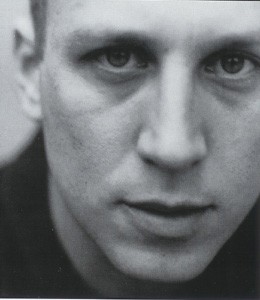
Hamza El Din

0

Le Nubian: Hamza El Din’s fans include the Kronos Quartet and Mickey Hart.

Nubian Nights

Hamza El Din summons a sensuous world of sound

By Greg Cahill

“I speak six languages and sometimes they all come out at once,” apologizes Hamza El-Din as he struggles to find the words for “goodbye” after an interview at his San Leandro home.

The whimsical moment of polyglot farewell underscores the multicultural side of this world-class singer, composer, and instrumentalist. Fifty years ago, he blended the rhythmic, sensuous music of his homeland in Sudanese Nubia with the plaintive sound of the ancient Egyptian oud, a fretless, short-necked precursor to the lute and the principal instrument of Arabic classical music.

It was a bold move. Nubia’s strict Muslim society had not embraced the instrument, and frowned on the idea of music as a profession. Musicologist and record producer Robert Garfias noted some 30 years ago that “the result is not a loose amalgamation of two vagrant forms of music but an entirely new mode of expression.”

Humble and gracious and sporting a broad, open smile, El Din, who performs Aug. 14 at the Healdsburg Guitar Festival, introduced his music to America in the early ’60s, recording the landmark world-music albums Music of Nubia in 1964 and Al Oud: Instrumental and Vocal Music from Nubia in 1965, both featuring original compositions performed in a traditional style and released on the Vanguard label. In 1964 he performed at the Newport Folk Festival and went on to share an apartment with guitar virtuoso Sandy Bull while teaching oud to American students.

El Din, 73, may not be a household name in his adopted America, but his work has continued to exert a profound influence on performers in the States, and El Din maintains a close relationship with a wide range of classical, world-music, and rock acts. For instance, in 1992 the Kronos Quartet paid tribute to El Din on its Pieces of Africa album by covering the evocative title track from his classic 1971 album Escalay: The Water Wheel. Former Kronos cellist Joan Jeanrenaud also recorded a haunting 17-minute version of “Escalay” on her recent solo debut Metamorphosis.

In 1982 Grateful Dead drummer Mickey Hart produced El Din’s album Eclipse for Hart’s acclaimed world-music series–El Din also is a master of the tar, a single-skinned drum played with the finger tips. Later, in 1990, Hart joined El Din onstage at the Marin Center at an international drumming summit. “He’s the most generous artist I’ve met in the United States,” says El Din, who introduced Hart to the musical magic of the desert villagers during the Dead’s 1978 Egypt tour.

Yet El Din was renowned long before a new generation of young, hip world-music buffs “discovered” his haunting rhythms and surging lyrical melodies. He began playing the oud during the late 1940s when he was an electrical engineering major at the University of Cairo. He later studied music formally at the Cairo Conservatory of Music. It was there, notes Garfias, that El Din began to draw the moods and the musical shades of ancient Nubia into the vast technical and aesthetic structure of Arabic classical music.

At the time, the Egyptian government had begun the massive Aswan High Dam project, which called for flooding hundreds of small villages–an action that was expected to sweep away forever much of Nubia’s rich musical culture. “Like so many college students, I wanted to get politically involved because I couldn’t convince my people that the water would come that high and cover their land,” El Din recalls. “So someone said, ‘Why don’t you sing it?'”

He’s still singing his own compositions as well as traditional Nubian folk tunes and Middle Eastern songs in his native tongue, which has been largely abandoned since Nubia was partitioned by Egypt and the Sudan.

Where does El Din find the musical inspiration? Well, he says, when playing tar he takes his cues from the drum itself. “You are not playing it,” he says solemnly, “it is playing you. You must feel exactly what is coming through it at any given moment. A lot of that has to do with touch. If you force it, you end up killing the overtones.”

Is that his secret?

“It’s one of my secrets,” he adds with a laugh.

Despite his virtuosity, El Din remains a gentle servant of the sounds that flow through his fingertips. “I don’t know how to respond when someone compliments me,” he says humbly. “It’s the grace of God.”

A truly amazing grace at that.

Hamza El Din performs Thursday, Aug. 14, on a bill with Algerian-born French guitarist Pierre Bensusan at the Healdsburg Guitar Festival. Tickets are $20-$39. The fest, which runs Aug. 14-17, is held at the Luther Burbank Center, 50 Mark West Springs Road, Santa Rosa. 707.546.3600.

From the August 7-13, 2003 issue of the North Bay Bohemian.

© Metro Publishing Inc.
CHP Domestic Violence Case

0

Our Boys in Beige

Purple Berets charge cover up in CHP domestic violence case

By Stephanie Hiller

The few drivers moving along Labath Avenue in Rohnert Park on a quiet Saturday afternoon were surprised to see some 50 women and men picketing the offices of the California Highway Patrol. Behind the speakers was a big sign identifying the Purple Berets as “Turning Up the Heat on Patriarchy,” with a picture of a woman grimacing while firing a blow torch. Many of the people assembled wore black T-shirts emblazoned with the words “Stop Violence Against Women.”

The July 26 demonstration was directed toward the CHP’s handling of charges made by Mitzie Grabner against officer Curt Lubiszewski. On repeated occasions, as Grabner recounted in her sworn statement, her former live-in boyfriend Lubiszewski grabbed her by the arms and shook her, pushed her, sat on her chest and yelled, threw her down stairs, took her keys, and broke her phone.

After Grabner came forward, Lubiszewski’s ex-wife Bonnie Garrett decided to support Grabner’s case by reporting her former husband’s attacks during their marriage. Grabner and Garrett had become acquainted while making childcare arrangements for Bonnie and Curt’s three boys. Both ex-wife and ex-girlfriend spoke at the protest.

In the 15 cases she has handled involving law-enforcement officers, this is the first where women have come forward, said Purple Beret founder Tanya Brannan, addressing the crowd. Partners do not usually report the violence because abusive policemen, aware that conviction could mean the end of their job, often threaten them.

Mitzie Grabner did not report the violence until after she left Lubiszewski. Scared that he would attack her when she returned to his apartment to pick up her things, she reported previous incidents to the Rohnert Park police, and a civil standby was arranged.

Protesters also heard strong statements from Bonnie’s mother, Rose Schloming, and Bonnie’s present husband, Jim Garrett.

“What kind of message are we giving to our youth,” asked Schloming, “if we don’t rise up and object to violence against women?”

Because of Grabner’s and Garrett’s sworn testimony and the testimony of a witness, Bonnie Leslie, an internal investigation was launched by the CHP in February, as well as a criminal investigation by the Rohnert Park Police Department that was sent on to the district attorney’s office.

The district attorney decided that there was insufficient evidence to bring the case to trial, and CHP Capt. Larry O’Shea told Brannan that without a court conviction, Lubiszewski could not be disciplined.

Grabner called on the Purple Berets, who demanded a new hearing and a new investigation.

In a letter charging mishandling of the case by law enforcement, Brannan accused the departments of intimidating Grabner during previous interviews and also of failing to interview all the witnesses. A new hearing was held May 28 and the case was reopened.

Cases of wife beating by law-enforcement officers are not unusual. Police are two to four times more likely to be guilty of battering than the rest of the population, and, according to two separate national studies, fully 40 percent of male officers report that they have hit their wives in the past year, compared with 10 percent of the general population.

Why are police officers more likely to be abusers than other men? Possession of a gun appears to be correlated with violence against women. A study reported in the July issue of the American Journal of Public Health shows that access to firearms increases the risk of gynocide by more than five times. Abusers who possess guns also “tend to inflict the most severe abuse.”

An intensive five-month investigation by the Seattle Post-Intelligencer of 41 officers who have been accused of assaulting, stalking, threatening, or harassing their wives, girlfriends, or children, found that “police departments are falling short on a number of fronts in the way they handle domestic-violence allegations against officers.”

District Attorney Stephan Passalacqua insists that “domestic violence is a very serious matter, and we are investigating this case very closely, as we do any allegation of domestic violence.” Citing new evidence since the May 28 hearing, Passalacqua repeated that the case is being taken “very seriously.”

Lt. Dan Moore of the CHP did not mention any new evidence. He did the first-level review of the initial investigation by Sgt. Scott Bartelson and considered it adequate. Asked whether the department censured domestic violence by officers, Moore replied, “I can’t say the statement of ethics covers domestic violence in great detail,” though he didn’t see how officers could fail to be aware of the problem, “given the status of this issue in the legal system.” Officers are not stupid, he said, “they know the issues that are happening to their fellow officers.”

In response to the question of whether it was necessary, as Capt. O’Shea had told Brannan, to have a court conviction before the department would discipline him, Lt. Moore said, “Give me a good reason why we should fire an employee that has not been convicted.”

However, according to Assistant Chief Bonnie Stanton in the Sacramento CHP office, CHP discipline depends on the evidence–and does not require a court decision.

Across the street from the protest, Curt’s brother Mark stood with his wife and Lubiszewski’s current girlfriend, passing out a purple sheet composed by a friend of Curt’s saying that the Purple Berets were making a mistake–though with little more information.

Asked whether it took courage for her to stand up on the street to state her case, Mitzie Grabner shook her head. “I have no reason to fear when I’m telling the truth,” she said.

From the August 7-13, 2003 issue of the North Bay Bohemian.

© Metro Publishing Inc.

Open Mic

Go West, Old Man

Shepherd Bliss says farewell to Sonoma County

By Shepherd Bliss

I used to think Hawaii was a place you won in a game show, where honeymooners drank piña coladas in a perpetual sunset, and rich tourists got sun-baked. Certainly not a place where this writer-farmer-teacher belonged or could make a home. I was wrong.

Visiting Hawaii never occurred to me until two years ago. I support the rights of Hawaiians for self-preservation and felt that a haole (non-Hawaiian) like myself might get in the way.

Then Hawaii started calling. I resisted. Laguna Farm’s Scott Mathieson invited me to join him for a visit. Upon arriving I had the same instinctive feeling I had when I first saw what became Kokopelli Farm–“I’m home.” The island evoked childhood memories from the isthmus of Panama.

Hawaii still has jungles, like Panama, with their moist mysteries. The active volcano invites change and creativity. The surrounding ocean both pounds and soothes.

I discovered diverse cultures, vibrant nature, active artists and writers, a growing community of sustainable farmers and conscious eaters, spiritual vitality, independent freedom-loving people, and many of the qualities that originally drew me to the San Francisco Bay Area. I have been learning a lot from Hawaii, which has become my teacher.

Redwood, apple, and oak trees drew me from Berkeley in the late 1980s to what was then the “Redwood Empire.” Now known more as “wine country,” industrial vineyards march into forests and across rolling hills. Nature recedes. Man’s heavy hand weighs on the environment and my soul.

High tech destroyed the once agriculturally vital Valley of the Heart’s Delight south of San Francisco, transforming it into Silicon Valley. It now threatens our once rural county with further urbanization.

A strong current flows through the earth’s greatest ocean between this coastal county and Hawaii. Sebastopol’s annual Apple Blossom Parade this year had the theme “Aloha Blossom.” We have a Hawaii support group that helps people who go back and forth. I hope to come back over summers and continue teaching at New College and the Institute of Imaginal Studies.

Until Bush’s seizure of power, I had expected to live in the bountiful North Bay the rest of my life. So I dropped anchor, settled in, and sent down roots. I hauled childhood memorabilia from the Bliss family home in the Midwest. My book collection swelled into the thousands, which I am now painfully selling.

My body now feels dread at what the American military is doing in the world and the liberties we are losing here at home. It’s time to retreat. Hawaii is technically America, but not exactly. Legally one of the United States, it remains culturally distinct and more serene with its aloha spirit.

In the military, I learned the importance of retreating and having an exit strategy, which differ from running away or surrendering. My growing grief at the loss of democracy built by generations of Americans is more than I can tolerate on the mainland, which is becoming increasingly speedy and aggressive. The once Land of Liberty is becoming the Land of Fear. Hawaii, in contrast, seems to remain the Land of Love.

I gave talks at peace rallies in Hilo earlier this year. A department chairperson inquired if teaching at the Hawaii Community College might interest me. After looking at my résumé, she asked if I would teach a course entitled “The Meaning of Life”–an offer I could not refuse. The University of Hawaii at Hilo later hired me full-time to teach in their communications department.

But really, I’m going to Hawaii more to learn from the island and its people than to teach. Indigenous and island wisdom about natural resources and sustainability have a lot to offer to inflated continental power and folly, especially at this time.

Our future is unpredictable. So I want to live where I can grow food, have friendly neighbors, and be distant from targets of both the American government and those whose fire it will increasingly draw by its bellicose behavior. Hawaii’s remoteness attracts me.

I’m a native son of California, born in Santa Monica on the Pacific Coast nearly 60 years ago. Moving is not easy. Letting go of lovely Sonoma County and California, my friends and land is difficult. I remain in love with my home state and my country, despite their shortcomings. I learned so much here, especially from the land, which I plan to practice in Hawaii. What might life after California and after the mainland be like?

I love Sonoma County; the land and people are wonderful. They’ve treated me well. What will I miss? Growing and providing people with healthy, tasty food. Monthly Sebastopol Art Walks. Weekly free summer concerts in the plaza, where you can encounter friends without making appointments. The rugged coast, the Russian River, and the rolling hills. (Sigh.) And KPFA radio–a voice of freedom.

How can I leave such a paradise? I sometimes wonder. But few new farmers and people like me can afford to buy here now. I could never purchase in Sebastopol today. I wonder what the county will be like in the future.

I delight that rural institutions such as the Occidental Arts and Ecology Center, Ocean Song, and the Western Sonoma County Rural Alliance remain vital. The continuity of groups such as the Community Alliance with Family Farmers and Farm Trails is important, as is the growth of various farmers markets. Newer groups such as Farm Link work to keep land in agricultural production.

Thoreau wrote that a town is saved by the woods and swamp that surround it. Approving the Laguna Vista development and the damage it would do to the Laguna de Santa Rosa would endanger small-town Sebastopol and its environment. The visible forest and laguna provide substantial invisible protection.

As vineyards expand into the forested Cazadero area, they further threaten the county and its remaining nature. The growth of groups such as the Blucher Creek Watershed Council and the South Sebastopol Neighbors for Safe Water are important to defend our water and other natural resources threatened by overdevelopment.

Hawaii is feminine, especially the Big Island, where the goddess Pele with her volcanic eruptions rules. The feminine has deep healing powers, including through nature, which the U.S.A. and the world need at this time.

Aloha may be a light to guide America out of its expanding darkness. Hawaii and Hawaiians have much to offer our troubled nation and the endangered world. Hawaii has become my teacher.

Shepherd Bliss has written for the ‘Sonoma County Independent’ and the ‘North Bay Bohemian’ for the last half dozen years and can now be reached at sb****@****ii.edu.

From the August 7-13, 2003 issue of the North Bay Bohemian.

© Metro Publishing Inc.

Movies in the Park

0

Photograph by Rory McNamara

Film Forum: Lisa Sides (left) and Robin Harigan saw the need for a community-oriented film night, and filled it.

Star Gazing

Petaluma’s new Movies in the Park mixes cinema and music under a wide open sky

It’s been decades since Petaluma had its own drive-in movie theater and at least two years since the last remaining indoor movie theater in town shut its doors. While the progressively minded Friday Night Film Series at the Petaluma Coffee Cafe has filled a tiny portion of the local movie vacuum, that series has ended for the summer. So unless you count watching the Wonderful World of Disney at your grandmother’s house, the only show in town may be the one held under the stars in Petaluma’s tree-filled McNear Park.

That is where a pair of Petaluma moms, Lisa Sides and Robin Harigan, have established Petaluma’s first official Movies in the Park series, screening popular films once a month throughout the summer in a comfortable picnic-and-a-movie setting. Think of it as a Films among the Oaks festival. You could even call it Field of Screens.

Or maybe not.

Modeled after similar film-night events held in other parts of the North Bay–and specifically inspired by Marin County’s long-running outdoor movie series–the premiere season of Petaluma’s Movies in the Park was kicked-off in mid-July with a well-attended screening of Steven Spielberg’s E.T., a fitting enough film to be watched under a moonlit sky while wrapped in blankets, hanging out on a grassy playing field in the park. Granted, the McNear park may not be a 12-screen multiplex with stadium seating and fancy cup holders, but for those who crave the human connection of seeing movies with a crowd, it’s a whole lot better than sitting home alone eating popcorn in the dark. And for that matter, a much better bargain.

Conceived as a fundraiser to help complete the remodeling of the Polly Hannah Klaas Performing Arts Center, the Movies in the Park events are technically–get this–free. The donations of $4 per adult and $2 per child go toward completion of the performing arts center. Besides that, in case you’ve never been there, McNear Park, at the corner of G and 11th streets, is an exceptionally pretty place to spend some time.

“This is a great place to see a movie!” exclaims Harigan, standing with Sides in front of the vast safety netting near the warm, green outfield. At the moment it all looks like, you know, a baseball field. But come the next Movies in the Park night, a large screen will be stretched out between two utility sheds, the smell of popcorn and coffee and assorted dinner foods will be floating in the air, and folks will be playing cards or throwing Frisbees while waiting for the show to begin. “It’s such a cool event,” says Sides. “Petaluma’s been needing something like this.”

For Sides and Harigan, the Movies in the Park ball got rolling two years ago when the two Petaluma women–who at that time knew each other only casually, as busy mothers picking up or dropping off kids at the Petaluma Parent Nursery School–accidentally bumped into one another in Marin at an open-air screening of A Bug’s Life. That film-night experience inspired Sides and Harigan to start daydreaming. At some point, recalls Harigan, one of them said, “We should do something like this in Petaluma–ha, ha, ha!”

A year later, when both families once again met up in Marin to see The Wizard of Oz–“Only this time we planned it,” reports Harigan–the idea of a Movies in the Park in Petaluma was raised again. “We talked about it,” Harigan says, “and then we just said, ‘That’s it. We’re going to do this.'”

“Actually, we’re a perfect team for this kind of thing,” allows Sides, laughing, “because we both know a little about film and theater. We both know how to put on a show.”

To say the least. Harigan has an extensive background in the movie business, having served as production coordinator on numerous commercials and feature films and done sound work on several animated films, including the Woody Allen-voiced Antz. Sides has worked extensively in the theater world as a stage manager and lighting designer for Cinnabar, Marin Theater Company, and Marin Civic Light Opera. With a combination of theatrical flair and hometown community building, Harigan and Sides have brainstormed a Petaluma-style Movies in the Park experience that will take what others have done and cavort with it a step or two further.

At the Movies in the Parks this summer, there will be preshow entertainment, some combination of musical ensembles, jazz groups, magicians, and the like. While the Petaluma Parent Nursery School will be selling popcorn, Johnny Garlic’s will be on hand to provide dinner for those who choose not to bring their own picnic spreads. Other food and drink providers, including Jumping Java and the Girl Scouts, will be in place selling coffee and baked goods, respectively.

That said, the main attraction will certainly be the films, the next of which, slated for Aug. 16, will be the Oscar-nominated animated adventure Ice Age, in which a band of prehistoric critters take on a babysitting job amid avalanches and earthquakes. Harigan and Sides anticipate (and intend to encourage) a lot of spontaneous participation from the audience, perhaps a bit of booing and hissing and cheering along the way.

“We chose these films to reach as broad an audience as possible,” says Harigan, whose all-time favorite film, The Princess Bride, will close out the season with a Movies in the Park screening on Sept. 20 (entertainment for that show starts at 6pm, rather than 7pm). “I can watch that movie over and over again,” she says, “so I always had that one in my head to show this summer.”

“It’s a social event,” says Sides of the experience. “It’s friends and neighbors coming together as a community, to see people you know and meet new people, and to have fun together doing something we all enjoy, which is watching movies.”

Next summer, they might expand from three films to six or eight films, and there has been talk about establishing movie themes for future summers, such as a series of films that were shot in Petaluma.

“It’ll all depend on how it goes this summer,” says Sides. “We don’t want to overdo it till we know how many people really want this in Petaluma.”

At any rate, this movie-loving duo is clear that Movies in the Park will become an annual event, and they expect that each year will bring new ways of having fun.

“We have lots of ideas,” laughs Harigan. “Lots!”

The showing of ‘Ice Age,’ on Aug. 16, will be preceded by entertainment starting at 7pm. Budderball the Clown, the Cherry Valley Elementary Rhythm Ensemble, and James K and Friends will perform. For more information, call 707.765.8828.

From the August 7-13, 2003 issue of the North Bay Bohemian.

© Metro Publishing Inc.
Sunflower Gardens

0

Photograph by Andrea Jolicoeur

Garden Therapy: Kids from the Family Support Center enjoy the fruits of the garden–after a little work.

How a Garden Grows

An empty lot is transformed into Sunflower Gardens

By Ellen Bicheler

Before the garden, this piece of land reminded me of a scene out of wartime Beirut,” says Mike Turley, neighbor and site operator of the Catholic Charities Homeless Service Center. He’s talking about Sunflower Gardens, the blossoming oasis at Morgan and A streets and across from Catholic Charities Family Support Center. “People abandoned their cars here; you had whole families living in them.”

Sunflower Gardens is a collaboration between the Santa Rosa Recreation and Parks Department and Catholic Charities Family Support Center, a homeless shelter. It’s completely organic (though not certified), offering an elaborate weaving of fruit trees, greenhouses, vegetable gardens, sculptures, places to sit, and floral displays. It provides an abundance of food to the shelter and community members, as well as an afternoon children’s gardening program run by Recreation and Parks.

More importantly, as Betsy Timm, associate director of development and communication at Catholic Charities, points out, “It is so grounded and such a source of beauty. It lends dignity to all the people that use it. Our overarching goal is to create hope and offer health. The garden works on a subliminal and underlying basis.”

The lot that the garden inhabits used to host a Queen Anne-style house. When it burned down in the early 1990s, the site quickly deteriorated into a large receptacle for garbage and abandoned cars.

In the mid-’90s, the construction of the Santa Rosa Memorial Hospital parking garage paved the way, in a sense, for the future garden. The conveniently empty lot received a huge load of soil from the building site, brought there for sifting after suspected Native American artifacts from a possible camp were found. Tom Origer, adjunct instructor of anthropology at Santa Rosa Junior College, and Grant Smith, a Pomo elder, supervised the quest.

Origer estimates the projectile points, obsidian flakes from tool making, and milling equipment to be 1,000 to 5,000 years old. Most of the soil was later removed to another location, and the artifacts became part of a collection at Sonoma State University, housed in the Anthropological Studies Center.

The dirt left behind formed the base of the present garden’s namesake sunflower mounds. According to Turley, surprised gardeners have sometimes unearthed an occasional remnant of the project–a projectile or some obsidian flakes. The 15 varieties of sunflowers seem to like their rich heritage, crossbreeding to form unique colors and sizes. Luther Burbank would have visited this garden.

Pam Peck, a quadriplegic neighbor, initiated the metamorphosis of the site in an attempt to transform the eyesore into something useful and to make the neighborhood safer. Turley and several others joined her to help with the massive trash cleanup. Lillith, an Americorps worker, used all of her connections to get the area plowed and the weeds pulled. The Family Support Center provided the water, PVC piping, and manpower. For the first two years, hoses were brought across the street for the watering.

It wasn’t until Bobby Ewall, recreation coordinator for Santa Rosa Recreation and Parks Department, found out about the project that it gained the steam necessary to bring it to its present form. (Ewall’s daughter is Peck’s goddaughter.) Ewall was able to secure a $5,000 grant from the city as start-up money for the community garden and “da Pad,” a teenage rec hall across the street. Ewall’s uncanny ability to stretch dollars, his numerous connections with volunteer organizations, and his bartering skills have brought the garden to its present stature.

When Ewall first walked into the lot, the weeds were six feet tall. He claims to have rototilled at least a hundred times, revealing a never-ending stream of car parts, clothing, and various beverage containers. According to Ewall, more sweat than gardening ability went into this venture. It took him a year and a half to actually enjoy the garden. “I can actually stop now and smell the roses,” he exalts.

Melissa Black, a recreation specialist with Recreation and Parks, joined forces with Ewall in the beginning to create the gorgeous landscape. She helps oversee the temporary staff hired from the neighborhood and the numerous volunteers. Black says that she’s been happy watching “the program come to life and seeing the enjoyment people get out of it.”

The children staying at the Family Support Center are some of the major recipients of that enjoyment. Andrea Jolicoeur works with the children at the center in an afternoon program. She wants to give the kids “a positive experience with nature.” She loves her work, explaining, “It’s good for me, it fulfills me. This work is so hands-on, so different from their school.” She likes to see children’s faces when they realize “this is where a tomato comes from” or “this flower becomes a strawberry.”

Thirteen-year-old Amber says that it’s “really cool to plant something and see it all grown.” She likes getting dirt beneath her fingernails. And for nine-year-old Cheyenne, her pleasure comes from the watering and the harvesting. “I like to go into the garden and enjoy it,” she says, “instead of being in the city without plants.” Anna Maria, who is almost 12, is a flower enthusiast; she likes to plant, water, and pick them.

Sometimes Jolicoeur will see some of her apprentices watching television in the shelter, and they’ll call to her and ask, “How’s my plant doing?” Some of the children don’t get to see the whole seed to harvest progression because of the brevity of their stay. Jolicoeur likes to send each of them off with a plant.

Timm says that 57 percent of the families move into stable housing after a stay at the Family Support Center of 90 to 120 days. Perhaps their plant will be planted at their new home. The others get to take a reminder of their experience, a plant that only needs water and sunlight to survive.

Serena Mora, a Recreation and Parks recreation leader, is enthusiastic about the community involvement in the garden. “Even disabled gardeners can use our garden.” There’s an area for the visually impaired. She enjoys the whole process of starting with a seed and the “focus on growth” on everyone and everything involved.

Sunflower Gardens is a curious blend of plants, herbs, and structures–much the same as the diverse group of people who have molded it and continue to do so. A 20-sided greenhouse built and donated by the Universal Industrial Church, a strawberry garden flanked by benches, recently braided garlic above an office desk, a bathtub of geraniums, a koi pond, blue pinwheels, and a place to store a homeless woman’s plants (her source of income) are some of the many attributes the garden offers. An apron of land around the outside of the chainlink fence sprouts grapes, tomatoes, strawberries, geraniums, and squash. It was purposely designed that way to invite picking.

This menagerie manages to produce a sizable amount of food for the shelter as well as the community, and provides a resting place for humans and the garden’s other inhabitants, like the monarch butterflies, ruby-throated hummingbirds, ladybugs, snails, and the occasional owl.

Ewall hopes to have this garden sustainable soon. He would like to find a group willing to adopt it for a month or a year, or to grow and sell plant starts to support the garden. The garden barely squeaked through the city budget this year, and the city has another community garden in the Apple Valley area that needs attention, too.

Ewall would like to step away from Sunflower Gardens and have it operate on its own. He has visions of turning other city lots into food sources and places of beauty and have them sustain themselves.

The influence of Sunflower Gardens has spilled onto the entire block. Plants propagated from the garden promenade up and down the street. The beautiful florals have dressed up the neighborhood. It’s hard to feel glum walking down this street.

Volunteers are needed all year round but particularly in October, February, and March. Contact Bobby Ewall at 707.543.3290 to volunteer or donate money, plants, or gardening resources. The Rosie bus will bring visitors from the Santa Rosa downtown market to Sunflower Gardens on Wednesday, Aug. 13. Catholic Charities Family Support Center will host an open house and showing of photographs in conjuncture with the children’s museum on Oct. 16. Call 707.528.8712 for more information.

From the August 7-13, 2003 issue of the North Bay Bohemian.

© Metro Publishing Inc.
Napa Valley Opera House

0

Fundraising efforts have gathered within $500,000 of the $14 million goal. Once the final funds are secured, the addition of a balcony to the green room will begin. Work on the interior space was started in 2000; a number of benefits were staged before the theater was finished–including this one, staged without the theater’s back wall. The main hall is being named the Margrit Biever Mondavi Theatre, in recognition of the Mondavis’ contribution to the fundraising efforts.

Center Stage

At the Napa Valley Opera House, the fat lady sings again

By Davina Baum

On a hot evening last June, people packed into the Napa Valley Opera House for a momentous occasion: the first public performance in the newly restored building since 1914. The performer was Dianne Reeves, who was touring in support of her Grammy-award winning record, The Calling: Celebrating Sarah Vaughan. The small cafe tables and low stage in the newly restored Cafe Theatre made for an intimate setting, and as Reeves’ voice wrapped itself around the listeners like a warm blanket, the crowd could have been at celebrated Oakland venue Yoshi’s or San Francisco’s Cafe du Nord.

But this was Napa, the land that music forgot. Locals had long complained about the dearth of performance venues in the town of Napa and in Napa Valley as well. But as Reeves’ voice rose to the ceiling, despite the excitement of the event, expectation was weighing down, because the main stage, above, stood empty.

The Cafe Theatre has had a successful year, hosting performers like Linda Tillery and Josh Kornbluth. But the venue, which seats 180, was only ever meant to be a step toward the primary goal of opening the main stage. And, as of Aug. 1, when the main stage opened with Rita Moreno’s sold-out performance, little Cafe Theatre took second stage, as it were, to the grand space above.

And grand it is.

Ennio is a lip-synching artist with tear-off paper costumes, easing his transformation from the Mona Lisa to the pope to Whitney Houston. He performs at the Opera House Aug. 15-31.

The theater is a masterpiece of feminine curves, bright and airy despite its relatively small size. The most striking touch is the curved balustrade of the upper-floor dress circle, which brings audience members surprisingly close to the stage. The wood of the balustrade has deliberately been left unfinished so theatergoers can touch the wood–the same wood that was touched by theatergoers a century ago–and see and feel the history of the place.

In all other aspects, the history of the Opera House has been entirely re-created. The building is listed as a historic building by the Historic Preservation Commission, which offered a grant toward its refurbishment and mandated that the theater be exact in its replication (technical advancements notwithstanding).

Thus, the pale yellow of the walls, the lush red of the seats, the deep proscenium of the stage, the wainscoting and staircase, as well as smaller features like the cornices and ceiling light–it’s all as it was in 1879. Executive director Michael Savage calls it “intimate grandeur.”

The Opera House facade was refurbished in 1996. The structure was designed in 1879 by Samuel and Joseph Newsome in classic Italianate style, with its flat, stone facade in lengthy vertical proportions and tall, rounded second-story windows. The inside has contained all the restoration action for the past eight years, though efforts to restore the building began in the 1980s, thanks to the efforts of a number of people, including the late Victoria di Rosa.

The original Opera House staged musical theater, as well as hosting stars such as Jack London and John Philip Sousa. In planning the new opera house, a survey was conducted to see what people were interested in. According to executive director Michael Savage, what they most want are plays, musical theater, opera, dance, jazz, chamber music–“everything really.” The model is Cal Performances in Berkeley, and “the aim is to bring in really top quality shows.”

Top of the Line

Restoring the theater was obviously not as simple as painting walls and rebuilding the stage. Savage and others were dedicated to ensuring that the Opera House regain its 19th-century glory and that it have 21st-century technology. So the sightlines are clean, the seats are comfortable, and the sound is fabulous.

One of the first and most important changes was earthquake retrofitting. According to Savage, during the first winter of restoration the roof was removed and structural steel was lowered in.

The stage floor was originally tilted, while the theater floor was flat. Now the theater floor is raked for better views and the stage floor is flat. The original balcony, too, was suspended from the roof with rods. Now it’s supported from below.

The acoustics, of course, were given a great deal of attention. Acousticians were brought in, and they mandated details such as plaster walls rather than sheetrock. The walls had to be uneven and thick, and they couldn’t be painted. So the pale yellow color of the walls is actually integral to the plaster, rather than painted over.

Because original owner George Crowey was worried that he wouldn’t be able to make enough money from ticket sales, he built the Opera House main stage on the second floor. The first floor hosted three narrow shops, one of which was a butcher shop. The downstairs Cafe Theater will now serve as a piano bar and lobby, where guests can linger and buy snacks and drinks before and after performances.

Savage is also quite proud of the restrooms, which are large. He noted that at the San Francisco Opera, where he worked previously, “the restrooms are so crowded there that women will be seen racing through the corridors just before the end of the act to get ahead of the line. We’ll never have that problem here.” He adds that a woman recently gave a gift “just on the strength of the women’s room.”

In the old days, when there was an orchestra, the musicians sat in front of the audience. Now a modular pit filler allows for the stage to be extended by nine feet. If the seating space needs to be larger, the filler can be removed, with the pit still holding 40 musicians.

In the theater’s previous incarnation, the building stopped at the back of the stage. Performers left the stage and found themselves on a catwalk, which led them to the hotel at the corner, where they changed. The backstage now holds four roomy dressing rooms, a green room that can be rented out, a freight elevator, and a technical room.

The Opera House closed in 1914. Damage caused by the 1906 earthquake, as well as damage caused by patrons’ decreased interest in vaudeville theater in favor of movies, sent the theater into decline.

Back to the Future

The first show staged at the Opera House (which has never, actually, staged an opera, but was named an opera house so as to distinguish itself from less respectable venues), in February of 1880, was Gilbert and Sullivan’s HMS Pinafore. That show will be making a return to the theater’s stage as the first main production this season, “for obvious historic reasons,” says Savage. The show made its way to Napa in 1880 within 20 months of its world premiere in London. This aptitude for being “up with the times,” as Savage puts it, is something that the venue hopes to re-create.

To that end, the Opera House has a far-reaching repertoire in its appointment book so far. The Vienna Choir Boys, Wynton Marsalis, the Pocket Opera, and the Taylor 2 Dance Company are all expected to make an appearance over the next few seasons.

Ticket prices will remain modest; prices for the first month top out at $35, and some are as low as $10.

Savage hopes to see people from all over the Bay Area, and beyond, at the Opera House. North Bay residents are the base market; but five million people a year visit the Napa Valley, and they are all welcome to visit the Opera House.

Savage also would like to organize a summer opera festival with Mozart and other 18th-century composers. He says, rather wistfully, that “this is the sort of theater that Mozart would have known in a beautiful palace in Austria or Germany.”

Tickets for Napa Valley Opera House performances are available online at www.napavalleyoperahouse.org, by calling 707.226.7372, or at the box office, 1000 Main St., Napa.

From the August 7-13, 2003 issue of the North Bay Bohemian.

© Metro Publishing Inc.

Hot Dogs

0

Photograph by Michael Amsler

Happiness Is a Warm Bun: Ralph Morgenbesser of Ralph’s Santa Rosa Subs and Ralph’s Courthouse Classics serves up classic dogs.

Hot Dog!

In search of an American classic

By Sara Bir

In terms of respect, hot dogs are underdogs, perceived as kid food, junk food, the final destination of all pig and cow (and God knows what else) parts deemed unfit for other uses. Between Memorial Day and Labor Day, millions of hot dogs are tossed with little mind onto grills and left to blister and sweat until they are as blackened and chewy as seared rubber sneakers.

Then there are the baseball games, amusement parks, county fairs, and seaside boardwalks. Here, where we find the hot dogs others make for us, are the stuff dreams are made of: moist, plump casings taut and beaded with a dew of grease. Their buns are cottony and yielding; their wrappers–foil, waxed paper–are always disposable.

It was in New York that I discovered the adult pleasure of hot dogs. What better place for a hot dog lover than New York! (I’ve never been to Chicago, so I can say that.) While young and in New York, when money is always in short order, hot dog vendors are ready and willing to supply low-cost fuel for carnivorous starving artists.

Particularly alluring was Papaya King and its nearly identical though inferior rival Gray’s Papaya, who hawked the inspired combination of fresh tropical fruit juices and very cheap hot dogs. You asked for kraut and onions (adding flavor, nutrition, and bulk), and then piled on the spicy mustard. You could eat your papaya dogs there at the counter, but the best thing to do was barrel down the crowded sidewalks, needling your way through pedestrians and consuming each hot dog in a feverish rapture spanning no longer than 30 seconds. Then you’d chase the salty-greasy bites of hot dog with sips of sunny sweet-tart papaya juice, and the whole world came alive.

Since that time, I’ve hungered for an equal, if not identical, hot dog sensation. Here’s the key: Superior hot dogs are best consumed outdoors or while standing up–preferably both. Also, there must be more on them then just mustard and ketchup. And also also, the hot dogs themselves must have natural casings so that they snap playfully when bitten into.

Jimbo’s Hot Dogs, visible from Highway 101 as it traverses that particularly hopeless stretch around Terra Linda where boxy, fortresslike corporate offices rise up from the hills as faceless and awful as giant broken robots, is right on the frontage road. A million times commuters must drive past it thinking, “Who in their right mind goes to eat hot dogs on a frontage road?”

Hot dog lovers, for one. It’s not very often in these parts that you find an entire commercial space devoted to hot dogs, and it’s pleasantly startling to enter Jimbo’s and see the worn linoleum floors, the low lunch counter scattered with newspapers, and the letterboard on the back wall spelling out Jimbo’s menu.

To get my bearings, I ordered a kraut dog ($2.65). A plain hot dog is called a Jimbo. (Note that regulars just order a Jimbo and not a Jimbo dog, a faux pas that will identify a newcomer.) The dogs are fat and elongated beef franks on steamed buns, topped with a choice of mustard (yellow, spicy, or Dijon), caramelized or raw onion, sauerkraut, relish, pepperoncini, jalapeños, and sliced tomatoes. Oh, and ketchup. Many people came in and effortlessly ordered elaborate personal variations on their Jimbos-to-go; these must be regular customers, hot dog addicts who take their daily vegetables in relish form.

It was a good hot dog. I don’t remember much, because even when seated it’s difficult to break that indelicate habit of scarfing down hot dogs, a rebel without a pause. Mostly, I was taken with the charm of Jimbo’s, whose interior emanated a roadside aura instead of a frontage-roadside gloom. A glass-fronted refrigerator held styrofoam containers of homemade potato salad ($1.75–classic stuff, laced with yellow mustard and dotted with relish) and half-pint cartons of milk.

On the counter were boxes of individually wrapped moon pies, Fig Newtons, and miniature Duchess-brand pecan pies, whose listing of ingredients was heavier on preservatives than pecans. I wanted a milkshake but only had a bit of change, so I got a moon pie instead, which was a whopping 85 cents or so.

On my next trip to Jimbo’s, I got a chili dog ($4.25). “For here or to go?” asked the young fellow behind the counter. I said I was eating in, and when I received a plateful of chili totally obscuring a bashful hot dog, I wondered how on earth anyone could manage to consume the to-go version without making a complete mess. I had to resort to using a plastic knife and fork to get through the layers of piquant onion, melted cheese, steaming chili, hidden hot dog, and soggy bun. To make up for the moon pie of the last visit, I also ordered a strawberry milkshake ($2.75), which arrived at the lunch counter in a paper cup, the surplus still residing in the metal container it had been churned in.

And here I made an important, if blundering, discovery: Chili dogs and strawberry milkshakes were made for each other. This is the honest-to-God truth. There’s a symbiotic relationship akin to that of the hot dog and papaya juice. The earthy chili–livened with the occasional bite of hot dog–darkened the palate, while the cheery, pink, fruity milkshake refreshed and invigorated the senses. Like yin and yang, without the healthful aspects.

Jimbo’s, despite packing a great deal of old-school charm, is indoors. Lunch-goers in Santa Rosa can look to Ralph’s Courthouse Classics to supply them with the outdoor hot dog element. It’s sort of a satellite of Ralph’s Santa Rosa Subs off Courthouse Square. The cart itself is perched on the prominent corner of Mendocino Avenue and Fourth Street. Sometimes there’s a little cafe-style table set up close to the cart, but the best thing to do is to sit on the green of Courthouse Square facing Fourth Street and watch the bums and punk rock kids and suits.

I lean toward the Classic ($3), which you can modify with the typical kraut, diced tomatoes, relish, and onions. Ralph’s diced onions are the fancy red kind too. How’s that for class!

The other day, I had neglected to bring a lunch to work, instead planning on quelling noontime belly rumblings with a big, fat hot dog eaten under the sun. So I was strolling down the sidewalk, dreaming of that perfect first hot dog bite, when I realized the cart was gone. Gone! Begrudgingly, I went to Ralph’s Santa Rosa Subs instead, where I discovered that Ralph had an event that day, hence the MIA cart. Which proves that even though you can always count on hot dogs, you can’t always count on them.

The delightfully named Inn the Hot Dog House, right off the plaza in Sebastopol, is a stationary walk-up and thus won’t vanish into thin air. From the view into the kitchen afforded by the narrow order window–you can see a warmer full of buns and a soda dispenser, if that–there’s little to indicate what sort of hot dog experience the diner is in for. The answer is sublime.

I ordered a foot-long ($2.50) but what I actually got was a short-fat–meaning it was a foot’s worth of hot dog condensed into a frankfurter as chubby as a cherub’s arm, full of hot doggy goodness. The casing packed that elusive snap, yielding a spicy interior good enough to be consumed on its own–a truly noble sausage. This one I had to be mindful of and enjoy, taking a whopping two minutes instead of the usual 30 seconds. Sometimes, you have to slow down and taste the hot dogs.

Jimbo’s Hot Dogs. 4288 Redwood Hwy. San Rafael. Open weekdays, 10am-4:30pm; Saturdays, 10am-3pm. 415.472.7707. Ralph’s Courthouse Classics, Old Courthouse Square (corner of Mendocino Avenue and Fourth Street), Santa Rosa. Open weekdays, 11:30am(ish)-2:30pm(ish). 707.526.6309. Inn The Hot Dog House. 150 Weeks Way, Sebastopol. Open Tuesday-Friday, 11:30am-5:30pm; Saturday, 11:30am-4:30pm. 707.829.8353.

From the August 7-13, 2003 issue of the North Bay Bohemian.

© Metro Publishing Inc.

John Jenkel

Photograph by Michael Amsler

Highway Politics: John Jenkel’s signs have become commonplace around Sonoma County, especially on his ranch in Sebastopol.

Sign Language

Conspiracy theorist John Jenkel isn’t subtle in his antiestablishment activism, and he’s not making many friends (unless he’s paying them)

By Joy Lanzendorfer

I don’t need directions to John Jenkel’s ranch. I, like many in Sonoma County, know exactly where he lives. All I have to do is look for the signs and the pile of manure.

John Jenkel has earned the nickname “The Sign Guy” for the controversial signs he posts outside his home along Highway 116 near Graton. The signs say things like “Honk for Bush Behind Bars” with an anti-Nazi symbol or “Graton Keep Us Out of Iraq” or “Secret Service Investigated Double Agent.”

There is another sign stuck in a giant manure pile that says, “Save Sebastopol from Brown Fascism.” The signs have provoked so much honking that Jenkel’s neighbor put up a sign across the street that says, “Please Don’t Honk!”

But when I drive up to the ranch, scraps of paper are the only indications the signs ever existed; vandals have had their way. Jenkel’s ranch is dotted with several buildings–a barn, a house, and a water tower, among others. Each building is spackled with a layer of dust. A man with strawberry blonde hair tells me that Jenkel is in his office at the back of the property.

At the office, Jenkel’s easily recognizable signs–clean black text printed on white backgrounds–lie in a pile on the ground, indicating this is the right place. Several horse carriages are parked to the side. Next door, acres of grasshopper-green vineyards stretch and roll away from the eye. Through some trees, construction workers are seen building a new winery.

Jenkel’s office has low ceilings and smells like leather and horses. Saddles line one wall, and signs with Jenkel’s cryptic political slogans are posted everywhere. The furniture consists of a couch, several grandfather clocks, mismatched desks, and a cabinet of white binders with labels like “SOB” and “Lies.” In the center of the room, a table is covered with so many sheets of paper that it looks like one more will send it all tumbling onto the floor in a tangled white mess.

Jenkel is a thin, balding man with a prominent nose and bright blue eyes. He shuffles around the room in untied moccasins and sits on a padded study desk, leaning forward when he talks. Though he is abrupt, he is not unfriendly. And he warms up when he tells me his theories.

The Truth Is Out There

On the surface, John Jenkel subscribes to the same theories that a lot of progressive liberals have about the Bush administration, theories that sound entirely possible. He believes the 2000 elections in Florida were rigged. He believes that Bush knows more about 9-11 than he’s letting on. He believes that the War in Iraq is more about oil than terrorism.

But Jenkel goes a few steps further. He believes that an elaborate conspiracy ties the Enron scandal, the war in Iraq, 9-11, the 2000 election, and the California energy debacle together. And, most importantly, Jenkel puts San Francisco mayor Willie Brown close to the top of the conspiracy pyramid.

Jenkel believes that Brown controls California–Governor Gray Davis is “just a puppet”–as well as the Democratic Party. Until the November 2002 elections, Jenkel says, Brown controlled the United States Senate as well. He believes Bush, Brown, and Enron executive Ken Lay were co-conspirators in 9-11.

“Brown has controlled every detail of this state since 1980,” says Jenkel. “The guy’s a micromanager. He works about 20 hours a day. Nothing of any significance in this state has happened that hasn’t crossed his desk first.”

Jenkel believes he is the only one who sees the truth, and that if Brown and Bush are not stopped, we will be facing World War III. To prove his point, he has created a book of printouts from websites and newspapers as evidence. On the front page, which is a copy of an article from a newspaper, he wrote the words “Impeach Him” in black marker. Throughout our conversation, he points to different articles in his book to bolster his argument, though they are usually pages from conspiracy web sites or articles that Jenkel is reading into.

“You see the word ‘they’ in this headline?” he says, pointing to an article about Cheney discussing the California energy crisis. “‘They knew over a year ago they had a problem.’ Do you know who the ‘they’ is there? Ken Lay and Willie Brown.”

Jenkel has sent his book out to everyone he can think of, including all members of Congress. He has also created a website (nineelevenbountyhunter.com) that explains his theory. And he has filed a suit against 70 members of Congress for endorsing the war in Iraq. It’s all part of his mission.

“I’m going to get rid of Willie Brown,” he says. “I’m going to get rid of George Bush. And when I do, there will be no more secret operations of government anywhere in this country.”

Mission Impossible

John Jenkel’s plan to save the world from Willie Brown and George Bush has taken some strange turns. He has become a regular fixture at the Sebastopol City Council, the Santa Rosa City Council, the Sonoma County Board of Supervisors, and the San Francisco Board of Supervisors, among others. He has haunted the offices of Lynn Woolsey, Barbara Boxer, Nancy Pelosi, Dianne Feinstein, and, of course, Willie Brown. He’s demanded repeatedly that they stand up against the war.

One might wonder what exactly the Sebastopol City Council could do to stop the war in Iraq, but to Jenkel the answer is obvious. He wants them to endorse House Joint Resolution 20, a little-known resolution that seeks to repeal the authorization for use of military force against Iraq. He has also attended San Francisco Board of Supervisors meetings to push the bill.

The response he’s gotten so far?

“Zero,” he admits. In fact, the Sebastopol City Council rejected a proposal to support the resolution out of fear of being connected in some way with Jenkel.

But Jenkel believes the low response is not a reflection on him but a sign that the various organizations have been “bought out” by Willie Brown. Thus, signs stuck in manure piles reading “Sebastopol’s Dirty Business” are references to their participation in the conspiracy.

“I don’t know if people understand my signs,” he says. “I’ll try anything. I’m just trying to get people to raise their consciousness level in this town.”

Hired Help

Earlier this year, while trying to stage a protest outside Lynn Woolsey’s office, Jenkel realized he needed some help. One man parading up and down in front of a building, even when he has attention-grabbing signs and a horse and buggy, is not as effective as a crowd of people protesting together.

“All the protesters were in front of the court house,” he says. “And I’m walking up and down with my sign thinking, ‘What the hell am I going to do? I need some help here.'”

So Jenkel hired some protesters. At this point, he has hired 35 to 45 people, ranging from homeless people to teenagers to migrant workers. He pays them $12 per hour to hold signs and hand out fliers, something he says is funded out of an inheritance. None of his employees I talked to filled out social security forms.

Jenkel has had a hard time keeping employees. Several workers have simply stopped talking to him.

“Most of my employees will be bought out at some point by Willie Brown,” he says. “Everywhere I go, there are efforts to sabotage me.”

One employee, a young man named Cody, came to Jenkel earlier this month and said that before the Fourth of July, two men in a black van pulled him and another one of Jenkel’s workers over. Jenkel asked Cody to relate his experience on tape. On it, Cody says that though the unidentified men initially asked about illegal fireworks, they knew about Jenkel and asked questions regarding his operation.

“They said I can get in trouble for working with people like you,” he said to Jenkel on the tape. “I’m not about to get into trouble. I was scared shitless.”

But later, Cody left me a voicemail saying that he was angry at Jenkel because Jenkel hadn’t paid him. (Jenkel says he’s paid Cody over $11,000.)

“I don’t like the way Mr. Jenkel does business,” Cody says.

Jenkel’s next step is to start a school called Natura, where students will learn Jenkel’s beliefs and practice standing up to the system. Paradoxically, the school will also teach a system of “no beliefs,” where students will shun traditional belief systems and get back to nature.

“I’m not sure what form the school will take, exactly,” says Jenkel. “We have a building to do it in on the ranch. It’s up on stilts right now.”

Some have questioned whether Jenkel is starting a cult, something Jenkel scoffs at. Still, a man with extreme views developing an unorthodox school on a ranch in California conjures unpleasant images, and it is easy to see why people might be wary.

But both a school and a cult need believers to be successful. Does Jenkel really have them?

Working for Change

It’s July 19, the day of the Bohemian Grove Protest in Monte Rio. John Jenkel sits outside the protest on his horse and buggy like an 18th-century gentleman, while his kids wander around inside handing out fliers.

The kids stand in a cluster in the middle of the protest, young, pierced, and tattooed. One, wearing a sleeveless black sweatshirt and combat boots, breaks away from the group. He waves a piece of paper with his tattooed arm and mumbles “Flier?” when he passes, being careful not to meet anyone’s eyes. He does this so quickly that he covers the entire protest in about two minutes. Then he rejoins the group and they all leave together. It’s not exactly the behavior of potential cult members.

Later, a girl with a rust-colored ponytail and a blue baseball hat named Ruby walks around in the same way only slower, offering fliers. She is able to sum up Jenkel’s beliefs, but when asked if she believes what Jenkel says, she shrugs.

“I don’t agree or disagree,” she says. “I’m neutral.”

In fact, very few of Jenkel’s people seem to actually believe his theory, if they have even heard it all. While some may support ending the war in Iraq, they aren’t as sure about the connections to Brown.

“I strongly believe we shouldn’t be in Iraq, but I’m not as clear about the connection to Brown, though he is probably corrupt,” says Kris Recend, who works for Jenkel. “I believe that John Jenkel is a passionate man, and though he has some kind of flamboyant or artistic way of getting his message out, I believe his heart is in the right place.”

Others are working off intuition about Jenkel.

“I felt strongly that John was probably correct in his theories,” says Jenkel employee Elizabeth Neylon. “When I tell people about his theories and say that I’m not sure if it’s correct, they usually nod and say that it is correct. So I feel that it is.”

Jenkel explains that though many of his workers don’t believe him when they start out, they often begin to believe as time goes on.

Experts say that Jenkel’s school sounds far from cultlike.

“What makes something a cult is if members are given instructions to participate in an agenda,” says Ari Harrison, M.D., staff psychiatrist for the Sonoma County Mental Health Division. “When they are asked to give up their old contacts or change their life in some extreme way, the belief of the group starts to become dangerous.”

Though it’s not likely to be a cult, knowing Jenkel, if Natura ever gets underway, there’s a good chance everyone will know about it.

“I’m not looking forward to it,” says Jenkel’s neighbor Kate Burroughs.

Neighborly Behavior

Earlier this year, Jenkel’s “Honk for Bush Behind Bars” sign got quite a response. The traffic on Highway 116 combined with the liberal politics of local residents led to constant honking, much to the annoyance of his neighbors.

“I try to take it all with a sense of humor, but it is just too much,” says Peter Wurtz, whose daughter put up the “Please Don’t Honk” sign. “He refuses to stop the noise pollution. The fact that he’s trying to somehow promote peace with a campaign that brings noise to the neighborhood is dismaying.”

His neighbors have contacted the police to take the signs down and enforce the litter laws. The police, however, can do nothing.

“There could have been a section of the vehicle code that applied to the Jenkel case, but the district is of the opinion that this is a free-speech situation,” says Lieutenant Matt McCaffrey of the Sonoma County Sheriff’s Department. “It’s one of those borderline free-speech issues.”

The neighbors have since filed a group lawsuit against Jenkel for disturbing the peace.

Jenkel says that annoying his neighbors is a “small price to pay” for his ultimate purpose. At the height of the chaos, his protesters were crowding the driveway of Burrough’s Harmony Farm Supply and Nursery. However, lately things have died down, partly because Caltrans stepped in and removed some of the signs and partly because the rest of Jenkel’s signs have been repeatedly vandalized.

Jenkel has called the police over 20 times for stolen signs. He blames his neighbors for the vandalism, both because he admits they are annoyed with him and because he believes Brown has bought them out.

Jenkel claims the Secret Service has visited his ranch and that his phone lines are tapped. He believes that quite a few of his neighbors are connected to Brown, including the Paul Hobbs Winery next door.

“They are building a winery right when all the other wineries are going broke,” Jenkel says. “Isn’t that unusual? And it happens to be next door to the office of the guy who has the goods on the most powerful man in the world, Willie Brown.”

The neighbors, of course, claim no such involvement and say such statements just prove Jenkel’s mental state.

“Personally, I believe he is mentally ill,” says Burroughs.

Interest in conspiracy theories has grown exponentially since the assassination of John F. Kennedy in 1963. Some people are attracted to conspiracy theories because they want to understand the truth behind a government they suspect is lying to them. But some people take it too far. Sometimes conspiracies turn from an intellectual exercise to sickness.

“We say something is a mental problem when it begins to interfere with a person’s life and affects their social situation or comes to the attention of the community,” says Dr. Harrison. “When an individual has an unorthodox belief that doesn’t jibe with reality, he could have a delusional disorder.”

People with delusional disorders often focus on highly unlikely but physically possible scenarios (“Michael Jackson is following me”) compared to psychotic disorders, which usually involve impossible beliefs (“Aliens take me aboard their spacecraft every night”). People with delusional disorders can often be highly functioning in other areas of their lives, explains Dr. Harrison.

Mark of the Beast

Jenkel invites me to see his horses. He keeps American Saddlebreds. We walk to his barn, and he stops outside to tell me that the barn is over 100 years old and to show me the square nails used when it was built.

Inside, about five bay horses stick their heads out of their stalls. They are pictures of health–glowing skin, bright eyes, and flowing manes–and friendly.

“This horse farm is about preserving horses,” he says. “I teach driving and riding skills. That’s how I teach people, especially women, to deal with the beast. All institutions are beasts, and you can’t reason with them. I encourage women who have a problem with fear to learn how to manage the beast, whether it be the beast in men, in institutions, or the beast out in the barn.”

Jenkel says he came to Sebastopol in 1964 after graduating from Stanford with a degree in engineering. For years, he ran a horse-and-carriage service for tourists in San Francisco.

Then in 1996, he lost his permit to operate a carriage in San Francisco to Gray Line Tours.

“He was never politically oriented, and then all of a sudden he lost his carriage-ride franchise and believed Willie Brown was connected,” says Wurtz. “That’s what started his political rantings.”

After losing his permit, Jenkel seemed to alter his beliefs about Brown. In seven years, he’s changed from believing Brown was involved in the lost permit to believing Brown was partially involved in 9-11.

But if nothing else, Jenkel is a man of his convictions.

“I have all my theories about why we invaded Iraq, but the fact is, I don’t want to be striking first,” he says. “I’ve never met an American who does. Any six-year-old knows it’s immoral to strike first. That’s just not something that the land of the free and the home of the brave does. This country’s in deep trouble, and people need to stand up and fight back.”

Which sounds particularly sane.

From the July 31-August 6, 2003 issue of the North Bay Bohemian.

© Metro Publishing Inc.

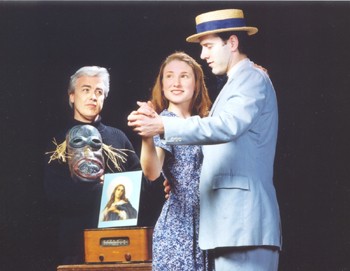
‘Big Love’

Photograph by Jeff Thomas

Fifty Brides for 50 Cousins: (l-r) Sigrid Sutter, Melissa Thompson, and Kelley Rose Anderson are forced into marriage.

Hearts of Darkness

‘Big Love’ offers grim view of gender war

By Patrick Sullivan

In Chekhov’s plays, it was the gun. If you saw a firearm lurking on the mantle in Act I, you knew it would go off by Act III. In Big Love, now at Actors Theatre, it’s the bubble bath–a big tub of soapy water sitting ominously in the middle of the stage. But here, we don’t wait long for the inevitable.

It takes a mere 30 seconds for Lydia (played by Sigrid Sutter) to burst through the door, strip off a wedding dress, and plunge into the waiting water. The punch line? It’s not her bath, it’s not her house, and it’s definitely not the hotel room she thought it was, as she learns when a resident of the house turns up to determine what a naked stranger is doing in the family bathtub.

As for the audience, it has just learned much of what it needs to know. For better or worse, Big Love was not written by the sort of playwright who worries about such questions as “Why would an apparently intelligent young woman mistake a private Italian villa for a hotel?” The song and dance numbers that follow confirm that gritty realism of the usual sort is not on offer here.

It’s easy to say what Big Love is not. Describing what it actually is amounts to a much tougher task. Playwright Charles Mee has taken one of the oldest surviving dramas in human history–Aeschylus’ Suppliants–and used it as a foundation for a surreal, disjointed, and disturbing exploration of the modern battle of the sexes.

The plot of Big Love isn’t too different from its source. After her splashy entrance, Lydia reveals that she is one of 50 sisters fleeing from the mother of all arranged marriages. The women–the audience only meets Lydia, Thyona (Melissa Thompson), and Olympia (Kelley Rose Anderson)–are supposed to wed 50 cousins, who are now in frantic pursuit of the wayward maidens. The sisters appeal to Piero (Joe Winkler), the villa’s owner, for protection. Piero dithers, the cousins arrive in force, and confusion and conflict ensue.

The cast, composed mainly of young actors, does a creditable job of bringing these characters to life. The three sisters are excellent, with Thompson standing out as the fierce Thyona, who promises to shed blood rather than surrender to her would-be husband. “This game isn’t over until someone lies on the ground with the flesh pulled off their bones,” she growls.

Patrick James Alparone is both compelling and appalling as Constantine, the militant leader of the suitors, who explains why he is unconcerned that his bride-to-be is not interested in marriage. “People are taken against their will every day,” he says. “Time itself is an act of rape.”

Director Paul Draper and choreographer Ann Woodhead keep these characters interacting and on the move. Woodhead’s dance numbers combine grace with a powerful emotional punch.

Big Love‘s big problem is how emotionally incoherent it proves to be. The playwright clearly wants his audience to think about the complicated compromises people must make to live in a world they never made. But a play about human relationships that revolves around forced marriage and rape makes nuanced feelings seem inane. We should probably be appalled when Thyona, facing imminent violation, proclaims, “These men should be snuffed out.” Instead, it’s hard not to want to reach up to the mantle and hand her the gun.

‘Big Love’ continues through Aug. 24 at Actors Theatre, LBC, 50 Mark West Springs Road, Santa Rosa. For details, call 707.523.4185.

From the July 31-August 6, 2003 issue of the North Bay Bohemian.

© Metro Publishing Inc.
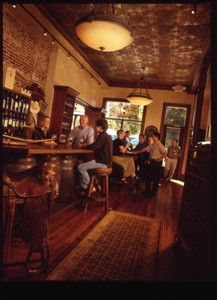
Gyudmed Tantric Monastery

Sands of Time: The monks' delicate sand mandalas will be an ongoing project throughout their stay in Napa.Strangers in a Strange LandMonks from the Gyudmed Tantric Monastery take residence in NapaBy M. V. WoodOn his first night in America, Lobsang Tsering, a Tibetan monk, sat by his tent on a hilltop and looked out over the Napa Valley. A...

Hamza El Din

Le Nubian: Hamza El Din's fans include the Kronos Quartet and Mickey Hart. Nubian NightsHamza El Din summons a sensuous world of soundBy Greg Cahill"I speak six languages and sometimes they all come out at once," apologizes Hamza El-Din as he struggles to find the words for "goodbye" after an interview at his San Leandro home.The whimsical moment of...

CHP Domestic Violence Case

Our Boys in BeigePurple Berets charge cover up in CHP domestic violence caseBy Stephanie HillerThe few drivers moving along Labath Avenue in Rohnert Park on a quiet Saturday afternoon were surprised to see some 50 women and men picketing the offices of the California Highway Patrol. Behind the speakers was a big sign identifying the Purple Berets as "Turning...

Open Mic

Go West, Old ManShepherd Bliss says farewell to Sonoma CountyBy Shepherd BlissI used to think Hawaii was a place you won in a game show, where honeymooners drank piña coladas in a perpetual sunset, and rich tourists got sun-baked. Certainly not a place where this writer-farmer-teacher belonged or could make a home. I was wrong.Visiting Hawaii never occurred to...

Movies in the Park

Photograph by Rory McNamaraFilm Forum: Lisa Sides (left) and Robin Harigan saw the need for a community-oriented film night, and filled it.Star GazingPetaluma's new Movies in the Park mixes cinema and music under a wide open sky It's been decades since Petaluma had its own drive-in movie theater and at least two years since the last remaining indoor...

Sunflower Gardens

Photograph by Andrea JolicoeurGarden Therapy: Kids from the Family Support Center enjoy the fruits of the garden--after a little work.How a Garden GrowsAn empty lot is transformed into Sunflower GardensBy Ellen BichelerBefore the garden, this piece of land reminded me of a scene out of wartime Beirut," says Mike Turley, neighbor and site operator of the Catholic Charities Homeless...

Napa Valley Opera House

Fundraising efforts have gathered within $500,000 of the $14 million goal. Once the final funds are secured, the addition of a balcony to the green room will begin. Work on the interior space was started in 2000; a number of benefits were staged before the theater was finished--including this one, staged without the theater's back wall. The main hall...

Hot Dogs

Photograph by Michael AmslerHappiness Is a Warm Bun: Ralph Morgenbesser of Ralph's Santa Rosa Subs and Ralph's Courthouse Classics serves up classic dogs.Hot Dog!In search of an American classicBy Sara BirIn terms of respect, hot dogs are underdogs, perceived as kid food, junk food, the final destination of all pig and cow (and God knows what else) parts deemed...

John Jenkel

Photograph by Michael AmslerHighway Politics: John Jenkel's signs have become commonplace around Sonoma County, especially on his ranch in Sebastopol.Sign LanguageConspiracy theorist John Jenkel isn't subtle in his antiestablishment activism, and he's not making many friends (unless he's paying them)By Joy LanzendorferI don't need directions to John Jenkel's ranch. I, like many in Sonoma County, know exactly where he...

‘Big Love’

Photograph by Jeff ThomasFifty Brides for 50 Cousins: (l-r) Sigrid Sutter, Melissa Thompson, and Kelley Rose Anderson are forced into marriage.Hearts of Darkness'Big Love' offers grim view of gender war By Patrick SullivanIn Chekhov's plays, it was the gun. If you saw a firearm lurking on the mantle in Act I, you knew it would go off by Act...
11,084FansLike
4,446FollowersFollow
6,928FollowersFollow