‘Queer Theory’

Photograph By Jeff Thomas

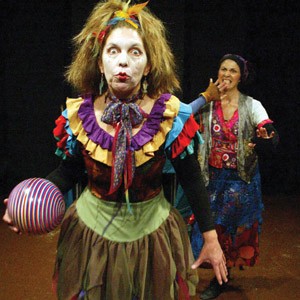
Odd Couple: Laura Jorgensen (left) and Elly Lichenstein tussle in ‘Queer Theory.’

Comedy of Errors

Petaluma’s Cinnabar Theater presents John O’Keefe’s world premiere, ‘Queer Theory’

Bay Area playwright John O’Keefe has a proven knack for creating intelligent, offbeat, gorgeously dialogued plays with provocative titles that are ripe with potential double-meaning: Spook, Glamour, All Night Long and especially his newest work, Queer Theory.

“The title, Queer Theory, is a double-entendre,” explains O’Keefe, speaking on the phone from his San Francisco home. “‘Queer theory’ is a term that came into popularity in the 1980s. It has, to a certain degree, to do with the content of gender studies programs in the university system. Queer theory is a branch of gender studies that proposes that the sexual identity of someone is partially or wholly socially constructed–which I think is a crock.

“But to a great deal,” he continues, “the other aspect of [the play] Queer Theory is that it’s also about queer people, by which I mean weird people, strange people, geeks. This show is more about the people than it is about their theories.”

The two-actor play–which had its official world premiere last weekend at the Cinnabar Theater in Petaluma, the first in a four-weekend run–is O’Keefe’s attempt to reconcile the basic political and cultural differences between two women in their 50s. One, Anne Ingersol (played by Laura Jorgensen) is a grain-elevator operator from Iowa. She never had a college education, and she’s been living on a farm with her husband, raising two kids she never really wanted. “She thinks babies look like Martians, but then she went and had two of them,” O’Keefe says.

The other woman is Rebecca Walsh (Elly Lichenstein), a gender theorist and college professor who happens to be lesbian, and who’s been living in a very privileged environment. “As a high-profile academic and gender theorist,” O’Keefe says, “she basically has the same attitude as a Calvinist preacher, except that she has different issues to fire her bullets at.”

In Queer Theory, O’Keefe throws the two women together as accidental roommates in a small cottage in England, near the birthplace of the famous Victorian-novel-writing Brontë sisters, Emily, Charlotte and Anne. Each woman has come to the Brontë’s Haworth Parsonage for her own mysterious reasons, and the resulting culture clash between O’Keefe’s off-kilter odd couple provides much of the drama and humor of the play.

“I’m hoping it’s kind of funny,” O’Keefe says with a laugh, “though this was a difficult one to write. There are so many hot-button issues. It felt like I was writing it in my own blood at times. In this play, I try not to get terribly involved in the digressive issues of whether queer theory is right or wrong, just or unjust. Basically, I just wanted to play with the issues of two people coming from different classes who are basically the same age and the same race. So it’s kind of fun. The whole idea is to bring a reconciliation between the two, and fooling around with these different positions.”

O’Keefe, 64, has written or directed over 40 plays and screenplays. Born in Iowa, he began doing theater work while attending Iowa University in 1968. A founding member of the Berkeley-based improv company known as the Blake Street Hawkeyes (the group that produced George Coates and Whoopi Goldberg), O’Keefe has gone on to build successful collaborative relationships with the experimental Iowa Theater Lab, San Francisco’s Magic Theatre, the Undermain Theater in Dallas and the Odyssey Theater in Los Angeles. Queer Theory marks O’Keefe’s fourth consecutive world premiere (after Glamour, Spook and Crystal Night, which became Times Like These) at the Cinnabar Theater, a house he’s come to appreciate and rely on.

“They give me a first-class production and all the freedom and resources I need to create the show I see in my mind,” he says. “It helps that they’ve got a great well of amazing actors to draw on, and a lighting and set designer [Aloysha Klebe] who is just amazing and very, very experienced. They are all so hard-working, the people at Cinnabar, and I respect that. It’s a great theater at which to launch a play. Every one of the plays I’ve premiered at Cinnabar has moved on to theaters all around the country.”

Times Like These, which premiered at the Cinnabar in 2002, went on to have an extended run at Odyssey Theater in Los Angeles and won several awards including the Los Angeles Drama Critics Circle Award for best playwriting. The Cinnabar world premiere of Queer Theory is the subject of an upcoming segment on KQED’s popular Sparks television series, to air on Wednesday, June 2, at 7:30pm.

An equal-opportunity playwright, O’Keefe says that Queer Theory makes as many jabs at segments of the progressive left as it does at the conservative right. “I’ve lived in the Bay Area since 1972,” he says, “and, I’m sorry, but a lot of people are kind of ‘holier than thou’ on the left. I come from very poor trash, as an Iowa kid in juvenile homes, so it isn’t like I was a white privileged male who has an easy time hanging out with left wingers. I don’t have a knee-jerk liberal reaction to any of these issues I’m writing about. Like many Iowa people, I am very independent in my choices.

“It’s very bothersome and disturbing that the left is so sanctimonious,” he continues. “It does not criticize itself whatsoever–though of course, the right doesn’t do that either. I suppose I’m trying to bring about a turnabout of the left, so that it can be better prepared to fight off the right.”

While such remarks might make Queer Theory seem important and “serious,” O’Keefe wants it made clear that his latest work is a comedy. “Though I suppose it’s a dangerous thing to say your play is a comedy,” he adds, “because if no one laughs, then it’s like, ‘Well, that was a bomb.’ And I can’t even say it’s a dark comedy because I don’t really write dark things. It’s ultimately an uplifting show–except,” he chuckles, “for really, really homophobic people.”

Cinnabar Theater’s world premiere of ‘Queer Theory’ runs Friday-Sunday through June 19. Friday-Saturday at 8pm; Sunday at 2pm. $16-$18. ‘Queer Theory’ is not appropriate for ages under 16. 3333 Petaluma Blvd. N., Petaluma. 707.763.8920.

From the June 2-8, 2004 issue of the North Bay Bohemian.

© Metro Publishing Inc.

Carbo-Loading

0

Photograph by Pablo C. Leites

Loaves and Wishes: A young customer dreams over loaves at Freestone’s Wild Flour Bakery.

Baker’s Dozen

Carbo-loading around the North Bay’s sweetest spots

By Heather Irwin

There’s always a crowd in the morning. Bleary-eyed and hungry, we congregate around warm coffee and a newspaper, in pure joy as frosting dribbles down our fingers. Licking fingers is permitted among friends and the gossip is always fresh.

Starting in Penngrove and winding our way around Sonoma, Napa and Marin, we gate-crash local coffee klatches and reveal the most soul-satisfying breads and pastries baking in the North Bay.

Atkins be damned.

Stop one: Full Circle Baking Company, Penngrove

Keith Giusto is a flour fanatic. He lives, breathes and dreams about the stuff, as you quickly realize when he starts talking passionately about his personal legion of wheat farmers. The photo album of his agricultural buddies only reinforces the notion that this is a man on a singular mission: to bake bread.

Part-owner of one of the largest organic grain mills in the West (located in Logan, Utah), Giusto is totally invested in his bread, from the germination of specially selected wheat varieties to his 15-year-old Zinfandel grape sourdough starter. The third generation baker and flour producer recently broke with his South San Francisco family to start his own bread-baking company in Penngrove. Though Giusto says it was fairly amicable, he describes himself as an artist who couldn’t worry more about the bottom line than he could about his beloved bread.

Giusto bakes fresh loaves every morning using flours created to his exact specifications. But the loaf to covet is his crispy, crunchy sourdough, which won a James Beard Award in 1996–sort of like the Academy Award of food. Though Giusto also sells on Wednesday and Saturday at the Santa Rosa farmers market, his Penngrove bakery and deli offers Italian meats and sandwiches. Our favorite was a crunchy baguette of sourdough with imported olive oil, balsamic vinegar, fresh mozzarella and basil.

Think you can bake like the pros? Giusto is glad to share his flour–just bring your own bag and prepare to be in the company of such devotees as Acme Breads, Amy’s and Whole Foods. Full Circle Baking Company, 10151 Main St., Penngrove. 707.794.9445.

Stop two: Ginger Bread Haus, Cotati

Just down the road, Alexandra Davison recently opened her first bakery, which features only “sweet stuff,” as she describes it. This is the place for special-order cakes–exotic flavors like the Scandinavian princess cake filled with raspberry, custard and whipped cream; a Moroccan pound cake with raisins, nuts and cinnamon; or a German bee sting cake with sugar and buttered almonds. Her cakes are mostly made to order, and she’s always up for a challenge. Davison bakes up scones and sweet rolls herself each morning, and offers an international selection of afternoon tea menus by reservation. Ginger Bread Haus, 8274 Old Redwood Hwy., Cotati. 707.665.9068.

Stop three: Cafe des Croissants, Rohnert Park

A gigantic box of walnut croissants has been a staple at every family get-together since I was a teenager. The men folk wake up early, start a pot of coffee and hunt down a hefty dozen of these gut-busters, filled with chopped walnuts and gently glazed on top. These big, burly, buttery treats are just about as close to orgasmic as one might want to get at a family reunion. Cafe des Croissants, 101 Golf Course Drive, Rohnert Park. 707.585.6185.

Stop four: The Village Bakery, Sebastopol

The little chocolate biskvie was calling my name. Unfortunately, the 10:45am coffee rush overwhelmed the staff and my biskvie–a chocolate and peanut butter confection demurely housed at the bottom of the pastry case–would have to wait. “Who invited all you people?” demanded the woman behind the counter, as the hungry crowd demanded gooey, buttery Danish pastries and hefty rye bread that could double as weight-training equipment.

The heavily trafficked Village Bakery adds a touch of Scandinavia to spice up usually ho-hum cookies with exotic spices like cardamom, ginger and cinnamon. “These got me through two pregnancies,” says one customer, looking longingly at the fruit-topped Danish and orange frosted buns. For those unable to wrap their tongues around a good smørrebrød, there are plenty of excellent sourdoughs and baguettes as well. In all the madness, I left with only a lemon-cornbread cookie and an ultimate macaroon, barely sating my hunger for the next seven miles. Village Bakery, 7225 Healdsburg Ave., Sebastopol. 707.829.8101.

Stop five: Wild Flour Bread, Freestone

We’ve lauded the organic, brick-oven-baked praises of Wild Flour before, and we’ll do it again. This off-the-beaten-path bakery turns out some of the heartiest and most flavorful breads in the North Bay, chock-full of cheese, herbs and fruit. Though the cinnamon sticky buns are among the most popular, we still love the fougasse. Just don’t try to get any warm buns during the week. The oft-shuttered bakery only turns out warm loaves to the public Friday through Monday. Wild Flour Bread, 140 Bohemian Hwy., Freestone. 707.874.2938.

Stop six: Downtown Bakery & Creamery, Healdsburg

Sitting outside Healdsburg’s most popular bakery, the steam from my double latte escapes its cardboard cup and swirls into the air. Pulling a crispy rosemary pizzetta from a bag dotted with olive oil and savoring the salty, herbaceous round in my hand, I’m reminded why being a food writer is so damn great. And who can resist an old-fashioned screen door that slams shut as you step inside? Resist the temptation to yell, “Mom! I’m hoooooome.” Downtown Bakery and Creamery, 308 Center St., Healdsburg. 707.431.2719.

Stop seven: Model Bakery, St. Helena

This little bakery is the hub of the town, serving up fresh, hot loaves from its brick ovens just about every morning. Locals swear it’s the very best bread for miles as they sip their morning coffee and watch the world go by. Model Bakery, 1357 Main St., St. Helena. 707.963.9731.

Stop eight: Bouchon Bakery, Yountville

You’ve never tasted a Napoleon quite so fabulous: rich, creamy layers of caramel cream separate crunchy layers of nougaty wafer and whipped cream. Trying to eat this in the car was quite nearly fatal. Let out your inner Gaul while nibbling on a jambon buerre, a skinny baguette smeared with butter and stuffed with ham and Gruyère cheese. Owned by the famed chef Thomas Keller, this Yountville takeout may be the closest an average human gets to the Laundry. Bouchon Bakery, 6528 Washington St., Yountville. 707.944.BAKE.

Stop nine: Sweetie Pies, Napa

My favorites are not so much pies as tiny, adorable cakes. Just about three inches in diameter, these pocket-sized confections are so beautiful it seems a shame to eat them. I’m over it, though, as I munch through two. The best of the best: the marjolaine ($6.75 for the individual size), a pint-sized cake layered with chocolate-praline butter cream, pralines, chocolate mousse and a chocolate glaze. Sweetie Pies, 525 Main St., Napa. 707.257.8817.

Stop 10: Basque Boulangerie, Sonoma

The line starts, oh, somewhere back near the door most mornings. Town so-and-so’s congregate for the latest gossip, a cup of push and a morning pastry. Frankly, we find the conversation better than the sweet stuff here, but being seen at the scene is a Sonoma tradition. Basque Boulangerie, 460 First St. E., Sonoma. 707.935.7687.

Stop 11: Artisan Bakers, Sonoma

Don’t let the fact that it’s been bought by Boudin keep you away. Artisan Bakers has maintained its stellar quality, cranking out some of the tastiest breads in Sonoma. This is a favorite prewinery picnic stop, featuring creations like the poached pear and blue-cheese sandwich and tomato-basil soup. An all-time favorite is the candied lemon scone–a buttery, creamy scone infused with candied lemon peel. Artisan Bakers, 750 W. Napa St., Sonoma. 707.939.1765.

Stop 12: Karina’s Mexican Bakery, Petaluma

As the lone gringa in this Latino sweet shop, it seemed best to simply point and smile at the case of enormous pastries before me. Churros are just the start. Piled high are Mexican doughnuts, fruit-topped buns, cream-filled rolls and pan fiña, sweet Mexican bread. 827 Petaluma Blvd. N., Petaluma. 707.765.2772.

Stop 13: Bovine Bakery, Pt. Reyes Station

A screen door swings open to a waft of warm, yeasty air. Just past the couple parked on the bench, the bikers java-ing up (Bovine is an espresso-free zone) and the patient dogs parked outside, is a cozy cup of a room, filled with crunchy, wholesome breads and pastries. This is energy food, with lots of sprouted grains and granola, along with just plain loads of butter in the chive and cheese croissants (our favorite). Bovine Bakery, 11315 State Route 1, Pt. Reyes Station. 415.663.9420.

From the June 2-8, 2004 issue of the North Bay Bohemian.

© Metro Publishing Inc.

Buck Institute

0

Bucking Old Age

Research at Novato’s Buck Institute may lead to anti-aging pill

By Joy Lanzendorfer

It sits on top of a hill like a Greek temple above Novato. The scientists who work there research anti-aging, an area of science that conjures images of regeneration chambers and magic serums. It’s the only facility of its kind in the United States and only one of three of its kind in the world, yet few people understand exactly what the Buck Institute does.

Driving up the long hill to the Buck Institute, security gates and signs warn against trespassing. Buck invested in these measures not to protect secret experiments but as a response to skateboarders and other curiosity seekers who were drawn to the building’s prime location. The mystique is enhanced by the main building, a half-rectangular, half-circular creation spliced by a giant triangle. I. M. Pei, the architect who designed the controversial pyramid in the Louvre, built the Buck Institute. It’s no surprise people wonder about this place.

“There is definitely an impression with the public that the scientists are doing something up on the hill, something behind closed doors,” says Buck Institute CEO Dale Bredesen, Md. “Shortly after Buck first formed, I was walking my dog in the park below and a woman pointed up to the institute and said to me, ‘You know, they are torturing primates up there.'”

The Buck Institute was founded in 1999 by the Leonard and Beryl Buck Foundation, which accounts for about one-third of the institute’s budget. The rest of the budget is primarily provided through grants. As an independent nonprofit, Buck is not involved in drug research or any other commercial development, though it has begun to license its research to biotech companies.

The institute’s focus is on good old-fashioned scientific research. But no torturing of primates goes on. Mice, and much simpler creatures, like the microscopic nematode worm, are the preferred specimens for the Buck’s three main areas of research: studying age-related diseases such as Alzheimer’s and Parkinson’s (last December a Buck study reported that a diseased brain may try to heal itself by growing new nerve cells, a possible breakthrough for treating Alzheimer’s); investigating the aging process itself; and researching such technologies as genomics that support the first two areas.

In June, Buck will open a new lab under scientist Pankaj Kapahi, studying the effects of caloric restriction on the life span of fruit flies. Scientists have found that for many species, cutting calories of a diet to as little as two-thirds the normal intake while still maintaining essential nutrients tends to increase the creature’s life span. The process is called “under-nutrition.”

“The evidence shows that when keeping with good nutrition, restricting eating may lead to a longer life,” says Bredesen. “Kapahi is actually weighing little fruit flies to see the effect of their diet.”

For example, cutting 30 percent of calories from the diet of rats increased their life span by 30 percent. The same animals tested under caloric restriction also get age-related ailments like cardiovascular disease or cancer much later in life than is normal for that species.

The work of Gordon Lithgow, another Buck Institute scientist, examines aging in nematode worms. One aspect of his research shows the effect of oxidative stress on cells. Last year, Lithgow linked a stress-management protein found in a mutant strain of genes to longevity in worms. The worms that had this strain lived 70 percent longer than other worms.

Some scientists have linked caloric reduction and oxidative stress together, suggesting that caloric reduction leads to less oxidative stress, and thus longer life spans.

While there’s obviously huge differences between worms and humans, Lithgow believes it’s fair to consider the implications of his research for people.

“When I first got into this, I thought studying worms was an interesting biological problem, but not something you can apply to human beings,” he says. “But it turns out it is connected. First of all, worms share many of our genes, so we are really more similar than anyone thought. Secondly, aging in a worm is remarkably similar to aging in people.”

The application of these and other experiments may lead to an anti-aging drug. It may sound like science fiction, but scientists believe they are only 10 years away from a pill that would slow the aging process. A person who took this pill throughout his or her lifetime might look and act 40 at 60.

“The chances of it happening are very high,” says Bredesen. “Look at just the genetic manipulations alone. We already have worms that are living six times as long–that’s a 400-year-old worm. An anti-aging pill is extremely feasible.”

Currently, of course, there is no single drug compound proven to lengthen the human lifespan, even though the average spam-filled e-mail box may seem to say otherwise. Every day, someone new seems to be offering a new magic cure to slow aging.

The proliferation of anti-aging pseudo-science has alarmed the scientists at Buck.

“It’s completely understandable,” says Lithgow. “You have the scientists on their white palace on the hill telling you one thing and all these voices of commerce telling you another. The confusion among people about anti-aging is almost palpable.”

From the June 2-8, 2004 issue of the North Bay Bohemian.

© Metro Publishing Inc.
J Mascis

0

Different Kind of Jewel: J Mascis was made to love from afar.

Why I Didn’t Talk to J

A faraway love song to J Mascis

By Sara Bir

If things had played out differently, you’d be reading a Jewel interview in this space right now. That’s right, we turned down an interview with Jewel–you know, Jewel, who sang that one song about being sad and wearing pajamas. Um . . . “You Were Meant for Me”? Yeah.

Instead, you get a complete lack of an interview with J Mascis, late of the highly influential proto-grunge band Dinosaur Jr., currently ringleader of J Mascis and the Fog and occasionally busting out a solo thingy every now and then.

J, whose long, flowing “Cousin It” locks have turned a shade or two grayer since Dinosaur Jr.’s late-’80s-early-’90s heyday, is famously laconic in interviews. It’s almost as if he reserves his expressiveness for his soaring guitar solos, which tread a blissfully fine line between easygoing and vengefully shredding.

Interviewing Jewel would be comparatively easy. I saw her on David Letterman once, and she seemed pretty nice. The problem is that no one I talked to cared. At a recent party, I tried to impress everyone with my big-time rock-journalist connections. “Say,” I slyly dropped, “I might be interviewing Jewel.”

The invariable response was, “Why?”

Someone, though, has to be a fan of VH1’s Alaskan queen of Lilith Fair Lite: tickets for her solo acoustic show at the Luther Burbank Center run $65 to $125 a pop. To those people, the chance to interview Jewel might be a big honking deal.

Which is exactly how I feel about interviewing J Mascis, who appears June 7 at the Mystic Theatre. Except that I’m not doing that, either.

The guy was made to love from afar. His typical noncommittal response in most printed interviews runs something like, “I’m not sure, whatever riffs come out” or “I just kind of play guitar and wait for something to come.” He seems like a much cooler person to run into in the airport, in which case I could try and impress a whole bunch of people at another party by saying, “I saw J Mascis the other day!”

And they’d say, “Who?”

No matter. Enough people know J Mascis is God that a number of websites trade bootlegs of his live shows and keep track of the set lists–and it’s not all because they are unequivocally devoted to J’s back catalogue of Dinosaur Jr. nuggets.

Formed in Amherst, Mass., in the early ’80s from the disparate ends of quasi hardcore band Deep Wound, Dinosaur (the Jr. came later) originally featured J and Lou Barlow. Eventually, the bad mojo between the two prompted Barlow’s departure in 1989, Barlow pouring the resulting resentment into all of those tasty manic-depressive songs that came with his successive band, Sebadoh.

Driven by J’s nasal, affably indifferent vocals and free-flowing indie-jam guitar solos, Dinosaur Jr. released a string of albums throughout the ’90s and left a mighty wake in the alternative-rock underground. There’s a terrific bit in Dave Markey’s documentary 1991: The Year Punk Broke where a zillion Europeans sing along in complete rapture to the slacker love anthem “Freak Scene,” as Dinosaur Jr. plays one of those massive outdoor festivals. It’s a rare snippet of a transcendent rock moment, the kind that every rabid fan seeks in every live show of every band she adores.

And that is why I never, ever want to speak to J Mascis in a journalistic context. I want to love him for his gross long hair and slovenly T-shirts and big, weird sneakers and all of the rumors that he dated Uma Thurman (not true!) and the chance of experiencing my own sliver of rock transcendence.

The dude is still at it, plugging away at live shows and assorted affiliations, jamming with members of the Stooges, skydiving, playing the drummer of a band in filmmaker Allison Anders’ current project, smoking pot with pal Kevin Shields of My Bloody Valentine. J’s albums since 2000 haven’t presented us with anything too new, but maybe that’s not the point. He’s here, which is enough.

And I bet that’s how Jewel’s fans feel, too.

J Mascis and the Fog play the Mystic Theatre on Monday, June 7, at 8pm. All Night Radio open. 23 Petaluma Blvd. N., Petaluma. $15. 707.765.2121.

From the June 2-8, 2004 issue of the North Bay Bohemian.

© Metro Publishing Inc.
Charles Lloyd

0

Bel Canto: Saxophonist Charles Lloyd says that he and colleague Billy Higgins ‘were deeply in service’ to art.

Billie’s Bounce

Jazz great Charles Lloyd pays tribute to a friend

By Greg Cahill

Ask jazz saxophonist and flutist Charles Lloyd to comment on the creativity that has driven his music for five decades, and he’ll offer a response that’s both enigmatic and profound. “I’m a musician by nature. Show-biz heaven is never what called me,” he says. “The music has always moved me and I feel blessed to have a song to sing. This world, as you know, is a dog’s curly tail, and [longtime friend and drummer Billy] Higgins and I were deeply in service.

“It’s the last night of the play–whether they boo or applaud, the song must be sung.”

The depth of that commitment can be heard on Which Way Is East, a new double-CD that captures Lloyd and Higgins just 12 weeks before the drummer’s untimely death three years ago from liver failure. Lloyd will pay tribute to his late friend at the upcoming sixth annual Healdsburg Jazz Festival (Higgins was a frequent guest at the North Bay event during its formative years).

One listen to Which Way Is East–which features Lloyd’s fluid sax and flute lines with Higgins’ performances on trap drums, berimbau and even acoustic guitar–is enough to underscore the special relationship between these two jazz greats.

Lloyd recalls, “Billy and I met when I was 18 and he was 19. We were friends and played gigs together in L.A., and then he left to go to New York with Ornette [Coleman]. I went later, in 1961. We would see each other in New York, but we didn’t play together again until 1993. It was instantly clear that we had both been through a lot, we had both cleaned up [from substance abuse] and we still loved to make music more than anything. From then on, our friendship and relationship on the bandstand became tighter and tighter.”

Higgins dazzled fans and colleagues alike with his extraordinary talent and his youthful exuberance. “His spirit was so undiluted,” Lloyd explains. “He was the music, no matter who he played with. As jazz critic Stanley Crouch so aptly put it, ‘Billy gives you a tailor-made suit no matter what.’ He had the ability to make anyone sound great. More specifically, his swing was out of this world, his subtlety and nuance, his élan. Billy always said that he and I had an inside thing, which lent itself to open explorations.”

For the final sessions, Lloyd set up borrowed recording equipment in the living room of his house and dusted off the same sax he’d been playing when the two first met as teens. “The music flowed like a river to the sea.”

In the decades between those meetings, Lloyd established himself as an innovator who helped usher in the world-music movement. During the 1960s, he worked as a sideman with the Chico Hamilton and Cannonball Adderley bands. In 1966, Lloyd made his debut as a leader, releasing Forest Flower and performing (and recording) a breakthrough set at the Monterey Jazz Festival in a band that featured a then-unknown piano whiz named Keith Jarrett.

“We were young and fearless,” Lloyd remembers. “It was a different time–the world at large was really open to new experiences. There was a lot of cross-pollination on radio, and that year we performed at Monterey. Things were in a rapid upward trajectory. We were just playing and loving every moment of it.”

Lloyd’s fame grew and he went on to open eclectic bills for Jimi Hendrix, the Grateful Dead and other acts of the psychedelic-rock era. But Lloyd startled fans by retreating from the music scene for most of the ’70s. He was sidelined with illness, spent time at the Big Sur artists’ retreat studying Eastern religions and reemerged in 1996 with the critically acclaimed album Canto, followed in 1998 by the Higgins collaboration The Water Is Wide.

But accolades meant little. “I’m always looking for my voice as an artist, and still finding it,” he says of his ongoing quest. “My voice has always been there, but as the interior work intensifies and deepens, you can hear it in my tone and expression.”

These days, Higgins is still on his mind, even as Lloyd stretches out into new musical terrain. “For me, because we were so close and so in tune with each other,” he says, “playing with Billy was effortless. It was flight. But I am now opening a new chapter, being able to make music with [former Marin percussionist] Zakir Hussain, which is an incredible experience. He comes from a tradition of tabla playing that goes back centuries. His father, Ustad Alla Rakha, was one of the baddest cats on the planet, and so is Zakir. Playing tabla and dancing with rhythm is in his DNA. But on top of that, he can swing in the most musical and effortless way.

“So he and Higgins have that in common–and the letter h.”

Charles Lloyd and percussionist Zakir Hussain perform a tribute to Billy Higgins on Saturday, June 12, at the Raven Theater as part of the Healdsburg Jazz Festival. 115 North St., Healdsburg. 8pm. $28-$45. The Healdsburg Jazz Festival runs Saturday, June 5, through Sunday, June 13. Other featured performers include the Geri Allen Trio and Fred Hersch (June 11); the John Heard Trio (June 11-12); the Carmen Lundy Quartet (June 12); and the Roy Haynes Group with Kenny Garrett and Frank Morgan Quartet (June 13). For complete details on all events, call 707.433.4644 or go to www.healdsburgjazzfestival.com.

From the June 2-8, 2004 issue of the North Bay Bohemian.

© Metro Publishing Inc.

Los Lobos

0

Buy one of the following Los Lobos CDs from amazon.com:

‘Del Este de Los Angeles (Just Another Band from East L.A.)’ (1978)

‘How Will the Wolf Survive?’ (1984)

‘By the Light of the Moon’ (1987)

‘La Pistola y El Corazon’ (1988)

‘The Neighborhood’ (1990)

‘Kiko’ (1992)

‘Just Another Band from East L.A.: A Collection’ (1993)

‘Papa’s Dream’ (1995)

‘Desperado: The Soundtrack’ (1995)

‘Colossal Head’ (1996)

‘This Time’ (1999)

‘El Cancionero: Mas y Mas’ (2000)

‘Good Morning Aztlán’ (2002)

‘The Ride’ (2004)

Born To ‘Ride’: Los Lobos return to what they do best.

Wolf at the Door

Los Lobos stage a strong return to form

By Greg Cahill

A cold, wind-whipped rain made for lousy driving that stormy Tuesday night as I cruised to Uncle Charlie’s, a popular but now defunct nightclub tucked into a nondescript Corte Madera strip mall. A few minutes earlier I had been high and dry, sequestered comfortably on the couch in the living room of my Fairfax apartment. The phone call from the manager at Uncle Charlie’s roused me from my pipe dreams.

“You gotta get down here tonight to catch these guys,” she enthused. “The band’s name is Los Lobos. They’re from East L.A., and believe me, they’re gonna be big some day.”

As it turned out, I was one of only two dozen people who saw Los Lobos that night at their North Bay debut 20 years ago. During a preshow interview in the tiny dressing room, guitarist and singer David Hidalgo passed a silver flask of whiskey that he kept tucked into his vest pocket. After a blistering set, the band lived up to the club manager’s promise.

Los Lobos went on to be big, indeed, garnering Grammys and gold records and a reputation as one of the tightest live acts in the industry.

Over the years, I’ve caught Los Lobos on numerous occasions and count many of those concerts as among the best I’ve ever seen, but I have to confess to walking out on their show at the Mystic Theatre last year. That night the band were sloppy, excessively loud and prone to longwinded instrumental jams, never their strong suit.

So it’s satisfying to discover that Los Lobos have reined in their excesses on the newly released album The Ride, arguably the band’s strongest recording in a decade. The Ride features an all-star cast of guest artists–including Dave Alvin, Richard Thompson, Elvis Costello, Tom Waits, Café Tacuba, Bobby Womack, Garth Hudson and Ruben Blades–playing on a handful of new original songs and reinvented favorites.

The band members produced this follow-up to 2002’s acclaimed Good Morning Aztlán, cloaking these songs in a richly textured array of musical styles, from ’50s-style rock and roll, funk and an ethereal Beatlesque production to jazz, salsa and rock en español.

But despite the eclectic approach, these recordings bond remarkably well under the influence of Los Lobos’ patented norteño-inflected border rock. The songs run the gamut from the opening “La Venganza de los Pelados,” a rock en español number that features the Mexican hipsters Café Tacuba, to the swampy New Orleans-style hoodoo of “Charmed”; from Tom Waits’ sassy Latin-soul duet with Quetzal singer and percussionist Martha Gonzales to Elvis Costello’s piano-ballad treatment of the plaintive “A Matter of Time,” first recorded on Los Lobos’ 1984 breakthrough album How Will the Wolf Survive? On the wistful “Somewhere in Time,” on which Dave Alvin croons in his deep baritone, there is a sense that Los Lobos have dug deep to regain the soulfulness that first infused the Latin-flavored roots music that made them one of the top rock acts of the ’80s and early ’90s.

On the remake of “Is This All There Is?” the band finally get to pay homage to one of their spiritual predecessors, as vocalist Little Willie G., of the seminal East L.A. Latin-rock band the Thee Midnighters, lends his woefully underrated brown-eyed soul to this song from the 1987 album By the Light of the Moon.

For a band that once reinvented itself through bold experimentation to now revitalize itself by staging such a stunning return to form should stand this year as one of pop music’s most impressive achievements.

Los Lobos return Friday, May 28, to the Mystic Theatre, 21 Petaluma Blvd. N., Petaluma. 8pm. $32. Jeffrey Halford and the Healers open the show. 707.765.2121.

Spin Du Jour

Jerry Garcia, All Good Things: The Jerry Garcia Studio Sessions (Rhino)

Jerry Garcia’s solo albums never generated as much heat as the Grateful Dead’s recorded oeuvre, and there’s little chance that this meticulously packaged six-CD box set will win any new listeners. But diehard fans won’t be disappointed by the ample bonus tracks (though those aren’t always revelatory) that augment Garcia’s five solo works, or the sixth disc of previously unreleased tracks, or the gorgeously crafted 130-page booklet, chock-full of photos, essays and discography.

As with the recent Dead reissues, these discs are digitally remastered and presented in high-definition sound. While Garcia’s solo work was wildly uneven, casual fans may want to look for individual volumes to hit the stores later this year–the guitarist’s 1972’s self-titled solo debut, which featured “Sugaree” and “The Wheel” is a must-have, since it serves as a mate to Workingman’s Dead and American Beauty, perhaps the Dead’s best works.

–G.C.

From the May 26-June 1, 2004 issue of the North Bay Bohemian.

© Metro Publishing Inc.

Medicare

0

Bad Medicine

Seniors turn to Canada as new Medicare bill fails to deliver

By Ellen Bicheler

Jewel Coccellato, 75, pays more than $200 per month for glaucoma, asthma and eczema medications. Diagnosed with high cholesterol, she now needs the prescription drug Zocar as well. Like many seniors living on a fixed income, the Sebastopol retiree can’t afford it. “It’s $93 more a month,” she complains. “I’ve been trying to cut back on my other medications to make them last longer.”

It wasn’t supposed to be like this. In his state of the union address in January, President George W. Bush promised that “most seniors can expect to see their drug bills cut in half,” thanks to the Republican-crafted Medicare Prescription Drug, Improvement and Modernization Act the president had signed into law the previous month. The legislation, which doesn’t take full effect until 2006, has since come under heavy criticism after it was revealed that Bush administration officials knowingly underestimated the bill’s $400 billion cost over 10 years by as much as $200 billion.

But that’s news to most viewers of Medicare’s $80 million publicly funded ad campaign touting the new prescription-drug benefit. Slick TV commercials promise seniors that once it takes effect in 2006, the drug benefit will deliver substantial savings–a dubious claim, considering the falsified budget numbers. In the interim, seniors are encouraged to use Medicare discount cards, available in June, which are also said to yield a substantial savings. Everyone’s a winner, the ads seem to say.

“Not true,” says Congresswoman Lynn Woolsey, who represents residents of Sonoma and Marin counties. “The only winners of the Republican-sponsored Medicare bill are the insurance industry and pharmaceutical companies. Their victory is at the expense of American’s senior citizens, who have paid into the system their entire working lives. Instead of money going to provide a necessary prescription-drug benefit, taxpayers’ dollars are going to fill the pockets of the drug companies.”

An April 2004 study by the Minority Staff of the House Committee on Government Reform supports the claims of Woolsey and others that the Medicare legislation just doesn’t perform as advertised. The study found that a one-month supply of the 10 top selling drugs using the Medicare card cost as much as 60 percent more than did purchasing the same drugs from Canada and other foreign countries via the Internet.

Gloria Rosen of Santa Rosa, 81, has looked at all the choices and found the cheapest prices for her Lipitor and Previcid prescriptions in Canada. The new Medicare rules don’t allow such purchases, but for Rosen, the decision was a no-brainer: she’s running for the border. “It’s very simple,” she says, adding that she expects to save $500 a year by purchasing her prescriptions in Canada.

The American Association of Retired Persons (AARP), which strongly supported the new Medicare legislation, is now enduring a backlash from angry members. Woolsey led 85 congressional colleagues in resigning their AARP memberships to protest the organization’s support of the legislation. According to newspaper reports, more than 60,000 individuals have quit AARP, and many more are not renewing their memberships. The association did not return repeated phone calls from the Bohemian.

Petaluma resident Dr. John Shearer sent in his AARP resignation in a red envelope. He is adamant that the new Medicare law is “a political scheme to privatize Medicare. In 10 to 12 years,” he says, “Medicare will no longer be affordable.” He’s deeply concerned that “pharmaceutical companies are being given free reign with the prices.”

According to the Sonoma County Department of Health Services, there are more than 62,000 Sonoma County residents eligible for Medicare, about 13 percent of the population. Thanks to those fancy Medicare ads, many seniors might think they have no choice but to turn to the discount cards when they become available in June.

The card costs $30; free cards will be issued to individual recipients with incomes under $12,569 and couples with incomes under $16,892. Low-income participants are eligible for $600 in assistance annually. So far, the discount cards–offered by 49 different providers, each with its own separate rules and formularies–have generated no savings but plenty of confusion, according to Christine Tschummi, project director for the North Bay Health Insurance Counseling and Advocacy Program.

Rather than just sign up for the discount card, advocates such as Tschummi are advising seniors to “shop around and compare prices.” Shirlee Zane, executive director of the Sonoma County Council on Aging, offers the same advice, pointing seniors to the Senior Action Network (www.senioractionnetwork.org), a website featuring information on cheaper generic drugs and name-brand medications available from Canada.

Like many seniors who have shopped around for the cheapest prescription drugs, Jewel Coccellato isn’t buying the new Medicare discount card. She says her most affordable option remains buying drugs from Canada.

That appears to be true for many seniors and will undoubtedly continue to make the new Medicare bill a hard sell.

From the May 26-June 1, 2004 issue of the North Bay Bohemian.

© Metro Publishing Inc.

Marc Spitz

Meet Is Murder: Marc Spitz’s first novel remembers the awkward agonies of growing up when the Smiths were the center of the universe.

Son and Heir

Author Marc Spitz is human and needs to be loved

By Michael Houghton

We all know the feeling of a particular album “finding” us, making us feel less alone and reassuring us that we are not the only ones ever to have felt this way. Our teen years are almost defined by these signposts: this is the album I listened to after my first heartbreak; that is the album that taught me to be defiant. And for many of us, the feeling that music is at least near the center of our lives never entirely goes away. Music can still change the world–at least for the next 45 minutes.

Rarely has that sentiment been captured in more sincere, bitingly funny or vulnerable text than in How Soon Is Never (Three Rivers Press; $13), just released in paperback, the semiautobiographical first novel by Spin magazine senior writer Marc Spitz. It is the story of Joe Green, jaded rock critic about to turn 30, suffocated by his Peter Pan life of rock and roll excess and frighteningly unhappy.

Joe hits upon a crazy plan to bring meaning back to his loathsome life: using his big-shot journalistic clout, he’s going to reunite the band that was the center of his teenage life, the Smiths, and in the process save his own soul. Oh, and did I mention that there is an unattainable girl–Miki, a fellow employee at the fictional Headphones magazine–whom he’s roped into this pursuit?

About half of the book is devoted to the funny, painful, ecstatic and awkward romp through Joe’s young life growing up in the ’80s. Memories of current events and album releases are interspersed with a first kiss, spiked hair, discovering “art room” friends and laugh-out-loud moments, such as the one with Joe spending hours with a finger hovering over the record button to capture that special song from the radio. What Spitz does particularly well is show how all these things are earth-shatteringly, dead-center the most important things in his teenage world.

Once the progression of time brings us back to the present, the story picks up even more speed and Joe begins slowly transforming from the self-loathing, needing-a-good-kicking narrator of the introduction into the scarred but squishy heart of the story. As it becomes more and more obvious that his flailing pursuit of both Miki and the Smiths reunion is destined to fail, the rawness and immediacy of his real problem begin to creep in. Joe is finally realizing it’s time to leave the never-never land of prolonged adolescence and accept his impending adulthood–a second coming of age.

Sure, the writing doesn’t always succeed. Sure, children of the ’80s, particularly those who worshipped at the altar of the Smiths, are the most likely to really “get” this book. But there is more to How Soon Is Never than just nostalgia. Spitz’s novel is alternately sentimental, romantic, darkly hilarious and as honest as a too-revealing e-mail from a friend. And through this often exhausting depth of emotion, it succeeds in something else: it helps us to feel less alone, showing us that we’re not the only ones ever to have felt this way.

From the May 26-June 1, 2004 issue of the North Bay Bohemian.

© Metro Publishing Inc.

Napa Chef’s Market

0

Photograph by Bob Ecker

Triple Way: Charles Diegel’s barbecued oysters are cooked three different ways before serving.

Half-Shell Hero

Charles Diegel is Napa’s barbecued-oyster king

By Bob Ecker

The most important thing,” says Charles Diegel, “is to have a good glove.” And with that, using his heavy canvas glove and an old sturdy knife, Diegel expertly shucks a steaming oyster. The juices run out hot and clear, and he lays the oyster shell on the next grill to simmer.

Diegel is known around town as the “barbecued-oyster king,” whose unique, three-step cooking process has made his oysters legendary throughout Napa Valley. A familiar face at the Friday night Chef’s Market in downtown Napa, which begins this year on Friday, May 28, Diegel is used to customers lining up at the sight and smell of these marvelous mollusks. “The oysters sell themselves,” he laughs with a tidy wave of his gloved hand.

Most of the oysters Diegel sells come from Washington state, but any kind can be used. He prefers Pacific Coast and Miyagi oysters, though he didn’t even eat oysters himself until a few years ago, when a Samoan friend turned him on to the taste. “We started by cooking them in butter and garlic at first. It was great for people like me who were afraid of oysters.” His entire family learned to love them, and he even cooked thousands of oysters for his own wedding. Diegel explains his culinary philosophy: “I love to cook and eat, it’s a simple as that.”

The Napa Chef’s Market brings together many styles of food, but clearly Diegel’s stand is a hit with the crowd. “These oysters are amazing, really mouth-watering. I love the pesto,” says Tina Brite, who visited the Chef’s Market last year from nearby American Canyon. Diegel, along with his wife, Molly, and his father and father-in-law, usually sells over 700 oysters each Friday night. For a private event or gathering, Diegel estimates a dozen oysters per person.

His customers have a number of sauces to choose from, including teriyaki, butter and garlic, sesame soy, a homemade pesto, a barbecue sauce and special hot sauce. Depending on the sauce, Diegel suggests complementing the oysters with a Sauvignon Blanc or hearty Zinfandel. His father, Chuck, also known as the “Mother Shucker,” recommends cold beer to help wash down a passel of oysters.

Diegel utilizes a no-nonsense yet tried-and-true method for barbecuing his oysters. He employs three separate grills, each with a separate function. The first pops open the shell, the second is used for simmering the oysters and the third is where the sauces get blended into the oyster. “You can use any barbecue,” he says, “but the best bet is propane to control the heat.” The three-grill system, Diegel explains, helps keeps oyster shells from getting into the finished product. Indeed, it’s fun watching Diegel in action, as he effortlessly places, shucks, steams and sauces his oysters.

Keeping the grills clean is the toughest part of the job, according to Diegel. He’s always on the lookout for small pieces of oyster shells that can get into the burners. He also swears that oysters are, indeed, the ocean’s aphrodisiac. “It’s nature’s Viagra,” he says with a grin. (He and his wife have five children.)

Diegel is pleased that people enjoy his oysters, and has high hopes for the future. “I’d like to open a little restaurant one of these days, and of course, oysters will be a prominently featured item on the menu.”

You can’t miss the Diegel’s Barbecued Oyster stand at the Chef’s Market–it’s the one with the healthy line. However, don’t worry–the line does move, and the oysters are definitely worth a taste.

The Napa Chef’s Market is open each Friday evening through August from 4pm to 9pm. First Street and Napa Town Center, downtown Napa. Free. 707.257.0322.


Charles Diegel’s Three-Step Barbecue Process

1. Take the oysters straight from the cooler and put them directly on the first grill, on high heat. Close the cover. After three to five minutes, remove oysters from the grill, “whether they’ve popped open or not,” Diegel says. Using a strong glove and a knife, open the shells. Diegel uses a stiff, stainless steel knife and has also used bait knives to open the oysters. “Good, cheap knives are great for shucking,” he says. Cut the muscle on the oyster to release it from the upper portion of the shell.
2. Put remaining oysters in the bottom half-shell directly on the second grill, on medium heat. The oysters should gently bubble in a combination of seawater and their own juices, steaming slightly. This warming station gets them ready for the last stage. Leave on no more than 10 minutes.
3. This is the sauce stage. Put warm oysters in the half-shell directly on to third grill, on medium heat. Pour sauces over the oysters. When all the oysters have been sauced, close the cover. Cook for approximately five minutes. Remove from heat, serve and eat immediately.

Molly Diegel’s Pesto Sauce

basil leaves
1 1/2 c. extra virgin olive oil
10 cloves of fresh garlic, peeled
1/4 c. pine nuts
1/2 c. Parmesan cheese, grated
1 whole stick of softened butter

Begin with a blender full of fresh basil leaves. Add olive oil and blend until well mixed. Next, add garlic and blend. Finally, add the pine nuts, Parmesan cheese and butter, and blend until entire mixture is thick. Pour approximately 1/2 tablespoon of pesto sauce onto each cooked oyster. Grill on medium heat about two minutes, until mixture melts into oyster. Serve immediately and enjoy. This recipe makes enough sauce for about two dozen oysters.

–B.E.

From the May 26-June 1, 2004 issue of the North Bay Bohemian.

© Metro Publishing Inc.

Bela Fleck/Edgar Meyer

0

Strange Soundfellows: Bela Fleck’s banjo and Edgar Meyer’s bass sound better together than perhaps they should.

String Theory

Fleck and Meyer are two of a kind

By Bruce Robinson

Banjo and string bass are not your usual lead instruments, but in the virtuosic hands of Béla Fleck and Edgar Meyer, they shed their lowly status to become vehicles of astonishing musical fusion. In their newly released Music for Two (Sony Classical), the duo cover material from Bach to Miles, touching musical reference points that range even further afield while maintaining a sweet, improbable coherence.

Consider the opening track, titled, with characteristic Fleckian whimsy, “Bug Tussle.” It starts with a bright, lively melody, briskly plucked with pizzicato bass counterpoint, then it quickly shifts into a new melodic line, this time lyric and legato with bowed underpinnings. And back again. Then, as the melodies begin to merge, the playing styles intertwine, everything melds into a completely natural cadence, and it’s over. A burst of applause confirms that it was all done live, and then they’re off on a Bach invention. And so on.

Although Fleck and Meyer have occasionally made music together over the past 20 years (including their shared membership in the progressive bluegrass band Strength in Numbers in the late 1980s), this is their first pure duet recording. But both men have a history of pushing the limits of their instruments far beyond traditional roles. Fleck’s jazzy explorations with the Flecktones earned him a higher profile with popular-music fans, who have come to embrace that ensemble as an unconventional jam band.

“I think our music has a little bit too much structure to really legitimately be called ‘jam band’ music,” Fleck told interviewer Daniel Taylor, “because there are a lot of jazz elements to it and bluegrass elements, and just a lot of structure. But there’s a lot of improvisation, too, which is where we do fit.”

Meyer, on the other hand, approaches their collaboration from a deep background in classical music that began with bass lessons at age five. The only bassist ever to win the prestigious Avery Fisher Prize, Meyer was lauded by The New Yorker magazine as “the most remarkable virtuoso in the relatively unchronicled history of his instrument.”

Meyer has been a featured soloist with many major orchestras, and performed his own Double Concerto for Double Bass and Cello with Jeffrey Kahane and the Santa Rosa Symphony back in January 1999. At the same time, he has done session work for such disparate pop artists as Garth Brooks, Bruce Cockburn, Lyle Lovett and the Chieftains. He even earned a MacArthur Foundation “genius grant” in 2002.

While Fleck honed his improvisational chops, Meyer flexed his compositional skills in projects blending classical and traditional styles and players, such as the Grammy-winning Appalachian Journey disc, on which he played with cellist Yo-Yo Ma and fiddler Mark O’Connor. He also toured extensively in a trio with Fleck and mandolinist Mike Marshall in the late 1990s.

Fleck was among the featured players on Meyer’s 1997 recording project Uncommon Ritual, and the two reversed roles for Fleck’s classical crossover disc Perpetual Motion in 2001. The notion of paring things down to a bass-banjo duo grew out of those sessions, and the two set out on tour together. That worked, so they did it again, adding new compositions to augment the classical repertoire they had adapted, ultimately recording the performances that make up the new disc.

It’s an impressive showcase, including classical improvisation (Meyer’s “Canon”), crystalline readings of Bach keyboard works transcribed for their instruments, a few unorthodox moments where Meyer’s agile bass takes the melodic lead and a furious, breakneck showdown on their joint composition “Woolly Mammoth.” (While his occasional moves to the piano provide some welcome tonal variety, Meyer’s keyboard work invokes too much George Winston and not enough Schumann.) Fleck also plays a little guitar, just for a change, here and there.

Throughout, the compatibility of their two primary instruments is uncanny. As they comment in the liner notes, “Both instruments overlap in register considerably, while retaining a large register that is their own. Both instruments have idiomatic methods of accompanying and of carrying the melody. Both instruments have played notable roles in 20th-century American music, the five-string banjo in bluegrass and the bass in jazz. But most of all, they just sound good together.”

Local listeners will be able to judge that for themselves, when Béla Fleck and Edgar Meyer perform together at the Mystic Theatre in Petaluma on June 1, capping a series of three Bay Area concert dates on their current tour.

Béla Fleck and Edgar Meyer appear Tuesday, June 1, at 8pm at the Mystic Theatre, 21 Petaluma Blvd. N., Petaluma. $32.50. 707.765.2121.

From the May 26-June 1, 2004 issue of the North Bay Bohemian.

© Metro Publishing Inc.

‘Queer Theory’

Photograph By Jeff ThomasOdd Couple: Laura Jorgensen (left) and Elly Lichenstein tussle in 'Queer Theory.'Comedy of ErrorsPetaluma's Cinnabar Theater presents John O'Keefe's world premiere, 'Queer Theory' Bay Area playwright John O'Keefe has a proven knack for creating intelligent, offbeat, gorgeously dialogued plays with provocative titles that are ripe with potential double-meaning: Spook, Glamour, All Night Long and especially his...

Carbo-Loading

Photograph by Pablo C. LeitesLoaves and Wishes: A young customer dreams over loaves at Freestone's Wild Flour Bakery.Baker's DozenCarbo-loading around the North Bay's sweetest spotsBy Heather IrwinThere's always a crowd in the morning. Bleary-eyed and hungry, we congregate around warm coffee and a newspaper, in pure joy as frosting dribbles down our fingers. Licking fingers is permitted among friends...

Buck Institute

Bucking Old AgeResearch at Novato's Buck Institute may lead to anti-aging pillBy Joy LanzendorferIt sits on top of a hill like a Greek temple above Novato. The scientists who work there research anti-aging, an area of science that conjures images of regeneration chambers and magic serums. It's the only facility of its kind in the United States and only...

J Mascis

Different Kind of Jewel: J Mascis was made to love from afar.Why I Didn't Talk to JA faraway love song to J MascisBy Sara BirIf things had played out differently, you'd be reading a Jewel interview in this space right now. That's right, we turned down an interview with Jewel--you know, Jewel, who sang that one song about being...

Charles Lloyd

Bel Canto: Saxophonist Charles Lloyd says that he and colleague Billy Higgins 'were deeply in service' to art.Billie's BounceJazz great Charles Lloyd pays tribute to a friendBy Greg CahillAsk jazz saxophonist and flutist Charles Lloyd to comment on the creativity that has driven his music for five decades, and he'll offer a response that's both enigmatic and profound. "I'm...

Los Lobos

Buy one of the following Los Lobos CDs from amazon.com:'Del Este de Los Angeles (Just Another Band from East L.A.)' (1978)'How Will the Wolf Survive?' (1984)'By the Light of the Moon' (1987)'La Pistola y El Corazon' (1988)'The Neighborhood' (1990)'Kiko' (1992)'Just Another Band from East L.A.: A Collection' (1993)'Papa's Dream' (1995)'Desperado: The Soundtrack' (1995)'Colossal Head' (1996)'This Time' (1999)'El Cancionero: Mas...

Medicare

Bad MedicineSeniors turn to Canada as new Medicare bill fails to deliverBy Ellen Bicheler Jewel Coccellato, 75, pays more than $200 per month for glaucoma, asthma and eczema medications. Diagnosed with high cholesterol, she now needs the prescription drug Zocar as well. Like many seniors living on a fixed income, the Sebastopol retiree can't afford it. "It's $93 more...

Marc Spitz

Meet Is Murder: Marc Spitz's first novel remembers the awkward agonies of growing up when the Smiths were the center of the universe.Son and HeirAuthor Marc Spitz is human and needs to be lovedBy Michael HoughtonWe all know the feeling of a particular album "finding" us, making us feel less alone and reassuring us that we are not the...

Napa Chef’s Market

Photograph by Bob EckerTriple Way: Charles Diegel's barbecued oysters are cooked three different ways before serving.Half-Shell HeroCharles Diegel is Napa's barbecued-oyster kingBy Bob Ecker The most important thing," says Charles Diegel, "is to have a good glove." And with that, using his heavy canvas glove and an old sturdy knife, Diegel expertly shucks a steaming oyster. The juices run...

Bela Fleck/Edgar Meyer

Strange Soundfellows: Bela Fleck's banjo and Edgar Meyer's bass sound better together than perhaps they should.String TheoryFleck and Meyer are two of a kindBy Bruce RobinsonBanjo and string bass are not your usual lead instruments, but in the virtuosic hands of Béla Fleck and Edgar Meyer, they shed their lowly status to become vehicles of astonishing musical fusion. In...
11,084FansLike
4,446FollowersFollow
6,928FollowersFollow