News Briefs

11.21.07

A Moving Trial

Renato Hughes Jr., 23, will not stand trial for murder in lily-white Lake County. On Nov. 15, a judge ruled that there’s reasonable doubt this young black man can get a fair trial there, and ordered the case moved to another county. As reported earlier this year in these pages (“” June 13), Hughes is being held legally responsible for the deaths of two of his closest friends, who were killed during what police allege was an attempted home-invasion robbery in Clearlake in 2005. The two young black men were shot in the back by the white homeowner, who wasn’t charged with a crime. Hughes is going to trial under a law that holds a person responsible if they provoke an action that leads to death. Lake County district attorney Jon Hopkins says he was “flabbergasted” that the judge approved the motion to move the trial to another county. “The jury selection process had revealed that people were not prejudiced by pretrial publicity and weren’t going to decide the case by race.” Defense attorney Stuart Hanlon says Hopkins “must have been sitting in a different jury selection process than I did.” The problem, Hanlon notes, is not overt but rather unconscious racism. “Lake County is such a homogenous society—it’s 90 percent white—that people there don’t deal with black people, especially black young men.” On Dec. 14 state officials will present three counties as potential new sites for Hughes’ trial. It’s the right move, Hanlon asserts. “The bottom line is everyone should want a fair trial and a chance to get at the truth, and now we have a chance to do that.”

Message for Feinstein

Sen. Diane Feinstein’s support for the successful nomination of Michael Mukasey as U.S. Attorney General despite his refusal to renounce waterboarding and other torture techniques prompted the Sonoma County Democratic Central Committee and Progressive Democrats Sonoma, among others, to ask a California Democratic Party executive board meeting to censure Feinstein. “[Feinstein] needs to pay attention to the people who elected her, and we all oppose torture. Democrats oppose torture,” says Alice Chan, spokeswoman for Progressive Democrats Sonoma. The call for the censure resolution failed, Chan says, in part because it was submitted after the agenda deadline, so under party rules if one committee member objected, the issue would be dropped. “We really didn’t expect it to pass,” Chan explains. She adds, “We’re not finished. There’s another [Democratic Party executive] meeting three months from now.”


Language Burier

0

Sushiholic has opened in the Vintage Oaks Shopping Center in Novato. Yet another Japanese restaurant in the North Bay wouldn’t be entirely “stop the presses” material except for its unfortunate name.

It got me to thinking: if raw fish and its Asian ilk is some of the most beautiful food in existence—and I believe that it is—why do modern-day vendors so often insist on insulting the art with increasingly ridiculous titles and food combinations?

The greatest offender, of course, is Tex Wasabi’s in Santa Rosa, with its ungodly “Jackass Roll” (tapioca rice paper with sushi rice, avocado, barbecued pork, French fries and garlic chile mayo) and “Screaming Gobbler Roll” (roast turkey, jalapeños, pepper Jack, avocado, green onion, mayo and siracha mayo in tapioca-paper-wrapped sushi rice). Yes, I understand, it’s attention-getting. For its part, “Sushiholic” implies a dining experience so fantastic that it’s addictive; it also denotes an experience so addictive that it’s harmful. But nowhere does it suggest an experience of pleasure based on thousands of years of art and tradition.

After a meal there, I’ll grant that this place is a nice addition to the local lineup, with a lengthy and well-crafted repertoire including uncommon dishes like nabeyaki udon ($14.95), zaru soba (cold buckwheat noodles; $8.95), yosenabe ($14.95) and sea bass teriyaki ($15.95).

The usual suspects are competently done, with good beef sukiyaki ($14.95), teppan ginger tofu ($11.95) and a sushi list that numbers more than a hundred choices. The setting is classy, with black woods, slate floors and a gold sakura mural on one wall. If I were in the neighborhood, I’d stop in for a rainbow roll ($12.95), the multifish creation inventively stuffed with shrimp tempura.

So why turn me off with a “Swamp Roll” ($10.95), an otherwise satisfying spicy tuna under a mound of crunchy, sweet, seaweed salad? The “Nuclear Crunch” roll ($7.50), meanwhile, isn’t a toxic breakfast cereal after all, but tempura bits and white tuna so spicy that the fish actually cooks itself like ceviche.

Ordering a “Volcano Ash Tofu” ($8.95) doesn’t appeal, either, though the resulting dish is quite delicious. A big slab of tofu is jolted with dots of jalapeño, sesame oil, soy and a dusting of exotically musty seasonings that the chef tells me is a secret. It burns the side of my mouth like black pepper and comes on a big salad of fresh greens, tomato and cucumber.

The “Sub 1000,” unfortunately, is indeed a deep, dark mess, buttery Hawaiian escolar drowning under a gloppy eel sauce tucked in an ungainly unagi roll. The “1000” refers to the depth at which this fish is caught, but it’s this recipe that should be deep-sixed.

Yet, there’s no need to saddle a perfectly decent katsu don buri under the clumsy title “food topped over rice in bowl.” Perhaps in this case, it was simply poor writing, not a funny attempt to sex up an ordinary pork cutlet-veggie-egg stew.

I like the food here just fine. But the experience simply doesn’t dance off my tongue in a way I’m proud of: “Hey, meet me at Sushiholic for a swamp roll, something nuclear and maybe a nice piece of ash.” Of course, I suppose it’s better than inviting a friend out to eat a jackass . . .

Sushiholic, in the Rowland Plaza, 112-C Vintage Way, Novato. Open Monday–Saturday for lunch and dinner. 415.898.8500.


SEARCH AVAILABLE RESERVATIONS & BOOK A TABLE

View All


Quick dining snapshots by Bohemian staffers.


Winery news and reviews.


Food-related comings and goings, openings and closings, and other essays for those who love the kitchen and what it produces.


Recipes for food that you can actually make.

Usual Suspects

0

the arts | stage |

Something Fishy: Michael C. Storm and Stephen Klum play some 20 roles in PASCO’s ‘A Tuna Christmas.’

By David Templeton

In local theater, the holidays are a lot like those “Secret Santa” gift swaps where you show up with a gift you hope will be appreciated by a stranger whose name you pulled from a hat, while sitting in perversely amused and/or nervous anticipation of the moment when you are handed your own gift-wrapped mystery, chosen (or found in the garage) by whoever it was had the good and/or bad luck to draw your name.

Much like in the game of Secret Santa, when it comes to holiday theater, good intentions only go so far; too much fake sentiment can be deadly, and you never know when you’ll be unwrapping a dud or a Yuletide treasure. With so many Nutcrackers and Christmas Carols to choose from between Thanksgiving and X-Day, it’s good to have some pointers in your pocket when you’re in search of some Christmas entertainment. Here, then, are the basic facts—with a bit of critical commentary—on some of the local sugar plums being served up this season.

For six consecutive years, the Sonoma County Repertory Theater has been staging a nifty, stripped-down version of Dickens’ Christmas Carol, with an adaptation by Preston Lane and Jonathan Moscone. The production has become a tradition for some people, who knew they could count on a good time from Eric Thompson, a religious studies teacher who’s made a bit of a career out of playing nasty, old ghost-haunted Ebenezer Scrooge. This year, there have been a few major changes in London Town, with Thompson sitting this one out due to scheduling conflicts. (Give the man a break! He’s done this six years in a row.)

Director Gene Abravaya, who is known for establishing a comfortable, creative working environment for his actors, makes his Rep debut, and Scrooge will this year be embodied by the Rep’s producing and artistic director Scott Philips, a tasty fit that should create some nicely irascible fireworks when let loose onstage among all those ghosts and plum puddings. The show runs Nov. 23–Dec. 23. Tickets run $18–$23, with pay-what-you-can nights on Thursdays. Call 707.823.0177 or go to www.the-rep.com for more information.

Another Christmas Carol rises from the fog this year, as director Carl Hamilton, known for his dark, minimal stagings of classic works, takes his own crack at Dickens. Expect it to be existential, edgy and to have John Vinson (who directed the Raven Player’s One Flew Over the Cuckoo’s Nest, finishing its run Nov. 24) as Scrooge. The show happens at the Raven Performing Arts Theatre in Healdsburg, Dec. 13–22. Tickets run $10–$18. Call 707.836.0104 or go to www.ravenplayers.org for information.

There is but a hint of the old miser Scrooge in it, but the freshest—and potentially the most hilarious—Christmas Show on the boards this year appears to be Pacific Alliance Stage Company’s two-actor romp A Tuna Christmas, written by Jaston Williams, Joe Sears and Ed Howard. Directed by Hector Correa, the play takes audiences through one wild Christmas in the town of Tuna, the third smallest town in Texas.

Two actors play all of the town’s inhabitants, including the vaguely Neanderthal local radio hosts Thurston Wheelis and Arles Struvie describing Tuna’s outlandish Christmas lawn decorations; Joe Bob Lipsey, the “not the marrying kind” director of the town’s struggling production of A Christmas Carol; the eyebrowless Elmer Watkins; and the snobbish Vera Carp, leader of the religiously right Smut Snatchers of the New Order; and about 20 more. The plot, such as it is, involves the mystery of who has been stealing baby Jesus figurines from the front lawns of local citizens. Could start a trend. The show runs Nov. 23–Dec. 9. $15–$20. Call 707.588.3400 or go to www.spreckelsonline.com.

Aimed squarely at the family audience, Petaluma’s Cinnabar Theater presents a very hip “young actors” musical production of the classic It’s a Wonderful Life. The script by Marcy Telles, with music by Janis Dunson Wilson, does not talk down to the younger audience and contains all the manic-depression and hints of group alcoholism suggested by the original material—making the whole thing somehow even cooler. It runs Nov. 30–Dec. 16. Tickets are $10–$15. Call 707.763.8920 or go to www.cinnabartheater.org to learn more.

Also aimed at families, Santa Rosa’s Sixth Street Playhouse presents an adaptation of C. S. Lewis’ wintry The Lion, the Witch and the Wardrobe, the first official holiday show from Sixth Street’s new School of Drama. Directed by Bronwen Shears and Jenifer Cote, the show is a fully staged production and features a cast made up of kids ages eight to 13. And if kids dressed up as animals isn’t a Christmas tradition, then neither is playing Secret Santa—or stealing baby Jesuses from your neighbor’s lawn. It runs Dec. 7–22. Tickets are $10. Call 707.523.4184 or go to www.6thstreetplayhouse.com for information.


View All


Museums and gallery notes.


Reviews of new book releases.


Reviews and previews of new plays, operas and symphony performances.


Reviews and previews of new dance performances and events.

Wine Tasting Room of the Week

0


It’s been a quiet week here in Healdsburg, on the edge of the Dry Creek Valley. The last wine warrior weekend was the closest thing they’d had to maximum capacity since, probably, the weekend before. There are plenty of seats down at the Flying Goat Cafe, where three telecommuters are lined up, laptops flipped open, like a pop-art triptych. Nice time to catch up on work.

Just outside of town, there’s a little mill that looks like it was lifted right off a tin of holiday cookies and plunked down on Westside Road. If you had holiday visitors to entertain, it’s the kind of quaint spot you might take them, and they might wonder aloud, “Is this from the old days, when they used water power to crush the grapes?” It’s a delightful notion.

You might wonder to yourself, is this rustic scene merely a branding concept of the liquor and spirits division of some corporation? No, sir. I report to you with confidence that since the 1970s the Kreck family has run the entire operation lock, stock and barrel—medium toast. While the historically inspired building is just spinning a decorative wheel, here at Mill Creek Vineyards and Winery, quaint is just a footnote to quality.

The dry Estate Gewürztraminer ($16) is a regular award winner and perennial favorite. Some folks from out of state stopped by for the express purpose of tasting it. Yeasty spiciness is imbued with honeydew melon and mango notes, with just a little residual sugar. Pair it with spicy Asian food, and you might not go too wrong. The 2005 Estate Reserve Chardonnay ($25) is a sweet, cool mouthful of frosted coffee cake with roasted nuts.

The 2004 Estate Merlot ($22) is a bright, warm scoop of cranberry and raspberry fruit. It’s a fine Merlot with, you know, soft tannins—but the out-of-staters sipping down the bar from me would have none of it. Seems That Movie has corrupted even our Deep South friends. Alas, this Dry Creek winery is a Pinot-free zone. (Too warm here, don’t ya know, although they’re just a stone’s throw from where Dry Creek make its appointment with the Russian River—OK, if it was a small stone, and you had a good arm and you drove a half mile down the road to get a better shot at it.)

The newest member of their family of wines is the standout 2004 Estate Syrah ($27), with its dark scents of berries, ink, violets and vanilla, and a hint of smoked blackberry pie. If, on a whim, you got the bright idea to put a pie in the smokehouse, it might come out something like this. You wonder if God made Pinot to give Frenchmen who couldn’t grow Syrah something to do with their hands, and keep them out of trouble.

Plan a visit Thanksgiving weekend. If it’s a lousy, cold day, a little wood-burning stove makes the tasting room quite toasty. I visited on a gorgeous, warm day. Better luck to you.

All the wines are above average at Mill Creek Vineyards and Winery, 1401 Westside Road, Healdsburg. Open daily, 10am to 4pm. Tasting fee for reserve wines. 707.431.2121.


View All

Torturous Geometry

11.21.07

Four skinheads nearly beat a man to death. Four bystanders—two women and two men—watch the violence unfold. The victim goes to the emergency room with a broken neck, a flattened skull, a broken scapula and a broken hand. Doctors drive 40 staples into his head in order to patch it back together. Two alleged perpetrators are apprehended and charged.

A year passes. Six of the eight persons present at the assault have not yet been questioned, including the man who reportedly lured the victim to his home. Neither have three of the four assailants.

And while the two men charged in the beating face hard time, their victim may wind up in an adjoining cell.

Visualize violent crime justice as an inverted triangle. In the top left corner, alleged perpetrators await trial. Tracking parallel to these defendants, the prosecuting attorney crouches in the triangle’s top-right corner, pointing fingers and tallying investigative discoveries. The judge and jury settle in to decide things from the middle. Meanwhile, the victim hunkers down at the triangle’s pointy bottom—beneath, between and pinned down by dueling antagonists above him. The victim lies on the bottom, at the very nadir of this inverted triangle. Simple gravity demands that all shit slide downward.

Late the night of Nov. 11, 2006, David, who requests that his last name be withheld, says that he entered a converted garage apartment in Santa Rosa. He’d come to sell a power washer to a man named Eli. Two women were in the apartment with Eli. David was told to help himself to a soda from the refrigerator. As he turned toward the fridge, four men burst in through the door. The men beat David with pipes, their fists and their boots.

David, who calls himself “Mestizos, or a half-breed of the Blackfoot Nation,” claims that they taunted him, calling him a “prairie nigger” and a dog while they beat him. David says that they attempted to bind him with duct tape and carry him from the apartment. David says that he fought them off, broke away and made like Indiana Jones through the window, then bounced off a table and a car before hitting the ground outside. He says that he managed to get to his feet and run to a neighbor’s home, screaming for someone to call 911.

That’s the last David recalls of the incident. An emergency vehicle rushed him to urgent care. He remained at Santa Rosa Memorial Hospital for five days before being discharged for breaking hospital regs. He’d sneaked outside to smoke a cigarette.

David was in no shape to camp in the streets, but he had no place to go. A friend offered David her spare bedroom until he recovered. A few days later, on Thanksgiving eve of last year, two Sonoma County deputy sheriffs came to the woman’s home with an arrest warrant for David. They removed his neck guard, his shoulder and hand brace, then handcuffed him and drove him to county lockup.

In a piece ironically titled “The Power of Laughter” and published on TheHuffingtonPost.com and Counterpunch.com, writer and ’60s counterculture icon Paul Krassner describes David’s travails this way: “At the Sonoma County jail, the guards kicked him . . . refused him all medical attention, placed him in solitary confinement, forced him to sleep on a concrete bed without a mattress and did not allow him to shower for six days. They eventually brought him to court, chained to a wheelchair.”

But why arrest David?

Because he’d missed a previously set court date. Instead of standing up in court, he’d been flat on his back, recovering from a severe beating, a registered patient at Santa Rosa Memorial Hospital. Until, that is, he sneaked that cigarette.

Sonoma County deputy district attorney Bob Waner is the latest prosecutor to head up David’s case. He’s politely asked David to testify against the two men charged in his assault, and seems confident that David will. Why? Perhaps because this victim, should he refuse to testify, stands to have his probation revoked.With leverage like that, Waner can afford to be polite.

A week prior to his assault, David made an illegal purchase. A short time later, he was arrested for possession of methamphetamine. Not much meth, but any meth is grist for the system. David’s fateful purchase would complicate his life no end. David claims he bought the drug from one of the guys later charged in his assault, though he says this guy took no physical part in the beating. He just set David up.

Waner told David that since this defendant witnessed but did not participate in David’s beating his conviction would be less than a lock-job. Which means that even should David testify against him, the perp might skate. David fears that, once the trial ends, this gentleman and his friends may come calling.

Testify, and face payback on the outside. Refuse to testify, and get locked up with associates of the accused on the inside. And you just know they’re all dying to hear your side of the story.

Afew months after David’s 2006 Thanksgiving surprise, the district attorney’s office threw him a bone. If he’d agree to testify against the two guys they’d charged with his assault, they’d set him up in the state’s witness protection program. That’s right, they’d even give him his very own room at Santa Rosa’s Flamingo Hotel. Thing is, David didn’t know about the tattoo convention taking place at the hotel the very same weekend he moved in. The Flamingo crawled with hundreds of bikers and shaved heads sporting all nature of inked Teutonica. David freaked, retreating to puff a nervous ciggie in his nonsmoking room. An alarm went off. That cigarette accomplished two things: It got him evicted from the hotel, and it definitely got him booted from the witness protection program. David went back onto the streets of Santa Rosa, homeless and broke.

Not one to miss an obvious lesson, David says that he has since quit smoking and using drugs.

Every prosecuting attorney wants convictions. Every defendant wants to walk. Victims may desire restitution, they may fantasize revenge, they may even plot self-righteous vendettas, but when sober reason sets in, what crime victims really want is simply to have their lives returned to them.

I asked David what he wanted out of any potential deal. Curiously, he wants the district attorney’s office to sell his small business as recompense for his testimony. Not surprisingly, he wants to feel safe again. That might take a while.

On Nov. 13, the guy David claims set him up pled guilty to felony assault, drug charges and being a felon in possession of a firearm. His sentence is eight years and four months, eligible for half-time parole. He goes back for formal sentencing in December. David says that one charge this gentleman pled to stems directly from his attack. David didn’t have to take the stand. Nonetheless, that this man heads to prison expecting that David would have testified against him greatly concerns David.

Meanwhile, the district attorney has served David yet another subpoena. It must be David’s anniversary gift—he’s to take the stand in the second defendant’s trial the week after Thanksgiving.



Back in the Saddle

0

11.21.07

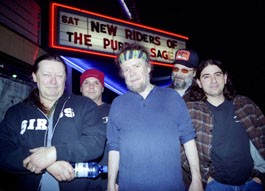
When a couple of young musician fans approached pedal-steel guitar wizard Buddy Cage and suggested he join them in reviving the New Riders of the Purple Sage two years ago, he was less than enthusiastic. “I was absolutely unimpressed by the whole idea,” Cage says.

After all, he had parted ways with the seminal Bay Area country-rock band as they ran out of steam more than 20 years before, after having been a key part of the group through the 10 years of their heyday. And he was reasonably content as an in-demand session player in New York, where he had found a new creative outlet hosting Jam On, on the Sirius satellite radio service’s jam-band channel.”

I hadn’t heard anybody in the promotional area suggest any kind of money figure that was anything less than insulting,” he continues, “so I wasn’t really interested.”

But since Cage is calling from aboard an NRPS tour bus that’s crossing Pennsylvania, it’s obvious that something changed his mind. Call it a “what the hell” epiphany.

Pondering the possibility, Cage checked in with founding Rider David Nelson and discovered that former Grateful Dead bassist Phil Lesh had “cannibalized” Nelson’s Northern California band for a while. “So Nelson was kinda doing nothing,” Cage says, picking up the tale, “and I was doing radio, so I said, ‘Jesus, Nelson, you feel like doing this for a while, for a couple of tours?'” He did, and soon the new New Riders (Ronnie Penque and Johnny Markowski, both from a group called Stir Fried, on bass and drums, respectively, plus former Hot Tuna sideman Michael Falzarano on guitar) were up and, well, riding again. They play Petaluma’s Mystic Theater on Nov. 24.

“The three guys who came in to join Nelson and me, they picked all their favorite New Riders tunes to do, so we could go out and work,” Cage says. “It worked, and younger people started coming to these New Riders gigs, who were, like, in their 20s. And they knew the words!”

It’s been two years now, and the reliance on classic New Riders material—much of it written by John “Marmaduke” Dawson, whose failing health has taken him out of music altogether—is waning. These days, the set lists still include “some of the old catalogue of course,” Cage says, “but some new tunes are coming in. Nelson’s got quite a few.”

A couple are showcased on the recently released double CD set N.R.P.S. Live, recorded last New Year’s Eve at a New Jersey club fittingly called Mexicali Blues, which finds the band in fine form, stretching out on lengthy versions of “Garden of Eden,” “Dirty Business” and Nelson’s previously unreleased “Any Naked Eye.

“During these same two years, a much younger Buddy Cage has also been on public view in the long-lost documentary Festival Express, an intimate video portrait of a rolling rock festival onboard a trans-Canadian train in 1970. Along with the Band, the Dead, Janis Joplin, Buddy Guy and other notables, Cage was there with Ian and Sylvia Tyson and Great Speckled Bird.

Along the way, he recalls, he was recruited by Jerry Garcia to join NRPS. “Garcia knew that he couldn’t any longer play the role of pedal-steel player for New Riders, and had broken the news to the band, like, ‘Sorry guys, I’ve got to stick with my real job, and you guys are going to need a ringer, a real steel player.’ And he heard me playing, and so he chose me.”

It was an offer too good to refuse.

Back in the 21st century, the updated New Riders gradually found a collective capacity for musical exploration that has made extended improvisational segments—such as those on the new CD—an important part of their performances. But Cage resists calling that a change. “I see it moving in the way we always were,” he says. “I see it evolving as something we’ve always done since 1970.”

We never considered ourselves a jam band back then. But I see us as certainly fitting into it,” Cage continues. “Everybody just keeps playing better and better all the time. Now we’re able to go places where we can just pull things out of our hat. I like that a lot.”

That’s why we’re all still together and still doing it,” he concludes. “As for whether we can make it go on for a few more years, that’s just up to the whims of change.”

The New Riders of the Purple Sage jam it down on Saturday, Nov. 24, at the Mystic Theater. 23 Petaluma Blvd. N., Petaluma. 7pm. $25. 707.765.2121.


Sister Act

0

11.14.07

Christmas was the starting point for the Roches.

“We traditionally did Christmas shows in New York for years. That’s how we started singing as a trio, on the streets at Christmas,” Suzzy Roche recounts cheerfully by phone from her Manhattan home. “That was when you used to be able to hear things on the street in New York,” she adds, “before it was just a complete sound of trucks and construction.”

Eventually the trio—Suzzy and her older sisters, Maggie and Terre—released a full-fledged Christmas album, We Three Kings, a 1990 disc that features their choral harmonies on the second-best known chorus from Handel’s Messiah, “For Unto Us a Child Is Born.”

“That was one of the first things we started doing way back when,” Roche confirms. “It was something we learned in high school, and we just figured out how to do it on the street.”

Not that they improvised their arrangement on the fly, she adds. Like all of their vocalizations, it was the product of a determined, sometimes difficult effort.

“It’s very, very painstaking,” Roche says of their collaborative creative process. “I think it’s one of the reasons why nobody else sounds like us. I can’t imagine that anybody would be crazy enough to sit down and do what we do. It’s note by note and everybody picks their own note, and it can get pretty heated up there, deciding who’s going to sing what. But it’s the way we’ve always done it, and we have a kind of common musical language at this point.” The Roches appear at the Mystic Theater on Nov. 17.

All three sisters write, individually and in multiple combinations, but authorship is rarely a point of contention. “Sometimes we purposely will do something like, somebody will write lyrics, give them to somebody else to write music and then somebody else will sing the main melody,” Roche explains. “In that way, you take it out of singular voice and put it in the group’s voice, and that’s really what the Roches is. It’s a sound of three parts.”

The three sisters came together earlier this year to write and record Moonswept, the first new Roches album in more than a decade. Not that they’d been sloughing off in the meantime. “Since the last trio record [1995’s Can We Go Home Now ], I’ve been involved in four records, two solo ones and two with Maggie, and Terre’s made a solo record, too,” Roche notes. “So there’s been a lot of activity, just not as the trio.”

Why now? “It just kind of happened organically,” she laughs. “In some ways, the project decides for you, whether people are up for it or not. These projects are enormous undertakings, and you never know where they’re going to lead, so it takes a certain amount of commitment. This last one, we were all three on board right away”

Moonswept is a seamless addition to the Roches catalogue, with characteristically spare production, close but unconventional harmonies, and a brace of new songs with the sisters’ usual off-center humor and unexpected insights. The surprise is four tunes from outside sources: “Long Before” is written and lovingly sung by Lucy Wainwright Roche (Suzzy’s daughter with Loudon Wainwright III, who will open the Mystic show), while the old Ames Brothers tune, “The Naughty Lady of Shady Lane,” was a family favorite when the sisters were young and still sharing a room at home.

The other two, “Jesus Shaves” and “No Shoes”—the latter, an energetic, absurdist riff on the revelation of a shoeless man who met another who lacked feet—were both contributed by a New York character known as Paranoid Larry, with whom Maggie Roche sometimes performs.

Now, as the year winds down, the Roches are touring in support of the new album, with a few holiday shows soon to be sprinkled into their schedule. But the road is just a change of scene for their daily interactions. “We see each other pretty much every day,” Roche explains. “We sorta have to. It’s a full-time type of thing.”

The Roches perform on Saturday, Nov. 17, at the Mystic Theater. Lucy Wainwright Roche opens. 23 Petaluma Blvd. N., Petaluma. 8pm. $25. 707.765.2121.


Sagebrush Logic

11.14.07

I would have thought that seven years of Texas metaphysics were enough for any country, whether it was filled with old men or not. But the new Joel and Ethan Coen film is already being heralded as a masterpiece and one of the best movies of the year. It certainly has punch, and if punch alone is what draws you to the cinema, it delivers.

In Texas, circa 1980, following a desert massacre, some killers and lawmen circle one another. All that’s left is a bundle of money, a group of bullet-ridden Mexican corpses and a truck full of contraband powder. A cagey Vietnam vet, Llewelyn Moss (Josh Brolin), out hunting antelope, discovers the mess, takes the money and leaves the drugs.

Then Moss puts himself on the criminals’ radar when he returns to the scene of the crime. He barely makes it out alive. Stalked by the worst of the drug runners, it would seem that his only hope of protection is rugged third-generation lawman Sheriff Tom Bell (Tommy Lee Jones), who is drawn into the case after a deputy is killed.

Trailing Moss is death itself: Javier Bardem, playing Anton Chigurh, a freakazoid with a black Prince Valiant haircut. He is a serial-killer-cum-professional-hit-man. “I gave my word,” he says, carrying out one murder just on the principle of the thing. That’s Texas metaphysics: you’re either for him or against him.

Chigurh is the proactive one in this movie, always going forward even as the other characters go into hiding, follow red herrings and turn up at the wrong places or too late. He displays superhuman abilities and a truly baroque murder weapon—he is a familiar figure from grindhouse cinema.

The human cattle who fall under his slaughterhouse killing machinery are grindhouse fodder: they’re peevish, old, obese or as trusting as village idiots. Chigurh is just culling the herd. Sometimes he gets cosmic on his victims in order to show them the transitory quality of their lives. It’s what Jigsaw does in the Saw movies—enlightenment through torture. If Chigurh uses psychological torture instead of a dungeon, he is still a torturer. The threat of death lies behind all torture. (An interrogator who says something like “I’m pulling out your fingernails, but then I’ll let you go” isn’t going to succeed in his career.)

Chigurh’s gambit appears less superficially ghastly: he allows some of his victims to flip a coin for their lives. True, his coin game with one aged gas station owner in the middle of nowhere is brutally suspenseful, almost as full of impact as the film’s finest moment, a brilliantly directed pit-bull attack on a riverbank.

The Coens approach Cormac McCarthy’s novel like kneeling penitents, crawling across Texas to follow his plot points. They are taken by Bell’s musings on the end of the old ways and how much weaker we are than those who came before us—and who wouldn’t be, when Tommy Lee Jones utters them. The Coens go flat and dry to heighten the tense set pieces; the movie is all motel blocks, vast skies scribbled with thin white clouds, tires soughing on roads instead of music.

It all leads to nada, to a postmodern finale, an action movie’s version of coitus interruptus. Like American Gangster and, to a lesser extent, 3:10 to Yuma, No Country for Old Men is a genre picture that has lost its faith in catharsis. Morose vagueness will get No Country for Old Men called a classic, instead of what it is: an often effective but pompous grindhouser. Its pretensions are so big, you couldn’t fit them in Texas.

‘No Country for Old Men’ opens on Friday, Nov. 19, at the Rialto Lakeside Cinemas, 551 Summerfield Road, Santa Rosa. 707.525.4840.


New and upcoming film releases.

Browse all movie reviews.

Forest for the Trees

11.14.07

I don’t spend too many of my waking hours thinking about flooring, though I do ponder the linoleum in my bathroom upon occasion. I have begun to wonder, for example, if perhaps the dark stains spreading from the vicinity of the bathtub could be due to moisture seeping underneath the floorboards. This is one of the perks of being a renter: rotting floorboards, while perhaps unattractive, are not that much of a personal concern. The reality of environmental responsibility, however, is that the choices other people make, the choices we all make, even in regards to something as seemingly insignificant as what type of flooring to use, have an impact that spreads well beyond the confines of my, or anyone else’s, personal domain. So while I may be stuck with rotting floorboards, my neighbors could be replacing theirs, and the choices they make in what type of flooring to use has an impact not only on their personal aesthetic surroundings, but on the world.

I speak to Lewis Buchner, CEO of San Rafael’s EcoTimber, about his company’s commitment to ensuring that its products are certified by the Forest Stewardship Council (FSC), that the glues are formaldehyde-free and that only zero-VOC (volatile organic compound) adhesives are used. There are a couple of significant issues to consider regarding building materials, one of which is the nontoxic issue (outgassing can continue for years, well beyond the time when the consumer has stopped noticing the stench), and the other, the responsibility for understanding where the materials are coming from and who, if anyone, is being hurt in the process. While putting in new flooring may be very satisfying on a personal level, the U.S. International Trade Commission estimates that 30 percent of hardwood products imported into the United States are from “suspicious or illegal” sources. Greenpeace reports that wood is being logged and exported illegally in Russia, Brazil and Indonesia, to sketch only a short list. Illegally harvested wood often results in deforestation, which, considering our current climate issues—not to mention the devastation of ecosystems across the globe—is something far more worthy of consideration than whether or not cherry or oak flooring will look better with the new couch.

The FSC is an international nonprofit organization working to ensure that forests are managed as ecosystems rather than as agricultural crops. Lewis tells me that much of the wood on the market today is grown through a process of clearcutting and chemical spraying, where the land is treated like an industrial corn field rather than a natural forest.

The woods used in EcoTimber are the result of a delicate balance where the land, the trees, the animals and the people who live there are respected and protected. This is a complex process that involves not just monitoring the harvesting of the wood, but tracking the “chain of custody” of the certified wood from the forest to the saw mill to the flooring mill, so that when the flooring finally arrives in the store, there is no question that what lies within the box is actually FSC-certified. With “greenwashing” on the rise, it is important to look beyond the claims made on boxes and brochures. To this end, Lewis travels around the world, searching for factories that can consistently maintain both FSC and EcoTimber standards. Ever the realist, I try not to lose sight of the single most pressing concern that stands between all Americans and their products: money. Recently, I painted my home with regular old house paint. I could have gone out of my way to buy VOC-free paint, and in the process respected not only myself and my family, but the people developing the paints and anyone who enters my house and breathes the air. But I didn’t, because I didn’t think I could afford it. With this in mind, I ask Lewis how much, exactly, this EcoTimber is going to set me back. One could argue that if you own your own home and can afford to put in new flooring, you can afford the monetary sacrifice. The reality is that we are a country consumed by the need for a better deal, even at the expense of ourselves, our children, our neighbors and the people we hire to do our work.

Lewis assures me that, due to increased demand for natural flooring, prices are becoming extremely competitive. More demand equals a mature market, which means more volume, more leverage and the availability of sustainable flooring that costs only zero to 10 percent more than the chemical-laden, forest-raping alternatives. Taken from the long-view vantage, few would argue that it’s expensive being green.

For more information on EcoTimber and to find a dealer near you, go to www.ecotimber.com. For details on the Forest Stewardship Council, go to www.fsc.org.


First Bite

0

11.14.07

Editor’s note: First Bite is a new concept in restaurant writing. This is not a go-three-times, try-everything-on-the-menu report; rather, this is a quick snapshot of a single experience. We invite you to come along with our writers as they&–informed, intelligent eaters like yourselves&–have a simple meal at an area restaurant, just like you do.

The legendary John McReynolds no longer cooks at Cafe La Haye, just off the plaza in Sonoma, but his ghost seems to haunt this intimate restaurant where you could spend as much as $750 on a dinner for two or less than $100 if you order carefully and don’t get the wine list’s $400 bottle of Sauternes. McReynolds, who has moved on to greener kitchens elsewhere, made many of his signature dishes and a reputation that went far beyond Sonoma at La Haye by cooking with fresh produce from Sonoma farms.

Norman Owens, who cut his eyeteeth as a chef in Seattle, isn’t afraid to feature local onions, grapes, beets, arugula, peppers and more. But the vegetables aren’t the stars of the impressive show he puts on; the produce plays a supporting role to his pan-seared chicken breast ($17.95), hangar steak ($19.95) and pork tenderloin ($21.95). You can even watch Owens at work in the postage stamp-sized kitchen, especially when seated on the upper level of the dining room.

Tables at La Haye are snapped up quickly, and reservations are recommended, though seats are almost always available at the counter. Tourists sit elbow-to-elbow with local writers and chefs&–they were out in force on a recent Tuesday night&–but the noise level doesn’t drown out conversations, and the art on the walls is pleasing to the eye.

There are specials every night, including the soup of the day, recently featuring Swiss chard, mixed peppers and bacon ($7). The seared scallops, on a bed of shaved Brussels sprouts and golden raisins with homemade grain mustard ($12.95), were cooked to perfection and elegantly presented. The bacon-and-egg starter that featured a soft-boiled egg over spinach and a celery root pancake, topped with crispy pancetta ($9.95), might not have been appetizing at breakfast, but the combination works well at dinner. The quail stuffed with figs and accompanied by a puff pastry filled with Pt. Reyes blue cheese and caramelized onions ($23.95) was very tasty indeed, and the tender, juicy lamb with Moroccan couscous, mint and pistachio pesto ($32.95) brought together rich, complex flavors.

To drink, I brought a Valley of the Moon 2005 Pinot Noir; the corkage fee is $20. (The least expensive wine on Cafe La Haye’s list, a Zinfandel, runs $30.) The pumpkin financier with quince caramel and walnut whipped cream ($7) was sweet but not sugary, and sorbets and seasonal crisps are usually available.

La Haye, which rhymes with “cafe,” turns out to be the name of the owner of the building, not an exotic village in France, as one might think. But the town of Sonoma, of course, has long had a romance with France, and at La Haye, Norman Owens marries the very best Sonoma ingredients with nouvelle French cooking styles. He’s clearly carved out his niche as a chef, and put his own unique stamp on dishes that will bring in tourists from around the world, who come to Sonoma for the wine and the history, as well as locals looking for something above and beyond the usual fare.

Cafe La Haye. Open for dinner, Tuesday&–Saturday. 140 E. Napa St., Sonoma. 707.935.5994.


Quick-and-dirty dashes through North Bay restaurants. These aren’t your standard “bring five friends and order everything on the menu” dining reviews.

News Briefs

11.21.07 A Moving TrialRenato Hughes Jr., 23, will not stand trial for murder in lily-white Lake County. On Nov. 15, a judge ruled that there's reasonable doubt this young black man can get a fair trial there, and ordered the case moved to another county. As reported earlier this year in these pages ("" June 13), Hughes is being held...

Language Burier

Usual Suspects

the arts | stage | Something Fishy: Michael C....

Torturous Geometry

11.21.07Four skinheads nearly beat a man to death. Four bystanders—two women and two men—watch the violence unfold. The victim goes to the emergency room with a broken neck, a flattened skull, a broken scapula and a broken hand. Doctors drive 40 staples into his head in order to patch it back together. Two alleged perpetrators are apprehended and charged....

Back in the Saddle

11.21.07When a couple of young musician fans approached pedal-steel guitar wizard Buddy Cage and suggested he join them in reviving the New Riders of the Purple Sage two years ago, he was less than enthusiastic. "I was absolutely unimpressed by the whole idea," Cage says.After all, he had parted ways with the seminal Bay Area country-rock band as they...

Sister Act

11.14.07Christmas was the starting point for the Roches. "We traditionally did Christmas shows in New York for years. That's how we started singing as a trio, on the streets at Christmas," Suzzy Roche recounts cheerfully by phone from her Manhattan home. "That was when you used to be able to hear things on the street in New York," she...

Sagebrush Logic

11.14.07I would have thought that seven years of Texas metaphysics were enough for any country, whether it was filled with old men or not. But the new Joel and Ethan Coen film is already being heralded as a masterpiece and one of the best movies of the year. It certainly has punch, and if punch alone is what draws...

Forest for the Trees

11.14.07 I don't spend too many of my waking hours thinking about flooring, though I do ponder the linoleum in my bathroom upon occasion. I have begun to wonder, for example, if perhaps the dark stains spreading from the vicinity of the bathtub could be due to moisture seeping underneath the floorboards. This is one of the perks of being...

First Bite

11.14.07Editor's note: First Bite is a new concept in restaurant writing. This is not a go-three-times, try-everything-on-the-menu report; rather, this is a quick snapshot of a single experience. We invite you to come along with our writers as they&–informed, intelligent eaters like yourselves&–have a simple meal at an area restaurant, just like you do.The legendary John McReynolds no longer...
11,084FansLike
4,606FollowersFollow
6,928FollowersFollow