Dual Nature

0

03.12.08

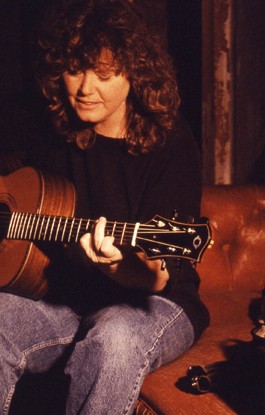
R egardless of the weather in California, it’s still deep winter in New England, where Cheryl Wheeler is having an eventful season. “I wrote a couple of songs in December, so I’m happy about that,” she reports. “I’ve been watching all the political races, and when I’m through with this call I’m talking the dogs for a w-a-l-k in the w-o-o-d-s. I have to spell it, ’cause they can hear me.”

The reason for the call, of course, is her imminent West Coast visit, which will bring Wheeler and accompanist Kenny White to the Sebastopol Community Center’s Youth Annex on March 15. Unlike many such sojourns, however, there is no new album to promote this time around.

“I would like to make another record; I don’t have enough material yet,” Wheeler says. (Her last official release was Defying Gravity in 2005.) Nor is she certain when that will change. “I used to write a lot more,” she laments. “As you get older, you’re less inclined to think that all your ideas are actually good. When I was in my 20s, if I was vaguely unhappy, I would think that was worthy of a song. Now I don’t.”

Not surprisingly, the casual quips that leaven Wheeler’s conversation are much like those that enliven her performances, if perhaps a bit more spontaneous that the side-splitting stage patter that delights her fans.

“Everything that I have ever said was in the moment, at least the first time I said it,” Wheeler explains. “But then if it works and I like it and it’s a good way to introduce the song, obviously I keep it in. My bottom line is that I’ve been hired to entertain people, that’s my job and I love doing that. And the best barometer I have is that I need to keep myself entertained, so I have to enjoy hearing it or think it’s funny. But if I feel like I’m getting sick of a little bit that I’m doing, that’s a good sign that I shouldn’t do it and it needs to change.”

But Wheeler is a singer-songwriter, not a standup comic. She balances her penchant for punch lines with a gift for crafting luminous melodies and crystalline lyric imagery, all in the service of insightful, emotionally resonant vignettes. Little wonder that her songs have been covered by such high-profile artists as Garth Brooks, Bette Midler, Kathy Mattea and Peter, Paul and Mary. She’s also penned sizable hits for Dan Seals (“Addicted”) and Suzy Bogguss (“Aces”).

Her most unusual cover came from country superstar Garth Brooks, who used a portion of Wheeler’s powerful “If It Were Up to Me,” as part of a track on his perplexing Chris Gaines album in 1999. Written in response to the Columbine school shootings, the song contains a lengthy list of possible reasons for the violent outburst: “Maybe it’s the high schools, maybe it’s the teachers / Maybe it’s the tattooed children in the bleachers / Maybe it’s the Bible, maybe it’s the lack / Maybe it’s the music, maybe it’s the crack / Maybe it’s the hairdos, maybe it’s the TV / Maybe it’s the cigarettes, maybe it’s the family / Maybe it’s the fast food, maybe it’s the news / Maybe it’s divorce, maybe it’s abuse . . .”

But Brooks did not include Wheeler’s concluding line: “If it were up to me, I’d take away the guns.” Wheeler says the omission didn’t bother her.

“He was using the litany to make a different point, but it wasn’t that different,” she says. “My point was very specially, if we’re going to wonder why children shoot each other, I think it’s because they have guns. His point was, why are we all so violent? I mean, Garth Brooks has a whole lot more to lose than I do if he comes out and makes some anti-gun comment. I’m not rabidly anti-gun; I’m rabidly anti-gun-in-the-hands-of-school-children. Or crazy people at any school.”

But politics, like comedy, is not Wheeler’s main focus. “I have written a lot of political songs in recent times—I mean, who hasn’t?” she sighs. “But I’m sick of it all, I just want to turn away from it. There’s nothing I can do about it.

“But things will be looking up,” she brightens. “Things can’t help but look up. Unless we elect Osama bin Laden, we’re going to be better off than we are now.”

Cheryl Wheeler and Kenny White perform on Saturday, March 15, at the Sebastopol Youth Annex. 425 Morris St., Sebastopol. 8pm. $32. 707.823.1511.


Geographica Gigantea

0

03.12.08


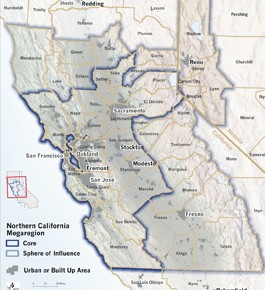
B ye-bye, North Bay. Bon voyage, Silicon Valley. Sad to see you go, Monterey Bay. You’ve all been supplanted. Encompassed. Enfolded. And not just into your granddad’s Greater Bay Area, but into a brand-new sweeping, diverse and gigantic area newly known as the Northern California Megaregion. It’s a region fanning out from six concentrated employment centers—San Francisco, Oakland, Sacramento, Modesto, Stockton and San Jose—embracing 21 counties from Yuba and Sutter in the north to Monterey in the south. It stretches from coastal Sonoma to inland Eldorado counties, and hosts 14 million people working at over 5.7 million jobs.

Born just a few days before Christmas 2007, the NorCal Megaregion’s record of emergence is as unremarkable as most birth records. It appears only as a minor note attached to a seemingly run-of-the-mill grant sought by several Oakland legislators who wanted $840 million in state funds to get cargo moving more quickly around the Port of Oakland.

The pitch the lawmakers made for the money, though, was unique: What happens in Oakland doesn’t stay in Oakland. When getting goods in and out of the port slows down due to creaky old docks, narrow freeway overpasses and twisted railroad tracks, congestion spreads outward for hundreds of miles across the whole (here it comes) megaregion.

To the immense shock of Southern California, a far longer established megaregion vying for the same funds, not only did the California Transportation Commission buy their argument and give the Oaklanders the entire $840 million, it also approved the megaregion approach for future use, inviting northern lawmakers to use it again for other big requests.

That official stamp of acceptance, in turn, energized others who had been talking about the reality of a Northern California megaregion—for quite some time—to speak up assertively.

One such entity is the think-tank San Francisco Planning and Urban Research Association (SPUR). Its executive director, Gabriel Metcalf, first ran across the concept in grad school in the 1961 Jean Gottman book Megalopolis , which focused on the burgeoning northeastern U.S. corridor radiating outward from New York City.

When, by 1967, the Regional Plan Association declared that the corridor had morphed into the “Atlantic Urban Region,” stretching from Maine to Virginia, long-term thinkers took note. In the 1980s Gottman, reviewing the concept, reported a number of megaregions bubbling up across the United States.

Virginia Tech’s Metropolitan Institute defines megaregions as those containing at least 10 million people living and working in at least two (and sometimes several dozen) cities and their suburbs linked by major transportation infrastructure and steady flows of goods and services, sharing a similar regional history and identity.

Megaregionalists argue that the cities, suburbs and exurbs conjoined into such areas cannot be realistically seen as separate population nodes, because activity involving them and travel among them—whether composed of visitors and commuters or burrito ingredients and bicycle parts—is unceasing. So if one community in a megaregion doesn’t do what’s necessary to keep the flow going—like repairing its roads or protecting against floods—it profoundly impacts the rest.

But many localities still refuse to acknowledge their interdependence and interresponsibility, and that has begun to create serious long-range consequences. Because whether we like it or not, the U.S. population has been moving en masse from sparser central continental areas into denser employment centers around the edges. America 2050, a national long-term planning group headed by such notables as Bruce Babbitt, predicts that “by mid-century, more than 70 percent of the nation’s population growth and economic growth is expected to take place . . . within these megaregions.”

The Big Picture

There is a way out, say long-range planners: stop thinking locally and start planning globally.

Saskia Sassen, professor of sociology at the University of Chicago and London School of Economics and a major voice in regional planning, gets excited by the possibilities, describing them as “the making of new economic history.”

Her primary interest being sustainable human settlements, which she has studied at length for UNESCO, Sassen examines patterns of healthy human relations. For her, the question is how do we enhance these urbanization advantages? How do we minimize the toll of traffic and crowding and reap some enjoyment from these new far-flung and densely interwoven zones of employment, housing recreation and culture?

For one thing, says Sassen—and this is common to megaregional thinkers—we need to get over some things, like the idea that there’s something inherently wrong with human beings traveling from place to place in large numbers.

“Once you hit excess congestion disadvantages,” she notes wryly, “you might as well go for activities that benefit from geographically dispersed arrangements.” Like, say, biking between a company’s Eastside office and Westside office, which on sunny days sure beats staying indoors in a single downtown office structure for eight hours straight.

Sassen also argues for tolerating moderate dispersion, pointing out that physical togetherness is no longer entirely necessary for common experience. “Central urban density . . . has historically helped solve the risk of insufficient variety,” Sassen says, but modern digital communications assure that “wherever people are, there should be access to many of the needed resources.” In other words, telecommuting starts to make sense in megaregions.

So while Sassen certainly doesn’t shrug at irresponsible sprawl, she doesn’t hold suburban living, commutes or megaregional travel as big issues either.

This is common of many megaregionalists: what’s crucial is that the region offers a healthy mix of housing, jobs and culture and alternative ways to move among them. There’s not a lot of moralizing over how many miles a day people travel, where they go or how much time they spend doing so. To the megaplanner, it’s having a wide set of choices that matters; people will sort their own way through them. The apparent motto: Plan intelligently, then control minimally.

Edward L. Glaeser, a Harvard land-use expert who has spent many seasons crunching numbers to show that overly tight local land-use regulations, not market sloth, have produced the most severe housing shortages in the United States, agrees.

“When bedroom suburbs make their own decisions” in absence of cooperative institutions, he says, “they tend to take into account only the interests of neighboring homeowners.” Not good for planning anything from roads to parks to wildlife habitats.

His recommendation? “While, like most economists, I remain enthusiastic about the diversity and competition that comes with local control, a regional approach to land-use regulation could improve the system.”

Leaving Local Behind

If planning should become primarily regional, though, what would happen to that common linchpin of both Southern conservative and coastal progressive politics: an insistence on local control?

SPUR director Gabriel Metcalf, who is backing a campaign to get statewide high-speed rail on the ballot, says it’s time to reconsider this sacred cow.

“We have to realize that planning and zoning are not merely local matters,” he says. “They also determine our carbon footprint and degree of environmental destruction.”

Any jurisdiction’s failure to plan, in this megaregional age, now affects others in every direction. And therefore, jurisdictions—and their constituencies—are going to have to start cooperating.

Planners are aware that this view, which is polar opposite to the convictions of many neighborhood-centric activists, will be a rough ride for some. The resident used to demanding that her city council remove a new traffic-accelerating left turn lane on a local state highway will more frequently find that the council won’t have final say any longer. “These decisions will be made countywide, at the least,” says Papadakis. So will determinations about greenbelts and habitats and bicycle paths.

Metcalf emphasizes the benefits of embracing wider regional planning. “What we have to gain is a region that’s more affordable to live in and that can maintain its economic competitiveness.”

But he agrees that the shift may prove tough.

“Like with global warming,” says Metcalf, “we’re asking a lot of people. We’re asking them to concern themselves with things that are really big and really scary, and pay attention to much more than their own blocks or neighborhoods.”


Valley Boys

0

03.12.08


Ask the members of the Grand Color Crayon why they haven’t left Napa and they’ll look confused. They reiterate the obvious, that it’s a beautiful, gorgeous place. And yet the GCC, who are easily the most important band in Napa at the moment and probably the most important band in Napa for the last 20 years, are also fervent critics of their odd spot in the world.

COPIA, they charge, is a gentrified waste of money that used to be a field. The Napa River is polluted. Lake Berryessa is a hotbed for date rape and random killings. Downtown clubs are full of “tourists trying to get laid” and “a bunch of people that realize that they can’t relate to anyone and they don’t know anyone and no one knows them and they’re sad.”

But perhaps the band’s fiercest and best-known quarrel is with the hometown newspaper, as evidenced in the song “Fuck the ‘Napa Register,'” which was born from coverage of two separate traffic accidents that band members say blatantly sympathized with white citizens in the wrong while insulting and vilifying black and Latino victims.

“They’re a bunch of fucking yellow journalists,” singer Kyle May, 21, vents. “[The paper] misspells, it’s written at a fifth-grade level, it doesn’t talk about anything important or real that happens in Napa, and it’s just something comfortable for the tourists to pick up.”

Twenty-two-year-old drummer Brian Montague, born in India and adopted in Napa, describes the area’s culture as “everyone trying to be accepted.” Guitarist Jakey Lieber—20, half black and also adopted—says that Napa’s youth are “paved over,” and that anything creative is relegated to the lower crust, “which is under the cement.” May, who’s half Native American, whose mom is a janitor and who, along with Lieber, grew up in a mobile home park, notes that the collective realization to embrace a low social status is what brought the band together in 2004.

As befits an outspoken band stuck in a county with few peers, the GCC are loud. Having traveled over the hill on a recent Friday night to Petaluma, the band played a set at a house party that could be heard two blocks away. May introduces songs in either a Barry Manilow croon or a Notorious B.I.G. mushmouth; Montague regularly breaks his snare drum; and Lieber, launching into the air with a gymnast’s precision, plays schizophrenic metal and hardcore riffs completely, and astonishingly, with just his bare thumb.

At the end of the set, the lights suddenly go dark. Someone rushes May and picks him up, swinging him around. Lieber’s guitar flies through the air. When the lights come back on, they’re both lying on the ground, out of breath, and May ends the show with a throat bellow that sounds like he’ll never speak again.

Not understood by hardcore bands, indie rock bands, screamo bands or metal bands, the GCC connect best, they say, with older people who were into DIY culture before the genre lines became so rigid, a mentality they professionally mock. Introducing the song “A Broaphobic Nosebleed,” the band rip off their shirts, exaggerating the jock mindset in punk rock with hilarious buffoonery while also spoofing the guttural gurgles of death metal. They’re known to bring free punch and cookies to hardcore shows.

So how does a band like the GCC get by? “Passion and heart” is how Montague describes it. Getting out of town on a couple mini-tours of the Pacific Northwest helps. The band also recently released a 7-inch, Ice Eaters, and is working on an upcoming EP.

Utilizing frustration and turning it on its ear with humor and expression is rare in a city like Napa, which offers few opportunities for its creative youth. Still, the relationship seems symbiotic—the band is a product of its stifling hometown just as much as Napa desperately needs a band like the Grand Color Crayon.

“We’re not gonna own shit in our life,” May explains without a drop of regret. “We’re poor in a nice community, where it’s like, ‘Hey, we’re safe.’ So we own this shit, dude, let’s turn it over on its fuckin’ edge.”[Marker]

Just don’t expect to read about it in the Napa Valley Register anytime soon.

For more, go to www.myspace.com/dagrandcolorcrayon.


First Bite

0

03.12.08

Editor’s note: First Bite is a new concept in restaurant writing. This is not a go-three-times, try-everything-on-the-menu report; rather, this is a quick snapshot of a single experience. We invite you to come along with our writers as they—informed, intelligent eaters like yourselves—have a simple meal at an area restaurant, just like you do.

After N.V. abruptly closed last August, Napa area diners wondered what had become of chef-owner Peter Halikas. Just a few weeks later, he reappeared along with his entire staff at Brix, up the road in Yountville.

He revamped the kitchen at the 11-year-old property, then introduced his signature menu, featuring an eclectic Mediterranean-California-French blend with Asian accents. I put the place on my “must visit” list and promptly got too busy to go.

And by the time I finally got there last week, I was too late. Surprise: Halikas had suddenly departed just days before, and in his place was a new executive chef, Carlos Canada. Gone was the Asian flair, and in its place was a pretty straightforward California bill of fare.

Too bad. Instead of the highly sophisticated Sonoma lamb shoulder sous vide with parsnip purée, icicle radishes and fennel jus or the sexy-sounding Fuyu persimmon and pineapple quince salad in vanilla-raspberry balsamic vinaigrette that I had been anticipating, I had tamer choices like roasted rack of lamb ($32) and Boston butter lettuce salad in Champagne vinaigrette ($9). A fine meal, to be sure, but not the exciting promise that had lured me for a 45-minute drive through a rain storm.

An appetizer of PEI mussels ($14) was a highly promising start, bringing almost a dozen plump mollusks bathed in a spicy saffron broth studded with fennel and chorizo—very dunkable with grilled sourdough. The butter lettuce salad slowed things down, an ordinary mound of oversalted greens sprinkled in pine nuts, sliced grapes and julienne Asian pear with no noticeable Champagne sparkle. Then the pizza ($14) came, and it was beautiful, the fluffy crust disappearing under an avalanche of slinky-chewy trumpet mushrooms, dollops of fresh mozzarella, tomato, basil and fiery peppered house-made fennel sausage.

The dayboat scallops ($30) were expertly pan-seared, glistening in brown butter atop a buttery swirl of cauliflower purée studded with capers and crowns of broccoli romanesco. Rack of lamb (no longer on the menu), meanwhile, was three rosy-hued chops moistened with a mild black olive jus over a mound of juicy chard and superbly cheesy spring onion potato gratin.

It was all very nice but highly conventional in this big restaurant that seems more suited for tourists than for fine dining (there’s even a gift shop at the entrance, as well as a massive private party space). A gorgeous, giant garden framed by the dining room windows hints of potential pristine vegetable orgies, but what we got was drowned in butter, oil or so much garlic that any earthy nuance was lost.

We ended with a good but entirely predictable chocolate chip cookie sundae ($9), the cookie crumbled into the ice cream and swirled with chocolate fudge and whipped cream.

At the time Halikas took over Brix, he told me that he hoped to liven up what was an ordinary menu in an extraordinary property. Here’s hoping chef Canada, or whoever takes the gauntlet next, keeps that dream alive.

Brix, 7377 St. Helena Hwy., Napa. Open for lunch and dinner daily. 707.944.2749.


Quick-and-dirty dashes through North Bay restaurants. These aren’t your standard “bring five friends and order everything on the menu” dining reviews.

Language of Love

0

03.12.08


T here is no actual sex in David Mamet’s effervescent 1999 play Boston Marriage, but thoughts of sex potently underscore nearly everything that happens in Mamet’s least angry, most uncharacteristically playful and sexy work. Superbly performed by a first-rate trio of actresses, and inventively directed by Sheri Lee Miller doing some of her best work here, this Boston Marriage, currently running at Santa Rosa’s Sixth Street Playhouse, takes what might have been mere sex farce (albeit with a lesbian twist) and gives us much more. This is a pioneering comedy, rather, in which sexual orientation is regarded as neither scandalous nor particularly political, but just another colorful character point in a play bursting with color and craftiness.

In Boston Marriage, Mamet launches some of the lightest, funniest, most quirkily entertaining writing he’s ever crafted—and lots of it. Mamet’s characters speak in flowing torrents of densely cadenced, beautifully constructed language, unleashing so many words and witticisms, punch lines and puns, pouring forth such a pounding surge of intimations, insults and ideas, that some members of the audience will find themselves missing more than they catch, but will still enjoy the experience of being drenched in the flood of Mamet’s genius with words.

Best known for harnessing the combative slurs and aggressive verbal interplay of the modern masculine world, Mamet takes an enormous artistic leap with Boston Marriage, a broadly comical, enticingly wicked slice of life about two middle-aged women in Victorian-era Boston. Their discreet long-term relationship—the so-called Boston marriage of the title, a common euphemism of the time—is threatened by a bizarre coincidence involving a necklace, a wealthy man who’s made one of them his mistress and a ripe young woman who’s become the object of the other’s lustful affection.

With her money starting to dwindle, Anna (Danielle Cain), accustomed to her life of upper-idle-class privilege, has taken a rich male lover who bestows jewelry and monthly stipends upon her. “In like a lion, out like a lamb,” is how she somewhat naughtily describes the relationship. Claire (Bronwen Shears), Anna’s longtime love, has returned from abroad (“One must follow the buffalo herd,” she quips) with unexpected news of her own: she has fallen in love with a very young woman, and has made plans for the girl to visit Anna’s home for a “vile assignation,” as the suddenly jealous Anna describes it. The delight in the play is how Anna and Claire—outrageously self-absorbed and casually cruel in the manner of Oscar Wilde and the like—simultaneously shock and delight each other with cultured verbiage that occasionally deflates into coarse street vernacular.

Both Cain and Shears are wonderful. Cain, who has the lioness’ share of the dialogue, perfects a kind of wounded, bitchy irritation that cuts like a stiletto, then crumbles to reveal the soft heart of a committed lover. Shears, straddling a role that requires her to be both smart and foolish in the same moment, performs miracles in the quietest of ways, giving some of her best bits while merely standing there, reacting with affection or shock at Anna’s machinations. And holding her own against the two powerhouses is young Catherine (Tess Coughlin), Anna’s befuddled Scottish maid who might not have the facility for words that her employers have, but quickly learns how to use the few words she does know.

After a thrilling twist in the last seconds of the first act, the play becomes more outlandish, with the two women concocting a plot to impersonate fortunetellers (it’s complicated), but the story is not the main attraction here. In the end, this is a love story, encompassing both Anna and Claire’s enduring love for each other, and Mamet’s love of the English language.

‘Boston Marriage’ runs Thursday&–Sunday through March 30 at the Sixth Street Playhouse. Thursday&–Saturday at 8pm; Sunday at 2pm; no show March 23. 52 W. Sixth St., Santa Rosa. $14&–$26. 707.523.4185.


Museums and gallery notes.

Reviews of new book releases.

Reviews and previews of new plays, operas and symphony performances.

Reviews and previews of new dance performances and events.

Kids Lose Again?

0

03.12.08

The bouncer says a flat no. You’re a few planetary orbits short of that mystical number 21. The sun’s setting and you’ve got a few hours to call your own. What to do now, you teen-to-20 person—where’s that place for you amidst this adult wonderland of wine, beer and French Laundrys? This is a question teens have posed since the invention of free time, and now, with ever more closures of every conceivable after-school program, it’s a critical issue facing practically every community throughout the North Bay.

Then came Napa’s Smoking Cat Cafe. It’s a youth-oriented oasis catering to enthusiasms for camaraderie and conversation, music, art and cheap food. Young adults and a smattering of old farts gather there daily, quaffing nonstupefying concoctions in a lively and creatively supportive atmosphere.

The Smoking Cat is run by Jackie Hammond, 23, and her 22-year-old fiancé Michael Mendez. The Cat could be a near-dream teen hangout. But the cafe’s faced nine residential neighbor complaints since first opening last October.

The house nearest the Smoking Cat is about 60 feet away. The problem, according to proprietor Hammond, is that “we get a natural echo happening, and our closest neighbor has an issue with the noise.” That closest neighbor is a family with children—children who need their sleep. Due to cafe racket, the neighboring family have placed their house up for sale and have attempted a commercial re-zone in order to enhance salability. So far no re-zone, no sale.

Now the city of Napa’s stepped in and hopes are high that the cafe and homeowners will patch things up in arbitration. Meanwhile, the Smoking Cat, its name culled from Alice in Wonderland’s hookah-smoking Cheshire, has adjusted its original plans to offer legal-aged patrons flavored tobacco to smoke from out-of-doors hookahs. With the youth-focus, this is a definitive nonstarter. The Smoking Cat has likewise rescinded its application for a beer and wine license, and has trimmed its Monday night open mic time by an hour to mollify noise concerns.

Aside from Monday night open mic, the Cat features Saturday morning cartoons and a free-of-charge movie each Friday and Saturday night at 7pm. The cafe hopes to expand its live acoustic music offerings, and plans are in the works to launch a weekly “Philosophers’ Group” get-together.

According to Hammond, the Smoking Cat “was originally developed as a local coffeehouse for the community, and we’d like to add even more things to enhance the community.” Sounds like they’re open to ideas. And perhaps, even still to kids. The Smoking Cat Cafe, 1502 Main St., Napa. 707. 255.5174.


Mad Money

ISSUEDATE


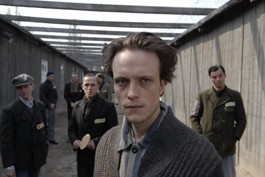
J ust when there seemed to be no new cinematic stories to tell about the concentration camps, Austrian director Stefan Ruzowitzky has come up with his Oscar-nominated The Counterfeiters . Based on Adolf Burger’s history The Devil’s Workshop , this drama tells of Operation Bernhard, the Nazis’ plan to flood the Allies with counterfeit money, using slave labor in a concentration camp.

It’s a “golden cage,” observes the wiliest man in the forgery operation. He is the master counterfeiter Salomon “Sally” Sorowitsch (Karl Markovics), who is picked up by the SS in 1936, right before he’s about to leave for safer climates. Markovics’ unusual lead acting helps overcome Ruzowitzky’s too-simple template of the rogue redeemed. He is a chilled, withdrawn actor, physically something like a cross between Ben Affleck and Max “Nosferatu” Schreck.

A Jew, Sorowitsch is branded with the green triangle of the habitual criminal. After years of filthy, crowded conditions in the regular ranks of the concentration camp, Sally is brought out to work on the Nazis’ plot. His new supervisor is the same officer who arrested him years previously, Herzog (Devid Striesow), a cop turned commandant.

Sally and his team of printers, respectable bankers and engravers begin the grinding work of trying to emulate a British pound note. They eventually succeed. The bill is perfect, even down to the minute pin holes found in used English pounds. (In the days when the British didn’t have wallets, they used to pin currency to the inside of their pockets.)

As Sally lives for both craftsmanship and survival, he is fairly satisfied with the results. But he is under pressure from Herzog, and the threat of extermination hangs over the team. Burger (August Diehl), an activist printer, urges Sally to sabotage the project even while the team is toiling over their magnum opus: the American dollar bill. As the war reaches its end, the pragmatic head forger is wedged between the ever more desperate Nazis and his rebellious fellow inmates.

I have read that Ruzowitzky was not eager to give the Nazi perspective in the visuals, so he used over-the-shoulder POV shots for the inmates but not for their vicious captors. And yet as Herzog, Striesow’s performance is a debonair, shrewd one, more full of surprises than anything else in the film. (The soundtrack is different from what you would expect, too; it’s a series of Argentine tangos on the harmonica, and it sounds more like Larry Adler’s score for Genevieve than anything else.)

To further motivate Sally, and to prove his broad-mindedness about the company of Jews, Herzog brings the counterfeiter to his home one Sunday to meet his Aryan wife and kids. Herzog startles us by showing up in civilian clothes. The whiteness of the commandant’s polo sweater blazes out of this film’s chronic murk, the brightest thing in the entire movie, even though The Counterfeiters includes scenes in a gambling salon in Monte Carlo.

An engrossing story beats almost any element in a film. Even if everything else is weak, a good true-life story will stand up for itself. That’s ultimately the case with The Counterfeiters . Unfortunately, Ruzowitzky and his director of photography, Benedict Neuenfels, are apparently scared of making this adventure picturesque or pretty. They go for a neo-documentary approach that makes for reliable ugliness.

A decorative rack focus—a zoom and retreat that doesn’t give us more details of a dimly lit face—shouts out a reminder that you’re sitting in a movie theater, even more so than an ordinary, scarcely noticed crane shot or a pan. And despite the wobble and shake of the hand-held camera, we’re still apprised that we’re watching a story of gradual redemption.

One reason for Sally’s trip to the commandant’s house is partially to negotiate some tuberculosis drugs for a dying inmate. Like anyone else in a Hollywood movie, Sally follows his insistence in not sticking his neck out for anybody by a familiar tortoiselike stretch. Somehow, you wish this film was darker in its soul and lighter in the visuals.

‘The Counterfeiters’ plays at the Century CineArts at Sequoia, 25 Throckmorton Ave., Mill Valley. 415.388.4862..


New and upcoming film releases.

Browse all movie reviews.

The Yield of Magical Thinking

0

03.12.08

T he making of Preparation 503 began just after dawn on a cold October morning at Stephen Decater’s Live Power Community Farm. As the sun rose over Mendocino County’s Round Valley, Decater waited near the barn where an 18-month-old Angus cross named Red was chewing his last breakfast. Although he seemed relaxed, this was a solemn affair for the 59-year-old Decater, who’s spent the last 23 years running his family’s 40-acre farm under the principles of biodynamics, an alternative organic-farming method that attaches near-religious significance to otherwise mundane activities such as planting, harvesting and slaughter.

“Before I prepare to kill an animal from the farm, my attitude is one of gratitude for the animal’s life,” he told me. He said a silent prayer, moved quietly to Red’s stall, pointed a .22 rifle between the bovine’s chocolate-brown eyes, and fired a single shot that dropped nearly 1,000 pounds of animal to the ground.

Red’s sacrifice was part of a ritual repeated every autumn, when Decater harvests the raw materials to make homemade tinctures, or, as they are called in biodynamic-speak, “preparations” or “preps.” After the cow is butchered, Decater and a handful of volunteers pull out its entrails and stuff them, sausagelike, with chamomile and other flowers, creating Preparation 503, which is added to the farm’s compost piles. They also tamp the animal’s manure into cow horns, which are buried. Come spring, the horns are unearthed, their rotted contents transformed into Preparation 500, which is believed to stimulate root formation.

For every acre, five tablespoons are mixed with five gallons of water and then applied to the crops and the soil. Over the course of the growing season, other preps, such as 501 (quartz in a horn), are sprayed on the plants and into the air around the farm; 505 (oak bark) and 506 (dandelion) are put in compost and then worked into the soil. It’s homeopathic medicine for the very dirt; the small, almost imperceptible quantities of substances imbued with special forces are to have a beneficial effect on the vitality of the soil and the crops.

A biodynamic farm isn’t just a place to produce food; it is a convergence zone for cosmic forces that work on the plants, animals, soil, microbes, and, maybe most importantly, the farmer. This is what convinced Decater to convert from organic agriculture to biodynamic in the mid-1980s. “I was out pruning my trees, the fruit trees,” he recalled, “and I realized, ‘I have no idea what I’m doing.'” Not in a literal sense, he meant, but in a spiritual sense.

Now he envisions his farm as a self-sufficient organism: horses till the fields, sheep provide meat, chickens lay eggs, cows give milk, and all of them contribute manure, which feeds the plants, which feed the people, who care for the land. “Everything is serving something else,” he says. “Biodynamics is trying to talk about reverence for everything in the world. We want to bring beauty and light into the world.”

Biodynamic farming has been well known, if not mainstream, in Europe since the late 1920s, but perhaps due to its mystical bent it’s been slow to catch on in the United States. That is changing as more people see it as an alternative to Big Organic. After all, biodynamic adheres to strict rules that large commercial and corporate organic operations can’t hope to follow. As one agricultural theorist writes, biodynamic “makes typical organic farming look like strip mining.”

Currently, there are only 102 biodynamic farms and 40 biodynamic wineries in the United States. But that number is steadily growing. Jim Fullmer, the executive director of Demeter USA, which issues its trademarked biodynamic seal to farmers who follow its guidelines, says he’s struggling to keep up with the demand from farmers to be certified.

I  first heard about biodynamic at one of those North Bay dinner parties where no one had ever been to a Wal-Mart, yet everyone was appalled that it was selling lettuce stamped with the USDA Organic label. The alternative to the new organic-industrial complex, one woman offered, was biodynamic. She said the biodynamic food she’d eaten in France had been the tastiest she’d ever had; the lettuce had a certain “force” to it.


As the daughter of organic back-to-the-landers, I’m fascinated by alternative farming methods, though I like to temper my enthusiasm with a side order of skepticism. Which is how I came to spend several weekends working at the Live Power farm last fall, breaking my back harvesting its melons, prodding its revered compost piles, witnessing the cosmos-capturing steer slaughter and quietly wondering if this wasn’t all just a bunch of hocus-pocus.

Before my visit, I did my homework on biodynamic. All roads led to one man: Rudolf Steiner. In America, the Austrian philosopher is most famous as the father of the holistic Waldorf education movement. In Europe, he’s also known as the father of biodynamic agriculture, which he introduced nearly 20 years before the organic movement took off. Steiner had little practical knowledge of farming, but that didn’t stop him from laying out detailed ideas for an agriculture that relied upon cosmic forces instead of chemical fertilizers.

The theory behind biodynamic isn’t exactly easy to grasp; Steiner’s lectures feature such cryptic statements as, “At the moment when the seed is placed in the soil, it is strongly worked upon by the terrestrial forces and it is filled with the longing to deny the cosmic forces, in order that it may spread and grow in all directions.” Steiner once admitted to an audience, “To our modern way of thinking, this all sounds quite insane. I am well aware of that.”

However, Steiner expected that science would eventually support his theories, and he may yet be proved right. When I mentioned biodynamics to Garrison Sposito, one of the world’s most well-regarded soil chemists, I was surprised that he agreed with its basic principles. What about sticking valerian root and dandelions into a compost pile? “Small amounts of certain things can make a difference,” said Sposito, who teaches at UC Berkeley. “There might be microbes that are activated, or they might slow-release certain enzymes.”

In the early 1990s, John Reganold, a soil science professor at Washington State University’s department of crop and soil sciences, started comparing conventional and biodynamic farms. His research, published in the journal Science, found that biodynamic farms had higher soil quality than conventional farms but were just as economically viable. Later studies found no difference between biodynamic and organic crops. Reganold admits that no one really knows how the preps work. “I’m not an organic freak,” he told me, yet he called biodynamic “the most holistic system I’ve seen.”

But being biodynamic isn’t easy. Demeter USA has codified the world’s most stringent organic agricultural guidelines, delineated in a 25-page document that frowns upon artificial fertilizers, petroleum products and other features of “unsustainable agriculture-related industry.” Which partly explains why the Decaters have no tractors, just four enormous Belgian draft horses.

Antique farm implements are strewn about the farm. I thought the tools were touchstones of authenticity à la Martha Stewart until I watched sweat pour off an apprentice’s brow as he tilled a field, the horses straining to pull a steel plow through dark, weedy earth. Demeter also has a strict ban on “parallel production”—a farm must be entirely biodynamic or not at all. Monocrops are forbidden, and 10 percent of a farm’s acreage must be set aside as a natural preserve.

Biodynamic’s small scale and anti-corporate ethos mean that you won’t generally find it at Whole Foods Market or even at your local farmers market. Live Power, for example, only distributes its harvest through a community-supported agriculture program in which customers subscribe to a year’s worth of produce.

Finding biodynamic wine is another story, an easier story to tell. (Vineyards are exempt from the no-monoculture rule.) Winemakers have always prided themselves on their terroir, a very Steinerian idea. And winemakers have never been afraid to embrace whatever it takes to set their products apart. French winemakers started going biodynamic in the 1990s; in 1997, the snooty, 300-year-old Domaine Leflaive vineyard made the switch after blind taste tests almost unanimously favored its wine made from biodynamically grown grapes.

Californian winemakers, still smarting from organic wine’s mediocre reputation, were initially slow to see biodynamic’s cachet. But soil scientists like Reganold are now courted by wineries. When a biodynamic viticulture consultant writes that “the grape is a truly cosmic plant,” wine drinkers don’t smirk; they reach for their checkbooks. The biodynamic Napa Valley Araujo Cabernet Sauvignon 2003 recently earned a 91 from Wine Spectator and sells for $215 a bottle.

A fter Red was killed, a small crowd assembled as a traveling butcher skinned the carcass and winched it into the air. The entrails, the size of a small sofa, slid out in one giant blob and were laid out in the afternoon sunlight. Then the volunteers set out to harvest the rest of the prep-making materials. We walked around the pasture, heads bowed, looking for the holy in cow pies. Harald Hoven, a biodynamic farmer and instructor at the Rudolf Steiner College in Fair Oaks, paused to consider a fresh specimen. “Notice how it is perfectly round,” he said with a slight German accent, remarking on “how much life and vitality it has.”

Flies and yellow jackets buzzed around a couple stuffing chamomile flowers into a soggy section of small intestine. Hoven deposited Red’s head near a hose, where two girls were on brain-removal detail. Normally, these sights would have sent me running, but the group was calm and purposeful. Its faith in the importance of what it was doing had a mesmerizing effect.

“By collecting the manure and further contracting it into a cow’s horn, we’re sort of filing away the energy of the farm for the winter,” explained Marney Blair, who runs a biodynamic farm. She said she’s been called crazy for believing in things like Preparation 503. “Sometimes it feels like we’re floating way out there. But there’s a longing to connect in an extremely deep way. It’s gospel.”

As the day came to a close, the group filed over to a large pit that Decater and his three teenage sons had dug the day before. I gasped. I had already witnessed the death and dismantling of a large mammal and the ensuing magic-potion making. But nothing prepared me for four feet of topsoil the color of a moist fudge brownie. Over the decades, millions of worms and billions of microbes had created this loamy home. Maybe they really do like yarrow, dandelion, chamomile and cow poop.

Hoven reached into the hole and began to stack the manure-laden horns, tips up. The chamomile-and-intestine sausages were to be taken to a place where snow would eventually cover them so, as Steiner had proclaimed, “the cosmic-astral influences will work down into the soil where the sausages are buried.”

The ritual was over, and so was the season. It was up to the subterranean creatures to finish the job. Before I took my leave, I remembered my initial visit to the farm. One morning, I had met Decater in a sweet-smelling herb field, where he patiently demonstrated the proper way to clip basil. As we picked, I noticed that his basil had a durability to it that the plants in my backyard garden lacked. The leaves and stems felt stronger.

When Decater carried away a full lug box, I snuck a leaf into my mouth. It certainly tasted better than my own crop. Somehow it seemed richer, with a complex tingle that stayed on my tongue. Or maybe I was imagining things.

Quick dining snapshots by Bohemian staffers.

Winery news and reviews.

Food-related comings and goings, openings and closings, and other essays for those who love the kitchen and what it produces.

Recipes for food that you can actually make.

Wine Tasting Room of the Week

0


O nce upon a time in California, mavericks were required to take on the big bosses Cabernet and Chardonnay. With henchman Merlot gobbling up more acres, the premium wine boom was looking locked up until the Rhone Rangers rode into Winetown to settle the score. A band of winemakers dedicated to promoting the 22 varietals of France’s Rhone region, they formed in the 1980s, then reformed in the 1990s. That decade saw exponential growth in diverse varietals that produce approachable wines in a wide variety of California climates. This weekend, the group’s 11th annual tasting event takes over San Francisco’s Fort Mason Center.

Syrah is the best-known Rhone because it’s the heart of many red blends, and perhaps also because of the popularity of value-priced Australian Shiraz, a Syrah by any other name that took a long detour down under. Only a few Californians can claim old-vine Syrah; much of it has been planted in the last decade-plus. The total Syrah crush increased more than 200-fold from 1990 to 2005. By contrast, Pinot Noir only increased three-fold during the same time.

Numbers, numbers. What’s so great about Rhones is the sensuality of perfumed whites like Viognier, Marsanne and Roussanne, and reds from robust Grenache and Mourvèdre to the obscure Counoise, Bourboulenc and Picpoul.

These days many wineries make at least one Rhone varietal, often the best of their lineup. For example, Novy Family Winery added some big, toothsome Syrahs to the scene. Novy gives daily tastings by appointment in its no-nonsense warehouse in an industrial park in Santa Rosa, and is better known, of course, as a celebrated member of the “Pinot posse” by its other moniker, Siduri.

The 2005 Page-Nord Vineyards Napa Syrah ($33) is a blackberry monster in the Aussie style, while the 2005 Christensen Vineyard Sonoma Syrah ($29) has more austere fruit and more than a few shakes of black pepper. From the wilds of the Santa Lucia Mountains, the tooth-stainingly purple 2005 Susan’s Hill Vineyard Syrah ($34) has a noseful of ink pot, and is well-nigh chewable (all that meant in the best way). Watch for the 2006 Russian River Valley Syrah ($27); a barrel sample offers a bite of leather saddle, black cherries rolled in dust and beef jerky washed down with a double IPA. It’s a Wild West campfire wine that, like great Rhones, will only become more complex and civilized with time.

Novy Family Winery, 980 Airway Court, Ste. C, Santa Rosa. Tasting by appointment, Monday–Saturday, 10am to 3pm. 707.578.3882. Rhone Rangers Grand Tasting, Sunday, March 16. [ http://www.rhonerangers.org/ ]www.rhonerangers.org.


View All

Rufus Wainwright at the Napa Valley Opera House

1

You’d think, with a healthy affinity for Broadway and a probably unhealthy affinity for pop vocalists from the ’50s and ’60s, that I’d be all over the Rufus Wainwright thing. One problem: I’ve heard his records, and they’re too syrupy and overdramatic, bogged down by pretense and orchestration. When he toured last year for Release the Stars with a large ensemble and wore, like, five different poofy outfits onstage, I didn’t feel like I’d missed much.
But today, friends, I stand before you a changed man. Wainwright played a solo show at the Napa Valley Opera House last night, spotlighting his songs in a stripped-down format, and it was absolutely incredible. I can’t say that I’d follow him around on tour, or hold up star-shaped signs, or jump up applauding after every song like some of the more fervent dyed-in-the-wool fans in the crowd did last night, but if there’s a regular old kind of casual fan club, then sign me up, brother.
The fact that Wainwright was playing such a small venue made the evening feel like a special event indeed. Apparently in the know about his obsessive fans, Napa Valley Opera House Artistic Director Evy Warshawski introduced Wainwright as “you-know-who,” and was forced to deny requests from the audience demanding to know which hotel he was staying at afterwards. Quite a build-up.
Getting off to a shaky start, Wainwright came out, sat at the piano and banged away on the piano for “Grey Gardens,” an otherwise nice song affected by an awkward attack and bad dynamics. Something must have been going on with the monitors, because for the first three songs, it felt like he was overcompensating for imaginary sounds in his head. Eventually, either Wainwright or the soundman figured things out, and throughout the hour and fifteen-minute set, his accompaniment only got better, and was especially sensitive on numbers like “Zebulon” and “Going to a Town.”
Wainwright’s still not the most suitable guitarist—abrasive strumming and fret buzz got in the way—but his piano playing became beautiful and exhilarating, especially during the hands-down best song of the night, “Nobody’s Off the Hook.” Contained in reverence from start to finish, with a pensive instrumental passage, a heartbreaking final verse and an upper-register quote of “Over the Rainbow,” it elicited a communal awed silence before bringing the house down.
From the small stage, Wainwright took advantage of the intimate Napa Valley Opera House, talking with the crowd like old friends. “This is such a cute little Opera House!” he exclaimed midway through the show. “I’m imagining a cute little production of Aida. . . with baby elephants playing big elephants. . . little midget singers. . .” The crowd couldn’t stop laughing, and Wainwright, trying to bring the mood back down for the sad lament “I’m Not Ready to Love,” begged, “Get sad!” When that only dragged out the laughter, he got mock-desperate: “Oh, this is a nightmare!”
“Matinee Idol” sparked an ongoing discussion with the audience about River Phoenix, Heath Ledger, Jon Voight and Cary Elwes, and during “California,” Wainwright changed the lyrics, pointedly singing that “life is the longest death in SOUTHERN California.” When the crowd hooted, he cattily admitted to the pander, saying, “I said ‘Northern’ down there!”
“Cigarettes and Chocolate Milk” and “April Fools” were woven nicely into medleys, and though Wainwright didn’t do any Judy Garland songs (like the night before in Monterrey when the crowd sang “Zing! Went the Strings of My Heart”) he convinced the crowd nonetheless to tackle the vocally gymnastic bridge to “Sansoucci,” his ode to the German palace which he hilariously referred to as “the Madonna Inn of Germany.” He also got off a side-splitting line about meeting up again with an old high school crush, a story which isn’t worth repeating here, unfortunately, because it would lack the necessary wit and zest-laden delivery of coming from Wainwright himself.


Wainwright’s songs are so good, his melodies so well-crafted, his sense of bombast so refined, and yet throughout the set all of these attributes sometimes took a backseat to his personality. Before the elegant final encore of “Dinner at Eight,” for example, Wainwright thanked opener Spencer Day for flying in at the last minute to help offset the Daylight Savings Time change. “And,” he quipped, “for providing me with an extra hour to look at myself back there.”
Some performers are performers and some performers are superstars. Wainwright isn’t a superstar, not yet, at least, but at least he’s adhering to the first rule of art, that of striking a pose. Wainwright’s chosen pose—a tortured diva who could crumble at any moment—would easily be an excruciating cliche, except that it’s backed up by such a richness of talent, and eventually, it will see itself fulfilled by said talent. So preen away, Rufus, and look at yourself for another hour. History will catch up.

Dual Nature

03.12.08R egardless of the weather in California, it's still deep winter in New England, where Cheryl Wheeler is having an eventful season. "I wrote a couple of songs in December, so I'm happy about that," she reports. "I've been watching all the political races, and when I'm through with this call I'm talking the dogs for a w-a-l-k in...

Geographica Gigantea

03.12.08B ye-bye, North Bay. Bon voyage, Silicon Valley. Sad to see you go, Monterey Bay. You've all been supplanted. Encompassed. Enfolded. And not just into your granddad's Greater Bay Area, but into a brand-new sweeping, diverse and gigantic area newly known as the Northern California Megaregion. It's a region fanning out from six concentrated employment centers—San Francisco, Oakland, Sacramento,...

Valley Boys

03.12.08Ask the members of the Grand Color Crayon why they haven't left Napa and they'll look confused. They reiterate the obvious, that it's a beautiful, gorgeous place. And yet the GCC, who are easily the most important band in Napa at the moment and probably the most important band in Napa for the last 20 years, are also fervent...

First Bite

03.12.08Editor's note: First Bite is a new concept in restaurant writing. This is not a go-three-times, try-everything-on-the-menu report; rather, this is a quick snapshot of a single experience. We invite you to come along with our writers as they—informed, intelligent eaters like yourselves—have a simple meal at an area restaurant, just like you do. After N.V. abruptly closed last...

Language of Love

03.12.08T here is no actual sex in David Mamet's effervescent 1999 play Boston Marriage, but thoughts of sex potently underscore nearly everything that happens in Mamet's least angry, most uncharacteristically playful and sexy work. Superbly performed by a first-rate trio of actresses, and inventively directed by Sheri Lee Miller doing some of her best work here, this Boston Marriage,...

Kids Lose Again?

03.12.08The bouncer says a flat no. You're a few planetary orbits short of that mystical number 21. The sun's setting and you've got a few hours to call your own. What to do now, you teen-to-20 person—where's that place for you amidst this adult wonderland of wine, beer and French Laundrys? This is a question teens have posed since...

Mad Money

ISSUEDATEJ ust when there seemed to be no new cinematic stories to tell about the concentration camps, Austrian director Stefan Ruzowitzky has come up with his Oscar-nominated The Counterfeiters . Based on Adolf Burger's history The Devil's Workshop , this drama tells of Operation Bernhard, the Nazis' plan to flood the Allies with counterfeit money, using slave labor in...

The Yield of Magical Thinking

03.12.08T he making of Preparation 503 began just after dawn on a cold October morning at Stephen Decater's Live Power Community Farm. As the sun rose over Mendocino County's Round Valley, Decater waited near the barn where an 18-month-old Angus cross named Red was chewing his last breakfast. Although he seemed relaxed, this was a solemn affair for the...

Rufus Wainwright at the Napa Valley Opera House

You'd think, with a healthy affinity for Broadway and a probably unhealthy affinity for pop vocalists from the '50s and '60s, that I'd be all over the Rufus Wainwright thing. One problem: I've heard his records, and they're too syrupy and overdramatic, bogged down by pretense and orchestration. When he toured last year for Release the Stars with a...
11,084FansLike
4,606FollowersFollow
6,928FollowersFollow