
From our constant reader
A cool and refreshing opinion piece from P. Joseph Potocki (“Playing the Hand Dealt,” Open Mic, June 11). Democrats, play the hand you’ve been dealt! Obama wasn’t my first choice, either. John Edwards seemed the better change agent (and a Southerner, to boot). But it won’t be the first time I’ve resolved to be hopeful about a politician who gave me doubts. As Potocki implies, look at the alternative. The country, the world, doesn’t have the leisure to sulk for another four years.
Another kind of cold came over me from Amanda Yskamp’s article on home-schooling (“Class Struggle,” June 11). What if all mothers followed Dawn Martin and maintained that they’d teach their children as God decreed? The answer to inadequate public schools is not pulling kids out of them but getting parents involved in them.
Don Mcqueen
Santa Rosa
Equal opp offense
Let’s face it, Santa Rosa is an urban planning disaster. Given this grim state of affairs, I offer a few modest urban planning proposals for Santa Rosa:
The first two steps will open up a lot of space in the middle of town. But what do we put in all this newly opened space? Two suggestions:
Finally, build the SMART train line, but after the downtown Petaluma station, have it go down the east side of the Petaluma River and end with a passenger ferry terminal at the Port Sonoma Marina.
Yes, I know. My proposals are absurd. Not quite as absurd as the current situation, but absurd nonetheless. And, yes, my proposals would be quite expensive, but they would not cost as much as you might think. After all, any Marin County resident who boarded a SMART train could be charged 100 times the normal fare.
Anonymous
Santa Rosa
Won’t even sign his or her name!
Counseling counselors
Being a Christian in the diversity of a postmodern world can sometimes feel like goosestepping naked through cold streets–a bit humiliating. But what the hey, I’m new to this thing and really didn’t become a Christian caring what anybody thought of me personally. However, I do care about my church and everything the sweet love of Jesus represents. So let me apologize for redemptive torture, vacuous televangelists, bombed abortion clinics and, yes, pedophilic priests.
Reading Tom Mariani’s “Spiritual Stains” (Open Mic, June 4), and giving silent kudos to Martin Luther and the printing press, I felt a welling, undeniable empathy. Where does a respected spiritual leader go when he feels the inklings of the impure? In light of the reverence that some still hold for their religious counsel, does a priest dare prostrate himself and confess his faults to those who may lose faith? I would sincerely hope so. This is the tragic demise of Father Rogers and many before him, inside as well as outside the ornate veil of the Catholic juggernaut. Counselors need counseling, too.
Trevor Moore
Santa Rosa
Dept. of Corrections
The Buckshot Boys would like you to know that there are other members to their band than just drummer Skyler Coleman (“Youngabilly,” Critic’s Choice, June 18), who evidently received more than his fair share of attention in our recent small salute to the band. Please meet songwriter/vocalist/rhythm guitarist Cassidy Crowley, bassist Evan Saunders and guitarist Brett Beaudry. For correct dates on their upcoming gigs (you know who you are, evil fairies!), go to www.myspace.com/buckshotboys. And please, don’t pay too much attention to Skyler.
The Ed.
missing the beat
&–&–>
Goin’ Out West
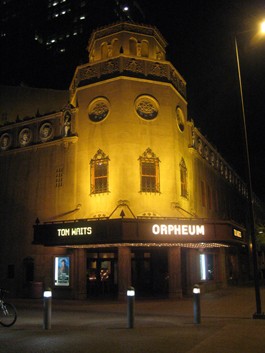
My friends and I have a running game in which we submit the most profanely ridiculous circumstances under which we’d see our favorite bands. “If there was a Jawbreaker reunion,” we ask each other, “but it’s in the middle of a jungle in Guam, accessible only by rusty machete, and they’re only playing four songs and tickets are $600, would you go?”
Time and again, the artist who always wins in the zaniest scenarios is Tom Waits. And so it was last week that a friend and I embarked on the obsessed fans’ journey to Phoenix, Ariz., where the temperature was 115 degrees, to join the fellow faithful who’d been lucky enough to score $100 tickets. No machetes necessary!
There are few artists I will travel such lengths to see, and the irony is not lost on me that the one at the top of the list lives a bike ride’s distance from my house. But the denim-clad Tom Waits that locals see digging through nails at Sebastopol Hardware is a completely different figure after donning the suit and taking the stage, and the transformation goes deeper the further from home he tours. No one in Phoenix, for example, could cite his regular coffee order at Flying Goat, and with an enigma like Waits, that’s a good thing.
We cruised the Orpheum Theater during the show the night before. A young couple inched down the alleyway, placing their ears up to each door in hopes of hearing any traces of the magic being conjured inside. A blonde girl pleaded with the box office, trying desperately to beg her way in. And on the sidewalk, so fittingly out of place, two ramshackle street musicians warbled a torturously off-key duet of “Sentimental Journey” to the empty night.
Our tickets, acquired through tenacity and dumb luck, were for the second night, and it was a chore to walk around town the next day and avoid hearing discussion of the previous night’s show. At record stores, junk shops, diners and bars, we continually had to ask people to please not tell us anything. “I’m gonna ruin it for you!” threatened a guy at the bar. “Tom Waits performed, and he was there for the whole night!”
Throughout the city, places were either shut down or, at the least, feeling the presence. One store greeted us with a sign explaining why the doors were closed: “Sorry man, it’s Waits. Come back tomorrow at 11am.” No other explanation needed.
A couple hours before the show, we entered an overflowing Irish pub a couple blocks from the theater. “Cold Water” was on the jukebox, and clusters of strangers toasted the Waits tour acronym when their beers arrived: “PEHDTSCKJMBA!” We shared a table with a couple who’d bought scalped tickets to the show the night before–very back row, in the balcony, $500 each. They told us they would’ve paid $1,500. The first dance at their wedding was “Take It with Me When I Go.” My wife and I danced to “Time,” I tell them, and our bond is instant.
It’s not much of a stretch to call the Waits crowd a congregation. The guys dressed like him–bowler hats and vests–and the girls clung to them in vicarious longing. People toted LPs of Heartattack & Vineand Mule Variations, hoping for an autograph. Once in line, they moved swiftly inside, despite Waits’ insistence on anti-scalping measures requiring everyone to produce their credit card and ID at the door.
As for the show–you can read reviews of the show anywhere online, including my own–it was utterly captivating. I slept under the escalator of the Phoenix airport later that night for a 6am flight back home, remembering that the last time I had slept on the floor of the Phoenix airport was to get home in time to catch Waits at the Raven Theater in 1996. During the fitful rest, a strange, whispery dream kept entering my head of an undefined figure in the mist, a metaphor for the night before.An atmosphere rather than a performance. Worlds rather than songs. A transfixion rather than a concert.
So let’s continue the crazy game my friends and I have. I know it’s nuts to fly 800 miles to a scorching desert and sleep on the floor to see Tom Waits, but man, that’s nothing–I’ve got tickets to the show in Dublin, Ireland, next month. Stay tuned.
To read the Phoenix review, go to .
News Blast
No dash for cash
Clean campaigning is sweeping the nation, dollar by dollar, county by county, slowly changing the face of elections and leveling the playing field.
California has recently joined an ever-growing collection of states intent on making publicly funded elections the norm, breaking away from the donor- and lobbyist-controlled campaign arena for good. The pros of this morally pristine strategy far outweigh the cons–not only do spending restrictions encourage more candidates to run, the voters become the central focus of a campaign.
Moira Brennan, the Northern California director of California’s Clean Money Campaign, says that San Rafael’s recent adoption of clean campaigning is a precedent-setting move for California, a “critical building block,” because of the benefits for communities and voters.
“There is a crisis in our election process,” Brennan says. “The government is not run for the benefit of ordinary citizens. I’m not cynical, but I really don’t think people think their vote counts. Things just don’t have to be this way.”
Before even being granted consideration, potential candidates are required to agree to voluntary spending limits, refuse any contributions from private donors and refrain from spending their own money to ensure a spot on the ballot. The average expenses for even a small local campaign are estimated to be in the $45,000 range.
Of course, some skeptics aren’t so sure that clean elections are that clean. First Amendment hawks have already cried foul with respect to the compulsory spending cap, and traditionalists claim that politics are meant to be dirty and unfair–always have been, always will be.
“First of all,” Brennan laughs. “It’s a voluntary system. And I would argue that because you’re giving candidates who might not have bundles of money the opportunity to get their messages out, you’re creating more free speech, feeding into the marketplace of ideas.”
The official launch of the San Rafael clean elections movement is slated for Monday, June 30, from 7pm to 9pm at the San Rafael City Hall. 1400 Fifth Ave., San Rafael.
Can you hear me now?
Sure, those wireless headsets are a tad dorky and make everyone look like a Secret Service agent, but beginning July 1, they are the only legal way to talk on the phone while driving. The California Highway Patrol would like to remind us that time spent driving is strictly for driving, so hang up the cellular or plug in that Bluetooth if a long-lost aunt just insists on catching up during the commute. Either that or leave the cell phone on speaker on the seat and yell into it while merging lanes on Highway 101. We recommend the headset.
Heavy Baggage

Lately I’ve been doing this thing called “Apocalypse Watch.” When I hear something disturbing, like scientist James Lovelock telling Rolling Stone magazine that global warming will have culled the world population from 6.6 billion to 500 million by 2100, or that Miley Cyrus thinks having her picture snapped by Annie Leibovitz is a reputation-destroying snafu, I make a little note of it.
Last week, I added rent-a-purses to my list.
If you’ve seen the new Sex and the City movie, you might recall a subplot involving Carrie Bradshaw’s assistant (Jennifer Hudson) renting a very ugly designer handbag on a weekly basis from a company called Bag Borrow or Steal (BBOS). Sadly, this is a real business, and, due to the unfounded popularity of what is considered a drab reincarnation of a much better television show, it’s booming.
At www.bagborroworsteal.com you can “join in the fun” of borrowing designer bags and accessories for a weekly fee. It’s $15 and up to rent Coach and $150 and up to rent vintage, and you can choose from every hoity-toity designer on the market. Gucci! Prada! Fendi! And–oh, who cares.
It’s not that bags are inherently evil or that I object to impoverished fashionistas who just want to be able to carry around the same black Prada fringe-bag (only $85 a week for BBOS members!) that Mary Kate Olsen, member of my Apocalypse Watch since 2006, carried one Tuesday when she went out shopping for another purse. (If Mary Kate is your celebrity of choice, no one can help you.) But in the immortal words of Gossip Girl: WTF?
A quick sampling of the Net reveals I’m not the only one scratching my head over this Netflix-for-purses marketing plan. On Tech Beat, Sarah Lacy writes, “BBOS claims their service is like borrowing from your girlfriends. One important distinction–your friends don’t charge you a $100 lending fee plus shipping.” Elsewhere, bloggers seem put off by the concept of renting a used designer bag for the same price it would cost to buy a convincing knockoff. And on the Bag Blog, a number of customers claim to have been scammed by BBOS, which, despite some apparent complimentary trial offers, seems slap-happy about getting your credit card number anyway and laying down the regular $20 membership fee whether or not you tell them no.
More disturbing to me, however, is the cultural obsession with handbags that has enabled companies like BBOS to spring up in the first place. Unlike shoes, the former fashion fetish of choice, handbags have always struck me as too utilitarian to convey any sort of fashion mystique. They’re for holding money and makeup, and are often coated with the bacteria of the same. They inevitably bulge with the receipts of things purchased, the wrappers of straws used and peppermints consumed. You carry tampons in your purse. You’re constantly, awkwardly fishing in their bulging, chaotic depths for that hideously vibrating cell phone or the MapQuest directions you negligently stuffed inside before you sped off on a trip to your girlfriend’s house. The most capitalistic of all fashion commodities, purses are things you put other things in. And so they remain the most unappealing commodity of all: visual proof of our cluttered, consumer society.
According to Freud, purses are also supposed to be some sort of vaginal substitute. While there’s no doubt Freud could have found the sexual connotations in dry wall, the idea of the purse-as-vagina is interesting to contemplate, particularly when we consider how many vacant sex goddesses seem to be pushing the purse upon impressionable members of the cult of celebrity. (From here on in, words like “pushing” and “member” will inevitably be fraught with hilarious duality–just try to work through it.)
Skanktards like Mary Kate Olsen and Victoria Beckham (what the hell do these women do again?), blonde people like Sienna Miller and Hayden Panettiere–these are the honeys with the most bags. Pink bags. Red bags. Fringed bags. Scaly bags. Glance at a fashion magazine and you’ll see that a big trend is the rounded satchel look, multiple orifices–I mean pockets–optional. That’s bags within bags, sistah!
If men compensate for small penises by buying huge cars, what does it say when women adorn themselves with an endless succession of gaping, multipocketed handbags? Is this some sort of female pissing contest? Or a girls vs. guys standoff? Women in Hollywood still make less than their male counterparts and the pay discrepency between the salaries of regular men and women still stands between 7 and 20 percent, depending on who does the math.
More amusingly, recent health studies have linked purses to the spread of disease. A study by the University of Arizona found that purses–so often set on the floors of public restrooms, movie theaters and restaurants–carry 100 times more bacteria than your average toilet seat. Everything from E. coli to hepatitis can lurk on the bottom of your rented Botkier, which seems somehow appropriate if you’re Amy Winehouse (pictured with her Botkier bag on BBOS), but also extremely gross when you consider how many women plunk their purses down on tabletops and counters where food is eaten or prepared.
Giant bags weighing seven to 10 pounds also get a bad rap. Medical News Today reports that giant handbags slung over the same shoulder over and over again can strain your neck and back. If poor Amy has as much physical baggage as mental, she probably knows this already.
As much as I despise the likes of Paris Hilton and Jessica Simpson, I wouldn’t wish E. coli on anyone. It is interesting to note, however, that these useless icons have perpetuated a craze that is literally as skanky as they are. Not only do their vaginal substitutes have their own faux STDs (thus reflecting what often happens to serial daters like Paris), the exorbitant amounts of money they’ve shelled out in order to possess the week’s hottest bag reflects their own place in popular culture–that of mindless eye candy. In the end, they’re just expensive, walking vaginas, garnering a brief, feverish affection before their 15 minutes get taken over by a Haylie, Nicky or Jamie Lynn.
Of course, the very presence of the little-sister brigade means that cult-of-celebrity members will be able to go on emulating their favorite fashion plate for a great while yet. And that’s what really bites about the purse thing. Are we so enamored of wealth that we must imitate its every gesture?
The Duff, Hilton and Spears sisters are all rather pretty, it’s true, but would we really be imitating them if they didn’t net $700,000 a month (Britney’s salary) or possess the power to buy a $1,400 Louis Vuitton wallet at the drop of a hat? Stripped of her awesome earning power, Paris Hilton is the airhead everyone despised in high school, Hillary Duff is just another unimaginative pop star and Jamie Lynn Spears is the sad, pathetic result of bad parenting. It is wealth alone that makes these women notable, a fact conveniently symbolized by their purse fetish.
More than anything else, the purse represents money and prestige. The existence of companies like BBOS betrays the fact that such commodities are become increasingly more difficult for ordinary people to obtain.
And yet, in the name of underweight, cosmetically enhanced fantasy figures, the trend persists, dreams of power and wealth somehow embodied by a microbe-resplendent receptacle for germs and credit card reciepts that will, by the time the consumer begs, borrows or steals it, already be obsolete in the almighty eyes of pop culture.
There’s only one thing to say about that.
Ladies, you’ve got baggage.
Museums and gallery notes.
Reviews of new book releases.
Reviews and previews of new plays, operas and symphony performances.
Reviews and previews of new dance performances and events.
Wine Tasting Room of the Week
Reminiscent of the final scene of the original Indiana Jones movie, in which the Ark is warehoused into obscurity amid thousands of similar crates, millions of under-$20 wines await discovery in football-field-sized warehouses. Every bucolic wine country has its commercial underbelly, where tanks are fabricated, barrels are toasted, shipping is shipped. For Napa Valley, the name of that underbelly is American Canyon. Wine-wise, this is the territory of economy of scale, of vast, utilitarian storage–of, one supposes, Two Buck Chuck. But in one industrial park, just where the road dead-ends–at a vineyard, natch–there’s another guy. Call him Ten Buck Tony.
Tony Cartlidge and Glenn Browne began in 1980, selling out 1,200 cases of Chardonnay. Today, Cartlidge and partners doggedly hold down a $10-$15 price point on premium California varietal wine in all the usual flavors, some appellation-designated. The winery receives perennial praise from none other than Robert Parker Jr., who can’t believe how so much flavor can be packed into a $10 bottle.
With “Stick Your Nose in Our Business” as its motto, C&B operates a tasting room, unlike many value brands, out here in nowheresville. Beyond the inscrutable glass front, one finds the quiet murmuring of business-office banter that one might expect; and behind the bar, the most unexpected, energetic woman presses endless free tastings upon the visitor, introduces strangers and even offers marital advice and wine spritzer recipes in a thick Greek accent, imbuing the scene with Old World hospitality. Various people wander in and out, from the CEO to a truck-driving regular, for a taste or a one-liner.
Despite the protestations of my Greek friend–and Parker–that it’s unoaked, I found the 2006 C&B Chardonnay’s ($11) brown sugar and butterscotch undermined by bitter wood. Next, the 2007 C&B Single Vineyard Sauvignon Blanc ($14) hits the varietal mark with a grassy strip on a steely palate, balanced with a dose of sweet fruit.
A pallet or two above expectation, 2006 C&B Cabernet Sauvignon ($11) is serious with licorice and leather, with the company’s typical soft tannin profile; the Aussie-style 2004 C&B Syrah ($11) is an everlasting gobstopper with the quenching, big taste of black cherry juice. Among other C&B labels, the 2004 Moser Scharding Cabernet Sauvignon ($35) and 2003 Stratford Napa Valley Cabernet Sauvignon ($21) are indisputable bargains with all the cassis and tobacco and soft warmth of an Upvalley Cab. Another benefit of C&B’s economy of scale: they don’t bother stacking partial pallets of older vintages, instead selling spare bottles for $7 or less. Three cases for $48? Chuck has nothing on Tony.
Cartlidge & Browne Winery, 205 Jim Oswalt Way, American Canyon. Open daily, 10am to 4pm. No tasting fee. 707.552.5199.
Shadow Economy
This is the third of a multipart series on the state of the economy and how we got here.
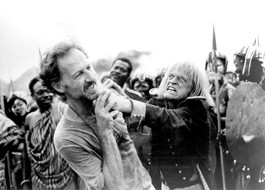
Wall Street is dangerously similar to German New Wave movies. Movies by Werner Herzog, Rainer Werner Fassbinder, Margarethe von Trotta, Volker Schlöndorff, Wim Wenders–you know the genre. Their movies are difficult and dense. Mostly, they are horrid. I hate these movies, but have never forgotten one.
I make the comparison because Wall Street, like German New Wave cinema, has always featured heroes with impossible dreams or people with unique talents in obscure fields. And like German New Wave, the obsessiveness of Wall Street’s main characters has also always taken the place of plot. The plan of Wall Street’s hot shots has always been that there is no plan. People are on their own. God is absent. Truth is elastic. The important thing is to keep on pushing.
In the lives of these characters, whether from German New Wave or Wall Street, a lot is improvised. For both groups, life is lived in the theater of the ridiculous. In the Wall Street version, that materializes in statements such as “I am ridiculously rich” or “I am ridiculously lucky.” It’s generally the opposite for characters in German New Wave.
In German New Wave movies, chickens often stand in for people. It’s too painful to watch a German New Wave movie without a little existential comic relief every now and then, and the directors know it. There are long shots of chickens on the beach, buried up to their necks in sand, as the tide comes in. Shots of dancing chickens. Hypnotized chickens. Cannibalistic chickens. Dwarves throwing chickens. Chickens talking to themselves. Chickens jumping off of cliffs.
Lately, the chickens have come home to roost on Wall Street. And like German New Wave cinema, the stories coming out of Wall Street this year are touched by the ridiculous, but more fundamentally Wagnerian in scope, influenced by operatic themes. Themes like character, ambition, greed, scandal, disgrace, bankruptcy, ignominy, shame and even justice.
Yes, justice.
Bear Stearns Bust
On Thursday, June 19, the FBI made its first big bust since last summer’s subprime mess, the first big bust since the housing and credit crises that followed the subprime mess pushed our country into a recession.
Hooray for the FBI. They busted hundreds of housing developers, mortgage lenders and brokers, lawyers, real estate agents and appraisers across the country, while two hedge fund managers on Wall Street were arrested in a separate but related case. (Incidentally, those two guys were referred to, but not named, in our May 28 article, “Secrets and Lies,” about Bear Stearns.)
FBI director Robert Mueller was quick to congratulate himself. “This dragnet operation is an example of our unified commitment to address a significant crime problem,” he told reporters. “The FBI will continue to direct its investigative and analytic resources toward the mortgage fraud and corporate securities fraud that threaten our nation’s economy.”
Nice start, Bob.
The fact that the investigation is ongoing underscores that the problems on Wall Street are not isolated to even a few hundred bad apples.
“These arrests make it clear that the causes of our credit problems are very broad-based and can’t be put at the feet of any one player,” Mark Zandi of Moody’s said at the same press conference. “It makes it clear that everyone was involved to one degree or another–from lender to investment banker to hedge fund manager–all the way from the bottom to the top.”
You forgot to mention someone, Mr. Zandi. You too, director Mueller.
Prime brokers. The new masters of the universe.
Among all their colleagues on Wall Street, it is the prime brokers who dream the most impossible dreams and who have the most unique talents in the most obscure fields.
If Werner Herzog were to make a movie about Wall Street today, he would be looking into the face of the prime broker. I’m reading from a possible movie review: “The face of the prime broker has the quality of a dream–at once vivid, but vague; easy to touch, but beyond reach; at once scary like science fiction and ethereally lovely like a fantasy. It is a beautiful face, reflected in the eerie blue of a computer screen, but in the end, it is the last face you will see before the market crashes.”
So who are they, these prime brokers? These guys who print the new money in the shadow banking system? These guys who live for all that is unregulated and opaque?
First of all, they are not regular people.
“They are professional madmen,” said Warren Buffet in his famous 2005 speech to shareholders at Berkshire Hathaway.
Except for Warren Buffet, nobody spoke up. Since Buffet’s speech, billions and billions of dollars, perhaps a trillion, were stashed in offshore accounts, as Wall Street managed its own fortune. (It’s a myth that Wall Street manages the fortunes of its clients. It does not. It serves itself the cake. We’re lucky if a few crumbs fall off the plate.)
Let’s now break this silence, and with it the omerta of prime brokerage.
‘Unspoken Terror’
It all started innocently enough, generically enough.
In the beginning, through the 1980s and ’90s, prime brokers were the guys at big investment banks like UBS, Morgan Stanley, Merrill Lynch, Goldman Sachs, Bear Stearns, Lehman Brothers, etc., who supported the nascent hedge fund industry with basic services.
A hedge fund start-up–and there were thousands of them back in the ’80s and ’90s, as many as 8,000 at one time–usually bought a basic package from a prime broker. The core services in the package included global custody (clearing, custody and asset servicing; no problem, all plain vanilla); securities lending (especially for what’s called “naked short sales,” which is illegal); financing (facilitating the crazy extreme leverage at hedge funds, sometimes as high as 40-to-1); customized technology (providing hedge funds with reporting necessary to value positions and risk; this is where things started to get funky); and operational support (prime brokers became the hedge fund’s primary operations contact with all other members of the broker-dealer community, and oh, did this invite abuse).
It is easy to see how young hedge funds became so dependent on prime brokers. Prime brokers served as incubators for hedge fund hatchlings that were proliferating like so many baby chicks at a Tyson chicken farm.
In addition to all the above services, prime brokers also provided what is quaintly called “value-added” services in the hedge fund industry, including capital introduction (introductions to the prime broker’s institutional clients and other possible investors, a blatant conflict of interest but nobody in Congress cared); office space leasing and services (read: free or discounted office space, replete with staff and support–a bribe for business? you bet); risk management advisory services (prime brokers advising hedge funds on the very same junk bonds they secretly wanted to dump on them); and something ambiguously called “consulting services” (often focused on how hedge funds could circumvent established regulatory requirements, usually by domiciling operations beyond the jurisdiction of U.S. law).
It got worse after 2000.
Introduce swaps and derivatives into the mix. Yeah, baby. Things suddenly got really interesting. Preserving the integrity of the balance sheet at hedge funds got thrown out the window as swaps and derivatives grew, including the exponential growth of something called “synthetic positions.”
“Synthetic” means fake, bogus, fixed, fraudulent. It’s that simple. Add to synthetic positions the liquidity of the first years of our decade as Alan Greenspan brought interest rates down to almost nothing, and you get the picture. In one year alone, from 2005 to 2006, the market for credit default swaps, just one product, grew from $12.4 trillion to $26 trillion.
Most markets are a zero-sum game, meaning there are an equal number of winners and losers. For every dollar someone makes, someone else loses a dollar. Prime brokers changed all that. Because prime brokers never lost.
Prime brokers acting as the hedge fund industry’s only interface with the world (see “operational support,” above) were able to create a shadow banking system where the counterparties to any hedge fund’s trades were unknown, even to the hedge fund. Add to that opaqueness a lack of infrastructure where a lot of trades are unconfirmed or delayed, and there are the makings for greatest bank heist in history.
While the Federal Reserve Bank has since 1996 published reports on these obvious problems, it wasn’t until September 2005 that the Fed addressed what was termed the “unspoken terror” of settlement issues among prime brokers.
Funny that it took two more years before Congress noticed. All it took to get their attention were last summer’s subprime mess, the blow-up at Bear Stearns and a country plunged into a recession.
Shadow Masters
Dreamers and those with unique talents in obscure fields are the folks who built the shadow banking system. They are the prime brokers.
Like actors in a Werner Herzog movie, they inhabit a strange new world, one as big as the traditional banking system or bigger, but where there are no federally insured deposits and where shadow banks neither have nor want–or even need–access to short-term borrowing from the Fed or any other central bank during times of crisis. It’s a world where no risk is too great, where collateral isn’t necessary, where there are no capital requirements and where counterparties are never identified. Shadow banks are beyond the reach of law, are almost always found offshore and redefine the term “international crime organization.” Indeed, because shadow banks always make money, they would even profit from the collapse of the global financial system. They might even cause it to happen.
Prime brokers have been the new masters, no question about it. But their primacy may finally be threatened.
“This bright new financial system–for all its talented participants, for all its rich rewards–has failed the test of the market place,” said Paul Volker, former president of the Federal Reserve, during a speech I attended in April. “It adds up to a clarion call for reform.”
Two months later, at a press conference where I was also present, Timothy Geithner, president of the Federal Reserve Bank of New York, answered that call.
“The structure of the financial system changed radically during the boom, with dramatic growth outside the traditional banking system,” Geithner warned in his speech, adding that unregulated growth in opaque assets made the last crisis difficult to manage and could make a future crisis impossible to manage.
And two weeks before the FBI busted those two guys at Bear Stearns, U.S. Treasury Secretary Henry Paulson said the Federal Reserve should “be allowed to collect information from large complex financial institutions.” He said, “Regulators should have a clear path toward figuring out how to intervene in a crisis and how to close a failed brokerage firm.”
Sounds like Paulson is expecting more trouble. If this were a New Wave German film instead of the banal horror of real life, someone would figure out that it must be time to pull out the chickens.
Futura Bold Oblique
Haight & Shrader, San Francisco:
Fear and Fury
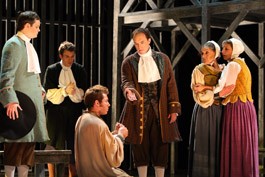
Arthur Miller’s The Crucible is one of those shows that, like Thornton Wilder’s Our Town and Frances Goodrich and Albert Hackett’s The Diary of Anne Frank, has suffered from decades of well-meaning but painful productions at the hands of underfunded high school theater departments and lesser community theater companies. After half a dozen such stagings, it is easy to forget that The Crucible, arguably Miller’s most accessible and riveting play, is a true American masterpiece. When done well, with a strong director, it is packed with drama and dripping with tension and roller-coaster emotions.
That’s the kind of Crucible that opens the Summer Repertory Theatre’s 2008 season at the Santa Rosa Junior College. With director David Storck orchestrating a first-rate cast of rising young actors from around the country, this is the Crucible to see.
Summer Repertory Theatre is one of the few remaining training-based repertory programs of its kind in America, and the North Bay is fortunate to have it. The first of five plays and musicals that make up this season at SRT (Claire Booth Luce’s The Women and Mel Brooks’ The Producers are up next), Storck’s production looks remarkable, with a sprawling, Broadway-quality set by Nathaniel Sinnet, and maintains a tone of grounded believability as the story of the infamous Salem witch trials plays itself out like a Hitchcockian thriller.
In 1792, in the contentious close-quarters of tiny Salem, Mass., farmer John Proctor (Matthew David Gellin) finds himself drawn into a local witchcraft scare when trouble-making Abigail Williams (an effectively duplicitous Jennice Butler), with whom Proctor once had an illicit affair, accuses several local people of trafficking with the devil. One of the accused is Proctor’s upright wife, Elizabeth (Denice Burbach, also very good), who has been struggling to forgive her husband after his fling with Abigail.
For her part, Abigail’s plot is two-fold: Her minister uncle, the self-serving Rev. Parris (Kyle Schaefer), has caught Abigail and several of the local girls dancing in the woods, playing at witchcraft as Abigail attempts to place a curse on Elizabeth Proctor. Frightened that they’ll be whipped or worse, the girls haphazardly improvise an alibi: they were under the spell of powerful local witches.
When the adults do more than just believe them, actually establishing a court to discover and try anyone consorting with the devil, the girls, with Abigail their tyrannical leader, find themselves gifted with a remarkable amount of local importance. From her new-found position of power, Abigail discovers a way to rid herself of Elizabeth, whom she sees as standing between herself and John, and she quickly devises a way to frame her for witchcraft.
The way all of this plays out is alternately hilarious and terrifying, with the superstitious and hypocritical Puritans turning on one another like starving dogs in a pit. While Gellin is a bit physically stiff, he has nailed the pent-up hurt and righteous rationality that defines John Proctor, and his final scene, in which, accused of witchcraft himself, he heartrendingly wrestles with own conscious, is a whopper of a performance.
Also good in a cast full of good young actors is Tyler Seiple as the visiting minister John Hale, an “expert” in the occult who at first unwittingly stirs up the villagers’ fears and then tries in vain to stop the destructive momentum he has started. Jacob Mahler, as Deputy-Governor Danforth, is properly frightening, wielding the powers of judge and jury with the right amount of arrogance and cruel relish. In the smallish role of Judge Hawthorne, Max Smythe displays a delightful ability to be skin-crawlingly creepy while doing nothing but staring at someone. Mollie Boice, as the good-natured Rebecca Nurse, the only one who keeps her head even after being accused herself, is also strong in a small but pivotal role.
The real star of this show, however, is David Storck, the director. With a firm hand on the play’s pacing, blocking, dramatic build and subtle sound elements (nicely done by Theo Bridant), he keeps this uniquely American story grounded in the human stories of its characters. And it is a timely story as well. In a world where a simple fist-bump or funny name can result in accusations of terrorist leanings, it is important to remember that we are never more than few idiotic steps from replaying Salem’s witch-hunt hysteria all over again.
‘The Crucible’ runs through July 27 at the Burbank Auditorium on the SRJC campus. June 27 at 7:30pm; July 2-3, 15-16 at 8pm; also July 2, 16 and 27 at 2pm. 1501 Mendocino Ave., Santa Rosa. $8-$15. 707.527.4343.
Museums and gallery notes.
Reviews of new book releases.
Reviews and previews of new plays, operas and symphony performances.
Reviews and previews of new dance performances and events.
Just the Facts
Since I started writing this column in 1999, I’ve seen a thousand Internet businesses rise and die. I’ve watched the web go from a medium you access via dial-up to the medium you carry around with you on your mobile. Still, there are three myths about the Internet that refuse to kick the bucket. Let’s hope the microgeneration that comes after the Web 2.0 weenies at last puts these misleading ideas to rest.
Myth: The Internet is free. This is my favorite Internet myth, because it has literally never been true. In the very early days of the Net, the only people who went online were university students or military researchers–the former got accounts via the price of tuition; the latter got it as part of their jobs. Once the Internet was opened up to the public, people could only access it by paying fees to their Internet service providers (ISPs). And let’s not even get into the fact that you have to buy a computer or pay to rent time on one.
I think this myth got started because pundits wanted to compare the price of publishing or mailing something on the Internet to the price of doing so using paper or the postal service. Putting up a site on the web is “free” only if you pretend that you don’t have to pay your ISP and a hosting service to do it. No doubt that’s cheaper than printing and distributing a magazine to thousands of people. But it’s not free.
Same goes for email. Sure it’s “free” to send an email, but again, you’re still paying your ISP for Internet access to send that letter. The poisonous part of this myth is that it sets up the false idea that the Internet removes all barriers to free expression. The Internet removes some barriers but erects others. You can get few free minutes online in your local public library, maybe, and set up a website using a free service (if the library’s filtering software allows that). But will you be able to catch anyone’s attention if you publish under those constraints?
Myth: The Internet knows no boundaries. Despite the Great Firewall of China, an elaborate system of Internet filters that prevent Chinese citizens from accessing websites not approved by the government, many people still believe that the Internet is a glorious international space that can bring the whole world together. When the government of a country like Pakistan can choose to block YouTube, which it has and does, it’s impossible to say the Internet has no boundaries. The Internet does have boundaries, and they are often drawn along national lines.
Of course, closed cultures are not the only source of these boundaries. Many people living in African and South American nations have little access to the Internet, mostly due to poverty. As long as we continue to behave as if the Internet is completely international, we forget that putting something online does not make it available to the whole world. And we also forget that communications technology alone cannot undo centuries of mistrust between various regions of the world.
Myth: The Internet is full of danger. Perhaps because the previous two myths are so powerful, many people have come to believe that the Internet is a dangerous place–sort of like the “bad” part of a city, where you’re likely to get mugged or hassled late at night.
The so-called dangers of the Internet were highlighted in two recent media frenzies: the MySpace child predator bust, in which Wired reporter Kevin Poulsen discovered that a registered sex offender was actively friending and trolling MySpace for kids; and the harassment of web pundit Kathy Sierra by a group of people who posted cruelly Photoshopped pictures of her, called for her death and then posted her home address.
Despite the genuine scariness represented by both these incidents, I would submit they are no less scary than what one could encounter “in real life,” offline. In general, the Internet is a far safer place for kids and vulnerable people than almost anywhere else. As long as you don’t hand out your address to strangers, you’ve got a cushion of anonymity and protection online that you’ll never have in the real world. It’s no surprise that our myths of the Internet overestimate both its ability to bring the world together and to destroy us.
Annalee Newitz is a surly media nerd who is biased in favor of facts. Open Mic is now a weekly feature in the Bohemian. We welcome your contribution. To have your topical essay of 700 words considered for publication, write [ mailto:op*****@******an.com” data-original-string=”TTU98yZadkppUCCtHmFxXg==06aYBra/NMHaikSlFkngWHThtZn+vOZYz1D+2caV29v5DGpZYcW4IL9nsorJhMrJXz57wy9vIpAXAHPwt0uNoNgn9tJ1QnlSIzwMbbgeX2Pd5E=” title=”This contact has been encoded by Anti-Spam by CleanTalk. Click to decode. To finish the decoding make sure that JavaScript is enabled in your browser. ]op*****@******an.com.
On Ah Come Up
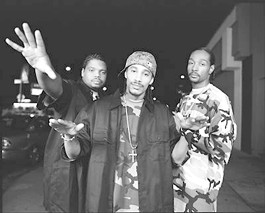
Nothing against children of the ’80s, but I believe the 1990s were the true golden age of hip-hop. The teenaged genre had finally hit its commercial and creative stride, giving us well-developed, eclectic voices from the Afrocentrism of Arrested Development and the gangsta swagger of West Coast g-funk to the urban vignettes of the Wu-Tang Clan and the trailer-park psychodrama of Eminem.
But few acts were as original or tuneful as Bone Thugs-n-Harmony. Long before Twista was hip-hop’s resident rapid tongue-wagger, the Cleveland group astounded with an infectious, speedy lyrical flow that never sacrificed melody or the gritty realism lying beneath the dizzying form. They appear at the Phoenix Theater on June 28.
After releasing their independent debut, Faces of Death, in 1993, the quintet chased fame the old-fashioned way: heading to L.A. in search of a big break, specifically through an audience with gangsta-rap pioneer and N.W.A. mastermind Eazy-E. After an audition over the phone, Eazy never contacted them like he’d promised. Undeterred, the group chartered a bus to Cleveland where Eazy was performing, got backstage and auditioned for him on the spot. The rest, as they say, is history.
Suddenly, Eazy had his own innovative protégés to counter then-rival Dr. Dre, complete with Ramones-style names: Krayzie Bone, Layzie Bone, Bizzy Bone, Wish Bone and Flesh-n-Bone. Their Ruthless Records release, Creepin’ on Ah Come Up, would soon be heard blaring out of every other car, especially their signature single “Thuggish Ruggish Bone.” Over thumping bass and distinctively Cali-style synthesizers, they stormed the major league. “Get ready for the bone and the mo thug, bustas, you know me as a hustla,” spit Wish Bone with an effortless internal rhyme scheme. “Try to creep and get beat, make me succeed, peep, gotta put them under.”
Getting a jump on millennium apprehension was the following year’s E 1999 Eternal, the group’s apocalyptic commercial breakthrough. The Grammy-nominated “1st of tha Month” was famously called an ignorant “welfare carol” by comedian Chris Rock, but the track’s uneasy world of short-term, hedonistic pleasures juxtaposed with territorial drug-deal murders conveys a regretful path born of violence and poverty. “Wake up, and I see that my sister was already dressed / She said, ‘I’m gonna run and go get my stamps / Watch and make sure no one snatches my check,'” raps Bizzy Bone.
Soon Bone was everywhere, on records for Mariah Carey and the Notorious B.I.G. (“Notorious Thugs” remains one of the few highlights on Life After Death). Their greatest success was “Tha Crossroads,” a tender, frustrated tribute to friends (including Eazy-E) and relatives who’d met their demise, naturally or unnaturally. Exhibiting substance to complement the speedy delivery, the song gave the thug life a compelling, empathetic sense of tragedy that became prescient of the murders of 2Pac and Biggie Smalls, both former Bone Thugs collaborators.
After the overly ambitious The Art of War in 1997, Bone’s star seemed to fade during what the All Music Guide calls “an age where weed-smoking gangsters have been replaced by champagne-sipping players.” High-pitched Bizzy Bone’s increasingly unreliable behavior led to his departure, and Flesh-n-Bone went to prison. But the remaining members persevered, releasing albums that culminated in last year’s Interscope debut Strength and Loyalty, which brought Bone gold status once again.
Armed with a slew of white-hot producers like will.i.am and Swizz Beatz, the new three-legged Bone Thugs sound grownup but not tired, even on the mature yet potent Jermaine Dupri-produced single “Lil’ Love” featuring old pal Mariah Carey. Most riveting is the spiritual “Order My Steps” with Yolanda Adams, which features a brash, synthesized grinding beat, perfect behind their best lyrical dilemma in years. “[I] simply know that the world gon’ tempt me, Satan is the enemy,” says a distressed Layzie Bone, “God please help us, I don’t want to be selfish / I don’t want to live my life tryin’ to be rebellious.”
Thankfully, there have been reliable rumblings about a full reunion, with Flesh-n-Bone eligible for parole next month. But the current lineup is enjoying their current creative spurt. “We recorded a ridiculous amount of songs for this album,” Layzie Bone excitedly said last year. “If it was smart to do, we’d put out about five albums at once, and blow they wig off.”
Bone Thugs-n-Harmony perform on Saturday, June 28, at the Phoenix Theater, 201 E. Washington St., Petaluma. 8pm. $30. 707.762.3565.
Letters to the Editor
Goin’ Out West
News Blast
Heavy Baggage
Shadow Economy
Fear and Fury
Just the Facts
On Ah Come Up



