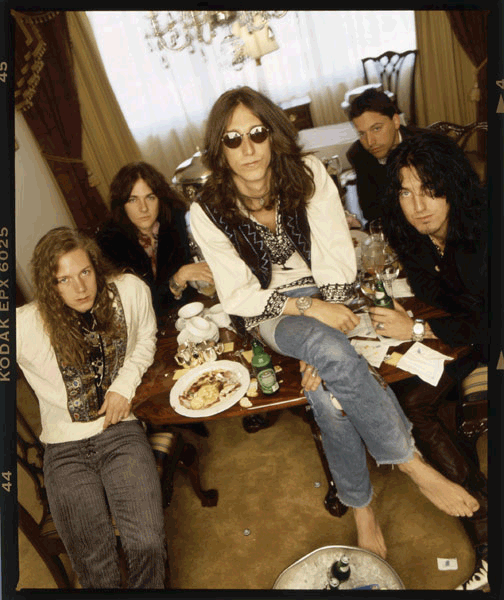
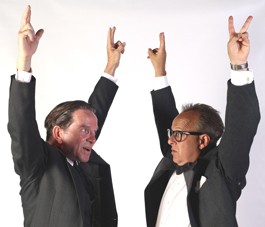
Los Lobos at the Marin Fair

1

No other band suffers such a disparity between their widely perceived “one hit” and their actual creative prowess as Los Lobos. It’s still one of the great misconceptions in rock and roll: while Los Lobos’ albums Kiko, Colossal Head and Good Morning Aztlan rank amongst the most invigorating and exciting listening experiences of the last fifteen years, drunk accountants in Cabo Wabo T-shirts at the Marin Fair last night still yelled for “La Bamba.”
“Not yet, man,” countered Cesar Rosas, no doubt resigned to the request by now. “If we play it, you’ll all leave!”
No true Los Lobos fan really gives a damn about hearing “La Bamba”—I’ve seen them twice before, and they didn’t play it, and no one asked for their money back. But a County Fair is a different story altogether, and Los Lobos knows this. So you’ve gotta hope that the old trick worked; namely, saving the payoff until the end, while in the meantime providing a look into one of the great catalogs of American music.
I, for one, am completely enamored of Los Lobos, which puts me in the company of bugeyed ex-Deadheads, aging Latino expatriates from L.A., and Sierra Nevada-swillin’ dudes with hairy shoulders. So be it. I love Los Lobos fans, if only to imagine them crawling into work the next morning, bedraggled in the best possible way, while their coworkers chug lattes and try to out-chipper each other with peppy chitchat.
Indeed, the large tent at the Marin Fair—on an island in the middle of a man-made lake—was packed with people preparing to feel like crap the next day. Dancing, swaying, drinking, singing along, and having the time of their life on the ever-festive last night of the fair. At certain moments, such as the ferocious three-way soloing pinnacle David Hidalgo, Cesar Rosas and Louie Pérez achieved in “That Train Don’t Stop Here,” it felt like the entire tent might explode.
Other highlights included “Short Side of Nothing,” “The Neighborhood,” “Kiko and the Lavender Moon,” and “This Time”—the latter of which Hidalgo started, then looked puzzled for a second, and finally asked the crowd, “Hey. . . who knows the first verse?”
If I’m not mistaken, the band played nothing from Colossal Head nor Good Morning Aztlan, but it didn’t matter—they’re so good live, and so dependent on how they play, that it’s somewhat negligible what they play. A few cumbias, a long blues jam, some newer songs, a guest saxophonist, and hey, they still rule.
If there’s any shrug to be had with the set, it’s that it was almost identical to the last time I saw Los Lobos, an entire five years ago. Then as now, covers included Traffic’s “Dear Mr. Fantasy” as well as a sing-along of Buddy Holly’s “Not Fade Away” segueing into the Dead’s “Bertha,” which sent the twirl brigade off and spinning on the fringes of the island.
But it was the final cover of the night that really lit people up: an encore of “La Bamba.” I made my way around the crowd and saw nothing but smiling, laughing, and getting down; and to my surprise, the aforementioned drunk accountant knew every Spanish word of the song. When Los Lobos seized on the chord progression and interpolated the Young Rascals’ “Good Lovin’,” the place went nuts. How can you argue?
I got a Philly Cheesesteak sandwich, watched the fireworks, rode the Merry-Go-Round, and then walked along the railroad tracks, to the rhythm of the bassline of Colossal Head‘s “Revolution,” stuck in my head, back to my car.
(P.S. Steve Berlin, if you are reading this—I’ve always wanted to ask if you’ve got any idea whether Lee Allen intentionally quoted both “Andalucia” and “Across the Alley from the Alamo” during his saxophone solo for “Roll ‘Em Pete” on the Blasters’ live EP, Over There, or if it was merely a musical accident. I’m totally serious—it’s plagued me for over ten years. Any clue?)

Stevie Wonder at the Shoreline Amphitheatre – July 5, 2008

0

After a near-decade hiatus from touring, Stevie Wonder rolled into the Bay Area for the second time in under a year, this time bringing his acclaimed A Wonder Summer’s Night to Mountain View. While not as life-affirming as last August’s powerhouse performance in Concord (where I actually got choked up only a few seconds into opener “Love’s In Need Of Love Today”), Saturday’s show proved the eighth wonder of the world is still the most solid, enjoyable, cross-generational, and most worth-the-expensive-ass-ticket-price of any of the nostalgia acts in rock n’ roll.

The lawn section (especially at the mammoth, impersonal Shoreline Amphitheatre) is mostly good for spying the latest in lawn chair innovations and observing territorialism in its most fascinating and primal form. Yet our spot behind the new “Family Zone” offered heartwarming views of families enjoying Fourth of July weekend, all possessing the distinctive Stevie Wonder concertgoer vibe: warm smiles, interracial beauty and irie vibes to spare. The lawn itself was packed in way I’ve not seen since Radiohead’s Kid A/Amnesiac showcase in 2001.

Even without an opener, not many around us seemed to mind when the legend appeared nearly an hour after the 7:30 “show time”, with the entire audience rising to their feet in a benevolent ovation. Flanked by his backup singer daughter Iesha and very young son (who later played his own drum kit beside the large band), Wonder again began the show with a few words, this time dedicating the show to Bill Graham as well as his late mother (whose passing was the reason for his decision to tour again) before expressing excitement over Obama’s candidacy.“Don’t just talk about [unity], be about it,” he told the crowd, before asking, “Now, y’all want to hear some music?” After we counted it off at the man’s behest, he was off and running with a pitch-perfect rendition of “As If You Read My Mind”, complete with his killer harmonica solo. Then followed three more numbers from this classic 1980 album Hotter Than July, a dark-horse candidate for Wonder’s best record ever. Much like last year’s concert bookends from Songs In The Key Of Life (The aforementioned “Love’s In Need…” and the extended closer “Another Star”), the opening July suite was a testament to the “album rock” format mostly because the tunes sounded amazingly just like the album versions.

Ian Curtis’ Gravestone Stolen

8

As reported by BBC News, the gravestone for Joy Division’s Ian Curtis has been stolen this week from its Macclesfield, UK cemetery.
Police and city authorities are “stunned,” “shocked,” and “agog” at the theft, but, like, have they never met any Joy Division fans? Can they really be surprised that the tombstone of a singer with the most death-obsessed fans in the world has been stolen?
More obviously: look at the thing. It’s begging to be stolen. It’s the perfect size to fit in a backpack and it’s held in place by tarmac, for chrissakes. On top of all that, it’s inscribed with the ultimate Joy Division epitaph, “Love Will Tear Us Apart.” I mean, geez. Who wouldn’t think about stealing it?
I don’t wanna seem like I’m rooting for the bad guys, but come on.
(I was way more surprised when Mac Dre’s tombstone got nabbed.)

Wine Tasting Room of the Week

0


It’s the end of the day in the middle of a heat wave, and the heat hasn’t lifted. There’s dust in my hair and dirt under my nails. My arms are seared from working in the sun, and I drive toward the ruby western sky needing a refreshing reward. Would a guy work this hard for an aluminum can of carbonated piss-water? Hell no. I want something ice-cold, crisp and clean, with the thirst-quenching character of strawberry and rose petals. Shout it to the world: Gimme some pink wine! Yeah! Say it like this to better convey the guttural gusto: pink wine—yeaaaaargh!

Incongruous? Better known by their French moniker, rosé wines just don’t get the cred here that they do in nations where men wear pink shirts with no fear. Rosés have got a lot of press lately (even from us, see “Rosé Rising,” Feb. 6), and wine shops and specialty groceries carry an improving variety. Unfortunately, the chilled-and-good-to-go section in the supermarket is not pretty in pink. In fact, the situation is not pretty at all—it’s still a white Zin world.

Being no wine snob, I grab the stumble home and Sutter Home ($3.99)—or vice-versa. A nancy wine of merely 9 percent alcohol, it’s not bad with a couple of ice cubes. The problem with cheap white Zinfandel (well, among the, etc.) is that, quantity being the primary concern, grapes are cropped for maximum tonnage, resulting in weak flavors augmented with sugar. Quite the opposite with many North Coast rosés, made from grapes harvested at ripeness for premium red wine. Winemakers separate, or “bleed off,” a portion of the pink juice to concentrate the red even more. The result is flavorful quaffs—in short supply. Par exemple, the 2007 Scherrer Dry Rosé ($14) is a nicely priced fringe benefit of its excellent Pinot Noir.

No wallflower wine, Malbec lends muscularity to 2007 Belasco de Baquedana’s Rosa de Argentina ($15), which shines like a pale ruby and is so dry it could almost use steak sauce. A great choice for the grill, like many of the better pink wines today, it’s enclosed with a handy screwcap top. (In curious counterintuition, the Sutter Home’s corked.) Also easy to break out of its graphically intense prison, Big House Pink ($8.99) is rich with chilled stewed strawberry flavor, and has weight and balance on the palate. Now that’s a refreshing, tasty beverage.

Grasping my stemware with pinky extended, I toss back a swig and shake my head in a raw enjoyment of times like these. Beads of sweat fly in every direction as the South Australian swimsuit team parachutes into the scene.

Among retailers that offer a great selection of rosé wines, try Traverso’s Gourmet Food & Liquor, 106 B St., Santa Rosa. Open Monday–Saturday, 9:30am–5:30pm. 707.542.2530.


View All

Grill To-Go

0

07.02.08

It happens every time. Dashing into the grocery store for the quick two-missing-items pickup, I am stopped by the delicious aroma of barbecue outside the market doors. There is something primal about the smell of charred, smoky meat. The cavewoman within me awakens. Salivation involuntarily starts. It need not be a hot, sunny summer afternoon, when the body craves salt replacement after sweating in the sun all day; a cold, foggy day works just as well, rousing the craving for the warmth of a fire and a good stick-to-the-ribs meal. No matter what the weather, impulse sets in and, damn, I guess we’re having barbecued tri-tip for dinner. The dash into the store now includes a couple of side dishes and a six-pack of beer or a bottle of hearty Burgundy to round out the meal.

Many local markets have smartly caught on to the desire for a hot cooked barbecue meal without the fuss of doing it yourself. There are countless tales of home grills gone wrong, from the whole roasted goat that tasted like “muddy hoof” to the Hawaiian, pit-cooked, translucent white pig with its teeth falling out à la Lord of the Flies.

My own childhood memories of grilling focus on chicken legs cooked on the backyard hibachi, crisply blackened on the outside while a stringy, raw pink on the inside. Best to leave it to the experts, and in the North Bay there are plenty to choose from. And when experts are involved, there are bound to be opinions on the best or most authentic methods for cooking over fire outdoors.

David Hoffman of Sebastopol’s Fircrest Market offers a primer in Barbecue 101. “Real barbecue isn’t done over live coals,” Hoffman instructs. “That’s grilling.” Taking on a scholarly tone, he continues: “True barbecue, which developed in Texas, is done long and slow, with indirect heat. A wood fire, most often using mesquite, is built in a metal box, and the heat is funneled to the meat, like in a convection oven. The slow cooking takes many hours, which gives the meat its intense, smoky flavor and keeps it nice and juicy.”

While other grillers agree that this may be the most accurate interpretation of barbecuing, customers prefer certain items like kabobs, fish or veggies grilled. Some city ordinances do not allow wood fires, so gas grills are the market’s only option. Most stores offer the barbecuer’s trifecta of tri-tip, ribs and chickens, by whole or half, piece or pound. Others offer more specialized meats, sandwiches or sides. Customers usually receive a ticket with their order, pay inside and return to pick up their barbecue after shopping. Unless the inner pyro in me rears its fiery head, I happily leave the cooking to the pros and head out with an easy dinner, its heavenly scent wafting through the car as I drive home—or maybe to the beach.

Here are a few suggestions for markets with barbecue to go.

Sonoma County

Andy’s Produce Market Ducky’s Barbecue offers sandwiches such as a beef brisket or pulled pork that has been slow-cooked for 14 hours. For a buck or two more, add a side of beans, slaw, cornbread or extra sauce. Don’t forget the greens: kale, collards, chard and leeks, sautéed in oil and garlic. 1691 Hwy. 116 N., Sebastopol. Open every day, 11:30am to 7pm. 707.837.3425.

Bill’s Farm Basket Maxwell’s Feel Good Barbecue proudly proclaims that the hot stuff they sell is “not your Grandma’s barbecue,” and Maxwell’s may not be your Grandpa’s, either. Chef Maxwell Meyer, formerly of Zazu and Seaweed restaurants, specializes in eclectic, mesquite-grilled meats, veggies and fruits. Try the soft Rocky chicken tacos with Cuban mojo sauce, black beans, rice, guacamole and veggie slaw for a complete meal. The chimichurri skirt steak and chicken apple sausage with pesto aioli and grilled peppers are also tempting. All foods used are organic and as locally obtained as possible. The menu changes seasonally, so keep a lookout for the hearty grilled soup come winter. A separate grill cooks up vegan and vegetarian treats like a grilled veggie and Bodega goat cheese sandwich. 10315 Bodega Hwy., Sebastopol. Open Friday&–Sunday, noon to 6pm. 707.829.1777.

El Bringuito Market barbecues chicken rubbed with a secret family seasoning, and serves it with traditional accompaniments—rice, beans, tortillas and salsa. 17380 Sonoma Hwy., Sonoma. Open Friday, 2pm to 4pm, and Saturday&–Sunday, 11am to 8pm. 707.996.4912.

Fiesta Market tumbles whole or half tri-tips in teriyaki or Italian garlic marinade. New to the menu are Willie Bird drumsticks. Corn on the cob, salmon steaks and oysters are offered when in season. 550 Hwy. 116 N., Sebastopol. Open Friday&–Sunday, 12:15pm to 7pm. 707.823.4916.

Fircrest Market Texas-style barbecued chicken, ribs and tri-tip. 998 Gravenstein Hwy. S., Sebastopol. Open Friday&–Saturday and select holidays, 1pm to 7pm. 707.8239171.

Lads Market presents an extensive range of meats and vegetables done up in sauces and marinades from around the globe. Island chicken teriyaki sticks, Brazilian churrasco beef kabobs, tandoori chicken skewers and Peruvian pollo a la braza—with garlic, vinegar, cumin and soy sauce—will spice up dinner even on a weekday. Grill master John Perezchica stresses that “all our marinades and sauces are made from scratch, and are original and unique. We pride ourselves on our specialties.” All items are offered in the meat department and can be grilled to order for a $3 charge if not on the daily menu. 3800 Marlow Road, Santa Rosa. Open Thursday&–Friday and Monday from 4pm to 8:30pm and Saturday&–Sunday, 2pm to 8:30pm. 707.573.7081.

Molsberry’s Larkfield Market tempts shoppers with cowboy baked potatoes with sour cream and butter for $1.50, in addition to the usual grilled meat choices. 522 Larkfield Shopping Center, Larkfield. Open Friday&–Saturday, noon to 7:30pm and Sunday&–Monday, noon to 6:30pm. 707.546.5041.

Oliver’s Market Grill Central Station sells the full gamut of grilled items, including oysters, corn on the cob, potatoes and salmon fillets with garlic butter. The menu varies slightly between stores and is not offered at the Cotati location. The guys at the Montecito branch boast that they “have the friendliest service and try to make every customer happy.” Customers waiting in line vigorously nod their heads in agreement. 560 Montecito Center, Santa Rosa. Open Friday&–Sunday, 11am to 7pm. 707.537.7123. 461 Stony Point Road, Santa Rosa. Open Friday&–Sunday, 11:30am to 7pm. 707.284.3530.

Petaluma Market offers “a mean cheeseburger,” according to head griller Bill Compton, who adds that “it’s the best deal in town at a mere five bucks.” Chicken with Italian rosemary dressing, tri-tip sandwiches and other meaty goodies are offered as well. 210 Western Ave., Petaluma. Open daily, noon to 5:30pm. 707.762.5464.

Marin County

Inverness Store serves its own version of surf and turf: charcoal grilled Petaluma fryers and barbecued Drake’s Bay Oysters. 12784 Sir Francis Drake Blvd., Inverness. Open Saturday&–Sunday, 11am to 7pm. 415.669.1041.

Santa Venetia Market Rocky’s Quality Meats Located across the street from the Marin Civic Center, Rocky’s offers a quick picnic dinner for those attending concerts or other events. Try the Burgundy-peppercorn marinated tri-tip or smoked baby back ribs. 71 San Pablo Ave. (at the corner of San Pedro Road), San Rafael. Open Mondays and Fridays, 3pm to 7pm. 415.479.2131.

Scotty’s Market uses a Traeger grill with cherry wood pellets for uniquely flavored meat. 620 Manuel T. Freitas Pkwy., San Rafael. Open Friday&–Sunday, noon to 7pm. 415.4792363.

United Market starts cooking first thing in the morning, and continues till “the shelves are full,” according to grill master Miguel Alizaga. United grills outside, then moves the meat inside for purchase. Turkey breasts, mild Italian sausage and pork loin are also on the menu. 100 Red Hill Road, San Anselmo. 415.456.1271. 515 Third St., San Rafael. Open Friday&–Sunday, from 8am. 415.454.8912.

Napa County

Brown’s Valley Marketcooks up mesquite tri-tip, St. Louis&–style ribs and Rocky Junior chickens. Grilled asparagus, corn on the cob and salmon with garlic and lemon are offered on occasion. All items are cooked outside, and then sold inside the deli. 3263 Brown’s Valley Road, Napa. Open Wednesday and Friday&–Saturday, 4pm to 7pm. 707.253.2178. 

Quick dining snapshots by Bohemian staffers.

Winery news and reviews.

Food-related comings and goings, openings and closings, and other essays for those who love the kitchen and what it produces.

Recipes for food that you can actually make.

Strange Sweetfellows

07.02.08

When I was a kid, I was terrorized by a neighbor down the hill who would force me to drink goat’s milk. While I have grown to love goat cheese, goat milk is something I still associate with eccentric neighbors wielding mason jars and dominating attitudes. So when I was approached by a person in my local grocery store offering free samples of LaLoo’s goat’s milk ice cream, I felt a qualm similar to the one I felt so long ago when the erstwhile neighbor forced her mason jar upon me, claiming as she did so, “It’s good for you.” Turning my cart the other direction, I politely declined.

Created by Laura Howard in Petaluma and now sold nationally, LaLoo’s goat’s milk ice cream claims to be good for you, too. As good as ice cream can possibly be, which means, sure, it’s still ice cream, it still has sugar in it, but it carries all the benefits of goat milk: easier to digest, lower in fat, higher in B-vitamins and calcium. Howard and I meet in one of the small barns she has renovated to serve as an office for LaLoo’s, located on her five-acre farm in Petaluma. Outside, LaLoo’s eight family goats roam about, interspersed with a horse or two, some chickens and a scrappy little dog, while inside, Howard and her two assistants are busy with the plethora of tasks that come with a small-time operation gone big.

I am here partially because I never did accept that free taste in the store, and partly because I want to find out more about LaLoo’s partnership with the Waterkeeper Alliance. LaLoo’s is releasing 25,000 pints of vanilla ice cream, specially marked with the Waterkeeper Alliance logo, this summer. Twenty-five percent of the proceeds from these containers will go directly to the Alliance, and its top three keeper programs in New York, Los Angeles and San Francisco. The Alliance helps protect waterways through education, grassroots mobilization and litigation, ensuring that polluters are held responsible and forced, if necessary, to change their ways.

Howard became engaged in the cleanliness of our waterways via a circuitous route. What began as a simple trade between her and a goat farmer in Maine—a little of LaLoo’s ice cream for some fresh Maine goat milk yogurt—turned into a new mission with the development of Clean Farm = Clean Water, a nonprofit that Howard is in the process of creating with the Waterkeeper Alliance. Howard has a keen sense of taste, evident in the delicate nuances of her 25 different flavored pints. What she noticed in her Maine yogurt would quite likely have passed over the nonconnoisseur’s palate undetected. To Howard, however, the taste was extra special, and she wanted to know why. What she learned was that her cohort in Maine was feeding her goats seaweed, which is rich in the fatty acid DHA.

In an attempt to keep it fresh and local, Howard decided to experiment with feeding her own goats seaweed from the Tomales Bay. What she discovered, however, was gravely disappointing. Apparently, there is no kelp in the Tomales Bay, or at least none to speak of. The bay is so polluted, largely from farm runoff, that its eco-system is in turmoil. Sea otters are dying off, which has allowed for proliferation of sea urchins, which then eat all of the kelp.

What began as a quest for flavor has blossomed into an all-out campaign. What Howard hopes to achieve with Clean Farms = Clean Water is nothing less than keeping the art of goat farming what it is today: small, family-owned and -operated, and free of the industrialization that has overtaken so much of the dairy cow industry. Industrial factory farms provide one of the greatest sources of water pollution in the country. With ice cream this good (and it is good—when I got home I tried one spoonful and then voraciously ate half the pint), it’s possible to visualize a future with goats crammed into warehouses, abused and neglected so consumers can get their goat’s milk ice cream fix.

As I leave LaLoo’s farm, my pint of free Strawberry Darling goat’s milk ice cream beside me, I try not to think about the possibility of little factory-farmed goats bleating among thousands of other bleating little goats. Instead, I think of members of the Waterkeeper Alliance racing about in their motorboats as they patrol the seas, and protect us, essentially, from ourselves. If a pint of LaLoo’s vanilla ice cream will help them fuel their boat, I see no reason not to get busy. While I may not be able to pilot a boat, at the very least I can always eat ice cream.

For more information about Waterkeeper Alliance go to www.waterkeeper.org. For more information on Clean Farm = Clean Water, go to [ http://www.cleanfarmcleanwater.org/ ]www.cleanfarmcleanwater.org.


Cats and Dogs

07.02.08


When Clare Booth Luce’s comedy-drama The Women opened on Broadway in the final days of 1936, the play, about the rocky love lives of several upper-class NYC socialites, was seen as shockingly, inappropriately modern. The show became a huge and scandalous success, with its casual dropping of such previously forbidden words as “sex,” “impotence,” “pregnancy” and (gasp!) “divorce,” and its inside look into the 1930s mechanics of marriage, mistress-keeping and marriage dissolution. (In those days, the quickest place to get a divorce was Reno, Nev., which became a kind of vacation refuge for jilted women waiting for the papers to be filed.) To modern audiences, Booth’s script will surely sound dated and museum-like, though the basic issues of security, abandonment, betrayal and love have certainly not gone out of style. Soon to be released in an updated film version starring Meg Ryan, Annette Bening and Eva Mendez (the 1939 Joan Crawford and Rosalind Russell version is considered a pre-feminist classic), The Women can be seen in its original form as part of the current Summer Repertory Theater season at Santa Rosa Junior College.

Directed by Luke Yankee, SRT’s lean, emotionally balanced production is being staged on the smallish Newman Auditorium stage, a perfect choice for a play that basically takes place in a series of shops and living rooms.Mary Haines (Rebecca Mason-Wygal, excellent in a difficult role) is a happily married mother who learns that her wealthy husband is having an affair with a gold-digging shop girl (Sara Hogrefe). Her scandal-addicted friends, led by gossip queen Sylvia Fowler (Julia Goretsky), know about the betrayal long before she does, and it is Mary’s eventual redefinition of her relationship to these “friends” and her gradual awakening as a power-packed woman that forms the dramatic spine of the play.

The comedy, and there is a feast of it, comes mainly in the language. Booth, a journalist and congresswoman, had a knack for bitchy-snarky, as when one woman observes, “I think it’s in bad taste for a man to try and mate his wife’s friends—especially when they’re bald and fat.” Though clearly a product of its day, there is much about The Women that remains spot-on, and with its hard-working, all-female cast, this production keeps it all fresh, frisky and funny.

From the old to the new. With Mel Brooks’ Producers, directed and choreographed by Amanda Folena, SRT continues its parade of big Broadway hits making their North Bay debut. Brooks’ 1968 movie of the same name follows an unscrupulous Broadway producer and a neurotic bookkeeper attempting to cash in on their investments by staging an enormous flop. The stage musical version takes the original story and uses it to parody Broadway musical conventions, to giddy, goofy effect.When producer Max Bialystock (William McNeill, the multitalented SRT mainstay last seen in Beauty and the Beast and The Man Who Came to Dinner) and accountant Leo Bloom (a superb Nathan C. Crocker) realize that money can be made from producing a flop—merely by promising all of your investors 50 percent of the profits—they start looking for the worst script ever written. They find it.Springtime for Hitler, written by the crazed, Hitler-worshipping Nazi holdout Franz Liebkind (Tyler Seiple), is an unproducible mess, an offensive white-washing of Hitler’s rise to power written as a light-hearted comedy. Sensing a show so bad it will close on opening night, Bialystock and Bloom hire the worst director in the business, the outrageously gay, taste-challenged Roger De Bris (Jacob Mahler, making a radical shift from the imperious Governor Danforth in SRT’s currently running Crucible). Much of the second act deals with the haphazard preparations for opening night.

Throughout are a string of hilariously tasteless, over-the-top production numbers, from Crocker’s crowd-pleasing “I Wanna Be a Producer” to the spirited theater-insider anthems “Keep It Gay” and “You Never Say Good Luck on Opening Night,” to the side-splitting badness of “Springtime for Hitler,” performed with tap-dancing Aryan youth and a massive swastika in bright pin-wheeling lights.

The heart of The Producers is the evolving friendship between Bialystock and Bloom, each lending the other some strength or bit of humanity they had previously lacked. It is part of this production’s success that, thanks to Folena, Crocker and McNeill, there is an enduring sweetness that remains among all that inspired madness.

‘The Women’ runs through Aug. 3. July 2, 12, 17&–18, 22&–24 and Aug. 1&–2 at 8pm; July 13 and Aug. 3 at 7:30pm; also July 13, 23 and Aug. 3 at 2pm.’

The Producers’ runs through Aug. 9. July 7, 12, 17&–18, 22&–24, Aug. 1&–3, 5 and 9 at 8pm. July 13 and Aug. 3 at 2pm and 7:30pm. Newman Auditorium, Santa Rosa Junior College, 1501 Mendocino Ave., Santa Rosa. $8&–$15. 707.527.4343.


Museums and gallery notes.

Reviews of new book releases.

Reviews and previews of new plays, operas and symphony performances.

Reviews and previews of new dance performances and events.

Declaration of Deliciousness

0

06.25.08

Oh, the glories of indulgence! The ability to bask in the sun with a brewski in one hand and a big hunk of chocolate cake in the other may be one of the greatest privileges a summer holiday can provide. With grills heating up along with the weather, foodies should find themselves in barbecue heaven this Fourth of July weekend. But a North Bay grill isn’t truly complete without the addition of local wines, proving that the Fourth doesn’t have to be only about tailgates and bandanas. All events below take place on Friday, July 4.

Among the many wineries serving up the food and drink this holiday is Raymond Burr Vineyards, started by former star of the ’50s hit show Perry Mason. Hot dogs and Sonoma County wines at special discounts should keep spirits high all weekend long. (8339 West Dry Creek Road, Healdsburg. 11am&–4pm. Free. 707.433.8559) . . .

Also pairing meat with fine wines is Ledson Winery and Vineyardsin Kenwood. Live music by the Mixed Nuts, winetasting and a variety of scrumptious edibles make up its Hooray for the USA festivities. (7335 Sonoma Highway, Kenwood. 11am&–4pm. $20&–$25. 707.833.2300) . . .

Martini Alliance Fourth of July Celebration will be taking place at the Louis M. Martini Winery in St. Helena, though attendees will have to shell out the bucks—general admission reservations are $95 a pop. (Louis M. Martini Winery, 254 S. St. Helena Hwy., St. Helena. 7&–10 pm. 866.549.2582) . . .

Those looking for something a little more homey may seek out a pancake breakfast or two. Novato’s pancake breakfast leads up to a parade and races. The theme, “Novato, Spirit of America,” celebrates teamwork. (1010 Grant Ave., downtown Novato. Breakfast, 7&–10am. Suggested donation, $3&–$5. 415.899.8900) . . .

The Marinwood Firefighters Association hosts its 48th annual Fourth of July pancake breakfast. (775 Miller Creek Road, San Rafael. 8:30&–11:30am. $5&–$7. 415.479.0122) . . .

For those who like to walk while they eat, Guerneville’s Independence Day Celebration on the sixth boasts a crafts fair, barbecue, beer and wine bar, and fun activities for kids. (Guerneville Plaza. Gates 10am; barbecue, 2&–8pm. Free. 707.869.9000) . . .

Others may prefer to sprawl out on the grass for a picnic. Enjoy a relaxed meal outdoors in the little well-to-do town of Ross. (The Grove Area of the Common. Noon. Free. 415.453.1453, ext. 176) . . .

Picnickers can gaze at the water while they eat at theSausalito Independence Day Celebration (Caledonia Street, Dunphy Park, Sausalito. Noon&–5pm. Free. 415.289.4100).

Feel free to venue-hop, or simply choose to stretch out on a lawn chair with an ice cold beer and slice of chocolate cake. We’ll forgive you.

Quick dining snapshots by Bohemian staffers.

Winery news and reviews.

Food-related comings and goings, openings and closings, and other essays for those who love the kitchen and what it produces.

Recipes for food that you can actually make.

Letters to the Editor

07.02.08

dehumanizing

Thank you for your recent article that put a human face on the impact of the ICE raids in our communities (“ICE Storm,” June 18). I was saddened to see people who are undocumented referred to as “illegal immigrants” though. People aren’t illegal. Such wording dehumanizes.

It also carries with it a perverse sense of moral authority, as though we who aren’t undocumented are justified in our presence here, while the undocumented are not. These people whom we refer to as “illegal” were here first. Their ancestors were migrating over the Rio Grande while my ancestors were still in Europe. 

“Illegal” also carries a sense that there is a disrupting of an otherwise orderly system. Our system relies on people who are undocumented. These people build our homes, harvest our agriculture, bake our bread and care for our elderly. We couldn’t function without them.

The article ends with an unfortunate quote from an ICE spokesperson: “[We] are a nation of immigrants, but we are also a nation of laws. And those laws have to be enforced.” It’s a tragedy that we violate the Geneva Convention, ignore the Bill of Rights, ignore SEC violations, but go full tilt after some of the most vulnerable, defenseless members of our society.

Kevin O’Connor

Sebastopol

from the Passive-Aggressive Files

We very much appreciated Lois Pearlman’s June 25 feature article on the current (and deteriorating) state of mental healthcare in Sonoma County (“Insane Situation”), but were appalled at your paper’s stigma-perpetuating use of the words “insane” and “crazy-making.” Such words tend to undo too much of the good that your fairly complete article might have done.

It is regrettable that the “Clip ‘n’ Go Guide” did not mention the organization which for 25 years has been providing helpful services to those in our county who have a mental illness and to their families: NAMI-Sonoma County, the local affiliate of the National Alliance on Mental Illness.

Liz and John Maxwell

Bloomfield

Hi: Thanks for taking the time to respond to our publication. Please know that the author did include notice of NAMI for the “Clip ‘n’ Go” but that we deleted it regretfully at the end due to space constrictions. This is to confirm receipt of your letter.

Best regards,

Gretchen Giles

Gretchen,

Thanks for your reply. We would certainly like to have the opportunity to meet with you and discuss the whole subject of mental healthcare in greater detail.

Two things. First, you totally ignored the main topic of my letter—the completely inappropriate use of the pejorative words in the article’s titles.

Second, as someone very familiar with publishing software and for years having edited and published periodicals, I will not accept your glib reason of “space considerations” for the censorship of NAMI-SC from your “Clip ‘n’ Go” sidebar.  Judicious use of either leading or font sizes would have permitted the inclusion of NAMI-SC and its free services along with the other nine groups under the Non-Emergency category (two-thirds of which charge for their services!).

Call us if you are able to work us into your schedule. Thanks again for your attention.

Um, I don’t think so.

Here’s the info we had to cut because we have an actual style book and template.

NAMI (National Association on Mental Illness) National organization offering education for people with mental illness and family members, support groups, a mental health library, a hotline during business hours, referrals, political advocacy and other resources. 1717 Yulupa Ave., Santa Rosa. 707.527.6655.

Buckelew An affordable independent housing project in Petaluma for people with serious mental illness. For information, call Gary Pierce at the Sonoma County Mental Health Department. 707.565.4943.

• Also, Chrysalis Counseling Services for Women would like to add that they use both interns and licensed clinicians in treating all ages and gender.

Dept. of Corrections

“Surely you can tell that’s a wasp,” said the exasperated woman on the phone. We peered more closely at the image accompanying a story about the glassy-winged sharpshooter (“Trouble That Never Came,” June 18). “Sharpshooters are leaf-hoppers,” the woman patiently stressed, as if that were an explanation. “Well, the University of California at Riverside doesn’t think it’s a sharpshooter, does it?” she asked, referring to the photo credit. No. We asked permission to reprint and they gave it. A leaf-hopper, huh? 

The Ed.

stung


&–&–>

Much Obliged

0

07.02.08

The gas station attendant came outside. Wow, I thought, full-serve! Ignoring me, she flung a magnetic price decal on top of the price per gallon. Regular unleaded had gone up 20 cents in the time it took me to drive from the curb to the pump.

“You’re kidding me,” I moaned.

“It’s 3 o’clock,” she shrugged. “Just got the new price.”

There has to be a better way, I thought. And there is.

It isn’t drilling in the Alaskan wilderness.

It sure isn’t John McCain’s plan to offer $300 million to the first person to come up with a longer-lasting car battery.

Gas prices could hit $7 a gallon before long, but Americans take a little comfort in the fact that Europeans have paid more than that for years. But Venezuelans pay a mere 19 cents per gallon. It’s 38 cents in Nigeria. Turkmenistanis might not have electoral democracy, but they only shell out $4.50 to fill a 15-gallon tank. Before we replaced Saddam Hussein with . . . whatever they have in Iraq now, Iraqis paid less than a dime for a gallon of gas.

One of the things that these countries have in common, of course, is that they’re oil-producing states. Iran, Saudi Arabia, Egypt, Burma, Malaysia, Kuwait, China and South Korea are just a few of the countries that keep fuel prices low in order to stimulate economic growth.

But they also share something else: common sense. Strange as it might sound to Americans used to reading about big oil windfalls, these nations consider cheap gas more of an economic necessity than lining energy company CEOs’ pockets. They don’t consider energy a profit center. To the contrary, government subsidies (Venezuela spends $2 billion a year on fuel subsidies) and nationalized oil companies keep gas prices low.

Unlike corporations, governments don’t care about turning a profit. They care about remaining in power. Like the rest of the world, Venezuelan consumers have been squeezed by rising prices, and even shortages, of groceries. In 2007, Venezuela’s socialist-leaning government decided to do something about it. First it imposed price controls on staple items. When suppliers began to hoard supplies to drive up prices, President Hugo Chavez threatened to nationalize them. “If they remain committed to violating the interests of the people, the constitution, the laws, I’m going to take the food storage units, corner stores, supermarkets and nationalize them,” he said. Food profiteers grumbled. Then they straightened up.

Not even international corporations are immune from Chavez’s determination to put the needs of ordinary Venezuelans ahead of the for-profit food industry. Faced with severe shortages of milk earlier this year, Chavez threatened Nestle and Parmalat’s Venezuelan operations with nationalization unless they opened the spigot. “This government needs to tighten the screws,” he said in February 2008, promising to “intervene and nationalize the plants” belonging to the two transnational corporations.

Miraculously, milk is turning up on the shelves.

When it works, nothing is better at creating an endless variety of reality TV shows than free market capitalism. But when it doesn’t, it isn’t just that extra brand of clear dishwashing liquid that goes away. Businesses fold. Banks foreclose. People starve. And no one can stop it.

The G8 nations met in Osaka recently to try to address soaring food and energy prices, a double threat that could plunge the global economy into a ruinous depression. But the summit ended in failure. “Any hope that the G8 meeting would result in coordinated monetary action—or concerted intervention in foreign exchange markets—to counter rises, principally in commodity prices, was dispelled by their failure to agree on the phenomenon’s underlying causes,” reported Forbes.

The problem isn’t the weak dollar or the nonexistent housing market. It’s capitalism. A sane government doesn’t leave essential goods and services—food, fuel, housing, healthcare, transportation, education—to the vicissitudes of “magic” markets. Nondiscretionary economic sectors should be strictly controlled by—indeed, owned by—the government.

Consider, on the one hand, snail mail and public education. The Postal Service and public schools both have their flaws. But what if they were privatized? It would cost a lot more than 42 cents to mail a letter from Tampa to Maui, and poor children wouldn’t get an education.

Privatization, particularly of essential services, has always proven disastrous. From California’s Enron-driven rotating blackouts to for-profit healthcare that has left 47 million Americans uninsured to predatory lenders pimping the housing bubble to Blackwater’s atrocities in Iraq, market-based corporations’ fiduciary obligation to maximize profits is inherently incompatible with a stable economy and a decent quality of life.

No one should pressure industries that produce things that people need in order to live to turn a quarterly profit. No one should go hungry or remain sick because some commodities trader in Zurich figured out some nifty way to take an eighth of a point arbitrage spread between the price of a hospital stock in New York and in Tokyo.

P.S. If you’re reading this in Caracas, please mail me some gas.

Ted Rall is the author of ‘Silk Road to Ruin: Is Central Asia the New Middle East?’ an in-depth prose and graphic novel analysis of America’s next big foreign policy challenge.

Open Mic is now a weekly feature in the Bohemian. We welcome your contribution. To have your topical essay of 700 words considered for publication, write [ mailto:op*****@******an.com” data-original-string=”pU6YxJwwnN1uYY7gziHDAw==06aN/TPwVWwMV/CpEL8APLP5WUOLCF+Ry356OlGzWPl0RPtnQMNpfDm+lMCGegAOvQV8Q5r3Fs8k8bUPNT7GKUT9jqePHFHbCeAX7lejShASvo=” title=”This contact has been encoded by Anti-Spam by CleanTalk. Click to decode. To finish the decoding make sure that JavaScript is enabled in your browser. ]op*****@******an.com.


Los Lobos at the Marin Fair

No other band suffers such a disparity between their widely perceived "one hit" and their actual creative prowess as Los Lobos. It's still one of the great misconceptions in rock and roll: while Los Lobos' albums Kiko, Colossal Head and Good Morning Aztlan rank amongst the most invigorating and exciting listening experiences of the last fifteen years, drunk accountants...

Stevie Wonder at the Shoreline Amphitheatre – July 5, 2008

After a near-decade hiatus from touring, Stevie Wonder rolled into the Bay Area for the second time in under a year, this time bringing his acclaimed A Wonder Summer’s Night to Mountain View. While not as life-affirming as last August’s powerhouse performance in Concord (where I actually got choked up only a few seconds into opener “Love’s In Need...

Ian Curtis’ Gravestone Stolen

As reported by BBC News, the gravestone for Joy Division's Ian Curtis has been stolen this week from its Macclesfield, UK cemetery. Police and city authorities are "stunned," "shocked," and "agog" at the theft, but, like, have they never met any Joy Division fans? Can they really be surprised that the tombstone of a singer with the most death-obsessed fans...

Grill To-Go

07.02.08It happens every time. Dashing into the grocery store for the quick two-missing-items pickup, I am stopped by the delicious aroma of barbecue outside the market doors. There is something primal about the smell of charred, smoky meat. The cavewoman within me awakens. Salivation involuntarily starts. It need not be a hot, sunny summer afternoon, when the body craves...

Strange Sweetfellows

07.02.08When I was a kid, I was terrorized by a neighbor down the hill who would force me to drink goat's milk. While I have grown to love goat cheese, goat milk is something I still associate with eccentric neighbors wielding mason jars and dominating attitudes. So when I was approached by a person in my local grocery store...

Cats and Dogs

07.02.08When Clare Booth Luce's comedy-drama The Women opened on Broadway in the final days of 1936, the play, about the rocky love lives of several upper-class NYC socialites, was seen as shockingly, inappropriately modern. The show became a huge and scandalous success, with its casual dropping of such previously forbidden words as "sex," "impotence," "pregnancy" and (gasp!) "divorce," and...

Declaration of Deliciousness

06.25.08Oh, the glories of indulgence! The ability to bask in the sun with a brewski in one hand and a big hunk of chocolate cake in the other may be one of the greatest privileges a summer holiday can provide. With grills heating up along with the weather, foodies should find themselves in barbecue heaven this Fourth of July...

Letters to the Editor

07.02.08dehumanizingThank you for your recent article that put a human face on the impact of the ICE raids in our communities ("ICE Storm," June 18). I was saddened to see people who are undocumented referred to as "illegal immigrants" though. People aren't illegal. Such wording dehumanizes.It also carries with it a perverse sense of moral authority, as though we...

Much Obliged

07.02.08The gas station attendant came outside. Wow, I thought, full-serve! Ignoring me, she flung a magnetic price decal on top of the price per gallon. Regular unleaded had gone up 20 cents in the time it took me to drive from the curb to the pump. "You're kidding me," I moaned. "It's 3 o'clock," she shrugged. "Just got the...
11,084FansLike
4,446FollowersFollow
6,928FollowersFollow