Yacht Rock

0

08.20.08

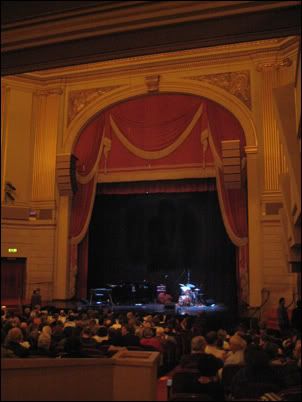
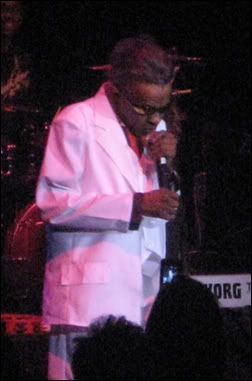
Lured West to play that irresistibly overflowing dosh-bash known as a Las Vegas private party, Steely Dan strangely enough end their national summer tour in Santa Rosa. Or perhaps not so strangely. I last saw them at the Mid State Fair, working outside in the fading 110-degree Paso Robles heat. This is a gig they reprised last month, so it’s probably safe to note that the once elusive duo known only as a studio band are now more used to crowds. Of course, one of the great things about the Wells Fargo Center is that “crowds” becomes a less explicit word in its 1,600 seat confines.

According to Wells Fargo Center director of programming Rick Bartalini, Dan fans have been making special requests with their tickets and none of them has anything to do with being close to the stage. Rather, it’s about finding that spot in the intimate hall where the sound hits sweetest. Naturally, those seats near the mixing board are way sold-out.

A Steely Dan show can have an air of mystery to it. Will they play even one hit or will they stick to the music that’s most currently interesting to them to the exclusion of all else, as they did at the Shoreline Amphitheater some years ago? Will the frighteningly intelligent Donald Fagen deign to speak or will he just hunker down grumpily over his keyboards, pissed to be in the sticks? And please no, no please no, will Walter Becker please not be allowed to do a song from his solo career? (Alas, he has a new solo disc.)

I’ve seen ’em do it every way, though the Mid State gig, interrupted as it was by carnival sounds and amateurish fireworks from the surrounding fair, was curiously the most satisfying. With a full horn section led by the late Cornelius Bumpus and with a complement of gorgeous women singing backup so hot that it was the audio equivalent of the sway and give of unbridled breasts in a red silk shirt, Fagen and Becker gave the audience every hit. And there are a lot of them.

Funny thing about Steely Dan. Evidently, you either love ’em or you hate ’em, as we found out when we decided to mount a Steely-Dan-a-Thon in honor of their two-night Wells Fargo Center stand. Bruce Robinson remembers one of their first public gigs, Gabe Meline heartily blames them for the smooth jazz explosion, Leilani Clark confesses flat-out love, Karl Byrn explores how they’re like Alice Cooper and certified sexologist P. Joseph Potocki traces the brave arc of dildo rock. Fun!

Steely Dan appear Tuesday&–Wednesday, Aug. 26&–27, at the Wells Fargo Center. 50 Mark West Springs Road, Santa Rosa. 8pm. $49.50&–$149.50. 707.546.3600.

—Gretchen Giles

Night of the Living Dan

As hyped-up Hollywood showcase gigs go, this one in early 1972 was relatively low-key. For one thing, it was held at the Whiskey a Go Go and not the newer and trendier Roxy a little way up the Sunset Strip. For another, the invitation list somehow included the manager of a student-run radio station at a small college across town.

Never one to admire a given horse’s dentistry, I was happily sitting at the front of the modest club’s small balcony when the lights came down and the sounds of musicians settling into place curled out from behind the slightly frayed curtain. It rose as the drummer ticked off a beat and a stuttering guitar lick led the band into their opening number. Arrayed across the triangular stage, nearly obscuring the drummer at the back, was a front line of five musicians, including a tall, dour-faced keyboardist standing at the far right.

As the first song’s chorus came around, the earnest lead singer was suddenly, gloriously surrounded by a wave of ringing voices as the full front five leaned into their microphones and filled the room with crisp harmonies. “Are you reelin’ in the years?” they demanded. “Are you gatherin’ up the tears? Have you had enough of mine?”

Those rhetorical musical questions, of course, remain unanswered. But there was no doubt, as the set unfurled, that this new band—with its odd mixture of pop hooks and complex song structures, wry, inscrutable lyrics and the slightly salacious in-joke name—was a crack performing unit. But no sooner had their debut album Can’t Buy a Thrill scaled the charts than the supporting tour took its toll and the downsizing of the Dan began, with singer David Palmer the first to depart. (He re-emerged later with the worthy but overlooked Southern California band Wha-Koo.)

Steely Dan were a quintet for the 1973 Countdown to Ecstasy LP and tour, after which Jeff “Skunk” Baxter moved on to the Doobie Brothers, and from 1974’s Pretzel Logic on, the “band” existed only as a studio collaboration directed by the famously exacting songwriting team of Donald Fagen and Walter Becker.

Twenty-plus years after that memorable debut, the Dan duo regrouped and emerged from their self-imposed performing exile with a pair of summer tours that yielded Alive in America, the group’s only official live recording. And there (despite a hoot of a Howl- inspired rant about the trials of their prior tour experiences in the CD booklet) it was clear that seven albums and a full generation later, Steely Dan were once again a crack live ensemble, still reelin’ in the years.

—Bruce Robinson

And Get Out of Here

High school jazz band, 1991. It had been 15 years since Steely Dan were cool, which was eons to us but was like yesterday to our band teacher. He was always valiantly aiming for us to be the high school that played “cool” music, so there we were, stuck playing Steely Dan.

As the bass player, I should have relished the bass lines to “Black Cow” and “Peg,” since both consist of flashy, gargantuan anchors for the indomitably polished tunes on the surface. But at 15, my bullshit meter went off. The songs weren’t “cool.” They used too many major seventh chords and ninth chords and something wanky called a “mu major” chord. They reeked of cocaine and polyester excess and icky sex parties thrown by people who don’t know how gross they look. They were the soundtrack to Amway and EST and Mind Dynamics and a whole lotta other crap our parents were once into.

Steely Dan may not have been the birth of smooth jazz, but they were certainly its midwife into the world of commercial success, and if that’s not enough to send them to the musical gallows, then I don’t know what is. It’s harsh, I know. But Becker and Fagen are used to people dissing them. After all, aren’t the liner notes to Aja just about what a couple of assholes they are?

—Gabe Meline

Drugs in the Cabin

During a visit to London in 1998, my friends took me to the Bug Bar, a Brixton pub in the basement of an old church. With its dark atmosphere and intimidatingly cool clientele, the place was like a scene from a movie. The dance floor was packed. The DJ rotated among Michael Jackson, Prince and New Order when, suddenly, with the flick of a needle, he mixed it up. The sweet opening strains of “Peg,” one of Steely Dan’s greatest tunes, swept across the dance floor. Nobody stopped. Nobody laughed. The hipsters kept dancing. It was a completely un-ironic gesture. And it was something that I’d never before experienced in my punk-rock-steeped cultural life.

When I returned home, I found a copy of Aja on vinyl and listened to it endlessly, enamored with the smoothness, the musical virtuosity and the lyrical enigmas. What is Donald Fagen really singing about when he says, “Then the shutter falls / You see it all in 3-D / It’s your favorite foreign movie”? The song gained even more cachet for me after I became obsessed with Michael McDonald, the world’s greatest backup singer, and during an intense Steely Dan listening session, discovered that, indeed, he had sung the fabulous backup vocals on the chorus to my new favorite song.

Of course, there is an element to the music that brings to mind sleek sailing yachts, wide-framed sunglasses, cool linen against a thigh, a white wine spritzer held in a manicured hand. Drugs in the cabin. But I love this element as much as the music itself. It’s like going into a time warp, one where the music was smooth and the lyrics were important.

—Leilani Clark

Can Buy a Thrill

Steely Dan reminds me of Alice Cooper. Along with such classic rock acts as Elton John, Deep Purple, Jackson Brown, Yes and Lynyrd Skynyrd, Dan and Cooper have been the subjects of a recent obsessive consumer binge of mine. Not satisfied with mere best-of discs, I’ve instead wrestled with the entire ’70s output of these acts. This has often been a poor choice. Cooper, John and Purple recorded terrific hits, but their album filler is largely outdated. Browne has powerful content but stiff production, while Yes remain sonically bracing but feature irrelevant content. Skynyrd’s great discs are tasty and substantial but clouded by the stigma of flag-waving red-neckism.

But the tasty and substantial Steely Dan catalogue carries no such stigma, no outdated production, no filler. In fact, their albums are almost too fresh and perfect, pulling off a weird, rare miracle of squeezing complexity from compromise. Their boogie-rock beats actually swing, the knotty guitar lines work like easy hooks, the arty jazz-fusion chords are sweet to follow and the obtuse lyrical allusions are full of candy.

Often, the thrills are lesser tracks, like Countdown to Ecstasy‘s “Pearl of the Quarter,” where a timid pedal-steel guitar almost evokes a modern alt-country band trying to ape ’70s-era Steely Dan. It’s not all feel-good oldies, though; Steely Dan had some ill-defined thing for the homeless, from the scary track “Charlie Freak” to lyrics like “While your poor people sleeping / All the stars come out at night,” from the cut “Show Biz Kids.”

Mind you, to soothe a true classic-rock jones, I’ll take Alice Cooper’s single hits “I’m Eighteen” and “Be My Lover” over any Steely Dan hit any day. But the holistic completeness of Steely Dan’s albums reminds me that I’m done with Cooper’s albums.

—Karl Byrn

Dildo Rock

Tunesmiths Donald Fagen and Walter Becker have been chart-topping rockers for close to 40 years now. Since the drollmeisters will soon be laying down their smooth ironies here, it’s long overdue to thrust beyond merely cataloguing their many hits and spats or ruminating over some arcane lyric’s meaning.

The dildo’s highest tribute no doubt is the heavy metal steam-driven device popularized in the 1959 Beat novel The Naked Lunch, writ large by gay trust-fund junkie William Seward Burroughs. Using Burroughs for titular inspiration, Fagen and Becker’s Steely Dan conjures up rock ‘n’ roll’s alchemical parallel universe—equal parts slick and clever, elegant and jazzy—impeccably produced, refined and eminently mature-person-palatable. Yet, the latest wave of dildo rockers might never have come to scream, wretch and thunder had they not Steely Dan’s polished and finely tuned pretensions to object to.

And so on to Steely Dan’s dissipated coevals. Dildo contemporaries abound, from Donovan and his psychedelic paean to electric bananas, to convict country-perv David Allen Coe’s romantic tearjerker “The Vibrator Queen,” to Van Morrison’s irritable labeling of Jefferson Airplane wasteoid Grace Slick as “Daphne Dildo,” to the Vibrators, a three-piece Brit punk band that’s chug-a-drugged itself through 21 members in 32 years, to Wendy O. Williams, Courtney Love and other dead and doddering dildo rockettes, to the girl with ants on her face—an uncredited Jean Warren—taking on an aptly named Sex Pistol in the movie The Great Rock ‘n’ Roll Swindle, with her timeless tease, “You, Steve Jones, are nothing but a walking dildo doing a good plumbing job.”

Let’s add S.F.’s beloved Tubes delivering both “Attack of the Fifty-Foot Dildo” and “Dithering Dildos on Dynamite Dope.” And who can forget famed groupie Cynthia “Plaster Caster,” mama of the gesso tribute to Jimi Hendrix, as well as to a spate of lesser rock gods’ members, including Dead Kennedy Jello Biafra’s and Kiss maestro Gene Simmons’. Moreover, what are Led Zeppelins, Rolling Stones and Yellow Submarines if not either festive gargantuan phallic probes and hepcat jargon for orbs ensconced within their baseload pouches?

Thanks in no small part to the shrill ream-graphic portrayal of Burroughs’ own, the Steely Dan has long gone foreign. The Dildo Warheads, a self-described “grungy guitarrockband” from Belgium, vie with Dildo, a Mexican punk aggregate, for top billing, while Placebo, a London-based “androgynous glam version of Nirvana” (the very band which gave us the log-jam classic “Brick Shithouse”), might just leapfrog to the top of the international marquee with their 22-and-a-half-minute epic “Burger Queen/Evil Dildo.”

This isn’t to say that there’s not plenty of good ol’ homegrown dildo rockers here to choose from. Regrettably, Alabama’s much grieved-for Stone Cold Dildo has left a distinctive glory hole in rock’s privy wall. But there’s still the anonymous-chick-fronted four-piece Rock and Roll Dildos, the singer gloriously wrecking her pipes to screech, “We are the future of dildo rock!” Then there’s the alt band Maria and the Broken Dildos, Milwaukee’s own punkin’ Brutal Dildos and a pantheon of others that space does not permit.

So while ancien régime rockers Steely Dan will hopefully perform live in Santa Rosa, it’s the amplified reactions they have wrought from the depths of our species’ shared sexual psychosis which seems to keenly interest those who now really matter—namely, today’s seething young adolescents. Because no matter your age, equipment or music preference, just like diamonds, dildos rock forever.

So while ancien régime rockers Steely Dan will hopefully perform live in Santa Rosa, it’s the amplified reactions they have wrought from the depths of our species’ shared sexual psychosis which seems to keenly interest those who now really matter—namely, today’s seething young adolescents. Because no matter your age, equipment or music preference, just like diamonds, dildos rock forever.

—P. Joseph Potocki


Drink Up!

08.20.08

State law has historically prohibited winetasting rooms from serving anything brawnier than one-ounce tastes. On July 16, that paltry limitation at last went out the window when Gov. Schwarzenegger signed into law Assembly Bill 2004. The bill, written by Assemblywoman Noreen Evans, will permit wineries to sell glasses of wine for immediate consumption and even entire bottles for drinking on the premises beginning in 2009.

The bill clears up a longstanding gray area in the law books, which have never explicitly permitted winery patrons to taste more that small sample-size servings of wine onsite, a vagueness interpreted by the Department of Alcoholic Beverage Control to mean such behavior as drinking a bottle at the picnic table outside is illegal.

But Michael Falasco, director of state relations at the Wine Institute, says the bill won’t actually change much in the way things work in the wine country. Many wineries, he notes, have long encouraged and accommodated the enjoyment of full bottles on the premises. Thus, AB 2004 merely adjusts the law to accommodate activity that was already occurring. Evans herself said in a written statement, “This bill is just common sense and will legalize what many people have been doing all along.”

Before AB 2004, wineries were allowed to offer the “tasting” of wine, not “consumption,” with the happy supposition being that most or all wine country tourists avidly use the provided spit bucket when running through a winery’s lineup. Unlikely, notes Falasco, who points out that 15 dainty tastes at a winery or two constitutes a pint of wine.

Speaking of pints, brewpubs have long been allowed to both make an alcoholic beverage and serve it in full portions onsite. Assembly Bill 2004 merely grants wineries equal privilege in 2009. Until then, it’s sniff, sip and spit for winery visitors, like we’ve been doing all along. Wink wink.

Quick dining snapshots by Bohemian staffers.

Winery news and reviews.

Food-related comings and goings, openings and closings, and other essays for those who love the kitchen and what it produces.

Recipes for food that you can actually make.

General Admission

0

08.20.08


Ask InTicketing founder and CEO Stephen Weisz what his first concert was, and he answers without hesitation. “Nineteen eighty-nine,” he says. “The Who, in Philadelphia, at the Vet, and it just blew me away. I was like, ‘Wow, this is my world, right here. This is what I want to get involved with.'”

Just how involved he’d get, as the owner of the most rapidly growing ticket company in the Bay Area, might not have been readily apparent. But Weisz, who in a black printed T-shirt, pinstripe suit jacket and jeans exudes an entrepreneurial confidence one usually associates with the dotcom boom, seems unsurprised at his own success. “I’ve been to over a hundred Dead shows, over a hundred Phish shows, over a hundred Widespread Panic shows,” he says, sipping from an InTicketing logo mug in the conference room of his San Rafael offices, “and I was really disgusted at what was going on with convenience fees. It was part of what triggered me, what catalyzed me getting into ticketing and offering an alternative and charging lower fees.”

For a look at InTicketing’s convenience fees contrasted with Ticketmaster’s, consider the recent Spanish Harlem Orchestra concert at Yoshi’s, an InTicketing client. For a $28 show, the fee was $2.50; Tickets for Aisha Tyler’s recent concert at the Fillmore, a Live Nation venue with tickets sold through Ticketmaster, cost a comparable amount, $27.50, but the convenience fee was a staggering $9.20, and that’s without “shipping” charges. Printing the ticket at home adds an additional fee of $2.50.It’s a broken mousetrap. Weisz has a better one.

As the exclusive ticket supplier for large festivals like Burning Man, Reggae Rising and various Bay Area clubs like the Great American Music Hall, the Catalyst, Slim’s and Yoshi’s, InTicketing is turning heads in the industry, selling over a million tickets a year. Weisz, 34 and every bit the young professional, credits it not only to innovation (his background at Georgia Tech with co-founder Marc Urbaitel allowed the two to develop open-source software early on, saving thousands) but to an attractive environmental policy.

InTicketing works directly with a 30-year-old nonprofit group, Trees for the Future, to plant a tree for each ticket it sells. InTicketing also uses hemp-flax recycled fiber paper and soy ink for tickets. Weisz condemns conventional, thermal-heated tickets cut from virgin paper and treated with a polyvinyl polymer-based alcohol coating.

“To go see your favorite band—and that band may be a total environmental activist like Dave Matthews or Jack Johnson—you have to directly support drilling for oil and cutting down trees,” he says, “which just seems kind of ridiculous.

“We were doing it before it was a fad, you know, ‘going green,'” he adds. “And now everybody sees that we’ve been doing it for 10 years, and they’re like, ‘Wow, these guys must know what they’re doing.'”

Which is true.

Inspired by the Grateful Dead’s flashy-looking, mail-order New Year’s Eve tickets, InTicketing offers full-color tickets with custom art and holographic foil, a specialized ticket that might cost up to $1.50 at a competitor but costs under 25 cents through InTicketing. How is it done? “It’s kind of like the stealth bomber,” Weisz says. “The government doesn’t give the plans to anybody. You build this part of it, have another company build this other part, and then we bring it all together. Nobody has every part of the ticket except for us.”

To date, InTicketing has supplied tickets for 4,000 venues worldwide, and its client base is expanding quickly. But it’s still the ticket buyers that Weisz holds at the forefront, reminiscing about waiting in line overnight outside video stores in the 1990s to buy tickets in the same sentence as he points out the ease of today’s systems. The wrong way his competitors do business continues to drive him; he was especially mortified when the Grateful Dead’s merchandising was sold to Music Today, which became a division of Clear Channel and subsequently Live Nation. “These guys,” he fumes, “they get under my skin.

“But if we can make some changes in the ticket industry at large, if we can change the way Ticketmaster does it or Live Nation does it, on a global scale, that’s great,” he adds. “I’m always coming up with new ideas, and I just tell people my ideas all the time. And they’re like, ‘Hey man, you should patent that, you shouldn’t tell people that!’ I’m like, look, if we’re filled up in a world of all my good ideas, if someone wants to go and take it and make it happen in the way that I’m seeing it, then all the power to them. Let’s see that happen.”


Museums and gallery notes.

Reviews of new book releases.

Reviews and previews of new plays, operas and symphony performances.

Reviews and previews of new dance performances and events.

Twisted Fairy Tales

0

08.20.08


Michael Garlington is photographing a woman with a ferret in her mouth. The ferret stands on a stump, its head deep in the back of the woman’s throat. It is licking saliva off her tongue, its white feet trembling to keep balance.

The woman is Cassidy Slater, one of many models who pose for Garlington for no payment other than a print of the photo. Slater is the model Garlington calls when he has a particularly weird concept, because, they both explain, she’s “up for anything.”

Today, Slater is wearing a drop-waist dress and her long hair is in ponytails. She’s sitting by a fence at the end of the country road outside of Petaluma. Garlington, who is standing a few feet away with a Polaroid camera, tells her to look at him while the ferret is in her mouth.

“That’s so good,” he says, looking through the camera. “The eyes will be like, ‘Am I doing something bad?’ Oh, this could be such a good fairy tale. ‘Hungry, hungry Etta, sitting by the fence.'”

Garlington, 31, has made a career of photographing people in situations like this. His work ranges from portraits of individuals on the street to people in strange, sometimes disturbing poses, such as black men in Ku Klux Klan uniforms, or a girl holding a fish with a person wearing a bear costume in the background. The photographs are usually black-and-white, and that, combined with the natural scratches and dots of the Polaroid film, give the photos a grainy look, the visual equivalent of a record playing on a Victrola. Garlington is often compared to photographers like Diane Arbus or Joel-Peter Witkin because his work has a dark, surreal quality.

After shaking the Polaroid, Garlington opens it to reveal a picture of a young-looking girl seeming to eat a live animal. The photo already has the twisted, otherworldly aspect Garlington favors. He is pleased.

“Very strange,” he says. “I’d almost say done. You just don’t get better than that.”

He takes one more picture of the scene, this time from farther away, because he wants to get in how the fence bends in the background. The photo will go into series of twisted fairy tales that he is working on. The plan is to collect 100 fairy-tale photos and publish them with descriptions of the scene. Garlington is in discussions with a book publisher on the idea.

It’s just one of many projects Garlington is working on. He has a show at Healdsburg’s Hammerfriar Gallery opening Sept. 20, as well as other upcoming shows in Los Angeles and San Francisco, including a photo collage that he is making for the Mission Cultural Center. This is in addition to a myriad of other projects, from building the light structure for this year’s Burning Man festival to directing a music video for the band Or, the Whale to teaching a class at San Francisco’s Academy of Art University.

Walking back to his studio, Garlington laments the demise of Polaroid, which has been discontinued. He already pays $200 for a box of Polaroid film, and eventually, the change will force him to go digital.

“I used to shoot a whole pack of Polaroid on, like, one stupid shot, and then realized what a waste it was of them,” he says, sighing. “Especially now. It is severely depressing that they have been discontinued, but you know, we carry on. It was just a tool.”

Garlington lives and works in some old buildings he shares with other artists. He has recently sheetrocked the inside of a barn, which is painted red with stained-glass windows. Beside the beat-up couches and dirty rugs, Garlington’s photographs are stacked everywhere—leaning against furniture, piled on the floor, hanging on the walls.

In the bathroom, Garlington drops the shots from the day in water to soak. The bathroom walls are covered with portraits of his recent trip to China. Each is a shot of a person he asked to pose for him. The Polaroids came in handy because he didn’t speak Chinese; he could give each model a copy of the picture and still keep the negatives.

“It was a reasonable trade,” he says. “There’s no English either. It’s all sign language. I didn’t know how it was going to work, but you know what? Some people just get it. You know, you say, ‘Stand there. Hold still. Don’t move.’ And they do.”

Like many artists, Garlington finds people fascinating. Everyone has a good picture in them, he believes, even if they might not like it themselves. “When I walk down the street, I see people and think, ‘God they’re just amazing,'” he says. “I’m not saying they’re really beautiful; they’re just unique. That’s what’s so amazing about photography; you can capture that and live with it. It’s a way to look. It’s hard to look in someone’s eyes without freaking them out.”

Born in Petaluma, Garlington has lived in the North Bay most of his life. In his teens, he dropped out of high school and started working full-time in his stepfather’s photo lab processing black-and-white photos.

Although he resisted photography at that age, the photo lab was a sort of apprenticeship for Garlington. He not only learned the dark room, he learned what made a picture work and what didn’t.

“That was the best education a guy like me could ever have,” he says. “High school just wasn’t right. This gave me a direction. I was always into the arts. I had concepts going through my head, and I had no outlet. If you do something that long and that intensively for 12 hours a day, it installs in your mind.”

When he was 18, Garlington started taking concept photos in his backyard. He painted a backdrop of a road and had his friends pose against it. From then on, he took as many photos as he could. By the time he was 20, he had hundreds of prints. He decided to approach Petaluma’s prestigious Barry Singer Gallery with 50 of his best prints.

“I could see that Barry Singer was impressed,” he says. “But I was a kid, so he was kind of punking me. He said, ‘Well, this is good. I like this. Come back tomorrow with some more prints.’ He didn’t think I had them. So I came back the next day with another hundred prints, and he signed me that day.”

Not long after that, Garlington got the idea of covering a car in photography and calling it Photo Car. Part gimmick and part free art show, the idea was to take his work to the public and see where it got him. When the car was finished, Garlington and some artist friends drove across country.

“I had got up two road trips before that without a Photo Car to collect photos, but I always realized it was hard to prove that I’m a photographer,” he says. “Well, everybody’s a photographer. But with this car, you don’t need to say it.”

The idea worked. Not only is Garlington’s Photo Van—a later incarnation of Photo Car—known throughout the North Bay, it may soon be the subject of a documentary. A German filmmaker wants Garlington to come to Germany and build a new Photo Car.

After soaking the picture of the girl with the ferret, Garlington begins developing it in his darkroom. It’s a painstaking process. He controls the light by waving his hands over it like he is making shadow puppets, choosing which parts of the photo will be lighter, which parts darker. Then he dips the print in three chemical baths to develop it. Later, he will tint the photo to give it the older look he prefers. If it works out, the photo will have a mix of new and old-fashioned sensibilities.

“I love timeless with some modern elements in it,” he says. “I want [the photos] to have that old-timey look, like somehow, in some realm, this is Michael Garlington’s universe. This is what goes on when you are playing cards in the belly of the whale. This would be it. I want to make my universe.”

Preparing to move away from Polaroid, Garlington is making short movies for gallery showings, collaborating on a stop-motion film of an alien that turns a forest black. He has already built the alien in his backyard. It is eight feet tall, covered in tar paper and posable like a giant, homemade action figure.

But it is just one of many concepts. You get the sense, talking to Garlington, that the projects never stop.


“It’s totally keeping busy,” he says, “that’s it. I find that if I ever feel depressed and I don’t know who I am, because, you know, everyone gets depressed sometimes—I wanted to make something that’s sure-fire proof against that. So that if I wake up in the morning and I’m feeling kind of apathetic or down, I can look around at the walls of art and say, ‘This is who I am.’ If I forgot, this is it.”

 Michael Garlington exhibits ‘conceptual photography’ with Randall Ingalls at the Hammerfriar Gallery, Sept. 17&–Oct. 31. 139 Healdsburg Ave., Healdsburg. 707.433.9600.


Museums and gallery notes.

Reviews of new book releases.

Reviews and previews of new plays, operas and symphony performances.

Reviews and previews of new dance performances and events.

News Blast

0

08.20.08

Eat This

Hold on a minute! Drop the Whopper. Swerve out of the drive-in line, and head to Slow Food Nation ’08, a weekend-long celebration of fabulous fresh food, for a tantalizing taste of the future—as provided by the past. The Slow Food and Roots of Change organizations are teaming up to prove to Slow Food newcomers that indulging in a cheap bite doesn’t have to be a health sacrifice. The event, though divided between two San Francisco locations, represents a variety of North Bay businesses and activists.

Progressive restaurants and foodies from all over are discovering the endless benefits of growing their own gardens and eating local. But the shift from a Burger King nation to one that values real food is still a work in progress. To some, the idea of Slow Food appears too lofty and intangible for everyday application. Slow Food Nation ’08, taking place Aug. 29–Sept. 1, feeds mouths and minds with delicious proof that fresh, nutritious environmentally sound food is within everybody’s grasp.

“Because of what’s happening with healthy issues worldwide, America’s waking up to this food issue. They’re seeing how central it is to our overall health as a nation,” says Michael Dimock, president of Roots of Change. “But it’s been confined to a fairly small group. There are perceptions surrounding it that it’s elitist. All of us involved [in Slow Food Nation ’08] are really reaching out to say we want to be partners. We represent passionate consumers.”

For the hungry and penniless, two free public food fests—a special farmers market and “Slow on the Go”—fill S.F.’s Civic Center Plaza with inexpensive fresh goodies. In the middle of it all, the Slow Food Nation Victory Garden rises up as an inspiring symbol of sustainable bountiful innovation. The garden is just one in Slow Food’s plan to install some 15 organic urban gardens throughout the city.

Real education happens Friday and Saturday at Herbst Theater and the Milton Marks Auditorium. The “Food for Thought” series hosts a slew of well-known doers and thinkers, including Alice Waters and Slow Food president Carlo Petrini, who give 90-minute lectures about their experiences transforming the world of food.

A Food Bill Declaration in the Rotunda of the San Francisco City Hall makes things even more official on Aug. 28. Calling for new vision for a 21st-century food, farm and agriculture policy, the bill is intended to capture 300,000 signatures and be taken to Washington for review.

That’s not all. Check out www.slowfoodnation.org for more info.


The Lesser-Knowns

0

08.20.08

Everyone knows about Radiohead. Everyone knows about Tom Petty. And everyone knows, for better or for worse, about Jack Johnson. But there’s much, much more to this weekend’s Outside Lands festival in Golden Gate Park than just the big headliners, and with the release of actual set times and stage schedules, the mapping out of must-see performers has begun. Here’s just a small few that might not be on the cover of Magnet or at the top of the Pitchfork blogs, but are worth scouting out on the crazy-crammed, five-stage schedule.

K’Naan: A Somalian-born poet and rapper who fled the “lake of blood” district of Mogadishu during the Somalian Civil War, K’Naan, above, has delivered the most gripping hip-hop album this year. The Dusty Foot Philosopher, an autobiographical document of growing up in a warzone and clinging to Nas and Rakim CDs for escape, is hip-hop’s Graceland: djembe drums, group chants and slit gongs provide the addictively unique texture, while the beat to Dusty Foot‘s opening track, “Wash it Down,” is comprised entirely of feet stomping and sloshing through water. With the metaphor as water for life, the track concludes with the clever poke: “People need water like Kanye need Jesus.” If there were any justice, he wouldn’t be playing such an early time slot on the Panhandle Stage, Sunday at 3pm.

Bon Iver: Last year, Justin Vernon went into a shed in rural Wisconsin, cleared his head, chopped some wood and recorded nine songs that have since turned just about every indie critic into a drooling, superlative-oozing pile of gush. Try as one might to resist, Vernon’s stark honesty is laid bare against basic guitar chords, and his personal variation of the falsetto-voice-as-spiritual-hypnotism that’s been going on in indie circles since OK Computer involves vocal multi-tracking and joyfully erratic sound samples. On the Presidio Stage, Sunday at 3:10pm.

Sharon Jones & the Dap-Kings: When soul diva Sharon Jones released the incredible Naturally on the diehard funk label Daptone, in 2005, it seemed as if the pinnacle of the underground soul revival had been achieved. Then Amy Winehouse came along, heisted Jones’ backup band, called her album Back to Black, for cryin’ out loud, and ran away with the prize. While Winehouse rots in the tabloids and the UK tries to cough up more blue-eyed soul sensations while their iron is hot, don’t miss the real deal on the Lands End Stage, Sunday at 4:10pm.

Manu Chao: Lots of folks know about Manu Chao by now, and since all the people jockeying to see Radiohead will be forced to stand through Chao’s high-energy set of rambunctious and cross-cultural revelry beforehand, it might be superfluous to recommend him. But if you’re slightly tempted, say, to suffer through Beck’s scientology folk because of some sort of 1996 Odelay nostalgia over on the Sutro Stage instead, at least know that you have a better option. Lands End Stage, Friday at 6:15pm.

The Outside Lands Festival runs Friday-Sunday, Aug. 22-24, at Golden Gate Park, San Francisco. For more info., see www.sfoutsidelands.com.


Guerrilla Finance 101

0

08.20.08

The Art of War is the classic book on military strategy written by Sun Tzu, a sixth-century general thought to have lived in the Chinese state of Wu. In a section on variations in tactics, Master Sun makes the point, “There are roads which must not be followed, armies which must not be attacked, towns which must not be besieged and positions which must not be contested.”

This is a lesson mostly lost on Catherine Austin Fitts. Fitts has taken on Wall Street—and the shadow banking system. And she has taken on the feds—and the shadow government. She has taken on subjects as dangerous as government-sponsored money laundering, arms trafficking, narcotics trafficking, warfare and other crimes against humanity committed by what Fitts calls the organized crime organizations of world government, in particular, the U.S. government. She appears in Mill Valley Aug. 29&–30.

Fitts is no dewy-eyed idealist or fringe extremist. In her career, she has been the managing director and member of the board of directors at Dillon Reed, one of Wall Street’s oldest and most venerable firms; assistant secretary of HUD; member of the emerging markets committee at the SEC; member of the board at Sallie Mae; member of the advisory council at Fannie Mae; founder and president of the Hamilton Securities Group; and founder and president of Solari Investment Advisory Services.

But for all that success, Fitts has usually “followed the roads which must not be followed, attacked the armies which must not be attacked, besieged the towns which must not be besieged, and contested the positions which must not be contested.” And she has asked the right questions.

Fitts has also been bold enough to suggest that keeping the world in a constant state of conflict serves the rich. (Sound familiar? See: Our current pissing contest with Iran over its nuclear program; our current pissing contest with Russia over Georgia and Caspian oil; and the constant state of conflict between Israel and the people of the West Bank and Palestine.)

“The fault lies not just with our leaders,” Fitts has said. “We in America vote with our dollars everyday in the marketplace—just like we vote every two or four years at the polls—for folks who generated the most wealth for us through these methods.”

I, for one, want to get off of this merry-go-round.

Catherine Austin Fitts lectures and leads a workshop Friday&–Saturday, Aug. 29&–30, at the Mill Valley Community Center. Lecture, Aug. 29 at 7pm; workshop, Aug. 30, 10am&–2pm. 180 Camino Alto Ave., Mill Valley. $25&–$250. 888.686.3354.


Museums and gallery notes.

Reviews of new book releases.

Reviews and previews of new plays, operas and symphony performances.

Reviews and previews of new dance performances and events.

End of Summer Sail

0

08.20.08

I have a soft spot for pirates. One sight of an eye-patch or a hook, a pegged leg or a skull and crossbones flying high, and I’m already 50 percent charmed. Because of this, I sat in my lawn chair with more than a little trepidation as the Sonoma County Repertory Theatre launched the final show of its 13th annual Sebastopol Shakespeare Festival with a new production of The Taming of the Shrew done buccaneer-style, with David R. Wright’s large outdoor set resembling a fantasy pirate ship. With such high standards, I was more than prepared to be disappointed—and then the pirates took the stage.

What can I say? They had me at “Arrrrrrrrr.”

Directed by Jennifer King, this is a Shrew set in a fantasy world not far removed from the Disneyland ride or the pratfall shenanigans of Gilbert and Sullivan. King has plunged Shakespeare’s battle of the sexes into this world, and it fits so well I’m surprised I’ve never seen it done this way before.

Petruchio (a swaggering Dodds Delzell, above, who should wear pirate garb more often) has come to Mantua looking for a wealthy wife, and quickly hears of the wealthy Baptista (William Wilson), who has two daughters: the beautiful and sought-after Bianca (Gwen Kingston, perfectly cast) and her older sister Kate (a magnificent Mary Gannon Graham, above), a short-tempered, swashbuckling, dagger-wielding pirate princess so hard to get along with that she’s been nicknamed “Kate the Cursed” by all the men in town.

With Baptista swearing that none of Bianca’s many suitors will win her hand until Kate has been married off first, the blustering Petruchio is persuaded to court Kate by the men of Mantua, a hilarious band of salty pirate characters played by the excellent Joe Winkler, Dan Saski, Benjamin Stowe and Miyaka Cochrane. The heart of the piece, as it should be, is the budding rock ’em, sock ’em relationship between Kate and Petruchio, and as directed by King, Graham and Delzell play the well-matched lovers with equal parts swoonish attraction and lusty, piratical-marital combat.

The inherent misogyny of the text somehow seems less potent when it’s happening in the world of pirates, and the obvious mutual affection of the couple, with Petruchio becoming increasingly tongue-tied as Kate figures out how to play the softer emotions of her dashing new husband, ultimately make it all work. At the end of the play, when Kate delivers her famous speech about women serving their husbands, it is obvious that, on this ship, it’s the shrew who has tamed the pirate. Arrrrrrrrrrr.

Taming of the Shrew runs Thursday&–Sunday through Aug. 31 at Ives Park, 7400 Willow St., Sebastopol. 7pm. $18&–$23; Thursdays, pay what you will. 707.823.0177.


Museums and gallery notes.

Reviews of new book releases.

Reviews and previews of new plays, operas and symphony performances.

Reviews and previews of new dance performances and events.

Emphatically Fourth Street

0

08.20.08

Ain’t a town with a passel of lined-up eateries and gin joints in these parts that doesn’t claim proud ownership of a “restaurant row.” But no town in the whole of the Bay Area indulges the appetite at anywhere near the number and fascinating variety of the almost 70 restaurants, pubs, pizzerias, coffee houses, cafes, crêperies, taquerias, boites, bistros, burger joints, diners, delis, doughnut, bagel and sandwich shops, steak houses (Philly to filet), juiceries, falafel huts, prepared food departments, ice cream and sushi parlors, burger joints, trattorias and pasta emporia lining the belly-boggling mile-and-a-half stretch of San Rafael known simply as Fourth Street.

And those 70 don’t include the dozen eateries in the Montecito Shopping Center a block from the row’s eastern end, nor the half-dozen on Fourth beyond the row’s western end, nor the many others on and just off neighboring Third Street, nor the tantalizing booths that line Fourth Street during every Thursday evening’s farmers market. (That’s about two dozen nors.) In all, there are close to a hundred places on and just off the strip to indulge the craving for any known taste. If you can’t select something to satisfy your innards from the cornucopia that is San Rafael’s restaurant row, you just don’t give a damn about dining out.

OK, in a barrel the size of this restaurant row there are bound to be a few bad apples, so it’s best to see the row as a barrel half-full or, better yet, as a tiara with many semiprecious gems and several bright diamonds.

Mexican food doesn’t get more authentic than “that place under the bridge,” Taqueria San Jose (615 Fourth St.; 415.455.0999), nestled directly under the Highway 101 overpass. At the (not very) upscale end of Mexican is the excellent Las Camelias (912 Lincoln Ave.; 415.453.5850). Two other Spanish-influenced places are superb: Sabor of Spain (1301 Fourth St.; 415.457.4088), with its tantalizing tapas, and the tiny, quaint Puerto Rican palace known as Sol Food (732 Fourth St.; 415.451.4765), featuring prawns, beef and a Cuban sandwich so good the restaurant had to open a garishly bigger place just a block south (901 Lincoln Ave.; 415.451.4765).

Three Italian eateries stand out: the veterans Il Davide (901 A St.; 415.454.8080) and Cafe Arrivederci (11 G St.; 415.453.6427), and the relative newcomer Vin Antico trattoria (881 Fourth St.; 415.454.4492).

Bacon and eggs and hash browns rise to the dignity of culinary art at Bobby’s Cafe (1617 Fourth St.; 415.454.4444). For delis, there are such standards as the prepared fare of Whole Foods (340 Third St.; 415.451.6333), the long-time pleasures of Marin institution Perry’s Deli (909 Lincoln Ave.; 415.456.4886), the reliable Moonlight Yogurt & Deli (1815 Fourth St.; 415.459.2835) and—how explicit can a name get?— Fresh Coffee and Sandwiches (969 Grand Ave.; 415.258.1688). And then there is the deli that sets the standard, the West End Cafe (1131 Fourth St.; 415.454.1424).

Bagels don’t get better that those thumped out at Marin Bagel Company (1560 Fourth St.; 415.457.8127), where you can watch ’em being made. (This may be more than you need to know, but I down about 350 of Marin Bagel Co.’s sesames a year, one a day with my morning coffee, each ritually toasted, buttered and topped with a smidgen of raspberry jam. This is what an authentic New York&–style water bagel is supposed to be. Too bad there’s no rye bread in the Bay Area to match it.)

The three Indian restaurants downtown are all good, but I especially like the newest, Om South Indian Cuisine (1518 Fourth St.; 415.458.1779), which specializes in mouthwatering curries and a remarkable rolled Dosa bread served in sizes ranging up to four feet long. Impressive.

Burgers? There’s the small California chain of Barney’s Gourmet Hamburgers (1020 Court St.; 415.454.4594), which are almost as good at the nonpareil Phyllis’ Giant Burgers (2202 Fourth St.; 415.456.0866) just beyond the row’s western end. And for steaks—and a mean cheeseburger—there’s San Rafael Joe’s (931 Fourth St.; 415.456.2425), in biz since 1947.

Asian food is represented by four Chinese, three Japanese, four Thai and one off-row Vietnamese. My favorite dish is the rarely found pressed almond duck at Yet Wah (1236 Fourth St.; 415.460.9833).

A real sleeper is the Lighthouse Diner (1016 Court St.; 415.721.7700), sister to the Lighthouse Cafe in Sausalito. Its unexpectedly eclectic menu includes several authentic Scandinavian dishes because the owners are Danish. Among the best are its traditional herrings, gravlax (marinated salmon), Danish meatballs and pitti panna, which is a hash. (In Sweden, they call it leftovers. I call it great.)

Dessert? For ice cream, let’s call it a draw between Double Rainbow (860 Fourth St.; 415.457.0803) and Cold Stone Creamery (1010 Court St.; 415.258.0105).

At the risk of—OK, in the hopes of—starting an argument, there are still some absolutes, even if they don’t reside in San Rafael. The best sushi in Marin is at Sushi Ran (107 Caledonia St., Sausalito; 415332.3620). My favorite steak house is good ol’ Izzy’s Steaks and Chops (55 Tamal Vista Blvd., Corte Madera; 415.924.3366), and there’s always perennial fave Marin Joe’s (1585 Casa Buena Drive, Corte Madera; 415.924.2081). Arguably the best Italian is Frantoio Ristorante (152 Shoreline Hwy.; 415.289.5777) in Mill Valley. I personally adore Chopsticks Chinese Cuisine (508 Third St.; 415.456.4942), just south of the row. I could go on naming fancier and better restaurants throughout Marin.


So what, then, is the essence of San Rafael’s restaurant row that makes it so special, so unique in all the Bay? The answer is easy: diversity, the unexpectedly high quality of its offerings and the simple fact that, if you haven’t called ahead but just park on Fourth Street and want a perfect place to eat, a different place to eat, just keep walking; you will find it. It’ll be a few doors down, a block down, across the street and still near where you parked. You can’t say that about any place in the Bay Area other than the biggest restaurant row of them all, San Francisco.

Quick dining snapshots by Bohemian staffers.

Winery news and reviews.

Food-related comings and goings, openings and closings, and other essays for those who love the kitchen and what it produces.

Recipes for food that you can actually make.

Ordinary Miracles

0

08.20.08

Like jazz, American cinema is easy to pronounce dead. “We’re in such a trough with American movies,” says longtime Bay Area moviemaker Rob Nilsson, sitting outside his unofficial satellite office and regular breakfast spot, Jimmy Bean’s Cafe in Berkeley. “This is a way of opening things up. Opening people up to themselves, opening up the sores.”

The “this” to which Nilsson refers is his own hard-bop-free-jazz hybrid way of making films, as identified in his “Direct Action Cinema” manifesto, which has resulted, most recently, in a nine-movie series called 9 @ Night. After its recent West Coast premiere at the Roxie in San Francisco, the series comes to the Rafael Film Center for a week-long run beginning Sept. 5. It is an event.

“There’s a certain democracy in jazz,” Nilsson says, “but, yes, you have to be able to play. If you can’t play, you can’t be in a jazz combo.” What he means is that a certain standard of practiced rigor is required in filmmaking as in music—but, importantly, what’s also required is an appetite for the human experience.

Consider his own. In 1990, Nilsson delved into San Francisco’s Tenderloin in search of his vanished mentally ill brother, wound up recruiting a troupe of amateur actors there, right from the streets, and emerged more than a decade later with an interlocking series of dramatic feature films about life among the hobos, hookers, strippers, addicts, thieves and everybody else who’s ever bottomed out in the inner city. “Cinema of the forgotten,” he calls it.

“You go to the poorest places, and you find the most sublime art. It’s because people don’t have much left to lose. They can’t be bought off.”

Nilsson recalls first purposefully roaming through the Tenderloin while editing his feature Heat and Sunlight, which went on to win the Grand Prize at Sundance in 1988. Fresh from that victory, he had plans for what might have been a commercially formidable film about a homeless Vietnam vet, with Danny Glover, Whoopi Goldberg and Samuel L. Jackson attached. What came to pass instead was Nilsson’s Tenderloin Group (a “contentious, improbable, multitalented, dysfunctional, brilliant, long-suffering and unlikely family”), whose weekly workshops renewed Nilsson’s cinematic prospects and kept him working, and inspired, for years. In other words, the perfect combo.

Their efforts epitomize what Nilsson terms his “Direct Action” method, in which the players invent their dramatic situation and inhabit it collaboratively, with each movie shot hand-held on video and in black-and-white, unscripted and stripped all the way down to its emotional core.

An old loner poet and Beat-era hanger-on gets himself and a friend kicked out of their flophouse just by having a stroke (Stroke). A chop-shopper learns he’s HIV-positive and has to hide out from his vengeful girlfriend among the homeless people he reviles (Attitude). A biker sleeps in filthy alleys just to show his cop father that he can (Scheme C6). The list goes on, 14 hours worth of dozens of characters’ crisscrossing lives, presented with a kind of unvarnished lyricism that’s all the more true and moving for being so raw.

Although arguably revolutionary, the modus operandi of 9 @ Night actually is quite straightforward. As Nilsson puts it, “You have to get down to the ground, with the people.”

Filmmaking’s tendency toward manifestos—like the Danish Dogme 95’s 10-point “vow of chastity” or Nilsson’s Direct Action or, more broadly, Italy’s Neorealism and France’s New Wave—might imply that the art has devolved into a state of tyranny: prohibitively expensive, relentlessly commercial, cosmetically or digitally enhanced, aesthetically unoriginal, politically predictable, bullying, patronizing or just plain bullshit. Can a resistance have any stable currency?

“Nobody wanted John Cassavetes,” Nilsson says of the filmmaker to whom he is often accurately but reductively compared. “He opened up a window: Why don’t we look in wonder or in horror at the world? I thought, ‘Wow, at last a chance to get out of this Hollywood way.’ When I saw [Cassavetes’] Shadows, I was bowled over. I thought, ‘Oh, my God. You mean it can really be about us?'”

Even beyond what he calls the “awful liturgy” of Hollywood, the presumed alternatives, too, tend to strike Nilsson as excessively politicized or otherwise solicitous. “A lot of people feel they’re being had,” he says, whether by the evangelical right or the left’s “airy-fairy good-for-ya crowd. I don’t like documentaries that are telling you what it is. I prefer to experience it, not to be told.” Or as the Direct Action manifesto would have it: “Discover, don’t prescribe.”

“I don’t want it to be doctrinaire,” the filmmaker adds. “I want it to be flexible, supple.”

Considering 9 @ Night’s topically relevant credentials—lo-fi and DIY, organic and locally grown, deeply concerned with the disadvantaged—one might worry that the project is also impossibly, tediously chic.

But the movies’ lack of affectation only magnifies their power. Nilsson’s mandate remains simply, as he puts it, to “seek and find the miracles of the ordinary.” That means, on any given movie, his goal is to make it “just so plain, you hardly think it’s a movie,” and that it should be “an experience rather than something that’s supposed to be about something. It’s not there to please, to cajole and say, ‘Hey, like me.'” As such, he allows that he’s not exactly going to get rich or famous making these kinds of movies. “The films have a special meaning, not recognized in the market,” he says.

Lest Nilsson come across as the lone artiste, striving earnestly and pretentiously in obscurity, it should be reiterated that his work is deeply collaborative. Another of the manifesto’s take-away ideas: “Film is not a director’s medium. The magicians who bottle the genie are the actors. The magician who lets the genie out of the bottle is the editor.” And, as he likes to say in reference to his fellow magicians, “nowadays, everybody’s ‘independent.’ Independent of what? We’re dependent on each other, happily so.”

Nilsson also has harvested similar community-based films through Direct Action workshops in Japan, Jordan and South Africa. And he doesn’t want for work at home—given an hour of conversation and alert observation, he’ll even start finding stories on the street corner right outside his favorite Berkeley cafe.

But 9 @ Night is a major achievement worth recognition, a love supreme. Taken together, the rough-hewn, enduringly soulful 9 @ Night films make a vital contribution to the cinema of America or anywhere, suggesting that maybe the reports of its death have been greatly exaggerated.

 The ‘9 @ Night’ series begin on Friday, Sept. 5, at the Smith Rafael Film Center, 1118 Fourth St., San Rafael. 415.454.1222.


Museums and gallery notes.

Reviews of new book releases.

Reviews and previews of new plays, operas and symphony performances.

Reviews and previews of new dance performances and events.

Yacht Rock

08.20.08Lured West to play that irresistibly overflowing dosh-bash known as a Las Vegas private party, Steely Dan strangely enough end their national summer tour in Santa Rosa. Or perhaps not so strangely. I last saw them at the Mid State Fair, working outside in the fading 110-degree Paso Robles heat. This is a gig they reprised last month, so...

Drink Up!

08.20.08State law has historically prohibited winetasting rooms from serving anything brawnier than one-ounce tastes. On July 16, that paltry limitation at last went out the window when Gov. Schwarzenegger signed into law Assembly Bill 2004. The bill, written by Assemblywoman Noreen Evans, will permit wineries to sell glasses of wine for immediate consumption and even entire bottles for drinking...

General Admission

08.20.08Ask InTicketing founder and CEO Stephen Weisz what his first concert was, and he answers without hesitation. "Nineteen eighty-nine," he says. "The Who, in Philadelphia, at the Vet, and it just blew me away. I was like, 'Wow, this is my world, right here. This is what I want to get involved with.'"Just how involved he'd get, as the...

Twisted Fairy Tales

08.20.08Michael Garlington is photographing a woman with a ferret in her mouth. The ferret stands on a stump, its head deep in the back of the woman's throat. It is licking saliva off her tongue, its white feet trembling to keep balance. The woman is Cassidy Slater, one of many models who pose for Garlington for no payment other...

News Blast

08.20.08 Eat ThisHold on a minute! Drop the Whopper. Swerve out of the drive-in line, and head to Slow Food Nation '08, a weekend-long celebration of fabulous fresh food, for a tantalizing taste of the future—as provided by the past. The Slow Food and Roots of Change organizations are teaming up to prove to Slow Food newcomers that indulging in...

The Lesser-Knowns

08.20.08Everyone knows about Radiohead. Everyone knows about Tom Petty. And everyone knows, for better or for worse, about Jack Johnson. But there's much, much more to this weekend's Outside Lands festival in Golden Gate Park than just the big headliners, and with the release of actual set times and stage schedules, the mapping out of must-see performers has begun....

Guerrilla Finance 101

08.20.08The Art of War is the classic book on military strategy written by Sun Tzu, a sixth-century general thought to have lived in the Chinese state of Wu. In a section on variations in tactics, Master Sun makes the point, "There are roads which must not be followed, armies which must not be attacked, towns which must not be...

End of Summer Sail

08.20.08I have a soft spot for pirates. One sight of an eye-patch or a hook, a pegged leg or a skull and crossbones flying high, and I'm already 50 percent charmed. Because of this, I sat in my lawn chair with more than a little trepidation as the Sonoma County Repertory Theatre launched the final show of its 13th...

Emphatically Fourth Street

08.20.08Ain't a town with a passel of lined-up eateries and gin joints in these parts that doesn't claim proud ownership of a "restaurant row." But no town in the whole of the Bay Area indulges the appetite at anywhere near the number and fascinating variety of the almost 70 restaurants, pubs, pizzerias, coffee houses, cafes, crêperies, taquerias, boites, bistros,...

Ordinary Miracles

08.20.08Like jazz, American cinema is easy to pronounce dead. "We're in such a trough with American movies," says longtime Bay Area moviemaker Rob Nilsson, sitting outside his unofficial satellite office and regular breakfast spot, Jimmy Bean's Cafe in Berkeley. "This is a way of opening things up. Opening people up to themselves, opening up the sores."The "this" to which...
11,084FansLike
4,446FollowersFollow
6,928FollowersFollow