Dude, Don’t Tax My Wine!

0

03.04.09

We dodged a bullet the other week. More accurately, we dodged a tax, and by we, I mean wine drinkers, wine producers—maybe even wine country bystanders. When the governor signed the California budget on Feb. 20, it did not include his proposed tax increase on wine. It does include a lot of other taxes. Yes, the state is billions in arrears, and everyone’s got to pony up their fair share. Why not wine drinkers, too? Sure, if a 640 percent increase fits your definition of “fair.” That’s a sin tax. To call it “luxury” tax is a two-fer of flattery and derision, and misleading because it was anything but progressive.

Proponents breezily billed the tax as a harmless “nickel a drink,” or $1.48 up from 20 cents per gallon. Well, with sales tax hiked 1 cent, that $7 glass of wine already got tagged an extra 7 cents, never mind the nickel. What the real cost could have been, and what hard rain was to fall on the industry, was the subject of some debate. It boiled down to two scenarios:

1. It’s the consumer’s dime—or quarter or sawbuck. Excise tax is levied at the producer level. In the wine-distribution system, nobody stops to separate out the tax, so by the time it’s passed on down the chain to the consumer, it could balloon into 50 cents. Ciao, Two Buck Chuck. While buyers of $100 cult Cab may brush off the small change, Johnny Chateau is not driving the industry as much as everyday supermarket wine. Magic price points thus breached, woe the would-be premium wine consumer who just can’t spend more than $9.99 (yes, fancy pants, $9.99 is the “premium” category).

2. Chuck foots the bill. Actually, not likely—but small wineries don’t have the clout of the big guys and complain of being squeezed by distributors who won’t pay them a penny more. A 5,000-case family winery slapped with a $17,000 tax bill may have been forced to make cuts, meaning that cellar workers or tasting room staff lose their job, potentially furthering the downward spiral of the local economy.

What’s the fuss if the tax is moot? Dread the return of the wine tax. The Wine Institute, the industry’s advocacy group, warns the tax may return later this year when the legislature visits the 2009–2010 budget. History shows that when panicked lawmakers look around for something to beat the dough out of, wine is right behind tobacco. Watch the skies. Or write your representative.


State of the Book

0

02.25.09

FIN? Oh, cheer up, the worst may not happen.

Irecently dug out some old copies of Hungry Mind Review, the book and culture magazine I started in the mid-’80s and edited for 15 years.

The magazine was published by Hungry Mind Bookstore, a wonderfully rich and eclectic independent in St. Paul, Minn. One of the mag’s goals was to be a link between independent bookstores around the country at a time when the chain bookstores were just beginning to flex their muscles, yet long before Amazon had become even a glint in Jeff Bezos’ eye.

The issue that really caught my attention was the 10th anniversary number, titled “The State of the Book” and published in the spring of 1996. The magazine was in pretty good health in those days with more than 40 percent of the large format pages consisting of publisher ads. On the inside back page, we printed a list of the 600-plus independent bookstores around the country where the magazine was available.

The editorial content was rich. Alongside an interview with John Updike, we ran essays by such luminaries as Isabel Allende, Dorothy Allison, Bill McKibben, Kathleen Norris, Luis Rodriguez, Kay Ryan, Jane Smiley and Sven Birkerts, whose 1994 book The Gutenberg Elegies: The Fate of Reading in a Digital Age prophesied the coming end of the book.

I contributed a windy and rather smug editor’s note, mocking the reactive response of publishers to the dawning of the digital age, as well as the then-new notion that content no longer consisted of text and image but interactivity. My conclusion suggested that the fate of the book was in the hands of readers. I mused about the vast numbers of Americans who can read but choose not to (a population that the National Endowment for the Arts targeted in a much publicized study a few years ago), and wondered if “the available distractions made it too difficult for longtime readers to keep at it.”

So where are we 13 years later? Glancing through the huge list of independent bookstores from that issue, I fear that more than two-thirds, along with Hungry Mind itself, have gone out of business. Most New York publishers are no longer independent companies run in the old-gentleman spirit of their founding, but are more likely the poor cousins of huge multinational entertainment corporations that demand greater returns than mere books can ever provide. It seems clear that the large number of jobs recently lost in publishing will never reappear, because the old-time publishing model is broken.

As newspapers across the country have shrunk their book review sections and begun themselves going out of business, publishers have pulled back their advertising, focusing almost entirely on their blockbusters. Since independent bookstores have become a memory in many parts of the country, and with reviews and advertising shrinking, the chance for readers to find out about new authors, and books unlikely to become bestsellers, has all but disappeared

And what about those readers? If the available distractions were a concern in 1996, they seem epidemic now. I mean, it was hard for me to drag myself away from Facebook long enough to write this little number, and before that I was busy Twittering about my status, which clearly did not involve reading anything beyond 140 characters.

As a novelist of the old school, the type who does not count characters or compose and publish on my cell phone, I’ve always been curious how a guy with a little imagination snags readers. Unfortunately, I’ve never figured it out. Last summer, when I asked my publisher how to get the word out about my new novel, given that it had no advertising budget, he had a simple answer. Start a blog. But there was more. “You’ve got to contribute actively to other people’s blogs,” he said. In other words, become my own full-time publicist. As someone with an unfailing instinct for the dead end, I started my next novel instead.

In the last 10 years, I’ve had four novels published by New York publishers. The first two, brought out by Viking, are out of print, available for 1 cent each on Amazon. My last two, published by a Random House imprint, are racing to get out of print. It strikes me as a truly amusing 21st-century wonder that my collected work will soon be readily available for 4 cents plus postage.

 Novelist Bart Schneider was the founding editor of ‘Hungry Mind Review’ and ‘Speakeasy Magazine.’ His latest novel is ‘The Man in the Blizzard.’ Lit Life is a biweekly feature. You can contact Bart at li*****@******an.com.


Museums and gallery notes.

Reviews of new book releases.

Reviews and previews of new plays, operas and symphony performances.

Reviews and previews of new dance performances and events.

Keepin’ It Greasy

0

03.04.09

It goes without saying that Dweezil, or any of the Zappa children for that matter, has almost impossible shoes to fill. Frank Zappa has named in his honor a street in Berlin; an official, mayoral-approved Frank Zappa Day in Baltimore, Md. (Dec. 21); a bacterium; a fish species; a computerized chess program; and a small asteroid in our solar system (3834 Zappafrank). There’s also the statue in Lithuania’s capital, not to mention the almost 80 albums Frank released while alive, with more coming out of the vaults posthumously.

Born Ian Donald Calvin Euclid Zappa, due to conservative nurses who would not put “Dweezil” (a name Frank came up with for one of his wife Gail’s oddly shaped toes) on the birth certificate, the second-oldest Zappa offspring took to music, and guitar playing in particular, as his controversial and brilliant father had before him.

Dweezil showed a talent for his own originality early on, penning songs like “My Mother Is a Space Cadet” and forming a band with brother Ahmet called Z. The Zappa boys made two interesting albums as Z, Music for Pets and Shampoohorn, the latter of which featured a cover picture of Ahmet and Dweezil sporting long, goofy “shampoohorns” atop their heads.

His guitar playing and tutelage under his father earned Dweezil attention as a solid, innovative, technical (if at times a bit noodley) musician, fitting in the canon somewhere between jazz-punk, experimental and good old-fashioned intellectual rock.

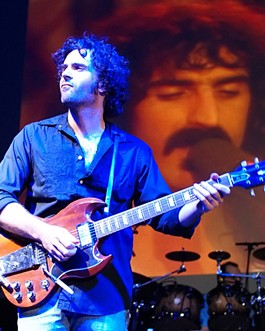
A few years ago, Dweezil began touring as ZPZ: Zappa Plays Zappa, in which Dweezil and his band (some of them veterans of Frank’s bands) perform Frank’s songs in loving homage, even projecting footage of Frank playing on a giant screen so Dweezil can jam along with the “ghost” of his father. Zappa Plays Zappa hits Santa Rosa on March 7 at the Wells Fargo Center.

This isn’t the first time this musical torch-passing has been done—Natalie Cole did a technology-aided duet with deceased dad Nat that was all the rage for a while in 1991—but it works in the ZPZ format. Dweezil acknowledges his father’s legendary footprint while keeping his complicated, humorous, ambitious songs alive for a younger generation of listeners. The experience, especially when he hits the same notes as the looming vid-ghost of his dad, gives Dweezil what he refers to as the “bump of chicken” (a bad Japanese translation of “goosebumps”).

Now in its third year, ZPZ is a three-hour production of some 30 songs that took Dweezil’s band a quarter of a year to learn and perfect. “While it is true that Frank had a great sense of humor, he was also very serious about composing music,” Dweezil has said. “In reality, there are only a handful of skilled players who can play his most complex pieces. It takes a lot of patience to learn, and requires a fantastic memory.”

Dweezil is no stranger to ambitious feats. Consider his 75-minute-long song “What the Hell Was I Thinking?” which features some 45 guitarists, many from the pantheon of legends. He’s dabbled in film and TV, with a cameo in The Running Man and the short-lived 2004 Food Network show Dweezil & Lisa (as in Loeb, his then-sweetheart). And he’s also given his dad some good-natured competition in original song titles: “Shoogagoogagunga,” “Flibberty Jibbet,” “Doomed to Be Together,” “My Beef Mailbox” and “I Wants Me Gold,” perhaps a reference to the enjoyably horrible Leprechaun film franchise.


But it’s his father’s music Dweezil focuses on with ZPZ, from the jazzy guitar fury of “Chunga’s Revenge” to the anti&–politically correct fun of “You Are What You Is” and “Broken Hearts Are for Assholes” to the symphonic gusto of “G-Spot Tornado” and the well-known classics “Muffin Man” and “Don’t Eat the Yellow Snow.”

The Zappas are, in a way, aristocrats of an iconoclastic, intellectual, hypercreative strain. Far from rolling in his grave, Frank would no doubt approve of ZPZ, as well as his own spectral involvement on certain songs, honored that Dweezil isn’t allowing folks to forget the brilliance of the mind of one Frank Zappa.

ZPZ: Zappa Plays Zappa comes alive on Saturday, March 7, at the Wells Fargo Center, 50 Mark West Springs Road, Santa Rosa. 8pm. $37.50&–$57.50. 707.546.3600.


Biking to the Promised Land

03.04.09

The late mythologist Joseph Campbell used to say that the promised land is an inner experience having nothing to do with real estate. If he was right, which I suspect he was, then a good bike ride, in place of a drive, can not only cut car use and carbon pollution but inadvertently lead us to the promised land. The journey varies from person to person. I’m a latecomer to the sport and content on an old bike with gears and brakes that work. On a decent road in good weather, cycling is a kick. But add just a little well-equipped fanaticism, and bike riding becomes transcendental.

Passionate bike riders are undaunted. More than once I’ve driven by a cyclist on some impossibly steep and narrow stretch of road and exclaimed from behind the wheel, “What a nut!” But secretly I envy her leg muscle and audacity. People taking hard rides for the joy of it are actually the best models for green self-transport. They’re the ones for whom cycling is bliss.

Marin rider Graham Hewson didn’t start riding because it was good for the planet. He began as a kid because it was fun. But when two wheels got traded for four, Hewson never let his bike go to rust. For decades he’s been a distance rider, and thinks nothing of the 22-mile trips he made from his home in Pt. Reyes to College of Marin for night classes. When I exclaim at his returning in the dark through Samuel P. Taylor State Park, Hewson explains dryly, “I used a headlight.” And through its beam the same owl glided over him at the same spot in the park several nights in a row.

Cycling nuts don’t spend years in the saddle without learning about wheels and gears. The 53-year-old Hewson is a bike mechanic in a Santa Rosa shop and often bikes the 49 miles to work. I visited Aria Velo innocently expecting the smell of patching glue and grease but instead arrived in what struck me as the waiting room of an upscale spa that happened to contain a few bikes. Bikes like I’ve never seen before.

“Here, pick this up,” invites owner Rand Libberton, pointing to a silvery one. I grasped it and hoisted. I might have been lifting a kitten. “Carbon frame,” he explains, grinning. The true nerds of this sport obsess over lightness. And they pay for it. The bike I lifted costs about $14,000.

But the vastly more affordable main business at Aria Velo is a bike fitting. Hewson put my bike on a platform and made me get on it while Libberton used computerized gadgets to analyze my posture.

“Most riders don’t adjust their seat properly,” Hewson says. “A fitting helps prevent injury and improve riding.” I scored high in pedaling efficiency and felt as proud as if I’d won the Tour de France. Well, almost. I could never feel the full exhilaration that real biking athletes feel because I could never generate that many endorphins without a carbon-framed bike and the kind of passion that makes Hewson and others ride a hundred miles just for fun.


“It’s meditative,” Hewson explains. “The rhythm of the bike can make you raise yourself into a state if nonthought. You hit the right moment on the bike, when your cadence matches your breathing, and you feel like you can go forever.” Hewson rides for bliss.

Others bike to win races, and for some distance riders with pricey equipment, using a bike as transportation interferes with their biking aesthetic. Not all riders are politically or environmentally aware. But many who are aware work for local bike-friendly land use and legislation through the Marin, Napa and Sonoma bike coalitions. They are heroes of the road.

Regardless of why or how they ride, all cyclists contribute to environmental progress. “The more people in cars who see people on bikes,” Hewson says, “the more it gives image to the bicycle as an alternative.” And the closer we get to alternatives like biking, the more frequently we may experience the promised land.


TrueWest

0

03.04.09

Jon and Holly have known each other since they attended a Marin County middle school together, but Jon never really noticed Holly until she starred in a dance revue at age 28. Jon, a world-class weightlifter, was smitten. Holly, an independent-minded woman, was thrilled. A romance ensued, a commitment ceremony followed and these two adults got on with their lives.

What’s different about Holly James and Jon Shapiro is that each has Down syndrome. What’s exactly ordinary about Holly and Jon is their love, their attempts to combine their lives as newlyweds and their aspirations, particularly Jon’s desire to win the heavyweight title for the sixth consecutive time at the annual Special Olympics. Just like his hero Lance Armstrong, Jon wants to beat all records; just like his hero Arnold Schwarzenegger, he wants to be the strongest man in the room. As for Holly—well, she just really likes his big muscles.

Bonnie Burt’s documentary Strong Love follows Holly and Jon for three years, tracing their courtship to the commitment ceremony at the Marin Art and Garden Center—their parents deciding not to allow the couple to marry due to possible loss of state benefits—through Jon’s arduous Special Olympics competition in Reno to the duo’s ongoing desire to have children (Holly was sterilized as a young woman, her mother frankly telling the camera that she couldn’t raise another child), a topic often raised, waggled about and then temporarily dropped.

Almost as fascinating are the supportive adults who continue to guide Jon and Holly, particularly their mothers and Jon’s weight coach Homayun, an Iranian man who joined the significant influx of immigrants to Marin when the Shah fell in the late 1970s. While “Homie” trains Jon to lift, he also trains him to be a man, realizing while the cameras run just how much Jon has taught him, too.

Strong Love is just one of 26 features and 18 short films slated to screen March 6&–8 at the second annual Sebastopol Documentary Film Festival. Sponsored by the Sebastopol Center for the Arts, the fest this year received some 300 submissions, according to executive director Linda Galletta. Filmmakers are hungry to have their work shown, and the documentary craft has grown exponentially in the last few years due to the relative ease and affordability of new equipment and the interest of a public poorly served but nonetheless piqued by reality television.

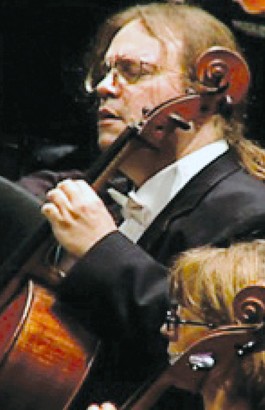
The festival’s focus this year is on films about music, and Freeway Philharmonic finds director Tal Skloot in the passenger seats of many North Bay musicians who travel half the state on a regular basis to perform. The “Freeway Phil” circuit, as the musicians casually refer to it, stretches from Reno to Fresno, with some players regularly pulling what they term a “triple,” in which they may attend rehearsal with the Marin Symphony in the morning, a dress rehearsal for the Santa Rosa Symphony in the afternoon and return to Santa Rosa in the evening to perform. The average pay is $90 per “service.”


One local bassoonist has 330,000 miles on her car; a French horn player tracks her gigs by the fast food outlets (Marin Symphony is A&W; Santa Rosa, Quiznos). While many of the musicians interviewed say that they love the freedom of the lifestyle, just as many frankly admit to having little other choice. The last time the San Francisco Opera had an opening for a lead bassoonist was 25 years ago; the S.F. Symphony, 15 years ago. “I feel like I’m giving a lot of my emotion to this piece of metal,” a classical trumpeter shrugs.

Among the featured shorts is KRCB staffer Valerie Landes’ three-minute visual poem Rock On, a nearly mute glimpse at the work of Bill Dan, a self-described “balance artist” who makes mutable rock sculptures on the shores of Crissy Field, defying gravity by placing boulders atop pebbles and taking it all down at the end of each day. “Is there a rod going through these?” a bystander wonders. Dan doesn’t answer, packing up and riding quietly away on his bike into the dusk.

The Sebastopol Film Festival runs Friday&–Sunday, March 6&–8, at various Sebastopol venues. Filmmakers are in attendance at many screenings and Q&As and other special events are scheduled. For complete details, go to www.sebastopolfilmfestival.org or call 707.829.4797.


New and upcoming film releases.

Browse all movie reviews.

Balls o’ Fire

0

03.04.09

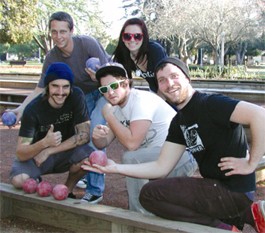
A quick count shows that there are four Napa Valley wineries with bocce courts; Sonoma County has 10. Graton’s Underwood Bar and Bistro has one out back, and more are being built all the time. Based on a game popular since the Roman Empire and variously known as boules or bowls, bocce is not a sport that rewards athleticism or strength; it can be played by those confined to wheelchairs, and it emphatically improves in disposition when accompanied by wine.

In the North Bay, St. Helena (population 6,000) holds the title of the largest and most contentious area bocce league, with almost a sixth of the citizenry competing on 89 teams. The St. Helena Star posts the weekly scores, and when musician and bocce ball commissioner John Kelly passed away last December, the paper vigorously related his history of fairness and attention to detail in a league regularly fraught with argument.

Now video producer and web designer Robert Battaile is poised to step gingerly into the mix, working with the city of Santa Rosa to begin a league in that city’s Juilliard and DeMeo parks with an eye to expanding to other civic properties. With one information session completed and another one slated for March 7, Battaile already has some 10 to 12 teams lined up and ready to play in a three-night-a-week spring league stretching April to mid-June. A fall league is also planned. Players are encouraged to bring wine in nonglass containers and potluck dishes to share. “Bocce’s important,” Battaile chuckles, “but so is the wine and food.” He adds, “A lot of people actually get better when they drink.”

While competition on the oyster bed “field” appropriate for bocce might be fierce, it is nothing if not a friendly game, with a near Zen quality to it. “Bocce’s the kind of game that takes 10 minutes to learn,” Battaile says, “and a lifetime to master.”

The Santa Rosa Bocce League hosts a free bocce clinic on Saturday, March 7, at 2pm in Juilliard Park for those interested. For details, go to [ http:-/www.santarosabocce.com- ]www.santarosabocce.com.


Museums and gallery notes.

Reviews of new book releases.

Reviews and previews of new plays, operas and symphony performances.

Reviews and previews of new dance performances and events.

‘Twixt Heaven and Hell

03.04.09


During this current economic crisis,” says Paul Nicholson, executive director of the Oregon Shakespeare Festival, “our strategies for survival are basically to anticipate hard times ahead, to stay very realistic and to be as smart as we can be with what money we’ve got.”

Nicholson, speaking at a Sunday morning press conference on the drizzly opening weekend of OSF’s annual nine-month-long theater-fest in Ashland, Ore., has just outlined a strategy that could also be the basic working plan for every intelligent, wage-earning citizen in America.

It certainly applies to fans of live theater. In times of financial hardship, the arts are often one of the first areas to be hit, as businesses scale back their donations, government and foundational grants shrink or dry up, and patrons make hard choices about where to spend each and every dollar. Last year in Ashland, where the OSF is currently celebrating its 74th anniversary, the festival saw its second-largest attendance in history but still took a slight financial hit, with overall revenues coming in 2 percent lower than anticipated.

“We had a lot of people sitting in our seats,” Nicholson says, “but those people were careful about their money, basically spending less for their tickets, on average, than we’d anticipated, taking more advantage of discount programs, that kind of thing. So all of that hit us, and also the downturn in investments hit us very badly, the result being that, though we had near record attendance—tickets sales only account for about 65 percent of our income—we still suffered a shortfall of over $800,000.”

As a result, for the just-opened 2009 season (four shows currently running, more to be added every month), the organization is anticipating even deeper declines in revenue and has acted by cutting $1.7 million from its original anticipated budget of $26.4 million, planning for a 6 percent decline in attendance compared to last year. Operationally, the cuts were made as judiciously as possible, Nicholson says, curtailing unnecessary travel, eliminating several positions, cutting salaries of the senior management staff, deferring the company’s retirement-matching program and taking a number of other measures.

On the artistic side, the management team, careful not to undercut the very thing that draws people to Ashland in the first place, launched a number of surgical cuts to the plays under development. According to Nicholson, these cuts included using live musicians in just two of the season’s 11 shows, negotiating contracts so that many actors will perform in three shows instead of the previous average of two, and similar changes.

None of these events were anticipated back in early 2008 when the current season was being planned, so the 2009 season features several productions—Shakespeare’s Macbeth, Much Ado about Nothing and Henry VIII; Nigerian playwright Wole Soyinka’s epic Death and the King’s Horseman; a new adaptation of Don Quixote; and a rare musical, The Music Man—all requiring opulent production values, colorful pageantry, dazzling special effects and large casts.

“We chose a pretty big season,” Nicholson laughs, “with what is probably the largest acting company in OSF history. But with very few exceptions, all of the cuts we’ve made have been made with the assumption that we would preserve the original vision and quality of the 2009 season. The least smart thing we could do, at this point, is to undercut our reputation for quality, because that, more than anything, is what will bring people to Ashland.”

“We’ve adjusted,” agrees Bob Hackett, OSF marketing manager. “We’ve adjusted to expect attendance to be down from last year, so our strategy is to simply maintain at our revised projections. Right now, we are doing that. The question is, what can we offer our patrons, and what can we do to bring in first-time patrons, so that we continue to maintain that level of attendance?”

The answer, of course, like the creepy monster-critters conjured by the Weird Sisters in this year’s entertainingly freak-show-ish Macbeth, is not an individual thing, it’s multiple things. The marketing department has launched a new campaign, “Stay Closer, Go Further.” Encouraging entertainment seekers to forgo trips to Disneyland or New York or Europe, and to instead take the relatively short trip (six to seven hours from the North Bay) to Southern Oregon, these ads have already been launched in Oregon, and will spread to California in April.

“We already think this campaign is driving new patronage,” Hackett says. “In this financial environment, we need to reach out to our first-time ticket buyers, both locally and regionally. The idea is that, for relatively low cost, you can visit Ashland, and in so doing actually visit Scotland with Macbeth, visit the courts of England with Equivocation and Henry VIII, visit Nigeria with Death and the King’s Horseman—or even visit River City, Iowa, with The Music Man.

Of course, as the OSF adjusts its budgets and marketing plans to match the changing economy, so are the rest of us making changes in how we spend. Even those of us lucky enough to have jobs are thinking long and hard before committing money to nonvital enterprises. Still, the arts are important, now more than ever, and vacations are perhaps as necessary during times of stress as they are during times of calm. Is there anything that can be done to make a trip to Ashland more affordable?

The answer is yes, and especially if you happen to be spontaneous or have some flexibility in your schedule. As with most things, being young is a bit of a bonus, too.

In terms of acquiring tickets, normally up to $70 a seat, OSF is rolling out two new programs this year. One is the 19&–35 program, inspired by the year that OSF staged its first shows. Aimed at young adults, the program makes tickets available for a generous $19.35. To participate, qualified young adults must register via the festival’s website (Google “OSF” and “19&–35”), after which the cash-strapped patron will receive weekly updates announcing shows for the following week that have seats available at the $19.35 price. Tickets can then be purchased online on a first-come, first-served basis. The emails go out every Friday and are based on how well a particular performance is selling, so the ability to make last-minute travel plans is helpful.

For the over-35 set, OSF also has created a “web specials” program, making available half-price tickets for the following week. Like the 19&–35 program, these tickets are announced based on the number of seats presold for a particular performance. If there are still a lot of seats for The Music Man one week in advance, then half-price web specials will be made available.

“We sell a lot of web specials,” Hackett says.

For those willing to take an even chancier risk and go to Ashland with no tickets waiting at all, OSF still offers half-price “rush tickets,” made available 30 minutes before show time at the box office, as long as there are seats that remain unfilled. Given the festival’s expectations that sales will be down overall this year, it actually works to the benefit of anyone willing to wait till the last minute.

As for where to stay when you get there, the basic rule of thumb is, the farther away from Ashland’s downtown theater complex, the less you can expect to pay, so being willing to drive or cycle a few miles to get to your shows will save you money. Other value-conscious options include the very nice and very close Ashland Hostel (www.theashlandhostel.com), featuring low-priced dormitory-style rooms at $28 a night, private rooms from $40 to $60, and private family suites for $84 a night. Even more affordable, but a little less cush, is the beautiful Glenyan Campground and RV park (www.glenyanrvpark.com), a mere six-mile trip from downtown Ashland, with tent-camping spaces available for $28.50 a night.

For those who simply must have a hotel room and a hot continental breakfast, the best cost-saving way to visit Ashland is to go right now. All around town, hotel rates are cheaper in the winter and spring, sometimes nearly half what they will be when the festival hits its stride in June with the opening of the big outdoor Elizabethan theater.

“Now is a good time for first-timers to experience Ashland,” Hackett says. “The experience we offer is truly a high-value experience, and I’m not just talking about the art onstage. The value is in taking the time to make a trip, the full festival experience, the full Ashland experience.”

 For information on OSF’s season and various ticket-buying options, visit www.osfashland.org. For full reviews of the current spate of new shows, visit www.bohemian.com.

Sound and Fury

Over the last 74 years, the words Ashland and Oregon have gradually become synonymous with the words William and Shakespeare. There’s good reason for that. The Oregon Shakespeare Festival, which opened its 74th consecutive season at the end of February, has established a reputation for quality, creativity, and—over the last few years—a willingness to take big chances. As evidence, consider the four shows that opened this year’s season, a season that will last nine months and by the end will have staged eleven shows, four of them by Shakespeare, the rest a combination of classic and contemporary plays. And for the first time in OSF history, the festival is even presenting a beloved American musical. Now playing are Shakespeare’s Macbeth, Wole Soyinka’s Nigerian epic Death and the King’s Horseman, Sarah Ruhl’s metaphysical noir-comedy Dead Man’s Cell Phone, and Meredith Willson’s The Music Man. Opening in March and April are Carlo Goldoni’s The Servant of Two Masters, and the world premiere of Bill Cain’s Equivocation, a drama about Shakespeare’s efforts to write that aforementioned, rumored-to-be-cursed epic that has come to be known as “The Scottish Play.” In June, with the opening of the festival’s celebrated outdoor Elizabethan Theater, Shakespeare’s Much Ado About Nothing and Henry VIII will be added to the line-up, along with San Francisco playwright Octavio Solis’ dramatic new adaptation of Don Quixote.

Here in the early part of the festival season, when snow and rain are still possible in Ashland and the shows all take place indoors, there is an introspective, plaintive side to the festival’s offerings, a mix of joyful optimism and melancholy reflection, with, in one case, an entertaining touch of tangible evil. On opening night, in the Angus Bowmer theater, director Gale Edwards unleashed the freakiest, creepiest, most nightmarishly entertaining Macbeth this reviewer has ever seen on stage. In Edwards’ version of Shakespeare’s epic, occult-tinged tragedy, swoards clash, heads are severed (note to propmaster: nice tendrils of flesh!), hands are bloodied, children are murdered, and the three weird witches perform the famous conjuring scene (“Double double, toil and trouble”) with special effects so sharply-wrought and startling the scene will surely go down as the most outrageous, visually striking moment of this entire festival season. As Macbeth, the stalwart soldier seduced by mystical promises of kingship and glory, Peter Macon is appropriately physical, playing the character as a dim-bulb drone with bright ambitions, who, in abandoning his principles with the murder of King Duncan and the usurpation of the crown, pays for his deeds with the loss of equally-ambitious wife, his kingdom, and ultimately his soul. The standout performance in the show is by Robin Goodrin Nordli as Lady M, whose none-too-solid sanity is pretty much history the moment she talks Macbeth into killing the king and taking his crown. As poor, misled Macbeth laments, late in the show, “Life is a tale told by an idiot” That may be true of life, but cannot be said of this emotionally arresting, visually dazzling production, told not by an idiot, but by an innovative director with a strong vision and a cast up to the challenge of bringing that vision to stunning, sleep-disturbing life.

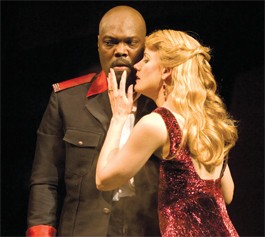
Also visually striking, though far less nightmarish, is director Chuck Smith’s transporting adaptation of Death and the King’s Horseman, by the great Nigerian playwright, Wole Soyinka. The play, written in 1975, is based on a true story from 1946, in which the colonial British government attempted to interfere with a traditional Yoruba death ritual, with tragic consequences. Atmospherically staged within a live sound-scape of tribal drumming and African folk-singing, Death is the lyrical, palpably mysterious story of Elesin (the great Derek Wheeden), charming and beloved horseman to the recently deceased king. In the opening moments of the play, set amidst the colorful daily celebrations of the village marketplace, we quickly learn that Elesin is living his last day on earth. With the death of the king, custom requires Elesin to commit ritual suicide, so as to become the king’s guide through the afterlife. As Elesin contemplates his life and the sacred act he will soon commit, he is alternately goaded and watched-over by the village Praise-singer (G. Valmont Thomas) and Lyoloja, the “mother” of the Market (Perri Gaffney), who sing Elesin’s praises while beginning to doubt his commitment to his duty. For all his boasting and talk of being the only man in the region to not fear death, Elesin is clearly attached to this life and its pleasures, impulsively demanding one last new bride, just hours before he is to die. When the British District Officer, Simon Pilkings (Rex Young) learns of the Horseman’s impending suicide, he moves to stop it, an effort that, to the local people, would mean a tearing of the fabric of the Universe, the destruction of the tribe’s spiritual future. In Soyinka’s lyrical, poetry-infused play, the audience is witness to more than just a clash of cultures. With language so rich and sweet it’s like a triple helping of desert, Death and the King’s Horseman is about the power of mystery, the fear of the unknown, and the human need to make sense of that unknown by inventing rituals to explain it. As Elesin, Wheeden is spectacular, playing a man as con flicted, complex and self-deluded as poor bloody Macbeth, only with a soul far more worthy of redemption.

Though Shakespeare is the primary draw to Ashland, OSF has committed itself to the presentation of contemporary plays by emerging playwrights. In the case of Sarah Ruhl’s Dead Man’s Cell Phone, one could argue that the playwright has already arrived. Though not yet 30, she’s produced a body of work that rivals many writers twice her age, and has been officially the Hot New Playwright for the last five years. Still, Ruhl seems to be growing and evolving with each new year, as evidenced by her most recent work, In the Next Room, or the Vibrator Play (reviewed a few weeks ago in this paper, and still playing at The Berkeley Rep), so it is illuminating to look back all the way to early 2007 (!), when she was still dabbling in the kind of whimsical metaphysics that she’s mastered with plays like The Clean House and Passion Play, the sort of thing she appears to have left behind with the infinitely more grounded, controlled Vibrator Play. Though a brilliant crafter of twisted language and odd situations, Ruhl is primarily a visual writer, crafting plays that have a very specific physical look. In Dead Man, directed by Christopher Liam Moore, that look is spare, surreal, and minimalist, moving from the near deserted New York restaurant in which her protagonist Jean (Sarah Agnew) discovers that a man (Jeffrey King) has just died a few tables over—his name was Gordon Gottlieb, and he’s still sitting there—and impulsively answers his constantly-ringing cell phone, to the stark, frighteningly chairless family mansion at which Jean is invited to dinner by Gordon’s oddball mother (Catherine E. Coulson, known to Twin Peaks fans as the Log Lady), who is curious to know why her deceased son’s cell phone is now in the hands of a woman she’s never heard of before. It seems that Jean has a knack for improvisation, and sensing that the people in Gordon’s life are sad at his passing, she begins inventing stories about the dead man’s last words, his dying wishes, and his fondness for his family; to explain her possession of the cell phone, which continues to ring, ring, ring, Jean tells Gordon’s wife Hermia (Terri McMahon), his weird but earnest brother Dwight (Brent Hinkley), even the mysterious woman who keeps calling Gordon’s phone, that she used to work with him, which surprises everyone since Jean is clearly a shy, by-the-books, compassionate type of person, and Gordon, it turns out, dealt in black-market body parts, matching rich folks in America with livers, kidneys, and hearts harvested from prisoners in Chinese prisons and willing sellers in third world countries. As Jean, Agnew is a delight, all bottled-up enthusiasm and adrenalized sweetness, which intensifies when she suddenly recognizes her attraction to poor insecure Dwight (he was so-named because his mother felt sorry for the little-respected name), comes face to face with Gordon’s femme-fatal mistress, becomes drawn into the shadowy world of body-part selling, and, when the play finally crosses over into the kind of supernatural netherscape Ruhl excels at creating, finds herself having a long-delayed conversation with the man whose phone and family she’s been so desperately protecting. Hip, hilarious, and unnervingly strange, Dead Man’s Cell Phone is a refreshingly outrageous excursion into those attitudes and innovations that, in a world ruled by portable technology, can both bring us together and force us apart.

At most theater companies, the decision to stage the world’s most popular musical would be a slam dunk, but with an institution whose reputation is supported by the twin towers of tradition (Shakespeare and his ilk) and originality (see the previous review), unleashing a storied, mainstream warhorse like Meredith Willson’s The Music Man is tantamount to treason. As it turns out, this version, a dream project from OSF’s Artistic Director Bill Rauch, is not your grandfather’s Music Man, though it probably wouldn’t fry his mind either. Borrowing a trick from the movie Pleasantville, Rauch has reconceived the show as a multi-racial fantasy, with the staid, conservative, early-1900s town of River City, Iowa solidly black-and-white) even the American Flag, flown proudly in the show’s 4th of July opening, is black and white and grey. With the arrival of the charmingly flamboyant, fast-talking band-instrument salesman “Professor” Howard Hill (festival stalwart Michael Elich, outstanding in every way), who walks into town dressed in eye-popping red and green, the town gradually succumbs to this “colorful” stranger. Each time Hill convinces one of the townspeople to burst into song, they join the ranks of the technicolored. On a stripped-down set, with the approximation of houses upstage and what amounts to scaffolding and lights on the flanks, Rauch has staged the show with a minimum of the usual musical-comedy frosting; though there is a small orchestra pit—another first at OSF—the live orchestra is deliberately small, and the overture, usually an all-the-bells-and-whistles event, is performed by a single actor, sitting in a suitcase, playing snippets of the show’s greatest hits on a harmonica. In many ways, the production’s most ingenious abdication from the norm is in the casting of the renowned deaf actor Howie Seago (his resume includes stints working for the greatest directors on the scene) as Hill’s helpful sidekick, and retire con artist Marcellus. Especially daring is this casting choice given that Seago, who signs his way through his on-stage conversations, as Elich translates, has one of The Music Man‘s biggest show-stopping songs, Shipoopi, which ny necessity is given her to a usually minor character, Marcellus’ good-girl girlfriend, Ethel Toffelmier K.T. Voght) as the people of River City dance, sing—and sign—in a massive, crowd-pleasing American Sign Language blowout. The unconventional casting doesn’t play so well in the casting of Gwendolyn Mulamba as the town’s prim music-teacher and librarian, Marian Paroo, who initially recognizes Hill as a charlatan before succumbing to his romantic charms. It is defiantly fantastical that in the Midwest in 1917 a white salesman would openly court a black music teacher, but okay, musicals are fundamentally artificial, and color-blind casting has for years been the norm at OSF. The primary problem with the casting of Mulamba is a musical one: her style is operatic, deep chest singing, rich and full and warm, and it doesn’t match what anyone else is doing on stage. It’s a shock every time she opens her mouth, an interesting casting choice that doesn’t quite work.

The Music Man, which will surely prove to be a solid draw despite its unconventional approach, is daring and different enough to silence the Oregon Shakespeare Festival purists, while serving up the kind of apple-pie promise that sells tickets in an uncertain economy. With Macbeth, Horseman, and Dead Man for company, even before any of the other shows have shown up, The Music Man is starting out a year that looks to be one of OSF’s most surprise-packed seasons in recent memory.

For more information on these plays and the entire OSF season, visit their website at [ http://www.osfshakespeare.org ]www.osfshakespeare.org.

Museums and gallery notes.

Reviews of new book releases.

Reviews and previews of new plays, operas and symphony performances.

Reviews and previews of new dance performances and events.

Tempest in a Beer glass?

03.04.09

The century-old Alexander Valley Store and Bar has been sold to the exceedingly green-friendly winery Medlock Ames, and some locals are treating the change as if it were a hostile takeover. “No one around here is happy about it,” says AVSB cashier Pam Peavler, an eight-year employee. “They’re taking away our history,” she says, “this is a tight-knit community, and people have been here all my life.”

As is so often the case when tempers flare and community members get up in arms about big-city boys coming in and changing everything around, few of those modifiers apply. The distinctly unglamorous truth is that Medlock Ames intended to use a vintage house on the AVSB property as a tasting room and entirely maintain the bar and store operations as extant. The problem? Septics. Once the county got involved with the sale, it determined that only one outlet could have a public toilet, and that means that the store will become the tasting room, the bar will remain the bar and the vintage house will be towed off the property. Medlock Ames is reportedly considering keeping a small amount of ordinary grocery items tucked away for sale for those Highway 128 residents who get all the way home and realize that they forgot Tampax, and will be selling regional and homegrown produce from their own farm.

Winery representatives also stressed that the company intends to restore the store and bar building with a clear eye on keeping the structure’s historical integrity intact. Sunday drivers who want to see the old place before it changes should hie up there in the next few weeks. Corner of Alexander Valley Road and Highway 128. 707.433.1214.

Quick dining snapshots by Bohemian staffers.

Winery news and reviews.

Food-related comings and goings, openings and closings, and other essays for those who love the kitchen and what it produces.

Recipes for food that you can actually make.

Young Gun

0

03.04.09

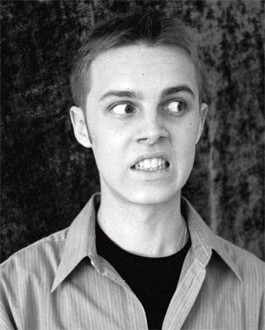
He enrolled at the San Francisco Comedy College in July, produced his first standup show in September and expects to fill the 500-seat Person Theater next week. Santa Rosa native David Studebaker is moving fast.

Just 19 and a product of area schools, kindergarten through the JC, Studebaker sets some of his routine in his hometown, describing the overly intimate atmosphere at his workout club, the Santa Rosa Family YMCA, where the older male athletes spend a good portion of their time naked, evidently cradling themselves and discussing the superior qualities of homemade casseroles. Studebaker knows plenty about family and old men; he still lives at home, a disconnect that doesn’t bother him at all. 

“It’s kind of a weird juxtaposition,” Studebaker admits, caught by cell phone as he prepares for an evening gig in Alameda. “I’ll go to San Francisco and perform and then drive home, and I’m still living upstairs in my parent’s house. People expect that if I’m doing standup full-time, that my life outside the stage is really wild, and that’s really funny to me. It’s actually been a huge help to me because I haven’t had to worry about getting a day job, and it’s also allowed me to focus on producing, which is the other aspect of the engine of my quick success.”

Studebaker has always been the funny one in his family but didn’t really get the standup bug until he was 15, when his aunt and uncle sneaked him into the Punchline to see Bobby Slayton. “He’s like the pit bull of comedy,” Studebaker explains. “We sat in the front row, and he spent the entire show just railing on me. I loved it.”

In addition to his own act, Studebaker produces the Young Guns of Comedy, a group standup show that features up-and-comer Ali Mafi, who is poised to have his own TV special this June. “Ali is gay and Muslim,” Studebaker explains, “which is a hilarious combination. All the comedians in the show are fantastic. We’re all 26 and under, we’re all young.”

Having been writing, performing, producing and studying his craft full-time since last summer, Studebaker has about 30 minutes of original material. He aims to have a full hour-long act done by next fall. After that, watch out, Jon Stewart.

The Young Guns of Comedy come to the Evert B. Person Theater on Saturday, March 7. SSU, 1801 E. Cotati Ave., Rohnert Park. 8pm. $15–$20. 707.664.2382.


Museums and gallery notes.

Reviews of new book releases.

Reviews and previews of new plays, operas and symphony performances.

Reviews and previews of new dance performances and events.

Live Review: OC Times at Napa Union High

0

Plenty of acapella groups these days, especially college acapella groups, revel in the cheekiness of performing unlikely songs in an acapella style. So many, in fact, that the “offbeat” performances are the majority, and the unlikely becomes likely, and the old-timers in the audience long to hear “Heart of My Heart” or “The Darktown Strutter’s Ball” instead of “Carry On My Wayward Son.” This doesn’t make hearing fantastic versions of Michael Jackson’s “Rock With You” or John Legend’s “It Don’t Have to Change” any less enjoyable, but it does mean that sometimes, acapella groups act more like a DJ whose sets are all about selection instead of technique. Mika’s “Grace Kelly” is not necessarily made good simply because it has been chosen, nor is Leonard Cohen’s “Hallelujah” going to further bless an overly “Hallelujah”-ized world due solely to being performed without instruments.
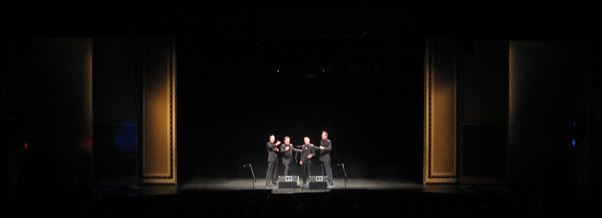
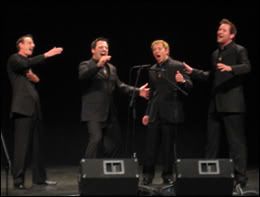
Many of these interesting experiments reside on YouTube, but last night, they arrived live and in-person at Napa Valley Union High School’s theater. The 4th Annual Acapella Extravaganza contained plenty of vocal-only jams by Toto, the Beatles, Eric Carmen and the like, though the real reason I made the one-hour drive was the addition of OC Times, who are currently the world’s greatest barbershop quartet. That’s not just superlatives falling out of my mouth, either; they truly are the world champions according to the foremost authorities: S.P.E.B.S.Q.S.A.
Why the Society for the Preservation and Encouragement of Barber Shop Quartet Singing in America, after existing 76 years with the beautiful acronym S.P.E.B.S.Q.S.A., changed its name to “Barbershop Harmony Society” is beyond anyone’s imagination. Refreshingly, a sizable backlash contingent still calls the organization S.P.E.B.S.Q.S.A., while the main thing is that there’s even an organization at all that promotes a dying part of our heritage. The core ideals remain the same—sing the hell out of that tag!—and the annual contest is a fine determiner of the barbershop quartet with the most talent and style. So when it was announced that current S.P.E.B.S.Q.S.A. champions would be performing in Napa, how could I stay away? (Lots of my friends and family have already discovered quite a few reasons, thank you.)
OC Times opened their set with “Oh! Look at Me Now,” from 1941, which paved the way for a concert more Brill Building and less MTV Music Awards. Contemporary hits were limited to “Sold (The Grundy County Auction Incident)” by John Michael Montgomery, from 1995, and then going back to “What a Wonderful World,” which entered the barbershop repertoire long ago. Plenty of 1950s doo-wop songs peppered the set—“So In Love,” “Teddy Bear,” “Sixteen Candles”—but it was classic barbershop arrangements of “Come Fly With Me” and “Blue Skies” that highlighted most a sharp performance.


Part Elvis, part Sinatra; part Nashville and part Los Angeles, OC Times has such a pitch-perfect blending of voices and timbre that it’s no wonder they’re the country’s best. Words can’t really convey how absolutely in step each phrase sounds. A little too-corny patter helps, too, and they keep one of the great S.P.E.B.S.Q.S.A. traditions alive by holding afterglows (casual receptions with singing and mingling) after their performances. By the time they sang their final number, “A Fool Such As I,” I was glad I made the drive, and ventured back to Santa Rosa with a heart, as they say, full of song.

P.S. One of my favorite acapella renditions right now is Of Montreal’s “Wraith Pinned to the Mist (And Other Games),” memorized and medleyized by The Stereotypes, from Washington University:

[display_podcast]

Dude, Don’t Tax My Wine!

03.04.09 We dodged a bullet the other week. More accurately, we dodged a tax, and by we, I mean wine drinkers, wine producers—maybe even wine country bystanders. When the governor signed the California budget on Feb. 20, it did not include his proposed tax increase on wine. It does include a lot of other taxes. Yes, the state is billions...

State of the Book

02.25.09 FIN? Oh, cheer up, the worst may not happen. Irecently dug out some old copies of Hungry Mind Review, the book and culture magazine I started in the mid-'80s and edited for 15 years. The magazine was published by Hungry Mind Bookstore, a wonderfully rich and eclectic independent in St. Paul, Minn. One of the mag's goals was to...

Keepin’ It Greasy

03.04.09It goes without saying that Dweezil, or any of the Zappa children for that matter, has almost impossible shoes to fill. Frank Zappa has named in his honor a street in Berlin; an official, mayoral-approved Frank Zappa Day in Baltimore, Md. (Dec. 21); a bacterium; a fish species; a computerized chess program; and a small asteroid in our solar...

Biking to the Promised Land

03.04.09The late mythologist Joseph Campbell used to say that the promised land is an inner experience having nothing to do with real estate. If he was right, which I suspect he was, then a good bike ride, in place of a drive, can not only cut car use and carbon pollution but inadvertently lead us to the promised land....

TrueWest

03.04.09 Jon and Holly have known each other since they attended a Marin County middle school together, but Jon never really noticed Holly until she starred in a dance revue at age 28. Jon, a world-class weightlifter, was smitten. Holly, an independent-minded woman, was thrilled. A romance ensued, a commitment ceremony followed and these two adults got on...

Balls o’ Fire

03.04.09A quick count shows that there are four Napa Valley wineries with bocce courts; Sonoma County has 10. Graton's Underwood Bar and Bistro has one out back, and more are being built all the time. Based on a game popular since the Roman Empire and variously known as boules or bowls, bocce is not a sport that rewards athleticism or...

‘Twixt Heaven and Hell

03.04.09During this current economic crisis," says Paul Nicholson, executive director of the Oregon Shakespeare Festival, "our strategies for survival are basically to anticipate hard times ahead, to stay very realistic and to be as smart as we can be with what money we've got." Nicholson, speaking at a Sunday morning press conference on the drizzly opening weekend of...

Tempest in a Beer glass?

03.04.09The century-old Alexander Valley Store and Bar has been sold to the exceedingly green-friendly winery Medlock Ames, and some locals are treating the change as if it were a hostile takeover. "No one around here is happy about it," says AVSB cashier Pam Peavler, an eight-year employee. "They're taking away our history," she says, "this is a tight-knit community,...

Young Gun

03.04.09He enrolled at the San Francisco Comedy College in July, produced his first standup show in September and expects to fill the 500-seat Person Theater next week. Santa Rosa native David Studebaker is moving fast.Just 19 and a product of area schools, kindergarten through the JC, Studebaker sets some of his routine in his hometown, describing the overly intimate...

Live Review: OC Times at Napa Union High

Plenty of acapella groups these days, especially college acapella groups, revel in the cheekiness of performing unlikely songs in an acapella style. So many, in fact, that the "offbeat" performances are the majority, and the unlikely becomes likely, and the old-timers in the audience long to hear “Heart of My Heart” or “The Darktown Strutter’s Ball” instead of “Carry...
11,084FansLike
4,446FollowersFollow
6,928FollowersFollow